
Introduction
This almanac page for Monday, May 8, 1972, pulls together various records created by the federal government and links to additional resources which can provide context about the events of the day.
Previous Date: Sunday, May 7, 1972
Next Date: Tuesday, May 9, 1972
Schedule and Public Documents
The Daily Diary files represent a consolidated record of the President's activities. Visit the finding aid to learn more.
The President's day began at The White House - Washington, D. C.
The Weekly Compilation of Presidential Documents made available transcripts of the President's news conferences; messages to Congress; public speeches, remarks, and statements; and other Presidential materials released by the White House.
Digitized versions can be found at HathiTrust.
Each Public Papers of the Presidents volume contains the papers and speeches of the President of the United States that were issued by the White House Office of the Press Secretary during the time period specified by the volume. The material is presented in chronological order, and the dates shown in the headings are the dates of the documents or events. In instances when the release date differs from the date of the document itself, that fact is shown in the text note.
To ensure accuracy, remarks have been checked against audio recordings (when available) and signed documents have been checked against the original, unless otherwise noted. Editors have provided text notes and cross references for purposes of identification or clarity.
The Federal Register is the official daily publication for rules, proposed rules, and notices of federal agencies and organizations, as well as executive orders and other Presidential documents.
No Federal Register published on this date
The Congressional Record is the official daily record of the debates and proceedings of the U.S. Congress.
Archival Holdings
Any selection of archival documents will necessarily be partial. You should use the documents and folders identified below as a starting place, but consult the linked collection finding aids and folder title lists and the collections themselves for context. Many documents to be found this way do not lend themselves to association with specific dates, but are essential to a complete understanding of the material.
Selective document listing
President's Office Files
The President's Office Files consists of materials drawn together by the Special Files Unit from several administrative subdivisions within the White House Office. It is the handwriting and sensitive papers sent to the Staff Secretary that now comprise much of the President's Office Files. Visit the finding aid to learn more.
- News Summaries, Unmarked News Summaries, Box 49, News Summaries - May 1972 [4 of 13] [Note: Due to the way News Summary products were compiled, you should also consult nearby days for potentially relevant materials.]
- Weekend News Review, May 8, 1972
- President's Daily Schedule, Box 102, [President's Daily Schedule, Apr.-July 1972] [1 of 3]
- The President's Schedule, Monday - May 8, 1972
President's Personal File
The President's Personal File is essentially a President's secretary's file, kept by Rose Mary Woods, personal secretary to the President, for two purposes: (1) preserving for posterity a collection of documents particularly close to the President, whether because he dictated or annotated them, or because of the importance of the correspondent or the event concerned and (2) giving appropriate attention–letters of gratitude, invitations to White House social events, and the like–to members and important friends and supporters of the Nixon administration. This generalization does not describe all the varied materials of a file group which is essentially a miscellany, but it does identify the reason for the existence of the file group's core. Visit the finding aid to learn more.
- President's Speech File
The H. R. Haldeman Diaries consists of seven handwritten diaries, 36 dictated diaries recorded as sound recordings, and two handwritten audio cassette tape subject logs. The diaries and logs reflect H. R. Haldeman’s candid personal record and reflections on events, issues, and people encountered during his service in the Nixon White House. As administrative assistant to the President and Chief of Staff, Haldeman attended and participated in public events and private meetings covering the entire scope of issues in which the Nixon White House engaged in during the years 1969-1973. Visit the finding aid to learn more.
- Transcript of diary entry (PDF)
Monday, May 8th. The President came down from Camp David last night after the, seeing a movie, then spent the day over at the EOB getting ready for his speech. He called a couple of times on the phone so that, on the details of the speech and all, then; no, correction he didn't spend the day at the EOB, he had the NSC meeting that went virtually all morning, from 9:00 until 12:00, and then went over to the EOB. He called, had me call Connally back, and he spent some time with Connally and Henry after the NSC meeting. Then at 1:00, he called me over, went through some minor details, and then raised the point in his mind that we ought to consider the question of...
-------------------------------------------------------------------------------------------------------------------
DECLASSIFIED - E.O. 13526, Sect. 3.4: by MS, NARA, June 12, 2013
Audio Cassette 21, Side B, Withdrawn Item Number 7 [AC-21(B) Sel 6]
Duration: 10 seconds
…going ahead with the summit and taking no action now and then taking this action right after we got back.
-------------------------------------------------------------------------------------------------------------------
He called Henry over, and had me make the argument on this point to Henry, saying that he didn't agree with it, but that I had raised it. I didn't do very well on making it, and at 2:00 exactly, the President said, well, it's 2:00, the time's up. We go. Henry was a little dismayed at that point and started arguing some more, but the President said, nope, the decision is made, no further discussion, and from then on, I think he felt very solid on the thing and moved on that basis.
He decided to have a Cabinet meeting after the speech, or I recommended that. He agreed that we do it. That they'd be in the Cabinet room to watch the speech, and the President would drop in afterwards.
I talked to Billy Graham during the day and he said to tell the President to get tough, that that's what people wanted. The President dictated a memo to me on the line that we should get out on the major purposes of the blockade and the backup arguments, on the President's courage and so forth. The speech went very well; he gave it, put it together well, and gave it, delivered it very well. I think we'll develop substantial support.
At the Cabinet meeting the President explained the background, said that as far as the speculation on the Summit was concerned, we were aware of the risks there, but an American President couldn't be in Moscow while the Soviet guns and tanks were in Hue. And we should say we're prepared to go forward and negotiate, or to continue with the Summit, or whatever, and that the responsibility now is the Russians. This decision wasn't easy. You can never be sure. The case for bombing, or doing nothing at all, all had to be weighed, but this is the best course at this time: to defend our interests, to get the POW's, and to put an end to the war.
The VP said you can depend on all the Cabinet to support this; we're all aware of your strength over the three years; you've given careful notice ahead of all your actions; the Soviet part of your speech was extremely well phrased. The President said he wrote every word of that himself. He said the ball's now on their side of the net.
Rogers said there's nothing really we can add to what you said. There are a couple of things regarding the legal qualifications: this is not a blockade because it's not on the high seas; it is within the territorial waters; the enemy has mined the harbors in South Vietnam, so they can't complain about our doing it. This is all in the Departments, in all the Departments we've got to get the word to our people that everybody should have a staff meeting in the morning. Tell them the chips are down that it's easy to support when things are going well, but we need to support now, and there'll be all hell to pay if you don't. You should do likewise. He said he was going to do that with his Department and to tell the other Cabinet members that they should do likewise with theirs. That there should be no second guessing the President has thought of all the factors made a tough decision. Now we want everybody to support it, publicly and privately. Said it's not really very tough to sell because the people are ready for it.
The President said I hate to give you a tough one like this with the Democratic convention two months away, and then the election, but the die is now cast. This is going to end one way or another; we're not going to break down. The airstrikes will concentrate on the rails and POL.
-------------------------------------------------------------------------------------------------------------------
DECLASSIFIED - E.O. 13526, Sect. 3.4: by MS, NARA, June 12, 2013
Audio Cassette 21, Side B, Withdrawn Item Number 9 [AC-21(B) Sel 8]
Duration: 15 seconds
The question was raised about how close to the Chinese border. Initially, there'd be a twenty-five mile buffer, but we won't say what we won't do.
-------------------------------------------------------------------------------------------------------------------
The President said this is a very simple deal: a cease-fire, POW's, and out in four months.
Elliot Richardson said we've seen you a number of times on TV talking to the nation. I have a sense that I have never seen you more resolute or strong, or reflective, or exceedingly thoughtful. There’s a real possibility that the people will respond with support because of your leadership. The people want to respect and support.
Rogers said that's a good line for all of us to take to our people.
The President then said, this has to work; we've crossed the Rubicon, instead of the foolish gradual escalation of LBJ, this is cleaner and more defensible. We deny the enemy the sources to wage war. We have a definite precise goal, to cut off the sources for making the aggressive war. You should all reflect the same confidence, calm, done the right thing; we'll stick to the course. No weak men on the team.
Then after the Cabinet meeting, he had me come over to the EOB, where we had some dinner and had Henry in. We reviewed some of the comments on it and Henry went out. Then he told me to talk to Connally on the basis that if the Summit's canceled, he has to stay a couple of weeks. If the Summit's on, he can go ahead and go. We went through the switchboard being jammed, all the telegrams, and that sort of thing.
At 10:45 the President called Meany and asked for his support. Shultz had called him earlier and set up a Kissinger call. Meany told him he thought he'd be pleased with what he had to say to say, and the President closed by saying that there'll be a time when we'll all be together again.
Then he said to try and figure a way to get Connally on TV in support of us. He had me check Rose Woods and Billy Graham and some of the others for their reactions. We got some very good, very positive reactions, and I think we're in good shape on the response to the speech.
End of May 8th. - Original audio recording (MP3)
The National Archives Catalog is the online portal to the records held at the National Archives, and information about those records. It is the main way of describing our holdings and also provides access to electronic records and digitized versions of our holdings.
The Catalog searches across multiple National Archives resources at once, including archival descriptions, digitized and electronic records, authority records, and web pages from Archives.gov and the Presidential Libraries. The Catalog also allows users to contribute to digitized historical records through tagging and transcription.
Nixon Library Holdings
All National Archives Units
National Security Documents
The President's Daily Brief is the primary vehicle for summarizing the day-to-day sensitive intelligence and analysis, as well as late-breaking reports, for the White House on current and future national security issues. Read "The President's Daily Brief: Delivering Intelligence to Nixon and Ford" to learn more.
The Foreign Relations of the United States series presents the official documentary historical record of major U.S. foreign policy decisions and significant diplomatic activity. Visit the State Department website for more information.
Vol. I, Foundations of Foreign Policy, 1969-1972
Foundations of Foreign Policy, 1969-1972
112. Address by President Nixon to the Nation, Washington, May 8, 1972
Source: Public Papers of the Presidents of the United States: Richard Nixon, 1972, pp. 583-587. The President spoke at 9 p.m. from the Oval Office at the White House. His address was broadcast live on radio and television.
Vol. VIII, Vietnam, January-October 1972
The North Vietnamese Offensive Falters, Negotiations Resume, May 8-July 18, 1972
131. Memorandum for the President’s Files, Washington, May 8, 1972, 9 a.m.-12:20 p.m.
Source: National Archives, Nixon Presidential Materials, NSC Files, Box 998, Alexander M. Haig Chronological Files, Haig Memcons, January–December 1972 [2 of 3]. Top Secret; Sensitive; Exclusively Eyes Only. According to the President’s Daily Diary, Haig also attended the NSC meeting. (Ibid., White House Central Files) Portions of the memorandum are also printed in Foreign Relations, 1969–1976, volume XIV, Soviet Union, October 1971–May 1972, Document 204.
133. Transcript of a Telephone Conversation Between the Chairman of the Joint Chiefs of Staff (Moorer) and the President’s Assistant for National Security Affairs (Kissinger), Washington, May 8, 1972, 6:15 p.m.
Source: National Archives, RG 218, Records of the Chairman, Moorer Diary, July 1970–July 1974. Top Secret.
134. Transcript of a Telephone Conversation Between President Nixon and the President’s Assistant for National Security Affairs (Kissinger), Washington, May 8, 1972, 6:55 p.m.
Source: National Archives, Nixon Presidential Materials, Kissinger Telephone Conversations, Box 14, Chronological File. No classification marking.
135. Memorandum of Conversation, Washington, May 8, 1972, 8:20-8:55 p.m.
Source: National Archives, Nixon Presidential Materials, NSC Files, Box 494, President’s Trip Files, Dobrynin/Kissinger, 1972, Vol. 2. Top Secret; Sensitive; Exclusively Eyes Only. The meeting was held in Kissinger’s office. Also printed in Foreign Relations, 1969–1976, volume XIV, Soviet Union, October 1971–May 1972, Document 207.
137. Memorandum From Philip A. Odeen of the National Security Council Staff to the President’s Assistant for National Security Affairs (Kissinger), Washington, May 8, 1972
Source: National Archives, Nixon Presidential Materials, NSC Files, NSC Institutional Files (H-Files), Box H–231, National Security Decision Memoranda, NSDM 154. Confidential. Sent for action. Haig initialed for Kissinger. Copies were sent to Holdridge and Richard Kennedy.
Vol. XIV, Soviet Union, October 1971-May 1972
Summit in the Balance: U.S.-Soviet Relations and the Decision to Mine Haiphong, April 26-May 12, 1972
203. Memorandum From President Nixon to Secretary of State Rogers, Washington, May 8, 1972
Source: National Archives, RG 59, Central Files 1970–73, POL US–USSR. Top Secret; Sensitive; Nodis.
204. Memorandum for the President’s Files, Washington, May 8, 1972, 9:00 a.m.-12:20 p.m.
Source: National Archives, Nixon Presidential Materials, NSC Files, NSC Institutional Files (H-Files), Box H–110, NSC Minutes, Originals. Top Secret; Sensitive; Exclusively Eyes Only. According to Nixon’s Daily Diary, the meeting lasted from 9:10 a.m. to 12:07 p.m. (Ibid., White House Central Files) That same morning, Kissinger sent the President a memorandum briefing him for this meeting and a proposed scenario for announcing the intended military actions. (Ibid., NSC Files, Box 128, Subject Files, Vietnam, President’s May 8, 1972 Speech) In his memoirs Nixon prints his diary entry, which reads: “Monday was a pretty tough day because the NSC meeting ran over three hours, with Laird opposing the decision and Rogers saying he would be for it if it worked. Connally and Agnew predictably took a very strong position for it. The record will speak for itself. Of course, in fairness to Laird and Rogers, both of their reputations are on the line, and I think they will have very serious doubts about whether the action will succeed. The real test, of course, will be whether they support once the decision is made and on that I have no doubt.” (RN: Memoirs, pp. 603–604) In his memoirs Kissinger also described the meeting: “The NSC met next day, Monday, May 8, in the unreal atmosphere that Nixon’s procedures generated. All present knew that he had almost certainly arrived at his final decision. They therefore had much less interest in considering the issues than in positioning themselves for the certain public uproar. Nixon, with his back to the wall, was at his best: direct, to the point, with none of the evasions that often characterized his style when facing opposition.” (White House Years, p. 1184) A tape recording of the meeting is in the National Archives, Nixon Presidential Materials, White House Tapes, Cabinet Room, Conversation No. 100–17.
206. Transcript of Telephone Conversation Between President Nixon and his Assistant for National Security Affairs (Kissinger), Washington, May 8, 1972, 5:30 p.m.
Source: Library of Congress, Manuscript Division, Kissinger Papers, Box 372, Telephone Conversations, Chronological File. No classification marking.
207. Memorandum of Conversation, Washington, May 8, 1972, 8:20-8:55 p.m.
Source: National Archives, Nixon Presidential Materials, NSC Files, Box 494, President’s Trip Files, Dobrynin/Kissinger, 1972, Vol. 2. Top Secret; Sensitive; Eyes Only. Kissinger’s Record of Schedule indicates that the meeting lasted until 9 p.m. but that Kissinger stepped out from 8:50 to 8:55 p.m. (Library of Congress, Manuscript Division, Kissinger Papers, Box 438, Miscellany, 1968–1976) According to Nixon’s Daily Diary, the President and Kissinger met from 8:50 to 8:55 p.m. (National Archives, Nixon Presidential Materials, White House Central Files) The meeting was held in Kissinger’s office. Kissinger described both his meeting with Dobrynin and the brief exchange with Nixon in his memoirs. (White House Years, pp. 1187–1189) Dobrynin also discussed his meeting with Kissinger in his memoirs. (In Confidence, pp. 246–247)
209. Minutes of Cabinet Meeting, Washington, May 8, 1972, 8:55-9:44 p.m.
Source: National Archives, Nixon Presidential Materials, White House Special Files, President’s Office Files, Box 88, Memoranda for the President, Beginning May 7, 1972. Confidential. Drafted by R.K. Price, Jr., a Nixon speechwriter. The time is from the President’s Daily Diary, which indicates that the President met with Cabinet and White House officials only from 9:28 to 9:44 p.m. (Ibid., White House Central Files) In his diary Haldeman provides a long account of the meeting. (The Haldeman Diaries: Multimedia Edition)
Vol. XVII, China, 1969-1972
China, March-December 1972
226. Letter From President Nixon to the Premier of the People’s Republic of China Chou En-lai, Washington, May 8, 1972
Source: Library of Congress, Manuscript Division, Kissinger Papers, Box CL 114, Geopolitical Files, China, Nixon, Richard M., Letters to Mao and Chou. No classification marking.
Vol. XXIX, Eastern Europe, 1969-1972
Bulgaria
72. Memorandum of Conversation, Washington, May 8, 1972, 4:30 p.m.
Source: National Archives, RG 59, Central Files 1967–69, POL BUL–US. Limited Official Use. Drafted by Wenick and approved in S on May 15.
Vol. XL, Germany and Berlin, 1969-1972
Germany and Berlin, 1969-1972
365. Memorandum for the Record, Washington, May 8, 1972
Source: National Archives, Nixon Presidential Materials, NSC Files, Box 687, Country Files, Europe, Germany (Bonn), Vol. XII. Confidential; Nodis. Sent for information. Drafted by Sonnenfeldt. According to an attached correspondence profile, Kissinger noted the memorandum on May 20.
366. Conversation Between the President’s Assistant for National Security Affairs (Kissinger) and the Deputy Secretary of Defense (Rush), Washington, May 8, 1972
Source: National Archives, Nixon Presidential Materials, White House Tapes, Recording of Conversation Between Kissinger and Rush, May 8, 1972, Time Unknown, White House Telephone, Conversation 024–4. The editor transcribed the portion of the conversation printed here specifically for this volume. The exact time of the conversation is unknown. Kissinger placed the call during a meeting with Nixon and Haldeman from 1:36 to 2:35 p.m. in the Executive Office Building. (Record of Schedule; Library of Congress, Manuscript Division, Kissinger Papers, Box 438, Miscellany, 1968–76) During the telephone call, Nixon and Haldeman continued their own discussion; a tape is in the National Archives, Nixon Presidential Materials, White House Tapes, Conversation Between Nixon, Haldeman, and Kissinger, May 8, 1972, 1:15–2:30 p.m., Executive Office Building, Conversation 336–8. Two instances when Nixon can be clearly heard on the telephone recording, apparently commenting on that conversation, are noted in footnotes 4 and 5 below.
Vol. E-4, Documents on Iran and Iraq, 1969-1972
Iran 1972
190. Memorandum From the Director of Central Intelligence (Helms) to the President’s Assistant for National Security Affairs (Kissinger), Washington, May 8, 1972
Helms forwarded to Kissinger the substance of Kermit Roosevelt’s recent conversation with the Shah, which they had agreed would be passed only to the White House.
Source: Central Intelligence Agency, Executive Registry Files, Job 80B01086A, Box 1, Executive Registry Subject Files, I–13 Iran. Secret; Sensitive. The memorandum is a copy that bears Helms’ typed signature with an indication that he signed the original.
Vol. E-7, Documents on South Asia, 1969-1972
U.S. Relations with India and Pakistan, 1972
260. Telegram 5704 From the Embassy in India to the Department of State, New Delhi, May 8, 1972, 1445Z
In light of the qualified nature of proposed U.S. economic assistance for India, and the failure to restore the assistance embargoed during the crisis, the Indian Foreign Ministry concluded that the U.S. was no longer interested in the economic development of India and stipulated that “all Americans working on economic aid” should leave India within a month.
Source: National Archives, RG 59, Central Files 1970–73, AID (US) INDIA. Confidential; Nodis. Eyes only for Sisco and Hannah.
Vol. E-13, Documents on China, 1969-1972
128. Memorandum of Conversation, New York, May 8, 1972, 8:45-9:10 p.m., New York, May 8, 1972, 8:45-9:10 p.m.
Chinese Ambassador to the UN Huang Hua informed NSC staff member Rodman that he would be unable to travel to Washington to meet with President’s Assistant for National Security Affairs Kissinger but would welcome a meeting with Kissinger in New York.
Source: National Archives, Nixon Presidential Materials, NSC Files, Box 849, President’s File-China Trip, China Exchanges, March 1, 1972-June 24, 1972. Top Secret; Sensitive; Eyes Only. The meeting was held at the PRC Mission at the UN. Brackets in the source text. Attached but not published is Nixon’s letter to Chou En-lai
The Kissinger telephone conversation transcripts consist of approximately 20,000 pages of transcripts of Kissinger’s telephone conversations during his tenure as Assistant to the President for National Security Affairs (1969-1974) and Secretary of State (1973-1974) during the administration of President Richard Nixon. Visit the finding aid for more information.
Digitized versions can be found in the National Archives Catalog.
Audiovisual Holdings
Visit the White House Tapes finding aid to learn about the taping system's operation and archival processing.
Cabinet Room
- 100-17; Unknown between 12:00 a.m. & 12:07 p.m.; Nixon, Richard M. (President); National Security Council; Agnew, Spiro T. (Vice President); Rogers, William P.; Laird, Melvin R.; Lincoln, George A. (Gen.); Connally, John B.; Moorer, Thomas H. (Adm.); Helms, Richard M.; Kissinger, Henry A.; Haig, Alexander M., Jr.; Negroponte, John
- 100-20; Unknown between 12:00 a.m. & 12:07 p.m.; Rogers, William P.; [Unknown person(s)]
- 101-1; Unknown between 12:07 p.m. & 11:59 p.m.; Nixon, Richard M. (President); Agnew, Spiro T. (Vice President); Cabinet officers; Rogers, William P.; Connally, John B.; Kleindienst, Richard G.; Morton, Rogers C. B.; Campbell, J. Philip; Hodgson, James D.; Richardson, Elliot L.; Romney, George W.; Volpe, John A.; Kennedy, David M.; Shultz, George P.; Finch, Robert H.; Rumsfeld, Donald H.; Haldeman, H. R. ("Bob"); Ehrlichman, John D.; Flanigan, Peter M.; MacGregor, Clark; Scali, John A.; Klein, Herbert G.; Price, Raymond K., Jr.; Ziegler, Ronald L.; Scowcroft, Brent G. (Gen.); Butterfield, Alexander P.; Colson, Charles W.; Haig, Alexander M., Jr.; Stein, Herbert; Weinberger, Caspar W. ("Cap"); Moorer, Thomas H. (Adm.)
- 101-4; Unknown between 9:44 p.m., 5/8 & 11:03 a.m., 3/9; White House tour group
- 101-6; Unknown between 9:44 p.m., 5/8 & 11:03 a.m., 3/9; White House tour group
- 101-8; Unknown between 9:44 p.m., 5/8 & 11:03 a.m., 3/9; White House tour group
Old Executive Office Building
- 336-8; 1:15 p.m. - 2:30 p.m.; Nixon, Richard M. (President); Haldeman, H. R. ("Bob"); Kissinger, Henry A.; White House operator; Rush, [David] Kenneth; White House operator; [Unknown person(s)]
- 336-9; 2:33 p.m. - 2:35 p.m.; Nixon, Richard M. (President); Ziegler, Ronald L.
- 336-10; Unknown between 2:35 p.m. & 3:45 p.m.; Nixon, Richard M. (President); [Unknown person(s)]
- 336-11; Unknown between 2:35 p.m. & 3:45 p.m.; Nixon, Richard M. (President); [Unknown person(s)]
- 336-12; 3:45 p.m. - 3:46 p.m.; Nixon, Richard M. (President); Acker, Marjorie P.
- 336-13; Unknown between 3:46 p.m. & 3:58 p.m.; Nixon, Richard M. (President); Woods, Rose Mary
- 336-14; Unknown between 3:46 p.m. & 3:58 p.m.; Nixon, Richard M. (President); Woods, Rose Mary
- 336-15; Unknown between 3:46 p.m. & 3:58 p.m.; Nixon, Richard M. (President); [Unknown person(s)]
- 336-16; Unknown between 3:58 p.m. & 3:59 p.m.; Kissinger, Henry A.; Nixon, Richard M. (President)
- 336-17; Unknown between 3:59 p.m. & 4:13 p.m.; Nixon, Richard M. (President); Woods, Rose Mary
- 336-18; Unknown between 3:59 p.m. & 4:13 p.m.; Nixon, Richard M. (President); [Unknown person(s)]
- 336-19; Unknown between 3:59 p.m. & 4:13 p.m.; Nixon, Richard M. (President); White House operator
- 336-20; 4:13 p.m. - 4:13 p.m.; Nixon, Richard M. (President); White House operator
- 336-21; Unknown between 4:14 p.m. & 4:15 p.m.; Nixon, Richard M. (President); Butterfield, Alexander P.
- 336-22; Unknown between 4:15 p.m. & 4:25 p.m.; Nixon, Richard M. (President); White House operator
- 336-23; Unknown between 4:15 p.m. & 4:25 p.m.; Nixon, Richard M. (President); [Unknown person(s)]
- 336-24; 4:25 p.m. - 4:25 p.m.; Nixon, Richard M. (President); White House operator
- 336-25; Unknown between 4:25 p.m. & 4:35 p.m.; Nixon, Richard M. (President); Sanchez, Manolo
- 336-26; Unknown between 4:25 p.m. & 4:35 p.m.; Nixon, Richard M. (President); [Unknown person(s)]
- 336-27; Unknown between 4:25 p.m. & 4:35 p.m.; Nixon, Richard M. (President); [Unknown person(s)]
- 336-28; Unknown between 4:35 p.m. & 4:36 p.m.; Nixon, Richard M. (President); Eisenhower, Julie Nixon
- 336-29; Unknown between 4:36 p.m. & 4:50 p.m.; Nixon, Richard M. (President); [Unknown person(s)]
- 336-30; Unknown between 4:36 p.m. & 4:50 p.m.; Nixon, Richard M. (President); [Unknown person(s)]
- 336-31; 4:50 p.m. - 4:55 p.m.; Nixon, Richard M. (President); Woods, Rose Mary
- 336-32; Unknown between 4:55 p.m. & 4:57 p.m.; Nixon, Richard M. (President); Kissinger, Henry A.; [Unknown person(s)]
- 336-33; Unknown between 4:57 p.m. & 5:23 p.m.; Nixon, Richard M. (President); [Unknown person(s)]
- 336-34; Unknown between 4:57 p.m. & 5:23 p.m.; Nixon, Richard M. (President)
- 336-35; Unknown between 4:57 p.m. & 5:23 p.m.; Nixon, Richard M. (President); White House operator
- 336-36; Unknown between 4:57 p.m. & 5:23 p.m.; Nixon, Richard M. (President)
- 336-37; Unknown between 5:23 p.m. & 5:27 p.m.; Nixon, Richard M. (President); Kissinger, Henry A.
- 336-38; 5:27 p.m. - 5:30 p.m.; Nixon, Richard M. (President); Woods, Rose Mary
- 336-39; Unknown between 5:52 p.m. & 5:54 p.m.; Nixon, Richard M. (President); Kissinger, Henry A.
- 336-40; 5:54 p.m. - 5:55 p.m.; Nixon, Richard M. (President); Woods, Rose Mary
- 336-41; Unknown between 5:55 p.m. & 6:09 p.m.; Nixon, Richard M. (President)
- 336-42; Unknown between 5:55 p.m. & 6:09 p.m.; Nixon, Richard M. (President); Woods, Rose Mary
- 336-43; Unknown between 5:55 p.m. & 6:09 p.m.; Nixon, Richard M. (President); [Unknown person(s)]
- 336-44; Unknown between 5:55 p.m. & 6:09 p.m.; Nixon, Richard M. (President); [Unknown person(s)]
- 336-45; Unknown between 5:55 p.m. & 6:09 p.m.; Nixon, Richard M. (President)
- 336-46; Unknown between 5:55 p.m. & 6:09 p.m.; Nixon, Richard M. (President); Kissinger, Henry A.
- 336-47; Unknown between 5:55 p.m. & 6:09 p.m.; Nixon, Richard M. (President)
- 336-48; Unknown between 5:55 p.m. & 6:09 p.m.; Nixon, Richard M. (President); Kissinger, Henry A.
- 336-49; 6:09 p.m. - 6:14 p.m.; Nixon, Richard M. (President); Butterfield, Alexander P.
- 336-50; Unknown between 6:14 p.m. & 6:22 p.m.; Nixon, Richard M. (President)
- 336-51; Unknown between 6:14 p.m. & 6:22 p.m.; Nixon, Richard M. (President); Kissinger, Henry A.
- 336-52; Unknown between 6:14 p.m. & 6:22 p.m.; Nixon, Richard M. (President)
- 336-53; Unknown between 6:14 p.m. & 6:22 p.m.; Nixon, Richard M. (President); [Unknown person(s)]
- 336-54; Unknown between 6:14 p.m. & 6:22 p.m.; Nixon, Richard M. (President); Kissinger, Henry A.
- 336-55; Unknown between 6:14 p.m. & 6:22 p.m.; Nixon, Richard M. (President)
- 336-56; 6:22 p.m. - 6:34 p.m.; Nixon, Richard M. (President); Kissinger, Henry A.; [Unknown person(s)]
- 336-57; Unknown between 6:34 p.m. & 7:14 p.m.; Nixon, Richard M. (President)
- 336-58; Unknown between 6:34 p.m. & 7:14 p.m.; Nixon, Richard M. (President); Kissinger, Henry A.
- 336-59; Unknown between 6:34 p.m. & 7:14 p.m.; Nixon, Richard M. (President)
- 336-60; Unknown between 6:34 p.m. & 7:14 p.m.; Nixon, Richard M. (President); [Unknown person(s)]
- 336-61; Unknown between 6:34 p.m. & 7:14 p.m.; Nixon, Richard M. (President); Kissinger, Henry A.
- 336-62; Unknown between 6:34 p.m. & 7:14 p.m.; Nixon, Richard M. (President)
- 336-63; Unknown between 6:34 p.m. & 7:14 p.m.; Nixon, Richard M. (President); [Unknown person(s)]
- 336-64; 7:14 p.m. - 7:25 p.m.; Nixon, Richard M. (President); Kissinger, Henry A.
- 336-65; Unknown between 7:25 p.m. & 8:04 p.m.; Nixon, Richard M. (President); [Unknown person(s)]
- 336-66; Unknown between 7:25 p.m. & 8:04 p.m.; Nixon, Richard M. (President)
- 336-67; Unknown between 7:25 p.m. & 8:04 p.m.; Nixon, Richard M. (President); [Unknown person(s)]
- 336-68; Unknown between 7:25 p.m. & 8:04 p.m.; Nixon, Richard M. (President)
- 336-69; 9:45 p.m. - 11:22 p.m.; Nixon, Richard M. (President); Haldeman, H. R. ("Bob"); [Unknown person(s)]; Butterfield, Alexander P.; Laird, Melvin R.; White House operator; Eisenhower, Julie Nixon; Nixon, Thelma C. ("Pat") (Ryan); Kissinger, Henry A.; Rebozo, Charles G. ("Bebe"); Colson, Charles W.; Rush, [David] Kenneth; Ziegler, Ronald L.; Meany, George; Cox, Edward R. F.; Graham, William F. ("Billy"); Higby, Lawrence M.
Oval Office
- 721-1; Unknown between 8:36 a.m. & 8:38 a.m.; Nixon, Richard M. (President); Butterfield, Alexander P.
- 721-2; 8:38 a.m. - 8:43 a.m.; Nixon, Richard M. (President); Ehrlichman, John D.
- 721-3; Unknown between 8:43 a.m. & 8:54 a.m.; Nixon, Richard M. (President); [Unknown person(s)]
- 721-4; 8:54 a.m. - 8:56 a.m.; Nixon, Richard M. (President); Ziegler, Ronald L.
- 721-5; Unknown between 8:56 a.m. & 8:59 a.m.; Nixon, Richard M. (President); [Unknown person(s)]
- 721-6; 8:59 a.m. - 9:06 a.m.; Nixon, Richard M. (President); Kissinger, Henry A.; Butterfield, Alexander P.
- 721-7; 9:07 a.m. - 9:08 a.m.; Nixon, Richard M. (President); Kissinger, Henry A.
- 721-8; Unknown between 12:07 p.m. & 12:13 p.m.; Nixon, Richard M. (President); [Unknown person(s)]
- 721-9; Unknown between 12:07 p.m. & 12:13 p.m.; Nixon, Richard M. (President); Haldeman, H. R. ("Bob")
- 721-10; Unknown between 12:07 p.m. & 12:13 p.m.; Nixon, Richard M. (President); [Unknown person(s)]
- 721-11; 12:13 p.m. - 1:15 p.m.; Nixon, Richard M. (President); Kissinger, Henry A.; Connally, John B.; Haldeman, H. R. ("Bob"); Sanchez, Manolo
- 721-12; Unknown between 1:15 p.m. & 8:40 p.m.; [Unknown person(s)]
- 721-13; Unknown between 1:15 p.m. & 8:40 p.m.; Bull, Stephen B.; United States Secret Service agents
White House Telephone
- 24-1; 8:38 a.m. - 8:43 a.m.; Nixon, Richard M. (President); Ehrlichman, John D.
- 24-2; 12:21 p.m. - 12:22 p.m.; Nixon, Richard M. (President); Haldeman, H. R. ("Bob")
- 24-3; Unknown between 1:35 p.m. & 2:10 p.m.; Kissinger, Henry A.; White House operator
- 24-4; Unknown between 1:35 p.m. & 2:10 p.m.; Kissinger, Henry A.; Rush, [David] Kenneth
- 24-5; 3:58 p.m. - 3:59 p.m.; Nixon, Richard M. (President); Kissinger, Henry A.
- 24-6; Unknown between 3:59 p.m. & 4:13 p.m.; Nixon, Richard M. (President); White House operator
- 24-7; 4:13 p.m. - 4:13 p.m.; Nixon, Richard M. (President); White House operator
- 24-8; 4:14 p.m. - 4:15 p.m.; Nixon, Richard M. (President); Butterfield, Alexander P.
- 24-9; Unknown between 4:15 p.m. & 4:25 p.m.; Nixon, Richard M. (President); White House operator
- 24-10; 4:25 p.m. - 4:25 p.m.; Nixon, Richard M. (President); White House operator
- 24-11; 4:35 p.m. - 4:36 p.m.; Nixon, Richard M. (President); Eisenhower, Julie Nixon
- 24-12; Unknown between 4:36 p.m. & 4:55 p.m.; Nixon, Richard M. (President); White House operator
- 24-13; 4:55 p.m. - 4:57 p.m.; Nixon, Richard M. (President); Kissinger, Henry A.; [Unknown person(s)]
- 24-14; Unknown between 4:57 p.m. & 5:23 p.m.; Nixon, Richard M. (President); White House operator
- 24-15; Unknown between 4:57 p.m. & 5:23 p.m.; Nixon, Richard M. (President); White House operator
- 24-16; 5:23 p.m. - 5:27 p.m.; Nixon, Richard M. (President); Kissinger, Henry A.
- 24-17; 8:04 p.m. - 8:05 p.m.; Nixon, Richard M. (President); Haldeman, H. R. ("Bob")
- 24-18; Unknown between 9:45 p.m. & 9:57 p.m.; Nixon, Richard M. (President); Butterfield, Alexander P.; Haldeman, H. R. ("Bob")
- 24-19; 9:57 p.m. - 10:00 p.m.; Nixon, Richard M. (President); Laird, Melvin R.
- 24-20; Unknown between 10:00 p.m. & 10:04 p.m.; Nixon, Richard M. (President); White House operator
- 24-21; 10:04 p.m. - 10:06 p.m.; Nixon, Richard M. (President); Eisenhower, Julie Nixon; Nixon, Thelma C. ("Pat") (Ryan)
- 24-22; Unknown between 10:23 p.m. & 10:42 p.m.; Haldeman, H. R. ("Bob"); White House operator
- 24-23; Unknown between 10:23 p.m. & 10:42 p.m.; Haldeman, H. R. ("Bob"); Rebozo, Charles G. ("Bebe")
- 24-24; Unknown between 10:23 p.m. & 10:42 p.m.; Haldeman, H. R. ("Bob"); White House operator; Nixon, Richard M. (President); Colson, Charles W.
- 24-25; Unknown between 10:23 p.m. & 10:42 p.m.; Nixon, Richard M. (President); White House operator
- 24-26; 10:42 p.m. - 10:45 p.m.; Nixon, Richard M. (President); Rush, [David] Kenneth
- 24-27; Unknown between 10:45 p.m. & 10:47 p.m.; Nixon, Richard M. (President); White House operator
- 24-28; 10:47 p.m. - 10:48 p.m.; Nixon, Richard M. (President); Meany, George
- 24-29; 10:49 p.m. - 10:52 p.m.; Nixon, Richard M. (President); Cox, Tricia Nixon; Cox, Edward R. F.
- 24-30; Unknown between 10:52 p.m. & 11:22 p.m.; Haldeman, H. R. ("Bob"); White House operator
- 24-31; Unknown between 10:52 p.m. & 11:22 p.m.; Nixon, Richard M. (President); White House operator
- 24-32; Unknown between 10:52 p.m. & 11:22 p.m.; White House operator; Haldeman, H. R. ("Bob")
- 24-33; Unknown between 10:52 p.m. & 11:22 p.m.; Haldeman, H. R. ("Bob"); Graham, William F. ("Billy")
- 24-34; Unknown between 10:52 p.m. & 11:22 p.m.; Colson, Charles W.; Haldeman, H. R. ("Bob")
- 24-35; Unknown between 10:52 p.m. & 11:22 p.m.; Colson, Charles W.; Haldeman, H. R. ("Bob")
- 24-36; Unknown between 10:52 p.m. & 11:22 p.m.; Higby, Lawrence M.; Haldeman, H. R. ("Bob")
- 24-169; Unknown between 10:45 a.m. & 10:47 a.m.; Nixon, Richard M. (President); White House operator
The White House Photo Office collection consists of photographic coverage of President Richard Nixon meeting with prominent social, political, and cultural personalities; speaking engagements and news conferences of the President and various high-ranking members of the White House staff and Cabinet; Presidential domestic and foreign travel, including Presidential vacations; social events and entertainment involving the First Family, including entertainers present; official portraits of the President, First Family, and high-ranking members of the Nixon administration; the 1969 and 1973 Inaugurals; the President’s 1972 Presidential election campaign appearances (including speeches) and other official activities of the White House staff and the President’s Cabinet from January 20, 1969 until August 9, 1974 at the White House and the Old Executive Office Building; other locations in Washington, DC, such as The Mall; and the Presidential retreats in Camp David, Maryland, Key Biscayne, Florida, and San Clemente, California. Visit the finding aid to learn more.
Roll WHPO-9026 Photographer: Atkins, Oliver | Color or B&W: B&W
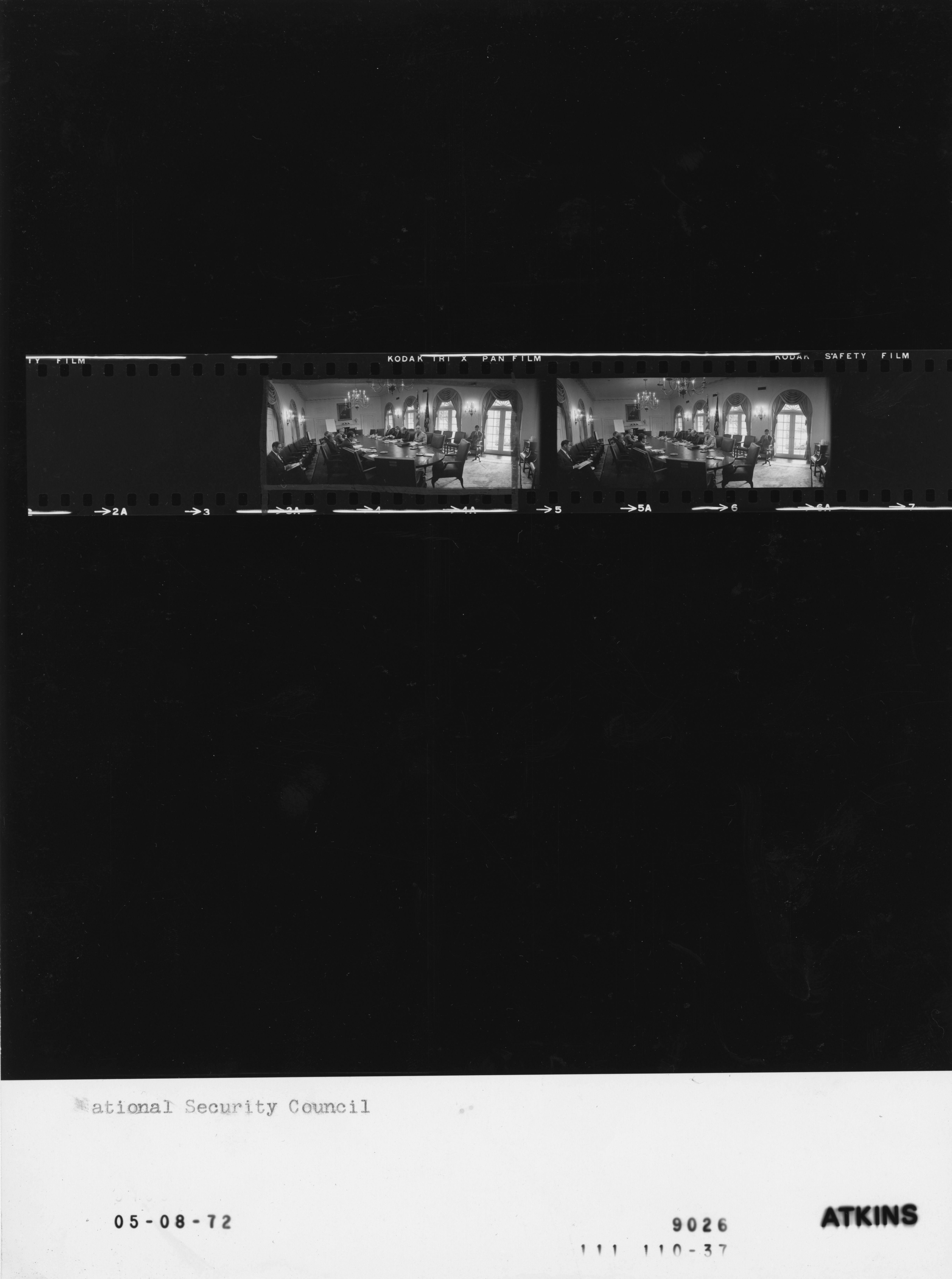
- Frame(s): WHPO-9026-, President Nixon attending a National Security Council (NSC) meeting. 5/8/1972, Washington, D.C. White House, Cabinet Room. President Nixon, William Rogers, Melvin Laird, George Lincoln, John Connally, Thomas Moorer, Richard Helms, Henry Kissinger, Alexander Haig, John Negroponte.
- Frame(s): WHPO-9026-04, Panoramic wide angle image - President Nixon attending a National Security Council (NSC) meeting. 5/8/1972, Washington, D.C. White House, Cabinet Room. President Nixon, Spiro Agnew, William Rogers, Melvin Laird, George Lincoln, John Connally, Thomas Moorer, Richard Helms, Henry Kissinger.
Roll WHPO-9029 Photographer: Schumaker, Byron | Color or B&W: B&W
- Frame(s): WHPO-9029-, Julie Eisenhower visiting the offices of the Citizens Committee to Re-Elect the President (CREP) and talking with staff members. 5/8/1972, Washington, D.C. CREP offices. Julie Eisenhower, Committee to Re-Elect the President (CREP) staff members.
Roll WHPO-9030 Photographer: Kightlinger, Jack | Color or B&W: B&W
- Frame(s): WHPO-9030-, Carlos Conde seated informally with staff members. 5/8/1972, Washington, D.C. unknown. Carlos Conde, staff members.
Roll WHPO-9031 Photographer: Kightlinger, Jack | Color or B&W: B&W
- Frame(s): WHPO-9031-02-07, President Nixon, Henry Kissinger, and security men entering the Executive Office Building (EOB). 5/8/1972, Washington, D.C. Executive Office Building, steps, entrance. President Nixon, Kissinger, Laird, military personnel, unidentified men, Ziegler.
- Frame(s): WHPO-9031-08-09, 13-14, Broadcast crew prepares Oval Office for President Nixon's speech on Vietnam. 5/8/1972, Washington, D.C. White House, Oval Office. President Nixon, Kissinger, Laird, military personnel, unidentified men, Ziegler.
- Frame(s): WHPO-9031-10-12, Laird and military personnel arrive at White House. 5/8/1972, Washington, D.C. steps, White House, North Portico entrance. President Nixon, Kissinger, Laird, military personnel, unidentified men, Ziegler.
Roll WHPO-9032 Photographer: Kightlinger, Jack | Color or B&W: B&W
- Frame(s): WHPO-9032-03-05, Unidentified woman climbing the Executive Office Building (EOB) steps. 5/8/1972, Washington, D.C. Executive Office Building, steps. President Nixon, unidentified woman.
- Frame(s): WHPO-9032-06-20, President Nixon descending the EOB steps and walking back into White House. 5/8/1972, Washington, D.C. Executive Office Building, steps; White House, exterior. President Nixon, unidentified woman.
Roll WHPO-9033 Photographer: Kightlinger, Jack | Color or B&W: B&W
- Frame(s): WHPO-9033-01-07, President Nixon walking to the Oval Office. 5/8/1972, Washington, D.C. corridor, room, Oval Office, White House, Cabinet Room. President Nixon, Connally, unidentified men.
- Frame(s): WHPO-9033-08, Unidentified seated man. 5/8/1972, Washington, D.C. corridor, room, Oval Office, White House, Cabinet Room. President Nixon, Connally, unidentified men.
- Frame(s): WHPO-9033-09-22, President Nixon giving a televised address about Vietnam. 5/8/1972, Washington, D.C. corridor, room, Oval Office, White House, Cabinet Room. President Nixon, Connally, unidentified men.
- Frame(s): WHPO-9033-20, President Nixon seated at his oval office desk giving a televised address about Vietnam. 5/8/1972, Washington, D.C. corridor, room, Oval Office, White House, Cabinet Room. President Nixon.
- Frame(s): WHPO-9033-26-27, Listeners in the Cabinet Room seen through a window. 5/8/1972, Washington, D.C. corridor, room, Oval Office, White House, Cabinet Room. President Nixon, Connally, unidentified men.
Roll WHPO-9034 Photographer: Knudsen, Robert L. | Color or B&W: B&W
- Frame(s): WHPO-9034-04A-23A, Preparations for President Nixon's Vietnam address. 5/8/1972, Washington, D.C. White House, Oval Office. President Nixon, unidentified men.
- Frame(s): WHPO-9034-24-31A, President Nixon leaving White House then walking up the steps of the Executive Office Building (EOB). 5/8/1972, Washington, D.C. Executive Office Building, exterior. President Nixon, unidentified men.
Roll WHPO-9035 Photographer: Knudsen, Robert L. | Color or B&W: B&W
- Frame(s): WHPO-9035-02-06, Security men guarding the Executive Office Building (EOB). 5/8/1972, Washington, D.C. steps, Executive Office Building; Oval Office, room, White House. President Nixon, guards, Barry Goldwater, Russell Long, John Tower, unidentified persons.
- Frame(s): WHPO-9035-07-13, Preparations for Nixon's speech. 5/8/1972, Washington, D.C. steps, Executive Office Building; Oval Office, room, White House. President Nixon, guards, Barry Goldwater, Russell Long, John Tower, unidentified persons.
- Frame(s): WHPO-9035-14-31, Persons listening to the speech and congratulating President Nixon afterwards. 5/8/1972, Washington, D.C. steps, Executive Office Building; Oval Office, room, White House. President Nixon, guards, Barry Goldwater, Russell Long, John Tower, unidentified persons.
Roll WHPO-9036 Photographer: Knudsen, Robert L. | Color or B&W: B&W
- Frame(s): WHPO-9036-, Unidentified staff members in Clark MacGregor's office, listening to President Nixon's speech. 5/8/1972, Washington, D.C. MacGregor's Office, White House. John Tower, Barry Goldwater, Russell Long, unidentified persons.
- Frame(s): WHPO-9036-03, President Nixon seated at his oval office desk, giving a televised address on Vietnam. An unidentified aide stands nearby. A television camera is seen in the foreground. 5/8/1972, Washington, D.C. White House, Oval Office. President Nixon, unidentified aide.
- Frame(s): WHPO-9036-11, President Nixon seated at his oval office desk, giving a televised address on Vietnam. Cameramen, news reporters and aides are seen in the background. 5/8/1972, Washington, D.C. White House, Oval Office. President Nixon, news reporters, cameramen, unidentified aides.
- Frame(s): WHPO-9036-21, President Nixon seated at his oval office desk, giving a televised address on Vietnam.(exterior shot through window). 5/8/1972, Washington, D.C. White House, Exterior Oval Office. President Nixon.
Roll WHPO-9037 Photographer: Knudsen, Robert L. | Color or B&W: B&W
- Frame(s): WHPO-9037-02-20, 24, Preparations for Nixon's speech. 5/8/1972, Washington, D.C. Oval Office, rooms, exterior, White House. unidentified persons.
- Frame(s): WHPO-9037-21-23, White House building portraits taken at night. 5/8/1972, Washington, D.C. Oval Office, rooms, exterior, White House. unidentified persons.
Roll WHPO-9038 Photographer: Atkins, Oliver | Color or B&W: B&W
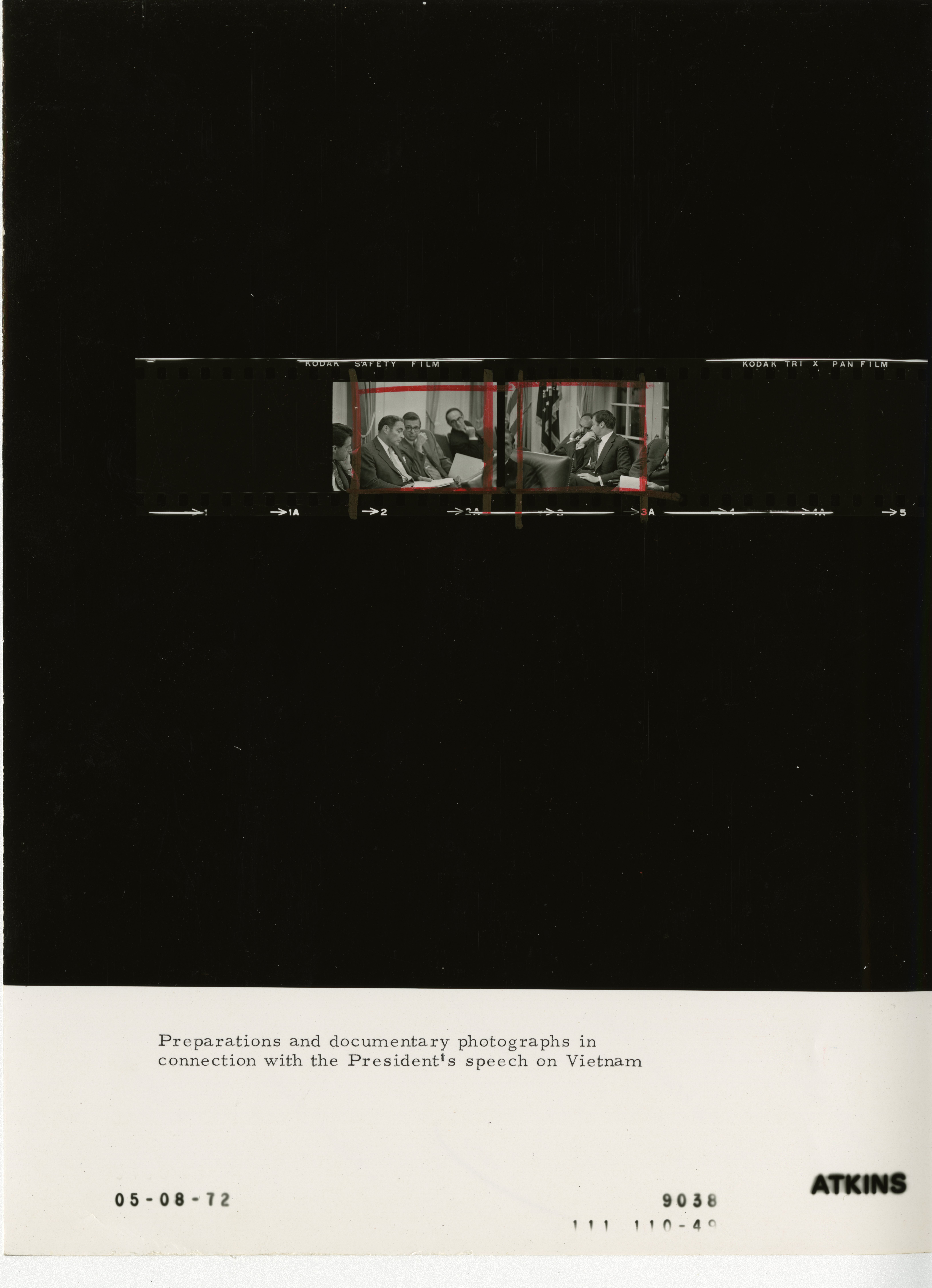
- Frame(s): WHPO-9038-, President Nixon's staff members talking. 5/8/1972, Washington, D.C. White House, Cabinet Room. Alexander Haig, Charles W. Colson, John Ehrlichman, unidentified men.
Roll WHPO-9039 Photographer: Atkins, Oliver | Color or B&W: B&W
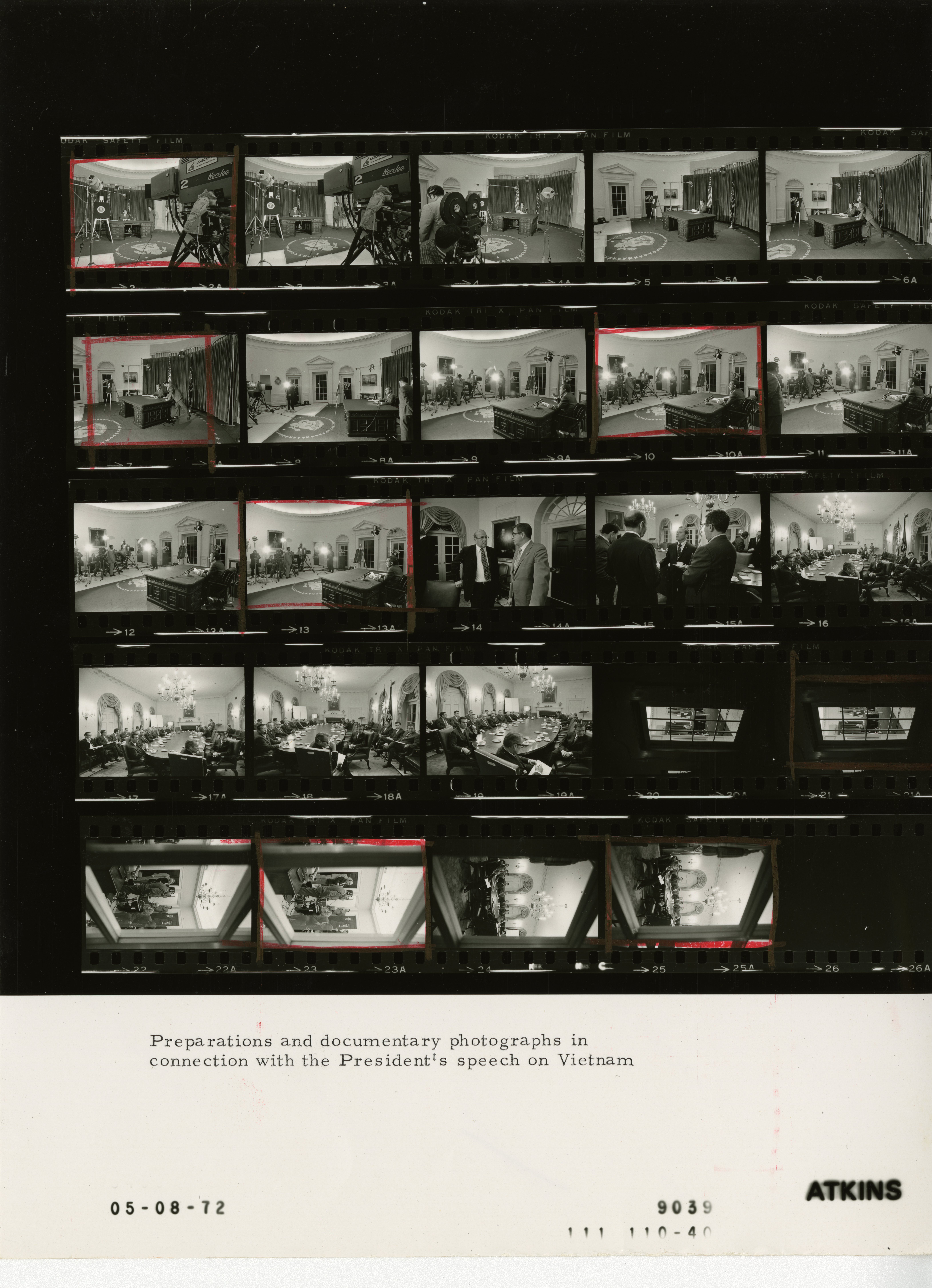
- Frame(s): WHPO-9039-02-13, 22-23, Preparations for President Nixon's speech. 5/8/1972, Washington, D.C. Oval Office, Cabinet Room, room, White House. President Nixon, George Shultz, Charles W. Colson, John Ehrlichman, John Connally, Spiro Agnew, George Romney, unidentified officials, unidentified persons.
- Frame(s): WHPO-9039-14-19, 24-25, Officials waiting and then listening to President Nixon's speech. 5/8/1972, Washington, D.C. Oval Office, Cabinet Room, room, White House. President Nixon, George Shultz, Charles W. Colson, John Ehrlichman, John Connally, Spiro Agnew, George Romney, unidentified officials, unidentified persons.
- Frame(s): WHPO-9039-20-21, President Nixon giving a speech, viewed through a window. 5/8/1972, Washington, D.C. Oval Office, Cabinet Room, room, White House. President Nixon, George Shultz, Charles W. Colson, John Ehrlichman, Connally, Spiro Agnew, Romney, unidentified officials, unidentified persons.
Roll WHPO-9040 Photographer: Atkins, Oliver | Color or B&W: B&W
- Frame(s): WHPO-9040-, Congressmen and others talking prior to Nixon's speech. 5/8/1972, Washington, D.C. unidentified room, White House. Carl Albert, Mike Mansfield, Hugh Scott, John Scali, unidentified men.
Roll WHPO-9041 Photographer: Atkins, Oliver | Color or B&W: B&W
- Frame(s): WHPO-9041-, Persons talking prior to Nixon's speech. 5/8/1972, Washington, D.C. unidentified room, White House. unidentified persons.
Roll WHPO-9042 Photographer: Atkins, Oliver | Color or B&W: B&W
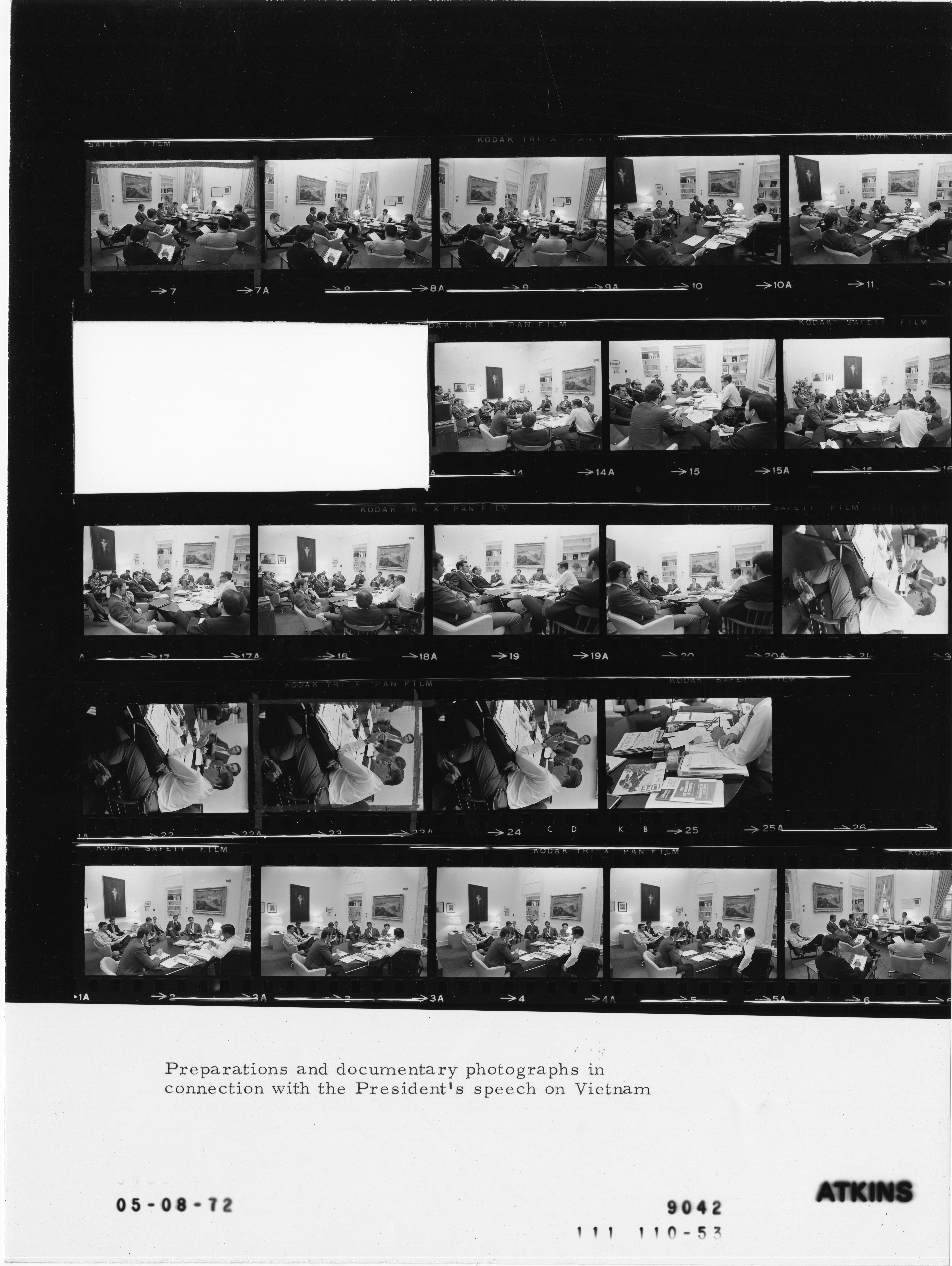
- Frame(s): WHPO-9042-, Persons talking prior to Nixon's speech. 5/8/1972, Washington, D.C. unidentified room, White House. unidentified persons.
- Frame(s): WHPO-9042-01, Charles Colson meeting with members of his staff and the leadership of the Committee to Re-Elect the President (CRP). 5/8/1972, Washington, D.C. unidentified room, White House. Charles Colson, Committee to Re-Elect the President, CRP.
- Frame(s): WHPO-9042-17, Charles Colson meeting with members of his staff and the leadership of the Committee to Re-Elect the President (CRP). 5/8/1972, Washington, D.C. unidentified room, White House. Committee to Re-Elect the President, CRP, Kathleen Balson, Doug Hallett, Lee Huebner, Kenneth Khachigian, Pat O'Donnell, Herb Porter, Steve Karabeicas, Dick Howard, Noel Koch, Van Shumway, Robert Odle, Charles Colson, Bruce Kehrli.
Roll WHPO-9043 Photographer: Atkins, Oliver | Color or B&W: B&W
- Frame(s): WHPO-9043-, Persons talking prior to President Nixon's speech. 5/8/1972, Washington, D.C. room, White House. Mike Mansfield, Carl Albert, Hugh Scott, unidentified men.
Roll WHPO-9044 Photographer: Atkins, Oliver | Color or B&W: B&W
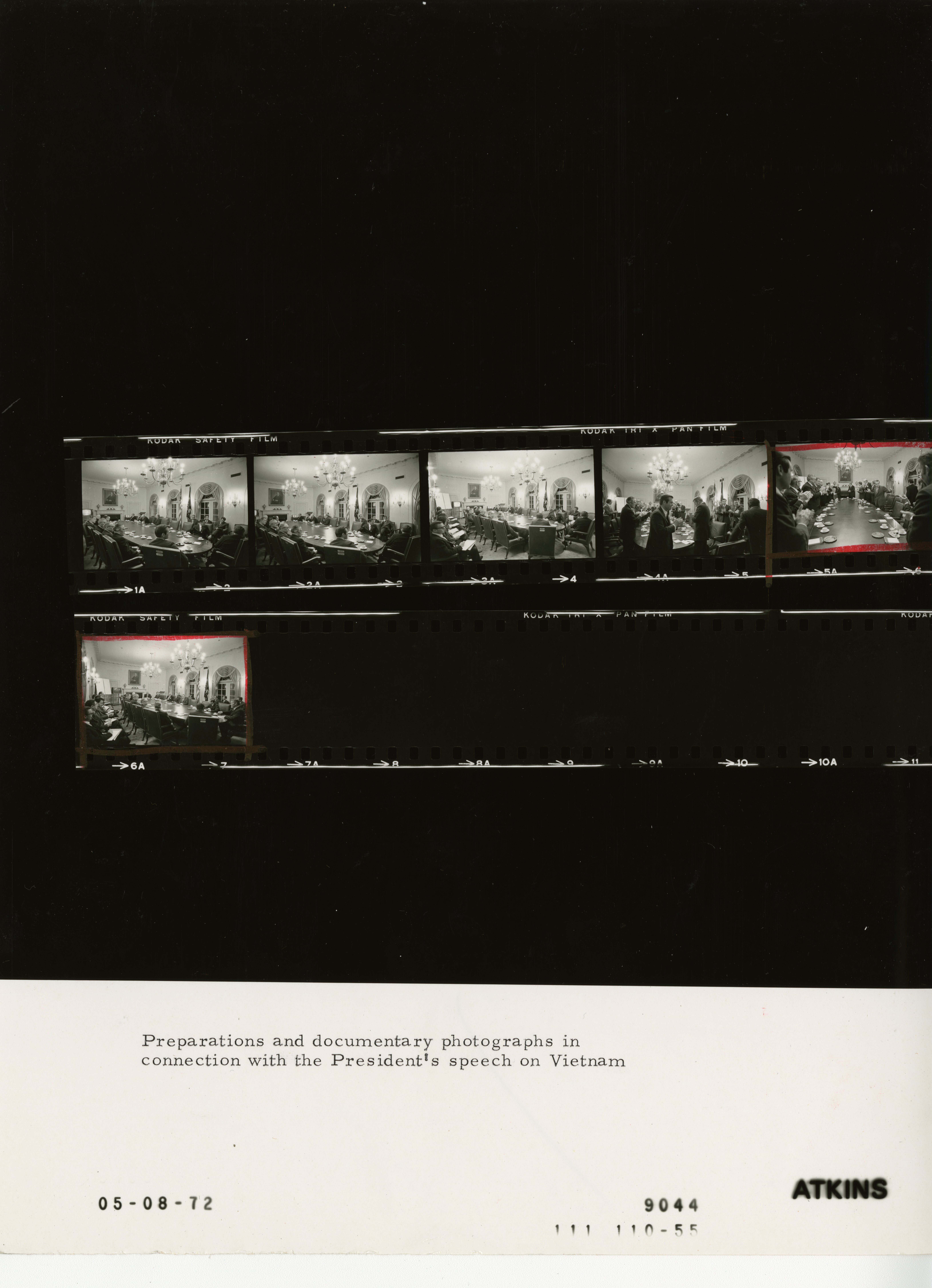
- Frame(s): WHPO-9044-, Staff members greeting President Nixon after his speech. 5/8/1972, Washington, D.C. White House, Cabinet Room. President Nixon, Romney, John Connally, Spiro Agnew, John Ehrlichman, Charles W. Colson, unidentified men.
Roll WHPO-9045 Photographer: Atkins, Oliver | Color or B&W: B&W
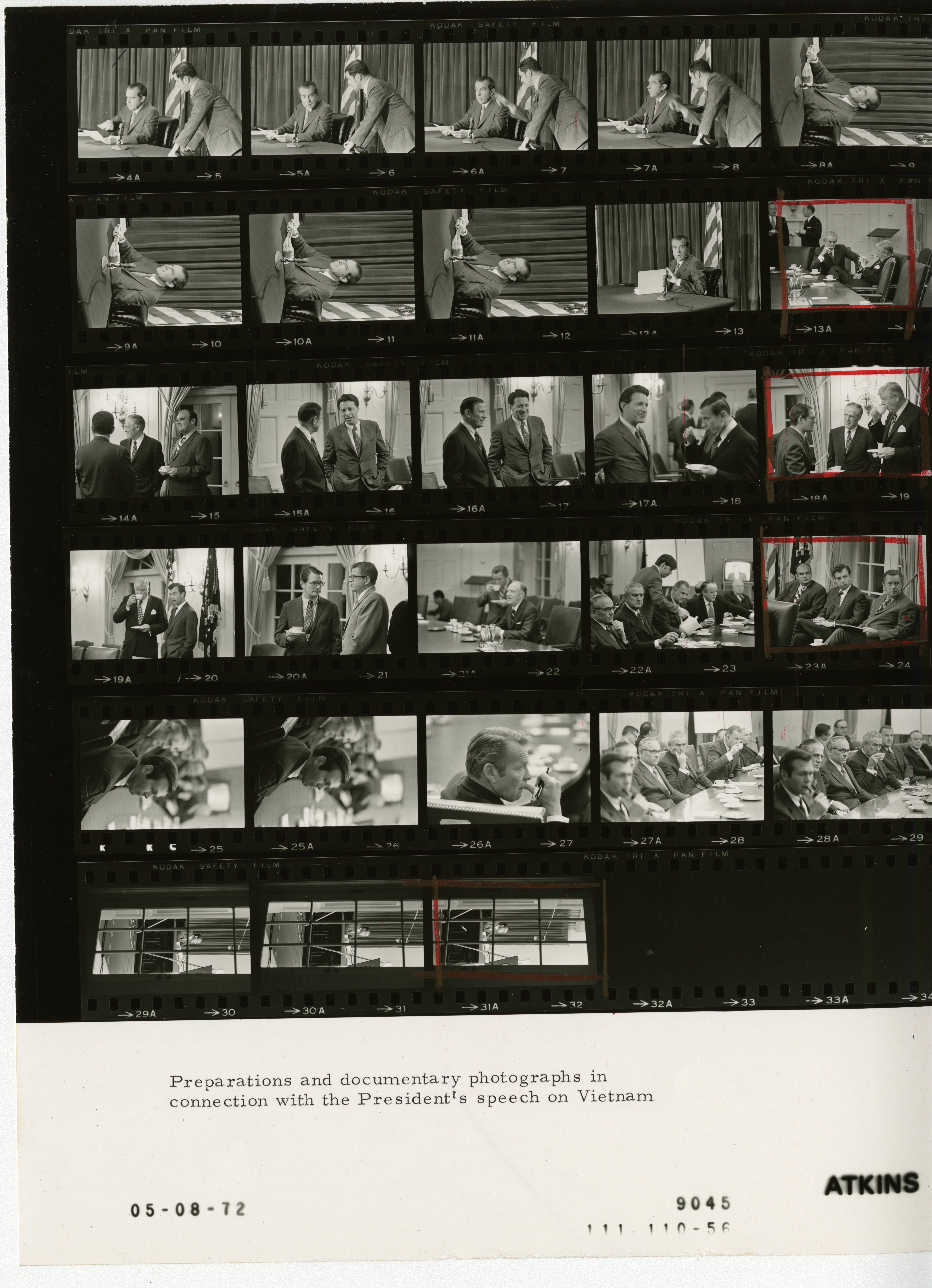
- Frame(s): WHPO-9045-04A-12A, President Nixon preparing for his speech. 5/8/1972, Washington, D.C. White House, Oval Office. President Nixon, Romney, Connally, Agnew, Richardson, Charles W. Colson, Caspar Weinberger, Rogers Morton, unidentified men.
- Frame(s): WHPO-9045-13A-28A, Officials talking prior to President Nixon's speech. Officials listening to President Nixon's speech. 5/8/1972, Washington, D.C. White House, Cabinet Room. President Nixon, George Romney, Connally, Spiro Agnew, Richardson, Charles W. Colson, Caspar Weinberger, Rogers Morton, unidentified men.
- Frame(s): WHPO-9045-29A-31A, President Nixon delivering his speech, as seen through a window. 5/8/1972, Washington, D.C. White House, Cabinet Room. President Nixon, Romney, John Connally, Spiro Agnew, Richardson, Charles W. Colson, Caspar Weinberger, Rogers Morton, unidentified men.
- Frame(s): WHPO-9045-30, President Nixon seated at his oval office desk, giving a televised address on Vietnam.(exterior shot through window). 5/8/1972, Washington, D.C. White House, Cabinet Room. President Nixon.
Roll WHPO-9046 Photographer: Atkins, Oliver | Color or B&W: B&W
- Frame(s): WHPO-9046-, Persons sitting in various offices and room in the White House, prior to President Nixon's speech. 5/8/1972, Washington, D.C. unknown rooms. Charles W. Colson, unidentified persons.
Roll WHPO-9048 Photographer: Kightlinger, Jack | Color or B&W: Color
- Frame(s): WHPO-9048-, Table settings in the State Dining Room ready for the Senate Ladies Luncheon. Pat Nixon greeting with Senate Ladies Luncheon guests. 5/8/1972, Washington, D.C. White House, State Dining Room. Pat Nixon, unidentified women.
The White House Communications Agency Sound Recordings Collection contains public statements that took place between 1969 and 1974. Visit the finding aid to learn more.
G - Cabinet Officer Briefings
- WHCA-SR-G-167
Press briefing by Secretary of Labor James D. Hodgson and Administrator Donald Johnson of the Veteran's Administration, with G. Warren. (5/8/1972, Press Center)
Runtime: 30:00:00
Production credits: Audio feed supplied by WHCA; Recorded by LDH (initials of WHCA engineer)
Original Format: 1/4-inch reel-to-reel audiotape. Original source type: Original.
H - White House Staff Member Recordings
- WHCA-SR-H-566
Press briefing by Herbert Klein. (5/8/1972, Room 162, Executive Office Building)
Runtime: 1:06
Keywords: Press conferences, news conferences, interviews, media
Production credits: Audio feed supplied by WHCA; Recorded by EEM (initials of WHCA engineer)
Original Format: 1/4-inch reel-to-reel audiotape. Original source type: Original.
P - Formal Presidential Remarks
- WHCA-SR-P-720503
Televised remarks re Vietnam. (5/8/1972)
Runtime: 16:56
Original Format: 1/4-inch reel-to-reel audiotape. Original source type: Original.
The White House Communications Agency Videotape Collection contains “off-the-air” recordings of televised programs produced between 1968 and 1974. Visit the finding aid to learn more.
- WHCA-5345
"Julie Eisenhower interview in Oakland, California," received 5/5/72.
NBC
Runtime: 00:34:19 - WHCA-5346
President Richard Nixon Address to the Nation on the Situation in Southeast Asia. President spoke at 9 p.m. from the Oval Office of the White House.
President announced the mining of all North Vietnamese ports and the beginning of air strikes against military targets throughout North Vietnam.
With CBS commentary
Post-Newsweek Stations, Inc.
Runtime: 00:30:26 - WHCA-5347
"Nixon Message on Vietnam", (with commentary). FTN: U.S. Senator Birch Bayh (D-IN); "MTP": Secretary of State William P. Rogers; "I&A": U.S. Senators Mike Gravel (D-AK) and Bob Dole (R-KA).
CBS, NBC, ABC
Runtime: 01:05:40 - WHCA-5348
"Nixon Message on Vietnam", (with commentary).
CBS
Runtime: 01:06:07 - WHCA-5349
"Nixon Message on Vietnam", (with commentary). Mike Balzano.
Metromedia
Runtime: 01:05:22 - WHCA-5361
Weekly News Summary, Tape I.
ALL NETWORKS
Runtime: 1:30
33. Chancellor/Jarriel: President Nixon on Vietnam (Senators Stennis, Fulbright, Humphrey). Time Code Start: 87:11. Keywords: Presidents, Senators, speeches, Laos, Cambodia, Vietnam War. Network: ABC. - WHCA-5362
Weekly News Summary, Tape II.
ALL NETWORKS
Runtime: 1:30
1. Reasoner/Shoumacher: Hue, Vietnam. Time Code Start: 00:00. Keywords: Vietnam War. Network: ABC.
2. Reasoner: Nebraska primaries. Matney-McGovern, Donaldson-Humphrey. Time Code Start: 03:18. Keywords: Presidential elections, campaigns, campaigning, primaries, candidates, voting, speeches. Network: ABC.
3. Smith: Commentary on what he would do if he were President. Time Code Start: 06:25. Keywords: Presidents, activities. Network: ABC.
4. Utley/Valeriani: Vietnam (Senators Fulbright, Stennis). Time Code Start: 08:16. Keywords: Laos, Cambodia, Vietnam War. Network: NBC.
5. Utley: Hanoi (Friedheim, pentagon spokesman). Time Code Start: 11:47. Keywords: United States Department of Defense headquarters, Armed Forces. Network: NBC.
6. Utley/Paxton: Tonkin Gulf. Time Code Start: 13:40. Keywords: Vietnam War, Congressional resolutions, Southeast Asia, North Vietnam, South China Seas, authorized military action. Network: NBC.
7. Utley/Ellis: Hue, Vietnam. Time Code Start: 15:26. Keywords: Vietnam War. Network: NBC.
8. Utley/Lord: Saigon, Vietnam. Time Code Start: 17:56. Keywords: Vietnam War. Network: NBC.
9. Utley/Briggs: Primaries in Nebraska, West Virginia,& Nebraska (McGovern). Time Code Start: 20:52. Keywords: Presidential elections, campaigns, campaigning, candidates. Network: NBC.
10. Cronkite/Rather: Presidents Nixon's speech. Time Code Start: 24:01. Keywords: Presidents, speeches. Network: CBS.
11. Cronkite/Threlkeld: Vietnam. Time Code Start: 27:03. Keywords: Vietnam War. Network: CBS.
12. Jones: Danang, Vietnam. Time Code Start: 32:10. Keywords: Vietnam War. Network: CBS.
13. Cronkite/Shoumacher/Clark: West Virginia and Nebraska primaries Humphrey and McGovern. Time Code Start: 35:10. Keywords: Presidential elections, campaigns, campaigning, primaries, candidates, voting, speeches. Network: CBS.
14. Sevareid: Commentary on Presidents Nixon's speech, commentary on Vietnam. Time Code Start: 38:30. Keywords: Presidents, speeches, Vietnam War. Network: CBS.
Context (External Sources)
The Vanderbilt Television News Archive is the world's most extensive and complete archive of television news. They have been recording, preserving and providing access to television news broadcasts of the national networks since August 5, 1968.
Wikipedia is a free encyclopedia that anyone can edit.