
Introduction
This almanac page for Friday, January 5, 1973, pulls together various records created by the federal government and links to additional resources which can provide context about the events of the day.
Previous Date: Thursday, January 4, 1973
Next Date: Saturday, January 6, 1973
Schedule and Public Documents
The Daily Diary files represent a consolidated record of the President's activities. Visit the finding aid to learn more.
The President's day began at The White House - Washington, D. C.
The Weekly Compilation of Presidential Documents made available transcripts of the President's news conferences; messages to Congress; public speeches, remarks, and statements; and other Presidential materials released by the White House.
Digitized versions can be found at HathiTrust.
Each Public Papers of the Presidents volume contains the papers and speeches of the President of the United States that were issued by the White House Office of the Press Secretary during the time period specified by the volume. The material is presented in chronological order, and the dates shown in the headings are the dates of the documents or events. In instances when the release date differs from the date of the document itself, that fact is shown in the text note.
To ensure accuracy, remarks have been checked against audio recordings (when available) and signed documents have been checked against the original, unless otherwise noted. Editors have provided text notes and cross references for purposes of identification or clarity.
The Federal Register is the official daily publication for rules, proposed rules, and notices of federal agencies and organizations, as well as executive orders and other Presidential documents.
Archival Holdings
Any selection of archival documents will necessarily be partial. You should use the documents and folders identified below as a starting place, but consult the linked collection finding aids and folder title lists and the collections themselves for context. Many documents to be found this way do not lend themselves to association with specific dates, but are essential to a complete understanding of the material.
Selective document listing
President's Office Files
The President's Office Files consists of materials drawn together by the Special Files Unit from several administrative subdivisions within the White House Office. It is the handwriting and sensitive papers sent to the Staff Secretary that now comprise much of the President's Office Files. Visit the finding aid to learn more.
- News Summaries, Unmarked News Summaries, Box 53, News Summaries - January 2 to 11, 1973 [3 of 7] [Note: Due to the way News Summary products were compiled, you should also consult nearby days for potentially relevant materials.]
- News Summary, January 5, 1973, (Thursday nets, wires)
President's Personal File
The President's Personal File is essentially a President's secretary's file, kept by Rose Mary Woods, personal secretary to the President, for two purposes: (1) preserving for posterity a collection of documents particularly close to the President, whether because he dictated or annotated them, or because of the importance of the correspondent or the event concerned and (2) giving appropriate attention–letters of gratitude, invitations to White House social events, and the like–to members and important friends and supporters of the Nixon administration. This generalization does not describe all the varied materials of a file group which is essentially a miscellany, but it does identify the reason for the existence of the file group's core. Visit the finding aid to learn more.
- President's Speech File
The H. R. Haldeman Diaries consists of seven handwritten diaries, 36 dictated diaries recorded as sound recordings, and two handwritten audio cassette tape subject logs. The diaries and logs reflect H. R. Haldeman’s candid personal record and reflections on events, issues, and people encountered during his service in the Nixon White House. As administrative assistant to the President and Chief of Staff, Haldeman attended and participated in public events and private meetings covering the entire scope of issues in which the Nixon White House engaged in during the years 1969-1973. Visit the finding aid to learn more.
- Transcript of diary entry (PDF)
Friday, January 5.
The President got into quite an analysis of the Congressional opposition, arising out of his discussions yesterday and then the leadership meeting today, which apparently went very well, although his reaction afterwards was quite negative. He feels that the reason the Congress are so negative and opposing him on everything, particularly Vietnam is because they look bad themselves now, and they’re trying to untangle that by putting some blame on the President. He feels strongly that they're taking the wrong approach in saying they more need buildings and more staff, rather they should be operating more effectively. He's taken the lead in reorganizing and thinks Congress should follow suit; he's told Ehrlichman to take that approach on TV this weekend.
He says Burger is overhauling the court system, too, and now the third branch should also move to overhaul and improve itself. He wants Timmons to change his approach and work Congress on an affirmative basis, not negative and defensive -- he shouldn't look like he's hanging crepe all the time. He’s obviously got some doubts about Timmons, mainly because he's not strong and positive enough, and feels that we’ve got to change our tune -- get away from the supplicant position. We won the election, so we should let them come to us.
He got into PR tactics with Kissinger also. Told him that since he had scheduled a meeting with Mansfield, he would also have to talk to Scott and Ford, ask them to stand up and scream treason at the opponents, hitting the opponents for undermining the negotiations. And as the President thought about that, he said no, we shouldn't do that, because that would hurt us in Paris. Henry was saying at that point, that we should try to get some reaction. The President then told him to call Colson, and tell him what he want hit, attacking the patriotism and that sort of thing, but then he backed off of it again, and said that we should not do it, which was also my view.
He's concerned about Laird, who took the position, apparently yesterday, that any agreement, no matter how bad it is, is better than no agreement, he's now sent a letter to the President making that point, so he's on record with it. Typical Laird device which he's done at every crunch period.
Kissinger made the point that no President since Lincoln has faced such a concerted opposition, the whole establishment, jumping on him at every slippage. The President said no, it's not just the opposition, it's their way of getting even for his winning the 61 percent. He told Kissinger to tell Mansfield when he met with him, that the POW deal alone won't work, that we've tried that, and they won't take it. Ziegler then came in to review the plan for the briefings. He's going to cover the reorganization, and then said that he wanted to repeat what the President said on Vietnam at the breakfast, the President said no, that the press doesn't sit in on those meetings, there's no reason why they should.
Ziegler pushed it a little, and the President then agreed on the basis that he should make the following points: that we have to proceed with the policy that we have, we feel that it's right, we should refer to the progress we've made over the last four years. Then he should repeat that the May 8 policy is in effect, that the objective, the POW's, cease-fire, and assuring South Vietnam of a way to control their own political future. Then he should build the chronology, that on May 8 we mined and bombed, on October 8 we had a breakthrough in Paris, with an agreement in principle, still with details to work out. As a result of that, the President suspended the bombing above the 20th parallel.
Then on October 26, while we were still trying to work out the details, North Vietnam announced the agreement on those issues, and Kissinger, being forced to, confirmed it. After the election, then North Vietnam backed away and posed conditions which were not what they had said to begin with, that were unacceptable, and these were in relation to POW's, cease-fire, supervision, and a number of other dilatory tactics. So Kissinger was sent back to Paris, presumably for three days -- he stayed for ten -- and it was clear during that period that there was a stalling pattern. And in the meantime, they were building up capability in North Vietnam and moving troops into South Vietnam. It was clear that there was no agreement, that they had backed away, so Kissinger returned and the President removed the suspension of bombing which he had ordered suspended on October 8. Then two days before the New Year, North Vietnam agreed to return to the negotiations, so the President again suspended the bombing and said that it will remain suspended as long as there are serious negotiations. He won't be optimistic or pessimistic, but there is a chance to end the war, not just to withdraw and that's what we're working for in the negotiations.
Then he got into the question of whether Kissinger supported the bombing, based on Kraft's column yesterday saying that he didn't. Then the President told Ron to deny the Kraft column. Then after Ron left he told me to call Kissinger and ask him how we should answer the Kraft thing. Kissinger said well I always say that the President and I were completely together on it, but that as a question of principle, I don't catalog what I recommend to the President. But on this point I will say that I was in total agreement, so you should just shoot it down on that basis. We need to be more definite on this the President feels. And when Ziegler hit Henry on it a little later, Henry backed off of Ziegler shooting it down, and said, well, I don't catalog the positions that I take with the President.
The other item of interest today was the President’s concern about our Colson, Ziegler, Timmons capability. He feels that the President can't take the whole load in the Oval Office -- that he has to assume that someone else is going to grab things and take the initiatives from a PR standpoint the way Colson now does. He called me tonight from Camp David after he’d gone up there, and got back to that again. He said the main thing to consider now is whether the attack operation is adequate, or are we dismantling too much in view of the position that we have with the Congress. That we should consider the people we have, who would be useful, and be able to move for us if necessary. After he meets with Kissinger tomorrow, and gets that settled, then the key thing is the PR side. Maybe Kissinger should have someone with him in Paris to tell him not to smile and so on. We need to get Ziegler and Timmons in all together -- get a PR point, not just the hot news, maybe we should stiffen up our apparatus if it's not adequate. He wants me to talk to Ziegler over the weekend regarding the handling of the PR over the next week. We must not be always on the defensive, especially when the Democrats are acting their usual way anyway. The overriding point, is how it all comes out so we shouldn't worry about the Canadian Parliament, or our Congress or anything else. Thinks I also ought to talk to MacGregor. Said that he had talked to Gerry Ford, who's had to make a deal with Wilson because Brown won't fight for the Campaign Committee Chairmanship. So Wilson’s agreed he’ll resign three days before the March dinner --the President said okay we'll accept that deal, if in addition they agree to appoint Brown as the recruitment man now. And then if they do, we'll just ignore Wilson.
End of January 5. - Original audio recording (MP3)
The National Archives Catalog is the online portal to the records held at the National Archives, and information about those records. It is the main way of describing our holdings and also provides access to electronic records and digitized versions of our holdings.
The Catalog searches across multiple National Archives resources at once, including archival descriptions, digitized and electronic records, authority records, and web pages from Archives.gov and the Presidential Libraries. The Catalog also allows users to contribute to digitized historical records through tagging and transcription.
Nixon Library Holdings
All National Archives Units
National Security Documents
The President's Daily Brief is the primary vehicle for summarizing the day-to-day sensitive intelligence and analysis, as well as late-breaking reports, for the White House on current and future national security issues. Read "The President's Daily Brief: Delivering Intelligence to Nixon and Ford" to learn more.
The Foreign Relations of the United States series presents the official documentary historical record of major U.S. foreign policy decisions and significant diplomatic activity. Visit the State Department website for more information.
Vol. IX, Vietnam, October 1972-January 1973
America Leaves the War, December 30, 1972-January 27, 1973
248. Backchannel Message From the President’s Assistant for National Security Affairs (Kissinger) to the Ambassador to Vietnam (Bunker), Washington, January 5, 1973, 0130Z
Source: Library of Congress, Manuscript Division, Kissinger Papers, Box TS 45, Geopolitical File, Vietnam, Cables, Dec. 1972–Apr. 1975. Top Secret; Immediate; Sensitive; Exclusively Eyes Only. Written on January 4.
249. Memorandum of Conversation, Washington, January 5, 1973, 2:40-3:30 p.m.
Source: National Archives, Nixon Presidential Materials, NSC Files, Box 859, For the President’s Files (Winston Lord)—China Trip/Vietnam, Sensitive Camp David, Vol. XXIII. Top Secret; Sensitive; Exclusively Eyes Only. The meeting was held in Kissinger’s office at the White House.
250. Message From the Chief of the U.S. Delegation to the Paris Peace Talks (Porter) to the President’s Assistant for National Security Affairs (Kissinger), Paris, January 5, 1973, 1940Z
Source: National Archives, Nixon Presidential Materials, NSC Files, Box 865, For the President’s Files (Winston Lord)—China Trip/Vietnam, Camp David Memcons, December 1972 [1 of 3]. Secret; Immediate; Sensitive; Exclusively Eyes Only. Sent via Guay and Kennedy.
Vol. XVIII, China, 1973-1976
Kissinger's Visits to Beijing and the Establishment of the Liaison Offices, January 1973-May 1973
2. Memorandum of Conversation, Washington, January 5, 1973, 4:00-4:15 p.m.
Source: National Archives, Nixon Presidential Materials, NSC Files, Box 1026, Presidential/HAK Memcons, Jan.–Mar. 1973. Secret; Nodis. The meeting was held in the Oval Office. In addition to the participants listed in the memorandum of conversation, the President’s Daily Diary indicates that a military aide, Lieutenant Colonel William L. Golden, also attended. (Ibid., White House Central Files) A tape of this conversation is ibid., White House Tapes, Conversation, No. 834–16.
Vol. E-2, Documents on Arms Control and Nonproliferation, 1969-1972
Chemical and Biological Warfare; Geneva Protocol; Biological Weapons Convention
275. Memorandum by the President’s Assistant for National Security Affairs (Kissinger), Washington, January 5, 1973
Kissinger requested reports reflecting recent discussions on verification measures and the question of stockpiles shelf-life pertaining to the NSSM 157 study be completed by January 21, 1973.
Source: National Archives, Nixon Presidential Materials, NSC Files, NSC Institutional Files (H-Files), Boxes H–192 and H–193, NSSM 157. Secret. The memorandum was also sent to Laird, Helms, Smith, and David.
Vol. E-5, Part 2, Documents on North Africa, 1969-1972
Morocco
137. National Security Decision Memorandum 200, Washington, January 5, 1973
Special Assistant to the President for National Security Affairs Kissinger forwarded President Nixon’s approval of the conclusions reached at the Senior Review Group meeting on Policy Toward Morocco.
Source: National Archives, Nixon Presidential Materials, NSC Files, NSC Institutional Files (H-Files), Box H-237, National Security Decision Memoranda, NSDM 200. Secret.
Vol. E-8, Documents on South Asia, 1973-1976
Bangladesh
29. Action Memorandum From the Assistant Secretary of State for Near Eastern and South Asian Affairs (Sisco) to Secretary of State Rogers, Washington, January 5, 1973
Sisco presented Secretary Rogers with a draft cable for the Dhaka Embassy instructing it to insist on an explanation of the police “fade out” and on procedures for recovering U.S. property.
Source: National Archives, RG 59, Central Files 1970—73, CUL 11 Bangladesh. Confidential. It was drafted by Laingen and cleared by Meyer. The Embassy delivered the letter attached in telegram 3179 to Dhaka on January 6. On January 2 police protecting the USIS center in Dhaka abandoned the building to student protesters. In telegram 218, January 11, the Embassy reported that with protection from Bangladeshi police, U.S. officials had reoccupied the USIS building in Dhaka. (Ibid., 23—8 BDG—US)
Vol. E-9, Documents on North Africa, 1973-1976
Morocco, 1973-1976
58. National Security Decision Memorandum 200, Washington, January 5, 1973
Summary: The memorandum lists Presidential decisions following the Senior Review Group meeting on Policy Toward Morocco, NSSM 160, November 30, 1972.
Source: Library of Congress, Manuscript Division, Kissinger Papers, Box CL 315, National Security Council, National Security Memoranda, NSDM August 1972–March 1973. Secret. For NSSM 160 and the minutes of the November 30, 1972, Senior Review Group meeting see Documents 132 and 135 in Foreign Relations, 1969–1976, vol. E–5, Part 2, Documents on Northern Africa, 1969–1972.59. Memorandum From Secretary of State Rogers to President Nixon, Washington, January 5, 1973
Summary: Rogers informed Nixon of King Hassan’s desire to receive a special envoy to examine the U.S. military presence in Morocco, and his concern over a perceived change in U.S.-Moroccan relations. Rogers suggested that Robert Murphy serve as special envoy.
Source: National Archives, Nixon Presidential Materials, NSC Files, Box 758, Presidential Correspondence, Morocco. Secret. In a letter dated January 15, Nixon informed King Hassan of Murphy’s mission. (Ibid.) In telegram 12132 to Rabat, January 19, the Department instructed the Embassy to arrange a private meeting between Murphy and King Hassan. (Ibid., NSC Country Files for Africa, Box 740, Morocco, Vol. II) In telegram 13960 to Rabat, January 24, the Department provided instructions to Murphy for his meeting with King Hassan. (Ibid.)
Vol. E-12, Documents on East and Southeast Asia, 1973-1976
Korean Peninsula
230. Memorandum of Conversation, Washington, January 5, 1973, 2:30 p.m., Washington, January 5, 1973, 2:30 p.m.
Nixon and Prime Minister Kim discussed Korean affairs.
Source: National Archives, Nixon Presidential Materials, NSC Files, Box 1026, Presidential/HAK Memcons, January–March 1973. Secret; Nodis. The conversation took place in the Oval Office. Prime Minister Kim and Foreign Minister Kim visited Washington to represent the Republic of Korea at the memorial service for Harry Truman on January 5. According to the President’s Daily Diary, the memorandum of conversation lists an incorrect date for the meeting, which occurred on January 5, 1973, from 2:31 until 3. (National Archives, Nixon Presidential Materials, White House Central Files, President’s Daily Diary)
Pacific Islands
304. Letter From the President’s Personal Representative for Micronesian Status Negotiations (Williams) to President Nixon, Washington, January 5, 1973., Washington, January 5, 1973
Williams reported on the status of negotiations with the Marianas and the other districts of the Trust Territory of the Pacific Islands.
Source: National Archives, Nixon Presidential Materials, NSC Files, Box 568, Country Files, Far East, Trust Territories, Vol. III [1 of 2]. Confidential. On March 19, Williams sent a study to the Chairman of the NSC Under Secretaries Committee concerning the negotiations on the future political status of the Mariana Islands District of the Trust Territory of the Pacific Islands. (Ibid., NSC Institutional Files (H-Files), Box H–276, Under Secretaries Decision Memorandums, U/DM 98 [2 of 5])
Philippines
314. Memorandum of Conversation, Washington, January 5, 1973, 3:30 p.m., Washington, January 5, 1973, 3:30 p.m.
Nixon and Romulo discussed affairs in the United States, the Philippines, and Vietnam.
Source: National Archives, Nixon Presidential Materials, NSC Files, Box 1026, Presidential/HAK Memcons, January–March 1973. Secret; Nodis. At the time Nixon and Romulo met, the Philippines had been under martial law since September 1972 and the Filipino army was fighting rebels in the Sula Archipelago.
Vol. E-14, Part 1, Documents on the United Nations, 1973-1976
United Nations Affairs
1. Airgram A–128 From the Department of State to All Diplomatic Posts, Washington, January 5, 1973., Washington, January 5, 1973
The Department provided posts with a general summary and assessment of the 27th United Nations General Assembly.
Source: National Archives, RG 59, Central Files 1970–73, UN 8 GA. Limited Official Use. Drafted by Hertz, Pelcovits, and other members of the IO staff on January 2; cleared by Rothenberg, McDonald, Schaufele, and in IO/SEC, AF, NEA, EUR/SOV, ACDA, EA/ACA, L/UNA, and L/OA; and approved by De Palma.
Vol. E-15, Part 1, Documents on Eastern Europe, 1973-1976
German Democratic Republic—Berlin
84. Airgram A-02 From the Mission in West Berlin to the Department of State, January 5, 1973.
The Mission offered its annual policy assessment of the German Democratic Republic.
Source: National Archives, RG 59, Central Files 1970-73, POL GER E-US. Secret. Drafted on January 3 by Alexander Akalovsky (EAS), Richard C. Barkley (PS), and Felix S. Bloch (ECON); cleared by EAS, POLAD, POL, ECON, USIS, and USCOB; and approved by Klein. Repeated to Belgrade, Bonn, Bucharest, Budapest, London, Moscow, Munich, NATO, Paris, Prague, Sofia, Warsaw, CINCEUR for POLAD, CINCUSSAFE for POLAD, CINCUSAREUR for POLAD, and USELMLO/Casteau.
Vol. E-15, Part 2, Documents on Western Europe, 1973-1976, Second, Revised Edition
Canada, 1973-1976
103. Memorandum From the President’s Assistant for National Security Affairs (Kissinger) to President Nixon, Washington, January 5, 1973
Summary: Kissinger relayed a message from Trudeau on Vietnam.
Source: National Archives, Nixon Presidential Materials, NSC Files, Box 750, Canada, Trudeau, corres. (1969–1973) (1 of 1). Secret. Sent for information. Attached but not published is Tab A. A stamped notation on the memorandum indicates the President saw it. Nixon circled the last paragraph of the memorandum and wrote, “No reply.” On January 17, Sonnenfeldt forwarded to Kissinger a draft condolence message to Trudeau on the death of his mother, noting that “the President rejected the idea of a reply to Trudeau’s recent Vietnam letter. There were also put in train some other manifestations of our displeasure. We now have the attached condolence message. I personally feel it should be sent as a civilized gesture. But because of the mood you described yesterday I want to be sure you know and agree this is being done.” Scowcroft wrote at the bottom of Sonnenfeldt’s memorandum, “HAK says no.” (Ibid.)
The Kissinger telephone conversation transcripts consist of approximately 20,000 pages of transcripts of Kissinger’s telephone conversations during his tenure as Assistant to the President for National Security Affairs (1969-1974) and Secretary of State (1973-1974) during the administration of President Richard Nixon. Visit the finding aid for more information.
Digitized versions can be found in the National Archives Catalog.
Audiovisual Holdings
Visit the White House Tapes finding aid to learn about the taping system's operation and archival processing.
Camp David Hard Wire
- 239-1; 7:38 p.m. - 7:58 p.m.; Nixon, Richard M. (President); Colson, Charles W.
- 239-2; Unknown between 7:58 p.m. & 8:27 p.m.; Nixon, Richard M. (President); Eisenhower, Julie Nixon
- 239-3; Unknown between 7:58 p.m. & 8:27 p.m.; Nixon, Richard M. (President); Camp David Operator
- 239-4; 8:27 p.m. - 8:31 p.m.; Nixon, Richard M. (President); Kissinger, Henry A.
- 239-5; Unknown between 8:31 p.m. & 8:47 p.m.; Nixon, Richard M. (President); Camp David Operator
- 239-6; 8:47 p.m. - 8:49 p.m.; Nixon, Richard M. (President); Rebozo, Charles G. ("Bebe")
- 239-7; 8:49 p.m. - 8:50 p.m.; Nixon, Richard M. (President); Camp David Operator
- 239-8; 8:50 p.m. - 9:00 p.m.; Haldeman, H. R. ("Bob")
- 239-9; Unknown between 7:58 p.m. & 8:27 p.m.; Eisenhower, Julie Nixon; Nixon, Thelma C. ("Pat") (Ryan)
- 239-10; Unknown between 8:31 p.m. & 8:47 p.m.; Nixon, Thelma C. (Ryan) (Pat); Eisenhower, Julie Nixon
Camp David Study Table
- 160-2; 7:38 p.m. - 7:58 p.m.; Nixon, Richard M. (President); Colson, Charles W.
- 160-3; Unknown between 7:58 p.m. & 8:27 p.m.; Nixon, Richard M. (President); Camp David Operator
- 160-4; 8:27 p.m. - 8:31 p.m.; Nixon, Richard M. (President); Kissinger, Henry A.
- 160-5; Unknown between 8:31 p.m. & 8:47 p.m.; Nixon, Richard M. (President); Camp David Operator
- 160-6; 8:47 p.m. - 8:49 p.m.; Nixon, Richard M. (President); Rebozo, Charles G. ("Bebe")
- 160-7; 8:49 p.m. - 8:50 p.m.; Nixon, Richard M. (President); Camp David Operator
- 160-8; 8:50 p.m. - 9:00 p.m.; Nixon, Richard M. (President); Haldeman, H. R. ("Bob")
Old Executive Office Building
- 394-1; Unknown between 11:53 a.m. & 12:02 p.m.; Nixon, Richard M. (President); Sanchez, Manolo
- 394-2; Unknown between 11:53 a.m. & 12:02 p.m.; Nixon, Richard M. (President); Bull, Stephen B.
- 394-3; Unknown between 12:02 p.m. & 12:36 p.m.; Nixon, Richard M. (President); Colson, Charles W.; Holm, Holly; Sanchez, Manolo
- 394-4; Unknown between 12:02 p.m. & 12:36 p.m.; Nixon, Richard M. (President); White House operator
- 394-5; Unknown between 12:02 p.m. & 12:36 p.m.; Nixon, Richard M. (President); White House operator
- 394-6; 12:36 p.m. - 12:36 p.m.; Nixon, Richard M. (President); White House operator
- 394-7; Unknown between 12:36 p.m. & 1:02 p.m.; Nixon, Richard M. (President); Colson, Charles W.; White House operator; Bull, Stephen B.; Timmons, William E.
- 394-8; 1:04 p.m. - 1:08 p.m.; Nixon, Richard M. (President); Ziegler, Ronald L.
- 394-9; Unknown between 1:08 p.m., 1/5 & 2:56 p.m., 12/28; Nixon, Richard M. (President); [Unknown person(s)]
- 394-10; Unknown between 1:08 p.m., 1/5 & 2:56 p.m., 12/28; Nixon, Richard M. (President); [Unknown person(s)]
- 394-11; Unknown between 1:08 p.m., 1/5 & 2:56 p.m., 12/28; Nixon, Richard M. (President); Sanchez, Manolo
- 394-12; Unknown between 1:08 p.m., 1/5 & 2:56 p.m., 12/28; Nixon, Richard M. (President); [Unknown person(s)]
- 394-13; Unknown between 1:08 p.m., 1/5 & 2:56 p.m., 12/28; Nixon, Richard M. (President); White House operator
Oval Office
- 834-1; Unknown between 10:11 a.m. & 10:18 a.m.; Nixon, Richard M. (President); Bull, Stephen B.
- 834-2; Unknown between 10:11 a.m. & 10:18 a.m.; Nixon, Richard M. (President); Bull, Stephen B.
- 834-3; 10:18 a.m. - 11:50 a.m.; Nixon, Richard M. (President); Haldeman, H. R. ("Bob"); Kissinger, Henry A.; Ziegler, Ronald L.; [Unknown person(s)]
- 834-4; Unknown between 1:57 p.m. & 2:03 p.m.; Nixon, Richard M. (President); Bull, Stephen B.
- 834-5; 2:03 p.m. - 2:04 p.m.; Nixon, Richard M. (President); Ziegler, Ronald L.
- 834-6; 2:04 p.m. - 2:19 p.m.; Nixon, Richard M. (President); Shazar, S. Zalman; Rabin, Yitzhak; Kennedy, Richard T. (Col.); Atkins, Oliver F. ("Ollie")
- 834-7; 2:20 p.m. - 2:21 p.m.; Nixon, Richard M. (President); Bull, Stephen B.
- 834-8; 2:22 p.m. - 2:30 p.m.; Nixon, Richard M. (President); David, Edward E., Jr. (Dr.); Bull, Stephen B.
- 834-9; 2:30 p.m. - 2:31 p.m.; Nixon, Richard M. (President); Bull, Stephen B.
- 834-10; Unknown between 2:31 p.m. & 3:03 p.m.; Nixon, Richard M. (President); Kim, Dong Jo; Chong-pil, Kim; Yong-sik, Kim; Han, Carl; Sullivan, Henry; Atkins, Oliver F. ("Ollie"); Bull, Stephen B.
- 834-11; 3:03 p.m. - 3:36 p.m.; Nixon, Richard M. (President); Lynch, John M. ("Jack"); Flanigan, Peter M.; Kennedy, Richard T. (Col.); Atkins, Oliver F. ("Ollie")
- 834-12; Unknown between 3:37 p.m. & 3:39 p.m.; Nixon, Richard M. (President); Bull, Stephen B.
- 834-13; 3:39 p.m. - 4:10 p.m.; Nixon, Richard M. (President); Romulo, Carlos P.; Kennedy, Richard T. (Col.); Atkins, Oliver F. ("Ollie"); Bull, Stephen B.
- 834-14; Unknown between 4:01 p.m. & 4:03 p.m.; Nixon, Richard M. (President); Bull, Stephen B.
- 834-15; 4:01 p.m. - 4:03 p.m.; Nixon, Richard M. (President); Bull, Stephen B.
- 834-16; 4:03 p.m. - 4:22 p.m.; Nixon, Richard M. (President); Kennedy, Richard T. (Col.); Gifford, William L.; Atkins, Oliver F. ("Ollie"); Chia-Kan, Yen; Wei-ping, Tsai; Shen, James C. H.; Bull, Stephen B.
- 834-17; Unknown between 4:23 p.m. & 4:25 p.m.; Nixon, Richard M. (President); Sanchez, Manolo
- 834-18; Unknown between 4:23 p.m. & 4:25 p.m.; Nixon, Richard M. (President); Butterfield, Alexander P.
- 834-19; 4:25 p.m. - 4:39 p.m.; Nixon, Richard M. (President); Decker, Terry L.
- 834-20; 4:40 p.m. - 4:44 p.m.; Nixon, Richard M. (President); Ziegler, Ronald L.
- 834-21; Unknown between 4:44 p.m. & 4:55 p.m.; Nixon, Richard M. (President); Bull, Stephen B.
- 834-22; 4:55 p.m. - 5:29 p.m.; Nixon, Richard M. (President); Ehrlichman, John D.; Kissinger, Henry A.
- 834-23; Unknown between 5:29 p.m. & 5:37 p.m.; Nixon, Richard M. (President); Bull, Stephen B.
White House Telephone
- 35-91; Unknown between 12:02 p.m. & 12:36 p.m.; Colson, Charles W.; White House operator; Holm, Holly
- 35-92; Unknown between 12:02 p.m. & 12:36 p.m.; Nixon, Richard M. (President); White House operator
- 35-93; Unknown between 12:02 p.m. & 12:36 p.m.; Nixon, Richard M. (President); White House operator
- 35-94; 12:36 p.m. - 12:36 p.m.; White House operator; Nixon, Richard M. (President)
- 35-95; 12:37 p.m. - 12:38 p.m.; Nixon, Richard M. (President); Bull, Stephen B.
- 35-96; Unknown between 12:38 p.m. & 1:02 p.m.; Colson, Charles W.; White House operator; Nixon, Richard M. (President); Timmons, William E.
The White House Photo Office collection consists of photographic coverage of President Richard Nixon meeting with prominent social, political, and cultural personalities; speaking engagements and news conferences of the President and various high-ranking members of the White House staff and Cabinet; Presidential domestic and foreign travel, including Presidential vacations; social events and entertainment involving the First Family, including entertainers present; official portraits of the President, First Family, and high-ranking members of the Nixon administration; the 1969 and 1973 Inaugurals; the President’s 1972 Presidential election campaign appearances (including speeches) and other official activities of the White House staff and the President’s Cabinet from January 20, 1969 until August 9, 1974 at the White House and the Old Executive Office Building; other locations in Washington, DC, such as The Mall; and the Presidential retreats in Camp David, Maryland, Key Biscayne, Florida, and San Clemente, California. Visit the finding aid to learn more.
Roll WHPO-D1177 Photographer: Atkins, Oliver | Color or B&W: B&W
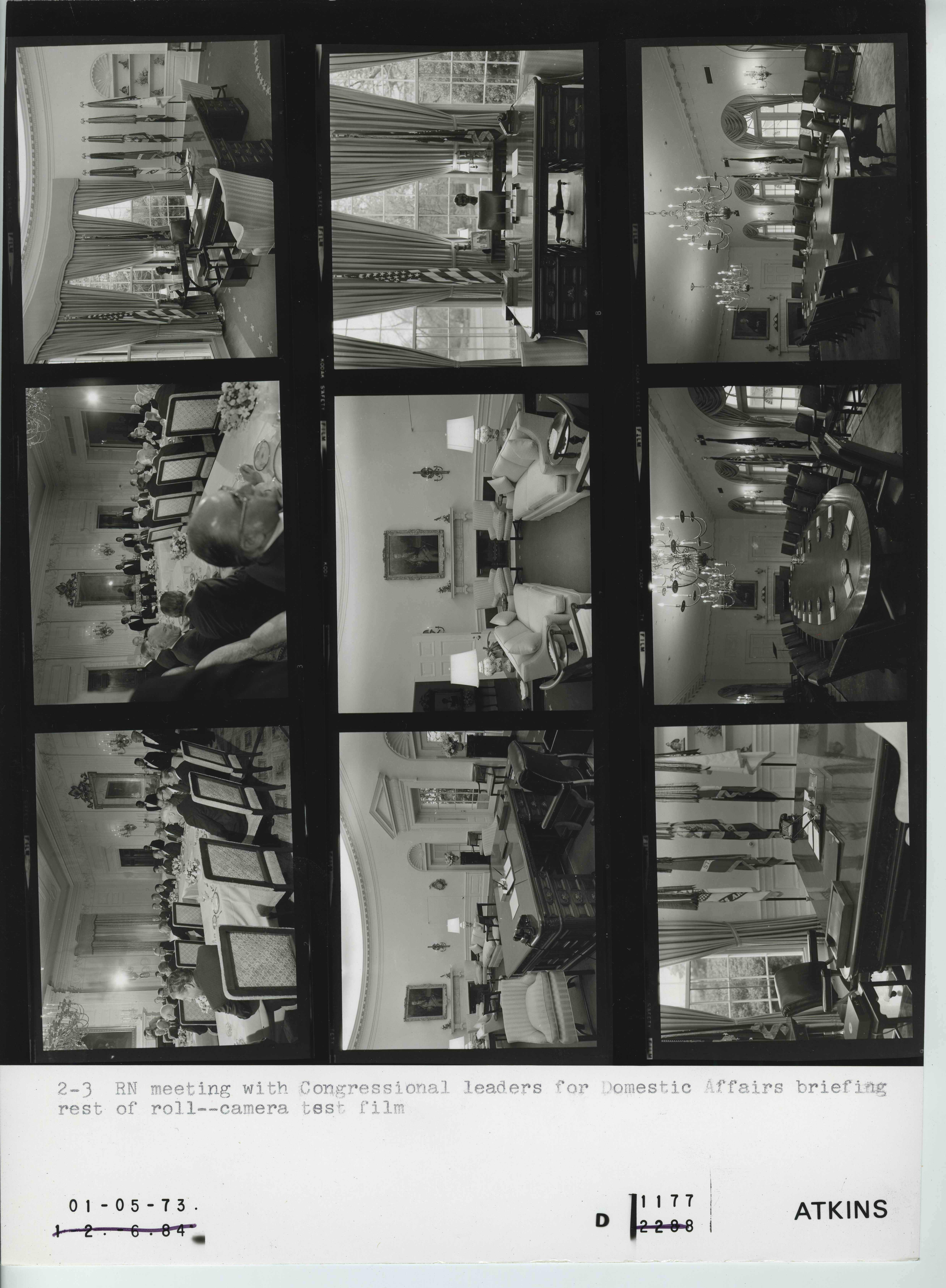
- Frame(s): WHPO-D1177-02-03, President Nixon seated at breakfast with bipartisan Congressional leaders and selected Committee Chairmen for Domestic Affairs briefing. 1/5/1973, Washington, D.C. State Dining Room, Oval Office, White House, Cabinet Room. President Nixon, Carl Albert, Mansfield, Thomas (Tip) O'Neill, Gerald Ford, George Shultz, Hugh Scott, leaders, unidentified chairmen, Staff, Butlers.
- Frame(s): WHPO-D1177-04-08, Unoccupied Oval Office, couch seating area and President's desk area furniture. 1/5/1973, Washington, D.C. State Dining Room, Oval Office, White House, Cabinet Room.
- Frame(s): WHPO-D1177-11, Unoccupied Cabinet Room with table set for a meeting. 1/5/1973, Washington, D.C. Cabinet Room.
Roll WHPO-D1178 Photographer: Atkins, Oliver | Color or B&W: B&W
- Frame(s): WHPO-D1178-02, President Nixon seated informally with Israeli President Shazar, Israeli Ambassador Rabin and Col. Kennedy. 1/5/1973, Washington, D.C. White House, Oval Office. President Nixon, S. Zalman Shazar, Yitzhak Rabin, Richard Kennedy, Edward David, Jr., Kim Chong-pil, Kim Yong-sik, Dong Jo Kim, Carl Han, Henry Sullivan, John Lynch, Peter Flanigan.
- Frame(s): WHPO-D1178-04-11, President Nixon with Dr. David. 1/5/1973, Washington, D.C. White House, Oval Office. President Nixon, S. Zalman Shazar, Yitzhak Rabin, Richard Kennedy, Edward David, Jr., Kim Chong-pil, Kim Yong-sik, Dong Jo Kim, Carl Han, Henry Sullivan, John Lynch, Peter Flanigan.
- Frame(s): WHPO-D1178-13-14, President Nixon seated informally with Korean dignitaries. 1/5/1973, Washington, D.C. White House, Oval Office. President Nixon, S. Zalman Shazar, Yitzhak Rabin, Richard Kennedy, Edward David, Jr., Kim Chong-pil, Kim Yong-sik, Dong Jo Kim, Carl Han, Henry Sullivan, John Lynch, Peter Flanigan.
- Frame(s): WHPO-D1178-19-21, President Nixon seated informally with Irish Prime Minister Lynch. 1/5/1973, Washington, D.C. White House, Oval Office. President Nixon, S. Zalman Shazar, Yitzhak Rabin, Richard Kennedy, Edward David, Jr., Kim Chong-pil, Kim Yong-sik, Dong Jo Kim, Carl Han, Henry Sullivan, John Lynch, Peter Flanigan.
Roll WHPO-D1179 Photographer: Royer | Color or B&W: B&W
- Frame(s): WHPO-D1179-05-25, Portrait of Mike Farrell outside White House. 1/5/1973, Washington, D.C. White House, South Lawn. Mike Farrell.
Roll WHPO-D1180 Photographer: Schumacher, Karl | Color or B&W: B&W
- Frame(s): WHPO-D1180-06-08, Vice President Agnew seated with Yen Chia- Kan, Vice President of the Republic of China and others. 1/5/1973, Washington, D.C. Executive Office Building, Vice Presidential Office. Spiro Agnew, Yen Chia-Kan, Tsai Wei-ping, James Shen (Taiwanese Ambassador to the U.S.), Stylianos Pattakos, unidentified man.
- Frame(s): WHPO-D1180-09-14, Vice President Agnew seated with Mr. Pattakos of Greece and an unidentified man. 1/5/1973, Washington, D.C. Executive Office Building, Vice Presidential Office. Spiro Agnew, Yen Chia-Kan, Tsai Wei-ping, James Shen (Taiwanese Ambassador to the U.S.), Stylianos Pattakos, unidentified man.
Roll WHPO-D1181 Photographer: Schumacher, Karl | Color or B&W: B&W
- Frame(s): WHPO-D1181-06-13, Vice President Agnew seated informally with Rep. of China Vice President Yen Chia-Kan of China. 1/5/1973, Washington, D.C. Executive Office Building, Vice Presidential Office. Spiro Agnew, Yen Chia-Kan, Stylianos Pattakos.
- Frame(s): WHPO-D1181-14-17, Vice President Agnew seated informally with Mr. Pattakos of Greece. 1/5/1973, Washington, D.C. Executive Office Building, Vice Presidential Office. Spiro Agnew, Yen Chia-Kan, Stylianos Pattakos.
Roll WHPO-D1182 Photographer: Knudsen, Robert L. | Color or B&W: B&W
- Frame(s): WHPO-D1182-01A-03A, President Nixon and Richard Kennedy seated informally with Philippine Secretary of Foreign Affairs Carlos Rumulo. 1/5/1973, Washington, D.C. White House, Oval Office. President Nixon, Carlos Rumulo, Yen Chia-Kan, James Shen, Tsai Wei-ping, Richard Kennedy.
- Frame(s): WHPO-D1182-07A-11A, President Nixon and Richard Kennedy seated informally with Philippine Secretary of Foreign Affairs Carlos Rumulo, Republic of China Vice President Yen Chia-Kan, Ambassador to the U.S. James Shen, and Vice Minister of Foreign Affairs Tsai Wei-ping. 1/5/1973, Washington, D.C. White House, Oval Office. President Nixon, Carlos Rumulo, Yen Chia-Kan, James Shen, Tsai Wei-ping, Richard Kennedy.
Roll WHPO-D1183 Photographer: Knudsen, Robert L. | Color or B&W: B&W
- Frame(s): WHPO-D1183-02, Unoccupied office desk with typewriter. 1/5/1973, Washington, D.C. unknown. Haig, William Rogers, John A. Scali, unidentified men and women.
- Frame(s): WHPO-D1183-03-11, Departure party for General Alexander Haig. 1/5/1973, Washington, D.C. unknown. Haig, William Rogers, John A. Scali, unidentified men and women.
The White House Communications Agency Sound Recordings Collection contains public statements that took place between 1969 and 1974. Visit the finding aid to learn more.
H - White House Staff Member Recordings
- WHCA-SR-H-688
Press briefing by John D. Ehrlichman and Ronald Ziegler. (1/5/1973, Press Lobby, White House)
Runtime: 55:00:00
Keywords: Press conferences, news conferences, interviews, media, press secretary
Production credits: Audio feed supplied by WHCA; Recorded by LDH (initials of WHCA engineer)
Original Format: 1/4-inch reel-to-reel audiotape. Original source type: Original.
L - White House Press Office Briefings
- WHCA-SR-L-100
Press briefing by Ronald Ziegler. (1/5/1973, White House Press Lobby)
Runtime: 42:24:00
Keywords: Press conferences, news conferences, interviews, media, press secretary
Original Format: 1/4-inch reel-to-reel audiotape. Original source type: Original.
P - Formal Presidential Remarks
- WHCA-SR-P-730102
Remarks by President Nixon at Congressional leadership breakfast with JDE, GS. (1/5/1973)
Runtime: 80:09:00
Original Format: 1/4-inch reel-to-reel audiotape. Original source type: Original. - WHCA-SR-P-730103
Remarks by President Nixon at reception for freshman Congressmen. (1/5/1973)
Runtime: 6:44
Original Format: 1/4-inch reel-to-reel audiotape. Original source type: Original.
The White House Communications Agency Videotape Collection contains “off-the-air” recordings of televised programs produced between 1968 and 1974. Visit the finding aid to learn more.
- WHCA-5993
Weekly News Summary, Tape I.
ALL NETWORKS
Runtime: 01:35:44
1. Smith/Jarriel: Canada disapproves of U.S. war actions; President Nixon meets with heads of Congress (Moss). Time Code Start: 00:00. Keywords: Presidents, House of Representatives, leaders, meetings, Vietnam War. Network: ABC.
2. Reasoner: Paris peace talks, Vietnam. Time Code Start: 02:10. Keywords: Paris Peace Talks, Vietnam War, treaty, treaties, negotiations. Network: ABC.
3. Smith/Matney: President Nixon meets with dignitaries who went to former President Truman's memorial services. Time Code Start: 02:45. Keywords: Presidents, death, memorials, ceremony, ceremonies, heads of state, meetings. Network: ABC.
4. Smith: President Nixon gives cabinet members more power. Time Code Start: 05:00. Keywords: Presidents, cabinet, advisors. Network: ABC.
5. Reasoner: Unemployment at 5.2%. Time Code Start: 05:33. Keywords: jobs, unemployment, statistics. Network: ABC.
6. Smith: Commentary on who will run in '76. Time Code Start: 06:05. Keywords: Presidential elections, campaigns, campaigning, candidates, predictions. Network: ABC.
7. Chancellor/Graham: President Nixon meets with Congress. Time Code Start: 08:09. Keywords: Presidents, meetings, House of Representatives, leaders. Network: NBC.
8. Chancellor: Paris peace talks; world reaction. Time Code Start: 10:21. Keywords: Paris Peace Talks, Vietnam War, treaty, treaties, negotiations. Network: NBC.
9. Chancellor: Unemployment figures. Time Code Start: 11:22. Keywords: jobs, unemployment, statistics. Network: NBC.
10. Chancellor/Stern: Watergate case. Time Code Start: 12:00. Keywords: Watergate, Senate committee hearings, investigations, testimony, testify, cover-ups, break-in, burglary, theft, plumbers, scandals. Network: NBC.
11. Chancellor: New appointments by President Nixon. Time Code Start: 13:55. Keywords: Presidents, cabinet, advisors, nominations, appointments, confirmations. Network: NBC.
12. Chancellor/McCormick: Memorial for former President Truman in Washington D.C. at the Washington Cathedral. Time Code Start: 14:49. Keywords: Presidents, death, memorials, ceremony, ceremonies. Network: NBC.
13. Rather/Pierpoint: New appointments by President Nixon. Time Code Start: 17:04. Keywords: Presidents, cabinet, advisors, nominations, appointments, confirmations. Network: CBS.
14. Mudd: Interview with Senator Moss after President Nixon's briefing. Time Code Start: 19:55. Keywords: Presidents, Senators, media, press conferences, news conferences, interviews. Network: CBS.
15. Rather: Reaction to bombing by other countries. Time Code Start: 21:13. Keywords: Vietnam War, bombings. Network: CBS.
16. Rather/Newfeld: Farm supports dropped by government for certain farm areas. Time Code Start: 23:00. Keywords: agriculture, farming, financial aid, funding, decreases. Network: CBS.
17. Rather: Interview with Secretary of Agriculture Butz on farm supports. Time Code Start: 25:21. Keywords: cabinet, advisors, farming, funding, decreases, media, press conferences, news conferences, interviews. Network: CBS.
18. Rather/Schorr: Watergate case. Time Code Start: 26:17. Keywords: Watergate, Senate committee hearings, investigations, testimony, testify, cover-ups, break-in, burglary, theft, plumbers, scandals. Network: CBS.
19. Rather: Unemployment figures. Time Code Start: 30:09. Keywords: jobs, unemployment, statistics. Network: CBS.
20. Rather/Herman: Memorial for former President Truman at the Washington Cathedral in Washington, D.C.. Time Code Start: 31:12. Keywords: Presidents, death, memorials, ceremony, ceremonies. Network: CBS.
Context (External Sources)
The Vanderbilt Television News Archive is the world's most extensive and complete archive of television news. They have been recording, preserving and providing access to television news broadcasts of the national networks since August 5, 1968.
Wikipedia is a free encyclopedia that anyone can edit.