
Introduction
This almanac page for Thursday, January 4, 1973, pulls together various records created by the federal government and links to additional resources which can provide context about the events of the day.
Previous Date: Wednesday, January 3, 1973
Next Date: Friday, January 5, 1973
Schedule and Public Documents
The Daily Diary files represent a consolidated record of the President's activities. Visit the finding aid to learn more.
The President's day began at The White House - Washington, D. C.
The Weekly Compilation of Presidential Documents made available transcripts of the President's news conferences; messages to Congress; public speeches, remarks, and statements; and other Presidential materials released by the White House.
Digitized versions can be found at HathiTrust.
The Federal Register is the official daily publication for rules, proposed rules, and notices of federal agencies and organizations, as well as executive orders and other Presidential documents.
The Congressional Record is the official daily record of the debates and proceedings of the U.S. Congress.
Archival Holdings
Any selection of archival documents will necessarily be partial. You should use the documents and folders identified below as a starting place, but consult the linked collection finding aids and folder title lists and the collections themselves for context. Many documents to be found this way do not lend themselves to association with specific dates, but are essential to a complete understanding of the material.
Selective document listing
President's Office Files
The President's Office Files consists of materials drawn together by the Special Files Unit from several administrative subdivisions within the White House Office. It is the handwriting and sensitive papers sent to the Staff Secretary that now comprise much of the President's Office Files. Visit the finding aid to learn more.
- News Summaries, Unmarked News Summaries, Box 53, News Summaries - January 2 to 11, 1973 [3 of 7] [Note: Due to the way News Summary products were compiled, you should also consult nearby days for potentially relevant materials.]
- News Summary, January 4, 1973, (Wed. nets and wires)
The H. R. Haldeman Diaries consists of seven handwritten diaries, 36 dictated diaries recorded as sound recordings, and two handwritten audio cassette tape subject logs. The diaries and logs reflect H. R. Haldeman’s candid personal record and reflections on events, issues, and people encountered during his service in the Nixon White House. As administrative assistant to the President and Chief of Staff, Haldeman attended and participated in public events and private meetings covering the entire scope of issues in which the Nixon White House engaged in during the years 1969-1973. Visit the finding aid to learn more.
- Transcript of diary entry (PDF)
Thursday, January 4.
The President had Ziegler and me in first thing this morning, reviewing plans for Ziegler's briefing. Told Ron, on Vietnam, to say there's no further comment from the White House, because of the sensitive negotiations under way. Reviewed other general items with Ron and got into how to handle press coverage of the Friday night Congressional reception. Told him that he could invite the two wire services and some good friendly reporters -- include their wives -- but let them cover it on a writing basis, also say that they were selected because of their interest in the new members of Congress. He also said he wanted from Ron on an early date the Nixon loyalist list to work on, including Timmons and Mollenhoff and that type, and also a list of those people that he should not see.
He had me talk to Rose today, and it went pretty well. She didn't seem to be particularly upset, or at least didn't want to get into any of her concerns with me. We had a good session on general plans for the second term: social engagement lists, etcetera.
He got into the education money question again, wanted me to hit Weinberger -- which I did on cutting MIT. He wants a further study of direct and indirect subsidy of higher education. Thinks all Cap had given him before was HEW and he wanted to cover everything, all Federal Government support, in every form. And wanted Cap to get together with Schlesinger on this, because of his suggestion that we make the cuts at MIT before Richardson gets into Defense, that is the Defense support cuts.
He got into a fair number of personnel items on AEC, but still wants to go with Dixy Lee Ray, if Schlesinger can sell her. Is concerned about ACTA; and thought we agreed probably we should go with Agnew. Raised the question of John Foster to the AEC, but then that was dropped later on the basis of that he's too much of a research man.
Told me to find out whether the dragon lady knows Thieu at all, or who the individual is in the United States who knows him best, and might be able to help us deal with him. Obviously he has something in mind there. That lead into some analysis of Vietnam and of the Congress --he can't figure why they all keep the pressure on for an explanation of why he's doing the bombing, and I must say I agree. The reason seems to be obvious, and I can't conceive that any intelligent person doesn't clearly understand why he's bombing, therefore, the questions and arguments are obviously political or academic.
He also got into his Kissinger concerns again. The need to keep Henry's dauber up this week, so that he will go strongly into the negotiations. Also, his concern about Haig being gone and whether Scowcroft is going to be strong enough to handle Henry and the problems there. I had a long talk with Henry late in the afternoon. He seemed to be in good shape, feels he's got a good chance of bringing off the negotiations, and overall seems to be at least reasonably optimistic.
They had a session with Laird, Rogers, and Moore this morning, and I guess that Rogers was pretty bad in it, making such helpful comments as “explain to Henry that he has to realize that you don't have an agreement until it's signed”, and that “he shouldn't run around smiling when he's with Le Duc Tho”. But other than the trivia, apparently everybody is solidly behind the program, and no real problem there. The President still is concerned about dealing with reaction here in the press and the Congress, but concludes that there is no way we can. That they're obsessed with negative stuff with Vietnam and are going to play it no matter what we do, and that all he can do is ride it out. If we get the settlement, none of the comment now will matter; if we don't get it we'll have far greater problems to deal with then what we now have.
End of January 4. - Original audio recording (MP3)
The National Archives Catalog is the online portal to the records held at the National Archives, and information about those records. It is the main way of describing our holdings and also provides access to electronic records and digitized versions of our holdings.
The Catalog searches across multiple National Archives resources at once, including archival descriptions, digitized and electronic records, authority records, and web pages from Archives.gov and the Presidential Libraries. The Catalog also allows users to contribute to digitized historical records through tagging and transcription.
Nixon Library Holdings
All National Archives Units
National Security Documents
The President's Daily Brief is the primary vehicle for summarizing the day-to-day sensitive intelligence and analysis, as well as late-breaking reports, for the White House on current and future national security issues. Read "The President's Daily Brief: Delivering Intelligence to Nixon and Ford" to learn more.
The Foreign Relations of the United States series presents the official documentary historical record of major U.S. foreign policy decisions and significant diplomatic activity. Visit the State Department website for more information.
Vol. IX, Vietnam, October 1972-January 1973
America Leaves the War, December 30, 1972-January 27, 1973
245. Memorandum of Conversation, Washington, January 4, 1973, 10 a.m.
Source: National Archives, Nixon Presidential Materials, NSC Files, Box 1026, Presidential/HAK MemCons, January–March 1973. Secret; Sensitive. All brackets, with the exception of those describing omitted material, are in the original.
246. Message From the Chief of the U.S. Delegation to the Paris Peace Talks (Porter) to the President’s Assistant for National Security Affairs (Kissinger), Paris, January 4, 1973, 1931Z
Source: National Archives, Nixon Presidential Materials, NSC Files, Box 865, For the President’s Files (Winston Lord)—China Trip/Vietnam, Camp David Memcons, December 1972 [1 of 3]. Secret; Sensitive; Exclusively Eyes Only. Sent via Guay and Kennedy.
247. Memorandum From the Special Assistant for Vietnamese Affairs, Central Intelligence Agency (Carver) to Director of Central Intelligence Helms, Washington, January 4, 1973
Source: Central Intelligence Agency, Files of the Deputy Director for Intelligence, Job 80–R01720R, Box 8, Folder 3, GAC [George A. Carver] Chronology. Secret; Sensitive.
Vol. XXXV, National Security Policy, 1973-1976
National Security Policy
1. Memorandum From the President’s Assistant for National Security Affairs (Kissinger) for the President’s Files, Washington, January 4, 1973, 11:45 a.m.
Source: National Archives, Nixon Presidential Materials, NSC Files, Presidential/HAK MemCons, Box 1025, MemCon—The President, Sec. Richardson, and HAK, Jan. 4, 1973. Secret; Sensitive. The memorandum is not initialed by Kissinger. The meeting, held in the Oval Office, concluded at 12:37 p.m. (Ibid., White House Central Files, President’s Daily Diary) There is a tape recording of this conversation. (Ibid., White House Tapes, Oval Office, Conversation No. 833–11)
Vol. E-3, Documents on Global Issues, 1973-1976
Drug Control, 1973-1976
143. Memorandum From the Director of the Special Action Office for Drug Abuse Prevention (Jaffe) to the Associate Director of the Domestic Council (Shepard), Washington, January 4, 1973
The memorandum clarified and suggested a reconsideration of U.S. policy concerning elimination of poppy cultivation.
Source: National Archives, RG 170, Acc. # 89–0025, Box 1, Opium Policy: 12/73 policy paper background. No classification marking.
Vol. E-12, Documents on East and Southeast Asia, 1973-1976
Japan
165. Memorandum of Conversation, Washington, January 4, 1973, 5:40 p.m., Washington, January 4, 1973, 5:40 p.m.
Kissinger criticized the Japanese government’s Vietnam message and discussed the state of U.S.-Japanese relations with Ambassador Ushiba.
Source: National Archives, Nixon Presidential Materials, NSC Files, Box 538, Country Files, Far East, Japan, January–June 1973, vol. 9. Secret; Sensitive. The meeting was held in Kissinger’s office. On January 3, John Holdridge provided talking points for Kissinger’s meeting with Ushiba and attached telegram 232944 to Tokyo, December 28, 1972, which contained the text of a message that Ushiba gave to U. Alexis Johnson on December 27, 1972, appealing to the United States to resume Vietnam peace negotiations as quickly as possible. (Ibid.)
Vol. E-15, Part 2, Documents on Western Europe, 1973-1976, Second, Revised Edition
Western Europe Regional, 1973-1976
1. Memorandum From the President’s Assistant for International Economic Affairs (Flanigan) to President Nixon, Washington, January 4, 1973
Summary: Flanigan sought Nixon’s approval of U.S. policy toward Concorde.
Source: National Archives, Nixon Presidential Materials, NSC Files, Box 752, Presidential Correspondence, France, Pompidou, 1972 (1 of 2). Confidential. Shultz and Colson concurred. Attached but not published is Tab 1, a December 11, 1972 letter from Kosciusko-Morizet to Nixon; Tab 2, a December 11 letter from Cromer to Nixon; and Tab 3, minutes of a December 11, 1972 Interagency Review Group discussion of Concorde. Nixon did not indicate his preferences regarding Flanigan’s recommendations; however, he did sign the attached letters to Heath and Pompidou, both of which are dated January 19. (Ibid.)
The Kissinger telephone conversation transcripts consist of approximately 20,000 pages of transcripts of Kissinger’s telephone conversations during his tenure as Assistant to the President for National Security Affairs (1969-1974) and Secretary of State (1973-1974) during the administration of President Richard Nixon. Visit the finding aid for more information.
Digitized versions can be found in the National Archives Catalog.
Audiovisual Holdings
Visit the White House Tapes finding aid to learn about the taping system's operation and archival processing.
Old Executive Office Building
- 393-4; Unknown between 1:48 p.m. & 2:54 p.m.; Nixon, Richard M. (President); Sanchez, Manolo
- 393-5; Unknown between 1:48 p.m. & 2:54 p.m.; Nixon, Richard M. (President); Sanchez, Manolo
- 393-6; Unknown between 1:48 p.m. & 2:54 p.m.; Nixon, Richard M. (President); Kissinger, Henry A.
- 393-7; Unknown between 1:48 p.m. & 2:54 p.m.; Nixon, Richard M. (President); Sanchez, Manolo
- 393-8; Unknown between 1:48 p.m. & 2:54 p.m.; Nixon, Richard M. (President); White House operator
- 393-9; Unknown between 1:48 p.m. & 2:54 p.m.; Nixon, Richard M. (President); Sanchez, Manolo
- 393-10; 2:54 p.m. - 2:55 p.m.; Nixon, Richard M. (President); Bull, Stephen B.
- 393-11; Unknown between 3:02 p.m. & 5:15 p.m.; Nixon, Richard M. (President); Ehrlichman, John D.; Haldeman, H. R. ("Bob"); Kissinger, Henry A.
- 393-12; Unknown between 5:15 p.m. & 5:16 p.m.; Nixon, Richard M. (President); Sanchez, Manolo
- 393-13; Unknown between 5:15 p.m. & 5:16 p.m.; Nixon, Richard M. (President); White House operator
- 393-14; 5:16 p.m. - 5:50 p.m.; Nixon, Richard M. (President); Colson, Charles W.; Bull, Stephen B.; Kissinger, Henry A.; Woods, Rose Mary
Oval Office
- 833-1; Unknown between 8:35 a.m. & 8:46 a.m.; Nixon, Richard M. (President); Bull, Stephen B.
- 833-2; Unknown between 8:35 a.m. & 8:46 a.m.; Nixon, Richard M. (President); Bull, Stephen B.; Sanchez, Manolo
- 833-3; Unknown between 8:35 a.m. & 8:46 a.m.; Nixon, Richard M. (President); White House operator
- 833-4; Unknown between 8:46 a.m. & 8:50 a.m.; Nixon, Richard M. (President); Colson, Charles W.
- 833-5; Unknown between 8:50 a.m. & 8:53 a.m.; Nixon, Richard M. (President); [Unknown person(s)]
- 833-6; Unknown between 8:50 a.m. & 8:53 a.m.; Nixon, Richard M. (President); White House operator
- 833-7; Unknown between 8:53 a.m. & 8:55 a.m.; Nixon, Richard M. (President); Colson, Charles W.
- 833-8; Unknown between 8:53 a.m. & 9:03 a.m.; Nixon, Richard M. (President); White House operator
- 833-9; Unknown between 8:55 a.m. & 9:03 a.m.; Nixon, Richard M. (President); Bull, Stephen B.
- 833-10; Unknown between 9:03 a.m. & 9:04 a.m.; Nixon, Richard M. (President); Martin, Paul L.; Ziegler, Ronald L.; Haldeman, H. R. ("Bob"); Kissinger, Henry A.; Bull, Stephen B.
- 833-11; Unknown between 10:03 a.m. & 11:33 a.m.; Nixon, Richard M. (President); Kissinger, Henry A.; Rogers, William P.; Moorer, Thomas H. (Adm.); Kennedy, Richard T. (Col.); Laird, Melvin R.
- 833-12; Unknown between 11:33 a.m. & 11:37 a.m.; Nixon, Richard M. (President); Bull, Stephen B.; Kissinger, Henry A.
- 833-13; Unknown between 11:37 a.m. & 11:48 a.m.; Nixon, Richard M. (President); Haig, Alexander M., Jr.; Laird, Melvin R.; Rogers, William P.; Kissinger, Henry A.; Moorer, Thomas H. (Adm.); Froehlke, Robert F.; Abrams, Creighton W., Jr. (Gen.); Scowcroft, Brent G. (Gen.); Golden, William L. (Lt. Col.); Haig, Alexander M., Sr. (Mrs.); Haig, Patricia; Fox, Alonzo; Haig, Alexander M., Sr.; Haig, Brian; Haig, Barbara; Haig, Frank; Meredith, Edward B.; Meredith, Edward B. (Mrs.); Meredith, George (Mrs.); Woods, Rose Mary; Bull, Stephen B.; Atkins, Oliver F. ("Ollie")
- 833-14; Unknown between 11:48 a.m. & 11:51 a.m.; Nixon, Richard M. (President); Ziegler, Ronald L.
- 833-15; Unknown between 11:51 a.m. & 11:55 a.m.; Nixon, Richard M. (President); Bull, Stephen B.
- 833-16; Unknown between 11:51 a.m. & 11:55 a.m.; Nixon, Richard M. (President); Bull, Stephen B.
- 833-17; 11:55 a.m. - 12:42 p.m.; Nixon, Richard M. (President); Richardson, Elliot L.; Kissinger, Henry A.; Bull, Stephen B.; [Unknown person(s)]
- 833-18; Unknown between 12:42 p.m. & 12:45 p.m.; Nixon, Richard M. (President); Sanchez, Manolo
- 833-19; Unknown between 12:42 p.m. & 12:45 p.m.; Nixon, Richard M. (President); Bull, Stephen B.; Haldeman, H. R. ("Bob")
- 833-20; 12:45 p.m. - 1:01 p.m.; Nixon, Richard M. (President); Kissinger, Henry A.; Smith, Gerard C.; Bull, Stephen B.; Atkins, Oliver F. ("Ollie")
- 833-21; Unknown between 1:01 p.m. & 1:46 p.m.; Nixon, Richard M. (President); Bull, Stephen B.; Haldeman, H. R. ("Bob")
- 833-22; Unknown between 1:46 p.m., 1/4 & 10:11 a.m., 11/30; [Unknown person(s)]
White House Telephone
- 35-79; Unknown between 8:35 a.m. & 8:46 a.m.; Nixon, Richard M. (President); White House operator
- 35-80; 8:46 a.m. - 8:50 a.m.; Nixon, Richard M. (President); Colson, Charles W.
- 35-81; Unknown between 8:50 a.m. & 8:53 a.m.; Nixon, Richard M. (President); White House operator
- 35-82; 8:53 a.m. - 8:55 a.m.; Nixon, Richard M. (President); Colson, Charles W.
- 35-83; Unknown between 8:55 a.m. & 9:03 a.m.; Nixon, Richard M. (President); White House operator
- 35-84; 9:03 a.m. - 9:04 a.m.; Nixon, Richard M. (President); Martin, Paul L.
- 35-85; Unknown between 1:48 p.m. & 2:54 p.m.; Nixon, Richard M. (President); White House operator
- 35-86; 2:54 p.m. - 2:55 p.m.; Nixon, Richard M. (President); Bull, Stephen B.
- 35-87; Unknown between 5:15 p.m. & 5:16 p.m.; Nixon, Richard M. (President); White House operator
- 35-88; 5:17 p.m. - 5:18 p.m.; Nixon, Richard M. (President); Bull, Stephen B.
- 35-89; Unknown between 5:52 p.m. & 8:13 p.m.; Nixon, Richard M. (President); White House operator
- 35-90; 8:13 p.m. - 8:34 p.m.; Nixon, Richard M. (President); Colson, Charles W.
The White House Photo Office collection consists of photographic coverage of President Richard Nixon meeting with prominent social, political, and cultural personalities; speaking engagements and news conferences of the President and various high-ranking members of the White House staff and Cabinet; Presidential domestic and foreign travel, including Presidential vacations; social events and entertainment involving the First Family, including entertainers present; official portraits of the President, First Family, and high-ranking members of the Nixon administration; the 1969 and 1973 Inaugurals; the President’s 1972 Presidential election campaign appearances (including speeches) and other official activities of the White House staff and the President’s Cabinet from January 20, 1969 until August 9, 1974 at the White House and the Old Executive Office Building; other locations in Washington, DC, such as The Mall; and the Presidential retreats in Camp David, Maryland, Key Biscayne, Florida, and San Clemente, California. Visit the finding aid to learn more.
Roll WHPO-D1172 Photographer: Royer | Color or B&W: B&W
- Frame(s): WHPO-D1172-02-08, Deputy Special Assistant John E. Nidecker accepting a painting from Mr. & Mrs. Jordan. 1/4/1973, Washington, D.C. unknown. John Nidecker, Mr. & Mrs. Jordan.
Roll WHPO-D1173 Photographer: Atkins, Oliver | Color or B&W: B&W
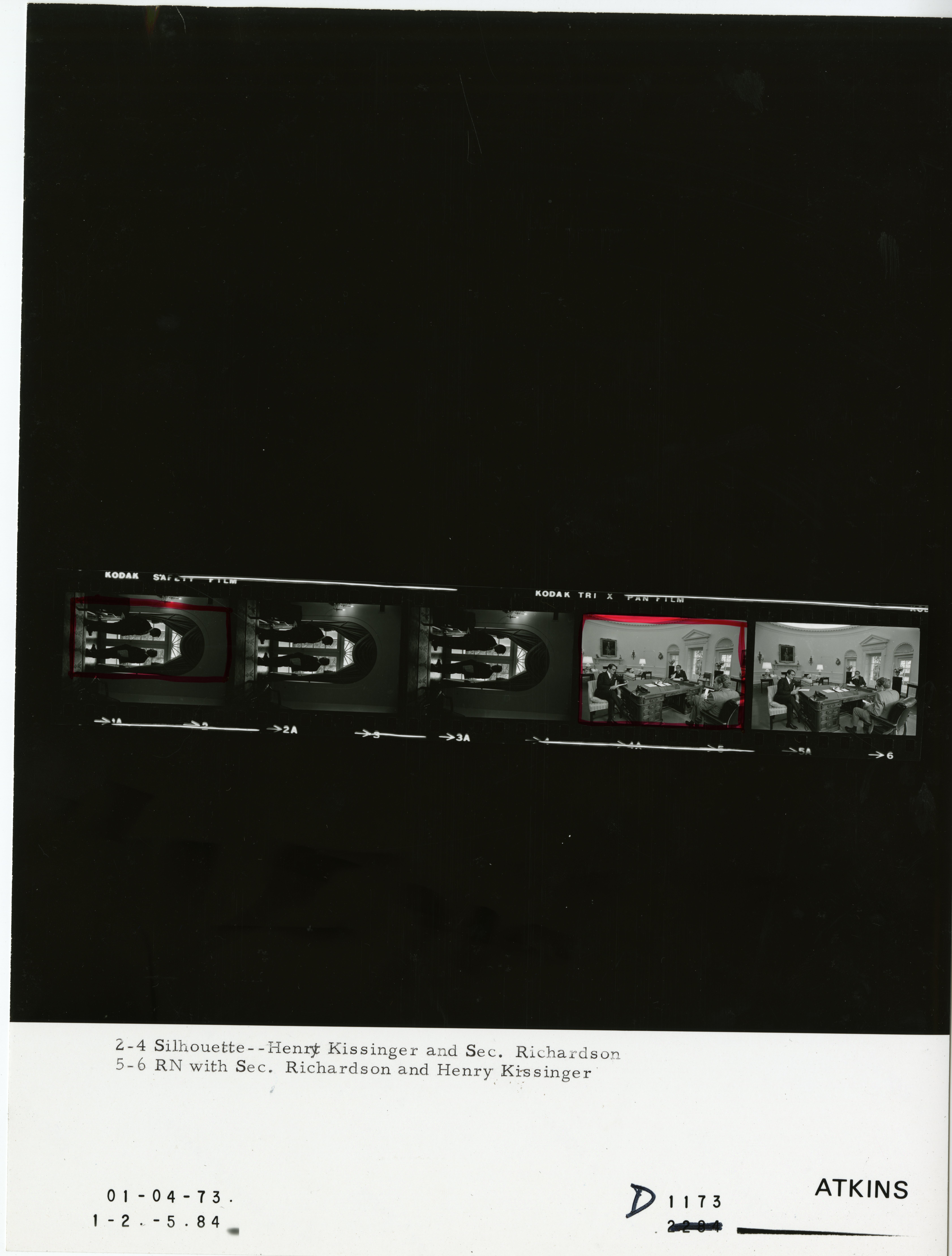
- Frame(s): WHPO-D1173-02-04, Henry Kissinger and Elliot Richardson seen in silhouette standing by the Oval office French window door. 1/4/1973, Washington, D.C. White House, Oval Office. Henry Kissinger, Elliot Richardson.
- Frame(s): WHPO-D1173-04A, President Nixon seated at his desk during a meeting with Henry Kissinger and Elliot Richardson. 1/4/1973, Washington, D.C. White House, Oval Office. President Nixon, Henry Kissinger, Elliot Richardson.
- Frame(s): WHPO-D1173-05-06, President Nixon seated at his desk during a meeting with Henry Kissinger and Richardson. 1/4/1973, Washington, D.C. White House, Oval Office. President Nixon, Henry Kissinger, Elliot Richardson.
Roll WHPO-D1174 Photographer: Atkins, Oliver | Color or B&W: B&W
- Frame(s): WHPO-D1174-02-04, 06-12, 14-15, President Nixon in the Oval Office presenting the Defense Distinguished Service Medal to Major General Alexander Haig while Henry Kissinger, Melvin Laird and Secretary of State William Rogers stand nearby. 1/4/1973, Washington, D.C. White House, Oval Office. President Nixon, Alexander Haig, Henry Kissinger, William Rogers, Melvin Laird, military officials, aides, guests.
- Frame(s): WHPO-D1174-05, 13, President Nixon in the Oval Office presenting the Defense Distinguished Service Medal to Major General Alexander Haig while Henry Kissinger, Melvin Laird and Secretary of State William Rogers stand nearby. 1/4/1973, Washington, D.C. White House, Oval Office. President Nixon, Alexander Haig, Henry Kissinger, William Rogers, Melvin Laird.
- Frame(s): WHPO-D1174-09, President Nixon in the Oval Office presenting the Defense Distinguished Service Medal to Major General Alexander Haig while Henry Kissinger, Melvin Laird and Secretary of State William Rogers and an unidentified miltiary aide stands nearby. 1/4/1973, Washington, D.C. White House, Oval Office. President Nixon, Alexander Haig, Henry Kissinger, William Rogers, Melvin Laird, unidentified military aide.
- Frame(s): WHPO-D1174-15, President Nixon and Major General Alexander Haig in the Oval Office greeting guests after presenting the Defense Distinguished Service Medal to General Alexander Haig. Catholic priest Father Frank Haig, and West Point Cadet Brian Haig in uniform stand nearby. 1/4/1973, Washington, D.C. White House, Oval Office. President Nixon, Maj. Gen. Alexander M. Haig, Jr., Deputy Assistant Melvin R. Laird, Secretary of Defense Henry M. Kissinger, Assistant Adm. Thomas H. Moorer, Chairman of the JCS. Robert F. Froehlke, Secretary of the Army, Gen. Creighton Abrams, Army Chief of Staff Brig. Gen. Brent Scowcroft, Military Assistant Col. William L. Golden, Military Aide, Mrs. Alexander M. Haig, Sr., mother Mrs. Alexander M. Haig, Jr., wife Lt. Gen. Alonzo Fox, Ret., father-in-law Alexander M. Haig. III, son Cadet Brian Haig, son, Barbara Haig, daughter, Father Frank Haig, brother, Mr. and Mrs. Edward B. Meredith, sister and brother-in-law Mrs. George Meredith, mother-in-law to Gen. Haig's sister, Rose Mary Woods, Personal Secretary to the President.
Roll WHPO-D1175 Photographer: Atkins, Oliver | Color or B&W: B&W
- Frame(s): WHPO-D1175-02A, 07A, 09A, President Nixon and Major General Alexander Haig in the Oval Office with Haig family members after presenting the Defense Distinguished Service Medal to Major General Alexander Haig. 1/4/1973, Washington, D.C. White House, Oval Office. President Nixon, Maj. Gen. Alexander M. Haig, Jr., Mrs. Alexander M. Haig, Sr., mother Mrs. Alexander M. Haig, Jr., wife Lt. Gen. Alonzo Fox, Ret., father-in-law Alexander M. Haig. III, son Cadet Brian Haig, son, Barbara Haig, daughter, Father Frank Haig, brother, Mr. and Mrs. Edward B. Meredith, sister and brother-in-law Mrs. George Meredith, mother-in-law to Gen. Haig's sister.
- Frame(s): WHPO-D1175-07-18, President Nixon and Major General Alexander Haig in the Oval Office with Haig family members after presenting the Defense Distinguished Service Medal to Major General Alexander Haig. 1/4/1973, Washington, D.C. White House, Oval Office. President Nixon, Alexander Haig, Mrs. Haig, Haig children, Haig family members, William Rogers, Laird, Kissinger, Robert Froehlke, Thomas Moorer, Creighton Abrams, Brent Scowcroft.
- Frame(s): WHPO-D1175-12A, President Nixon and Major General Alexander Haig in the Oval Office with Officials and Armed Forces Leaders after the President presented Maj. Gen. Haig with the Defense Distinguished Service Medal. 1/4/1973, Washington, D.C. White House, Oval Office. President Nixon, Maj. Gen. Alexander M. Haig, Jr., Deputy Assistant. Melvin R. Laird, (Secretary of Defense) Henry M. Kissinger, Assistant, Adm. Thomas H. Moorer (Chairman of the Joint Chiefs of Staff). Robert F. Froehlke, (Secretary of the Army), Gen. Creighton Abrams, Army Chief of Staff Brig. Gen. Brent Scowcroft, Military Assistant Col. William L. Golden, Military Aide.
Roll WHPO-D1176 Photographer: Knudsen, Robert L. | Color or B&W: B&W
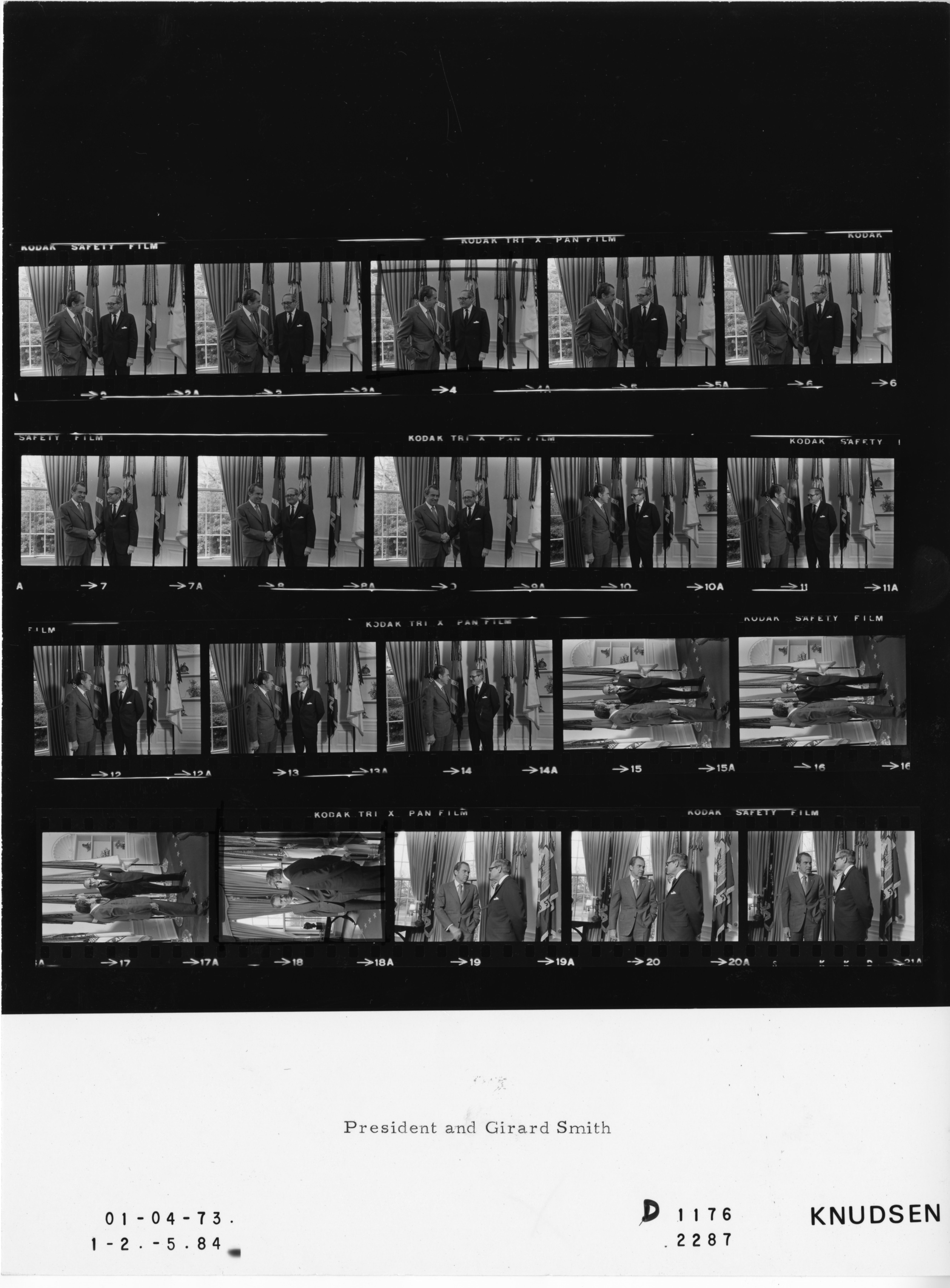
- Frame(s): WHPO-D1176-02-21, President Nixon with Gerard Smith, U.S. Ambassador to the SALT Agreement Talks. 1/4/1973, Washington, D.C. White House, Oval Office. President Nixon, Gerard Smith.
The White House Communications Agency Sound Recordings Collection contains public statements that took place between 1969 and 1974. Visit the finding aid to learn more.
L - White House Press Office Briefings
- WHCA-SR-L-099
Press briefing by Gerald Warren. (1/4/1973, White House Press Lobby)
Runtime: 28:38:00
Keywords: Press conferences, news conferences, interviews, media
Original Format: 1/4-inch reel-to-reel audiotape. Original source type: Original.
The White House Communications Agency Videotape Collection contains “off-the-air” recordings of televised programs produced between 1968 and 1974. Visit the finding aid to learn more.
- WHCA-5985
Weekly News Summary, Tape IV.
ALL NETWORKS
Runtime: 01:03:40
1. Reasoner/Cioffi: Paris peace talks; Hanoi casualty report. Time Code Start: 00:00. Keywords: Paris Peace Talks, treaty, treaties, negotiations, Vietnam War, killed in action, KIA, death tolls, fatalities, casualty, casualties, military, troops. Network: ABC.
2. Smith/Clark: Senate Democrats vote to stop war funds. Time Code Start: 02:34. Keywords: Senators, Vietnam War, funding, money, finances, political parties, Democratic Party, voting. Network: ABC.
3. Smith/Peterson/Tuckner: F14 cost overrun. Time Code Start: 04:27. Keywords: military, aircraft, costs, budgets. Network: ABC.
4. Smith/Geer: Death penalty asked by Kleindienst. Time Code Start: 07:32. Keywords: jails, penal institutions, incarceration, penitentiary, inmates, capital punishments, death sentences, death penalty. Network: ABC.
5. Reasoner/Jarriel: General Haig receives a medal. Time Code Start: 09:11. Keywords: Presidents, Generals, White House, staff, awards, medals, Armed Forces, Air Force, Army, Navy, Marines. Network: ABC.
6. Smith/Kreiger: Representative Boggs memorial. Time Code Start: 10:48. Keywords: Congress, officials, missing persons, planes, accidents, mysteries, death, memorials, ceremony, funeral. Network: ABC.
7. Reasoner: Law and fact; Constitutional questions today concern Presidential power of President Nixon. Time Code Start: 11:50. Keywords: Presidents, executive powers. Network: ABC.
8. Chancellor/Dobyns: Paris peace talks with Ambassador William J. Porter. Time Code Start: 14:55. Keywords: Paris Peace Talks, Vietnam War, treaty, treaties, negotiations, government, officials. Network: NBC.
9. Duke: Congress upset over lack of briefing by administration with Senator Jackson, Senator Ted Kennedy. Time Code Start: 17:58. Keywords: Senators, House of Representatives, voting, Vietnam War, funding, finances, decreases. Network: NBC.
10. Chancellor/Levine: Subsidy cuts with Secretary of Agriculture Butz. Time Code Start: 19:56. Keywords: food, markets, retail stores, prices, costs, increases, shortages, farming, funding, decreases, cabinet, advisors. Network: NBC.
11. Chancellor/Brinkley: Attorney General Kleindienst wants capital punishment restored; commentary by David Brinkley. Time Code Start: 22:32. Keywords: death sentences, executions, prisons, punishments. Network: NBC.
12. Rather/Mudd: Congress votes to stop war funds with Jackson, Senator Ted Kennedy. Time Code Start: 24:53. Keywords: House of Representatives, voting, Vietnam War, funding, finances, decreases. Network: CBS.
13. Rather/Kalisher: Vietnam, Paris peace talks with Ambassador William J. Porter. Time Code Start: 27:41. Keywords: Paris Peace Talks, Vietnam War, treaty, treaties, negotiations, government, officials. Network: CBS.
14. Kalb: More on Paris peace talks and Vietnam war. Time Code Start: 30:39. Keywords: Paris Peace Talks, Vietnam War, treaty, treaties, negotiations. Network: CBS.
15. Pierpoint: General Haig receives a promotion, Vietnam War briefing postponed. Time Code Start: 32:00. Keywords: cabinet, advisors, media, press conferences, news conferences, interviews, Vietnam War, military, leaders, military, awards, promotions. Network: CBS.
16. Sevareid: Commentary on the bombing issue. Time Code Start: 33:55. Keywords: Vietnam War, bombings. Network: CBS.
17. Graham: Attorney General Kleindienst holds new conference, asks for capital punishment. Time Code Start: 36:28. Keywords: law officials, media, press conferences, news conferences, interviews. Network: CBS.
Context (External Sources)
The Vanderbilt Television News Archive is the world's most extensive and complete archive of television news. They have been recording, preserving and providing access to television news broadcasts of the national networks since August 5, 1968.
Wikipedia is a free encyclopedia that anyone can edit.