
Introduction
This almanac page for Tuesday, February 13, 1973, pulls together various records created by the federal government and links to additional resources which can provide context about the events of the day.
Previous Date: Monday, February 12, 1973
Next Date: Wednesday, February 14, 1973
Schedule and Public Documents
The Daily Diary files represent a consolidated record of the President's activities. Visit the finding aid to learn more.
The President's day began at The White House - Washington, D. C.
The Weekly Compilation of Presidential Documents made available transcripts of the President's news conferences; messages to Congress; public speeches, remarks, and statements; and other Presidential materials released by the White House.
Digitized versions can be found at HathiTrust.
Each Public Papers of the Presidents volume contains the papers and speeches of the President of the United States that were issued by the White House Office of the Press Secretary during the time period specified by the volume. The material is presented in chronological order, and the dates shown in the headings are the dates of the documents or events. In instances when the release date differs from the date of the document itself, that fact is shown in the text note.
To ensure accuracy, remarks have been checked against audio recordings (when available) and signed documents have been checked against the original, unless otherwise noted. Editors have provided text notes and cross references for purposes of identification or clarity.
The Federal Register is the official daily publication for rules, proposed rules, and notices of federal agencies and organizations, as well as executive orders and other Presidential documents.
Archival Holdings
Any selection of archival documents will necessarily be partial. You should use the documents and folders identified below as a starting place, but consult the linked collection finding aids and folder title lists and the collections themselves for context. Many documents to be found this way do not lend themselves to association with specific dates, but are essential to a complete understanding of the material.
Selective document listing
President's Office Files
The President's Office Files consists of materials drawn together by the Special Files Unit from several administrative subdivisions within the White House Office. It is the handwriting and sensitive papers sent to the Staff Secretary that now comprise much of the President's Office Files. Visit the finding aid to learn more.
- News Summaries, Annotated News Summaries, Box 42, Feb. 8-17, 1973 [4 of 7] [Note: Due to the way News Summary products were compiled, you should also consult nearby days for potentially relevant materials.]
- News Summary, February 13, 1973, (Monday nets, wires, mags)
President's Personal File
The President's Personal File is essentially a President's secretary's file, kept by Rose Mary Woods, personal secretary to the President, for two purposes: (1) preserving for posterity a collection of documents particularly close to the President, whether because he dictated or annotated them, or because of the importance of the correspondent or the event concerned and (2) giving appropriate attention–letters of gratitude, invitations to White House social events, and the like–to members and important friends and supporters of the Nixon administration. This generalization does not describe all the varied materials of a file group which is essentially a miscellany, but it does identify the reason for the existence of the file group's core. Visit the finding aid to learn more.
- President's Speech File
The H. R. Haldeman Diaries consists of seven handwritten diaries, 36 dictated diaries recorded as sound recordings, and two handwritten audio cassette tape subject logs. The diaries and logs reflect H. R. Haldeman’s candid personal record and reflections on events, issues, and people encountered during his service in the Nixon White House. As administrative assistant to the President and Chief of Staff, Haldeman attended and participated in public events and private meetings covering the entire scope of issues in which the Nixon White House engaged in during the years 1969-1973. Visit the finding aid to learn more.
- Transcript of diary entry (PDF)
Tuesday, February 13.
The President had a fairly involved schedule today, with some farewell calls and so on, and so he didn't have me over until about 4:15. At that time, he got into a number of personnel items. He says now he's inclining to go along with Gray at the FBI and to get Sullivan in under him. Thinks that perhaps a known quantity will do what he's told, and that it would look bad to move him out at this point. He talked about Colson's reaction to Larson, who is Ehrlichman's candidate to the IRS. Colson thinks he'd be a disaster. He thinks now he'd like to bring Colonel Risner in as the Military Assistant to the President. He's the POW that called the President yesterday.
In the midst of the discussion, he called John Ford, the movie director, to tell him he wants to give him a Medal of Freedom, to set up something on that. He was very disturbed by the comment Senator Curtis made about the ad-men in the White House being the reason that the Republicans lost the election, because they didn't understand the middle America situation. He talked about the Bicentennial; he's concerned on that. He needs a status report, wants to be sure we've got a good person in charge. He raises the question of Frank Borman again. We talked about amnesty some. He still feels strongly on that, but thinks we should get some readings before we get way out on it. Asked for some brief items on the Watergate.
In our Brennan meeting this morning with Colson, Shultz, and Ehrlichman, it was rather interesting because John takes a very sour view towards the whole thing, and practically refused to participate. The feeling was that the basic problem was first, Brennan's relation to the White House; and second, the substance of handling activities at the Labor Department. And that we're operating on an erroneous premise that first, Brennan is different than other Cabinet people, and second, that Brennan is able to handle this difference. The problem is that Brennan feels he reports through Colson. We need to clear up the basic relationship, rather than just fill the slots. Shultz felt that if we make Brennan's appointments, we'd have to scratch off the Labor Department and find other ways to get the work done. He also feels Brennan's very frustrated, a caged lion, on the basis of his talk with him last week. And he suggests first, that we persuade him that his success depends on good people who are different from him, that he can draw on; second, he should get his clunkers out of the picture and get some good names in. And Shultz should have a private talk with Meany about the problem, and then if he agrees, get Meany to talk to Brennan. Colson thinks that it won't work, that Brennan will see through it. He's very suspicious. Colson says to give him some of the people he's comfortable with, Malek created the problem at the beginning by forcing Caupiden on him, and we're still reaping the consequences of that. Brennan now feels it's an adversary relationship. He feels very lonely, surrounded and boxed in, no entre at the White House, basically very suspicious. It seems to me the basic problem is that Shultz and Ehrlichman feel that Brennan has a special relationship, and this poses a serious potential threat. Ehrlichman feels that Brennan has been encouraged to believe that Colson is his White House terminal, and Ehrlichman says he was specifically told by the President that Brennan had no line through the Domestic Council, and that Colson was his contact at the White House. And John obviously feels that that basically is the cause and source of all of the problems, rather than the personnel thing. The upshot was that we didn't get very far, but Shultz agreed to talk further with Brennan and try to establish a rapport that would give him a basis for working all this out.
End of February 13. - Original audio recording (MP3)
The National Archives Catalog is the online portal to the records held at the National Archives, and information about those records. It is the main way of describing our holdings and also provides access to electronic records and digitized versions of our holdings.
The Catalog searches across multiple National Archives resources at once, including archival descriptions, digitized and electronic records, authority records, and web pages from Archives.gov and the Presidential Libraries. The Catalog also allows users to contribute to digitized historical records through tagging and transcription.
Nixon Library Holdings
All National Archives Units
National Security Documents
The President's Daily Brief is the primary vehicle for summarizing the day-to-day sensitive intelligence and analysis, as well as late-breaking reports, for the White House on current and future national security issues. Read "The President's Daily Brief: Delivering Intelligence to Nixon and Ford" to learn more.
The Foreign Relations of the United States series presents the official documentary historical record of major U.S. foreign policy decisions and significant diplomatic activity. Visit the State Department website for more information.
Vol. XXV, Arab-Israeli Crisis and War, 1973
Arab-Israeli Crisis and War, 1973
16. Memorandum From the President’s Assistant for National Security Affairs (Kissinger) to President Nixon, Washington, February 13, 1973
Source: National Archives, Nixon Presidential Materials, NSC Files, Box 49, President’s Daily Briefings, President’s Daily Briefs, Feb 1–Feb 15, 1973. Top Secret; Sensitive; Contains Codeword.
17. Telegram From the Embassy in Israel to the Department of State, Tel Aviv, February 13, 1973, 1507Z
Source: National Archives, RG 59, Central Files 1970–73, POL 27–14 ARAB–ISR. Secret; Nodis; Cedar Plus.
18. Memorandum of Conversation, Washington, February 13, 1973, 11:30 a.m.
Source: Ford Library, National Security Adviser, Memoranda of Conversation, Box 1. Secret; Nodis. The meeting was held in the Oval Office.
Vol. XXXV, National Security Policy, 1973-1976
National Security Policy
4. National Security Study Memorandum 169, Washington, February 13, 1973
Source: National Archives, Nixon Presidential Materials, NSC Files, Box 365, Subject Files, NSSMs—104–206. Top Secret; Sensitive.
5. National Security Study Memorandum 171, Washington, February 13, 1973
Source: National Archives, Nixon Presidential Materials, NSC Institutional Files (H-Files), Box H–196, Study Memorandums, NSSM 171 [1 of 2]. Secret. NSSM 171 is also printed as Document 2 in Foreign Relations, 1969–1976, Vol. E–12, Southeast and East Asia, 1973–1976.
Vol. XLII, Vietnam: The Kissinger-Le Duc Tho Negotiations
Attempting To Implement the Accords, February 1973-December 1973
56. Memorandum of Conversation, Hanoi, February 13, 1973, 8:55-10:55 a.m.
Source: National Archives, Nixon Presidential Materials, NSC Files, Kissinger Office Files, Box 113, Country Files, Far East, Vietnam Negotiations, Hanoi Memcons, February 10–13, 1973. Top Secret; Sensitive; Exclusively Eyes Only. The meeting was held in the Government Guest House. All brackets are in the original.
Vol. E-1, Documents on Global Issues, 1969-1972
U.S.-Cuba Hijacking Agreement, 1969-February 1973
142. Memorandum From Serban Vallimarescu of the National Security Council Staff to the President’s Deputy Assistant for National Security Affairs (Scowcroft), Washington, February 13, 1973
Vallimarescu informed Scowcroft that the United States and Cuba had reached an agreement on hijacking and attached a copy of the final text. He then summarized the agreement.
Source: National Archives, Nixon Presidential Materials, NSC Files, Box 780, Country Files, Latin America, Cuba, Vol. II. Confidential. Sent for information.
Vol. E-11, Part 1, Documents on Mexico; Central America; and the Caribbean, 1973-1976
Cuba
271. Memorandum From Serban Vallimarescu of the National Security Council Staff to the President’s Deputy Assistant for National Security Affairs (Scowcroft), Washington, February 13, 1973
Summary: Vallimarescu informed Scowcroft that the United States and Cuba had reached an agreement on the handling of hijacking cases.
Source: National Archives, Nixon Presidential Materials, NSC Files, Country Files, Box 780, Cuba, Vol. II. Confidential. Sent for information. Attached (Tab A) is the text of the U.S.-Cuba hijacking agreement, published with this memorandum as Document 142 in Foreign Relations, 1969–1976, volume E–1, Documents on Global Issues, 1969–1972. In airgram A–1746 to all diplomatic and consular posts, February 26, the Department transmitted the text of a February 15 note from Secretary of State Rogers to Czechoslovak Chargé Jaroslav Zantovsky that contained the agreement with the Cuban Government on hijacking. (National Archives, RG 59, ARA/CCA Files, Lot 78D189, POL 40 Costa Rica, 1973)
Vol. E-11, Part 2, Documents on South America, 1973-1976
Uruguay
331. Telegram 453 From the Embassy in Uruguay to the Department of State, Montevideo, February 13, 1973, 1328Z
Summary: The Embassy noted that an agreement between President Bordaberry and the armed forces had ended the political crisis with minimal changes to Uruguay’s government institutions or personnel, although the “locus of power” now rested in the military. The Embassy recommended that the U.S. adopt “a low-key, business as usual position” on routine interactions between the two governments but watch new developments carefully.
Source: National Archives, RG 59, Central Files, 1970–73, POL 15 UR. Confidential; Immediate; Limdis. Repeated Immediate to Southcom and to DIA. In a memorandum to Kissinger, February 13, Eliot reported many of the same points about the agreement but made no policy recommendations. (Nixon Library, NSC-Latin America, Box 796, Folder 3, Uruguay Vol. I [1 of 2])
Vol. E-12, Documents on East and Southeast Asia, 1973-1976
East Asia and Pacific Regional, SEATO, ASEAN
2. National Security Study Memorandum 171, Washington, February 13, 1973., Washington, February 13, 1973
On behalf of the President, Kissinger ordered a review of U.S. strategy for Asia.
Source: National Archives, Nixon Presidential Materials, NSC Institutional Files (H-Files), Box H–196, NSSM 171 [1 of 2]. Secret. The undated paper in response to NSSM 171 was organized in five parts: first, an overview of the study; second, the questions raised for presidential decision; third, the issues involved in U.S. force planning for Asia; fourth, possible U.S. deployment postures in Asia for the FY 74–78 period; fifth, uncertainties in Asian trends and their potential force implications. Six issues were raised for presidential decision: first, the role of theater nuclear forces in support of conventional forces; second, maintaining a counterforce capability to reduce the PRC nuclear threat; third, whether the U.S. should encourage the ROK to seek a more balanced capability between its ground, air, and naval forces; fourth, the deployment of Marines on Okinawa; fifth, the deployment of the U.S. Army division in Korea; sixth, long term deployment planning for Asia. The paper is ibid.
Vol. E-14, Part 1, Documents on the United Nations, 1973-1976
United Nations Affairs
President Nixon discussed United Nations affairs with newly-appointed Ambassador Scali.
Source: National Archives, Nixon Presidential Materials, NSC Files, Box 304, Agency Files, USUN (1973 thru Sept), Vol. XI [Part 4]. Secret. Congressman John James Rooney (D–NY) was a member of the House of Representatives Appropriations Committee and Chair of the Subcommittee on Appropriations for State, Justice, Commerce, the Judiciary and related agencies. “The Fairley book” is a reference to Henry Fairlie, The Kennedy Promise: The Politics of Expectation (Garden City, N.Y.: Doubleday, 1973).
Vol. E-15, Part 2, Documents on Western Europe, 1973-1976, Second, Revised Edition
Western Europe Regional, 1973-1976
7. National Security Study Memorandum 168, Washington, February 13, 1973
Summary: The President requested a comprehensive study of NATO strategy, U.S. policy choices, and programs supporting the NATO allies.
Source: National Archives, Nixon Presidential Materials, NSC Files, NSC Institutional Files (H-Files), Box H–195, Study Memorandums, 1969–1974, NSSM–168 (2 of 2). Secret.8. National Security Study Memorandum 170, Washington, February 13, 1973
Summary: The President requested a study of alternative arrangements that could ease the future balance of payments costs of keeping U.S. troops in Europe and provide a firm economic foundation for preserving current levels of U.S. troop deployments in the future.
Source: National Archives, Nixon Presidential Materials, NSC Files, NSC Institutional Files (H-Files), Box H–196, Study Memorandums, 1969–1974, NSSM–170. Secret. Copies were sent to the DCI and the President’s Assistant for International Economic Affairs. Eliot sent Kissinger the requested position paper on U.S.–FRG bilateral offset on February 22. (Ibid.)
The Kissinger telephone conversation transcripts consist of approximately 20,000 pages of transcripts of Kissinger’s telephone conversations during his tenure as Assistant to the President for National Security Affairs (1969-1974) and Secretary of State (1973-1974) during the administration of President Richard Nixon. Visit the finding aid for more information.
Digitized versions can be found in the National Archives Catalog.
Audiovisual Holdings
Visit the White House Tapes finding aid to learn about the taping system's operation and archival processing.
Oval Office
- 854-1; Unknown between 8:11 a.m. & 8:27 a.m.; Nixon, Richard M. (President); White House operator
- 854-2; Unknown between 8:11 a.m. & 8:27 a.m.; Nixon, Richard M. (President); Bull, Stephen B.
- 854-3; Unknown between 8:27 a.m. & 8:33 a.m.; Nixon, Richard M. (President); Risner, Robinson
- 854-4; 8:35 a.m. - 8:37 a.m.; Nixon, Richard M. (President); Denton, Jeremiah P. (Mrs.)
- 854-5; Unknown between 8:37 a.m. & 8:47 a.m.; Nixon, Richard M. (President); White House operator
- 854-6; 8:47 a.m. - 8:54 a.m.; Nixon, Richard M. (President); Johnson, Claudia A.
- 854-7; Unknown between 8:54 a.m. & 9:00 a.m.; Nixon, Richard M. (President); Bull, Stephen B.
- 854-8; 9:00 a.m. - 9:15 a.m.; Nixon, Richard M. (President); Ziegler, Ronald L.
- 854-9; Unknown between 9:15 a.m. & 9:34 a.m.; Nixon, Richard M. (President); [Unknown person(s)]
- 854-10; Unknown between 9:15 a.m. & 9:34 a.m.; Nixon, Richard M. (President); Bull, Stephen B.
- 854-11; Unknown between 9:15 a.m. & 9:34 a.m.; Nixon, Richard M. (President); Bull, Stephen B.
- 854-12; Unknown between 9:15 a.m. & 9:34 a.m.; Nixon, Richard M. (President); [Unknown person(s)]
- 854-13; Unknown between 9:15 a.m. & 9:34 a.m.; Nixon, Richard M. (President); White House operator
- 854-14; 9:34 a.m. - 9:41 a.m.; Nixon, Richard M. (President); Mulligan, James A., Jr. (Mrs.)
- 854-15; Unknown between 9:41 a.m. & 9:48 a.m.; Nixon, Richard M. (President); Bull, Stephen B.
- 854-16; Unknown between 9:41 a.m. & 9:48 a.m.; Nixon, Richard M. (President); [Unknown person(s)]
- 854-17; 9:48 a.m. - 10:52 a.m.; Nixon, Richard M. (President); Colson, Charles W.; Sanchez, Manolo; Bull, Stephen B.
- 854-18; 10:53 a.m. - 10:57 a.m.; Nixon, Richard M. (President); Ziegler, Ronald L.
- 854-19; 10:59 a.m. - 11:42 a.m.; Nixon, Richard M. (President); Ehrlichman, John D.; Bull, Stephen B.; Shultz, George P.; Sanchez, Manolo
- 854-20; 11:42 a.m. - 11:43 a.m.; Nixon, Richard M. (President); Bull, Stephen B.
- 854-21; 11:43 a.m. - 12:25 p.m.; Nixon, Richard M. (President); Scali, John A.; Scowcroft, Brent G. (Gen.)
- 854-22; 12:25 p.m. - 12:26 p.m.; Nixon, Richard M. (President); Bull, Stephen B.; White House operator
- 854-23; 12:26 p.m. - 12:28 p.m.; Nixon, Richard M. (President); Eisenhower, Julie Nixon
- 854-24; 12:29 p.m. - 12:35 p.m.; Nixon, Richard M. (President); Bull, Stephen B.
- 854-25; Unknown between 12:35 p.m. & 12:38 p.m.; Nixon, Richard M. (President); Bull, Stephen B.
- 854-26; 12:38 p.m. - 12:43 p.m.; Nixon, Richard M. (President); Scowcroft, Brent G. (Gen.); Bull, Stephen B.
- 854-27; Unknown between 12:43 p.m. & 12:45 p.m.; Nixon, Richard M. (President); Acker, Marjorie P.
- 854-28; 12:45 p.m. - 12:46 p.m.; Nixon, Richard M. (President); Bull, Stephen B.
- 854-29; Unknown between 12:46 p.m. & 12:55 p.m.; Nixon, Richard M. (President); Bull, Stephen B.
- 854-30; Unknown between 12:46 p.m. & 12:55 p.m.; Nixon, Richard M. (President); Bull, Stephen B.
- 854-31; Unknown between 12:46 p.m. & 12:55 p.m.; Nixon, Richard M. (President); Sanchez, Manolo
- 854-32; Unknown between 12:46 p.m. & 12:55 p.m.; Nixon, Richard M. (President); Bull, Stephen B.; White House operator
- 854-33; 12:55 p.m. - 1:04 p.m.; Nixon, Richard M. (President); Rogers, William P.
- 854-34; Unknown between 1:04 p.m. & 1:05 p.m.; Nixon, Richard M. (President); Rumsfeld, Donald H.; Bull, Stephen B.
- 854-35; 1:11 p.m. - 1:41 p.m.; Nixon, Richard M. (President); Rumsfeld, Donald H.; Sanchez, Manolo; Rumsfeld, Nicholas
- 854-36; Unknown between 1:41 p.m. & 1:42 p.m.; Nixon, Richard M. (President); Bull, Stephen B.
- 854-37; Unknown between 1:41 p.m. & 11:59 p.m.; Nixon, Richard M. (President); Ziegler, Ronald L.
- 854-38; Unknown between 9:41 a.m. & 9:48 a.m.; Nixon, Richard M. (President); [Unknown person(s)]
White House Telephone
- 43-56; Unknown between 8:27 a.m. & 8:33 a.m.; Nixon, Richard M. (President); White House operator
- 43-57; Unknown between 8:27 a.m. & 8:33 a.m.; Nixon, Richard M. (President); Risner, Robinson
- 43-58; 8:35 a.m. - 8:37 a.m.; Nixon, Richard M. (President); Denton, Jeremiah A., Jr.
- 43-59; Unknown between 8:37 a.m. & 8:47 a.m.; Nixon, Richard M. (President); White House operator
- 43-60; 8:47 a.m. - 8:54 a.m.; Nixon, Richard M. (President); Johnson, Claudia A.
- 43-61; Unknown between 8:54 a.m. & 9:34 a.m.; Nixon, Richard M. (President); White House operator
- 43-62; 9:34 a.m. - 9:41 a.m.; Nixon, Richard M. (President); Mulligan, James (Mrs.)
- 43-63; Unknown between 11:13 a.m. & 12:55 p.m.; Nixon, Richard M. (President); White House operator
- 43-64; Unknown between 11:13 a.m. & 12:55 p.m.; Nixon, Richard M. (President); Eisenhower, Julie Nixon
- 43-65; Unknown between 11:47 a.m. & 12:55 p.m.; Nixon, Richard M. (President); White House operator
- 43-66; 12:55 p.m. - 1:04 p.m.; Nixon, Richard M. (President); Rogers, William P.
- 43-67; Unknown between 1:41 p.m. & 1:49 p.m.; Nixon, Richard M. (President); White House operator
- 43-68; 1:49 p.m. - 1:50 p.m.; Nixon, Richard M. (President); Ziegler, Ronald L.
- 43-69; Unknown between 1:50 p.m. & 4:55 p.m.; Nixon, Richard M. (President); White House operator
- 43-70; 4:55 p.m. - 4:57 p.m.; Nixon, Richard M. (President); Ford, John
- 43-71; 5:40 p.m. - 5:41 p.m.; Nixon, Richard M. (President); Ziegler, Ronald L.
- 43-216; Unknown between 4:57 p.m. & 5:40 p.m.; Nixon, Richard M. (President); White House operator
The White House Photo Office collection consists of photographic coverage of President Richard Nixon meeting with prominent social, political, and cultural personalities; speaking engagements and news conferences of the President and various high-ranking members of the White House staff and Cabinet; Presidential domestic and foreign travel, including Presidential vacations; social events and entertainment involving the First Family, including entertainers present; official portraits of the President, First Family, and high-ranking members of the Nixon administration; the 1969 and 1973 Inaugurals; the President’s 1972 Presidential election campaign appearances (including speeches) and other official activities of the White House staff and the President’s Cabinet from January 20, 1969 until August 9, 1974 at the White House and the Old Executive Office Building; other locations in Washington, DC, such as The Mall; and the Presidential retreats in Camp David, Maryland, Key Biscayne, Florida, and San Clemente, California. Visit the finding aid to learn more.
Roll WHPO-E0211 Photographer: Schumacher, Karl | Color or B&W: B&W
- Frame(s): WHPO-E0211-, Stan Scott standing with White House in the background. 2/13/1973, Washington, D.C. White House, South Lawn. Stan Scott.
Roll WHPO-E0212 Photographer: Schumacher, Karl | Color or B&W: Color
- Frame(s): WHPO-E0212-, Stan Scott standing on the South Lawn with the White House visible in the background. 2/13/1973, Washington, D.C. White House, South Lawn. Stan Scott.
Roll WHPO-E0213 Photographer: Schumacher, Karl | Color or B&W: B&W
- Frame(s): WHPO-E0213-, President Nixon standing and speaking with John Scali on the White House lawn. 2/13/1973, Washington, D.C. White House, South Lawn. President Nixon, John A. Scali.
- Frame(s): WHPO-E0213-14, President Nixon standing and speaking with John Scali on the White House lawn. 2/13/1973, Washington, D.C. White House, South Lawn. President Nixon, John A. Scali.
Roll WHPO-E0214 Photographer: Parish, William | Color or B&W: B&W
- Frame(s): WHPO-E0214-02-03, Portrait study of an Unidentified man, possibly a staff member. 2/13/1973, Washington, D.C. unknown. unidentified man.
- Frame(s): WHPO-E0214-04-31, President Nixon walking and standing with John Scali. 2/13/1973, Washington, D.C. White House, South Lawn. President Nixon, John Scali.
- Frame(s): WHPO-E0214-28, Headshot of President Nixon standing and talking with John Scali. 2/13/1973, Washington, D.C. White House, South Lawn. President Nixon, John A. Scali.
Roll WHPO-E0215 Photographer: Schumacher, Karl | Color or B&W: B&W
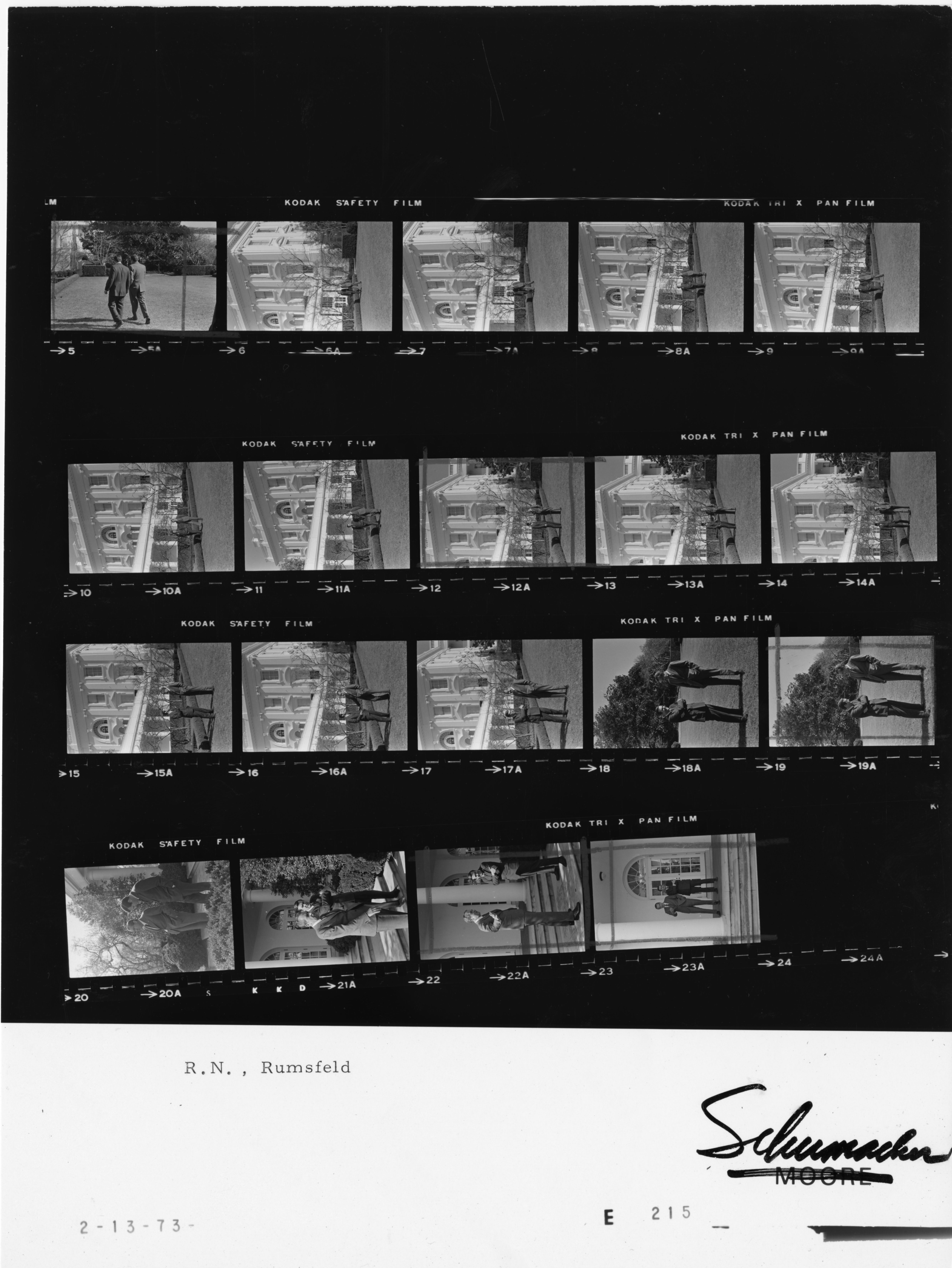
- Frame(s): WHPO-E0215-, President Nixon standing and speaking with Donald Rumsfeld in the rose garden area outside the White House. 2/13/1973, Washington, D.C. Rose Garden, White House. President Nixon, Donald Rumsfeld.
- Frame(s): WHPO-E0215-13A, President Nixon standing and speaking with Donald Rumsfeld in the rose garden area outside the White House. 2/13/1973, Washington, D.C. Rose Garden, White House. President Nixon, Donald Rumsfeld.
Roll WHPO-E0219 Photographer: Atkins, Oliver | Color or B&W: Color
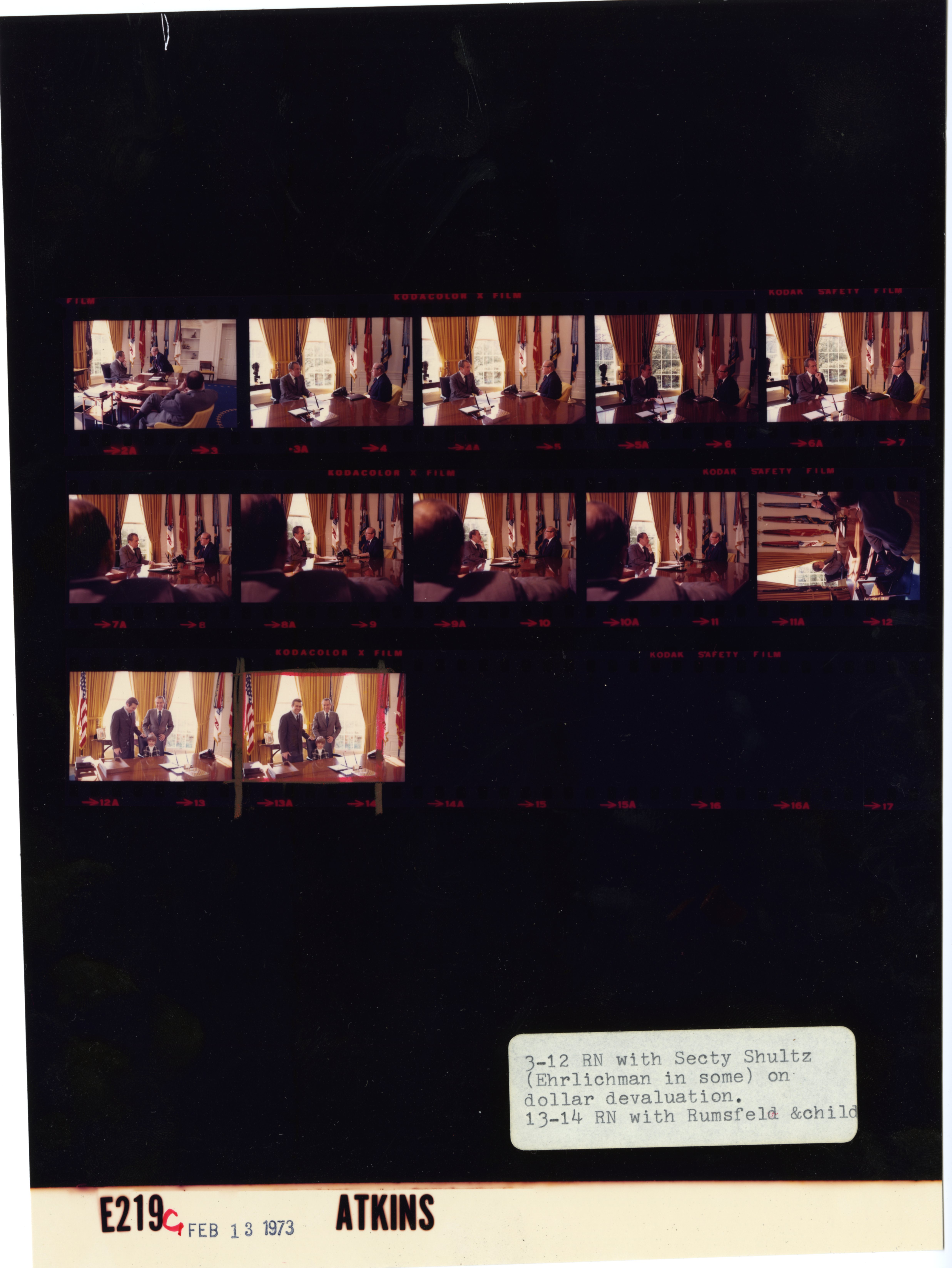
- Frame(s): WHPO-E0219-03-12, President Nixon seated at his Oval office desk during a meeting with George Shultz and John Ehrlichman. 2/13/1973, Washington, D.C. White House, Oval Office. President Nixon, Shultz, Ehrlichman.
- Frame(s): WHPO-E0219-13-14, President Nixon standing at his desk next to Donald Rumsfeld and his young son. 2/13/1973, Washington, D.C. White House, Oval Office. President Nixon, Rumsfeld, Nicholas Rumsfeld.
Roll WHPO-E0220 Photographer: Atkins, Oliver | Color or B&W: Color
- Frame(s): WHPO-E0220-00A-02A, President Nixon seated at his oval office desk. 2/13/1973, Washington, D.C. Oval Office, grounds, White House. President Nixon, Scali.
- Frame(s): WHPO-E0220-03A-29A, President Nixon walking on the White House grounds with John Scali. 2/13/1973, Washington, D.C. White House, Oval Office, grounds. President Nixon, John Scali.
Roll WHPO-E0241 Photographer: Knudsen, Robert L. | Color or B&W: B&W
- Frame(s): WHPO-E0241-, Henry Kissinger on his Far East Tour. Kissinger on a plane with the Vietnamese prime minister [Pham Van Dong?] and unidentified officials. 2/13/1973, Vietnam air, airport tarmac. Kissinger, Vietnamese prime minister, officials.
Roll WHPO-E0242 Photographer: Knudsen, Robert L. | Color or B&W: Color
- Frame(s): WHPO-E0242-, Henry Kissinger on his Far East Tour. Kissinger with Vietnamese Prime Minister Pham Van Dong. 2/13/1973, Vietnam airport tarmac. Henry Kissinger, Vietnamese prime minister [Pham Van Dong?], officials.
Roll WHPO-E0246 Photographer: Kightlinger, Jack | Color or B&W: Color
- Frame(s): WHPO-E0246-, Pat Nixon greeting members of the Women's Committee of the National Symphony. 2/13/1973, Washington, D.C. White House, State Dining Room. Pat Nixon, committee members.
Roll WHPO-E0247 Photographer: Schumacher, Karl | Color or B&W: B&W
- Frame(s): WHPO-E0247-, Marsh Thomson accepting a gift on behalf of Agnew. 2/13/1973, Washington, D.C. unknown room. Marsh Thomson, unidentified men.
The White House Communications Agency Sound Recordings Collection contains public statements that took place between 1969 and 1974. Visit the finding aid to learn more.
L - White House Press Office Briefings
- WHCA-SR-L-131
Press briefing by Ronald Ziegler with 2 press pool reports. (2/13/1973, White House Press Lobby)
Runtime: 41:49:00
Keywords: Press conferences, news conferences, interviews, media, press secretary
Original Format: 1/4-inch reel-to-reel audiotape. Original source type: Original. - WHCA-SR-L-132
Press briefing by Ronald Ziegler. (2/13/1973, White House Press Lobby)
Runtime: 8:00
Keywords: Press conferences, news conferences, interviews, media, press secretary
Original Format: 1/4-inch reel-to-reel audiotape. Original source type: Original.
P - Formal Presidential Remarks
- WHCA-SR-P-730213
Remarks by President Nixon on flag-raising for return of Vietnam POWs (Vietnam Prisoner of War). (2/13/1973)
Runtime: 1:12
Original Format: 1/4-inch reel-to-reel audiotape. Original source type: Original. - WHCA-SR-P-730214
Remarks by President Nixon to bystanders at Statler Hilton Hotel. (2/13/1973)
Runtime: 10:28
Original Format: 1/4-inch reel-to-reel audiotape. Original source type: Original.
The White House Communications Agency Videotape Collection contains “off-the-air” recordings of televised programs produced between 1968 and 1974. Visit the finding aid to learn more.
- WHCA-6122
Weekly News Summary, Tape IV.
ALL NETWORKS
Runtime: 0:30
1. Smith/Jarriel/Clark: President Nixon and the dollar; Congress and money. Time Code Start: 01:17. Keywords: Presidents, House of Representatives, economy, economics, budgets, finances, recession, inflation, money, currency, monetary values, exchange rates, decreases, wages, costs, increases. Network: ABC.
2. Reasoner/Watson/Shoumacher: Europe on the dollar; effects on imports. Time Code Start: 06:12. Keywords: economy, economics, budgets, finances, recession, inflation, money, currency, monetary values, exchange rates, decreases, wages, costs, increases. Network: ABC.
3. Smith/Jennings: POWs at Clark Air Force Base. Time Code Start: 11:37. Keywords: Vietnam War, Vietnam Prisoner of War, releases, arrivals, Armed Forces, military, air bases, airfields, airports, hospitals. Network: ABC.
4. Reasoner: Vietnamese prisoner exchange. Time Code Start: 14:54. Keywords: Vietnam War, Vietnam Prisoner of War, exchanges. Network: ABC.
5. Smith/Gill/Tomlinson: U.S.-Cuba anti-hijacking agreement near. Time Code Start: 17:49. Keywords: hijackings, skyjackings, kidnappings, terrorism, aircraft, airlines, Cuban. Network: ABC.
6. Reasoner: Commentary on testimonials of movie stars doing commercials. Time Code Start: 25:29. Keywords: advertisements, ads, TV spots, television, celebrities, motion pictures, Actor, actors, celebrities,. Network: ABC. - WHCA-6123
Weekly News Summary, Tape V.
ALL NETWORKS
Runtime: 1:00
1. Chancellor/Levine: U.S. dollar devalued by 10%. Time Code Start: 01:05. Keywords: economy, economics, budgets, finances, recession, inflation, money, currency, monetary values, exchange rates, decreases, wages, costs, increases. Network: NBC.
2. Valeriani: More on the dollar with President Nixon and Shultz on film. Time Code Start: 03:00. Keywords: cabinet, advisors, economy, economics, budgets, finances, recession, inflation, money, wages, costs, prices. Network: NBC.
3. Duke: Reaction on Capitol Hill to dollar devaluation. Time Code Start: 04:06. Keywords: House of Representatives, Congress, economy, economics, budgets, finances, recession, inflation, money, currency, monetary values, exchange rates, decreases, wages, costs, increases. Network: NBC.
4. Lewis: What the devaluation means to the American consumer. Time Code Start: 08:12. Keywords: product users, retail buyers, shoppers, inflation, recession, economy, economics, budgets, finances, recession, inflation, money, currency, monetary values, exchange rates, decreases, wages, costs, increases. Network: NBC.
5. Oliver: Foreign car prices to go up by 10%. Time Code Start: 09:33. Keywords: wage and price controls, freezes, prices, costs, increases, decreases, economy, economics, budgets, finances, recession, inflation, money, automobiles, autos, vehicles. Network: NBC.
6. Chancellor/Perkins: More on released POWs. Time Code Start: 12:14. Keywords: Vietnam War, Vietnam Prisoner of War, releases. Network: NBC.
7. Brinkley: Commentary on what the prisoners will see upon their return home. Time Code Start: 15:57. Keywords: Vietnam War, Vietnam Prisoner of War, releases, military air bases, airports. Network: NBC.
8. Chancellor/Jones: Vietnamese prisoner exchange. Time Code Start: 18:32. Keywords: Vietnam War, Vietnam Prisoner of War, exchanges. Network: NBC.
9. Chancellor/Delaney: Quang Tri in Vietnam, International Commission of Control and Supervision (ICCS) watches over prisoner exchange there. Time Code Start: 19:52. Keywords: Vietnam War, Vietnam Prisoner of War, releases, exchanges, ceasefires, management organizations. Network: NBC.
10. Chancellor/Rosenfeld: President Nixon and Rumsfeld discuss hijacking treaty with Cuba. Time Code Start: 23:05. Keywords: Presidents, cabinet, advisors, interviews, hijackings, skyjackings, kidnappings, terrorism, aircraft, airlines, treaties, agreements, Cuban. Network: NBC.
11. Cronkite/Herman: U.S. devalues dollar by 10% with President Nixon, Shultz, Representative Reuss and Senator Proxmire. Time Code Start: 30:30. Keywords: Presidents, speeches, cabinet, advisors, economy, economics, budgets, finances, recession, inflation, money, currency, monetary values, exchange rates, decreases, wages, costs, increases. Network: CBS.
12. Cronkite/Shephard: Effect of devaluation on American consumer. Time Code Start: 33:22. Keywords: product users, retail buyers, shoppers, inflation, recession, economy, economics, budgets, finances, recession, inflation, money, currency, monetary values, exchange rates, decreases, wages, costs, increases. Network: CBS.
13. Cronkite/Kalischer/Laurence: Overseas effects of devaluation. Time Code Start: 36:12. Keywords: economy, economics, budgets, finances, recession, inflation, money, currency, monetary values, exchange rates, decreases, wages, costs, increases. Network: CBS.
14. Cronkite/McLaughlin: More on POWs at Clark Air Force Base. Time Code Start: 39:44. Keywords: Vietnam War, Vietnam Prisoner of War, releases, arrivals, Armed Forces, military, air bases, airfields, airports, hospitals. Network: CBS.
15. Cronkite/Serafin: Secretary of State Rogers on hijacking agreement with Cuba; Robert Taylor retires from Secret Services over disagreement with Haldeman. Time Code Start: 45:25. Keywords: hijackings, skyjackings, kidnappings, terrorism, aircraft, airlines, Cuban, cabinet, advisors, security, employees, retirement. Network: CBS.
16. Sevareid: Commentary on the dollar devaluation. Time Code Start: 49:20. Keywords: economy, economics, budgets, finances, recession, inflation, money, currency, monetary values, exchange rates, decreases, wages, costs, increases. Network: CBS.
17. Cronkite: Goodies the POWs may receive; visit with POW family. Time Code Start: 54:00. Keywords: Vietnam War, Vietnam Prisoner of War, releases, families, gifts. Network: CBS.
Context (External Sources)
The Vanderbilt Television News Archive is the world's most extensive and complete archive of television news. They have been recording, preserving and providing access to television news broadcasts of the national networks since August 5, 1968.
Wikipedia is a free encyclopedia that anyone can edit.