
Introduction
This almanac page for Wednesday, February 14, 1973, pulls together various records created by the federal government and links to additional resources which can provide context about the events of the day.
Previous Date: Tuesday, February 13, 1973
Next Date: Thursday, February 15, 1973
Schedule and Public Documents
The Daily Diary files represent a consolidated record of the President's activities. Visit the finding aid to learn more.
The President's day began at The White House - Washington, D. C.
The Weekly Compilation of Presidential Documents made available transcripts of the President's news conferences; messages to Congress; public speeches, remarks, and statements; and other Presidential materials released by the White House.
Digitized versions can be found at HathiTrust.
Each Public Papers of the Presidents volume contains the papers and speeches of the President of the United States that were issued by the White House Office of the Press Secretary during the time period specified by the volume. The material is presented in chronological order, and the dates shown in the headings are the dates of the documents or events. In instances when the release date differs from the date of the document itself, that fact is shown in the text note.
To ensure accuracy, remarks have been checked against audio recordings (when available) and signed documents have been checked against the original, unless otherwise noted. Editors have provided text notes and cross references for purposes of identification or clarity.
The Federal Register is the official daily publication for rules, proposed rules, and notices of federal agencies and organizations, as well as executive orders and other Presidential documents.
Archival Holdings
Any selection of archival documents will necessarily be partial. You should use the documents and folders identified below as a starting place, but consult the linked collection finding aids and folder title lists and the collections themselves for context. Many documents to be found this way do not lend themselves to association with specific dates, but are essential to a complete understanding of the material.
Selective document listing
President's Office Files
The President's Office Files consists of materials drawn together by the Special Files Unit from several administrative subdivisions within the White House Office. It is the handwriting and sensitive papers sent to the Staff Secretary that now comprise much of the President's Office Files. Visit the finding aid to learn more.
- News Summaries, Annotated News Summaries, Box 42, Feb. 8-17, 1973 [5 of 7] [Note: Due to the way News Summary products were compiled, you should also consult nearby days for potentially relevant materials.]
- News Summary, February 14, 1973, (Tuesday nets, wires, mags)
President's Personal File
The President's Personal File is essentially a President's secretary's file, kept by Rose Mary Woods, personal secretary to the President, for two purposes: (1) preserving for posterity a collection of documents particularly close to the President, whether because he dictated or annotated them, or because of the importance of the correspondent or the event concerned and (2) giving appropriate attention–letters of gratitude, invitations to White House social events, and the like–to members and important friends and supporters of the Nixon administration. This generalization does not describe all the varied materials of a file group which is essentially a miscellany, but it does identify the reason for the existence of the file group's core. Visit the finding aid to learn more.
- President's Speech File
The H. R. Haldeman Diaries consists of seven handwritten diaries, 36 dictated diaries recorded as sound recordings, and two handwritten audio cassette tape subject logs. The diaries and logs reflect H. R. Haldeman’s candid personal record and reflections on events, issues, and people encountered during his service in the Nixon White House. As administrative assistant to the President and Chief of Staff, Haldeman attended and participated in public events and private meetings covering the entire scope of issues in which the Nixon White House engaged in during the years 1969-1973. Visit the finding aid to learn more.
- Transcript of diary entry (PDF)
Wednesday, February 14.
The President got into the POW follow-up first thing this morning, making the point that some of our idea staff should have thought of the two key things that he came up with that have been most effective: the idea of the corsage to each of the POW wives, which has worked extremely well in pictures in the paper, on TV, etcetera; and the idea of raising the flag to full staff on their return, which also has had a very positive effect. He wanted to be sure that we were in touch with Ross Perot; and had him involved in some way since he's been so interested in the whole POW project.
He then got into a long critique on speech writing in connection with his speech today on the State of the Union message on environment. He made the point that he'd done some editing and wanted the writers to review it for consideration for the future. They should look at the clarifications that he's made and the style changes. For example, you don't need transitions in speeches, you have to put it the way people talk, so we need an editor that goes through and does this. You should never say "I want to conclude by saying," you just spell out the points. You never start a good sentence with "but", because that rules it out as a quote. The quotes they select still don't make it; they're not quotable lines, they're colorful language. For example, his line that "you need a fair shake for American products in the world" is the kind of thing he's looking for. Ziegler in this regard is not a phrase-maker he just picks out their leads. Instead, you need a creative type who's a speech doctor to goose it up, put in the colorful quote. Unless you have a quotable line it won't be remembered, the things that people can see; otherwise, you can have all the beautiful words and still make no points. Can't we get a speech doctor as such? There are such people. Which guys that we have now have the colorful phrases? That's really the editor's job to break up the distended sentences, put it in speech form, drop out the transitions, leave out the things of "that reminds me of a story," just tell the story. Always work in something timely, such as his idea of China a year ago with "America the Beautiful", which also reminds people of our good points, like China, and the POW's and so forth. We should always go back and bring in the big issues; think in terms of audience interest, anecdotal timeliness, so that it's not just a gray exercise in good management. His usual, complaint.
He talked a little about the problem with the blacks and how we work on that, reacting to the Newsweek cover story this week. He feels that there is a need for us to show that we love them in some way, and maybe that we need a Presidential speech on this to do the kind of thing the Kennedys did, which is to give it lip service. On PR, he’s concerned that we still don't get enough out of the Ziegler operation, in terms of getting a lot out of a little, the way the Kennedys did. We especially need the McCrary-type approach––which we don't really have––that is based on an understanding about how people feel, emotional reactions. He asked who our best person is who senses how people feel, and I said Warren Herschensohn. He said that concludes that we're weak in this area. That Ehrlichman and I should contribute to this, and we need to get others to work on it.
He then got into the question of the schedule for the Stans dinners; he's worried about having the same people at those as we have at the State Dinners, and the problem of just hauling in contributors. It's better to get them to "Evenings at the White House" with small dinners ahead of time that Cabinet people give, plus as many as possible for State Dinners and all. He did agree stag dinners with Stans' people would be okay with a briefing in the afternoon first, and then have the wives for "Evenings at the White House", and a few of them at the big dinners. Tell him that the stag dinners will have their wives later. Go to maximum capacity around tables, have a full four-course dinner that takes plenty of time, so the President doesn't have to talk to them too much.
He met this afternoon with Bush and Armstrong for a general political discussion, mainly involved in Bush giving them a sort of a progress report on what he's doing, how he's setting up the committee, how he's approaching things with the effort to build Congressional candidates to work with Bud Brown instead of Bob Wilson, and so on. George went through a lot of his problems and I think, gave the President a more negative impression than he really intended to, but basically he's in pretty good shape anyway.
End of February 14. - Original audio recording (MP3)
The National Archives Catalog is the online portal to the records held at the National Archives, and information about those records. It is the main way of describing our holdings and also provides access to electronic records and digitized versions of our holdings.
The Catalog searches across multiple National Archives resources at once, including archival descriptions, digitized and electronic records, authority records, and web pages from Archives.gov and the Presidential Libraries. The Catalog also allows users to contribute to digitized historical records through tagging and transcription.
Nixon Library Holdings
All National Archives Units
National Security Documents
The President's Daily Brief is the primary vehicle for summarizing the day-to-day sensitive intelligence and analysis, as well as late-breaking reports, for the White House on current and future national security issues. Read "The President's Daily Brief: Delivering Intelligence to Nixon and Ford" to learn more.
The Foreign Relations of the United States series presents the official documentary historical record of major U.S. foreign policy decisions and significant diplomatic activity. Visit the State Department website for more information.
Vol. X, Vietnam, January 1973-July 1975
Neither War nor Peace, January 27-June 15, 1973
17. Memorandum From the President’s Deputy Assistant for National Security Affairs (Scowcroft) to President Nixon, Washington, February 14, 1973
Source: National Archives, Nixon Presidential Materials, NSC Files, Kissinger Office Files, Box 29, HAK Trip Files, February 7–20, 1973. Top Secret; Sensitive; Exclusively Eyes Only. A notation at the top of the memorandum reads: “The President Has Seen.” Kissinger sent the original report to Scowcroft in message Hakto 59, February 14, 0900Z. (Ibid., HAKTO 1–117)
18. Message From the Deputy Assistant Secretary of State for East Asian and Pacific Affairs (Sullivan) to the President’s Assistant for National Security Affairs (Kissinger) in Beijing, Saigon, February 14, 1973, 1415Z
Source: National Archives, Nixon Presidential Materials, NSC Files, Kissinger Office Files, Box 30, HAK Trip Files, February 7–20, 1973, TOHAK 141–200. Top Secret; Sensitive; Immediate. The message was sent to the White House for transmittal exclusively to Kissinger who arrived in Beijing on February 15. Sullivan sent a second report on his final meetings in Saigon and visit to Phnom Penh in message 704/Tohak 184, February 15. (Ibid.) Message 711/Tohak 206, February 16, contains a summary of Sullivan’s conference in Vientiane. (Ibid., TOHAK 201–250)
Vol. E-11, Part 2, Documents on South America, 1973-1976
Uruguay
332. Telegram 28424 From the Department of State to the Embassy in Uruguay, Washington, February 14, 1973, 2243Z
Summary: The Department of State concurred with the Embassy’s recommendation that contact with the Uruguayan Government should be normal but that any new initiatives should wait until developments in Uruguay were clearer.
Source: National Archives, RG 59, Central Files, 1970–73, POL 15 UR. Confidential; Limdis. Drafted by Stedman and K.N. Rogers; cleared by Crimmins; and approved by Meyer. Repeated for information to Southcom. Telegram 453 from the Embassy in Uruguay is Document 331.
The Kissinger telephone conversation transcripts consist of approximately 20,000 pages of transcripts of Kissinger’s telephone conversations during his tenure as Assistant to the President for National Security Affairs (1969-1974) and Secretary of State (1973-1974) during the administration of President Richard Nixon. Visit the finding aid for more information.
Digitized versions can be found in the National Archives Catalog.
Audiovisual Holdings
Visit the White House Tapes finding aid to learn about the taping system's operation and archival processing.
Old Executive Office Building
- 412-1; Unknown between 2:31 p.m. & 2:38 p.m.; Nixon, Richard M. (President); Sanchez, Manolo
- 412-2; Unknown between 2:31 p.m. & 2:38 p.m.; Nixon, Richard M. (President); White House operator
- 412-3; 2:38 p.m. - 2:39 p.m.; Nixon, Richard M. (President); Bull, Stephen B.
- 412-4; Unknown between 2:39 p.m. & 2:59 p.m.; Nixon, Richard M. (President); White House operator
- 412-5; 2:59 p.m. - 3:04 p.m.; Nixon, Richard M. (President); Timmons, William E.
- 412-6; Unknown between 3:04 p.m. & 4:05 p.m.; Nixon, Richard M. (President); Bull, Stephen B.
- 412-7; Unknown between 3:04 p.m. & 4:05 p.m.; Nixon, Richard M. (President); Moorer, Thomas H. (Adm.); White House photographer
- 412-8; 4:06 p.m. - 5:25 p.m.; Nixon, Richard M. (President); Bush, George H. W.; Armstrong, Anne L.; Haldeman, H. R. ("Bob"); White House operator; Bull, Stephen B.
Oval Office
- 855-1; 8:49 a.m. - 8:57 a.m.; Nixon, Richard M. (President); Bull, Stephen B.
- 855-2; Unknown between 8:57 a.m. & 9:20 a.m.; Nixon, Richard M. (President); Bull, Stephen B.
- 855-3; Unknown between 8:57 a.m. & 9:20 a.m.; Nixon, Richard M. (President); White House operator
- 855-4; 9:20 a.m. - 9:21 a.m.; Nixon, Richard M. (President); Rebozo, Charles G. ("Bebe")
- 855-5; Unknown between 9:12 a.m. & 10:04 a.m.; Nixon, Richard M. (President); Bull, Stephen B.
- 855-6; Unknown between 9:12 a.m. & 10:04 a.m.; Nixon, Richard M. (President); Bull, Stephen B.
- 855-7; 10:04 a.m. - 10:08 a.m.; Nixon, Richard M. (President); Woods, Rose Mary
- 855-8; Unknown between 10:08 a.m. & 10:13 a.m.; Nixon, Richard M. (President); Bull, Stephen B.
- 855-9; Unknown between 10:08 a.m. & 10:13 a.m.; Nixon, Richard M. (President); Bull, Stephen B.
- 855-10; 10:13 a.m. - 10:49 a.m.; Nixon, Richard M. (President); Colson, Charles W.; Bull, Stephen B.; Sanchez, Manolo
- 855-11; 10:51 a.m. - 11:16 a.m.; Nixon, Richard M. (President); Ziegler, Ronald L.; Woods, Rose Mary
- 855-12; 11:16 a.m. - 11:52 a.m.; Nixon, Richard M. (President); Scowcroft, Brent G. (Gen.); Helms, Richard M.; Ziegler, Ronald L.; Bull, Stephen B.
- 855-13; 11:53 a.m. - 11:56 a.m.; Nixon, Richard M. (President); Bull, Stephen B.
- 855-14; Unknown between 11:56 a.m. & 12:06 p.m.; Nixon, Richard M. (President); Bull, Stephen B.
- 855-15; Unknown between 12:19 p.m. & 12:23 p.m.; Nixon, Richard M. (President); Bull, Stephen B.
- 855-16; Unknown between 12:19 p.m. & 12:23 p.m.; Nixon, Richard M. (President); Bull, Stephen B.
- 855-17; Unknown between 12:19 p.m. & 12:23 p.m.; Nixon, Richard M. (President); White House operator
- 855-18; 12:23 p.m. - 12:34 p.m.; Nixon, Richard M. (President); Morgan, Edward L.; Bull, Stephen B.; Ehrlichman, John D.; Clawson, James; Clawson, James (Mrs.); Clawson, Courtney; Clawson, Jason B.; Clawson, Brooke A.; Evans, Katherine R.; Evans, Constance R.; Evans, Elizabeth G.; Evans, John F., III; Cashen, Henry C., II; White, Stuart C.; White, Stuart C. (Mrs.)
- 855-19; 12:35 p.m. - 12:36 p.m.; Nixon, Richard M. (President); Bull, Stephen B.; Hart, Thomas
- 855-20; Unknown between 12:36 p.m. & 12:37 p.m.; Nixon, Richard M. (President); Sanchez, Manolo
- 855-21; 12:37 p.m. - 12:38 p.m.; Nixon, Richard M. (President); Eisenhower, Julie Nixon
- 855-22; 12:38 p.m. - 1:46 p.m.; Nixon, Richard M. (President); Haldeman, H. R. ("Bob"); Bull, Stephen B.; Ehrlichman, John D.; Ziegler, Ronald L.
- 855-23; Unknown between 1:46 p.m. & 1:52 p.m.; Nixon, Richard M. (President); Sanchez, Manolo
- 855-24; Unknown between 1:52 p.m. & 11:59 p.m.; [Unknown person(s)]
- 855-25; Unknown between 12:36 p.m. & 12:37 p.m.; Nixon, Richard M. (President); White House operator
- 855-26; Unknown between 1:46 p.m. & 1:52 p.m.; Nixon, Richard M. (President); Bull, Stephen B.
- 855-27; Unknown between 1:46 p.m. & 1:52 p.m.; Sanchez, Manolo; [Unknown person(s)]
- 855-28; Unknown between 1:46 p.m. & 1:52 p.m.; Nixon, Richard M. (President); Bull, Stephen B.
- 856-1; Unknown between 2:20 p.m. & 2:31 p.m.; Nixon, Richard M. (President); Unknown
- 856-2; 5:29 p.m. - 5:33 p.m.; Nixon, Richard M. (President); Richardson, Elliot L.
- 856-3; Unknown between 5:34 p.m. & 6:06 p.m.; Nixon, Richard M. (President); Ziegler, Ronald L.; Scowcroft, Brent G. (Gen.)
- 856-4; Unknown between 5:34 p.m. & 6:06 p.m.; Nixon, Richard M. (President); Ehrlichman, John D.; Bull, Stephen B.
- 856-5; Unknown between 6:06 p.m., 2/14 & 8:15 a.m., 2/3; [Unknown person(s)]
- 856-6; Unknown between 6:06 p.m., 2/14 & 8:15 a.m., 2/3; [Unknown person(s)]
- 856-7; Unknown between 6:06 p.m., 2/14 & 8:15 a.m., 2/3; United States Secret Service agents
White House Telephone
- 43-72; Unknown between 8:49 a.m. & 9:20 a.m.; Nixon, Richard M. (President); White House operator
- 43-73; 9:20 a.m. - 9:21 a.m.; Nixon, Richard M. (President); Rebozo, Charles G. ("Bebe")
- 43-74; Unknown between 9:21 a.m. & 12:37 p.m.; Nixon, Richard M. (President); White House operator
- 43-75; 12:36 p.m. - 12:36 p.m.; Nixon, Richard M. (President); White House operator
- 43-76; 12:37 p.m. - 12:37 p.m.; Nixon, Richard M. (President); Eisenhower, Julie Nixon
- 43-77; Unknown between 12:37 p.m. & 2:30 p.m.; [Unknown person(s)]; White House operator
- 43-78; 2:38 p.m. - 2:38 p.m.; Nixon, Richard M. (President); White House operator
- 43-79; 2:38 p.m. - 2:39 p.m.; Nixon, Richard M. (President); Bull, Stephen B.
- 43-80; Unknown between 2:39 p.m. & 2:59 p.m.; Nixon, Richard M. (President); White House operator
- 43-81; Unknown between 2:59 p.m. & 3:04 p.m.; Nixon, Richard M. (President); Timmons, William E.
- 43-82; Unknown between 3:04 p.m. & 5:06 p.m.; Nixon, Richard M. (President); White House operator
- 43-83; 5:06 p.m. - 5:07 p.m.; Nixon, Richard M. (President); Bull, Stephen B.
- 43-84; 5:29 p.m. - 5:33 p.m.; Nixon, Richard M. (President); Richardson, Elliot L.
- 43-85; Unknown between 5:33 p.m. & 8:04 p.m.; Nixon, Richard M. (President); White House operator
- 43-86; 8:04 p.m. - 8:11 p.m.; Nixon, Richard M. (President); Lewis, Hobart D.
- 43-217; 12:37 p.m. - 12:37 p.m.; Nixon, Richard M. (President); White House operator
The White House Photo Office collection consists of photographic coverage of President Richard Nixon meeting with prominent social, political, and cultural personalities; speaking engagements and news conferences of the President and various high-ranking members of the White House staff and Cabinet; Presidential domestic and foreign travel, including Presidential vacations; social events and entertainment involving the First Family, including entertainers present; official portraits of the President, First Family, and high-ranking members of the Nixon administration; the 1969 and 1973 Inaugurals; the President’s 1972 Presidential election campaign appearances (including speeches) and other official activities of the White House staff and the President’s Cabinet from January 20, 1969 until August 9, 1974 at the White House and the Old Executive Office Building; other locations in Washington, DC, such as The Mall; and the Presidential retreats in Camp David, Maryland, Key Biscayne, Florida, and San Clemente, California. Visit the finding aid to learn more.
Roll WHPO-E0248 Photographer: Schumacher, Karl | Color or B&W: B&W
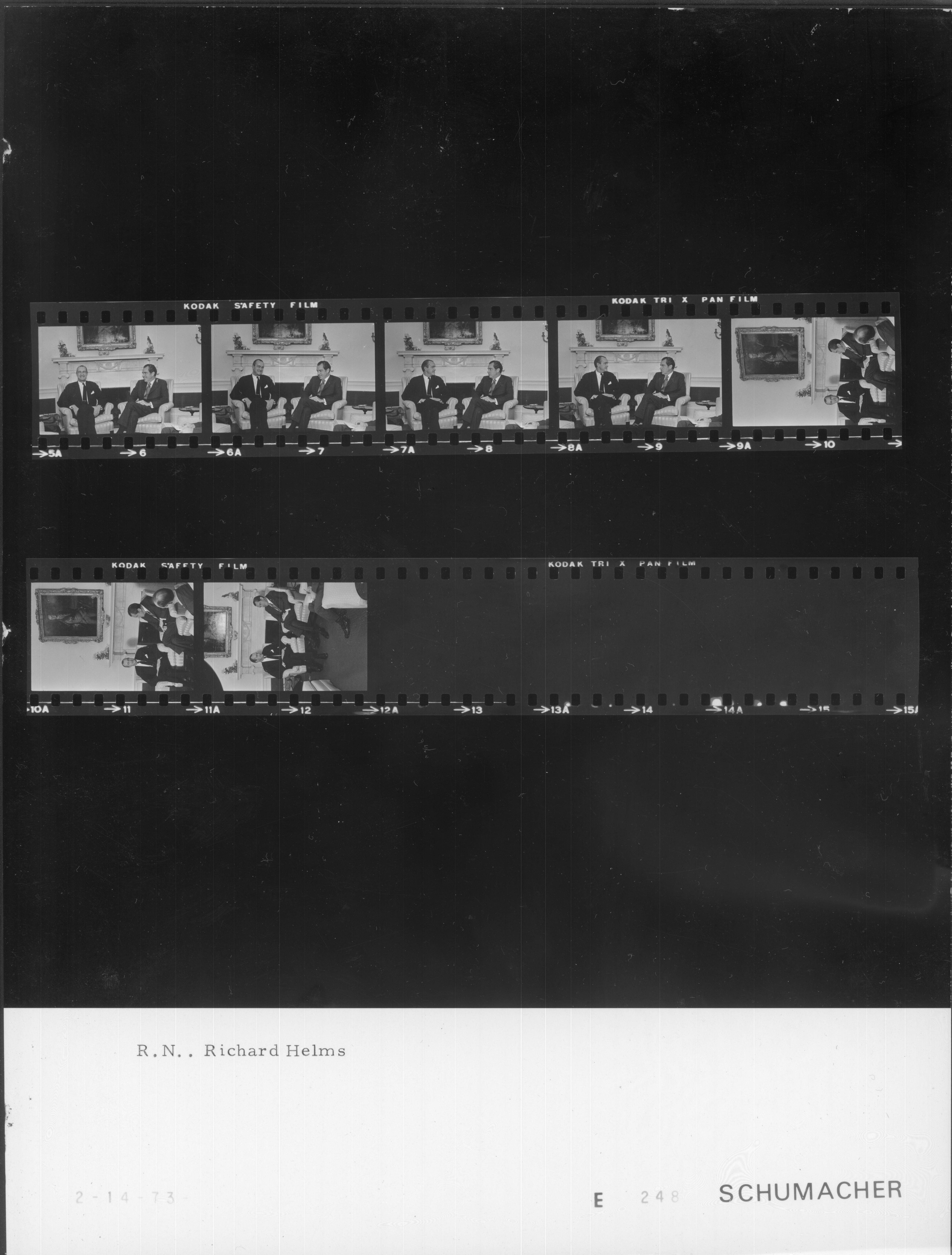
- Frame(s): WHPO-E0248-, President Nixon seated in the Oval Office with Richard Helms and Brig. Gen. Brent Scowcroft. 2/14/1973, Washington, D.C. White House, Oval Office. President Nixon, Brigadier General Brent Scowcroft, Director of Central Intelligence Richard Helms.
Roll WHPO-E0249 Photographer: Schumacher, Karl | Color or B&W: B&W
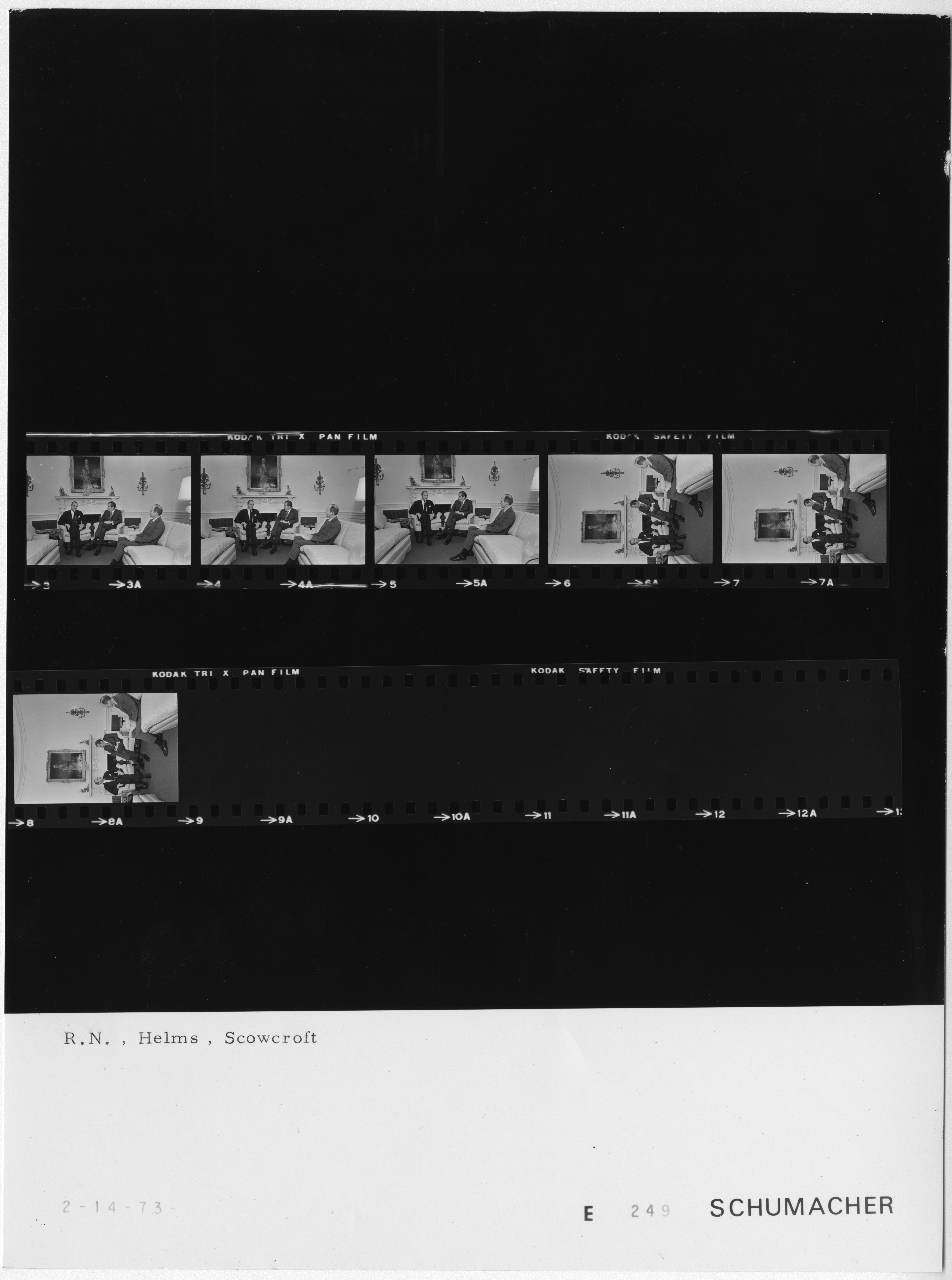
- Frame(s): WHPO-E0249-, President Nixon seated informally in the Oval Office during a meeting with Director of the Central Intelligence Agency Richard Helms (CIA) and Brigadier General Brent Scowcroft. 2/14/1973, Washington, D.C. White House, Oval Office. President Nixon, Brig. Gen Brent Scowcroft, Richard Helms.
- Frame(s): WHPO-E0249-05A, President Nixon seated informally in the Oval Office during a meeting with Director of the Central Intelligence Agency Richard Helms (CIA) and Brigadier General Brent Scowcroft. 2/14/1973, Washington, D.C. White House, Oval Office. President Nixon, Brig. Gen Brent Scowcroft, Richard Helms.
Roll WHPO-E0250 Photographer: Schumacher, Karl | Color or B&W: B&W
- Frame(s): WHPO-E0250-, Farrell receiving a plaque. 2/14/1973, Washington, D.C. White House, South Lawn. Farrell, unidentified men, women, and children.
Roll WHPO-E0251 Photographer: Atkins, Oliver | Color or B&W: Color
- Frame(s): WHPO-E0251-, Portraits of Nixon family dog Yorkshire terrier Pasha wearing a patchwork leather fringed jacket coverup with a tiny revolver gun holster attached. Cowboy outfit costume. 2/14/1973, Washington, D.C. unknown. Pasha.
Roll WHPO-E0252 Photographer: Atkins, Oliver | Color or B&W: B&W
- Frame(s): WHPO-E0252-02-04, President Nixon standing in the Oval office with Edward Morgan. 2/14/1973, Washington, D.C. White House, Oval Office. President Nixon, Edward Morgan, Henry Cashen, Mrs. Henry Cashen.
- Frame(s): WHPO-E0252-05-08, President Nixon standing in the Oval office with Henry Cashen and his wife. 2/14/1973, Washington, D.C. White House, Oval Office. President Nixon, Edward Morgan, Henry Cashen, Mrs. Henry Cashen.
Roll WHPO-E0253 Photographer: Atkins, Oliver | Color or B&W: B&W
- Frame(s): WHPO-E0253-03A-08A, President Nixon standing in the Oval office with James Clawson and family. 2/14/1973, Washington, D.C. White House, Oval Office. President Nixon, James Clawson, Clawson family members, John Evans, Evans family members, Margareta White, White family members.
- Frame(s): WHPO-E0253-09A-13A, President Nixon standing in the Oval office with John Evans and family. 2/14/1973, Washington, D.C. White House, Oval Office. President Nixon, James Clawson, Clawson family members, John Evans, Evans family members, Margareta White, White family members.
- Frame(s): WHPO-E0253-14A-20A, President Nixon standing in the Oval office with Margareta (Margita) White family. 2/14/1973, Washington, D.C. White House, Oval Office. President Nixon, James Clawson, Clawson family members, John Evans, Evans family members, Margareta (Margita) White, White family members.
Roll WHPO-E0254 Photographer: Atkins, Oliver | Color or B&W: B&W
- Frame(s): WHPO-E0254-, President Nixon seated at his desk in preparation for a televised version of his radio recording titled "Natural Resources and the Environment.". 2/14/1973, Washington, D.C. White House, Oval Office. President Nixon.
- Frame(s): WHPO-E0254-03A, President Nixon seated at his oval office desk in preparation for a televised version of his radio recording titled "Natural Resources and the Environment.". 2/14/1973, Washington, D.C. White House, Oval Office. President Nixon.
- Frame(s): WHPO-E0254-10A, President Nixon seated at his oval office desk in preparation for a televised version of his radio recording titled "Natural Resources and the Environment.". 2/14/1973, Washington, D.C. White House, Oval Office. President Nixon.
Roll WHPO-E0256 Photographer: Kightlinger, Jack | Color or B&W: Color
- Frame(s): WHPO-E0256-, Pat Nixon with National Center for Voluntary Action award winners. 2/14/1973, Washington, D.C. Blue Room, White House. Pat Nixon, unidentified men, women, and children.
Roll WHPO-E0257 Photographer: Atkins, Oliver | Color or B&W: Color
- Frame(s): WHPO-E0257-02-05, President Nixon seated informally in the Presidential Executive Office Building office (EOB) during a meeting with Admiral Thomas Moorer. 2/14/1973, Washington, D.C. Executive Office Building, Presidential Office. President Nixon, Thomas Moorer, George Bush, Anne Armstrong.
- Frame(s): WHPO-E0257-04, President Nixon seated informally in the Presidential Executive Office Building office (EOB) during a meeting with Admiral Thomas Moorer. 2/14/1973, Washington, D.C. Executive Office Building, Presidential Office. President Nixon, Admiral Thomas Moorer.
- Frame(s): WHPO-E0257-07-10, President Nixon seated during a meeting in his EOB office, with Admiral Thomas Moorer, George H. W. Bush and Mrs. Anne Armstrong. 2/14/1973, Washington, D.C. Executive Office Building, Presidential Office. President Nixon, Thomas Moorer, George Bush, Anne Armstrong.
- Frame(s): WHPO-E0257-09, President Nixon seated during a meeting in his EOB office, with Admiral Thomas Moorer, George H. W. Bush and Mrs. Anne Armstrong. Viewed from his desk chair across the room. Items on desk include Gavel, elephant and Irish Setter dog sculpture, crystal gifts and memorabilia. 2/14/1973, Washington, D.C. Executive Office Building, Presidential Office. President Nixon, Thomas Moorer, George Bush, Anne Armstrong.
The White House Communications Agency Sound Recordings Collection contains public statements that took place between 1969 and 1974. Visit the finding aid to learn more.
L - White House Press Office Briefings
- WHCA-SR-L-133
Press briefing by Ronald Ziegler [recording speed changes when Ron Ziegler departs]. (2/14/1973, White House Press Lobby)
Runtime: 37:00:00
Keywords: Press conferences, news conferences, interviews, media, press secretary
Original Format: 1/4-inch reel-to-reel audiotape. Original source type: Original. - WHCA-SR-L-134
Press briefing by Ronald Ziegler. (2/14/1973, White House Press Lobby)
Runtime: 4:20
Keywords: Press conferences, news conferences, interviews, media, press secretary
Original Format: 1/4-inch reel-to-reel audiotape. Original source type: Original.
P - Formal Presidential Remarks
- WHCA-SR-P-730215
Remarks by President Nixon for a radio address on natural resources and the environment. (2/14/1973, Private Office, the White House)
Runtime: 0:11:25
Keywords: environment, environmental, ecology, pollution, mountains, lakes, rivers, clean air, Environmental Protection Agency (EPA)
Production credits: Audio feed supplied by WHCA; Recorded by MJP (initials of WHCA engineer)
Original Format: 1/4-inch reel-to-reel audiotape. Original source type: Original. - WHCA-SR-P-730216
Remarks by President Nixon on natural resources and the environment, excerpt for reels. (2/14/1973)
Runtime: 0:02:20
Original Format: 1/4-inch reel-to-reel audiotape. Original source type: Original.
The White House Communications Agency Videotape Collection contains “off-the-air” recordings of televised programs produced between 1968 and 1974. Visit the finding aid to learn more.
- WHCA-6117
CBS Coverage of POW's Return to Travis AFB. Coverage of American POW's returning from southeast Asia (South Vietnam) (Vietnam Prisoner of War)
ALL NETWORKS
Runtime: 0:30 - WHCA-6118
Live Coverage of POW's return to Travis AFB. coverage of American POW's returning from southeast Asia (Vietnam Prisoner of War)
ALL NETWORKS
Runtime: 1:00 - WHCA-6124
Weekly News Summary, Tape VI.
ALL NETWORKS
Runtime: 0:30
1. Smith/Jarriel: Hanoi aid plan with Ziegler. Time Code Start: 01:18. Keywords: Vietnam War, financial aid, weapons, funding, media, press conferences, news conferences, interviews. Network: ABC.
2. Reasoner/Jarriel: POWs at Clark Air Force Base. Time Code Start: 04:19. Keywords: Vietnam War, Vietnam Prisoner of War, releases, arrivals, Armed Forces, military, air bases, airfields, airports, hospitals. Network: ABC.
3. Smith/Murphy/Shoumacher: More on POWs. Time Code Start: 08:51. Keywords: Vietnam War, Vietnam Prisoner of War, releases. Network: ABC.
4. Reasoner/Koppel: South Vietnam's President Thieu. Time Code Start: 14:14. Keywords: South Vietnam, Presidents, speeches, statements, Vietnam War. Network: ABC.
5. Reasoner/Bennett: North Vietnamese prisoners. Time Code Start: 16:00. Keywords: Vietnam War, Vietnam Prisoner of War, releases. Network: ABC.
6. Smith/Ellis: The dollar. Time Code Start: 20:43. Keywords: economy, economics, budgets, finances, recession, inflation, money, currency, monetary values, exchange rates, decreases, wages, costs, increases. Network: ABC.
7. Reasoner: Presidents Nixon's speech - oval office. Time Code Start: 24:30. Keywords: Presidents, speeches. Network: ABC.
8. Smith: Commentary on aid to Hanoi. Time Code Start: 26:43. Keywords: Vietnam War, foreign aid, financial, finances, funding. Network: ABC. - WHCA-6125
Weekly News Summary, Tape VII.
ALL NETWORKS
Runtime: 1:00
1. Chancellor/Valeriani: Reconstruction of North Vietnam. Time Code Start: 00:50. Keywords: Vietnam War, destruction, rebuilding. Network: NBC.
2. Chancellor/Brinkley: Aid to North Vietnam. Time Code Start: 02:46. Keywords: Vietnam War. Network: NBC.
3. Chancellor/Neal: POWs at Clark Air Force Base. Time Code Start: 06:10. Keywords: Vietnam War, Vietnam Prisoner of War, releases, arrivals, Armed Forces, military, air bases, airfields, airports, hospitals. Network: NBC.
4. Chancellor: More violations of ceasefire. Time Code Start: 13:13. Keywords: Vietnam War, ceasefires. Network: NBC.
5. Chancellor/Brady: more on dollar devaluation. Time Code Start: 15:47. Keywords: economy, economics, budgets, finances, recession, inflation, money, currency, monetary values, exchange rates, decreases, wages, costs, increases. Network: NBC.
6. Chancellor/Briggs: President Nixon on the environment; the energy crisis. Time Code Start: 19:20. Keywords: petroleum, oil, gasoline, fuel, shortages, rationing, natural resources, ecology, environment, mountains, lakes, rivers, clean air, Environmental Protection Agency, EPA. Network: NBC.
7. Cronkite/Seggi: POWs at Travis Air Force Base. Time Code Start: 30:40. Keywords: Vietnam War, Vietnam Prisoner of War, releases, arrivals, Armed Forces, military, air bases, airfields, airports, hospitals. Network: CBS.
8. Cronkite/Kalb: At Clark Air Force Base. Time Code Start: 34:18. Keywords: Armed Forces, military, air bases, airfields, airports. Network: CBS.
9. Cronkite/Jennings: South Vietnamese prisoners. Time Code Start: 39:14. Keywords: Vietnam War, Vietnam Prisoner of War. Network: CBS.
10. Cronkite: President Nixon environment speech. Time Code Start: 45:55. Keywords: Presidents, speeches, ecology, environment, Environmental Protection Agency, EPA. Network: CBS.
11. Cronkite/Fenton/Kalischer: Money crisis overseas (dollar crisis). Time Code Start: 46:55. Keywords: economy, economics, budgets, finances, recession, inflation, money, currency, monetary values, exchange rates, decreases, wages, costs, increases. Network: CBS.
Context (External Sources)
The Vanderbilt Television News Archive is the world's most extensive and complete archive of television news. They have been recording, preserving and providing access to television news broadcasts of the national networks since August 5, 1968.
Wikipedia is a free encyclopedia that anyone can edit.