
Introduction
This almanac page for Monday, October 18, 1971, pulls together various records created by the federal government and links to additional resources which can provide context about the events of the day.
Previous Date: Sunday, October 17, 1971
Next Date: Tuesday, October 19, 1971
Schedule and Public Documents
The Daily Diary files represent a consolidated record of the President's activities. Visit the finding aid to learn more.
The President's day began at The White House - Washington, D. C.
The Weekly Compilation of Presidential Documents made available transcripts of the President's news conferences; messages to Congress; public speeches, remarks, and statements; and other Presidential materials released by the White House.
Digitized versions can be found at HathiTrust.
Each Public Papers of the Presidents volume contains the papers and speeches of the President of the United States that were issued by the White House Office of the Press Secretary during the time period specified by the volume. The material is presented in chronological order, and the dates shown in the headings are the dates of the documents or events. In instances when the release date differs from the date of the document itself, that fact is shown in the text note.
To ensure accuracy, remarks have been checked against audio recordings (when available) and signed documents have been checked against the original, unless otherwise noted. Editors have provided text notes and cross references for purposes of identification or clarity.
The Federal Register is the official daily publication for rules, proposed rules, and notices of federal agencies and organizations, as well as executive orders and other Presidential documents.
No Federal Register published on this date
The Congressional Record is the official daily record of the debates and proceedings of the U.S. Congress.
Archival Holdings
Any selection of archival documents will necessarily be partial. You should use the documents and folders identified below as a starting place, but consult the linked collection finding aids and folder title lists and the collections themselves for context. Many documents to be found this way do not lend themselves to association with specific dates, but are essential to a complete understanding of the material.
Selective document listing
President's Office Files
The President's Office Files consists of materials drawn together by the Special Files Unit from several administrative subdivisions within the White House Office. It is the handwriting and sensitive papers sent to the Staff Secretary that now comprise much of the President's Office Files. Visit the finding aid to learn more.
- News Summaries, Annotated News Summaries, Box 31, News Summaries - October 13-20, 1971 [3 of 4] [Note: Due to the way News Summary products were compiled, you should also consult nearby days for potentially relevant materials.]
- Weekend News Review, October 18, 1971
- President's Daily Schedule, Box 102, [President's Daily Schedule, Sept.-Dec. 1971] [2 of 3]
- The President's Schedule, Monday - October 18, 1971
The H. R. Haldeman Diaries consists of seven handwritten diaries, 36 dictated diaries recorded as sound recordings, and two handwritten audio cassette tape subject logs. The diaries and logs reflect H. R. Haldeman’s candid personal record and reflections on events, issues, and people encountered during his service in the Nixon White House. As administrative assistant to the President and Chief of Staff, Haldeman attended and participated in public events and private meetings covering the entire scope of issues in which the Nixon White House engaged in during the years 1969-1973. Visit the finding aid to learn more.
- Transcript of diary entry (PDF)
Monday, October 18th. Staff meeting this morning, we started the discussion of the Supreme Court problem; the PR problems on our being attacked on mediocrity. And Ehrlichman said that he, his team of Dave Young and John Dean, who had been quizzing Herschel Friday in Arkansas, were concerned because he has no convictions and, therefore, could really be bad. They said he's a typical lawyer who can take either side. That Mitchell waves us off, he's not concerned about it, but they feel it could really make him an unfortunate appointment. So I raised this later with the President, and the whole question of the PR problem on the Court, and I think got him thinking about it a little more in that light. Whereas before he had been inclined to go along basically with Mitchell's recommendations, whatever they might be. He's decided that, as soon as the Court thing's settled, he wants to make the announcement at 7:30 television time, so we can get our side across on the appointees and not give the press the shot of a Q and A. He did decide he'd better meet with Mitchell this afternoon and go over it, which he did, and they sort of reopened the whole question with some new possibilities now.
He went out to Fort Dietrich this morning to announce the turning it over to our drug, or our health operation for the war on cancer, and was not particularly pleased with the gimmicky nature of that particular exercise and doesn't think we should do those again.
Henry is in Hawaii on his way to China, and the President raised some concerns, particularly about a George Sherman story in the Star last week that implied that Henry was dominating the making of all foreign policy. The President was quite concerned about it, first, because it's not true, particularly the China initiative, for instance, was not Henry's; second, that it would drive Rogers up the wall; third, it creates the impression that the President's doing all this for cynical reasons and that he doesn't know anything about what he's doing; and fourth, he thinks this results from the way Henry does his briefings, and that it creates a problem. In any event, he wanted me to talk to Haig and try to get that worked out...
-------------------------------------------------------------------------------------------------------------------
DECLASSIFIED - E.O. 13526, Sect. 3.4: by MS, NARA, June 12, 2013
Audio Cassette 14, Side B, Withdrawn Item Number 17 [AC-14(B) Sel 15]
Duration: 17 seconds
...as well as to lean hard on him on the fact that Henry is not to take any trip to Moscow or to Viet–, North Vietnam to try and settle the war. That the President totally disapproves of this, and that Henry's not to go to Moscow either on that or on summit preparations.
-------------------------------------------------------------------------------------------------------------------
The President also re-raised the public broadcasting thing again. He's fairly upset at the inability of our people to get control of any of it, and feels that we've got to find a way, somehow, to avoid letting them stockpile all the anti-Nixon newscasters and subsidize them. We have Malek working with Colson and Flanigan to try and get at this. The problem is, that we don't have working control of the board, and there's virtually no other way that we can take any effective action. This evening was the opening of the Eisenhower Theater at Kennedy Center. The President attended. It was a good opening, I guess, but rather a dull play—Ibsen's A Doll's House.
End of October 18th. - Original audio recording (MP3)
The National Archives Catalog is the online portal to the records held at the National Archives, and information about those records. It is the main way of describing our holdings and also provides access to electronic records and digitized versions of our holdings.
The Catalog searches across multiple National Archives resources at once, including archival descriptions, digitized and electronic records, authority records, and web pages from Archives.gov and the Presidential Libraries. The Catalog also allows users to contribute to digitized historical records through tagging and transcription.
Nixon Library Holdings
All National Archives Units
National Security Documents
The President's Daily Brief is the primary vehicle for summarizing the day-to-day sensitive intelligence and analysis, as well as late-breaking reports, for the White House on current and future national security issues. Read "The President's Daily Brief: Delivering Intelligence to Nixon and Ford" to learn more.
The Foreign Relations of the United States series presents the official documentary historical record of major U.S. foreign policy decisions and significant diplomatic activity. Visit the State Department website for more information.
Vol. XXIII, Arab-Israeli Dispute, 1969-1972
Proximity Talks and the Backchannel: Separate Department of State and White House Negotiating Tricks
260. Letter From Secretary of Defense Laird to Secretary of State Rogers, Washington, October 18, 1971
Source: Washington National Records Center, ISA Files: FRC 330–74–0083, Box 23, Middle East. Secret.
Vol. XXIX, Eastern Mediterranean, 1969-1972
Greece
325. Telegram From the Vice Presidentʼs Party to the Department of State, Athens, October 18, 1971, 2310Z
Source: National Archives, Nixon Presidential Materials, NSC Files, Box 594, Country Files—Middle East, Greece, Vol. II 1 Nov 1970–31 Dec 1971. Secret; Nodis.
Vol. E-10, Documents on American Republics, 1969-1972
Nicaragua
509. Intelligence Memorandum, OCI No. 2080/71, Washington, October 18, 1971., Washington, October 18, 1971
CIA assessed the emergence of “national unity” pacts in Honduras and Nicaragua. According to the Agency, while ostensibly providing for democratic transitions, such pacts were “ploys by strongmen whose terms of office are legally terminated to disguise continuismo.”
Source: Central Intelligence Agency, Office of Current Intelligence, Job 79–T00831A. Secret; No Foreign Dissem. The intelligence memorandum was self-initiated at CIA. Three inserts included in the memorandum, are not published. They were a map with “Selected Examples of Continuismo,” “The Honduran Unity Pact,” and “Opposition Participation in Nicaragua.”
The Kissinger telephone conversation transcripts consist of approximately 20,000 pages of transcripts of Kissinger’s telephone conversations during his tenure as Assistant to the President for National Security Affairs (1969-1974) and Secretary of State (1973-1974) during the administration of President Richard Nixon. Visit the finding aid for more information.
Digitized versions can be found in the National Archives Catalog.
Audiovisual Holdings
The White House Tapes are sound recordings of President Richard Nixon's telephone conversations and of meetings held in the Oval Office and the Cabinet Room in the White House, the President's office in the Old Executive Office Building (OEOB), the Lincoln Sitting Room in the residence section of the White House, and several locations at the Presidential retreat at Camp David, Maryland. These recordings document many of the major events and decisions of the Nixon Administration from February 16, 1971 to July 18, 1973. Visit the White House Tapes finding aid to learn about the taping system's operation and archival processing.
Old Executive Office Building
- 291-11; 3:47 p.m. - 5:00 p.m.; Ehrlichman, John D.; Mitchell, John N.; Nixon, Richard M. (President); White House operator; Cox, Tricia Nixon
- 291-12; Unknown between 5:00 p.m. & 5:15 p.m.; Nixon, Richard M. (President); Ehrlichman, John D.
- 291-13; Unknown between 5:00 p.m. & 5:15 p.m.; Nixon, Richard M. (President); White House operator
- 291-14; 5:15 p.m. - 5:20 p.m.; Nixon, Richard M. (President); Butterfield, Alexander P.; Holifield, Chet
- 291-15; Unknown between 5:21 p.m. & 5:24 p.m.; Nixon, Richard M. (President); Haig, Alexander M., Jr.
- 291-16; Unknown between 5:21 p.m. & 5:24 p.m.; Nixon, Richard M. (President); White House operator
- 291-17; 5:24 p.m. - 5:25 p.m.; Nixon, Richard M. (President); Nixon, Thelma C. ("Pat") (Ryan)
- 291-18; Unknown between 5:25 p.m. & 5:32 p.m.; Nixon, Richard M. (President); White House operator
- 291-19; 5:32 p.m. - 5:40 p.m.; Nixon, Richard M. (President); Colson, Charles W.; Ziegler, Ronald L.
- 291-20; Unknown between 5:45 p.m. & 5:54 p.m.; Nixon, Richard M. (President); White House operator
- 291-21; Unknown between 5:45 p.m. & 5:54 p.m.; Nixon, Richard M. (President); White House operator
- 291-22; 5:54 p.m. - 5:58 p.m.; Nixon, Richard M. (President); Haldeman, H. R. ("Bob")
Oval Office
- 594-1; Unknown between 8:25 a.m. & 8:45 a.m.; Nixon, Richard M. (President); Bull, Stephen B.
- 594-2; 8:45 a.m. - 9:58 a.m.; Nixon, Richard M. (President); Haldeman, H. R. ("Bob")
- 594-3; 10:00 a.m. - 10:17 a.m.; Nixon, Richard M. (President); Woods, Rose Mary; Butterfield, Alexander P.
- 594-4; Unknown between 10:19 a.m. & 12:00 p.m.; [Unknown person(s)]
- 594-5; 12:01 p.m. - 12:35 p.m.; Nixon, Richard M. (President); Rogers, William P.; Finch, Robert H.; White House photographer; Bull, Stephen B.
- 594-6; Unknown between 12:35 p.m. & 12:37 p.m.; Nixon, Richard M. (President); Butterfield, Alexander P.
- 594-7; 12:37 p.m. - 12:44 p.m.; Bell, George T.; Walters, Thomas G.; Walters, Thomas G. (Mrs.); Tarr, Clarence M.; Tarr, Clarence M. (Mrs.); Sparks, Arthur L.; Sparks, Arthur L. (Mrs.); Walkendifer, Vincent G.; Walkendifer, Vincent G. (Mrs.); Davis, Gertrude G.; Chace, Carleton J.; Stone, James W.; Stone, James W. (Mrs.); Gardner, Ted R.; Gardner, Ted R. (Mrs.); Johnson, Glenn R. (Col.); O'Connor, F. E.; Miller, Luther L.; Attebery, Joe G.; Attebery, Joe G. (Mrs.); Meadows, Ed W.; Meadows, Ed W. (Mrs.); Hillyard, Ray; Turrisi, Charles J.; Turrisi, Charles J. (Mrs.); Graybill, Ben W.; Magee, David M.; O'Neill, Chris J.; Park, Judith E.; Slade, Katherine G.
- 594-8; Unknown between 12:44 p.m. & 12:46 p.m.; Nixon, Richard M. (President); Bull, Stephen B.
- 594-9; Unknown between 12:44 p.m. & 12:46 p.m.; Nixon, Richard M. (President); Sanchez, Manolo
- 594-10; 12:46 p.m. - 1:15 p.m.; Nixon, Richard M. (President); Haig, Alexander M., Jr.
- 595-1; 12:46 p.m. - 1:15 p.m.; Nixon, Richard M. (President); Haig, Alexander M., Jr.
- 595-2; 1:15 p.m. - 1:29 p.m.; Nixon, Richard M. (President); Butterfield, Alexander P.; Woods, Rose Mary
- 595-3; Unknown between 1:29 p.m. & 2:22 p.m.; Nixon, Richard M. (President); Bull, Stephen B.
- 595-4; Unknown between 1:29 p.m. & 2:32 p.m.; Nixon, Richard M. (President); Haldeman, H. R. ("Bob"); White House operator; Cox, Tricia Nixon; Bull, Stephen B.
- 595-5; Unknown between 2:32 p.m. & 2:44 p.m.; Nixon, Richard M. (President); Pardee, Jack; Pardee, Phyllis Lane (Perryman); Burman, George; Burman, George (Mrs.); Baughan, Maxie; Baughan, Maxie (Mrs.); Bull, Stephen B.; White House photographer
- 595-6; Unknown between 3:10 p.m. & 3:11 p.m.; Nixon, Richard M. (President); Bull, Stephen B.
- 595-7; 3:11 p.m. - 3:45 p.m.; Nixon, Richard M. (President); Ellsworth, Robert F.; Haig, Alexander M., Jr.; [Unknown person(s)]; Bull, Stephen B.
- 595-8; Unknown between 3:45 p.m. & 11:59 p.m.; [Unknown person(s)]
White House Telephone
- 11-106; Unknown between 8:25 a.m. & 2:22 p.m.; Nixon, Richard M. (President); White House operator
- 11-107; 2:22 p.m. - 2:24 p.m.; Nixon, Richard M. (President); Cox, Tricia Nixon
- 11-108; Unknown between 2:24 p.m. & 4:56 p.m.; Nixon, Richard M. (President); [Unknown person(s)]
- 11-109; Unknown between 2:24 p.m. & 4:56 p.m.; Nixon, Richard M. (President); White House operator
- 11-110; Unknown between 2:24 p.m. & 4:56 p.m.; White House operator; Mitchell, John N.
- 11-112; 4:56 p.m. - 4:57 p.m.; Nixon, Richard M. (President); Cox, Tricia Nixon
- 11-113; 4:57 p.m. - 4:57 p.m.; Nixon, Richard M. (President); [Unknown person(s)]
- 11-114; Unknown between 4:57 p.m. & 5:19 p.m.; Nixon, Richard M. (President); White House operator
- 11-115; 5:19 p.m. - 5:21 p.m.; Nixon, Richard M. (President); Holifield, Chet
- 11-116; Unknown between 5:21 p.m. & 5:24 p.m.; Nixon, Richard M. (President); White House operator
- 11-117; 5:24 p.m. - 5:25 p.m.; Nixon, Richard M. (President); Nixon, Thelma C. ("Pat") (Ryan)
- 11-118; Unknown between 5:25 p.m. & 5:32 p.m.; Nixon, Richard M. (President); White House operator
- 11-119; 5:32 p.m. - 5:40 p.m.; Nixon, Richard M. (President); Colson, Charles W.; [Unknown person(s)]
- 11-120; Unknown between 5:40 p.m. & 5:54 p.m.; Nixon, Richard M. (President); White House operator
- 11-121; Unknown between 5:40 p.m. & 5:54 p.m.; Nixon, Richard M. (President); White House operator
- 11-122; 5:54 p.m. - 5:58 p.m.; Nixon, Richard M. (President); Haldeman, H. R. ("Bob")
The White House Photo Office collection consists of photographic coverage of President Richard Nixon meeting with prominent social, political, and cultural personalities; speaking engagements and news conferences of the President and various high-ranking members of the White House staff and Cabinet; Presidential domestic and foreign travel, including Presidential vacations; social events and entertainment involving the First Family, including entertainers present; official portraits of the President, First Family, and high-ranking members of the Nixon administration; the 1969 and 1973 Inaugurals; the President’s 1972 Presidential election campaign appearances (including speeches) and other official activities of the White House staff and the President’s Cabinet from January 20, 1969 until August 9, 1974 at the White House and the Old Executive Office Building; other locations in Washington, DC, such as The Mall; and the Presidential retreats in Camp David, Maryland, Key Biscayne, Florida, and San Clemente, California. Visit the finding aid to learn more.
Roll WHPO-7525 Photographer: Schumaker, Byron | Color or B&W: B&W
- Frame(s): WHPO-7525-01A-13A, Robert Finch swearing in Raymond Telles as Commissioner of the Equal Employment Opportunity Commission. 10/18/1971, Washington, D.C. unknown. Robert Finch, Raymond Telles, Telles family members, unidentified men and women.
Roll WHPO-7526 Photographer: Atkins, Oliver | Color or B&W: B&W
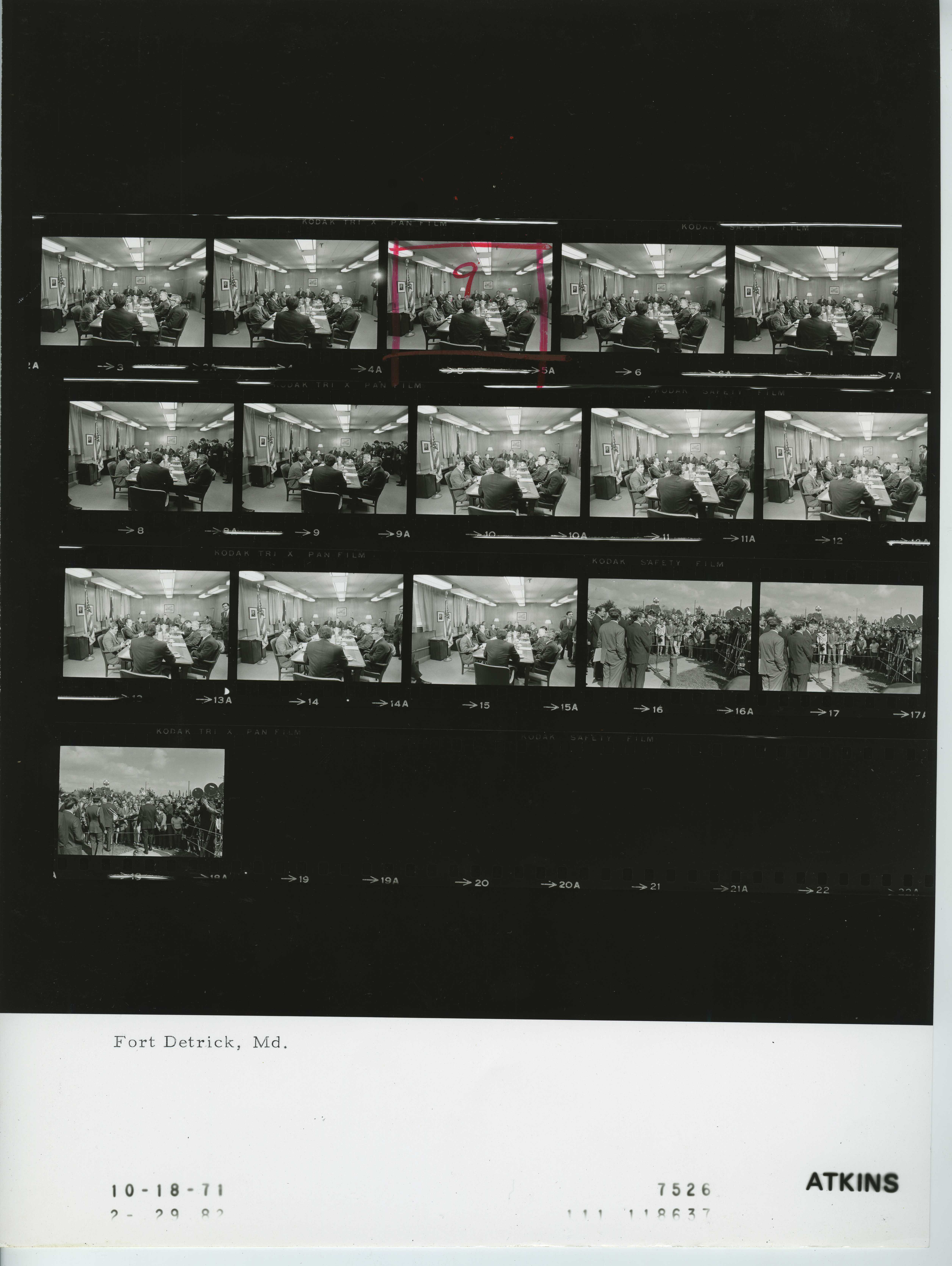
- Frame(s): WHPO-7526-03-15, President Nixon attending a briefing on the conversion of Fort Detrick's lab facilities to a cancer research center. 10/18/1971, Fort Detrick, Maryland office of Col. Mitman. President Nixon, Floyd Mitman, unidentified men, crowd, press corps members.
- Frame(s): WHPO-7526-16-19, President Nixon addressing a crowd after attending a briefing on the conversion of Fort Detrick's lab facilities to a cancer research center. 10/18/1971, Fort Detrick, Maryland exterior. President Nixon, Floyd Mitman, unidentified men, crowd, press corps members.
Roll WHPO-7527 Photographer: Knudsen, Robert L. | Color or B&W: B&W
- Frame(s): WHPO-7527-02-14, President Nixon seated at his Oval Office desk during a meeting with Robert Finch and William Rogers. 10/18/1971, Washington, D.C. White House, Oval Office. President Nixon, William Rogers, Robert Finch.
- Frame(s): WHPO-7527-04A, President Nixon seated at his Oval Office desk during a meeting with Robert Finch and William Rogers. 10/18/1971, Washington, D.C. White House, Oval Office. President Nixon, William Rogers, Robert Finch.
Roll WHPO-7528 Photographer: Knudsen, Robert L. | Color or B&W: B&W
- Frame(s): WHPO-7528-02-05, President Nixon with the Executive Board of the National Association of Retired Federal Employees (NARFE) and their wives. 10/18/1971, Washington, D.C. White House, Oval Office. President Nixon,, NARFE Executive Board members and wives.
Roll WHPO-7529 Photographer: Knudsen, Robert L. | Color or B&W: B&W
- Frame(s): WHPO-7529-02A-08A, Meeting of the Cabinet Committee on Cable TV. 10/18/1971, Washington, D.C. White House, Roosevelt Room. L-R: Bruce Owen, Robert Finch, Herbert Klein, George W. Romney, Clay Whitehead, Maurice H. Stans, Leonard Garment, Cabinet members, Walter Hinchman.
Roll WHPO-7530 Photographer: Knudsen, Robert L. | Color or B&W: B&W
- Frame(s): WHPO-7530-02A-11A, Bob Brown receiving a Black History Calendar from unidentified men. 10/18/1971, Washington, D.C. unknown. Bob Brown, unidentified men.
Roll WHPO-7531 Photographer: Atkins, Oliver | Color or B&W: B&W
- Frame(s): WHPO-7531-02A-23A, President Nixon with Washington Redskins players Jack Pardee, Maxie Baughan, George Burman, and their families. 10/18/1971, Washington, D.C. White House, Oval Office. President Nixon, Jack Pardee, Judee Pardee and children, Maxie Baughan, Dianne Baughan and children, George Burman, Marianne Burman and son.
Roll WHPO-7532 Photographer: Schumaker, Byron | Color or B&W: B&W
- Frame(s): WHPO-7532-02A-04A, President Nixon seated at his desk during a meeting with Robert Ellsworth, former U.S. Ambassador to the North Atlantic Treaty Organization, and Brig. Gen. Alexander Haig. 10/18/1971, Washington, D.C. White House, Oval Office. President Nixon, Robert Bunker, Alexander Haig.
Roll WHPO-7533 Photographer: Kightlinger, Jack | Color or B&W: B&W
- Frame(s): WHPO-7533-02-04, President Nixon and Pat Nixon in the Presidential Box for the opening of the Eisenhower Theater, a performance of Henrik Ibsen's "A Doll's House," starring Claire Bloom. 10/18/1971, Washington, D.C. Kennedy Center, Eisenhower Theater. President Nixon, Pat Nixon, J. Willard Marriott, Mrs. J. Willard Marriott, guests, audience.
- Frame(s): WHPO-7533-05-34, President Nixon and Pat Nixon in a receiving line at a small reception after the performance of Henrik Ibsen's A Doll's House, starring Claire Bloom. 10/18/1971, Washington, D.C. Kennedy Center, South Lounge. President Nixon, Pat Nixon, J. Willard Marriott, Mrs. J. Willard Marriott, guests, audience.
Roll WHPO-7534 Photographer: Kightlinger, Jack | Color or B&W: B&W
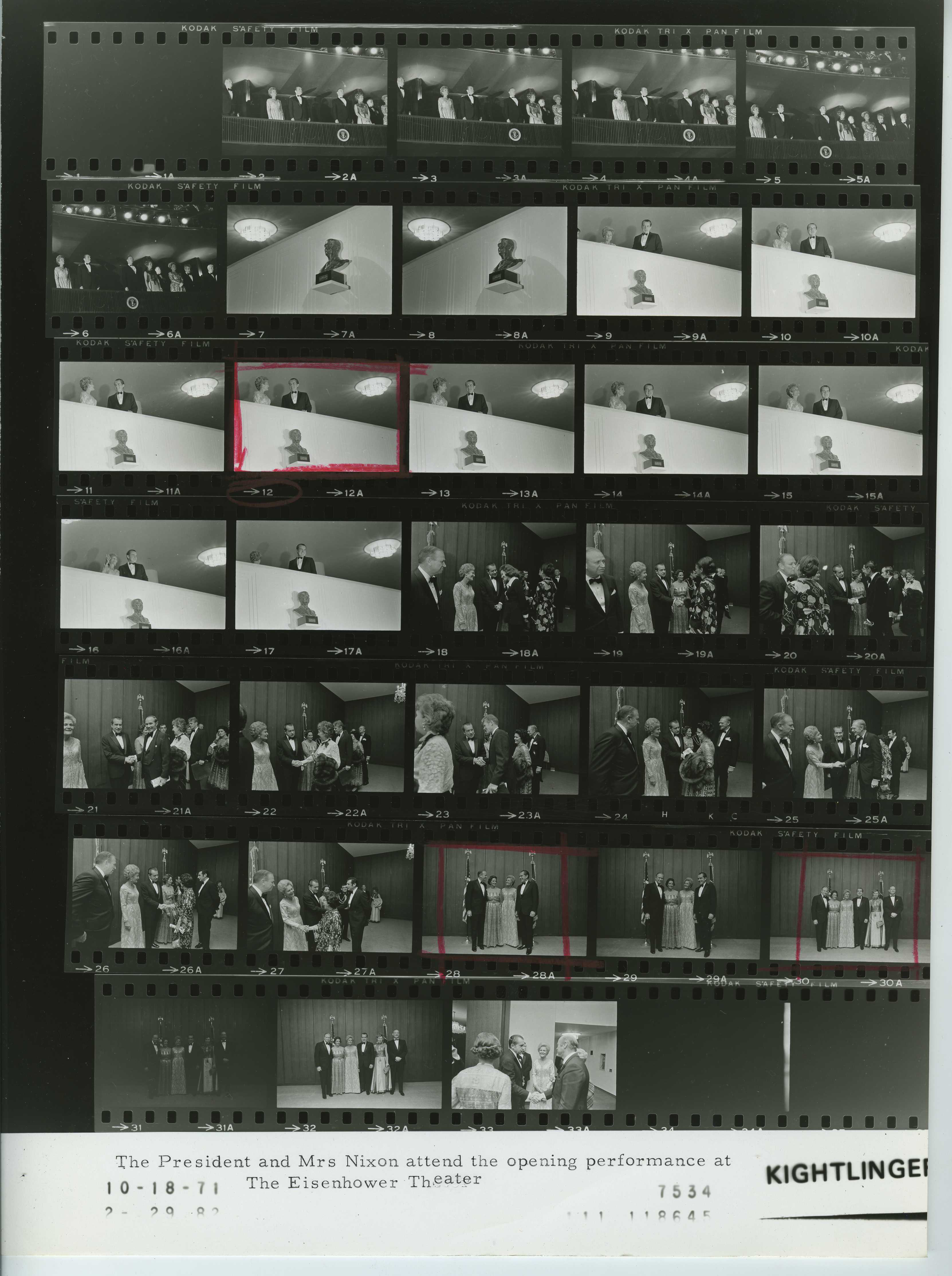
- Frame(s): WHPO-7534-02-17, President Nixon, Pat Nixon, Mr. & Mrs. J. Willard Marriott, Inaugural Committee Chairman with Ambassador John Eisenhower and Mrs. John Eisenhower in the Presidential Box for the opening of the Eisenhower Theater, for a performance of Henrik Ibsen's "A Doll's House," starring Claire Bloom. 10/18/1971, Washington, D.C. Kennedy Center, Eisenhower Theater. President Nixon, Pat Nixon, J. Willard Marriott, Mrs. J. Willard Marriott, John Eisenhower, Mrs. John Eisenhower, guests.
- Frame(s): WHPO-7534-12A, President Nixon and Pat Nixon in the Presidential Box for the opening of the Eisenhower Theater, during which Henrik Ibsen's "A Doll's House" was performed, starring Claire Bloom. A bust of Dwight D. Eisenhower sits in front of the Presidential Box. 10/18/1971, Washington, D.C. Kennedy Center, Eisenhower Theater. President Nixon, Pat Nixon.
- Frame(s): WHPO-7534-18-27, 33, President Nixon and Pat Nixon in a receiving line at a small reception after the performance of Henrik Ibsen's "A Doll's House", starring Claire Bloom. 10/18/1971, Washington, D.C. Kennedy Center, South Lounge. President Nixon, Pat Nixon, J. Willard Marriott, Mrs. J. Willard Marriott, John Eisenhower, Mrs. John Eisenhower, guests.
- Frame(s): WHPO-7534-28, President Nixon and Pat Nixon stand for a portrait with J. Willard Marriott and his wife Alice Sheets Marriott. 10/18/1971, Washington, D.C. Kennedy Center, South Lounge. President Nixon, Pat Nixon, J. Willard Marriott, Alice Sheets Marriott.
- Frame(s): WHPO-7534-28-32, President Nixon and Pat Nixon stand for a portrait with Mr. & Mrs. J. Willard Marriott, Inaugural Committee Chairman and Ambassador John Eisenhower and Mrs. John Eisenhower. 10/18/1971, Washington, D.C. Kennedy Center, South Lounge. President Nixon, Pat Nixon, J. Willard Marriott, Mrs. J. Willard Marriott, John Eisenhower, Mrs. John Eisenhower, guests.
Roll WHPO-7583 Photographer: Schumacher, Karl | Color or B&W: B&W
- Frame(s): WHPO-7583-03A-28A, Vice President Agnew and Judy Agnew attending a daytime reception in Athens, Greece. 10/18/1971, Athens, Greece unknown. Spiro T. Agnew, Judy Agnew, officials, guests.
Roll WHPO-7584 Photographer: Schumacher, Karl | Color or B&W: B&W
- Frame(s): WHPO-7584-04A-36A, Vice President Agnew and Judy Agnew attending an evening black tie event in Athens, Greece. 10/18/1971, Athens, Greece unknown. Spiro T. Agnew, Judy Agnew, officials, guests.
Roll WHPO-7585 Photographer: Schumacher, Karl | Color or B&W: B&W
- Frame(s): WHPO-7585-06-36A, Vice President Agnew and Judy Agnew attending a formal function in Athens, Greece. 10/18/1971, Athens, Greece unknown. Spiro T. Agnew, Judy Agnew, officials, guests.
Roll WHPO-7586 Photographer: Schumacher, Karl | Color or B&W: Color
- Frame(s): WHPO-7586-00A-01A, Vice President Agnew at the Athens Palace. 10/18/1971, Athens, Greece Palace, exterior. Spiro T. Agnew, aides, officials, military personnel.
- Frame(s): WHPO-7586-02A-08A, 21A-22A, Vice President Agnew greeting and sitting with an unidentified official. 10/18/1971, Athens, Greece unknown. Spiro T. Agnew, aides, officials, military personnel.
- Frame(s): WHPO-7586-12A-16A, 18A-20A, Vice President Agnew touring Athens. 10/18/1971, Athens, Greece unknown. Spiro T. Agnew, aides, officials, military personnel.
- Frame(s): WHPO-7586-23A, The Acropolis. 10/18/1971, Athens, Greece Acropolis.
Roll WHPO-7587 Photographer: Schumacher, Karl | Color or B&W: Color
- Frame(s): WHPO-7587-02A-08A, Vice Presidential Motorcade in Athens. 10/18/1971, Athens, Greece streets. officials, troops.
- Frame(s): WHPO-7587-13A-17A, Vice President Agnew reviewing troops. 10/18/1971, Athens, Greece unidentified locations. Spiro T. Agnew, officials, troops.
The White House Communications Agency Sound Recordings Collection contains public statements that took place between 1969 and 1974. Visit the finding aid to learn more.
P - Formal Presidential Remarks
- WHCA-SR-P-711012
Remarks by President Nixon in briefing at Ft. Detrick, Md. with Ken Cole, Dr. Zubron, Dr. Baker. (10/18/1971)
Runtime: 31:57:00
Original Format: 1/4-inch reel-to-reel audiotape. Original source type: Original. - WHCA-SR-P-711013
Remarks by President Nixon at Ft. Detrick HQ Bldg. (10/18/1971)
Runtime: 4:57
Original Format: 1/4-inch reel-to-reel audiotape. Original source type: Original.
The White House Communications Agency Videotape Collection contains “off-the-air” recordings of televised programs produced between 1968 and 1974. Visit the finding aid to learn more.
- WHCA-4734
President Nixon in Charlotte, North Carolina, In Honor of Billy Graham.
NET Public Affairs
Runtime: 01:32:00 - WHCA-4735
PBS Special - The United Nations Debate on the Two China Policy. People's Republic of China Richard Nixon.
NBC, ABC, CBS
Runtime: 01:06:39 - WHCA-4736
"The David Frost Show". Walker, Walter Mondale, and George Shultz.
WETA
Runtime: 01:29:43 - WHCA-4737
"Martin Agronsky: Evening Edition".
Undetermined
Runtime: 00:30:10 - WHCA-4744
Weekly News Summary, Tape I.
ALL NETWORKS
Runtime: 1:30
20. Reasoner/MacVane: Two China debate in United Nations (U.N.) (People's Republic of China). Time Code Start: 41:22. Keywords: organization of nations, intergovernmental alliance, People's Republic of China, Taiwanese. Network: ABC.
21. Smith/Jarriel: President Nixon at Ft. Detrick, Maryland, changing a biological weapons warfare plant to cancer research. Time Code Start: 43:49. Keywords: Presidents, dedications, speeches, military bases, health, cancers, diseases, medical research, investigations, chemicals, nerve gas, biological weapons, Agent Orange, herbicidal warfare. Network: ABC.
22. Reasoner/Jackson: Mayor John Lindsay a Presidential candidate. Time Code Start: 46:07. Keywords: Mayors, Presidential elections, campaigns, primaries, candidates. Network: ABC.
23. Smith: Commentary on President Nixon's record. Time Code Start: 49:33. Keywords: Presidents,. Network: ABC.
24. Chancellor/Frederick: United Nations (U.N.) debate on Two Chinas (People's Republic of China). Time Code Start: 51:14. Keywords: organization of nations, intergovernmental alliance, People's Republic of China, Taiwanese. Network: NBC.
25. Chancellor: Ft. Detrick changed to cancer research center. Time Code Start: 55:43. Keywords: military bases, health, cancers, diseases, medical research, investigations, chemicals, nerve gas, biological weapons, Agent Orange, herbicidal warfare. Network: NBC.
26. Cronkite/Hottlet: Two China's debate in United Nations (U.N.). Time Code Start: 55:58. Keywords: organization of nations, intergovernmental alliance, People's Republic of China, Taiwanese. Network: CBS.
27. Cronkite: The war; Mansfield to call for no aid to Cambodia. Time Code Start: 59:10. Keywords: Cambodia, Vietnam War, Senators, aid. Network: CBS.
28. Cronkite: Germ warfare center converted to cancer research at Ft. Detrick, Maryland. Time Code Start: 60:18. Keywords: military bases, health, cancers, diseases, medical research, investigations, chemicals, nerve gas, biological weapons, Agent Orange, herbicidal warfare. Network: CBS.
29. Sevareid: Supreme Court openings. Time Code Start: 60:48. Keywords: law officials, judges, justices, courts, trials, investigations, nominees, Lewis Powell, William Rehnquist. Network: CBS.
30. Cronkite: John Connally to go to Vietnam; Vice President Agnew in Greece. Time Code Start: 62:58. Keywords: Vietnam War, Vice Presidents, Mediterranean, Greek, travel, trips. Network: CBS.
Context (External Sources)
The Vanderbilt Television News Archive is the world's most extensive and complete archive of television news. They have been recording, preserving and providing access to television news broadcasts of the national networks since August 5, 1968.
Wikipedia is a free encyclopedia that anyone can edit.