
Introduction
This almanac page for Tuesday, October 19, 1971, pulls together various records created by the federal government and links to additional resources which can provide context about the events of the day.
Previous Date: Monday, October 18, 1971
Next Date: Wednesday, October 20, 1971
Schedule and Public Documents
The Daily Diary files represent a consolidated record of the President's activities. Visit the finding aid to learn more.
The President's day began at The White House - Washington, D. C.
The Weekly Compilation of Presidential Documents made available transcripts of the President's news conferences; messages to Congress; public speeches, remarks, and statements; and other Presidential materials released by the White House.
Digitized versions can be found at HathiTrust.
The Federal Register is the official daily publication for rules, proposed rules, and notices of federal agencies and organizations, as well as executive orders and other Presidential documents.
The Congressional Record is the official daily record of the debates and proceedings of the U.S. Congress.
Archival Holdings
Any selection of archival documents will necessarily be partial. You should use the documents and folders identified below as a starting place, but consult the linked collection finding aids and folder title lists and the collections themselves for context. Many documents to be found this way do not lend themselves to association with specific dates, but are essential to a complete understanding of the material.
Selective document listing
President's Office Files
The President's Office Files consists of materials drawn together by the Special Files Unit from several administrative subdivisions within the White House Office. It is the handwriting and sensitive papers sent to the Staff Secretary that now comprise much of the President's Office Files. Visit the finding aid to learn more.
- News Summaries, Annotated News Summaries, Box 31, News Summaries - October 13-20, 1971 [3 of 4] [Note: Due to the way News Summary products were compiled, you should also consult nearby days for potentially relevant materials.]
- News Summary, October 19, 1971, (Monday TV, plus wires, columns and magazines)
- President's Daily Schedule, Box 102, [President's Daily Schedule, Sept.-Dec. 1971] [2 of 3]
- The President's Schedule, Tuesday - October 19, 1971
The H. R. Haldeman Diaries consists of seven handwritten diaries, 36 dictated diaries recorded as sound recordings, and two handwritten audio cassette tape subject logs. The diaries and logs reflect H. R. Haldeman’s candid personal record and reflections on events, issues, and people encountered during his service in the Nixon White House. As administrative assistant to the President and Chief of Staff, Haldeman attended and participated in public events and private meetings covering the entire scope of issues in which the Nixon White House engaged in during the years 1969-1973. Visit the finding aid to learn more.
- Transcript of diary entry (PDF)
Tuesday, October 19.
We had a number of discussions on appointments today. The NATO question was back up because Bob Ellsworth was in for a meeting. The President now wants to put Kennedy on the NATO assignment if he can. We also talked about Japan, the question of whether that is still available, and if it is, he wants to send Tex Thornton. I reviewed the final recommendations for candidates for the Price Board, including Kermit Gordon, and the President even agreed to putting him on, buying the recommendation on the basis of the Machiavellian approach that it traps them into being with us at Brookings.
And back into the Court again; he met again this morning with John Mitchell. He's now thinking of some different approaches and is not telling anybody what he's really up to, but he's forcing Mitchell to reevaluate. I think he's basically dropped the idea of Herschel Friday. He's decided now that, if the ABA gives Mildred Lilly a good rating, he'll go with her. If they don't, he'll drop her and blame them for it. So he wins either way. He seems to be intrigued with Howard Baker as a possibility, which was a suggestion that came in from Len Garment and that I passed on to him yesterday when I was making my pitch for looking for some more distinction.
He got into the Common Cause problem with Colson and me this afternoon. He feels--apparently it came up at the Congressional leaders meeting this morning that Common Cause is very effective at getting letters into the Congressmen, and so on, in their lobbying effort. The President wanted us to try to do as good a job. Thinks we should regenerate our attack on Common Cause. That they're working now on the Mansfield Amendment, and they had done, apparently, a very effective job.
He had a Budget meeting this afternoon and, as a result of that, decided to have another long session with Ehrlichman on domestic priorities on Friday or Saturday and then another budget meeting, with Connally present, on Monday. He's, therefore, canceling his plan to go to Florida this weekend. He's been thoroughly enjoying throughout the day the possibility of coming down with a cold. Since he's not been outside or anything where he would normally catch one, he's decided that there is something to the virus theory and that he has caught Connally's virus, which seems to sort of please him also.
End of October 19, and end of this tape. - Original audio recording (MP3)
The National Archives Catalog is the online portal to the records held at the National Archives, and information about those records. It is the main way of describing our holdings and also provides access to electronic records and digitized versions of our holdings.
The Catalog searches across multiple National Archives resources at once, including archival descriptions, digitized and electronic records, authority records, and web pages from Archives.gov and the Presidential Libraries. The Catalog also allows users to contribute to digitized historical records through tagging and transcription.
Nixon Library Holdings
All National Archives Units
National Security Documents
The President's Daily Brief is the primary vehicle for summarizing the day-to-day sensitive intelligence and analysis, as well as late-breaking reports, for the White House on current and future national security issues. Read "The President's Daily Brief: Delivering Intelligence to Nixon and Ford" to learn more.
The Foreign Relations of the United States series presents the official documentary historical record of major U.S. foreign policy decisions and significant diplomatic activity. Visit the State Department website for more information.
Vol. V, United Nations, 1969-1972
Chinese Representation in the United Nations
421. Telegram From the Mission to the United Nations to the Department of State, New York, October 19, 1971, 0150Z
Source: National Archives, RG 59, Central Files 1970–73, UN 6 CHICOM. Confidential. Repeated to Bangkok, Canberra, Taipei, Tokyo, and Wellington.
Vol. XI, South Asia Crisis, 1971
South Asia Crisis, 1971
169. Telegram From the Department of State to the Embassy in Pakistan, Washington, October 19, 1971, 2159Z
Source: National Archives, Nixon Presidential Materials, NSC Files, Box 578, Indo-Pak War, Pakistan Chronology, Dr. Kissinger. Secret; Exdis. Drafted and approved by Van Hollen and cleared by Laingen and Jeanne Davis, Director of the NSC Staff Secretariat. Repeated to New Delhi and Dacca.
Vol. XIV, Soviet Union, October 1971-May 1972
Announcement of Summit Through the South Asia Crisis, October 12-December 1971
6. Letter From President Nixon to Soviet General Secretary Brezhnev, Washington, October 19, 1971
Source: National Archives, Nixon Presidential Materials, NSC Files, Box 492, President’s Trip Files, Dobrynin/Kissinger, 1971, Vol. 8. An undated and unattributed draft of this letter has handwritten revisions by Kissinger. The major substantive change made by Kissinger was to insert paragraph two of the letter. (Ibid.) On October 16 Haig sent an unsigned copy of this letter to Dobrynin. (Ibid.) A note at the top of the page reads: “Orig hand carried to Amb. Dobrynin, 10/19/71.”
Vol. XXXII, SALT I, 1969-1972
Narrowing the Issues, October 19, 1971-April 18, 1972
205. Letter From President Nixon to Soviet General Secretary Brezhnev, Washington, October 19, 1971
Source: National Archives, Nixon Presidential Materials, NSC Files, Box 492, President’s Trip Files, Dobrynin/Kissinger, 1971, Vol. 8. No classification marking. According to a handwritten notation at the top of the first page, the letter was “hand carried” to Dobrynin on October 19. The full text of the letter is printed in Foreign Relations, 1969–1976, volume XIV, Soviet Union, October 1971–May 1972, Document 6.
206. Conversation Among President Nixon, the President’s Deputy Assistant for National Security Affairs (Haig), the Director of the Office of Management and Budget (Shultz), and the Deputy Director of the Office of Management and Budget (Weinberger), Washington, October 19, 1971
Source: National Archives, Nixon Presidential Materials, White House Tapes, Executive Office Building, Conversation No. 292–11. No classification marking. According to the President’s Daily Diary, Nixon met with Haig, Shultz, Weinberger, and Ehrlichman between 3:05 and 5:05 p.m. (Ibid., White House Central Files) The editor transcribed the portion of the conversation printed here specifically for this volume.
Vol. XLI, Western Europe; NATO, 1969-1972
Spain
305. Letter From President Nixon to Spanish Head of State Franco, Washington, October 19, 1971
Source: National Archives, Nixon Presidential Materials, NSC Files, Box 762, Presidential Correspondence, Spain Franco corres. Secret. Hill presented Nixon’s letter to Franco on October 22. He reported on the meeting in telegram 4815 from Madrid, October 22; for text, see Foreign Relations, 1969–1976, volume E–1, Documents on Global Issues, 1969–1972, Document 413.
The Kissinger telephone conversation transcripts consist of approximately 20,000 pages of transcripts of Kissinger’s telephone conversations during his tenure as Assistant to the President for National Security Affairs (1969-1974) and Secretary of State (1973-1974) during the administration of President Richard Nixon. Visit the finding aid for more information.
Digitized versions can be found in the National Archives Catalog.
Audiovisual Holdings
The White House Tapes are sound recordings of President Richard Nixon's telephone conversations and of meetings held in the Oval Office and the Cabinet Room in the White House, the President's office in the Old Executive Office Building (OEOB), the Lincoln Sitting Room in the residence section of the White House, and several locations at the Presidential retreat at Camp David, Maryland. These recordings document many of the major events and decisions of the Nixon Administration from February 16, 1971 to July 18, 1973. Visit the White House Tapes finding aid to learn about the taping system's operation and archival processing.
Cabinet Room
- 80-2; 8:06 a.m. - 9:55 a.m.; Nixon, Richard M. (President); Rogers, William P.; Walker, Charls E.; Scott, Hugh; Griffin, Robert P.; Smith, Margaret Chase; Allott, Gordon L.; Dominick, Peter H.; Cotton, Norris; Ford, Gerald R.; Arends, Leslie C.; Anderson, John B.; Wilson, Robert C. ("Bob"); Rhodes, John J.; Conable, Barber B., Jr.; Poff, Richard H.; Devine, Samuel L.; Ehrlichman, John D.; Shultz, George P.; MacGregor, Clark; Dent, Harry S.; Timmons, William E.; Cook, Richard K.; Cowen, Eugene S.; Buchanan, Patrick J.; Harlow, Bryce N.; Ziegler, Ronald L.
- 80-3; Unknown between 12:33 p.m. & 11:59 p.m.; Bull, Stephen B.; [Unknown person(s)]
Old Executive Office Building
- 292-1; Unknown between 1:45 p.m. & 2:53 p.m.; Nixon, Richard M. (President); Sanchez, Manolo
- 292-2; Unknown between 1:45 p.m. & 2:53 p.m.; Nixon, Richard M. (President); Sanchez, Manolo
- 292-3; Unknown between 1:45 p.m. & 2:53 p.m.; Nixon, Richard M. (President); Sanchez, Manolo
- 292-4; Unknown between 1:45 p.m. & 2:53 p.m.; Nixon, Richard M. (President); White House operator
- 292-5; Unknown between 1:45 p.m. & 2:53 p.m.; Nixon, Richard M. (President); Haldeman, H. R. ("Bob")
- 292-6; 2:53 p.m. - 2:53 p.m.; Nixon, Richard M. (President); White House operator
- 292-7; Unknown between 2:53 p.m. & 3:00 p.m.; Nixon, Richard M. (President); Bull, Stephen B.
- 292-8; Unknown between 2:53 p.m. & 3:00 p.m.; Nixon, Richard M. (President); Haldeman, H. R. ("Bob")
- 292-9; 3:00 p.m. - 3:05 p.m.; Nixon, Richard M. (President); Mitchell, John N.
- 292-10; 3:05 p.m. - 3:05 p.m.; Nixon, Richard M. (President); Bull, Stephen B.
- 292-11; 3:05 p.m. - 5:05 p.m.; Nixon, Richard M. (President); Ehrlichman, John D.; Haig, Alexander M., Jr.; Weinberger, Caspar W. ("Cap"); Shultz, George P.; Sanchez, Manolo
- 292-12; 5:08 p.m. - 5:08 p.m.; Nixon, Richard M. (President); White House operator
- 292-13; Unknown between 5:08 p.m. & 5:09 p.m.; Nixon, Richard M. (President); Haldeman, H. R. ("Bob"); Sanchez, Manolo
- 292-14; Unknown between 5:08 p.m. & 5:09 p.m.; Nixon, Richard M. (President); White House operator
- 292-15; 5:09 p.m. - 5:27 p.m.; Nixon, Richard M. (President); Colson, Charles W.
- 292-16; 5:27 p.m. - 5:38 p.m.; Nixon, Richard M. (President); Sanchez, Manolo
- 292-17; Unknown between 5:27 p.m. & 5:38 p.m.; Nixon, Richard M. (President); White House operator
- 292-18; 5:38 p.m. - 5:43 p.m.; Nixon, Richard M. (President); Mitchell, John N.
- 292-19; Unknown between 5:43 p.m. & 5:49 p.m.; Nixon, Richard M. (President); White House operator
- 292-20; Unknown between 5:43 p.m. & 5:49 p.m.; Nixon, Richard M. (President); White House operator
- 292-21; Unknown between 5:43 p.m. & 5:49 p.m.; Nixon, Richard M. (President); [Unknown person(s)]
- 292-22; 5:49 p.m. - 5:50 p.m.; Nixon, Richard M. (President); Nixon, Thelma C. ("Pat") (Ryan)
- 292-23; Unknown between 5:50 p.m. & 6:04 p.m.; Nixon, Richard M. (President); Sanchez, Manolo
- 292-24; Unknown between 5:50 p.m. & 6:04 p.m.; Nixon, Richard M. (President); Ehrlichman, John D.
- 292-25; Unknown between 5:50 p.m. & 6:04 p.m.; Nixon, Richard M. (President); White House operator
- 292-26; 6:04 p.m. - 6:09 p.m.; Nixon, Richard M. (President); Graham, William F. ("Billy")
- 292-27; Unknown between 6:09 p.m. & 6:16 p.m.; Nixon, Richard M. (President); White House operator
- 292-28; 6:16 p.m. - 6:20 p.m.; Nixon, Richard M. (President); Rebozo, Charles G. ("Bebe")
- 292-29; Unknown between 6:20 p.m. & 6:30 p.m.; Nixon, Richard M. (President); Sanchez, Manolo
- 292-30; Unknown between 6:20 p.m. & 6:30 p.m.; Nixon, Richard M. (President); Sanchez, Manolo
- 292-31; 6:30 p.m. - 6:34 p.m.; Nixon, Richard M. (President); Butterfield, Alexander P.
- 292-32; Unknown between 6:34 p.m. & 6:45 p.m.; Nixon, Richard M. (President); Sanchez, Manolo
- 292-33; Unknown between 6:34 p.m. & 6:45 p.m.; Nixon, Richard M. (President); Sanchez, Manolo
- 292-34; Unknown between 6:34 p.m. & 6:45 p.m.; Nixon, Richard M. (President); Sanchez, Manolo
- 292-35; Unknown between 6:34 p.m. & 6:45 p.m.; Nixon, Richard M. (President); White House operator
- 292-36; Unknown between 6:34 p.m. & 6:45 p.m.; Nixon, Richard M. (President); Sanchez, Manolo; Keyes, Paul W.
- 292-37; Unknown between 6:47 p.m. & 7:49 p.m.; Nixon, Richard M. (President); Sanchez, Manolo
Oval Office
- 596-1; Unknown between 7:53 a.m. & 8:06 a.m.; Nixon, Richard M. (President); Bull, Stephen B.
- 596-2; Unknown between 8:06 a.m. & 10:14 a.m.; [Unknown person(s)]
- 596-3; 10:14 a.m. - 10:55 a.m.; Nixon, Richard M. (President); Mitchell, John N.; Haldeman, H. R. ("Bob"); Bull, Stephen B.
- 596-4; 10:55 a.m. - 12:14 p.m.; Nixon, Richard M. (President); Haldeman, H. R. ("Bob"); Bandaranaike, Sirimavo; Kankaratne, Neville; Strausz-Hupe, Robert; Mosbacher, Emil, Jr. (Bus); Haig, Alexander M., Jr.; White House photographer; [Unknown person(s)]
- 596-5; 12:14 p.m. - 12:15 p.m.; [Unknown person(s)]
- 596-6; Unknown between 12:15 p.m. & 12:17 p.m.; Nixon, Richard M. (President); Haig, Alexander M., Jr.
- 596-7; 12:17 p.m. - 12:18 p.m.; Nixon, Richard M. (President); Bull, Stephen B.
- 596-8; 12:23 p.m. - 12:23 p.m.; Nixon, Richard M. (President); White House operator
- 596-9; 12:23 p.m. - 12:23 p.m.; Nixon, Richard M. (President); White House operator
- 596-10; Unknown between 12:30 p.m. & 12:31 p.m.; Nixon, Richard M. (President); White House operator
- 596-11; 12:31 p.m. - 12:33 p.m.; Nixon, Richard M. (President); Bull, Stephen B.; Tomkins, Ross; Reynders, Charlton ("Rink"); White House photographer
- 596-12; Unknown between 12:33 p.m. & 12:36 p.m.; Nixon, Richard M. (President); Sanchez, Manolo
- 596-13; 12:36 p.m. - 12:53 p.m.; Nixon, Richard M. (President); Woods, Rose Mary; White House operator; Poff, Richard H.; Nixon, Thelma C. ("Pat") (Ryan)
- 596-14; 12:53 p.m. - 12:53 p.m.; Nixon, Richard M. (President); White House operator
- 596-15; Unknown between 12:53 p.m. & 12:54 p.m.; Nixon, Richard M. (President); [Unknown person(s)]
- 596-16; 12:54 p.m. - 12:56 p.m.; Nixon, Richard M. (President); Mitchell, John N.
- 596-17; 12:56 p.m. - 1:26 p.m.; Nixon, Richard M. (President); Haldeman, H. R. ("Bob"); Colson, Charles W.; Bull, Stephen B.
- 596-18; 1:26 p.m. - 1:37 p.m.; Nixon, Richard M. (President); Mitchell, John N.
- 596-19; Unknown between 1:37 p.m. & 1:39 p.m.; Nixon, Richard M. (President); Haldeman, H. R. ("Bob")
- 596-20; Unknown between 1:37 p.m. & 1:39 p.m.; Nixon, Richard M. (President); White House operator
- 596-21; 1:39 p.m. - 1:44 p.m.; Nixon, Richard M. (President); Rumsfeld, Donald H.
- 596-22; Unknown between 1:45 p.m. & 11:59 p.m.; [Unknown person(s)]
- 596-23; Unknown between 12:23 p.m. & 12:30 p.m.; Nixon, Richard M. (President); Meares, Charles W. V.; Lawry, Sylvia; Cole, Kenneth R., Jr.; White House photographer; Bull, Stephen B.
White House Telephone
- 11-123; Unknown between 7:53 a.m. & 12:42 p.m.; Nixon, Richard M. (President); White House operator
- 11-124; Unknown between 7:53 a.m. & 12:42 p.m.; Nixon, Richard M. (President); White House operator
- 11-125; Unknown between 7:53 a.m. & 12:42 p.m.; Nixon, Richard M. (President); White House operator
- 11-126; Unknown between 7:53 a.m. & 12:42 p.m.; Nixon, Richard M. (President); [Unknown person(s)]
- 11-127; Unknown between 7:53 a.m. & 12:42 p.m.; Nixon, Richard M. (President); White House operator
- 11-128; 12:42 p.m. - 12:43 p.m.; Nixon, Richard M. (President); Poff, Richard H.
- 11-129; 12:45 p.m. - 12:46 p.m.; Nixon, Richard M. (President); Nixon, Thelma C. ("Pat") (Ryan)
- 11-130; Unknown between 12:46 p.m. & 12:54 p.m.; Nixon, Richard M. (President); White House operator
- 11-131; 12:54 p.m. - 12:56 p.m.; Nixon, Richard M. (President); Mitchell, John N.
- 11-132; Unknown between 12:54 p.m. & 1:26 p.m.; Nixon, Richard M. (President); White House operator
- 11-133; 1:26 p.m. - 1:37 p.m.; Nixon, Richard M. (President); Mitchell, John N.
- 11-134; Unknown between 1:37 p.m. & 1:39 p.m.; Nixon, Richard M. (President); White House operator
- 11-135; 1:39 p.m. - 1:44 p.m.; Nixon, Richard M. (President); Rumsfeld, Donald H.
- 11-136; Unknown between 1:44 p.m. & 3:00 p.m.; Nixon, Richard M. (President); White House operator
- 11-137; Unknown between 1:44 p.m. & 3:00 p.m.; Nixon, Richard M. (President); White House operator
- 11-138; 3:00 p.m. - 3:05 p.m.; Nixon, Richard M. (President); Mitchell, John N.
- 11-139; 5:08 p.m. - 5:08 p.m.; Nixon, Richard M. (President); White House operator
- 11-140; Unknown between 5:08 p.m. & 5:09 p.m.; Nixon, Richard M. (President); White House operator
- 11-141; 5:09 p.m. - 5:27 p.m.; Nixon, Richard M. (President); Colson, Charles W.
- 11-142; Unknown between 5:27 p.m. & 5:38 p.m.; Nixon, Richard M. (President); White House operator
- 11-143; 5:38 p.m. - 5:43 p.m.; Nixon, Richard M. (President); Mitchell, John N.
- 11-144; 5:43 p.m. - 5:48 p.m.; Nixon, Richard M. (President); White House operator
- 11-145; Unknown between 5:43 p.m. & 5:48 p.m.; Nixon, Richard M. (President); White House operator
- 11-146; 5:49 p.m. - 5:50 p.m.; Nixon, Richard M. (President); Nixon, Thelma C. ("Pat") (Ryan)
- 11-147; 5:50 p.m. - 6:04 p.m.; Nixon, Richard M. (President); White House operator
- 11-148; 6:04 p.m. - 6:09 p.m.; Nixon, Richard M. (President); Graham, William F. ("Billy")
- 11-149; Unknown between 6:09 p.m. & 6:16 p.m.; Nixon, Richard M. (President); White House operator
- 11-150; 6:16 p.m. - 6:20 p.m.; Nixon, Richard M. (President); Rebozo, Charles G. ("Bebe")
- 11-151; Unknown between 6:20 p.m. & 6:45 p.m.; Nixon, Richard M. (President); White House operator
- 11-152; 6:45 p.m. - 6:47 p.m.; Nixon, Richard M. (President); Keyes, Paul W.
- 11-153; 7:49 p.m. - 8:02 p.m.; Nixon, Richard M. (President); Powell, Lewis F., Jr.
- 11-154; Unknown between 8:02 p.m. & 8:19 p.m.; Nixon, Richard M. (President); White House operator
- 11-155; 8:19 p.m. - 8:24 p.m.; Nixon, Richard M. (President); Mitchell, John N.
The White House Photo Office collection consists of photographic coverage of President Richard Nixon meeting with prominent social, political, and cultural personalities; speaking engagements and news conferences of the President and various high-ranking members of the White House staff and Cabinet; Presidential domestic and foreign travel, including Presidential vacations; social events and entertainment involving the First Family, including entertainers present; official portraits of the President, First Family, and high-ranking members of the Nixon administration; the 1969 and 1973 Inaugurals; the President’s 1972 Presidential election campaign appearances (including speeches) and other official activities of the White House staff and the President’s Cabinet from January 20, 1969 until August 9, 1974 at the White House and the Old Executive Office Building; other locations in Washington, DC, such as The Mall; and the Presidential retreats in Camp David, Maryland, Key Biscayne, Florida, and San Clemente, California. Visit the finding aid to learn more.
Roll WHPO-7535 Photographer: Atkins, Oliver | Color or B&W: B&W
- Frame(s): WHPO-7535-, President Nixon sitting with Prime Minister of Ceylon, Her Excellency Sirimavo Bandaranaike, Ambassador from Ceylon to the U.S., Ambassador Neville Kanakaratne, Ambassador Robert Strausz-Hupe, Sectretary of Protocol Emil Mosbacher, Jr. and Brig. Gen. Alexander Haig. 10/19/1971, Washington, D.C. White House, Oval Office. President Nixon, Emil Mosbacher, Alexander Haig, Robert Strausz-Hupe, Sirimavo Bandaranaike, Neville Kanakaratne.
Roll WHPO-7536 Photographer: Schumaker, Byron | Color or B&W: B&W
- Frame(s): WHPO-7536-02-10, Representative Gerald Ford and Senator Hugh Scott in front of microphones, briefing an audience, with Ron Ziegler beside them. 10/19/1971, Washington, D.C. White House. Gerald Ford, Hugh Scott, Ronald Ziegler.
Roll WHPO-7537 Photographer: Schumaker, Byron | Color or B&W: B&W
- Frame(s): WHPO-7537-01-02, Representative Gerald Ford and Senator Hugh Scott in front of microphones, briefing an audience, with Ron Ziegler beside them. 10/19/1971, Washington, D.C. White House. Gerald Ford, Hugh Scott, Ronald Ziegler.
Roll WHPO-7538 Photographer: Atkins, Oliver | Color or B&W: B&W
- Frame(s): WHPO-7538-03-09, Charles Meares, Campaign Chairman for the National Multiple Sclerosis Society, and Sylvia Lawry, Executive Director of the National Multiple Sclerosis Society, presenting a tray expressing gratitude of the Society to President Nixon. 10/19/1971, Washington, D.C. White House, Oval Office. President Nixon, Charles W.V. Meares, Sylvia Lawry.
- Frame(s): WHPO-7538-11-16, President Nixon with aide Stephen Bull, and "to Tell the Truth" television quiz show contestants Ross Tompkins and Charles "Rink" Reynders who impersonated Bull. 10/19/1971, Washington, D.C. White House, Oval Office. President Nixon, Stephen B. Bull, Ross Tompkins, Charlton Reynders.
Roll WHPO-7539 Photographer: Kightlinger, Jack | Color or B&W: B&W
- Frame(s): WHPO-7539-02A-17A, Pat Nixon attending the 19th Annual Landscape Awards Ceremony of the American Association of Nurserymen. 10/19/1971, Washington, D.C. White House, East Garden. Pat Nixon, unidentified persons.
Roll WHPO-7540 Photographer: Kightlinger, Jack | Color or B&W: Color
- Frame(s): WHPO-7540-02-03, Pat Nixon attending the 19th Annual Landscape Awards Ceremony of the American Association of Nurserymen. 10/19/1971, Washington, D.C. White House, East Garden. Pat Nixon.
- Frame(s): WHPO-7540-02-35, Pat Nixon presenting award certificates to winners at the 19th Annual Landscape Awards Ceremony of the American Association of Nurserymen. 10/19/1971, Washington, D.C. White House, East Garden. Pat Nixon, Joseph Klupenger, Robert Lederer, award winners.
- Frame(s): WHPO-7540-04-08, Joseph Klupenger, President of the American Association of Nurserymen and Robert Lederer, Executive Vice President of the Amerian Association of Nurserymen introducing Pat Nixon as Honorary Chairman of the 19th Annual Landscape Awards Ceremon. 10/19/1971, Washington, D.C. White House, East Garden. Pat Nixon, Joseph Klupenger, Robert Lederer, award winners.
Roll WHPO-7541 Photographer: Kightlinger, Jack | Color or B&W: Color
- Frame(s): WHPO-7541-02-22, Pat Nixon presenting award certificates to winners at the 19th Annual Landscape Awards Ceremony of the American Association of Nurserymen. 10/19/1971, Washington, D.C. White House, East Garden. Pat Nixon, award winners.
- Frame(s): WHPO-7541-23-36, Pat Nixon attending the 19th Annual Landscape Awards Ceremony of the American Association of Nurserymen. 10/19/1971, Washington, D.C. White House, East Garden. Pat Nixon, award winners, guests, band.
Roll WHPO-7542 Photographer: Knudsen, Robert L. | Color or B&W: B&W
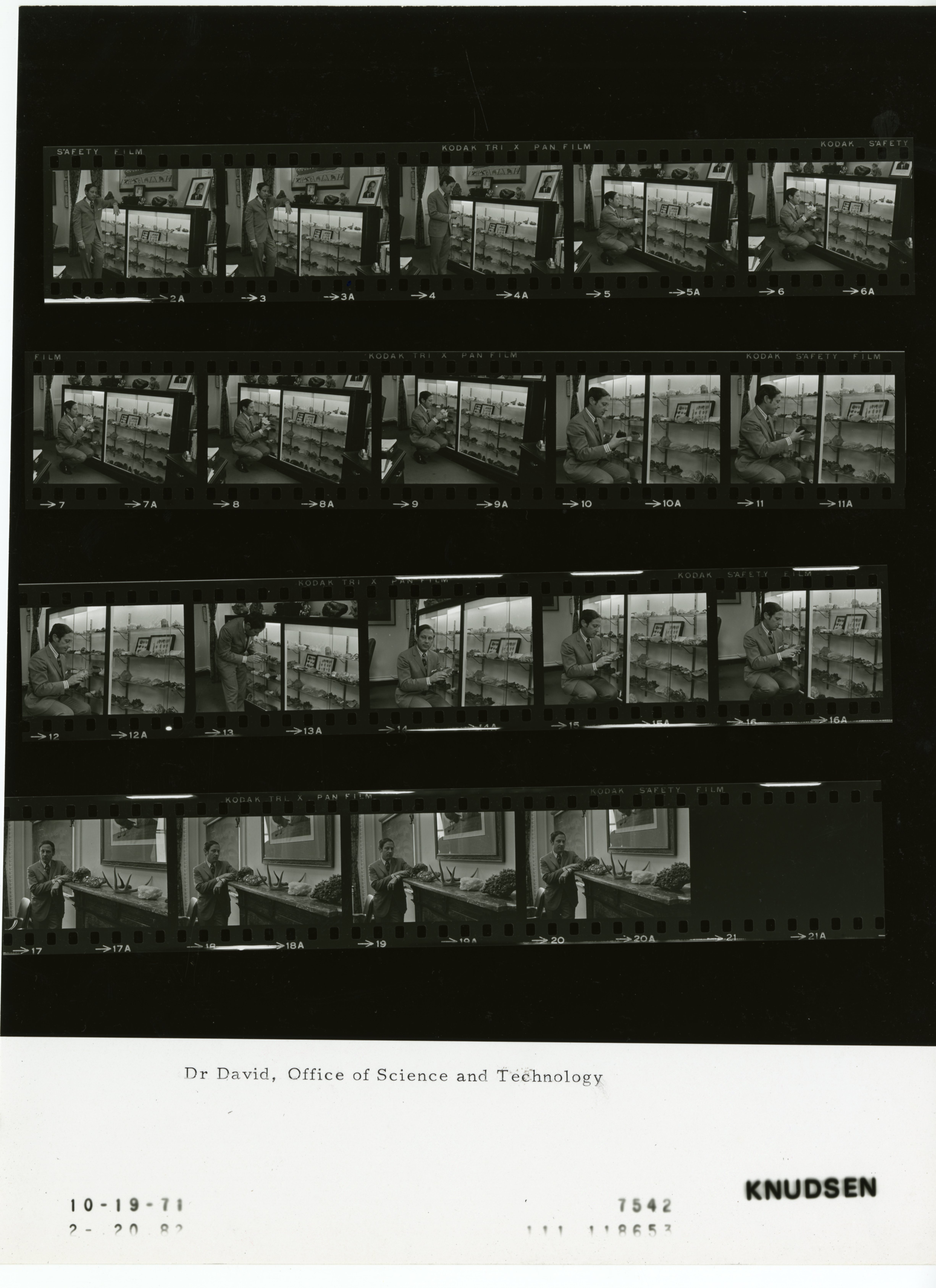
- Frame(s): WHPO-7542-02-20, Dr. Edward David, Jr., Presidential Science Advisor, in front of display cases and pointing out items on display. 10/19/1971, Washington, D.C. unknown. Edward David, Jr.
Roll WHPO-7543 Photographer: Knudsen, Robert L. | Color or B&W: Color
- Frame(s): WHPO-7543-02-11, Stephen Bull with "To Tell The Truth" TV producers. 10/19/1971, Washington, D.C. White House, Oval Office. Stephen B. Bull, unidentified men and woman.
Roll WHPO-7544 Photographer: Kightlinger, Jack | Color or B&W: Color
- Frame(s): WHPO-7544-03-05, Pat Nixon sitting with Prime Minister of Ceylon, Her Excellency Sirimavo Bandaranaike. 10/19/1971, Washington, D.C. White House, Yellow Oval Room. Pat Nixon, Sirimavo Bandaranaike.
Roll WHPO-7588 Photographer: Schumacher, Karl | Color or B&W: Color
- Frame(s): WHPO-7588-03-27, Vice President Agnew and Judy Agnew participating in an arrival ceremony in Agnew's ancestral home town of Gargaliani, Greece. 10/19/1971, Gargaliani, Greece unknown. Spiro T. Agnew, Judy Agnew, officials, folk dancers, military personnel.
Roll WHPO-7589 Photographer: Schumacher, Karl | Color or B&W: Color
- Frame(s): WHPO-7589-03A-30A, Vice President Agnew and Judy Agnew participating in an arrival ceremony in Agnew's ancestral home town of Gargaliani, Greece. 10/19/1971, Gargaliani, Greece unknown. Spiro T. Agnew, Judy Agnew, officials, folk dancers, military personnel.
Roll WHPO-7590 Photographer: Schumacher, Karl | Color or B&W: Color
- Frame(s): WHPO-7590-10A-18A, 31A-34A, Vice President Agnew and Judy Agnew touring his ancestral home town of Gargaliani, Greece. 10/19/1971, Gargaliani, Greece various outdoor locations. Agnew, Judy Agnew, Greek clergymen, officials, crowd.
- Frame(s): WHPO-7590-19A-26A, Vice President Agnew and Judy Agnew visiting a cemetery while on a visit to his ancestral home town of Gargaliani, Greece. 10/19/1971, Gargaliani, Greece unidentified cemetery. Agnew, Judy Agnew, Greek clergymen, officials, crowd.
- Frame(s): WHPO-7590-27A-30A, Vice President Agnew and Judy Agnew giving a little girl an American flag, while on a visit to his ancestral home town of Gargaliani, Greece. 10/19/1971, Gargaliani, Greece unidentified cemetery. Agnew, Judy Agnew, Greek clergymen, officials, crowd.
- Frame(s): WHPO-7590-30, Vice President Agnew and Judy Agnew giving a little girl an American flag while on a visit to his ancestral home town of Gargaliani, Greece. 10/19/1971, Gargaliani, Greece unidentified cemetery. Spiro Agnew, Judy Agnew, unidentified little girl, reporters, unidentified persons.
Roll WHPO-7591 Photographer: Schumacher, Karl | Color or B&W: Color
- Frame(s): WHPO-7591-07, 11, 13-15, Vice President Agnew and Judy Agnew touring his ancestral home town of Gargaliani, Greece. 10/19/1971, Gargaliani, Greece unknown. Spiro T. Agnew, Judy Agnew, officials, crowd.
- Frame(s): WHPO-7591-09-10, 12, 18, Vice President Agnew and Judy Agnew touring his ancestral home town of Gargaliani, Greece. 10/19/1971, Gargaliani, Greece unknown interior. Spiro T. Agnew, Judy Agnew, officials, crowd.
- Frame(s): WHPO-7591-19-36A, Vice President Agnew greeting memers of the crowd while on a visit to his ancestral home town of Gargaliani, Greece. 10/19/1971, Gargaliani, Greece unknown. Spiro T. Agnew, Judy Agnew, officials, crowd.
Roll WHPO-7592 Photographer: Schumacher, Karl | Color or B&W: Color
- Frame(s): WHPO-7592-03A-09A, Vice President Agnew and Judy Agnew greeting members of the crowd upon arrival in his ancestral home town of Gargaliani, Greece. 10/19/1971, Gargaliani, Greece airport, tarmac. Spiro T. Agnew, Judy Agnew, officials, crowd.
- Frame(s): WHPO-7592-10A-13A, Vice President Agnew and Judy Agnew attending receptions while on a visit to his ancestral home town of Gargaliani, Greece. 10/19/1971, Gargaliani, Greece unknown. Spiro T. Agnew, Judy Agnew, officials, crowd.
Roll WHPO-7593 Photographer: Schumacher, Karl | Color or B&W: Color
- Frame(s): WHPO-7593-03-08, Vice President Agnew and Judy Agnew are greeted by officials and clergy upon arrival at an airport near his ancestral home town of Gargaliani, Greece. 10/19/1971, Gargaliani, Greece airport. Spiro T. Agnew, Judy Agnew, Greek clergymen, military personnel, officials.
- Frame(s): WHPO-7593-09-11, Vice President Agnew reviewing troops upon arrival in his ancestral home town of Gargaliani, Greece. 10/19/1971, Gargaliani, Greece airport. Spiro T. Agnew, Judy Agnew, Greek clergymen, military personnel, officials.
Roll WHPO-7594 Photographer: Schumacher, Karl | Color or B&W: Color
- Frame(s): WHPO-7594-03A-24A, Vice President Agnew and Judy Agnew attending a reception and luncheon in his ancestral home town of Gargaliani, Greece. 10/19/1971, Gargaliani, Greece unknown. Spiro T. Agnew, Judy Agnew, Greek clergymen, officials, guests.
Roll WHPO-7595 Photographer: Schumacher, Karl | Color or B&W: Color
- Frame(s): WHPO-7595-03A-04A, Crete cityscape seen from the interior of Air Force Two (AF2) arriving at Iraklion. 10/19/1971, Iraklion, Crete airplane, interior.
- Frame(s): WHPO-7595-05A-19A, Vice President Agnew and Judy Agnew greeting a crowd upon arrival to Iraklion, Crete. 10/19/1971, Iraklion, Crete airport, tarmac. Spiro T. Agnew, Judy Agnew, Greek clergymen, officials, crowd.
- Frame(s): WHPO-7595-20A-22A, 24A, Vice President Agnew and Judy Agnew inside an unidentified building. 10/19/1971, Iraklion, Crete unknown. Spiro T. Agnew, Judy Agnew, Greek clergymen, officials, crowd.
- Frame(s): WHPO-7595-25A-34A, Vice President Agnew and Judy Agnew descending a staircase and then greeting a crowd at its base. 10/19/1971, Iraklion, Crete unknown. Spiro T. Agnew, Judy Agnew, Greek clergymen, officials, crowd.
Roll WHPO-7596 Photographer: Schumacher, Karl | Color or B&W: Color
- Frame(s): WHPO-7596-02A-10A, Vice President Agnew and Judy Agnew attending an indoor reception in Iraklion, Crete. 10/19/1971, Iraklion, Crete unknown. Spiro T. Agnew, Judy Agnew, officials, guests.
The White House Communications Agency Sound Recordings Collection contains public statements that took place between 1969 and 1974. Visit the finding aid to learn more.
B - Vice-Presidential (Agnew and Ford)
- WHCA-SR-B-199
Remarks at a luncheon hosted by the City of Gargalianoi-Gargalianoi, Greece. (10/19/1971)
Runtime: 10:00
Original Format: 1/4-inch reel-to-reel audiotape. Original source type: Original. - WHCA-SR-B-199
Remarks-Gargalianoi, Greece. (10/19/1971)
Runtime: 5:00
Original Format: 1/4-inch reel-to-reel audiotape. Original source type: Original. - WHCA-SR-B-200
Press conference-A.F. 2 enroute Iraklion, Crete. (10/19/1971)
Runtime: 15:00
Original Format: 1/4-inch reel-to-reel audiotape. Original source type: Original. - WHCA-SR-B-201
Remarks at Liberty Square-Iraklion, Crete. (10/19/1971)
Runtime: 5:00
Original Format: 1/4-inch reel-to-reel audiotape. Original source type: Original.
C - First Lady
- WHCA-SR-C-086
Remarks by Pat Nixon during the Landscape Awards presentation in the East Garden. (10/19/1971, East Garden, The White House)
Runtime: 1:25
Production credits: Audio feed supplied by WHCA; Recorded by LRR (initials of WHCA engineer)
Original Format: 1/4-inch reel-to-reel audiotape. Original source type: Original.
H - White House Staff Member Recordings
- WHCA-SR-H-447
Press briefing by Donald Rumsfeld and Charles Walker on Phase II. (10/19/1971, Press Center, White House)
Runtime: 31:50:00
Keywords: Press conferences, news conferences, interviews, media
Production credits: Audio feed supplied by ABC; Recorded by LDH (initials of WHCA engineer)
Original Format: 1/4-inch reel-to-reel audiotape. Original source type: Original.
P - Formal Presidential Remarks
- WHCA-SR-P-711014
Briefing by Joint Chiefs of Staff. (10/19/1971)
Runtime: 14:07
Original Format: 1/4-inch reel-to-reel audiotape. Original source type: Original.
The White House Communications Agency Videotape Collection contains “off-the-air” recordings of televised programs produced between 1968 and 1974. Visit the finding aid to learn more.
- WHCA-4744
Weekly News Summary, Tape I.
ALL NETWORKS
Runtime: 1:30
31. Smith: Two Chinas debate (People's Republic of China). Time Code Start: 64:31. Keywords: organization of nations, intergovernmental alliance, United Nations (U.N.), People's Republic of China, Taiwanese. Network: ABC.
32. Smith/Donaldson: Mansfield Amendment. Time Code Start: 65:10. Keywords: Vietnam War, troops, withdrawals, amendments, voting, losses. Network: ABC.
33. Smith/Jarriel: Phase II economy. Time Code Start: 66:58. Keywords: wage and price controls, freezes, prices, costs, increases, decreases, economy, economics, budgets, finances, recession, inflation, money. Network: ABC.
34. Chancellor/Levine: Phase II economy. Time Code Start: 69:00. Keywords: wage and price controls, freezes, prices, costs, increases, decreases, economy, economics, budgets, finances, recession, inflation, money. Network: NBC.
35. Chancellor: Representative Springer, David Brinkley, testimony before Senate; Freedom of the press. Time Code Start: 71:26. Keywords: media, newspapers, magazines, publications, television, TV, civil rights, constitutional rights, First Amendment, hearings, testify, testimonies. Network: NBC.
36. Chancellor: Unemployment statistics, July, August, September. Time Code Start: 74:00. Keywords: jobs, unemployment, statistics. Network: NBC.
37. Quinn: Vice President Agnew in Greece. Time Code Start: 74:36. Keywords: Vice Presidents, Mediterranean, Greek, travel, trips. Network: NBC.
38. Cronkite/Rather: Phase II economy. Time Code Start: 76:52. Keywords: wage and price controls, freezes, prices, costs, increases, decreases, economy, economics, budgets, finances, recession, inflation, money. Network: CBS.
39. Cronkite/Kalb: Mansfield Ammendment. Time Code Start: 79:15. Keywords: Military Authorization Act, ammendments, Armed Forces, military, research projects. Network: CBS.
40. Cronkite/Brayle: Vice President Agnew in Greece. Time Code Start: 81:16. Keywords: Vice Presidents, Mediterranean, Greek, travel, trips. Network: CBS.
41. Cronkite/Herman: Freedom of the press with David Brinkley, Representative Springer. Time Code Start: 83:51. Keywords: media, newspapers, magazines, publications, civil rights, constitutional rights, First Amendment. Network: CBS.
42. Cronkite: Ex-Secret Serviceman Youngblood, criticizes President Nixon. Time Code Start: 86:21. Keywords: Presidents, opinons, security, police. Network: CBS.
43. Sevareid: Phase II economy. Time Code Start: 86:52. Keywords: wage and price controls, freezes, prices, costs, increases, decreases, economy, economics, budgets, finances, recession, inflation, money. Network: CBS.
Context (External Sources)
The Vanderbilt Television News Archive is the world's most extensive and complete archive of television news. They have been recording, preserving and providing access to television news broadcasts of the national networks since August 5, 1968.
Wikipedia is a free encyclopedia that anyone can edit.