
Introduction
This almanac page for Tuesday, May 16, 1972, pulls together various records created by the federal government and links to additional resources which can provide context about the events of the day.
Previous Date: Monday, May 15, 1972
Next Date: Wednesday, May 17, 1972
Schedule and Public Documents
The Daily Diary files represent a consolidated record of the President's activities. Visit the finding aid to learn more.
The President's day began at The White House - Washington, D. C.
The Weekly Compilation of Presidential Documents made available transcripts of the President's news conferences; messages to Congress; public speeches, remarks, and statements; and other Presidential materials released by the White House.
Digitized versions can be found at HathiTrust.
Each Public Papers of the Presidents volume contains the papers and speeches of the President of the United States that were issued by the White House Office of the Press Secretary during the time period specified by the volume. The material is presented in chronological order, and the dates shown in the headings are the dates of the documents or events. In instances when the release date differs from the date of the document itself, that fact is shown in the text note.
To ensure accuracy, remarks have been checked against audio recordings (when available) and signed documents have been checked against the original, unless otherwise noted. Editors have provided text notes and cross references for purposes of identification or clarity.
The Federal Register is the official daily publication for rules, proposed rules, and notices of federal agencies and organizations, as well as executive orders and other Presidential documents.
The Congressional Record is the official daily record of the debates and proceedings of the U.S. Congress.
Archival Holdings
Any selection of archival documents will necessarily be partial. You should use the documents and folders identified below as a starting place, but consult the linked collection finding aids and folder title lists and the collections themselves for context. Many documents to be found this way do not lend themselves to association with specific dates, but are essential to a complete understanding of the material.
Selective document listing
President's Office Files
The President's Office Files consists of materials drawn together by the Special Files Unit from several administrative subdivisions within the White House Office. It is the handwriting and sensitive papers sent to the Staff Secretary that now comprise much of the President's Office Files. Visit the finding aid to learn more.
- News Summaries, Unmarked News Summaries, Box 49, News Summaries - May 1972 [7 of 13] [Note: Due to the way News Summary products were compiled, you should also consult nearby days for potentially relevant materials.]
- CBS-TV Special - "Where We Stand" 7:30 - 8:30 p.m., May 16, 1972
- News Summaries, Unmarked News Summaries, Box 49, News Summaries - May 1972 [12 of 13]
- News Summary, May 16, 1972, (Mon. nets, wires, mags, columns)
- Special Report on Shooting of Gov. Wallace, May 16, 1972
- President's Daily Schedule, Box 102, [President's Daily Schedule, Apr.-July 1972] [2 of 3]
- The President's Schedule, Tuesday - May 16, 1972
President's Personal File
The President's Personal File is essentially a President's secretary's file, kept by Rose Mary Woods, personal secretary to the President, for two purposes: (1) preserving for posterity a collection of documents particularly close to the President, whether because he dictated or annotated them, or because of the importance of the correspondent or the event concerned and (2) giving appropriate attention–letters of gratitude, invitations to White House social events, and the like–to members and important friends and supporters of the Nixon administration. This generalization does not describe all the varied materials of a file group which is essentially a miscellany, but it does identify the reason for the existence of the file group's core. Visit the finding aid to learn more.
- President's Speech File
The H. R. Haldeman Diaries consists of seven handwritten diaries, 36 dictated diaries recorded as sound recordings, and two handwritten audio cassette tape subject logs. The diaries and logs reflect H. R. Haldeman’s candid personal record and reflections on events, issues, and people encountered during his service in the Nixon White House. As administrative assistant to the President and Chief of Staff, Haldeman attended and participated in public events and private meetings covering the entire scope of issues in which the Nixon White House engaged in during the years 1969-1973. Visit the finding aid to learn more.
- Transcript of diary entry (PDF)
Tuesday, May 16th. The President had me in at 8:00, first thing this morning. Said he wanted to see Ehrlichman, Colson, and me right after the staff meeting. Wanted to be sure that his Secret Service is not increased at all doesn't want to allow a climate of fear to be created. He asked me to think of something he could do to go out today, maybe just go for a walk or something. I suggested he go over to the Treasury after the Connally announcement that would give him a chance to talk to the people in line waiting to get into the White House, which he agreed to do. He did it, and it worked out great.
He feels that from a political standpoint, this now assures Hubert's nomination, and he talked about that a little.
At 8:45, we came in after the staff meeting. As we walked in, the President was hitting Haig hard about massing tanks and going out. He gave his lecture that's covered in a memo he wrote over the weekend, that's in the file dated May 15th, on the need for taking chances in order to get results, rather than just going by the book.
Lukach says the Wallace prognosis is pretty grim. He probably can't be back on the campaign or anything in the way of normal work for at least three months, and there's a good chance that he'll be at least partially paralyzed permanently. The President feels this gives Hubert a tremendous boost with Wallace not nibbling him on the right anymore, he can now move all the way to the left.
He told Ehrlichman to do something fast today on the handgun thing, such as a ten year automatic jail sentence for concealed weapons. Then he gave us a lecture about the psychology of the Vietnam War, then got back to Wallace. Made the point that what matters is not winning the trial, what matters for the next 24-48 hours is the story regarding the guy, and so on. He said don't worry about doing it all by the book, the problem is who wins the public opinion on it. It’s all PR at this point, not a matter of who wins the case.
Even though he wanted to keep his own security loose, he did suggest that the girls not do too much outside activity for a while.
He expressed some concerns about Flanigan, he doesn't, he got a lot of this from his meeting with Kendall yesterday, I think, he doesn't think Pete's up to the subtlety of what we have to do in his kind of job: that it requires scope, negotiating tact, and so on. He says Kissinger raised it, too, and that what we really need is Peterson's brains and Flanigan's character. And he's concerned about Flanigan in the Soviet Union, but there's nothing he can do about that now.
Cabinet meeting with the Connally announcement went pretty well. The President opened by giving a report on Wallace, on the outlook, and then describing the steps he had taken on Secret Service protection for Teddy and Chisholm. And on Connally, he said that he had come in on December 14, with the understanding that he'd be here a year, and then because we were in the middle of the international monetary situation in December, he agreed to stay until the present time. Now the economy is moving its succe--, we have the success of our inflation fight, and so we've agreed that mid-May is the time to announce his departure. He'll stay until his successor is confirmed. Kleindienst then broke the room up by saying, good luck.
He, the President then said that history will record that, never has one Cabinet member in a year and a half done more for his country. John Connally has been the architect of the international economic policy; led the fight against inflation; has led in our effort to have the US stand up to the other countries. He gave a little vignette about the dinner in Bermuda on the ship...
-------------------------------------------------------------------------------------------------------------------
DECLASSIFIED - E.O. 13526, Sect. 3.4: by MS, NARA, June 12, 2013
Audio Cassette 21, Side B, Withdrawn Item Number 31 [AC-21(B) Sel 28]
Duration: 12 seconds
…when Tony Barber, the Chancellor of the Exchequer, said in regard to the Smithsonian Agreements that without John Connally, we couldn't have had an agreement.
-------------------------------------------------------------------------------------------------------------------
The President said this kind of talent is hard to come by and it's hard to lose it. He's been a tower of strength in other areas, especially national security. He's a man of unusual quality to an extraordinary degree, which is that, when the going is toughest, he's at his best. He referred to his decision last week said Connally will take some part-time assignments that will be announced after the Soviet trip. Regarding his successor, he'd given it a lot of thought. There’s really only one logical man with his, the philosophy close to the President's and Connally's, who knows the government inside and out, and that's George Shultz. He's not a politician, but any dean of a school has to have something: his tenacity, his soft voice, his great strength, and most important, his philosophy.
Then Cap, his old friend from California, as director of OMB, the only problem is he's soft on budget matters, which had a laugh. The President then called on Connally, said we have common background, we fought so many battles and all, and we'd like to hear what Connally has to say.
Connally said it's no secret to the Cabinet how I feel about the President and the great privilege it has been to serve you. You and I know the circumstances under which I came for a limited period—that's been extended now. I leave with mixed emotions. It’s easy to adopt an indispensable air. It’s hard to leave when the problems still exist, but there will always be problems, and new ones will just keep coming. Under your great leadership, the country's in the best shape it's been in in recent years. Your move on Vietnam was right for the country. The courage you have shown makes it more difficult for me to leave; it's hard to explain how deeply I feel. I admire, my admiration and respect is boundless. You've done one of the great jobs that's been done in the history of the country. I leave with a sense of remorse, however, the little I can do, I feel I should do. You're entitled to ask of anyone, anything that you want. I did not seek the job, or any record of longevity in the job. The speculation will be rife, and I'll try to allay that. I will say for the Cabinet the plain unvarnished truth, that there's no disagreement on policy. I've the greatest admiration for the incredible job you're doing. I'm going because the time is up and I ought to go. I'm going back to Texas for a while, I won't do much until September except rest. I'll be available to the President for any additional services I can perform. Regarding the political speculation there's no ramifications at all. This has nothing to do with Texas or Wallace. The decision was made months ago, we talked in San Clemente in January. I have no future political ambitions. I don't know what the future holds.
It's to the interest of the country that the President be reelected. There's no choice in these times. I don't know what my role I will play, but I'm not changing party affiliations. I have mixed emotions I can't adequately express.
It's been a great privilege to serve with all of you. I have great respect for each of you and even more for the President and Mrs. Nixon, who carry their burdens with such great poise and grace. I have a profound appreciation for the opportunity of serving.
The Treasury will be blessed with my successor, George Shultz, is the ideal man for the job.
The President then called on Romney and Volpe. Romney said Connally's capacity to put the country first was his great attribute as Governor, because of his ability and dedication. He’s delighted he'll continue to be of help. Volpe said I could see the word outstanding written all over him when I first met him. It's been a great pleasure to know John and Nellie. I'm sorry to see him leave, but I'm sure he'll be here often.
The President then went over to the Treasury, did a bit there and came back through the crowd which worked out fine.
He then had a batch of meetings and appointments this afternoon, culminating with a boat ride with Cardinal Krol, and then he choppered on up to Camp David, where he'll spend the next couple of days getting ready for the Russian trip.
End of May 16th. - Original audio recording (MP3)
The National Archives Catalog is the online portal to the records held at the National Archives, and information about those records. It is the main way of describing our holdings and also provides access to electronic records and digitized versions of our holdings.
The Catalog searches across multiple National Archives resources at once, including archival descriptions, digitized and electronic records, authority records, and web pages from Archives.gov and the Presidential Libraries. The Catalog also allows users to contribute to digitized historical records through tagging and transcription.
Nixon Library Holdings
All National Archives Units
National Security Documents
The President's Daily Brief is the primary vehicle for summarizing the day-to-day sensitive intelligence and analysis, as well as late-breaking reports, for the White House on current and future national security issues. Read "The President's Daily Brief: Delivering Intelligence to Nixon and Ford" to learn more.
The Foreign Relations of the United States series presents the official documentary historical record of major U.S. foreign policy decisions and significant diplomatic activity. Visit the State Department website for more information.
Vol. VIII, Vietnam, January-October 1972
The North Vietnamese Offensive Falters, Negotiations Resume, May 8-July 18, 1972
152. Transcript of a Telephone Conversation Between President Nixon and the President’s Deputy Assistant for National Security Affairs (Haig), Washington, May 16, 1972, 8:45 a.m.
Source: National Archives, Nixon Presidential Materials, NSC Files, Box 999, Alexander M. Haig Chronological Files, Haig Telcons, 1972 [2 of 2]. No classification marking.
153. Summary of Conclusions of a Washington Special Actions Group Meeting, Washington, May 16, 1972, 10:06-10:49 a.m.
Source: National Archives, Nixon Presidential Materials, NSC Files, NSC Institutional Files (H-Files), Box H–116, Washington Special Actions Group, WSAG Minutes (Originals) 1–3–72 to 7–24–72. Top Secret; Sensitive. The meeting took place in the White House Situation Room.
Vol. XIV, Soviet Union, October 1971-May 1972
Nixon at the Summit, May 13-May 31, 1972
229. Telegram From the Department of State to the Strategic Arms Limitation Talks Delegation in Helsinki, Washington, May 16, 1972, 2234Z
Source: National Archives, RG 59, Central Files 1970–73, DEF 18–3 FIN (HE). Secret; Nodis. Drafted and approved by Philip J. Farley, Deputy Director of ACDA.
231. Paper Prepared by the National Security Council Staff, Washington, May 16, 1972
Source: National Archives, Nixon Presidential Materials, NSC Files, Box 484, President’s Trip Files, The President, Issues Papers—USSR, III, [Part 1]. Top Secret; Sensitive; Exclusively Eyes Only. A notation on the paper indicates the President saw it. According to a May 16 memorandum from Kissinger to Nixon, this was the full content of the third briefing book for the summit sent to the President. (Ibid., RG 59, S/P Files, Lot 77 D 112, Box 335, Lord Chronology, May, 1972)
Vol. E-7, Documents on South Asia, 1969-1972
U.S. Relations with India and Pakistan, 1972
263. Telegram 85263 From the Department of State to the Embassy in India, Washington, May 16, 1972, 0035Z
The Department reiterated that the Indian Government should be made aware that the request to reduce AID staff in India was carefully considered in Washington, and that the U.S. concurred.
Source: National Archives, RG 59, Central Files 1970–73, AID (US) INDIA. Secret; Priority; Nodis. Drafted on May 15 by Schneider; cleared by Van Hollen and Williams, and approved by Sisco.
Bangladesh, December 1971-December 1972
423. Memorandum For the President’s File, Washington, May 16, 1972
Ambassador-Designate Karim made his initial call on President Nixon who pledged that the United States would do everything it could to help Bangladesh survive and to provide hope for the future.
Source: National Archives, RG 59, Central Files 1970–73, POL 17 BANGLADESH–US. Confidential; Exdis. Drafted by Hoskinson.
Vol. E-13, Documents on China, 1969-1972
129. Memorandum of Conversation, New York, May 16, 1972, 6:10-7:10 p.m., New York, May 16, 1972, 6:10-7:10 p.m.
President’s Assistant for National Security Affairs Kissinger alerted Chinese Ambassador to the UN Huang Hua as to the nature of the discussions at the upcoming U.S.-Soviet summit and reassured him that the U.S. would not agree to anything that would hurt Chinese interests.
Source: National Archives, Nixon Presidential Materials, NSC Files, Box 849, President’s File-China Trip, China Exchanges, March 1, 1972-June 24, 1972. Top Secret; Sensitive; Exclusively Eyes Only. The meeting was held at the PRC Mission at the UN. Attached at Tab A is the U.S.-Soviet Bilateral Agreements; attached at Tab B is the Basic Principles of U.S.-Soviet Relations; and attached at Tab C is the draft Sino-American announcement.
The Kissinger telephone conversation transcripts consist of approximately 20,000 pages of transcripts of Kissinger’s telephone conversations during his tenure as Assistant to the President for National Security Affairs (1969-1974) and Secretary of State (1973-1974) during the administration of President Richard Nixon. Visit the finding aid for more information.
Digitized versions can be found in the National Archives Catalog.
Audiovisual Holdings
Visit the White House Tapes finding aid to learn about the taping system's operation and archival processing.
Cabinet Room
Camp David Study Table
- 131-1; Unknown between 12:01 a.m., 5/16 & 2:26 p.m., 1/20; [Unknown person(s)]
- 131-2; Unknown between 12:01 a.m., 5/16 & 2:26 p.m., 1/20; [Unknown person(s)]; Camp David Operator
- 131-3; Unknown between 12:01 a.m., 5/16 & 2:26 p.m., 1/20; [Unknown person(s)]; Mizzer, John ("Microwave")
- 131-4; Unknown between 12:01 a.m., 5/16 & 2:26 p.m., 1/20; Mizzer, John ("Microwave"); Camp David Operator; [Unknown person(s)]
Old Executive Office Building
- 340-1; 1:12 p.m. - 1:13 p.m.; Nixon, Richard M. (President); Butterfield, Alexander P.
- 340-2; Unknown between 1:13 p.m. & 1:19 p.m.; Nixon, Richard M. (President); [Unknown person(s)]; Monzon, Zosimo T.
- 340-3; 1:19 p.m. - 1:20 p.m.; Nixon, Richard M. (President); Butterfield, Alexander P.
- 340-4; 1:20 p.m. - 1:20 p.m.; Nixon, Richard M. (President); White House operator
- 340-5; 1:20 p.m. - 1:22 p.m.; Nixon, Richard M. (President); Ziegler, Ronald L.
- 340-6; Unknown between 1:22 p.m. & 3:03 p.m.; Nixon, Richard M. (President); [Unknown person(s)]
Oval Office
- 725-1; Unknown between 7:55 a.m. & 7:57 a.m.; Nixon, Richard M. (President); Haldeman, H. R. ("Bob")
- 725-2; 7:57 a.m. - 8:03 a.m.; Nixon, Richard M. (President); Haldeman, H. R. ("Bob")
- 725-3; Unknown between 8:03 a.m. & 8:11 a.m.; Nixon, Richard M. (President); [Unknown person(s)]
- 725-4; Unknown between 8:03 a.m. & 8:11 a.m.; Nixon, Richard M. (President); Haldeman, H. R. ("Bob")
- 725-5; Unknown between 8:03 a.m. & 8:11 a.m.; Nixon, Richard M. (President); White House operator
- 725-6; Unknown between 8:03 a.m. & 8:11 a.m.; Nixon, Richard M. (President); Acker, Marjorie P.
- 725-7; Unknown between 8:03 a.m. & 8:12 a.m.; Nixon, Richard M. (President); White House operator; Haig, Alexander M., Jr.
- 725-8; Unknown between 8:12 a.m. & 8:14 a.m.; Nixon, Richard M. (President); Acker, Marjorie P.
- 725-9; Unknown between 8:12 a.m. & 8:14 a.m.; Nixon, Richard M. (President); Acker, Marjorie P.
- 725-10; 8:14 a.m. - 8:43 a.m.; Nixon, Richard M. (President); Haig, Alexander M., Jr.; Lukash, William M.
- 725-11; 8:43 a.m. - 9:47 a.m.; Nixon, Richard M. (President); Haldeman, H. R. ("Bob"); Colson, Charles W.; Ehrlichman, John D.; [Unknown person(s)]; Haig, Alexander M., Jr.
- 725-12; 9:47 a.m. - 9:47 a.m.; Nixon, Richard M. (President); White House operator; Bull, Stephen B.
- 725-13; 9:48 a.m. - 9:50 a.m.; Nixon, Richard M. (President); Haig, Alexander M., Jr.
- 725-14; Unknown between 9:50 a.m. & 9:52 a.m.; Nixon, Richard M. (President); Haldeman, H. R. ("Bob")
- 725-15; Unknown between 9:50 a.m. & 9:56 a.m.; Nixon, Richard M. (President); White House operator
- 725-16; Unknown between 9:50 a.m. & 9:57 a.m.; Nixon, Richard M. (President); Butterfield, Alexander P.; Bull, Stephen B.; Haldeman, H. R. ("Bob")
- 725-17; Unknown between 9:57 a.m. & 9:59 a.m.; Nixon, Richard M. (President); Rebozo, Charles G. ("Bebe")
- 725-18; Unknown between 9:59 a.m. & 10:00 a.m.; Nixon, Richard M. (President); White House operator
- 725-19; Unknown between 10:00 a.m. & 10:05 a.m.; Nixon, Richard M. (President); Nixon, Thelma C. ("Pat") (Ryan); Tkach, Walter R.
- 725-20; Unknown between 10:05 a.m. & 10:11 a.m.; Nixon, Richard M. (President); White House operator
- 725-21; Unknown between 10:11 a.m. & 10:12 a.m.; Nixon, Richard M. (President); Nixon, Thelma C. ("Pat") (Ryan)
- 725-22; Unknown between 10:12 a.m. & 10:23 a.m.; Nixon, Richard M. (President); Butterfield, Alexander P.
- 725-23; Unknown between 10:12 a.m. & 10:23 a.m.; Nixon, Richard M. (President); Bull, Stephen B.
- 725-24; 10:23 a.m. - 10:52 a.m.; Nixon, Richard M. (President); Ziegler, Ronald L.; Haldeman, H. R. ("Bob")
- 725-25; Unknown between 10:52 a.m. & 10:55 a.m.; Nixon, Richard M. (President); Kissinger, Henry A.
- 725-26; 10:55 a.m. - 11:03 a.m.; Nixon, Richard M. (President); Kissinger, Henry A.
- 725-27; 11:30 a.m. - 11:30 a.m.; Nixon, Richard M. (President); Haldeman, H. R. ("Bob")
- 725-28; 11:31 a.m. - 11:35 a.m.; Nixon, Richard M. (President); Connally, John B.
- 725-29; 11:49 a.m. - 11:56 a.m.; Nixon, Richard M. (President); Haldeman, H. R. ("Bob"); [Unknown person(s)]
- 725-30; Unknown between 11:49 a.m. & 11:57 a.m.; Nixon, Richard M. (President); Haldeman, H. R. ("Bob"); White House operator; Nixon, Thelma C. ("Pat") (Ryan)
- 725-31; Unknown between 11:55 a.m. & 12:03 p.m.; Nixon, Richard M. (President); [Unknown person(s)]; Haldeman, H. R. ("Bob"); Connally, John B.; Shultz, George P.; Weinberger, Caspar W. ("Cap"); Ziegler, Ronald L.
- 725-32; 12:46 p.m. - 12:49 p.m.; Nixon, Richard M. (President); Ehrlichman, John D.; Bull, Stephen B.
- 725-33; 12:49 p.m. - 12:53 p.m.; Nixon, Richard M. (President); Karim, Knayet; Hoskinson, Samuel; White House photographer
- 725-34; 12:54 p.m. - 1:01 p.m.; Nixon, Richard M. (President); Granfil, Toma; Sonnenfeldt, Helmut ("Hal"); White House photographer
- 725-35; Unknown between 4:58 p.m. & 5:05 p.m.; Nixon, Richard M. (President); MacGregor, Clark; Hoopes, David C.; Bull, Stephen B.
- 725-36; 5:05 p.m. - 5:40 p.m.; Nixon, Richard M. (President); Mitchell, John N.; Bliss, Ray C.; White House photographer; Bull, Stephen B.
- 725-37; Unknown between 5:40 p.m. & 5:43 p.m.; Nixon, Richard M. (President); [Unknown person(s)]; Bull, Stephen B.
- 725-38; 5:43 p.m. - 5:54 p.m.; Nixon, Richard M. (President); Krol, John Cardinal; Bull, Stephen B.; White House photographer
- 725-39; Unknown between 11:03 a.m. & 11:30 a.m.; United States Secret Service agents
- 725-40; Unknown between 11:03 a.m. & 11:30 a.m.; [Unknown person(s)]
- 725-41; 12:45 p.m. - 12:45 p.m.; Ehrlichman, John D.; Ziegler, Ronald L.
- 725-42; Unknown between 1:01 p.m. & 4:58 p.m.; United States Secret Service agents
- 725-43; Unknown between 5:54 p.m. & 11:59 p.m.; United States Secret Service agents
White House Telephone
- 24-137; Unknown between 8:03 a.m. & 8:11 a.m.; Nixon, Richard M. (President); White House operator
- 24-138; Unknown between 8:03 a.m. & 8:11 a.m.; Nixon, Richard M. (President); White House operator
- 24-139; 8:11 a.m. - 8:12 a.m.; Nixon, Richard M. (President); Haig, Alexander M., Jr.
- 24-140; 8:10 a.m. - 8:25 a.m.; Lukash, William M.; Nixon, Richard M. (President); Haig, Alexander M., Jr.
- 24-141; 9:47 a.m. - 9:47 a.m.; Nixon, Richard M. (President); White House operator
- 24-142; Unknown between 9:50 a.m. & 9:56 a.m.; Nixon, Richard M. (President); White House operator
- 24-143; 9:56 a.m. - 9:57 a.m.; Haldeman, H. R. ("Bob"); Nixon, Richard M. (President); Butterfield, Alexander P.; Bull, Stephen B.
- 24-144; 9:57 a.m. - 9:59 a.m.; Nixon, Richard M. (President); Rebozo, Charles G. ("Bebe")
- 24-145; Unknown between 9:59 a.m. & 10:00 a.m.; Nixon, Richard M. (President); White House operator
- 24-146; 10:00 a.m. - 10:05 a.m.; Nixon, Richard M. (President); Nixon, Thelma C. ("Pat") (Ryan); Tkach, Walter R.
- 24-147; Unknown between 1:05 a.m. & 10:11 a.m.; Nixon, Richard M. (President); White House operator
- 24-148; 10:11 a.m. - 10:12 a.m.; Nixon, Richard M. (President); Nixon, Thelma C. ("Pat") (Ryan)
- 24-149; Unknown between 11:49 a.m. & 11:54 a.m.; Nixon, Richard M. (President); White House operator
- 24-150; 11:54 a.m. - 11:55 a.m.; Nixon, Richard M. (President); Nixon, Thelma C. ("Pat") (Ryan)
- 24-151; 1:20 p.m. - 1:20 p.m.; Nixon, Richard M. (President); White House operator
- 24-152; Unknown between 1:22 p.m. & 3:50 p.m.; Nixon, Richard M. (President); White House operator
- 24-153; 3:50 p.m. - 3:58 p.m.; Nixon, Richard M. (President); Haldeman, H. R. ("Bob")
- 24-154; Unknown between 3:58 p.m. & 3:59 p.m.; Nixon, Richard M. (President); White House operator
- 24-155; 3:59 p.m. - 4:10 p.m.; Nixon, Richard M. (President); Colson, Charles W.; Bull, Stephen B.
- 24-168; 1:20 p.m. - 1:22 p.m.; Nixon, Richard M. (President); Ziegler, Ronald L.
The White House Photo Office collection consists of photographic coverage of President Richard Nixon meeting with prominent social, political, and cultural personalities; speaking engagements and news conferences of the President and various high-ranking members of the White House staff and Cabinet; Presidential domestic and foreign travel, including Presidential vacations; social events and entertainment involving the First Family, including entertainers present; official portraits of the President, First Family, and high-ranking members of the Nixon administration; the 1969 and 1973 Inaugurals; the President’s 1972 Presidential election campaign appearances (including speeches) and other official activities of the White House staff and the President’s Cabinet from January 20, 1969 until August 9, 1974 at the White House and the Old Executive Office Building; other locations in Washington, DC, such as The Mall; and the Presidential retreats in Camp David, Maryland, Key Biscayne, Florida, and San Clemente, California. Visit the finding aid to learn more.
Roll WHPO-9071 Photographer: Schumaker, Byron | Color or B&W: B&W
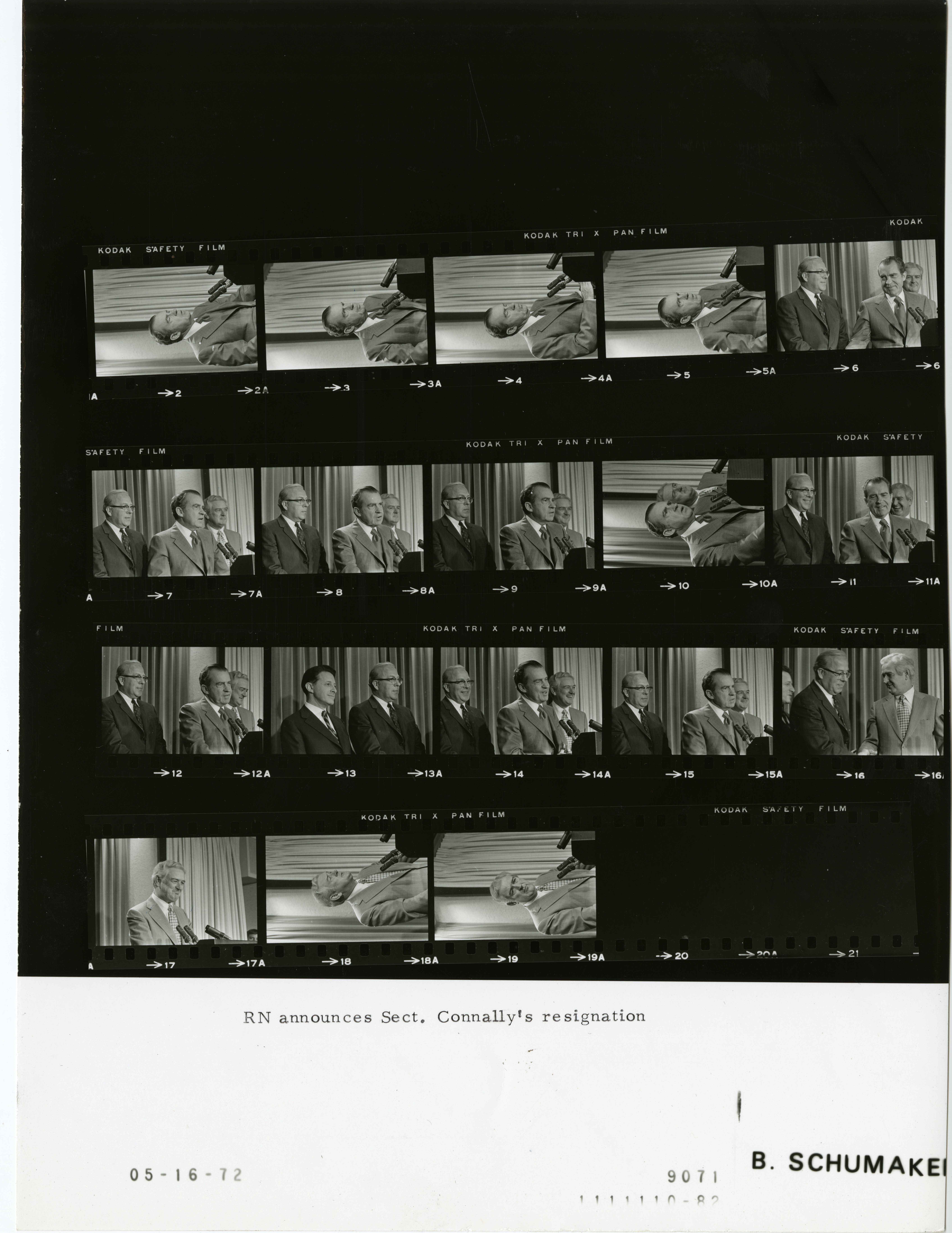
- Frame(s): WHPO-9071-, President Nixon announcing the resignation of Treasury Secretary Connally and the nomination of Shultz to the post. Weinberger will replace Shultz at OMB. 5/16/1972, Washington, D.C. Press Room, White House. President Nixon, Connally, Shultz, Weinberger.
Roll WHPO-9072 Photographer: Knudsen, Robert L. | Color or B&W: B&W
- Frame(s): WHPO-9072-02A-07A, President Nixon standing with Enayet Karim, Charge d'Affaires from Bangladesh. 5/16/1972, Washington, D.C. White House, Oval Office. President Nixon, Enayet Karim, Toma Granfil.
- Frame(s): WHPO-9072-09A-13A, President Nixon standing with Yugoslavian Ambassador Toma Granfil. 5/16/1972, Washington, D.C. White House, Oval Office. President Nixon, Enayet Karim, Toma Granfil.
Roll WHPO-9073 Photographer: Atkins, Oliver | Color or B&W: B&W
- Frame(s): WHPO-9073-00A-7A, 14A-30A, President Nixon surrounded by tourists as he walks from the White House to the Treasury Building and back. 5/16/1972, Washington, D.C. sidewalk, Conference Room, Treasury Building. President Nixon, Connally, Shultz, Weinberger, officials, tourists, staff.
- Frame(s): WHPO-9073-05A, President Nixon greeting the crowd as he walks from the White House to the Treasury Building. The street sign, "Alexander Hamilton Place N.W." is visible in the background. 5/16/1972, Washington, D.C. sidewalk. President Nixon, secret service, crowd.
- Frame(s): WHPO-9073-08A-13A, Connally speaking to Treasury officials about his resignation, with Nixon, Shultz, and Weinberger seated around him. 5/16/1972, Washington, D.C. sidewalk, Conference Room, Treasury Building. President Nixon, Connally, Shultz, Weinberger, officials, tourists, staff.
- Frame(s): WHPO-9073-17A, President Nixon greeting the crowd as he walks from White House to the Treasury Building. Members of the press stand nearby with a film camera. 5/16/1972, Washington, D.C. sidewalk. President Nixon, secret service, crowd, members of the press.
Roll WHPO-9074 Photographer: Knudsen, Robert L. | Color or B&W: B&W
- Frame(s): WHPO-9074-03-10, President Nixon standing in the Oval Office with Ray Bliss and Mitchell. 5/16/1972, Washington, D.C. White House, Oval Office. President Nixon, Mitchell, Ray Bliss.
- Frame(s): WHPO-9074-13-23, President Nixon standing in the Oval Office with and seated informally with John Cardinal Krol. 5/16/1972, Washington, D.C. White House, Oval Office. President Nixon, John Cardinal Krol.
- Frame(s): WHPO-9074-14, President Nixon standing in the Oval Office with Cardinal John Krol. 5/16/1972, Washington, D.C. White House, Oval Office. President Nixon, Cardinal John Krol.
Roll WHPO-9075 Photographer: Knudsen, Robert L. | Color or B&W: B&W
- Frame(s): WHPO-9075-, Leonard Garment receiving petitions collected by the Zionist Organization of America in his office. 5/16/1972, Washington, D.C. Office of Leonard Garment. Leonard Garment, Donald E. Wolfe, Joseph Spector, Judge Kleiman, Jewish.
Roll WHPO-9076 Photographer: Kightlinger, Jack | Color or B&W: B&W
- Frame(s): WHPO-9076-03A-09A, President Nixon addressing delegates to the Mexico-U.S. Interparliamentary Conference and their guests. 5/16/1972, Washington, D.C. White House, East Room. President Nixon, Pat Nixon, delegates, guests.
- Frame(s): WHPO-9076-10A-17A, President Nixon and Pat Nixon in a receiving line for the delegates and guests. 5/16/1972, Washington, D.C. White House, State Dining Room. President Nixon, Pat Nixon, delegates, guests.
Roll WHPO-9077 Photographer: Kightlinger, Jack | Color or B&W: B&W
- Frame(s): WHPO-9077-, Unidentified man and woman walking along an inner West Wing corridor. 5/16/1972, Washington, D.C. inner corridor, White House. unidentified man and woman.
- Frame(s): WHPO-9077-02-11, President Nixon addressing delegates to the Mexico-U.S. Interparliamentary Conference and their guests. 5/16/1972, Washington, D.C. White House, East Room. President Nixon, delegates, guests.
Roll WHPO-9078 Photographer: Atkins, Oliver | Color or B&W: B&W
- Frame(s): WHPO-9078-, President Nixon and Pat Nixon greeting delegates to the Conference. 5/16/1972, Washington, D.C. Red Room, White House. President Nixon, Pat Nixon, James Wright, Jr., Jose Juan de Olloqui, Mike Mansfield, Enrique Olivares Santana y Sra, Alfredo Bonfil Pinto y Sra.
Roll WHPO-9079 Photographer: Knudsen, Robert L. | Color or B&W: Color
- Frame(s): WHPO-9079-, President Nixon welcomes members of the Mexico-US Inter-Parliamentary Group to the White House. 5/16/1972, Washington, D.C. White House, East Room. President Nixon, delegates, guests.
Roll WHPO-9080 Photographer: Knudsen, Robert L. | Color or B&W: Color
- Frame(s): WHPO-9080-, President Nixon addressing delegates to the Conference and guests. Nixon and Pat Nixon leaving the room. 5/16/1972, Washington, D.C. White House, East Room. President Nixon, Pat Nixon, delegates, guests.
Roll WHPO-9081 Photographer: unknown | Color or B&W: Color
- Frame(s): WHPO-9081-, Copy of a photo of a plaque given to Pat Nixon depicting the U.S., with insets of gold and diamonds. 5/16/1972, Washington, D.C. unknown.
Roll WHPO-9096 Photographer: Schumacher, Karl | Color or B&W: B&W
- Frame(s): WHPO-9096-03A-04A, Vice President Agnew leaving Tokyo, Japan. 5/16/1972, Tokyo, Japan Tokyo International Airport. Agnew, Japanese officials, Thai officials.
- Frame(s): WHPO-9096-05A-06A, Vice President Agnew arriving in Bangkok, Thailand. 5/16/1972, Bangkok, Thailand Don Mueang International Airport. Agnew, Japanese officials, Thai officials.
Roll WHPO-9098 Photographer: Schumacher, Karl | Color or B&W: Color
- Frame(s): WHPO-9098-28-32, Vice President Agnew arriving in Bangkok and greeting members of the crowd. 5/16/1972, Bangkok, Thailand airport. Agnew, Thai officials, guests.
The White House Communications Agency Sound Recordings Collection contains public statements that took place between 1969 and 1974. Visit the finding aid to learn more.
I - Various Administration Events
- WHCA-SR-I-113
The showing of films from the USSR in the White House theater (the Family Theater). (5/16/1972, Family Theater, White House)
Runtime: 30:00:00
Production credits: Audio feed supplied by WHCA; Recorded by GET (initials of WHCA engineer)
Original Format: 1/4-inch reel-to-reel audiotape. Original source type: Original.
P - Formal Presidential Remarks
- WHCA-SR-P-720506
Announcement of successor for JC as Secretary of the Treasury with JC. (5/16/1972)
Runtime: 12:46
Original Format: 1/4-inch reel-to-reel audiotape. Original source type: Original. - WHCA-SR-P-720507
Remarks by President Nixon at reception for Mexico-US Interparliamentary Group. (5/16/1972)
Runtime: 7:00
Original Format: 1/4-inch reel-to-reel audiotape. Original source type: Original.
The White House Communications Agency Videotape Collection contains “off-the-air” recordings of televised programs produced between 1968 and 1974. Visit the finding aid to learn more.
- WHCA-5375
"Today" Show, hour 1. reaction to George Wallace shooting, discussion of busing Richard Nixon.
CBS
Runtime: 1:00 - WHCA-5375B
"Today" Show, hour 2. more on George Wallace shooting Richard Nixon.
ABC
Runtime: 1:00 - WHCA-5376
Where We Stand. Richard Nixon.
NBC
Runtime: 01:00:41 - WHCA-5377
"The Advocates". Richard Nixon, Robert McNeil, Barbara Walters.
WETA
Runtime: 1:00 - WHCA-5378
"Decision '72".
Eastern Educational Network
Runtime: 00:31:18 - WHCA-5379
Michigan and MD Primary Coverage AND WTOP report: Michigan and MD Primary Results.
CBS
Runtime: 1:00 - WHCA-5384
Weekly News Summary, Tape II.
ALL NETWORKS
Runtime: 01:33:15
16. Smith/Bell: Report on Governor George Wallace's recovery. Time Code Start: 41:09. Keywords: Governors, Presidential elections, campaigns, primaries, candidates, assassinations, shootings, reactions, reports, health. Network: ABC.
17. Reasoner/Geer/Hill: Report on Bremer. Time Code Start: 43:16. Keywords: Governors, Presidential elections, campaigns, primaries, candidates, reports, assassinations, shootings. Network: ABC.
18. Smith/Sherwood: L. Patrick Gray (FBI acting director) comments on Governor George Wallace's case and political violence. Time Code Start: 48:16. Keywords: Governors, Presidential elections, campaigns, candidates, assassinations, shootings, reactions, violence, Federal Bureau of Investigations, leaders. Network: ABC.
19. Bergman: Gun control. Time Code Start: 50:30. Keywords: bills, laws, weapons, sales, controls, registrations, licenses. Network: ABC.
20. Reasoner/Clark: Secret Service agents assigned to Senator Ted Kennedy. Time Code Start: 52:14. Keywords: Protective Services, police, security, Senators, Presidential elections, campaigns, candidates. Network: ABC.
21. Jarriel: President Nixon walks to Treasury building. Time Code Start: 53:30. Keywords: Presidents,. Network: ABC.
22. Reasoner/Kincaid: Primaries in Michigan and Maryland. Time Code Start: 55:06. Keywords: Presidential elections, campaigns, campaigning, candidates, primaries, voting. Network: ABC.
23. Smith: Coverage of the war in North Vietnam. Time Code Start: 56:54. Keywords: Vietnam War. Network: ABC.
24. Smith/Gill: Secretary Connally resigns (President Nixon). Time Code Start: 57:43. Keywords: Presidents, cabinet, advisors, resignations. Network: ABC.
25. Reasoner: Commentary on U.S. violence. Time Code Start: 59:58. Keywords: militants, bombings, violence, sabotage, shootings, kidnappings, death, assassinations, terrorism. Network: ABC.
26. Chancellor/Mackin: Governor George Wallace's condition is improving. Time Code Start: 61:50. Keywords: Governors, Presidential elections, campaigns, primaries, candidates, reports, assassinations, shootings. Network: NBC.
27. Chancellor/Stern: Bremer held on $200,000 bail; biography of Bremer. Time Code Start: 64:00. Keywords: Governors, Presidential elections, campaigns, primaries, candidates, reports, assassinations, shootings. Network: NBC.
28. Brinkley: The gun problem with respect to political leaders. Time Code Start: 68:16. Keywords: bills, laws, weapons, sales, controls, registrations, licenses. Network: NBC.
29. Chancellor/Levine: Secretary Connally retires, replaced by Shultz (President Nixon). Time Code Start: 70:18. Keywords: cabinet, advisors, retirement, appointments, confirmations. Network: NBC.
30. Chancellor/Valeriani: President Nixon shaking hands with tourists; Russian summit still going forward. Time Code Start: 73:10. Keywords: SALT, S.A.L.T., Strategic Arms Limitation Talks, Russia, Soviet Union, USSR, Cold War, détente, summits, meetings. Network: NBC.
31. Chancellor/Troute: More on the action in South Vietnam. Time Code Start: 74:53. Keywords: Vietnam War. Network: NBC.
32. Chancellor/Luke/Kiker: Billy Joe Camp says Governor George Wallace's campaign will continue; primary coverage in Maryland in Michigan. Time Code Start: 77:32. Keywords: Governors, Presidential elections, campaigns, primaries, candidates, reports, assassinations, shootings. Network: NBC.
33. Cronkite/Dick: Coverage of Governor George Wallace's recovery with Tom Burke Md.. Time Code Start: 82:00. Keywords: Governors, Presidential elections, campaigns, primaries, candidates, reports, assassinations, shootings. Network: CBS.
34. Cronkite/Walker: Bremer moved to Baltimore; more on how he stalked Governor George Wallace. Time Code Start: 85:18. Keywords: Governors, Presidential elections, campaigns, primaries, candidates, reports, assassinations, shootings. Network: CBS.
35. Cronkite: Foreign reaction to Bremer's attempted murder of Governor George Wallace. Time Code Start: 88:40. Keywords: Governors, Presidential elections, campaigns, primaries, candidates, reports, assassinations, shootings. Network: CBS.
36. Cronkite/Pierpoint: Secretary Connally quits and replaced by Shultz (President Nixon). Time Code Start: 89:06. Keywords: cabinet, advisors, retirement, appointments, confirmations. Network: CBS. - WHCA-5385
Weekly News Summary, Tape III.
ALL NETWORKS
Runtime: 01:23:02
1. Cronkite/Pappas/Shoumacher: Primary coverage in Michigan and Maryland. Time Code Start: 00:00. Keywords: Presidential elections, campaigns, primaries, voting. Network: CBS.
2. Mudd: Governor George Wallace sympathy vote. Time Code Start: 03:40. Keywords: Governors, Presidential elections, campaigns, candidates, assassinations, shootings, voting. Network: CBS.
3. Cronkite: Art Bremer biography. Time Code Start: 05:08. Keywords: Governors, Presidential elections, campaigns, primaries, candidates, assassinations, shootings. Network: CBS.
4. Sevareid: Commentary on how political candidates are targets for assassins. Time Code Start: 08:00. Keywords: elections, campaigns, candidates, assassinations, shootings, criminal profiles,. Network: CBS.
Context (External Sources)
The Vanderbilt Television News Archive is the world's most extensive and complete archive of television news. They have been recording, preserving and providing access to television news broadcasts of the national networks since August 5, 1968.
Wikipedia is a free encyclopedia that anyone can edit.