
Introduction
This almanac page for Monday, May 15, 1972, pulls together various records created by the federal government and links to additional resources which can provide context about the events of the day.
Previous Date: Sunday, May 14, 1972
Next Date: Tuesday, May 16, 1972
Schedule and Public Documents
The Daily Diary files represent a consolidated record of the President's activities. Visit the finding aid to learn more.
The President's day began at The White House - Washington, D. C.
The Weekly Compilation of Presidential Documents made available transcripts of the President's news conferences; messages to Congress; public speeches, remarks, and statements; and other Presidential materials released by the White House.
Digitized versions can be found at HathiTrust.
Each Public Papers of the Presidents volume contains the papers and speeches of the President of the United States that were issued by the White House Office of the Press Secretary during the time period specified by the volume. The material is presented in chronological order, and the dates shown in the headings are the dates of the documents or events. In instances when the release date differs from the date of the document itself, that fact is shown in the text note.
To ensure accuracy, remarks have been checked against audio recordings (when available) and signed documents have been checked against the original, unless otherwise noted. Editors have provided text notes and cross references for purposes of identification or clarity.
The Federal Register is the official daily publication for rules, proposed rules, and notices of federal agencies and organizations, as well as executive orders and other Presidential documents.
No Federal Register published on this date
The Congressional Record is the official daily record of the debates and proceedings of the U.S. Congress.
Archival Holdings
Any selection of archival documents will necessarily be partial. You should use the documents and folders identified below as a starting place, but consult the linked collection finding aids and folder title lists and the collections themselves for context. Many documents to be found this way do not lend themselves to association with specific dates, but are essential to a complete understanding of the material.
Selective document listing
President's Office Files
The President's Office Files consists of materials drawn together by the Special Files Unit from several administrative subdivisions within the White House Office. It is the handwriting and sensitive papers sent to the Staff Secretary that now comprise much of the President's Office Files. Visit the finding aid to learn more.
- News Summaries, Unmarked News Summaries, Box 49, News Summaries - May 1972 [11 of 13] [Note: Due to the way News Summary products were compiled, you should also consult nearby days for potentially relevant materials.]
- Weekend News Review, May 15, 1972
- President's Daily Schedule, Box 102, [President's Daily Schedule, Apr.-July 1972] [2 of 3]
- The President's Schedule, Monday - May 15, 1972
President's Personal File
The President's Personal File is essentially a President's secretary's file, kept by Rose Mary Woods, personal secretary to the President, for two purposes: (1) preserving for posterity a collection of documents particularly close to the President, whether because he dictated or annotated them, or because of the importance of the correspondent or the event concerned and (2) giving appropriate attention–letters of gratitude, invitations to White House social events, and the like–to members and important friends and supporters of the Nixon administration. This generalization does not describe all the varied materials of a file group which is essentially a miscellany, but it does identify the reason for the existence of the file group's core. Visit the finding aid to learn more.
- President's Speech File
The H. R. Haldeman Diaries consists of seven handwritten diaries, 36 dictated diaries recorded as sound recordings, and two handwritten audio cassette tape subject logs. The diaries and logs reflect H. R. Haldeman’s candid personal record and reflections on events, issues, and people encountered during his service in the Nixon White House. As administrative assistant to the President and Chief of Staff, Haldeman attended and participated in public events and private meetings covering the entire scope of issues in which the Nixon White House engaged in during the years 1969-1973. Visit the finding aid to learn more.
- Transcript of diary entry (PDF)
Monday, May 15th. The President had a pretty busy schedule today, but had me in first thing in the morning. He had written a lot of memos over the weekend, wanted to do some follow-up and discussion on trip plans. He's concerned about operational confusion around him with too many aides and Secret Service and so on, wants some changes there also, wants to cut way down on the people on the President's plane, etcetera.
I warned him about the probable small reception in Poland, and he wants to get Radio Free Europe to build that up.
He's agreed to have the, or he decided to have the leaders at breakfast Friday morning and then changed that back, later in the day, to an afternoon briefing. He wants to get moving on the Congressional attack on the war again. Thinks we have to have a tougher speech on the floor: first, to say that an American president for the first time is going to Moscow, and they must not undercut him before he goes. And second, that the responsibility for prolonging the war goes to those who give the enemy encouragement and incentive on the grounds that they'll get a better deal from a new Administration. In the process they're undercutting the most generous peace offer we've made: we need to lay the record on these points.
He also wants Colson to get Hobe Lewis to have Alan Drury to write a book on Vietnam and the press, as the blackest page in American journalism; not just the writing press but also TV. Hit them on Tet, Cambodia, Haiphong, etcetera, and how disloyal they are to the country, and how they're always on the side of the enemy.
The Connally announcement is going to go ahead for tomorrow, he told me to talk to Mitchell tomorrow morning; no, to talk to Mitchell today about the announcement tomorrow morning, and especially cover with him the political arrangements. I did that before the regular political meeting today, and Mitchell seemed to be pretty startled by the whole thing, and I think distrusts Connally's motivation, as I'm sure many people will. I think John felt this was some sort of maneuver on Connally's part to set himself up but he doesn't exactly have a feeling as to what and how.
Later in the morning the President got into a discussion of personnel ideas for the second term. He wants to be sure that the head of GSA is a total partisan. He wants to be sure that we get rid of Hartzog with the Park Service. He wants to start looking now for a new head of the CIA. He wants to go for young selfless people. No Eastern establishment types, and nobody that we have to beg to take the job. He wants to be sure that we get the list of appointees who are carryovers and do something about that.
Rogers called me...
-------------------------------------------------------------------------------------------------------------------
DECLASSIFIED - E.O. 13526, Sect. 3.4: by MS, NARA, June 12, 2013
Audio Cassette 21, Side B, Withdrawn Item Number 28 [AC-21(B) Sel 26]
Duration: 29 seconds
…all upset because he'd just found out he wasn't going to Poland, and he wanted to appeal it to the President. He feels the symbolism is important, that the plans were all made. That he could meet with the foreign minister while the President is doing his sightseeing and all. It will cause real trouble for him if he doesn't go, and wants the President to reconsider. I raised it later with the President, and he, of course, agreed we had to take him although he was extremely distressed with Rogers for raising it. He obviously shouldn't be there…
-------------------------------------------------------------------------------------------------------------------
...and that's a pretty petty point which lost him even more ground than he's already lost.
The President was concerned because Kissinger was all gloomy about the magazines today. It turns out it's as usual a totally personal thing, where there were a couple of minor digs at him, and that's what's got him all upset. Overall, the reports were reasonably good, considering how much we've done.
Then this afternoon we got the report that George Wallace was shot. I waited a while to try and get some information, finally went in a little after 5:00, and interrupted the President's meeting with Don Kendall, and had him come into the little office. I informed the President that we had the report that he had been shot. The President looked very annoyed at being told this, really, and said, is he killed?, and I said, no. And he said, and I gave him a brief description of what, at that time, appeared to be the injuries and he said, okay, and went back into the meeting. As the afternoon wore on, though, the thing built up steam. He asked to have Connally over, and we discussed what he ought to do. It was agreed that he should put out a statement, which we did. That he should put Secret Service protection on Teddy Kennedy and Shirley Chisholm, which he told Connally to do, and that he should go ahead and appear at the Blue Room dedication ceremonies, although he should not stay for the receiving line. He did this and it worked out extremely well, because it gave him a chance to make a statement on television about Wallace, without having to set up a special occasion to do it.
We then, he hauled me over to the EOB and then called Colson in a little later. Had us have dinner with him there and spent quite a little time going over it trying to get reports on what actually had happened. He was very distressed with the FBI and the Secret Service for not being on top of things and knowing what was going on. We moved Ehrlichman in and he told Felt, who was Acting Director of the FBI that he was holding the Bureau responsible for the safety of the prisoner they'd captured. And, we pushed Kleindienst, Pat Gray, and all the rest of them on a basis of, of trying to make sure that they understood that the question here was not all the legalities or specifics, it was one of trying to get the right posture set before the press
immediately leaped on exactly the wrong thing and started making a big point of how the guy was a right-wing radical and that sort of thing.
We got pretty good control of it finally and left at 8:15 to go to a Motion Picture Association movie. Ehrlichman and I came back to the White House at about 11:00, worked there until 12:00, getting updated, and filling the President in on Wallace's condition, and the status of the FBI interrogation. Then we gave him a report about midnight, and went on home.
During the evening he called Connally to discuss some point with him, and then got Nellie on the phone and told her how great she's been and how much he's appreciated having her in Washington and all that sort of thing.
The battle between the FBI and Secret Service got going right at the beginning with jurisdictional disputes and then with each blaming the other for any of the mistakes that have been made. So we're back to the same old thing in that area.
End of May 15th. - Original audio recording (MP3)
The National Archives Catalog is the online portal to the records held at the National Archives, and information about those records. It is the main way of describing our holdings and also provides access to electronic records and digitized versions of our holdings.
The Catalog searches across multiple National Archives resources at once, including archival descriptions, digitized and electronic records, authority records, and web pages from Archives.gov and the Presidential Libraries. The Catalog also allows users to contribute to digitized historical records through tagging and transcription.
Nixon Library Holdings
All National Archives Units
National Security Documents
The President's Daily Brief is the primary vehicle for summarizing the day-to-day sensitive intelligence and analysis, as well as late-breaking reports, for the White House on current and future national security issues. Read "The President's Daily Brief: Delivering Intelligence to Nixon and Ford" to learn more.
The Foreign Relations of the United States series presents the official documentary historical record of major U.S. foreign policy decisions and significant diplomatic activity. Visit the State Department website for more information.
Vol. II, Organization and Management of U.S. Foreign Policy, 1969-1972
The Intelligence Community and the White House
272. Memorandum From the Assistant Secretary of Defense for Intelligence (Hall) to Secretary of Defense Laird, Washington, May 15, 1972
Source: Washington National Records Center, RG 330, OSD Files: FRC 330 77 094, 350.09 (March–Dec) 1972. Secret.
Vol. VIII, Vietnam, January-October 1972
The North Vietnamese Offensive Falters, Negotiations Resume, May 8-July 18, 1972
147. Memorandum From President Nixon to the President’s Assistant for National Security Affairs (Kissinger) and the President’s Deputy Assistant for National Security Affairs (Haig), Washington, May 15, 1972
Source: National Archives, Nixon Presidential Materials, NSC Files, Box 341, Subject Files, HAK/President Memos, 1971. Personal and Confidential.
148. Memorandum for the President’s Files by the President’s Military Assistant (Scowcroft), Washington, May 15, 1972, 10:30 a.m.
Source: National Archives, Nixon Presidential Materials, White House Special Files, President’s Office File, Box 88, Memoranda for the President, Beginning May 14, 1972. No classification marking.
149. Minutes of a Washington Special Actions Group Meeting, Washington, May 15, 1972, 11:14-11:42 a.m.
Source: Library of Congress, Manuscript Division, Kissinger Papers, Box TS 79, National Security Council, Committees and Panels, Washington Special Actions Group, May 1972. Top Secret; Sensitive. The meeting took place in the White House Situation Room. All brackets are in the original.
150. Memorandum From the Chairman of the Joint Chiefs of Staff (Moorer) to Secretary of Defense Laird, Washington, May 15, 1972
Source: Washington National Records Center, OSD Files: FRC 330–77–0095, 385.1, Viet (January–May 1972). Top Secret; Sensitive.
Vol. XIV, Soviet Union, October 1971-May 1972
Nixon at the Summit, May 13-May 31, 1972
226. Memorandum of Conversation, Washington, May 15, 1972, 5 p.m.
Source: National Archives, Nixon Presidential Materials, NSC Files, Box 494, President’s Trip Files, Dobrynin/Kissinger, 1972, Vol. 12, Part 2. Top Secret; Sensitive; Exclusively Eyes Only. Accordingly to Kissinger’s Record of Schedule, the meeting, which was held in General Scowcroft’s office, ended at 6:15 p.m. (Library of Congress, Manuscript Division, Kissinger Papers, Box 438, Miscellany, 1968–1976)
227. Memorandum From the President’s Assistant for National Security Affairs (Kissinger) to President Nixon, Washington, May 15, 1972
Source: National Archives, Nixon Presidential Materials, NSC Files, Box 478, President’s Trip Files, The President, Bilateral Agreements. Secret; Exclusively Eyes Only. Sent for information. A notation on the memorandum indicates the President saw it. According to a May 16 memorandum from Kissinger to Nixon, this was part of the fifth briefing book for the summit delivered to the President before books one to four. (Ibid., RG 59, S/P Files: Lot 77 D D112, Box 335, Lord Chronology, 1972)
228. Telephone Conversation Between President Nixon and his Special Assistant for National Security Affairs (Kissinger), Washington, May 15, 1972
Source: National Archives, Nixon Presidential Materials, White House Tapes, White House, Conversation No. 24–126. No classification marking. According to his Daily Diary, Nixon met with Kissinger from 9:29 to 9:35 p.m. The editors transcribed the portion of the conversation printed here specifically for this volume. According to the President’s Daily Diary, President Nixon placed the call. (Ibid., White House Central Files)
Vol. XXXII, SALT I, 1969-1972
Kissinger's Secret Trip to Moscow and Aftermath, April 19-May 17, 1972
276. Backchannel Message From the President’s Assistant for National Security Affairs (Kissinger) to the Chief of the Delegation to the Strategic Arms Limitation Talks (Smith), Washington, May 15, 1972, 0252Z
Source: National Archives, Nixon Presidential Materials, NSC Files, Box 427, Backchannel Files, Backchannel Messages, 1972 SALT. Top Secret; Sensitive; Eyes Only.
277. Memorandum From Secretary of Defense Laird to President Nixon, Washington, May 15, 1972
Source: Ford Library, Laird Papers, Box 26, SALT, Chronological File. Top Secret.
Vol. E-7, Documents on South Asia, 1969-1972
Bangladesh, December 1971-December 1972
422. Memorandum From the Executive Secretary of the Department of State (Eliot) to the President’s Assistant for National Security Affairs (Kissinger), Washington, May 15, 1972
In response to the President’s expressed desire to convert as much multilateral economic assistance to Bangladesh as possible into bilateral assistance, Eliot forwarded the Department’s recommendations as to how the remaining $130 million of a $200 million Congressional appropriation for South Asian relief could be channeled to Bangladesh in the form of bilateral assistance.
Source: National Archives, RG 59, Central Files 1970–73, AID (US) BANGLADESH. Limited Official Use. No drafting information appears on the memorandum. The attachment cited in the memorandum is not published. On May 22 NSC Staff Secretary Davis sent a memorandum to Eliot which reads: “In response to your May 15 memorandum, bilateral assistance of $75 to $100 million in the current U.S. fiscal year has been approved. Your recommendations on the mix of other relief assistance for Bangladesh is (sic.) also approved.” (Ibid.) On May 30 the Department of State announced that the United States and Bangladesh had signed a bilateral agreement providing for $90 million in U.S. assistance to Bangladesh as a grant for rehabilitation. (Telegram 94906 to Dacca, May 30; ibid., AID (US) 4 BANGLADESH)
Vol. E-10, Documents on American Republics, 1969-1972
Mexico
478. Memorandum for the Record, Washington, May 15, 1972, 3–3:30 p.m., Washington, May 15, 1972, 3-3:30 p.m.
President’s Assistant for National Security Affairs Henry Kissinger and Foreign Secretary Rabasa discussed the Colorado River salinity issue and illegal immigration. On salinity, Rabasa suggested third party arbitration, to which Kissinger responded “that if we decided we could go the arbitration route, the approach outlined by Rabasa seemed quite fair.” On illegal immigrants, Rabasa suggested that the United States and Mexico issue a joint communiqué announcing the creation of a Joint Commission to study the problem.
Source: National Archives, Nixon Presidential Materials, NSC Files, Box 788, Country Files, Latin America, Mexico, Vol. III. Secret; Sensitive. It was prepared by Jorden. Jorden signed WJJ above his typeset signature. The memorandum to which Kissinger referred is published as Document 477.
The Kissinger telephone conversation transcripts consist of approximately 20,000 pages of transcripts of Kissinger’s telephone conversations during his tenure as Assistant to the President for National Security Affairs (1969-1974) and Secretary of State (1973-1974) during the administration of President Richard Nixon. Visit the finding aid for more information.
Digitized versions can be found in the National Archives Catalog.
Audiovisual Holdings
Visit the White House Tapes finding aid to learn about the taping system's operation and archival processing.
Old Executive Office Building
- 339-3; Unknown between 6:33 p.m. & 7:57 p.m.; Nixon, Richard M. (President); Haldeman, H. R. ("Bob"); White House operator; Colson, Charles W.; [Unknown person(s)]; Rowley, James J.; Ehrlichman, John D.; Kleindienst, Richard G.; Kelley, Thomas J.
- 339-4; Unknown between 7:42 p.m. & 8:10 p.m.; Nixon, Richard M. (President); Haldeman, H. R. ("Bob"); [Unknown person(s)]; Colson, Charles W.; White House operator; Clawson, Kenneth W.; Kleindienst, Richard G.; Connally, John B.; Connally, Idanell (Brill) (Nellie)
- 339-5; Unknown between 8:10 p.m. & 9:16 p.m.; Nixon, Richard M. (President); Yates, Nellie L.; Felt, W. Mark
- 339-6; Unknown between 8:18 p.m. & 9:16 p.m.; Nixon, Richard M. (President); White House operator
- 339-7; Unknown between 8:18 p.m. & 9:16 p.m.; Nixon, Richard M. (President); White House operator
- 339-8; Unknown between 8:18 p.m. & 9:16 p.m.; Nixon, Richard M. (President); White House operator
- 339-9; Unknown between 8:18 p.m. & 9:16 p.m.; Nixon, Richard M. (President); White House operator
- 339-10; 9:16 p.m. - 9:19 p.m.; Nixon, Richard M. (President); Nixon, Thelma C. ("Pat") (Ryan)
- 339-11; Unknown between 9:19 p.m. & 9:23 p.m.; Nixon, Richard M. (President); White House operator
- 339-12; Unknown between 9:19 p.m. & 9:23 p.m.; Nixon, Richard M. (President); White House operator
- 339-13; 9:23 p.m. - 9:24 p.m.; Nixon, Richard M. (President); Colson, Charles W.
- 339-14; 9:25 p.m. - 9:27 p.m.; Nixon, Richard M. (President); Ehrlichman, John D.
- 339-15; 9:29 p.m. - 9:35 p.m.; Nixon, Richard M. (President); Kissinger, Henry A.
- 339-16; Unknown between 9:35 p.m. & 9:36 p.m.; Nixon, Richard M. (President); White House operator
- 339-17; 9:36 p.m. - 9:39 p.m.; Nixon, Richard M. (President); Woods, Rose Mary
- 339-18; 9:40 p.m. - 9:43 p.m.; Nixon, Richard M. (President); Lukash, William M.
- 339-19; 9:44 p.m. - 9:45 p.m.; Nixon, Richard M. (President); Duggan, Ann
- 339-20; Unknown between 9:45 p.m. & 9:48 p.m.; Nixon, Richard M. (President); [Unknown person(s)]
Oval Office
- 724-1; Unknown between 1:39 p.m. & 2:29 p.m.; Nixon, Richard M. (President); Bull, Stephen B.; Butterfield, Alexander P.
- 724-2; Unknown between 2:25 p.m. & 3:32 p.m.; Nixon, Richard M. (President); Bull, Stephen B.; Connally, John B.; [Unknown person(s)]
- 724-3; 3:32 p.m. - 4:06 p.m.; Nixon, Richard M. (President); Shultz, George P.; [Unknown person(s)]; Bull, Stephen B.; Connally, John B.
- 724-4; 4:06 p.m. - 4:54 p.m.; Nixon, Richard M. (President); Kendall, Donald McI.; Flanigan, Peter M.; [Unknown person(s)]; Bull, Stephen B.
- 724-5; 4:54 p.m. - 5:05 p.m.; Nixon, Richard M. (President); Shultz, George P.; Weinberger, Caspar W. ("Cap"); Haldeman, H. R. ("Bob")
- 724-6; 5:06 p.m. - 5:14 p.m.; Nixon, Richard M. (President); Butterfield, Alexander P.; Haldeman, H. R. ("Bob"); White House operator; Nixon, Thelma C. ("Pat") (Ryan)
- 724-7; Unknown between 5:14 p.m. & 5:16 p.m.; Nixon, Richard M. (President); Bull, Stephen B.
- 724-8; 5:16 p.m. - 6:06 p.m.; Nixon, Richard M. (President); Haldeman, H. R. ("Bob"); White House operator; Nixon, Thelma C. ("Pat") (Ryan); Connally, John B.; Ziegler, Ronald L.; Wallace, Cornelia; Kennedy, Edward M.; Rossides, Eugene T.; Butterfield, Alexander P.
- 724-9; Unknown between 9:48 p.m. & 10:15 p.m.; Nixon, Richard M. (President); Haig, Alexander M., Jr.
- 724-10; 5:06 p.m. - 5:06 p.m.; Nixon, Richard M. (President); White House operator
White House Telephone
- 24-81; Unknown between 4:00 p.m. & 5:10 p.m.; Nixon, Richard M. (President); White House operator
- 24-82; Unknown between 5:06 p.m. & 5:10 p.m.; Nixon, Richard M. (President); White House operator
- 24-83; 5:10 p.m. - 5:13 p.m.; Nixon, Richard M. (President); Nixon, Thelma C. ("Pat") (Ryan); Haldeman, H. R. ("Bob")
- 24-84; Unknown between 5:16 p.m. & 5:21 p.m.; Nixon, Richard M. (President); White House operator; Haldeman, H. R. ("Bob")
- 24-85; 5:21 p.m. - 5:23 p.m.; Nixon, Richard M. (President); Nixon, Thelma C. ("Pat") (Ryan); Haldeman, H. R. ("Bob")
- 24-86; Unknown between 5:24 p.m. & 5:30 p.m.; Haldeman, H. R. ("Bob"); White House operator
- 24-87; Unknown between 5:24 p.m. & 5:30 p.m.; White House operator; Haldeman, H. R. ("Bob"); Connally, John B.; Rossides, Eugene T.; Nixon, Richard M. (President)
- 24-88; Unknown between 5:30 p.m. & 5:38 p.m.; Haldeman, H. R. ("Bob"); White House operator
- 24-89; 5:38 p.m. - 5:41 p.m.; White House operator; Haldeman, H. R. ("Bob"); Nixon, Richard M. (President); Wallace, Cornelia
- 24-90; Unknown between 5:41 p.m. & 5:45 p.m.; White House operator; Haldeman, H. R. ("Bob")
- 24-91; Unknown between 5:41 p.m. & 5:45 p.m.; White House operator; Haldeman, H. R. ("Bob"); Connally, John B.; Kennedy, Edward M.
- 24-92; Unknown between 5:52 p.m. & 5:54 p.m.; Haldeman, H. R. ("Bob"); White House operator
- 24-93; Unknown between 5:52 p.m. & 5:58 p.m.; White House operator; Haldeman, H. R. ("Bob"); Connally, John B.; Rossides, Eugene T.; Nixon, Richard M. (President)
- 24-94; Unknown between 6:33 p.m. & 6:45 p.m.; Haldeman, H. R. ("Bob"); White House operator; Colson, Charles W.
- 24-95; Unknown between 6:45 p.m. & 7:07 p.m.; Haldeman, H. R. ("Bob"); White House operator; Nixon, Richard M. (President); Colson, Charles W.; Rowley, James J.
- 24-96; Unknown between 6:45 p.m. & 7:07 p.m.; Haldeman, H. R. ("Bob"); White House operator; Nixon, Richard M. (President); Colson, Charles W.
- 24-97; Unknown between 6:45 p.m. & 7:07 p.m.; White House operator; Haldeman, H. R. ("Bob"); Kleindienst, Richard G.
- 24-98; Unknown between 6:45 p.m. & 7:07 p.m.; Haldeman, H. R. ("Bob"); White House operator; Colson, Charles W.; Nixon, Richard M. (President)
- 24-99; 7:07 p.m. - 7:07 p.m.; Nixon, Richard M. (President); White House operator
- 24-100; Unknown between 7:07 p.m. & 7:37 p.m.; Kelley, Thomas J.; Haldeman, H. R. ("Bob"); Nixon, Richard M. (President)
- 24-101; Unknown between 7:07 p.m. & 7:37 p.m.; Colson, Charles W.; White House operator; Holm, Holly
- 24-102; Unknown between 7:07 p.m. & 7:37 p.m.; Colson, Charles W.; White House operator; [Unknown person(s)]; Clawson, Kenneth W.
- 24-104; Unknown between 7:07 p.m. & 7:37 p.m.; Haldeman, H. R. ("Bob"); White House operator
- 24-105; Unknown between 7:07 p.m. & 7:37 p.m.; Haldeman, H. R. ("Bob"); White House operator
- 24-106; Unknown between 7:07 p.m. & 7:37 p.m.; Kleindienst, Richard G.; Haldeman, H. R. ("Bob"); Nixon, Richard M. (President); Colson, Charles W.
- 24-107; 7:37 p.m. - 7:42 p.m.; White House operator; Haldeman, H. R. ("Bob"); Ehrlichman, John D.; Nixon, Richard M. (President)
- 24-108; Unknown between 7:42 p.m. & 7:57 p.m.; Colson, Charles W.; White House operator; Nixon, Richard M. (President)
- 24-109; Unknown between 7:42 p.m. & 7:57 p.m.; White House operator; Colson, Charles W.; Haldeman, H. R. ("Bob"); Nixon, Richard M. (President); Felt, W. Mark
- 24-110; Unknown between 7:42 p.m. & 7:57 p.m.; Colson, Charles W.; White House operator; Hall, Joan
- 24-111; Unknown between 7:42 p.m. & 7:57 p.m.; Colson, Charles W.; White House operator; Nixon, Richard M. (President); Clawson, Kenneth W.
- 24-112; Unknown between 7:57 p.m. & 7:59 p.m.; Haldeman, H. R. ("Bob"); White House operator
- 24-113; Unknown between 7:57 p.m. & 7:59 p.m.; Kleindienst, Richard G.; Haldeman, H. R. ("Bob")
- 24-114; Unknown between 7:59 p.m. & 8:02 p.m.; Nixon, Richard M. (President); White House operator
- 24-115; 8:02 p.m. - 8:04 p.m.; Nixon, Richard M. (President); Connally, John B.; Connally, Idanell (Brill) (Nellie)
- 24-116; 8:15 p.m. - 8:18 p.m.; Felt, W. Mark; Nixon, Richard M. (President)
- 24-117; Unknown between 8:18 p.m. & 9:16 p.m.; Nixon, Richard M. (President); White House operator
- 24-118; Unknown between 8:18 p.m. & 9:16 p.m.; Nixon, Richard M. (President); White House operator
- 24-119; Unknown between 8:18 p.m. & 9:16 p.m.; Nixon, Richard M. (President); White House operator
- 24-120; Unknown between 8:18 p.m. & 9:16 p.m.; Nixon, Richard M. (President); White House operator
- 24-121; 9:16 p.m. - 9:19 p.m.; Nixon, Richard M. (President); Nixon, Thelma C. ("Pat") (Ryan)
- 24-122; Unknown between 9:19 p.m. & 9:23 p.m.; Nixon, Richard M. (President); White House operator
- 24-123; Unknown between 9:19 p.m. & 9:23 p.m.; Nixon, Richard M. (President); White House operator
- 24-124; 9:23 p.m. - 9:24 p.m.; Nixon, Richard M. (President); Colson, Charles W.
- 24-125; 9:25 p.m. - 9:27 p.m.; Nixon, Richard M. (President); Ehrlichman, John D.
- 24-126; 9:29 p.m. - 9:35 p.m.; Nixon, Richard M. (President); Kissinger, Henry A.
- 24-127; Unknown between 9:35 p.m. & 9:36 p.m.; Nixon, Richard M. (President); White House operator
- 24-128; 9:36 p.m. - 9:39 p.m.; Nixon, Richard M. (President); Woods, Rose Mary
- 24-129; 9:40 p.m. - 9:43 p.m.; Nixon, Richard M. (President); Lukash, William M.
- 24-130; 9:44 p.m. - 9:45 p.m.; Nixon, Richard M. (President); Duggan, Ann
- 24-131; Unknown between 10:15 p.m. & 11:07 p.m.; Nixon, Richard M. (President); White House operator
- 24-132; Unknown between 10:15 p.m. & 11:07 p.m.; Nixon, Richard M. (President); White House operator
- 24-133; Unknown between 11:07 p.m. & 11:12 p.m.; Nixon, Richard M. (President); White House operator
- 24-134; 11:12 p.m. - 11:41 p.m.; Nixon, Richard M. (President); Colson, Charles W.
- 24-135; Unknown between 11:41 p.m. & 11:42 p.m.; Nixon, Richard M. (President); White House operator
- 24-136; 11:42 p.m. - 11:49 p.m.; Nixon, Richard M. (President); Waggonner, Joe D., Jr.; Haldeman, H. R. ("Bob")
The White House Photo Office collection consists of photographic coverage of President Richard Nixon meeting with prominent social, political, and cultural personalities; speaking engagements and news conferences of the President and various high-ranking members of the White House staff and Cabinet; Presidential domestic and foreign travel, including Presidential vacations; social events and entertainment involving the First Family, including entertainers present; official portraits of the President, First Family, and high-ranking members of the Nixon administration; the 1969 and 1973 Inaugurals; the President’s 1972 Presidential election campaign appearances (including speeches) and other official activities of the White House staff and the President’s Cabinet from January 20, 1969 until August 9, 1974 at the White House and the Old Executive Office Building; other locations in Washington, DC, such as The Mall; and the Presidential retreats in Camp David, Maryland, Key Biscayne, Florida, and San Clemente, California. Visit the finding aid to learn more.
Roll WHPO-9060 Photographer: Schumaker, Byron | Color or B&W: B&W
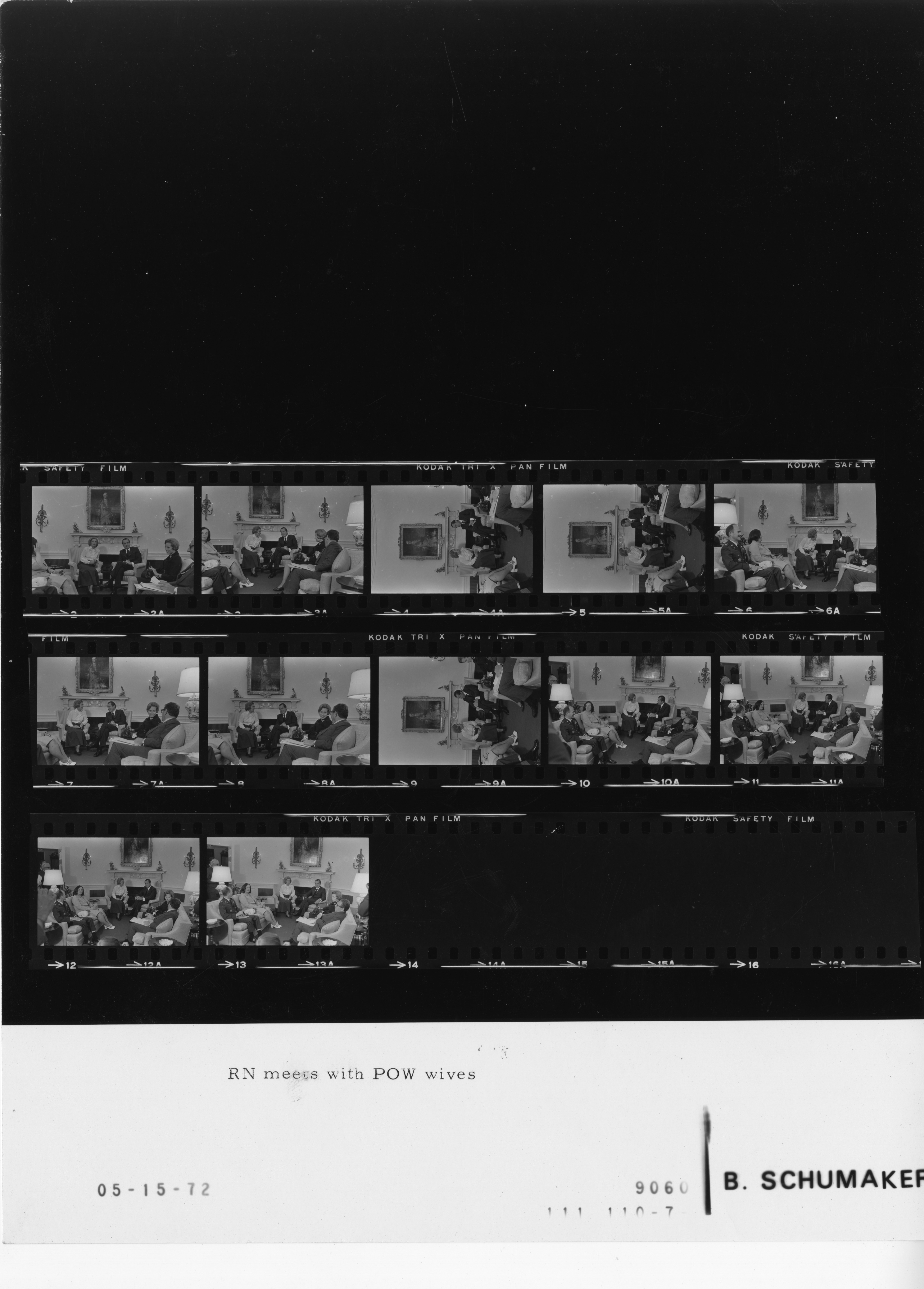
- Frame(s): WHPO-9060-, President Nixon and others meeting with representatives of the National League of Families of American Prisoners and Missing in Southeast Asia (POW-Vietnam Prisoner of War, Missing in Action). 5/15/1972, Washington, D.C. White House, Oval Office. President Nixon, Henry Kissinger, Gen. Brent Scowcroft, Mrs. James Stockdale, Mrs. Joseph Dunn, Mrs. Paul Galanti.
- Frame(s): WHPO-9060-11A, President Nixon and others meeting with representatives of the National League of Families of American Prisoners and Missing in Southeast Asia (POW-Vietnam Prisoner of War, Missing in Action). 5/15/1972, Washington, D.C. White House, Oval Office. President Nixon, Henry Kissinger, Gen. Brent Scowcroft, Mrs. James Stockdale, Mrs. Joseph Dunn, Mrs. Paul Galanti.
Roll WHPO-9061 Photographer: Atkins, Oliver | Color or B&W: B&W
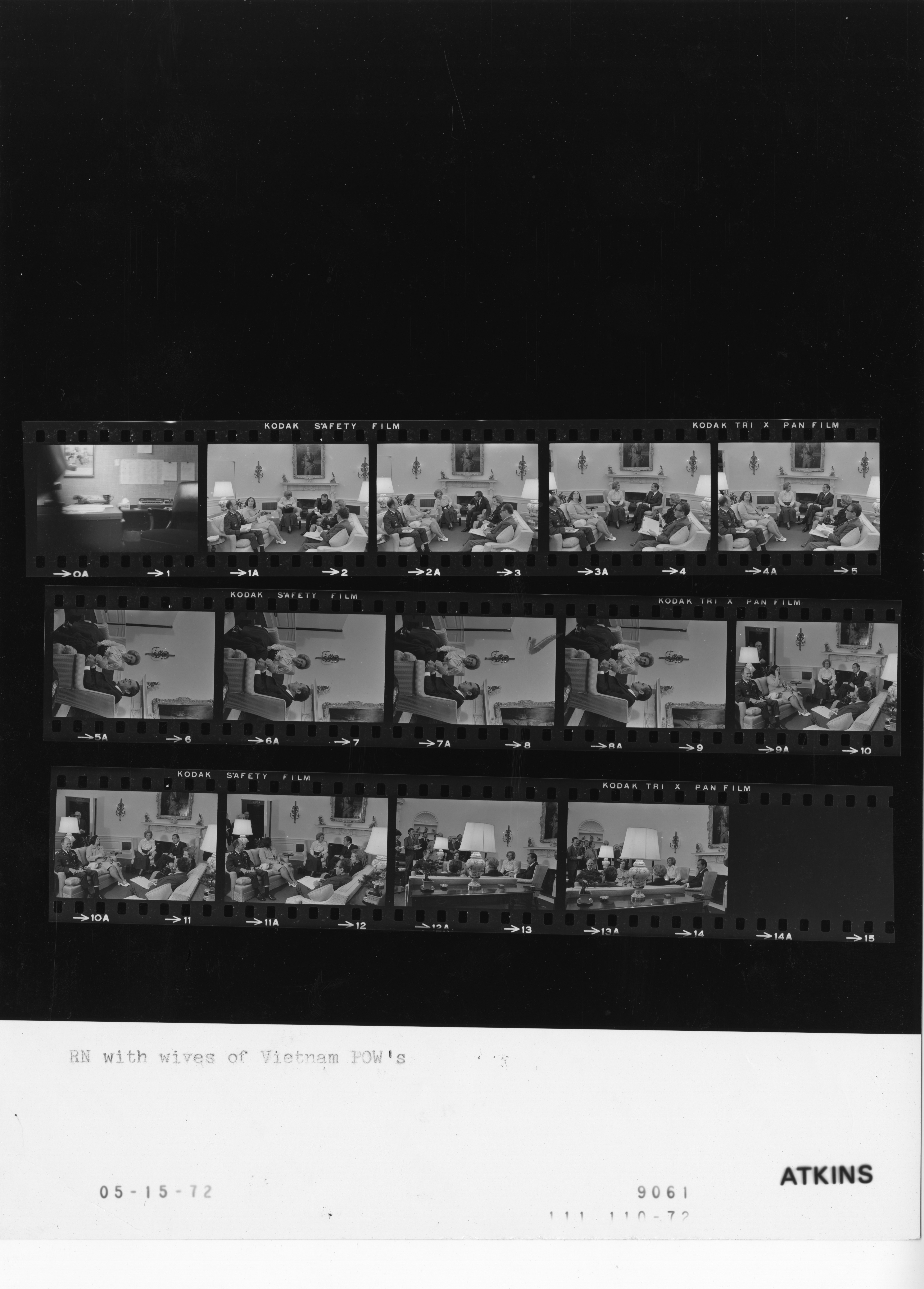
- Frame(s): WHPO-9061-, President Nixon and others meeting with representatives of the National League of Families of American Prisoners and Missing in Southeast Asia (POW-Vietnam Prisoner of War, Missing in Action). 5/15/1972, Washington, D.C. White House, Oval Office. President Nixon, Kissinger, Brent Scowcroft, Mrs. James Stockdale, Mrs. Joseph Dunn, Mrs. Paul Galanti.
Roll WHPO-9062 Photographer: Atkins, Oliver | Color or B&W: B&W
- Frame(s): WHPO-9062-02A-06A, President Nixon receiving the diplomatic credentials from Andres Aguilar, Venezuela. 5/15/1972, Washington, D.C. White House, East Room. President Nixon, Andres Aguilar, Mrs. Aguilar, Jacques Kosciusko-Morizet, Mrs. Kosciusko-Morizet, Kifle Wodajo, Mohammad Khan, Mrs. Mohammad Khan.
- Frame(s): WHPO-9062-08A-13A, President Nixon receiving the diplomatic credentials from Jacques Kosciusko-Morizet, France. 5/15/1972, Washington, D.C. White House, East Room. President Nixon, Andres Aguilar, Mrs. Aguilar, Jacques Kosciusko-Morizet, Mrs. Kosciusko-Morizet, Kifle Wodajo, Mohammad Khan, Mrs. Mohammad Khan.
- Frame(s): WHPO-9062-15A-16A, President Nixon receiving the diplomatic credentials from Kifle Wodajo, Ethiopia. 5/15/1972, Washington, D.C. White House, East Room. President Nixon, Andres Aguilar, Mrs. Aguilar, Jacques Kosciusko-Morizet, Mrs. Kosciusko-Morizet, Kifle Wodajo, Mohammad Khan, Mrs. Mohammad Khan.
- Frame(s): WHPO-9062-18A-23A, President Nixon receiving the diplomatic credentials from Sultan Mohammad Khan, Pakistan. 5/15/1972, Washington, D.C. White House, East Room. President Nixon, Andres Aguilar, Mrs. Aguilar, Jacques Kosciusko-Morizet, Mrs. Kosciusko-Morizet, Kifle Wodajo, Mohammad Khan, Mrs. Mohammad Khan.
Roll WHPO-9063 Photographer: Atkins, Oliver | Color or B&W: B&W
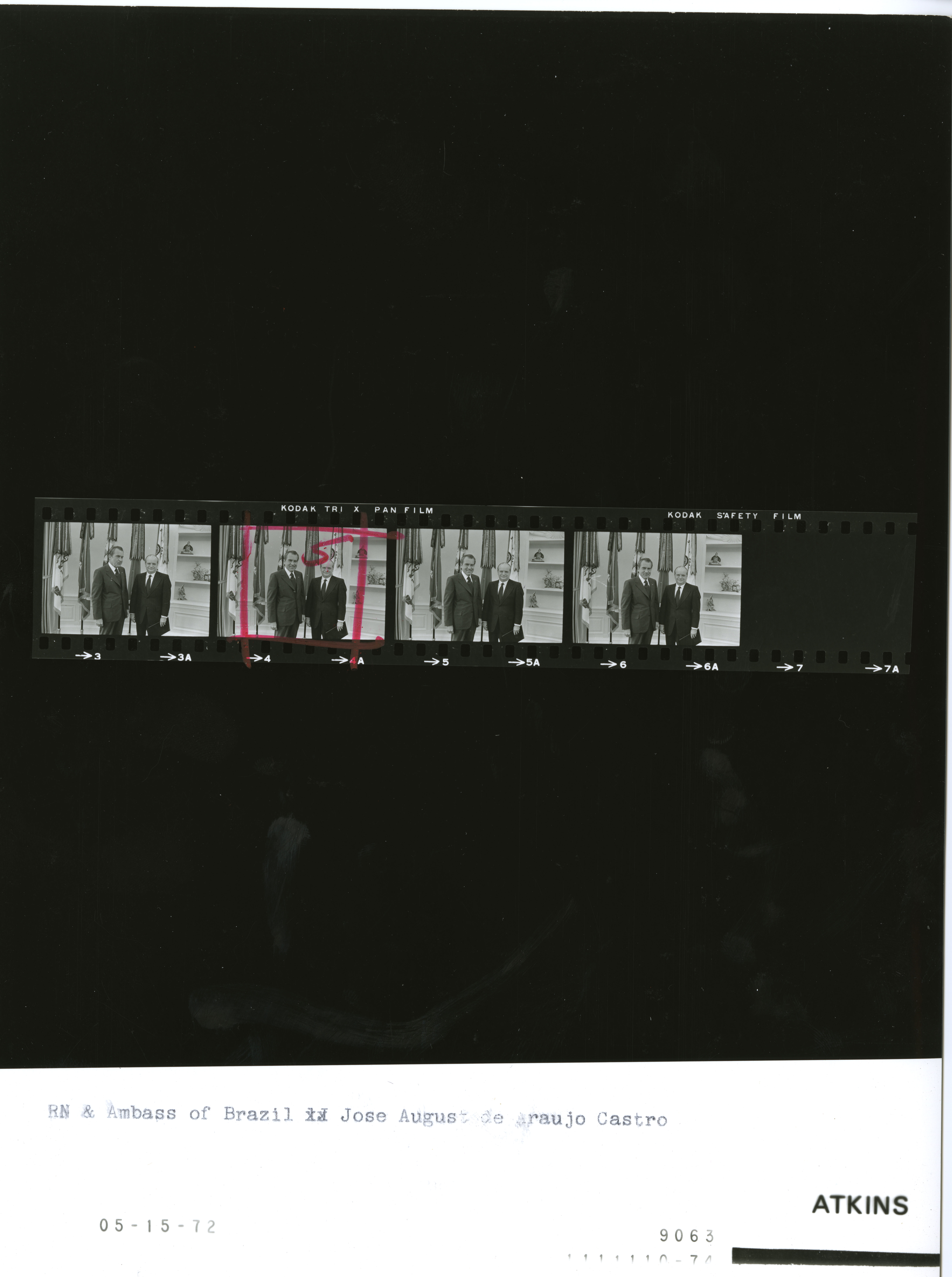
- Frame(s): WHPO-9063-, President Nixon standing with Brazilian Ambassador Joao Augusto de Araujo Castro. 5/15/1972, Washington, D.C. White House, Oval Office. President Nixon, Joao Augusto de Araujo Castro.
Roll WHPO-9064 Photographer: Schumaker, Byron | Color or B&W: B&W
- Frame(s): WHPO-9064-, Alexander Haig standing with William Robinson of the Massachusetts House of Representatives. 5/15/1972, Washington, D.C. West Wing Colonnade, White House. Alexander Haig, William Robinson.
Roll WHPO-9065 Photographer: Schumaker, Byron | Color or B&W: Color
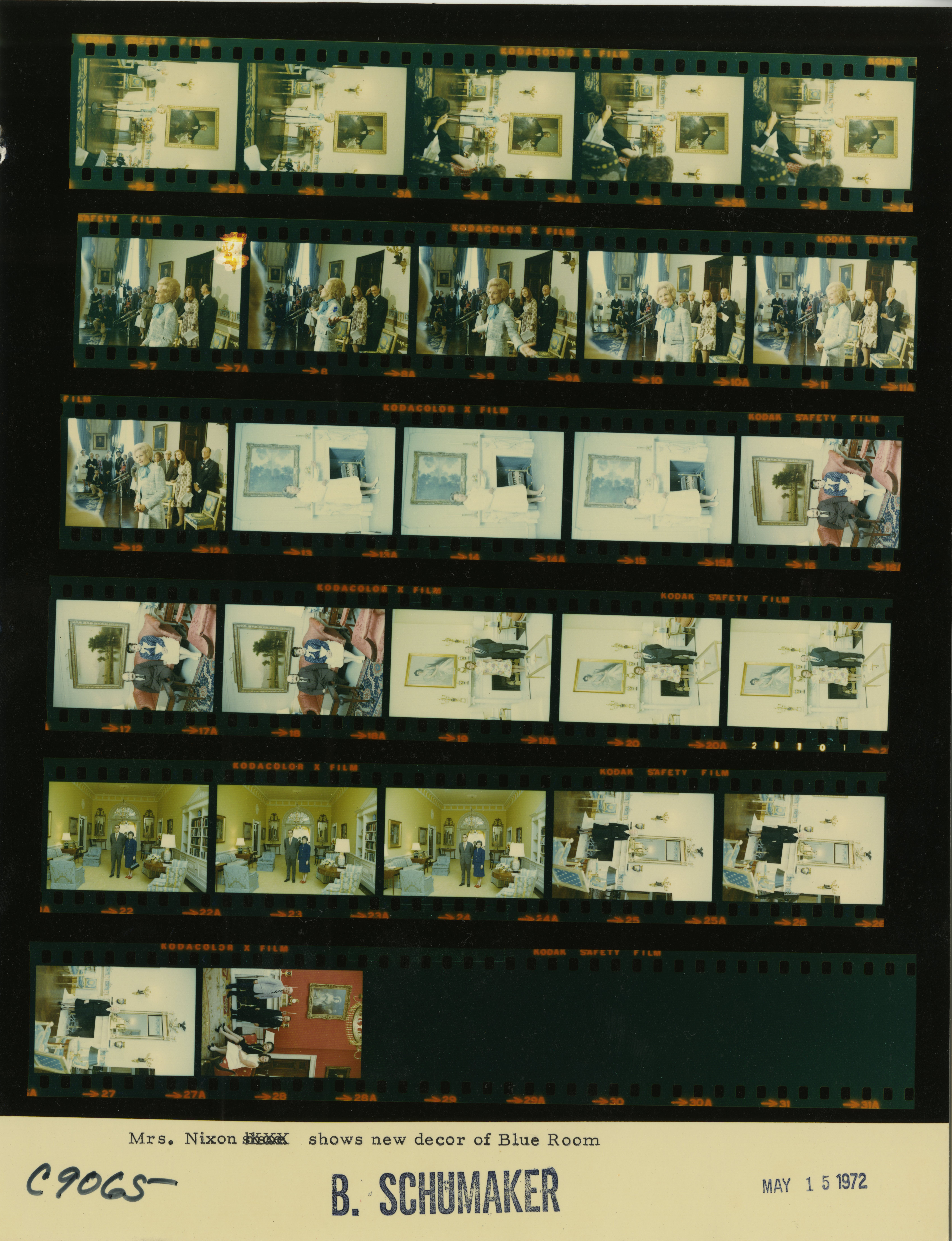
- Frame(s): WHPO-9065-02-12, Pat Nixon speaking to guests and the press in the reopened Blue Room. 5/15/1972, Washington, D.C. Blue Room, White House. Pat Nixon, unidentified persons.
- Frame(s): WHPO-9065-13-15, Various groupings of unidentified persons in the Vermeil Room. 5/15/1972, Washington, D.C. Vermeil Room, White House. Pat Nixon, unidentified persons.
- Frame(s): WHPO-9065-16-18, Various groupings of unidentified persons in the Map Room. 5/15/1972, Washington, D.C. Map Room, White House. Pat Nixon, unidentified persons.
- Frame(s): WHPO-9065-19-21, Various groupings of unidentified persons in the Yellow Oval Room. 5/15/1972, Washington, D.C. Yellow Oval Room, White House. Pat Nixon, unidentified persons.
- Frame(s): WHPO-9065-22-24, Various groupings of unidentified persons in the Central Hall. 5/15/1972, Washington, D.C. Central Hall, White House. Pat Nixon, unidentified persons.
- Frame(s): WHPO-9065-25-27, Various groupings of unidentified persons in the Blue Room. 5/15/1972, Washington, D.C. Blue Room, White House. Pat Nixon, unidentified persons.
- Frame(s): WHPO-9065-28, Various groupings of unidentified persons in the Red Room. 5/15/1972, Washington, D.C. Red Room, White House. Pat Nixon, unidentified persons.
Roll WHPO-9066 Photographer: Schumaker, Byron | Color or B&W: Color
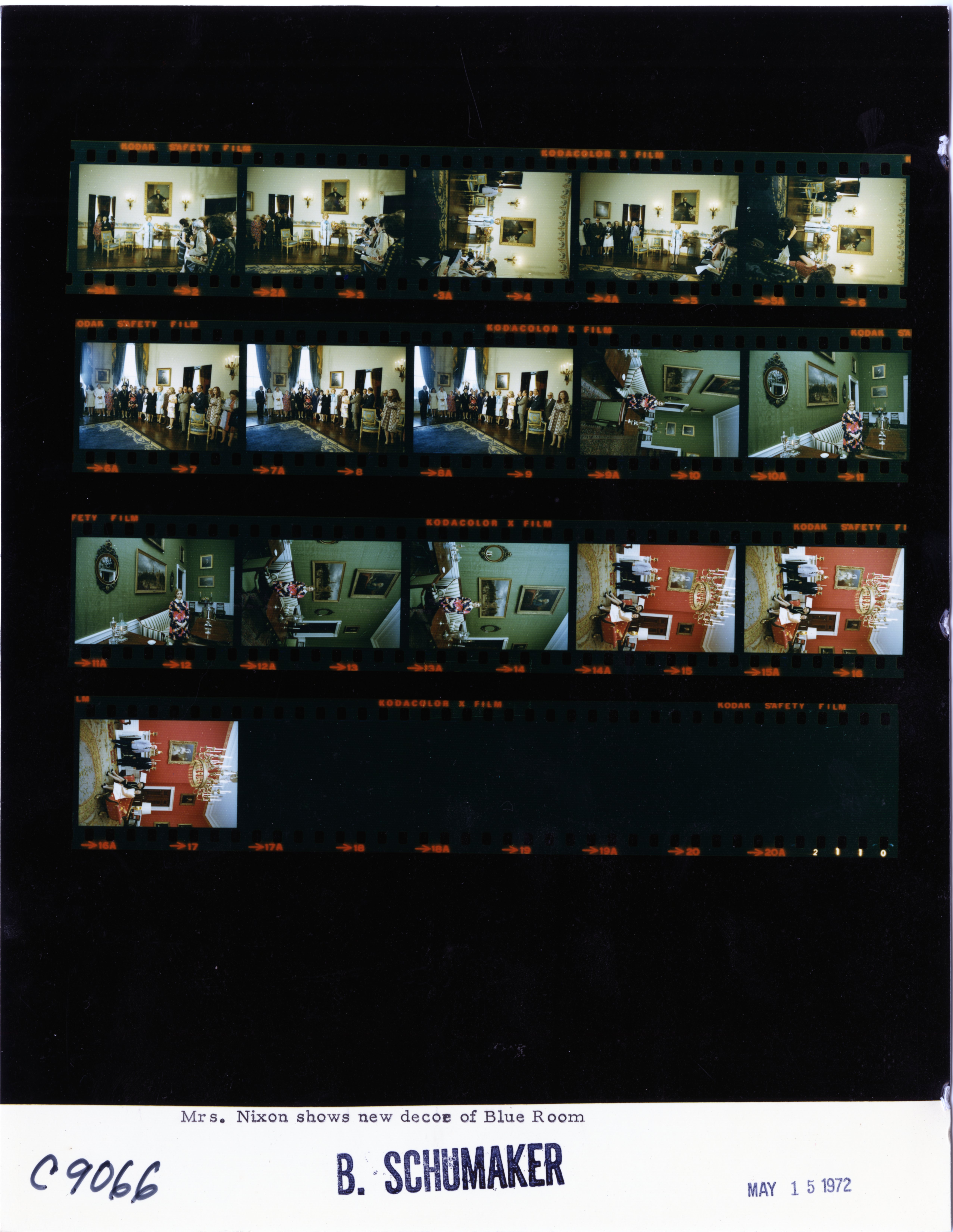
- Frame(s): WHPO-9066-02-09, Pat Nixon speaking to guests and the press in the reopened Blue Room. 5/15/1972, Washington, D.C. Blue Room, Green Room, Red Room, White House. Pat Nixon, unidentified persons.
- Frame(s): WHPO-9066-10-13, Various groupings of unidentified persons in the Green Room. 5/15/1972, Washington, D.C. Blue Room, Green Room, Red Room, White House. Pat Nixon, unidentified persons.
- Frame(s): WHPO-9066-15-17, Various groupings of unidentified persons in the Red Room. 5/15/1972, Washington, D.C. Blue Room, Green Room, Red Room, White House. Pat Nixon, unidentified persons.
Roll WHPO-9067 Photographer: Knudsen, Robert L. | Color or B&W: Color
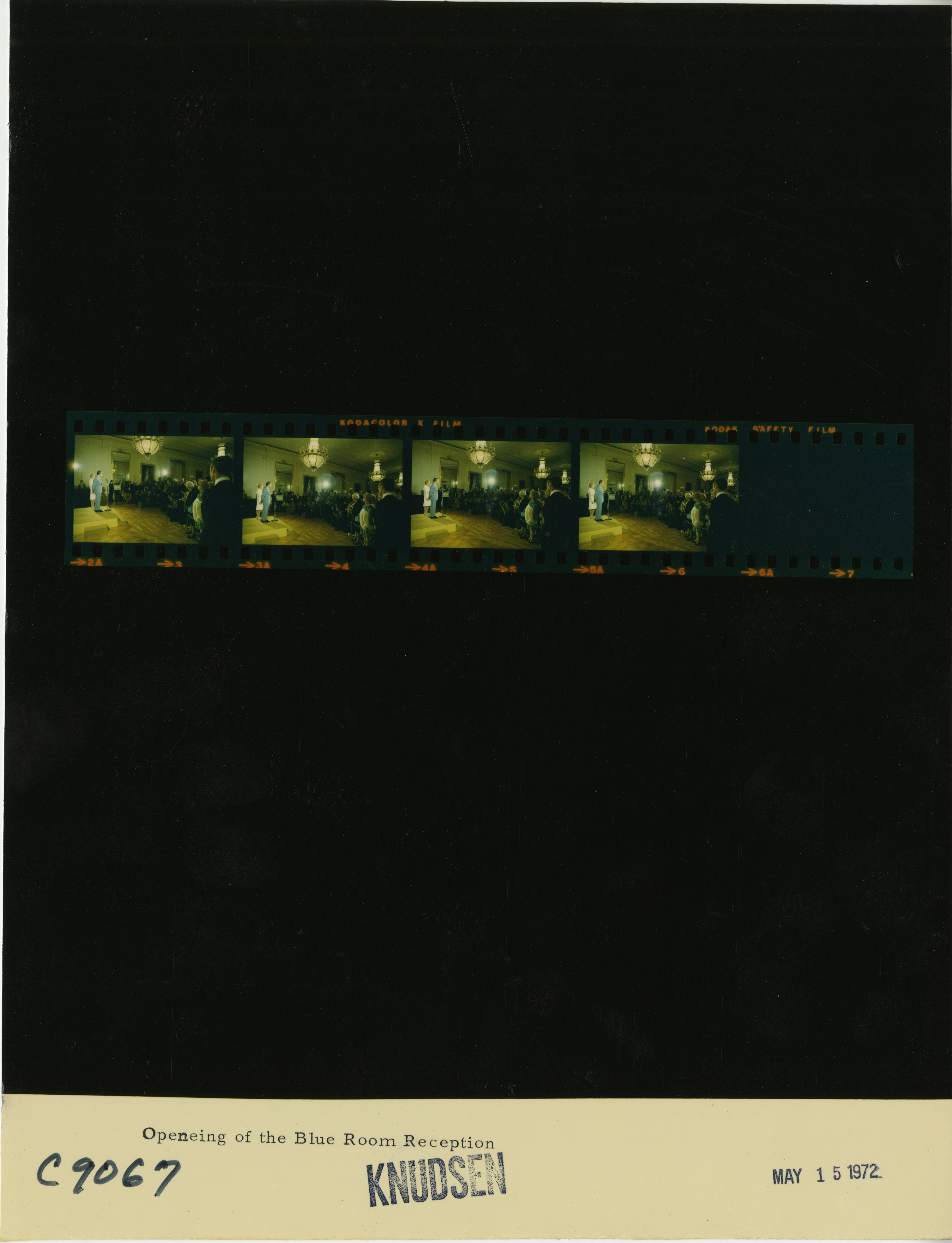
- Frame(s): WHPO-9067-, Nixon addressing guests upon the reopening of the Blue Room, with Pat Nixon at his side. 5/15/1972, Washington, D.C. White House, East Room. President Nixon, Pat Nixon, guests.
- Frame(s): WHPO-9067-, Nixon addressing guests upon the reopening of the Blue Room, with Pat Nixon at his side. 5/15/1972, Washington, D.C. White House, East Room. President Nixon, Pat Nixon, guests.
- Frame(s): WHPO-9067-, Nixon addressing guests upon the reopening of the Blue Room, with Pat Nixon at his side. 5/15/1972, Washington, D.C. White House, East Room. President Nixon, Pat Nixon, guests.
Roll WHPO-9068 Photographer: Knudsen, Robert L. | Color or B&W: Color
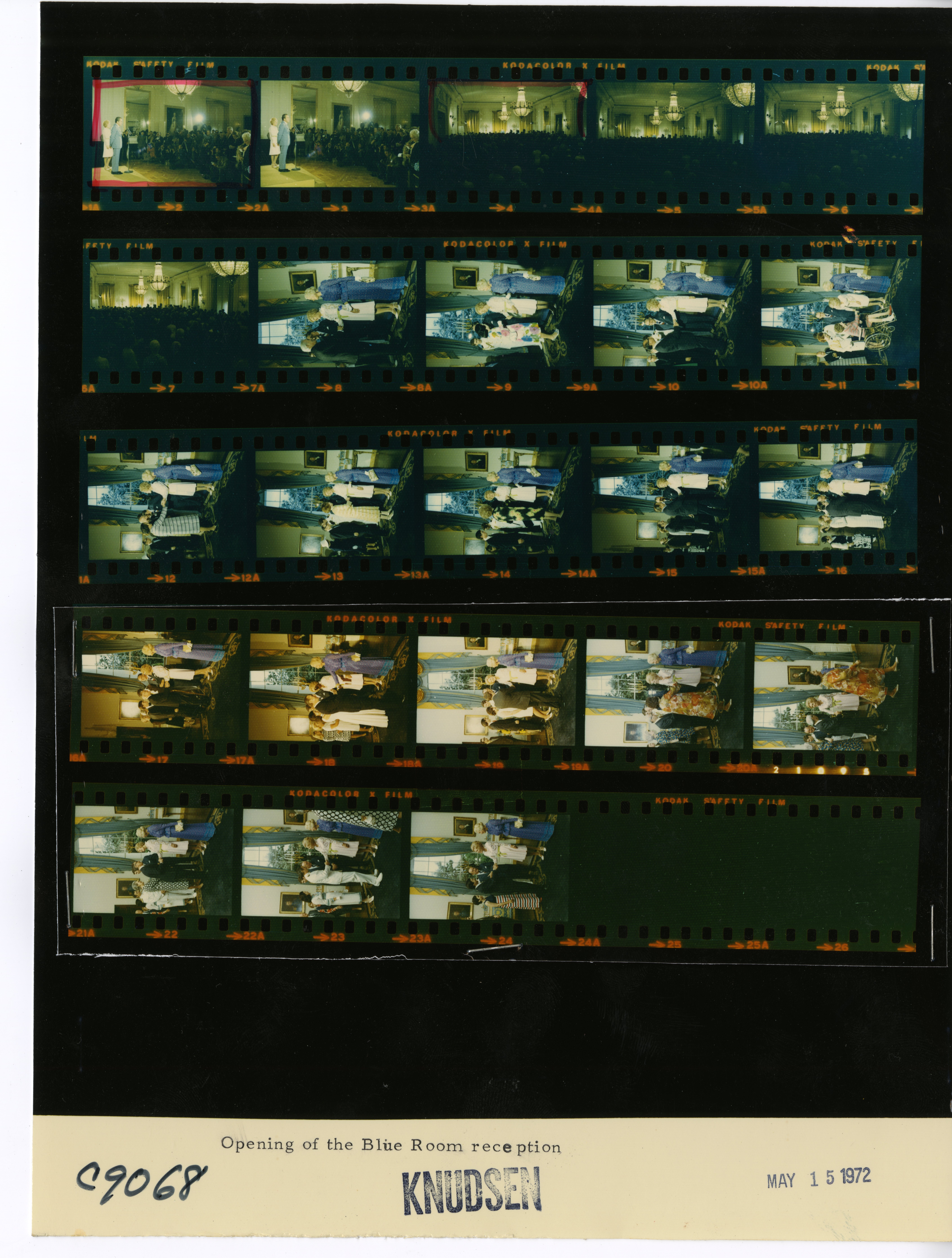
- Frame(s): WHPO-9068-02-07, President Nixon addressing guests upon the reopening of the Blue Room, with Pat Nixon at his side. 5/15/1972, Washington, D.C. East Room, Blue Room, White House. President Nixon, Pat Nixon, guests.
- Frame(s): WHPO-9068-08-24, Pat Nixon in a receiving line with unidentified persons. 5/15/1972, Washington, D.C. East Room, Blue Room, White House. President Nixon, Pat Nixon, guests.
Roll WHPO-9069 Photographer: Kightlinger, Jack | Color or B&W: Color
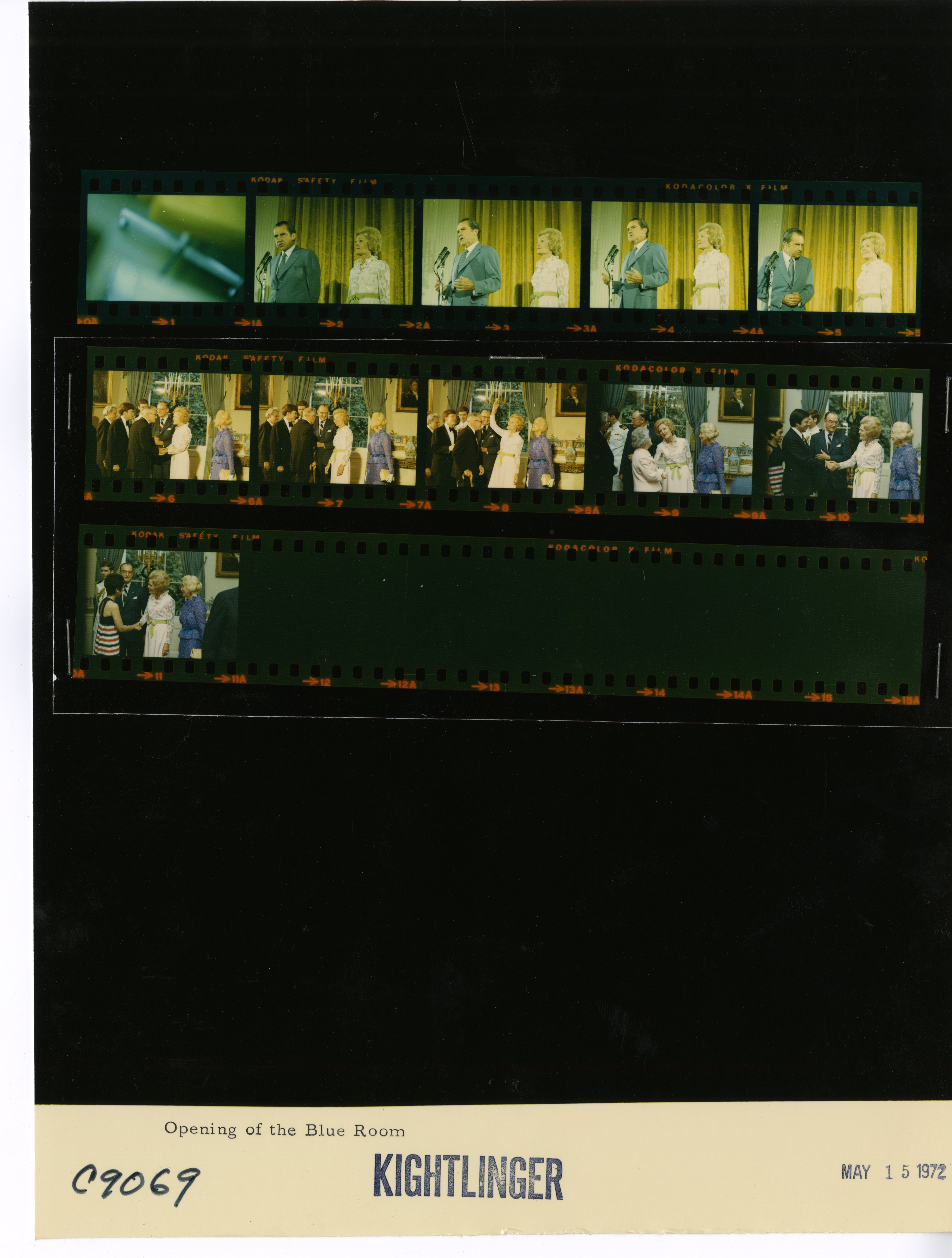
- Frame(s): WHPO-9069-02-05, President Nixon addressing guests upon the reopening of the Blue Room, with Pat Nixon at his side. 5/15/1972, Washington, D.C. East Room, Blue Room, White House. President Nixon, Pat Nixon, guests.
- Frame(s): WHPO-9069-06-11, Pat Nixon in a receiving line with unidentified persons. 5/15/1972, Washington, D.C. East Room, Blue Room, White House. President Nixon, Pat Nixon, guests.
Roll WHPO-9070 Photographer: Kightlinger, Jack | Color or B&W: Color
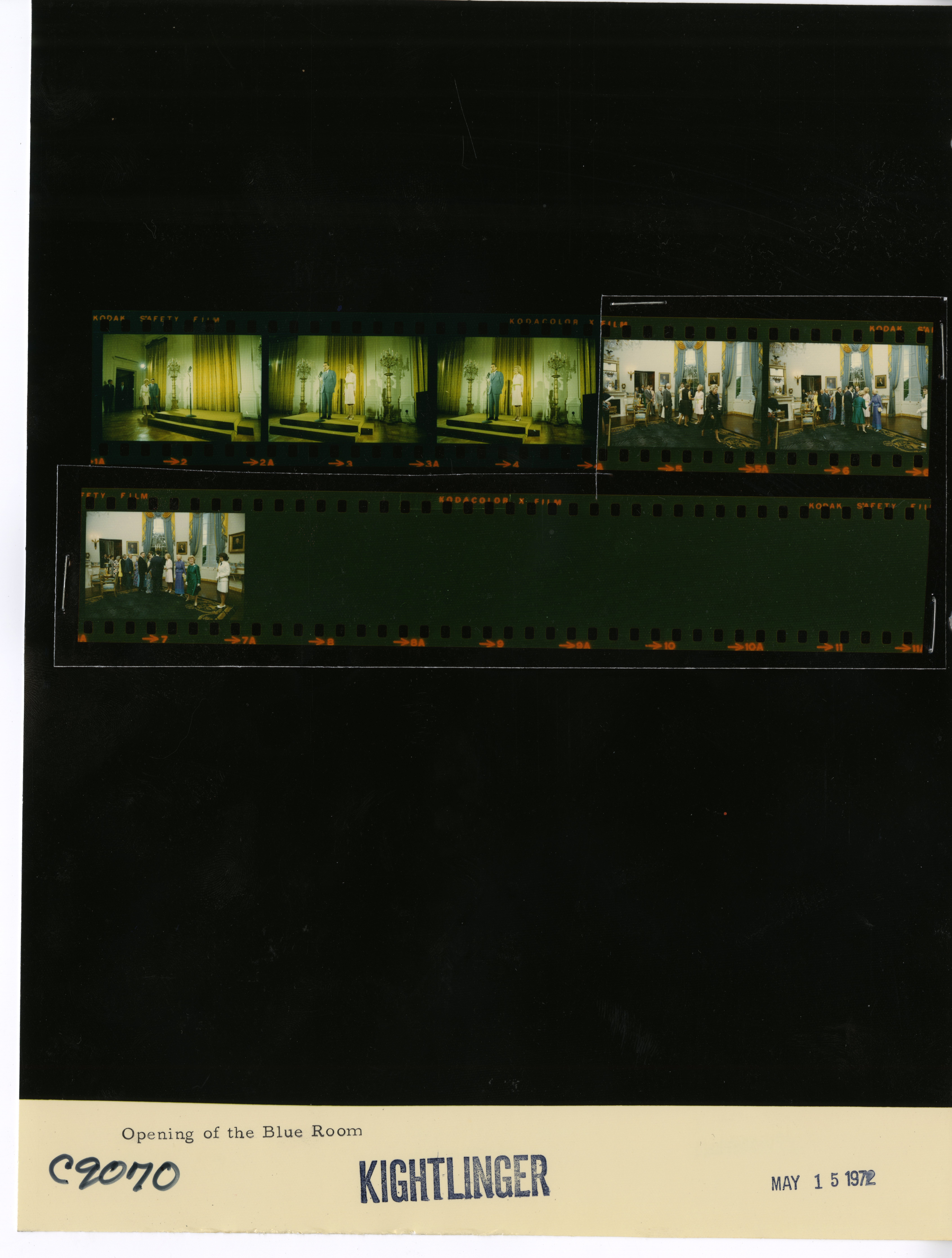
- Frame(s): WHPO-9070-02-04, President Nixon addressing guests upon the reopening of the Blue Room, with Pat Nixon at his side. 5/15/1972, Washington, D.C. East Room, Blue Room, White House. President Nixon, Pat Nixon, guests.
- Frame(s): WHPO-9070-05-07, Pat Nixon in a receiving line with unidentified persons. 5/15/1972, Washington, D.C. East Room, Blue Room, White House. President Nixon, Pat Nixon, guests.
Roll WHPO-9093 Photographer: Schumacher, Karl | Color or B&W: B&W
- Frame(s): WHPO-9093-, Vice President Agnew greeting people, taking photos, and making a toast at a reception. 5/15/1972, Tokyo, Japan unknown. Agnew, Eisaku Sato, Japanese officials, guests.
Roll WHPO-9094 Photographer: Schumacher, Karl | Color or B&W: B&W
- Frame(s): WHPO-9094-, Vice President Agnew at a reversion ceremony in Tokyo. 5/15/1972, Tokyo, Japan unknown. Spiro Agnew, Japanese officials, guests.
Roll WHPO-9095 Photographer: Schumacher, Karl | Color or B&W: Color
- Frame(s): WHPO-9095-03-16, Vice President Agnew at a reversion ceremony in Tokyo. 5/15/1972, Tokyo, Japan unknown. Spiro Agnew, Japanese officials, guests.
- Frame(s): WHPO-9095-18-23, Vice President Agnew and officials speaking outdoors in a park. 5/15/1972, Tokyo, Japan unknown. Spiro Agnew, Japanese officials, guests.
Roll WHPO-9098 Photographer: Schumacher, Karl | Color or B&W: Color
- Frame(s): WHPO-9098-04-24, Vice President Agnew at a dinner at the U.S. Embassy. 5/15/1972, Tokyo, Japan U.S. Embassy. Agnew, Japanese officials, guests.
The White House Communications Agency Sound Recordings Collection contains public statements that took place between 1969 and 1974. Visit the finding aid to learn more.
C - First Lady
- WHCA-SR-C-127
Remarks by Pat Nixon at the dedication of the newly-decorated Blue Room. (5/15/1972, Blue Room, The White House)
Runtime: 0:12:35
Production credits: Audio feed supplied by WHCA; Recorded by JAD (initials of WHCA engineer)
Original Format: 1/4-inch reel-to-reel audiotape. Original source type: Original.
H - White House Staff Member Recordings
- WHCA-SR-H-571
Remarks of POW (Vietnam Prisoner of War) wives after a meeting with Nixon. (5/15/1972, West Driveway, White House)
Runtime: 21:00
Production credits: Audio feed supplied by WHCA; Recorded by BAC (initials of WHCA engineer)
Original Format: 1/4-inch reel-to-reel audiotape. Original source type: Original.
P - Formal Presidential Remarks
- WHCA-SR-P-720505
Remarks by President Nixon at dedication of the Blue Room. (5/15/1972)
Runtime: 6:46
Original Format: 1/4-inch reel-to-reel audiotape. Original source type: Original.
The White House Communications Agency Videotape Collection contains “off-the-air” recordings of televised programs produced between 1968 and 1974. Visit the finding aid to learn more.
- WHCA-5372
"Panorama".
CBS
Runtime: 01:28:44 - WHCA-5373
"Closer Look '72". PSA for education for the handicapped Robert Finch.
Southern Educational Communications Association
Runtime: 00:05:54 - WHCA-5374
"Conversation with Julie", Detroit, Mich. AND "Conversation with Julie", Houston, Texas. Julie Nixon Eisenhower.
Runtime: 01:05:33 - WHCA-5383
Weekly News Summary, Tape I.
ALL NETWORKS
Runtime: 01:34:07
26. Smith/Geer/Reasoner: Governor George Wallace is shot in Laurel, Maryland. Time Code Start: 72:50. Keywords: Senators, Governors, Presidential elections, campaigns, primaries, candidates. Network: ABC.
27. Smith: President Nixon sends personal physician to Governor George Wallace's hospital with Senator Hubert Humphrey. Time Code Start: 79:45. Keywords: Presidents, Senators, Governors, reports, assassinations, shootings, hospitals. Network: ABC.
28. Reasoner/Reynolds: Michigan primary coverage. Time Code Start: 81:00. Keywords: Presidential elections, campaigns, primaries, voting. Network: ABC.
29. Reasoner/Shoumacher: South Vietnam offensive. Time Code Start: 84:10. Keywords: Vietnam War. Network: ABC.
30. Smith: Pentagon releases photo of North Vietnam. Time Code Start: 87:30. Keywords: United States Department of Defense headquarters, Armed Forces, Vietnam War, photography, photographs. Network: ABC.
31. Smith/Jarriel: President Nixon meets with POWs families and they comment on the meeting. Time Code Start: 88:30. Keywords: Vietnam War, Vietnam Prisoner of War, families, Presidents, meetings. Network: ABC.
32. Reasoner: McGovern wishes Governor George Wallace a speedy recovery. Time Code Start: 90:10. Keywords: Senators, Governors, Presidential elections, campaigns, primaries, candidates. Network: ABC.
33. Smith: Commentary on gun control laws. Time Code Start: 91:27. Keywords: bills, laws, weapons, sales, controls, registrations, licenses. Network: ABC. - WHCA-5384
Weekly News Summary, Tape II.
ALL NETWORKS
Runtime: 01:33:15
1. Chancellor/Mackin: Governor George Wallace shot while campaigning (film). Time Code Start: 00:00. Keywords: Senators, Governors, Presidential elections, campaigns, primaries, candidates. Network: NBC.
2. Mackin: Governor George Wallace campaigning. Time Code Start: 04:90. Keywords: Senators, Governors, Presidential elections, campaigns, primaries, candidates. Network: NBC.
3. Chancellor: President Nixon, Senators McGovern and Humphrey comments on shooting of Governor George Wallace. Time Code Start: 06:00. Keywords: Presidents,Senators, Governors, Presidential elections, campaigns, primaries, candidates, reports, assassinations, shootings. Network: NBC.
4. Duke: Film of Senator Humphrey at Holy Cross Hospital Holy Cross Hospital in Silver Springs, MD after shooting of Governor George Wallace. Time Code Start: 06:00. Keywords: Senators, Governors, Presidential elections, campaigns, primaries, candidates, reports, assassinations, shootings, hospitals. Network: NBC.
5. Brinkley's Journal: Commentary on political shootings. Time Code Start: 08:30. Keywords: politicians, assasinations, violence, attacks,. Network: NBC.
6. Chancellor/Kiker: Campaign '72, Michigan (Senators Humphrey, McGovern). Time Code Start: 10:00. Keywords: Presidential elections, campaigns, campaigning, primaries, candidates, voting, speeches. Network: NBC.
7. Chancellor: More ships to war; Secretary of State Rogers questioned by Senate committee. Time Code Start: 13:54. Keywords: cabinet, advisors, Navy, warships, Senate Committee Hearings, testimony, testify. Network: NBC.
8. Chancellor: Vietnam. Time Code Start: 16:30. Keywords: Vietnam War. Network: NBC.
9. Brady: Vice President Agnew at return of Okinawa to Japan. Time Code Start: 17:12. Keywords: Vice Presidents, travel, trips, Japanese. Network: NBC.
10. Cronkite/Dick: Governor George Wallace shot at campaign rally. Time Code Start: 22:20. Keywords: Senators, Governors, Presidential elections, campaigns, primaries, candidates, assassinations, shootings. Network: CBS.
11. Dick: Governor George Wallace campaigns in Maryland. Time Code Start: 26:14. Keywords: Governors, Presidential elections, campaigns, primaries, candidates. Network: CBS.
12. Cronkite: Slow motion of Governor George Wallace shooting; comment on political murders. Time Code Start: 29:30. Keywords: Governors, Presidential elections, campaigns, primaries, candidates, assassinations, shootings. Network: CBS.
13. Mudd: Reaction to shooting of Governor George Wallace. Time Code Start: 33:38. Keywords: Governors, Presidential elections, campaigns, primaries, candidates, assassinations, shootings, reactions, reports. Network: CBS.
14. Rather: President Nixon comment on Governor George Wallace shooting. Time Code Start: 34:43. Keywords: Presidents, speeches, Governors, Presidential elections, campaigns, primaries, candidates, assassinations, shootings, reactions, reports. Network: CBS.
15. Cronkite/Threlkeld: Vietnam; Hue. Time Code Start: 36:52. Keywords: Vietnam War. Network: CBS.
Context (External Sources)
The Vanderbilt Television News Archive is the world's most extensive and complete archive of television news. They have been recording, preserving and providing access to television news broadcasts of the national networks since August 5, 1968.
Wikipedia is a free encyclopedia that anyone can edit.