
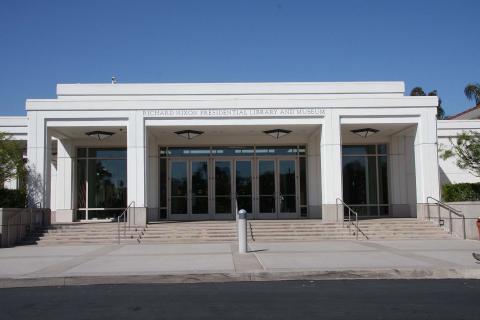
Introduction
This almanac page for Wednesday, June 30, 1971, pulls together various records created by the federal government and links to additional resources which can provide context about the events of the day.
Previous Date: Tuesday, June 29, 1971
Next Date: Thursday, July 1, 1971
Schedule and Public Documents
The Daily Diary files represent a consolidated record of the President's activities. Visit the finding aid to learn more.
The President's day began at The White House - Washington, D. C.
The Weekly Compilation of Presidential Documents made available transcripts of the President's news conferences; messages to Congress; public speeches, remarks, and statements; and other Presidential materials released by the White House.
Digitized versions can be found at HathiTrust.
Each Public Papers of the Presidents volume contains the papers and speeches of the President of the United States that were issued by the White House Office of the Press Secretary during the time period specified by the volume. The material is presented in chronological order, and the dates shown in the headings are the dates of the documents or events. In instances when the release date differs from the date of the document itself, that fact is shown in the text note.
To ensure accuracy, remarks have been checked against audio recordings (when available) and signed documents have been checked against the original, unless otherwise noted. Editors have provided text notes and cross references for purposes of identification or clarity.
- Remarks Announcing Decision by the Turkish Government To Ban Cultivation of Opium Poppies.
- Statement About the Turkish Government's Ban on Cultivation of Opium Poppies
- Message to Nikolai V. Podgorny, Chairman of the Presidium of the Supreme Soviet, on the Death of Three Soviet Cosmonauts.
- Statement About Ratification of the 26th Amendment to the Constitution
- Executive Order 11603—Assigning Additional Functions to the Director of ACTION
- Remarks at Graduation Exercises of the FBI National Academy
The Federal Register is the official daily publication for rules, proposed rules, and notices of federal agencies and organizations, as well as executive orders and other Presidential documents.
The Congressional Record is the official daily record of the debates and proceedings of the U.S. Congress.
Archival Holdings
Any selection of archival documents will necessarily be partial. You should use the documents and folders identified below as a starting place, but consult the linked collection finding aids and folder title lists and the collections themselves for context. Many documents to be found this way do not lend themselves to association with specific dates, but are essential to a complete understanding of the material.
Selective document listing
President's Office Files
The President's Office Files consists of materials drawn together by the Special Files Unit from several administrative subdivisions within the White House Office. It is the handwriting and sensitive papers sent to the Staff Secretary that now comprise much of the President's Office Files. Visit the finding aid to learn more.
- Annotated News Summaries, Box 30, News Summaries - June 1971 [1 of 2]
- Annotated News Summaries, Box 30, News Summaries - June 1971 [2 of 2] [During this period, the Staff Secretary only removed pages from the News Summaries which contained President Nixon's handwriting, often leaving the document with no date. In addition to the individual document(s) listed below, you should also consult the full folder for the month.]
- News Summary, June 30, 1971, Television Report (Tuesday Telecasts)
- President's Daily Schedule, Box 101, [President's Daily Schedule, June-Aug. 1971] [1 of 3]
- The President's Schedule, Wednesday - June 30, 1971
President's Personal File
The President's Personal File is essentially a President's secretary's file, kept by Rose Mary Woods, personal secretary to the President, for two purposes: (1) preserving for posterity a collection of documents particularly close to the President, whether because he dictated or annotated them, or because of the importance of the correspondent or the event concerned and (2) giving appropriate attention–letters of gratitude, invitations to White House social events, and the like–to members and important friends and supporters of the Nixon administration. This generalization does not describe all the varied materials of a file group which is essentially a miscellany, but it does identify the reason for the existence of the file group's core. Visit the finding aid to learn more.
- President's Speech File
The H. R. Haldeman Diaries consists of seven handwritten diaries, 36 dictated diaries recorded as sound recordings, and two handwritten audio cassette tape subject logs. The diaries and logs reflect H. R. Haldeman’s candid personal record and reflections on events, issues, and people encountered during his service in the Nixon White House. As administrative assistant to the President and Chief of Staff, Haldeman attended and participated in public events and private meetings covering the entire scope of issues in which the Nixon White House engaged in during the years 1969-1973. Visit the finding aid to learn more.
- Transcript of diary entry (PDF)
Wednesday, June 30th. We had the court decision today, this afternoon, and that pretty much dominated the developments. Earlier in the day, we had learned that there was a leak from inside the court about what they were going to do, and the President wanted to try and get someone to rap that, which might help knock their decision the other way, but it didn't do any good. The Court went 6 to 3 against us. After the NSC meeting this afternoon, the President had Laird and Mitchell into his office and he called Kissinger and me in for a discussion on the court decision and how we should handle the reaction. Laird took the view that he should supply copies of all of the Pentagon Papers to the press, because the papers have agreed to delete the sensitive sections; and that we should make copies available to all papers, with our deletions, as a way of getting them to the Chicago Tribune and the other good papers, who will carry the stories with the slant that we would want. Henry argued very strongly that we have to maintain the principle of the security of government and that we should not give the papers out. Laird argued a line of not declassifying the papers, which was one thing that discourage, that distressed Henry, but rather release them, because the Supreme Court has allowed the stolen documents to be printed, and in fairness to other media, we have to allow them to have those documents too; make the point that we fought against printing any of it, but we lost. The President decided that we must declassify only on the merits of the material, not on the basis of what was printed.
There's a general agreement that there is very definitely a conspiracy here, on these papers, and Laird alluded to some intelligence they had that he didn't get into detail on. He did mention a guy named Cooke who works for Elliot Richardson, who had moved from the Defense Department to the State Department under Elliot, and then to HEW with Elliot. They think he had some of the stats of these things and he's part of the big conspiracy; that he apparently photostatted and delivered classified documents, apparently to Ellsberg, while he was at the State Department. So the President ordered me to follow up on Richardson with that, which I did. I covered the problem with him and told him that the President needed the report back. Elliot called me back late tonight to say that the guy had shown some cables from Ellsworth Bunker regarding the Chow case to Ellsberg, while Ellsberg was at Rand; so there was no violation, because Ellsberg had a clearance. The cables then leaked and were printed in the Washington Star in a column by Jimmy Doyle. Elliot excuses this on the basis that a number of people who knew Chow had gone to bat for him; that Cooke and Ellsberg were in that group, as was Bunker who had talked to Thieu about trying to protect him. Cooke volunteered the fact that Ellsberg, could have been the leak, and the State Department people at the time talked to Rowan, the head of Rand, and urged him to fire Ellsberg, but by then Ellsberg was already gone, so State dropped the matter. Elliot talked to Cooke tonight and asked him if he had given, or shown, any other information to Ellsberg and he said that he had not and that he had no other communication with him. Elliot then went through a whole run down on what a fine fellow he is and how strongly he endorsed him.
Earlier in the evening, the President called me at home, following up on our meeting, said that we should not release the papers that the President wants to take a hard line and not cave-in. He wants Ehrlichman to develop a plan on that basis. That we ought to start...
-------------------------------------------------------------------------------------------------------------------
DECLASSIFIED - E.O. 13526, Sect. 3.4: by MS, NARA, June 12, 2013
Audio Cassette 10, Side A, Withdrawn Item Number 7 [AC-10(A) Sel 5]
Duration: 3 seconds
...using Laird and his espionage unit on this...
-------------------------------------------------------------------------------------------------------------------
…that we have to get all the information out. He wants me to follow up some more on the Richardson thing. He's concerned because Mitchell was obviously sold on the repression problem, and the President's not concerned about repression, if we can make secure, the security issue. He doesn't want any cave-in of the security system, and he doesn't want to listen to Scali, etcetera, on taking a soft line on it. He was pleased about the stock market increase, but analyzed that as being the necessity of the funds to buy before July 1st. Also, he called ecstatic about the unemployment figures which will come out on Friday that show it down from 6.2 to 5.6. He wants to get the maximum mileage out of that, naturally.
End of June 30th. - Original audio recording (MP3)
The National Archives Catalog is the online portal to the records held at the National Archives, and information about those records. It is the main way of describing our holdings and also provides access to electronic records and digitized versions of our holdings.
The Catalog searches across multiple National Archives resources at once, including archival descriptions, digitized and electronic records, authority records, and web pages from Archives.gov and the Presidential Libraries. The Catalog also allows users to contribute to digitized historical records through tagging and transcription.
Nixon Library Holdings
All National Archives Units
National Security Documents
The President's Daily Brief is the primary vehicle for summarizing the day-to-day sensitive intelligence and analysis, as well as late-breaking reports, for the White House on current and future national security issues. Read "The President's Daily Brief: Delivering Intelligence to Nixon and Ford" to learn more.
The Foreign Relations of the United States series presents the official documentary historical record of major U.S. foreign policy decisions and significant diplomatic activity. Visit the State Department website for more information.
Vol. IV, Foreign Assistance, International Development, Trade Policies, 1969-1972
East-West Trade, 1969-1972
336. Memorandum From Ernest Johnston of the National Security Council Staff to the President’s Assistant for National Security Affairs (Kissinger), Washington, June 30, 1971
Source: National Archives, Nixon Presidential Materials, NSC Files, President’s Trip Files, Box 491, Dobrynin/HAK 1971, Volume 6, Part 1. Confidential. Kissinger wrote “Port Security” at the top of the page. Documentation on access of Soviet ships to American ports (and reciprocal access of American ships to Soviet ports) and security procedures to be followed when Soviet ships were in U.S. ports is ibid.
Vol. XI, South Asia Crisis, 1971
South Asia Crisis, 1971
84. Memorandum From the Assistant Secretary of State for Near Eastern and South Asian Affairs (Sisco) to Secretary of State Rogers, Washington, June 30, 1971
Source: National Archives, RG 59, NEA/PAB Files: Lot 77 D 91, POL 15–1, Head of State. Confidential. Drafted on June 29 by Joel M. Woldman (NEA/PAF) with the concurrence of Van Hollen. The memorandum is stamped June 29, but Sisco corrected the date by hand.
Vol. XIII, Soviet Union, October 1970-October 1971
"One of Two Routes": Soviet-American Relations and Kissinger's Secret Trip to China, April 23-July 18, 1971
269. Memorandum From Ernest Johnston of the National Security Council Staff to the President’s Assistant for National Security Affairs (Kissinger), Washington, June 30, 1971
Source: National Archives, Nixon Presidential Materials, NSC Files, Box 491, President’s Trip Files, Dobrynin/Kissinger, 1971, Vol. 6 [part 1]. Secret. Sent for information. A copy was sent to Sonnenfeldt. Haig forwarded the memorandum to Kissinger with the comment: “I am afraid something has slipped the cog here because I don’t see anything for your use tonight except the more general considerations outlined in the strategy paper at Tab B.”
Vol. XVII, China, 1969-1972
China,January-September 1971
136. Conversation Between President Nixon and the Ambassador to the Republic of China (McConaughy), Washington, June 30, 1971, 12:18-12:35 p.m.
Source: National Archives, Nixon Presidential Materials, White House Tapes, Oval Office, Conversation No. 532-17. No classification marking. The editor transcribed the portion of the conversation published here specifically for this volume.
Vol. XXIX, Eastern Mediterranean, 1969-1972
Turkey
450. Telegram From the Embassy in Turkey to the Department of State, Ankara, June 30, 1971, 1215Z
Source: National Archives, Nixon Presidential Materials, NSC Files, Box 633, Country Files—Middle East, Turkey, Vol. II 1 Jan 1970–31 Dec 1971. Secret; Priority; Exdis.
Vol. XXXII, SALT I, 1969-1972
From SALT Announcement to Summit Announcement, May 27-October 12, 1971
169. Memorandum From the Chairman of the Joint Chiefs of Staff (Moorer) to Secretary of Defense Laird, Washington, June 30, 1971
Source: Ford Library, Laird Papers, Box 26, SALT, Chronological. Top Secret; Sensitive. Moorer sent a draft of this memorandum covering the same points to the JCS on June 29 for approval. Another copy is in the National Archives, RG 218, Records of the Joint Chiefs of Staff, Moorer, Box 52, 388.3, SALT.
170. Minutes of a National Security Council Meeting, Washington, June 30, 1971, 3:15-4:50 p.m.
Source: National Archives, Nixon Presidential Materials, NSC Institutional Files (H–Files), Box H–110, NSC Minutes, Originals, 1971–6/20/74. Top Secret;SALT; Nodis; Codeword. The meeting took place in the Roosevelt Room at the White House.
Vol. XL, Germany and Berlin, 1969-1972
Germany and Berlin, 1969-1972
264. Message From the German State Secretary for Foreign, Defense, and German Policy (Bahr) to the President’s Assistant for National Security Affairs (Kissinger), Bonn, June 30, 1971
Source: National Archives, Nixon Presidential Materials, NSC Files, Kissinger Office Files, Box 60, Country Files, Europe, Egon Bahr, Berlin File [2 of 3]. Top Secret; Sensitive; Exclusively Eyes Only. The message, translated here from the original German by the editor, was sent through the special Navy channel in Frankfurt. No time of transmission appears on the message; a handwritten note indicates that it was received in Washington at 2157Z. For the German text, see also Akten zur Auswärtigen Politik der Bundesrepublik Deutschland, 1971, Vol. 2, pp. 1035–37.
265. Message From the Ambassador to Germany (Rush) to the President’s Assistant for National Security Affairs (Kissinger), Bonn, June 30, 1971
Source: National Archives, Nixon Presidential Materials, NSC Files, Kissinger Office Files, Box 59, Country Files, Europe, Ambassador Rush, Berlin, Vol. 1. Top Secret; Sensitive; Exclusively Eyes Only. A copy was sent to Haig. The message was sent through the special Navy channel in Frankfurt. No time of transmission is on the message; a handwritten note indicates that it was received in Washington on July 1 at 0110Z.
Vol. E-10, Documents on American Republics, 1969-1972
Argentina
67. Backchannel Message From the Ambassador to Argentina (Lodge) to the Assistant Secretary for Inter-American Affairs (Meyer), Buenos Aires, June 30, 1971., Buenos Aires, June 30, 1971
Ambassador Lodge discussed the process he thought necessary for Argentina to receive U.S. economic assistance.
Source: National Archives, Nixon Presidential Materials, NSC Files, Box 768, Country Files, Latin America, Argentina 1969–71. Secret; Sensitive; Eyes Only.
The Kissinger telephone conversation transcripts consist of approximately 20,000 pages of transcripts of Kissinger’s telephone conversations during his tenure as Assistant to the President for National Security Affairs (1969-1974) and Secretary of State (1973-1974) during the administration of President Richard Nixon. Visit the finding aid for more information.
Digitized versions can be found in the National Archives Catalog.
Audiovisual Holdings
The White House Tapes are sound recordings of President Richard Nixon's telephone conversations and of meetings held in the Oval Office and the Cabinet Room in the White House, the President's office in the Old Executive Office Building (OEOB), the Lincoln Sitting Room in the residence section of the White House, and several locations at the Presidential retreat at Camp David, Maryland. These recordings document many of the major events and decisions of the Nixon Administration from February 16, 1971 to July 18, 1973. Visit the White House Tapes finding aid to learn about the taping system's operation and archival processing.
Oval Office
- 532-1; Unknown between 8:33 a.m. & 9:05 p.m.; Nixon, Richard M. (President); [Unknown person(s)]
- 532-2; Unknown between 8:33 a.m. & 9:05 a.m.; Nixon, Richard M. (President); [Unknown person(s)]
- 532-3; Unknown between 8:33 a.m. & 9:05 a.m.; Nixon, Richard M. (President); Bull, Stephen B.
- 532-4; 9:05 a.m. - 9:09 a.m.; Nixon, Richard M. (President); Rogers, William P.; Esembel, Melih; Ziegler, Ronald L.; Atkins, Oliver F. ("Ollie"); White House photographer
- 532-5; 9:13 a.m. - 9:13 a.m.; Nixon, Richard M. (President); [Unknown person(s)]
- 532-6; 9:13 a.m. - 9:54 a.m.; Nixon, Richard M. (President); Haldeman, H. R. ("Bob"); Kissinger, Henry A.; White House operator; Haig, Alexander M., Jr.; Dobrynin, Anatoliy F.; Hébert, F. Edward
- 532-7; Unknown between 9:54 a.m. & 9:59 a.m.; [Unknown person(s)]; Sanchez, Manolo
- 532-8; Unknown between 9:59 a.m. & 10:02 a.m.; Nixon, Richard M. (President); Ziegler, Ronald L.; Goldwater, Barry M.; White House operator
- 532-9; 10:02 a.m. - 10:02 a.m.; Nixon, Richard M. (President); White House operator
- 532-10; Unknown between 10:02 a.m. & 10:18 a.m.; Nixon, Richard M. (President); [Unknown person(s)]
- 532-11; 10:18 a.m. - 10:30 a.m.; Nixon, Richard M. (President); Kissinger, Henry A.; White House operator; Rangel, Charles B.
- 532-12; 11:00 a.m. - 12:08 p.m.; Nixon, Richard M. (President); Haldeman, H. R. ("Bob"); Butterfield, Alexander P.; [Unknown person(s)]; Ziegler, Ronald L.; McCracken, Paul W.; Sanchez, Manolo; Bull, Stephen B.
- 532-13; 12:08 p.m. - 12:08 p.m.; Nixon, Richard M. (President); Bull, Stephen B.
- 532-14; 12:15 p.m. - 12:15 p.m.; Nixon, Richard M. (President); Bull, Stephen B.
- 532-15; 12:16 p.m. - 12:18 p.m.; Nixon, Richard M. (President); Bull, Stephen B.; Henkel, William, Jr.; Henkel, William, Jr. (Mrs.); Henkel, William, Sr.; Henkel, William, Sr. (Mrs.)
- 532-16; 12:18 p.m. - 12:18 p.m.; Nixon, Richard M. (President); Bull, Stephen B.
- 532-17; 12:18 p.m. - 12:35 p.m.; Nixon, Richard M. (President); McConaughy, Walter P.; Haig, Alexander M., Jr.
- 532-18; Unknown between 12:35 p.m. & 12:36 p.m.; Nixon, Richard M. (President); Sanchez, Manolo
- 532-19; 12:36 p.m. - 12:37 p.m.; Nixon, Richard M. (President); Butterfield, Alexander P.
- 532-20; 12:40 p.m. - 1:30 p.m.; Nixon, Richard M. (President); Haldeman, H. R. ("Bob"); Butterfield, Alexander P.
- 532-21; 2:31 p.m. - 2:31 p.m.; Nixon, Richard M. (President); White House operator
- 532-22; 2:31 p.m. - 2:31 p.m.; Nixon, Richard M. (President); White House operator
- 532-23; 2:31 p.m. - 3:07 p.m.; Nixon, Richard M. (President); Woods, Rose Mary; Garment, Leonard; Bull, Stephen B.; White House operator; Davies, John S.; Frink, Cynthia; Butterfield, Alexander P.; Kissinger, Henry A.; Mitchell, John N.
- 532-24; 3:08 p.m. - 3:08 p.m.; Nixon, Richard M. (President); Bull, Stephen B.
- 532-26; Unknown between 10:30 a.m. & 11:00 a.m.; [Unknown person(s)]
- 532-27; 12:08 p.m. - 12:15 p.m.; Nixon, Richard M. (President); Manesiotis, Louis G.; Nakis, Sam; Spirtos, Michael N.; Tsaffaras, William P.; Derzis, Peter N.; Bell, George T.; Korologos, Thomas C.; Atkins, Oliver F. ("Ollie")
- 533-1; 5:14 p.m. - 6:23 p.m.; Nixon, Richard M. (President); Butterfield, Alexander P.; Woods, Rose Mary; Haldeman, H. R. ("Bob"); Laird, Melvin R.; Mitchell, John N.; Kissinger, Henry A.; Ziegler, Ronald L.
- 533-2; Unknown between 6:23 p.m. & 10:35 p.m.; United States Secret Service agents
White House Telephone
- 6-38; Unknown between 9:23 a.m. & 9:45 a.m.; Nixon, Richard M. (President); Kissinger, Henry A.; White House operator; Haig, Alexander M., Jr.
- 6-39; Unknown between 9:23 a.m. & 9:45 a.m.; Kissinger, Henry A.; White House operator
- 6-40; Unknown between 9:23 a.m. & 9:45 a.m.; Kissinger, Henry A.; Dobrynin, Anatoliy F.; Nixon, Richard M. (President)
- 6-41; Unknown between 9:23 a.m. & 9:45 a.m.; Nixon, Richard M. (President); White House operator; [Unknown person(s)]
- 6-42; 9:45 a.m. - 9:50 a.m.; Nixon, Richard M. (President); Hébert, F. Edward; Kissinger, Henry A.
- 6-43; Unknown between 9:50 a.m. & 9:59 a.m.; Nixon, Richard M. (President); White House operator
- 6-44; Unknown between 9:50 a.m. & 9:59 a.m.; Nixon, Richard M. (President); White House operator
- 6-45; 9:59 a.m. - 10:00 a.m.; Nixon, Richard M. (President); Goldwater, Barry M.
- 6-46; 10:01 a.m. - 10:01 a.m.; Nixon, Richard M. (President); White House operator
- 6-47; 10:02 a.m. - 10:02 a.m.; Nixon, Richard M. (President); White House operator
- 6-48; 10:19 a.m. - 10:25 a.m.; Nixon, Richard M. (President); Rangel, Charles B.
- 6-49; 2:31 p.m. - 2:31 p.m.; Nixon, Richard M. (President); White House operator
- 6-50; 2:31 p.m. - 2:31 p.m.; Nixon, Richard M. (President); White House operator
- 6-51; 2:32 p.m. - 2:36 p.m.; Nixon, Richard M. (President); Garment, Leonard
- 6-52; Unknown between 2:36 p.m. & 2:40 p.m.; Nixon, Richard M. (President); White House operator
- 6-53; 2:40 p.m. - 2:42 p.m.; Nixon, Richard M. (President); Davies, John S.
- 6-54; 2:43 p.m. - 2:44 p.m.; Nixon, Richard M. (President); Frink, Cynthia
- 6-55; Unknown between 2:44 p.m. & 2:52 p.m.; Nixon, Richard M. (President); White House operator
- 6-56; Unknown between 2:44 p.m. & 2:52 p.m.; Nixon, Richard M. (President); White House operator
- 6-57; 2:52 p.m. - 2:53 p.m.; Nixon, Richard M. (President); Davies, John S.
- 6-58; Unknown between 2:53 p.m. & 3:08 p.m.; Nixon, Richard M. (President); White House operator
- 6-59; 3:08 p.m. - 3:09 p.m.; Nixon, Richard M. (President); Colson, Charles W.
- 6-60; 5:14 p.m. - 5:15 p.m.; Nixon, Richard M. (President); Woods, Rose Mary
- 6-61; Unknown between 6:23 p.m. & 7:22 p.m.; Nixon, Richard M. (President); White House operator
- 6-62; 7:22 p.m. - 7:27 p.m.; Nixon, Richard M. (President); Haldeman, H. R. ("Bob")
- 6-63; 7:28 p.m. - 7:29 p.m.; Nixon, Richard M. (President); Butterfield, Alexander P.
- 6-64; 7:29 p.m. - 7:29 p.m.; Nixon, Richard M. (President); White House operator
- 6-65; 7:30 p.m. - 7:30 p.m.; Nixon, Richard M. (President); White House operator
- 6-66; Unknown between 7:30 p.m. & 7:41 p.m.; Nixon, Richard M. (President); White House operator
- 6-67; 7:41 p.m. - 7:43 p.m.; Nixon, Richard M. (President); Cox, Tricia Nixon
- 6-68; 7:44 p.m. - 7:46 p.m.; Nixon, Richard M. (President); Shultz, George P.
- 6-69; 7:46 p.m. - 7:46 p.m.; Nixon, Richard M. (President); White House operator
- 6-70; 7:46 p.m. - 7:49 p.m.; Nixon, Richard M. (President); Haldeman, H. R. ("Bob")
- 6-71; 7:49 p.m. - 7:49 p.m.; Nixon, Richard M. (President); White House operator
- 6-72; 7:50 p.m. - 7:50 p.m.; Nixon, Richard M. (President); White House operator
- 6-73; Unknown between 7:50 p.m. & 7:53 p.m.; Nixon, Richard M. (President); White House operator
- 6-74; Unknown between 7:50 p.m. & 7:53 p.m.; Nixon, Richard M. (President); White House operator
- 6-75; 7:53 p.m. - 7:54 p.m.; Nixon, Richard M. (President); Taylor, Joseph
The White House Photo Office collection consists of photographic coverage of President Richard Nixon meeting with prominent social, political, and cultural personalities; speaking engagements and news conferences of the President and various high-ranking members of the White House staff and Cabinet; Presidential domestic and foreign travel, including Presidential vacations; social events and entertainment involving the First Family, including entertainers present; official portraits of the President, First Family, and high-ranking members of the Nixon administration; the 1969 and 1973 Inaugurals; the President’s 1972 Presidential election campaign appearances (including speeches) and other official activities of the White House staff and the President’s Cabinet from January 20, 1969 until August 9, 1974 at the White House and the Old Executive Office Building; other locations in Washington, DC, such as The Mall; and the Presidential retreats in Camp David, Maryland, Key Biscayne, Florida, and San Clemente, California. Visit the finding aid to learn more.
Roll WHPO-6717 Photographer: Schumaker, Byron | Color or B&W: B&W
- Frame(s): WHPO-6717-01-09, President Nixon making an announcment concerning the cessation of growing poppies in Turkey, with William Rogers and Melih Esenbel, Ambassador from Turkey. 6/30/1971, Washington, D.C. White House, Press Briefing Room. President Nixon, Melih Esenbel, William Rogers.
Roll WHPO-6718 Photographer: Atkins, Oliver | Color or B&W: B&W
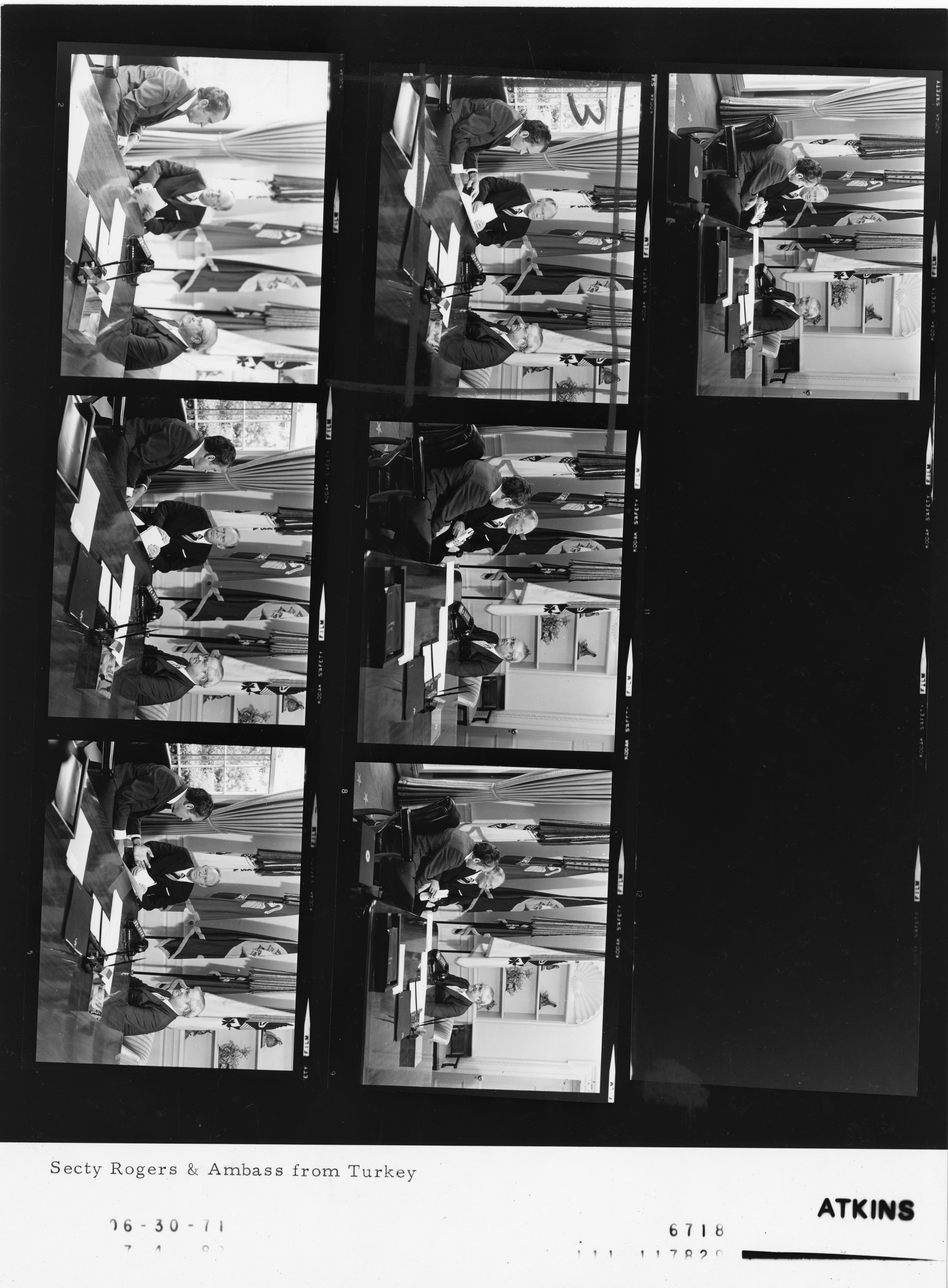
- Frame(s): WHPO-6718-02-10, President Nixon seated at his Oval Office desk during a meeting with Turkish Ambassador Melih Esenbel and Secretary of State William Rogers to discuss the Turkish government's pledge to decrease and eventually eliminate the growing of opium poppies in Turkey. 6/30/1971, Washington, D.C. White House, Oval Office. President Nixon, Melih Esenbel, William Rogers.
- Frame(s): WHPO-6718-05, President Nixon seated at his Oval Office desk during a meeting with Turkish Ambassador Melih Esenbel and Secretary of State William Rogers to discuss the Turkish government's pledge to decrease and eventually eliminate the growing of opium poppies in Turkey. 6/30/1971, Washington, D.C. White House, Oval Office. President Nixon, Melih Esenbel, William Rogers.
Roll WHPO-6719 Photographer: Atkins, Oliver | Color or B&W: B&W
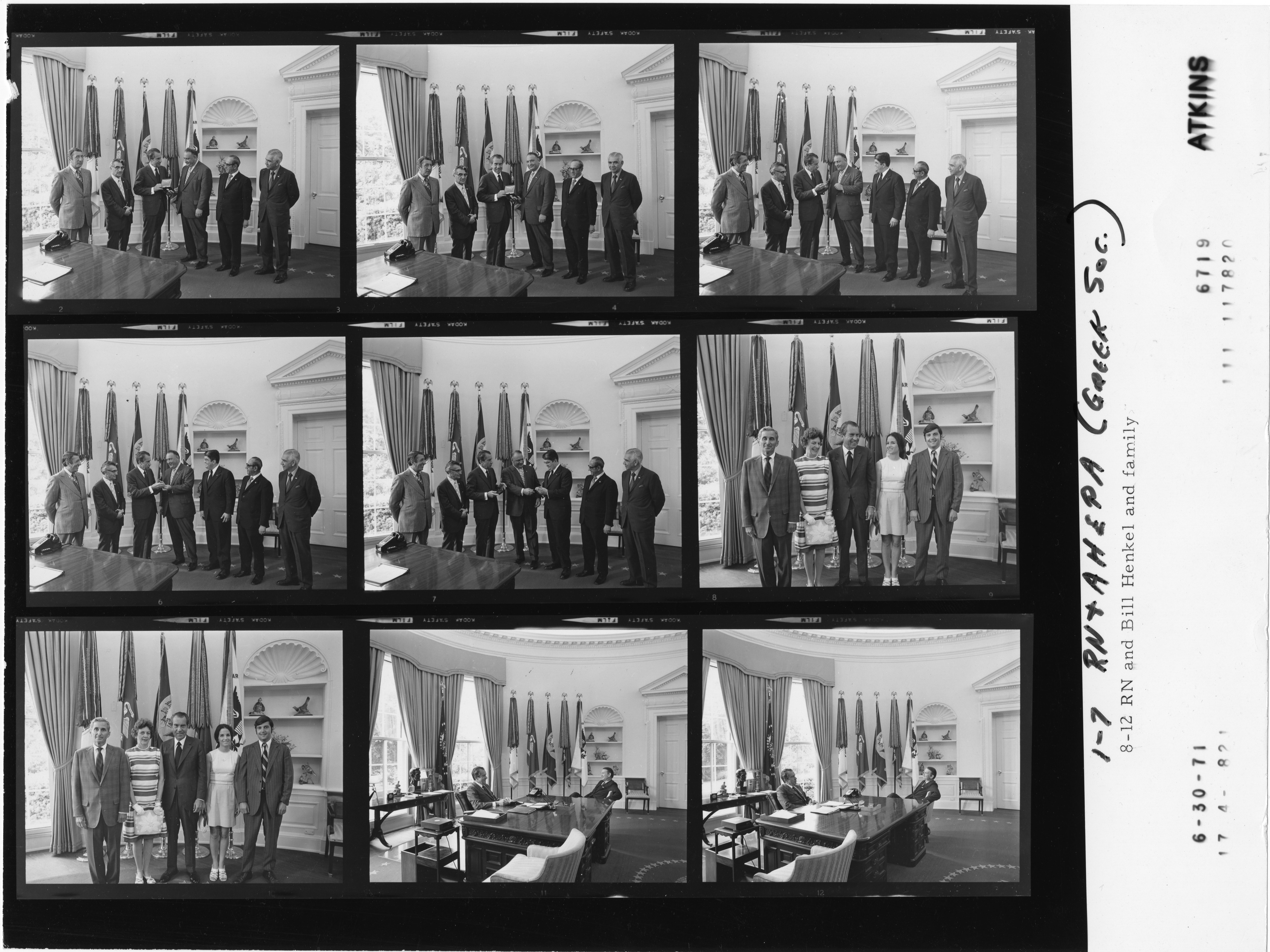
- Frame(s): WHPO-6719-02-07, President Nixon receiving a medal commemorating the 150th anniversary of Greek independence from members of the Order of AHEPA. 6/30/1971, Washington, D.C. White House, Oval Office. President Nixon, Louis Manesiotis, Tom Korologos, Sam Nakis, Michael Spirtos, William Tsaffaras, Peter Derzis.
- Frame(s): WHPO-6719-08-09, President Nixon standing with Henkel family members. 6/30/1971, Washington, D.C. White House, Oval Office. President Nixon, Louis Manesiotis, Tom Korologos, AHEPA members, William Henkel, Sr., Mrs. William Henkel, Sr., William Henkel, Jr., Mrs. William Henkel, Jr., Walter McConaughy.
- Frame(s): WHPO-6719-11-12, President Nixon meeting at his desk with U.S. ambassador to China Walter McConaughy. 6/30/1971, Washington, D.C. White House, Oval Office. President Nixon, Louis Manesiotis, Tom Korologos, AHEPA members, Mr. & Mrs. William Henkel, Sr., Mr. & Mrs. William Henkel, Jr., Walter McConaughy.
Roll WHPO-6720 Photographer: Schumaker, Byron | Color or B&W: B&W
- Frame(s): WHPO-6720-01-05, President Nixon bing greeted by J. Edgar Hoover, and officials. 6/30/1971, Washington, D.C. Department of Labor, Departmental Auditorium. President Nixon, J. Edgar Hoover, John Mitchell, unidentified officials.
- Frame(s): WHPO-6720-06-22, President Nixon addressing the 87th FBI National Academy graduation class. 6/30/1971, Washington, D.C. Department of Labor, Departmental Auditorium. President Nixon, J. Edgar Hoover, John Mitchell, unidentified officials.
Roll WHPO-6721 Photographer: Schumaker, Byron | Color or B&W: B&W
- Frame(s): WHPO-6721-01-03, President Nixon addressing the 87th FBI National Academy graduation class. 6/30/1971, Washington, D.C. Department of Labor, Departmental Auditorium. President Nixon, J. Edgar Hoover, John Mitchell, unidentified officials.
Roll WHPO-6723 Photographer: Knudsen, Robert L. | Color or B&W: Color
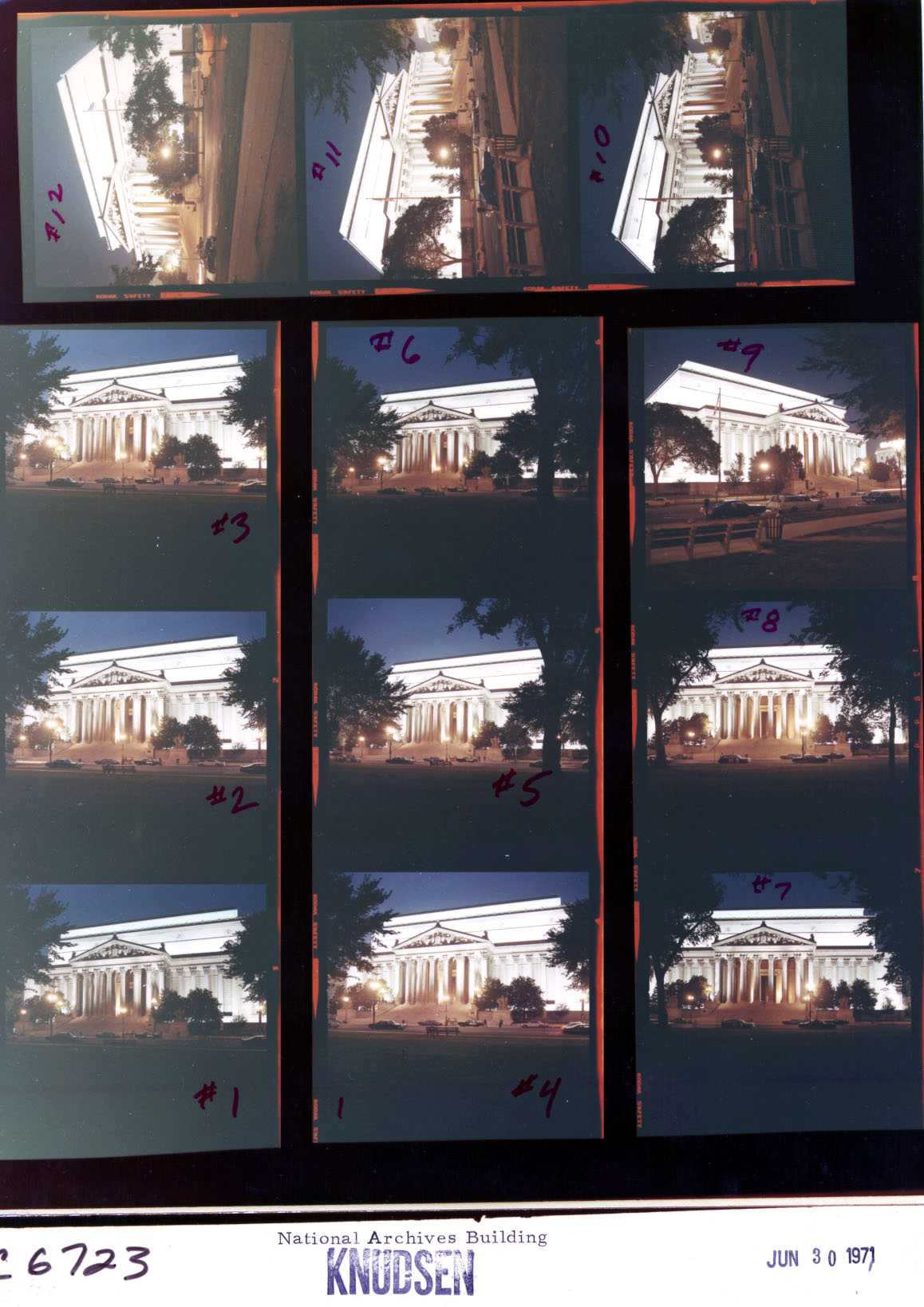
- Frame(s): WHPO-6723-01-12, The National Archives Building. 6/30/1971, Washington, D.C. National Archives Building, exterior.
Roll WHPO-6724 Photographer: Schumaker, Byron | Color or B&W: Color
- Frame(s): WHPO-6724-02-32, Pat Nixon, Rogers Morton, and guests at a Summer in the Park gathering. 6/30/1971, Washington, D.C. White House, South Lawn. Pat Nixon, Rogers Morton, officials, guests.
- Frame(s): WHPO-6724-04, The Nixon family dogs, Pasha, Vicki, and King Timahoe, with a dog handler, possibly Traphes Bryant. 6/30/1971, Washington, D.C. White House, South Lawn. Pasha, Vicki, King Timahoe; unidentified dog handler, possibly Traphes Bryant.
Roll WHPO-6725 Photographer: Schumaker, Byron | Color or B&W: Color
- Frame(s): WHPO-6725-, Pat Nixon, band, and guests at a Summer in the Park gathering. 6/30/1971, Washington, D.C. White House, South Lawn. Pat Nixon, band members, officials, guests.
Roll WHPO-6826 Photographer: Schumacher, Karl | Color or B&W: B&W
- Frame(s): WHPO-6826-02A-05A, Vice President Agnew signing a guest register in Korea. 6/30/1971, Seoul, Korea Blue House. Spiro Agnew, Chung Hee Park, aides.
- Frame(s): WHPO-6826-06A, Vice President Agnew is greeted by President Park upon his arrival in Soeul, Korea. 6/30/1971, Seoul, Korea Blue House. Spiro Agnew, Chung Hee Park, aides.
- Frame(s): WHPO-6826-07A-13A, Vice President Agnew sitting with President Park in Korea. 6/30/1971, Seoul, Korea Blue House. Spiro Agnew, Chung Hee Park, aides.
The White House Communications Agency Sound Recordings Collection contains public statements that took place between 1969 and 1974. Visit the finding aid to learn more.
C - First Lady
- WHCA-SR-C-076
Remarks by Pat Nixon at the Summer in the Parks program on the South Lawn. (6/30/1971, South Lawn, The White House)
Runtime: 0:14
Production credits: Audio feed supplied by WHCA; Recorded by RAS (initials of WHCA engineer)
Original Format: 1/4-inch reel-to-reel audiotape. Original source type: Original.
H - White House Staff Member Recordings
- WHCA-SR-H-409
Press briefing by Ronald Ziegler regarding deaths of Soviet cosmonauts. (6/30/1971, Press Center, White House)
Runtime: 1:30
Keywords: Press conferences, news conferences, interviews, media, press secretary
Production credits: Audio feed supplied by WHCA; Recorded by BAC (initials of WHCA engineer)
Original Format: 1/4-inch reel-to-reel audiotape. Original source type: Original.
I - Various Administration Events
- WHCA-SR-I-086
Ruffls and Flourishes and "Hail to the Chief" by the U.S. Marine Band. (6/30/1971, [None listed])
Runtime: 8:00
Keywords: Music, performance
Production credits: No feed information listed; No WHCA engineer initials listed
Original Format: 1/4-inch reel-to-reel audiotape. Original source type: Original.
P - Formal Presidential Remarks
- WHCA-SR-P-710628
Remarks by President Nixon to press re Turkish Poppy Crop Agreement with Ambassador Esambel, Secretary Rogers. (6/30/1971)
Runtime: 1:15
Original Format: 1/4-inch reel-to-reel audiotape. Original source type: Original. - WHCA-SR-P-710629
Remarks by President Nixon to graduating class of FBI agents with JM, JE Hoover, Joe Casper, George Davis, Jack Montgomery. (6/30/1971)
Runtime: 10:40
Original Format: 1/4-inch reel-to-reel audiotape. Original source type: Original.
The White House Communications Agency Videotape Collection contains “off-the-air” recordings of televised programs produced between 1968 and 1974. Visit the finding aid to learn more.
- WHCA-4486
President Nixon's Visit to Rochester, N.Y. on June 18, 1971.
ALL NETWORKS
Runtime: 01:05:00 - WHCA-4487
"The Dick Cavett Show". John Kerry and John O'Neill debate the wisdom of the U.S. involvement in Vietnam
ALL NETWORKS
Runtime: 01:30:00 - WHCA-4488
"The Supreme Court and The Pentagon Papers".
ALL NETWORKS
Runtime: 00:59:34
Context (External Sources)
The Vanderbilt Television News Archive is the world's most extensive and complete archive of television news. They have been recording, preserving and providing access to television news broadcasts of the national networks since August 5, 1968.
Wikipedia is a free encyclopedia that anyone can edit.