

Introduction
This almanac page for Tuesday, June 29, 1971, pulls together various records created by the federal government and links to additional resources which can provide context about the events of the day.
Previous Date: Monday, June 28, 1971
Next Date: Wednesday, June 30, 1971
Schedule and Public Documents
The Daily Diary files represent a consolidated record of the President's activities. Visit the finding aid to learn more.
The President's day began at The White House - Washington, D. C.
The Weekly Compilation of Presidential Documents made available transcripts of the President's news conferences; messages to Congress; public speeches, remarks, and statements; and other Presidential materials released by the White House.
Digitized versions can be found at HathiTrust.
Each Public Papers of the Presidents volume contains the papers and speeches of the President of the United States that were issued by the White House Office of the Press Secretary during the time period specified by the volume. The material is presented in chronological order, and the dates shown in the headings are the dates of the documents or events. In instances when the release date differs from the date of the document itself, that fact is shown in the text note.
To ensure accuracy, remarks have been checked against audio recordings (when available) and signed documents have been checked against the original, unless otherwise noted. Editors have provided text notes and cross references for purposes of identification or clarity.
- Message to the Senate Transmitting Convention on Psychotropic Substances.
- Message to the Congress Transmitting Annual Report on National Housing Goals.
- Veto of the Accelerated Public Works Bill
- Executive Order 11600—Establishing a Seal for the Office of Management and Budget
- Executive Order 11602—Providing for Administration of the Clean Air Act with Respect to Federal Contracts, Grants, or Loans
- Executive Order 11601—Amending Executive Order No. 11390, Providing for the Delegation of Certain Functions of the President to the Secretary of Defense
The Federal Register is the official daily publication for rules, proposed rules, and notices of federal agencies and organizations, as well as executive orders and other Presidential documents.
The Congressional Record is the official daily record of the debates and proceedings of the U.S. Congress.
Archival Holdings
Any selection of archival documents will necessarily be partial. You should use the documents and folders identified below as a starting place, but consult the linked collection finding aids and folder title lists and the collections themselves for context. Many documents to be found this way do not lend themselves to association with specific dates, but are essential to a complete understanding of the material.
Selective document listing
President's Office Files
The President's Office Files consists of materials drawn together by the Special Files Unit from several administrative subdivisions within the White House Office. It is the handwriting and sensitive papers sent to the Staff Secretary that now comprise much of the President's Office Files. Visit the finding aid to learn more.
- Annotated News Summaries, Box 30, News Summaries - June 1971 [1 of 2]
- Annotated News Summaries, Box 30, News Summaries - June 1971 [2 of 2] [During this period, the Staff Secretary only removed pages from the News Summaries which contained President Nixon's handwriting, often leaving the document with no date. Although there are no specific documents with this date, you should also consult the full folder for the month.]
The H. R. Haldeman Diaries consists of seven handwritten diaries, 36 dictated diaries recorded as sound recordings, and two handwritten audio cassette tape subject logs. The diaries and logs reflect H. R. Haldeman’s candid personal record and reflections on events, issues, and people encountered during his service in the Nixon White House. As administrative assistant to the President and Chief of Staff, Haldeman attended and participated in public events and private meetings covering the entire scope of issues in which the Nixon White House engaged in during the years 1969-1973. Visit the finding aid to learn more.
- Transcript of diary entry (PDF)
Tuesday, June 29.
Today started with the 8:00 Cabinet meeting at which the President delivered his blast to the Cabinet along the same lines that he had done with the economic group yesterday. He was in for a half an hour, which was the total length of the meeting, and the President did all the talking. Walked in, started it, delivered his pitch, got up and walked out. He opened with the point that this was probably the most important Cabinet meeting this year, and perhaps through next year. He had only the Cabinet members present, with a couple of Under Secretaries sitting in for those who were absent, and I was the only staff member present.
He started by talking about the controversy on the Pentagon Papers and said if we are going to have order in government, there must be a process for making decisions, so we can get the best possible advice, without being compromised by it being publicized. We are not talking about history, we're talking about now. Down in the government are a bunch of sons of bitches. Some of those that you've appointed may well-- be well-intentioned sons of bitches, but there's still a problem. There are some in the Civil Service who are dedicated, but many who sit in the meetings and debriefings, and so forth are out to get us. This is true of all Administrations, but it's worse now, and it's strange because I've been much more permissive than any other President. We have yet to fire one of these people.
From now on, Haldeman is the Lord High Executioner. Don't you come whining to me when he tells you to do something. He will do it because I asked him to, and you're to carry it out. The President must have the best possible advice with the bark off, but he must not see it in the newspapers, and that isn't going to happen anymore. We've checked and found that 96 percent of the bureaucracy are against us; they're bastards who are here to screw us. We don't need to be concerned about the so-called “open Administration.” We're plenty open, like a sieve, everything gets out. Every day we see that one Department is fighting another. Justice versus Treasury, and so on. Of course they are, and they always will be, but they cannot be doing it in the press. The President will make the decisions, such as appointments to various posts. I'll make them. I'm not referring to you here, but to the people in your woodwork.
You've got to realize the press aren't interested in liking you; they're only interested in news or in screwing me. So don't fall for the line that they want something just for their guidance and background, and so on. They're going to screw you with it. Regarding Presidential decisions, appointments and otherwise, I want discipline. It's up to Haldeman to police it. We have ways to do it that will be extremely effective. When he calls, I want action. Unless we act effectively on the leaks now, it will be too late later next year. In the economic field, this is a very difficult subject. The economists don't know what to do. For example, Arthur Burns has changed his mind over and over. He has memos in on all different positions. Unfortunately, he said each of them publicly before he sent the memo to the President. There are many different views now regarding the economy, taxes, and so on. A lot of papers have been presented for the historical record and it's fine for everyone to do that, but the outcome depends on success or failure.
From the advisor's viewpoint, if he's wrong and we succeed, it'll be forgotten, and nobody’ll-- the President will never reveal the fact that he had given the wrong advice. If the advice is right and we fail, it'll still come out that he advised the right thing, and he can be a hero while we fall. So the advisor has the luxury of winning both ways. The President doesn't have that choice. He's the only one in this room who has to run for office.
Regarding the economy, I've made the decision; it'll be announced by Connally today-- he's our economic spokesman. You're free to express your views only when you support the President, but the whole damn thing on the economy has already been in the papers, and thus it affects the decisions. So we've created the impression on this thing and on other things, not that we're wrong or that we're right, but that we're not sure. So what does the businessman do? He decides to wait and see what we're going to do. There's only one thing worse than being wrong, and that's in not being sure. So we're stopping that crap today. The first time there's a leak out of this Administration regarding an inside debate, we're going to crack down on the people at the top or at the second level, and they're going to go; so start looking for the scapegoat. You're all on the top, and each of you have a few loyal lieutenants, but beneath you, you have a whole department full of vipers, and they'll strike because they want to beat us, especially next year. For example: Goldstein at the Bureau of Labor and Statistics, a left-wing radical who hates us. So the Secretary of Labor now gives the policy and political interpretations. Don't worry about not being an open Administration. Civil servants weren't appointed to represent us.
Regarding the economy, we can't stop the situation with the Fed. Burns can say what he pleases. I hope he'll see the wisdom someday of being helpful and restrained in what he says, or he can be independent. Period. Our decisions are: there will be no wage-price controls, no wage-price board. We will call in the steel people and raise hell on both prices and wages, on specifics. We are going ahead with the depreciation allowance, but there will be no increase in exemptions, no investment tax credit. There's no point in these, because we can't get them through Congress anyway, and that would just show the impotence of the Presidency. Many of you have been on one side or the other of these, or both sides. I believe we're on the right track, but there must be confidence that we know what we're doing and that we have confidence in what we're doing.
Haldeman will be telling the White House staff all of this, right down to the pip-squeaks. We've got a lot of little people who love to be heroes. Ellsberg has gone out and said he's not guilty because, what he did, he did for the sake of the country. Hiss and the Rosenbergs and those people all said the same thing. Its irrelevant which side Ellsberg is on; we can't have the decision made regarding what is to be released, made by someone who doesn't have the responsibility. This ruins an orderly government. I get a lot of advice on PR and personality and how I've got to put on my nice-guy hat and dance at the White House, so I did it, but let me make it clear that's not my nature. We're going to go forward on Ellsberg and prosecute him.
The success or failure of the Administration depends on discipline: absolute frankness on advice around the table here, and I'll take the responsibility so don't hesitate; don't worry that you'll look bad, I won't tell. You'll make the record if you look good. We want a strong, hard line regarding the decisions before they’re made, or we can't govern, especially regarding the budget which will be tough. Put the blame on the President, he said no, that you can't tell the press anything until it's decided. The President has the right to advice without pressure, especially pressure by leaks to bring press pressure. I want you to make this same talk to your subordinates. Haldeman has the worst job that anybody can have in the White House. I remember poor old Bedell Smith, who had to carry out a lot of tough decisions for Eisenhower. In his later years he started to drink a lot, probably to try and forget the things he had to do in his early years. He was at my house one night, and he started to cry and he said, ''All my life I've just been Ike's prat boy, doing his dirty work." Well, Haldeman is my prat boy; he'll be down the throat of anyone here regarding leaks if they affect the national interest. When he talks, it's me talking, and don't think it'll do you any good to come and talk to me, because I'll be tougher than he is. That's the way it's going to be.
Then he just got up and walked out, that was the end of the meeting. It was pretty impressive, for all of them. I walked out right after he did, but picked up some talk later in the day, and they seemed to be very much impressed, so I think it had its effect.
We had some discussions later in the day on various odds and ends, particularly with Pete Peterson who wants to bring Dick Allen in as his Deputy, where the President wanted to use Dick Allen to handle the declassification project He decided to let Pete go ahead on Allen, however. During the discussion, the President made the comment to Peterson that you find after you've been in Washington for a while you start thinking about doing something else, that O'Neill's comment was certainly true: you can never go home again.
Tonight was the farewell dinner for Red Blount. He had all the Cabinet and Under Secretaries and top White House staff and a few of the key Agency heads. It was a nice party. President did a good job of praising Blount and the whole postal reform concept.
End of June 29. - Original audio recording (MP3)
The National Archives Catalog is the online portal to the records held at the National Archives, and information about those records. It is the main way of describing our holdings and also provides access to electronic records and digitized versions of our holdings.
The Catalog searches across multiple National Archives resources at once, including archival descriptions, digitized and electronic records, authority records, and web pages from Archives.gov and the Presidential Libraries. The Catalog also allows users to contribute to digitized historical records through tagging and transcription.
Nixon Library Holdings
All National Archives Units
National Security Documents
The President's Daily Brief is the primary vehicle for summarizing the day-to-day sensitive intelligence and analysis, as well as late-breaking reports, for the White House on current and future national security issues. Read "The President's Daily Brief: Delivering Intelligence to Nixon and Ford" to learn more.
The Foreign Relations of the United States series presents the official documentary historical record of major U.S. foreign policy decisions and significant diplomatic activity. Visit the State Department website for more information.
Vol. I, Foundations of Foreign Policy, 1969-1972
Foundations of Foreign Policy, 1969-1972
91. Memorandum for the President’s File by the President’s Special Assistant (Safire), Washington, June 29, 1971
Source: National Archives, Nixon Presidential Materials, White House Special Files, President’s Office Files, Memoranda for the President, Box 85, May 2-August 15, 1971. No classification marking. The memorandum is Safire’s record of the President’s comments before a meeting of the President’s Commission on Productivity, which met between 10:07 and 10:47 a.m. in the Cabinet Room of the White House. (Ibid., White House Central Files, Staff Members and Office Files, Office of Presidential Papers and Archives, Daily Diary)
Vol. II, Organization and Management of U.S. Foreign Policy, 1969-1972
The NSC System
157. Memorandum From the Assistant Secretary of Defense for International Security Affairs (Nutter) to the Deputy Secretary of Defense (Packard), Washington, June 29, 1971
Source: Washington National Records Center, RG 330 OASD/ISA Files: FRC 330 74 040, NSC June 1971. Confidential.
Vol. V, United Nations, 1969-1972
Secretary-General Succession
220. Telegram From the Mission to the United Nations to the Department of State, New York, June 29, 1971, 2238Z
Source: National Archives, RG 59, Central Files 1970–73, UN 8–3. Confidential. Repeated to Addis Ababa.
Vol. VII, Vietnam, July 1970-January 1972
The Consequences of Operation Lan Som 719 and the Search for a Settlement, April 8-October 6, 1971
224. Memorandum From the President’s Assistant for National Security Affairs (Kissinger) to President Nixon, Washington, June 29, 1971
Source: National Archives, Nixon Presidential Materials, NSC Files, Box 512, Country Files, Far East, Cambodia, Vol. XIII. Top. Secret. Sent for action. A stamped notation on the memorandum reads, “The President has seen.”
Vol. XI, South Asia Crisis, 1971
South Asia Crisis, 1971
83. Transcript of Telephone Conversation Between the Presidentʼs Assistant for National Security Affairs (Kissinger) and the Assistant Secretary of State for Near Eastern and South Asian Affairs (Sisco), Washington, June 29, 1971, 10:40 a.m.
Source: Library of Congress, Manuscript Division, Kissinger Papers, Box 368, Telephone Conversations, Chronological File. No classification marking.
Vol. XIII, Soviet Union, October 1970-October 1971
"One of Two Routes": Soviet-American Relations and Kissinger's Secret Trip to China, April 23-July 18, 1971
267. Conversation Between President Nixon and the President’s Assistant for National Security Affairs (Kissinger), Washington, June 29, 1971
Source: National Archives, Nixon Presidential Materials, White House Tapes, Conversation 531–27. No classification marking. The editors transcribed the portions of the tape recording printed here specifically for this volume. According to the President’s Daily Diary, Nixon met Kissinger in the Oval Office from 4:21 to 4:31 p.m. (Ibid., White House Central Files)
268. Conversation Between President Nixon and the President’s Assistant for National Security Affairs (Kissinger), Washington, June 29, 1971
Source: National Archives, Nixon Presidential Materials, White House Tapes, Conversation 531–31. No classification marking. The editors transcribed the portion of the tape recording printed here specifically for this volume. According to the President’s Daily Diary, Nixon met Kissinger and Haig in the Oval Office at 6:29 p.m. Haig left at 6:54, and Nixon and Kissinger continued to talk until 7; the transcript printed here covers this conversation. (Ibid., White House Central Files)
Vol. XXIX, Eastern Europe, 1969-1972
Hungary
118. Telegram From the Embassy in Hungary to the Department of State, Budapest, June 29, 1971, 1225Z
Source: National Archives, Nixon Presidential Materials, NSC Files, Box 693, Country Files, Europe, Hungary, Vol. I. Secret; Priority; Exdis. Repeated priority to Rome.
Vol. XL, Germany and Berlin, 1969-1972
Germany and Berlin, 1969-1972
263. Message From the Ambassador to Germany (Rush) to the President’s Assistant for National Security Affairs (Kissinger), Bonn, June 29, 1971
Source: National Archives, Nixon Presidential Materials, NSC Files, Kissinger Office Files, Box 59, Country Files, Europe, Ambassador Rush, Berlin, Vol. 1. Top Secret; Sensitive; Exclusively Eyes Only. A copy was sent to Haig. The message was sent through the special Navy channel in Frankfurt. No time of transmission appears on the message; a handwritten note indicates that it was received in Washington at 2218Z. Attached to the message but not printed is the text of a partial draft agreement, consisting of formulations for parts I and II and Annex I.
Vol. XLI, Western Europe; NATO, 1969-1972
Malta
228. Telegram From the Department of State to the Embassy in Malta, Washington, June 29, 1971, 0421Z
Source: National Archives, Nixon Presidential Materials, NSC Files, Box 622, Country Files—Middle East, Malta, Vol. I. Confidential. Drafted by R.T. Burns (EUR/BMI); cleared by Johnson and the Joint Chiefs of Staff and in PM/ISO, EUR/RPM, S/S-O, and OSD/ISA; and approved by Hillenbrand.
Vol. E-1, Documents on Global Issues, 1969-1972
Oceans Policy
401. Memorandum From John Hedley of the Office of the Deputy Director for Intelligence, Central Intelligence Agency to Jeanne Davis of the National Security Council Staff, Washington, June 29, 1971
Hedley noted that certain options suggested in NSSM 125 might prove counterproductive and suggested considering long-range changes in technology when calculating national defense requirements.
Source: National Archives, Nixon Presidential Materials, NSC Files, NSC Institutional Files (H-Files), Box H-55, SRG Meeting, Oceans Policy (NSSM 125), 7/12/71 [1 of 2]. Top Secret. John H. Hedley was a member of the Office of the Deputy Director for Intelligence.
Vol. E-10, Documents on American Republics, 1969-1972
Bolivia
104. Memorandum for the 40 Committee, Washington, June 29, 1971., Washington, June 29, 1971
This 7 page memorandum proposed a covert action program to aid the moderate political opposition to the Torres regime.
Source: Department of State, INR/IL Historical Files, Box 19, File Bolivia, 1973–1980. Secret; Sensitive; Eyes Only. Sent to Meyer, Crimmins, and Fischer on July 6. The covert assistance plan is discussed in Document 105.
The Kissinger telephone conversation transcripts consist of approximately 20,000 pages of transcripts of Kissinger’s telephone conversations during his tenure as Assistant to the President for National Security Affairs (1969-1974) and Secretary of State (1973-1974) during the administration of President Richard Nixon. Visit the finding aid for more information.
Digitized versions can be found in the National Archives Catalog.
Audiovisual Holdings
The White House Tapes are sound recordings of President Richard Nixon's telephone conversations and of meetings held in the Oval Office and the Cabinet Room in the White House, the President's office in the Old Executive Office Building (OEOB), the Lincoln Sitting Room in the residence section of the White House, and several locations at the Presidential retreat at Camp David, Maryland. These recordings document many of the major events and decisions of the Nixon Administration from February 16, 1971 to July 18, 1973. Visit the White House Tapes finding aid to learn about the taping system's operation and archival processing.
Cabinet Room
- 63-3; Unknown between 8:05 a.m. & 10:07 a.m.; Nixon, Richard M. (President); Cabinet officers; Rogers, William P.; Connally, John B.; Laird, Melvin R.; Mitchell, John N.; Morton, Rogers C. B.; Stans, Maurice H.; Hodgson, James D.; Veneman, John G.; Van Dusen, Richard C.; Volpe, John A.; Shultz, George P.; Bush, George H. W.
- 63-4; Unknown between 10:07 a.m. & 2:50 p.m.; Nixon, Richard M. (President); National Commission on Productivity; Rosow, Jerome M.; Branch, Harllee, Jr.; Carter, Edward W.; Roche, James M.; Wriston, Walter B.; O'Connell, John; Shaver, J. Warren; Lohrentz, W. L.; Atkinson, Robert; Lundin, Oscar A.; Abel, I[lorwith] W.; Beirne, Joseph A.; Meany, George; Smith, Floyd E. ("Red"); Woodcock, Leonard; Weinberg, Nat; Goldfinger, Nathaniel; Newell, Reginald; Coleman, William T., Jr.; Dunlop, John T.; Johnson, Howard W.; Miller, Arjay; Wallis, W. Allen; Connally, John B.; Hodgson, James D.; McCracken, Paul W.; Stans, Maurice H.; David, Edward E., Jr. (Dr.); Greenberg, Leon; Heffner, Hubert (Dr.); Kohlberg, William H.; Passer, Harold C.; Wool, Harold; Savit, Carl; Weidenbaum, Murray L.; Shultz, George P.; White House photographer
- 63-5; Unknown between 2:50 p.m. & 11:59 p.m.; Nixon, Richard M. (President); National Commission on Productivity; Shultz, George P.; Rosow, Jerome M.; Branch, Harllee, Jr.; Carter, Edward W.; Roche, James M.; Wriston, Walter B.; O'Connell, John; Shaver, J. Warren; Lohrentz, W. L.; Atkinson, Robert; Lundin, Oscar A.; Abel, I[lorwith] W.; Beirne, Joseph A.; Meany, George; Smith, Floyd E. ("Red"); Woodcock, Leonard; Weinberg, Nat; Goldfinger, Nathaniel; Newell, Reginald; Coleman, William T., Jr.; Dunlop, John T.; Johnson, Howard W.; Miller, Arjay; Wallis, W. Allen; Miller, Arjay; Hodgson, James D.; McCracken, Paul W.; Stans, Maurice H.; David, Edward E., Jr. (Dr.); Greenberg, Leon; Heffner, Hubert (Dr.); Kohlberg, William H.; Passer, Harold C.; Wool, Harold; Weidenbaum, Murray L.; Savit, Carl
Old Executive Office Building
- 261-25; Unknown between 11:27 a.m. & 2:28 p.m.; Nixon, Richard M. (President); White House operator
- 261-26; 2:28 p.m. - 2:32 p.m.; Nixon, Richard M. (President); Colson, Charles W.
Oval Office
- 530-1; Unknown between 7:59 a.m. & 8:03 a.m.; Nixon, Richard M. (President); Bull, Stephen B.
- 530-2; Unknown between 8:32 a.m. & 8:42 a.m.; Nixon, Richard M. (President); White House operator
- 530-3; Unknown between 8:32 a.m. & 10:07 a.m.; Nixon, Richard M. (President); Haldeman, H. R. ("Bob"); Buchanan, Patrick J.; White House operator; O'Konski, Alvin E.; Sanchez, Manolo; Woods, Rose Mary; Bull, Stephen B.; Connally, John B.; Ziegler, Ronald L.; Shultz, George P.
- 530-4; Unknown between 10:47 a.m. & 10:57 a.m.; Nixon, Richard M. (President); Ziegler, Ronald L.; Sanchez, Manolo
- 530-5; Unknown between 10:47 a.m. & 10:57 a.m.; Nixon, Richard M. (President); [Unknown person(s)]
- 530-6; 10:57 a.m. - 11:06 a.m.; Nixon, Richard M. (President); Haldeman, H. R. ("Bob"); Bull, Stephen B.
- 530-7; 11:22 a.m. - 11:22 a.m.; Nixon, Richard M. (President); Ehrlichman, John D.; White House operator
- 530-8; 11:22 a.m. - 11:27 a.m.; Nixon, Richard M. (President); Mitchell, John N.
- 530-9; Unknown between 11:27 a.m. & 11:30 a.m.; Nixon, Richard M. (President); [Unknown person(s)]
- 530-10; 11:30 a.m. - 12:01 p.m.; Nixon, Richard M. (President); Peterson, Peter G.; Bull, Stephen B.
- 530-11; 12:03 p.m. - 12:11 p.m.; Nixon, Richard M. (President); Gualtier, Fred; DeLuca, Frank; Williams, Carnen; Bell, George T.; White House photographer
- 530-12; 12:11 p.m. - 12:42 p.m.; Nixon, Richard M. (President); Haldeman, H. R. ("Bob"); Peterson, Peter G.; Butterfield, Alexander P.
- 530-13; 12:42 p.m. - 12:44 p.m.; Nixon, Richard M. (President); Butterfield, Alexander P.
- 530-14; 12:44 p.m. - 12:46 p.m.; Nixon, Richard M. (President); Bull, Stephen B.; Mason, Frank (Mrs.); Bull, Pam; White House photographer
- 530-15; 12:46 p.m. - 1:11 p.m.; Nixon, Richard M. (President); Haldeman, H. R. ("Bob"); [Unknown person(s)]
- 531-25; 12:46 p.m. - 1:11 p.m.; Nixon, Richard M. (President); Haldeman, H. R. ("Bob")
- 531-26; 4:18 p.m. - 4:21 p.m.; Nixon, Richard M. (President); Butterfield, Alexander P.
- 531-27; 4:21 p.m. - 4:31 p.m.; Nixon, Richard M. (President); Kissinger, Henry A.
- 531-28; 4:32 p.m. - 5:50 p.m.; Nixon, Richard M. (President); Haldeman, H. R. ("Bob"); Sanchez, Manolo; White House operator; Haig, Alexander M., Jr.; Bull, Stephen B.; Ehrlichman, John D.; MacGregor, Clark; Malek, Frederic V.; Higby, Lawrence M.; Swann, Mary; Mitchell, John N.
- 531-29; 5:50 p.m. - 6:29 p.m.; Nixon, Richard M. (President); Hodgson, James D.; Shultz, George P.; Sanchez, Manolo; [Unknown person(s)]; Bull, Stephen B.
- 531-30; 6:29 p.m. - 6:30 p.m.; Nixon, Richard M. (President); Butterfield, Alexander P.
- 531-31; 6:30 p.m. - 7:00 p.m.; Nixon, Richard M. (President); Kissinger, Henry A.; Haig, Alexander M., Jr.; Hébert, F. Edward
- 531-32; Unknown between 1:11 p.m. & 4:18 p.m.; Bull, Stephen B.; [Unknown person(s)]
White House Telephone
- 6-12; Unknown between 8:32 a.m. & 8:42 a.m.; Nixon, Richard M. (President); White House operator
- 6-13; 8:42 a.m. - 8:44 a.m.; Nixon, Richard M. (President); Buchanan, Patrick J.
- 6-14; 8:45 a.m. - 8:45 a.m.; Nixon, Richard M. (President); White House operator
- 6-15; 8:46 a.m. - 8:47 a.m.; Nixon, Richard M. (President); Buchanan, Patrick J.
- 6-16; Unknown between 8:47 a.m. & 9:03 a.m.; Nixon, Richard M. (President); White House operator
- 6-17; 9:03 a.m. - 9:06 a.m.; Nixon, Richard M. (President); Oäó»Kinski, Alvin E.
- 6-18; 9:07 a.m. - 9:07 a.m.; Nixon, Richard M. (President); White House operator
- 6-19; 9:08 a.m. - 9:09 a.m.; Nixon, Richard M. (President); Woods, Rose Mary; [Unknown person(s)]
- 6-20; 11:22 a.m. - 11:22 a.m.; Nixon, Richard M. (President); White House operator
- 6-21; 11:22 a.m. - 11:27 a.m.; Nixon, Richard M. (President); Mitchell, John N.
- 6-22; Unknown between 11:27 a.m. & 2:28 p.m.; Nixon, Richard M. (President); White House operator
- 6-23; 2:28 p.m. - 2:32 p.m.; Nixon, Richard M. (President); Colson, Charles W.; Haldeman, H. R. ("Bob")
- 6-24; Unknown between 2:32 p.m. & 5:03 p.m.; Nixon, Richard M. (President); White House operator
- 6-25; Unknown between 4:32 p.m. & 5:03 p.m.; Nixon, Richard M. (President); White House operator
- 6-26; 5:03 p.m. - 5:06 p.m.; Nixon, Richard M. (President); Haig, Alexander M., Jr.
- 6-27; Unknown between 5:06 p.m. & 5:35 p.m.; Haldeman, H. R. ("Bob"); White House operator
- 6-28; Unknown between 5:06 p.m. & 5:35 p.m.; Haldeman, H. R. ("Bob"); MacGregor, Clark
- 6-29; Unknown between 5:06 p.m. & 5:35 p.m.; Haldeman, H. R. ("Bob"); White House operator
- 6-30; Unknown between 5:06 p.m. & 5:35 p.m.; Haldeman, H. R. ("Bob"); Malek, Frederic V.
- 6-31; Unknown between 5:06 p.m. & 5:35 p.m.; Nixon, Richard M. (President); White House operator
- 6-32; 5:35 p.m. - 5:39 p.m.; Nixon, Richard M. (President); MacGregor, Clark
- 6-33; Unknown between 5:39 p.m. & 5:44 p.m.; Nixon, Richard M. (President); White House operator
- 6-34; 5:44 p.m. - 5:45 p.m.; Nixon, Richard M. (President); Swann, Mary
- 6-35; 5:45 p.m. - 5:45 p.m.; Nixon, Richard M. (President); White House operator
- 6-36; 5:46 p.m. - 5:50 p.m.; Nixon, Richard M. (President); Mitchell, John N.; Haldeman, H. R. ("Bob")
- 6-37; 6:30 p.m. - 6:36 p.m.; Nixon, Richard M. (President); Hébert, F. Edward
The White House Photo Office collection consists of photographic coverage of President Richard Nixon meeting with prominent social, political, and cultural personalities; speaking engagements and news conferences of the President and various high-ranking members of the White House staff and Cabinet; Presidential domestic and foreign travel, including Presidential vacations; social events and entertainment involving the First Family, including entertainers present; official portraits of the President, First Family, and high-ranking members of the Nixon administration; the 1969 and 1973 Inaugurals; the President’s 1972 Presidential election campaign appearances (including speeches) and other official activities of the White House staff and the President’s Cabinet from January 20, 1969 until August 9, 1974 at the White House and the Old Executive Office Building; other locations in Washington, DC, such as The Mall; and the Presidential retreats in Camp David, Maryland, Key Biscayne, Florida, and San Clemente, California. Visit the finding aid to learn more.
Roll WHPO-6708 Photographer: Atkins, Oliver | Color or B&W: B&W
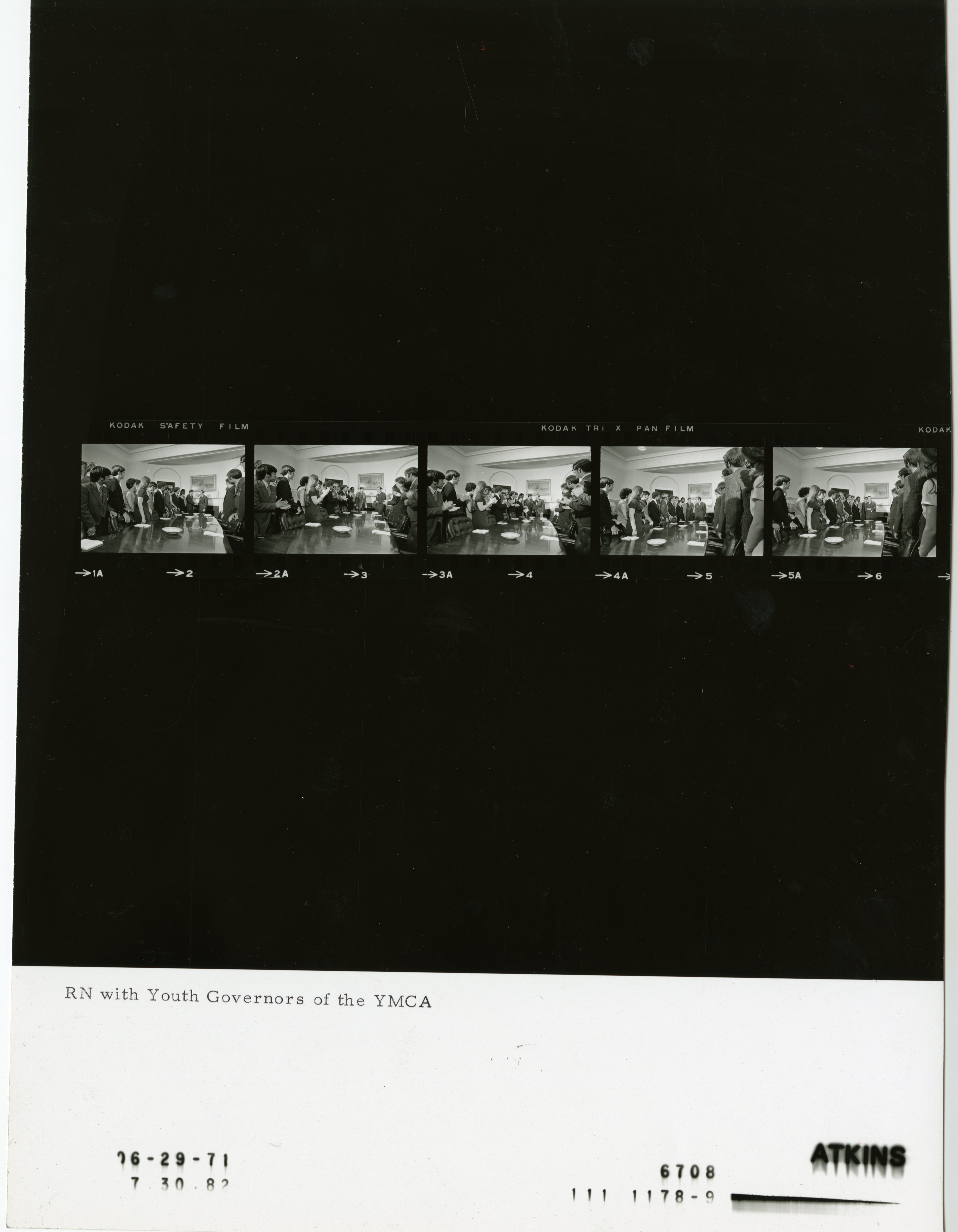
- Frame(s): WHPO-6708-01A-05A, President Nixon meeting with delegates and sponsors to the National YMCA Youth Governors Conference. 6/29/1971, Washington, D.C. White House, Roosevelt Room. President Nixon, YMCA conference attendees, unidentified persons.
- Frame(s): WHPO-6708-02, President Nixon meeting with delegates and sponsors to the National YMCA Youth Governors Conference. 6/29/1971, Washington, D.C. White House, Roosevelt Room. President Nixon, YMCA conference attendees, unidentified persons.
Roll WHPO-6709 Photographer: Atkins, Oliver | Color or B&W: B&W
- Frame(s): WHPO-6709-02-03, President Nixon with Steve Bull and Bull family members. 6/29/1971, Washington, D.C. White House, Roosevelt Room. President Nixon, Steve Bull, Mrs. Steve Bull, Mrs. Frank Mason.
Roll WHPO-6710 Photographer: Schumaker, Byron | Color or B&W: B&W
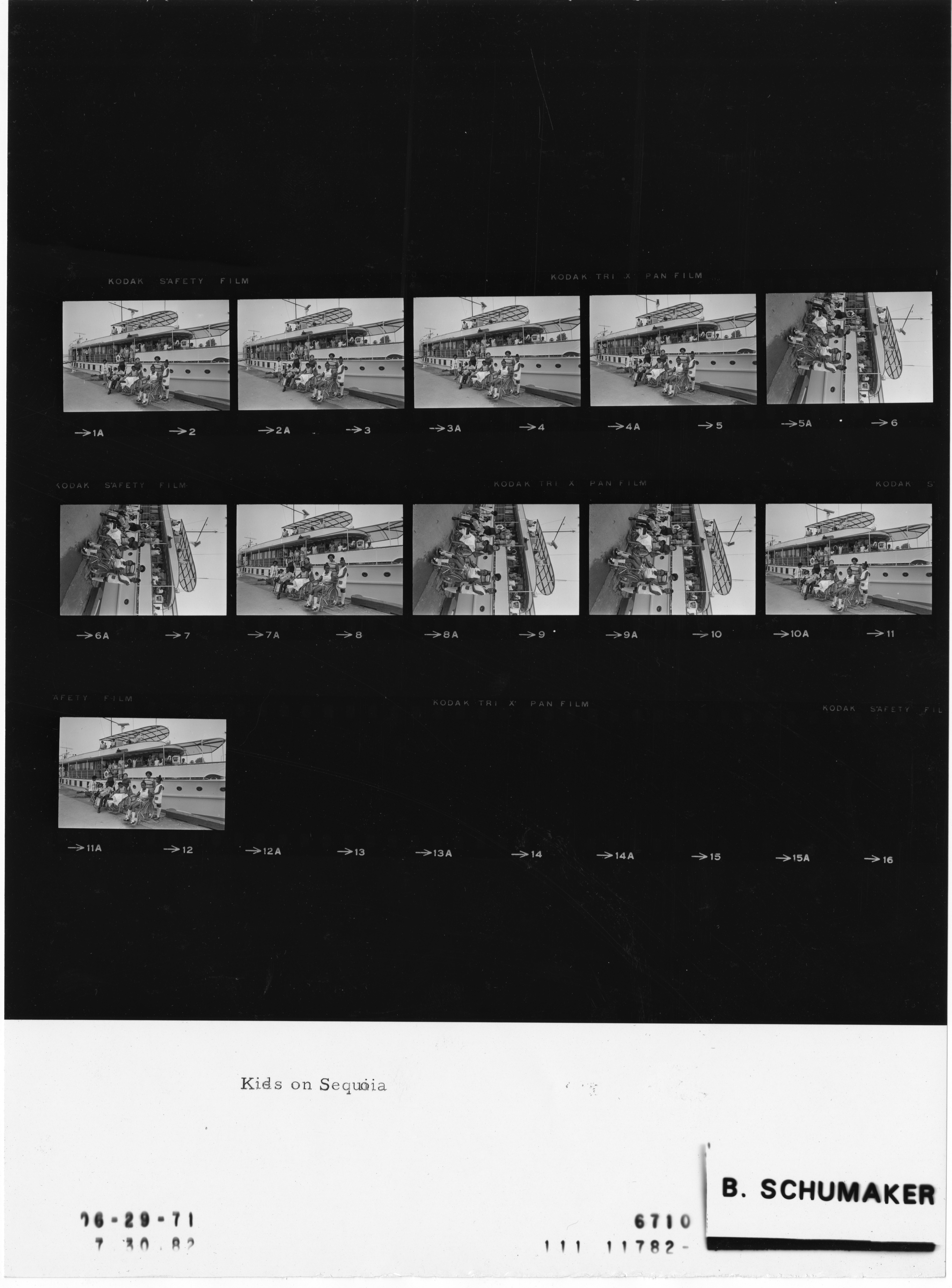
- Frame(s): WHPO-6710-01A-11A, Children and adults in front of the Presidential Yacht Sequoia. 6/29/1971, Washington, D.C. Navy Yard, Pier 1. unidentified children, persons.
- Frame(s): WHPO-6710-01A-11A, Children and adults on board the Presidential Yacht Sequoia. 6/29/1971, Washington, D.C. Navy Yard, Pier 1. unidentified children, persons.
Roll WHPO-6711 Photographer: Schumaker, Byron | Color or B&W: B&W
- Frame(s): WHPO-6711-03-04, President Nixon meeting with the National Commission on Productivity. 6/29/1971, Washington, D.C. White House, Cabinet Room. President Nixon, meeting participants.
Roll WHPO-6712 Photographer: Schumaker, Byron | Color or B&W: Color
- Frame(s): WHPO-6712-01A-17A, Pat Nixon receiving the Grand Cross of the Order of the Sun medal from Ambassador from Peru Fernando Berckemeyer in the company of Peruvian First Lady Consuelo de Velasco. The Order of the Sun is the highest and historically oldest medal of merit Peru bestows for military or civil merit. 6/29/1971, Washington, D.C. Embassy of Peru. Pat Nixon, Consuelo Gonzáles Arriola de Velasco, Fernando Berckemeyer, Peruvian officials, guests.
- Frame(s): WHPO-6712-07A, Pat Nixon hugging Peruvian First Lady Consuelo de Velasco after receiving the Grand Cross of the Order of the Sun medal from Ambassador from Peru Fernando Berckemeyer. The Order of the Sun is the highest and historically oldest medal of merit Peru bestows for military or civil merit. 6/29/1971, Washington, D.C. Embassy of Peru. Pat Nixon, Consuelo Gonzáles Arriola de Velasco, Fernando Berckemeyer, Peruvian officials, guests.
- Frame(s): WHPO-6712-12A, Pat Nixon speaking at the microphone after receiving the Grand Cross of the Order of the Sun medal from Ambassador from Peru Fernando Berckemeyer in the company of Peruvian First Lady Consuelo de Velasco. The Order of the Sun is the highest and historically oldest medal of merit Peru bestows for military or civil merit. 6/29/1971, Washington, D.C. Embassy of Peru. Pat Nixon, Consuelo Gonzáles Arriola de Velasco, Fernando Berckemeyer, Peruvian officials, guests.
- Frame(s): WHPO-6712-18A-32A, Pat Nixon greeting guests after receiving the Grand Cross of the Order of the Sun medal. 6/29/1971, Washington, D.C. Embassy of Peru. Pat Nixon, Peruvian officials, guests.
Roll WHPO-6713 Photographer: Schumaker, Byron | Color or B&W: Color
- Frame(s): WHPO-6713-01-08, Pat Nixon receiving the Grand Cross of the Order of the Sun, from the Ambassador of Peru, in the company of Peruvian First Lady Consuelo Velasco. The Order is the highest and oldest medal of merit Peru bestows for military or civil merit. 6/29/1971, Washington, D.C. Embassy of Peru. Pat Nixon, Peruvian officials, guests.
Roll WHPO-6714 Photographer: Knudsen, Robert L. | Color or B&W: B&W
- Frame(s): WHPO-6714-01A-27A, Close-up portrait study of John McLaughlin. 6/29/1971, Washington, D.C. unknown. John McLaughlin.
Roll WHPO-6715 Photographer: Schumaker, Byron | Color or B&W: B&W
- Frame(s): WHPO-6715-01-05, Portrait of Paul McCracken and members of the Council of Economic Advisers. 6/29/1971, Washington, D.C. Executive Office Building. Paul McCracken, Council of Economic Advisers members.
Roll WHPO-6716 Photographer: Knudsen, Robert L. | Color or B&W: Color
- Frame(s): WHPO-6716-03-09, Table settings for a dinner in honor of Postmaster General Winton Blount. 6/29/1971, Washington, D.C. White House, State Dining Room. choral group members, unidentified individuals.
- Frame(s): WHPO-6716-10-12, Portrait of choral group "Sing Out South," entertainers at a dinner held in honor of Postmaster General Winton Blount. 6/29/1971, Washington, D.C. White House, State Dining Room. Choir, Sing Out South, unidentified individuals.
- Frame(s): WHPO-6716-13, Guests Inez Thurson, Jim Strube, and Deborah Sloan attend a dinner in honor of Postmaster General Winton Blount. 6/29/1971, Washington, D.C. White House, State Dining Room. Inez Thurson, Jim Strube, Deborah Sloan.
Roll WHPO-6722 Photographer: Atkins, Oliver | Color or B&W: Color
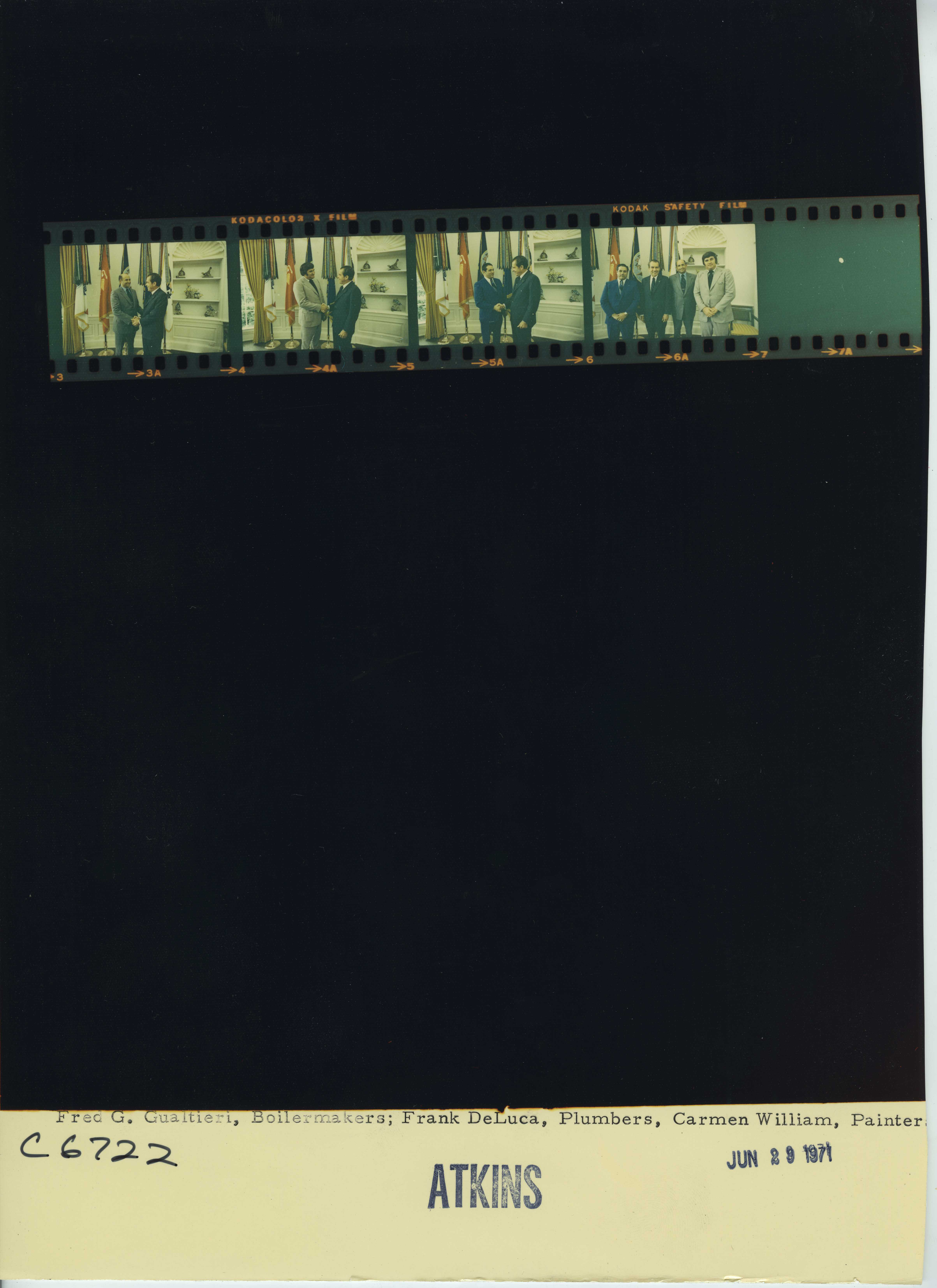
- Frame(s): WHPO-6722-03A, President Nixon shaking hands with Fred Bualtieri, Business Manager for the International Brotherhood of Boilermakers. 6/29/1971, Washington, D.C. White House, Oval Office. President Nixon, Fred Bualtieri, Frank DeLuca, Carmen Williams.
- Frame(s): WHPO-6722-04A, President Nixon shaking hands with Frank DeLuca, Business Manager for the Plumbers and Steamfitters Union. 6/29/1971, Washington, D.C. White House, Oval Office. President Nixon, Fred Bualtieri, Frank DeLuca, Carmen Williams.
- Frame(s): WHPO-6722-05A, President Nixon shaking hands with Carmen Williams, President of the Pennsylvania State Painters Association. 6/29/1971, Washington, D.C. White House, Oval Office. President Nixon, Fred Bualtieri, Frank DeLuca, Carmen Williams.
- Frame(s): WHPO-6722-06A, President Nixon with Fred Bualtieri, Frank DeLuca, and Carmen Williams. 6/29/1971, Washington, D.C. White House, Oval Office. President Nixon, Fred Bualtieri, Frank DeLuca, Carmen Williams.
Roll WHPO-6809 Photographer: Schumacher, Karl | Color or B&W: Color
- Frame(s): WHPO-6809-, Vice President Agnew's official arrival ceremony in Seoul, South Korea during his round the world diplomatic mission. 6/29/1971, Seoul, South Korea Gimpo Airport. Spiro Agnew, officials, aides, military personnel.
Roll WHPO-6810 Photographer: Schumacher, Karl | Color or B&W: Color
- Frame(s): WHPO-6810-, Vice President Agnew receiving flowers during an arrival ceremony in Seoul, Korea during his round the world diplomatic mission. 6/29/1971, Seoul, South Korea Gimpo Airport. Spiro Agnew, unidentified young woman, official.
Roll WHPO-6811 Photographer: Schumacher, Karl | Color or B&W: Color
- Frame(s): WHPO-6811-, Vice President Agnew holding a press conference aboard Air Force Two. 6/29/1971, air, Hawaii Air Force Two, (AF2) airport. Spiro Agnew, press corps members, hula dancers, crowd.
- Frame(s): WHPO-6811-, Vice President Agnew arriving in Hawaii. 6/29/1971, air, Hawaii Air Force Two, airport. Spiro Agnew, press corps members, hula dancers, crowd.
Roll WHPO-9767 Photographer: Atkins, Oliver | Color or B&W: Color
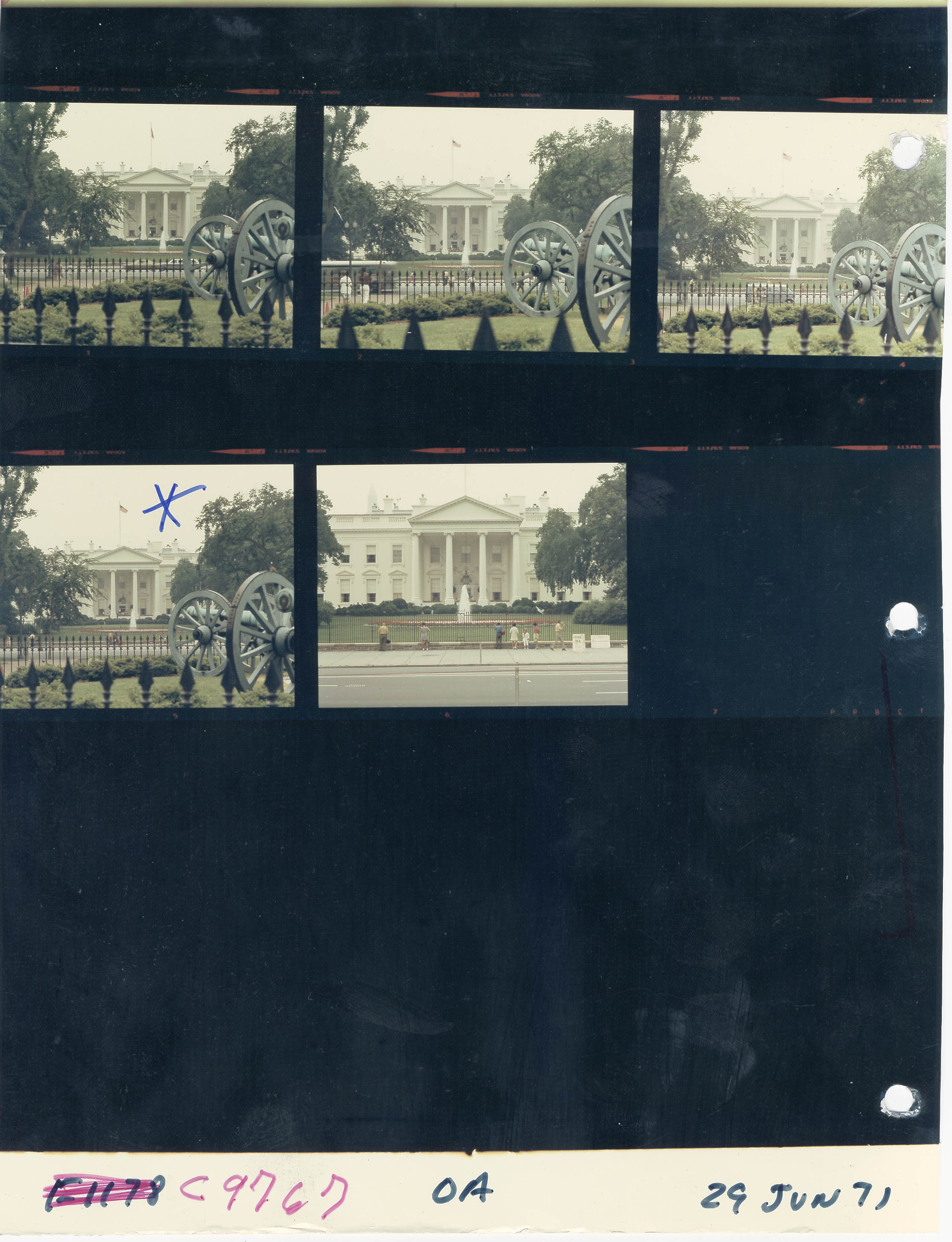
- Frame(s): WHPO-9767-, Views of the White House North Portico, seen from Lafayette Park. 6/29/1971, Washington, D.C. Lafayette Park.
- Frame(s): WHPO-9767-03, The White House North Portico, seen from Lafayette Park, with Cannon wheels visible in the foreground. 6/29/1971, Washington, D.C. Lafayette Park.
The White House Communications Agency Sound Recordings Collection contains public statements that took place between 1969 and 1974. Visit the finding aid to learn more.
C - First Lady
- WHCA-SR-C-075
Remarks by Pat Nixon at a presentation of the Grand Cross of the Order of the Sun by the Peruvian Government at the Peruvian Embassy. (6/29/1971, Peruvian Embassy, Washington D.C.)
Runtime: 0:09:56
Production credits: Audio feed supplied by WHCA; Recorded by JMC (initials of WHCA engineer)
Original Format: 1/4-inch reel-to-reel audiotape. Original source type: Original.
G - Cabinet Officer Briefings
- WHCA-SR-G-124
Press briefing by Secretary of the Treasury John B. Connally. (6/29/1971, Press Center)
Runtime: 38:00:00
Production credits: Audio feed supplied by WHCA; Recorded by BQC (initials of WHCA engineer)
Original Format: 1/4-inch reel-to-reel audiotape. Original source type: Original.
P - Formal Presidential Remarks
- WHCA-SR-P-710627
Remarks by President Nixon at dinner honoring WB with WB, JDE, RM, George Bush. (6/29/1971)
Runtime: 19:55
Original Format: 1/4-inch reel-to-reel audiotape. Original source type: Original.
The White House Communications Agency Videotape Collection contains “off-the-air” recordings of televised programs produced between 1968 and 1974. Visit the finding aid to learn more.
- WHCA-4483
"Thirty Minutes".
PBS
Runtime: 00:29:32 - WHCA-4484
"POW's. . . Pawns of War?". Vietnam Prisoner of War Major James "Nick" Rowe, former Vietnam prisoner of war (POW); Howard Cosell, actor Chuck McCann, and Irish singer Val Doonican.
Group W Productions
Runtime: 1:00 - WHCA-4485
Vice President's Address.
WETA Public Affairs
Runtime: 01:33:00
Context (External Sources)
The Vanderbilt Television News Archive is the world's most extensive and complete archive of television news. They have been recording, preserving and providing access to television news broadcasts of the national networks since August 5, 1968.
Wikipedia is a free encyclopedia that anyone can edit.