
Introduction
This almanac page for Thursday, July 1, 1971, pulls together various records created by the federal government and links to additional resources which can provide context about the events of the day.
Previous Date: Wednesday, June 30, 1971
Next Date: Friday, July 2, 1971
Schedule and Public Documents
The Daily Diary files represent a consolidated record of the President's activities. Visit the finding aid to learn more.
The President's day began at The White House - Washington, D. C.
The Weekly Compilation of Presidential Documents made available transcripts of the President's news conferences; messages to Congress; public speeches, remarks, and statements; and other Presidential materials released by the White House.
Digitized versions can be found at HathiTrust.
Each Public Papers of the Presidents volume contains the papers and speeches of the President of the United States that were issued by the White House Office of the Press Secretary during the time period specified by the volume. The material is presented in chronological order, and the dates shown in the headings are the dates of the documents or events. In instances when the release date differs from the date of the document itself, that fact is shown in the text note.
To ensure accuracy, remarks have been checked against audio recordings (when available) and signed documents have been checked against the original, unless otherwise noted. Editors have provided text notes and cross references for purposes of identification or clarity.
The Federal Register is the official daily publication for rules, proposed rules, and notices of federal agencies and organizations, as well as executive orders and other Presidential documents.
The Congressional Record is the official daily record of the debates and proceedings of the U.S. Congress.
Archival Holdings
Any selection of archival documents will necessarily be partial. You should use the documents and folders identified below as a starting place, but consult the linked collection finding aids and folder title lists and the collections themselves for context. Many documents to be found this way do not lend themselves to association with specific dates, but are essential to a complete understanding of the material.
Selective document listing
President's Office Files
The President's Office Files consists of materials drawn together by the Special Files Unit from several administrative subdivisions within the White House Office. It is the handwriting and sensitive papers sent to the Staff Secretary that now comprise much of the President's Office Files. Visit the finding aid to learn more.
- Annotated News Summaries, Box 30, News Summaries - July 1971 [1 of 2]
- Annotated News Summaries, Box 30, News Summaries - July 1971 [2 of 2] [During this period, the Staff Secretary only removed pages from the News Summaries which contained President Nixon's handwriting, often leaving the document with no date. Although there are no specific documents with this date, you should also consult the full folder for the month.]
- President's Daily Schedule, Box 101, [President's Daily Schedule, June-Aug. 1971] [2 of 3]
- The President's Schedule, Thursday - July 1, 1971
The H. R. Haldeman Diaries consists of seven handwritten diaries, 36 dictated diaries recorded as sound recordings, and two handwritten audio cassette tape subject logs. The diaries and logs reflect H. R. Haldeman’s candid personal record and reflections on events, issues, and people encountered during his service in the Nixon White House. As administrative assistant to the President and Chief of Staff, Haldeman attended and participated in public events and private meetings covering the entire scope of issues in which the Nixon White House engaged in during the years 1969-1973. Visit the finding aid to learn more.
- Transcript of diary entry (PDF)
Thursday, July 1.
In discussing the Pentagon Paper question, in one of a long series of long meetings today, President raised the point of the Hiss question again and said that Elliot Richardson has got to fire Cooke, regardless of what he thinks about him. That one of the points he kept making about Alger Hiss is that his family was beyond reproach, etcetera. He wants Ehrlichman to realize that we have a great opportunity here: that this is a conspiracy; that they are not on good ground; that we now can leak out the other bad stories. He feels this isn't the time for a Presidential statement: that he should not elevate the suppression of the Papers, and it's not a good issue for us. So maybe further down the line, after our newsbreak on the July 15th, then he can really unload. The problem is that he doesn't want to get into the Ellsberg question. So he wanted Ehrlichman to do some checking on that, with the key staff people. He really got going again on trying to get Huston, or Dick Allen, or somebody, in fast to take this whole project on, like the President took on the Hiss case. 18 hours a day, with total dedication, tracking down every lead, leaking stuff to the press. Making-- he made the point that the Hiss case was won in the newspapers, because no one would prosecute, even the FBI. Also, on the declassification thing, leak the other stories to the good newspapers, because this takes the people's eyes off of Vietnam and gets them thinking about the past. What we need is not a workman like Whitaker, but an SOB like Huston, and the President will direct it himself. He doesn't believe the Cooke story. He's convinced Cooke was working against us, within the bureaucracy. He said, don't ever have Cooke in the White House, and he was very discouraged that Elliot won't move ahead and fire him. He feels that we're being too soft on Cooke. The real question is, why did he show anything to Ellsberg? What was Ellsberg's need to know? Later, he made the point that if we can't get Elliot to fire Ellsberg then we should at least cru-- I mean to fire Cooke, we should at least crucify him in the press.
He feels that, going back to the statement question: that we're still better off to let Ellsberg unfold a little more, before it's the right time for him to say something. We had a lot of discussions back and forth on whether to go ahead, and our final recommendation was that he should not say anything on television, but that it probably would be a good idea for him to make a basic statement at the Kansas City briefing. He's very anxious to get going on the busting out the other papers, and the declassification stuff. Still looking for names, so we suggested the idea of having Congressmen take the lead on this, like Rousselot or somebody like that, which he liked, but he still wants an inside staff man to ride herd on it.
He developed the line, regarding The Times that the court has now said that the newspaper can print the material if it doesn't do irreparable damage. Question now is whether a newspaper has the responsibility in any standard. That is, is irreparable damage the standard that the American people-- the American press is going to hold for itself? He feels that the press is on a bad wicket, regarding the right to profit from the publication of stolen documents. They have a constitutional right under the First Amendment, and that overrides the right of America and the right of an American who is fighting for his country to stay alive. They say they don't care about the effects. If declassification is going to follow unauthorized disclosure, then the de-- the whole classification system is destroyed. There's no grounds for release on the basis that other people have it. He's very strongly pushing to cut off the security clearances of most of the people in government and all the outside organizations, like Rand and Brookings, etcetera. Buchanan's arguing harder for a Presidential statement, and again we went back and forth throughout the day on that thing. The problem being that nobody really has made a clear statement of our line, and that's bothering him.
He had a meeting with the security declassification group that was set up under his order of January 1st; this is Rehnquist's group, and he really jumped on these poor guys who are second level bureaucrats. He told them to attack the thing frontally, to start classifying far less material, and have far greater penalties for violations of classified material, and to cut way down on the number of people with top secret clearances, setting up new classifications. He also wants to knock off the clearances for outside institutions. Don't classify to protect politically, only to protect the national security. Cut the number of documents and the number of people and then get a much stricter law, not under the Espionage Act, something with a straight criminal penalty, very stiff, for anyone who takes a classified document. He told them to expand their study to cover all previous wars. They should not be classified, and he wants them to give the President recommendations on how to declassify. This goes back to his idea on Korea, World War II, Cuba, etcetera. He says we now have the standard applied in an arrogant way to this war, because it's immoral. So it should-- shouldn't we also declassify the other wars? We can't have a double standard. He says that his purpose is not more secrecy, but less, because we classify too much, and then we can't protect it.
He wants a new classification at an extraordinary level, like "Presidential decision" or something, with highest security and only a hundred people cleared for it. He makes the point that you can’t protect-- because you can't protect these documents and all, we've become inhibited, so we don't put things through the bureaucracy anymore. He wants to set up an ad hoc clearance for outsiders, so that they're cleared for one purpose when needed, but don't give them a permanent clearance so they can see anything. We can't worry about protecting individual reputations; we can only worry about the national security.
He made the point that the establishment has a new intellectual arrogance which leads them to think that they know best and that the determination regarding what the public should know should be made by them. There’s a new morality where the individual determines what is moral and what is right. We can't let individuals through the government make determination: there wouldn't be any consultations, memos, or anything else. We serve a different morality. Elected officials establish the law, the courts enforce them. Those who disobey, even if they think the laws are wrong, are immoral. If the cause is right, they say it justifies breaking the law, but that's fascism: the means justify the ends. He told them to spend some time on their study and not to rush it, which is what Ehrlichman wanted him to do.
Mitchell called late in the day and suggested that we do a polygraph on Cooke. He doesn't think we should let him off. He's talked with the guys at Defense––Buzhardt, and so forth–– and they are convinced that there's more to this then Elliot says. Also, that it would be a beautiful deterrent in the bureaucracy. The President said to have Mitchell have a tough talk with Elliot, telling him that we have to be able to fi-- answer our critics, and this is the only way we can do it.
End of July 1. - Original audio recording (MP3)
The National Archives Catalog is the online portal to the records held at the National Archives, and information about those records. It is the main way of describing our holdings and also provides access to electronic records and digitized versions of our holdings.
The Catalog searches across multiple National Archives resources at once, including archival descriptions, digitized and electronic records, authority records, and web pages from Archives.gov and the Presidential Libraries. The Catalog also allows users to contribute to digitized historical records through tagging and transcription.
Nixon Library Holdings
All National Archives Units
National Security Documents
The President's Daily Brief is the primary vehicle for summarizing the day-to-day sensitive intelligence and analysis, as well as late-breaking reports, for the White House on current and future national security issues. Read "The President's Daily Brief: Delivering Intelligence to Nixon and Ford" to learn more.
The Foreign Relations of the United States series presents the official documentary historical record of major U.S. foreign policy decisions and significant diplomatic activity. Visit the State Department website for more information.
Vol. IV, Foreign Assistance, International Development, Trade Policies, 1969-1972
East-West Trade, 1969-1972
338. Information Memorandum From Ernest Johnston of the National Security Council Staff to the President’s Assistant for National Security Affairs (Kissinger), Washington, July 1, 1971
Source: National Archives, Nixon Presidential Materials, NSC Files, Subject Files, Box 402, Trade, Volume IV 7-12/71. Confidential.
Vol. V, United Nations, 1969-1972
Chinese Representation in the United Nations
368. Memorandum of Conversation, Washington, July 1, 1971, 3:17-3:35 p.m.
Source: National Archives, Nixon Presidential Materials, NSC Files, Box 522, Country Files, Far East, China, Vol. VII. Secret; Sensitive. Drafted on July 21. The time of the meeting is from Kissinger’s Record of Schedule. (Library of Congress, Manuscript Division, Kissinger Papers, Box CL 446, Miscellany, 1968–1976)
Vol. VII, Vietnam, July 1970-January 1972
The Consequences of Operation Lan Som 719 and the Search for a Settlement, April 8-October 6, 1971
226. Memorandum from W. Richard Smyser of the National Security Council Staff to the President’s Assistant for National Security Affairs (Kissinger), Washington, July 1, 1971
Source: National Archives, Nixon Presidential Materials, NSC Files, Box 853, For the President’s Files, Winston Lord China Trip, Vietnam, Vol. IX. Top Secret; Sensitive; Exclusively Eyes Only. Sent for information. A handwritten note at the top indicates that Haig passed the memorandum to Kissinger, who initialed it. All brackets are in the original.
227. Conversation Among President Nixon, his Assistant for National Security Affairs (Kissinger), and his Deputy Assistant for National Security Affairs (Haig), Washington, July 1, 1971
Source: National Archives, Nixon Presidential Materials, White House Tapes, Oval Office, Conversation 534–3. No classification marking. The editors transcribed the portions of the tape recording printed here specifically for this volume. The exchange is part of a larger conversation, 9:54–10:26 a.m.
Vol. XI, South Asia Crisis, 1971
South Asia Crisis, 1971
85. Letter From President Nixon to Pakistani President Yahya, Washington, July 1, 1971
Source: National Archives, Nixon Presidential Materials, NSC Files, Box 759, Presidential Correspondence File, Pakistan (1971). No classification marking.
86. Letter From President Nixon to Indian Prime Minister Gandhi, Washington, July 1, 1971
Source: National Archives, Nixon Presidential Materials, NSC Files, Box 755, Presidential Correspondence File, India (1971). No classification marking.
Vol. XIII, Soviet Union, October 1970-October 1971
"One of Two Routes": Soviet-American Relations and Kissinger's Secret Trip to China, April 23-July 18, 1971
270. Conversation Among President Nixon, the President’s Assistant for National Security Affairs (Kissinger), and the President’s Deputy Assistant for National Security Affairs (Haig), Washington, July 1, 1971
Source: National Archives, Nixon Presidential Materials, White House Tapes, Conversation 534–3. No classification marking. The editors transcribed the portions of the tape recording printed here specifically for this volume. According to the President’s Daily Diary, Nixon met Kissinger and Haig in the Oval Office on July 1 from 9:54 to 10:26 a.m. (Ibid., White House Central Files) Haig drafted a memorandum of the conversation; printed in Foreign Relations, 1969–1976, volume XVII, China, 1969–1972, Document 137. For his memoir account, see Kissinger, White House Years, pp. 734–736.
Vol. XVII, China, 1969-1972
China,January-September 1971
137. Memorandum for the President’s File, Washington, July 1, 1971
Source: Library of Congress, Manuscript Division, Kissinger Papers, Geopolitical Files, China, China Trips, July 1971 Briefing Notebook. Top Secret; Sensitive; Exclusively Eyes Only. According to the President’s Daily Diary, Nixon, Kissinger, and Haig met from 9:18 to 9:52 a.m. and from 9:54 to 10:26 a.m. (National Archives, Nixon Presidential Materials, White House Central Files)
Vol. E-1, Documents on Global Issues, 1969-1972
U.S. Policy Towards International Production and Trafficking in Illegal Drugs
202. Intelligence Report, Washington, July 1, 1971
Source: National Archives, Nixon Presidential Materials, NSC Files, Box 359, Subject Files, Narcotics V. Secret; Sensitive
Vol. E-4, Documents on Iran and Iraq, 1969-1972
Iran 1971
134. Telegram 119690 From the Department of State to the Embassy in Iran, Washington, July 1, 1971, 2015Z
The Department of State notified the Embassy of the credit terms authorized by the Export-Import Bank for Iran’s FY 1972 military purchases.
Source: National Archives, RG 59, Central Files 1970–73, DEF 12–5 IRAN. Confidential. Drafted by John Lentz; cleared by Glenn McLaughlin, Don Bostwick (XMB), and Robert L. Dowell, Jr. (NEA/IRN); and approved by Paul H. Boeker (E/IFD/ODF).
Vol. E-10, Documents on American Republics, 1969-1972
Panama
550. Telegram 118183 From the Department of State to the Embassy in Panama, July 1, 1971, 0243Z., July 1, 1971, 0243Z
Under Secretary John Irwin summarized the first meeting of the treaty negotiations, which focused on issues of jurisdiction and duration. Irwin stated that the U.S. position called for a treaty which accommodated existing defense arrangements.
Source: National Archives, RG 59, Central Files 1970–73, POL PAN–US. Confidential. Copies sent to USCINCSO and the Panama Canal Company. Drafted on June 30 by Finn; cleared by Curran; and approved by Finn.
Venezuela
676. Memorandum From Arnold Nachmanoff of the National Security Council Staff to the President’s Assistant for National Security Affairs (Kissinger), Washington, July 1, 1971., Washington, July 1, 1971
The Venezuelan Congress was on the verge of passing petroleum and gas legislation that would potentially hurt the interests of U.S. companies operating there.
Source: National Archives, Nixon Presidential Materials, NSC Files, Box 796, Country Files, Latin America, Venezuela, Vol. 1, 1969–1971. Confidential. Sent for information. Kissinger initialed the first page of the document. Written in the top right-hand corner was “Hold HAK [Kissinger].” Attached but not published at Tab A is a June 28 memorandum from Rogers entitled “Pending Venezuelan Petroleum and Gas Legislation.”
The Kissinger telephone conversation transcripts consist of approximately 20,000 pages of transcripts of Kissinger’s telephone conversations during his tenure as Assistant to the President for National Security Affairs (1969-1974) and Secretary of State (1973-1974) during the administration of President Richard Nixon. Visit the finding aid for more information.
Digitized versions can be found in the National Archives Catalog.
Audiovisual Holdings
The White House Tapes are sound recordings of President Richard Nixon's telephone conversations and of meetings held in the Oval Office and the Cabinet Room in the White House, the President's office in the Old Executive Office Building (OEOB), the Lincoln Sitting Room in the residence section of the White House, and several locations at the Presidential retreat at Camp David, Maryland. These recordings document many of the major events and decisions of the Nixon Administration from February 16, 1971 to July 18, 1973. Visit the White House Tapes finding aid to learn about the taping system's operation and archival processing.
Cabinet Room
- 64-1; Unknown between 8:35 a.m. & 10:32 a.m.; Knauer, Virginia H.; [Unknown person(s)]
- 64-2; Unknown between 8:35 a.m. & 10:32 a.m.; [Unknown person(s)]
Old Executive Office Building
- 260-1; Unknown between 2:05 p.m. & 9:47 p.m.; Nixon, Richard M. (President); [Unknown person(s)]
- 260-2; Unknown between 2:05 p.m. & 9:47 p.m.; Nixon, Richard M. (President); Sanchez, Manolo
- 261-27; Unknown between 2:05 p.m. & 2:11 p.m.; Nixon, Richard M. (President); Sanchez, Manolo
- 261-28; Unknown between 9:53 a.m. & 2:11 p.m.; Nixon, Richard M. (President); White House operator
- 261-29; Unknown between 9:53 a.m. & 2:11 p.m.; Nixon, Richard M. (President); Butterfield, Alexander P.
- 261-30; 2:11 p.m. - 2:11 p.m.; Nixon, Richard M. (President); White House operator
- 261-31; 3:14 p.m. - 3:16 p.m.; Nixon, Richard M. (President); Dobrynin, Anatoliy F.
- 261-32; 3:17 p.m. - 3:17 p.m.; Nixon, Richard M. (President); [Unknown person(s)]
- 261-33; 3:18 p.m. - 3:22 p.m.; Nixon, Richard M. (President); Butterfield, Alexander P.
- 261-34; Unknown between 3:22 p.m. & 3:55 p.m.; Nixon, Richard M. (President); Haldeman, H. R. ("Bob")
- 261-35; 3:55 p.m. - 4:25 p.m.; Nixon, Richard M. (President); Kissinger, Henry A.; Butterfield, Alexander P.; Haldeman, H. R. ("Bob"); [Unknown person(s)]; Ehrlichman, John D.
- 261-36; Unknown between 4:25 p.m. & 5:09 p.m.; Nixon, Richard M. (President); [Unknown person(s)]
- 261-37; Unknown between 4:25 p.m. & 5:55 p.m.; Nixon, Richard M. (President); Ziegler, Ronald L.; White House operator; Nixon, Thelma C. ("Pat") (Ryan)
- 261-38; Unknown between 5:10 p.m. & 5:55 p.m.; Nixon, Richard M. (President); Sanchez, Manolo
- 261-39; Unknown between 5:10 p.m. & 5:55 p.m.; Nixon, Richard M. (President); Sanchez, Manolo
- 261-40; Unknown between 5:10 p.m. & 5:55 p.m.; Nixon, Richard M. (President); Kissinger, Henry A.
- 261-41; Unknown between 5:01 p.m. & 6:00 p.m.; Nixon, Richard M. (President); White House operator
- 261-42; 5:55 p.m. - 6:20 p.m.; Nixon, Richard M. (President); Kissinger, Henry A.; Hoover, J. Edgar
- 261-43; Unknown between 6:20 p.m. & 6:30 p.m.; Nixon, Richard M. (President); Sanchez, Manolo
- 261-44; Unknown between 6:07 p.m. & 6:30 p.m.; Nixon, Richard M. (President); White House operator
- 261-45; 6:30 p.m. - 6:37 p.m.; Nixon, Richard M. (President); Colson, Charles W.
- 261-46; Unknown between 6:37 p.m. & 6:45 p.m.; Nixon, Richard M. (President); White House operator
- 261-47; 6:45 p.m. - 6:46 p.m.; Nixon, Richard M. (President); Haldeman, H. R. ("Bob")
- 261-48; Unknown between 6:46 p.m. & 7:00 p.m.; Nixon, Richard M. (President); Sanchez, Manolo
- 261-49; 7:00 p.m. - 7:20 p.m.; Nixon, Richard M. (President); Haldeman, H. R. ("Bob")
- 261-50; Unknown between 7:20 p.m., 7/1 & 4:02 p.m., 5/31; Nixon, Richard M. (President); Sanchez, Manolo
- 261-51; Unknown between 7:20 p.m., 7/1 & 4:02 p.m., 5/31; Nixon, Richard M. (President); Sanchez, Manolo
Oval Office
- 534-1; Unknown between 8:35 a.m. & 8:41 a.m.; [Unknown person(s)]; Sanchez, Manolo
- 534-2; 8:45 a.m. - 9:52 a.m.; Nixon, Richard M. (President); Haldeman, H. R. ("Bob"); Bull, Stephen B.; Kissinger, Henry A.; Haig, Alexander M., Jr.
- 534-3; 9:54 a.m. - 10:26 a.m.; Nixon, Richard M. (President); Bull, Stephen B.; Haig, Alexander M., Jr.; Kissinger, Henry A.
- 534-4; Unknown between 10:26 a.m. & 10:27 a.m.; Nixon, Richard M. (President); Bull, Stephen B.
- 534-5; 10:27 a.m. - 11:49 a.m.; Nixon, Richard M. (President); Haldeman, H. R. ("Bob"); Colson, Charles W.; Ehrlichman, John D.; Sanchez, Manolo; Kissinger, Henry A.; Bull, Stephen B.
- 534-6; 11:49 a.m. - 11:49 a.m.; Nixon, Richard M. (President); Butterfield, Alexander P.; Bull, Stephen B.
- 534-7; Unknown between 11:50 a.m. & 12:06 p.m.; Bull, Stephen B.; Blatchford, Joseph H.; Donnell, Thmas R., Jr.; Percy, Charles H.; Holifield, Chet; Horton, Frank J.; Weber, Arnold R.; White House photographer
- 534-8; Unknown between 12:06 p.m. & 12:09 p.m.; Nixon, Richard M. (President); Pontier, Andrey
- 534-9; Unknown between 12:06 p.m. & 12:09 p.m.; Nixon, Richard M. (President); Bull, Stephen B.
- 534-10; Unknown between 12:06 p.m. & 12:09 p.m.; Nixon, Richard M. (President); Ehrlichman, John D.
- 534-11; 12:09 p.m. - 1:38 p.m.; Nixon, Richard M. (President); Davis, Sammy, Jr.; Brown, Robert J.; Cashen, Henry C., II; Donfeld, Jeffrey; White House photographer; [Unknown person(s)]; Richardson, Elliot L.; Hodgson, James D.; Shultz, George P.; Ehrlichman, John D.
- 534-12; Unknown between 1:38 p.m. & 2:05 p.m.; Nixon, Richard M. (President); Butterfield, Alexander P.; Haldeman, H. R. ("Bob")
- 534-13; Unknown between 2:02 p.m. & 2:11 p.m.; [Unknown person(s)]; Sanchez, Manolo
- 534-14; 8:41 a.m. - 8:45 a.m.; Nixon, Richard M. (President); Butterfield, Alexander P.
White House Telephone
- 6-76; 9:53 a.m. - 9:53 a.m.; Nixon, Richard M. (President); White House operator
- 6-77; Unknown between 9:53 a.m. & 2:11 p.m.; Nixon, Richard M. (President); White House operator
- 6-78; 2:11 p.m. - 2:11 p.m.; Nixon, Richard M. (President); White House operator
- 6-79; 3:14 p.m. - 3:16 p.m.; Nixon, Richard M. (President); Dobrynin, Anatoliy F.
- 6-80; 4:09 p.m. - 4:11 p.m.; Nixon, Richard M. (President); Haldeman, H. R. ("Bob"); Ehrlichman, John D.
- 6-81; Unknown between 4:11 p.m. & 5:09 p.m.; Nixon, Richard M. (President); White House operator
- 6-82; 5:09 p.m. - 5:10 p.m.; Nixon, Richard M. (President); Nixon, Thelma C. ("Pat") (Ryan)
- 6-83; Unknown between 5:10 p.m. & 6:00 p.m.; Nixon, Richard M. (President); White House operator
- 6-84; 6:00 p.m. - 6:07 p.m.; Nixon, Richard M. (President); Hoover, J. Edgar
- 6-85; Unknown between 6:07 p.m. & 6:30 p.m.; Nixon, Richard M. (President); White House operator
- 6-86; 6:30 p.m. - 6:37 p.m.; Nixon, Richard M. (President); Colson, Charles W.
- 6-87; Unknown between 6:37 p.m. & 6:45 p.m.; Nixon, Richard M. (President); White House operator
- 6-88; 6:45 p.m. - 6:46 p.m.; Nixon, Richard M. (President); Haldeman, H. R. ("Bob")
- 6-89; Unknown between 6:46 p.m., 7/1 & 4:08 p.m., 6/11; Cox, Edward R. F.; Atkins, Oliver F. ("Ollie")
The White House Photo Office collection consists of photographic coverage of President Richard Nixon meeting with prominent social, political, and cultural personalities; speaking engagements and news conferences of the President and various high-ranking members of the White House staff and Cabinet; Presidential domestic and foreign travel, including Presidential vacations; social events and entertainment involving the First Family, including entertainers present; official portraits of the President, First Family, and high-ranking members of the Nixon administration; the 1969 and 1973 Inaugurals; the President’s 1972 Presidential election campaign appearances (including speeches) and other official activities of the White House staff and the President’s Cabinet from January 20, 1969 until August 9, 1974 at the White House and the Old Executive Office Building; other locations in Washington, DC, such as The Mall; and the Presidential retreats in Camp David, Maryland, Key Biscayne, Florida, and San Clemente, California. Visit the finding aid to learn more.
Roll WHPO-6726 Photographer: Schumaker, Byron | Color or B&W: Color
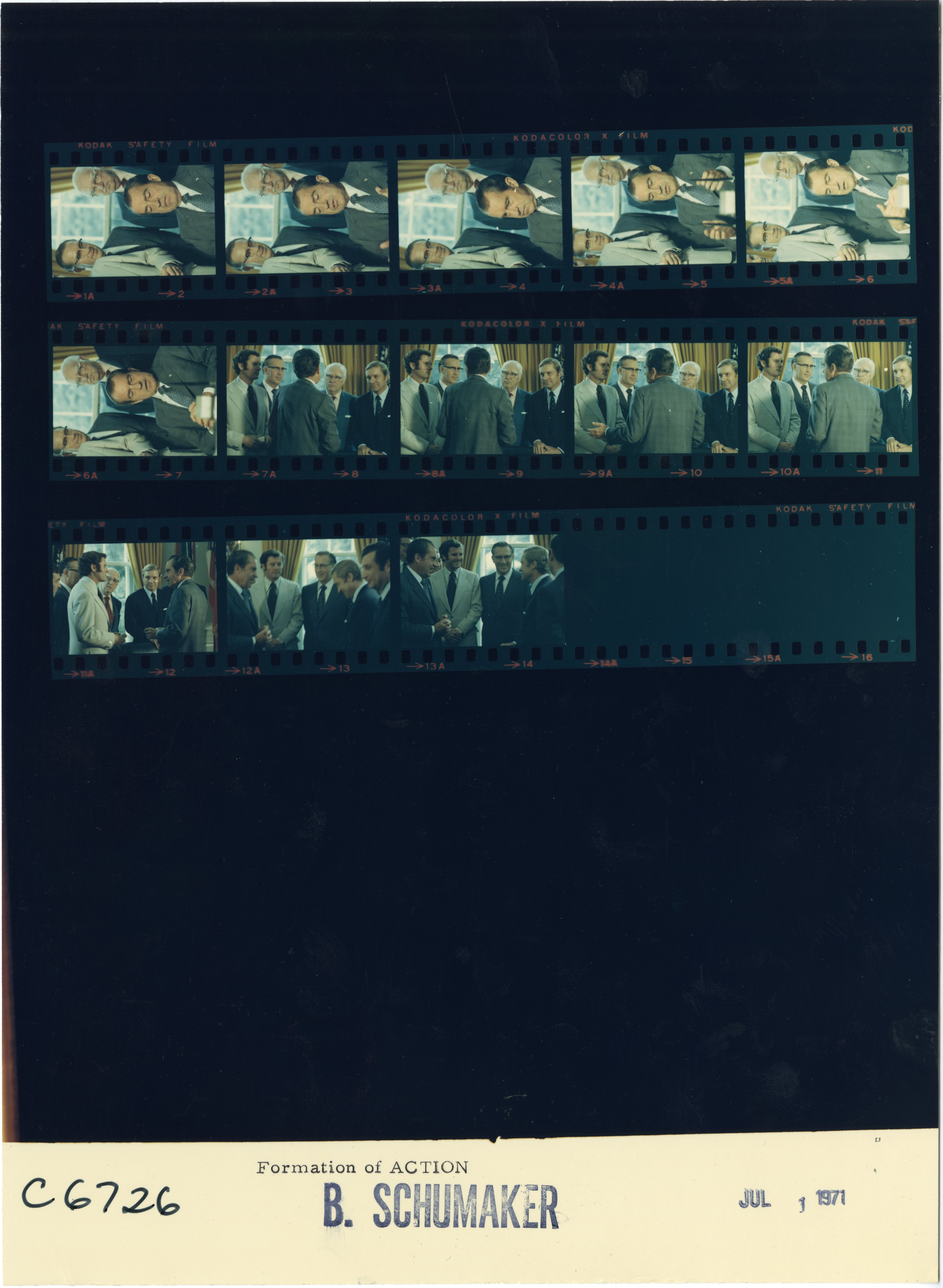
- Frame(s): WHPO-6726-, President Nixon at a ceremony marking the formation of the ACTION Agency. 7/1/1971, Washington, D.C. White House, Oval Office. President Nixon, Chester E. Holifield, Frank Horton, Charles Percy, Joseph Blatchford (Peace Corps).
Roll WHPO-6727 Photographer: Schumaker, Byron | Color or B&W: Color
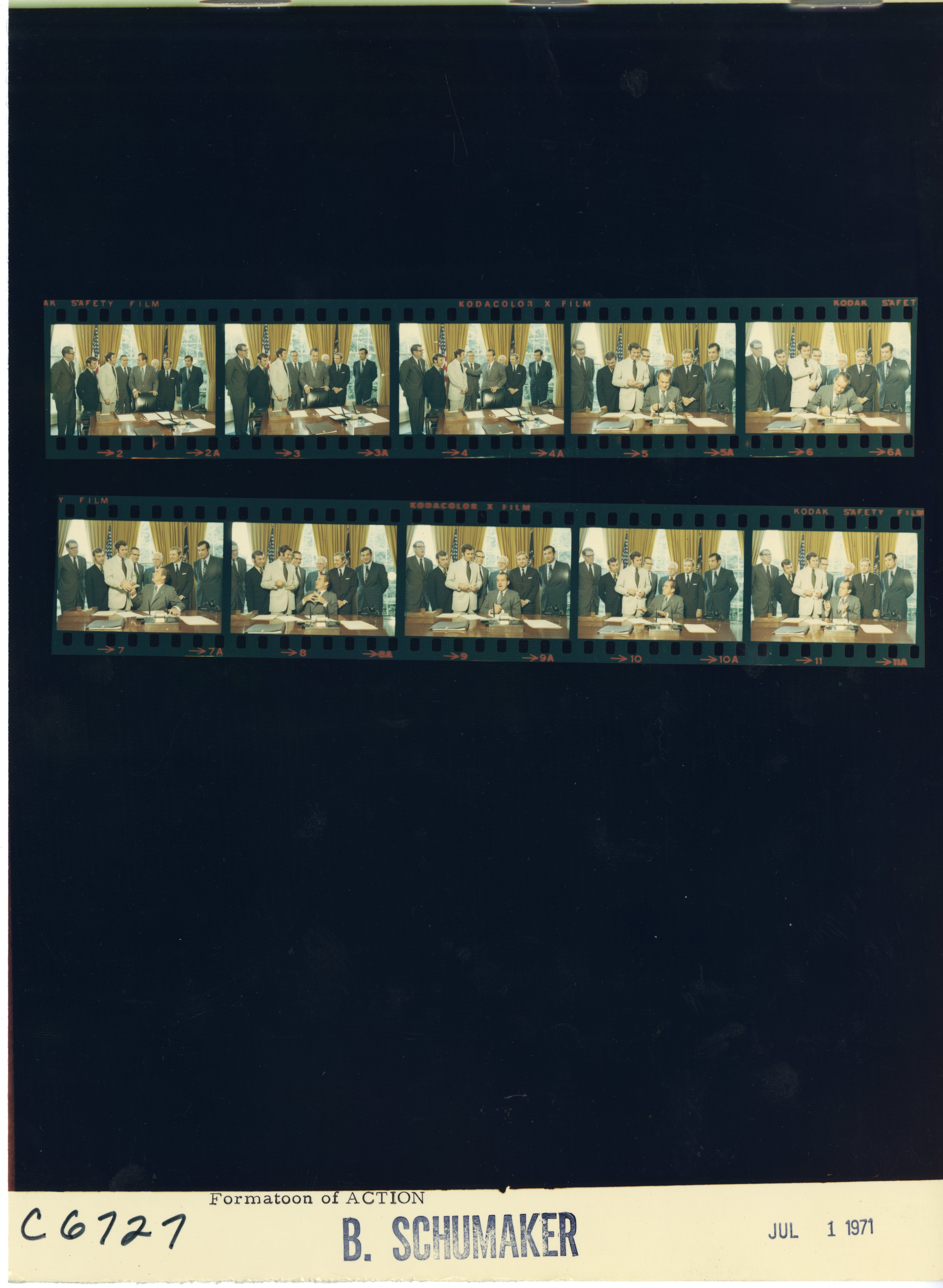
- Frame(s): WHPO-6727-, President Nixon and others at his desk for the formation ceremony of the ACTION Agency. 7/1/1971, Washington, D.C. White House, Oval Office. President Nixon, MacGregor, Joseph Blatchford (Peace Corps), Thomas Donnelly, Charles Percy, Chet Holifield, Frank Horton, Arnold Weber.
Roll WHPO-6728 Photographer: Knudsen, Robert L. | Color or B&W: B&W
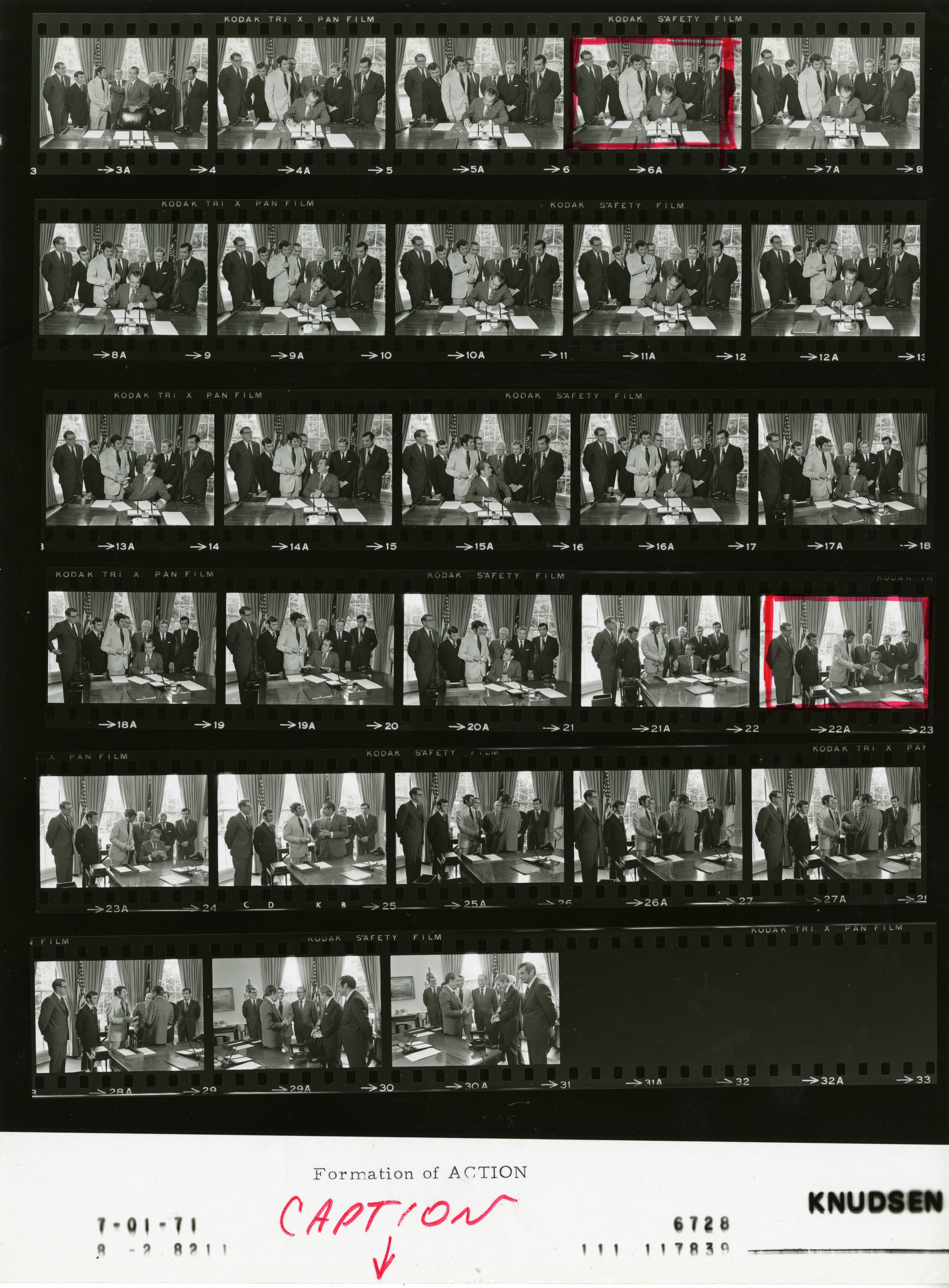
- Frame(s): WHPO-6728-, President Nixon and others at his desk for the formation ceremony of the ACTION Agency. 7/1/1971, Washington, D.C. White House, Oval Office. President Nixon, MacGregor, Joseph Blatchford (Peace Corps), Thomas Donnelly, Charles Percy, Chet Holifield, Frank Horton, Arnold Weber.
- Frame(s): WHPO-6728-, President Nixon and others at his desk for the formation ceremony of the ACTION Agency. 7/1/1971, Washington, D.C. White House, Oval Office. President Nixon, MacGregor, Joseph Blatchford (Peace Corps), Thomas Donnelly, Charles Percy, Chet Holifield, Frank Horton, Arnold Weber.
- Frame(s): WHPO-6728-06A, President Nixon and others at his desk for the formation ceremony (signing ceremony) of the ACTION Agency. 7/1/1971, Washington, D.C. White House, Oval Office. President Nixon, MacGregor, Joseph Blatchford (Peace Corps), Thomas Donnelly, Charles Percy, Chet Holifield, Frank Horton, Arnold Weber.
- Frame(s): WHPO-6728-06A, President Nixon and others at his desk for the formation ceremony (signing ceremony) of the ACTION Agency. 7/1/1971, Washington, D.C. White House, Oval Office. President Nixon, MacGregor, Joseph Blatchford (Peace Corps), Thomas Donnelly, Charles Percy, Chet Holifield, Frank Horton, Arnold Weber.
Roll WHPO-6729 Photographer: Atkins, Oliver | Color or B&W: B&W
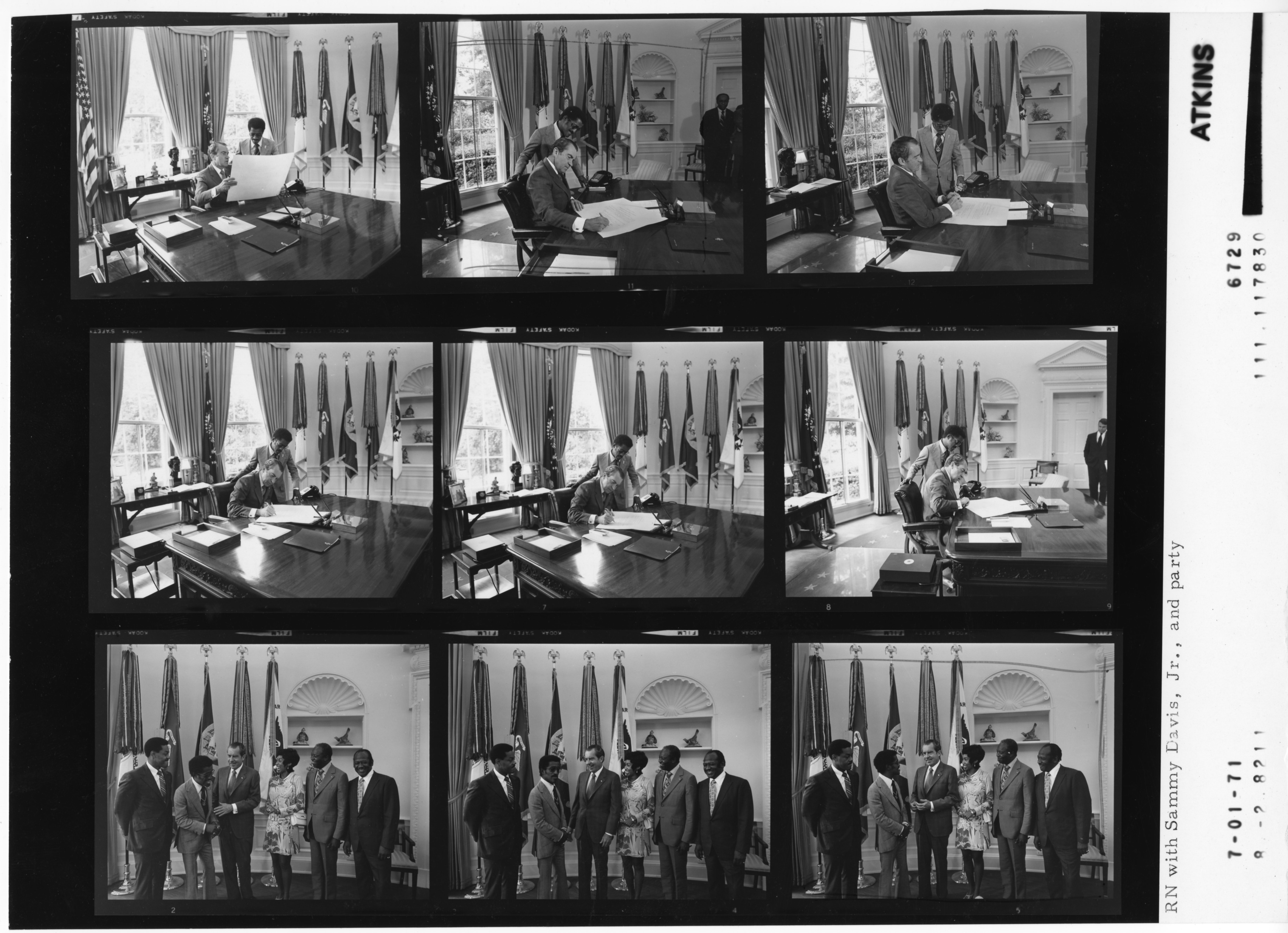
- Frame(s): WHPO-6729-, President Nixon with Sammy Davis, Jr. 7/1/1971, Washington, D.C. White House, Oval Office. President Nixon, Sammy Davis, Jr., Mrs. Davis, Robert Brown, unidentified men and woman.
- Frame(s): WHPO-6729-02, President Nixon speaking with singer-actor Sammy Davis, Jr. (laughing) and his wife, Mrs. Altovise Davis, Jr. 7/1/1971, Washington, D.C. White House, Oval Office. President Nixon, Sammy Davis, Jr., Altovise Davis.
- Frame(s): WHPO-6729-11, President Nixon signing a document (likely related to the commissioning of Davis as a member of the National Advisory Board of the Office of Economic Orrortunity (OEO)) with Sammy Davis Jr. standing nearby watching. 7/1/1971, Washington, D.C. White House, Oval Office. President Nixon, Sammy Davis, Jr.
Roll WHPO-6730 Photographer: unknown | Color or B&W: B&W
- Frame(s): WHPO-6730-, John McLaughlin portrait. 7/1/1971, Washington, D.C. unknown. John McLaughlin.
Roll WHPO-6731 Photographer: Kightlinger, Jack | Color or B&W: Color
- Frame(s): WHPO-6731-04A-08A, Pat Nixon leaving via the South Lawn. 7/1/1971, Washington, D.C. White House, South Lawn. Pat Nixon, Jouett Shouse, unidentified men and women.
- Frame(s): WHPO-6731-09A-24:, Pat Nixon at the Wolf Trap Gala Opening. 7/1/1971, Virginia Wolf Trap Farm. Pat Nixon, Jouett Shouse, unidentified men and women.
Roll WHPO-6812 Photographer: Schumacher, Karl | Color or B&W: B&W
- Frame(s): WHPO-6812-03-12, Vice President Agnew arriving at and departing from Singapore during his round the world diplomatic mission. 7/1/1971, Singapore, air airport. Spiro Agnew, officials, press corps members, military personnel.
- Frame(s): WHPO-6812-13-30, Independence Day (4th of July) celebration aboard Air Force Two. 7/1/1971, Singapore, air airport, Air Force Two (AF2). Spiro Agnew, officials, press corps members, military personnel.
Roll WHPO-6813 Photographer: Schumacher, Karl | Color or B&W: B&W
- Frame(s): WHPO-6813-07A-08A, Vice President Agnew arriving at Singapore during his round the world diplomatic mission. 7/1/1971, Singapore airport, unidentified location. Spiro Agnew, officials, staff.
- Frame(s): WHPO-6813-09A, 12A-22A, Vice President Agnew at an informal staff dinner in Singapore during his round the world diplomatic mission. 7/1/1971, Singapore airport, unidentified location. Spiro Agnew, officials, staff.
Roll WHPO-6924 Photographer: Schumacher, Karl | Color or B&W: B&W
- Frame(s): WHPO-6924-03A-12A, Vice President Agnew with officials in various locations in Seoul, Korea. 7/1/1971, Seoul, Korea unknown. Spiro Agnew, unidentified officials.
Roll WHPO-6925 Photographer: Schumacher, Karl | Color or B&W: B&W
- Frame(s): WHPO-6925-05-11, Vice President Agnew attending a ceremony. 7/1/1971, Seoul, Korea unknown. Spiro Agnew, unidentified officials, guests.
- Frame(s): WHPO-6925-12-17, Unidentified official speaking at a podium at a ceremony. 7/1/1971, Seoul, Korea unknown. Spiro Agnew, unidentified officials, guests.
The White House Communications Agency Sound Recordings Collection contains public statements that took place between 1969 and 1974. Visit the finding aid to learn more.
H - White House Staff Member Recordings
- WHCA-SR-H-410
Press briefing by Ronald Ziegler and Joseph Blatchford on the formation of ACTION Agency. (7/1/1971, Press Center, White House)
Runtime: 35:20:00
Keywords: Press conferences, news conferences, interviews, media, press secretary, ACTION (U.S. government agency), Peace Corps, volunteer programs, volunteerism
Production credits: Audio feed supplied by WHCA; Recorded by RSM (initials of WHCA engineer)
Original Format: 1/4-inch reel-to-reel audiotape. Original source type: Original.
The White House Communications Agency Videotape Collection contains “off-the-air” recordings of televised programs produced between 1968 and 1974. Visit the finding aid to learn more.
- WHCA-4489
"Today" Show.
Undetermined
Runtime: 00:20:40 - WHCA-4490
Weekly News Summary, Tape I. Excerpts of evening network news broadcasts from the week of 6/25/71 to 7/1/71
ABC
Runtime: 1:30 - WHCA-4491
Weekly News Summary, Tape II. Excerpts of evening network news broadcasts from the week of 6/25/71 to 7/1/71 FTN: U.S. Senator George McGovern; "MTP": U.S. Senator Stuart Symington; "I&A": West German Chancellor Willy Brandt.
CBS, NBC, ABC
Runtime: 01:31:38 - WHCA-4492
Weekly News Summary, Tape III. Excerpts of evening network news broadcasts from the week of 6/25/71 to 7/1/71
NBC
Runtime: 1:00
Context (External Sources)
The Vanderbilt Television News Archive is the world's most extensive and complete archive of television news. They have been recording, preserving and providing access to television news broadcasts of the national networks since August 5, 1968.
Wikipedia is a free encyclopedia that anyone can edit.