
Introduction
This almanac page for Wednesday, January 26, 1972, pulls together various records created by the federal government and links to additional resources which can provide context about the events of the day.
Previous Date: Tuesday, January 25, 1972
Next Date: Thursday, January 27, 1972
Schedule and Public Documents
The Daily Diary files represent a consolidated record of the President's activities. Visit the finding aid to learn more.
The President's day began at The White House - Washington, D. C.
The Weekly Compilation of Presidential Documents made available transcripts of the President's news conferences; messages to Congress; public speeches, remarks, and statements; and other Presidential materials released by the White House.
Digitized versions can be found at HathiTrust.
Each Public Papers of the Presidents volume contains the papers and speeches of the President of the United States that were issued by the White House Office of the Press Secretary during the time period specified by the volume. The material is presented in chronological order, and the dates shown in the headings are the dates of the documents or events. In instances when the release date differs from the date of the document itself, that fact is shown in the text note.
To ensure accuracy, remarks have been checked against audio recordings (when available) and signed documents have been checked against the original, unless otherwise noted. Editors have provided text notes and cross references for purposes of identification or clarity.
The Federal Register is the official daily publication for rules, proposed rules, and notices of federal agencies and organizations, as well as executive orders and other Presidential documents.
The Congressional Record is the official daily record of the debates and proceedings of the U.S. Congress.
Archival Holdings
Any selection of archival documents will necessarily be partial. You should use the documents and folders identified below as a starting place, but consult the linked collection finding aids and folder title lists and the collections themselves for context. Many documents to be found this way do not lend themselves to association with specific dates, but are essential to a complete understanding of the material.
Selective document listing
President's Office Files
The President's Office Files consists of materials drawn together by the Special Files Unit from several administrative subdivisions within the White House Office. It is the handwriting and sensitive papers sent to the Staff Secretary that now comprise much of the President's Office Files. Visit the finding aid to learn more.
- News Summaries, Unmarked News Summaries, Box 47, News Summaries - January 1972 [4 of 6] [Note: Due to the way News Summary products were compiled, you should also consult nearby days for potentially relevant materials.]
- January 26, 1972
- News Summary, January 26, 1972, (Wed. nets, specials, wires and mags.)
- President's Daily Schedule, Box 102, [President's Daily Schedule, Jan.-Mar. 1972] [3 of 3]
- The President's Schedule, Wednesday - January 26, 1972
The H. R. Haldeman Diaries consists of seven handwritten diaries, 36 dictated diaries recorded as sound recordings, and two handwritten audio cassette tape subject logs. The diaries and logs reflect H. R. Haldeman’s candid personal record and reflections on events, issues, and people encountered during his service in the Nixon White House. As administrative assistant to the President and Chief of Staff, Haldeman attended and participated in public events and private meetings covering the entire scope of issues in which the Nixon White House engaged in during the years 1969-1973. Visit the finding aid to learn more.
- Transcript of diary entry (PDF)
Wednesday, January 26.
President had a heavy schedule today with the 8:00 leadership meeting: the Dutch Prime Minister; the Quadriad; and Congressman Belcher late in the afternoon.
We spent some time this morning after the leadership on speech reaction. He's very concerned that we don't assume that the reaction's going to get across and that we realize we have to ride it. He was not pleased with the Post and Times headlines saying reaction had been mixed, although basically they were as accurate as could be hoped for. We're moving to get out the positive response. All the analysis indicates the speech scored extremely well, and now it is just a matter of working the follow-up, the thoughtful people and so on. He wanted to be sure we had Colson really clanking on the various groups and so forth.
He was very distressed by the Vice President's performance at the leadership meeting, because he apparently was critical of some of the facets of the announcement, and said so in the wrong way at the wrong time. President talked to Bill Rogers about this later in the day, and Rogers agreed it was a problem, but nobody seems to know what to do about it. He had me call Harlow to see if he had any thoughts on it, and Bryce is going to talk to the VP and see if he can work something out.
President was pleased with a gag he had dreamed up where Henry's speaking at the Women's Press Club tonight, so the President's going to call him with the phone call broadcast to the dinner, and make some crack about how he wants Henry to come back right away to give him hell for half an hour. This was all the President's idea, and he had me work it out with White House Communications Agency to have the phone arrangements worked out. He called Walker to have the phone arrangements set up. He called Stanton this afternoon, told him how great his crews were, and what a superb job they did on the Christmas show, the Rather show, and then in doing the announcement last night. He asked me to do some checking on the reports he had gotten as to how good his delivery was, and he was curious as to why, what he had done that led to that. Carruthers says it was basically the timing: that he was at ease with the material.
I had a meeting late this afternoon with Rogers to go over the President's latest directive to him on the Middle East, and this time it went very well. He seemed to take it well, and understood the background point, which I had to make to him verbally, which was that the President wanted to be sure that this was all handled properly from a political viewpoint, and that it was a reversal or a revision of the earlier instructions to Rogers regarding his dealings with the Israelis.
End of January 26. - Original audio recording (MP3)
The National Archives Catalog is the online portal to the records held at the National Archives, and information about those records. It is the main way of describing our holdings and also provides access to electronic records and digitized versions of our holdings.
The Catalog searches across multiple National Archives resources at once, including archival descriptions, digitized and electronic records, authority records, and web pages from Archives.gov and the Presidential Libraries. The Catalog also allows users to contribute to digitized historical records through tagging and transcription.
Nixon Library Holdings
All National Archives Units
National Security Documents
The President's Daily Brief is the primary vehicle for summarizing the day-to-day sensitive intelligence and analysis, as well as late-breaking reports, for the White House on current and future national security issues. Read "The President's Daily Brief: Delivering Intelligence to Nixon and Ford" to learn more.
The Foreign Relations of the United States series presents the official documentary historical record of major U.S. foreign policy decisions and significant diplomatic activity. Visit the State Department website for more information.
Vol. IV, Foreign Assistance, International Development, Trade Policies, 1969-1972
Foreign Assistance Policy, 1969-1972
82. Memorandum From the Under Secretary of State (Irwin) to the Administrator of the Agency for International Development (Hannah), Washington, January 26, 1972
Source: National Archives, RG 59, Central Files 1970-73, AID (US). Confidential. Drafted by J.K. Wilhelm (S/PC) on January 22 and forwarded to Irwin under cover of a January 24 memorandum from Arthur Hartman, which noted that Hannah’s reform package had already gone to the Secretary and Congress and included four sets of comments received from within the Department to help guide the Under Secretary’s decision.
Vol. VIII, Vietnam, January-October 1972
Before the Easter Offensive, January 20-March 29, 1972
7. Transcript of a Telephone Conversation Between David Kraslow, Washington Bureau Chief of the Los Angeles Times, and the President’s Assistant for National Security Affairs (Kissinger), Washington, January 26, 1972, 3:15 p.m.
Source: National Archives, Nixon Presidential Materials, Kissinger Telephone Conversations, Box 13, Chronological File, January 25–31, 1972. No classification marking. All blank underscores are omissions in the original.
Vol. XXXII, SALT I, 1969-1972
Narrowing the Issues, October 19, 1971-April 18, 1972
229. Memorandum From Philip Odeen of the National Security Council Staff to the President’s Assistant for National Security Affairs (Kissinger), Washington, January 26, 1972
Source: National Archives, Nixon Presidential Materials, NSC Files, Box 882, SALT, SALT talks (Helenski) [sic], Vol. 17, January–April 1972. Top Secret; Sensitive. Urgent; Sent for information. On January 17 Odeen and Sonnenfeldt sent Kissinger a memorandum in which they conveyed Smith’s request for guidance to explore “allowing equal number of interceptors within our 2 or 1 ABM proposal” and “allowing freedom-to-mix from ICBMs to SLBMs,” as a way to circumvent OSD and JCS objections. Odeen and Sonnenfeldt recommended four possible actions: “1) prepare a memorandum to the President with a draft directive; 2) prepare a draft directive for me; 3) call a Verification Panel meeting as soon as possible; 4) hold in abeyance.” Kissinger approved their recommendation to call a Verification Panel meeting as soon as possible and added the handwritten comment, “this is no commitment to Smith.” (Ibid.)
Vol. XXXIV, National Security Policy, 1969-1972
The Defense Budget and U.S. National Security Policy
205. Memorandum From Secretary of Defense Laird to President Nixon, Washington, January 26, 1972
Source: National Archives, Nixon Presidential Materials, NSC Files, Box 230, Agency Files, Department of Defense, Vol. XVI. Top Secret.
Vol. E-7, Documents on South Asia, 1969-1972
U.S. Relations with India and Pakistan, 1972
216. Memorandum From the Executive Secretary of the Department of State (Eliot) to the President’s Assistant for National Security Affairs (Kissinger), Washington, January 26, 1972
The Department recommended continued suspension of the sale or delivery of lethal military equipment and spare parts to India and Pakistan “until the situation is further clarified.”
Source: National Archives, Nixon Presidential Materials, NSC Files, NSC Institutional Files (H-Files), Box H–061, SRG Meeting, South Asia, 2/1/72. Secret; Exdis. Curran signed for Eliot.
Vol. E-7, Documents on South Asia, 1969-1972
Bangladesh, December 1971-December 1972
389. Memorandum From the Executive Secretary of the Department of State (Eliot) to the President’s Assistant for National Security Affairs (Kissinger), Washington, January 26, 1972
The Department of State and AID responded to an instruction from the Senior Review Group to prepare recommendations for humanitarian assistance to Bangladesh and India.
Source: National Archives, Nixon Presidential Materials, NSC Files, NSC Institutional Files (H-Files), Box H-061, SRG Meeting, South Asia, 2/1/72. Confidential. Signed in S/S for Eliot by Robert T. Curran. This memorandum was considered by the SRG at its meeting on February 1. The minutes of the January 19 and February 1 SRG meetings are Documents 210 and 220. Issues relating to South Asia were discussed in both meetings, but the latter was devoted largely to a discussion of humanitarian assistance to Bangladesh.
Vol. E-13, Documents on China, 1969-1972
82. Memorandum for the Record, Paris, January 26, 1972, 7:30 p.m., Paris, January 26, 1972, 7:30 p.m.
Military Attaché Walters handed the Chinese the U.S. proposal for Indochina.
Source: National Archives, Nixon Presidential Materials, NSC Files, Box 849, President’s File-China Trip, China Exchanges, January 1-February 29, 1972. No classification marking. The meeting was held at Chen’s residence in Neuilly. No drafting date appears on the memorandum. Walters added the handwritten notation “Provided” next to the sentence beginning with “He also said that they did not know…” For additional information about the attached tabs, see Document 80.
The Kissinger telephone conversation transcripts consist of approximately 20,000 pages of transcripts of Kissinger’s telephone conversations during his tenure as Assistant to the President for National Security Affairs (1969-1974) and Secretary of State (1973-1974) during the administration of President Richard Nixon. Visit the finding aid for more information.
Digitized versions can be found in the National Archives Catalog.
Audiovisual Holdings
Visit the White House Tapes finding aid to learn about the taping system's operation and archival processing.
Cabinet Room
Old Executive Office Building
- 318-1; Unknown between 3:23 p.m. & 3:29 p.m.; Nixon, Richard M. (President); White House operator
- 318-2; Unknown between 3:23 p.m. & 3:29 p.m.; Nixon, Richard M. (President); Kissinger, Henry A.
- 318-3; 3:29 p.m. - 4:20 p.m.; Nixon, Richard M. (President); Colson, Charles W.; Haldeman, H. R. ("Bob"); White House operator; Harlow, Bryce N.; Stanton, Frank; Carruthers, William H.
- 318-4; 4:20 p.m. - 4:20 p.m.; Nixon, Richard M. (President); White House operator
- 318-5; 4:20 p.m. - 4:21 p.m.; Nixon, Richard M. (President); Shultz, George P.
- 318-6; Unknown between 4:21 p.m. & 4:23 p.m.; Nixon, Richard M. (President); White House operator
- 318-7; 4:23 p.m. - 5:01 p.m.; Nixon, Richard M. (President); Romney, George W.; Shultz, George P.; Connally, John B.; White House operator; Flanigan, Peter M.; Sanchez, Manolo
Oval Office
- 656-2; Unknown between 7:47 a.m. & 7:52 a.m.; Nixon, Richard M. (President); [Unknown person(s)]
- 656-3; Unknown between 7:47 a.m. & 7:52 a.m.; Nixon, Richard M. (President); Bull, Stephen B.
- 656-4; Unknown between 7:47 a.m. & 7:52 a.m.; Nixon, Richard M. (President); Bull, Stephen B.
- 656-5; Unknown between 7:47 a.m. & 7:52 a.m.; Nixon, Richard M. (President); White House operator; Woods, Rose Mary
- 656-6; Unknown between 7:47 a.m. & 7:52 a.m.; Nixon, Richard M. (President); Colson, Charles W.
- 656-7; 7:52 a.m. - 8:03 a.m.; Nixon, Richard M. (President); Colson, Charles W.; Woods, Rose Mary; Haldeman, H. R. ("Bob")
- 656-8; Unknown between 10:02 a.m. & 10:08 a.m.; Nixon, Richard M. (President); Sanchez, Manolo
- 656-9; Unknown between 10:02 a.m. & 10:08 a.m.; Nixon, Richard M. (President); White House operator; Fannin, Paul J.
- 656-10; 10:08 a.m. - 12:02 p.m.; Nixon, Richard M. (President); Haldeman, H. R. ("Bob"); Kissinger, Henry A.; Fannin, Paul J.; White House operator; Rogers, William P.; Bull, Stephen B.; Haig, Alexander M., Jr.; Biesheuvel, Barend W.; Middendorf, J. William, II; White House photographer; [Unknown person(s)]; Lynden, Baron Rijnard B. Van
- 656-11; Unknown between 12:02 p.m. & 12:05 p.m.; United States Secret Service agents
- 656-12; 12:05 p.m. - 12:08 p.m.; Nixon, Richard M. (President); Haig, Alexander M., Jr.; Middendorf, J. William, II
- 656-13; 12:11 p.m. - 12:11 p.m.; Nixon, Richard M. (President); White House operator; Reagan, Ronald W.; Bull, Stephen B.
- 656-14; Unknown between 12:09 p.m. & 12:12 p.m.; Nixon, Richard M. (President); Butterfield, Alexander P.
- 656-15; 12:12 p.m. - 12:12 p.m.; Nixon, Richard M. (President); White House operator; Scott, Cornelius A.
- 656-16; Unknown between 12:12 p.m. & 12:14 p.m.; Nixon, Richard M. (President); Butterfield, Alexander P.
- 656-17; 12:14 p.m. - 12:57 p.m.; Nixon, Richard M. (President); Woods, Rose Mary; Scott, Cornelius A.; Ziegler, Ronald L.; Kissinger, Henry A.; Butterfield, Alexander P.
- 656-18; 12:57 p.m. - 1:02 p.m.; Nixon, Richard M. (President); Reagan, Ronald W.
- 656-19; Unknown between 1:02 p.m. & 1:58 p.m.; Nixon, Richard M. (President); Butterfield, Alexander P.
- 656-20; Unknown between 1:02 p.m. & 1:58 p.m.; Nixon, Richard M. (President); Haig, Alexander M., Jr.
- 656-21; Unknown between 1:02 p.m. & 1:58 p.m.; Nixon, Richard M. (President); [Unknown person(s)]
- 656-22; Unknown between 1:02 p.m. & 1:58 p.m.; Nixon, Richard M. (President); White House operator; Pitchess, Peter J.
- 656-23; Unknown between 1:02 p.m. & 1:58 p.m.; Nixon, Richard M. (President); White House operator; Snyder, M. Gene
- 656-24; 1:58 p.m. - 1:58 p.m.; Nixon, Richard M. (President); White House operator
- 656-25; 2:00 p.m. - 2:00 p.m.; Nixon, Richard M. (President); White House operator; Colson, Charles W.
- 656-26; 2:00 p.m. - 2:00 p.m.; Nixon, Richard M. (President); Bull, Stephen B.
- 656-27; 2:00 p.m. - 3:20 p.m.; Nixon, Richard M. (President); Connally, John B.; White House operator; Burns, Arthur F.; Shultz, George P.; Stein, Herbert; Bull, Stephen B.; Atkins, Oliver F. ("Ollie"); [Unknown person(s)]; Ziegler, Ronald L.
- 656-28; Unknown between 3:20 p.m. & 3:23 p.m.; Nixon, Richard M. (President); Haldeman, H. R. ("Bob")
- 656-29; Unknown between 3:20 p.m. & 3:23 p.m.; Nixon, Richard M. (President); Sanchez, Manolo
- 656-30; Unknown between 3:23 p.m. & 5:01 p.m.; United States Secret Service agents; [Unknown person(s)]
- 657-1; 5:05 p.m. - 6:17 p.m.; Nixon, Richard M. (President); Kissinger, Henry A.; Belcher, Page; White House photographer; White House operator; MacGregor, Clark; Bull, Stephen B.; Murray, Hyde H.; Butz, Earl L.; Butterfield, Alexander P.; Sanchez, Manolo
- 657-2; Unknown between 6:17 p.m. & 11:59 p.m.; Butterfield, Alexander P.; [Unknown person(s)]
White House Telephone
- 19-90; Unknown between 7:47 a.m. & 7:52 a.m.; Nixon, Richard M. (President); White House operator
- 19-91; 7:52 a.m. - 7:53 a.m.; Nixon, Richard M. (President); Woods, Rose Mary
- 19-92; Unknown between 10:02 a.m. & 10:11 a.m.; Nixon, Richard M. (President); White House operator
- 19-93; 10:11 a.m. - 10:12 a.m.; Nixon, Richard M. (President); Fannin, Paul J.
- 19-94; Unknown between 10:12 a.m. & 10:17 a.m.; Nixon, Richard M. (President); White House operator
- 19-95; Unknown between 10:18 a.m. & 10:42 a.m.; Nixon, Richard M. (President); White House operator
- 19-96; 10:42 a.m. - 10:43 a.m.; Nixon, Richard M. (President); Haig, Alexander M., Jr.
- 19-97; 12:11 p.m. - 12:11 p.m.; Nixon, Richard M. (President); White House operator
- 19-98; 12:12 p.m. - 12:12 p.m.; Nixon, Richard M. (President); White House operator
- 19-99; Unknown between 12:14 p.m. & 12:25 p.m.; Nixon, Richard M. (President); White House operator; Woods, Rose Mary
- 19-100; Unknown between 12:14 p.m. & 12:25 p.m.; Nixon, Richard M. (President); Scott, Cornelius A.
- 19-101; 12:56 p.m. - 1:02 p.m.; Nixon, Richard M. (President); Reagan, Ronald W.
- 19-102; Unknown between 1:02 p.m. & 1:58 p.m.; Nixon, Richard M. (President); White House operator
- 19-103; Unknown between 1:02 p.m. & 1:58 p.m.; Nixon, Richard M. (President); White House operator
- 19-104; 1:58 p.m. - 1:58 p.m.; Nixon, Richard M. (President); White House operator
- 19-105; 1:58 p.m. - 1:58 p.m.; Nixon, Richard M. (President); White House operator
- 19-106; 2:00 p.m. - 2:00 p.m.; Nixon, Richard M. (President); White House operator
- 19-107; Unknown between 2:00 p.m. & 3:23 p.m.; Nixon, Richard M. (President); White House operator
- 19-108; 3:29 p.m. - 3:35 p.m.; Nixon, Richard M. (President); Colson, Charles W.
- 19-109; Unknown between 3:35 p.m. & 3:58 p.m.; Nixon, Richard M. (President); White House operator
- 19-110; Unknown between 3:35 p.m. & 3:58 p.m.; Haldeman, H. R. ("Bob"); Harlow, Bryce N.
- 19-111; Unknown between 3:35 p.m. & 3:58 p.m.; Nixon, Richard M. (President); White House operator
- 19-112; 3:58 p.m. - 4:01 p.m.; Nixon, Richard M. (President); Stanton, Frank
- 19-113; Unknown between 4:01 p.m. & 4:20 p.m.; Haldeman, H. R. ("Bob"); White House operator
- 19-114; Unknown between 4:01 p.m. & 4:20 p.m.; Haldeman, H. R. ("Bob"); Carruthers, William H.
- 19-115; 4:20 p.m. - 4:20 p.m.; Nixon, Richard M. (President); White House operator
- 19-116; 4:20 p.m. - 4:21 p.m.; Nixon, Richard M. (President); Shultz, George P.
- 19-117; Unknown between 4:21 p.m. & 4:23 p.m.; Nixon, Richard M. (President); White House operator
- 19-118; 4:23 p.m. - 4:24 p.m.; Nixon, Richard M. (President); Romney, George W.; Shultz, George P.
- 19-119; 4:36 p.m. - 4:42 p.m.; Nixon, Richard M. (President); Connally, John B.
- 19-120; Unknown between 4:42 p.m. & 4:47 p.m.; Nixon, Richard M. (President); White House operator
- 19-121; 4:47 p.m. - 4:48 p.m.; Nixon, Richard M. (President); Flanigan, Peter M.
- 19-122; Unknown between 5:12 p.m. & 5:24 p.m.; Nixon, Richard M. (President); White House operator
- 19-123; 5:14 p.m. - 5:15 p.m.; Nixon, Richard M. (President); MacGregor, Clark
- 19-124; Unknown between 7:47 p.m. & 7:51 p.m.; Nixon, Richard M. (President); White House operator
- 19-125; 7:51 p.m. - 7:51 p.m.; Nixon, Richard M. (President); White House operator
- 19-126; Unknown between 7:51 p.m. & 8:00 p.m.; Nixon, Richard M. (President); White House operator
- 19-127; 8:00 p.m. - 8:03 p.m.; Nixon, Richard M. (President); Rebozo, Charles G. ("Bebe")
- 19-128; Unknown between 8:03 p.m. & 8:18 p.m.; Nixon, Richard M. (President); White House operator
- 19-129; 8:18 p.m. - 8:22 p.m.; Nixon, Richard M. (President); Lewis, Hobart D.
- 19-130; 8:40 p.m. - 8:41 p.m.; Nixon, Richard M. (President); Kissinger, Henry A.
- 19-181; 10:17 a.m. - 10:18 a.m.; Nixon, Richard M. (President); Rogers, William P.
The White House Photo Office collection consists of photographic coverage of President Richard Nixon meeting with prominent social, political, and cultural personalities; speaking engagements and news conferences of the President and various high-ranking members of the White House staff and Cabinet; Presidential domestic and foreign travel, including Presidential vacations; social events and entertainment involving the First Family, including entertainers present; official portraits of the President, First Family, and high-ranking members of the Nixon administration; the 1969 and 1973 Inaugurals; the President’s 1972 Presidential election campaign appearances (including speeches) and other official activities of the White House staff and the President’s Cabinet from January 20, 1969 until August 9, 1974 at the White House and the Old Executive Office Building; other locations in Washington, DC, such as The Mall; and the Presidential retreats in Camp David, Maryland, Key Biscayne, Florida, and San Clemente, California. Visit the finding aid to learn more.
Roll WHPO-8328 Photographer: Atkins, Oliver | Color or B&W: B&W
- Frame(s): WHPO-8328-, President Nixon seated informally with the Quadriad. 1/26/1972, Washington, D.C. White House, Oval Office. President Nixon, Burns, Connally, Shultz, Stein.
Roll WHPO-8329 Photographer: Atkins, Oliver | Color or B&W: B&W
- Frame(s): WHPO-8329-, President Nixon at a Republican Congressional Leadership meeting. 1/26/1972, Washington, D.C. White House, Cabinet Room. President Nixon, Republican Congressional leaders.
Roll WHPO-8330 Photographer: Schumacher, Karl | Color or B&W: B&W
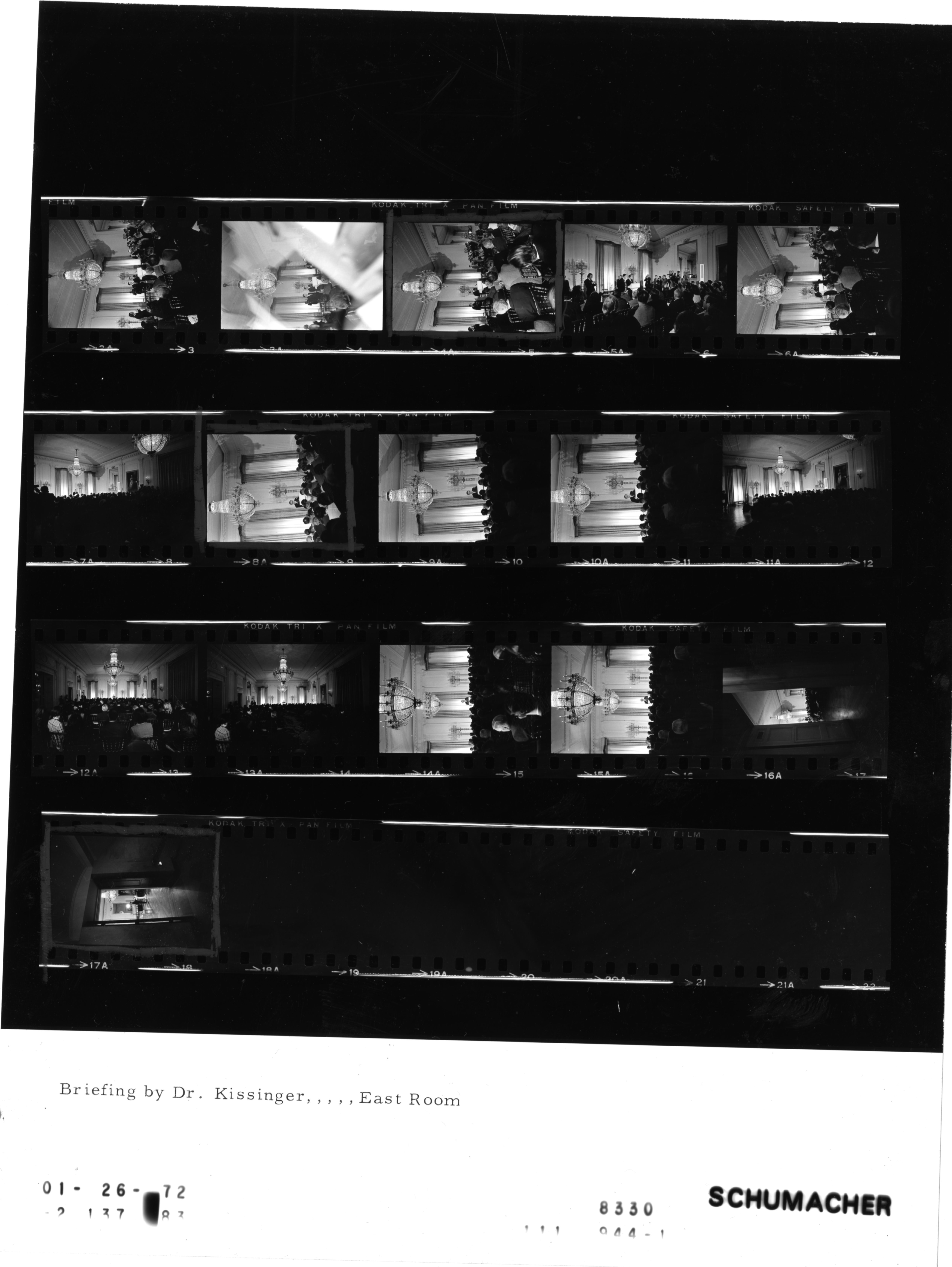
- Frame(s): WHPO-8330-, Henry Kissinger at a briefing. 1/26/1972, Washington, D.C. White House, East Room. Kissinger, briefing participants.
Roll WHPO-8331 Photographer: Schumaker, Byron | Color or B&W: B&W
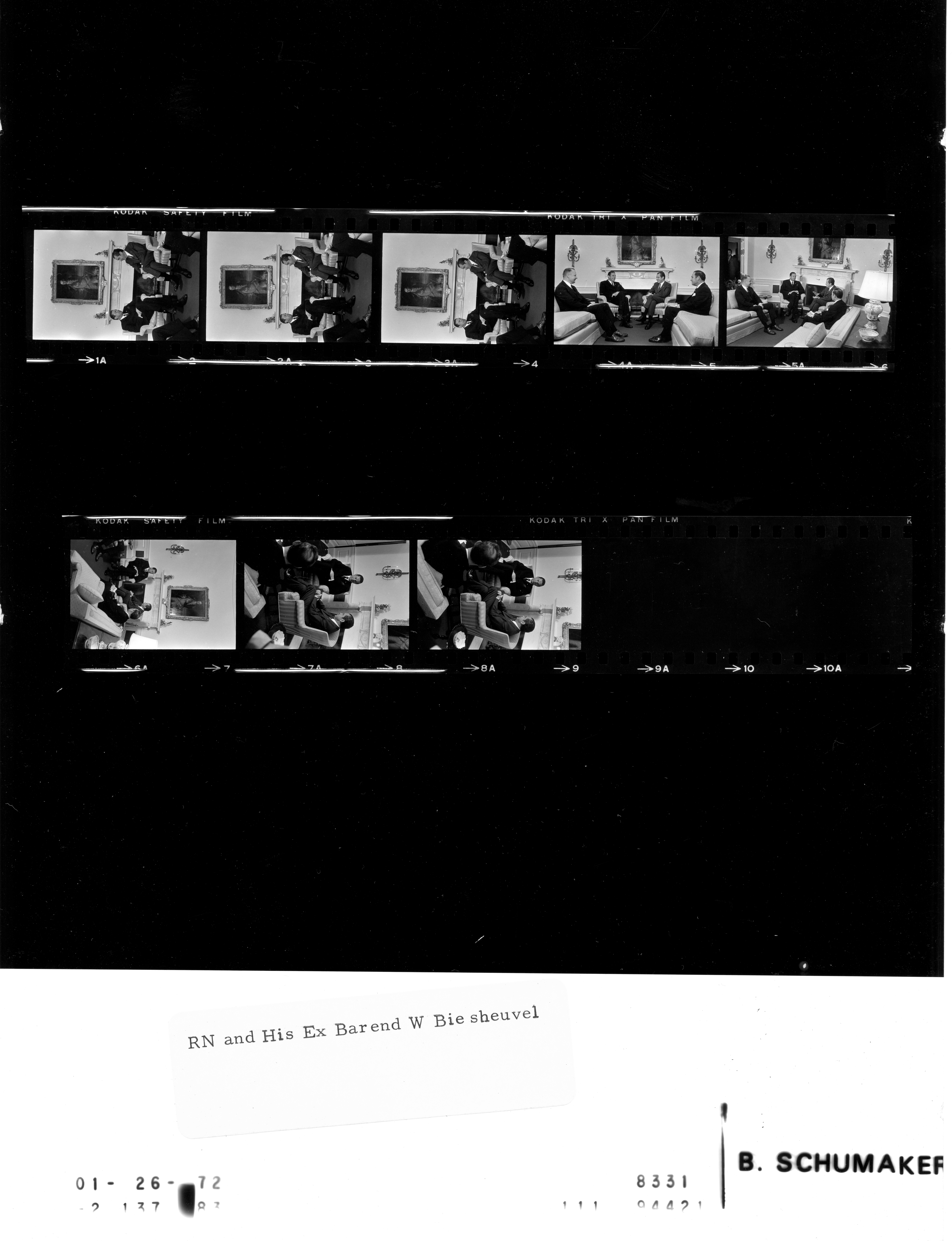
- Frame(s): WHPO-8331-, President Nixon seated informally with Netherlands Prime Minister Barend Biesheuvel and others. 1/26/1972, Washington, D.C. White House, Oval Office. President Nixon, Barend Biesheuvel, William Middendorf, Haig.
Roll WHPO-8332 Photographer: Knudsen, Robert L. | Color or B&W: B&W
- Frame(s): WHPO-8332-, President Nixon seated informally with the Quadriad. 1/26/1972, Washington, D.C. White House, Oval Office. President Nixon, Arthur Burns, John Connally, George Shultz, Hebert Stein, press corps members.
- Frame(s): WHPO-8332-11, President Nixon seated informally with the Quadriad in the Oval Office. 1/26/1972, Washington, D.C. White House, Oval Office. President Nixon, Arthur Burns, John Connally, George Shultz, Hebert Stein.
Roll WHPO-8333 Photographer: Knudsen, Robert L. | Color or B&W: B&W
- Frame(s): WHPO-8333-, President Nixon seated informally with Rep. Page Belcher. 1/26/1972, Washington, D.C. White House, Oval Office. President Nixon, Page Belcher.
The White House Communications Agency Sound Recordings Collection contains public statements that took place between 1969 and 1974. Visit the finding aid to learn more.
H - White House Staff Member Recordings
- WHCA-SR-H-499
Press briefing by Henry Kissinger and Ronald Ziegler. (1/26/1972, [None listed])
Runtime: 1:14:00
Keywords: Press conferences, news conferences, interviews, media, press secretary
Production credits: Audio feed supplied by WHCA; Recorded by RER (initials of WHCA engineer)
Original Format: 1/4-inch reel-to-reel audiotape. Original source type: Original.
H - White House Staff Member Recordings
- WHCA-SR-H-500
Press briefing by Neil Ball and Herb Stein. (1/26/1972, Room 2008, Executive Office Building)
Runtime: [Nonelisted]
Keywords: Press conferences, news conferences, interviews, media
Production credits: Audio feed supplied by WHCA; Recorded by SRJ (initials of WHCA engineer)
Original Format: 1/4-inch reel-to-reel audiotape. Original source type: Original.
H - White House Staff Member Recordings
- WHCA-SR-H-501
Henry Kissinger's remarks to the Women's National Press Club. (1/26/1972, Sheraton-Park Hotel, Washington, D.C.)
Runtime: 16:00
Keywords: Press conferences, news conferences, interviews, media
Production credits: Audio feed supplied by WHCA; Recorded by RSM (initials of WHCA engineer)
Original Format: 1/4-inch reel-to-reel audiotape. Original source type: Original.
P - Formal Presidential Remarks
- WHCA-SR-P-720112
Telephone conversation with HAK at the Sheraton Park Hotel. (1/26/1972)
Runtime: 0:36
Original Format: 1/4-inch reel-to-reel audiotape. Original source type: Original.
The White House Communications Agency Videotape Collection contains “off-the-air” recordings of televised programs produced between 1968 and 1974. Visit the finding aid to learn more.
- WHCA-5008
Weekly News Summary, Tape II.
All networks
Runtime: 1:30
11. Smith/Jarriel: President Nixon's peace plan; Kissinger's briefing. Time Code Start: 22:58. Keywords: media, press conferences, news conferences, interviews. Network: ABC.
12. Clark: Reaction to President Nixon's speech, Muskie, Hubert H. Humphrey, McGovern, Senator Ted Kennedy. Time Code Start: 25:58. Keywords: Presidents, speeches, public opinions, polls, approval ratings, Gallup poll, Harris poll, Presidential elections, campaigns, campaigning, primaries, candidates, voting, speeches. Network: ABC.
13. Smith/Tucker: POWs, MIAs; POW families reaction to President Nixon's speech. Time Code Start: 28:45. Keywords: Vietnam War, Vietnam Prisoner of War/Missing in Action, families, reactions, Presidents, statements, speeches. Network: ABC.
14. Smith: Commentary on President Nixon's speech. Time Code Start: 31:39. Keywords: Presidents, speeches. Network: ABC.
15. Chancellor: North Vietnam denounces President Nixon plan. Time Code Start: 33:26. Keywords: Presidents, Vietnam War, criticisms. Network: NBC.
16. Chancellor/Kaplow/Lord/Scherer: Kissinger briefing; VN report (Vietnam ?); Paris talks. Time Code Start: 34:40. Keywords: cabinet, advisors, media, press conferences, news conferences, interviews, Paris Peace Talks, Vietnam War, treaty, treaties, negotiations. Network: NBC.
17. Brinkley's Journal: Peace offer made by President Nixon. Time Code Start: 39:37. Keywords: Presidents, Paris Peace Talks, Vietnam War, treaty, treaties, negotiations. Network: NBC.
18. Chancellor: Reaction to Presidents Nixon's speech, McGovern, Hubert H. Humphrey, Muskie. Time Code Start: 41:32. Keywords: Presidents, speeches, public opinions, polls, approval ratings, Gallup poll, Harris poll, Presidential elections, campaigns, campaigning, primaries, candidates, voting, speeches. Network: NBC.
19. Chancellor: Former Secretary of Defense Clark Clifford, McCloskey reaction. Time Code Start: 44:32. Keywords: public opinions, reactions, cabinet, advisors, military, Vietnam War. Network: NBC.
20. Chancellor/Lewis/Graham/Flick/Hall: Reactions of American troops; POW families reaction; Alvarez family; Berrigan people comment (Harrisburg 7). Time Code Start: 45:49. Keywords: Vietnam War, Vietnam Prisoner of War, protests, militants, bombings, violence, sabotage, shootings, kidnappings, courts, trials, investigations, prosecutions. Network: NBC.
21. Cronkite/Rather: NV reaction (North Vietnam ?) ; Kissinger briefing. Time Code Start: 51:27. Keywords: Vietnam War, cabinet, advisors, media, press conferences, news conferences, interviews,. Network: CBS.
22. Cronkite/Jones: SV reaction (possibly South Vietnam). Time Code Start: 53:53. Keywords: Vietnam War, opinions, reactions. Network: CBS.
23. Cronkite/Kalb: President Nixon's speech. Time Code Start: 55:48. Keywords: Presidents, speeches. Network: CBS.
24. Cronkite/Simon: New arrivals in SV (South Vietnam ?). Time Code Start: 57:28. Keywords: Vietnam War. Network: CBS.
25. Sevareid: Commentary on President Nixon. Time Code Start: 62:00. Keywords: Presidents,. Network: CBS.
Context (External Sources)
The Vanderbilt Television News Archive is the world's most extensive and complete archive of television news. They have been recording, preserving and providing access to television news broadcasts of the national networks since August 5, 1968.
Wikipedia is a free encyclopedia that anyone can edit.