
Introduction
This almanac page for Thursday, January 27, 1972, pulls together various records created by the federal government and links to additional resources which can provide context about the events of the day.
Previous Date: Wednesday, January 26, 1972
Next Date: Friday, January 28, 1972
Schedule and Public Documents
The Daily Diary files represent a consolidated record of the President's activities. Visit the finding aid to learn more.
The President's day began at The White House - Washington, D. C.
The Weekly Compilation of Presidential Documents made available transcripts of the President's news conferences; messages to Congress; public speeches, remarks, and statements; and other Presidential materials released by the White House.
Digitized versions can be found at HathiTrust.
Each Public Papers of the Presidents volume contains the papers and speeches of the President of the United States that were issued by the White House Office of the Press Secretary during the time period specified by the volume. The material is presented in chronological order, and the dates shown in the headings are the dates of the documents or events. In instances when the release date differs from the date of the document itself, that fact is shown in the text note.
To ensure accuracy, remarks have been checked against audio recordings (when available) and signed documents have been checked against the original, unless otherwise noted. Editors have provided text notes and cross references for purposes of identification or clarity.
- Remarks Announcing Changes in the Cabinet and the Executive Office of the President.
- Letter Accepting the Resignation of Maurice H. Stans as Secretary of Commerce.
- Annual Message to the Congress: The Economic Report of the President
- Statement on the Death of Mahalia Jackson.
- Statement on Nominating Peter G. Peterson To Be Secretary of Commerce
The Federal Register is the official daily publication for rules, proposed rules, and notices of federal agencies and organizations, as well as executive orders and other Presidential documents.
The Congressional Record is the official daily record of the debates and proceedings of the U.S. Congress.
Archival Holdings
Any selection of archival documents will necessarily be partial. You should use the documents and folders identified below as a starting place, but consult the linked collection finding aids and folder title lists and the collections themselves for context. Many documents to be found this way do not lend themselves to association with specific dates, but are essential to a complete understanding of the material.
Selective document listing
President's Office Files
The President's Office Files consists of materials drawn together by the Special Files Unit from several administrative subdivisions within the White House Office. It is the handwriting and sensitive papers sent to the Staff Secretary that now comprise much of the President's Office Files. Visit the finding aid to learn more.
- News Summaries, Annotated News Summaries, Box 33, [Jan. 25-31, 1972] [1 of 2] [Note: Due to the way News Summary products were compiled, you should also consult nearby days for potentially relevant materials.]
- January 27, 1972
- News Summary, January 27, 1972
- President's Daily Schedule, Box 102, [President's Daily Schedule, Jan.-Mar. 1972] [3 of 3]
- The President's Schedule, Thursday - January 27, 1972
The H. R. Haldeman Diaries consists of seven handwritten diaries, 36 dictated diaries recorded as sound recordings, and two handwritten audio cassette tape subject logs. The diaries and logs reflect H. R. Haldeman’s candid personal record and reflections on events, issues, and people encountered during his service in the Nixon White House. As administrative assistant to the President and Chief of Staff, Haldeman attended and participated in public events and private meetings covering the entire scope of issues in which the Nixon White House engaged in during the years 1969-1973. Visit the finding aid to learn more.
- Transcript of diary entry (PDF)
Wedn-- Thursday, January 27.
Back to some more speech follow-up today as the President starts dealing with the various reactions. He specifically wanted to see whether Clifford had asked for a cease-fire, and if so, have Rogers hit him on it, because Clifford's attacking us on the wrong basis, saying that the cease-fire is the hang-up, whereas it's in North Vietnam's nine points, so we have an agreement on it. Also, the Kennedy attack he feels is particularly effective in saying that there should only be one point instead of eight points. He wants to be sure Rogers doesn't back off to that position. In general, he wants to stick to our offer and shift no ground.
He was furious with The Washington Post editorial, wants Henry to write a letter to The Post rebutting it. Also, said he's taking The Post off the China trip, and that Ron is not to come simpering and arguing about it. They deliberately screwed us, and we're going to have to get back at them, and that Ziegler's not to tell any press people they're going until the President reviews the China list again.
He wants Scali to get Rogers to crack Clifford on the cease-fire and answer the Kennedy line on the POW's with withdrawal, making the point that the Democratic critics are the party of surrender. We should praise the good Democrats like Nancy, Oden, Jackson, don't do it as a partisan thing, but say they want a Communist South Vietnam. We should drop the subtleties and fight, and keep after it day after day. One line, "peace is too important for politics", and another, "our critics are putting partisanship above peace, and partisanship above POW's". He wants Buchanan to write some of these, get some mileage out of them.
He called George Meany per our suggestion this afternoon, and apparently had a good chat with him. Meany said he agrees with Stennis, that the President's gone as far as he can on the Vietnam thing, also derided McCloskey as he calls him, for attacking the secrecy, because as Meany knows, secrecy is the only way you can end up with a good bargain.
President left at about 4:00 for Camp David to spend the night, be back tomorrow.
End of January 27. - Original audio recording (MP3)
The National Archives Catalog is the online portal to the records held at the National Archives, and information about those records. It is the main way of describing our holdings and also provides access to electronic records and digitized versions of our holdings.
The Catalog searches across multiple National Archives resources at once, including archival descriptions, digitized and electronic records, authority records, and web pages from Archives.gov and the Presidential Libraries. The Catalog also allows users to contribute to digitized historical records through tagging and transcription.
Nixon Library Holdings
All National Archives Units
National Security Documents
The President's Daily Brief is the primary vehicle for summarizing the day-to-day sensitive intelligence and analysis, as well as late-breaking reports, for the White House on current and future national security issues. Read "The President's Daily Brief: Delivering Intelligence to Nixon and Ford" to learn more.
The Foreign Relations of the United States series presents the official documentary historical record of major U.S. foreign policy decisions and significant diplomatic activity. Visit the State Department website for more information.
Vol. VIII, Vietnam, January-October 1972
Before the Easter Offensive, January 20-March 29, 1972
8. Joint United States and Republic of Vietnam Proposal, Washington, January 27, 1972
Source: National Archives, Nixon Presidential Materials, NSC Files, Kissinger Office Files, Box 107, Country Files, Far East, Vietnam Negotiations, Paris Negotiations, January 25, 1972–January 1973. No classification marking. This proposal was submitted at the plenary session of the Paris Peace Talks. The text of the proposal was released on January 25, the day of President Nixon’s speech (see Document 5). It is also printed in Public Papers: Nixon, 1972, pp. 105–106.
Vol. E-16, Documents on Chile, 1969-1973
Cool and Correct: The U.S. Response to the Allende Administration, November 5, 1970-December 31, 1972
101. Memorandum From the Chairman of the Ad Hoc Interagency Working Group on Chile (Meyer) to the Working Group, Washington, January 27, 1972
Summary: This memorandum outlined a proposal to the Ad Hoc Interagency Working Group on Chile that AID grant $125,000 to the American Institute for Free Labor Development for programs in Chile.
Source: National Archives, Nixon Presidential Materials, NSC Files, Box 776, Country Files, Latin America, Chile, Vol. VII. Secret. Sent to the Working Group members: Selden, Leddy, Kendall, Hartman, Hewitt, Broe, Carter, and Eaton. A February 9 covering memorandum from Hewitt to Kissinger, stated, “The AIFLD overseas program permits the U.S. to maintain a toe-hold in Chilean labor, and is consistent with the President’s decision to continue people-to-people type programs.” Haig initialed approval for Kissinger on the covering memorandum.
The Kissinger telephone conversation transcripts consist of approximately 20,000 pages of transcripts of Kissinger’s telephone conversations during his tenure as Assistant to the President for National Security Affairs (1969-1974) and Secretary of State (1973-1974) during the administration of President Richard Nixon. Visit the finding aid for more information.
Digitized versions can be found in the National Archives Catalog.
Audiovisual Holdings
Visit the White House Tapes finding aid to learn about the taping system's operation and archival processing.
Oval Office
- 658-1; Unknown between 8:45 a.m. & 8:50 a.m.; Nixon, Richard M. (President); Sanchez, Manolo
- 658-2; Unknown between 8:45 a.m. & 8:50 a.m.; Nixon, Richard M. (President); Butterfield, Alexander P.
- 658-3; 9:10 a.m. - 10:05 a.m.; Nixon, Richard M. (President); Haldeman, H. R. ("Bob"); Bull, Stephen B.; Kissinger, Henry A.; Butterfield, Alexander P.
- 658-4; 10:14 a.m. - 10:27 a.m.; Nixon, Richard M. (President); Woods, Rose Mary; Bull, Stephen B.
- 658-5; 10:27 a.m. - 11:12 a.m.; Nixon, Richard M. (President); Scammon, Richard M.; Colson, Charles W.; White House photographer
- 658-6; Unknown between 11:12 a.m. & 11:13 a.m.; Nixon, Richard M. (President); Bull, Stephen B.
- 658-7; 11:13 a.m. - 11:24 a.m.; Nixon, Richard M. (President); Stans, Maurice H.; Ziegler, Ronald L.; Peterson, Peter G.; Flanigan, Peter M.; White House photographer
- 658-8; 11:30 a.m. - 11:30 a.m.; Nixon, Richard M. (President); White House operator
- 658-9; 11:30 a.m. - 11:45 a.m.; Nixon, Richard M. (President); Butterfield, Alexander P.; Connally, John B.; [Unknown person(s)]; Bull, Stephen B.
- 658-10; 11:47 a.m. - 1:03 p.m.; Nixon, Richard M. (President); Haldeman, H. R. ("Bob"); Colson, Charles W.; Butterfield, Alexander P.
- 658-11; Unknown between 1:03 p.m. & 2:10 p.m.; Nixon, Richard M. (President); Butterfield, Alexander P.
- 658-12; Unknown between 1:03 p.m. & 2:10 p.m.; Nixon, Richard M. (President); White House operator
- 658-13; Unknown between 1:03 p.m. & 2:10 p.m.; Nixon, Richard M. (President); Bull, Stephen B.
- 658-14; Unknown between 1:03 p.m. & 2:10 p.m.; Nixon, Richard M. (President); Bull, Stephen B.
- 658-15; 2:10 p.m. - 2:17 p.m.; Nixon, Richard M. (President); Mansfield, Michael J. ("Mike")
- 658-16; Unknown between 2:17 p.m. & 2:20 p.m.; Nixon, Richard M. (President); White House operator
- 658-17; 2:20 p.m. - 2:20 p.m.; Nixon, Richard M. (President); White House operator
- 658-18; Unknown between 2:20 p.m. & 2:23 p.m.; Nixon, Richard M. (President); White House operator
- 658-19; Unknown between 2:20 p.m. & 2:23 p.m.; Nixon, Richard M. (President); Bull, Stephen B.
- 658-20; 2:23 p.m. - 2:24 p.m.; Nixon, Richard M. (President); Wilson, Jerry V.
- 658-21; Unknown between 2:24 p.m. & 2:32 p.m.; Nixon, Richard M. (President); White House operator
- 658-22; 2:32 p.m. - 2:34 p.m.; Nixon, Richard M. (President); Pitchess, Peter J.
- 658-23; Unknown between 2:34 p.m. & 2:40 p.m.; Nixon, Richard M. (President); White House operator
- 658-24; Unknown between 2:34 p.m. & 2:40 p.m.; Nixon, Richard M. (President); White House operator
- 658-25; 2:40 p.m. - 2:45 p.m.; Nixon, Richard M. (President); Mitchell, John N.
- 658-26; 2:50 p.m. - 3:00 p.m.; Nixon, Richard M. (President); Butterfield, Alexander P.; Bull, Stephen B.; Meany, George
- 658-27; Unknown between 3:00 p.m. & 3:07 p.m.; Nixon, Richard M. (President); Bull, Stephen B.
- 658-28; Unknown between 3:00 p.m. & 3:07 p.m.; Nixon, Richard M. (President); White House operator
- 658-29; 3:07 p.m. - 3:07 p.m.; Nixon, Richard M. (President); White House operator
- 658-30; Unknown between 3:07 p.m. & 3:13 p.m.; Nixon, Richard M. (President); Haldeman, H. R. ("Bob")
- 658-31; 3:13 p.m. - 3:46 p.m.; Nixon, Richard M. (President); Kissinger, Henry A.; [Unknown person(s)]; Butterfield, Alexander P.
- 658-32; Unknown between 3:46 p.m. & 3:49 p.m.; Nixon, Richard M. (President); Bull, Stephen B.
- 658-33; Unknown between 3:46 p.m. & 3:49 p.m.; United States Secret Service agents
- 658-34; Unknown between 10:05 a.m. & 10:14 a.m.; United States Secret Service agents
- 658-35; Unknown between 11:24 a.m. & 11:30 a.m.; United States Secret Service agents; [Unknown person(s)]
White House Telephone
- 19-131; 11:30 a.m. - 11:30 a.m.; Nixon, Richard M. (President); White House operator
- 19-132; 11:32 a.m. - 11:41 a.m.; Nixon, Richard M. (President); Connally, John B.
- 19-133; Unknown between 1:03 p.m. & 2:10 p.m.; Nixon, Richard M. (President); White House operator
- 19-134; 2:10 p.m. - 2:17 p.m.; Nixon, Richard M. (President); Mansfield, Michael J. ("Mike")
- 19-135; Unknown between 2:17 p.m. & 2:20 p.m.; Nixon, Richard M. (President); White House operator
- 19-136; 2:20 p.m. - 2:20 p.m.; Nixon, Richard M. (President); White House operator
- 19-137; Unknown between 2:20 p.m. & 2:23 p.m.; Nixon, Richard M. (President); White House operator
- 19-138; 2:23 p.m. - 2:24 p.m.; Nixon, Richard M. (President); Wilson, Jerry V.
- 19-139; Unknown between 2:24 p.m. & 2:32 p.m.; Nixon, Richard M. (President); White House operator
- 19-140; 2:32 p.m. - 2:34 p.m.; Nixon, Richard M. (President); Pitchess, Peter J.
- 19-141; Unknown between 2:34 p.m. & 2:40 p.m.; Nixon, Richard M. (President); White House operator
- 19-142; 2:40 p.m. - 2:45 p.m.; Nixon, Richard M. (President); Mitchell, John N.
- 19-143; 2:56 p.m. - 3:00 p.m.; Nixon, Richard M. (President); Meany, George
- 19-144; Unknown between 3:00 p.m. & 3:07 p.m.; Nixon, Richard M. (President); White House operator
- 19-145; 3:07 p.m. - 3:07 p.m.; Nixon, Richard M. (President); White House operator
The White House Photo Office collection consists of photographic coverage of President Richard Nixon meeting with prominent social, political, and cultural personalities; speaking engagements and news conferences of the President and various high-ranking members of the White House staff and Cabinet; Presidential domestic and foreign travel, including Presidential vacations; social events and entertainment involving the First Family, including entertainers present; official portraits of the President, First Family, and high-ranking members of the Nixon administration; the 1969 and 1973 Inaugurals; the President’s 1972 Presidential election campaign appearances (including speeches) and other official activities of the White House staff and the President’s Cabinet from January 20, 1969 until August 9, 1974 at the White House and the Old Executive Office Building; other locations in Washington, DC, such as The Mall; and the Presidential retreats in Camp David, Maryland, Key Biscayne, Florida, and San Clemente, California. Visit the finding aid to learn more.
Roll WHPO-8334 Photographer: Atkins, Oliver | Color or B&W: B&W
- Frame(s): WHPO-8334-, President Nixon signing the 1972 Economic Report as Stein and CEA staff members watch. 1/27/1972, Washington, D.C. White House, Cabinet Room. President Nixon, Stein, Ziegler, CEA staff members.
Roll WHPO-8335 Photographer: Schumaker, Byron | Color or B&W: B&W
- Frame(s): WHPO-8335-, President Nixon signing the 1972 Economic Report as Stein and CEA staff members watch. 1/27/1972, Washington, D.C. White House, Cabinet Room. President Nixon, Stein, Ziegler, CEA staff members, press corps members.
- Frame(s): WHPO-8335-11, Panoramic view of President Nixon signing the 1972 Economic Report as Stein and CEA staff members watch. 1/27/1972, Washington, D.C. White House, Cabinet Room. President Nixon, Stein, Ziegler, CEA staff members, press corps members.
Roll WHPO-8336 Photographer: Schumacher, Karl | Color or B&W: B&W
- Frame(s): WHPO-8336-, President Nixon standing with out-going Commerce Secretary Stans, Secretary-designate Peter Peterson, and Peter Flanigan. 1/27/1972, Washington, D.C. White House, Oval Office. President Nixon, Stans, Peter Peterson, Peter Flanigan.
Roll WHPO-8337 Photographer: Schumacher, Karl | Color or B&W: B&W
- Frame(s): WHPO-8337-, President Nixon standing with Richard Scammon. 1/27/1972, Washington, D.C. White House, Oval Office. President Nixon, Richard Scammon.
Roll WHPO-8338 Photographer: Schumaker, Byron | Color or B&W: B&W
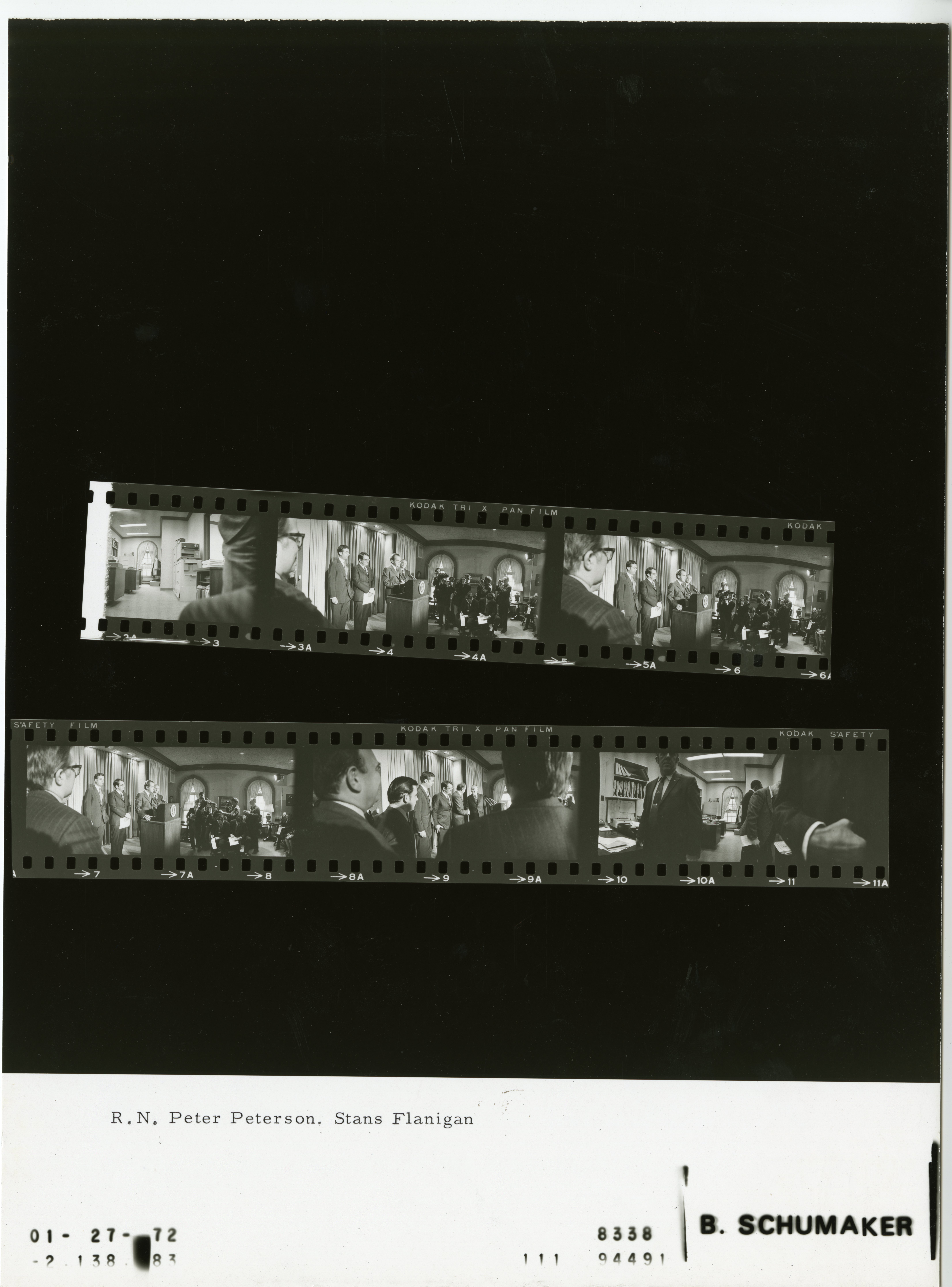
- Frame(s): WHPO-8338-, President Nixon at a podium briefing the press about the change in Commerce Secretaries. 1/27/1972, Washington, D.C. Press Room, White House. President Nixon, Stans, Peter Peterson, Peter Flanigan, press corps members.
Roll WHPO-8339 Photographer: Schumaker, Byron | Color or B&W: B&W
- Frame(s): WHPO-8339-, President Nixon and others at a podium briefing the press about the change in Commerce Secretaries. 1/27/1972, Washington, D.C. Press Room, White House. President Nixon, Stans, Peter Peterson, Peter Flanigan, press corps members.
Roll WHPO-8340 Photographer: Knudsen, Robert L. | Color or B&W: Color
- Frame(s): WHPO-8340-, President Nixon standing with Stans, Peter Peterson, and Peter Flanigan. 1/27/1972, Washington, D.C. White House, Oval Office. President Nixon, Stans, Peter Peterson, Peter Flanigan.
Roll WHPO-8341 Photographer: Knudsen, Robert L. | Color or B&W: B&W
- Frame(s): WHPO-8341-, President Nixon greeting women from the Washington-Tokyo Society. 1/27/1972, Washington, D.C. White House, Rose Garden. President Nixon, unidentified women.
- Frame(s): WHPO-8341-[DASH], Autographed head and shoulders formal portrait of President Nixon. 1/27/1972, Washington, D.C. White House, Oval Office. President Nixon.
Roll WHPO-8342 Photographer: Knudsen, Robert L. | Color or B&W: B&W
- Frame(s): WHPO-8342-02-20, Unidentified men receiving Safe Driving Awards. 1/27/1972, Washington, D.C. unknown. unidentified persons.
- Frame(s): WHPO-8342-21-24, Unidentified man and woman in an office. 1/27/1972, Washington, D.C. unknown. unidentified persons.
The White House Communications Agency Sound Recordings Collection contains public statements that took place between 1969 and 1974. Visit the finding aid to learn more.
P - Formal Presidential Remarks
- WHCA-SR-P-720113
Announcement of resignation of Secretary Stans with Secretary Stans, PP, PF. (1/27/1972)
Runtime: 4:21
Original Format: 1/4-inch reel-to-reel audiotape. Original source type: Original.
The White House Communications Agency Videotape Collection contains “off-the-air” recordings of televised programs produced between 1968 and 1974. Visit the finding aid to learn more.
- WHCA-5004
"McCaffrey at Large". Senators Humphrey and Muskie.
CBS
Runtime: 00:30:46 - WHCA-5005
"Lyndon Johnson Talks Politics".
CBS
Runtime: 00:59:20 - WHCA-5006
"Martin Agronsky: Evening Edition".
Runtime: 00:29:27 - WHCA-5008
Weekly News Summary, Tape II.
All networks
Runtime: 1:30
26. Reasoner/Dunsmore: Paris Peace Talks, Ambassador William J. Porter. Time Code Start: 64:35. Keywords: Paris Peace Talks, Vietnam War, treaty, treaties, negotiations, government, officials. Network: ABC.
27. Smith/Matney: Secretary of State Rogers' press conference. Time Code Start: 66:33. Keywords: cabinet, advisors, media, press conferences, news conferences, interviews. Network: ABC.
28. Smith: Casualty report. Time Code Start: 68:15. Keywords: Vietnam War, killed in action, KIA, death tolls, fatalities, casualty, casualties, military, troops. Network: ABC.
29. Smith: Economic indicators; President Nixon economic report; George boldt controversy. Time Code Start: 68:50. Keywords: economy, economics, budgets, finances, recession, inflation, money, wages, costs, unemployment, prices, reports. Network: ABC.
30. Smith/jarriel: Secretary Stans resigns, President Nixon. Time Code Start: 69:41. Keywords: Presidents, cabinet, advisors, resignations. Network: ABC.
31. Smith/Gill: Henry Kissinger at Washington Press Club. Time Code Start: 71:32. Keywords: cabinet, advisors, speeches, media, news organizations. Network: ABC.
32. Reasoner: Commentary on Howard Hughes. Time Code Start: 73:42. Keywords: Presidents, gifts, money, funding, fundraising, donations, contributions, Howard Hughes, aviators. Network: ABC.
33. Chancellor/Utley: Paris Peace Talks, Ambassador William J. Porter. Time Code Start: 75:40. Keywords: Paris Peace Talks, Vietnam War, treaty, treaties, negotiations, government, officials. Network: NBC.
34. Chancellor: Secretary of State Rogers on peace talks. Time Code Start: 78:28. Keywords: cabinet, advisors, Paris Peace Talks, Vietnam War, treaty, treaties, negotiations, statements, speeches. Network: NBC.
35. Chancellor/Paxton: Vietnam war action. Time Code Start: 80:15. Keywords: Vietnam War. Network: NBC.
36. Chancellor: President Nixon's economic message to Congress and the budget, Representative Mahon, Shultz. Time Code Start: 82:42. Keywords: Presidents, speeches, reports, economy, economics, budgets, finances, recession, inflation, money, wages, costs, unemployment, prices, payments. Network: NBC.
37. Chancellor/Levine: George Holdt controversy. Time Code Start: 85:16. Keywords: scandals. Network: NBC. - WHCA-5009
Weekly News Summary, Tape III.
All networks
Runtime: 0:30
1. Cronkite: Paris Peace Talks, Ambassador William J. Porter. Time Code Start: 00:00. Keywords: Paris Peace Talks, Vietnam War, treaty, treaties, negotiations, government, officials. Network: CBS.
2. Cronkite/Kalb: Secretary of State Rogers comments on peace talks. Time Code Start: 02:57. Keywords: cabinet, advisors, Paris Peace Talks, Vietnam War, treaty, treaties, negotiations, statements, speeches. Network: CBS.
3. Cronkite: Vietnam war action. Time Code Start: 04:30. Keywords: Vietnam War. Network: CBS.
4. Cronkite/Schorr: Economic indicators; President Nixon economic report, Herbert Stein. Time Code Start: 05:45. Keywords: economy, economics, budgets, finances, recession, inflation, money, wages, costs, unemployment, prices, reports. Network: CBS.
5. Cronkite: former President Johnson (LBJ) interview. Time Code Start: 08:45. Keywords: Presidents, speeches, media, interviews. Network: CBS.
6. Cronkite: Kissinger speaks to Washington Press Club. Time Code Start: 10:50. Keywords: cabinet, advisors, speeches, media, news organizations. Network: CBS.
7. Sevareid: Commentary on New York traffic problems. Time Code Start: 12:33. Keywords: cities, roads, congestion, traffic jams, rush hour, cars, automobiles. Network: CBS.
Context (External Sources)
The Vanderbilt Television News Archive is the world's most extensive and complete archive of television news. They have been recording, preserving and providing access to television news broadcasts of the national networks since August 5, 1968.
Wikipedia is a free encyclopedia that anyone can edit.