
Introduction
This almanac page for Tuesday, April 10, 1973, pulls together various records created by the federal government and links to additional resources which can provide context about the events of the day.
Previous Date: Monday, April 9, 1973
Next Date: Wednesday, April 11, 1973
Schedule and Public Documents
The Daily Diary files represent a consolidated record of the President's activities. Visit the finding aid to learn more.
The President's day began at The White House - Washington, D. C.
The Weekly Compilation of Presidential Documents made available transcripts of the President's news conferences; messages to Congress; public speeches, remarks, and statements; and other Presidential materials released by the White House.
Digitized versions can be found at HathiTrust.
Each Public Papers of the Presidents volume contains the papers and speeches of the President of the United States that were issued by the White House Office of the Press Secretary during the time period specified by the volume. The material is presented in chronological order, and the dates shown in the headings are the dates of the documents or events. In instances when the release date differs from the date of the document itself, that fact is shown in the text note.
To ensure accuracy, remarks have been checked against audio recordings (when available) and signed documents have been checked against the original, unless otherwise noted. Editors have provided text notes and cross references for purposes of identification or clarity.
- Remarks on Transmitting a Special Message to the Congress on Proposed Trade Reform Legislation.
- Special Message to the Congress Proposing Trade Reform Legislation
- Statement About House Action Sustaining the Veto of the Rural Water and Sewer Grant Program Bill
- Toasts of the President and Prime Minister Lee Kuan Yew of Singapore.
- Proclamation 4206—Nicolaus Copernicus Week
The Federal Register is the official daily publication for rules, proposed rules, and notices of federal agencies and organizations, as well as executive orders and other Presidential documents.
The Congressional Record is the official daily record of the debates and proceedings of the U.S. Congress.
Archival Holdings
Any selection of archival documents will necessarily be partial. You should use the documents and folders identified below as a starting place, but consult the linked collection finding aids and folder title lists and the collections themselves for context. Many documents to be found this way do not lend themselves to association with specific dates, but are essential to a complete understanding of the material.
Selective document listing
President's Office Files
The President's Office Files consists of materials drawn together by the Special Files Unit from several administrative subdivisions within the White House Office. It is the handwriting and sensitive papers sent to the Staff Secretary that now comprise much of the President's Office Files. Visit the finding aid to learn more.
- News Summaries, Unmarked News Summaries, Box 54, News Summaries - April 2-14, 1973 [6 of 10] [Note: Due to the way News Summary products were compiled, you should also consult nearby days for potentially relevant materials.]
- News Summary, April 10, 1973, (Monday nets, wires)
President's Personal File
The President's Personal File is essentially a President's secretary's file, kept by Rose Mary Woods, personal secretary to the President, for two purposes: (1) preserving for posterity a collection of documents particularly close to the President, whether because he dictated or annotated them, or because of the importance of the correspondent or the event concerned and (2) giving appropriate attention–letters of gratitude, invitations to White House social events, and the like–to members and important friends and supporters of the Nixon administration. This generalization does not describe all the varied materials of a file group which is essentially a miscellany, but it does identify the reason for the existence of the file group's core. Visit the finding aid to learn more.
- President's Speech File
The H. R. Haldeman Diaries consists of seven handwritten diaries, 36 dictated diaries recorded as sound recordings, and two handwritten audio cassette tape subject logs. The diaries and logs reflect H. R. Haldeman’s candid personal record and reflections on events, issues, and people encountered during his service in the Nixon White House. As administrative assistant to the President and Chief of Staff, Haldeman attended and participated in public events and private meetings covering the entire scope of issues in which the Nixon White House engaged in during the years 1969-1973. Visit the finding aid to learn more.
- Transcript of diary entry (PDF)
Wednesday, April 10.
The President got me in first thing this morning before the leadership meeting again to go back over the David and Julie house problem. And wanted me to talk to Bush again today and get that straightened out once more around. The upshot was that we worked it out that Goodling did want to see the President and we set that up, and then the President and Devine met with David to say that Goodling isn't going to tell anybody what his decision is until January, but in fact, he's not going to run, although David is theoretically not supposed to know that. On that basis, we will not hire David in his office, so David's got to go to work somewhere else and there's no problem about the house and his living in the District, apparently, as long as it's set up that way.
The Vice President called me over today and said he had a real problem, because Jerry Wolff, who used to work for him back in Maryland, and then he brought him to Washington with him and who is now back as an engineer in Maryland is about to be called by the US Attorney who was busting open campaign contribution cases and kickbacks to contractors. It seems that Wolf kept verbatim records of meetings with the Vice President and others, back over the years, regarding fundraising, and has a lot of quotes about how much we ought to get from a certain contractor, and so on, who has had good jobs. It wasn't shakedown stuff, it was merely going back to get support from those who had been given-- who had benefited from the Administration, but the way it's worded, the Vice President feels it would sound bad. He made the point that George Beall, who is Glenn Beall's brother, is the US Attorney there, and that if Glenn Beall would talk to him, he could straighten it out. The Vice President's tried to get him to, but apparently not successfully, so he wanted me to talk to Glenn Beall, which, of course, I won't do, in order to verify a White House awareness and concern. He feels that publication of this stuff would finish the VP, because Wolf was with him for so long and is very much concerned. He agreed he'd probably get Colson into it, and that it would be the best way to handle it.
The President had me over again the end of the day for another sort of general rambling discussion of the Watergate thing which basically accomplished nothing.
End of April 10. - Original audio recording (MP3)
The National Archives Catalog is the online portal to the records held at the National Archives, and information about those records. It is the main way of describing our holdings and also provides access to electronic records and digitized versions of our holdings.
The Catalog searches across multiple National Archives resources at once, including archival descriptions, digitized and electronic records, authority records, and web pages from Archives.gov and the Presidential Libraries. The Catalog also allows users to contribute to digitized historical records through tagging and transcription.
Nixon Library Holdings
All National Archives Units
National Security Documents
The President's Daily Brief is the primary vehicle for summarizing the day-to-day sensitive intelligence and analysis, as well as late-breaking reports, for the White House on current and future national security issues. Read "The President's Daily Brief: Delivering Intelligence to Nixon and Ford" to learn more.
The Foreign Relations of the United States series presents the official documentary historical record of major U.S. foreign policy decisions and significant diplomatic activity. Visit the State Department website for more information.
Vol. XV, Soviet Union, June 1972-August 1974
Summit Preparations; Jackson-Vanik Amendment; Non-Use of Nuclear Weapons, December 1972-April 1973
94. Meeting Between President Nixon and the Bipartisan Congressional Leadership, Washington, April 10, 1973
Source: National Archives, Nixon Presidential Materials, White House Tapes, Cabinet Room, Conversation No. 122–1. No classification marking. The editor transcribed the portion of the conversation printed here specifically for this volume. This conversation took place sometime between 8:37 a.m. and 10:19 a.m. A list of attendees is in the President’s Daily Diary. (Ibid., White House Central Files)
95. Memorandum of Conversation, Washington, April 10, 1973, 8:40-9:45 a.m.
Source: National Archives, Nixon Presidential Materials, NSC Files, Box 496, President’s Trip Files, Dobrynin/Kissinger, Vol. 16. Top Secret; Sensitive; Exclusively Eyes Only. The meeting took place in the Map Room at the White House. Sonnenfeldt sent Kissinger an April 9 briefing memorandum prior to the meeting with Dobrynin. (Ibid., Kissinger Office Files, Box 67, Country Files—Europe—USSR, Map Room, Aug. 1972–May 31, 1973 [1 of 3])
Vol. XXVII, Iran; Iraq, 1973-1976
Iraq, January 1973-December 1974
211. Telegram From the Interests Section in Baghdad to the Department of State, Baghdad, April 10, 1973, 1213Z
Source: National Archives, RG 59, Central Files 1970–73, POL 12 IRAQ. Confidential. Repeated to Amman, Beirut, Jidda, Kuwait, London, Moscow, Paris, Tehran, Tripoli, and Cairo.
212. Telegram From the Interests Section in Baghdad to the Department of State, Baghdad, April 10, 1973, 1230Z
Source: National Archives, RG 59, Central Files 1970–73, POL IRAQ–USSR. Confidential. Repeated to Amman, Beirut, Jidda, Kuwait, London, Moscow, Paris, Tehran, Tripoli, and Cairo.
Vol. XXXIX, European Security
Opening Negotiations, December 1972-July 1973
133. Memorandum From Helmut Sonnenfeldt of the National Security Council Staff to the President’s Assistant for National Security Affairs (Kissinger), Washington, April 10, 1973
Source: National Archives, Nixon Presidential Materials, NSC Files, Box 1335, Unfiled Material, 1973, 5 of 12.
Vol. E-6, Documents on Africa, 1973-1976
Africa Region
4. Memorandum From the Deputy Assistant Secretary of State for African Affairs (Ross) to the Under Secretary of State for Security Affairs (Tarr), Washington, April 10, 1973
Ross attached a reexamination of United States purposes, goals and rationale behind U.S. security assistance programs for Africa.
Source: National Archives, RG 59, AF/I Files: Lot 75 D 420, Box 1, MAP FY 74. Confidential. Drafted by Andre J. Navez (AF/RA); cleared by Peter Walker (AF/RA). The memorandum is a copy with an indication that Ross signed the original.
Vol. E-8, Documents on South Asia, 1973-1976
Nepal, Sikkim, and Bhutan
242. Telegram 4127 From the Embassy in India to the Department of State, New Delhi, April 10, 1973, 1326Z
The Embassy discussed the restoration of an Indian administrator in Sikkim after a period of popular unrest. The Embassy anticipated that the administrative situation in Sikkim would revert to the pre-1972 pattern.
Source: National Archives, RG 59, Central Foreign Policy Files. Confidential; Immediate. It was repeated to Bombay, Calcutta, Madras, Hong Kong, Katmandu, and Islamabad.
Vol. E-11, Part 1, Documents on Mexico; Central America; and the Caribbean, 1973-1976
Costa Rica
110. Telegram 1248 From the Embassy in Costa Rica to the Department of State, San José, April 10, 1973, 1700Z
Summary: Ambassador Vaky informed President Figueres of the SEC’s rejection of his offer to help mediate a settlement between the Commission and Robert Vesco.
Source: National Archives, Nixon Presidential Materials, NSC Files, Country Files, Box 779, Latin America, Costa Rica. Confidential; Nodis. The April 2 letter from the Securities and Exchange Commission to Figueres referred to in this telegram has not been found. In telegram 984 from San José, March 22, Vaky reported on a conversation with Figueres, observing that the President seemed to feel the SEC’s primary concern was keeping investment capital within the United States. Vaky countered that the Commission was seeking to ensure the “honest and proper management of funds.” (Ibid.) In telegram 58280 to Panama City, April 10, Rogers described Vesco’s possible bank deposits. (Ibid., RG 59, Central Foreign Policy File, [no film number]) Telegram 983 from San José was not found.
Haiti
393. Memorandum From the Director of the Office of Caribbean Affairs (Burke) to the Deputy Assistant Secretary of State for Inter-American Affairs (Hurwitch), Washington, April 10, 1973
Summary: Burke briefed Hurwitch in advance of a meeting with Haitian Foreign Minister Adrien Raymond, informing him of Haiti’s interest in receiving additional U.S. economic aid and in becoming eligible for increased military assistance.
Source: National Archives, RG 59, Central Files, 1970–1973, ARA/CAR, Lot 75D393, POL 7 Visits and Meetings. Confidential. In a February 28 letter to Burke, Knox expressed satisfaction that consideration was being given to including Haiti in the Foreign Military Sales (FMS) program and recommended that military training be provided through the Military Assistance Program (MAP). (Ibid., POL 1–3 CASP) In telegram 93698 to Port-au-Prince, May 16, the Department informed the Embassy of its approval for Haiti’s first purchase of military equipment under the FMS program. (Ibid., Central Foreign Policy File, [no film number]) No record of the April 10 meeting between Hurwitch and Raymond has been found.
Vol. E-11, Part 2, Documents on South America, 1973-1976
Uruguay
333. Memorandum Prepared in the Central Intelligence Agency, Washington, April 10, 1973
Summary: The Central Intelligence Agency concluded that the February dispute between President Bordaberry and the Uruguayan military had ended with the armed forces “in virtual control of the government,” and that the military would soon move toward economic reform.
Source: Central Intelligence Agency, Office of Support Services (DI), Job 79T00861A: Intel Pub Files (1973), Box 11, Folder 1: The Future Role of the Military in Uruguay. Secret; [handling restriction not declassified]. Attached notes indicate that the memorandum was distributed to Kendall, Jorden, Stedman, Vallimarescu, and Summ.
Vol. E-12, Documents on East and Southeast Asia, 1973-1976
Malaysia and Singapore
292. Memorandum of Conversation, Washington, April 10, 1973, 10:30–11:03 a.m., Washington, April 10, 1973, 10:30-11:03 a.m.
Kissinger and Lee discussed the international situation in East Asia.
Source: National Archives, Nixon Presidential Materials, NSC Files, Box 938, VIP Visits, Singapore Prime Minister Lee Kuan Yew, April 10, 1973. Secret; Sensitive. The conversation took place in Kissinger’s office in the White House. Holdridge’s talking points for Kissinger, April 9, are ibid.293. Memorandum of Conversation, Washington, April 10, 1973, 11:13 a.m. –12:18 p.m., Washington, April 10, 1973, 11:13 a.m.-12:18 p.m.
Nixon and Lee discussed international affairs.
Source: National Archives, Nixon Presidential Materials, NSC Files, Box 938, VIP Visits, Singapore Prime Minister Lee Kuan Yew, April 10, 1973. Secret. The conversation took place in the White House. Undated talking points from Kissinger to the President, which the President saw, are ibid.
The Kissinger telephone conversation transcripts consist of approximately 20,000 pages of transcripts of Kissinger’s telephone conversations during his tenure as Assistant to the President for National Security Affairs (1969-1974) and Secretary of State (1973-1974) during the administration of President Richard Nixon. Visit the finding aid for more information.
Digitized versions can be found in the National Archives Catalog.
Audiovisual Holdings
Visit the White House Tapes finding aid to learn about the taping system's operation and archival processing.
Cabinet Room
Old Executive Office Building
- 426-27; 2:01 p.m. - 2:02 p.m.; Nixon, Richard M. (President); Bull, Stephen B.; White House operator
- 426-28; 2:02 p.m. - 2:03 p.m.; Nixon, Richard M. (President); Timmons, William E.
- 426-29; Unknown between 2:03 p.m. & 2:09 p.m.; Nixon, Richard M. (President); Sanchez, Manolo; White House operator
- 426-30; 2:09 p.m. - 2:10 p.m.; Nixon, Richard M. (President); Bull, Stephen B.
- 426-31; 2:10 p.m. - 2:10 p.m.; Nixon, Richard M. (President); White House operator
- 426-32; 2:11 p.m. - 2:11 p.m.; Nixon, Richard M. (President); White House operator
- 426-33; Unknown between 2:11 p.m. & 3:25 p.m.; Nixon, Richard M. (President); White House operator
- 426-34; 3:25 p.m. - 3:25 p.m.; Nixon, Richard M. (President); White House operator
- 426-35; 3:26 p.m. - 3:30 p.m.; Nixon, Richard M. (President); Arends, Leslie C.
- 426-36; 3:33 p.m. - 3:33 p.m.; Nixon, Richard M. (President); White House operator
- 426-37; Unknown between 3:33 p.m. & 3:34 p.m.; Nixon, Richard M. (President); White House operator
- 426-38; 3:34 p.m. - 3:45 p.m.; Nixon, Richard M. (President); Waggonner, Joe D., Jr.
- 426-39; Unknown between 3:45 p.m. & 3:46 p.m.; Nixon, Richard M. (President); White House operator
- 426-40; 3:46 p.m. - 3:48 p.m.; Nixon, Richard M. (President); Cook, Richard K.
- 426-41; 3:49 p.m. - 3:50 p.m.; Nixon, Richard M. (President); Bull, Stephen B.
- 426-42; Unknown between 4:45 p.m. & 5:59 p.m.; Nixon, Richard M. (President); Devine, Samuel L.; [Unknown person(s)]; Eisenhower, [Dwight] David, II
- 426-43; Unknown between 4:58 p.m. & 5:59 p.m.; Nixon, Richard M. (President); White House operator
- 426-44; Unknown between 5:00 p.m. & 5:59 p.m.; Nixon, Richard M. (President)
- 426-45; Unknown between 5:00 p.m. & 5:59 p.m.; Nixon, Richard M. (President); White House operator
- 426-46; Unknown between 5:00 p.m. & 5:59 p.m.; Nixon, Richard M. (President)
- 426-47; Unknown between 5:00 p.m. & 5:59 p.m.; Nixon, Richard M. (President); [Unknown person(s)]
- 426-48; Unknown between 5:00 p.m. & 5:59 p.m.; Nixon, Richard M. (President); Eisenhower, [Dwight] David, II; Devine, Samuel L.
- 426-49; 5:59 p.m. - 5:59 p.m.; Nixon, Richard M. (President); [Unknown person(s)]
- 426-50; 5:59 p.m. - 6:09 p.m.; Nixon, Richard M. (President); Ehrlichman, John D.
- 426-51; 6:09 p.m. - 6:14 p.m.; Nixon, Richard M. (President); Bull, Stephen B.
- 426-52; 6:14 p.m. - 6:14 p.m.; Nixon, Richard M. (President); Haldeman, H. R. ("Bob")
- 426-53; Unknown between 6:14 p.m. & 6:17 p.m.; Nixon, Richard M. (President); White House operator
- 426-54; 6:17 p.m. - 6:18 p.m.; Nixon, Richard M. (President); Eisenhower, Julie Nixon; [Unknown person(s)]
- 426-55; 6:20 p.m. - 7:01 p.m.; Nixon, Richard M. (President); Haldeman, H. R. ("Bob")
Oval Office
- 892-1; Unknown between 8:10 a.m. & 8:16 a.m.; Nixon, Richard M. (President); Sanchez, Manolo
- 892-2; Unknown between 8:10 a.m. & 8:16 a.m.; Nixon, Richard M. (President); [Unknown person(s)]
- 892-3; Unknown between 8:10 a.m. & 8:16 a.m.; Nixon, Richard M. (President); [Unknown person(s)]
- 892-4; Unknown between 8:16 a.m. & 8:37 a.m.; Nixon, Richard M. (President); Haldeman, H. R. ("Bob"); Timmons, William E.
- 892-5; 10:22 a.m. - 10:22 a.m.; Nixon, Richard M. (President); Timmons, William E.; Korologos, Thomas C.
- 892-6; Unknown between 10:39 a.m. & 10:44 a.m.; Nixon, Richard M. (President); Bull, Stephen B.
- 892-7; 10:44 a.m. - 11:05 a.m.; Nixon, Richard M. (President); Haldeman, H. R. ("Bob")
- 892-8; Unknown between 11:05 a.m. & 11:10 a.m.; Nixon, Richard M. (President); [Unknown person(s)]
- 892-9; Unknown between 11:10 a.m. & 12:18 p.m.; Nixon, Richard M. (President); Yew, Lee Kuan; Monteiro, Ernest S.; Kissinger, Henry A.; Sanchez, Manolo
- 892-10; Unknown between 12:19 p.m. & 12:24 p.m.; Nixon, Richard M. (President); Bull, Stephen B.; Kissinger, Henry A.
- 892-11; Unknown between 12:19 p.m. & 12:44 p.m.; Nixon, Richard M. (President); Bull, Stephen B.; Kissinger, Henry A.
- 892-12; Unknown between 12:44 p.m. & 12:48 p.m.; Nixon, Richard M. (President); Ehrlichman, John D.
- 892-13; Unknown between 12:44 p.m. & 12:48 p.m.; Nixon, Richard M. (President); Sanchez, Manolo
- 892-14; 12:48 p.m. - 2:00 p.m.; Nixon, Richard M. (President); Ehrlichman, John D.; Haldeman, H. R. ("Bob")
- 892-15; Unknown between 3:54 p.m. & 3:56 p.m.; Nixon, Richard M. (President); [Unknown person(s)]
- 892-16; 3:56 p.m. - 4:42 p.m.; Nixon, Richard M. (President); Goodling, George A.; Devine, Samuel L.; White House photographer; Woods, Rose Mary
- 892-17; Unknown between 4:42 p.m. & 4:45 p.m.; Nixon, Richard M. (President); Woods, Rose Mary; Sanchez, Manolo; [Unknown person(s)]
- 892-18; Unknown between 12:19 p.m. & 12:24 p.m.; [Unknown person(s)]
White House Telephone
- 44-120; 2:01 p.m. - 2:01 p.m.; Nixon, Richard M. (President); White House operator
- 44-121; Unknown between 2:01 p.m. & 2:03 p.m.; Nixon, Richard M. (President); Timmons, William E.
- 44-122; Unknown between 2:03 p.m. & 2:09 p.m.; Nixon, Richard M. (President); White House operator
- 44-123; Unknown between 2:09 p.m. & 2:10 p.m.; Nixon, Richard M. (President); White House operator
- 44-124; Unknown between 2:09 p.m. & 2:10 p.m.; Nixon, Richard M. (President); Bull, Stephen B.
- 44-125; Unknown between 2:10 p.m. & 2:11 p.m.; Nixon, Richard M. (President); White House operator
- 44-126; 12:11 p.m. - 12:11 p.m.; Nixon, Richard M. (President); White House operator
- 44-127; Unknown between 2:11 p.m. & 3:25 p.m.; Nixon, Richard M. (President); White House operator
- 44-128; 3:25 p.m. - 3:25 p.m.; Nixon, Richard M. (President); White House operator
- 44-129; Unknown between 3:26 p.m. & 3:30 p.m.; Nixon, Richard M. (President); Arends, Leslie C.
- 44-130; 3:33 p.m. - 3:33 p.m.; Nixon, Richard M. (President); White House operator
- 44-131; 3:33 p.m. - 3:33 p.m.; Nixon, Richard M. (President); White House operator
- 44-132; 3:33 p.m. - 3:34 p.m.; Nixon, Richard M. (President); Waggonner, Joe D., Jr.
- 44-133; Unknown between 3:45 p.m. & 3:46 p.m.; Nixon, Richard M. (President); White House operator
- 44-134; Unknown between 3:45 p.m. & 3:46 p.m.; Nixon, Richard M. (President); White House operator
- 44-135; Unknown between 3:46 p.m. & 3:47 p.m.; Nixon, Richard M. (President); Cook, Richard K.
- 44-136; 3:49 p.m. - 3:50 p.m.; Nixon, Richard M. (President); Bull, Stephen B.
- 44-137; Unknown between 4:45 p.m. & 5:59 p.m.; Nixon, Richard M. (President); White House operator
- 44-138; Unknown between 4:45 p.m. & 5:59 p.m.; Nixon, Richard M. (President); White House operator
- 44-139; 5:59 p.m. - 6:09 p.m.; Nixon, Richard M. (President); Ehrlichman, John D.
- 44-140; Unknown between 6:14 p.m. & 6:17 p.m.; Nixon, Richard M. (President); White House operator
- 44-141; 6:17 p.m. - 6:18 p.m.; Nixon, Richard M. (President); Eisenhower, Julie Nixon
The White House Photo Office collection consists of photographic coverage of President Richard Nixon meeting with prominent social, political, and cultural personalities; speaking engagements and news conferences of the President and various high-ranking members of the White House staff and Cabinet; Presidential domestic and foreign travel, including Presidential vacations; social events and entertainment involving the First Family, including entertainers present; official portraits of the President, First Family, and high-ranking members of the Nixon administration; the 1969 and 1973 Inaugurals; the President’s 1972 Presidential election campaign appearances (including speeches) and other official activities of the White House staff and the President’s Cabinet from January 20, 1969 until August 9, 1974 at the White House and the Old Executive Office Building; other locations in Washington, DC, such as The Mall; and the Presidential retreats in Camp David, Maryland, Key Biscayne, Florida, and San Clemente, California. Visit the finding aid to learn more.
Roll WHPO-E0589 Photographer: Atkins, Oliver | Color or B&W: B&W
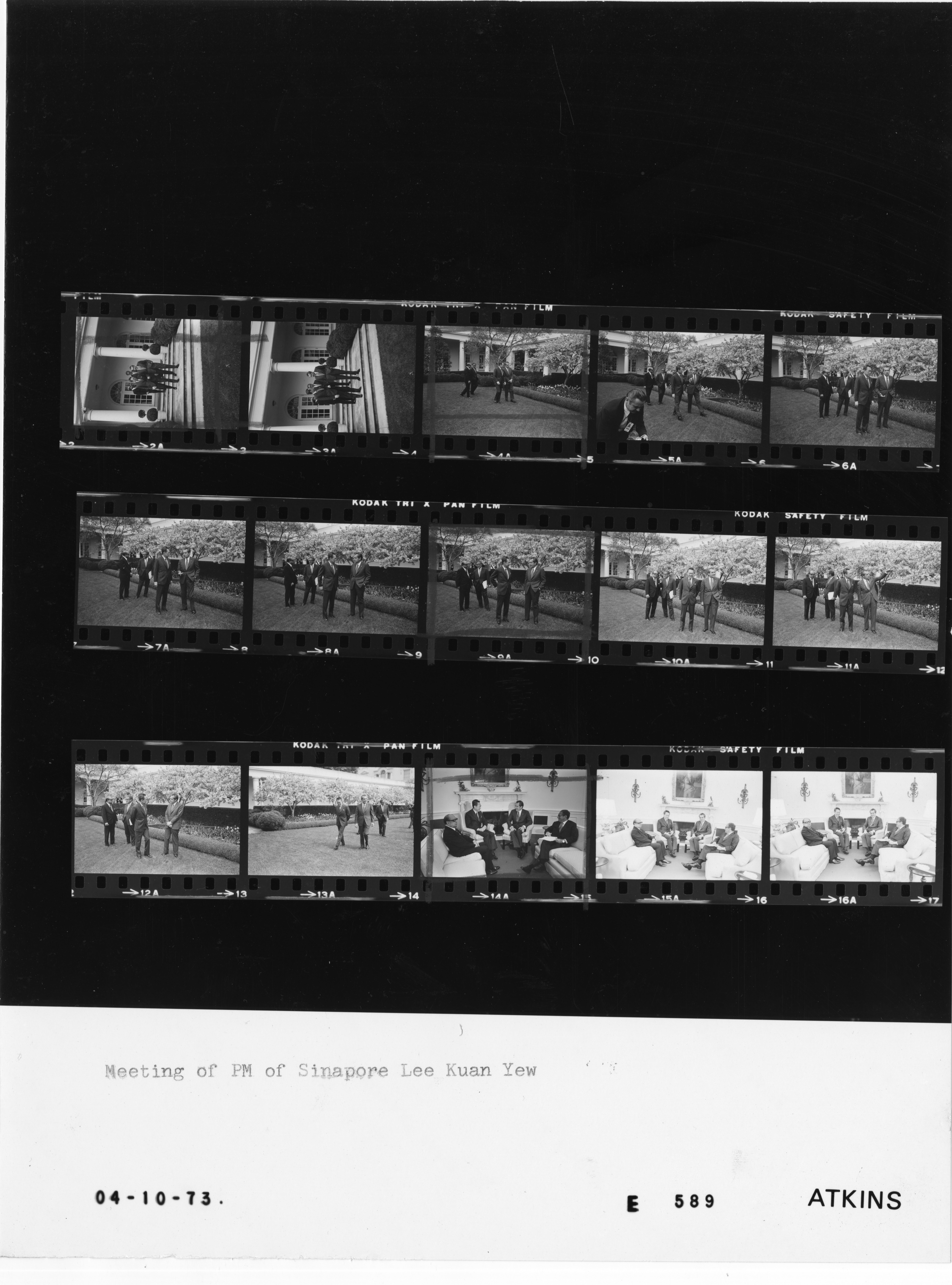
- Frame(s): WHPO-E0589-02A-13A, President Nixon and Henry Kissinger, Prime Minister of Singapore Lee Kuan Yew and Ambassador from Singapore Ernest Monteiro in the White House Rose Garden. 4/10/1973, Washington, D.C. White House, Rose Garden. President Nixon, Prime Minister Lee Kuan Yew, Henry Kissinger, Ambassador from Singapore Ernest S. Monteiro.
- Frame(s): WHPO-E0589-11A, President Nixon meeting with Prime Minister of Singapore Lee Kuan Yew inside the Rose Garden. Henry Kissinger and Ambassador from Singapore Ernest Monteiro stand nearby. 4/10/1973, Washington, D.C. White House, Rose Garden. President Nixon, Prime Minister Lee Kuan Yew, Henry Kissinger, Ambassador Ernest S. Monteiro.
- Frame(s): WHPO-E0589-14A-16A, President Nixon meeting Prime Minister of Singapore Lee Kuan Yew. 4/10/1973, Washington, D.C. White House, Oval Office. President Nixon, Prime Minister Lee Kuan Yew, Henry Kissinger, Ambassador from Singapore Ernest S. Monteiro.
Roll WHPO-E0590 Photographer: Atkins, Oliver | Color or B&W: B&W
- Frame(s): WHPO-E0590-, President Nixon attending bipartisan Congressional leadership meeting. 4/10/1973, Washington, D.C. White House, Cabinet Room. President Nixon, Spiro Agnew, George P. Shultz, Peter M. Flanigan, Hugh Scott, Robert P. Griffin, Mike Mansfield, Robert Byrd, Russell Long, William Fulbright, Wallace Bennett, George Aiken, Carl B. Albert, Thomas O'Neill, Gerald R. Ford, John McFall, Leslie C. Arends, Wilbur D. Mills, Thomas Morgan, Herbert Schneebeli, William Mailliard, John Ehrlichman, Ronald L. Ziegler, William E. Timmons, Richard Cook, Tom C. Korologos, Kenneth Dam, William D. Eberle, William Pierce.
Roll WHPO-E0591 Photographer: Parish, William | Color or B&W: B&W
- Frame(s): WHPO-E0591-, Anne Armstrong swearing-in Ray Madero. 4/10/1973, Washington, D.C. unknown. Anne Armstrong, Ray Madero, unidentified attendees.
Roll WHPO-E0592 Photographer: Parish, William | Color or B&W: Color
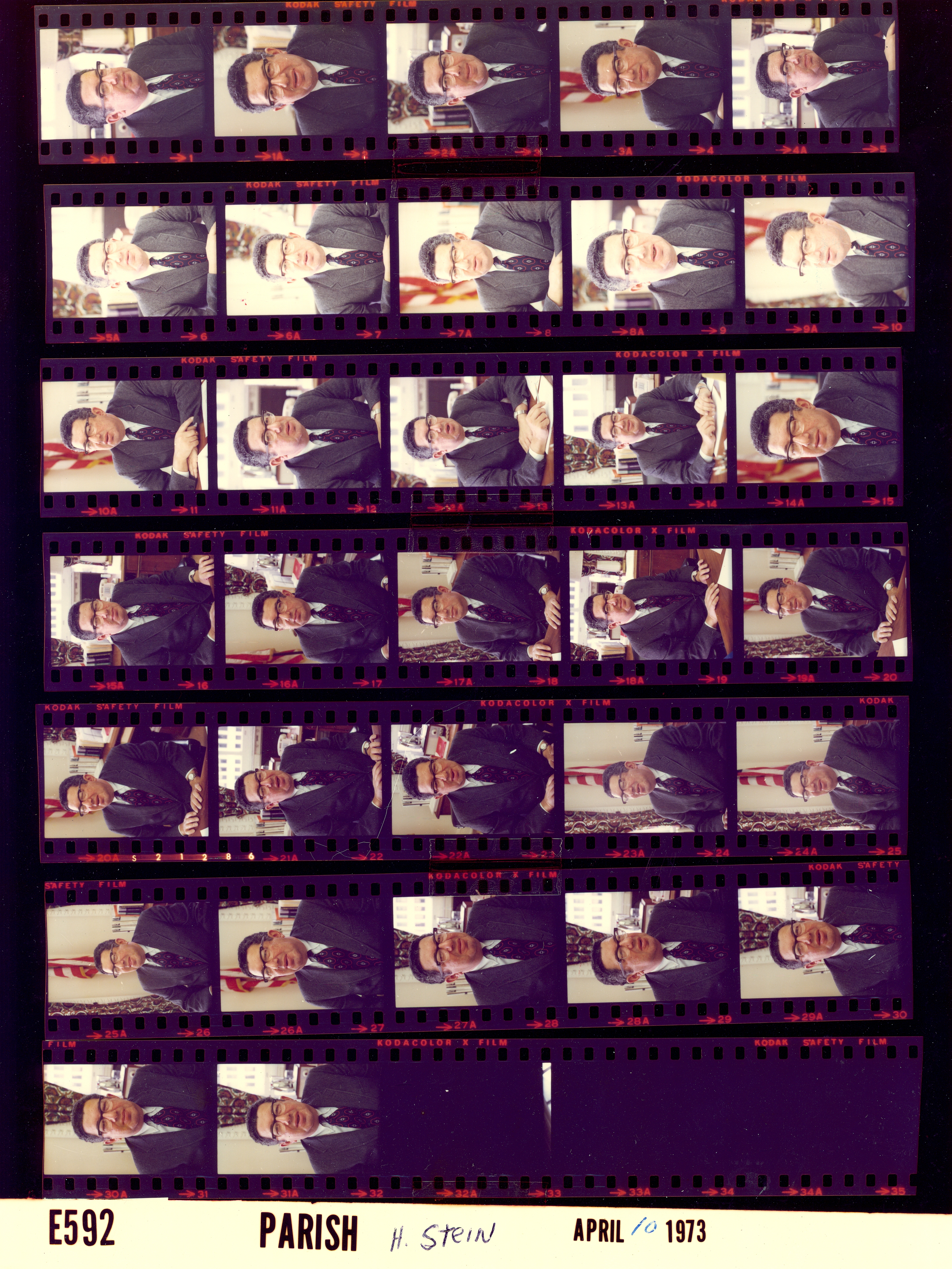
- Frame(s): WHPO-E0592-, Herb Stein portraits. 4/10/1973, Washington, D.C. unknown. Herbert Stein.
Roll WHPO-E0593 Photographer: Schumacher, Karl | Color or B&W: Color
- Frame(s): WHPO-E0593-, Childrens Garden. 4/10/1973, Washington, D. C. Childrens Garden, White House. none.
Roll WHPO-E0595 Photographer: Knudsen, Robert L. | Color or B&W: Color
- Frame(s): WHPO-E0595-, Pat Nixon attending Ladies of the Senate Red Cross First Lady's Luncheon. 4/10/1973, Washington, D.C. Caucus Room, Senate Office Building. Pat Nixon, Judy Agnew, Maryon Allen, Ann Buckley, attendees.
Roll WHPO-E0596 Photographer: Kightlinger, Jack | Color or B&W: Color
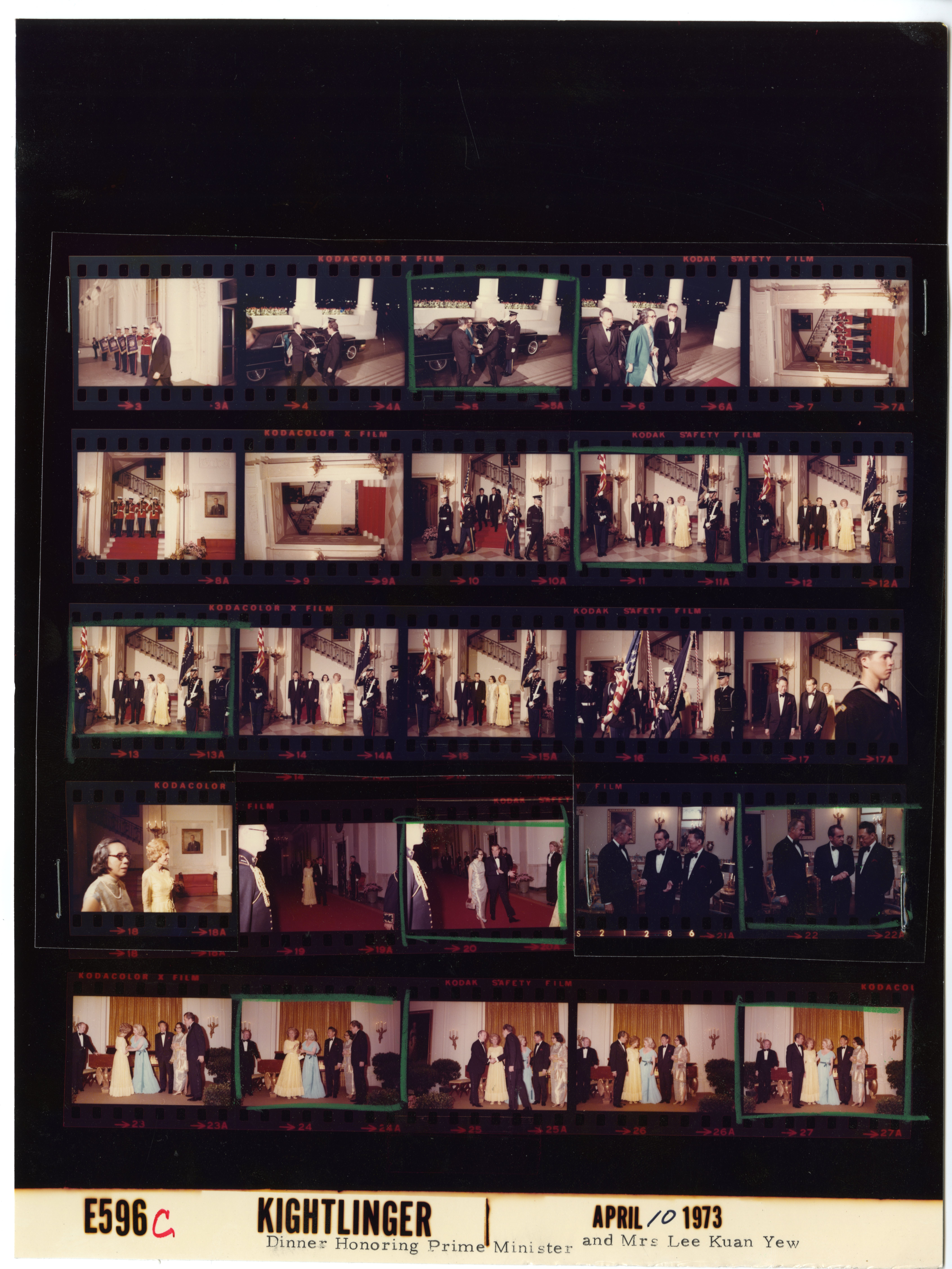
- Frame(s): WHPO-E0596-03-06, President Nixon greeting Singapore Prime Minister Lee Kuan Yew and Mrs. Yew as they arrive for a state dinner evening. 4/10/1973, Washington, D.C. White House, North Portico. President Nixon, Prime Minister Lee Kuan Yew, Mrs. Lee Kuan Yew, honor guard.
- Frame(s): WHPO-E0596-07-08, Four President's Own buglers standing in the Grand Staircase doorway playing their bugles announcing the entrance of President Nixon. 4/10/1973, Washington, D.C. White House, Grand Staircase. President's Own buglers.
- Frame(s): WHPO-E0596-09-18, President Nixon, Pat Nixon, Singapore Prime Minister Lee Kuan Yew, and Mrs. Yew pose for a formal portrait at the Grand Staircase entry on the evening of a state dinner. Color honor guards precede the group then stand nearby. 4/10/1973, Washington, D.C. White House, North Portico. President Nixon, Pat Nixon, Prime Minister Lee Kuan Yew, Mrs. Lee Kuan Yew, honor guard.
- Frame(s): WHPO-E0596-13, President Nixon, Pat Nixon, Singapore's Prime Minister Lee Kuan Yew, and Mrs. Yew pose for a formal portrait at the Grand Staircase entry on the evening of a state dinner. 4/10/1973, Washington, D.C. Grand Hall, White House. President Nixon, Pat Nixon, Prime Minister Lee Kuan Yew, Mrs. Lee Kuan Yew, honor guard.
- Frame(s): WHPO-E0596-19-20, President Nixon, Pat Nixon, Singapore Prime Minister Lee Kuan Yew, and Mrs. Yew walk the red cartpet in the Grand Hall on state dinner evening. 4/10/1973, Washington, D.C. White House, Grand Hallway. President Nixon, Pat Nixon, Prime Minister Lee Kuan Yew, Mrs. Lee Kuan Yew.
- Frame(s): WHPO-E0596-21-22, President Nixon, Vice President Agnew, and Singapore Prime Minister Lee Kuan Yew talk during a Blue Room reception before attending a state dinner. 4/10/1973, Washington, D.C. White House, Blue Room. President Nixon, Spiro Agnew, Prime Minister Lee Kuan Yew, Mrs. Lee Kuan Yew.
- Frame(s): WHPO-E0596-23-27, President Nixon, Pat Nixon, Singapore Prime Minister Lee Kuan Yew, Mrs. Yew, opera singer Mary Costa, and an unidentified pianist pose for a portrait after an East Room perfomance following a state dinner. 4/10/1973, Washington, D.C. White House, East Room. President Nixon, Pat Nixon, Prime Minister Lee Kuan Yew, Mrs. Lee Kuan Yew, Agnew, opera singer Mary Costa, unidentified pianist.
- Frame(s): WHPO-E0596-27, President Nixon, Pat Nixon, Singapore Prime Minister Lee Kuan Yew, Mrs. Yew, opera singer Mary Costa, and an unidentified pianist pose for a portrait after an East Room perfomance following a state dinner. 4/10/1973, Washington, D.C. Grand Hall, White House. President Nixon, Pat Nixon, Prime Minister Lee Kuan Yew, Mrs. Lee Kuan Yew, Mary Costa, unidentified pianist.
Roll WHPO-E0601 Photographer: Knudsen, Robert L. | Color or B&W: B&W
- Frame(s): WHPO-E0601-, President Nixon seated informally in the Oval Office during a meeting with Congressmen Sam Devine and George Goodling. 4/10/1973, Washington, D.C. White House, Oval Office. President Nixon, Samuel L. Devine, George A. Goodling.
- Frame(s): WHPO-E0601-07, President Nixon seated informally in the Oval Office during a meeting with Congressmen Sam Devine and George Goodling. 4/10/1973, Washington, D.C. White House, Oval Office. President Nixon, Samuel L. Devine, George A. Goodling.
Roll WHPO-E0607 Photographer: Atkins, Oliver | Color or B&W: B&W
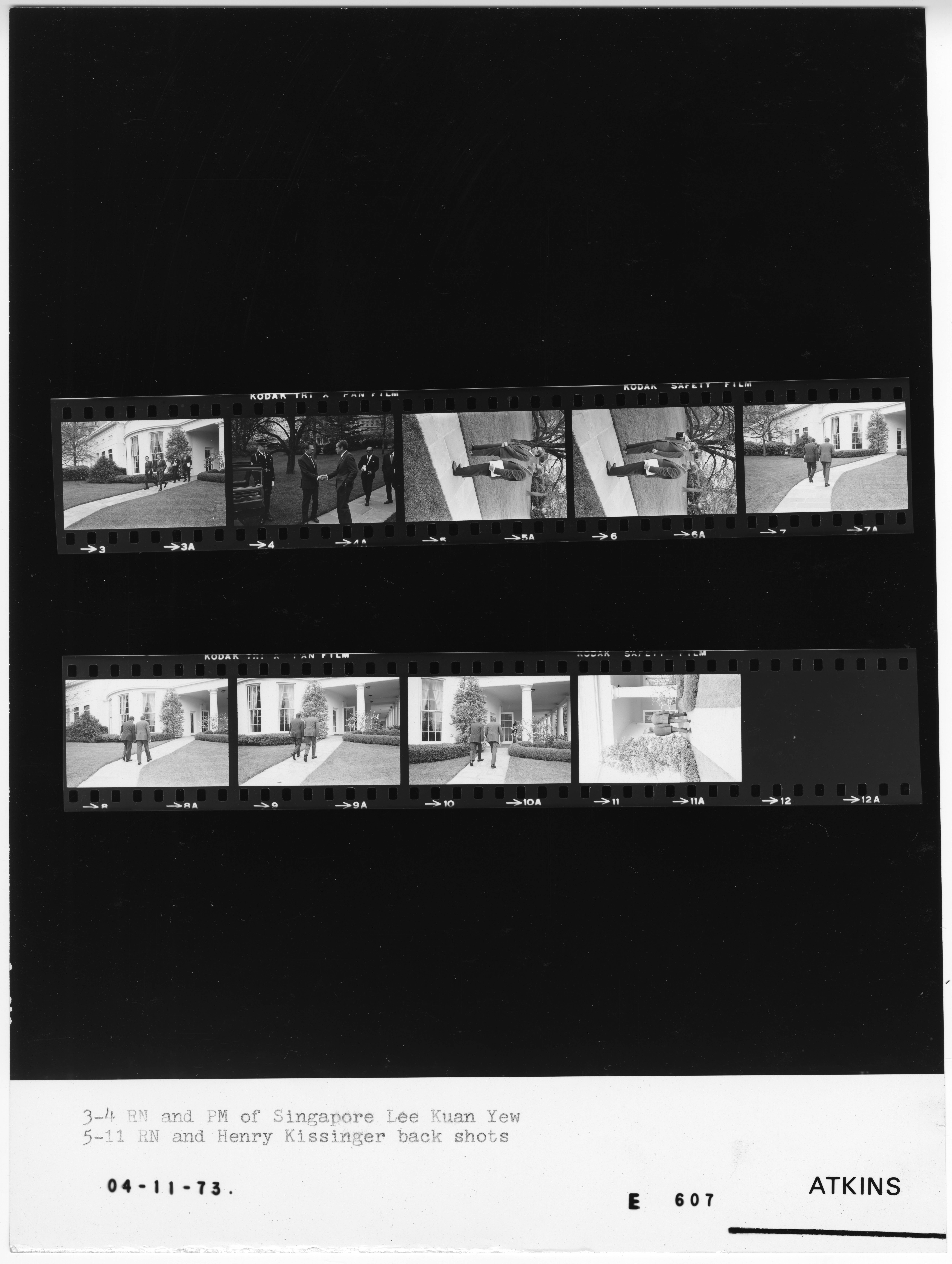
- Frame(s): WHPO-E0607-, President Nixon escorting Prime Minister Lee to waiting limousine. 4/10/1973, Washington, D.C. White House exterior. President Nixon, Kissinger, Prime Minister of Singapore Lee Kuan Yew, Ambassador from Singapore Ernest S. Monteiro.
Roll WHPO-E0622 Photographer: Kightlinger, Jack | Color or B&W: Color
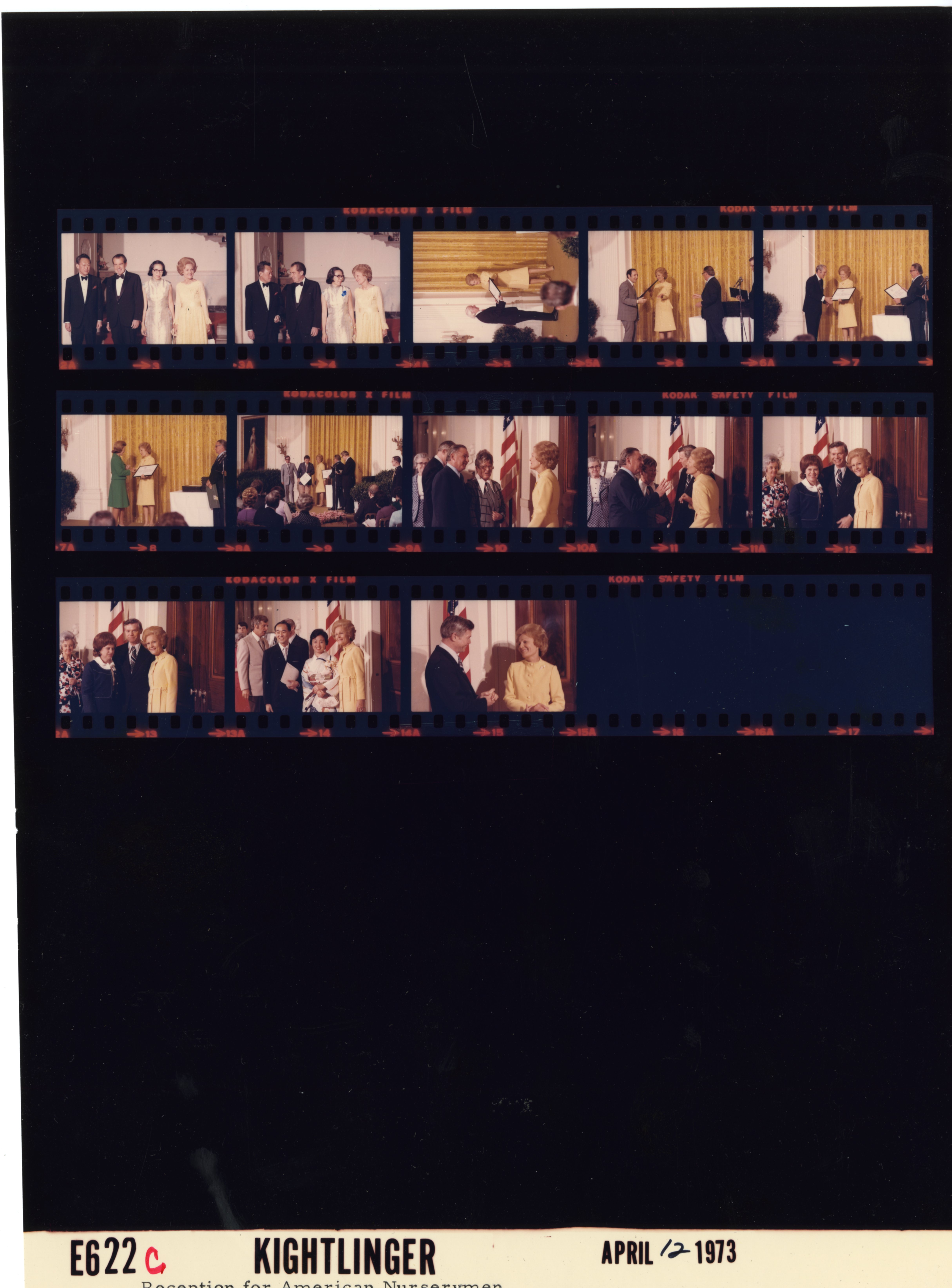
- Frame(s): WHPO-E0622-03-04, Events on state dinner evening for Prime Minister Lee Kuan Yew of Singapore. 4/10/1973, Washington, D.C. Grand Hallway, White House. President Nixon, Pat Nixon, Prime Minister Lee Kuan Yew, Mrs. Lee Kuan Yew.
- Frame(s): WHPO-E0622-04, President Nixon, Pat Nixon, Prime Minister Lee Kuan Yew of Singapore, and Mrs. Yew pose for a formal portrait at the Grand Staircase entry before a state dinner. 4/10/1973, Washington, D.C. Grand Hallway, White House. President Nixon, Pat Nixon, Prime Minister Lee Kuan Yew, Mrs. Lee Kuan Yew.
The White House Communications Agency Sound Recordings Collection contains public statements that took place between 1969 and 1974. Visit the finding aid to learn more.
K - Informal Presidential Remarks
- WHCA-SR-K-049
Photo opportunity/Prime Minister of Singapore Lee Kuan Yew-Rose Garden. (4/10/1973)
Runtime: 5:00
Original Format: 1/4-inch reel-to-reel audiotape. Original source type: Original.
P - Formal Presidential Remarks
- WHCA-SR-P-730406
Remarks by President Nixon in toast to Prime Minister Lee Kuan Yew. (4/10/1973)
Runtime: 5:40
Original Format: 1/4-inch reel-to-reel audiotape. Original source type: Original. - WHCA-SR-P-730407
Remarks by President Nixon at entertainment in honor of Prime Minister Lee Kuan Yew with Mary Costa. (4/10/1973)
Runtime: 1:21
Keywords: Musician, musicians, music, celebrities, performance
Original Format: 1/4-inch reel-to-reel audiotape. Original source type: Original.
S - White House Press Office Briefings (continuation of the L-series)
- WHCA-SR-S-057
Anne Armstrong, swearing-in ceremony for a member of the Council on Spanish-speaking People. (4/10/1973, Roosevelt Room)
Runtime: 10:16
Keywords: ceremonies
Production credits: Audio feed supplied by WHCA; Recorded by RMM (initials of WHCA engineer)
Original Format: 1/4-inch reel-to-reel audiotape. Original source type: Original. - WHCA-SR-S-058
Press briefing by Peter Flanigan and George Shultz. (4/10/1973, White House Press Lobby)
Runtime: 50:00:00
Keywords: Press conferences, news conferences, interviews, media
Production credits: Audio feed supplied by WHCA; Recorded by LDH (initials of WHCA engineer)
Original Format: 1/4-inch reel-to-reel audiotape. Original source type: Original. - WHCA-SR-S-059
Press briefing by Gerald Warren. (4/10/1973, White House Press Lobby)
Runtime: 15:00
Keywords: Press conferences, news conferences, interviews, media
Production credits: Audio feed supplied by WHCA; Recorded by LDH (initials of WHCA engineer)
Original Format: 1/4-inch reel-to-reel audiotape. Original source type: Original.
The White House Communications Agency Videotape Collection contains “off-the-air” recordings of televised programs produced between 1968 and 1974. Visit the finding aid to learn more.
- WHCA-6231
Weekly News Summary, Tape II.
ALL NETWORKS
Runtime: 1:30
13. Smith/Jarriel/Clark: President Nixon sends trade bill to Congress with Secretary Shultz; Executive Privilege with Kleindienst. Time Code Start: 26:21. Keywords: Presidents, cabinet, advisors, House of Representatives, bills, laws, voting, business, exchanges, agreements, contracts, profits, finance, sales, buying, selling. Network: ABC.
14. Smith/Sherwood: Day care protest. Time Code Start: 30:25. Keywords: child care, welfare, demonstrations, rally, protests, protesters, demonstraters, demonstrators. Network: ABC.
15. Smith/Reynolds: Freedom of press. Time Code Start: 33:00. Keywords: media, newspapers, magazines, publications, civil rights, constitutional rights, First Amendment. Network: ABC.
16. Smith: Commentary on world trade. Time Code Start: 36:42. Keywords: foreign relations, business, exchanges, agreements, contracts, profits, finance, sales, buying, selling, imports, exports. Network: ABC.
17. Chancellor/Levine: Secretary Brennan on minimum wage. Time Code Start: 38:31. Keywords: cabinet, advisors. Network: NBC.
18. Chancellor/Lewis: Increasing trade with Russia; President Nixon wants new foreign trade powers. Time Code Start: 40:36. Keywords: Presidents, trade, imports, Soviet Union, USSR, business, exchanges, agreements, contracts, profits, finance, sales, buying, selling. Network: NBC.
19. Chancellor: Congress vs. President Nixon with Kleindienst. Time Code Start: 45:46. Keywords: Presidents, House of Representatives. Network: NBC.
20. Brinkley: Commentary on tax reform. Time Code Start: 46:50. Keywords: bills, laws, taxes, taxation, revenue, reforms. Network: NBC.
21. Cronkite/Sheehan: South Vietnam's President Thieu in Germany. Time Code Start: 49:26. Keywords: South Vietnam, Presidents, travel, trips, West Germany. Network: CBS.
22. Cronkite/Mudd: Congress vs. President Nixon. Time Code Start: 50:35. Keywords: Presidents, House of Representatives. Network: CBS.
23. Cronkite: Senator Muskie comments on secrecy privilege of the President with Kleindienst. Time Code Start: 52:20. Keywords: Presidents, Senators. Network: CBS.
24. Cronkite/Fred Graham/Artist Don Juhlin: Pentagon papers trial testimony of Ellsberg and Anthony Russo. Time Code Start: 54:56. Keywords: Armed Forces, military, classified documents, secrets, Watergate, courts, trials, Vietnam War, Indochina War, bombings, testify. Network: CBS.
25. Sevareid: Commentary on the energy crisis. Time Code Start: 56:26. Keywords: petroleum, oil, gasoline, fuel, shortages, rationing, natural resources. Network: CBS.
26. Cronkite/Morton: Generation gap in the Veterans Administration; the returning veterans part V. Time Code Start: 59:13. Keywords: Vietnam War, military, troops, organizations, management, benefits. Network: CBS.
Context (External Sources)
The Vanderbilt Television News Archive is the world's most extensive and complete archive of television news. They have been recording, preserving and providing access to television news broadcasts of the national networks since August 5, 1968.
Wikipedia is a free encyclopedia that anyone can edit.