
Introduction
This almanac page for Wednesday, April 11, 1973, pulls together various records created by the federal government and links to additional resources which can provide context about the events of the day.
Previous Date: Tuesday, April 10, 1973
Next Date: Thursday, April 12, 1973
Schedule and Public Documents
The Daily Diary files represent a consolidated record of the President's activities. Visit the finding aid to learn more.
The President's day began at The White House - Washington, D. C.
The Weekly Compilation of Presidential Documents made available transcripts of the President's news conferences; messages to Congress; public speeches, remarks, and statements; and other Presidential materials released by the White House.
Digitized versions can be found at HathiTrust.
Each Public Papers of the Presidents volume contains the papers and speeches of the President of the United States that were issued by the White House Office of the Press Secretary during the time period specified by the volume. The material is presented in chronological order, and the dates shown in the headings are the dates of the documents or events. In instances when the release date differs from the date of the document itself, that fact is shown in the text note.
To ensure accuracy, remarks have been checked against audio recordings (when available) and signed documents have been checked against the original, unless otherwise noted. Editors have provided text notes and cross references for purposes of identification or clarity.
The Federal Register is the official daily publication for rules, proposed rules, and notices of federal agencies and organizations, as well as executive orders and other Presidential documents.
The Congressional Record is the official daily record of the debates and proceedings of the U.S. Congress.
Archival Holdings
Any selection of archival documents will necessarily be partial. You should use the documents and folders identified below as a starting place, but consult the linked collection finding aids and folder title lists and the collections themselves for context. Many documents to be found this way do not lend themselves to association with specific dates, but are essential to a complete understanding of the material.
Selective document listing
President's Office Files
The President's Office Files consists of materials drawn together by the Special Files Unit from several administrative subdivisions within the White House Office. It is the handwriting and sensitive papers sent to the Staff Secretary that now comprise much of the President's Office Files. Visit the finding aid to learn more.
- News Summaries, Unmarked News Summaries, Box 54, News Summaries - April 2-14, 1973 [7 of 10] [Note: Due to the way News Summary products were compiled, you should also consult nearby days for potentially relevant materials.]
- News Summary, April 11, 1973, (Tuesday nets, wires)
- Digest of Recent News Comment, April 11, 1973
The H. R. Haldeman Diaries consists of seven handwritten diaries, 36 dictated diaries recorded as sound recordings, and two handwritten audio cassette tape subject logs. The diaries and logs reflect H. R. Haldeman’s candid personal record and reflections on events, issues, and people encountered during his service in the Nixon White House. As administrative assistant to the President and Chief of Staff, Haldeman attended and participated in public events and private meetings covering the entire scope of issues in which the Nixon White House engaged in during the years 1969-1973. Visit the finding aid to learn more.
- Transcript of diary entry (PDF)
Wednesday, April 11.
I was out most of the morning…
-------------------------------------------------------------------------------------------------------------------
PRIVACY- Reviewed and withheld under Deed of Gift, DR, NARA, September 11, 2014
Audio Cassette 33, Side A.
Duration: 7 seconds
-------------------------------------------------------------------------------------------------------------------
Mitchell called, which I returned from home. He wanted to talk about the settlement of the civil suits. He'd been talking to Strauss of the Democratic National Committee, and he said this morning that he had cleared the whole thing with Mansfield and Albert and so on. And we could go ahead and settle, but Mitchell said after two-hours with Stans, he's still holding out for damages in the O'Brien libel suit, and we need to turn that off. That he had talked with Ehrlichman and thought he had that taken care of.
He also was concerned that Dean's testimony would be the one thing that could really unscramble the whole operation. We should try to get Dean not to go to the grand jury, in his opinion. I mentioned this to the President. He's quite concerned about it. Told me to talk to Ehrlichman. He was raising the question of whether that is the linchpin in the whole thing. And the President had Ziegler come in and we went through the whole question of the White House going up to the Senate. Ron argues strongly that we should not. His real fear is that it's going to focus the whole thing onto me and hang it on me and destroy me, and he feels that’ll be extremely harmful to the President. The President made the point again that the key here is to protect Haldeman, but Ziegler feels that Ehrlichman's moves to lock up the Senate deal with Ervin is going to basically haul me in.
Chapin and Strachan both testified at the grand jury today, and both said that I had agreed to their approaching Segretti. And Chapin said afterwards, that some assistant DA that's working with Silbert made the point that this was a real bombshell and was gonna probably destroy the President, because it laid the whole thing right at the White House doorstep and, really, right at the President.
In the Ziegler meeting, Ehrlichman came in and there was general agreement that we should put out a preemptive statement of some kind. In other words, that I should make my statement ahead of going to the grand jury, so that we get our story out in writing separately from the Question and Answer session story. Try and establish our own position first, so I'm going to work on getting my statement ready with that thought in mind.
The President is still obviously very concerned about the whole issue and spending quite a little time on it. Ehrlichman meets this evening again with Ervin and Baker to try to resolve the ground rule question of whether we go up to the Senate and how. Dean is still concerned on the whole grand jury question. Magruder called and wanted guidance from me on what to do, and I had Larry call him back and say I couldn't give him any guidance. That he should do what his lawyer tells him to, and he apparently wasn't satisfied with that and said, well, he hated to do it, and he wanted us to know he was still on the team. But he was going to have to go ahead, if that's what we said, and he was going up to tell Mitchell that tomorrow. Looks like we're nearing the moment of truth and everybody's getting a little panicky in the crunch.
End on April 11. - Original audio recording (MP3)
The National Archives Catalog is the online portal to the records held at the National Archives, and information about those records. It is the main way of describing our holdings and also provides access to electronic records and digitized versions of our holdings.
The Catalog searches across multiple National Archives resources at once, including archival descriptions, digitized and electronic records, authority records, and web pages from Archives.gov and the Presidential Libraries. The Catalog also allows users to contribute to digitized historical records through tagging and transcription.
Nixon Library Holdings
All National Archives Units
National Security Documents
The President's Daily Brief is the primary vehicle for summarizing the day-to-day sensitive intelligence and analysis, as well as late-breaking reports, for the White House on current and future national security issues. Read "The President's Daily Brief: Delivering Intelligence to Nixon and Ford" to learn more.
The Foreign Relations of the United States series presents the official documentary historical record of major U.S. foreign policy decisions and significant diplomatic activity. Visit the State Department website for more information.
Vol. X, Vietnam, January 1973-July 1975
Neither War nor Peace, January 27-June 15, 1973
40. National Security Decision Memorandum 210, Washington, April 11, 1973
Source: National Archives, Nixon Presidential Materials, NSC Files, NSC Institutional Files (H–Files), Box H–239, NSDM Files, NSDM 210. Secret; Exdis. Copies were sent to the DCI and Chairman of the JCS.
41. Memorandum From the President’s Deputy Assistant for National Security Affairs (Scowcroft) to the President’s Assistant for National Security Affairs (Kissinger), Washington, April 11, 1973
Source: National Archives, Nixon Presidential Materials, NSC Files, Box 1334, Un-filed Materials, NSC Unfiled Materials, 1973. Top Secret; Sensitive.
Vol. XV, Soviet Union, June 1972-August 1974
Summit Preparations; Jackson-Vanik Amendment; Non-Use of Nuclear Weapons, December 1972-April 1973
96. Memorandum From Helmut Sonnenfeldt of the National Security Council Staff to the President’s Assistant for National Security Affairs (Kissinger), Washington, April 11, 1973
Source: National Archives, Nixon Presidential Materials, NSC Files, Box 496, President’s Trip Files, Dobrynin/Kissinger, Vol. 16. Secret; Sensitive; Exclusively Eyes Only. Urgent; sent for information.
Vol. XXII, Panama, 1973-1976
Panama, 1973-1976
9. Backchannel Message From the Governor of the Panama Canal Zone (Parker) to the Deputy Under Secretary of the Army (Koren), Balboa Heights, Panama Canal Zone, April 11, 1973
Source: National Archives, RG 185, Subject Files of 1979 Panama Canal Treaty Planning Group, Box 5, Msgs Jan–June 1973. Secret; Eyes Only; Priority for Transmission; Deliver During First Duty Hours. A handwritten note on the message reads: “Msg received by Mr. Koren at 11:58—4/11/73.”
Vol. XXV, Arab-Israeli Crisis and War, 1973
Arab-Israeli Crisis and War, 1973
46. Memorandum From Secretary of State Rogers to President Nixon, Washington, April 11, 1973
Source: National Archives, Nixon Presidential Materials, NSC Files, Box 621, Country Files, Middle East, Lebanon, Vol. III, Jan. 71–Oct. 73. Secret; Nodis.
47. Backchannel Message From the President’s Assistant for National Security Affairs (Kissinger) to the Egyptian Presidential Adviser for National Security Affairs (Ismail), Washington, April 11, 1973
Source: National Archives, Nixon Presidential Materials, NSC Files, Kissinger Office Files, Box 131, Country Files, Middle East, Egypt/Ismail, Vol. IV, February 24–May 19, 1973. Secret; Sensitive; Eyes Only.
Vol. E-6, Documents on Africa, 1973-1976
Horn of Africa
84. Memorandum From Fernando Rondon of the National Security Council Staff to the President’s Assistant for National Security Affairs (Kissinger), Washington, April 11, 1973
Rondon summarized recent developments in the Horn of Africa and recommended that Kissinger approve an attached NSSM to review U.S. interests and policy options. Kissinger approved the NSSM.
Source: National Archives, Nixon Presidential Materials, NSC Institutional Files (H-Files), Box H-200, NSSM 184. Secret. Sent for action. Cleared by Kennedy, Saunders, and Hyland. Kissinger initialed his approval. On the first page, Kissinger wrote: “Brent-Send out the NSSM in usual way-Pres. is too preoccupied now. I would like to review Kagnew decision.” An attached handwritten note from Scowcroft to Kennedy reads: “NSSM is approved for State/DOD coordination and issue. Note HAK wants to review the Kagnew decision. Why not crank that into the NSSM-if it could become an issue?” Tab I, Suggested memorandum for the President, with proposed NSSM request for approval, is not published.
Vol. E-9, Documents on North Africa, 1973-1976
Libya, 1973-1976
11. Telegram 460 From the Embassy in Libya to the Department of State, Tripoli, April 11, 1973, 1410Z
Summary: Chargé Harold G. Josif questioned the wisdom and timing of the resumption of reconnaissance flights over Libya. Josif expressed concern about the impact of the flights on tensions in the Middle East, and dismay that more time for diplomatic action in Tripoli was not allowed.
Source: Washington National Records Center, OSD Files: FRC 330–780002, Box 6, Libya 452. Secret; Immediate; Exdis. Repeated to Rabat.
Vol. E-11, Part 1, Documents on Mexico; Central America; and the Caribbean, 1973-1976
Mexico
51. Memorandum From William J. Jorden of the National Security Council Staff to the President’s Assistant for National Security Affairs (Kissinger), Washington, April 11, 1973
Summary: Jorden briefed Kissinger on possible U.S. approaches to President Echeverría’s proposal for a charter of economic rights and duties.
Source: National Archives, Nixon Presidential Materials, NSC Files, Country Files, Box 788, Latin America, Mexico, Vol. IV, 1973. Confidential. Sent for information. On the first page of the memorandum Kissinger wrote, “I favor approach 2 or anything else that delays it.” Copies were sent to Hormats and Rondon.
Vol. E-12, Documents on East and Southeast Asia, 1973-1976
Malaysia and Singapore
294. Memorandum of Conversation, Washington, April 11, 1973, 9:50–10:20 a.m., Washington, April 11, 1973, 9:50-10:20 a.m.
Kissinger and Lee discussed Southeast Asia.
Source: National Archives, Nixon Presidential Materials, NSC Files, Box 1027, Presidential/HAK memcons, Folder 5, April–November 1975. Top Secret; Sensitive; Exclusively Eyes Only. The conversation took place in Kissinger’s Office. On August 4, 3:30–4:40 p.m., Lee and Kissinger met in a conference room at Kennedy International Airport in New York. A memorandum of conversation from their meeting, which mainly discussed affairs in Indochina, is ibid., folder 3.
The Kissinger telephone conversation transcripts consist of approximately 20,000 pages of transcripts of Kissinger’s telephone conversations during his tenure as Assistant to the President for National Security Affairs (1969-1974) and Secretary of State (1973-1974) during the administration of President Richard Nixon. Visit the finding aid for more information.
Digitized versions can be found in the National Archives Catalog.
Audiovisual Holdings
Visit the White House Tapes finding aid to learn about the taping system's operation and archival processing.
Oval Office
- 893-1; Unknown between 9:40 a.m. & 9:42 a.m.; Nixon, Richard M. (President); Woods, Rose Mary
- 893-2; 9:42 a.m. - 9:50 a.m.; Nixon, Richard M. (President); Kissinger, Henry A.
- 893-3; Unknown between 9:50 a.m. & 10:00 a.m.; Nixon, Richard M. (President); Bull, Stephen B.
- 893-4; Unknown between 9:50 a.m. & 10:00 a.m.; Nixon, Richard M. (President); White House operator; Graham, William F. ("Billy")
- 893-5; Unknown between 10:00 a.m. & 10:08 a.m.; Nixon, Richard M. (President); Graham, William F. ("Billy")
- 893-6; 10:11 a.m. - 10:59 a.m.; Nixon, Richard M. (President); Eisenhower, [Dwight] David, II; Eisenhower, Julie Nixon
- 893-7; Unknown between 10:59 a.m. & 11:05 a.m.; Nixon, Richard M. (President); Bull, Stephen B.
- 893-8; Unknown between 10:59 a.m. & 11:05 a.m.; Nixon, Richard M. (President); Bull, Stephen B.
- 893-9; Unknown between 10:59 a.m. & 11:05 a.m.; Nixon, Richard M. (President); [Unknown person(s)]
- 893-10; 11:05 a.m. - 11:50 a.m.; Nixon, Richard M. (President); Ehrlichman, John D.; Bull, Stephen B.; [Unknown person(s)]
- 893-11; Unknown between 11:50 a.m. & 11:51 a.m.; Nixon, Richard M. (President); [Unknown person(s)]
- 893-12; 11:51 a.m. - 12:02 p.m.; Nixon, Richard M. (President); Lopez Bravo de Castro, Gregorio; Kissinger, Henry A.; White House photographer
- 893-13; 12:04 p.m. - 12:29 p.m.; Nixon, Richard M. (President); Shields, Roger E.; Scowcroft, Brent G. (Gen.); White House photographer
- 893-14; Unknown between 12:29 p.m. & 12:34 p.m.; Nixon, Richard M. (President); Bull, Stephen B.
- 893-15; Unknown between 12:29 p.m. & 12:34 p.m.; Nixon, Richard M. (President); White House operator
- 893-16; 12:34 p.m. - 1:20 p.m.; Nixon, Richard M. (President); Ehrlichman, John D.; Ford, Gerald R.; Bull, Stephen B.
- 893-17; 1:20 p.m. - 1:20 p.m.; Nixon, Richard M. (President); Sanchez, Manolo
- 893-18; Unknown between 2:59 p.m. & 3:05 p.m.; Nixon, Richard M. (President); [Unknown person(s)]
- 893-19; 3:05 p.m. - 3:15 p.m.; Nixon, Richard M. (President); Nixon, Thelma C. ("Pat") (Ryan); Pardee, Jack; Pardee, Phyllis Lane (Perryman); Ebersol, Charles R.; Ebersol, Mary D.; Adams, Lane W.; Adams, Lane W. (Mrs.); Rimer, Irving I.; Barrie, Steve; Pearl, Minnie; Cannon, Henry; Cavanaugh, James H.; White House photographer; Members of the press
- 893-20; Unknown between 3:15 p.m. & 3:18 p.m.; Nixon, Richard M. (President); [Unknown person(s)]
- 893-21; 3:18 p.m. - 4:49 p.m.; Nixon, Richard M. (President); Ehrlichman, John D.; Haldeman, H. R. ("Bob"); Ziegler, Ronald L.; Bull, Stephen B.
- 893-22; 4:49 p.m. - 4:49 p.m.; Nixon, Richard M. (President); Bull, Stephen B.
- 893-23; Unknown between 1:20 p.m. & 2:59 p.m.; Sanchez, Manolo; [Unknown person(s)]
White House Telephone
- 44-142; Unknown between 9:50 a.m. & 10:00 a.m.; Nixon, Richard M. (President); White House operator
- 44-143; 10:00 a.m. - 10:08 a.m.; Nixon, Richard M. (President); Graham, William F. ("Billy")
- 44-144; Unknown between 12:29 p.m. & 12:34 p.m.; Nixon, Richard M. (President); Ford, Gerald R.
- 44-145; 12:35 p.m. - 12:39 p.m.; Nixon, Richard M. (President); Ford, Gerald R.
- 44-146; Unknown between 1:20 p.m. & 1:28 p.m.; Nixon, Richard M. (President); White House operator
- 44-147; 1:28 p.m. - 1:29 p.m.; Nixon, Richard M. (President); Cox, Tricia Nixon
- 44-148; Unknown between 1:29 p.m. & 1:34 p.m.; Nixon, Richard M. (President); White House operator
- 44-149; 1:34 p.m. - 1:37 p.m.; Nixon, Richard M. (President); Bull, Stephen B.
The White House Photo Office collection consists of photographic coverage of President Richard Nixon meeting with prominent social, political, and cultural personalities; speaking engagements and news conferences of the President and various high-ranking members of the White House staff and Cabinet; Presidential domestic and foreign travel, including Presidential vacations; social events and entertainment involving the First Family, including entertainers present; official portraits of the President, First Family, and high-ranking members of the Nixon administration; the 1969 and 1973 Inaugurals; the President’s 1972 Presidential election campaign appearances (including speeches) and other official activities of the White House staff and the President’s Cabinet from January 20, 1969 until August 9, 1974 at the White House and the Old Executive Office Building; other locations in Washington, DC, such as The Mall; and the Presidential retreats in Camp David, Maryland, Key Biscayne, Florida, and San Clemente, California. Visit the finding aid to learn more.
Roll WHPO-E0597 Photographer: Parish, William | Color or B&W: B&W
- Frame(s): WHPO-E0597-, Jeni Brown portraits. 4/11/1973, Washington, D.C. White House exterior. Jeni Brown, unidentified male.
Roll WHPO-E0598 Photographer: Parish, William | Color or B&W: B&W
- Frame(s): WHPO-E0598-, Jeni Brown portraits. 4/11/1973, Washington, D.C. White House exterior. Jeni Brown, Herb Klein, unidentified male, unidentified Marine.
Roll WHPO-E0599 Photographer: Parish, William | Color or B&W: B&W
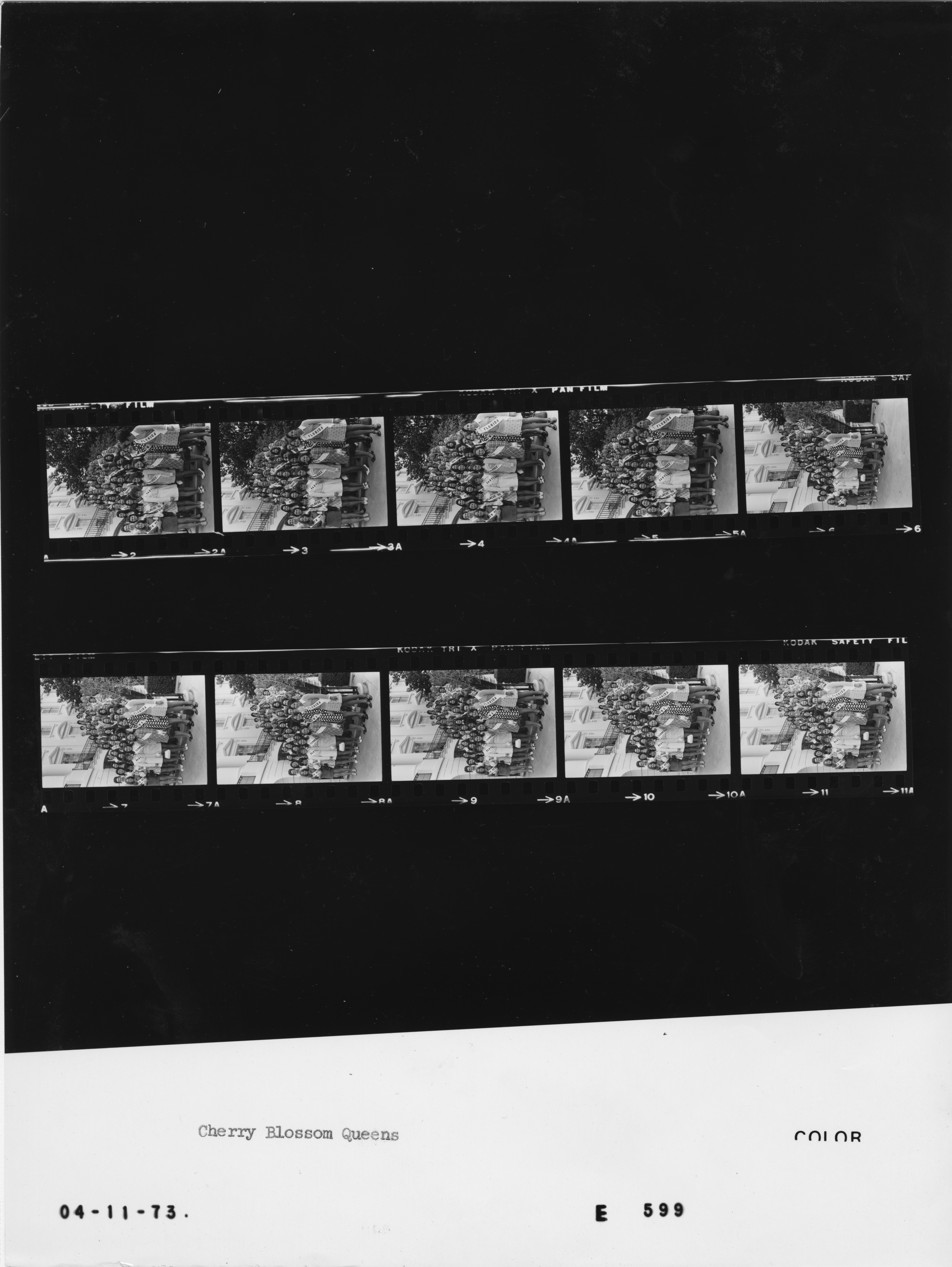
- Frame(s): WHPO-E0599-, Cherry Blossom Queens. 4/11/1973, Washington, D.C. South Portico, White House. unidentified Cherry Blossom Queens.
Roll WHPO-E0600 Photographer: Schumacher, Karl | Color or B&W: B&W
- Frame(s): WHPO-E0600-, Vice President Agnew meeting Mr. Michael. 4/11/1973, Washington, D.C. Vice Presidential Office, Executive Office Building. Spiro Agnew, Mr. Michael.
Roll WHPO-E0602 Photographer: Schumacher, Karl | Color or B&W: Color
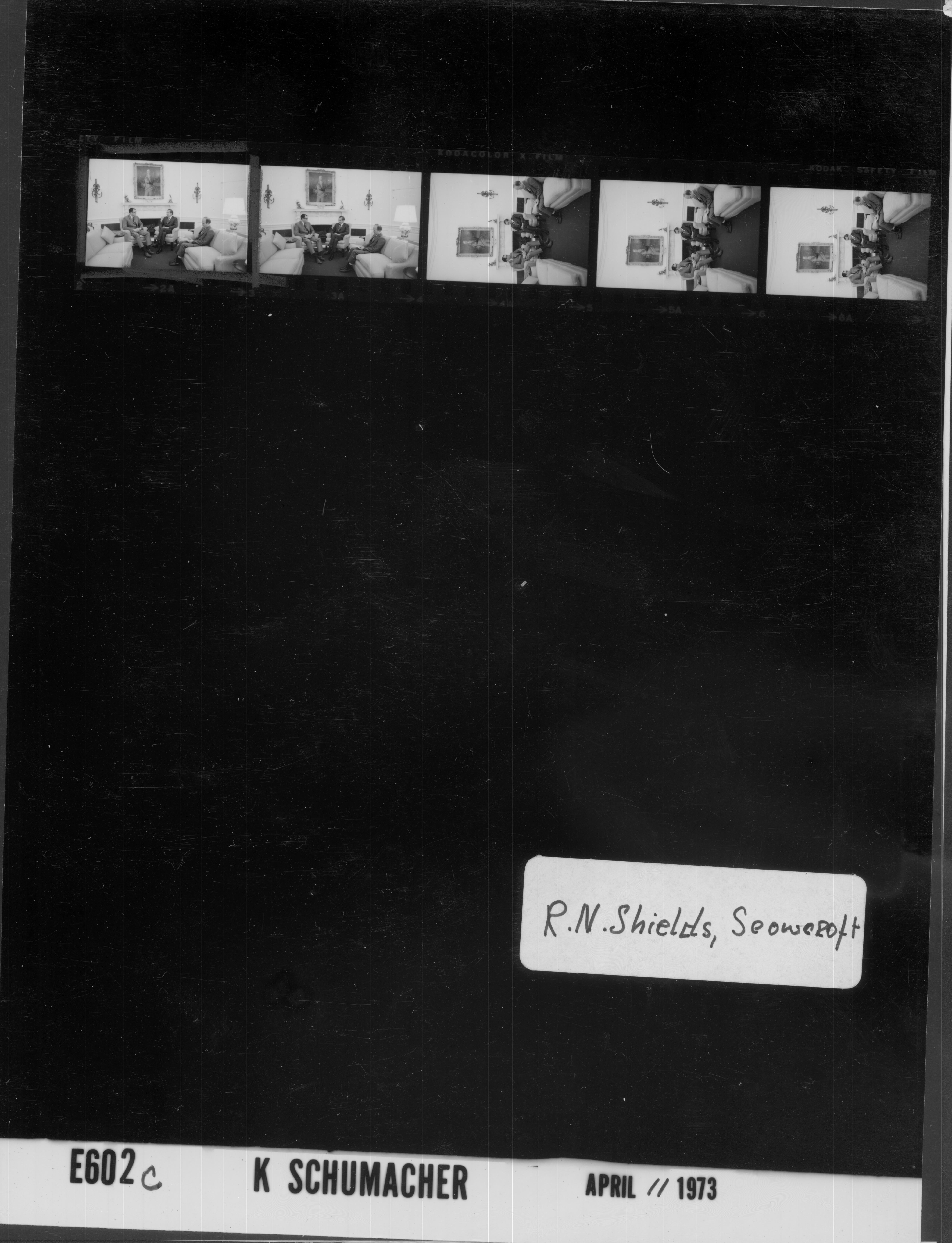
- Frame(s): WHPO-E0602-, President Nixon meeting Roger Shields and Brent Scowcroft. 4/11/1973, Washington, D.C. White House, Oval Office. President Nixon, Assistant to the Assistant Secretary of Defense for International Security Affairs Roger E. Shields, Brigadier General Brent G. Scowcroft.
Roll WHPO-E0603 Photographer: Knudsen, Robert L. | Color or B&W: B&W
- Frame(s): WHPO-E0603-02A-10A, President Nixon meeting in the Oval Office with Spanish Foreign Minister Gregorio Lopez Bravo de Castro. 4/11/1973, Washington, D.C. White House, Oval Office. President Nixon, Spanish Foreign Minister Gregorio Lopez Bravo de Castro, unidentified man.
- Frame(s): WHPO-E0603-05A, President Nixon standing in the Oval Office during a meeting with Spanish Foreign Minister Gregorio Lopez Bravo de Castro. 4/11/1973, Washington, D.C. White House, Oval Office. President Nixon, Spanish Foreign Minister Gregorio Lopez Bravo de Castro, unidentified man possibly an interpreter.
- Frame(s): WHPO-E0603-13A-17A, President Nixon standing in the Oval Office during a meeting with Roger Shields the Assistant to the Assistant Secretary of Defense for International Security Affairs, and Brig. Gen. Brent Scowcroft, to congratulate Shields on his work on behalf of American POWs (Vietnam Prisoners of War). 4/11/1973, Washington, D.C. White House, Oval Office. President Nixon, Assistant to the Assistant Secretary of Defense for International Security Affairs Roger E. Shields, Brigadier General Brent G. Scowcroft.
Roll WHPO-E0604 Photographer: Kightlinger, Jack | Color or B&W: Color
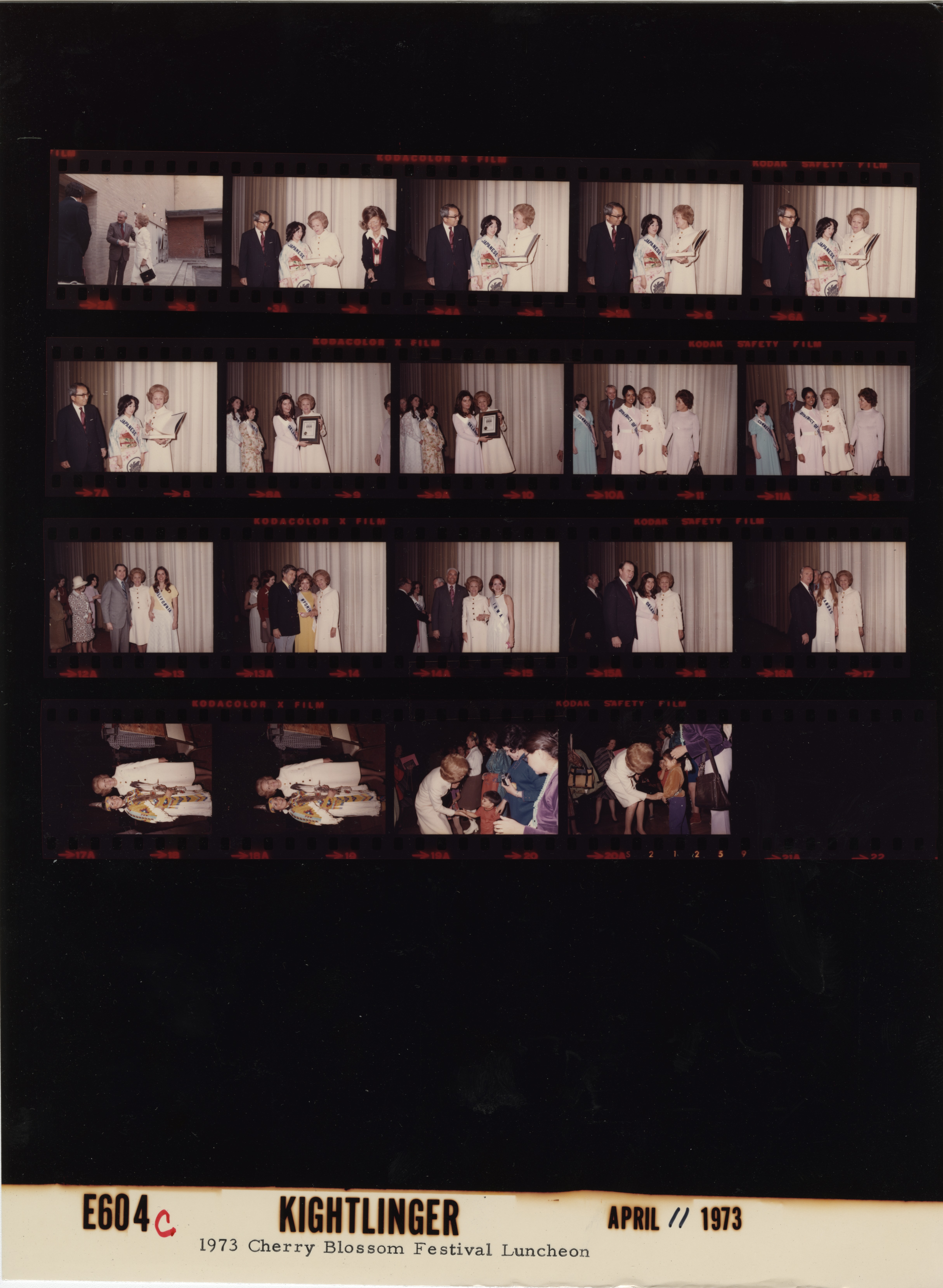
- Frame(s): WHPO-E0604-02A-20A, Pat Nixon speaking with the 1973 National Cherry Blossom Festival officials including the Cherry Blossom Queen from Japan with Japanese Ambassador Nobuhiko Ushiba, and the American Indian Queen. 4/11/1973, Washington, D.C. Park Ballroom, Sheraton Park Hotel. Pat Nixon, Festival Chairman Richard Vierbuchen, Luncheon Chairman Mrs. Eve Lloyd Thompson, unidentified Cherry Blossom Queen from Japan, Japanese Ambassador to the U.S. Nobuhiko Ushiba, unidentified Cherry Blossom Princesses.
Roll WHPO-E0605 Photographer: Schumacher, Karl | Color or B&W: Color
- Frame(s): WHPO-E0605-, President Nixon presenting American Cancer Society's "Courage Award" to professional football player Jack Pardee. 4/11/1973, Washington, D.C. White House, Oval Office. President Nixon, Pat Nixon, Jack Pardee, Mrs. Jack Pardee, Charles R. Ebersol, Mrs. Charles Ebersol, Lane W. Adams, Mrs. Lane Adams, Irving I. Rimer, Steve Barrie, Minnie Pearl, Henry Cannon.
Roll WHPO-E0606 Photographer: Knudsen, Robert L. | Color or B&W: B&W
- Frame(s): WHPO-E0606-, President Nixon presenting American Cancer Society's "Courage Award" to professional football player Jack Pardee. 4/11/1973, Washington, D.C. White House, Oval Office. President Nixon, Pat Nixon, Jack Pardee, Mrs. Jack Pardee, Charles R. Ebersol, Mrs. Charles Ebersol, Lane W. Adams, Mrs. Lane Adams, Irving I. Rimer, Steve Barrie, Minnie Pearl, Henry Cannon.
Roll WHPO-E0613 Photographer: Knudsen, Robert L. | Color or B&W: B&W
- Frame(s): WHPO-E0613-04-07, President Nixon departing by helicopter for Camp David. 4/11/1973, Washington, D.C. White House, South Lawn. President Nixon, unidentified Marine aide.
- Frame(s): WHPO-E0613-08-09, Unidentified man at podium. 4/11/1973, Washington, D.C. unknown. unidentified official.
The White House Communications Agency Sound Recordings Collection contains public statements that took place between 1969 and 1974. Visit the finding aid to learn more.
P - Formal Presidential Remarks
- WHCA-SR-P-730408
Remarks by President Nixon at presentation of Cancer Courage Award to Jack Pardee with PN, M&M Pardee. (4/11/1973)
Runtime: 2:35
Original Format: 1/4-inch reel-to-reel audiotape. Original source type: Original.
S - White House Press Office Briefings (continuation of the L-series)
- WHCA-SR-S-060
Press briefing by George Shultz on pension reform. (4/11/1973, White House Press Lobby)
Runtime: 35:45:00
Keywords: Press conferences, news conferences, interviews, media
Production credits: Audio feed supplied by WHCA; Recorded by GET (initials of WHCA engineer)
Original Format: 1/4-inch reel-to-reel audiotape. Original source type: Original. - WHCA-SR-S-061
Press briefing by Ronald Ziegler. (4/11/1973, White House Press Lobby)
Runtime: 28:03:00
Keywords: Press conferences, news conferences, interviews, media, press secretary
Production credits: Audio feed supplied by WHCA; Recorded by GET (initials of WHCA engineer)
Original Format: 1/4-inch reel-to-reel audiotape. Original source type: Original. - WHCA-SR-S-062
Press briefing by Virginia Knauer. (4/11/1973, EOB Conference Room (450))
Runtime: 42:00:00
Keywords: Press conferences, news conferences, interviews, media
Production credits: Audio feed supplied by WHCA; Recorded by Earl Doss (initials of WHCA engineer)
Original Format: 1/4-inch reel-to-reel audiotape. Original source type: Original. - WHCA-SR-S-063
Briefing for TV broadcasters by Herbert Klein. (4/11/1973, EOB Conference Room (450))
Runtime: 58:00:00
Keywords: Briefings, public briefings, statements to the press (see also Press conferences, news conferences, interviews, media)
Production credits: Audio feed supplied by WHCA; Recorded by Earl Doss (initials of WHCA engineer)
Original Format: 1/4-inch reel-to-reel audiotape. Original source type: Original.
The White House Communications Agency Videotape Collection contains “off-the-air” recordings of televised programs produced between 1968 and 1974. Visit the finding aid to learn more.
- WHCA-6229
Amnesty Between Us.
CBS
Runtime: 01:32:37 - WHCA-6231
Weekly News Summary, Tape II.
ALL NETWORKS
Runtime: 1:30
27. Smith/Miller: Air pollution with Ruckleshaus. Time Code Start: 63:45. Keywords: ecology, environment, pollutants, air pollution, water pollution, noise pollution, smog, smoke, fossil fuels, litter, sludge, contamination, debris. Network: ABC.
28. Smith/Schoumacher: The abolition of Office of Economic Opportunity (OEO). Time Code Start: 68:40. Keywords: Office of Economic Opportunity, war on poverty, VISTA, Job Corps, Community Action Program, Head Start , welfare, closings. Network: ABC.
29. Smith: President Nixon's pension plans. Time Code Start: 71:00. Keywords: Presidents, retirement, finances, pensions. Network: ABC.
30. Smith/Zimmerman: Meat boycott. Time Code Start: 71:45. Keywords: food, meats, animal products, markets, retail stores, prices, costs, increases, shortages, protests, boycotts. Network: ABC.
31. Reasoner: Cambodia, Vietnam. Time Code Start: 73:51. Keywords: Cambodia, Vietnam War. Network: ABC.
32. Smith/Donaldson: Watergate. Time Code Start: 74:44. Keywords: Watergate, Senate committee hearings, investigations, testimony, testify, cover-ups, break-in, burglary, theft, plumbers, scandals. Network: ABC.
33. Reasoner/Schoumacher: Pentagon papers. Time Code Start: 77:10. Keywords: Armed Forces, military, classified documents, secrets, Ellsberg, Russo, Watergate, courts, trials, Supreme Court, Vietnam War, Indochina War, bombings. Network: ABC.
34. Smith: Commentary on the Middle East. Time Code Start: 79:00. Keywords: Middle East, Mideast, war. Network: ABC.
35. Chancellor/Jones: Cambodia and Vietnam with General Haig. Time Code Start: 80:52. Keywords: Cambodia, Vietnam War, military, officials, interviews. Network: NBC.
36. Chancellor/Secretary of Defense Richardson: Vietnam. Time Code Start: 83:20. Keywords: cabinet, advisors, Vietnam War. Network: NBC.
37. Chancellor/Brady: Refugees in Phnom Penh, Cambodia. Time Code Start: 84:16. Keywords: Cambodia, Vietnam War, cities, immigrants, homeless. Network: NBC.
38. Brinkley: Commentary on peace in Indochina. Time Code Start: 86:00. Keywords: Laos, Cambodia, Paris Peace Talks, Vietnam War, treaty, treaties, negotiations. Network: NBC.
39. Chancellor/Hackes: Federal courts and the Office of Economic Opportunity (OEO) with Ruckleshaus. Time Code Start: 87:26. Keywords: Office of Economic Opportunity, war on poverty, VISTA, Job Corps, Community Action Program, Head Start , welfare, closings. Network: NBC. - WHCA-6232
Weekly News Summary, Tape III.
ALL NETWORKS
Runtime: 00:54:32
1. Chancellor/Duke: Watergate with Dwight Chapin and Senator Barry Goldwater. Time Code Start: 00:00. Keywords: Dirty Tricks, political sabotage, trials, Watergate, Senate committee hearings, investigations, testimony, testify, cover-ups, Presidential elections, campaigns. Network: NBC.
2. Chancellor: More on Mitchell and Watergate and more on executive privilege. Time Code Start: 02:35. Keywords: Watergate, Senate committee hearings, investigations, testimony, testify, cover-ups, break-in, burglary, theft, plumbers, scandals. Network: NBC.
3. Cronkite/Schorr: Office of Economic Opportunity (OEO) and Ruckleshaus on auto pollution. Time Code Start: 04:41. Keywords: Office of Economic Opportunity, automobiles, cars, trucks, vehicles, emissions, pollutants, air pollution, smog, smoke. Network: CBS.
4. Pappas: Auto makers respond to Ruckleshaus. Time Code Start: 08:48. Keywords: automobiles, cars, trucks, vehicles, manufacturing. Network: CBS.
5. Cronkite/Dunning: Mazda and Honda meet pollution standard. Time Code Start: 10:50. Keywords: autos, cars, trucks, organizations, business, manufacturing, tests, ecology, environment, pollutants, air pollution, water pollution, noise pollution, smog, smoke, fossil fuels, litter, sludge, contamination, debris. Network: CBS.
6. Cronkite: Watergate with Dwight Chapin; Senator Barry Goldwater speaks out. Time Code Start: 13:48. Keywords: Dirty Tricks, political sabotage, trials, Watergate, Senate committee hearings, investigations, testimony, testify, cover-ups, Presidential elections, campaigns. Network: CBS.
7. Cronkite/McGlockin: Senator Anderson on executive privilege. Time Code Start: 15:30. Keywords: Senators, media, interviews, testimony. Network: CBS.
8. Cronkite/Pierpoint: South Vietnam and Cambodia. Time Code Start: 17:50. Keywords: Vietnam War, Cambodia. Network: CBS.
9. Cronkite/Fred Graham/Artist Don Juhlin: Pentagon Papers trial Ellsberg testimony, describes how he changed from Vietnam War hawk to dove. Time Code Start: 20:20. Keywords: Armed Forces, military, classified documents, secrets, Watergate, courts, trials, Vietnam War, Indochina War, bombings, testify. Network: CBS.
Context (External Sources)
The Vanderbilt Television News Archive is the world's most extensive and complete archive of television news. They have been recording, preserving and providing access to television news broadcasts of the national networks since August 5, 1968.
Wikipedia is a free encyclopedia that anyone can edit.