
Introduction
This almanac page for Monday, November 20, 1972, pulls together various records created by the federal government and links to additional resources which can provide context about the events of the day.
Previous Date: Sunday, November 19, 1972
Next Date: Tuesday, November 21, 1972
Schedule and Public Documents
The Daily Diary files represent a consolidated record of the President's activities. Visit the finding aid to learn more.
The President's day began at Camp David, Maryland
The Weekly Compilation of Presidential Documents made available transcripts of the President's news conferences; messages to Congress; public speeches, remarks, and statements; and other Presidential materials released by the White House.
Digitized versions can be found at HathiTrust.
The Federal Register is the official daily publication for rules, proposed rules, and notices of federal agencies and organizations, as well as executive orders and other Presidential documents.
No Federal Register published on this date
Archival Holdings
Any selection of archival documents will necessarily be partial. You should use the documents and folders identified below as a starting place, but consult the linked collection finding aids and folder title lists and the collections themselves for context. Many documents to be found this way do not lend themselves to association with specific dates, but are essential to a complete understanding of the material.
Selective document listing
President's Office Files
The President's Office Files consists of materials drawn together by the Special Files Unit from several administrative subdivisions within the White House Office. It is the handwriting and sensitive papers sent to the Staff Secretary that now comprise much of the President's Office Files. Visit the finding aid to learn more.
- News Summaries, Unmarked News Summaries, Box 52, News Summaries - November 1972 [4 of 11] [Note: Due to the way News Summary products were compiled, you should also consult nearby days for potentially relevant materials.]
- Weekend News Review, November 20, 1972
The H. R. Haldeman Diaries consists of seven handwritten diaries, 36 dictated diaries recorded as sound recordings, and two handwritten audio cassette tape subject logs. The diaries and logs reflect H. R. Haldeman’s candid personal record and reflections on events, issues, and people encountered during his service in the Nixon White House. As administrative assistant to the President and Chief of Staff, Haldeman attended and participated in public events and private meetings covering the entire scope of issues in which the Nixon White House engaged in during the years 1969-1973. Visit the finding aid to learn more.
- Transcript of diary entry (PDF)
Monday, November 20.
The President had me over first thing this morning. Opened with schedule changes. He's dropped his Florida plans for this weekend and will go the following weekend. In the meantime he wants to set up all the possible activity he can for appointments to get cleaned up on Friday and Saturday, either here or in New York at the Waldorf. Load the schedule in the mornings. He's decided to go up to New York with the family after a Thanksgiving here at Camp David, to do Christmas shopping, go to the theater, and visit Tricia's possible new home in Brooklyn, etcetera. I think he's just getting a little stir crazy and wants to get out, which is probably a good idea, from a general appearance anyway. They've also decided to go to California for Christmas and have Bebe come out the day after, and he came up with the idea of trying to get Pat Nixon named as the Grand Marshal for the Rose Parade this year.
Got into a lot of general personnel items. Doesn't want Shultz to discuss the Secretary of Labor with Meany when he meets with him this morning, because he's basically decided to take Brennan. We have to take a Brennan-type. He's tilting strongly to Scali on the United Nations, because he gives us an Italian on the Cabinet and someone to really sell our foreign policy. He says to give Walter Washington an Ambassadorship, he won't put him in the UN. Wants to leave Morton in Interior and consider Whitaker as Under Secretary. Feels we've got to get Colson's input on the appointments and personnel since he understands the things that the President wants. Wants to be sure we have a bag of things to offer Hodgson, such as the SEC, etcetera, including an Ambassadorship, when we drop him. Wants to move Stan Scott in as the house black, vote him onto the social list and so on. Bring Ed Nixon into the White House as sort of a family ombudsman.
Brief session with me first, and later Ziegler, on transition PR. He says that he wants Ehrlichman to start his briefing on the reorganization by saying the change is nothing in relation to Congress, that the President's simply trying to make his and the White House's relations with the Cabinet more effective. So they're dividing the work of the Cabinet into areas that coincide with the Ash Council recommendations on the basis of their studies. The President will meet with these groups as required and will only have full Cabinet meetings when they're needed on great overall issues. This would be a much better use of the Cabinet. And the President feels this is a good way to present that part of it. We then got into transition PR on a current basis with Ziegler when he came in. Told Ron to knock down the Star story, that it is pretty far off the mark, and, of course, on the Kissinger story say "no comment." Says to tell the press they shouldn't expect an announcement all at once, that when the changes are made they won't be at once, and they'll be announced when they're ready, since the organizational changes involve the whole realm of government. The Cabinet has welcomed this opportunity to meet with the President. The President told them several months ago that he wanted new ideas and new thrust, not just to ride the momentum of the landslide. The normal tendency is to go downhill after a landslide. This is an effort to reverse this and to try to move to new heights. The Cabinet people are making excellent suggestions regarding their Departments. All of them agree with the President that there can be significant reductions, and that this is the time to do it. Provides an opportunity, because it's forced everyone in the bureaucracy to think. The Cabinet is speaking, not as prisoners of their bureaucracy, but stepping aside and thinking new. President hasn't determined yet what he's going to do, there will be no announcements until he talks to all the members of the Cabinet. There will be some like Laird who will want to leave, others will be moving to other posts. Every member of the Cabinet is a valued member of the team, an outstanding public servant, and should remain in the public service, the President feels, if they don't have to return to private life. The President has developed some imaginative ways to utilize these people. And then we’ll start moving the stuff on Tuesday as to what we actually are doing.
He also got into image, PR. He had apparently gotten up early this morning and started in on a long memorandum to me on the subject, to use as a talking paper to discuss with other people. He says we need to be concerned about what people write regarding the Administration, we've struck out on the boldness, courage, and heart lines. Our problem is that all our people are technicians. Kissinger is interested in progress --process, Ehrlichman in programs, Ziegler in hard news. Moore understands, but has no ability to get it out, Safire's too hard, McRory understands it, and Niddecker-types do. Price's TV speech, versus the way that Gavin and the President wrote it is a case in point. Price was uncomfortable with this kind of thing. We have to get away from process and programs. The reason we won big was the four big plays the President made --China, Russia, May 8th and August 15th. There won't be any big plays in the second term, and we can't make another acceptance speech. He thinks he can pump this into Teddy White for a couple of hours, but we've got to find new ways to emphasize the positive. He agrees that Safire should go ahead on his book with a lot of access --talk to Connally and Moynihan and so on, get their views and cover how the press has pissed on us, and then Moore should work with him, and Colson and Kissinger.
The Kissinger PR problems. He’s very distressed with the Kissinger interview, which gave away the moral ground in Vietnam, plus praising Tho and knocking Thieu, which was bad. He wants to set up a situation for a social engagement with General and Mrs. Haig as a cover, and then he wants to talk to Haig candidly about the Kissinger problem next week sometime. Wants me to knock off Kissinger's going to China before the Inaugural, which Henry wants to do. We've got to leash Henry more than we have up to now. He wants to be sure that I get from Kissinger's office all the files and memoranda from and to the President, and get them into the President's files-- especially all of his handwritten stuff, the originals, physically move it into the President’s files now. Ziegler again on the Life picture, and wants Colson to run an all-out effort on Life and all their advertisers and so on. Talked some about getting a real good secretary, his description being, "The most brilliant, loyal, experienced, fairly young, single secretary, who is very fast and totally loyal." This to replace Rose. In terms of the President’s reliance since he can’t really count on Rose anymore because of her temperament.
He had quite a series of meetings today; I sat in on several of them. With Richardson there was no problem, he was ecstatic at being offered the Defense Department post, which I discussed with him before he went to see the President. He, I think, was genuinely surprised, but clearly pleased to be selected. The President emphasized the need for shrinking the Pentagon bureaus, especially the DIA, told him we were going to make the appointments, the President was going to make the appointments of the key spots, and that the President will have a direct relationship with the Joint Chiefs. Said the President will make the decisions on what has to be done, not Kissinger --that is, a look at the service schools that are too big, DIA must be cut, we won't fill all the posts at the Pentagon; the assistant secretaries, we'll thin down the service secretaries, do more of the Haig type thing of boosting lower level guys. Said he had great confidence in Haig, told him that he was going to get Clements up right away and go ahead with that appointment. He suggested that Elliot sit in the WSAG meetings instead of having the Deputy Secretary sit in and felt that would be a better way of dealing with Henry. He made quite a point of Elliot's ability to deal with Henry, and his understanding of him and so on, as being one of the major pluses. He met with Helms, we had no preliminary meeting. The President told Helms he was going to make a change, gave him a good buildup first. Offered him an Ambassadorship. He asked for an evaluation of personnel, said he'd like his recommendations for the President's eyes only and not through the NSC, and also any recommendations on reorganization that's never taken place, that now is the time to move on "the establishment." They talked about specific Ambassadorships and Helms lobbed in Iran, President responded very favorably and agreed to hold Iran open until Helms decides whether he wants it or not. He urged him to take it. Helms pushed Colby and Karamessinas for the CIA head. President said there's a question of whether to promote from within or whether to go outside for the new Director. It was basically a friendly meeting, although I think Helms was a little surprised and obviously very disappointed to be moving out after 25 years, but there didn't seem to be any problem.
Flanigan meeting went pretty well, Shultz laid it out to him ahead of time that he was not going to be given any post that required confirmation. And that the problem of re-opening ITT and everything was too great, at least at this stage. And then Shultz gave him a pitch on wanting to keep him in the CIEP and working with George on a general basis on international things. And I moved in and made the same pitch. Pete wasn't overly pleased, but I think was not overly startled either. Talking with the President --he made the pitch that he really wanted Pete as Deputy Secretary of the Treasury or Under Secretary for Economics at State, but couldn't do it because of the confirmation thing, at least now, but maybe in a few months or a year it could be done. There was also some discussion about the Energy Program, the need to settle how to handle it. Flanigan suggested making the Atomic Energy Commission the National Energy Commission, with Schlesinger as head of it in the Natural Resources Department. Going to consider a plan on that.
The Garment meeting, the President told him he wanted him to stay on, praised him for his unsung heroism, etcetera. Len made a pitch for being included in more meetings and policy matters and get a new title and be moved into the White House, which the President more or less bought. Also said we ought to replace the whole Bicentennial Commission and staff, and suggested Scranton or Frank Stanton as the new head. President was a little shocked by that. Garment also suggested putting the money in the Foundation for the Arts and Humanities for grants to support traditional stuff like libraries, museums and orchestras, and put the country in the shape to celebrate. President made the point that the arts are not our people, that we should get into academia with a committee of our scholars, have a competition on what's right with America. Also musical competition and painting, etcetera, but more in terms of writing and speaking, a massive thing with a lot of prizes --not too big and involve all the kids in the United States. President gave him the lecture about having to find a way not to pander to our enemies, that we have to do something for our friends, the 61 percent. We have a different problem than in '69. Now we should do as FDR: reward the friends, punish the enemies, and build something that was strong. Len then mentioned the Nobel Peace Prize in connection with Stanton, who had boosted the President for it, and the President said that he wouldn't accept it --a public man must never accept an award for doing his job and he will never accept it. He hopes they're foolish enough to offer it to him so he can turn them down. He said to try to find a way to use the Bicentennial to change the thinking of the country, affect the thinking on the core values of America, and sort of charged Len up on that basis.
During the few breaks I got out from the President's office, I had two major phone calls. One, with Mitchell, who re-raised the Nitze thing about the guy that's writing a book on the SALT talks, thinks Kissinger can get that cleaned up. On Attorney General, wants to be sure Peterson stays on, as well as Kleindienst. On Stans rehabilitation, says Maury has taken his lumps and is now going to get his integrity re-established. Maybe an Ambassador-at-large with some economic assignments would do it. Mitchell pushed Rita Hauser, who is bugging him for the UN, or Solicitor- General. Arlen Specter, he wants put in LEAA or something like that which would get him out of Pennsylvania and make Rizzo happy. Reagan is pushing Bill Smith for Attorney General or the Court. Marriott is jumping up and down about the Inaugural. Mitchell says George Bush would be great for the National Committee, but he won't take it, and he agreed that Lee Nunn would be the guy to start moving on shaking up the Dole thing in the National Committee.
Henry called from Paris to say that the press found out about their meeting place, so there'll be a lot of pictures and stories, and so on, because they tailed the Vietnamese there and were there when Henry arrived. He's proposed to move the meetings to the city, but the Vietnamese haven't agreed as yet, said he's sending a report that things are going about as expected-- no worse, maybe a little better. They're tough, but not unmanageable. They're going to meet again tomorrow afternoon. They're studying the proposals, we should say nothing. He’ll call again tomorrow, and that was about it.
President had Colson, Ehrlichman, and Ziegler and me to dinner tonight. Spent a lot of time discussing specific personnel things, especially Secretary of Labor. Agreed to put Usery in the Curt Counts job, consider Counts for an Agency Head or Commission Chairman. Ehrlichman got a call from Bush, who met with the President earlier, and the President pitched him on the RNC. Bush saying that he would do it, if that's what the President wants. Some discussion of Arch Davis for HUD, and Stazney [unclear] for some key job.
It was a long, full day, covered some pretty good ground, got a few things established, and no major problems except apparently Rumsfeld, who had his meeting with the President after a premeeting with Ehrlichman and so on, where he agreed that he should go on out to HEW-- correction go on out to Illinois and run for the Senate. But then when he got in the meeting with the President, he said no, that just wouldn't do, that he’d have to have an Administration job for a year, which was a complete shock to the President and Ehrlichman, and a typical Rumsfeld, rather slimy, maneuver.
End of November 20. - Original audio recording (MP3)
The National Archives Catalog is the online portal to the records held at the National Archives, and information about those records. It is the main way of describing our holdings and also provides access to electronic records and digitized versions of our holdings.
The Catalog searches across multiple National Archives resources at once, including archival descriptions, digitized and electronic records, authority records, and web pages from Archives.gov and the Presidential Libraries. The Catalog also allows users to contribute to digitized historical records through tagging and transcription.
Nixon Library Holdings
All National Archives Units
National Security Documents
The President's Daily Brief is the primary vehicle for summarizing the day-to-day sensitive intelligence and analysis, as well as late-breaking reports, for the White House on current and future national security issues. Read "The President's Daily Brief: Delivering Intelligence to Nixon and Ford" to learn more.
The Foreign Relations of the United States series presents the official documentary historical record of major U.S. foreign policy decisions and significant diplomatic activity. Visit the State Department website for more information.
Vol. IV, Foreign Assistance, International Development, Trade Policies, 1969-1972
Coordinating Committee on Export Controls, 1969-1972
383. Memorandum From the Chairman of the Inter-Agency Task Force To Review the COCOM System (Armstrong) to the Chairman of the National Security Council Under Secretaries Committee (Irwin), Washington, November 20, 1972
Source: National Archives, RG 59, S/S Files: Lot 81 D 309, NSC-U/SM 109C. Confidential. Drafted by R.B. Wright (EB/ITP/EWT). An attached November 24 memorandum from Acting Staff Director Seymour Weiss to members of the Task Force requested comments on the paper attached to this memorandum. Also attached is a draft memorandum to the President. For the revised memorandum based on comments received pursuant to Weiss’ November 24 memorandum, see Document 387.
Vol. V, United Nations, 1969-1972
UN Finances and Reduction of the U.S. Assessment
201. Telegram From the Mission to the United Nations to the Department of State, New York, November 20, 1972, 0341Z
Source: National Archives, RG 59, Central Files 1970–73, UN 10–4. Confidential; Limdis.
Vol. IX, Vietnam, October 1972-January 1973
Paris Negotiations Collapse, October 24-December 13, 1972
115. Message From the President’s Assistant for National Security Affairs (Kissinger) to President Nixon, Paris, November 20, 1972, 1900Z
Source: National Archives, Nixon Presidential Materials, NSC Files, Kissinger Office Files, Box 26, HAK Trip Files, HAK Paris Trip Hakto, November 18–25, 1972. Top Secret; Codeword; Sensitive. Sent via Kennedy and Haldeman. A stamped notation on the message reads: “The President has seen.”
Vol. XL, Germany and Berlin, 1969-1972
Germany and Berlin, 1969-1972
385. Backchannel Message from Helmut Sonnenfeldt of the National Security Council Staff to the President’s Assistant for National Security Affairs (Kissinger), Washington, November 20, 1972, 0146Z
Source: National Archives, Nixon Presidential Materials, NSC Files, Kissinger Office Files, Box 26, HAK Trip Files, HAK Paris Trip, TOHAK [2 of 2]. Confidential. Kissinger was in Paris for private discussions with Le Duc Tho to negotiate a settlement of the Vietnam War. A memorandum from Kissinger, briefly summarizing Sonnenfeldt’s message, was forwarded to the President on November 20. (Ibid., NSC Files, Box 47, President’s Daily Brief, November 17–30, 1972)
Vol. XLII, Vietnam: The Kissinger-Le Duc Tho Negotiations
Breakdown of Negotiations, November 1972-December 1972
26. Memorandum of Conversation, Paris, November 20, 1972, 10:45 a.m.-4:55 p.m.
Source: National Archives, Nixon Presidential Materials, NSC Files, Box 858, For the President’s Files (Winston Lord)—China Trip/Vietnam Negotiations, Sensitive, Camp David, Vol. XXI, Minutes of Meetings. Top Secret; Sensitive; Exclusively Eyes Only. The meeting took place at 108 Avenue Du Général Leclerc in Gif-sur-Yvette. All brackets except where noted are in the original. The tabs are attached but not printed.
Since Kissinger’s last meeting with the North Vietnamese in Paris on October 17, South Vietnamese President Thieu had blocked the settlement, rejecting the agreement negotiated by Kissinger and Le Duc Tho despite Kissinger’s attempt to persuade Thieu during his (Kissinger’s) October 19–22 visit. Thieu had numerous criticisms of the agreement but central to his objections was that it did not require North Vietnamese forces in South Vietnam, estimated to be 140,000–300,000, to leave the South. Believing it was critical that the United States and South Vietnam be on the same page regarding the negotiations, President Nixon directed Kissinger at this next meeting in Paris to present and argue for the changes Thieu requested. For documentation on Kissinger’s visit to Saigon and his meetings with Thieu, see Foreign Relations, 1969–1976, vol. IX, Vietnam, October 1972–January 1973, Documents 27, 29, 32, 34–36, 39, 41–44, 48–50, and 52–58.
The number of changes demanded by the South Vietnamese numbered 69, and Le Duc Tho was, as Kissinger noted in his November 20 memorandum to the President reporting on the meeting, “obviously somewhat taken aback by the extent of our proposed modifications and indicated that they may have some changes of their own.” While most modifications desired by South Vietnam were less than significant, a few were, and the question of North Vietnamese troops in the South was the most significant for both Hanoi and Saigon. Kissinger, according to his memorandum to Nixon, made it clear to Le Duc Tho that “the most important remaining obstacle was the issue of North Vietnamese troops in the South. Although he [Tho] did not reject some give on this issue he was essentially noncommittal in expressing any degree of flexibility.” (Ibid., Document 115) It should be recalled that Tho had said many times in the negotiations that the question of North Vietnamese soldiers in the South would not, as a matter of principle, be discussed.
After Le Duc Tho reported to the Politburo on the developments at this November 20 meeting, the Politburo sent the following analysis and directive: “Based on the points that Kissinger demands be changed both as part of the Agreement and outside the written agreement, the Politburo believes that the U.S has changed the content of the Agreement and has reversed its position on many important issues to which it had previously agreed. This means that we must view this as a re-negotiation of the agreement.” To this the Politburo added: “You need to concentrate on arguing hard to defeat the American plan to change the content of the Agreement and to reverse themselves on issues about which agreement has previously been reached.” (Message from the Politburo to Le Duc Tho and Xuan Thuy, 22 November 1972, in Doan Duc, et al., compilers, Major Events: The Diplomatic Struggle and International Activities during the Resistance War Against the Americans to Save the Nation, 1954–1975, volume 4, p. 349)
Vol. E-1, Documents on Global Issues, 1969-1972
U.S.-Cuba Hijacking Agreement, 1969-February 1973
136. Information Memorandum from Assistant Secretary Meyer to Secretary Rogers, Washington, November 20, 1972
Meyer reported that the Cuban Government was ready for early talks on hijacking and other serious crimes.
Source: National Archives, RG 59, Central Files 1970-73, AV 12. Confidential; Exdis. Drafted by Joseph Norbury (ARA/CCA) and cleared by Hurwitch. Rogers informed the President of this response on November 22. (Ibid., President’s Evening Reading: Lot 74 D 164)
Vol. E-10, Documents on American Republics, 1969-1972
Panama
562. Memorandum From William J. Jorden of the National Security Council Staff to the President’s Assistant for National Security Affairs (Kissinger), Washington, November 20, 1972., Washington, November 20, 1972
National Security Council staff member Jorden discussed efforts to gain the release of two U.S. ships, a possible meeting between President Nixon and General Torrijos, an upcoming UNSC meeting in Panama, and Canal negotiations. If President’s Assistant for National Security Affairs Kissinger thought it were necessary, Jorden stated that he was willing to ascertain from Torrijos what he wanted regarding the Canal negotiations.
Source: National Archives, Nixon Presidential Materials, NSC Files, Box 791, Country Files, Latin America, Panama, Vol. 3, January 1972. Secret; Sensitive. Sent for action. The memorandum was sent to Kissinger through Haig. Kissinger approved the recommendation, and wrote next to Jorden’s name, “I think you should go. HK.” [text not declassified] Tab B, “Previous Scenario 11/1/72,” has not been found. For documents on efforts to release the ships, see Documents 258, 262, and 264 in the Cuba compilation. Jorden traveled to Panama February 9–11, 1973.
The Kissinger telephone conversation transcripts consist of approximately 20,000 pages of transcripts of Kissinger’s telephone conversations during his tenure as Assistant to the President for National Security Affairs (1969-1974) and Secretary of State (1973-1974) during the administration of President Richard Nixon. Visit the finding aid for more information.
Digitized versions can be found in the National Archives Catalog.
Audiovisual Holdings
Visit the White House Tapes finding aid to learn about the taping system's operation and archival processing.
Camp David Hard Wire
- 228-1; Unknown between 9:09 a.m. & 11:16 a.m.; Nixon, Richard M. (President); Haldeman, H. R. ("Bob"); Sanchez, Manolo; Ziegler, Ronald L.; Camp David Operator; Ehrlichman, John D.
- 228-2; Unknown between 1:21 p.m. & 1:42 p.m.; Nixon, Richard M. (President)
- 228-3; 1:42 p.m. - 1:46 p.m.; Nixon, Richard M. (President); Haldeman, H. R. ("Bob")
- 228-4; Unknown between 1:46 p.m. & 2:05 p.m.; Nixon, Richard M. (President)
- 228-5; Unknown between 1:46 p.m. & 2:05 p.m.; Nixon, Richard M. (President); Camp David Operator
- 228-6; 2:05 p.m. - 2:21 p.m.; Nixon, Richard M. (President); Colson, Charles W.
- 228-7; 2:26 p.m. - 2:27 p.m.; Nixon, Richard M. (President); Eisenhower, Julie Nixon
- 228-8; 4:41 p.m. - 4:42 p.m.; Nixon, Richard M. (President); Haldeman, H. R. ("Bob")
- 229-1; Unknown between 6:22 p.m. & 6:29 p.m.; Nixon, Richard M. (President); Haldeman, H. R. ("Bob")
- 229-2; Unknown between 6:29 p.m. & 6:49 p.m.; Nixon, Richard M. (President); [Unknown person(s)]
- 229-3; 6:49 p.m. - 6:50 p.m.; Nixon, Richard M. (President); Camp David Operator
- 229-4; Unknown between 6:50 p.m. & 9:00 p.m.; Nixon, Richard M. (President); Cox, Tricia Nixon
- 229-5; Unknown between 6:50 p.m. & 9:00 p.m.; Nixon, Richard M. (President); Sanchez, Manolo
- 229-6; Unknown between 6:00 p.m. & 9:00 p.m.; Nixon, Richard M. (President); Sanchez, Manolo
- 229-7; Unknown between 6:50 p.m. & 7:15 p.m.; Nixon, Richard M. (President); [Unknown person(s)]
- 229-15; Unknown between 6:50 p.m. & 7:15 p.m.; [Unknown person(s)]
Camp David Study Table
- 155-5; Unknown between 8:00 a.m. & 8:36 a.m.; Nixon, Richard M. (President); Camp David Operator
- 155-6; Unknown between 8:00 a.m. & 8:36 a.m.; Nixon, Richard M. (President); Camp David Operator
- 155-7; 8:36 a.m. - 8:41 a.m.; Nixon, Richard M. (President); Val, Claudia
- 155-8; Unknown between 8:41 a.m. & 8:46 a.m.; Nixon, Richard M. (President); Camp David Operator
- 155-9; 8:46 a.m. - 8:50 a.m.; Nixon, Richard M. (President); Woods, Rose Mary
- 155-10; 9:05 a.m. - 9:09 a.m.; Nixon, Richard M. (President); Eisenhower, Julie Nixon
- 155-11; Unknown between 9:09 a.m. & 10:53 a.m.; Nixon, Richard M. (President); White House operator
- 155-12; Unknown between 10:53 a.m. & 11:10 a.m.; Nixon, Richard M. (President); Camp David Operator
- 155-13; Unknown between 10:53 a.m. & 11:10 a.m.; Nixon, Richard M. (President); Camp David Operator
- 155-14; 11:10 a.m. - 11:11 a.m.; Nixon, Richard M. (President); Ehrlichman, John D.
- 155-15; 1:42 p.m. - 1:46 p.m.; Nixon, Richard M. (President); Haldeman, H. R. ("Bob"); Ehrlichman, John D.
- 155-16; Unknown between 1:46 p.m. & 2:05 p.m.; Nixon, Richard M. (President); Camp David Operator
- 155-17; 2:05 p.m. - 2:21 p.m.; Nixon, Richard M. (President); Colson, Charles W.
- 155-18; Unknown between 2:21 p.m. & 2:26 p.m.; Nixon, Richard M. (President); Camp David Operator
- 155-19; 2:26 p.m. - 2:27 p.m.; Nixon, Richard M. (President); Eisenhower, Julie Nixon
- 155-20; Unknown between 6:29 p.m. & 6:49 p.m.; Nixon, Richard M. (President); Camp David Operator
- 155-21; 6:49 p.m. - 6:50 p.m.; Nixon, Richard M. (President); Cox, Tricia Nixon
The White House Photo Office collection consists of photographic coverage of President Richard Nixon meeting with prominent social, political, and cultural personalities; speaking engagements and news conferences of the President and various high-ranking members of the White House staff and Cabinet; Presidential domestic and foreign travel, including Presidential vacations; social events and entertainment involving the First Family, including entertainers present; official portraits of the President, First Family, and high-ranking members of the Nixon administration; the 1969 and 1973 Inaugurals; the President’s 1972 Presidential election campaign appearances (including speeches) and other official activities of the White House staff and the President’s Cabinet from January 20, 1969 until August 9, 1974 at the White House and the Old Executive Office Building; other locations in Washington, DC, such as The Mall; and the Presidential retreats in Camp David, Maryland, Key Biscayne, Florida, and San Clemente, California. Visit the finding aid to learn more.
Roll WHPO-D0999 Photographer: Schumacher, Karl | Color or B&W: Color
- Frame(s): WHPO-D0999-, Pat Nixon standing with children and adults before and after a performance, and seated during the performance. 11/20/1972, Washington, D.C. various sites, Kennedy Center. Pat Nixon, children, adults.
Roll WHPO-D1001 Photographer: Atkins, Oliver | Color or B&W: B&W
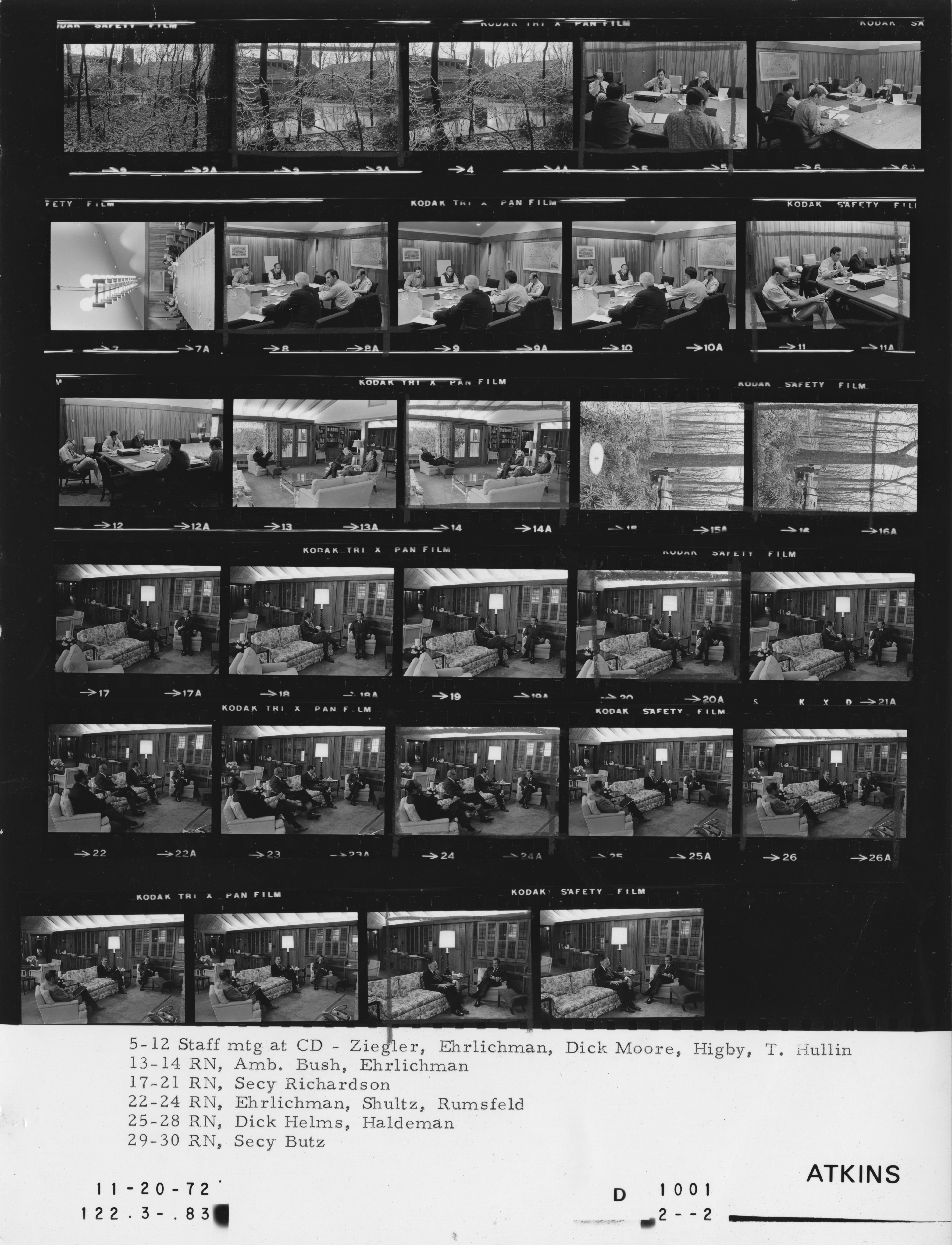
- Frame(s): WHPO-D1001-03, A Camp David cabin looking lodge seen through bare trees, branches covered with ice and small icicles. 11/20/1972, Camp David, Maryland Aspen Lodge, grounds.
- Frame(s): WHPO-D1001-03-04,15-16, Camp David grounds and bare trees surounding cabin looking lodges in the winter. 11/20/1972, Camp David, Maryland Aspen Lodge, grounds.
- Frame(s): WHPO-D1001-05-12, President Nixon and staff members during a meeting in the Aspen Lodge at Camp David. 11/20/1972, Camp David, Maryland Aspen Lodge, unidentified room. President Nixon, John Ehrlichman, George Bush, Elliott Richardson, Shultz, Rumsfeld, Richard Helms, Haldeman, Butz, unidentified uniformed man, Ronald Ziegler, Richard Moore, Larry Higby, Tom Hullin.
- Frame(s): WHPO-D1001-13-14, President Nixon seated with John Ehrlichman and George H. W. Bush. 11/20/1972, Camp David, Maryland Aspen Lodge, living room. President Nixon, Ehrlichman, George Bush.
- Frame(s): WHPO-D1001-14, President Nixon seated informally during a meeting in the Aspen Lodge Camp David living room with John Ehrlichman and George H. W. Bush. 11/20/1972, Camp David, Maryland Aspen Lodge, living room. President Nixon, John Ehrlichman, George Bush.
- Frame(s): WHPO-D1001-17-21, President Nixon seated with Richardson. 11/20/1972, Camp David, Maryland Aspen Lodge, unidentified room. President Nixon, Elliot Richardson.
- Frame(s): WHPO-D1001-22-24, President Nixon seated with John Ehrlichman, Donald Rumsfeld, and George Shultz. 11/20/1972, Camp David, Maryland Aspen Lodge, unidentified room. President Nixon, John Ehrlichman, Donald Rumsfeld, George Shultz.
- Frame(s): WHPO-D1001-25-28, President Nixon seated with H.R. Haldeman, and Richard Helms. President Nixon confirms Helms' removal as CIA Director and awards him an Ambassadorship to Iran. 11/20/1972, Camp David, Maryland Aspen Lodge, unidentified room. President Nixon, Richard Helms, Haldeman.
- Frame(s): WHPO-D1001-29-30, President Nixon seated with H.R. Haldeman, Richard Helms and Earl Butz. 11/20/1972, Camp David, Maryland Aspen Lodge, unidentified room. President Nixon, Richard Helms, Haldeman, Earl Butz.
Roll WHPO-D1002 Photographer: Atkins, Oliver | Color or B&W: B&W
- Frame(s): WHPO-D1002-04, Unidentified man walking on the Camp David grounds carrying an umbrella. 11/20/1972, Camp David, Maryland grounds. unidentified man.
- Frame(s): WHPO-D1002-05-14, Presidential Staff members at work during their stay at Camp David. 11/20/1972, Camp David, Maryland unidentified rooms. Larry Higby, Tom Hullin, Richard Moore, Jana Hruska.
Roll WHPO-D1003 Photographer: Schumacher, Karl | Color or B&W: B&W
- Frame(s): WHPO-D1003-04-05, Unidentified young woman at her desk. 11/20/1972, Washington, D.C. unknown. unidentified young woman, possibly a secretary.
- Frame(s): WHPO-D1003-06-10, Vice President Agnew in his EOB office shaking hands with Norm Van Brocklin. 11/20/1972, Washington, D.C. Executive Office Building, (EOB), Vice Presidential Office. Spiro Agnew, Norm Van Brocklin.
The White House Communications Agency Sound Recordings Collection contains public statements that took place between 1969 and 1974. Visit the finding aid to learn more.
L - White House Press Office Briefings
- WHCA-SR-L-064
Press briefing by Ronald Ziegler. (11/20/1972, Camp David)
Runtime: 26:00:00
Keywords: Press conferences, news conferences, interviews, media, press secretary
Original Format: 1/4-inch reel-to-reel audiotape. Original source type: Original.
The White House Communications Agency Videotape Collection contains “off-the-air” recordings of televised programs produced between 1968 and 1974. Visit the finding aid to learn more.
- WHCA-5931
Weekly News Summary, Tape I.
ALL NETWORKS
Runtime: 1:30
13. Reasoner/Koppel: More on Paris Peace Talks. Time Code Start: 42:32. Keywords: Paris Peace Talks, Vietnam War, treaty, treaties, negotiations. Network: ABC.
14. Chancellor/Lord: Paris peace talks, Kim Fook (Phan Thị Kim Phúc, the young napalm burn victim running in Vietnam War, Pulitzer photograph by Nick Ut). Time Code Start: 45:49. Keywords: Paris Peace Talks, Vietnam War, treaty, treaties, negotiations, military, fire, victims, children, photographs. Network: NBC.
15. Chancellor/Paxton: SALT talks [Strategic Arms Limitation Talks]. Time Code Start: 48:48. Keywords: SALT, S.A.L.T., Strategic Arms Limitation Talks, Russia, Soviet Union, USSR, Cold War, détente. Network: NBC.
16. Mudd/Kalisher: Kissinger in Paris again. Time Code Start: 50:37. Keywords: Paris Peace Talks, Vietnam War, treaty, treaties, negotiations, government, officials, travel, trips. Network: CBS.
17. [Time correct? Out of order?] Kalb: U.S.-Cuba relations and hijacking. Time Code Start: 54:06. Keywords: hijackings, skyjackings, kidnappings, terrorism, aircraft, airlines. Network: CBS.
18. Sevareid: Commentary on the Paris peace talks. Time Code Start: 55:38. Keywords: Paris Peace Talks, Vietnam War, treaty, treaties, negotiations. Network: CBS.
Context (External Sources)
The Vanderbilt Television News Archive is the world's most extensive and complete archive of television news. They have been recording, preserving and providing access to television news broadcasts of the national networks since August 5, 1968.
Wikipedia is a free encyclopedia that anyone can edit.