
Introduction
This almanac page for Tuesday, November 21, 1972, pulls together various records created by the federal government and links to additional resources which can provide context about the events of the day.
Previous Date: Monday, November 20, 1972
Next Date: Wednesday, November 22, 1972
Schedule and Public Documents
The Daily Diary files represent a consolidated record of the President's activities. Visit the finding aid to learn more.
The President's day began at Camp David, Maryland
The Weekly Compilation of Presidential Documents made available transcripts of the President's news conferences; messages to Congress; public speeches, remarks, and statements; and other Presidential materials released by the White House.
Digitized versions can be found at HathiTrust.
Each Public Papers of the Presidents volume contains the papers and speeches of the President of the United States that were issued by the White House Office of the Press Secretary during the time period specified by the volume. The material is presented in chronological order, and the dates shown in the headings are the dates of the documents or events. In instances when the release date differs from the date of the document itself, that fact is shown in the text note.
To ensure accuracy, remarks have been checked against audio recordings (when available) and signed documents have been checked against the original, unless otherwise noted. Editors have provided text notes and cross references for purposes of identification or clarity.
The Federal Register is the official daily publication for rules, proposed rules, and notices of federal agencies and organizations, as well as executive orders and other Presidential documents.
Archival Holdings
Any selection of archival documents will necessarily be partial. You should use the documents and folders identified below as a starting place, but consult the linked collection finding aids and folder title lists and the collections themselves for context. Many documents to be found this way do not lend themselves to association with specific dates, but are essential to a complete understanding of the material.
Selective document listing
President's Office Files
The President's Office Files consists of materials drawn together by the Special Files Unit from several administrative subdivisions within the White House Office. It is the handwriting and sensitive papers sent to the Staff Secretary that now comprise much of the President's Office Files. Visit the finding aid to learn more.
- News Summaries, Unmarked News Summaries, Box 52, News Summaries - November 1972 [5 of 11] [Note: Due to the way News Summary products were compiled, you should also consult nearby days for potentially relevant materials.]
- News Summaries, November 21, 1972, (Monday Nets, Wires, Mags)
The H. R. Haldeman Diaries consists of seven handwritten diaries, 36 dictated diaries recorded as sound recordings, and two handwritten audio cassette tape subject logs. The diaries and logs reflect H. R. Haldeman’s candid personal record and reflections on events, issues, and people encountered during his service in the Nixon White House. As administrative assistant to the President and Chief of Staff, Haldeman attended and participated in public events and private meetings covering the entire scope of issues in which the Nixon White House engaged in during the years 1969-1973. Visit the finding aid to learn more.
- Transcript of diary entry (PDF)
Tuesday, November 21st. The President had me over first thing this morning; run through preparations, schedule, and odds and ends for the day.
He got on to the Dole problem first thing; wants Ford and Scott to go to work on trying to get Dole to step down. And it, the item came up a couple of times again as the day went on, especially since it appeared, as the day went on, that Bush was more likely to take the National Chairmanship. He ended up at the end of the day agreeing that he would take it, so, we now have our replacement set. As a result, the President thought that Mitchell should call Dole, tell him that we've got to have a full-time Chairman. The President does want him to step down. And then, when he comes to see the President, he should ask to be released, and should recommend to the President that he get a full-time man, and that he wants, that for Dole's sake, he ought to step out while he's on top.
Kissinger problems came up a number of times in conversations during the day. The President thought Henry ought to forget about the fetish of secret meetings. That he's worried about Henry observing the freeze on Time and Life. He says if Time does a Man of the Year this year and doesn't give it to Nixon, it'll probably go to Kissinger, which would really create a problem, and that Henry should not give an interview, if this does happen. Yeah. He feels that getting the whole Kissinger situation into shape is going to be hard, and that I'm going to have to handle it; that he can't tolerate Henry's increasing problems. That I've got to talk to him when he gets back, bring him back to earth, make the point that we can't go on with him bouncing around this way. The President really feels he should leave by midyear. He wants to be sure also that I turn him off on his idea of the China trip before the inaugural, and make the point that he can't do anything to detract from the President's position at this stage. Also that I should land on him on the Italian article, regarding what he really sees as his own role; it's very distressing to the people who count; not the jokes, and so on.
These, there are appointments that he made, members of his staff, people who, in support of McGovern, hit him hard on the 50 percent staff cut, and drop the extra divisions, Africa and Latin America, and so on; not the secretaries, but the top people; go for the disloyal people, especially.
The President had some concerns about Ehrlichman talking to Volpe before he comes in; that we've got to get it set before he sees the President; that Shultz has got to talk to Rinfret and ask him to do something; that we've got to work out Garment's rank. Bill Timmisch is the really knowledgeable President watcher. That put Webster in IRS, and the President's assuming that's done and wants to be told if it's not. The President's concerned about Butz wanting to run his own show, and that Ehrlichman's going to make it clear to him that the President is going to make the appointments; also going to make this clear to Morton. We've got to pound Butz on reorganizing his department. He wants everybody to stop using the term super-cabinet.
We have to make the point to Bush that we've got to totally reorganize the National Committee. Flanigan should maintain a low profile and let time heal his wounds; and that Malek should move to the OMB now. That moved out of the Secret Service, also Bob Taylor in the Presidential detail. That Colson should not be the RNC counsel. That I should meet with Rogers and cover the changes we're going to be making in the State Department.
The President had another batch of meetings today. The first one, which I had to handle, was Herb Klein. I made the pitch to Herb before the meeting about the reorganization, now that the campaign's over, and that we can only have one guy in charge of general PR and that has to be the Press Secretary, so the Communication Office will be retained, but under Ziegler, and slimmed down. That Colson's leaving, and so on, and under the circumstances Herb should not stay…
-------------------------------------------------------------------------------------------------------------------
DECLASSIFIED - E.O. 13526, Sect. 3.4: by MS, NARA, June 12, 2013
Audio Cassette 27, Side A, Withdrawn Item Number 15 [AC-27(A) Sel 12]
Duration: 9 seconds
…he can have ambassador to Mexico if he wants to or anything on the outside that we can help him on…
-------------------------------------------------------------------------------------------------------------------
...and that we want to put a new organization in, January 15th. Herb, needless to say, was not at all pleased by the discussion, but I think realized its inevitability, especially after the President hit basically the same line I did, and in some cases, even harder. Herb made the pitch that he ought to stay until he can find another job, and then should leave on that basis, and the office be closed after he leaves, rather than closing the office now, saying he's leaving to look for something. And I think he's right, not only from his viewpoint, but from ours, so we'll do that, since the President agreed to it, too, in our later meeting.
-------------------------------------------------------------------------------------------------------------------
DECLASSIFIED - E.O. 13526, Sect. 3.4: by MS, NARA, June 12, 2013
Audio Cassette 27, Side A, Withdrawn Item Number 16 [AC-27(A) Sel 13]
Duration: 18 seconds
Herb recommended Parma for ambassador to Mexico, and the President was intrigued with that. The President raised USIA as a possibility for Herb and he didn't turn that down although he did turn Mexico down.
-------------------------------------------------------------------------------------------------------------------
I don't think he'll take USIA, but we'll see. Also made the point that we should see if Shakespeare would take something else. Made the point to Herb that one of the best things he could do was go with one of the television networks as news director. And, he asked Klein for his analysis of PIOs; he wants that immediately.
Next meeting I had was Schlesinger. The President made him the pitch on wanting him to consider CIA, asked him how he would go about it. Schlesinger had some ideas: agreed with the President's view that it needed to be changed, and that the DIA was even worse, and that the Director of Central Intelligence should exercise overall control of both, but does not now; that Helms is a captive of the Georgetown set, at least to a degree; and that it is time for a change. He obviously wants the CIA job and is perfectly willing to leave the AEC. He did suggest holding it until March, when Helms becomes sixty and would logically retire, which would also give him time to get cleaned up at the AEC. The President told him to give him a memo on how the DIA should be controlled, vis-à-vis the Secretary of Defense. And, overall, Schlesinger did well in the interview, and I think the President is pleased with the thought of that move.
Next one was Bill Casey. The President made him the pitch for, ultimately, Deputy Secretary of State, but at first Under Secretary. The President at first said for Administration, but Casey got him shifted over to Economic Affairs, which is really better because it gives him more stroke. And Casey is obviously delighted. Totally agrees with the President's assessment of the State Department bureaucracy. Asked some of the right questions, but understands the problem with Rogers and is willing to work with that for the interim period; and is delighted at the opportunity to get in and clean out the dead wood. I think that one's going to work out extremely well. Next one was Rush, who obviously was hoping to get Defense, but the President opened the discussion by saying that Laird had recommended him, but the President had a more important post for him, and that he really needed him in the State Department situation. The President gave him the whole background of the Rogers ultimate shift, and the present retention that…
[End of tape reel AC-27(A)]
[Begin tape reel AC-27(B)]
It is Tuesday, November 21st continued. Talking about the meeting with Rush. The President reviewed the State Department situation; made the point that Rush may or may not move up to Secretary, and that would remain to be seen after Rogers leaves; explained the Casey role as the guy to tear up the Department. Rush's role is to back him and handle substantive matters. He said basically there'd be two purposes for Rush: one is substantive, that he should work on the preparations for the European Security Conference, SALT, Vietnam, and so on; and second, is a cover for the beginning of the reorganization. Rush got into quite an analysis of Laird and made the point that it was interesting in that department that Laird's theory was that he, Mel, was totally loyal with the President, and that the way he ran his Department was to insist that all of his people be totally loyal to him, and that that was the way he would insure their loyalty to the President. That meant that whenever Laird's position or view differed from the President's, the Department followed him rather than the President, which Rush obviously saw as not desirable. He made the point that there is a terrible problem of bureaucracy at Defense, as well as at State, but he recognized very much the President's views as to the problems at State, and totally agreed with the need to move in and clean it out. He expressed his view of Rogers as being a complete captive of the Foreign Service. That his, the problem with the Foreign Service is that what they want is to control foreign policy, and they aren't, and that makes them unhappy, and the way they react reflects that unhappiness, which is what poses the problem for the President with them. The thing that they don't recognize is that it's not the business of the Foreign Service or the State Department to control foreign policy or to make the decisions, but rather to provide the President with the input and information so that he can do that, and then to insure that his policy decisions are carried out precisely. This may very well have been self-serving rhetoric, as far as Rush was concerned, but it hit the point exactly right, and it's clear he's very pleased with a chance to take on this role, and understands that if he goes at it right, he's got a chance to move up to Secretary, which gives him a pretty strong motivation.
Henry called from Paris to report on the talks. The main thing had to tell me was that they had another five hour session; and that they had built TV towers outside their meeting place so that the camera could see into the courtyard, and they're getting pictures of him. He says they're getting pretty tough on substance; there's a cable coming on later. He's off to Brussels tonight to meet Suharto in the morning; meet tomorrow afternoon in Paris again at 2:30. He says he can't be back before Saturday; that the agreement will take two to three days, and then they have to go through the protocol and all, so he'd probably be back Saturday or Sunday...
-------------------------------------------------------------------------------------------------------------------
DECLASSIFIED - E.O. 13526, Sect. 3.4: by MS, NARA, June 12, 2013
Audio Cassette 27, Side B, Withdrawn Item Number 1 [AC-27(B) Sel 1]
Duration: 10 seconds
…and will be bringing Duc of Nor--, South of South Vietnam back with him to see the President.
-------------------------------------------------------------------------------------------------------------------
The President this evening got into the Secret Service problem; and he wants to change Rowley at the top and Bob Taylor on the Presidential detail. Lower the profile of the Secret Service and their coverage of him, especially keep them off the running boards and all, where they’re so obvious. And they're to ride no more than six people in a normal car behind him in motorcades, rather than the open car. He wants to start this on the New York trip.
And he mentioned the Rumsfeld reaction. He was really furious the more he thought about it. He wants Ehrlichman to let Rumsfeld know that the President was amazed, and that it embarrassed Ehrlichman, and raised the question of what in the world was he doing, and so on.
End of November 21st.
Continuing November 21st. We had a long session tonight after dinner on personnel for remaining Cabinet posts and a complete rundown on undersecretaries and on agency heads. Good people lined up, and things are starting to fall together reasonably well.
End of November 21st. - Original audio recording (MP3)
The National Archives Catalog is the online portal to the records held at the National Archives, and information about those records. It is the main way of describing our holdings and also provides access to electronic records and digitized versions of our holdings.
The Catalog searches across multiple National Archives resources at once, including archival descriptions, digitized and electronic records, authority records, and web pages from Archives.gov and the Presidential Libraries. The Catalog also allows users to contribute to digitized historical records through tagging and transcription.
Nixon Library Holdings
All National Archives Units
National Security Documents
The President's Daily Brief is the primary vehicle for summarizing the day-to-day sensitive intelligence and analysis, as well as late-breaking reports, for the White House on current and future national security issues. Read "The President's Daily Brief: Delivering Intelligence to Nixon and Ford" to learn more.
The Foreign Relations of the United States series presents the official documentary historical record of major U.S. foreign policy decisions and significant diplomatic activity. Visit the State Department website for more information.
Vol. V, United Nations, 1969-1972
UN Finances and Reduction of the U.S. Assessment
202. Telegram From the Mission to the United Nations to the Department of State, New York, November 21, 1972, 0200Z
Source: National Archives, RG 59, Central Files 1970–73, UN 10–4. Confidential. Repeated to Hong Kong.
203. Telegram From the Mission to the United Nations to the Department of State, New York, November 21, 1972, 0406Z
Source: National Archives, RG 59, Central Files 1970–73, UN 10–4. Limited Official Use. Repeated to Accra, Belgrade, Buenos Aires, Colombo, Jidda, Lagos, Monrovia, Port-au-Prince, and Santo Domingo.
Vol. XX, Southeast Asia, 1969-1972
Indonesia
332. Memorandum From John H. Holdridge of the National Security Council Staff to the President’s Assistant for National Security Affairs (Kissinger), Washington, November 21, 1972
Source: National Archives, Nixon Presidential Materials, NSC Files, Kissinger Office Files, Box 101, Backchannel Messages 1970, Indonesia, HAK/Sumitro [1 of 2]. Secret; Sensitive; Entirely out of system. Sent for information.
Vol. XXIII, Arab-Israeli Dispute, 1969-1972
Proximity Talks and the Backchannel: Separate Department of State and White House Negotiating Tricks
320. Memorandum From the President’s Deputy Assistant for National Security Affairs (Haig) to the President’s Assistant for National Security Affairs (Kissinger), Washington, November 21, 1972
Source: National Archives, Nixon Presidential Materials, NSC Files, Kissinger Office Files, Box 131, Country Files, Middle East. Secret; Sensitive; Exclusively Eyes Only. Kissinger initialed the memorandum and wrote “OBE” at the top of the first page.
Vol. XLII, Vietnam: The Kissinger-Le Duc Tho Negotiations
Breakdown of Negotiations, November 1972-December 1972
27. Memorandum of Conversation, Paris, November 21, 1972, 3:02-7:26 p.m.
Source: National Archives, Nixon Presidential Materials, NSC Files, Box 858, For the President’s Files (Winston Lord)—China Trip/Vietnam Negotiations, Sensitive, Camp David, Vol. XXI, Minutes of Meetings. Top Secret; Sensitive; Exclusively Eyes Only. The meeting took place at 108 Avenue du Général Leclerc in Gif-sur-Yvette. All brackets are in the original. The tabs are attached but not printed.
Le Duc Tho made the following report to the Politburo:
“We criticized Kissinger’s suggested changes to the Agreement and raised four matters of principle:
“+The Agreement must include the name of the Provisional Revolutionary Government of the Republic of South Vietnam along with the names of the other governments participating in the agreement.
“+The areas controlled by the two sides must be clearly delineated.
“+No withdrawal of North Vietnamese troops.
“+Article IV must mention the South Vietnamese people’s right to determine their own future.” (Message from Le Duc Tho and Xuan Thuy to the Politburo, 21 November 1972, in Doan Duc, et al., compilers, Major Events: The Diplomatic Struggle and International Activities during the Resistance War Against the Americans to Save the Nation, 1954–1975, volume 4, p. 350)
On November 22, Kissinger reported to the President, describing the North Vietnamese response to the 69 proposed changes as follows:
“—They accepted a few changes which were slanted primarily in the direction of preserving U.S. prestige or adopting technical improvements.
“—They demonstrated absolutely no substantive give and in fact drastically hardened their position on the political conditions, the problem of political prisoners, and the presence of U.S. civilian personnel in South Vietnam following the 60-day withdrawal period.
“—In several important areas they returned to former (pre-October 8) negotiating positions.”
Kissinger continued:
“It is patently clear that in typical Communist fashion they have hardened their position in order to neutralize the many changes we have asked of them. It is now apparent that we have some very difficult negotiations ahead of us which will probably keep us here for the remainder of the week.” He continued: “During tomorrow’s session we will attempt to reduce the now-serious areas of difference and focus more clearly on the more crucial changes which we must have. The task ahead is a considerable one but it is still obvious that the North Vietnamese do want a settlement. One of the main difficulties now will be to convince Saigon of the urgent necessity of dropping their petty demands and the need to focus on the few really critical issues.” (Foreign Relations, 1969–1976, vol. IX, Vietnam, October 1972–January 1973, Document 116)
Vol. E-4, Documents on Iran and Iraq, 1969-1972
Iran 1972
235. Backchannel Message From the President’s Assistant for National Security Affairs (Kissinger) to the Ambassador to Iran (Farland), Washington, November 21, 1972
Kissinger inquired whether the compensation package described for the Shah was sufficient or whether more was required.
Source: National Archives, Nixon Presidential Materials, NSC Files, Box 1282, Saunders Files, Middle East Negotiations, Iran 10/1/72–12/31/72. Top Secret. The source text is the White House approved draft as sent for transmission.
Vol. E-13, Documents on China, 1969-1972
66. Memorandum for the Record, Washington, November 21, 1971, Washington, November 21, 1972
NSC staff member Winston Lord recounted that President’s Assistant for National Security Affairs Kissinger had instructed him to telephone Chinese Ambassador Huang Hua in order to communicate a message from Kissinger. Lord also indicated that NSC staff member Commander Jonathan Howe would directly communicate the message on November 22.
Source: National Archives, Nixon Presidential Materials, NSC Files, Box 849, President’s File-China Trip, China Exchanges, Oct 20, 1971-Dec 31, 1971. Top Secret; Sensitive; Exclusively Eyes Only. Drafted by Lord on November 22. Huang Hua was staying at the Hotel Roosevelt in New York.
The Kissinger telephone conversation transcripts consist of approximately 20,000 pages of transcripts of Kissinger’s telephone conversations during his tenure as Assistant to the President for National Security Affairs (1969-1974) and Secretary of State (1973-1974) during the administration of President Richard Nixon. Visit the finding aid for more information.
Digitized versions can be found in the National Archives Catalog.
Audiovisual Holdings
Visit the White House Tapes finding aid to learn about the taping system's operation and archival processing.
Camp David Hard Wire
- 229-8; Unknown between 9:10 a.m. & 9:24 a.m.; Nixon, Richard M. (President); Camp David Operator
- 229-9; Unknown between 9:10 a.m. & 9:24 a.m.; Nixon, Richard M. (President); Sanchez, Manolo
- 229-10; 9:24 a.m. - 9:25 a.m.; Nixon, Richard M. (President); Nixon, Thelma C. ("Pat") (Ryan)
- 229-11; Unknown between 9:25 a.m. & 10:35 a.m.; Nixon, Richard M. (President); Haldeman, H. R. ("Bob"); Camp David Operator; Woods, Rose Mary; Brennan, John V.; [Unknown person(s)]
- 229-12; Unknown between 10:35 a.m. & 12:44 p.m.; Nixon, Richard M. (President); Ehrlichman, John D.
- 229-13; 12:25 p.m. - 12:43 p.m.; Nixon, Richard M. (President); Haldeman, H. R. ("Bob"); Ehrlichman, John D.
- 229-14; Unknown between 1:35 p.m. & 2:09 p.m.; Nixon, Richard M. (President); Brennan, John V.
- 230-1; 7:55 p.m. - 7:58 p.m.; Nixon, Richard M. (President); Ehrlichman, John D.
- 230-2; Unknown between 7:58 p.m., 11/21 & 10:52 a.m., 10/7; Nixon, Richard M. (President)
- 230-3; Unknown between 7:58 p.m., 11/21 & 10:52 a.m., 10/7; Nixon, Richard M. (President); [Unknown person(s)]
- 230-4; Unknown between 7:58 p.m., 11/21 & 10:52 a.m., 10/7; Nixon, Thelma C. ("Pat") (Ryan); United States Secret Service agents
- 230-5; Unknown between 7:58 p.m., 11/21 & 10:52 a.m., 10/7; [Unknown person(s)]
- 230-6; Unknown between 7:58 p.m., 11/21 & 10:52 a.m., 10/7; Nixon, Richard M. (President); [Unknown person(s)]
- 230-7; Unknown between 7:58 p.m., 11/21 & 10:52 a.m., 10/8; Nixon, Richard M. (President); [Unknown person(s)]
- 230-8; Unknown between 7:58 p.m., 11/21 & 10:52 a.m., 10/8; Eisenhower, Julie Nixon; Nixon, Richard M. (President)
- 230-9; Unknown between 7:58 p.m., 11/21 & 10:52 a.m., 10/10; Nixon, Richard M. (President); Sanchez, Manolo
- 230-10; Unknown between 7:58 p.m., 11/21 & 10:52 a.m., 10/10; Nixon, Richard M. (President); Sanchez, Manolo
Camp David Study Desk
Camp David Study Table
- 155-22; Unknown between 9:10 a.m. & 9:24 a.m.; Nixon, Richard M. (President); Camp David Operator
- 155-23; 9:24 a.m. - 9:25 a.m.; Nixon, Richard M. (President); Nixon, Thelma C. ("Pat") (Ryan)
- 155-24; Unknown between 9:25 a.m. & 9:28 a.m.; Nixon, Richard M. (President); Camp David Operator
- 155-25; 9:28 a.m. - 9:32 a.m.; Nixon, Richard M. (President); Woods, Rose Mary
- 155-26; 9:43 a.m. - 9:48 a.m.; Woods, Rose Mary; Nixon, Richard M. (President); Haldeman, H. R. ("Bob")
- 155-27; 7:55 p.m. - 7:58 p.m.; Nixon, Richard M. (President); Ehrlichman, John D.
The White House Photo Office collection consists of photographic coverage of President Richard Nixon meeting with prominent social, political, and cultural personalities; speaking engagements and news conferences of the President and various high-ranking members of the White House staff and Cabinet; Presidential domestic and foreign travel, including Presidential vacations; social events and entertainment involving the First Family, including entertainers present; official portraits of the President, First Family, and high-ranking members of the Nixon administration; the 1969 and 1973 Inaugurals; the President’s 1972 Presidential election campaign appearances (including speeches) and other official activities of the White House staff and the President’s Cabinet from January 20, 1969 until August 9, 1974 at the White House and the Old Executive Office Building; other locations in Washington, DC, such as The Mall; and the Presidential retreats in Camp David, Maryland, Key Biscayne, Florida, and San Clemente, California. Visit the finding aid to learn more.
Roll WHPO-D1004 Photographer: Schumacher, Karl | Color or B&W: B&W
- Frame(s): WHPO-D1004-, Copy of a cartoon depicting President Nixon in a baseball uniform. 11/21/1972, Washington, D.C. unknown.
Roll WHPO-D1005 Photographer: Knudsen, Robert L. | Color or B&W: B&W
- Frame(s): WHPO-D1005-, Deputy Special Assistant John Nidecker receiving the live Thanksgiving turkey and two frozen turkeys from an unidentified group. 11/21/1972, Washington, D.C. Jacqueline Kennedy Garden, White House. John E. Nidecker, unidentified men and woman.
Roll WHPO-D1006 Photographer: Kightlinger, Jack | Color or B&W: Color
- Frame(s): WHPO-D1006-, Deputy Special Assistant John Nidecker receiving the live Thanksgiving turkey and two frozen turkeys from an unidentified group. 11/21/1972, Washington, D.C. Jacqueline Kennedy Garden, White House. John E. Nidecker, unidentified men and woman.
Roll WHPO-D1007 Photographer: Atkins, Oliver | Color or B&W: B&W

- Frame(s): WHPO-D1007-03-11, Unidentified Presidential staff members indoors and outside of cabin lodges at Camp David. 11/21/1972, Camp David, Maryland unidentified rooms, grounds. unidentified staff members.
- Frame(s): WHPO-D1007-12-14, Herb Stein seated alone at Camp David. 11/21/1972, Camp David, Maryland Aspen Lodge Den, unidentified room, grounds. Herb Stein.
- Frame(s): WHPO-D1007-14-18, Herb Stein seated at a Camp David conference table during a meeting with George Shultz and John Ehrlichman. 11/21/1972, Camp David, Maryland Aspen Lodge Den, unidentified room, grounds. President Nixon, Herb Stein, Shultz, Ehrlichman, Haldeman.
- Frame(s): WHPO-D1007-20-21, H.R. Haldeman riding in a golf cart on the grounds of Camp David. 11/21/1972, Camp David, Maryland Aspen Lodge Den, unidentified room, grounds. Haldeman.
- Frame(s): WHPO-D1007-21-25, George Shultz and Herb Stein entering Aspen Lodge at Camp David. 11/21/1972, Camp David, Maryland Aspen Lodge Den, unidentified room, grounds. President Nixon, Herb Stein, Shultz, Ehrlichman, Haldeman.
- Frame(s): WHPO-D1007-26-28, George Shultz and Herb Stein with President Nixon at Camp David. 11/21/1972, Camp David, Maryland Aspen Lodge Den, unidentified room, grounds. President Nixon, Herb Stein, Shultz.
- Frame(s): WHPO-D1007-29-32, President Nixon with H.R. Haldeman at Camp David. 11/21/1972, Camp David, Maryland Aspen Lodge Den, unidentified room, grounds. President Nixon, Haldeman.
Roll WHPO-D1008 Photographer: Atkins, Oliver | Color or B&W: B&W
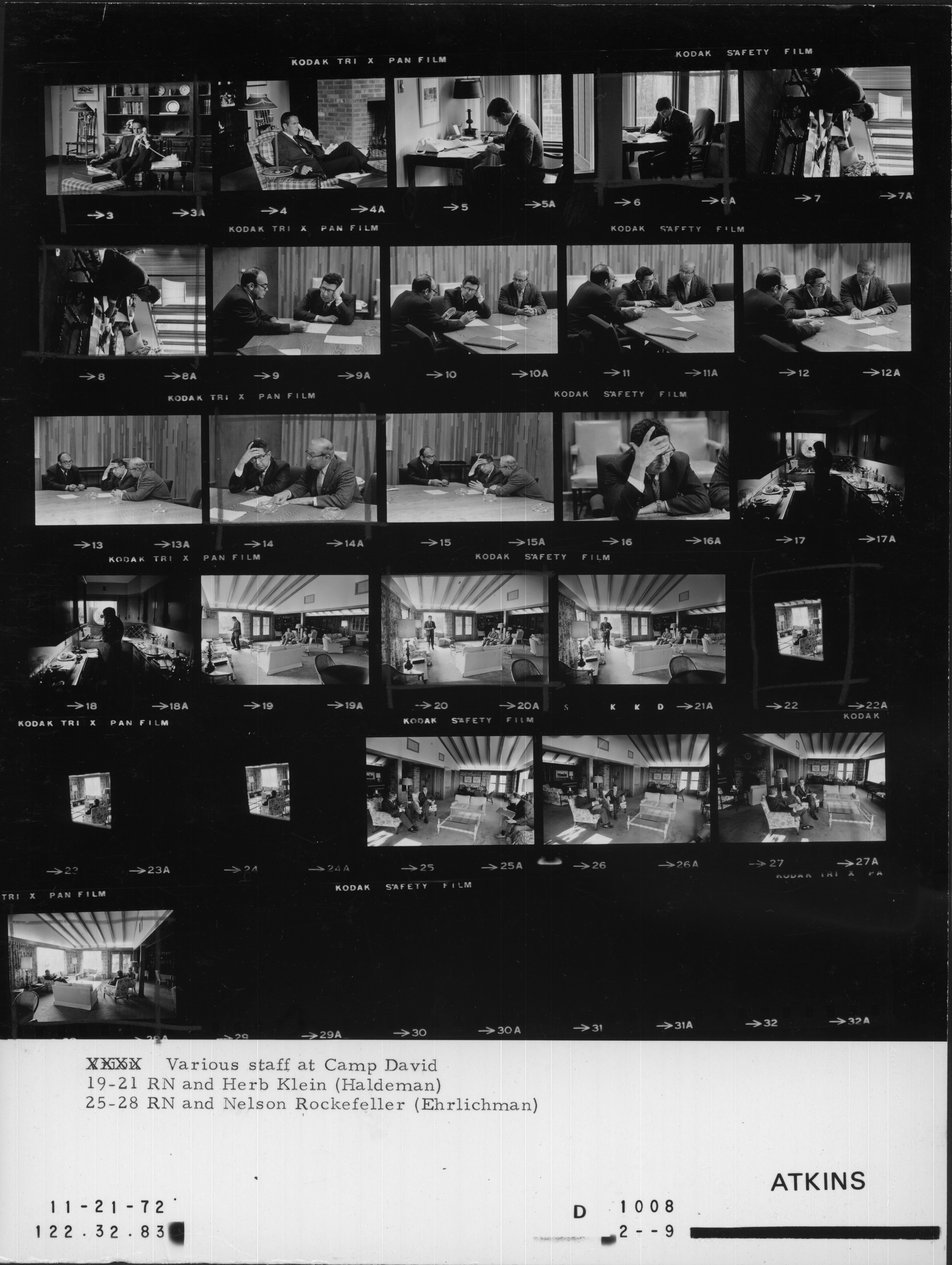
- Frame(s): WHPO-D1008-03-04, H.R. Haldeman talking on the telephone while seated in a plaid upholstered chair at Camp David. 11/21/1972, Camp David, Maryland Aspen Lodge Den. H.R. Haldeman.
- Frame(s): WHPO-D1008-05-06, Unidentified man (possibly Dwight Chapin) working on paperwork at Camp David while sitting alone at a desk. 11/21/1972, Camp David, Maryland Aspen Lodge Den. Possibly Dwight Chapin.
- Frame(s): WHPO-D1008-07-08, Herb Stein seated alone on a couch looking at paperwork laid out on a coffee table at Camp David. 11/21/1972, Camp David, Maryland Aspen Lodge Den. Herb Stein.
- Frame(s): WHPO-D1008-09, John Ehrlichman and Herb Stein seated at a conference table during a meeting at Camp David. 11/21/1972, Camp David, Maryland conference room, Aspen Lodge. Herb Stein, John Ehrlichman.
- Frame(s): WHPO-D1008-10-13, 15, John Ehrlichman, Herb Stein and George Shultz seated at a conference table during a meeting at Camp David. 11/21/1972, Camp David, Maryland conference room, Aspen Lodge. Herb Stein, George Shultz, John Ehrlichman.
- Frame(s): WHPO-D1008-14, Herb Stein and George Shultz seated at a conference table during a meeting at Camp David. 11/21/1972, Camp David, Maryland conference room, Aspen Lodge Den. Herb Stein, George Shultz.
- Frame(s): WHPO-D1008-16, Herb Stein seated at a conference table during a meeting at Camp David. 11/21/1972, Camp David, Maryland conference room, Aspen Lodge. Herb Stein.
- Frame(s): WHPO-D1008-17-18, Unidentified man (possibly Dwight Chapin or President Nixon) seen in silhouette standing in a dark messy kitchen area, while speaking on a telephone. 11/21/1972, Camp David, Maryland Kitchen, Aspen Lodge. unidentified man.
- Frame(s): WHPO-D1008-19-21, President Nixon and Herb Klein seated in a living room area, while H.R. Haldeman stands by the window at Camp David. 11/21/1972, Camp David, Maryland living room, Aspen Lodge Den. President Nixon, H. R. Haldeman, Herb Klein.
- Frame(s): WHPO-D1008-22-24, President Nixon seated in a living room area upholstered chair at Camp David, seen from behind. 11/21/1972, Camp David, Maryland living room, Aspen Lodge Den. President Nixon.
- Frame(s): WHPO-D1008-25, 28, President Nixon, John Ehrlichman and Governor Nelson Rockefeller seated in a living room area at Camp David. 11/21/1972, Camp David, Maryland living room, Aspen Lodge Den. President Nixon, John Ehrlichman, Nelson Rockefeller.
- Frame(s): WHPO-D1008-26-27, President Nixon and Governor Nelson Rockefeller seated in a living room area at Camp David. 11/21/1972, Camp David, Maryland living room, Aspen Lodge Den. President Nixon, Nelson Rockefeller.
Roll WHPO-D1009 Photographer: Atkins, Oliver | Color or B&W: B&W
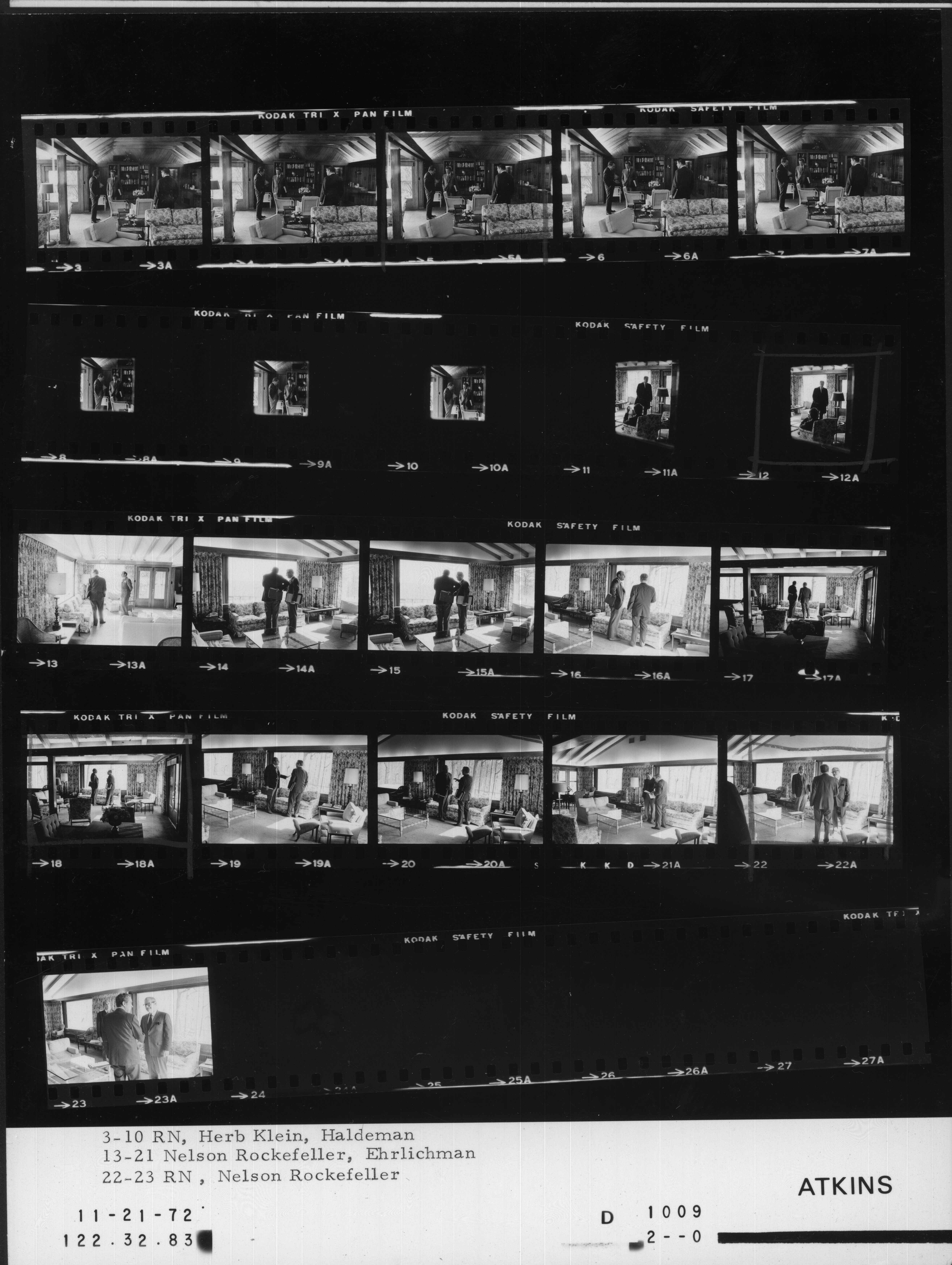
- Frame(s): WHPO-D1009-03-12, President Nixon at Camp David standing in the living room speaking with HR Haldeman, Herb Klein, Gov. Rockefeller Ehrlichman. 11/21/1972, Camp David, Maryland Aspen Lodge Den. President Nixon, Herb Klein, H.R. Haldeman, John Ehrlichman, Nelson Rockefeller.
- Frame(s): WHPO-D1009-12, H.R. Haldeman standing while speaking to President Nixon, seated in the living room and seen from behind, while holding a brief conference between reorganization meetings. Scene is viewed from outside a window looking in. 11/21/1972, Camp David, Maryland Aspen Lodge Den. President Nixon, H.R. Haldeman.
- Frame(s): WHPO-D1009-12A, H.R. Haldeman standing while speaking to President Nixon, seated in the living room and seen from behind, while holding a brief conference between reorganization meetings. Scene is viewed from outside a window looking in. 11/21/1972, Camp David, Maryland Aspen Lodge Den. President Nixon, H.R. Haldeman.
- Frame(s): WHPO-D1009-18A, John Ehrlichman standing to speak with Governor Nelson Rockefeller in a living room area at Camp David. 11/21/1972, Camp David, Maryland Aspen Lodge Den. John Ehrlichman, Nelson Rockefeller.
- Frame(s): WHPO-D1009-22A, President Nixon standing to speak with Governor Nelson Rockefeller and John Ehrlichman in the Aspen Lodge living room at Camp David. 11/21/1972, Camp David, Maryland Aspen Lodge Den. President Nixon, John Ehrlichman, Gov. Nelson Rockefeller.
Roll WHPO-D1010 Photographer: Atkins, Oliver | Color or B&W: B&W

- Frame(s): WHPO-D1010-02, Unidentified man seated at Camp David. 11/21/1972, Camp David, Maryland kitchenette. unidentified man.
- Frame(s): WHPO-D1010-04-06, President Nixon seated informally at Camp David during a meeting with Secretary of the Interior Rogers Morton and John Ehrlichman. 11/21/1972, Camp David, Maryland Aspen Lodge Den. President Nixon, Rogers Morton, Ehrlichman.
Roll WHPO-D1011 Photographer: Atkins, Oliver | Color or B&W: B&W
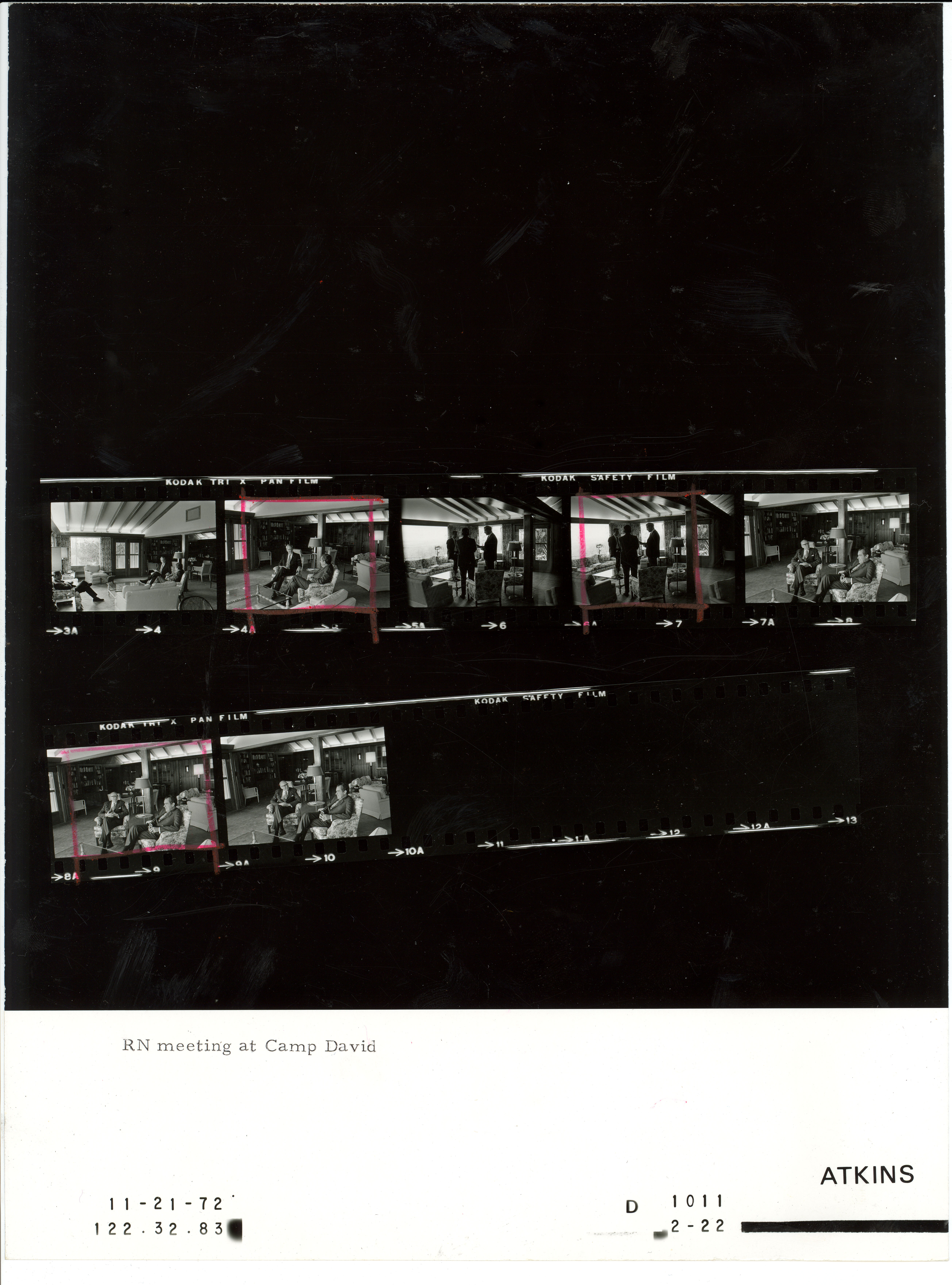
- Frame(s): WHPO-D1011-04, President Nixon, H.R. Haldeman and James Schlesinger seated informally during a meeting in the Aspen Lodge living room at Camp David. 11/21/1972, Camp David, Maryland Aspen Lodge Den. President Nixon, H.R. Haldeman, James Schlesinger.
- Frame(s): WHPO-D1011-05, President Nixon, H.R. Haldeman and James Schlesinger seated informally during a meeting in the Aspen Lodge living room at Camp David. 11/21/1972, Camp David, Maryland Aspen Lodge Den. President Nixon, James Schlesinger.
- Frame(s): WHPO-D1011-06-07, President Nixon, H.R. Haldeman, and James Schlesinger standing in a living room area and talking at Camp David. 11/21/1972, Camp David, Maryland Aspen Lodge Den. President Nixon, H.R. Haldeman, James Schlesinger.
- Frame(s): WHPO-D1011-08-10, President Nixon and William Casey seated during a meeting in a living room area at Camp David. 11/21/1972, Camp David, Maryland Aspen Lodge Den. President Nixon, William Casey.
Roll WHPO-D1012 Photographer: Atkins, Oliver | Color or B&W: B&W
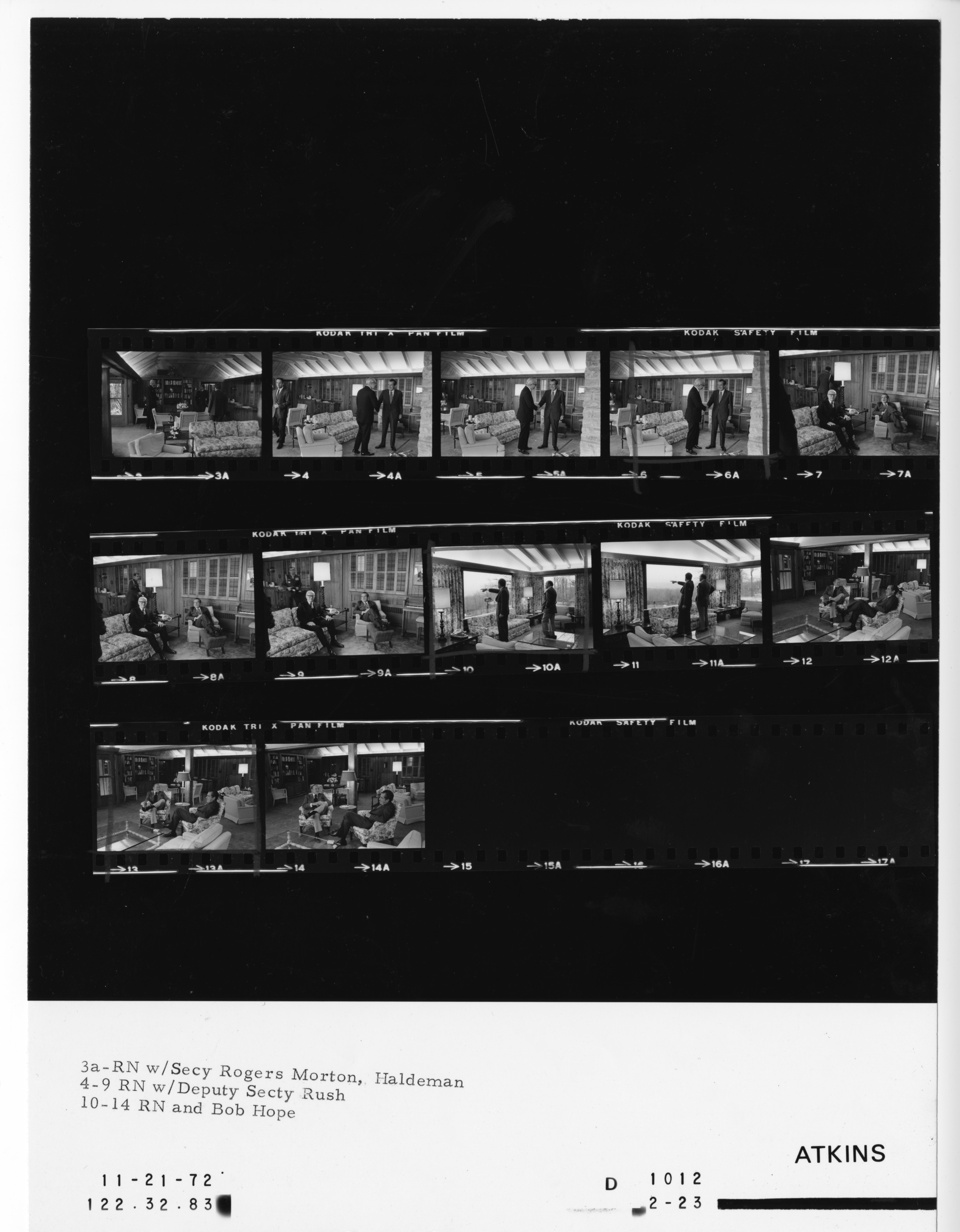
- Frame(s): WHPO-D1012-03, H.R. Haldeman and Rogers Morton standing in the Aspen Lodge at Camp David. 11/21/1972, Camp David, Maryland Aspen Lodge Den. H. R. Haldeman, Rogers Morton, Maj. John V. Brennan (AKA) Jack Brennan.
- Frame(s): WHPO-D1012-04-09, President Nixon greeting and seated with Deputy Secretary of Defense Kenneth Rush. President Nixon informs Kenneth Rush that he will soon replace William Rogers as Secretary of State. 11/21/1972, Camp David, Maryland Aspen Lodge Den. President Nixon, Kenneth Rush, Maj. John V. Brennan (AKA) Jack Brennan.
- Frame(s): WHPO-D1012-10-11, President Nixon visits with Comedian Bob Hope, both seen standing to look out the window from the Aspen Lodge living room at Camp David. 11/21/1972, Camp David, Maryland Aspen Lodge Den. President Nixon, Bob Hope.
- Frame(s): WHPO-D1012-10A, President Nixon and Bob Hope, both seen standing to look out the window from the Aspen Lodge living room at Camp David. 11/21/1972, Camp David, Maryland Aspen Lodge Den. President Nixon, Bob Hope.
- Frame(s): WHPO-D1012-12-14, President Nixon visits with Comedian Bob Hope in the Aspen Lodge living room at Camp David. 11/21/1972, Camp David, Maryland Aspen Lodge Den. President Nixon, Bob Hope.
- Frame(s): WHPO-D1012-13A, President Nixon seated informall during a visit with Bob Hope in the Aspen Lodge living room at Camp David. 11/21/1972, Camp David, Maryland Aspen Lodge Den. President Nixon, Bob Hope.
The White House Communications Agency Sound Recordings Collection contains public statements that took place between 1969 and 1974. Visit the finding aid to learn more.
L - White House Press Office Briefings
- WHCA-SR-L-065
Press briefing by Ronald Ziegler. (11/21/1972, Camp David)
Runtime: 27:00:00
Keywords: Press conferences, news conferences, interviews, media, press secretary
Original Format: 1/4-inch reel-to-reel audiotape. Original source type: Original.
The White House Communications Agency Videotape Collection contains “off-the-air” recordings of televised programs produced between 1968 and 1974. Visit the finding aid to learn more.
- WHCA-5931
Weekly News Summary, Tape I.
ALL NETWORKS
Runtime: 1:30
19. Rolfson: Kissinger and the peace talks. Time Code Start: 58:04. Keywords: Paris Peace Talks, Vietnam War, treaty, treaties, negotiations. Network: ABC.
20. Reasoner/Farmer: SALT talks are on again [Strategic Arms Limitation Talks]. Time Code Start: 60:12. Keywords: SALT, S.A.L.T., Strategic Arms Limitation Talks, Russia, Soviet Union, USSR, Cold War, détente. Network: ABC.
21. Reasoner: Commentary on establishing new high speed commuter trains. Time Code Start: 63:19. Keywords: mass transportation, railways, railroads, commuter trains, railroads, trains, rail travel, mass transit, transportation, commuters, commuting. Network: ABC.
22. Chancellor/Dobyns: Kissinger in Paris. Time Code Start: 65:22. Keywords: Paris Peace Talks, Vietnam War, treaty, treaties, negotiations, government, officials, travel, trips. Network: NBC.
23. Nessen: More on the aftermath of the invasion in Bureau of Indian Affairs (BIA). Time Code Start: 69:22. Keywords: American Indians, Native Americans, tribes, American Indian Movement, occupations, government agencies. Network: NBC.
24. Chancellor/Paxton: SALT talks [Strategic Arms Limitation Talks]. Time Code Start: 71:32. Keywords: SALT, S.A.L.T., Strategic Arms Limitation Talks, Russia, Soviet Union, USSR, Cold War, détente. Network: NBC.
25. Chancellor: Senator Proxmire running around his state. Time Code Start: 73:40. Keywords: Senators, travel, trips. Network: NBC.
26. Mudd/Kalisher: Peace talks in Paris. Time Code Start: 76:25. Keywords: Paris Peace Talks, Vietnam War, treaty, treaties, negotiations. Network: CBS.
27. Mudd/Kalb: State department comment on Vietnam. Time Code Start: 78:12. Keywords: Vietnam War. Network: CBS.
28. Sevareid: Commentary on world peace. Time Code Start: 79:23. Keywords: wars, truces, treaty, treaties, ceasefires. Network: CBS.
Context (External Sources)
The Vanderbilt Television News Archive is the world's most extensive and complete archive of television news. They have been recording, preserving and providing access to television news broadcasts of the national networks since August 5, 1968.
Wikipedia is a free encyclopedia that anyone can edit.