

Introduction
This almanac page for Thursday, March 23, 1972, pulls together various records created by the federal government and links to additional resources which can provide context about the events of the day.
Previous Date: Wednesday, March 22, 1972
Next Date: Friday, March 24, 1972
Schedule and Public Documents
The Daily Diary files represent a consolidated record of the President's activities. Visit the finding aid to learn more.
The President's day began at The White House - Washington, D. C.
The Weekly Compilation of Presidential Documents made available transcripts of the President's news conferences; messages to Congress; public speeches, remarks, and statements; and other Presidential materials released by the White House.
Digitized versions can be found at HathiTrust.
Each Public Papers of the Presidents volume contains the papers and speeches of the President of the United States that were issued by the White House Office of the Press Secretary during the time period specified by the volume. The material is presented in chronological order, and the dates shown in the headings are the dates of the documents or events. In instances when the release date differs from the date of the document itself, that fact is shown in the text note.
To ensure accuracy, remarks have been checked against audio recordings (when available) and signed documents have been checked against the original, unless otherwise noted. Editors have provided text notes and cross references for purposes of identification or clarity.
- Special Message to the Congress on Older Americans.
- Remarks About the Resignation of George Meany From the Pay Board.
- Statement About New Composition of Pay Board Membership Following Resignations of Certain Labor Members
- Executive Order 11660—Amending Executive Order No. 11640, Further Providing for the Stabilization of the Economy
The Federal Register is the official daily publication for rules, proposed rules, and notices of federal agencies and organizations, as well as executive orders and other Presidential documents.
The Congressional Record is the official daily record of the debates and proceedings of the U.S. Congress.
Archival Holdings
Any selection of archival documents will necessarily be partial. You should use the documents and folders identified below as a starting place, but consult the linked collection finding aids and folder title lists and the collections themselves for context. Many documents to be found this way do not lend themselves to association with specific dates, but are essential to a complete understanding of the material.
Selective document listing
President's Office Files
The President's Office Files consists of materials drawn together by the Special Files Unit from several administrative subdivisions within the White House Office. It is the handwriting and sensitive papers sent to the Staff Secretary that now comprise much of the President's Office Files. Visit the finding aid to learn more.
- News Summaries, Annotated News Summaries, Box 34, March 18-25, 1972 [3 of 4] [Note: Due to the way News Summary products were compiled, you should also consult nearby days for potentially relevant materials.]
- News Summary, March 23, 1972, (Wed. nets, wires and editorial reaction to busing speech)
- President's Daily Schedule, Box 102, [President's Daily Schedule, Jan.-Mar. 1972] [2 of 3]
- The President's Schedule, Thursday - March 23, 1972
President's Personal File
The President's Personal File is essentially a President's secretary's file, kept by Rose Mary Woods, personal secretary to the President, for two purposes: (1) preserving for posterity a collection of documents particularly close to the President, whether because he dictated or annotated them, or because of the importance of the correspondent or the event concerned and (2) giving appropriate attention–letters of gratitude, invitations to White House social events, and the like–to members and important friends and supporters of the Nixon administration. This generalization does not describe all the varied materials of a file group which is essentially a miscellany, but it does identify the reason for the existence of the file group's core. Visit the finding aid to learn more.
- President's Speech File
The H. R. Haldeman Diaries consists of seven handwritten diaries, 36 dictated diaries recorded as sound recordings, and two handwritten audio cassette tape subject logs. The diaries and logs reflect H. R. Haldeman’s candid personal record and reflections on events, issues, and people encountered during his service in the Nixon White House. As administrative assistant to the President and Chief of Staff, Haldeman attended and participated in public events and private meetings covering the entire scope of issues in which the Nixon White House engaged in during the years 1969-1973. Visit the finding aid to learn more.
- Transcript of diary entry (PDF)
Thursday, March 23.
The big item today was the Pay Board situation: Meany's walk out yesterday, etcetera. Shultz made the point at the staff meeting this morning that the problem now is that we're being maneuvered into the wrong position, in that we're being portrayed as the Party that is for controls. While Humphrey and Meany and all come out against controls. The problem of standing up to labor is, what can you do, how can you succeed, it looks like we can't govern if we don't do something. So Shultz came up with the plan that we should let the Pay Board know that they have their standards, but they should become essentially a pre-notification agency, drop a control of small firms, review proposed new contracts over a 30 day period. Maybe get Usery and a team of mediators into it. We should go ahead and say what we had planned to say today but then in a couple of weeks clean out the red tape and shift to this. Problem with this plan is that it would be seen as dismantling Phase II under pressure from labor. I raised the point then of maybe doing that consciously, openly, and saying we're moving to Phase III. That maybe this would be a good move.
We had a strategy meeting with Connally, Shultz, and the rest of the group a little later in the morning. Shultz made the point that we made the point that this whole program requires voluntary support: the tripartite approach was a concession to that view. We're in pretty good shape now, except for the Longshore situation. Overall we've stayed within 5.5 percent on wage increases, so we should put together a set of moves to concentrate more on large enterprises and change the method of administration of the Pay Board, do essentially the pre-notification thing that Shultz had in mind. We would drop the small businesses, drop rent control, rearrange the system more sharply, and either do this now and explicitly, or do it as the Pay Board works these things out. Stein felt that we have a great clear cut issue, the question of who's for stability of the country and who's against it. We have Meany in a bad spot and we shouldn't let him be proved right. Everybody else tended to agree with that, and that we should make the case that until yesterday, things were moving along well, and now we're coming into a different era, where labor has forced us into an adjusted position. On the basis of this, we decided to stay with the plan that we'd had for last night and the Pres-- .
[End of tape reel AC-19(B)]
[Begin tape reel AC-20(A)]
March 23, continued. President made the point in preparation that-- for his remarks this evening that he wanted to really zing Meany, and make the point that he objects to the fact that the Board wouldn't approve the 20 percent increase for the longshoremen after a 137 day strike while millions of Americans are limited to a 5 percent increase. That to allow 20 percent to one specific special group was wrong. He went ahead with a strong attack on Meany and felt afterwards that it had come off quite well and seemed to be in good spirits for having done it.
Got into a discussion with Ehrlichman this morning on busing follow-up, checking on legislative action and Ehrlichman says they' re going push it through the Conference, he thinks that'll work. He says the degree of Congressional support is strong, and broadly based, that the editorial support is pretty good and we're working in the South, the West, and the Border States. On intervention, Kleindienst and Morgan are meeting and moving ahead on that, we won't announce any this week but will release them one at a time, and string them out over a period of time in the future. Thinks that the Cabinet's in good shape, we're getting good background material. The President's concerned that some of the editorial reaction shows a lack of understanding. Ehrlichman raised the point of having a dinner for the Supreme Court to show the right Presidential attitude towards the Court which has been jarred a little bit as a result of the busing statement. President said he'd prefer to do an article or-- then I suggested a radio address which they both thought as the best idea.
Got into a discussion of Arthur Burns who is insisting on seeing the President, President says he won't see him, that he wants me to tell Burns that he doesn't approve of the articles that are appearing that are driving the wedge and he wants to know what the story is on this, and that I'm to tell him to have Arthur report to Connally at the President's direction.
When I talked to Arthur later he pushed strongly for seeing the President, saying the President had told him he wanted to see him before he made the next appointment to the Board, and Arthur wanted to discuss that with him in his report on his trip. And he didn't buy my idea of his seeing Connally, so we're just going to stall him for a while.
On ITT follow-up, Colson seems to think now that they've got the typewriter case worked out pretty well, and that we can prove that the memo wasn't typed in June, and thoroughly discredited, although Dita Beard's testimony is apparently going to come out pretty well.
President went into quite a discussion on the economic statistics because it shows that government purchasing has slowed way down, and he wants me to really hit Shultz on following up on this, especially to kick Laird and Rush. And I'm supposed to get them over to the White House and make the point that the President wants the report twice a week personally on this, that they are to cut their Vietnam reports down and pick up reporting on this because the responsibility isn’t the Defense Department and it's up to them to move on it, and he wants to stay on top of it personally. He's concerned that we aren't using the purchasing power we have to get the economy moving, and he wants to really put the heat on them to force them to do it.
End of March 23. - Original audio recording (MP3)
The National Archives Catalog is the online portal to the records held at the National Archives, and information about those records. It is the main way of describing our holdings and also provides access to electronic records and digitized versions of our holdings.
The Catalog searches across multiple National Archives resources at once, including archival descriptions, digitized and electronic records, authority records, and web pages from Archives.gov and the Presidential Libraries. The Catalog also allows users to contribute to digitized historical records through tagging and transcription.
Nixon Library Holdings
All National Archives Units
National Security Documents
The President's Daily Brief is the primary vehicle for summarizing the day-to-day sensitive intelligence and analysis, as well as late-breaking reports, for the White House on current and future national security issues. Read "The President's Daily Brief: Delivering Intelligence to Nixon and Ford" to learn more.
The Foreign Relations of the United States series presents the official documentary historical record of major U.S. foreign policy decisions and significant diplomatic activity. Visit the State Department website for more information.
Vol. V, United Nations, 1969-1972
Appointments of Senior UN Personnel
271. Telegram From the Department of State to the Mission to the United Nations, Washington, March 23, 1972, 0326Z
Source: National Archives, Nixon Presidential Materials, NSC Files, Box 303, Agency Files, USUN, Vol. X. Confidential; Exdis. Drafted by Assistant Secretary De Palma, cleared by R. Christiansen, and approved by De Palma.
Vol. XIV, Soviet Union, October 1971-May 1972
Preparing for Moscow and Nixon's Trip to China, January 1-March 29, 1972
69. Backchannel Message From the Presidents’ Deputy Assistant for National Security Affairs (Haig) to the President’s Assistant for National Security Affairs (Kissinger), Washington, March 23, 1972, 2214Z
Source: National Archives, Nixon Presidential Materials, NSC Files, Box 493, President’s Trip Files, Dobrynin/Kissinger, 1972, Vol. 10. Top Secret; Sensitive; Exclusively Eyes Only. Sent from the White House to the Embassy in Mexico City. Kissinger remained on vacation in Acapulco through March 27. According to a notation on the original, Dobrynin delivered it to Haig on March 23. (Ibid.)
Vol. XVII, China, 1969-1972
China, March-December 1972
215. Memorandum for the President’s File by John H. Holdridge of the National Security Council Staff, Washington, March 23, 1972
Source: National Archives, Nixon Presidential Materials, White House Special Files, President’s Office Files, Box 88, Memoranda for the President. Secret; Nodis. According to the President’s Daily Diary, the meeting was held from 4:08 to 5:02 p.m. (Ibid., White House Central Files)
Vol. XXIII, Arab-Israeli Dispute, 1969-1972
Proximity Talks and the Backchannel: Separate Department of State and White House Negotiating Tricks
283. Telegram From the Department of State to the Embassy in Israel, Washington, March 23, 1972, 2027Z
Source: National Archives, Nixon Presidential Materials, NSC Files, Box 609, Country Files, Middle East, Israel, Vol. 10. Secret; Nodis. Drafted by Atherton and approved by Sisco and Rogers.
Vol. XXXII, SALT I, 1969-1972
Narrowing the Issues, October 19, 1971-April 18, 1972
243. National Security Decision Memorandum 158, Washington, March 23, 1972
Source: National Archives, Nixon Presidential Materials, NSC Files, NSC Institutional Files (H–Files), Box H–208, National Security Decision Memoranda, NSDMs 151–200. Top Secret; Nodis; SALT.
Vol. E-4, Documents on Iran and Iraq, 1969-1972
Iran 1972
176. Telegram 1665 From the Embassy in Iran to the Department of State, Tehran, March 23, 1972, 0240Z
Despite the need for a fifteen percent MAAG reduction world wide, the country team in Iran lobbied for a requested increase in the ARMISH/MAAG complement.
Source: National Archives, RG 59, Central Files 1970–73, DEF 19–9 US-IRAN. Confidential.
Vol. E-7, Documents on South Asia, 1969-1972
U.S. Relations with India and Pakistan, 1972
239. Telegram 49598 From the Department of State to the Embassy in Pakistan, Washington, March 23, 1972, 0219Z
The Department transmitted to the Embassy a summary of an extensive request for military assistance and sales conveyed to Assistant Secretary Sisco on March 20 by Pakistani Ambassador Raza. The request included 100 tanks, 4 submarines, and 3 squadrons of planes.
Source: National Archives, RG 59, Central Files 1970–73, DEF 12–5 PAK. Secret; Exdis. Drafted by Peter Constable (NEA/PAF) on March 21; cleared by Laingen, Schneider, Van Hollen, and Alan Ford, Deputy Director of the Office of Military Assistance and Sales (PM/MAS); and approved by Sisco. Sent for information to DOD/ISA/NESA for Colonel Gross. Raza’s letter to Sisco can be found ibid., Nixon Presidential Materials, NSC Files, Box 627, Country File, Middle East, Pakistan, Vol. IX, Jan–31 Aug 72.240. Memorandum From Secretary of State Rogers to President Nixon, Washington, March 23, 1972
Rogers informed Nixon about his conversation on March 22 with Aziz Ahmed, Secretary General of the Pakistani Ministry of Foreign Affairs. Ahmed pressed for a decision on Pakistan’s request for military sales and assistance and for an assessment of the future role of the U.S. in South Asia. Rogers assured Ahmed of continuing U.S. support for Pakistan and added that the issue of military supply was under review.
Source: National Archives, Nixon Presidential Materials, NSC Files, Box 627, Country File, Middle East, Pakistan, Vol. IX Jan–31 Aug 72. Secret; Exdis. Irwin signed for Rogers.241. Telegram 3666 From the Embassy in India to the Department of State, New Delhi, March 23, 1972, 1550Z
Ambassador Keating expressed his opposition to any increase in U.S. military collaboration with Pakistan.
Source: National Archives, RG 59, Central Files 1970–73, DEF 15 PAK–US. Top Secret; Exdis.
Bangladesh, December 1971-December 1972
411. Telegram 1019 From the Consulate General in Dacca to the Department of State, Dacca, March 23, 1972, 0930Z
The Consulate General reported on the increasing irritation with the United States exhibited by the Government, the media, and the public in Bangladesh. The Consulate General’s concern was that the Government’s patience was wearing thin and it might take action against the US mission.
Source: National Archives, RG 59, Central Files 1970–73, POL BANGLADESH–US. Confidential; Priority; Limdis. Repeated to Islamabad and New Delhi. Prime Ministers Gandhi and Mujibur Rahman met in Calcutta February 6–8. On February 8 they issued a joint declaration summarizing the meetings and stressing the solidarity that existed between the two countries. (The text of the declaration was transmitted to the Department on February 9 in telegram 283 from Calcutta; ibid., POL BANGLADESH–INDIA) Gandhi and Mujibur Rahman subsequently met in Dacca March 18–19, where they signed a mutual defense treaty patterned on the Indo-Soviet treaty of August 1971. (Telegram 3714 from New Delhi, March 24; ibid.)
The Kissinger telephone conversation transcripts consist of approximately 20,000 pages of transcripts of Kissinger’s telephone conversations during his tenure as Assistant to the President for National Security Affairs (1969-1974) and Secretary of State (1973-1974) during the administration of President Richard Nixon. Visit the finding aid for more information.
Digitized versions can be found in the National Archives Catalog.
Audiovisual Holdings
Visit the White House Tapes finding aid to learn about the taping system's operation and archival processing.
Cabinet Room
- 96-4; Unknown between 3:02 p.m. & 3:56 p.m.; Nixon, Richard M. (President); Cost of Living Council; Connally, John B.; Stein, Herbert; Rumsfeld, Donald H.; Campbell, J. Philip; Peterson, Peter G.; Hodgson, James D.; Romney, George W.; Shultz, George P.; Lincoln, George A. (Gen.); Knauer, Virginia H.; Burns, Arthur F.; McLane, James W.; Abrahams, Albert E.; Mullaney, Joseph; Kosters, Marvin H.; Cheney, Richard B.; Connor, James; Alfultis, Richard J.; Smith, Donald; MacGregor, Clark; Gifford, William L.; Perry, Charles R.; White House photographer
- 97-1; Unknown between 3:56 p.m. & 11:59 p.m.; Connally, John B.; Shultz, George P.; Rumsfeld, Donald H.; Cheney, Richard B.; [Unknown person(s)]
Old Executive Office Building
- 325-6; Unknown between 9:31 a.m. & 10:19 a.m.; Nixon, Richard M. (President); Butterfield, Alexander P.
- 325-7; Unknown between 9:31 a.m. & 10:19 a.m.; Nixon, Richard M. (President); Acker, Marjorie P.
- 325-8; Unknown between 9:31 a.m. & 10:19 a.m.; Nixon, Richard M. (President); Haldeman, H. R. ("Bob"); Ehrlichman, John D.
- 325-9; Unknown between 9:31 a.m. & 10:19 a.m.; Nixon, Richard M. (President); Haldeman, H. R. ("Bob"); Ehrlichman, John D.
- 325-10; 10:19 a.m. - 12:45 p.m.; Nixon, Richard M. (President); Haldeman, H. R. ("Bob"); Ehrlichman, John D.; Ziegler, Ronald L.; [Unknown person(s)]; Woods, Rose Mary; White House operator; Safire, William L.; Butterfield, Alexander P.
- 325-11; Unknown between 12:45 p.m. & 1:00 p.m.; Nixon, Richard M. (President); Sanchez, Manolo
- 325-12; Unknown between 12:45 p.m. & 1:00 p.m.; Nixon, Richard M. (President); [Unknown person(s)]
- 325-13; Unknown between 12:45 p.m. & 1:00 p.m.; Nixon, Richard M. (President); Acker, Marjorie P.; [Unknown person(s)]
- 325-15; Unknown between 12:45 p.m. & 1:00 p.m.; Nixon, Richard M. (President); Acker, Marjorie P.; Sanchez, Manolo
- 325-16; Unknown between 12:45 p.m. & 1:00 p.m.; Nixon, Richard M. (President); Acker, Marjorie P.
- 325-17; Unknown between 12:45 p.m. & 1:00 p.m.; Nixon, Richard M. (President); Haldeman, H. R. ("Bob")
- 325-18; Unknown between 12:45 p.m. & 1:00 p.m.; Nixon, Richard M. (President); [Unknown person(s)]
- 325-19; Unknown between 12:45 p.m. & 1:00 p.m.; Nixon, Richard M. (President); Woods, Rose Mary
- 325-20; Unknown between 12:45 p.m. & 1:00 p.m.; Nixon, Richard M. (President); Safire, William L.
- 325-21; Unknown between 12:45 p.m. & 1:00 p.m.; Nixon, Richard M. (President); [Unknown person(s)]
- 325-22; Unknown between 12:45 p.m. & 1:00 p.m.; Nixon, Richard M. (President); Kissinger, Henry A.
- 325-23; Unknown between 12:45 p.m. & 1:00 p.m.; Nixon, Richard M. (President); Ehrlichman, John D.; [Unknown person(s)]
Oval Office
- 692-1; Unknown between 3:56 p.m. & 4:03 p.m.; Nixon, Richard M. (President)
- 692-2; 4:03 p.m. - 5:04 p.m.; Nixon, Richard M. (President); Ziegler, Ronald L.
- 692-3; 4:08 p.m. - 5:02 p.m.; Nixon, Richard M. (President); Green, Marshall; Holdridge, John H.; Haig, Alexander M., Jr.; White House photographer; [Unknown person(s)]; White House photographer; Bull, Stephen B.
- 692-4; 5:03 p.m. - 5:17 p.m.; Nixon, Richard M. (President); Ziegler, Ronald L.
- 692-5; 5:17 p.m. - 5:22 p.m.; Nixon, Richard M. (President); Butterfield, Alexander P.
- 692-6; 5:22 p.m. - 5:23 p.m.; Nixon, Richard M. (President); Butterfield, Alexander P.
- 692-7; 5:23 p.m. - 6:24 p.m.; Nixon, Richard M. (President); Haldeman, H. R. ("Bob"); [Unknown person(s)]; White House operator; Ziegler, Ronald L.; Colson, Charles W.
- 692-8; 6:24 p.m. - 6:27 p.m.; Nixon, Richard M. (President); Sanchez, Manolo; Woods, Rose Mary
- 692-9; 6:27 p.m. - 6:28 p.m.; Nixon, Richard M. (President); Haldeman, H. R. ("Bob")
- 692-10; 6:27 p.m. - 6:28 p.m.; Nixon, Richard M. (President); [Unknown person(s)]; Woods, Rose Mary
White House Telephone
- 22-2; Unknown between 10:20 a.m. & 1:31 p.m.; Haldeman, H. R. ("Bob"); White House operator; Nixon, Richard M. (President); Safire, William L.
- 22-3; Unknown between 10:20 a.m. & 1:31 p.m.; Haldeman, H. R. ("Bob"); White House operator; Safire, William L.
- 22-4; 2:36 p.m. - 2:40 p.m.; Nixon, Richard M. (President); Safire, William L.
- 22-5; Unknown between 2:40 p.m. & 5:33 p.m.; Nixon, Richard M. (President); White House operator
- 22-6; 5:33 p.m. - 5:34 p.m.; Nixon, Richard M. (President); Ziegler, Ronald L.; Haig, Alexander M., Jr.
- 22-7; 7:41 p.m. - 7:47 p.m.; Nixon, Richard M. (President); White House operator; Cox, Tricia Nixon
- 22-8; Unknown between 7:47 p.m. & 7:53 p.m.; Nixon, Richard M. (President); White House operator
- 22-9; 7:53 p.m. - 8:05 p.m.; Nixon, Richard M. (President); Colson, Charles W.
The White House Photo Office collection consists of photographic coverage of President Richard Nixon meeting with prominent social, political, and cultural personalities; speaking engagements and news conferences of the President and various high-ranking members of the White House staff and Cabinet; Presidential domestic and foreign travel, including Presidential vacations; social events and entertainment involving the First Family, including entertainers present; official portraits of the President, First Family, and high-ranking members of the Nixon administration; the 1969 and 1973 Inaugurals; the President’s 1972 Presidential election campaign appearances (including speeches) and other official activities of the White House staff and the President’s Cabinet from January 20, 1969 until August 9, 1974 at the White House and the Old Executive Office Building; other locations in Washington, DC, such as The Mall; and the Presidential retreats in Camp David, Maryland, Key Biscayne, Florida, and San Clemente, California. Visit the finding aid to learn more.
Roll WHPO-8764 Photographer: Atkins, Oliver | Color or B&W: B&W
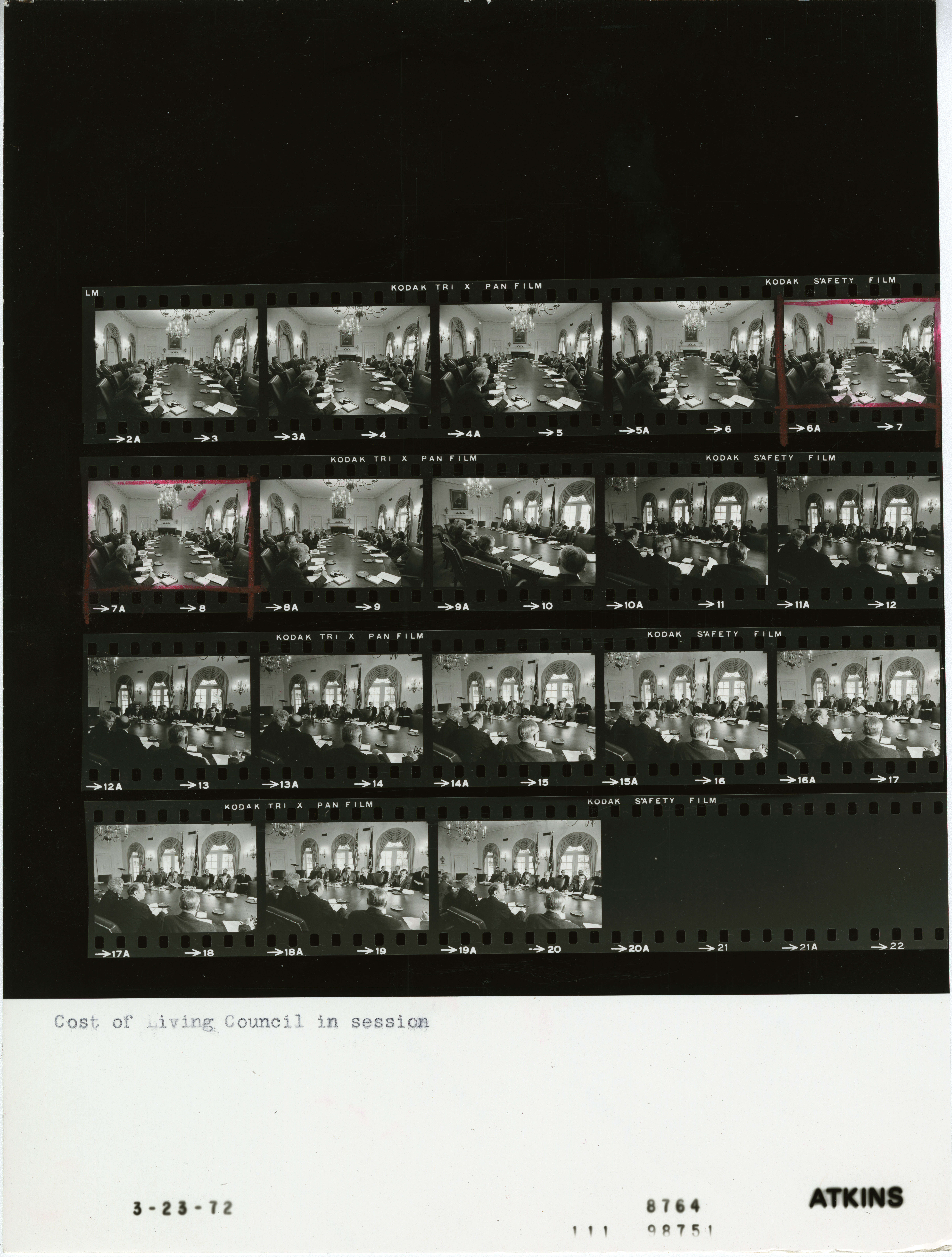
- Frame(s): WHPO-8764-, President Nixon meeting with the Cost of Living Council members President Nixon, John B. Connally Secretary of the Treasury, Herbert Stein Chairman of the Council of Economic Advisers, Donald Rumsfeld Counsellor, J. Phil Campbell, Jr. Under Secretary of Agriculture, Peter G. Peterson Secretary of Commerce, James D. Hodgson Secretary of Labor, George W. Romney Secretary of HUD, George P. Shultz Director of the OMB, George A. Lincoln Director of the Office of Emergency Planning, Virginia Knauer Special Consultant, Arthur F. Burns Director of the Board of Governors of the Federal Reserve System, James W. McLane Deputy Director, Albert E. Abrahams Assistant Director, Joseph Mullaney General Counsel, Marvin Kosters Assistant Director, Richard DICK Cheney Assistant Director, James Connor Assistant Director, Richard Alfultis Assistant Director, Donald P. Smith Executive Secretariat, Clark MacGregor Counsel, William Gifford Special Assistant Department of Labor, Charles Perry Staff Associate Director OMB. 3/23/1972, Washington, D.C. White House, Cabinet Room. President Nixon, John B. Connally, Herbert Stein, Donald Rumsfeld Counsellor, J. Phil Campbell, Jr, Peter G. Peterson, James D. Hodgson, George W. Romney, George P. Shultz, George A. Lincoln, Virginia Knauer, Arthur F. Burns, James W. McLane, Albert E. Abrahams, Joseph Mullaney, Marvin Kosters, Richard (Dick) Cheney, James Connor, Richard Alfultis, Donald P. Smith, Clark MacGregor, William Gifford, Charles Perry Staff Associate Director OMB.
- Frame(s): WHPO-8764-15, President Nixon meeting with the Cost of Living Council members President Nixon, John B. Connally Secretary of the Treasury, Herbert Stein Chairman of the Council of Economic Advisers, Donald Rumsfeld Counsellor, J. Phil Campbell, Jr. Under Secretary of Agriculture, Peter G. Peterson Secretary of Commerce, James D. Hodgson Secretary of Labor, George W. Romney Secretary of HUD, George P. Shultz Director of the OMB, George A. Lincoln Director of the Office of Emergency Planning, Virginia Knauer Special Consultant, Arthur F. Burns Director of the Board of Governors of the Federal Reserve System, James W. McLane Deputy Director, Albert E. Abrahams Assistant Director, Joseph Mullaney General Counsel, Marvin Kosters Assistant Director, Richard DICK Cheney Assistant Director, James Connor Assistant Director, Richard Alfultis Assistant Director, Donald P. Smith Executive Secretariat, Clark MacGregor Counsel, William Gifford Special Assistant Department of Labor, Charles Perry Staff Associate Director OMB. 3/23/1972, Washington, D.C. White House, Cabinet Room. President Nixon, John B. Connally, Herbert Stein, Donald Rumsfeld Counsellor, J. Phil Campbell, Jr, Peter G. Peterson, James D. Hodgson, George W. Romney, George P. Shultz, George A. Lincoln, Virginia Knauer, Arthur F. Burns, James W. McLane, Albert E. Abrahams, Joseph Mullaney, Marvin Kosters, Richard (Dick) Cheney, James Connor, Richard Alfultis, Donald P. Smith, Clark MacGregor, William Gifford, Charles Perry Staff Associate Director OMB.
Roll WHPO-8765 Photographer: Atkins, Oliver | Color or B&W: B&W
- Frame(s): WHPO-8765-, President Nixon seated next to Herb Stein and John Connally. 3/23/1972, Washington, D.C. White House, Cabinet Room. President Nixon, John Connally, Herb Stein, aides.
Roll WHPO-8766 Photographer: Atkins, Oliver | Color or B&W: B&W
- Frame(s): WHPO-8766-, President Nixon seated informally with Alexander Haig, Marshall Green, and John Holdridge. 3/23/1972, Washington, D.C. White House, Oval Office. President Nixon, Alexander Haig, Marshall Green, John Holdridge.
Roll WHPO-8767 Photographer: Atkins, Oliver | Color or B&W: B&W
- Frame(s): WHPO-8767-, President Nixon at a press briefing making a statement regarding the resignations of certain labor members from the Pay Board. 3/23/1972, Washington, D.C. Press Room, White House. President Nixon, press corps members.
- Frame(s): WHPO-8767-09A, President Nixon at a press briefing making a statement regarding the resignations of certain labor members from the Pay Board. 3/23/1972, Washington, D.C. Press Room, White House.
Roll WHPO-8768 Photographer: Kightlinger, Jack | Color or B&W: B&W
- Frame(s): WHPO-8768-, President Nixon seated informally with Marshall Green, National Security Council (NSC) senior staff member John Holdridge and Maj. Gen. Alexander Haig. 3/23/1972, Washington, D.C. White House, Oval Office. President Nixon, Marshall Green, Assistant Secretary of State, John H. Holdridge, Maj. Gen. Alexander M. Haig, Jr. Deputy Assistant.
The White House Communications Agency Sound Recordings Collection contains public statements that took place between 1969 and 1974. Visit the finding aid to learn more.
G - Cabinet Officer Briefings
- WHCA-SR-G-160
Press briefing by Secretary of Health, Education and Welfare Elliot Richardson, with Neil Ball. (3/23/1972, Press Center)
Runtime: 17:00
Production credits: Audio feed supplied by WHCA; Recorded by GLG (initials of WHCA engineer)
Original Format: 1/4-inch reel-to-reel audiotape. Original source type: Original.
P - Formal Presidential Remarks
- WHCA-SR-P-720311
Remarks by President Nixon at a press briefing concerning labor leaders. (3/23/1972, White House Press Center, Washington, D.C.)
Runtime: 0:04:55
Production credits: Mult feed supplied by ABC; Recorded by MJP (initials of WHCA engineer)
Original Format: 1/4-inch reel-to-reel audiotape. Original source type: Original.
The White House Communications Agency Videotape Collection contains “off-the-air” recordings of televised programs produced between 1968 and 1974. Visit the finding aid to learn more.
- WHCA-5217
"The Mike Douglas Show".
NBC
Runtime: 01:29:25 - WHCA-5218
"ABC Evening News". syndicated newspaper columnist Jack Anderson.
CBS, CBS
Runtime: 00:29:13 - WHCA-5219
"Caution!".
Southern Educational Communications Association
Runtime: 00:30:27 - WHCA-5222
Weekly News Summary, Tape III.
ALL NETWORKS
Runtime: 1:30
22. Chancellor/Kaplan: Paris talks closed down. Time Code Start: 51:47. Keywords: Paris Peace Talks, Vietnam War, treaty, treaties, negotiations, government, officials, endings. Network: NBC.
23. Chancellor/Brady: War dead in Cambodia. Time Code Start: 54:32. Keywords: Cambodia, Killed in Action, troops, fatalities, casualties, Vietnam War. Network: NBC.
24. Chancellor/Briggs: President Nixon reaction to Pay Board walkout, Woodcock resigns from board also. Time Code Start: 57:16. Keywords: cabinet, advisors, resignations, leaders, labor, unions, United Auto Workers. Network: NBC.
25. Chancellor: Cost of living. Time Code Start: 61:01. Keywords: economy, economics, budgets, finances, recession, inflation, money, wages, costs, unemployment, prices, reports. Network: NBC.
26. Chancellor/Utley: Wisconsin primary (McGovern, Lindsay). Time Code Start: 61:43. Keywords: Presidential elections, campaigns, campaigning, candidates, primaries, voting, conventions, delegates. Network: NBC.
27. Chancellor/Nessen: Education improvements in Washington D.C.. Time Code Start: 65:10. Keywords: schools, colleges, universities, education. Network: NBC.
28. Mudd/Pierpoint/Schorr: Cost of living up; President Nixon comments on Pay Board walkout. Time Code Start: 68:28. Keywords: economy, economics, budgets, finances, recession, inflation, money, wages, costs, unemployment, prices, reports, Presidents, speeches. Network: CBS.
29. Mudd/Kalasher: Paris talks broken off. Time Code Start: 73:55. Keywords: Paris Peace Talks, Vietnam War, treaty, treaties, negotiations, government, officials, endings. Network: CBS.
30. Mudd/Herman: Networks & TV violence. Time Code Start: 76:10. Keywords: media, violent content, television, shows, programming, shootings, murder, death, killings, assaults. Network: CBS.
31. Mudd: Health, Education and Welfare (HEW) & justice. Time Code Start: 78:33. Keywords: Family Assistance Programs, government agencies, financial aid, counseling, benefits. Network: CBS.
32. Mudd/Sevareid: Commentary on The Magic Weed… Marijuana. Time Code Start: 79:10. Keywords: drugs, drug abuse, cannabis, marijuana, pot smoking, addicts, addiction, prevention programs. Network: CBS.
Context (External Sources)
The Vanderbilt Television News Archive is the world's most extensive and complete archive of television news. They have been recording, preserving and providing access to television news broadcasts of the national networks since August 5, 1968.
Wikipedia is a free encyclopedia that anyone can edit.