
Introduction
This almanac page for Monday, June 28, 1971, pulls together various records created by the federal government and links to additional resources which can provide context about the events of the day.
Previous Date: Sunday, June 27, 1971
Next Date: Tuesday, June 29, 1971
Schedule and Public Documents
The Daily Diary files represent a consolidated record of the President's activities. Visit the finding aid to learn more.
The President's day began at The White House - Washington, D. C.
The Weekly Compilation of Presidential Documents made available transcripts of the President's news conferences; messages to Congress; public speeches, remarks, and statements; and other Presidential materials released by the White House.
Digitized versions can be found at HathiTrust.
Each Public Papers of the Presidents volume contains the papers and speeches of the President of the United States that were issued by the White House Office of the Press Secretary during the time period specified by the volume. The material is presented in chronological order, and the dates shown in the headings are the dates of the documents or events. In instances when the release date differs from the date of the document itself, that fact is shown in the text note.
To ensure accuracy, remarks have been checked against audio recordings (when available) and signed documents have been checked against the original, unless otherwise noted. Editors have provided text notes and cross references for purposes of identification or clarity.
The Federal Register is the official daily publication for rules, proposed rules, and notices of federal agencies and organizations, as well as executive orders and other Presidential documents.
No Federal Register published on this date
The Congressional Record is the official daily record of the debates and proceedings of the U.S. Congress.
Archival Holdings
Any selection of archival documents will necessarily be partial. You should use the documents and folders identified below as a starting place, but consult the linked collection finding aids and folder title lists and the collections themselves for context. Many documents to be found this way do not lend themselves to association with specific dates, but are essential to a complete understanding of the material.
Selective document listing
President's Office Files
The President's Office Files consists of materials drawn together by the Special Files Unit from several administrative subdivisions within the White House Office. It is the handwriting and sensitive papers sent to the Staff Secretary that now comprise much of the President's Office Files. Visit the finding aid to learn more.
- Annotated News Summaries, Box 30, News Summaries - June 1971 [1 of 2]
- Annotated News Summaries, Box 30, News Summaries - June 1971 [2 of 2] [During this period, the Staff Secretary only removed pages from the News Summaries which contained President Nixon's handwriting, often leaving the document with no date. In addition to the individual document(s) listed below, you should also consult the full folder for the month.]
- [6/28/71]
- President's Daily Schedule, Box 101, [President's Daily Schedule, June-Aug. 1971] [1 of 3]
- The President's Schedule, Monday - June 28, 1971
President's Personal File
The President's Personal File is essentially a President's secretary's file, kept by Rose Mary Woods, personal secretary to the President, for two purposes: (1) preserving for posterity a collection of documents particularly close to the President, whether because he dictated or annotated them, or because of the importance of the correspondent or the event concerned and (2) giving appropriate attention–letters of gratitude, invitations to White House social events, and the like–to members and important friends and supporters of the Nixon administration. This generalization does not describe all the varied materials of a file group which is essentially a miscellany, but it does identify the reason for the existence of the file group's core. Visit the finding aid to learn more.
- President's Speech File
The H. R. Haldeman Diaries consists of seven handwritten diaries, 36 dictated diaries recorded as sound recordings, and two handwritten audio cassette tape subject logs. The diaries and logs reflect H. R. Haldeman’s candid personal record and reflections on events, issues, and people encountered during his service in the Nixon White House. As administrative assistant to the President and Chief of Staff, Haldeman attended and participated in public events and private meetings covering the entire scope of issues in which the Nixon White House engaged in during the years 1969-1973. Visit the finding aid to learn more.
- Transcript of diary entry (PDF)
Monday, June 28.
The President had breakfast with Speaker Albert this morning and says he really laid it on the line with him, regarding the problems created by the Mansfield Amendment and the serious potential damage to negotiations. He says that Albert seriously doubts that the House will have hearings on the New York Times papers, that they're going to hold up on that, but he is concerned that they will eventually move ahead on some adverse action on Vietnam. The President made it clear to him that if they screw up the negotiations, he will call them off, bring Bruce home and announce the reason why is the Congress––in other words, put the blame on them. He felt that he had Albert pretty well shook by this.
Kissinger was in this morning, reviewing his schedule for announcements. As of now, he expects to announce on July 15 that we will be sending Bruce to Peking in October, and that's all we'll say at that time. Then on July 25, we would announce the end of our combat role in Vietnam. On August 1, we would announce the Russian Summit. In September, we'd have the Russian Summit. In October, Bruce would go to Peking, and in November, we would announce the President’s China visit. He feels that by October 1, we'll be out of the negotiation phase, and that will be settled; so some time prior to then we'll be able to announce the negotiations.
The thought of both the President and Henry on the July 15 announcement on China is to take five minutes of prime time at 8:00 California time for the President to go on. The President made the comment then that we're sitting now at a great watershed in history, clearly the greatest since World War II. Henry interjected that he considered it to be the greatest since the Civil War, as far as the overall effect on the nation. We then got into some discussion of who goes to Peking. Definitely, Rogers would. Then the President raised Mansfield and Scott, which both Henry and I are very much opposed to. The President made the point that Henry must get an agreement out of Chou En-lai that no Democrat is to go to China before the President goes. The question was also raised as to how we postpone the UN date.
As the day went on, we got into a monumental flap vis-à-vis Kissinger and the State Department, as Henry discovered in the New York Times an article that indicated that Kissinger would be going to Peking as the President’s representative sometime in '72. Henry's convinced that Rogers leaked this on purpose, in an attempt not to-- in an attempt to try and stop Henry as the negotiator with the Chinese and to break off his relations with Dobrynin. The same story had a number of accurate reports on changes in Ambassadorial assignments, which Henry feels were just put in to validate the other points. The President then told me to call Rogers, tell him that the President was damn distressed about this, that these leaks were very embarrassing and that, therefore, he's withdrawing all the Ambassador appointments and will reconsider them, and that he's doing this as a means of discipline within the Administration. After he thought about it, he decided not to raise this question with Rogers; it would only escalate the China question, which he doesn't want done. He told me to talk to Haig about keeping Henry calmed down, because there's nothing we can do; we just have to play out the game. He also said to order Ziegler to make the point that we have no comment on these speculative stories.
The President met with his economic group: Connally, Shultz, Flanigan, Peterson, the Council of Economic Advisors, Hodgson, and Stans, who was unable to be there. And really cut loose on them this morning. He sat all alone on his side of the Cabinet table. The rest of them lined up on the Vice President’s side. As he started talking, a thunderstorm hit, and there were loud claps of thunder outside.
He made the point that he has made a number of tough decisions regarding foreign policy in recent weeks and months, that before each of them there was a lot of opposition, from Defense, State, Joint Chiefs, etcetera, and that some of them had gone to the extreme of sending memoranda in after the decision was made, but before it was announced, giving the Department's view on the decision. He said that it's perfectly all right for them and others to do this, but the right way to express a dissenting view is in the form of a memo to the President, with the clear understanding that the memo is for the President. He then injected sarcastically, that he'll be sure once he's received it that it's marked Top Secret, so it will get out in all the newspapers. He said that we cannot have a debate in the press; it must be a debate inside, because the President must know all the views. It's fine for them to go ahead and make the record to protect their place in history, but it's unconscionable for any member of the Administration to go out and talk ahead of the decision, saying what's under consideration. This compromises the ability to make the decisions freely. It breaks the news impact of the decision, and it creates uncertainty and, by that, a lack of confidence. We cannot tolerate uncertainty by Administration people stating their views on the record.
He made the point that the one who goes up or down on any of these decisions is not you, it's the President. If it works, I’ll give you credit; if it doesn't work, I’ll keep your views a secret. Then he referred to Cambodia and the fact that a number of people who had written memos to him on Cambodia were very happy that he had not made them public, since they were all opposed, and it had turned out to be a great success.
Then he said the decisions on the economy now are final; we will not have a wage price board. We will have jawboning, but his way. There will be no change in tax policy now, and he doesn't want any discussion now regarding the possibility of a change in policy later. To have any confidence, there must be certainty. To have certainty, there must be one voice. So he's designating one man, the Secretary of Treasury, as the economic spokesman. He's ideally suited for this role because he doesn't leak things in advance, he doesn't whine around after a decision. The implication was quite clear here. He said that everybody in this room will follow the line announced by the Secretary of Treasury, or on occasion by the President. He knows this will be hard, because you're all experts. He then said, "I sat in that chair as Vice President for eight years, and if I disagreed, by God, I always told the President; I never told the press." There will be no more of this crap. I will hold the head of the office responsible, and he's fired if some of the-- any of this is violated. There must be a united front, from everyone in the Administration. We have a plan, we will follow it, we have confidence in it. No guidance is to be provided to the press, off the record or any other way, falling into the old shell game. Don't tell any press man anything that you don't want to see in the paper. If you can't follow this rule, or if you can't go along with the Administration decision, then get out. None of you are responsible, I am, and I'm taking the responsibility and it will work. You speak out only for the purpose of supporting the line.
Having said that, he got up abruptly and walked out of the room, leaving them all pretty much gaping. He had Henry and me sit in, as did Ehrlichman. Henry was ecstatic afterwards and made the comment that was one of the great moments here.
-------------------------------------------------------------------------------------------------------------------
PRIVACY- Reviewed and released under Deed of Gift, DR, NARA, September 11, 2014
Audio Cassette 10, Side A.
Duration: 16 seconds
He had a session with Rose and me about the Drown problem and his great concern that they’re going to ruin his California stay. Wants me to have Kalmbach take care of that for him.
-------------------------------------------------------------------------------------------------------------------
Also apparently Rose got in and complained that she was not directing the guest list situation and that Alex had loused things up for her on that. So I’ve got to straighten that out with Alex.
The President has dinner tonight with Chowder and Marching.
End of June 28. - Original audio recording (MP3)
The National Archives Catalog is the online portal to the records held at the National Archives, and information about those records. It is the main way of describing our holdings and also provides access to electronic records and digitized versions of our holdings.
The Catalog searches across multiple National Archives resources at once, including archival descriptions, digitized and electronic records, authority records, and web pages from Archives.gov and the Presidential Libraries. The Catalog also allows users to contribute to digitized historical records through tagging and transcription.
Nixon Library Holdings
All National Archives Units
National Security Documents
The President's Daily Brief is the primary vehicle for summarizing the day-to-day sensitive intelligence and analysis, as well as late-breaking reports, for the White House on current and future national security issues. Read "The President's Daily Brief: Delivering Intelligence to Nixon and Ford" to learn more.
The Foreign Relations of the United States series presents the official documentary historical record of major U.S. foreign policy decisions and significant diplomatic activity. Visit the State Department website for more information.
Vol. XI, South Asia Crisis, 1971
South Asia Crisis, 1971
80. Memorandum From the Deputy Assistant Secretary of Defense for International Security Affairs (Selden) to Secretary of Defense Laird, Washington, June 28, 1971
Source: Washington National Records Center, OSD Files, FRC 330 76 0197, Box 74, Pakistan 091.3 1971. Secret. A stamped notation on the memorandum indicates Laird saw it.
81. Telegram From the Embassy in Pakistan to the Department of State, Islamabad, June 28, 1971, 1440Z
Source: National Archives, RG 59, Central Files 1970–73, REF PAK. Secret; Priority; Exdis. Repeated to Calcutta, Dacca, New Delhi, Geneva, USUN, and London.
82. Letter From Pakistani President Yahya to President Nixon, Islamabad, June 28, 1971
Source: National Archives, Nixon Presidential Materials, NSC Files, Box 759, Presidential Correspondence File, Pakistan (1971). Secret. Sent to Kissinger on June 29 under cover of a letter from Pakistan Ambassador Hilaly which indicated that the text of the letter had been transmitted by telegram from Islamabad. (Ibid.)
Vol. XIII, Soviet Union, October 1970-October 1971
"One of Two Routes": Soviet-American Relations and Kissinger's Secret Trip to China, April 23-July 18, 1971
265. Memorandum of Conversation, Washington, June 28, 1971
Source: National Archives, Nixon Presidential Materials, NSC Files, Box 491, President’s Trip Files, Dobrynin/Kissinger, 1971, Vol. 6 [part 1]. Top Secret; Sensitive; Eyes Only. Young forwarded a draft of this memorandum and another summarizing it for the President to Kissinger and Haig. On the issue of whether to forward the memoranda to Nixon, Kissinger wrote: “Just file.” According to Kissinger’s Record of Schedule, the meeting, which was held in General Hughes’s office, lasted from 2:34 to 3:29 p.m. (Library of Congress, Manuscript Division, Kissinger Papers, Box 438, Miscellany, 1968–76)
Vol. XIX, Part 1, Korea, 1969-1972
Republic of Korea Troops in Vietnam and Force Modernization, April 1971-December 1972
98. Memorandum From the Chairman of the National Security Council Under Secretaries Committee (Irwin) to President Nixon, Washington, June 28, 1971
Source: Washington National Records Center, RG 330, OSD Files:FRC 330 76 197, Korea, 000.1–292. Secret; Noforn. A June 28 covering memorandum from Arthur Hartman, Staff Director for the NSC Under Secretaries Committee, indicates that this memorandum was sent to the President.
Vol. XXIX, Eastern Mediterranean, 1969-1972
Turkey
449. Memorandum From Secretary of State Rogers to President Nixon, Washington, June 28, 1971
Source: National Archives, Nixon Presidential Materials, NSC Files, Box 633, Country Files—Middle East, Turkey, Vol. II 1 Jan 1970–31 Dec 1971. Secret.
Vol. XXXIX, European Security
MBFR and the Conference on European Security, December 1970-December 1971
65. National Security Decision Memorandum 116, Washington, June 28, 1971
Source: National Archives, Nixon Presidential Materials, NSC Files, Box 364, Subject Files, National Security Decision Memorandum (NSDMs), Nos. 97–144. Top Secret.
Vol. XL, Germany and Berlin, 1969-1972
Germany and Berlin, 1969-1972
262. Message From the President’s Assistant for National Security Affairs (Kissinger) to the Ambassador to Germany (Rush), Washington, June 28, 1971
Source: National Archives, Nixon Presidential Materials, NSC Files, Kissinger Office Files, Box 59, Country Files, Europe, Ambassador Rush, Berlin, Vol. 1. Top Secret; Sensitive; Exclusively Eyes Only. The message, which Haig initialed for Kissinger, was sent through the special Navy channel in Frankfurt. No time of transmission appears on the message.
Vol. XLI, Western Europe; NATO, 1969-1972
Portugal
269. Memorandum From the President’s Assistant for National Security Affairs (Kissinger) to President Nixon, Washington, June 28, 1971
Source: National Archives, Nixon Presidential Materials, NSC Files, Box 701, Country Files—Europe, Portugal, Vol. I. Confidential. Sent for action. The tabs are not printed. The memorandum bears the stamped notation: “The President has seen.”
Vol. E-1, Documents on Global Issues, 1969-1972
U.S. Policy Towards International Production and Trafficking in Illegal Drugs
201. Telegram 116137 From the Department of State to the Embassy in Turkey, Washington, June 28, 1971, 0114Z
The Department laid out the exact terms of Ambassador Handley’s agreement with the Turkish Government over opium control in order to avoid any potential misunderstanding.
Source: National Archives, RG 59, Central Files 1970-73, INCO-DRUGS TUR. Secret; Immediate, Exdis. Drafted by Pugh; cleared by Davies, Sisco, Connally, and Saunders; cleared in draft with Williams and in substance with Ingersoll and Wellman; and approved by Rogers.
Vol. E-2, Documents on Arms Control and Nonproliferation, 1969-1972
Chemical and Biological Warfare; Geneva Protocol; Biological Weapons Convention
232. Memorandum From the President’s Assistant for National Security Affairs (Kissinger) to the Secretary of State Rogers and Secretary of Defense Laird, Washington, June 28, 1971
Kissinger forwarded Fulbright’s April 5 letter (misdated March 5) on the Geneva Protocol, which indicated the Committee’s support of the Protocol, but cited contentious issues that needed to be addressed before it could be ratified. Kissinger, given the deadlock in the Senate over the Protocol, then requested a careful review of the situation.
Source: National Archives, Nixon Presidential Materials, NSC Files, Box 312, Subject Files, Chemical, Biological Warfare (Toxins, etc.) Vol. IV. Confidential; Limdis. A copy was sent to Helms, Smith, Moorer, and David. Regarding the proper date of Fulbright’s letter, see the attachment to Document 230. According to an undated, unsigned note attached to Document 272, a secretary in Fulbright’s office erroneously typed March 5 prior to sending the letter to the White House.
Conferences on Nuclear and World Disarmament and Soviet UN Initiative on Non-Use of Force
326. National Security Study Memorandum 132 (Revised), Washington, June 28, 1971
The President directed that a preliminary analysis be made of the issues involved in a five-power conference as proposed by the Soviets and provided guidelines regarding the U.S. position on the conference to be used in diplomatic contacts and press statements.
Source: National Archives, Nixon Presidential Materials, NSC Files, Box 365, Subject Files, NSSMs (104–206). Secret. A copy was sent to Helms and Moorer.
The Kissinger telephone conversation transcripts consist of approximately 20,000 pages of transcripts of Kissinger’s telephone conversations during his tenure as Assistant to the President for National Security Affairs (1969-1974) and Secretary of State (1973-1974) during the administration of President Richard Nixon. Visit the finding aid for more information.
Digitized versions can be found in the National Archives Catalog.
Audiovisual Holdings
The White House Tapes are sound recordings of President Richard Nixon's telephone conversations and of meetings held in the Oval Office and the Cabinet Room in the White House, the President's office in the Old Executive Office Building (OEOB), the Lincoln Sitting Room in the residence section of the White House, and several locations at the Presidential retreat at Camp David, Maryland. These recordings document many of the major events and decisions of the Nixon Administration from February 16, 1971 to July 18, 1973. Visit the White House Tapes finding aid to learn about the taping system's operation and archival processing.
Cabinet Room
Old Executive Office Building
- 259-1; Unknown between 1:40 p.m. & 2:47 p.m.; Nixon, Richard M. (President); Kissinger, Henry A.
- 259-2; Unknown between 1:40 p.m. & 2:47 p.m.; Nixon, Richard M. (President); Sanchez, Manolo
- 259-3; Unknown between 1:40 p.m. & 2:47 p.m.; Nixon, Richard M. (President); White House operator
- 259-4; 2:47 p.m. - 2:48 p.m.; Nixon, Richard M. (President); Bull, Stephen B.
- 259-5; 2:48 p.m. - 2:48 p.m.; Nixon, Richard M. (President); White House operator
- 259-6; 2:49 p.m. - 2:50 p.m.; Nixon, Richard M. (President); Woods, Rose Mary
- 259-7; 2:53 p.m. - 4:01 p.m.; Nixon, Richard M. (President); Woods, Rose Mary
- 259-8; 4:02 p.m. - 4:02 p.m.; Nixon, Richard M. (President); White House operator
- 259-9; 4:03 p.m. - 4:06 p.m.; Nixon, Richard M. (President); Butterfield, Alexander P.
- 259-10; 4:07 p.m. - 4:28 p.m.; Nixon, Richard M. (President); Haldeman, H. R. ("Bob"); Butterfield, Alexander P.
Oval Office
- 529-15; Unknown between 9:12 a.m. & 9:21 a.m.; Nixon, Richard M. (President); Sanchez, Manolo
- 529-16; 9:21 a.m. - 10:04 a.m.; Nixon, Richard M. (President); Haldeman, H. R. ("Bob"); Ziegler, Ronald L.; [Unknown person(s)]; Kissinger, Henry A.; Bull, Stephen B.
- 529-17; Unknown between 10:04 a.m. & 10:05 a.m.; Nixon, Richard M. (President); Ziegler, Ronald L.; Butterfield, Alexander P.
- 529-18; Unknown between 10:05 a.m. & 10:21 a.m.; [Unknown person(s)]
- 529-19; 10:22 a.m. - 10:22 a.m.; Nixon, Richard M. (President); Sanchez, Manolo
- 529-20; 10:23 a.m. - 10:51 a.m.; Nixon, Richard M. (President); Haldeman, H. R. ("Bob"); Kissinger, Henry A.; Bull, Stephen B.
- 529-21; 10:54 a.m. - 11:38 a.m.; Nixon, Richard M. (President); Jordan, Vernon E., Jr.; Brown, Robert J.; Ehrlichman, John D.; Shultz, George P.; Garment, Leonard; Atkins, Oliver F. ("Ollie"); Sanchez, Manolo
- 529-22; Unknown between 11:38 a.m. & 11:46 a.m.; Nixon, Richard M. (President); White House operator
- 529-23; 11:39 a.m. - 1:40 p.m.; Nixon, Richard M. (President); Haldeman, H. R. ("Bob"); Brotzman, Donald G.; Kissinger, Henry A.; White House operator; Flanigan, Peter M.; McDonald, Jack H.; [Unknown person(s)]; Connally, John B.; Ehrlichman, John D.; Woods, Rose Mary
- 529-24; Unknown between 11:38 a.m. & 11:46 a.m.; Nixon, Richard M. (President); Sanchez, Manolo
- 531-1; Unknown between 1:40 p.m. & 4:32 p.m.; Haldeman, H. R. ("Bob"); [Unknown person(s)]
- 531-2; 4:32 p.m. - 4:35 p.m.; Nixon, Richard M. (President); Houttakker, Henrik S.; McCracken, Paul W.; White House photographer; Bull, Stephen B.
- 531-3; 4:35 p.m. - 4:39 p.m.; Nixon, Richard M. (President); Dart, Jane; Ehrlichman, John D.; White House photographer
- 531-4; 4:39 p.m. - 4:41 p.m.; Nixon, Richard M. (President); Kilberg, Barbara ("Bobbie") (Greene); Ehrlichman, John D.; White House photographer
- 531-5; 4:41 p.m. - 4:44 p.m.; Nixon, Richard M. (President); Rosow, Jerome M.; Hodgson, James D.; Ehrlichman, John D.; Shultz, George P.; Bull, Stephen B.; White House photographer
- 531-6; 4:44 p.m. - 4:44 p.m.; Nixon, Richard M. (President); Bull, Stephen B.
- 531-7; 4:44 p.m. - 4:47 p.m.; Nixon, Richard M. (President); Bull, Stephen B.; Bergsten, C. Fred; Haig, Alexander M., Jr.; White House photographer
- 531-8; 4:47 p.m. - 4:49 p.m.; Nixon, Richard M. (President); Parker, T. Warren; Colson, Charles W.; White House photographer
- 531-9; 4:49 p.m. - 4:52 p.m.; Nixon, Richard M. (President); Casselman, William E., II; White House photographer; Timmons, William E.
- 531-10; 4:52 p.m. - 4:54 p.m.; Nixon, Richard M. (President); Kriegsman, William E.; Bull, Stephen B.; Whitaker, John C.; White House photographer
- 531-11; 4:54 p.m. - 4:56 p.m.; Nixon, Richard M. (President); Butterfield, Alexander P.; Bull, Stephen B.; Harley, Ronald A.; White House photographer
- 531-12; Unknown between 4:56 p.m. & 5:07 p.m.; Nixon, Richard M. (President); Bull, Stephen B.
- 531-13; Unknown between 4:56 p.m. & 5:07 p.m.; Nixon, Richard M. (President); Kissinger, Henry A.
- 531-14; Unknown between 4:56 p.m. & 5:07 p.m.; Nixon, Richard M. (President); Butterfield, Alexander P.
- 531-15; Unknown between 4:56 p.m. & 5:07 p.m.; Nixon, Richard M. (President); Bull, Stephen B.
- 531-16; 5:07 p.m. - 5:58 p.m.; Nixon, Richard M. (President); Connally, John B.; Burns, Arthur F.
- 531-17; 5:58 p.m. - 5:58 p.m.; Nixon, Richard M. (President); Sanchez, Manolo; Bull, Stephen B.
- 531-18; 5:58 p.m. - 5:58 p.m.; Nixon, Richard M. (President); White House operator
- 531-19; 5:59 p.m. - 6:15 p.m.; Nixon, Richard M. (President); Haldeman, H. R. ("Bob"); Shultz, George P.
- 531-20; Unknown between 6:45 p.m. & 6:47 p.m.; Nixon, Richard M. (President); White House operator
- 531-21; 6:46 p.m. - 6:46 p.m.; Nixon, Richard M. (President); Bull, Stephen B.
- 531-22; 6:47 p.m. - 6:47 p.m.; Nixon, Richard M. (President); Butterfield, Alexander P.
- 531-23; 6:47 p.m. - 6:50 p.m.; Nixon, Richard M. (President); MacGregor, Clark
- 531-24; 6:50 p.m. - 7:25 p.m.; Nixon, Richard M. (President); Colson, Charles W.; Butterfield, Alexander P.; Sanchez, Manolo; White House operator; Scouten, Rex W.
White House Telephone
- 5-164; Unknown between 10:21 a.m. & 11:46 a.m.; Nixon, Richard M. (President); White House operator
- 5-165; 11:46 a.m. - 11:47 a.m.; Nixon, Richard M. (President); Brotzman, Donald G.
- 5-166; Unknown between 11:47 a.m. & 11:50 a.m.; Haldeman, H. R. ("Bob"); White House operator
- 5-167; 11:50 a.m. - 11:51 a.m.; Nixon, Richard M. (President); Flanigan, Peter M.; Haldeman, H. R. ("Bob")
- 5-168; Unknown between 11:51 a.m. & 11:55 a.m.; Nixon, Richard M. (President); White House operator
- 5-169; 11:55 a.m. - 11:56 a.m.; Nixon, Richard M. (President); McDonald, Jack H.
- 5-170; Unknown between 11:51 a.m. & 1:40 p.m.; Haldeman, H. R. ("Bob"); White House operator; Woods, Rose Mary; Connally, John B.
- 6-1; Unknown between 11:51 a.m. & 2:47 p.m.; Nixon, Richard M. (President); White House operator
- 6-2; 2:47 p.m. - 2:48 p.m.; Nixon, Richard M. (President); Bull, Stephen B.
- 6-3; 2:48 p.m. - 2:48 p.m.; Nixon, Richard M. (President); White House operator
- 6-4; 2:49 p.m. - 2:50 p.m.; Nixon, Richard M. (President); Woods, Rose Mary
- 6-5; Unknown between 2:50 p.m. & 5:59 p.m.; Butterfield, Alexander P.; White House operator; Buchanan, Patrick J.
- 6-6; 5:58 p.m. - 5:58 p.m.; Nixon, Richard M. (President); White House operator
- 6-7; 5:59 p.m. - 6:01 p.m.; Nixon, Richard M. (President); Shultz, George P.
- 6-8; Unknown between 6:45 p.m. & 6:47 p.m.; Nixon, Richard M. (President); White House operator
- 6-9; 6:47 p.m. - 6:50 p.m.; Nixon, Richard M. (President); MacGregor, Clark
- 6-10; Unknown between 7:08 p.m. & 7:12 p.m.; Nixon, Richard M. (President); White House operator
- 6-11; 7:12 p.m. - 7:13 p.m.; Nixon, Richard M. (President); Scouten, Rex W.
The White House Photo Office collection consists of photographic coverage of President Richard Nixon meeting with prominent social, political, and cultural personalities; speaking engagements and news conferences of the President and various high-ranking members of the White House staff and Cabinet; Presidential domestic and foreign travel, including Presidential vacations; social events and entertainment involving the First Family, including entertainers present; official portraits of the President, First Family, and high-ranking members of the Nixon administration; the 1969 and 1973 Inaugurals; the President’s 1972 Presidential election campaign appearances (including speeches) and other official activities of the White House staff and the President’s Cabinet from January 20, 1969 until August 9, 1974 at the White House and the Old Executive Office Building; other locations in Washington, DC, such as The Mall; and the Presidential retreats in Camp David, Maryland, Key Biscayne, Florida, and San Clemente, California. Visit the finding aid to learn more.
Roll WHPO-6699 Photographer: Atkins, Oliver | Color or B&W: B&W
- Frame(s): WHPO-6699-02A-03A, President Nixon having breakfast with Speaker of the House Carl Albert. 6/28/1971, Washington, D.C. White House, Family Dining Room. President Nixon, Carl Albert.
- Frame(s): WHPO-6699-04, President Nixon having breakfast with Speaker of the House Carl Albert. 6/28/1971, Washington, D.C. White House, Family Dining Room. President Nixon, Carl Albert.
- Frame(s): WHPO-6699-05A, President Nixon meeting with the Cabinet Committee on Economic Policy. 6/28/1971, Washington, D.C. White House, Cabinet Room. President Nixon, Carl Albert, James Day Hodgson, George Shultz, Connally, McCracken, Henry Kissinger, Hendrik Houthakker, Herbert Stein, aides.
Roll WHPO-6700 Photographer: Knudsen, Robert L. | Color or B&W: B&W
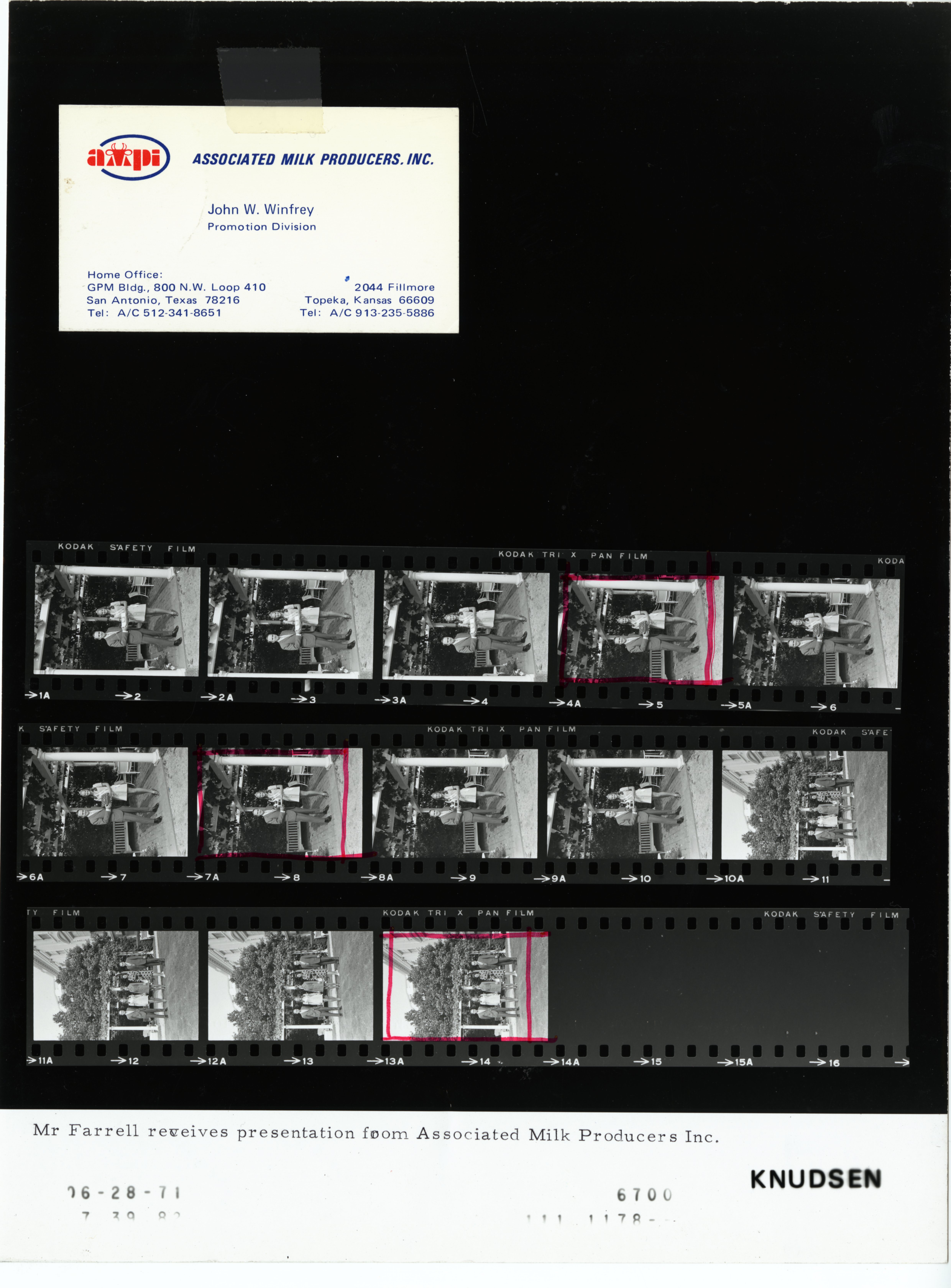
- Frame(s): WHPO-6700-01A-13A, Mike Farrell receiving a gift presentation from the Associated Milk Producers, Inc. 6/28/1971, Washington, D.C. White House, Jacqueline Kennedy Garden. Mike Farrell, unidentified persons.
Roll WHPO-6701 Photographer: Atkins, Oliver | Color or B&W: B&W
- Frame(s): WHPO-6701-03-05, President Nixon meeting with George Shultz, Vernon Jordan, Executive Director-designate of the National Urban League, and staff. 6/28/1971, Washington, D.C. White House, Oval Office. President Nixon, Vernon Jordan, Shultz, Robert Brown, Leonard Garment, JohnEhrlichman.
Roll WHPO-6702 Photographer: Schumaker, Byron | Color or B&W: B&W
- Frame(s): WHPO-6702-00A-05A, Swearing-in ceremony of Wyeth Quarles. 6/28/1971, Washington, D.C. unknown. Wyeth Quarles, Quarles family members, unidentified man.
Roll WHPO-6703 Photographer: Schumaker, Byron | Color or B&W: B&W
- Frame(s): WHPO-6703-02-06, Robert Finch and T. Harding Jones sitting at a table. 6/28/1971, Washington, D.C. unknown. Robert Finch, T. Harding Jones.
Roll WHPO-6704 Photographer: Knudsen, Robert L. | Color or B&W: B&W
- Frame(s): WHPO-6704-01A-03A, President Nixon with C. Fred Bergsten. 6/28/1971, Washington, D.C. White House, Oval Office. President Nixon, C. Fred Bergsten, William Kriegsman, Ronald Harley.
- Frame(s): WHPO-6704-06A-09A, President Nixon with William Kriegsman. 6/28/1971, Washington, D.C. White House, Oval Office. President Nixon, C. Fred Bergsten, William Kriegsman, Ronald Harley.
- Frame(s): WHPO-6704-13A-15A, President Nixon with Ronald Harley. 6/28/1971, Washington, D.C. White House, Oval Office. President Nixon, C. Fred Bergsten, William Kriegsman, Ronald Harley.
Roll WHPO-6705 Photographer: Knudsen, Robert L. | Color or B&W: Color
- Frame(s): WHPO-6705-02-04, President Nixon with Jane Dart, Secretary to Egil Krogh, Jr. 6/28/1971, Washington, D.C. White House, Oval Office. President Nixon, Jane Dart.
Roll WHPO-6706 Photographer: Schumaker, Byron | Color or B&W: Color
- Frame(s): WHPO-6706-03-09, Pat Nixon receiving a decorated Easter Egg from Mrs. Norma Younger. 6/28/1971, Washington, D.C. White House, unknown room. Pat Nixon, Norma Younger.
Roll WHPO-6707 Photographer: Atkins, Oliver | Color or B&W: B&W
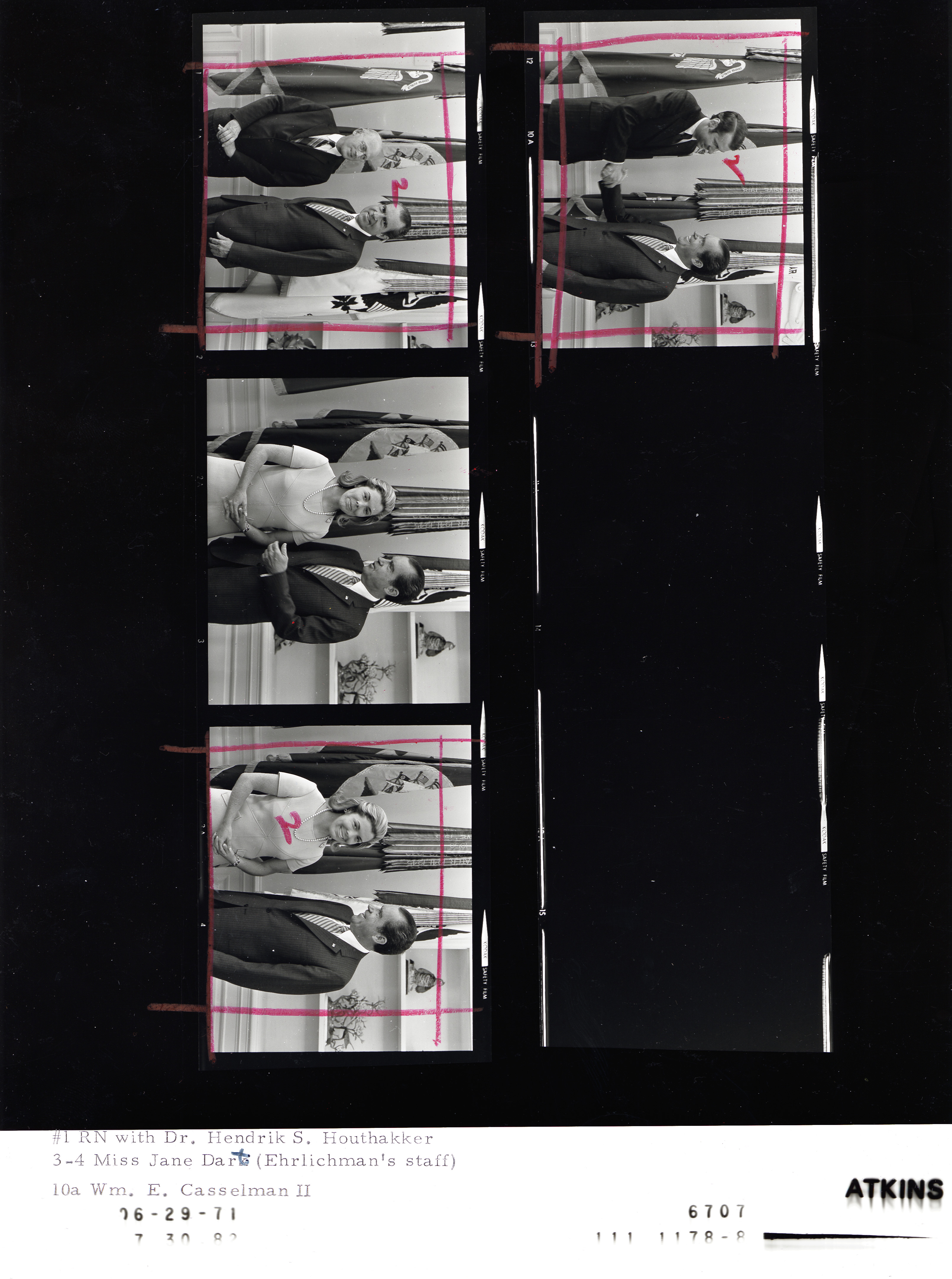
- Frame(s): WHPO-6707-01, President Nixon with Dr. Hendrik Houthakker, member of the Council of Economic Advisors. 6/28/1971, Washington, D.C. White House, Oval Office. President Nixon, Hendrik Houthakker.
- Frame(s): WHPO-6707-02-03, President Nixon with Jane Dart, Secretary to Egil Krogh, Jr. 6/28/1971, Washington, D.C. White House, Oval Office. President Nixon, Jane Dart.
- Frame(s): WHPO-6707-05-05A, President Nixon with Barbara Kilberg, Staff Assistant. 6/28/1971, Washington, D.C. White House, Oval Office. President Nixon, Barbara Kilberg.
- Frame(s): WHPO-6707-06A-09, President Nixon with Jerome Rosow, Assistant Secretary of Labor. 6/28/1971, Washington, D.C. White House, Oval Office. President Nixon, Jerome Rosow.
- Frame(s): WHPO-6707-10, President Nixon with George Shultz, Jerome Rosow, James Hodgson, and John Ehrlichman. 6/28/1971, Washington, D.C. White House, Oval Office. President Nixon, George Shultz, James Hodgson, John Ehrlichman.
- Frame(s): WHPO-6707-10A, President Nixon with William Casselman II, Deputy Special Assistant. 6/28/1971, Washington, D.C. White House, Oval Office. President Nixon, William Casselman II.
- Frame(s): WHPO-6707-11, President Nixon with T. Warren Parker, Research Aide. 6/28/1971, Washington, D.C. White House, Oval Office. President Nixon, T. Warren Parker.
The White House Communications Agency Sound Recordings Collection contains public statements that took place between 1969 and 1974. Visit the finding aid to learn more.
B - Vice-Presidential (Agnew and Ford)
- WHCA-SR-B-179
Press briefing-A.F. 2 enroute Guam. (6/28/1971)
Runtime: 20:00
Original Format: 1/4-inch reel-to-reel audiotape. Original source type: Original.
H - White House Staff Member Recordings
- WHCA-SR-H-408
Remarks by Robert Finch re voter registration for 18 year olds; (releasable through Dr. Wegner/Mr. H. Jones). (6/28/1971, Studio 79)
Runtime: 23:00
Keywords: Vote, voters, voting
Production credits: Audio feed supplied by WHCA; Recorded by VAC (initials of WHCA engineer)
Original Format: 1/4-inch reel-to-reel audiotape. Original source type: Original.
I - Various Administration Events
- WHCA-SR-I-089
Continental Congress 1976. (6/28/1971, [None listed])
Runtime: [Nonelisted]
Production credits: Audio feed supplied by "VTR"; Recorded by JAD (initials of WHCA engineer)
Original Format: 1/4-inch reel-to-reel audiotape. Original source type: Original.
P - Formal Presidential Remarks
- WHCA-SR-P-710631
Remarks by President Nixon to Chowder and Marching Society. (6/28/1971)
Runtime: 21:00
Original Format: 1/4-inch reel-to-reel audiotape. Original source type: Original.
The White House Communications Agency Videotape Collection contains “off-the-air” recordings of televised programs produced between 1968 and 1974. Visit the finding aid to learn more.
- WHCA-4482
" 'Top Secret' - Who Draws The Line?".
Undetermined
Runtime: 00:30:03
Context (External Sources)
The Vanderbilt Television News Archive is the world's most extensive and complete archive of television news. They have been recording, preserving and providing access to television news broadcasts of the national networks since August 5, 1968.
Wikipedia is a free encyclopedia that anyone can edit.