

Introduction
This almanac page for Thursday, August 17, 1972, pulls together various records created by the federal government and links to additional resources which can provide context about the events of the day.
Previous Date: Wednesday, August 16, 1972
Next Date: Friday, August 18, 1972
Schedule and Public Documents
The Daily Diary files represent a consolidated record of the President's activities. Visit the finding aid to learn more.
The President's day began at Camp David, Maryland
The Weekly Compilation of Presidential Documents made available transcripts of the President's news conferences; messages to Congress; public speeches, remarks, and statements; and other Presidential materials released by the White House.
Digitized versions can be found at HathiTrust.
The Federal Register is the official daily publication for rules, proposed rules, and notices of federal agencies and organizations, as well as executive orders and other Presidential documents.
The Congressional Record is the official daily record of the debates and proceedings of the U.S. Congress.
Archival Holdings
Any selection of archival documents will necessarily be partial. You should use the documents and folders identified below as a starting place, but consult the linked collection finding aids and folder title lists and the collections themselves for context. Many documents to be found this way do not lend themselves to association with specific dates, but are essential to a complete understanding of the material.
Selective document listing
President's Office Files
The President's Office Files consists of materials drawn together by the Special Files Unit from several administrative subdivisions within the White House Office. It is the handwriting and sensitive papers sent to the Staff Secretary that now comprise much of the President's Office Files. Visit the finding aid to learn more.
- News Summaries, Unmarked News Summaries, Box 50, News Summaries - August 1972 [5 of 7] [Note: Due to the way News Summary products were compiled, you should also consult nearby days for potentially relevant materials.]
- News Summary, Aug. 17, 1972, (Wed. nets, wires, mags)
The H. R. Haldeman Diaries consists of seven handwritten diaries, 36 dictated diaries recorded as sound recordings, and two handwritten audio cassette tape subject logs. The diaries and logs reflect H. R. Haldeman’s candid personal record and reflections on events, issues, and people encountered during his service in the Nixon White House. As administrative assistant to the President and Chief of Staff, Haldeman attended and participated in public events and private meetings covering the entire scope of issues in which the Nixon White House engaged in during the years 1969-1973. Visit the finding aid to learn more.
- Transcript of diary entry (PDF)
Thursday, August 17.
He called on the phone at 9:00 this morning. Says he's going to avoid going down today, he won't do the Olympics after all, that he started one theme last night, worked on it for quite a long time, and it didn't work. Then he got into the need for some other judgment regarding the "how we should go after the Vietnam attack", hitting McGovern on his screwing up the peace. That he wanted me to have Ziegler, Connally, MacGregor, and Rogers' judgment on the idea of maybe having a Rogers speech. The President's general reaction is not to delay, he thinks it's best to shoot when the target is there, that we should hit him on seriously jeopardizing the peace negotiations. Question of whether we should wait until Henry gets back, or hit at the Convention, raises the question of maybe they're purposely trying to hit the thing to louse up our Convention and for that reason we should wait until afterwards.
Talked to Connally on it, and he said that he thinks somebody at this point should spell it out, but it should not be the President, not Rogers, not the Vice President, should be done without characterizing, but just to bring it into focus, maybe Gerry Ford or someone on the Senate Foreign Relations Committee, not Reagan. Maybe Margaret Smith, or Aiken. Should be done with sadness and resignation, that it's unbelievable. Not mean, just to bring it into focus––set up the target now and hit it later––don't need it now, so don't hit it too hard. The war isn't hurting us. The only adverse thing is food prices, and we shouldn't move too fast on that. We should look at that if we didn't have the war, we wouldn't have them screwing up on these things, and we want to keep the issue focused on Vietnam, because it's to our benefit. So we should do it at the Convention, where we get maximum coverage. With a good governor or someone to plant it in people's minds. We should posture the indecisiveness, credibility, inability to deal with problems. Hit him on lack of understanding, indecision, naiveté. Connally then said maybe he should hit it at the VFW, but then he figured maybe he's probably not the best one.
President then got into quite a discussion on the speech, says that we've got to do something about the themes in the liberal press, that we always run a bad campaign and lose. That we shouldn't worry about this one; second, that our supporters are very thin, and we really do have solid support. He then outlined that he feels there's three points he can make: economics, law and order and justice––building on the courts, and crime and so on––and peace. Then wonders about one exception from his feeling that he should not go through a laundry list, which would be a pitch for young people. In the last four years, something significant regarding the young don't judge all American youth by the "shouters" and those engaged in violence. The majority are studying, working and working within the system. He feels we have to say the Democrats are unpatriotic, but we should wait till after the Convention to do it, except maybe Reagan hitting it at the Convention.
Going back to Connally, he reported that Tom Johnson is going to be leaving Lyndon Johnson and wants to come back to Washington, get into government, so I told him that we'd be happy to give him a position, we'd be delighted to have him in the government, he’s exactly the kind of young guy we want.
On the attack on Vietnam, the President doesn't feel that it should be done in a partisan format, it's better to come from a Democrat, it will be a good shift and not a slashing attack, we should just talk about bipartisan foreign policy, pick up the President's speeches of the past and so on. He wants Connally to do it. He told me to have Bakshian do the Connally speech, making the point "Don't play partisan politics," with peace. He should congratulate the VFW, who are mostly Democrats, as the President did, for backing the national foreign policy. Wants to be sure Ziegler and Klein and all don't hit McGovern on this, wants Colson to hit them on their dirty low road campaign. Slander, smear, and fear, so on. In his American Legion speech, he wants to use the Truman quote regarding the need for keeping politics out of foreign policy. Regarding the Legion, making the point that the Legion always puts country above party.
Then he got into some ideas that when there are serious negotiations, of great seriousness and importance, for an individual outside the government to intervene is a terrible thing. Without raising false hopes, you know that serious talks have been taking place––Paris and Saigon––but because the enemy might misinterpret, we have a problem here. Then he got down to, because discussions are going on at the highest levels, this intervention by an outsider could seriously jeopardize the possibility of peace and all. These ideas were for Ziegler to say something, hitting this so that we don't downplay the McGovern thing too much. That is the Ramsey Clark deal. Colson agreed that Connally was the perfect guy to hit the deal on McGovern. He thinks we have a very serious problem in the need for a Ziegler line and was pushing hard for that.
Had a long talk with Billy Graham who reported on his weekend with Lyndon Johnson. Billy says he helped Johnson modify his endorsement to make it as cool as possible, he says that he's selling his TV station, Johnson is, to the LA. Times later this week. Secondly, he's giving his home and all to the Park System. Third, he advises the President to ignore McGovern. He says he should go out and identify with people unannounced, to ball games, factories, and so on. He thinks the McGovern people will defeat themselves. He feels very strongly anti-McGovern. Says the President should not do too much campaigning, stay above it, as Johnson did with Goldwater. He's very grateful regarding the treatment by Nixon for him, especially of his two daughters. He doesn't think Marvin Watson should come out for the President because Nixon will win Texas 60/40 anyway, and Watson's the only Democrat left in Texas who can take over and run for Governor in the Democratic Party.
Graham is a little concerned about Vietnam and about the bugging thing. He doesn't think bugging is going to hurt us. Lyndon Johnson laughed about it, said it won't hurt a bit. Graham says the evangelical wing of the church is pro-Jewish, so the Jewish shift helps to solidify the evangelical types, too. Regarding the acceptance speech, Billy feels that it should not be like four years ago, because he's now President. He doesn't need the flamboyance of a challenger. What will appeal is a high road, innumerate the accomplishments, look to the future, what can be done. Have a foundation to build a new world, and a new America, and we're just now able to do it. He says that the President must talk to the workers of the campaign. Get into the issue but never mention McGovern by name. Hit the socialistic welfare state versus America, where you can start at the bottom and work to the top. The only way the McGovern plan would work is under a dictatorship. Says the speech should not be long, and it should always be as President of the US. He feels McGovern's getting more desperate and contradictory every day, that we should let him stew in his own problems, he can't reconcile his people in the party. California's the one exception. It will be most difficult, and that's why Billy's out there, doing press conferences and so on. He went into the question of Shriver having asked him to pray at his acceptance. Billy said he had no problem turning it down. He will not be used by Shriver, but he will be used by Nixon, wherever we want him to be. He's going to be California for a month doing press conferences and that kind of thing. He had Askew at his home for lunch, Askew said we'll carry Florida without campaigning, he thinks McGovern's a total loss.
I talked to Ehlichman at the President's direction regarding the speech. John likes the "new coalition" idea, rather than "new majority". He thinks "majority" sounds like winning an election. Thinks it's a new coming together of common interests, like a new federation or a union, or something. He likes reciting accomplishments and the things to be done. Doesn’t like the negative view of comparing Nixon's position versus McGovern's. He thinks that that makes the new coalition for the purpose of defeating McGovern, instead of accomplishing what our goals are. That there should be uplift, not attack, and then talk about how to do it. We should start on a strongly affirmative basis, with the goals we seek. Also, he thinks that McGovern's tactics are an attack on the institution of this country, not on the Administration. The issue is not the incumbent versus the challenger, but the view of the nation and its institutions. One is an uncharted sea with an unknown navigator, so the conflict is between McGovern and all we hold dear, not between two men contending for the Presidency. McGovern's done this to himself, so we should cement him in, force him to stay on an assault against the institutions. In this form, the President should talk about what he's done and what's left to do, the past is prologue.
In approach, he should divide the speech in half, first, make the point that we're in the midpoint of the course between '69 and '76, the direction is clear, it leads us to a point where we want to be, and then he should define it. Second, we now are met with a challenge from an alien ideology that says that those should not be the points we want to end up at. So this is an election about goals. I believe this. We've come a long ways toward this. My opponent believes that, and I disagree. We need the flavor of “just on the threshold of great stuff that McGovern will throw away", but most important is to say what we've accomplished. We should give a feel of the whole canvas and the interrelationship, show a grasp of the complexity. He thinks it's a great opportunity to spike the secret plan to end the war, by contrasting the President's conduct as an out versus the conduct of the opponents now. Say I wouldn't discuss it as a campaign issue, so it was only a secret plan during the campaign. He thinks this would lay this one out cold. President had asked me to review this whole thing with John, and that was the reaction John came up with. The President's sort of reaching out now, trying to get various people's ideas on this. One big question still is just the very basic approach.
He gave me a bunch of questions to follow-up on, regarding primarily economic stuff, some statistics that he wants to use to make the point that the regarding the economic-- present economic situation and the tax question. Had a stir today on the Jewish situation, because the Russians are going to charge duty to Jews leaving Russia, and that's created a big flap in this country. Bill Rogers all stirred up about it; and I'm supposed to keep Rogers from seeing Dobrynin on it tomorrow, which I think I've successfully done.
End of August 17. - Original audio recording (MP3)
The National Archives Catalog is the online portal to the records held at the National Archives, and information about those records. It is the main way of describing our holdings and also provides access to electronic records and digitized versions of our holdings.
The Catalog searches across multiple National Archives resources at once, including archival descriptions, digitized and electronic records, authority records, and web pages from Archives.gov and the Presidential Libraries. The Catalog also allows users to contribute to digitized historical records through tagging and transcription.
Nixon Library Holdings
All National Archives Units
National Security Documents
The President's Daily Brief is the primary vehicle for summarizing the day-to-day sensitive intelligence and analysis, as well as late-breaking reports, for the White House on current and future national security issues. Read "The President's Daily Brief: Delivering Intelligence to Nixon and Ford" to learn more.
The Foreign Relations of the United States series presents the official documentary historical record of major U.S. foreign policy decisions and significant diplomatic activity. Visit the State Department website for more information.
Vol. VIII, Vietnam, January-October 1972
The Parties Move Toward Agreement, July 19-October 7, 1972
242. Memorandum of Conversation, Saigon, August 17, 1972, 2-3:20 p.m.
Source: Library of Congress, Manuscript Division, Kissinger Papers, Box TS 58, Geopolitical File, Vietnam, Trips, Kissinger Memcons, August 1972. Top Secret; Sensitive; Eyes Only. The meeting took place at Ambassador Bunker’s residence. All brackets are in the original.
243. Memorandum of Conversation, Saigon, August 17, 1972, 4:35-6:40 p.m.
Source: National Archives, Nixon Presidential Materials, NSC Files, Box 864, For the President’s Files (Winston Lord)—China Trip/Vietnam, Sensitive Camp David Memcons, May–October 1972 [3 of 5]. Top Secret; Sensitive; Exclusively Eyes Only. The meeting took place at the Presidential Palace. All brackets, except those that indicate the omission of material, are in the original.
Vol. XV, Soviet Union, June 1972-August 1974
Post-Moscow Summit Discussions and Issues, June-August 1972
27. Backchannel Message From the President’s Deputy Assistant for National Security Affairs (Haig) to the President’s Assistant for National Security Affairs (Kissinger) in Saigon, Washington, August 17, 1972, 2325Z
Source: National Archives, Nixon Presidential Materials, NSC Files, Kissinger Office Files, Box 23, HAK Trip Files, HAK’s Secret Paris Trip, Switzerland, Saigon, Tokyo, August 13–19, 1972, To/Frm 86971 & Backchannels. Secret; Eyes Only; Flash. A stamped notation on the message indicates it was received in the White House Situation Room at 8:23 p.m. on August 17.
Vol. XLI, Western Europe; NATO, 1969-1972
Ireland
176. Memorandum From Helmut Sonnenfeldt of the National Security Council Staff to the President’s Assistant for National Security Affairs (Kissinger), Washington, August 17, 1972
Source: National Archives, Nixon Presidential Materials, NSC Files, Box 694, Country Files—Europe, Ireland. Confidential; Sensitive. Sent for information. Initialed by Kissinger.
United Kingdom
356. Letter From President Nixon to British Prime Minister Heath, Washington, August 17, 1972
Source: National Archives, Nixon Presidential Materials, NSC Files, Box 764, Presidential Correspondence, United Kingdom, Prime Minister Edward Heath. Secret.
Vol. E-2, Documents on Arms Control and Nonproliferation, 1969-1972
Chemical and Biological Warfare; Geneva Protocol; Biological Weapons Convention
268. Memorandum From the President’s Science Adviser (David) to the President’s Assistant for National Security Affairs (Kissinger), Washington, August 17, 1972
David expressed support for Option 1 in the NSSM 157 study, placing no ban on production and no limitation of stockpiles, and urged that the U.S. retain a chemical weapons retaliatory capability
Source: National Archives, Nixon Presidential Materials, NSC Files, NSC Institutional Files (H-Files), Box H–66, SRG Meeting, NSSM 157, 3/5/73. Secret.269. Memorandum From the Deputy Secretary of State (Irwin) to President’s Assistant for National Security Affairs (Kissinger), Washington, August 17, 1972
Irwin provided a detailed analysis of the reasons why the Department of State favored Option 2 in the NSSM 157 study, prohibiting the production and transfer of toxic agents, over Option 3 supported by the Department of Defense.
Source: National Archives, Nixon Presidential Materials, NSC Files, NSC Institutional Files (H-Files), Box H–66, SRG Meeting, NSSM 157, 3/5/73. Secret.
Vol. E-5, Part 2, Documents on North Africa, 1969-1972
Morocco
126. Telegram 3761 From the Embassy in Morocco to the Department of State, Rabat, August 17, 1972, 0020Z
Ambassador to Morocco Stuart Rockwell gave a preliminary assessment on the failure of another attempt to assassinate King Hassan.
Source: National Archives, RG 59, Central Files 1970–73, POL 15–1 MOR. Confidential; Niact; Immediate. It was repeated Immediate to Paris, Rome, Madrid, Tunis, Tripoli, Algiers, and London, and to USCINCEUR and COMNAVTRACOM.127. Intelligence Note RAAN-36 Prepared in the Bureau of Intelligence and Research, Washington, August 17, 1972
This 3 page report observed that the General Oufkir’s suicide removed an irreplaceable pillar of support to the Hassan regime as Oufkir’s total devotion to the monarch, coupled with his ruthlessness and organization, had enabled the monarchy to maintain control of the military in spite of attempts to overthrow the regime. As the loyalty of the military was critical to the survival of Hassan’s regime, the report noted that a purge of the Moroccan forces was likely and that the United States might possibly be assigned responsibility for supporting the opposition.
Source: National Archives, RG 59, Central Files 1970–73, POL 15–1 MOR. Confidential. Drafted by Hoffman; cleared by Godfrey Summ (INR/Africa).
The Kissinger telephone conversation transcripts consist of approximately 20,000 pages of transcripts of Kissinger’s telephone conversations during his tenure as Assistant to the President for National Security Affairs (1969-1974) and Secretary of State (1973-1974) during the administration of President Richard Nixon. Visit the finding aid for more information.
Digitized versions can be found in the National Archives Catalog.
Audiovisual Holdings
Visit the White House Tapes finding aid to learn about the taping system's operation and archival processing.
Camp David Hard Wire
- 203-4; 9:01 a.m. - 9:01 a.m.; Nixon, Richard M. (President); Camp David Operator
- 203-5; 9:01 a.m. - 9:47 a.m.; Nixon, Richard M. (President); Haldeman, H. R. ("Bob"); Sanchez, Manolo
- 203-6; 9:47 a.m. - 9:47 a.m.; Nixon, Richard M. (President); Camp David Operator
- 203-7; 9:48 a.m. - 9:54 a.m.; Nixon, Richard M. (President); Eisenhower, Julie Nixon
- 203-8; 9:57 a.m. - 9:57 a.m.; Nixon, Richard M. (President); Camp David Operator
- 203-9; 9:57 a.m. - 9:57 a.m.; Nixon, Richard M. (President); Camp David Operator
- 203-10; 9:58 a.m. - 9:58 a.m.; Nixon, Richard M. (President); Camp David Operator
- 203-11; Unknown between 9:58 a.m. & 10:16 a.m.; Nixon, Richard M. (President); Sanchez, Manolo
- 203-12; Unknown between 9:58 a.m. & 10:16 a.m.; Nixon, Richard M. (President); Camp David Operator
- 203-13; 10:16 a.m. - 10:54 a.m.; Nixon, Richard M. (President); Haldeman, H. R. ("Bob")
- 203-14; 10:56 a.m. - 10:58 a.m.; Nixon, Richard M. (President); Meany, George
- 203-15; 11:10 a.m. - 11:10 a.m.; Nixon, Richard M. (President); Camp David Operator
- 203-16; Unknown between 11:10 a.m. & 11:22 a.m.; Nixon, Richard M. (President); Sanchez, Manolo
- 203-17; 11:22 a.m. - 11:29 a.m.; Nixon, Richard M. (President); Haldeman, H. R. ("Bob")
- 203-18; Unknown between 11:29 a.m. & 1:15 p.m.; Nixon, Richard M. (President); Sanchez, Manolo
- 203-19; 1:15 p.m. - 2:45 p.m.; Nixon, Richard M. (President); Haldeman, H. R. ("Bob")
- 203-20; Unknown between 2:45 p.m. & 3:06 p.m.; Nixon, Richard M. (President); Sanchez, Manolo
- 203-21; Unknown between 2:45 p.m. & 3:06 p.m.; Nixon, Richard M. (President); Sanchez, Manolo
- 203-22; 3:06 p.m. - 3:21 p.m.; Nixon, Richard M. (President); Ziegler, Ronald L.
- 203-23; Unknown between 3:21 p.m. & 6:08 p.m.; Nixon, Richard M. (President); Sanchez, Manolo
- 203-24; Unknown between 3:21 p.m. & 6:08 p.m.; Nixon, Richard M. (President); Sanchez, Manolo
- 203-25; Unknown between 3:21 p.m. & 6:08 p.m.; Nixon, Richard M. (President); [Unknown person(s)]
- 203-26; 6:08 p.m. - 6:13 p.m.; Nixon, Richard M. (President); Camp David Operator; Cox, Tricia Nixon
- 203-27; Unknown between 6:13 p.m. & 6:18 p.m.; Nixon, Richard M. (President); Sanchez, Manolo
- 203-28; 6:18 p.m. - 6:23 p.m.; Nixon, Richard M. (President); Camp David Operator; Cox, Tricia Nixon
- 203-29; Unknown between 6:23 p.m. & 6:25 p.m.; Nixon, Richard M. (President); Sanchez, Manolo
- 203-30; 6:25 p.m. - 6:26 p.m.; Nixon, Richard M. (President); Camp David Operator; Cox, Tricia Nixon
- 204-1; Unknown between 6:26 p.m. & 7:35 p.m.; Nixon, Richard M. (President); Haldeman, H. R. ("Bob")
- 204-2; Unknown between 8:30 p.m. & 10:32 p.m.; Nixon, Richard M. (President)
- 204-3; Unknown between 8:30 p.m. & 10:32 p.m.; Nixon, Richard M. (President); Camp David Operator
- 204-4; 10:32 p.m. - 10:51 p.m.; Nixon, Richard M. (President); Haldeman, H. R. ("Bob")
- 204-5; Unknown between 10:51 p.m. & 11:02 p.m.; Nixon, Richard M. (President); Camp David Operator
- 204-6; 11:02 p.m. - 11:04 p.m.; Nixon, Richard M. (President); Haldeman, H. R. ("Bob")
- 204-7; Unknown between 11:04 p.m. & 11:43 p.m.; Nixon, Richard M. (President)
- 204-8; Unknown between 11:04 p.m. & 11:43 p.m.; Nixon, Richard M. (President); Camp David Operator
- 204-9; Unknown between 11:04 p.m., 8/17 & 12:45 a.m., 6/8; Nixon, Richard M. (President); Woods, Rose Mary; Camp David Operator; Haldeman, H. R. ("Bob")
- 204-10; Unknown between 11:49 p.m., 8/17 & 12:45 a.m., 6/8; Nixon, Richard M. (President); Sanchez, Manolo
- 204-11; Unknown between 11:49 p.m., 8/17 & 12:45 a.m., 6/8; Nixon, Richard M. (President)
- 204-12; Unknown between 11:49 p.m., 8/17 & 12:45 a.m., 6/8; Nixon, Richard M. (President); Sanchez, Manolo
Camp David Study Desk
- 176-4; 6:08 p.m. - 6:13 p.m.; Nixon, Richard M. (President); Camp David Operator; Cox, Tricia Nixon
- 176-5; 6:18 p.m. - 6:23 p.m.; Nixon, Richard M. (President); Camp David Operator; Sanchez, Manolo; Cox, Tricia Nixon
- 176-6; 6:25 p.m. - 6:26 p.m.; Nixon, Richard M. (President); Camp David Operator; Cox, Tricia Nixon
Camp David Study Table
- 140-15; Unknown between 8:45 a.m. & 9:01 a.m.; Nixon, Richard M. (President); Camp David Operator
- 140-16; 9:01 a.m. - 9:47 a.m.; Nixon, Richard M. (President); Haldeman, H. R. ("Bob"); Sanchez, Manolo
- 140-17; 9:47 a.m. - 9:47 a.m.; Nixon, Richard M. (President); Camp David Operator
- 140-18; 9:48 a.m. - 9:54 a.m.; Nixon, Richard M. (President); Eisenhower, Julie Nixon
- 140-19; 9:57 a.m. - 9:57 a.m.; Nixon, Richard M. (President); Camp David Operator
- 140-20; 9:57 a.m. - 9:57 a.m.; Nixon, Richard M. (President); Camp David Operator
- 140-21; 9:58 a.m. - 9:58 a.m.; Nixon, Richard M. (President); Camp David Operator
- 140-22; Unknown between 9:58 a.m. & 10:16 a.m.; Nixon, Richard M. (President); Camp David Operator
- 140-23; 10:16 a.m. - 10:54 a.m.; Nixon, Richard M. (President); Camp David Operator; Haldeman, H. R. ("Bob")
- 140-24; 10:56 a.m. - 10:58 a.m.; Nixon, Richard M. (President); Camp David Operator; Meany, George
- 140-25; 11:10 a.m. - 11:10 a.m.; Nixon, Richard M. (President); Camp David Operator
- 140-26; 11:22 a.m. - 11:29 a.m.; Nixon, Richard M. (President); Camp David Operator; Haldeman, H. R. ("Bob")
- 140-27; 3:06 p.m. - 3:21 p.m.; Nixon, Richard M. (President); Camp David Operator; Ziegler, Ronald L.
- 140-28; Unknown between 8:30 p.m. & 10:32 p.m.; Nixon, Richard M. (President); Camp David Operator
- 140-29; 10:32 p.m. - 10:51 p.m.; Nixon, Richard M. (President); Haldeman, H. R. ("Bob")
- 140-30; Unknown between 10:51 p.m. & 11:02 p.m.; Nixon, Richard M. (President); Camp David Operator
- 140-31; 11:02 p.m. - 11:04 p.m.; Nixon, Richard M. (President); Haldeman, H. R. ("Bob")
- 140-32; Unknown between 11:04 p.m. & 11:43 p.m.; Nixon, Richard M. (President); Camp David Operator
- 140-33; Unknown between 11:04 p.m. & 11:43 p.m.; Nixon, Richard M. (President); Camp David Operator
- 140-34; 11:43 p.m. - 11:49 p.m.; Nixon, Richard M. (President); Haldeman, H. R. ("Bob")
The White House Photo Office collection consists of photographic coverage of President Richard Nixon meeting with prominent social, political, and cultural personalities; speaking engagements and news conferences of the President and various high-ranking members of the White House staff and Cabinet; Presidential domestic and foreign travel, including Presidential vacations; social events and entertainment involving the First Family, including entertainers present; official portraits of the President, First Family, and high-ranking members of the Nixon administration; the 1969 and 1973 Inaugurals; the President’s 1972 Presidential election campaign appearances (including speeches) and other official activities of the White House staff and the President’s Cabinet from January 20, 1969 until August 9, 1974 at the White House and the Old Executive Office Building; other locations in Washington, DC, such as The Mall; and the Presidential retreats in Camp David, Maryland, Key Biscayne, Florida, and San Clemente, California. Visit the finding aid to learn more.
Roll WHPO-9818 Photographer: Schumacher, Karl | Color or B&W: B&W
- Frame(s): WHPO-9818-, Deputy Special Assistant John E. Nidecker receiving watermelons from a unidentified group. 8/17/1972, Washington, D.C. Diplomatic Entrance, White House. Nidecker, unidentified group.
Roll WHPO-9819 Photographer: Schumacher, Karl | Color or B&W: B&W
- Frame(s): WHPO-9819-, Vice President Agnew with Nancy Miller and the Schleicher brothers. 8/17/1972, Washington, D.C. unknown. Agnew, Nancy Miller, Schleicher brothers, unidentified persons.
Roll WHPO-9820 Photographer: Schumaker, Byron | Color or B&W: B&W
- Frame(s): WHPO-9820-, Vice President Agnew greeting and seated with a group of unidentified men. 8/17/1972, Washington, D.C. unknown. Agnew, unidentified men.
Roll WHPO-9821 Photographer: Grove, Andrew | Color or B&W: Color
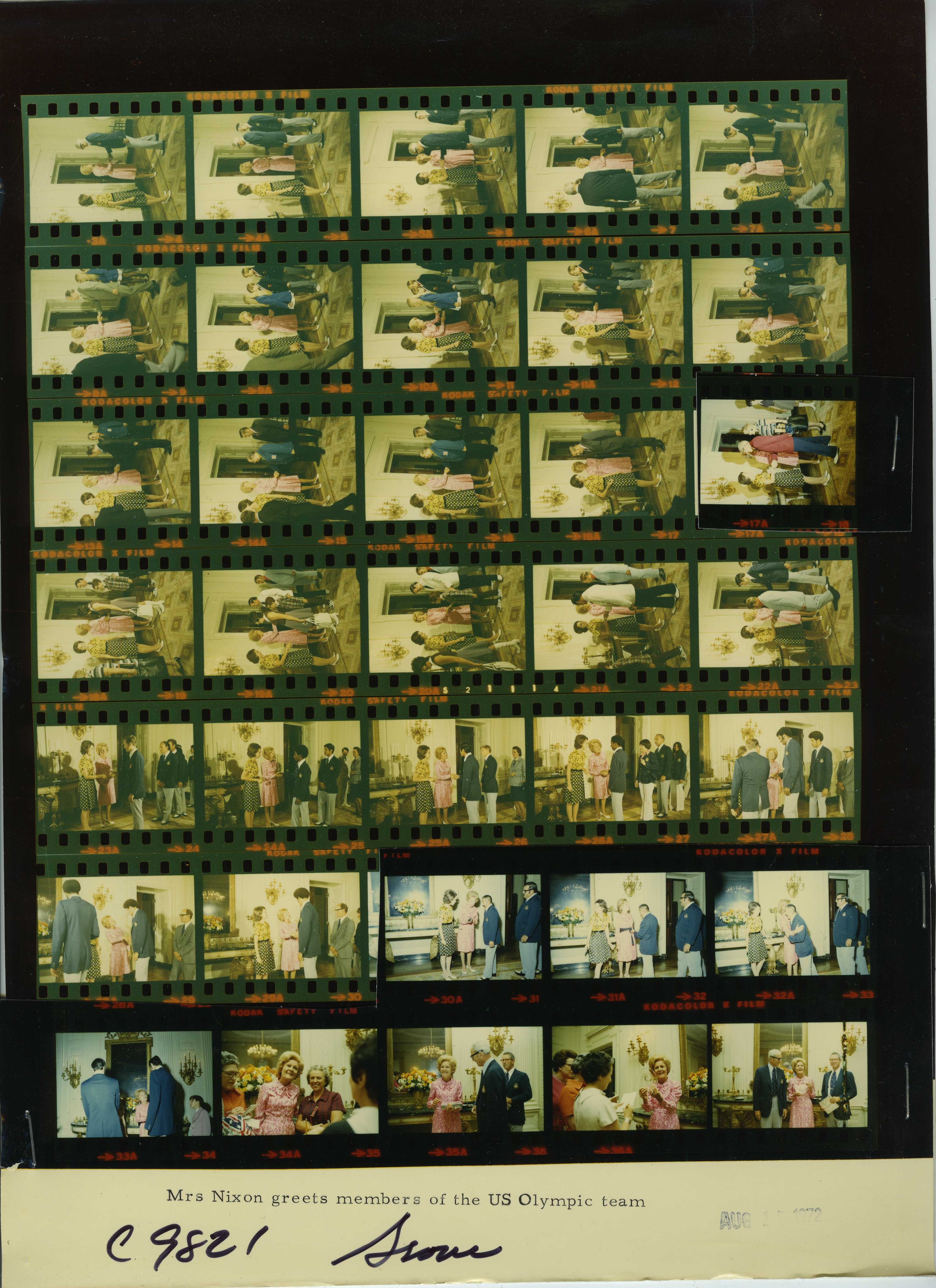
- Frame(s): WHPO-9821-, Pat Nixon and Julie Eisenhower greeting members of the U.S. Olympic teams, and their families. Basketball team members greeting Pat Nixon. 8/17/1972, Washington, D.C. White House, State Dining Room. Pat Nixon, Julie Eisenhower, Olympic team members, family members.
Roll WHPO-9822 Photographer: Parish, William | Color or B&W: B&W
- Frame(s): WHPO-9822-, Tricia Nixon Cox visiting sites at the Illinois State Fair. 8/17/1972, Springfield, Illinois various outdoor sites. Tricia Nixon Cox, unidentified persons.
Roll WHPO-9823 Photographer: Parish, William | Color or B&W: B&W
- Frame(s): WHPO-9823-, Tricia Nixon Cox speaking to reporters at the Springfield, Illinois State Fairgrounds. 8/17/1972, Springfield, Illinois airport tarmac, State Fair grounds. Tricia Nixon Cox, Roy Rogers, Dale Evans, officials, crowd, reporters.
- Frame(s): WHPO-9823-, Tricia Nixon Cox is greeted by Roy Rogers, Dale Evans, and others on her arrival at the Springfield, Illinois Airport. 8/17/1972, Springfield, Illinois airport tarmac, State Fair grounds. Tricia Nixon Cox, Roy Rogers, Dale Evans, officials, crowd, reporters.
- Frame(s): WHPO-9823-, Tricia Nixon Cox greeting people in the waiting crowd at the Springfield, Illinois Airport. 8/17/1972, Springfield, Illinois airport tarmac, State Fair grounds. Tricia Nixon Cox, Roy Rogers, Dale Evans, officials, crowd, reporters.
Roll WHPO-9824 Photographer: Parish, William | Color or B&W: Color
- Frame(s): WHPO-9824-, Tricia Nixon Cox is greeted by Roy Rogers, Dale Evans, and others on her arrival at the Springfield, Illinois Airport. 8/17/1972, Springfield, Illinois airport tarmac, State Fair grounds. Tricia Nixon Cox, Roy Rogers, Dale Evans, officials, crowd, reporters.
- Frame(s): WHPO-9824-, Tricia Nixon Cox speaking to reporters at the Springfield, Illinois State Fairgrounds. 8/17/1972, Springfield, Illinois airport tarmac, State Fair grounds. Tricia Nixon Cox, Roy Rogers, Dale Evans, officials, crowd, reporters.
- Frame(s): WHPO-9824-, Tricia Nixon Cox greeting people in the waiting crowd at the Springfield, Illinois Airport. 8/17/1972, Springfield, Illinois airport tarmac, State Fair grounds. Tricia Nixon Cox, Roy Rogers, Dale Evans, officials, crowd, reporters.
Roll WHPO-9825 Photographer: Parish, William | Color or B&W: Color
- Frame(s): WHPO-9825-, Tricia Nixon Cox visiting the Springfield, Illinois State Fair exhibits. 8/17/1972, Springfield, Illinois State Fair grounds. Tricia Nixon Cox, unidentified persons.
Roll WHPO-9826 Photographer: Parish, William | Color or B&W: Color
- Frame(s): WHPO-9826-, Tricia Nixon Cox at various sites. 8/17/1972, Springfield, Illinois State Fair grounds. Tricia Nixon Cox, unidentified persons.
Roll WHPO-9827 Photographer: Parish, William | Color or B&W: Color
- Frame(s): WHPO-9827-, Tricia Nixon Cox at various sites. 8/17/1972, Springfield, Illinois State Fair grounds. Tricia Nixon Cox, unidentified persons.
Roll WHPO-9828 Photographer: Parish, William | Color or B&W: Color
- Frame(s): WHPO-9828-, Tricia Nixon Cox at various sites at the State Fair and boarding a plane. 8/17/1972, Springfield, Illinois State Fair grounds, tarmac. Tricia Nixon Cox, unidentified persons.
Roll WHPO-9829 Photographer: Parish, William | Color or B&W: Color
- Frame(s): WHPO-9829-, Tricia Nixon Cox greeting the crowd at the airport. Shots of the sky taken from the plane. 8/17/1972, Springfield, Illinois airport, air. Tricia Nixon Cox, crowd.
Roll WHPO-D0018 Photographer: Knudsen, Robert L. | Color or B&W: B&W
- Frame(s): WHPO-D0018-, The Convention Center floor. Unidentified persons at various sites in the Convention Center building. 8/17/1972, Miami Beach, Florida Miami Convention Hall. unidentified persons.
- Frame(s): WHPO-D0018-14A, Ron Walker, Dwight Chapin and other unidentified officials talk during a meeting on the unoccupied Convention Center floor. 8/17/1972, Miami Beach, Florida Miami Convention Hall. Ron Walker, Dwight Chapin, unidentified staff members.
The White House Communications Agency Sound Recordings Collection contains public statements that took place between 1969 and 1974. Visit the finding aid to learn more.
L - White House Press Office Briefings
- WHCA-SR-L-005
Press briefing. (8/17/1972, White House Press Lobby)
Runtime: 20:00
Keywords: Press conferences, news conferences, interviews, media
Original Format: 1/4-inch reel-to-reel audiotape. Original source type: Original.
The White House Communications Agency Videotape Collection contains “off-the-air” recordings of televised programs produced between 1968 and 1974. Visit the finding aid to learn more.
- WHCA-5656
Weekly News Summary, Tape III.
ALL NETWORKS
Runtime: 1:30
24. Smith/Bennett: Comment on Henry Kissinger trip to Saigon, Vietnam. Time Code Start: 59:45. Keywords: Vietnam War, cabinet, advisors, travel, trips. Network: ABC.
25. Smith/Jarriel: White House lashes out at Salinger trip. Time Code Start: 61:35. Keywords: travel, trips. Network: ABC.
26. Matney: McGovern comments on why he does not want White House briefings; attacks Kissinger's trip as a political move. Time Code Start: 63:15. Keywords: Presidential elections, campaigns, campaigning, candidates, cabinet, advisors, travel, trips, media, press conferences, news conferences, interviews. Network: ABC.
27. Collins: The continuing battle for Quang Tri in Vietnam. Time Code Start: 65:17. Keywords: Vietnam War. Network: ABC.
28. Reasoner/Kaplow: Platform hearings, arguments on busing. Time Code Start: 66:30. Keywords: Presidential elections, campaigns, campaigning, candidates, conventions, political parties, bills, laws, legislation, desegregation, racism, racial discrimination, African Americans, schools, students, transportation, reports. Network: ABC.
29. Sherwood: More from the rules committee. Time Code Start: 66:30. Keywords: Presidential elections, campaigns, campaigning, candidates, primaries, voting, conventions, delegations, delegates. Network: ABC.
30. Smith/Gill: Chuck Colsen comments on Watergate incident. Time Code Start: 70:12. Keywords: Watergate, Senate committee hearings, investigations, testimony, testify, cover-ups, break-in, burglary, theft, plumbers, scandals. Network: ABC.
31. Reasoner: Commentary on the pitfalls that McGovern has encountered. Time Code Start: 73:52. Keywords: Presidential elections, campaigns, campaigning, candidates. Network: ABC.
32. Chancellor: Vietnam; Peace, with Senator Griffin in Miami, comment on Salinger. Time Code Start: 75:45. Keywords: Paris Peace Talks, Vietnam War, treaty, treaties, negotiations. Network: NBC.
33. Chancellor: McGovern says he did not send Salinger to Paris. Time Code Start: 77:55. Keywords: Paris Peace Talks, Vietnam War, treaty, treaties, negotiations, government, officials, travel, trips. Network: NBC.
34. Chancellor/Lord: Henry Kissinger in Saigon, Vietnam. Time Code Start: 79:50. Keywords: Vietnam War. Network: NBC.
35. Chancellor/Steithorst: Vietnam, death toll. Time Code Start: 82:40. Keywords: Vietnam War, Killed in Action, KIA, troops, death tolls, fatalities, casualties. Network: NBC.
36. Chancellor/Mackin/Pettit: End of Platform Hearings and Rules Committee hearings with Ehrlichman. Time Code Start: 85:33. Keywords: Presidential elections, campaigns, campaigning, candidates, advisors, counsels, attorneys, lawyers. Network: NBC.
37. Chancellor/Briggs: Colorado Labor council supports McGovern. Time Code Start: 90:32. Keywords: Presidential elections, campaigns, campaigning, candidates. Network: NBC.
38. Chancellor/Kiker: Republicans and Democrats differ. Time Code Start: 92:45. Keywords: political parties, Republicans, GOP, Republican Party, Democrats, Democratic Party, comparisons, differences. Network: NBC. - WHCA-5657
Weekly News Summary, Tape IV.
ALL NETWORKS
Runtime: 0:30
1. Collingwood/Simon: Bombing heavy in North Vietnam (Kissinger). Time Code Start: 00:00. Keywords: Vietnam War, bombings. Network: CBS.
2. Collingwood/Quint: Paris Peace Talks. Time Code Start: 02:46. Keywords: Paris Peace Talks, Vietnam War, treaty, treaties, negotiations. Network: CBS.
3. Cronkite/Plant/Pierpoint: Political war on Salinger move (McGovern). Time Code Start: 04:38. Keywords: Presidential elections, campaigns, campaigning, candidates. Network: CBS.
4. Cronkite/Schorr: Republican platform hearings over platform rundowns. Time Code Start: 08:32. Keywords: Presidential elections, campaigns, campaigning, candidates, primaries, voting, conventions, political parties, Republican Party, GOP. Network: CBS.
5. Collingwood/Webster: Vietnam, death toll, Quang Tri. Time Code Start: 11:43. Keywords: Vietnam War, Killed in Action, KIA, troops, death tolls, fatalities, casualties. Network: CBS.
6. Collingwood: Second quarter economics. Time Code Start: 13:43. Keywords: economy, economics, budgets, finances, recession, inflation, money, wages, costs, unemployment, prices, reports. Network: CBS. - WHCA-5658
"Martin Agronsky: Evening Edition" AND ABC Special: "The Nixon Team". Senator Thomas Eagleton, Noel Harrison, Austin Pendleton.
ABC
Runtime: 00:59:24 - WHCA-5659
"McCaffery At Large".
ALL NETWORKS
Runtime: 00:25:49
Context (External Sources)
The Vanderbilt Television News Archive is the world's most extensive and complete archive of television news. They have been recording, preserving and providing access to television news broadcasts of the national networks since August 5, 1968.
Wikipedia is a free encyclopedia that anyone can edit.