
Introduction
This almanac page for Friday, March 9, 1973, pulls together various records created by the federal government and links to additional resources which can provide context about the events of the day.
Previous Date: Thursday, March 8, 1973
Next Date: Saturday, March 10, 1973
Schedule and Public Documents
The Daily Diary files represent a consolidated record of the President's activities. Visit the finding aid to learn more.
The President's day began at The White House - Washington, D. C.
The Weekly Compilation of Presidential Documents made available transcripts of the President's news conferences; messages to Congress; public speeches, remarks, and statements; and other Presidential materials released by the White House.
Digitized versions can be found at HathiTrust.
The Federal Register is the official daily publication for rules, proposed rules, and notices of federal agencies and organizations, as well as executive orders and other Presidential documents.
Archival Holdings
Any selection of archival documents will necessarily be partial. You should use the documents and folders identified below as a starting place, but consult the linked collection finding aids and folder title lists and the collections themselves for context. Many documents to be found this way do not lend themselves to association with specific dates, but are essential to a complete understanding of the material.
Selective document listing
President's Office Files
The President's Office Files consists of materials drawn together by the Special Files Unit from several administrative subdivisions within the White House Office. It is the handwriting and sensitive papers sent to the Staff Secretary that now comprise much of the President's Office Files. Visit the finding aid to learn more.
- News Summaries, Annotated News Summaries, Box 44, March 8-13, 1973 [2 of 4] [Note: Due to the way News Summary products were compiled, you should also consult nearby days for potentially relevant materials.]
- News Summary, March 9, 1973, (Thursday nets, wires)
- Digest of Recent News Comment, March 9, 1973
President's Personal File
The President's Personal File is essentially a President's secretary's file, kept by Rose Mary Woods, personal secretary to the President, for two purposes: (1) preserving for posterity a collection of documents particularly close to the President, whether because he dictated or annotated them, or because of the importance of the correspondent or the event concerned and (2) giving appropriate attention–letters of gratitude, invitations to White House social events, and the like–to members and important friends and supporters of the Nixon administration. This generalization does not describe all the varied materials of a file group which is essentially a miscellany, but it does identify the reason for the existence of the file group's core. Visit the finding aid to learn more.
- President's Speech File
The H. R. Haldeman Diaries consists of seven handwritten diaries, 36 dictated diaries recorded as sound recordings, and two handwritten audio cassette tape subject logs. The diaries and logs reflect H. R. Haldeman’s candid personal record and reflections on events, issues, and people encountered during his service in the Nixon White House. As administrative assistant to the President and Chief of Staff, Haldeman attended and participated in public events and private meetings covering the entire scope of issues in which the Nixon White House engaged in during the years 1969-1973. Visit the finding aid to learn more.
- Transcript of diary entry (PDF)
Friday, March 9.
Started out today with a long Cabinet meeting. The President had the dentist in at the house first. The point of the Cabinet meeting was to make the pitch to Cabinet members to start the Presidential spokesman program of their getting out and selling the budget battle program. The President opened and turned it over to Ehrlichman, who dropped his papers as he stepped to the
podium and after getting that all together made his pitch. The President interrupted frequently, made the point that when they're out, they should worry about making local news, not national, and realize that it's all part of the overall whole.
That we need a massive effort over a long period, and that Congress will change their minds because of public pressure, if we keep it up. Told them to make the point of writing their Congressmen, whether they agree or disagree. We can't directly lobby Congressmen, so we have to put our pitch on the basis that we want them to write either an agreement or disagreement on this great debate on the important issues. The point is we're not doing this to affect polls. The game is to see that the Congressmen hear from home, and he emphasized the influence of establishment people in the home towns. Said that the effort on this program, unlike in the election, is it’s important to work against the establishment individuals as well as the masses of people. He told them to sit down with power groups and off the record sessions. Said the problem is that the Congressmen now have a plague of locusts on them up on the Hill. One call from an influential individual at home can change that effect.
Ehrlichman made the point of selling the interests of the new majority, not on the basis of supporting the President. The President said always express great respect for Congress. Kleindienst interrupted and said, "is that an order sir?", and then laughed. The President said that he should say that the members of Congress want to do what is right, and that we've got to convince them is to support this budget. The problem is that he’s deluged by special interests, so we have to let him know there's another voice.
Regarding veterans, he said their lobby is very clever. They're not Vietnam veterans, but they play that to get attention and sympathy. All people-- All that the people care about are the Vietnam veterans and the disabled, and we must support them, but we shouldn't be taken in on other veteran's gimmicks. They should hit women's forums on taxes, spending and the family budget. Women are all great letter writers. The President laughed and said, "I know". Said it was great that Jesse Jackson and his crowd went up to lobby Congress because the more they appear against us, the more that they help us.
On scheduling, he said to go where the Congressional votes are. That it's hard to make the sell in New York, Pennsylvania, and so forth in the East, because those Congressmen are spenders. It's easier to sell in the South, and we should hit hard there on the high patriotism, more conservative and so on. Don't limit your speech totally to the budget though. Always take them to the mountaintop on the historic breakthroughs, peace and so on, but the US must have a strong, free domestic economy, and the budget that does not raise prices or taxes. Elliott Richardson said that you can make the point on the liberal conservatives split, that the new majority rejects this characterization, it isn't liberal to have Washington regulations on the local activities. Our point is let the individuals decide, not the social workers. The President is the one really returning power to the people call for a new vocabulary in this regard. The President said just don't get out a memo regarding a PR blitz that we're doing, handle it subtly and discreetly, he then called on the Vice President and said can you make the sale-- sell on this.
The Vice President said this is a much harder job then in the campaign. It's a difficult subject, and we need to simplify and bring in the larger picture. We should avoid getting deadly, brevity is important, don't get to ponderous. Don't overplay the new American majority phase-- phrase, because it's too gimmicky. Someone had said earlier to go for the 90 seconds on television. And Scali said don't aim for a minute and half, go for 45 seconds, wrap up a key point in 45 seconds, pull those out and make them so attractive that they have to use them. The President said that means 75 words.
Bush said another theme that we should work on is jobs, in relation to inflation. This diffuses the minority criticism and the compassion attack, and will help with the Congress where we need it in the weaker urban areas. Ash said you can't win if you're caught on the defensive on the little issues. We have to twist it to the positive forum on the big issue the total budget, not individual programs. The President said to sum up as you develop your own thoughts, if you ever debate the specific programs, you lose. You should cite polls, make up the figures about the people favor more dollars for each thing. But the point is that the pollsters don't ask the right questions, they should ask are you willing to pay more taxes for these things. Regarding the poor, on taxes and inflation, the new inflation would destroy the whole economy especially to the poor in their family budget. So we're talking about your taxes, your prices, your job. On prices, if we exceed the full employment budget, and then if we don't raise taxes, it will raise prices. It's not whether you can for the programs, but how much of the program you’re for. And we have to decide what comes first, this is not an austerity budget, it doubles the domestic spending versus four years ago. For instance, the higher education lobby, they're not fighting about the money they get, they're fighting because we're going to change the plan and give the money to the students rather than the institutions. And the institutions don't want the students to have the freedom of choice. In all this though we must show compassion, but don't debate who's more compassionate. The greatest compassion we can show is by not raising taxes and prices. The person inflation kills is the poor not the rich, everybody is affected by prices. We're doing the greatest divestiture of power of any government in Washington has ever asked Congress for. The problem is that they don't want the power in the local areas, they would rather have the buck stop here, they don't want to take the heat. Lindsay, for instance, made the point of how little he got out of us. And the President laughed and said it was damn little, too. Regarding revenue sharing, special revenue sharing, the locals get more than in '74, never less. As we look at programs we're cutting out, Community Action and Model Cities, they sound good, the locals want them because it means money, but they didn't work. We are keeping Head Start and Manpower Training because they help people. Community Action and Model Cities don't work. If you get the question on it, say does it help the poor? Look at the "trickle-down theory" argument it trickles down through layers and layers of bureaucracy, and the poor end up with about ten percent of the money. We want to mainline it. He said put it that way, the people understand that. Most of them are on drugs anyway. The whole philosophy is to get rid of the middle man. Get rid of Community Action and Model Cities, even though there are some good facets to them, because overall they haven't panned out. Cut them out, so that we'll have dollars to help the poor directly, and cut out those that are in the business of helping the poor. The main lead on this has to be prices, taxes, jobs. The big spender label.
The Vice President said that programs that are working the best are the ones that have the smallest lobbies, which is a point you can also make. The President said anything worthwhile in government is worth the battle. This one isn't the battle on the dollars, it's the battle on philosophy. Our opponents have a vested interest in the approach that we reject, that is, that Washington make the decision. If we don't do this, it will never be done. And we can’t do it-- we can do it with the vetoes because there we only need one-third of the Congress.
Then you turn to the question of why not cut the defense budget, in other words the matter of priorities. The argument is, after the China and Russia trips and the limitation of arms and the end of the war, that we don't need so much money for defense. The simple answer is why were we successful on these initiatives? Because we were strong. We had something to give not just to get. If prior to this year's negotiations, Congress cuts our budgets, we may as well cancel the meetings, because all hopes for arms control would be down the tubes, we have to defend the defense budget. In the last four years, we've doubled the non-defense, and we've held the line on defense. Actually we're spending less in real dollars, and that's the razor's edge, we can't go under it. We've reduced the armed forces from 3.5 million to 2.2 million, the lowest level in a quarter of a century, and no young Americans are being drafted. We should keep that story going.
He then turned to Rogers on foreign assistance. Bill said, it really isn’t-- the problem we have here is the title "foreign assistance", it's really assistance for the US foreign policy, and we should talk about Indo-China, not just North Vietnam. Then he reviewed what’s happened, that we had a half million men, and hopeless war and so on. The President interjected that if we had copped out in Vietnam, the American people would have been so frustrated that we would have copped out of the world. We spent a $130 billion to fight the war, three million men served in the war, 300,000 a year were being drafted at the time we came in. The objective was Vietnam's ability for self-determination that was a democratic president's objective. In May of '72 the President outlined his offer to settle, and everybody applauded and said if he could do that it would be great, and we did accomplish it. Then the question of whether we've made a commitment to aid the North Vietnam. We haven't legally, but it was morally made first by LBJ, later by Nixon, supported by McGovern. The subject, however, won't arise for 60 to 90 days as far as any request for aid, and there won't be any request at all, unless the agreement works, so we don't have to argue it now. The agreement provides supervision by an international commission and they’re there on our representation to keep the agreement lasting. The military part will be carried out in 60 days. What's left is the possibility that they can solve their own problems. We have to carry out our part, and support them. We said we'd help in reconstruction, other nations will help, too. If we don't, the whole thing will fail. First, it's a small amount of money compared to fighting the war. The Vice President raised the question of how much the war costs. The President said the war was costing $30 billion when we came in. Both Rogers and the President said don't use the numbers, keep that open, don't let people get committed against this though. Second, if we don't provide assistance, our part of the bargain, we could lose all that we fought for. We have our word with others over a long period, it's the cement that holds the peace together, we can't throw up our hands now. Suppose we had the opportunity for bilateral assistance to Czechoslovakia, we would all be for it as a good investment. The North Vietnamese want us there, the Soviets don't want us helping the North Vietnam, so even if there is no other reason, this is a good opportunity. We'd gain a lot of influence at small costs, otherwise it would mean that we fought the war simply to get the POW's back. We will win this fight. The Hill has to support us because it's a small price to pay for peace.
The Vice President said then to Rogers that he was worried about our saying that we're committed to aid them. The next question then is, if that's the case, why isn't it in the agreement. Rogers said it is in the agreement; in other words, the Vice President had his facts wrong again, raised the wrong question the right way. We said that subject to Congressional approval, and that we have indicated our willingness to help, provided they keep the agreement. He agreed that we shouldn't look like it's a secret deal, and it's not. Richardson referred to the cost of the war, and said even in '74 we have $2.9 billion for the war, so the agreement-- so as the agreement works, our costs go down, especially in South Vietnam. The strategy now is to keep people's minds open for 90 days.
The President said there are basically four points to be made. Then he referred to after World War II where we took the Japanese and Germans and aided them. In other words, we helped hated enemies in order to keep them peaceful, to avoid new aggression, and to avoid their falling to the Communists. As a result, they're now strong, free, world partners. So the points are, first, that the other nations are already pledged to help Japanese, European, etcetera. Second, the funds would not require any domestic budget cuts, they'll come out of National Security and Defense budgets. Third, it's an investment in peace, in the United States' interests, not humanitarian. Assistance is conditioned on complying with the peace agreement, and it's worth it, it's in the agreement because it's to our interest. We don't want the Russians and Chinese to help us on this. Scali injected the argument that the critics are playing politics with peace, if aid is not provided, they'll be responsible for the peace going down the tubes. If peace is unraveled, the local dam that they would have gotten with the money instead is useless. The President said that we need assistance on a bilateral basis in order to influence North Vietnam and referred to the point that all the libs were for tractors for Castro when that came up. We should not tie this into Ehrlichman's budget pitch, we should just have it as an answer to a question when someone's out giving a speech. Make the point that we're doing well in the world––peace, US leadership, and so on. Now is a critical time not to blow it with a bad budget that destroys economic power. Rogers said on the point of reparations, we should say, definitely it’s not. The proof is that there's no talk about the amounts and so on until the POW's are back. If it were reparations, we would be setting the amounts now. Elliot made another point on the defense budget. He's concerned that we hold the line on that. We're at the lowest manpower level since 1950, the lowest proportion of the budget, the lowest proportion of the Gross National Product, and we are facing problems arising from the success of the President's foreign policy, because it creates an atmosphere of détente and people think we don't need defense. But the successes succeeded, because we had strength. Now we must not cut below the danger point and take away the tools that brought the success.
The Vice President made the point that to have credibility you must have strength, to have trade you must have credibility. The President said to add an item in your speeches-- to include in all your speeches, the point of law enforcement. Take a very hard line. We have to move in this area. Step up penalties on drugs and so on. We can't cure crime because there are always bad people but we can take strong steps to fight it. The President, later in the day, got into the thing on his crime speech and said we're doing some significant things. But it needs a name like "Clean Air" and "Safe Streets" and so on. Wants me to put the whole crew to work on developing a name for the new act we're going out with, something to dramatize it. That led him to feeling we need someone between Gergen and himself, who is a phrasemaker, an editor. Maybe Ehrlichman should cut his schedule and do some of this. For instance, the President added the phrase "Crime is color blind" and the thing on hating the cop killers. What he needs is a good wordsmith, who won't worry about substance but who will just think of ways to sloganize it. There should be one man to do that as the President did it at the Cabinet meeting today.
Kissinger burst in to announce that Chou En-lai had just cabled him agreeing to release the CIA prisoner they've been holding for years. We made an appeal Wednesday on the basis of the man's mother being critically ill, and we got a response today he's being released on Monday. They're also releasing the other two prisoners on Thursday. They've also agreed to Bruce as the head of the mission there, which is good news. All of this the President will announce today and the Bruce thing on Thursday at his press conference.
On some miscellaneous items, he wanted me to be sure to tell Bush not to get burned in dabbling around in primaries, so let Mitchell handle the tough ones. And also that he's got to get the House deal settled now, we can't wait till May 9 to start the candidate search. He wants to let Devine bring in 40 loyalists of the conservative group for a thank you deal like he did with the freshmen. And wants to be sure we've got a nice gift to give the Irish Ambassador on Saturday when he presents the shamrocks. He raised the question of the President getting out to sell the budget, and wondered whether I thought he ought to be doing more on that. I said that I thought we ought to be laying the groundwork first, and that he ought not to go out, at least for a while. He met with Rogers then this afternoon and left right from there for Camp David for the weekend.
End of March 9. - Original audio recording (MP3)
The National Archives Catalog is the online portal to the records held at the National Archives, and information about those records. It is the main way of describing our holdings and also provides access to electronic records and digitized versions of our holdings.
The Catalog searches across multiple National Archives resources at once, including archival descriptions, digitized and electronic records, authority records, and web pages from Archives.gov and the Presidential Libraries. The Catalog also allows users to contribute to digitized historical records through tagging and transcription.
Nixon Library Holdings
All National Archives Units
National Security Documents
The President's Daily Brief is the primary vehicle for summarizing the day-to-day sensitive intelligence and analysis, as well as late-breaking reports, for the White House on current and future national security issues. Read "The President's Daily Brief: Delivering Intelligence to Nixon and Ford" to learn more.
The Foreign Relations of the United States series presents the official documentary historical record of major U.S. foreign policy decisions and significant diplomatic activity. Visit the State Department website for more information.
Vol. X, Vietnam, January 1973-July 1975
Neither War nor Peace, January 27-June 15, 1973
28. Memorandum From the President’s Assistant for National Security Affairs (Kissinger) to President Nixon, Washington, March 9, 1973
Source: National Archives, Nixon Presidential Materials, NSC Files, Box 163, Vietnam Country Files, Vietnam, January 1973–April 1973. Secret. Sent for information. A handwritten notation at the top of the memorandum reads: “Noted by Pres.”
Vol. XV, Soviet Union, June 1972-August 1974
Summit Preparations; Jackson-Vanik Amendment; Non-Use of Nuclear Weapons, December 1972-April 1973
82. Memorandum From Helmut Sonnenfeldt of the National Security Council Staff to the President’s Assistant for National Security Affairs (Kissinger), Washington, March 9, 1973
Source: National Archives, Nixon Presidential Materials, NSC Files, Kissinger Office Files, Box 67, Country Files—Europe—USSR, Map Room, Aug. 1972–May 31, 1973 [1 of 3]. Secret; Exclusively Eyes Only.
Vol. XXXV, National Security Policy, 1973-1976
National Security Policy
8. Memorandum for the President’s File by Raymond K. Price, Jr., Washington, March 9, 1973
Source: National Archives, Nixon Presidential Materials, White House Special Files, Staff Member and Office Files, President’s Office Files, Box 91, President’s Meetings File—Beginning March 4 [1973]. Administratively Confidential. Not initialed by Price. There is a tape recording of this entire conversation. (Ibid., White House Tapes, Cabinet Room, Conversation No. 117–7)
Vol. E-6, Documents on Africa, 1973-1976
Horn of Africa
82. Telegram 43589 From the Department of State to the Embassy in Ethiopia, Washington, March 9, 1973, 1505Z
A preliminary interagency response to Embassy requests discouraged both an Ethiopian delegation visit to Washington and an official visit by the Emperor, but offered to pursue a business meeting for the Emperor with President Nixon.
Source: National Archives, RG 59, Central Files 1970–73, POL ETH-US. Secret. Repeated to Addis Ababa, Mogadiscio, Nairobi, Asmara, and USCINCEUR. Drafted by Melone on March 2; cleared in S/CPR, AF/RA, White House, PM/MAS, OSD/ISA, S/S, and AF/E; approved by Newsom.
Uganda
243. Memorandum From Secretary of State Rogers to President Nixon, Washington, March 9, 1973
Rogers asked Nixon to reconsider his decision not to send Ambassador Melady back to Kampala, arguing that Melady’s failure to return could endanger U.S. citizens in Uganda.
Source: National Archives, Nixon Presidential Materials, NSC Files, Box 746, Uganda, Vol. 1. Confidential. Rogers highlighted the last sentence of the second paragraph and added a handwritten note that reads: “What I mean is that he is crazy—and we have to recognize it. WRR”
Vol. E-11, Part 1, Documents on Mexico; Central America; and the Caribbean, 1973-1976
Cuba
273. Circular telegram 43380 From the Department of State to Certain Diplomatic Posts, Washington, March 9, 1973, 0032Z
Summary: The Department instructed Ambassadors to many Latin American countries to inform their host governments that the hijacking agreement with Cuba did not signal a change in U.S. policy and that the United States still firmly supported OAS sanctions against Cuba.
Source: National Archives, RG 59, Central Files, 1970–1973, POL CUBA–US. Limited Official Use. Drafted by Philip Johnson in ARA/CCA; cleared by Hurwitch, Norbury, Ford, and Meyer; and approved by Rogers. Sent to Asunción, Bogotá, Buenos Aires, Brasilia, Caracas, Guatemala City, La Paz, Managua, Panama City, Bridgetown, Georgetown, Kingston, Lima, Port of Spain, Mexico City, and Santiago. In a March 23 memorandum to Kissinger, Eliot reported that the Latin American governments that received this message appreciated the U.S. statement but that their reactions had indicated that the OAS sanctions policy was on an uncertain footing. (Ibid., Nixon Presidential Materials, NSC Files, Country Files, Box 781, Latin America, Cuba, Vol. IV, 1972) In telegram 58440 to Asunción, Bogotá, Buenos Aires, Brasilia, San Salvador, Guatemala City, La Paz, Managua, Montevideo, Port-au-Prince, San José, Santo Domingo, and Tegucigalpa, March 29, the Department requested that Ambassadors reemphasize the United States’s position on Cuba “if you now have any doubts about your host govt’s intentions.” (Ibid., RG 59, Central Foreign Policy File, [no film number]) Telegram 171684 was not found. Telegram 203974 to Mbabane is dated October 15. (National Archives, RG 59, Central Foreign Policy File, [no film number]) Telegram 224911 to Marshall Islands is dated November 14. (Ibid.)
Vol. E-12, Documents on East and Southeast Asia, 1973-1976
Japan
170. Memorandum of Conversation, Washington, March 9, 1973, 1430–1500., Washington, March 9, 1973, 1430-1500
Richardson and Ushiba discussed relations between the United States and Japan, especially within the context of improving relations with the People’s Republic of China.
Source: Washington National Records Center, OASD/ISA Files: FRC 330–76–117, Japan, 333, 1973 January, March 13, 1973. Secret. Prepared by Doolin and approved by Eagleburger. The conversation took place in Richardson’s office.
Vol. E-14, Part 2, Documents on Arms Control and Nonproliferation, 1973-1976
3. Memorandum From Helmut Sonnenfeldt of the National Security Council Staff to the President’s Assistant for National Security Affairs (Kissinger), Washington, March 9, 1973
Summary: In response to Kissinger’s request, Sonnenfeldt provided a proposal on chemical weapons as a “possible agreement” between President Nixon and Soviet General Secretary Brezhnev that Nixon could raise during Brezhnev’s upcoming visit to the United States.
Source: National Archives, Nixon Presidential Materials, NSC Files, Kissinger Office Files, Box 67, Country Files—Europe—USSR, Map Room, Aug. 1972–May 31, 1973 (1 of 3). Secret; Exclusively Eyes Only. This memorandum is also printed in Foreign Relations, 1969–1976, volume XV, Soviet Union, June 1972–August 1974, as Document 82. For the text of the 1972 joint communiqué, see Public Papers: Nixon, 1972, pp. 635–642. The paper Sonnenfeldt described (Tab A) is attached but not published. The minutes of the March 5 SRG meeting, at which the participants discussed the NSSM 157 study, are in the National Archives, Nixon Presidential Materials, NSC Files, Institutional Files, Senior Review Group Meetings, Box H–66, SRG Meeting NSSM 157 3/5/73.
Vol. E-15, Part 2, Documents on Western Europe, 1973-1976, Second, Revised Edition
Canada, 1973-1976
104. Memorandum From Secretary of State Rogers to President Nixon, Washington, March 9, 1973
Summary: Rogers discussed Canadian views on the ICCS.
Source: National Archives, RG 59, Central Files 1970–1973, POL 27–14 VIET. Secret; Exdis. A memorandum of conversation on Porter’s March 8 talk with Sharp is ibid. During a March 8 telephone conversation with Kissinger, World Bank President Robert McNamara reported that he had recently urged continued participation in the ICCS on Sharp, who “was really on the ropes” politically over the issue. Kissinger remarked, “They are a God damned bunch of selfish gripers.” McNamara replied that the purpose of his call was to advise Kissinger “to massage” the Canadians. Kissinger agreed, commenting, “I guess we’ll send Porter up there to talk to him.” (Ibid., Nixon Presidential Materials, Kissinger Telephone Conversations, Box 19)
France, 1973-1976
305. Memorandum From the President’s Assistant for National Security Affairs (Kissinger) to Secretary of Defense Richardson, Washington, March 9, 1973
Summary: The President directed the Department of Defense to proceed on an interim basis with limited assistance to the French missile program.
Source: National Archives, Nixon Presidential Materials, NSC Files, NSC Institutional Files (H-Files), Box H–198, Study Memorandums, 1969–1974, NSSM–175. Top Secret; Sensitive. Copies were sent to the Secretary of State and the DCI.
The Kissinger telephone conversation transcripts consist of approximately 20,000 pages of transcripts of Kissinger’s telephone conversations during his tenure as Assistant to the President for National Security Affairs (1969-1974) and Secretary of State (1973-1974) during the administration of President Richard Nixon. Visit the finding aid for more information.
Digitized versions can be found in the National Archives Catalog.
Audiovisual Holdings
Visit the White House Tapes finding aid to learn about the taping system's operation and archival processing.
Cabinet Room
Old Executive Office Building
- 418-3; Unknown between 2:12 p.m. & 2:15 p.m.; Nixon, Richard M. (President); Sanchez, Manolo; Haldeman, H. R. ("Bob")
- 418-4; Unknown between 2:12 p.m. & 2:15 p.m.; Nixon, Richard M. (President); White House operator
- 418-5; Unknown between 2:15 p.m. & 3:05 p.m.; Nixon, Richard M. (President); Haldeman, H. R. ("Bob"); Rebozo, Charles G. ("Bebe"); Kissinger, Henry A.; White House operator; Downey, William; Ziegler, Ronald L.; Meskill, Thomas J.
- 418-6; Unknown between 3:05 p.m., 3/9 & 12:46 p.m., 2/8; [Unknown person(s)]
Oval Office
- 874-1; 9:26 a.m. - 9:26 a.m.; Nixon, Richard M. (President); White House operator
- 874-2; Unknown between 9:26 a.m. & 9:52 a.m.; Nixon, Richard M. (President); Bull, Stephen B.
- 874-3; Unknown between 9:26 a.m. & 9:52 a.m.; Nixon, Richard M. (President); White House operator
- 874-4; Unknown between 9:26 a.m. & 9:52 a.m.; Nixon, Richard M. (President); Bull, Stephen B.
- 874-5; Unknown between 9:26 a.m. & 9:52 a.m.; Nixon, Richard M. (President); Bull, Stephen B.
- 874-6; Unknown between 9:26 a.m. & 9:52 a.m.; Nixon, Richard M. (President); Bull, Stephen B.
- 874-7; Unknown between 9:26 a.m. & 9:52 a.m.; Nixon, Richard M. (President); Bull, Stephen B.
- 874-8; Unknown between 9:52 a.m. & 9:54 a.m.; Nixon, Richard M. (President); Ziegler, Ronald L.
- 874-9; Unknown between 9:54 a.m. & 9:57 a.m.; Nixon, Richard M. (President); Bull, Stephen B.; [Unknown person(s)]
- 874-10; 12:15 p.m. - 12:30 p.m.; Nixon, Richard M. (President); Hart, Thomas; Johnston, Janet J.; Bush, George H. W.
- 874-11; Unknown between 12:31 p.m. & 12:42 p.m.; Nixon, Richard M. (President); Hart, Thomas; Bauer, Doug; Baxter, Robert; Bostic, Jim; Carroll, Joseph; Fryer, John; Gross, Jim; McConahey, Steve; McGlashan, Bill; Mumford, John; Nogales, Luis; Nunn, Lee, Jr.; Powell, Colin; Ramsay, Ann; Schrempf, Bill; Stukel, Don; Yasinsky, John; Loeffke, Bernard; Benziger, Joan
- 874-12; Unknown between 12:43 p.m. & 12:56 p.m.; Nixon, Richard M. (President); Scowcroft, Brent G. (Gen.); Irwin, John N., II
- 874-13; Unknown between 12:56 p.m. & 1:04 p.m.; Nixon, Richard M. (President); [Unknown person(s)]; Bull, Stephen B.
- 874-14; Unknown between 12:56 p.m. & 1:04 p.m.; Nixon, Richard M. (President); [Unknown person(s)]
- 874-15; Unknown between 12:56 p.m. & 1:04 p.m.; Nixon, Richard M. (President); Bull, Stephen B.
- 874-16; Unknown between 12:56 p.m. & 1:04 p.m.; Nixon, Richard M. (President); [Unknown person(s)]; Bull, Stephen B.
- 874-17; Unknown between 12:56 p.m. & 1:04 p.m.; Nixon, Richard M. (President); White House operator
- 874-18; Unknown between 1:04 p.m. & 1:05 p.m.; Nixon, Richard M. (President); Bull, Stephen B.
- 874-19; Unknown between 1:05 p.m. & 1:35 p.m.; Nixon, Richard M. (President); Bull, Stephen B.
- 874-20; Unknown between 1:05 p.m. & 1:35 p.m.; Nixon, Richard M. (President); [Unknown person(s)]
- 874-21; 1:35 p.m. - 1:40 p.m.; Nixon, Richard M. (President); Ziegler, Ronald L.; Bull, Stephen B.
- 874-22; Unknown between 1:40 p.m. & 2:03 p.m.; Nixon, Richard M. (President); [Unknown person(s)]
- 874-23; Unknown between 1:40 p.m. & 2:03 p.m.; Nixon, Richard M. (President); [Unknown person(s)]
- 874-24; Unknown between 1:40 p.m. & 2:03 p.m.; Nixon, Richard M. (President); Bull, Stephen B.
- 874-25; Unknown between 1:40 p.m. & 2:03 p.m.; Nixon, Richard M. (President); Bull, Stephen B.
- 874-26; Unknown between 2:03 p.m. & 2:10 p.m.; Nixon, Richard M. (President); Woods, Rose Mary; [Unknown person(s)]
- 874-27; Unknown between 1:40 p.m. & 2:03 p.m.; Nixon, Richard M. (President); [Unknown person(s)]
- 874-28; Unknown between 9:54 a.m. & 12:15 p.m.; [Unknown person(s)]; United States Secret Service agents
- 874-29; Unknown between 2:10 p.m. & 3:10 p.m.; [Unknown person(s)]
- 875-1; Unknown between 3:10 p.m. & 3:17 p.m.; [Unknown person(s)]
- 875-2; 3:17 p.m. - 3:53 p.m.; Nixon, Richard M. (President); Simon, William E.; Dunlop, John T.; Ehrlichman, John D.; Stein, Herbert; Ziegler, Ronald L.; Kissinger, Henry A.
- 875-3; Unknown between 3:53 p.m. & 4:40 p.m.; [Unknown person(s)]
- 875-4; Unknown between 3:53 p.m. & 11:59 p.m.; Nixon, Richard M. (President); [Unknown person(s)]
- 875-5; Unknown between 3:10 p.m. & 3:17 p.m.; [Unknown person(s)]
White House Telephone
- 37-64; 9:26 a.m. - 9:26 a.m.; Nixon, Richard M. (President); White House operator
- 37-65; Unknown between 9:26 a.m. & 9:52 a.m.; Nixon, Richard M. (President); White House operator
- 37-66; Unknown between 12:56 p.m. & 1:04 p.m.; Nixon, Richard M. (President); White House operator
- 37-67; Unknown between 1:04 p.m. & 1:05 p.m.; Nixon, Richard M. (President); Bull, Stephen B.
- 37-68; Unknown between 2:12 p.m. & 2:15 p.m.; Nixon, Richard M. (President); White House operator
- 37-69; 2:16 p.m. - 2:18 p.m.; Nixon, Richard M. (President); Rebozo, Charles G. ("Bebe")
- 37-70; Unknown between 2:35 p.m. & 2:46 p.m.; Nixon, Richard M. (President); White House operator
- 37-71; Unknown between 2:35 p.m. & 2:46 p.m.; Nixon, Richard M. (President); Kissinger, Henry A.; Downey, William
- 37-72; Unknown between 2:35 p.m. & 2:46 p.m.; Kissinger, Henry A.; White House operator
- 37-73; 2:46 p.m. - 2:46 p.m.; Nixon, Richard M. (President); White House operator
- 37-74; Unknown between 2:46 p.m. & 2:53 p.m.; Kissinger, Henry A.; Ziegler, Ronald L.
- 37-75; 3:00 p.m. - 3:02 p.m.; Nixon, Richard M. (President); Meskill, Thomas J.
The White House Photo Office collection consists of photographic coverage of President Richard Nixon meeting with prominent social, political, and cultural personalities; speaking engagements and news conferences of the President and various high-ranking members of the White House staff and Cabinet; Presidential domestic and foreign travel, including Presidential vacations; social events and entertainment involving the First Family, including entertainers present; official portraits of the President, First Family, and high-ranking members of the Nixon administration; the 1969 and 1973 Inaugurals; the President’s 1972 Presidential election campaign appearances (including speeches) and other official activities of the White House staff and the President’s Cabinet from January 20, 1969 until August 9, 1974 at the White House and the Old Executive Office Building; other locations in Washington, DC, such as The Mall; and the Presidential retreats in Camp David, Maryland, Key Biscayne, Florida, and San Clemente, California. Visit the finding aid to learn more.
Roll WHPO-E0412 Photographer: Kightlinger, Jack | Color or B&W: Color
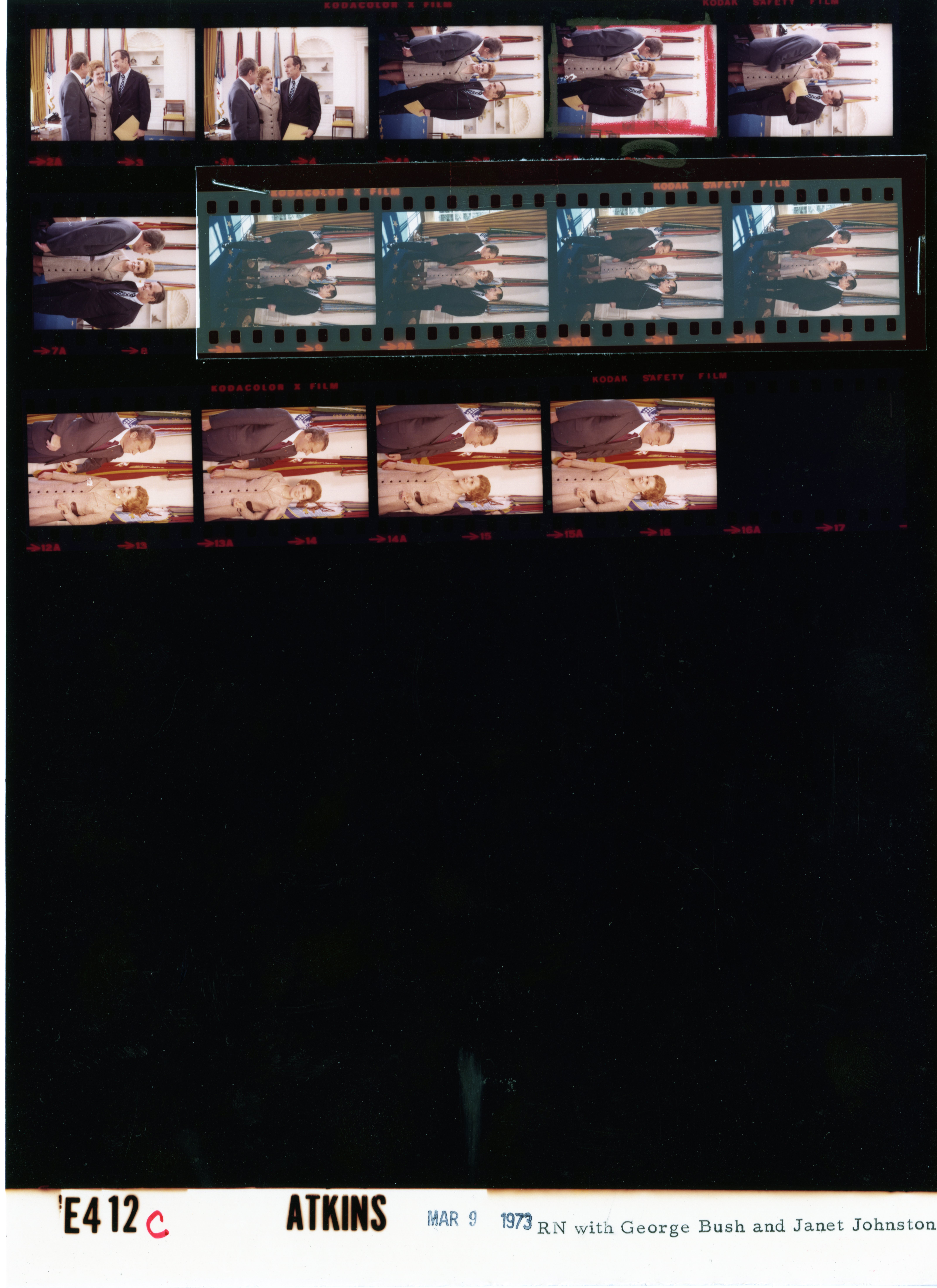
- Frame(s): WHPO-E0412-, President Nixon standing with George H. W. Bush and Janet Johnston. 3/9/1973, Washington, D.C. White House, Oval Office. President Nixon, Republican National Committee Chairman George H. W. Bush, Republican National Committee Co-Chair Janet Johnston.
Roll WHPO-E0413 Photographer: Atkins, Oliver | Color or B&W: Color
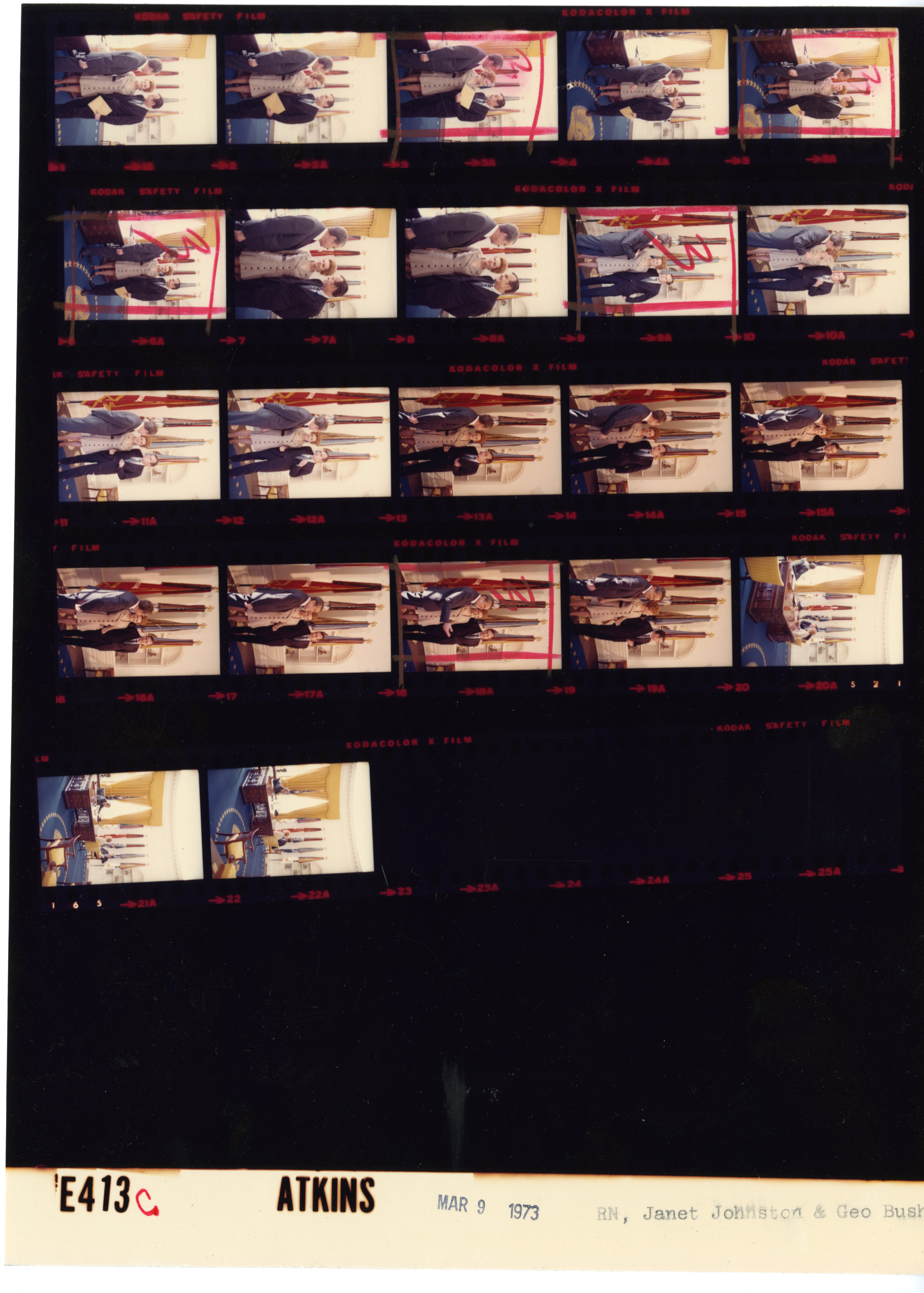
- Frame(s): WHPO-E0413-, President Nixon standing with George H. W. Bush and Janet Johnston. 3/9/1973, Washington, D.C. White House, Oval Office. President Nixon, Republican National Committee Chairman George H. W. Bush, Republican National Committee Co-Chair Janet Johnston.
Roll WHPO-E0414 Photographer: Atkins, Oliver | Color or B&W: B&W
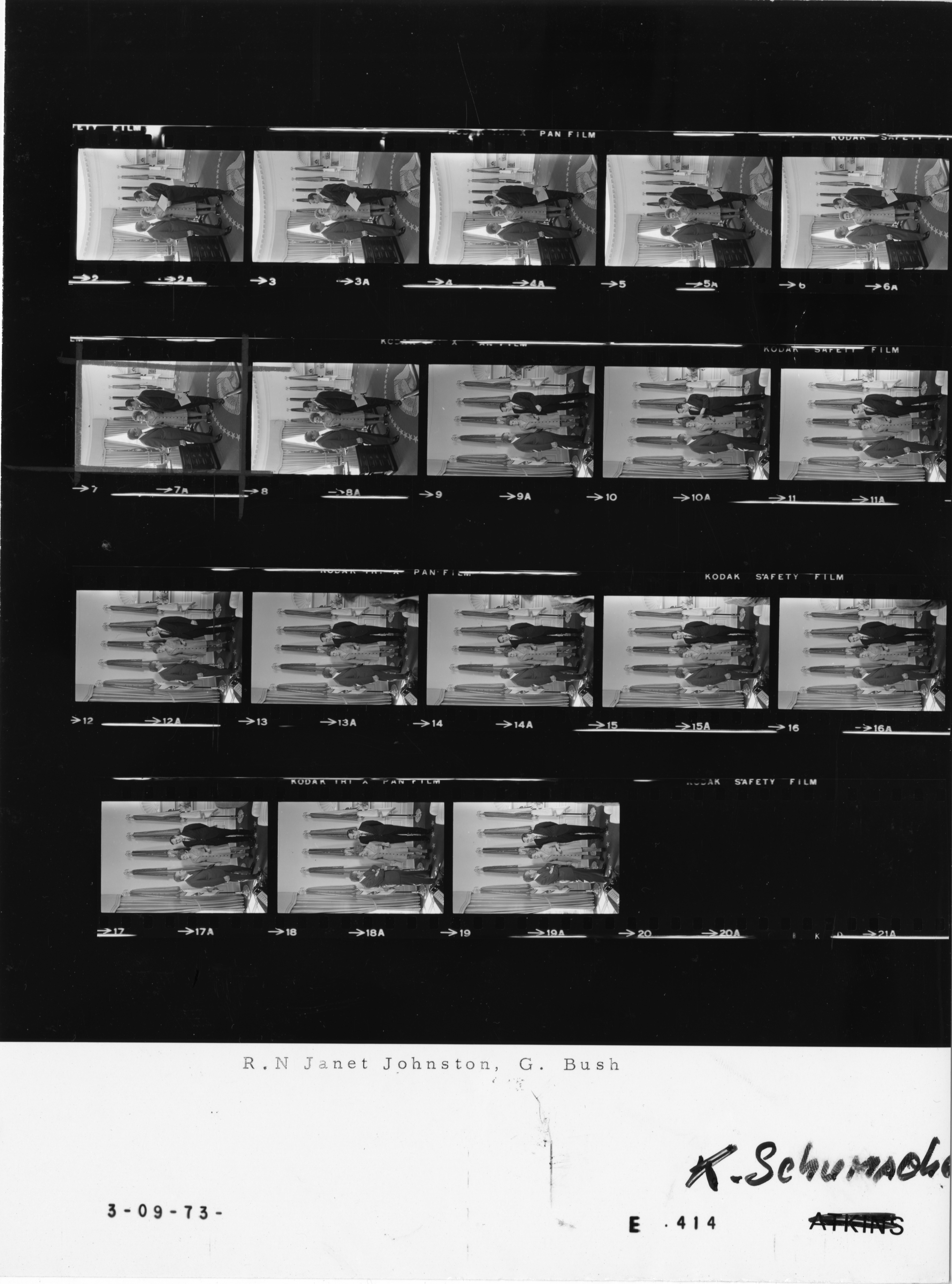
- Frame(s): WHPO-E0414-, President Nixon standing with George H. W. Bush and Janet Johnston. 3/9/1973, Washington, D.C. White House, Oval Office. President Nixon, Republican National Committee Chairman George H. W. Bush, Republican National Committee Co-Chair Janet Johnston.
Roll WHPO-E0415 Photographer: Atkins, Oliver | Color or B&W: B&W
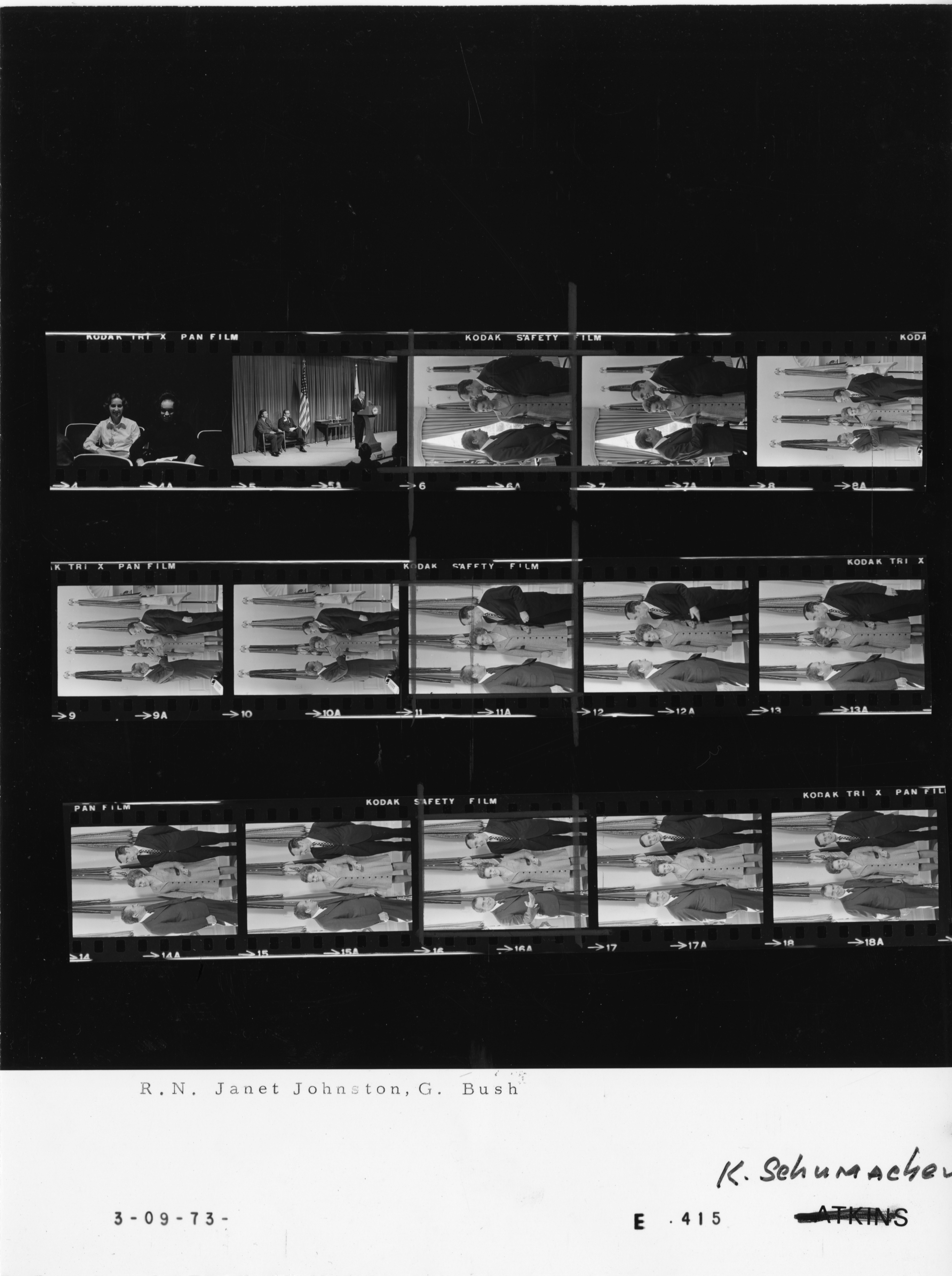
- Frame(s): WHPO-E0415-05, Vice President Agnew speaking at a podium. 3/9/1973, Washington, D.C. unknown. 5A: Spiro Agnew, two unidentified seated men.
- Frame(s): WHPO-E0415-06A-18A, President Nixon standing with Republican National Committee Chairman George H. W. Bush and Republican National Committee Co-Chair Janet Johnston. 3/9/1973, Washington, D.C. White House, Oval Office.
Roll WHPO-E0416 Photographer: Atkins, Oliver | Color or B&W: B&W
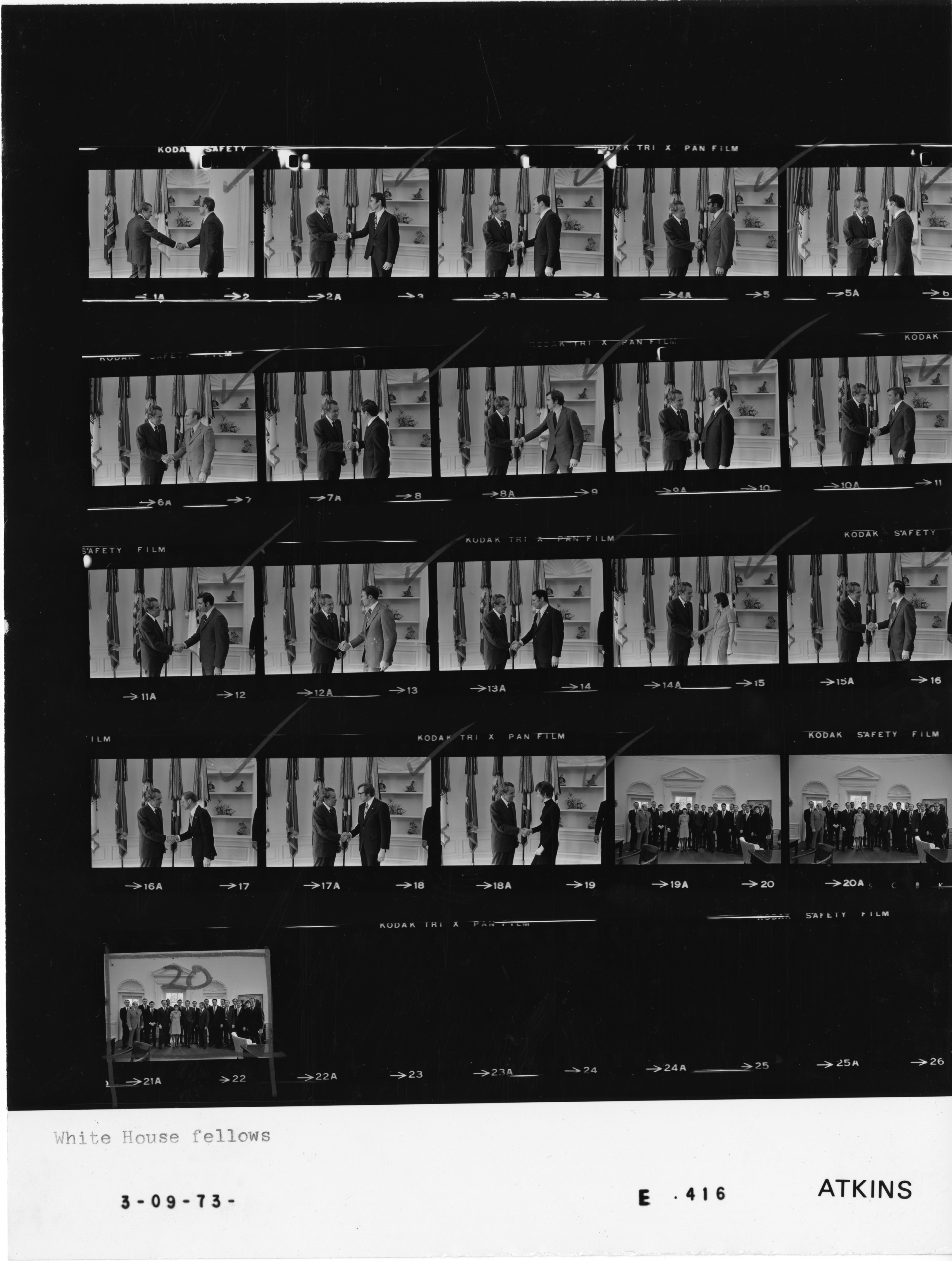
- Frame(s): WHPO-E0416-01A-18A, President Nixon shakes hands individually with unidentified White House Fellows. 3/9/1973, Washington, D.C. White House, Oval Office. President Nixon, White House Fellows.
- Frame(s): WHPO-E0416-13A, President Nixon shakes hands individually with White House Fellow Colin Powell. 3/9/1973, Washington, D.C. White House, Oval Office. President Nixon, Colin Powell, White House Fellow.
- Frame(s): WHPO-E0416-19A-21A, White House Fellows group photo. 3/9/1973, Washington, D.C. White House, Oval Office. White House Fellows.
Roll WHPO-E0417 Photographer: Kightlinger, Jack | Color or B&W: B&W
- Frame(s): WHPO-E0417-, President Nixon meeting with Ambassador John Irwin. 3/9/1973, Washington, D.C. White House, Oval Office. President Nixon, Ambassador to France John N. Irwin, II.
Roll WHPO-E0418 Photographer: Atkins, Oliver | Color or B&W: Color
- Frame(s): WHPO-E0418-, President Nixon meeting with Ambassador John Irwin. 3/9/1973, Washington, D.C. White House, Oval Office. President Nixon, Ambassador to France John N. Irwin, II.
Roll WHPO-E0419 Photographer: Kightlinger, Jack | Color or B&W: B&W
- Frame(s): WHPO-E0419-, President Nixon standing with White House Photographers Association award winners. 3/9/1973, Washington, D.C. White House interior. President Nixon, White House Photographers Association award winners.
- Frame(s): WHPO-E0419-25, President Nixon standing with White House Photographers Association award winners. 3/9/1973, Washington, D.C. White House interior.
Roll WHPO-E0420 Photographer: Schumacher, Karl | Color or B&W: B&W
- Frame(s): WHPO-E0420-, John Ehrlichman in conversation. 3/9/1973, Washington, D.C. White House interior. President Nixon, unidentified male.
Roll WHPO-E0421 Photographer: Atkins, Oliver | Color or B&W: B&W
- Frame(s): WHPO-E0421-, President Nixon standing with White House Photographers Association award winners. 3/9/1973, Washington, D.C. White House interior. President Nixon, White House Photographers Association award winners.
Roll WHPO-E0422 Photographer: Atkins, Oliver | Color or B&W: B&W
- Frame(s): WHPO-E0422-02, President Nixon meeting with Federal Regulation Council. 3/9/1973, Washington, D.C. White House interior. President Nixon, unidentified council members.
- Frame(s): WHPO-E0422-06-08, President Nixon standing with White House Photographers Association award winners. 3/9/1973, Washington, D.C. White House interior. President Nixon, White House Photographers Association award winners.
Roll WHPO-E0423 Photographer: Atkins, Oliver | Color or B&W: Color
- Frame(s): WHPO-E0423-05A-25, President Nixon seated outside at the White House Rose Garden wicker chairs during a meeting with Henry Kissinger and Secretary of State William Rogers. 3/9/1973, Washington, D.C. White House, Rose Garden. President Nixon, Henry Kissinger, William P. Rogers, unidentified men.
- Frame(s): WHPO-E0423-17A, President Nixon seated outside at the White House Rose Garden wicker chairs during a meeting with Henry Kissinger and Secretary of State William Rogers. 3/9/1973, Washington, D.C. White House, Rose Garden. President Nixon, Henry Kissinger, William P. Rogers.
- Frame(s): WHPO-E0423-26-34, The Rose Garden through White House window. 3/9/1973, Washington, D.C. White House interior.
Roll WHPO-E0424 Photographer: Kightlinger, Jack | Color or B&W: Color
- Frame(s): WHPO-E0424-, The Rose Garden through White House window. 3/9/1973, Washington, D.C. White House interior. none.
Roll WHPO-E0425 Photographer: Schumacher, Karl | Color or B&W: Color
- Frame(s): WHPO-E0425-03-08, A Bookcase and music stand. 3/9/1973, Washington, D.C. White House interior. none.
- Frame(s): WHPO-E0425-10-14, John Ehrlichman in conversation. 3/9/1973, Washington, D.C. White House interior. John Ehrlichman, unidentified male.
The White House Communications Agency Sound Recordings Collection contains public statements that took place between 1969 and 1974. Visit the finding aid to learn more.
K - Informal Presidential Remarks
- WHCA-SR-K-044
Photo opportunity/Ms. Janet Johnston, Co-Chairman of RNC-Oval Office. (3/9/1973)
Original Format: 1/4-inch reel-to-reel audiotape. Original source type: Original. - WHCA-SR-K-045
Photo opportunity/William Rogers and HARose Garden. (3/9/1973)
Original Format: 1/4-inch reel-to-reel audiotape. Original source type: Original.
P - Formal Presidential Remarks
- WHCA-SR-P-730314A
Remarks by President Nixon in a recording for radio broadcast on crime and drugs. (3/9/1973, Private Office, the White House)
Runtime: 0:15:19
Keywords: drugs, drug abuse, narcotics, heroin, marijuana, addicts, addiction, prevention, programs
Production credits: Audio feed supplied by WHCA; Recorded by CRB (initials of WHCA engineer)
Original Format: 1/4-inch reel-to-reel audiotape. Original source type: Original. - WHCA-SR-P-730314B
Remarks by President Nixon in a recording for radio broadcast on crime and drugs - Edited Copy. (3/9/1973, Private Office, the White House)
Runtime: 0:14:58
Keywords: drugs, drug abuse, narcotics, heroin, marijuana, addicts, addiction, prevention, programs
Production credits: Audio feed supplied by WHCA; Recorded by CRB (initials of WHCA engineer)
Original Format: 1/4-inch reel-to-reel audiotape. Original source type: Original. - WHCA-SR-P-730315
Remarks by President Nixon on crime and drugs for network film. (3/9/1973)
Runtime: 0:50
Keywords: drugs, drug abuse, narcotics, heroin, marijuana, addicts, addiction, prevention, programs
Original Format: 1/4-inch reel-to-reel audiotape. Original source type: Original.
S - White House Press Office Briefings (continuation of the L-series)
- WHCA-SR-S-016
Press briefing by Ronald Ziegler and John D. Ehrlichman. (3/9/1973, White House Press Lobby)
Runtime: 47:00:00
Keywords: Press conferences, news conferences, interviews, media, press secretary
Production credits: Audio feed supplied by WHCA; Recorded by JMC (initials of WHCA engineer)
Original Format: 1/4-inch reel-to-reel audiotape. Original source type: Original. - WHCA-SR-S-017
Press briefing by Ronald Ziegler. (3/9/1973, White House Press Lobby)
Runtime: 13:45
Keywords: Press conferences, news conferences, interviews, media, press secretary
Production credits: Audio feed supplied by WHCA; Recorded by JMC (initials of WHCA engineer)
Original Format: 1/4-inch reel-to-reel audiotape. Original source type: Original. - WHCA-SR-S-029
Press briefing by Ronald Ziegler on U.S. personnel to be released by the People's Republic of China. (3/9/1973, White House Press Lobby)
Runtime: 15:45
Keywords: Vietnam War, Vietnam Prisoner of War, releases, People's Republic of China, Press conferences, news conferences, interviews, media, press secretary
Production credits: Audio feed supplied by WHCA; Recorded by JBA (initials of WHCA engineer)
Original Format: 1/4-inch reel-to-reel audiotape. Original source type: Original.
The White House Communications Agency Videotape Collection contains “off-the-air” recordings of televised programs produced between 1968 and 1974. Visit the finding aid to learn more.
- WHCA-6178
Weekly News Summary, Tape I.
ALL NETWORKS
Runtime: 01:31:56
1. Chancellor/Hager: Unemployment; the dollar crisis; speculators. Time Code Start: 00:00. Keywords: jobs, unemployment, statistics, economy, economics, budgets, finances, recession, inflation, money, currency, monetary values, exchange rates, decreases, wages, costs, increases. Network: NBC.
2. Chancellor: Rising food prices. Time Code Start: 02:35. Keywords: food, meat, agriculture, animal products, dairy products, prices, costs, increases, shortages. Network: NBC.
3. Chancellor/Perkins: Release of POWs in China; Ho Chi Minh trail heavy with traffic; 707's for Vietnamese use. Time Code Start: 03:15. Keywords: Vietnam War, Vietnam Prisoner of War, releases, People's Republic of China, roads, traffic, aircraft. Network: NBC.
4. Chancellor/Don Oliver/Artist David Rose: Pentagon papers trial, testimony of CIA researcher Sam Adams, McGeorge Bundy, adviser for former President Kennedy (JFK) and President Johnson (LBJ). Time Code Start: 05:25. Keywords: Armed Forces, military, classified documents, secrets, Ellsberg, Russo, Watergate, courts, trials, Supreme Court, Vietnam War, Indochina War, bombings. Network: NBC.
5. Chancellor/Stern: Strong stand on drugs by administration. Time Code Start: 07:37. Keywords: pharmaceuticals, medicines, drugs, drug abuse, narcotics, heroin, marijuana, alcohol, alcoholism, addicts, addiction, prevention, programs. Network: NBC.
6. Brinkley: Moral decay in Russia [related terms: Soviet Union, USSR] and America. Time Code Start: 09:15. Keywords: Soviet Union, USSR,. Network: NBC.
7. Cronkite/Kalischer: Unemployment figures and food prices. Time Code Start: 11:44. Keywords: jobs, unemployment, statistics , food, meat, agriculture, plants, animal products, dairy products, prices, costs, increases, shortages. Network: CBS.
8. Cronkite/Rather: Ehrlichman says he wants several of the Democratic Congressional bills stopped. Time Code Start: 14:31. Keywords: advisors, counsels, attorneys, lawyers, statements, political parties, Democrats, Democratic Party. Network: CBS.
9. Cronkite/Strawser: More on nomination hearings for L. Patrick Gray. Time Code Start: 16:50. Keywords: Federal Bureau of Investigations, leaders, nominees, Senate committee hearings, testimony, testify. Network: CBS.
Context (External Sources)
The Vanderbilt Television News Archive is the world's most extensive and complete archive of television news. They have been recording, preserving and providing access to television news broadcasts of the national networks since August 5, 1968.
Wikipedia is a free encyclopedia that anyone can edit.