

Introduction
This almanac page for Thursday, March 1, 1973, pulls together various records created by the federal government and links to additional resources which can provide context about the events of the day.
Previous Date: Wednesday, February 28, 1973
Next Date: Friday, March 2, 1973
Schedule and Public Documents
The Daily Diary files represent a consolidated record of the President's activities. Visit the finding aid to learn more.
The President's day began at The White House - Washington, D. C.
The Weekly Compilation of Presidential Documents made available transcripts of the President's news conferences; messages to Congress; public speeches, remarks, and statements; and other Presidential materials released by the White House.
Digitized versions can be found at HathiTrust.
Each Public Papers of the Presidents volume contains the papers and speeches of the President of the United States that were issued by the White House Office of the Press Secretary during the time period specified by the volume. The material is presented in chronological order, and the dates shown in the headings are the dates of the documents or events. In instances when the release date differs from the date of the document itself, that fact is shown in the text note.
To ensure accuracy, remarks have been checked against audio recordings (when available) and signed documents have been checked against the original, unless otherwise noted. Editors have provided text notes and cross references for purposes of identification or clarity.
The Federal Register is the official daily publication for rules, proposed rules, and notices of federal agencies and organizations, as well as executive orders and other Presidential documents.
The Congressional Record is the official daily record of the debates and proceedings of the U.S. Congress.
Archival Holdings
Any selection of archival documents will necessarily be partial. You should use the documents and folders identified below as a starting place, but consult the linked collection finding aids and folder title lists and the collections themselves for context. Many documents to be found this way do not lend themselves to association with specific dates, but are essential to a complete understanding of the material.
Selective document listing
President's Office Files
The President's Office Files consists of materials drawn together by the Special Files Unit from several administrative subdivisions within the White House Office. It is the handwriting and sensitive papers sent to the Staff Secretary that now comprise much of the President's Office Files. Visit the finding aid to learn more.
- News Summaries, Annotated News Summaries, Box 43, March 1-7, 1973 [1 of 5] [Note: Due to the way News Summary products were compiled, you should also consult nearby days for potentially relevant materials.]
- News Summary, March 1, 1973, (Wednesday nets, wires)
President's Personal File
The President's Personal File is essentially a President's secretary's file, kept by Rose Mary Woods, personal secretary to the President, for two purposes: (1) preserving for posterity a collection of documents particularly close to the President, whether because he dictated or annotated them, or because of the importance of the correspondent or the event concerned and (2) giving appropriate attention–letters of gratitude, invitations to White House social events, and the like–to members and important friends and supporters of the Nixon administration. This generalization does not describe all the varied materials of a file group which is essentially a miscellany, but it does identify the reason for the existence of the file group's core. Visit the finding aid to learn more.
- President's Speech File
The H. R. Haldeman Diaries consists of seven handwritten diaries, 36 dictated diaries recorded as sound recordings, and two handwritten audio cassette tape subject logs. The diaries and logs reflect H. R. Haldeman’s candid personal record and reflections on events, issues, and people encountered during his service in the Nixon White House. As administrative assistant to the President and Chief of Staff, Haldeman attended and participated in public events and private meetings covering the entire scope of issues in which the Nixon White House engaged in during the years 1969-1973. Visit the finding aid to learn more.
- Transcript of diary entry (PDF)
Thursday, March 1.
The President was pretty well tied up during the day, and I spent most of the time on getting my things cleaned up. I had a call from Billy Graham, mainly about Marvin Watson. He thinks that if Connally switches to the Republicans, Watson would do the same. He's a man of equal ability, decisiveness, brains, as Connally that he could be brought into the government and is interested in the Post Office. And even though he is considered the heir to Armand Hammer at Occidental, Billy suspects that he would be open to any top position. He's smart, has guts, religion and total loyalty. The reason that he didn't come into Democrats for Nixon, was that Lyndon Johnson told him that he could run for Governor of Texas, but he’d destroy his chances if he did that, and that stopped him. He wants to be considered on Nixon's team, has deep concern regarding what's happening in the Post Office. He's extremely pro-Nixon, so Billy wanted us to consider that.
I did my Newsweek interview, and it went reasonably well. They asked nothing about the Watergate, or any of that sort of thing. They claim they're doing a straight cover story on me, so maybe it won't be as bad as we had been afraid it would. Mitchell called and said that Hal Bruno at Newsweek had talked to him, and he thinks it's going to be a favorable speech too-- piece, too. But they do keep coming back to the Barbara Walters interview and other things and try and make me out as a super-conservative type.
The POW problem was solved today, as the Communists folded and agreed to release the men within the next 48 hours, so the President hanging tight on that paid off. They’ve now gone back to the Paris conferences. The Golda Meir visit is going without any major incident apparently. The President had a long session with her this morning, and then dinner tonight. The big problem today was the Indian uprising. They have laid siege to some area, are holding hostages and all that sort of thing. The President was only mildly interested in it.
End of March 1. - Original audio recording (MP3)
The National Archives Catalog is the online portal to the records held at the National Archives, and information about those records. It is the main way of describing our holdings and also provides access to electronic records and digitized versions of our holdings.
The Catalog searches across multiple National Archives resources at once, including archival descriptions, digitized and electronic records, authority records, and web pages from Archives.gov and the Presidential Libraries. The Catalog also allows users to contribute to digitized historical records through tagging and transcription.
Nixon Library Holdings
All National Archives Units
National Security Documents
The President's Daily Brief is the primary vehicle for summarizing the day-to-day sensitive intelligence and analysis, as well as late-breaking reports, for the White House on current and future national security issues. Read "The President's Daily Brief: Delivering Intelligence to Nixon and Ford" to learn more.
The Foreign Relations of the United States series presents the official documentary historical record of major U.S. foreign policy decisions and significant diplomatic activity. Visit the State Department website for more information.
Vol. XXV, Arab-Israeli Crisis and War, 1973
Arab-Israeli Crisis and War, 1973
33. Memorandum From Harold H. Saunders of the National Security Council Staff to the President’s Assistant for National Security Affairs (Kissinger), Washington, March 1, 1973
Source: National Archives, Nixon Presidential Materials, NSC Files, Box 922, VIP Visits, Israel (Golda Meir’s Visit), 1 Mar. 1973. Secret. Sent for information.
34. Conversation Between President Nixon and his Assistant for National Security Affairs (Kissinger), Washington, March 1, 1973
Source: National Archives, Nixon Presidential Materials, White House Tapes, Conversation No. 866–4. No classification marking. According to the President’s Daily Diary, Nixon met with Kissinger in the Oval Office between 9:47 and 10:37 a.m. (Ibid., White House Central Files) The editors transcribed the portion printed here specifically for this volume.
35. Memorandum of Conversation, Washington, March 1, 1973, 11:03-12:25 a.m.
Source: National Archives, Nixon Presidential Materials, NSC Files, Box 1026, Presidential/HAK Memcons, Memcons—Presidential/HAK, January–March 1973. Secret; Nodis. The meeting took place in the Oval Office. Brackets are in the original. There is a Presidential tape recording of the meeting ibid., White House Tapes, Oval Office, Conversation No. 866–15, that covers the period 11:03 a.m.–12:39 p.m.
36. Conversation Between President Nixon and his Assistant for National Security Affairs (Kissinger), Washington, March 1, 1973
Source: National Archives, Nixon Presidential Materials, White House Tapes, Conversation No. 866–16. No classification marking. According to the President’s Daily Diary, Nixon met with Kissinger in the Oval Office between 12:44 and 1:06 p.m. (Ibid., White House Central Files) The editors transcribed the portion printed here specifically for this volume.
Vol. XXVII, Iran; Iraq, 1973-1976
Iran, January-August 1973
10. Memorandum From Acting Secretary of State Rush to President Nixon, Washington, March 1, 1973
Source: National Archives, Nixon Presidential Materials, NSC Files, Box 602, Country Files—Middle East, Iran, Vol. IV, September 1971–April 1973. Confidential.
Vol. XXXVI, Energy Crisis, 1969-1974
March 16, 1972-March 6, 1973
167. Memorandum From Acting Secretary of State Rush to President Nixon, Washington, March 1, 1973
Source: National Archives, Nixon Presidential Materials, NSC Files, Box 602, Country Files, Middle East, Iran, Vol. IV, 1 Sept 71–Apr 73. Confidential.
Vol. E-6, Documents on Africa, 1973-1976
Uganda
241. Intelligence Note RAAN–6 Prepared in the Bureau of Intelligence and Research, Washington, March 1, 1973
The intelligence note analyzed the prospects for General Amin’s political survival, the future of Uganda, and the status of Uganda’s relations within the region and with the United States.
Source: National Archives, RG 59, Central Files 1970–73, POL Uganda. Secret; No Foreign Dissem; Controlled Dissem. Drafted by Summ, cleared by Reid, and approved by Denney.
Vol. E-12, Documents on East and Southeast Asia, 1973-1976
Australia, New Zealand, ANZUS, Papua New Guinea
27. Memorandum From John Holdridge of the National Security Council Staff to the President’s Assistant for National Security Affairs (Kissinger), Washington, March 1, 1973., Washington, March 1, 1973
Holdridge informed Kissinger of Whitlam’s discussions with Suharto.
Source: National Archives, Nixon Presidential Materials, NSC Files, Box 504, Country Files, Far East, Australia, January 1972–December 31, 1973. Secret. Sent for information. Kissinger initialed the memorandum on March 20.
Vol. E-12, Documents on East and Southeast Asia, 1973-1976
Korean Peninsula
233. Memorandum From John Holdridge of the National Security Council Staff to the President’s Assistant for National Security Affairs (Kissinger), Washington, March 1, 1973., Washington, March 1, 1973
Holdridge informed Kissinger about the Department of State’s discussions with South Korea.
Source: National Archives, Nixon Presidential Materials, NSC Files, Country Files, Far East, Box 544, Korea, Volume 6, January 1973–October 1973. Secret; Sensitive. Sent for information. Kissinger initialed the memorandum on March 20.
Malaysia and Singapore
291. Memorandum From John Holdridge and Richard Kennedy of the National Security Council Staff to the President’s Assistant for National Security Affairs (Kissinger), Washington, March 1, 1973., Washington, March 1, 1973
Kissinger agreed with Holdridge’s and Kennedy’s recommendation that the U.S. Air Force continue directed procurement of air repair service in Singapore.
Source: National Archives, Nixon Presidential Materials, NSC Files, Box 559, Country Files, Far East, Singapore, 1972–. Secret. Sent for action. Tab A, the draft State/Defense cable on procurement policy, and Tab B, Kissinger’s memoranda of May 7 and June 28, 1971, are attached but not published. Kissinger initialed his approval of both recommendations on March 6.
The Kissinger telephone conversation transcripts consist of approximately 20,000 pages of transcripts of Kissinger’s telephone conversations during his tenure as Assistant to the President for National Security Affairs (1969-1974) and Secretary of State (1973-1974) during the administration of President Richard Nixon. Visit the finding aid for more information.
Digitized versions can be found in the National Archives Catalog.
Audiovisual Holdings
Visit the White House Tapes finding aid to learn about the taping system's operation and archival processing.
Old Executive Office Building
- 416-3; 1:15 p.m. - 1:25 p.m.; Nixon, Richard M. (President); Sanchez, Manolo; Bull, Stephen B.; Haldeman, H. R. ("Bob")
- 416-4; Unknown between 1:25 p.m. & 3:02 p.m.; Nixon, Richard M. (President); Sanchez, Manolo
- 416-5; Unknown between 1:25 p.m. & 3:02 p.m.; Nixon, Richard M. (President); Sanchez, Manolo
- 416-6; Unknown between 1:25 p.m. & 3:02 p.m.; Nixon, Richard M. (President)
- 416-7; 3:35 p.m. - 3:36 p.m.; Nixon, Richard M. (President); Bull, Stephen B.
- 416-8; Unknown between 3:36 p.m. & 4:00 p.m.; Nixon, Richard M. (President); Bull, Stephen B.
- 416-9; 4:00 p.m. - 4:01 p.m.; Nixon, Richard M. (President); Bull, Stephen B.
- 416-10; Unknown between 4:01 p.m. & 4:42 p.m.; Nixon, Richard M. (President); White House operator
- 416-11; 4:42 p.m. - 4:44 p.m.; Nixon, Richard M. (President); Brennan, Peter J.
- 416-12; 4:46 p.m. - 4:47 p.m.; Nixon, Richard M. (President); Bull, Stephen B.
- 416-13; Unknown between 4:47 p.m. & 4:48 p.m.; Nixon, Richard M. (President); White House operator
- 416-14; 4:48 p.m. - 4:50 p.m.; Nixon, Richard M. (President); Ziegler, Ronald L.
- 416-15; Unknown between 4:50 p.m. & 5:40 p.m.; Nixon, Richard M. (President); Haldeman, H. R. ("Bob")
- 416-16; Unknown between 4:50 p.m. & 5:40 p.m.; Nixon, Richard M. (President); Sanchez, Manolo
- 416-17; Unknown between 4:50 p.m. & 5:40 p.m.; Nixon, Richard M. (President); Sanchez, Manolo
- 416-18; 5:40 p.m. - 6:40 p.m.; Nixon, Richard M. (President); Haldeman, H. R. ("Bob"); Sanchez, Manolo; Cole, Kenneth R., Jr.; Ziegler, Ronald L.
- 416-51; Unknown between 3:02 p.m. & 3:35 p.m.; [Unknown person(s)]
Oval Office
- 866-1; Unknown between 8:42 a.m. & 9:18 a.m.; Nixon, Richard M. (President); [Unknown person(s)]
- 866-2; Unknown between 8:42 a.m. & 9:18 a.m.; Nixon, Richard M. (President); [Unknown person(s)]
- 866-3; Unknown between 9:18 a.m. & 9:46 a.m.; Nixon, Richard M. (President); Dean, John W., III; Sanchez, Manolo
- 866-4; Unknown between 9:47 a.m. & 10:44 a.m.; Nixon, Richard M. (President); Kissinger, Henry A.; Ziegler, Ronald L.; White House operator; Rabin, Yitzhak; [Unknown person(s)]; Dean, John W., III
- 866-5; Unknown between 10:44 a.m. & 10:57 a.m.; Nixon, Richard M. (President); [Unknown person(s)]
- 866-6; 10:51 a.m. - 10:51 a.m.; Nixon, Richard M. (President); White House operator
- 866-7; Unknown between 10:51 a.m. & 10:56 a.m.; Nixon, Richard M. (President); [Unknown person(s)]
- 866-8; Unknown between 10:51 a.m. & 10:56 a.m.; Nixon, Richard M. (President); [Unknown person(s)]
- 866-9; Unknown between 10:51 a.m. & 10:56 a.m.; Nixon, Richard M. (President); Bull, Stephen B.
- 866-10; Unknown between 10:51 a.m. & 10:56 a.m.; Nixon, Richard M. (President); White House operator
- 866-11; Unknown between 10:51 a.m. & 10:56 a.m.; Nixon, Richard M. (President); Sanchez, Manolo
- 866-12; Unknown between 10:52 a.m. & 10:56 a.m.; Nixon, Richard M. (President); Kleindienst, Richard G.
- 866-13; 10:57 p.m. - 10:57 p.m.; Nixon, Richard M. (President); Bull, Stephen B.
- 866-14; 10:57 a.m. - 11:00 a.m.; Nixon, Richard M. (President); White, William L.
- 866-15; Unknown between 11:00 a.m. & 12:39 p.m.; Nixon, Richard M. (President); Ziegler, Ronald L.; Kissinger, Henry A.; [Unknown person(s)]; Scowcroft, Brent G. (Gen.); Meir, Golda; Dinitz, Simcha; Rabin, Yitzhak
- 866-16; 12:41 p.m. - 1:06 p.m.; Nixon, Richard M. (President); Ziegler, Ronald L.; Kissinger, Henry A.
- 866-17; 1:06 p.m. - 1:14 p.m.; Nixon, Richard M. (President); [Unknown person(s)]; Dean, John W., III
- 866-18; Unknown between 3:02 p.m. & 3:06 p.m.; Nixon, Richard M. (President); [Unknown person(s)]
- 866-19; 3:06 p.m. - 3:30 p.m.; Nixon, Richard M. (President); Roth, Robert; Tkach, Walter R.; Wilson, Richard L.; Steele, John L.; Warren, Lucian C; terHorst, Jerald F. ("Jerry"); Ziegler, Ronald L.; Sanchez, Manolo
- 866-20; Unknown between 8:42 a.m. & 9:18 a.m.; Nixon, Richard M. (President); [Unknown person(s)]
- 866-21; Unknown between 12:39 a.m. & 12:41 a.m.; [Unknown person(s)]
- 866-22; Unknown between 1:14 p.m. & 3:06 p.m.; [Unknown person(s)]; United States Secret Service agents
- 866-23; Unknown between 3:30 p.m., 3/1 & 11:00 a.m., 2/13; [Unknown person(s)]; United States Secret Service agents
White House Telephone
- 37-13; Unknown between 10:05 a.m. & 10:36 a.m.; Kissinger, Henry A.; White House operator
- 37-14; Unknown between 10:05 a.m. & 10:36 a.m.; Kissinger, Henry A.; Rabin, Yitzhak
- 37-15; 10:51 a.m. - 10:51 a.m.; Nixon, Richard M. (President); White House operator
- 37-16; Unknown between 10:51 a.m. & 10:52 a.m.; Nixon, Richard M. (President); White House operator
- 37-17; 10:52 a.m. - 10:56 a.m.; Nixon, Richard M. (President); Kleindienst, Richard G.
- 37-18; 10:57 a.m. - 11:00 a.m.; Nixon, Richard M. (President); White, William L.
- 37-19; Unknown between 4:01 p.m. & 4:42 p.m.; Nixon, Richard M. (President); White House operator
- 37-20; 4:42 p.m. - 4:44 p.m.; Nixon, Richard M. (President); Brennan, Peter J.
- 37-21; Unknown between 4:44 p.m. & 4:46 p.m.; Nixon, Richard M. (President); White House operator
- 37-22; 4:46 p.m. - 4:47 p.m.; Nixon, Richard M. (President); Bull, Stephen B.
- 37-23; Unknown between 4:47 p.m. & 4:48 p.m.; Nixon, Richard M. (President); White House operator
- 37-24; 4:48 p.m. - 4:50 p.m.; Nixon, Richard M. (President); Ziegler, Ronald L.
- 37-25; Unknown between 6:00 p.m. & 6:20 p.m.; Haldeman, H. R. ("Bob"); Cole, Kenneth R., Jr.; Nixon, Richard M. (President); Ziegler, Ronald L.
The White House Photo Office collection consists of photographic coverage of President Richard Nixon meeting with prominent social, political, and cultural personalities; speaking engagements and news conferences of the President and various high-ranking members of the White House staff and Cabinet; Presidential domestic and foreign travel, including Presidential vacations; social events and entertainment involving the First Family, including entertainers present; official portraits of the President, First Family, and high-ranking members of the Nixon administration; the 1969 and 1973 Inaugurals; the President’s 1972 Presidential election campaign appearances (including speeches) and other official activities of the White House staff and the President’s Cabinet from January 20, 1969 until August 9, 1974 at the White House and the Old Executive Office Building; other locations in Washington, DC, such as The Mall; and the Presidential retreats in Camp David, Maryland, Key Biscayne, Florida, and San Clemente, California. Visit the finding aid to learn more.
Roll WHPO-E0354 Photographer: Atkins, Oliver | Color or B&W: B&W
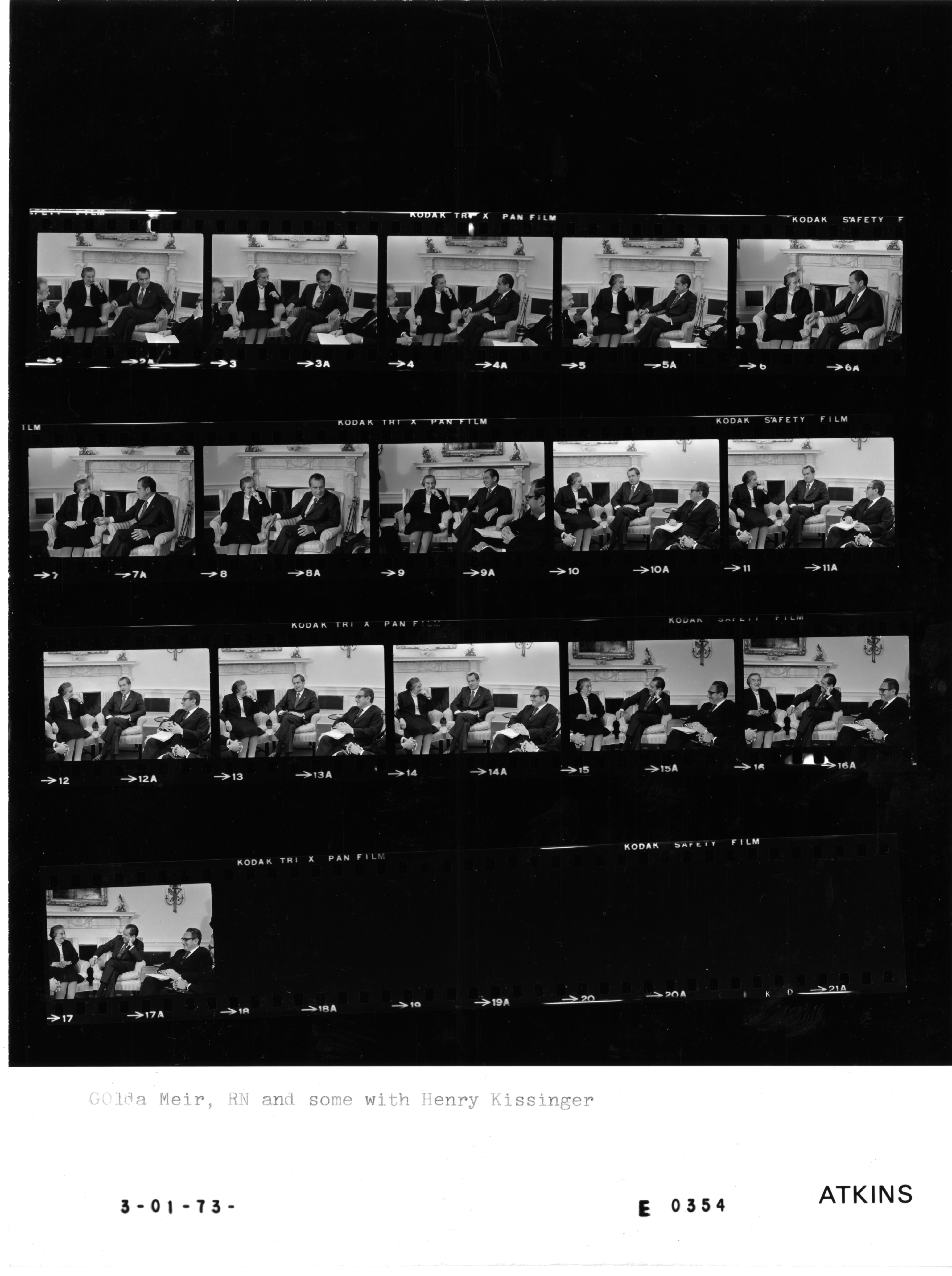
- Frame(s): WHPO-E0354-, President Nixon seated informally in the Oval Office with Israeli Prime Minister Golda Meir and Heny Kissinger. 3/1/1973, Washington, D.C. White House, Oval Office. President Nixon, Golda Meir, Kissinger, Yitzhak Rabin, Simeha Dinitz.
- Frame(s): WHPO-E0354-15A, President Nixon seated informally in the Oval Office with Israeli Prime Minister Golda Meir, Heny Kissinger, and, present but not in frame, Yitzhak Rabin and Simeha Dinitz. 3/1/1973, Washington, D.C. White House, Oval Office. President Nixon, Golda Meir, Henry Kissinger.
Roll WHPO-E0355 Photographer: Schumacher, Karl | Color or B&W: B&W

- Frame(s): WHPO-E0355-, President Nixon seated informally in the Oval Office during a meeting with Israeli Prime Minister Golda Meir, Ambassador Yitzhak Rabin, Simcha Dinitz, Brent Scowcroft and Henry Kissinger. 3/1/1973, Washington, D.C. White House, Oval Office. President Nixon, Golda Meir, Henry Kissinger, Yitzhak Rabin, Simcha Dinitz, Brent Scowcroft, press corps members.
Roll WHPO-E0356 Photographer: Atkins, Oliver | Color or B&W: B&W

- Frame(s): WHPO-E0356-, President Nixon walking Israeli Prime Minister Golda Meir to her waiting limousine. 3/1/1973, Washington, D.C. White House, South Grounds. President Nixon, Golda Meir, Yitzhak Rabin, Simcha Dinitz, aides.
- Frame(s): WHPO-E0356-06A, President Nixon walking Israeli Prime Minister Golda Meir to her waiting limousine. 3/1/1973, Washington, D.C. White House, South Grounds. President Nixon, Golda Meir, aides.
Roll WHPO-E0357 Photographer: Atkins, Oliver | Color or B&W: B&W
- Frame(s): WHPO-E0357-, President Nixon shaking hands with the six officers of the Gridiron Club. 3/1/1973, Washington, D.C. White House, Oval Office. President Nixon, Robert Roth, Walter Ridder, Richard Wilson, John Steele, Lucian Warren, Jerald terHorst.
Roll WHPO-E0358 Photographer: Knudsen, Robert L. | Color or B&W: Color
- Frame(s): WHPO-E0358-, President Nixon and Pat Nixon greet Prime Minister Golda Meir of Israel at the White House North Portico before a state dinner. 3/1/1973, Washington, D.C. North Portico Entrance, White House. President Nixon, Pat Nixon, Golda Meir, Van Cliburn, military aides.
- Frame(s): WHPO-E0358-, President Nixon and Pat Nixon pose for formal portraits with Israeli Prime Minister Golda Meir, before the White House state dinner. 3/1/1973, Washington, D.C. Grand Staircase, White House. President Nixon, Pat Nixon, Golda Meir.
- Frame(s): WHPO-E0358-21A, President Nixon, Pat Nixon, and Israeli Prime Minister Golda Meir walk the Grand Hall red carpet to attend a White House state dinner. 3/1/1973, Washington, D.C. Grand Hall, White House. President Nixon, Pat Nixon, Golda Meir.
- Frame(s): WHPO-E0358-30A, President Nixon, Pat Nixon, and Prime Minister Golda Meir of Israel speak with pianist Van Cliburn after his East Room performance during the evening of a state dinner. 3/1/1973, Washington, D.C. White House, East Room. President Nixon, Pat Nixon, Golda Meir, Van Cliburn.
Roll WHPO-E0359 Photographer: Parish | Color or B&W: B&W
- Frame(s): WHPO-E0359-, Allan Kaupinen portraits. 3/1/1973, Washington, D.C. unknown. Allan Kaupinen.
Roll WHPO-E0360 Photographer: Parish | Color or B&W: Color
- Frame(s): WHPO-E0360-, Allan Kaupinen portraits. 3/1/1973, Washington, D.C. unknown. Allan Kaupinen.
Roll WHPO-E0361 Photographer: Parish | Color or B&W: Color
- Frame(s): WHPO-E0361-02-35, Allan Kaupinen. Misc. 3/1/1973, Washington, D.C. unknown. Allan Kaupinen, unidentified woman.
- Frame(s): WHPO-E0361-36, Unidentified woman. 3/1/1973, Washington, D.C. unknown. Allan Kaupinen, unidentified woman.
The White House Communications Agency Sound Recordings Collection contains public statements that took place between 1969 and 1974. Visit the finding aid to learn more.
P - Formal Presidential Remarks
- WHCA-SR-P-730301
Remarks by President Nixon at a photo opportunity with Prime Minister Golda Meir of Israel. (3/1/1973, Oval Office, White House)
Runtime: 0:04:01
Production credits: Audio feed supplied by "WHCA only"; Recorded by SB (engineer initials listed
Original Format: 1/4-inch reel-to-reel audiotape. Original source type: Original. - WHCA-SR-P-730302
Exchange of toasts by President Nixon and Prime Minister Golda Meir of Israel. (3/1/1973, State Dining Room, White House)
Runtime: 3:40
Production credits: Audio feed supplied by WHCA; Recorded by JBA (initials of WHCA engineer)
Original Format: 1/4-inch reel-to-reel audiotape. Original source type: Original. - WHCA-SR-P-730303
Remarks by President Nixon at entertainment for Prime Minister Golda Meir of Israel (3 minutes) and a performance by Van Cliburn (52 minutes). (3/1/1973)
Runtime: 55:00:00
Keywords: Musician, musicians, music, celebrities, performance, American popular music
Original Format: 1/4-inch reel-to-reel audiotape. Original source type: Original.
S - White House Press Office Briefings (continuation of the L-series)
- WHCA-SR-S-001
Press briefing by Caspar Weinberger. (3/1/1973, White House Press Lobby)
Runtime: 40:00:00
Keywords: Press conferences, news conferences, interviews, media
Production credits: Audio feed supplied by WHCA; Recorded by DB (initials of WHCA engineer)
Original Format: 1/4-inch reel-to-reel audiotape. Original source type: Original. - WHCA-SR-S-002
Press briefing by Ronald Ziegler. (3/1/1973, White House Press Lobby)
Runtime: 24:00:00
Keywords: Press conferences, news conferences, interviews, media, press secretary
Production credits: Audio feed supplied by WHCA; Recorded by DB (initials of WHCA engineer)
Original Format: 1/4-inch reel-to-reel audiotape. Original source type: Original.
The White House Communications Agency Videotape Collection contains “off-the-air” recordings of televised programs produced between 1968 and 1974. Visit the finding aid to learn more.
- WHCA-6150
"Panorama".
ABC
Runtime: 00:20:29 - WHCA-6153
Weekly News Summary, Tape III.
ALL NETWORKS
Runtime: 00:53:00
1. Reasoner/Tomlinson: Black September group in Khartoum, Sudan takes diplomats as hostages; Israel's Prime Minister Golda Meir in Washington, D.C.. Time Code Start: 00:00. Keywords: Ambassadors, embassies, North Africa, Sudanese, militants, bombings, violence, sabotage, shootings, kidnappings, terrorism, hostages, Middle East, Mideast, Israeli, Prime Ministers, leaders, meetings. Network: ABC.
2. Reasoner/Koppel: Secretary of State Rogers at Paris conference on Vietnam; POW release this weekend. Time Code Start: 03:35. Keywords: cabinet, advisors, Paris Peace Talks, Vietnam War, Vietnam Prisoner of War, releases, treaty, treaties, negotiations. Network: ABC.
3. Reasoner: Commander Alvarez says anti-war demonstrations prolonged this war. Time Code Start: 06:35. Keywords: demonstrations, rally, protests, protesters, demonstraters, demonstrators, Vietnam War, anti-war. Network: ABC.
4. Smith: President Nixon sends statement to Congress on Human Resources. Time Code Start: 07:04. Keywords: Presidents, House of Representatives, statements, messages. Network: ABC.
5. Zimmerman: Governors Conference discusses Revenue Sharing. Time Code Start: 07:25. Keywords: Governors, conferences, meetings, State and Local Fiscal Assistance Act of 1972, financial aid, debates. Network: ABC.
6. Reasoner/Clark: Senate hearings on L. Patrick Gray. Time Code Start: 09:31. Keywords: Federal Bureau of Investigations, leaders, nominees, Senate committee hearings, testimony, testify. Network: ABC.
7. Chancellor/Dobyns: POW release Saturday; IPC in Paris with Secretary of State Rogers; Canadians unhappy. Time Code Start: 11:19. Keywords: cabinet, advisors, Paris Peace Talks, Vietnam War, Vietnam Prisoner of War, releases, treaty, treaties, negotiations. Network: NBC.
8. Chancellor/xx: Sudan's Black September group kidnaps diplomats American Ambassador Cleo J. Noel, Jr, and assistant, holding them hostages; Israel's Prime Minister Golda Meir visits with President Nixon. Time Code Start: 15:10. Keywords: Ambassadors, embassies, North Africa, Sudanese, militants, bombings, violence, sabotage, shootings, kidnappings, terrorism, hostages, Presidents, Middle East, Mideast, Israeli, Prime Ministers, leaders, meetings. Network: NBC.
9. Chancellor/Briggs: Indians take over Wounded Knee, South Dakota; Wounded Knee trading post owned by Mr. and Mrs. Gildersleeve left in shambles by Indians; AIM leader Russell MEANS says Indians original landowners. Time Code Start: 16:30. Keywords: American Indians, Native Americans, tribes, American Indian Movement, occupations. Network: NBC.
10. Chancellor/Valeriani: President Nixon's fourth State of the Union address message on social reforms with Secretary of Health, Education and Welfare (HEW) Caspar Weinberger. Time Code Start: 20:39. Keywords: Presidents, speeches, cabinet, advisors, Congress, House of Representatives, Senate, Senators. Network: NBC.
11. Chancellor/Mackin: Governor's conference ends, most are unhappy. Time Code Start: 22:43. Keywords: Governors, conferences, meetings. Network: NBC.
12. Chancellor/Brinkley: Senator Hartke does not want to be searched. Time Code Start: 24:51. Keywords: Senators, anti-war, Vietnam War. Network: NBC.
13. Cronkite: Terrorists hold American Ambassador Cleo J. Noel, Jr, and assistant in Sudan; Israel's Prime Minister Golda Meir visits with President Nixon. Time Code Start: 26:54. Keywords: Ambassadors, embassies, North Africa, Sudanese, militants, bombings, violence, sabotage, shootings, kidnappings, terrorism, hostages, Middle East, Mideast, Israeli, Prime Ministers, leaders, meetings. Network: CBS.
14. Cronkite/Kalb: POWs to be released; IPC in Paris with Secretary of State Rogers. Time Code Start: 28:31. Keywords: cabinet, advisors, Paris Peace Talks, Vietnam War, Vietnam Prisoner of War, releases, treaty, treaties, negotiations. Network: CBS.
15. Cronkite: Lieutenant Colonel Alvarez thinks anti-war demonstrations prolonged the war. Time Code Start: 30:45. Keywords: demonstrations, rally, protests, protesters, demonstraters, demonstrators, Vietnam War, anti-war. Network: CBS.
16. Cronkite: President Nixon's fourth State of the Union address message, on social reform. Time Code Start: 31:56. Keywords: Presidents, speeches, Congress, House of Representatives, Senate, Senators. Network: CBS.
17. Cronkite/Kilpatrick: Reorganization of Office of Economic Opportunity (OEO). Time Code Start: 32:55. Keywords: Office of Economic Opportunity, war on poverty, VISTA, Job Corps, Community Action Program, Head Start , welfare, closings. Network: CBS.
18. Sevareid: On the confirmation hearings of L. Patrick Gray. Time Code Start: 35:15. Keywords: Federal Bureau of Investigations, leaders, nominees, Senate committee hearings, testimony, testify. Network: CBS.
19. Cronkite: Sons of returning POW Navy Commander Robert Schweitzer barely remember their father. Time Code Start: 37:58. Keywords: Vietnam War, Vietnam Prisoner of War, releases, families, children. Network: CBS.
Context (External Sources)
The Vanderbilt Television News Archive is the world's most extensive and complete archive of television news. They have been recording, preserving and providing access to television news broadcasts of the national networks since August 5, 1968.
Wikipedia is a free encyclopedia that anyone can edit.