
Introduction
This almanac page for Friday, July 21, 1972, pulls together various records created by the federal government and links to additional resources which can provide context about the events of the day.
Previous Date: Thursday, July 20, 1972
Next Date: Saturday, July 22, 1972
Schedule and Public Documents
The Daily Diary files represent a consolidated record of the President's activities. Visit the finding aid to learn more.
The President's day began at The White House - Washington, D. C.
The Weekly Compilation of Presidential Documents made available transcripts of the President's news conferences; messages to Congress; public speeches, remarks, and statements; and other Presidential materials released by the White House.
Digitized versions can be found at HathiTrust.
The Federal Register is the official daily publication for rules, proposed rules, and notices of federal agencies and organizations, as well as executive orders and other Presidential documents.
The Congressional Record is the official daily record of the debates and proceedings of the U.S. Congress.
Archival Holdings
Any selection of archival documents will necessarily be partial. You should use the documents and folders identified below as a starting place, but consult the linked collection finding aids and folder title lists and the collections themselves for context. Many documents to be found this way do not lend themselves to association with specific dates, but are essential to a complete understanding of the material.
Selective document listing
President's Office Files
The President's Office Files consists of materials drawn together by the Special Files Unit from several administrative subdivisions within the White House Office. It is the handwriting and sensitive papers sent to the Staff Secretary that now comprise much of the President's Office Files. Visit the finding aid to learn more.
- News Summaries, Annotated News Summaries, Box 36, July 1-24, 1972 [3 of 4] [Note: Due to the way News Summary products were compiled, you should also consult nearby days for potentially relevant materials.]
- News Summary, July 21, 1972, (Thurs. nets, wires, columns)
- President's Daily Schedule, Box 102, [President's Daily Schedule, Apr.-July 1972] [3 of 3]
- The President's Schedule, Friday - July 21, 1972
The H. R. Haldeman Diaries consists of seven handwritten diaries, 36 dictated diaries recorded as sound recordings, and two handwritten audio cassette tape subject logs. The diaries and logs reflect H. R. Haldeman’s candid personal record and reflections on events, issues, and people encountered during his service in the Nixon White House. As administrative assistant to the President and Chief of Staff, Haldeman attended and participated in public events and private meetings covering the entire scope of issues in which the Nixon White House engaged in during the years 1969-1973. Visit the finding aid to learn more.
- Transcript of diary entry (PDF)
Friday, July 21st. We had a Joint Leaders—that's Republican leaders—breakfast with the Cabinet this morning. The President opened pointing out the Congressional strategy from here on out will all be political, but we won't take bad bills in order to get the good stuff; that our purpose is tactical. McGovern reviewed the campaign, made a point of the great understanding of the President and foreign policy, but the need to educate on his other accomplishments. His achievements and diplomacy are because we've been strong; that McGovern had destroyed his capability. The pitch that everybody here is a surrogate, this will be the most intensive Presidential campaign in history; more involvement with Cabinet, Senators, wives, and so forth to spread the story. The President made the point that we must never say Republicans and Democrats. We should never blame the Democrats or beat on the Democrats; always use the term McGovernites.
Timmons reported on the four weeks until the convention: an adjournment until October 1st, on October 1st or 15th, after the convention, four to six weeks meeting. That the Senate Foreign Aid will pass on Monday; our main task is defeating unwise legislation on the budget busting matters, and that we've got six to eight veto candidates in the process now.
Ehrlichman talked about the political implications on domestic issues; that we have a unique situation in that the opposition has its own proposals instead of taking us on on our proposals. So we are able to take the fight to the McGovern proposals, which are the best strategy, to tie McGovern's original proposals to him. Let him deny and argue, not us. McGovern is pitting the haves versus the have-nots. Our campaign is the antithesis of this polarizing. The opposition is trying to build divisiveness; we can turn this around. The battleground is not Congress, it's the Senate, because both candidates are there, we can force them to take positions, for example on busing. Our strategy next week will be to issue an ominous statement on the general question of overspending without reference to specific issues. There's a daily battle of communication to make the point that the vetoes are not against children, clean water, and so forth, but rather against taxes and high prices. We have to fight hard to break even at best on this. The President made the point that we have a President in the White House ahead in the polls, which is different than Truman, so there's a question of how we handle the opposition control of Congress. They'll try to say that the President has blocked Congress.
Hugh Scott made the point that their platform is that if you've got it, we'll spend it. The answer to the veto is not that we're doing less, but that we've already done more and done it effectively and done the maximum that the taxpayers can carry. We have more than met our legislative and executive responsibilities. We can't let McGovern off the hook we've got to keep talking about his original proposals. We can only assume that the revisions will be worse than the first attempts. The youth vote for McGovern is greatly overestimated. We should make the point of the unrepresentative convention: the quota systems are not democracy. There’s no quota for senior citizens, veterans, farmers, the under-represented Italian Americans, Germans, and so forth. That basically it was a fraud regarding true reform. We should hold their feet to the fire, talk about why they don't adopt the platform.
In Congress they have nothing in it that they can enact into law. McGovern is the only Democrat nominee ever born without labor. Ford said we have a potential worth exploring regarding getting Democrats first, to endorse the President, and second, to vote for a Republican speaker. He's working on Operation Switch Over, but this complicates the problem, because we can't clobber Democrats who might switch. The President referred to the '64 Congressional results; Republican Congressmen avoided Goldwater in the campaign; the Democrats got their candidates to tie their Congressional candidates to Goldwater. We should do this in the areas where McGovern's behind. Force the Democrat to back or repudiate McGovern's candidacy. They won't work unless there’s a concerted program to do this though. It's important to make this a campaign on the issues, not on personalities. We should tie to the McGovernite wing of the Democratic Party. McGovern represents a minority of his own Party, so don't say the Democrats. There's defection all over the country regarding the issues, but we make it impossible, if we put in on a Party basis. It was easy for LBJ to keep Goldwater in a corner in '64, because he had allies in the media. The press never let Goldwater off his extreme positions, but they'll do all they can to let McGovern off. We should always campaign against what the man said originally, not mean, not vicious. You do know where McGovern stands; that's what he said and that's what he meant. He sincerely believes in whatever it is. This is the clearest choice the American people have had in this century. There's no question where the President and McGovern stand on Defense, on permissiveness, on welfare.
Don't get into cute, tricky, name calling. Give the Rizzos, and so on, an easy way to move to us; no name calling, campaign on the issues, on McGovern's original position, and let him repudiate.
Dole made the point that we should isolate McGovern from the Party regulars. Enthusiastic and optimistic but not over confident; take McGovern on head on the issues; gear the campaign to the average American. The Democrats are the elite. Stay positive. Regarding the convention, we're doing serious business; we have work to do. It will be interesting, and it will be high level.
The President said that the Secretary of State and Defense are usually not in campaigns, but they can get in strong licks on foreign policy and defense; it's their duty to respond to the attacks that are made. The cardinal rule in politics is to make the other fellow play your game, not his, play your issues, not his. Their goal will be the poor versus the rich, class divisions, economic issues; we should not let that be paramount. For example, some of our staff says we don't need to emphasize foreign policy because everybody knows about it, but there are some domestic issues where we win, like busing, law, court and so forth, but others where they do, especially spending. We should not assume the people know about our foreign policy accomplishments; that's where he's weak and we're strong. Our strongest point is defense and foreign policy and we should hit it in every speech.
Rogers said people are interested in two points of foreign policy. One, they want a strong America; we should emphasize this. Two, they want to be respected in the world. We should say two things: first, our prestige in the world has never been higher, both with our friends and our adversaries; second, President Nixon is the world leader in the cause of peace, also, both with our friends and our enemies.
-------------------------------------------------------------------------------------------------------------------
DECLASSIFIED - E.O. 13526, Sect. 3.4: by MS, NARA, June 12, 2013
Audio Cassette 23, Side A, Withdrawn Item Number 8 [AC-23(A) Sel 5]
Duration: 10 seconds
Then he quoted Brezhnev, Ceausescu, and Tito as all hoping Nixon would be elected.
------------------------------------------------------------------------------------------------------------------
We have the strongest case in terms of tactics. McGovern applauds all that we've done, but opposes all that made it possible; he can't have it both ways. He can't say come home America and then applaud all we're doing in the world. The President said we don't want Laird and Rogers to do partisan audiences, but they will do good nonpartisan things, especially with television.
Laird said this is not the time to turn back to isolationism. He then listed his speeches and the things he's going to do on defense bases to show what McGovern's cutbacks will mean and so forth. The President said a weak United States isn't worth talking to regarding negotiations. McGovern's cuts would give the Soviet Union an insurmountable advantage. We’ve got to put
the Defense cut issue clearly: jobs and US position in the world to maintain peace. In the campaign there is no complacency or overconfidence, because we know the numbers are against us. Our hope is to win decisively and to win the Congress. It depends on getting out the Republican vote, picking up the Independents, and getting a third of the Democrats. So we've got to hit those issues that appeal to the Democrat or the Independent; make the election more important than Party.
Following that, there was a Cabinet meeting. The President made the point that we have a serious budget problem. Shultz says all our economic strategy is now finally coming together; it shows the importance of holding our budget strategy; one of the best days in the history of economics. The President said speeches are not important; the main thing is to get on television; noon and morning speeches are better than evening, a night speech is a dead loser. In terms of events you can accept, don't take any state for granted and don't concede any, but concentrate on the big key states. The votes are at the nonpartisan meetings; take all possible ethnic, labor, and religious forums.
After the Cabinet meeting, we had a meeting with Dole and MacGregor. The President told Dole he wanted him to stay on as National Chairman, and they discussed some minor strategy ideas.
This afternoon the President, Mitchell, and I met with the Vice President and the President hit him hard on the way he wants him to handle his campaign emphasizing: no attacks on the press; to attack McGovern only on the issues, not personally; to ignore Eagleton; not let himself become the issue; stay noncontroversial; no discussion or comment on '76; concentrate on ethnics and labor; build closer ties personally to Senators and Congressmen; sell the positive story of the President, especially in foreign policy; avoid public appearance of aloofness, break away from the Secret Service; do some partisan events, because the President can't; don’t concern yourself with platform issues; consult with Mitchell, Haldeman, MacGregor on strategy.
He decided to make the announcement tomorrow from the White House with the VP having a press conference afterwards, before he leaves for Oregon. The VP, incredibly, raised the point that he was going to hit the press again in Oregon. Mitchell and the President told him he must not do that, and so hopefully he's changing his speech.
We went to Camp David this afternoon; had dinner with Connally and Colson. I dictated a separate memo on Connally's views on campaign strategy as he covered it during the evening. Most of the evening was a general discussion of specifics on pulling together the Democrats for Nixon, running down Colson's reports, and so forth. The President called Colson and me back in after the dinner for some general chitchat for about an hour before we went to bed.
End of July 21st. - Original audio recording (MP3)
The National Archives Catalog is the online portal to the records held at the National Archives, and information about those records. It is the main way of describing our holdings and also provides access to electronic records and digitized versions of our holdings.
The Catalog searches across multiple National Archives resources at once, including archival descriptions, digitized and electronic records, authority records, and web pages from Archives.gov and the Presidential Libraries. The Catalog also allows users to contribute to digitized historical records through tagging and transcription.
Nixon Library Holdings
All National Archives Units
National Security Documents
The President's Daily Brief is the primary vehicle for summarizing the day-to-day sensitive intelligence and analysis, as well as late-breaking reports, for the White House on current and future national security issues. Read "The President's Daily Brief: Delivering Intelligence to Nixon and Ford" to learn more.
The Foreign Relations of the United States series presents the official documentary historical record of major U.S. foreign policy decisions and significant diplomatic activity. Visit the State Department website for more information.
Vol. IV, Foreign Assistance, International Development, Trade Policies, 1969-1972
Foreign Assistance Policy, 1969-1972
92. Letter From the Director of the Office of Management and Budget (Weinberger) to Secretary of State Rogers, Washington, July 21, 1972
Source: National Archives, Nixon Presidential Materials, NSC Files, Subject Files, Box 324, Foreign Aid, Volume II 1972. No classification marking. Attached to an August 14 memorandum from Kissinger to the President agreeing with Laird’s position that the FY 1974 security assistance ceilings were too low. See footnote 1, Document 95.
Vol. XV, Soviet Union, June 1972-August 1974
Post-Moscow Summit Discussions and Issues, June-August 1972
17. Memorandum of Conversation, Washington, July 21, 1972, 12:40-1:10 p.m.
Source: National Archives, Nixon Presidential Materials, NSC Files, Box 494, President’s Trip Files, Dobrynin/Kissinger, Vol. 13. Top Secret; Sensitive; Exclusively Eyes Only. The meeting was held in the White House Map Room.
Vol. XXXIV, National Security Policy, 1969-1972
Taking Stock
219. Minutes of Defense Program Review Committee Meeting, Washington, July 21, 1972, 3:10-4:06 p.m.
Source: National Archives, Nixon Presidential Materials, NSC Files, NSC Institutional Files (H-Files), Box H–118, DPRC Minutes, Originals, 1969–73 [2 of 3]. Top Secret. The meeting was held in the Situation Room of the White House. All brackets except those that indicate omitted material are in the original.
Vol. XXXVI, Energy Crisis, 1969-1974
March 16, 1972-March 6, 1973
130. Airgram From the Department of State to the Embassies in All OECD Capitals, Washington, July 21, 1972, 9:10 a.m.
Source: National Archives, RG 59, Central Files 1970–73, PET 3 OECD. Confidential. Drafted by R. Ebel on July 12 and approved by Akins.
Vol. E-10, Documents on American Republics, 1969-1972
Guatemala
363. Telegram 3250 From the Embassy in Guatemala to the Department of State, July 21, 1972, 1730Z., July 21, 1972, 1730Z
The Embassy provided a mid-year assessment of the situation in Guatemala, noting that the Government would likely not re-impose a state of siege and that political violence levels were considerably reduced when compared with 1971.
Source: National Archives, RG 59, Central Files 1970–73, POL 15 GUAT. Secret. It was repeated to Managua, Panama, San José, San Salvador, Tegucigalpa, and CINCSO for POLAD.
The Kissinger telephone conversation transcripts consist of approximately 20,000 pages of transcripts of Kissinger’s telephone conversations during his tenure as Assistant to the President for National Security Affairs (1969-1974) and Secretary of State (1973-1974) during the administration of President Richard Nixon. Visit the finding aid for more information.
Digitized versions can be found in the National Archives Catalog.
Audiovisual Holdings
Visit the White House Tapes finding aid to learn about the taping system's operation and archival processing.
Cabinet Room
Camp David Hard Wire
- 197-1; Unknown between 5:36 p.m. & 6:05 p.m.; [Unknown person(s)]
- 197-2; Unknown between 5:36 p.m. & 6:05 p.m.; [Unknown person(s)]
- 197-3; Unknown between 5:36 p.m. & 6:05 p.m.; Nixon, Richard M. (President); Sanchez, Manolo
- 197-4; Unknown between 5:36 p.m. & 6:05 p.m.; Sanchez, Manolo; [Unknown person(s)]
- 197-5; Unknown between 5:36 p.m. & 6:05 p.m.; [Unknown person(s)]
Oval Office
- 749-1; 10:11 a.m. - 10:16 a.m.; Nixon, Richard M. (President); Butterfield, Alexander P.; Haldeman, H. R. ("Bob")
- 749-2; 10:45 a.m. - 11:39 a.m.; Nixon, Richard M. (President); Haldeman, H. R. ("Bob"); MacGregor, Clark; Dole, Robert J.
- 749-3; Unknown between 11:39 p.m. & 11:43 p.m.; Nixon, Richard M. (President); Sanchez, Manolo
- 749-4; Unknown between 11:39 p.m. & 11:43 p.m.; Nixon, Richard M. (President); Bull, Stephen B.
- 749-5; 11:43 a.m. - 1:02 p.m.; Nixon, Richard M. (President); Shultz, George P.; Haldeman, H. R. ("Bob"); [Unknown person(s)]; White House operator; Bull, Stephen B.
- 749-6; Unknown between 1:02 p.m. & 1:30 p.m.; Butterfield, Alexander P.; [Unknown person(s)]
- 750-1; 2:04 p.m. - 3:11 p.m.; Nixon, Richard M. (President); Haldeman, H. R. ("Bob"); Agnew, Spiro T. (Vice President); Mitchell, John N.; Bull, Stephen B.
- 750-2; Unknown between 3:11 p.m. & 3:12 p.m.; Sanchez, Manolo; [Unknown person(s)]
- 750-3; 3:11 p.m. - 3:12 p.m.; Nixon, Richard M. (President); Butterfield, Alexander P.
- 750-4; 3:35 p.m. - 3:43 p.m.; Nixon, Richard M. (President); Woods, Rose Mary
- 750-5; Unknown between 3:43 p.m. & 3:49 p.m.; Nixon, Richard M. (President); Butterfield, Alexander P.
- 750-6; 3:49 p.m. - 3:50 p.m.; Nixon, Richard M. (President); Woods, Rose Mary
- 750-7; Unknown between 3:50 p.m. & 4:07 p.m.; Nixon, Richard M. (President); White House operator
- 750-8; 4:07 p.m. - 4:09 p.m.; Nixon, Richard M. (President); Eisenhower, Julie Nixon
- 750-9; Unknown between 4:09 p.m. & 4:10 p.m.; Nixon, Richard M. (President); White House operator
- 750-10; 4:10 p.m. - 4:13 p.m.; Nixon, Richard M. (President); Cox, Tricia Nixon
- 750-11; Unknown between 4:13 p.m. & 4:20 p.m.; Nixon, Richard M. (President); Bull, Stephen B.
- 750-12; Unknown between 4:13 p.m. & 4:20 p.m.; Nixon, Richard M. (President); Bull, Stephen B.
- 750-13; 4:20 p.m. - 4:59 p.m.; Nixon, Richard M. (President); Kissinger, Henry A.; Haldeman, H. R. ("Bob"); Butterfield, Alexander P.; Woods, Rose Mary; Bull, Stephen B.
- 750-14; 4:59 p.m. - 5:00 p.m.; Nixon, Richard M. (President); Connally, John B.
- 750-15; Unknown between 5:00 p.m., 7/21 & 8:47 a.m., 6/2; United States Secret Service agents
- 750-16; Unknown between 3:12 p.m. & 3:35 p.m.; Nixon, Richard M. (President); Sanchez, Manolo
White House Telephone
- 27-31; Unknown between 12:07 p.m. & 1:02 p.m.; Haldeman, H. R. ("Bob"); White House operator; Ziegler, Ronald L.
- 27-32; 1:41 p.m. - 1:41 p.m.; Nixon, Richard M. (President); White House operator
- 27-33; 1:45 p.m. - 1:46 p.m.; Nixon, Richard M. (President); Ehrlichman, John D.
- 27-34; 1:47 p.m. - 1:53 p.m.; Nixon, Richard M. (President); Shultz, George P.
- 27-35; Unknown between 3:50 p.m. & 4:07 p.m.; Nixon, Richard M. (President); White House operator
- 27-36; 4:07 p.m. - 4:09 p.m.; Nixon, Richard M. (President); Eisenhower, Julie Nixon
- 27-37; 4:09 p.m. - 4:10 p.m.; Nixon, Richard M. (President); White House operator
- 27-38; 4:10 p.m. - 4:13 p.m.; Nixon, Richard M. (President); Cox, Tricia Nixon
- 27-39; Unknown between 4:13 p.m., 7/21 & 11:55 a.m., 5/16;
The White House Photo Office collection consists of photographic coverage of President Richard Nixon meeting with prominent social, political, and cultural personalities; speaking engagements and news conferences of the President and various high-ranking members of the White House staff and Cabinet; Presidential domestic and foreign travel, including Presidential vacations; social events and entertainment involving the First Family, including entertainers present; official portraits of the President, First Family, and high-ranking members of the Nixon administration; the 1969 and 1973 Inaugurals; the President’s 1972 Presidential election campaign appearances (including speeches) and other official activities of the White House staff and the President’s Cabinet from January 20, 1969 until August 9, 1974 at the White House and the Old Executive Office Building; other locations in Washington, DC, such as The Mall; and the Presidential retreats in Camp David, Maryland, Key Biscayne, Florida, and San Clemente, California. Visit the finding aid to learn more.
Roll WHPO-9606 Photographer: Atkins, Oliver | Color or B&W: B&W
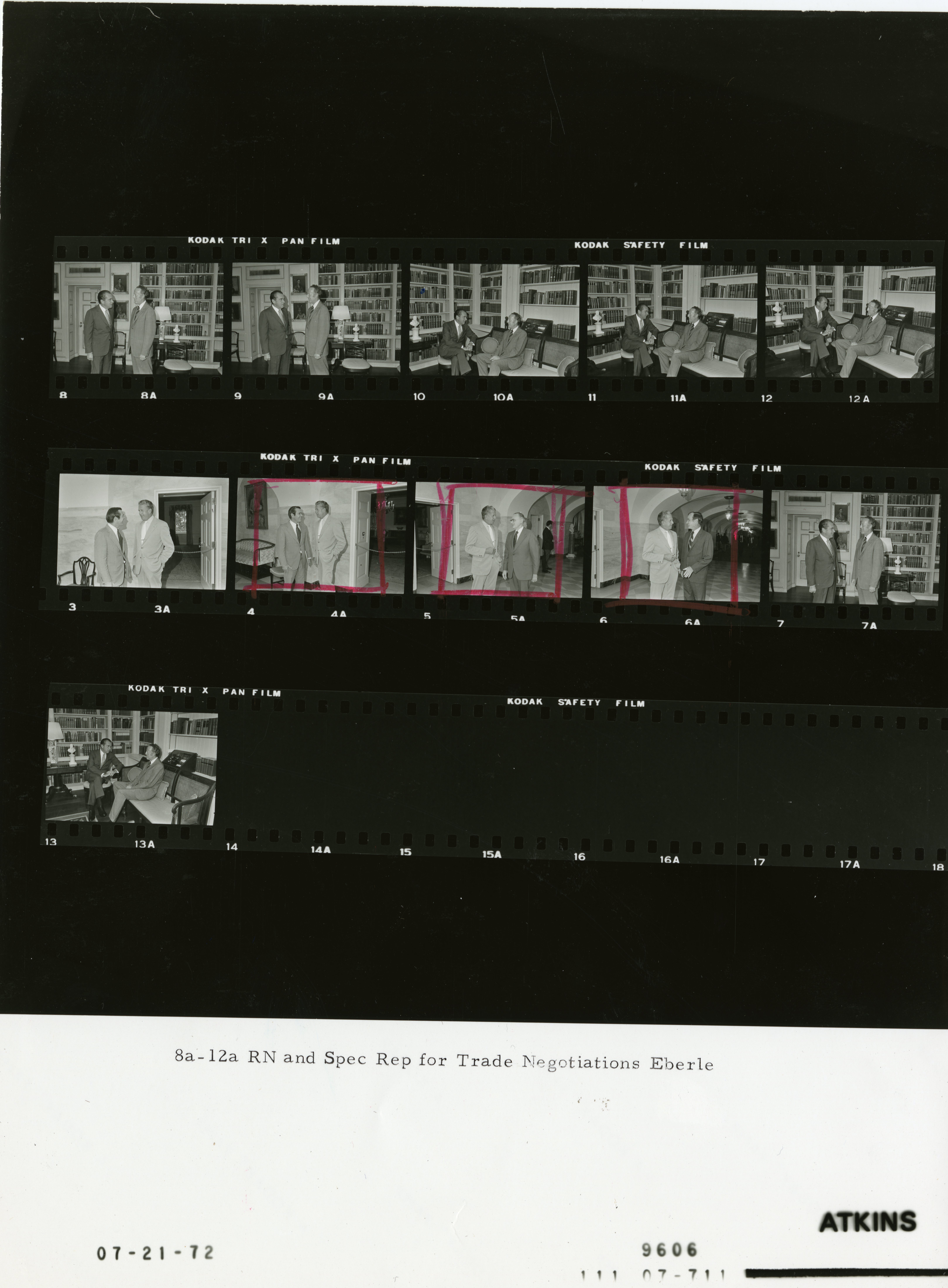
- Frame(s): WHPO-9606-03A-06A, Ohio Congressman Samuel Devine standing individually with unidentified men, probably other State Representatives ready for Breakfast meeting of the Cabinet and Republican Leadership. 7/21/1972, Washington, D.C. White House, Ground Floor Corridor. Samuel Devine.
- Frame(s): WHPO-9606-07A-13A, President Nixon seated informally in a library corner, during a meeting with William Eberle, Special Representative for Trade Negotiations. 7/21/1972, Washington, D.C. White House, Ground Floor Corridor, Library. President Nixon, William D. Eberle, Peter M. Flanigan, Assistant. Alexander P. Butterfield, Deputy Assistant.
- Frame(s): WHPO-9606-13A, President Nixon seated informally in a library corner, during a meeting with William Eberle, Special Representative for Trade Negotiations. 7/21/1972, Washington, D.C. White House, Ground Floor Corridor, Library. President Nixon, William D. Eberle.
Roll WHPO-9614 Photographer: Schumacher, Karl | Color or B&W: B&W
- Frame(s): WHPO-9614-, Farrell with a woman and a boy in the Oval Office and outside White House. 7/21/1972, Washington, D.C. Oval Office, grounds, White House. Farrell, unidentified woman and boy.
Roll WHPO-9615 Photographer: Schumacher, Karl | Color or B&W: B&W
- Frame(s): WHPO-9615-, Vice President Agnew receiving a presentation from a group of men. 7/21/1972, Washington, D.C. unknown. Spiro Agnew, unidentified men.
Roll WHPO-9616 Photographer: Grove, Andrew | Color or B&W: B&W
- Frame(s): WHPO-9616-02A-08A, Deputy Special Assistant John E. Nidecker standing outside with a group of people. 7/21/1972, Washington, D.C. White House, grounds. John Nidecker, John Ehrlichman, unidentified men and women, summer interns.
- Frame(s): WHPO-9616-09A-13A, John Nidecker standing inside with an unidentified person. 7/21/1972, Washington, D.C. White House, unknown room. John Nidecker, John Ehrlichman, unidentified men and women, summer interns.
- Frame(s): WHPO-9616-17A-20A, John Ehrlichman briefing summer White House interns. 7/21/1972, Washington, D.C. White House, Roosevelt Room. John E. Nidecker, John Ehrlichman, unidentified men and women, summer interns.
Roll WHPO-9617 Photographer: Grove, Andrew | Color or B&W: B&W
- Frame(s): WHPO-9617-01-03, Rose Garden lawn furniture. 7/21/1972, Washington, D.C. Rose Garden grounds, Diplomatic Entrance stairs. Pat Price, cyclists.
- Frame(s): WHPO-9617-04-09, Pat Price with a group of cyclists. 7/21/1972, Washington, D.C. Rose Garden grounds, Diplomatic Entrance stairs. Pat Price, cyclists.
Roll WHPO-9618 Photographer: Knudsen, Robert L. | Color or B&W: B&W
- Frame(s): WHPO-9618-02-08, President Nixon receiving the diplomatic credentials of, and greeting Amos Manyangwa Dambe of Botswana and family. 7/21/1972, Washington, D.C. White House, Blue Room. President Nixon, Amos Manyangwa Dambe and family, Abdullah Saleh Al Mania, Tran Kim Phuong and family, U Lwin, Harry R. Amonoo.
- Frame(s): WHPO-9618-13-26, President Nixon receiving the diplomatic credentials of, and greeting Tran Kim Phuong of Vietnam and family. 7/21/1972, Washington, D.C. White House, Blue Room. President Nixon, Amos Manyangwa Dambe and family, Abdullah Saleh Al Mania, Tran Kim Phuong and family, U Lwin, Harry R. Amonoo.
- Frame(s): WHPO-9618-27-32, President Nixon receiving the diplomatic credentials of, and greeting U Lwin of Burma. 7/21/1972, Washington, D.C. White House, Blue Room. President Nixon, Amos Manyangwa Dambe and family, Abdullah Saleh Al Mania, Tran Kim Phuong and family, U Lwin, Harry R. Amonoo.
- Frame(s): WHPO-9618-33-36, President Nixon receiving the diplomatic credentials of, and greeting Harry R. Amonoo of Ghana. 7/21/1972, Washington, D.C. White House, Blue Room. President Nixon, Amos Manyangwa Dambe and family, Abdullah Saleh Al Mania, Tran Kim Phuong and family, U Lwin, Harry R. Amonoo.
- Frame(s): WHPO-9618-9-12, President Nixon receiving the diplomatic credentials of, and greeting Abdullah Saleh Al Mania of Qatar. 7/21/1972, Washington, D.C. White House, Blue Room. President Nixon, Amos Manyangwa Dambe and family, Abdullah Saleh Al Mania, Tran Kim Phuong and family, U Lwin, Harry R. Amonoo.
The White House Communications Agency Sound Recordings Collection contains public statements that took place between 1969 and 1974. Visit the finding aid to learn more.
H - White House Staff Member Recordings
- WHCA-SR-H-624
John D. Ehrlichman holds a question and answer session with summer interns. (7/21/1972, Roosevelt Room, White House)
Runtime: 1:07:00
Keywords: Briefings, private briefings
Production credits: Audio feed supplied by WHCA; Recorded by GET (initials of WHCA engineer)
Original Format: 1/4-inch reel-to-reel audiotape. Original source type: Original.
The White House Communications Agency Videotape Collection contains “off-the-air” recordings of televised programs produced between 1968 and 1974. Visit the finding aid to learn more.
- WHCA-5616
Weekly News Summary, Tape I.
ALL NETWORKS
Runtime: 01:33:00
1. Smith/Greer: Stein; economic figures. Time Code Start: 00:00. Keywords: economy, economics, budgets, finances, recession, inflation, money, wages, costs, unemployment, prices, reports. Network: ABC.
2. Brannigan: Meat prices. Time Code Start: 01:27. Keywords: food, meats, animal products, markets, retail stores, prices, costs, increases, shortages. Network: ABC.
3. Smith/Donaldson: Republicans decide that Democrats cause inflation; head of Democratic National Committee Jean Westwood meets with McGovern's staff. Time Code Start: 03:00. Keywords: Presidential elections, campaigns, campaigning, candidates, leaders, women, advisors, political parties, Demomcrats. Network: ABC.
4. Collins/Davis: War action near Quang Tri, Vietnam. Time Code Start: 05:41. Keywords: Vietnam War. Network: ABC.
5. Smith: Commentary on power shortage and pollution. Time Code Start: 10:13. Keywords: energy crisis, shortages, eletricity, ecology, environment, pollutants, air pollution, water pollution, noise pollution, smog, smoke, fossil fuels, litter, sludge, contamination, debris. Network: ABC.
6. Chancellor: Economy report inflation goes down. Time Code Start: 12:04. Keywords: economy, economics, debt, budgets, finances, recession, inflation, money. Network: NBC.
7. Chancellor/Jones: Navy ships off the coast of Vietnam. Time Code Start: 13:47. Keywords: Vietnam War, Naval, ships. Network: NBC.
8. Chancellor/Erickson/Cloroski: Pentagon refutes bombing of dikes and civilian areas. Time Code Start: 16:05. Keywords: United States Department of Defense headquarters, Armed Forces, Vietnam War, bombings. Network: NBC.
9. Chancellor/Brinkley: Washington, D.C. and bureaucracy. Time Code Start: 22:09. Keywords: government agencies, issues, rules and regulations. Network: NBC.
10. Mudd/Walker: Nations economy (Herb Stein). Time Code Start: 24:31. Keywords: reports, officials, economy, economics, debt, budgets, finances, recession, inflation, money. Network: CBS.
11. Mudd/Pierpoint: Welfare reform (Griffin); Gallup poll. Time Code Start: 28:00. Keywords: public opinions, polls, approval ratings, Gallup poll, Harris poll, bills, laws, Family Assistance Programs, government aid, welfare, health, families, children, financial aid. Network: CBS.
12. Mudd/Henderson: Jane Fonda in North Vietnam. Time Code Start: 30:32. Keywords: Actor, actors, celebrities, Vietnam War, celebrities, activists, antiwar. Network: CBS.
13. Mudd/Morton: Burning forests in Vietnam (Shaply, Senator Nelson). Time Code Start: 32:51. Keywords: Vietnam War, trees, fires. Network: CBS.
Context (External Sources)
The Vanderbilt Television News Archive is the world's most extensive and complete archive of television news. They have been recording, preserving and providing access to television news broadcasts of the national networks since August 5, 1968.
Wikipedia is a free encyclopedia that anyone can edit.