
Introduction
This almanac page for Monday, January 3, 1972, pulls together various records created by the federal government and links to additional resources which can provide context about the events of the day.
Previous Date: Sunday, January 2, 1972
Next Date: Tuesday, January 4, 1972
Schedule and Public Documents
The Daily Diary files represent a consolidated record of the President's activities. Visit the finding aid to learn more.
The President's day began at The White House - Washington, D. C.
The Weekly Compilation of Presidential Documents made available transcripts of the President's news conferences; messages to Congress; public speeches, remarks, and statements; and other Presidential materials released by the White House.
Digitized versions can be found at HathiTrust.
The Federal Register is the official daily publication for rules, proposed rules, and notices of federal agencies and organizations, as well as executive orders and other Presidential documents.
No Federal Register published on this date
Archival Holdings
Any selection of archival documents will necessarily be partial. You should use the documents and folders identified below as a starting place, but consult the linked collection finding aids and folder title lists and the collections themselves for context. Many documents to be found this way do not lend themselves to association with specific dates, but are essential to a complete understanding of the material.
Selective document listing
President's Office Files
The President's Office Files consists of materials drawn together by the Special Files Unit from several administrative subdivisions within the White House Office. It is the handwriting and sensitive papers sent to the Staff Secretary that now comprise much of the President's Office Files. Visit the finding aid to learn more.
- News Summaries, Unmarked News Summaries, Box 47, News Summaries - January 1972 [1 of 6] [Note: Due to the way News Summary products were compiled, you should also consult nearby days for potentially relevant materials.]
- January 3, 1972
- Weekend News Review, January 3, 1972, (Friday thru Sunday)
- President's Daily Schedule, Box 102, [President's Daily Schedule, Jan.-Mar. 1972] [1 of 3]
- The President's Schedule, Monday - January 3, 1972
The H. R. Haldeman Diaries consists of seven handwritten diaries, 36 dictated diaries recorded as sound recordings, and two handwritten audio cassette tape subject logs. The diaries and logs reflect H. R. Haldeman’s candid personal record and reflections on events, issues, and people encountered during his service in the Nixon White House. As administrative assistant to the President and Chief of Staff, Haldeman attended and participated in public events and private meetings covering the entire scope of issues in which the Nixon White House engaged in during the years 1969-1973. Visit the finding aid to learn more.
- Transcript of diary entry (PDF)
Monday, January 3.
President had a full schedule today, getting ready for California departure. He agreed to meet with Peterson's International Economic Policy Group this afternoon and then wanted me to check with Connally, because he wants to be sure that the line he's going to take with them is right. He-His intention is to drag his feet on any legislative action on international trade this year, but he feels that he should get this meeting out of the way and therefore is going ahead and talk with them. Wanted to be sure Connally agreed with that strategy. I was never able to reach Connally on it however. President had called me in at 8:00 in the morning. He was up early and obviously hadn't had much sleep because of the reaction to the TV last night, and he was pretty antsy. He kept me in until about 9:00, and then we both went into the morning staff meeting. He talked with them about the press mainly. Said that the staff had done a remarkable job last year.
He referred to Rather in his interview and made the point that in spite of all we had done, Rather sort of piled it all up to what has to be done this year. He then told him the anecdote about Pat Hillings at the Benson Hotel in '52 when they were trying to get the President off the ticket, and Hillings said the only way to handle this is to beat them. He said that's the way we've got to handle the press and our critics now. He said we have to realize that our favorable notices from the press, when we do get them, are for a reason, which is that they praise one of you in order to screw someone else. The group in general felt the TV had come off extremely well and that seems to be the general response. President, however, was concerned about the technical side of the TV and got some reports, which were confirmed by some of our others, that the picture wasn't as good as it ought to be. The camera work not good, so on.
I had Frank Shakespeare in for discussion of his resignation, which he had submitted several weeks ago. He said that his reasons for resigning were, first, that he wanted to get back to the business world. That he couldn't stay beyond this year anyway, but secondly, and undoubtedly far more important, was his disagreement with our basic foreign policy in terms of our failure to accept the Soviet threat as such. His third reason was the exclusion from knowledge and participation which makes it impossible for him to function, especially since his views run counter to those of the establishment, although parallel to those of the President. He said our problem is that we've got to make a basic decision. Either we do or don't want an independent USIA. The State Department, of course, wants to take it over and keep it locked up under its wing. If we do want an independent USIA that represents the President and his policy, then we've got to have the right director first, and secondly, the director must know why we are doing things in foreign policy. He has to be present at all NSC, Cabinet, and Washington Special Actions Group meetings, both so he'll be informed, and so that the bureaucracy will know that he's part of the estab-- internal establishment. It's essential that he be fully informed on policy and the reasons for it, so that he knows how to formulate what's disclosed. He says Kissinger has a clear policy of exclusion of the USIA by plan, and it's obvious to him that this is the case. And that-- as long as that policy exists, you are not going to be able to maintain an independent USIA. He feels it's too late to try to make such a shift now, and that rather than do that, we should just conduct a holding action this year and move in to take over next year at the same time that we make major personnel changes, etcetera, at the State Department. His recommendation then would be to move Loomis up to Director and Ken Towry up as Deputy to hold the line and try to keep the Shakespeare conservative team in there. I later discussed this with the President on the plane, and he-- I guess it was, yeah-- and he agreed to that recommendation.
Later in the afternoon President and I met with the Attorney General for what was supposed to be an hour meeting and ended up going for about two hours. AG covered his regular political things: the New Hampshire announcement plan, the situation with Stans, the need to find a job for Schneider from Indiana, the idea of Peter Flanigan for Under Secretary of Defense, but then we got into the Kissinger-Rogers situation. The AG had breakfast with Henry this morning, so he had the latest batch of Henry's input, although I had met with Henry also during the day today. Henry boiled it down to the point that he's got to have his demands met. First of all, that Rogers has to understand that any attack on Kissinger by the State Department or any of its people is a direct attack on the President. Secondly, that all cables and communications out of State must be cleared at the White House first. Third, that there is to be no communication between State and the Soviets without prior knowledge of the White House and without a Memcon afterwards summarizing everything that was discussed. Henry feels these are probably impossible demands, and therefore he'll have to leave, but he won't do so until after the Russian trip. In discussing this, the President understood Henry's view. I went further than the Attorney General and told the President about Henry's further view that the President had lost confidence in him and that the evidence, at least to Henry, was the fact that the President was constantly trying to butter him up and keep him happy and was not really getting into the nitty-gritty of foreign policy anymore. Henry sees this as a slippage in his own standing, and that probably is what worries him more than anything else. That, plus the fact that he knows he made the mistake in India-Pakistan and doesn't know how to cope with it. In any event, the President agreed that we should put the ultimatum to Rogers and agreed with my recommendation that Mitchell and I do it as soon as we get back from San Clemente. Then Mitchell and I are to meet with Henry as soon as he gets back, later in the week, next week, to lay out to him the fact that he can't keep going through these tirades and everything. That he's got to get in line, too. I don't know whether it'll work, but I don't see any other solution at this point.
On the plane going out to California this evening, Henry said that Flanigan had been discussed with Laird as Under Secretary, and he won't take him. Henry thinks that the President's idea of Eberle for that job would be ideal. On the discussion about the plan for the Vietnam announcement, the President now decided to go on the basic announcement of troop withdrawal on the 13th and will do that on a pretty low key basis. Probably just going to the press room in the afternoon and giving the three month figure of another 70,000 troops out. Then he'll wait until the 18th, the day Congress comes back, and that noon announce that he'll address the nation that evening in a major foreign policy statement. Then the plan will be to go on TV, review all of our peace overtures and then publicly make the offer that we have already secretly made to the North Vietnamese. This he figures will be a major blockbuster on the Vietnam thing, and that it'll be especially effective because the first announcement will suck all the peaceniks out, and the second move will chop them all off. The bombing reaction has done some of that already also.
He called me after we got back from San Clemente in great glee to report that the-- he was right that the dining room table at the house there only seats 10. So he's going to have to get a new table for the Japanese dinner Thursday night, because we're having 12 guests.
End of January 3. - Original audio recording (MP3)
The National Archives Catalog is the online portal to the records held at the National Archives, and information about those records. It is the main way of describing our holdings and also provides access to electronic records and digitized versions of our holdings.
The Catalog searches across multiple National Archives resources at once, including archival descriptions, digitized and electronic records, authority records, and web pages from Archives.gov and the Presidential Libraries. The Catalog also allows users to contribute to digitized historical records through tagging and transcription.
Nixon Library Holdings
All National Archives Units
National Security Documents
The President's Daily Brief is the primary vehicle for summarizing the day-to-day sensitive intelligence and analysis, as well as late-breaking reports, for the White House on current and future national security issues. Read "The President's Daily Brief: Delivering Intelligence to Nixon and Ford" to learn more.
The Foreign Relations of the United States series presents the official documentary historical record of major U.S. foreign policy decisions and significant diplomatic activity. Visit the State Department website for more information.
Vol. VII, Vietnam, July 1970-January 1972
Military and Diplomatic Stalemate, October 11, 1971-January 26, 1972
286. Memorandum From the President’s Assistant for National Security Affairs (Kissinger) to the Under Secretary of State for Political Affairs (Johnson) and the Deputy Secretary of Defense (Packard), Washington, January 3, 1972
Source: National Archives, Nixon Presidential Materials, NSC Files, Box 158, Vietnam Country Files, Vietnam, Jan–Feb 72. Secret. Odeen forwarded the memorandum to Kissinger under a December 22 covering memorandum which indicated that he had redrafted it to ask for both a near and long term study. Copies were sent to the Director of Central Intelligence, the Chairman of the Joint Chiefs of Staff, the Director of the Office of Management and Budget, the Chairman of the Council of Economic Advisors, the Administrator of the Agency for International Development, the Assistant Secretary of the Treasury for International Affairs, and the Assistant Secretary of Agriculture for International Affairs.
287. Information Memorandum From the Under Secretary of State for Political Affairs (Johnson) to Secretary of State Rogers, Washington, January 3, 1972
Source: National Archives, RG 59, Central Files 1970–73, DEF 1–1 US. Top Secret; Nodis. Drafted by Sullivan.
Vol. XVII, China, 1969-1972
China, October 1971-February 1972
183. Memorandum of Conversation, Beijing, January 3, 1972, midnight
Source: National Archives, Nixon Presidential Materials, NSC Files, Box 1037, Files for the President—China Material, Haig Trip—Memcons, January 1972. Top Secret; Sensitive; Exclusively Eyes Only. Haig was in the PRC January 3–10 with a team of Americans who made technical arrangements for Nixon’s February visit. The meeting was held in the Great Hall of the People.
Vol. XIX, Part 2, Japan, 1969-1972
November 1971-December 1972: Toward a New Equilibrium
110. Memorandum From the President’s Assistant for National Security Affairs (Kissinger) to President Nixon, Washington, January 3, 1972
Source: National Archives, Nixon Presidential Materials, NSC Files, Box 537, Country Files, Far East, Japan, Vol. VI, October–31 December 1971. Limited Official Use. Sent for information. A notation on the memorandum indicates the President saw it. An additional handwritten notation indicates that Kissinger saw it. In a December 18, 1971, memorandum, Holdridge had recommended that Kissinger sign this memorandum to the President, which summarized the views of Strickland on U.S.-Japanese relations. (Ibid.)
Vol. XXXII, SALT I, 1969-1972
Narrowing the Issues, October 19, 1971-April 18, 1972
219. Conversation Between President Nixon and the President’s Assistant for National Security Affairs (Kissinger), Washington, January 3, 1972
Source: National Archives, Nixon Presidential Materials, White House Tapes, Oval Office, Conversation No. 642–15. No classification marking. According to the President’s Daily Diary, Nixon met with Kissinger from 9:25 to 10:04 a.m. (Ibid., White House Central Files) The editor transcribed the portion of the conversation printed here specifically for this volume.
220. Memorandum of Conversation, Washington, January 3, 1972
Source: Washington National Records Center, RG 330, ACDA Files: FRC 383–97–0010, Box 1, Director’s Files, Smith/White House Correspondence, January–May 1972. Top Secret; Eyes Only. A tape recording of this conversation is in the National Archives, Nixon Presidential Materials, White House Tapes, Oval Office, Conversation No. 642–20. According to the President’s Daily Diary, Nixon met with Smith, Rogers, and Kissinger from 10:23 to 10:56 a.m. (Ibid., White House Central Files)
221. National Security Decision Memorandum 145, Washington, January 3, 1972
Source: National Archives, Nixon Presidential Materials, NSC Files, NSC Institutional Files (H-Files), Box H–208, National Security Decision Memoranda, NSDMs 101–150. Top Secret; Nodis; SALT.
Vol. XXXVI, Energy Crisis, 1969-1974
April 15, 1971-March 11, 1972
104. Memorandum of Conversation, Washington, January 3, 1972
Source: National Archives, RG 59, Central Files 1970–73, PET 6. Confidential. Drafted by Brown on January 6; cleared in E/ORF, D, and U; and approved on January 19 in S and D.
Vol. E-7, Documents on South Asia, 1969-1972
U.S. Relations with India and Pakistan, 1972
199. Telegram 22 From the Consulate General in Karachi to the Department of State, Karachi, January 3, 1972, 1014Z
Ambassador Farland met with Pakistani President Bhutto who was planning to announce that day that Sheikh Mujibur Rahman would be released from prison.
Source: National Archives, RG 59, Central Files 1970–73, POL 29 PAK. Secret; Immediate; Exdis. Repeated to Islamabad.200. Telegram 26 From the Consulate General in Karachi to the Department of State, Karachi, January 3, 1972, 1154Z
In response to Pakistani President Bhutto’s request to President Nixon for economic assistance to help Pakistan recover from the effects of the war with India, Ambassador Farland said that he was authorized by Nixon to begin negotiations for a new PL–480 agreement.
Source: National Archives, RG 59, Central Files 1970–73, POL 15–1 PAK. Confidential; Priority. Repeated to Islamabad, New Delhi, Dacca, and Lahore. The text of Bhutto’s letter to Nixon on December 21, 1971, transmitted to Islamabad on December 30 in telegram 233015, is in Foreign Relations, 1969–1976, vol. XI, South Asia Crisis, 1971, Document 330
Bangladesh, December 1971-December 1972
378. Telegram 10 From the Consulate General in Dacca to the Department of State, Dacca, January 3, 1972, 0651Z
In part one of his report on his January 1 meeting with Foreign Minister Samad, Consul General Spivack reported that Samad had solicited U.S. assistance in securing the release of Sheikh Mujibur Rahman from imprisonment in Pakistan. Samad assured Spivack that the Consulate General would be allowed to function for the time being and would receive “honorable treatment” while the U.S. considered the question of recognition.
Source: National Archives, Nixon Presidential Materials, NSC Files, Box 627, Country Files, Middle East, Pakistan, Vol. IX, Jan-31 Aug 72. Confidential; Immediate; Exdis. Repeated to Islamabad, Calcutta, and New Delhi.379. Telegram 11 From the Consulate General in Dacca to the Department of State, Dacca, January 3, 1972, 0650Z
Consul General Spivack reported that part two of his January 1 conversation with Foreign Minister Samad involved a discussion of the question of recognition. Samad asked about the factors being considered by the U.S. in weighing recognition of Bangladesh, and Spivack indicated that he was not authorized to discuss the question in other than broad, hypothetical terms.
Source: National Archives, Nixon Presidential Materials, NSC Files, Box 627, Country Files, Middle East, Pakistan, Vol. IX, Jan-31 Aug 72. Confidential; Immediate; Exdis. Repeated to Islamabad, Calcutta, and New Delhi.380. Telegram 12 From the Consulate General in Dacca to the Department of State, Dacca, January 3, 1972, 0713Z
Consul General Spivack noted that at the conclusion of their conversation on January 1 Foreign Minister Samad raised the question of whether the U.S. intended to continue funding partially-completed projects begun by USAID. They then discussed how best to describe their meeting to the press. In his concluding comment, Spivack observed that press and television coverage of the meeting was extensive.
Source: National Archives, Nixon Presidential Materials, NSC Files, Box 627, Country Files, Middle East, Pakistan, Vol. IX, Jan-31 Aug 72. Confidential; Immediate, Exdis. Repeated to Islamabad, Calcutta, and New Delhi.
The Kissinger telephone conversation transcripts consist of approximately 20,000 pages of transcripts of Kissinger’s telephone conversations during his tenure as Assistant to the President for National Security Affairs (1969-1974) and Secretary of State (1973-1974) during the administration of President Richard Nixon. Visit the finding aid for more information.
Digitized versions can be found in the National Archives Catalog.
Audiovisual Holdings
Visit the White House Tapes finding aid to learn about the taping system's operation and archival processing.
Cabinet Room
- 87-1; 3:40 p.m. - 4:44 p.m.; Nixon, Richard M. (President); Rogers, William P.; Volcker, Paul A.; Shultz, George P.; Flanigan, Peter M.; MacGregor, Clark; Peterson, Peter G.; Allen, Richard V. ("Dick"); Hinton, Deane R.; Eberle, William D.; Bull, Stephen B.
- 87-2; Unknown between 4:44 p.m., 1/3 & 2:45 p.m., 4/9; [Unknown person(s)]
- 87-3; Unknown between 4:44 p.m., 1/3 & 2:45 p.m., 4/9; White House tour group
- 87-4; Unknown between 4:44 p.m., 1/3 & 2:45 p.m., 4/9; [Unknown person(s)]
- 87-5; Unknown between 4:44 p.m., 1/3 & 2:45 p.m., 4/9; White House tour group
- 87-6; Unknown between 4:44 p.m., 1/3 & 2:45 p.m., 4/9; [Unknown person(s)]
- 87-7; Unknown between 4:44 p.m., 1/3 & 2:45 p.m., 4/9; White House tour group
- 87-8; Unknown between 4:44 p.m., 1/3 & 2:45 p.m., 4/9; Farrell, Michael J.; Parker, David N.; [Unknown person(s)]
- 87-9; Unknown between 4:44 p.m., 1/3 & 2:45 p.m., 4/9; [Unknown person(s)]
- 87-11; Unknown between 4:44 p.m., 1/3 & 2:45 p.m., 4/9; [Unknown person(s)]
Oval Office
- 642-2; Unknown between 8:02 a.m. & 8:15 a.m.; Nixon, Richard M. (President); Haldeman, H. R. ("Bob")
- 642-3; Unknown between 8:15 a.m. & 8:45 a.m.; Nixon, Richard M. (President); Haldeman, H. R. ("Bob"); [Unknown person(s)]
- 642-4; Unknown between 8:15 a.m. & 8:45 a.m.; Nixon, Richard M. (President); Haldeman, H. R. ("Bob")
- 642-5; Unknown between 8:45 a.m. & 9:02 a.m.; United States Secret Service agents; [Unknown person(s)]
- 642-6; Unknown between 9:02 a.m. & 9:07 a.m.; Nixon, Richard M. (President); Bull, Stephen B.
- 642-7; Unknown between 9:02 a.m. & 9:07 a.m.; Nixon, Richard M. (President); White House operator
- 642-8; Unknown between 9:02 a.m. & 9:07 a.m.; Nixon, Richard M. (President); Kissinger, Henry A.
- 642-9; Unknown between 9:02 a.m. & 9:07 a.m.; Nixon, Richard M. (President); [Unknown person(s)]
- 642-10; 9:07 a.m. - 9:14 a.m.; Nixon, Richard M. (President); Moore, Richard A.
- 642-11; 9:15 a.m. - 9:19 a.m.; Nixon, Richard M. (President); Warren, Gerald L.; [Unknown person(s)]; Woods, Rose Mary
- 642-12; 9:19 a.m. - 9:19 a.m.; Nixon, Richard M. (President); Kissinger, Henry A.
- 642-13; 9:19 a.m. - 9:19 a.m.; Nixon, Richard M. (President); White House operator
- 642-14; 9:19 a.m. - 9:23 a.m.; Nixon, Richard M. (President); Rogers, William P.
- 642-15; 9:25 a.m. - 10:04 a.m.; Nixon, Richard M. (President); Kissinger, Henry A.; Woods, Rose Mary; Bull, Stephen B.
- 642-16; Unknown between 10:05 a.m. & 10:14 a.m.; Nixon, Richard M. (President); Woods, Rose Mary; Sanchez, Manolo; White House operator; Warren, Gerald L.; Bull, Stephen B.
- 642-17; 10:14 a.m. - 10:15 a.m.; Nixon, Richard M. (President); Woods, Rose Mary
- 642-18; Unknown between 10:15 a.m. & 10:23 a.m.; Nixon, Richard M. (President); Sanchez, Manolo
- 642-19; Unknown between 10:15 a.m. & 10:23 a.m.; Nixon, Richard M. (President); Bull, Stephen B.
- 642-20; 10:23 a.m. - 10:56 a.m.; Nixon, Richard M. (President); Smith, Gerard C.; Rogers, William P.; Kissinger, Henry A.; White House photographer
- 642-21; Unknown between 10:56 a.m. & 11:00 a.m.; Nixon, Richard M. (President); Bull, Stephen B.; Sanchez, Manolo; [Unknown person(s)]
- 642-22; Unknown between 10:56 a.m. & 11:00 a.m.; Nixon, Richard M. (President); Haldeman, H. R. ("Bob")
- 642-23; 11:00 a.m. - 11:08 a.m.; Nixon, Richard M. (President); Shultz, George P.
- 642-24; Unknown between 11:08 a.m. & 11:09 a.m.; Nixon, Richard M. (President); White House operator
- 642-25; Unknown between 11:08 a.m. & 11:09 a.m.; Nixon, Richard M. (President); Bull, Stephen B.
- 642-26; 11:09 a.m. - 11:15 a.m.; Nixon, Richard M. (President); Haldeman, H. R. ("Bob")
- 642-27; 11:15 a.m. - 11:42 a.m.; Nixon, Richard M. (President); MacGregor, Clark; Smith, Jody; Sanchez, Manolo
- 642-28; Unknown between 12:46 p.m. & 2:07 p.m.; Nixon, Richard M. (President); [Unknown person(s)]
- 642-29; 11:42 a.m. - 12:05 p.m.; Nixon, Richard M. (President); Shultz, George P.; Weinberger, Caspar W. ("Cap"); Sanchez, Manolo; White House operator
- 642-30; 12:07 p.m. - 12:13 p.m.; Nixon, Richard M. (President); Hoffman, Clarence C.; Hoffman, Clarence C. (Mrs.); Colson, Charles W.; McGill, John P.; [Unknown person(s)]; White House photographer
- 642-31; 12:13 p.m. - 12:15 p.m.; Nixon, Richard M. (President); Allen, George E.
- 642-32; 12:16 p.m. - 12:16 p.m.; Nixon, Richard M. (President); White House operator
- 642-33; Unknown between 12:16 p.m. & 12:18 p.m.; Nixon, Richard M. (President); Bull, Stephen B.
- 642-34; Unknown between 12:16 p.m. & 12:18 p.m.; Nixon, Richard M. (President); Shultz, George P.; Weinberger, Caspar W. ("Cap")
- 642-35; Unknown between 12:16 p.m. & 12:18 p.m.; Nixon, Richard M. (President); [Unknown person(s)]
- 642-36; Unknown between 12:16 p.m. & 12:18 p.m.; Nixon, Richard M. (President); Bull, Stephen B.
- 642-37; 12:18 p.m. - 12:32 p.m.; Nixon, Richard M. (President); Kauffman, John W.; Morris, Stephen M.; Hahn, Jack A. L.; Cole, Kenneth R., Jr.; Cavanaugh, James H.; White House photographer; Bull, Stephen B.
- 642-38; Unknown between 12:32 p.m. & 12:36 p.m.; Nixon, Richard M. (President); Bull, Stephen B.
- 642-39; Unknown between 12:32 p.m. & 12:43 p.m.; Nixon, Richard M. (President); Bull, Stephen B.; White House operator; Butterfield, Alexander P.; Cox, Tricia Nixon
- 642-40; Unknown between 12:43 p.m. & 12:45 p.m.; Nixon, Richard M. (President); [Unknown person(s)]
- 642-41; Unknown between 12:43 p.m. & 12:45 p.m.; Nixon, Richard M. (President); Bull, Stephen B.
- 642-42; 12:45 p.m. - 12:46 p.m.; Nixon, Richard M. (President); Dreyfus, Jack J., Jr.; Bull, Stephen B.
- 643-3; 2:07 p.m. - 2:10 p.m.; Nixon, Richard M. (President); Dreyfus, Jack J., Jr.; Bull, Stephen B.
- 643-4; Unknown between 2:10 p.m. & 2:17 p.m.; Nixon, Richard M. (President); Sanchez, Manolo
- 643-5; Unknown between 2:10 p.m. & 2:17 p.m.; Nixon, Richard M. (President); [Unknown person(s)]
- 643-6; Unknown between 2:10 p.m. & 2:17 p.m.; Nixon, Richard M. (President); [Unknown person(s)]; Butterfield, Alexander P.
- 643-7; Unknown between 2:10 p.m. & 2:17 p.m.; Nixon, Richard M. (President); Bull, Stephen B.; [Unknown person(s)]
- 643-8; 2:17 p.m. - 3:07 p.m.; Nixon, Richard M. (President); Colson, Charles W.; [Unknown person(s)]; Sanchez, Manolo; Haldeman, H. R. ("Bob"); Bull, Stephen B.
- 643-9; Unknown between 6:01 p.m. & 11:59 p.m.; United States Secret Service agents; [Unknown person(s)]
- 643-10; 3:07 p.m. - 3:40 p.m.; Nixon, Richard M. (President); Ford, Henry, II; Etherington, Edwin D.; Colson, Charles W.; Hanzlik, Rayburn D.; White House photographer; Bull, Stephen B.; Sanchez, Manolo; Peterson, Peter G.
- 643-11; Unknown between 3:40 p.m. & 4:44 p.m.; United States Secret Service agents; [Unknown person(s)]
- 643-12; Unknown between 3:40 p.m. & 4:44 p.m.; United States Secret Service agents; [Unknown person(s)]
- 643-13; 4:44 p.m. - 6:00 p.m.; Nixon, Richard M. (President); Mitchell, John N.; White House operator; Rogers, William P.; [Unknown person(s)]; Haldeman, H. R. ("Bob"); Butterfield, Alexander P.
- 643-14; Unknown between 6:00 p.m. & 6:01 p.m.; Nixon, Richard M. (President); [Unknown person(s)]
- 643-15; Unknown between 6:01 p.m. & 11:59 p.m.; United States Secret Service agents
White House Telephone
- 17-167; 12:29 a.m. - 12:30 a.m.; Nixon, Richard M. (President); Rebozo, Charles G. ("Bebe")
- 17-168; 12:30 a.m. - 12:30 a.m.; Nixon, Richard M. (President); White House operator
- 17-169; 12:31 a.m. - 12:45 a.m.; Nixon, Richard M. (President); Kissinger, Henry A.
- 18-1; 9:19 a.m. - 9:19 a.m.; Nixon, Richard M. (President); White House operator
- 18-2; 9:19 a.m. - 9:23 a.m.; Nixon, Richard M. (President); Rogers, William P.
- 18-3; Unknown between 10:05 a.m. & 10:10 a.m.; Nixon, Richard M. (President); White House operator
- 18-4; Unknown between 11:08 a.m. & 11:09 a.m.; Nixon, Richard M. (President); White House operator
- 18-5; 11:20 a.m. - 11:21 a.m.; Nixon, Richard M. (President); Smith, Jody
- 18-6; Unknown between 11:42 a.m. & 12:05 p.m.; Nixon, Richard M. (President); White House operator
- 18-8; 12:13 p.m. - 12:15 p.m.; Nixon, Richard M. (President); Allen, George E.
- 18-9; 12:16 p.m. - 12:16 p.m.; Nixon, Richard M. (President); White House operator
- 18-10; Unknown between 12:16 p.m. & 12:18 p.m.; Nixon, Richard M. (President); Shultz, George P.; Weinberger, Caspar W. ("Cap")
- 18-11; Unknown between 12:32 p.m. & 12:36 p.m.; Nixon, Richard M. (President); White House operator
- 18-12; Unknown between 12:32 p.m. & 12:43 p.m.; White House operator; Butterfield, Alexander P.; Nixon, Richard M. (President); Cox, Tricia Nixon
- 18-13; Unknown between 4:44 p.m. & 5:15 p.m.; Nixon, Richard M. (President); White House operator
- 18-14; Unknown between 4:44 p.m. & 5:15 p.m.; Nixon, Richard M. (President); Rogers, William P.; [Unknown person(s)]; Mitchell, John N.
- 18-108; 2:58 p.m. - 3:00 p.m.; Nixon, Richard M. (President); Morton, Rogers C. B.
- 18-109; 10:10 a.m. - 10:11 a.m.; Nixon, Richard M. (President); Warren, Gerald L.
- 18-110; Unknown between 10:11 a.m. & 11:08 a.m.; Nixon, Richard M. (President)
- 18-111; Unknown between 5:15 p.m., 1/3 & 11:44 p.m., 12/24; Nixon, Richard M. (President); White House operator
The White House Photo Office collection consists of photographic coverage of President Richard Nixon meeting with prominent social, political, and cultural personalities; speaking engagements and news conferences of the President and various high-ranking members of the White House staff and Cabinet; Presidential domestic and foreign travel, including Presidential vacations; social events and entertainment involving the First Family, including entertainers present; official portraits of the President, First Family, and high-ranking members of the Nixon administration; the 1969 and 1973 Inaugurals; the President’s 1972 Presidential election campaign appearances (including speeches) and other official activities of the White House staff and the President’s Cabinet from January 20, 1969 until August 9, 1974 at the White House and the Old Executive Office Building; other locations in Washington, DC, such as The Mall; and the Presidential retreats in Camp David, Maryland, Key Biscayne, Florida, and San Clemente, California. Visit the finding aid to learn more.
Roll WHPO-8157 Photographer: Atkins, Oliver | Color or B&W: B&W
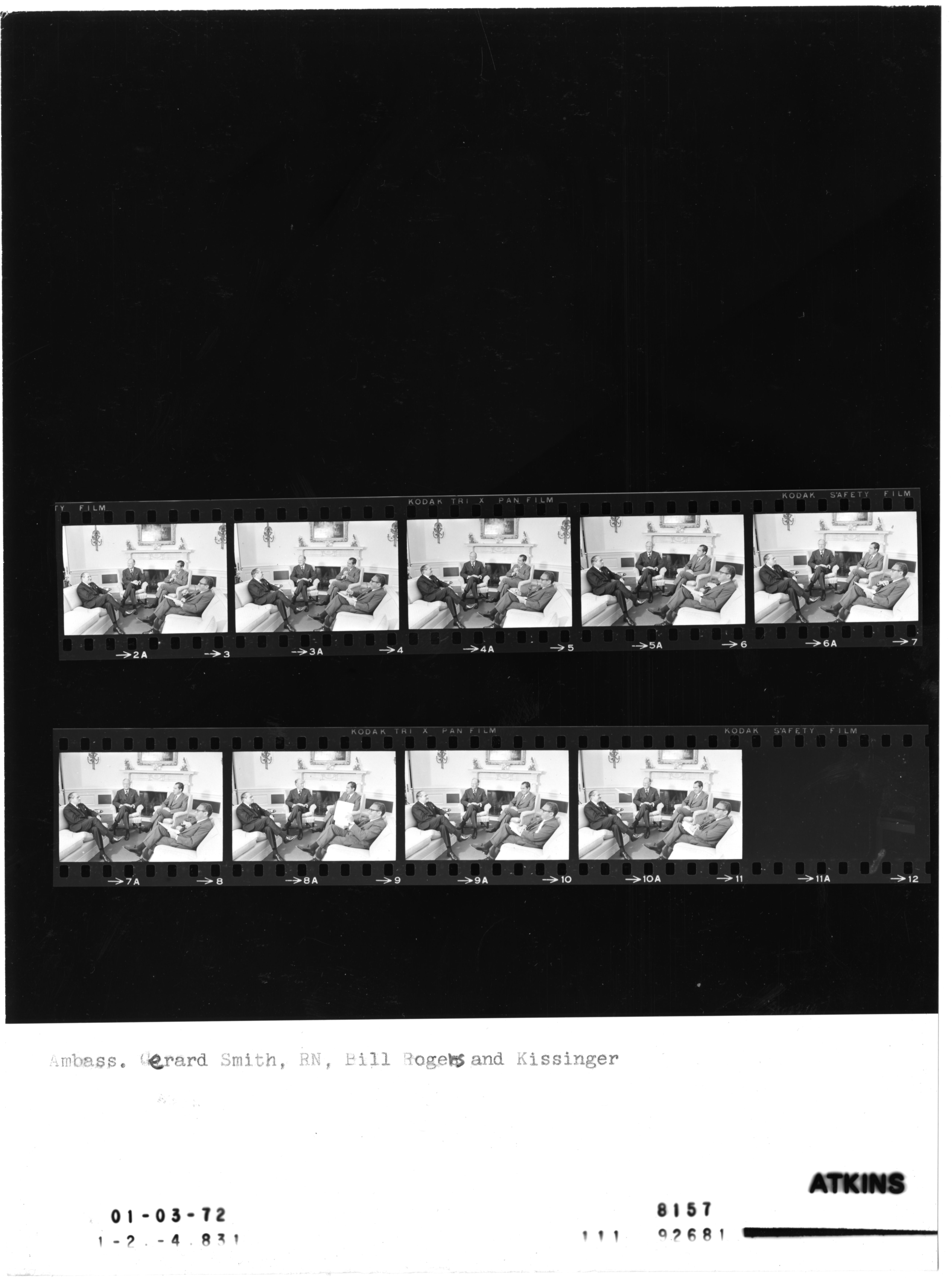
- Frame(s): WHPO-8157-, President Nixon meeting with Gerard Smith, Bill Rogers, Henry Kissinger. 1/3/1972, Washington, D.C. Oval Office. L-R: Director of U.S. Arms Control and Disarmament Agency Ambassador Gerard C. Smith, Nixon, Secretary of State William P. Rogers, Henry Kissinger.
Roll WHPO-8158 Photographer: Atkins, Oliver | Color or B&W: B&W
- Frame(s): WHPO-8158-, President Nixon presenting Driver of the Year award. 1/3/1972, Washington, D.C. Oval Office. President Nixon, unidentified male, unidentified female.
Roll WHPO-8159 Photographer: Atkins, Oliver | Color or B&W: B&W
- Frame(s): WHPO-8159-, President Nixon with American Hospital Association officers. 1/3/1972, Washington, D.C. Oval Office. President Nixon, unidentified men.
Roll WHPO-8160 Photographer: Knudsen, Robert L. | Color or B&W: B&W
- Frame(s): WHPO-8160-, Jon Huntsman and an unidentified staff member in an office. 1/3/1972, unknown unknown office. Jon Meade Huntsman, Sr., unidentified staff.
Roll WHPO-8161 Photographer: Knudsen, Robert L. | Color or B&W: B&W
- Frame(s): WHPO-8161-03-09, President Nixon meeting Henry Ford and staff. 1/3/1972, Washington, D.C. Oval Office. 3A-9A: Nixon, Henry Ford, unidentified staff.
- Frame(s): WHPO-8161-10A-14A, International Trade Advisors meeting. 1/3/1972, Washington, D.C. White House Cabinet Room. Unidentified advisors.
Roll WHPO-8226 Photographer: Kightlinger, Jack | Color or B&W: Color

- Frame(s): WHPO-8226-, Pat Nixon attending the inauguration of Liberia's President William Tolbert. 1/3/1972, Monrovia, Liberia, Africa Executive Pavilion. Pat Nixon, President William R. Tolbert, Jr., Mrs. Tolbert, unidentified guests.
- Frame(s): WHPO-8226-, Pat Nixon attending the inaugural ball of Liberia's new President William Tolbert. 1/3/1972, Monrovia, Liberia, Africa Executive Pavilion. Pat Nixon, President William R. Tolbert, Jr., Mrs. Tolbert, unidentified guests.
- Frame(s): WHPO-8226-14, Liberia's new President William Tolbert stands with Pat Nixon wearing her newly bestowed medal, the Grand Cordon in the Venerable Order of the Knighthood of the Pioneers of African Redemption while officials applaud nearby. 1/3/1972, Monrovia, Liberia, Africa Executive Pavilion. Pat Nixon, President William R. Tolbert, Jr., unidentified guests.
Roll WHPO-8227 Photographer: Kightlinger, Jack | Color or B&W: Color

- Frame(s): WHPO-8227-, Pat Nixon and Mrs. William Tolbert in a motorcade through Monrovia in Liberia during her trip to attend newly elected President Tolbert's inauguration. 1/3/1972, Monrovia, Liberia, Africa unknown street. Pat Nixon, Mrs. William Tolbert.
Roll WHPO-8228 Photographer: Kightlinger, Jack | Color or B&W: Color
- Frame(s): WHPO-8228-, Pat Nixon attending President William Tolbert's Inauguration reception. 1/3/1972, Monrovia, Liberia, Africa Executive Mansion. Pat Nixon, President William R. Tolbert, Jr., Mrs. Tolbert, unidentified guests.
Roll WHPO-8229 Photographer: Kightlinger, Jack | Color or B&W: Color
- Frame(s): WHPO-8229-, Pat Nixon attending the Inaugural parade for Liberia's new President William Tolbert. 1/3/1972, Monrovia, Liberia, Africa Executive Mansion. Pat Nixon, President William R. Tolbert, Jr., crowd.
- Frame(s): WHPO-8229-03A-12A, Pat Nixon and Mrs. William Tolbert in a motorcade through Monrovia in Liberia during her trip to attend newly elected President Tolbert's inauguration. 1/3/1972, Monrovia, Liberia, Africa unknown street. Pat Nixon, Mrs. Tolbert, Liberian officials.
Roll WHPO-8230 Photographer: Kightlinger, Jack | Color or B&W: Color
- Frame(s): WHPO-8230-03-23, Pat Nixon attending the Inaugural parade for Liberia's new President William Tolbert. 1/3/1972, Monrovia, Liberia Executive Mansion exterior. Pat Nixon, President William R. Tolbert, Jr., guests.
The White House Communications Agency Sound Recordings Collection contains public statements that took place between 1969 and 1974. Visit the finding aid to learn more.
C - First Lady
- WHCA-SR-C-096
Remarks by Pat Nixon at President William Tolbert's inauguration at the Executive Mansion in Monrovia, Liberia, with remarks by President Tolbert. (1/3/1972, Monrovia, Liberia)
Runtime: 0:20:45
Production credits: Audio feed supplied by WHCA; Recorded by JMC (initials of WHCA engineer)
Original Format: 1/4-inch reel-to-reel audiotape. Original source type: Original. - WHCA-SR-C-163
Remarks by Pat Nixon at an Inaugural Ball in Monrovia, Liberia. Additional Speaker: President of Liberia. (1/3/1972, Monrovia, Liberia)
Runtime: none listed
Production credits: No feed information listed; Recorded by LRR (initials of WHCA engineer)
Original Format: 1/4-inch reel-to-reel audiotape. Original source type: Original.
The White House Communications Agency Videotape Collection contains “off-the-air” recordings of televised programs produced between 1968 and 1974. Visit the finding aid to learn more.
- WHCA-4935
Nixon speaks to the National 4H Convention. Prime Minister Edward Heath of Great Britain.
Eastern Educational Network, WRC
Runtime: 01:05:30 - WHCA-4936
"Martin Agronsky: Evening Edition".
NBC
Runtime: 00:33:32 - WHCA-4946
Weekly News Summary, Tape I.
ALL NETWORKS
Runtime: 1:30
9. Smith: Indochina still at war. Time Code Start: 27:56. Keywords: Laos, Cambodia, Vietnam War,. Network: ABC.
10. Smith/Jarriel: President Nixon comments on the POW problem, no fixed withdrawal date ever set (McGovern). Time Code Start: 28:30. Keywords: Vietnam War, Vietnam Prisoner of War, Presidents, statements, speeches, withdrawals. Network: ABC.
11. Reasoner/Geer: President Nixon enters New Hampshire primary; Hartke runs in New Hampshire. Time Code Start: 31:53. Keywords: Presidential elections, campaigns, primaries, voting. Network: ABC.
12. Smith/Bell: Price guidelines enforced. Time Code Start: 34:10. Keywords: wage and price controls, freezes, prices, costs, increases, decreases, economy, economics, budgets, finances, recession, inflation, money. Network: ABC.
13. Reasoner/Dinsmore: First Lady Pat Nixon arrives in Liberia, Africa (on film disembarking). Time Code Start: 36:54. Keywords: Presidents, families, wife, travel, First Lady trips, international, Liberian, Africa. Network: ABC.
14. Smith: Commentary on 1971 crises don't look to bad in retrospect. Time Code Start: 38:40. Keywords: yearly, reports, summaries, history, retrospectives, reviews. Network: ABC.
15. Chancellor: Commentary on Presidents Nixon's speech of 2 Jan (McGovern). Time Code Start: 40:25. Keywords: Presidents, speeches. Network: NBC.
16. Chancellor/Lord: The war and Laos. Time Code Start: 43:05. Keywords: Laos, Vietnam War. Network: NBC.
17. Chancellor: Commentary on President Nixon reason for heavy bombing. Time Code Start: 46:07. Keywords: Vietnam War, bombings. Network: NBC.
18. Chancellor: Hartke enters New Hampshire primary. Time Code Start: 47:11. Keywords: Presidential elections, campaigns, campaigning, candidates. Network: NBC.
19. Chancellor: Democrats want equal time on TV. Time Code Start: 49:00. Keywords: Federal Communication Commisssion, Equal-time Rule, media, radio, television, TV, the press, network broadcasting corporations, elections, campaigns, campaigning, candidates, debates, speeches. Network: NBC.
20. Chancellor/Levine: Phase II and retail stores. Time Code Start: 49:35. Keywords: wage and price controls, freezes, prices, costs, increases, decreases, economy, economics, budgets, finances, recession, inflation, money. Network: NBC.
21. Chancellor/Perkins: The new Army wants to join you!?. Time Code Start: 52:22. Keywords: Armed Forces, military, enlistment, advertisement, advertising, campaigns. Network: NBC.
22. Cronkite: President Nixon in New Hampshire primary; Hartke and Muskie too. Time Code Start: 54:18. Keywords: Presidential elections, campaigns, campaigning, candidates, primaries, voting. Network: CBS.
23. Cronkite/Kalb: Commentary on Presidents Nixon's speech of 2 Jan (McGovern). Time Code Start: 56:00. Keywords: Presidents, speeches. Network: CBS.
24. Cronkite: The war and Laos. Time Code Start: 58:46. Keywords: Laos, Vietnam War. Network: CBS.
25. Cronkite/Schackne/Herman: Welfare in New York and poor welfare administration. Time Code Start: 64:30. Keywords: Family Assistance Programs, government aid, financial aid, health and welfare assistance. Network: CBS.
26. Cronkite/McClocklin: First Lady Pat Nixon in Liberia, Africa. Time Code Start: 70:03. Keywords: Presidents, families, wife, travel, First Lady trips, international, Liberian, Africa. Network: CBS.
Context (External Sources)
The Vanderbilt Television News Archive is the world's most extensive and complete archive of television news. They have been recording, preserving and providing access to television news broadcasts of the national networks since August 5, 1968.
Wikipedia is a free encyclopedia that anyone can edit.