

Introduction
This almanac page for Sunday, January 2, 1972, pulls together various records created by the federal government and links to additional resources which can provide context about the events of the day.
Previous Date: Saturday, January 1, 1972
Next Date: Monday, January 3, 1972
Schedule and Public Documents
The Daily Diary files represent a consolidated record of the President's activities. Visit the finding aid to learn more.
The President's day began at The White House - Washington, D. C.
The Weekly Compilation of Presidential Documents made available transcripts of the President's news conferences; messages to Congress; public speeches, remarks, and statements; and other Presidential materials released by the White House.
Digitized versions can be found at HathiTrust.
Each Public Papers of the Presidents volume contains the papers and speeches of the President of the United States that were issued by the White House Office of the Press Secretary during the time period specified by the volume. The material is presented in chronological order, and the dates shown in the headings are the dates of the documents or events. In instances when the release date differs from the date of the document itself, that fact is shown in the text note.
To ensure accuracy, remarks have been checked against audio recordings (when available) and signed documents have been checked against the original, unless otherwise noted. Editors have provided text notes and cross references for purposes of identification or clarity.
The Federal Register is the official daily publication for rules, proposed rules, and notices of federal agencies and organizations, as well as executive orders and other Presidential documents.
No Federal Register published on this date
Archival Holdings
Any selection of archival documents will necessarily be partial. You should use the documents and folders identified below as a starting place, but consult the linked collection finding aids and folder title lists and the collections themselves for context. Many documents to be found this way do not lend themselves to association with specific dates, but are essential to a complete understanding of the material.
Selective document listing
President's Office Files
The President's Office Files consists of materials drawn together by the Special Files Unit from several administrative subdivisions within the White House Office. It is the handwriting and sensitive papers sent to the Staff Secretary that now comprise much of the President's Office Files. Visit the finding aid to learn more.
- Annotated and Unmarked News Summaries [Note: Although there was no News Summary on this date, due to the way News Summary products were compiled, you should also consult nearby days for potentially relevant materials.]
- President's Daily Schedule, Box 102, [President's Daily Schedule, Jan.-Mar. 1972] [1 of 3]
- The President's Schedule, Sunday - January 2, 1972
President's Personal File
The President's Personal File is essentially a President's secretary's file, kept by Rose Mary Woods, personal secretary to the President, for two purposes: (1) preserving for posterity a collection of documents particularly close to the President, whether because he dictated or annotated them, or because of the importance of the correspondent or the event concerned and (2) giving appropriate attention–letters of gratitude, invitations to White House social events, and the like–to members and important friends and supporters of the Nixon administration. This generalization does not describe all the varied materials of a file group which is essentially a miscellany, but it does identify the reason for the existence of the file group's core. Visit the finding aid to learn more.
- President's Speech File
Among Pat Buchanan’s duties was the compilation and coordination of background briefing materials for Presidential and a few Vice Presidential press conferences. The briefings—for both the larger, announced press conferences and the smaller, informal ones held in the Oval Office—related to a widespread number of topics and were in the form of probable questions which the White House staff members anticipated news reporters would address to the President. Along with the questions, were answers recommended by Buchanan, other members of the White House staff, and the heads of major departments of the government.
The briefing books are primarily in the form of potential questions and suggested answers (often with heavy annotation by President Nixon), along with associated memos. A listing of briefing books is below, with indication of whether President Nixon annotated the book or not. Each book has an index to the potential questions with direct links to the National Archives Catalog. You should consult the full digital folder for suggested responses, President Nixon's annotations, and other documents and topics not covered by the index.
FOREIGN AND DOMESTIC BRIEFING BOOK WITH DAN RATHER January 2, 1972 (Annotated)
Citation: FOREIGN AND DOMESTIC BRIEFING BOOK WITH DAN RATHER January 2, 1972; box 5; White House Central Files: Staff Member and Office Files: Patrick J. Buchanan; Richard Nixon Presidential Library and Museum, Yorba Linda, CA
Consult the full digital folders ([1 of 2] and [2 of 2]) for other briefing materials not in the form of prepared questions and answers.
- VIETNAM AND CAMBODIA
- With regard to what your Administration is calling "limited-duration protective reaction strikes" in North Vietnam, does this mean that we consider the 1968 understanding a dead letter and have we resumed bombing North Vietnam?
- Have we abandoned all hope for the Paris negotiations?
- Has Hanoi -- as it seems -- really hardened its bargaining position on American prisoners, prior to your trip to Peking? What are the current prospects for negotiations and the early return of American prisoners of war?
- If the presence of 550,000 American troops could not get our prisoners back, how much leverage can we exert for their return with 400,000 fewer men in Vietnam? Can you say anything today about future troop withdrawals?
- How do you answer the charge that in Vietnam all we have succeeded in doing is changing the "color of the bodies?" Our use of air power seems to be visiting as much death and destruction on the Vietnamese as our troops previously did.
- Considering the crisis situation in Laos and Cambodia, do you really believe today as you did a year ago, that the Cambodian and Laotian incursions were great military successes for the United States -- or were they not simply temporary victories which altered nothing?
- United States troops are supposed to be in "defensive" positions; yet, we read of massive American air support for the Cambodian army, of air support for the ARVN invasion of Cambodia, of U.S. advisers moving intelligence agents operating within Cambodia. If these reports are true, how do you square them with your statement about American soldiers being in a defensive role?
- How do you assess the military situation in Cambodia in light of the reports of severe setbacks for the Phnom Penh government in light of reports that the capital has been endangered, and that Communists control 80 percent of the countryside?
- Do you not agree that a provision of amnesty for American deserters who fled to Canada and Sweden to avoid going to Vietnam would help bring us together?
- Considering all the cost in blood and treasure, all the division and bitterness it has brought to our country, the resources diverted away from the works of peace, the alienation of our allies and own people from our Government -- has the price of Vietnam
- SOUTH ASIA
- Why did the United States side with dictatorship Pakistan against Democratic India in the South Asia war; and in retrospect do you think this is a wise and successful policy?
- Was there a secret commitment by President Kennedy to defend Pakistan against Indian attack or not? Are we still bound by it?
- Why were elements of the Seventh Fleet sent into the Indian Ocean during the South Asian crisis? Were you prepared to send carrier planes into action?
- India is apparently planning either to try certain Pakistani civilian and military officials for alleged atrocities or else turn them over to the Bangla Desh authorities for trial. What do we think about that, and what, if anything, have we said to the Indians about it?
- Has not the Soviet position in South Asia been greatly enhanced as a result of the India-Pakistan war?
- What is the future of US economic and military assistance to India and Pakistan after the war?
- How would the United States view the establishment of a Soviet naval base on the Indian subcontinent in the aftermath of this war?
- CHINA
- What do you expect to accomplish during your visit to the People's Republic of China?
- Do you still think that your decision to visit China was on balance a wise one, given the ensuing difficulties with Japan, the U.S. defeat at the UN on Chinese representation and the resulting expulsion of the Republic of China, and the subsequent conclusion of the India-Soviet agreement?
- A top White House official has stated that the ultimate relationship of Taiwan and the People's Republic of China should be settled by direct negotiations between the two. Is this not a decided break with past American policy; does it not rule out both an American role in determining the fact of the ROC, and the people of Taiwan, as well as rule out an independent Taiwan?
- Will the advance party headed by General Haig now visiting Peking give further attention to the agenda for your February visit or other matters of substance?
- What is your attitude toward the release of the other Americans held in China, now that Mr. Fecteau and Miss Harbert have been set free by the Peking authorities?
- In an article in the January issue of Atlantic Monthly, Contributing Editor Ross Terrill, who visited China last summer, says that before Peking invited you to visit China, Dr. Kissinger "intimated that by the time (you) reached Peking, further reductions in the U.S. military presence on Taiwan would have taken place." Could you comment on this?
- SOVIET/STRATEGIC
- PRESENT STATUS OF SALT
- EUROPEAN SECURITY CONFERENCE
- MIDDLE EAST
- RN ECONOMIC PREDICTION
- PAY BOARD
- PHASE II
- CONNALLY HARDLINE
- BRING US TOGETHER
- POLITICAL QUESTIONS
- The non-political year, as you christened 1971, is over; the very political year, 1972, is upon us. Can you tell us now whether or not you will be a candidate for re-election in 1972.
- Assuming you do run for re-election, is it likely that your running mate would be Spiro Agnew?
- Will Attorney General Mitchell be your campaign manager and do you expect his resignation to take up those chores in coming weeks?
- Who do you think is the likely Democratic nominee and the strongest?
- Do you share the view that Mr. Muskie has the Democratic nomination wrapped up? Who would be most difficult to beat?
- The Civil Rights Commission, under Father Hesburgh, has accused you of "less than adequate" enforcement of Civil Rights Laws; how would you respond to that criticism?
- INTEGRATED HOUSING
- BUSSING AMENDMENTS
- YOUTH
- NO SENSE OF URGENCY
- H.R. 1
- NEW AMERICAN REVOLUTION
- INTIMIDATION OF THE PRESS
- "WORST" PRESS
- PRESIDENT & THE PRESS
- 1971
- ACCOMPLISHMENTS & FAILURES
- RN HOPES FOR THE FUTURE
- CONSERVATIVE CHALLENGE
- THE NEW NIXON "FLEXIBILITY"
- PARTY POLITICS
- Do you share the view of political reporters Broder and Hyanes Johnson that we are in an era of the decline of the political party as a force in American politics; do you consider that a good thing?
- Although you opposed the check-off allegedly on principle, you signed legislation which would make it effective in 1976, though not in 1972; can you explain that inconsistency?
- DECLINING CONFIDENCE
- SUPREME COURT
- VALUE-ADDED TAX
- NEW QUESTIONS & LIKELY QUESTIONS
- Tell me, what job did your Administration plan to offer Daniel Schorr of CBS?
- Are those bombings of the North precipitated by the collapsing US and allied positions in Laos; or Was the purpose of the bombing in the North to forestall an enemy offensive and ensure that SVN can make it past the 1972 elections.
- Mr. Hoover has been at his post for forty-five years; he is the target of increasing criticism; need for new faces has been emphasized; any chance he will retire in first or second Nixon term?
The H. R. Haldeman Diaries consists of seven handwritten diaries, 36 dictated diaries recorded as sound recordings, and two handwritten audio cassette tape subject logs. The diaries and logs reflect H. R. Haldeman’s candid personal record and reflections on events, issues, and people encountered during his service in the Nixon White House. As administrative assistant to the President and Chief of Staff, Haldeman attended and participated in public events and private meetings covering the entire scope of issues in which the Nixon White House engaged in during the years 1969-1973. Visit the finding aid to learn more.
- Transcript of diary entry (PDF)
Sunday, January 2.
I talked to the President a couple of times on the phone today, mainly on minor details regarding the TV for tonight and some schedule items for Monday. He was concerned about a report in Buchanan's news summary that said-- that told about the Daniel Schorr story last night saying that Connally and the President were having a falling out. The President said he wanted to see Connally for dinner Wednesday evening in California and suggested I give Connally a call to make sure everything is okay there. I did so, and Connally couldn't have been more cheerful: said that he had called the President yesterday to wish him a happy New Year, but hadn't been able to get through, said the general outlook was very good as far as the country's attitude is concerned, that the President should be confident on both domestic and international fronts but not over optimistic. He feels there's a tide of confidence building in the country and much less anger and less frustration in people than there has been in years. That we're making progress on the international front, the domestic situation looks good, the stock market is going up, so on. I asked him if he thought we had suffered from the North Vietnam bombing this last week, and he said not at all, that the story only lasted a couple of days and in ten days from now no one will remember we did it. He did suggest that the President, on the international thing, not say that we've solved all our problems with our trading partners. He should sound like he's looking after American interest, because that's what all Americans want at any level. I checked-- reported this back to the President, he felt better about it: said that he agreed that on the bombing thing we have no problem, that it's just that the press have to find some negative story to run with, and so this is what they're using. He also raised the point that on the plane going out tomorrow he wants me to spend some time with Bill Rogers getting his advice on schedule and so forth politically, the press conference, speech, use of TV and all his PR judgment, and then he, the President, will meet with Rogers and me on the subject.
End of January 2. - Original audio recording (MP3)
The National Archives Catalog is the online portal to the records held at the National Archives, and information about those records. It is the main way of describing our holdings and also provides access to electronic records and digitized versions of our holdings.
The Catalog searches across multiple National Archives resources at once, including archival descriptions, digitized and electronic records, authority records, and web pages from Archives.gov and the Presidential Libraries. The Catalog also allows users to contribute to digitized historical records through tagging and transcription.
Nixon Library Holdings
All National Archives Units
National Security Documents
The President's Daily Brief is the primary vehicle for summarizing the day-to-day sensitive intelligence and analysis, as well as late-breaking reports, for the White House on current and future national security issues. Read "The President's Daily Brief: Delivering Intelligence to Nixon and Ford" to learn more.
- No President's Daily Brief delivered on this date
The Foreign Relations of the United States series presents the official documentary historical record of major U.S. foreign policy decisions and significant diplomatic activity. Visit the State Department website for more information.
Vol. E-1, Documents on Global Issues, 1969-1972
Oceans Policy
418. Memorandum From the President’s Assistant for National Security Affairs (Kissinger) to President Nixon, Washington, January 2, 1972
Kissinger provided an update on fisheries dispute with Ecuador, Peru, and Chile. He recommended a compromise with the Ecuadorian Government that would not prejudice the U.S. position on issues vital to national security.
Source: National Archives, Nixon Presidential Materials, NSC Files, NSC Institutional Files (H-Files), Box H-229, NSDM Files, NSDM 139. Secret. Sent for action. There is no indication on the memorandum of Nixon’s approval or disapproval of the recommendation, but Tab A, published as Document 419, issued instructions that follow the recommendations advanced in this memorandum. Tab B is a December 24 memorandum to Kissinger from Irwin, in which he recommended a compromise with Ecuador that is encapsulated in NSDM 147 (Ibid.). At Tab C is an undated draft of proposed amendments to the Fisherman’s Protective Act. Tabs B and C are not published.
The Kissinger telephone conversation transcripts consist of approximately 20,000 pages of transcripts of Kissinger’s telephone conversations during his tenure as Assistant to the President for National Security Affairs (1969-1974) and Secretary of State (1973-1974) during the administration of President Richard Nixon. Visit the finding aid for more information.
Digitized versions can be found in the National Archives Catalog.
Audiovisual Holdings
Visit the White House Tapes finding aid to learn about the taping system's operation and archival processing.
Old Executive Office Building
- 311-32; Unknown between 10:17 a.m. & 10:27 a.m.; Nixon, Richard M. (President); White House operator
- 311-33; 10:27 a.m. - 10:34 a.m.; Nixon, Richard M. (President); Buchanan, Patrick J.
- 311-34; Unknown between 10:34 a.m. & 12:12 p.m.; Nixon, Richard M. (President); Sanchez, Manolo
- 311-35; Unknown between 10:34 a.m. & 12:12 p.m.; Nixon, Richard M. (President); Sanchez, Manolo
- 311-36; Unknown between 10:34 a.m. & 12:12 p.m.; Nixon, Richard M. (President); White House operator
- 311-37; 12:12 p.m. - 12:12 p.m.; Nixon, Richard M. (President); White House operator
- 311-38; Unknown between 12:12 p.m. & 12:24 p.m.; Nixon, Richard M. (President); [Unknown person(s)]
- 311-39; 12:24 p.m. - 12:28 p.m.; Nixon, Richard M. (President); Haldeman, H. R. ("Bob")
- 311-40; Unknown between 12:28 p.m. & 12:39 p.m.; Nixon, Richard M. (President); White House operator
- 311-41; 12:39 p.m. - 12:48 p.m.; Nixon, Richard M. (President); Kissinger, Henry A.
- 311-42; Unknown between 12:48 p.m. & 3:30 p.m.; Nixon, Richard M. (President); Sanchez, Manolo
- 311-43; Unknown between 12:48 p.m. & 3:30 p.m.; Nixon, Richard M. (President); Sanchez, Manolo
- 311-44; 3:30 p.m. - 3:36 p.m.; Nixon, Richard M. (President); Haldeman, H. R. ("Bob")
- 311-45; Unknown between 3:36 p.m. & 3:40 p.m.; Nixon, Richard M. (President); White House operator
- 311-46; 3:40 p.m. - 3:50 p.m.; Nixon, Richard M. (President); Kissinger, Henry A.
- 311-47; Unknown between 3:50 p.m. & 3:58 p.m.; Nixon, Richard M. (President); White House operator
- 311-48; 3:58 p.m. - 4:07 p.m.; Nixon, Richard M. (President); Haldeman, H. R. ("Bob")
- 311-49; Unknown between 4:07 p.m. & 6:35 p.m.; Nixon, Richard M. (President); Sanchez, Manolo
- 311-50; Unknown between 4:07 p.m. & 6:35 p.m.; Nixon, Richard M. (President); Sanchez, Manolo
- 311-51; Unknown between 4:07 p.m. & 6:35 p.m.; Nixon, Richard M. (President); Sanchez, Manolo
- 311-52; Unknown between 4:07 p.m. & 6:35 p.m.; Nixon, Richard M. (President); Sanchez, Manolo
- 311-53; Unknown between 4:07 p.m. & 6:35 p.m.; Nixon, Richard M. (President); White House operator
- 311-54; 6:35 p.m. - 6:44 p.m.; Nixon, Richard M. (President); Kissinger, Henry A.
- 311-55; Unknown between 6:44 p.m. & 7:09 p.m.; Nixon, Richard M. (President); Sanchez, Manolo
- 311-56; 7:09 p.m. - 7:12 p.m.; Nixon, Richard M. (President); Kissinger, Henry A.
- 311-57; Unknown between 7:12 p.m. & 8:35 p.m.; Nixon, Richard M. (President); Sanchez, Manolo
- 311-58; Unknown between 7:12 p.m. & 8:35 p.m.; Nixon, Richard M. (President); Sanchez, Manolo
- 311-59; Unknown between 7:12 p.m. & 8:35 p.m.; Nixon, Richard M. (President); Sanchez, Manolo
Oval Office
White House Telephone
- 17-136; Unknown between 10:17 a.m. & 10:27 a.m.; Nixon, Richard M. (President); White House operator
- 17-137; 10:27 a.m. - 10:34 a.m.; Nixon, Richard M. (President); Buchanan, Patrick J.
- 17-138; Unknown between 10:34 a.m. & 12:12 p.m.; Nixon, Richard M. (President); White House operator
- 17-139; 12:12 p.m. - 12:12 p.m.; Nixon, Richard M. (President); White House operator
- 17-140; 12:24 p.m. - 12:28 p.m.; Nixon, Richard M. (President); Haldeman, H. R. ("Bob")
- 17-141; Unknown between 12:28 p.m. & 12:39 p.m.; Nixon, Richard M. (President); White House operator
- 17-142; 12:39 p.m. - 12:48 p.m.; Nixon, Richard M. (President); Kissinger, Henry A.
- 17-143; Unknown between 12:48 p.m. & 3:30 p.m.; Nixon, Richard M. (President); White House operator
- 17-144; 3:30 p.m. - 3:36 p.m.; Nixon, Richard M. (President); Haldeman, H. R. ("Bob")
- 17-145; Unknown between 3:36 p.m. & 3:40 p.m.; Nixon, Richard M. (President); White House operator
- 17-146; 3:40 p.m. - 3:50 p.m.; Nixon, Richard M. (President); Kissinger, Henry A.
- 17-147; Unknown between 3:50 p.m. & 3:58 p.m.; Nixon, Richard M. (President); White House operator
- 17-148; 3:58 p.m. - 4:07 p.m.; Nixon, Richard M. (President); Haldeman, H. R. ("Bob")
- 17-149; Unknown between 4:07 p.m. & 6:35 p.m.; Nixon, Richard M. (President); White House operator
- 17-150; 6:35 p.m. - 6:44 p.m.; Nixon, Richard M. (President); Kissinger, Henry A.
- 17-151; 7:09 p.m. - 7:12 p.m.; Nixon, Richard M. (President); Kissinger, Henry A.
- 17-152; Unknown between 9:30 p.m. & 11:11 p.m.; White House operator; [Unknown person(s)]
- 17-153; Unknown between 9:30 p.m. & 11:11 p.m.; Nixon, Richard M. (President); White House operator
- 17-154; 11:11 p.m. - 11:12 p.m.; Nixon, Richard M. (President); Woods, Rose Mary
- 17-155; 11:12 p.m. - 11:12 p.m.; Nixon, Richard M. (President); White House operator
- 17-156; 11:13 p.m. - 11:22 p.m.; Nixon, Richard M. (President); Haldeman, H. R. ("Bob")
- 17-157; 11:22 p.m. - 11:22 p.m.; Nixon, Richard M. (President); White House operator
- 17-158; 11:23 p.m. - 11:28 p.m.; Nixon, Richard M. (President); Woods, Rose Mary
- 17-159; Unknown between 11:28 p.m. & 11:30 p.m.; Nixon, Richard M. (President); White House operator
- 17-160; 11:30 p.m. - 11:35 p.m.; Nixon, Richard M. (President); Rogers, William P.
- 17-161; 11:35 p.m. - 11:35 p.m.; Nixon, Richard M. (President); White House operator
- 17-162; 11:36 p.m. - 11:42 p.m.; Nixon, Richard M. (President); Colson, Charles W.
- 17-163; Unknown between 11:42 p.m. & 11:44 p.m.; [Unknown person(s)]; White House operator
- 17-164; Unknown between 11:42 p.m. & 11:44 p.m.; Nixon, Richard M. (President); White House operator
- 17-165; 11:44 p.m. - 11:45 p.m.; Nixon, Richard M. (President); Woods, Rose Mary
- 17-166; Unknown between 11:45 p.m., 1/2 & 12:29 a.m., 12/8; Nixon, Richard M. (President); White House operator
The White House Photo Office collection consists of photographic coverage of President Richard Nixon meeting with prominent social, political, and cultural personalities; speaking engagements and news conferences of the President and various high-ranking members of the White House staff and Cabinet; Presidential domestic and foreign travel, including Presidential vacations; social events and entertainment involving the First Family, including entertainers present; official portraits of the President, First Family, and high-ranking members of the Nixon administration; the 1969 and 1973 Inaugurals; the President’s 1972 Presidential election campaign appearances (including speeches) and other official activities of the White House staff and the President’s Cabinet from January 20, 1969 until August 9, 1974 at the White House and the Old Executive Office Building; other locations in Washington, DC, such as The Mall; and the Presidential retreats in Camp David, Maryland, Key Biscayne, Florida, and San Clemente, California. Visit the finding aid to learn more.
Roll WHPO-8151 Photographer: Atkins, Oliver | Color or B&W: B&W
- Frame(s): WHPO-8151-, CBS special TV show technicians with President Nixon after broadcast. 1/2/1972, Washington, D.C. Oval Office. President Nixon, Dan Rather, unidentified CBS TV technicians.
Roll WHPO-8152 Photographer: Atkins, Oliver | Color or B&W: Color
- Frame(s): WHPO-8152-, CBS TV special interview with Dan Rather. 1/2/1972, Washington, D.C. Oval Office. President Nixon, Dan Rather.
- Frame(s): WHPO-8152-15A, CBS TV special interview with Dan Rather. 1/2/1972, Washington, D.C. Oval Office.
Roll WHPO-8220 Photographer: Kightlinger, Jack | Color or B&W: Color
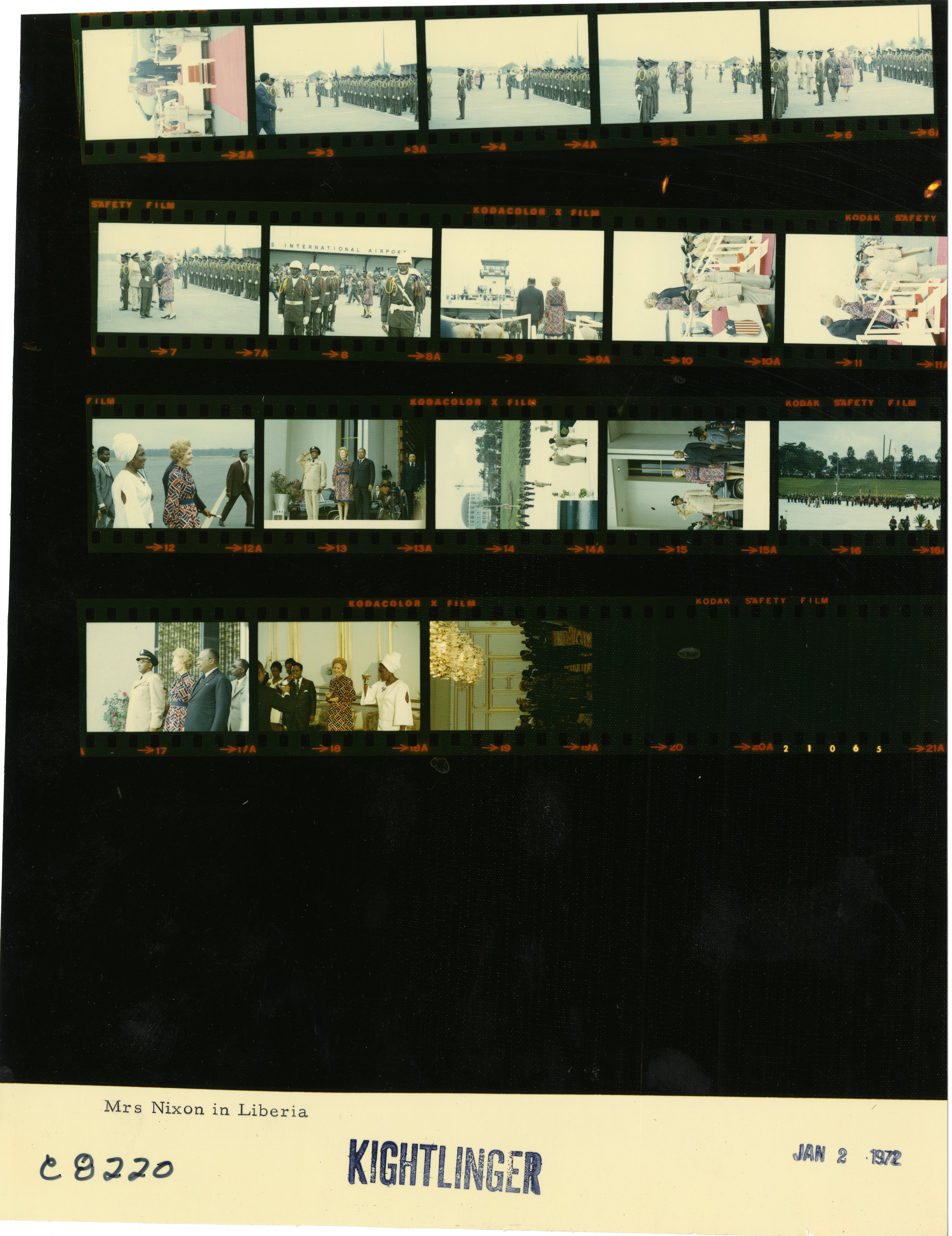
- Frame(s): WHPO-8220-, Pat Nixon during her Liberia, Africa Goodwill tour visit. 1/2/1972, Monrovia, Liberia Executive Mansion. Pat Nixon, President William R. Tolbert, Jr., Maj. John V. Brennan (AKA) Jack Brennan, Mrs. Tolbert, Liberian soldiers.
- Frame(s): WHPO-8220-02-12, Pat Nixon arrival in Liberia, Africa. 1/2/1972, Monrovia, Liberia Roberts International Airport. Pat Nixon, Maj. John V. Brennan (AKA) Jack Brennan, Liberian Commander of Troops, Liberian soldiers, President William R. Tolbert, Jr., Mrs. Tolbert.
Roll WHPO-8221 Photographer: Kightlinger, Jack | Color or B&W: Color
- Frame(s): WHPO-8221-, Pat Nixon visiting Liberia, Africa. 1/2/1972, Monrovia, Liberia Executive Mansion. Pat Nixon, unidentified Liberian officials, staff.
Roll WHPO-8222 Photographer: Kightlinger, Jack | Color or B&W: Color
- Frame(s): WHPO-8222-, Pat Nixon arriving at the Executive Mansion in Monrovia, Liberia during her Goodwill tour of Africa. 1/2/1972, Monrovia, Liberia Executive Mansion. Pat Nixon, President Tolbert, Mrs. Tolbert, Maj. John V. Brennan (AKA) Jack Brennan.
- Frame(s): WHPO-8222-03-23, Pat Nixon arrival in Monrovia, Liberia, Africa. 1/2/1972, Monrovia, Liberia Roberts International Airport. Pat Nixon, President William R. Tolbert, Jr., Mrs. Tolbert, Fammatta Yancy, Ambassador Samuel Z. Westerfield, Chief of Protocol James E. Morgan, Rev. Billy Graham, Sec. J. Rudolph Grimes, Mrs. Grimes, ambassador S. Edward Peal, Mrs. Peal.
- Frame(s): WHPO-8222-24-27, Pat Nixon's motorcade driving through Monrovia, Liberia. 1/2/1972, Monrovia, Liberia city streets. Pat Nixon, crowd.
- Frame(s): WHPO-8222-26, Pat Nixon in a limousine motorcade waving at the crowd in Monrovia, Liberia. A sign reads, "God Bless Liberia." Crowd is seen waving American flags. 1/2/1972, Monrovia, Liberia city streets. Pat Nixon, crowd.
Roll WHPO-8259 Photographer: Kightlinger, Jack | Color or B&W: B&W
- Frame(s): WHPO-8259-, Pat Nixon in Liberia, Africa. 1/2/1972, Liberia, Africa Liberia, Africa. Pat Nixon, President Tolbert.
The White House Communications Agency Sound Recordings Collection contains public statements that took place between 1969 and 1974. Visit the finding aid to learn more.
C - First Lady
- WHCA-SR-C-095
Remarks by Pat Nixon on arrival at the Executive Mansion in Monrovia, Liberia. (1/2/1972, Monrovia, Liberia)
Production credits: Audio feed supplied by WHCA; Recorded by JMC (initials of WHCA engineer)
Original Format: 1/4-inch reel-to-reel audiotape. Original source type: Original. - WHCA-SR-C-162
First Lady airport arrival and toast at the Executive Mansion in Monrovia, Liberia. Additional speaker: President of Liberia. (1/2/1972, Monrovia, Liberia)
Runtime: none listed
Production credits: No feed information listed; Recorded by LRR (initials of WHCA engineer)
Original Format: 1/4-inch reel-to-reel audiotape. Original source type: Original.
P - Formal Presidential Remarks
- WHCA-SR-P-720101
Dan Rather's A Conversation with the President. (1/2/1972)
Runtime: 58:45:00
Original Format: 1/4-inch reel-to-reel audiotape. Original source type: Original.
The White House Communications Agency Videotape Collection contains “off-the-air” recordings of televised programs produced between 1968 and 1974. Visit the finding aid to learn more.
- WHCA-4930
"Strangers in Their Own Land - Chicanos," part III. Richard Allen.
Undetermined
Runtime: 00:54:31 - WHCA-4931
"Face the Nation", "Meet the Press" AND "Issues and Answers".
CBS
Runtime: 01:30:13 - WHCA-4932
"60 Minutes". a segment on the families of POW's in Vietnam (Vietnam Prisoner of War)
WCET, Los Angeles
Runtime: 01:05:15 - WHCA-4933
"A Conversation with the President". Steve Bull, Julie Eisenhower, Richard Helms, Gary Washington, George Shultz, Paul McCracken, John Connally, Arthur Burns, Donald Rumsfeld, Romagna Banuelos, Pierre Elliott Trudeau, Frank Fitzsimmons, Pat Nixon, Tricia Cox, Lewis Powell, John Chancellor, G.
NBC
Runtime: 01:06:46 - WHCA-4934
"A Conversation with the President," (linefeed from CBS truck).
NBC
Runtime: 01:00:39
Context (External Sources)
The Vanderbilt Television News Archive is the world's most extensive and complete archive of television news. They have been recording, preserving and providing access to television news broadcasts of the national networks since August 5, 1968.
Wikipedia is a free encyclopedia that anyone can edit.