

Introduction
This almanac page for Monday, January 22, 1973, pulls together various records created by the federal government and links to additional resources which can provide context about the events of the day.
Previous Date: Sunday, January 21, 1973
Next Date: Tuesday, January 23, 1973
Schedule and Public Documents
The Daily Diary files represent a consolidated record of the President's activities. Visit the finding aid to learn more.
The President's day began at The White House - Washington, D. C.
The Weekly Compilation of Presidential Documents made available transcripts of the President's news conferences; messages to Congress; public speeches, remarks, and statements; and other Presidential materials released by the White House.
Digitized versions can be found at HathiTrust.
Each Public Papers of the Presidents volume contains the papers and speeches of the President of the United States that were issued by the White House Office of the Press Secretary during the time period specified by the volume. The material is presented in chronological order, and the dates shown in the headings are the dates of the documents or events. In instances when the release date differs from the date of the document itself, that fact is shown in the text note.
To ensure accuracy, remarks have been checked against audio recordings (when available) and signed documents have been checked against the original, unless otherwise noted. Editors have provided text notes and cross references for purposes of identification or clarity.
The Federal Register is the official daily publication for rules, proposed rules, and notices of federal agencies and organizations, as well as executive orders and other Presidential documents.
The Congressional Record is the official daily record of the debates and proceedings of the U.S. Congress.
Archival Holdings
Any selection of archival documents will necessarily be partial. You should use the documents and folders identified below as a starting place, but consult the linked collection finding aids and folder title lists and the collections themselves for context. Many documents to be found this way do not lend themselves to association with specific dates, but are essential to a complete understanding of the material.
Selective document listing
President's Office Files
The President's Office Files consists of materials drawn together by the Special Files Unit from several administrative subdivisions within the White House Office. It is the handwriting and sensitive papers sent to the Staff Secretary that now comprise much of the President's Office Files. Visit the finding aid to learn more.
- News Summaries, Unmarked News Summaries, Box 53, News Summaries - January 12 to 31, 1973 [2 of 5] [Note: Due to the way News Summary products were compiled, you should also consult nearby days for potentially relevant materials.]
- Weekend News Review, January 22, 1973, (Fri-Sun nets, wires; Sat-Sun papers)
The H. R. Haldeman Diaries consists of seven handwritten diaries, 36 dictated diaries recorded as sound recordings, and two handwritten audio cassette tape subject logs. The diaries and logs reflect H. R. Haldeman’s candid personal record and reflections on events, issues, and people encountered during his service in the Nixon White House. As administrative assistant to the President and Chief of Staff, Haldeman attended and participated in public events and private meetings covering the entire scope of issues in which the Nixon White House engaged in during the years 1969-1973. Visit the finding aid to learn more.
- Transcript of diary entry (PDF)
Monday, January 22.
Big question today was planning on the Vietnam settlement. Henry left this morning for Paris, and the President told Ziegler to get a leak out to the Post and to Dan Rather that the initialing will be on Friday, so that we can throw them off-balance. Then he got into a lot of miscellaneous Inaugural follow-up on the social plans and scheduling: that we need an impresario for White House entertainment; he wants to get the guy that charged his car yesterday and was arrested, released on the President's recommendation; concerned about writers, that he’ll never attend anything at the cathedral again; that he had a problem at his Inaugural address, because when he got what was supposed to be the final draft Friday evening, he discovered a sentence was missing. He called Rose and she said she had told the girls to proof it, but she couldn't do anything about it now, she was late for a party. Then he tried to reach Ray and he was already at the Kennedy Center, so he had Manalo go down and get the press copy, and the sentence was missing from that, too. The President couldn't find Ziegler to check with him, so he dropped the sentence, but it must have been a rather discouraging sequence for him, not to be able to find anybody to take care of the problem.
He got into the usual concerns about follow-up on all the recognition to the Inaugural people, mailing out of the address and the church service scripts and things of that sort. He got into the question of the domestic TV speech again. He feels that we're loading too much TV into his activity if he goes on, on Sunday, and wonders if it could be postponed a week. He's really concerned about the problem of overexertion and is obviously tired from the Inaugural weekend. He's afraid he can't get the speech ready, that there's not enough time available. It's got to be down to a reasonable length and be in crisp terms, and he agreed that if they could have a speech by noon on Wednesday, he would tape it on Thursday. He's shooting for trying to get away for the weekend. He wanted me, though, to try and sell Ehrlichman of -- on the problem against going on TV Sunday night and kicking the Great Society, if something should happen to Lyndon Johnson. Then a little later, while we were meeting with Ray Price on the Vietnam speech, going over the question of whether to give it to Congress or out at the office, we got word that President Johnson had probably died. I had a note from Larry saying that he'd been taken to the hospital seriously ill, then a follow-up note saying that the Secret Service thought he was dead when they found him. Tkach couldn't get any confirmation, until finally Lady Bird called an hour and fifteen or twenty minutes after our first notice, and officially informed the President. We had been informed just a few minutes before that by Tkach, finally, that he was dead, but that they had tried to revive him on the plane and that they couldn't get Mrs. Johnson to notify her, and they didn't want to put any word out until she had been told. I then talked to Tom Johnson, at the President's request, to tell him that they should not have a service at the cathedral and to set up all the arrangements for any help we could provide to them. I talked to Tom later in the evening about the arrangements and we’re setting everything up for them to handle it just the way they want to do it.
The President then got back to the TV thing again on the phone this evening. He said that he doesn't want to do the TV. Thinks that we shouldn't overuse the President and that this is a good time for him to take off three days during the Johnson funeral period. That we've been pouring it on for too long and then we've got the press conference next week. He wouldn't mind doing radio. He's concerned that he’ll be on the TV medium too much. Then he went back to agreeing to taping it on Thursday, if we could then let him take off Thursday night for the weekend.
End of January 22. - Original audio recording (MP3)
The National Archives Catalog is the online portal to the records held at the National Archives, and information about those records. It is the main way of describing our holdings and also provides access to electronic records and digitized versions of our holdings.
The Catalog searches across multiple National Archives resources at once, including archival descriptions, digitized and electronic records, authority records, and web pages from Archives.gov and the Presidential Libraries. The Catalog also allows users to contribute to digitized historical records through tagging and transcription.
Nixon Library Holdings
All National Archives Units
National Security Documents
The President's Daily Brief is the primary vehicle for summarizing the day-to-day sensitive intelligence and analysis, as well as late-breaking reports, for the White House on current and future national security issues. Read "The President's Daily Brief: Delivering Intelligence to Nixon and Ford" to learn more.
The Foreign Relations of the United States series presents the official documentary historical record of major U.S. foreign policy decisions and significant diplomatic activity. Visit the State Department website for more information.
Vol. IX, Vietnam, October 1972-January 1973
America Leaves the War, December 30, 1972-January 27, 1973
324. Memorandum From the Department of State Deputy Legal Adviser (Aldrich) to the President’s Assistant for National Security Affairs (Kissinger), Paris, January 22, 1973
Source: National Archives, Nixon Presidential Materials, NSC Files, Kissinger Office Files, Box 109, Country Files, Far East, Vietnam Negotiations, Rationale. Secret.
325. Backchannel Message From the President’s Assistant for National Security Affairs (Kissinger) to the Ambassador to Vietnam (Bunker), Washington, January 22, 1973, 0203Z
Source: National Archives, Nixon Presidential Materials, NSC Files, Box 860, For the President’s Files (Winston Lord)—China Trip/Vietnam, Sensitive Camp David, Vol. XXIV. Top Secret; Flash; Sensitive; Exclusively Eyes Only.
326. Backchannel Message From the Ambassador to Vietnam (Bunker) to the President’s Assistant for National Security Affairs (Kissinger), Saigon, January 22, 1973, 0850Z
Source: National Archives, Nixon Presidential Materials, NSC Files, Box 860, For the President’s Files (Winston Lord)—China Trip/Vietnam, Sensitive Camp David, Vol. XXIV. Top Secret; Operational Immediate; Sensitive; Exclusively Eyes Only.
327. Transcript of a Telephone Conversation Between the President’s Assistant for National Security Affairs (Kissinger) and the Vice Chief of Staff of the Army (Haig), Washington, January 22, 1973, 9:20 a.m.
Source: National Archives, Nixon Presidential Materials, Kissinger Telephone Conversations, Box 18, Chronological File. No classification marking.
328. Message From the Deputy Assistant Secretary of State for East Asian and Pacific Affairs (Sullivan) to the President’s Assistant for National Security Affairs (Kissinger), Paris, January 22, 1973, 1517Z
Source: National Archives, Nixon Presidential Materials, NSC Files, Box 860, For the President’s Files (Winston Lord)—China Trip/Vietnam, Sensitive Camp David, Vol. XXIV. Secret; Operational Immediate; Sensitive; Exclusively Eyes Only. Sent via Guay and Scowcroft.
329. Message From the President’s Military Assistant (Scowcroft) to the President’s Assistant for National Security Affairs (Kissinger), Washington, January 22, 1973, 2300Z
Source: National Archives, Nixon Presidential Materials, NSC Files, Kissinger Office Files, Box 28, HAK Trip Files, HAK Paris Trip Hakto & Tohak & Misc. Memos, etc., January 22–23, 1973. Top Secret; Flash; Sensitive; Exclusively Eyes Only.
Vol. XXV, Arab-Israeli Crisis and War, 1973
Arab-Israeli Crisis and War, 1973
5. Telegram From the Embassy in Jordan to the Department of State, Amman, January 22, 1973, 1030Z
Source: National Archives, Nixon Presidential Materials, NSC Files, Box 618, Country Files, Middle East, Jordan, IX, January–October 1973. Secret; Nodis.
Vol. E-6, Documents on Africa, 1973-1976
Horn of Africa
78. Telegram 782 From the Embassy in Ethiopia to the Department of State, Addis Ababa, January 22, 1973, 1418Z
Chargé d’Affaires Parker W. Wyman reported on the implications for U.S. policy of the Somali threat to Ethiopia. He recommended immediate U.S. assistance to Ethiopia.
Source: National Archives, RG 59, Central Files 1970–73, ETH-SOMALIA. Secret; Priority. Repeated to Bonn, London, Mogadiscio, Moscow, Nairobi, Paris, Rome, Tel Aviv, USCINCEUR, and Asmara. The Airgram was sent from the Embassy as A-13 on January 24. (Ibid., RG 84, Addis Ababa Embassy Files: Lot 77 F 121, POL-DCM, MAP Level 1973)
Vol. E-12, Documents on East and Southeast Asia, 1973-1976
Philippines
315. Telegram 0823 From the Embassy in the Philippines to the Department of State, January 22, 1973, 1000Z., January 22, 1973, 1000Z
The embassy analyzed events in the Philippines.
Source: National Archives, Nixon Presidential Materials, NSC Institutional Files (H-Files), Box H–192, NSSM 155 [2 of 2]. Secret; Exdis. Repeated Priority to DOD and CINCPAC.
The Kissinger telephone conversation transcripts consist of approximately 20,000 pages of transcripts of Kissinger’s telephone conversations during his tenure as Assistant to the President for National Security Affairs (1969-1974) and Secretary of State (1973-1974) during the administration of President Richard Nixon. Visit the finding aid for more information.
Digitized versions can be found in the National Archives Catalog.
Audiovisual Holdings
Visit the White House Tapes finding aid to learn about the taping system's operation and archival processing.
Old Executive Office Building
- 398-16; Unknown between 7:56 p.m. & 8:15 p.m.; Nixon, Richard M. (President); Sanchez, Manolo
- 398-17; Unknown between 7:56 p.m. & 8:15 p.m.; Nixon, Richard M. (President); [Unknown person(s)]
- 399-1; Unknown between 7:56 a.m. & 8:15 a.m.; Nixon, Richard M. (President)
- 399-2; 8:15 a.m. - 9:10 a.m.; Nixon, Richard M. (President); Kissinger, Henry A.
- 399-3; Unknown between 9:10 a.m. & 9:47 a.m.; Nixon, Richard M. (President)
- 399-4; Unknown between 9:10 a.m. & 9:47 a.m.; Nixon, Richard M. (President)
- 399-5; Unknown between 9:10 a.m. & 9:47 a.m.; Nixon, Richard M. (President); Sanchez, Manolo
- 399-6; Unknown between 9:10 a.m. & 9:47 a.m.; Nixon, Richard M. (President); Kissinger, Henry A.
- 399-7; Unknown between 9:10 a.m. & 9:47 a.m.; Nixon, Richard M. (President); White House operator
- 399-8; Unknown between 9:47 a.m. & 9:53 a.m.; Nixon, Richard M. (President); Haig, Alexander M., Jr.
- 399-9; Unknown between 9:53 a.m. & 10:14 a.m.; Nixon, Richard M. (President); Sanchez, Manolo
- 399-10; Unknown between 9:53 a.m. & 10:14 a.m.; Nixon, Richard M. (President); Terry, Debbie; White House operator
- 399-11; Unknown between 10:14 a.m. & 10:48 a.m.; Nixon, Richard M. (President); Price, Raymond K., Jr.; Sanchez, Manolo; White House operator; Ziegler, Ronald L.
- 399-12; Unknown between 10:48 a.m. & 11:01 a.m.; Nixon, Richard M. (President); Sanchez, Manolo
- 399-13; Unknown between 10:48 a.m. & 11:01 a.m.; Nixon, Richard M. (President); Sanchez, Manolo
- 399-14; 11:01 a.m. - 1:20 p.m.; Nixon, Richard M. (President); Haldeman, H. R. ("Bob"); Ziegler, Ronald L.; Eisenhower, Julie Nixon
- 399-15; Unknown between 1:20 p.m. & 2:53 p.m.; Nixon, Richard M. (President); Sanchez, Manolo
- 399-16; Unknown between 1:20 p.m. & 2:53 p.m.; Nixon, Richard M. (President); Sanchez, Manolo
- 400-1; Unknown between 12:12 p.m. & 2:53 p.m.; Nixon, Richard M. (President); [Unknown person(s)]
- 400-2; Unknown between 12:12 p.m. & 2:53 p.m.; Nixon, Richard M. (President); Sanchez, Manolo
- 400-3; Unknown between 12:12 p.m. & 2:53 p.m.; Nixon, Richard M. (President); [Unknown person(s)]
- 400-4; 2:53 p.m. - 2:55 p.m.; Nixon, Richard M. (President); Sanchez, Manolo; Bull, Stephen B.
- 400-5; Unknown between 2:55 p.m. & 3:39 p.m.; Nixon, Richard M. (President); Haldeman, H. R. ("Bob")
- 400-6; Unknown between 2:55 p.m. & 3:39 p.m.; Nixon, Richard M. (President); Haldeman, H. R. ("Bob")
- 400-7; Unknown between 3:15 p.m. & 3:39 p.m.; Nixon, Richard M. (President)
- 400-8; 3:39 p.m. - 3:39 p.m.; Nixon, Richard M. (President); White House operator
- 400-9; Unknown between 3:39 p.m. & 4:05 p.m.; Nixon, Richard M. (President); Sanchez, Manolo
- 400-10; Unknown between 3:39 p.m. & 4:05 p.m.; Nixon, Richard M. (President)
- 400-11; Unknown between 3:40 p.m. & 4:05 p.m.; Nixon, Richard M. (President); Colson, Charles W.; Price, Raymond K., Jr.; White House operator; Ziegler, Ronald L.
- 400-12; 4:51 p.m. - 4:51 p.m.; Nixon, Richard M. (President); White House operator
- 400-13; Unknown between 4:51 p.m. & 5:00 p.m.; Nixon, Richard M. (President); Haldeman, H. R. ("Bob")
- 400-14; 5:00 p.m. - 6:30 p.m.; Nixon, Richard M. (President); Price, Raymond K., Jr.; Sanchez, Manolo; Haldeman, H. R. ("Bob"); Bull, Stephen B.; Tkach, Walter R.; White House operator; Haig, Alexander M., Jr.
- 402-12; Unknown between 8:22 p.m. & 8:47 p.m.; Nixon, Richard M. (President); Sanchez, Manolo
- 402-13; Unknown between 8:22 p.m. & 8:47 p.m.; Nixon, Richard M. (President)
- 402-14; Unknown between 8:22 p.m. & 8:47 p.m.; Nixon, Richard M. (President); White House operator
- 402-15; Unknown between 8:22 p.m. & 8:47 p.m.; Nixon, Richard M. (President)
- 402-16; Unknown between 8:47 p.m. & 8:50 p.m.; Nixon, Richard M. (President); Colson, Charles W.
- 402-17; Unknown between 8:47 p.m. & 8:50 p.m.; Nixon, Richard M. (President); Haig, Alexander M., Jr.; Price, Raymond K., Jr.
White House Telephone
- 36-36; 9:47 a.m. - 9:53 a.m.; Nixon, Richard M. (President); White House operator
- 36-37; Unknown between 9:10 a.m. & 9:47 a.m.; Nixon, Richard M. (President); Haig, Alexander M., Jr.
- 36-38; 10:14 a.m. - 10:14 a.m.; Nixon, Richard M. (President); White House operator
- 36-39; 10:26 a.m. - 10:27 a.m.; Nixon, Richard M. (President); Ziegler, Ronald L.
- 36-40; 12:10 p.m. - 12:22 p.m.; Nixon, Richard M. (President); Eisenhower, Julie Nixon
- 36-41; 3:39 p.m. - 3:39 p.m.; Nixon, Richard M. (President); White House operator
- 36-42; 4:05 p.m. - 4:06 p.m.; Nixon, Richard M. (President); Price, Raymond K., Jr.
- 36-43; Unknown between 4:06 p.m. & 4:13 p.m.; Nixon, Richard M. (President); White House operator
- 36-44; 4:13 p.m. - 4:14 p.m.; Nixon, Richard M. (President); Ziegler, Ronald L.
- 36-45; 4:14 p.m. - 4:14 p.m.; Nixon, Richard M. (President); White House operator
- 36-46; 4:15 p.m. - 4:16 p.m.; Nixon, Richard M. (President); Ziegler, Ronald L.
- 36-47; 4:51 p.m. - 4:51 p.m.; Nixon, Richard M. (President); White House operator
- 36-48; Unknown between 5:55 p.m. & 6:19 p.m.; Haldeman, H. R. ("Bob"); Tkach, Walter R.
- 36-49; Unknown between 5:55 p.m. & 6:19 p.m.; Haldeman, H. R. ("Bob"); Tkach, Walter R.
- 36-50; Unknown between 5:55 p.m. & 6:19 p.m.; Tkach, Walter R.; Haldeman, H. R. ("Bob")
- 36-51; Unknown between 5:55 p.m. & 6:19 p.m.; Haldeman, H. R. ("Bob"); Tkach, Walter R.
- 36-52; Unknown between 5:55 p.m. & 6:19 p.m.; Nixon, Richard M. (President); White House operator
- 36-53; 6:19 p.m. - 6:22 p.m.; Nixon, Richard M. (President); Haig, Alexander M., Jr.
- 36-54; Unknown between 6:22 p.m. & 7:14 p.m.; Nixon, Richard M. (President); White House operator
- 36-55; 7:14 p.m. - 7:20 p.m.; Nixon, Richard M. (President); Haldeman, H. R. ("Bob")
- 36-56; 7:26 p.m. - 7:26 p.m.; Nixon, Richard M. (President); White House operator
- 36-57; Unknown between 7:26 p.m. & 7:29 p.m.; Nixon, Richard M. (President); White House operator
- 36-58; 7:29 p.m. - 7:31 p.m.; Nixon, Richard M. (President); Ziegler, Ronald L.
- 36-59; 7:38 p.m. - 7:40 p.m.; Nixon, Richard M. (President); Rebozo, Charles G. ("Bebe")
- 36-60; 8:03 p.m. - 8:05 p.m.; Nixon, Richard M. (President); Ziegler, Ronald L.
- 36-61; 8:47 p.m. - 8:50 p.m.; Nixon, Richard M. (President); Colson, Charles W.
The White House Photo Office collection consists of photographic coverage of President Richard Nixon meeting with prominent social, political, and cultural personalities; speaking engagements and news conferences of the President and various high-ranking members of the White House staff and Cabinet; Presidential domestic and foreign travel, including Presidential vacations; social events and entertainment involving the First Family, including entertainers present; official portraits of the President, First Family, and high-ranking members of the Nixon administration; the 1969 and 1973 Inaugurals; the President’s 1972 Presidential election campaign appearances (including speeches) and other official activities of the White House staff and the President’s Cabinet from January 20, 1969 until August 9, 1974 at the White House and the Old Executive Office Building; other locations in Washington, DC, such as The Mall; and the Presidential retreats in Camp David, Maryland, Key Biscayne, Florida, and San Clemente, California. Visit the finding aid to learn more.
Roll WHPO-E0066 Photographer: unknown | Color or B&W: B&W
- Frame(s): WHPO-E0066-, Copies of John Scali portraits. 1/22/1973, unknown unknown. John Scali.
- Frame(s): WHPO-E0066-00, Portrait study of John Scali. 1/22/1973, unknown unknown. John Scali.
Roll WHPO-E0067 Photographer: unknown | Color or B&W: B&W
- Frame(s): WHPO-E0067-, Copies of John Scali portraits. 1/22/1973, unknown unknown. John Scali.
- Frame(s): WHPO-E0067-00, Close-up portrait study of John Scali. 1/22/1973, unknown unknown. John Scali.
Roll WHPO-E0068 Photographer: Schumacher, Karl | Color or B&W: Color
- Frame(s): WHPO-E0068-, Unidentified man and woman standing next to a large floral arrangement of the Presidential Seal. 1/22/1973, Washington, D.C. unknown. unidentified man and woman.
Roll WHPO-E0069 Photographer: Royer | Color or B&W: B&W
- Frame(s): WHPO-E0069-, Herb Klein receiving a plaque with his name on it. 1/22/1973, Washington, D.C. unknown. Klein, unidentified man and woman.
Roll WHPO-E0070 Photographer: Royer | Color or B&W: B&W
- Frame(s): WHPO-E0070-, Deputy Special Assistant John E. Nidecker receiving gifts. 1/22/1973, Washington, D.C. unknown. Nidecker, unidentified man and woman.
Roll WHPO-E0072 Photographer: Knudsen, Robert L. | Color or B&W: B&W
- Frame(s): WHPO-E0072-, Henry Kissinger initializing the Vietnam Peace Accord Agreement 'peace talks' by meeting with Vietnamese government officials in Paris. 1/22/1973, Paris, France unknown. Henry Kissinger, Le Duc Tho, Kissinger team, North Vietnamese negotiators, South Vietnamese Negotiators, Le Duc Tho, unidentified officials.
- Frame(s): WHPO-E0072-, Henry Kissinger leaving a building after meeting with Vietnamese government officials to initialize the Vietnam Peace Accord Agreement 'Paris Peace Talks.'. 1/22/1973, Paris, France unknown. Henry Kissinger, Le Duc Tho, Kissinger team, North Vietnamese negotiators, South Vietnamese Negotiators, Le Duc Tho, unidentified officials.
- Frame(s): WHPO-E0072-, Henry Kissinger signing the Vietnam Peace Accord Agreement. Henry Kissinger shaking hands with Vietnamese government officials including Le Duc Tho during the Paris Peace Talks. 1/22/1973, Paris, France unknown. Henry Kissinger, Le Duc Tho, Kissinger team, North Vietnamese negotiators, South Vietnamese Negotiators, Le Duc Tho, unidentified officials.
- Frame(s): WHPO-E0072-17, Henry Kissinger shaking hands with Le Duc Tho while leading Vietnamese negotiators to stand with Xuan Thuy, nearby in a receiving line at the Vietnam Peace Accord talks. (Paris Peace Accords). 1/22/1973, Paris, France unknown. Henry Kissinger, Le Duc Tho, Xuan Thuy, Kissinger team, North Vietnamese negotiators, South Vietnamese Negotiators, unidentified officials.
Roll WHPO-E0073 Photographer: Knudsen, Robert L. | Color or B&W: B&W
- Frame(s): WHPO-E0073-, Henry Kissinger signing the Vietnam Peace Agreement at the Paris Peace Talks conference table. 1/22/1973, Paris, France unknown. Henry Kissinger, Le Duc Tho, Kissinger team, Winston Lord, North Vietnamese negotiators, South Vietnamese Negotiators, Le Duc Tho, unidentified officials.
- Frame(s): WHPO-E0073-31A, Henry Kissinger signing the Vietnam Peace Agreement at the Paris Peace Talks conference table while an Asian cameraman films the event. 1/22/1973, Paris, France unknown. Henry Kissinger, Le Duc Tho, Kissinger team, Winston Lord, North Vietnamese negotiators, South Vietnamese Negotiators, unidentified officials.
Roll WHPO-E0074 Photographer: Knudsen, Robert L. | Color or B&W: Color
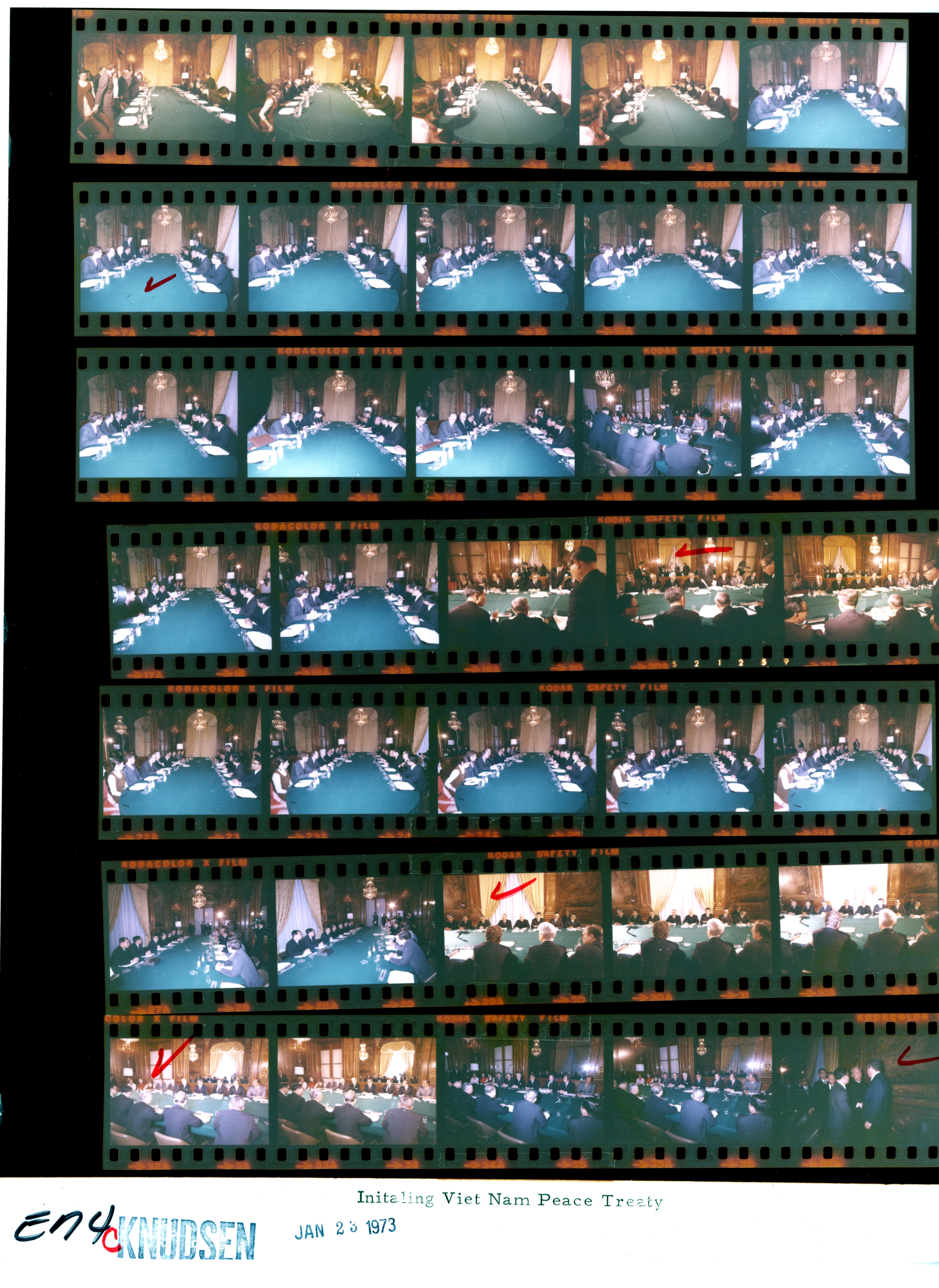
- Frame(s): WHPO-E0074-, Henry Kissinger seated at a conference table with other officials initialing the Vietnam Peace Accord Agreement talks. Henry Kissinger shaking an unidentified official's hands. (Paris Peace Talks). 1/22/1973, Paris, France unknown. Henry Kissinger, Le Duc Tho, Kissinger team, Winston Lord, North Vietnamese negotiators, South Vietnamese Negotiators, Le Duc Tho, unidentified officials.
- Frame(s): WHPO-E0074-, Henry Kissinger shaking an unidentified Vietnamese official's hand during a session of the Vietnam Peace Accord Agreement talks in Paris. (Paris Peace Talks). 1/22/1973, Paris, France unknown. Henry Kissinger, Le Duc Tho, Kissinger team, Winston Lord, North Vietnamese negotiators, South Vietnamese Negotiators, Le Duc Tho, unidentified officials.
- Frame(s): WHPO-E0074-04, Henry Kissinger seated at a conference table with other officials during the Vietnam Peace Accord Agreement talks. (Paris Peace Talks). 1/22/1973, Paris, France unknown. Henry Kissinger, Le Duc Tho, Kissinger team, Winston Lord, North Vietnamese negotiators, South Vietnamese Negotiators, Le Duc Tho, unidentified officials.
- Frame(s): WHPO-E0074-05A, Henry Kissinger seated at a conference table with other officials during the Vietnam Peace Accord Agreement talks. (Paris Peace Talks). 1/22/1973, Paris, France unknown. Henry Kissinger, Le Duc Tho, Kissinger team, Winston Lord, North Vietnamese negotiators, South Vietnamese Negotiators, unidentified officials.
- Frame(s): WHPO-E0074-07A, Henry Kissinger seated at a conference table with other officials during the Vietnam Peace Accord Agreement talks. (Paris Peace Talks). 1/22/1973, Paris, France unknown. Henry Kissinger, Le Duc Tho, Kissinger team, Winston Lord, North Vietnamese negotiators, South Vietnamese Negotiators, unidentified officials.
- Frame(s): WHPO-E0074-17, Henry Kissinger seated at a conference table with other officials during the Vietnam Peace Accord Agreement talks. (Paris Peace Talks). 1/22/1973, Paris, France unknown. Henry Kissinger, Le Duc Tho, Kissinger team, Winston Lord, North Vietnamese negotiators, South Vietnamese Negotiators, unidentified officials.
- Frame(s): WHPO-E0074-19A, Henry Kissinger seated at a conference table with other officials during the Vietnam Peace Accord Agreement talks. (Paris Peace Talks). 1/22/1973, Paris, France unknown. Henry Kissinger, Le Duc Tho, Kissinger team, Winston Lord, North Vietnamese negotiators, South Vietnamese Negotiators, unidentified officials.
- Frame(s): WHPO-E0074-20A, Henry Kissinger seated at a conference table with other officials during the Vietnam Peace Accord Agreement talks. (Paris Peace Talks). 1/22/1973, Paris, France unknown. Henry Kissinger, Le Duc Tho, Kissinger team, Winston Lord, North Vietnamese negotiators, South Vietnamese Negotiators, unidentified officials.
- Frame(s): WHPO-E0074-29A, Henry Kissinger seated at a conference table with other officials during the Vietnam Peace Accord Agreement talks. (Paris Peace Talks). 1/22/1973, Paris, France unknown. Henry Kissinger, Le Duc Tho, Kissinger team, Winston Lord, North Vietnamese negotiators, South Vietnamese Negotiators, unidentified officials.
- Frame(s): WHPO-E0074-32A, Henry Kissinger seated at a conference table with other officials during the Vietnam Peace Accord Agreement talks. (Paris Peace Talks). 1/22/1973, Paris, France unknown. Henry Kissinger, Le Duc Tho, Kissinger team, Winston Lord, North Vietnamese negotiators, South Vietnamese Negotiators, unidentified officials.
Roll WHPO-E0076 Photographer: Knudsen, Robert L. | Color or B&W: B&W
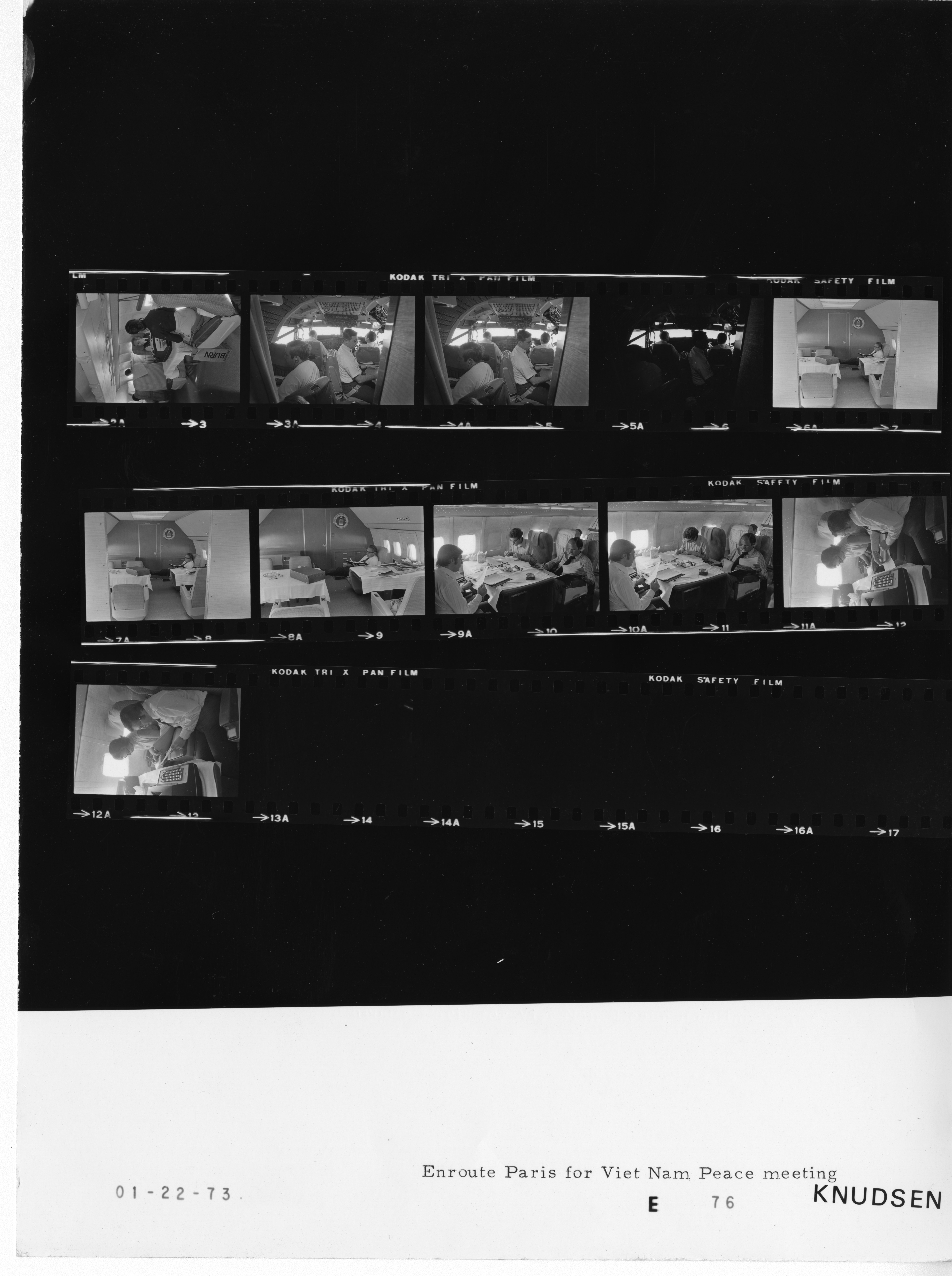
- Frame(s): WHPO-E0076-, Henry Kissinger, staff, and flight crew aboard the plane bound for the Vietnam Peace Accord talks in Paris. (Paris Peace Talks). 1/22/1973, air airplane. Henry Kissinger, flight crew, staff.
Roll WHPO-E0077 Photographer: Knudsen, Robert L. | Color or B&W: B&W
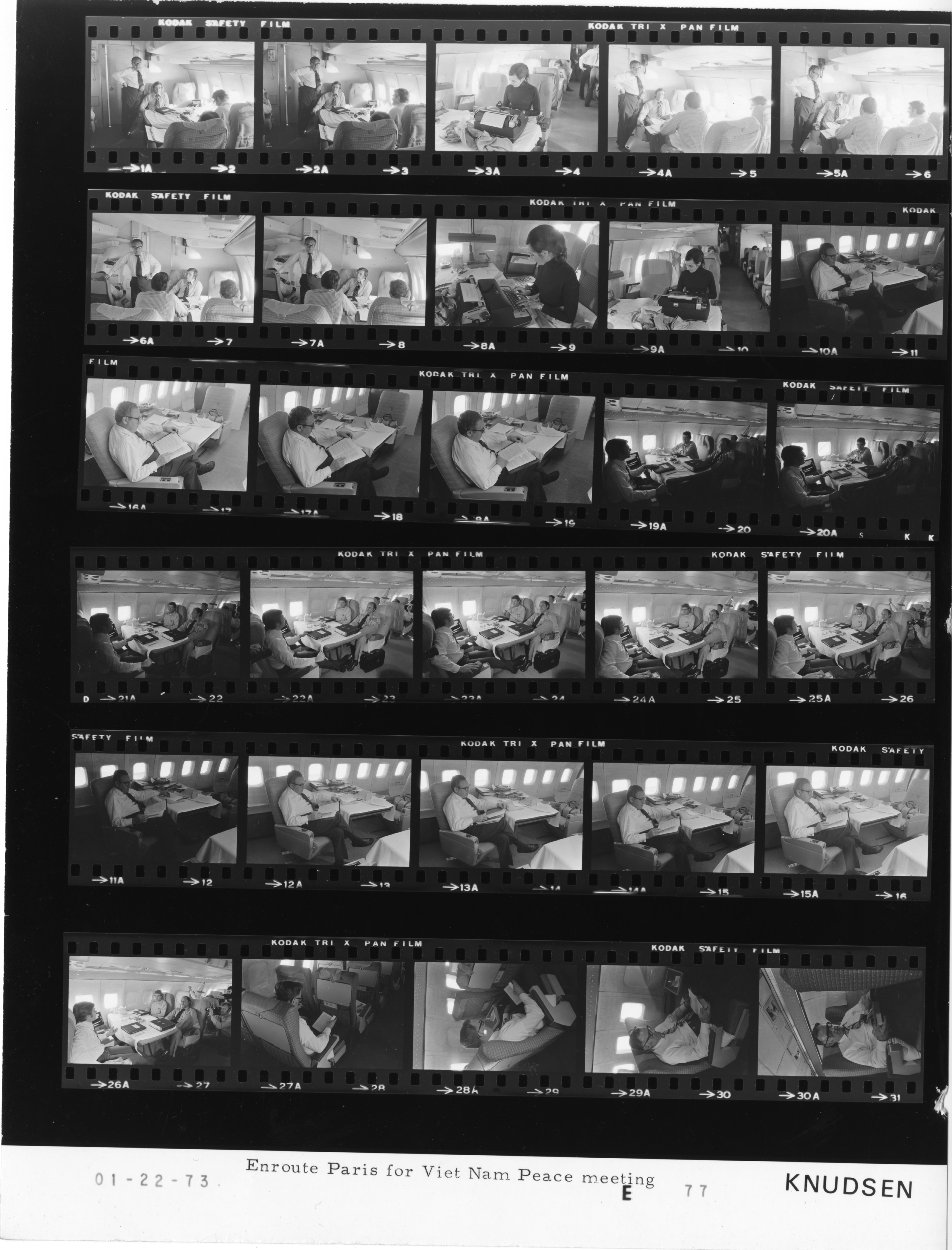
- Frame(s): WHPO-E0077-, Henry Kissinger and staff aboard the plane bound for the Vietnam Peace Accord talks in Paris. (Paris Peace Talks). 1/22/1973, air airplane. Henry Kissinger, Winston Lord, unidentified staff.
- Frame(s): WHPO-E0077-, Henry Kissinger and staff aboard the plane bound for the Vietnam Peace Accord talks in Paris. (Paris Peace Talks). 1/22/1973, air airplane. Henry Kissinger, Winston Lord, unidentified staff.
- Frame(s): WHPO-E0077-, Henry Kissinger and staff aboard the plane bound for the Vietnam Peace Accord talks in Paris. (Paris Peace Talks). 1/22/1973, air airplane. Henry Kissinger, Winston Lord, unidentified staff.
Roll WHPO-E0078 Photographer: Knudsen, Robert L. | Color or B&W: Color
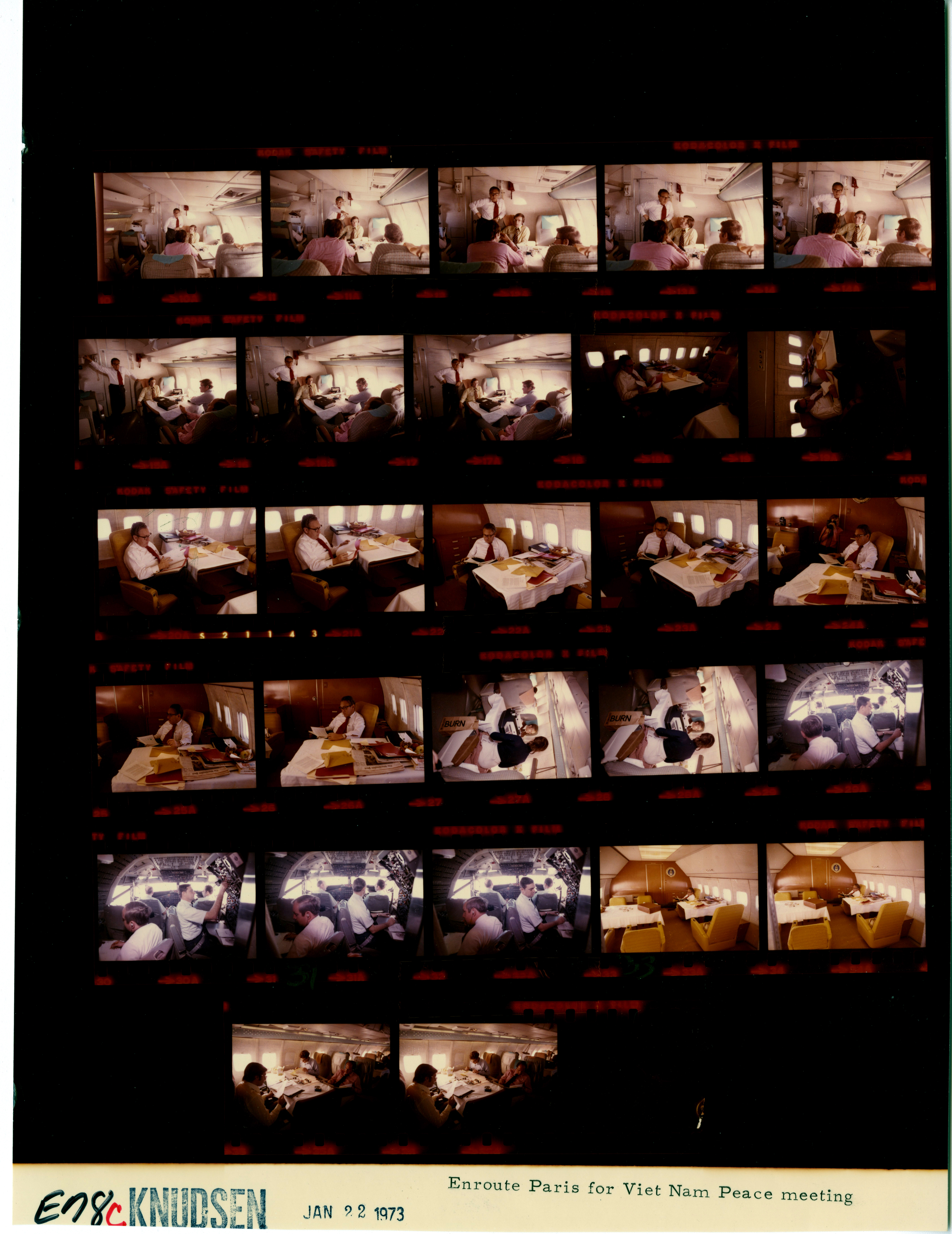
- Frame(s): WHPO-E0078-, Henry Kissinger, staff and flight crew aboard the plane bound for the Vietnam Peace Accord talks in Paris. (Paris Peace Talks). 1/22/1973, enroute, mid-air airplane interior. Henry Kissinger, Winston Lord, John Negroponte, Kissinger staff, flight crew.
- Frame(s): WHPO-E0078-03A, Henry Kissinger, staff and flight crew aboard the plane bound for the Vietnam Peace Accord talks in Paris. (Paris Peace Talks). 1/22/1973, enroute, mid-air airplane interior. Henry Kissinger, Winston Lord, John Negroponte, Kissinger staff, flight crew.
- Frame(s): WHPO-E0078-20A, Henry Kissinger seated at a table strewn with booklets, papers and newspapers. Kissinger reads and does paperwork while aboard a plane bound for the Vietnam Peace Accord talks in Paris. (Paris Peace Talks). 1/22/1973, enroute, mid-air airplane interior. Henry Kissinger.
- Frame(s): WHPO-E0078-26A, Henry Kissinger seated at a table strewn with booklets, papers and newspapers. Kissinger reads and does paperwork while aboard a plane bound for the Vietnam Peace Accord talks in Paris. (Paris Peace Talks). 1/22/1973, enroute, mid-air airplane interior. Henry Kissinger.
- Frame(s): WHPO-E0078-28, Unidentified male and female members of Henry Kissinger's staff aboard the plane enroute for the Vietnam Peace Accord talks in Paris. (Paris Peace Talks). Woman seen from behind typing while seated on blankets on her chair next to a burn bag. 1/22/1973, enroute, mid-air airplane interior. Unidentified staff members.
- Frame(s): WHPO-E0078-31A, Pilots and flight crew (navigator) in the cockpit working aboard Henry Kissinger's plane enroute to the Vietnam Peace Accord talks in Paris. (Paris Peace Talks). 1/22/1973, enroute, mid-air airplane interior. Unidentified crew and pilots.
- Frame(s): WHPO-E0078-33A, Henry Kissinger seated at a table strewn with booklets, papers and newspapers. Kissinger reads and does paperwork while aboard a plane bound for the Vietnam Peace Accord talks in Paris. (Paris Peace Talks). 1/22/1973, enroute, mid-air airplane interior. Henry Kissinger.
- Frame(s): WHPO-E0078-35A, Kissinger staff members seated at a table strewn with booklets, reading and working on paperwork, while aboard the plane bound for the Vietnam Peace Accord talks in Paris. (Paris Peace Talks). 1/22/1973, enroute, mid-air airplane interior. unidentified Kissinger team members, Winston Lord.
The White House Communications Agency Sound Recordings Collection contains public statements that took place between 1969 and 1974. Visit the finding aid to learn more.
L - White House Press Office Briefings
- WHCA-SR-L-111
Press briefing by Ronald Ziegler. (1/22/1973, White House Press Lobby)
Runtime: 16:30
Keywords: Press conferences, news conferences, interviews, media, press secretary
Original Format: 1/4-inch reel-to-reel audiotape. Original source type: Original. - WHCA-SR-L-112
Press briefing by Ronald Ziegler. (1/22/1973, White House Press Lobby)
Keywords: Press conferences, news conferences, interviews, media, press secretary
Original Format: 1/4-inch reel-to-reel audiotape. Original source type: Original.
The White House Communications Agency Videotape Collection contains “off-the-air” recordings of televised programs produced between 1968 and 1974. Visit the finding aid to learn more.
- WHCA-6020
"Today" Show excerpt.
CBS
Runtime: 00:29:56 - WHCA-6021
NBC Special on LBJ; NBC Special Report. MTP: John Ehrlichman, Herb Klein; "I&A": John Lynch.
NBC, ABC
Runtime: 00:59:39 - WHCA-6022
CBS Special on the Life & Death of LBJ.
CBS
Runtime: 01:00:47 - WHCA-6060
Weekly News Summary, Tape III.
ALL NETWORKS
Runtime: 0:30
1. Top stories: Former President Johnson (LBJ) dies, Paris peace talks (Vietnam War), Supreme Court rules abortion private matter between doctor and women in 1st 3 mos. Pregnancy, General Motors (GM) recall. Time Code Start: 00:00. Keywords: Presidents, death, Paris Peace Talks, Vietnam War, abortions, Feminism, Feminist movement, women's rights, Womens Liberation, equality, equal rights, gender, civil rights, activists, women, automobiles, cars, manufacturing, recalls, auto manufacturers. Network: ABC.
2. Report on former President Johnson (LBJ)'s death from a heart attack; film of his last speech to a civil rights symposium at the Johnson Presidential Library. Time Code Start: 00:46. Keywords: Presidents, death, speeches, African Americans, leaders, desegregation, racism, racial discrimination,. Network: ABC.
3. Commercials. Time Code Start: 03:23. Keywords: advertisements, ads, TV spots, television. Network: ABC.
4. Report on Paris ceasefire talks. Time Code Start: 04:25. Keywords: Paris Peace Talks, Vietnam War, treaty, treaties, negotiations, ceasefires. Network: ABC.
5. Film report on Paris peace talks, Kissinger, other principals arrive for final few days of negotiation. Time Code Start: 05:10. Keywords: Paris Peace Talks, Vietnam War, treaty, treaties, negotiations, government, officials, travel, trips. Network: ABC.
6. Phone interview with former President Johnson's (LBJ) press aide Tom Johnson on Johnson's death. Time Code Start: 07:16. Keywords: Presidents, death, staff, officials, statements, interviews. Network: ABC.
7. Commercials. Time Code Start: 09:35. Keywords: advertisements, ads, TV spots, television. Network: ABC.
8. Supreme court issues 7-2 ruling limiting states' rights to regulate abortions in the first and second trimesters of pregnancy (Roe vs. Wade). Time Code Start: 10:37. Keywords: law officials, judges, justices, courts, trials, investigations, rulings, decisions, lawsuits, judgements, abortions, birth, regulations. Network: ABC.
9. Film report from New York City on abortion decision; interviews with pro-life activist, women; film of picketers outside abortion clinic. Time Code Start: 11:32. Keywords: anti-abortion protests, demonstrations, Pro-Life issues, pregnancy, birth, right to life, Feminism, Feminist movement, women's rights, Womens Liberation, equality, equal rights, gender, civil rights, activists, women, abortion. Network: ABC.
10. Supreme Court decision voids government payments to private schools. Time Code Start: 14:05. Keywords: law officials, judges, justices, courts, trials, investigations, rulings, decisions, schools, money, subsidies. Network: ABC.
11. Report on Watergate trial testimony of Alfred Baldwin, surveillance expert who monitored the Democratic Headquarters bugs. Time Code Start: 14:21. Keywords: bugging, bugs, wiretapping, wire taps, surveillance, spying, recordings, Watergate, Senate committee hearings, investigations, testimony, testify, cover-ups, break-in, burglary, theft, plumbers, scandals. Network: ABC.
12. Film obituary of former President Johnson (LBJ). Time Code Start: 16:09. Keywords: Presidents, death, media, reports, documentary. Network: ABC.
13. Reasoner/Smith: News anchormen remember former President Johnson (LBJ) and his legacy. Time Code Start: 22:11. Keywords: Presidents, death, media, reports, documentary, news, celebrities. Network: ABC. - WHCA-6061
Weekly News Summary, Tape IV.
ALL NETWORKS
Runtime: 1:00
1. Top stories: Paris peace talks, abortion decision. Time Code Start: 00:00. Keywords: Paris Peace Talks, Vietnam War, treaty, treaties, negotiations. Network: NBC.
2. Report on final cease-fire talks sessions in Paris, with film of Kissinger, conference room, South Vietnamese and Viet Cong Foreign Ministers. Time Code Start: 00:51. Keywords: Paris Peace Talks, Vietnam War, ceasefires, treaty, treaties, negotiations, Vietnam War, People's Liberation Armed Forces (PLAF), National Liberation Front (NLF), VC, officials, travel, trips, media, speeches, interviews. Network: NBC.
3. Commercials. Time Code Start: 04:28. Keywords: advertisements, ads, TV spots, television. Network: NBC.
4. Report on last minute fighting in South Vietnam to gain ground before ceasefire. Time Code Start: 05:08. Keywords: Vietnam War, ceasefires, reports. Network: NBC.
5. POWs to be released within 60 days of ceasefire agreement. East German film interview of captured American B-52 airman, film of SAM-2 anti-aircraft missile. Time Code Start: 06:37. Keywords: Vietnam War, Vietnam Prisoner of War, ceasefires, aircraft, artillery, weapons. Network: NBC.
6. John Ehrlichman claims domestic spending will not increase after ceasefire agreement. Time Code Start: 10:01. Keywords: Vietnam War, ceasefires, budgets, funding, advisors, counsels, attorneys, lawyers. Network: NBC.
7. Commercials. Time Code Start: 10:24. Keywords: advertisements, ads, TV spots, television. Network: NBC.
8. Special Bulletin: Former President Johnson (LBJ) dies of a heart attack. Time Code Start: 11:25. Keywords: Presidents, death. Network: NBC.
9. Report on Supreme court decision limiting states' right to regulate abortions in first two trimesters. Time Code Start: 12:04. Keywords: Supreme Court, laws, lawsuits, judgements, abortions, birth, regulations. Network: NBC.
10. Film report on reaction to high court decision in New York state; interviews with pro-life, pro-choice advocates; film of pickets in front of abortion clinic. Time Code Start: 12:52. Keywords: anti-abortion protests, demonstrations, Pro-Life issues, pregnancy, birth, right to life. Network: NBC.
11. Supreme Court to hear case on local government aid to non-public schools. Time Code Start: 14:58. Keywords: law officials, judges, justices, courts, trials, investigations, rulings, decisions, schools, money, subsidies. Network: NBC.
12. Report on teacher strikes around the country. Time Code Start: 15:13. Keywords: schools, instructors, staff, strikes, boycotts. Network: NBC.
13. Film obituary of former President Johnson (LBJ). Time Code Start: 17:12. Keywords: Presidents, death, media, reports, documentary. Network: NBC.
14. Anchor Garrick Utley remembers former President Johnson (LBJ). Time Code Start: 27:42. Keywords: Presidents, death, staff, officials, statements, interviews. Network: NBC.
15. Former President Johnson (LBJ) dies of a heart attack. Time Code Start: 30:16. Keywords: Presidents, death. Network: CBS.
16. Film obituary of former President Johnson (LBJ). Time Code Start: 31:24. Keywords: Presidents, death, media, reports, documentary. Network: CBS.
17. Commercials. Time Code Start: 40:10. Keywords: advertisements, ads, TV spots, television. Network: CBS.
18. Report on Supreme Court Decision limiting states' power to regulate abortions. Time Code Start: 41:11. Keywords: law officials, judges, justices, courts, trials, investigations, rulings, decisions, lawsuits, judgements, abortions, birth, regulations. Network: CBS.
19. Supreme Court agrees to hear case on private school tuition reimbursement. Time Code Start: 44:51. Keywords: law officials, judges, justices, courts, trials, investigations, rulings, decisions, schools, money, subsidies. Network: CBS.
20. Commercials. Time Code Start: 45:08. Keywords: advertisements, ads, TV spots, television. Network: CBS.
21. Report on the final round of Vietnam cease-fire negotiations. Time Code Start: 46:10. Keywords: Vietnam War, ceasefires. Network: CBS.
22. Cronkite: Jordanian jet crashes on landing in Kano, Nigeria, carrying Muslim pilgrims to Mecca, 180 killed; rest severely burned. Time Code Start: 48:53. Keywords: Africa, Nigerian, planes, aircraft, planes, jets, airliners, crashes, accidents, deaths, injured. Network: CBS.
23. General Motors recalls '71 and '72 automobiles. Time Code Start: 49:21. Keywords: automobiles, cars, manufacturing, recalls, auto manufacturers. Network: CBS.
24. Commercials. Time Code Start: 50:02. Keywords: advertisements, ads, TV spots, television. Network: CBS.
25. Eric Sevareid: commentary on former President Johnson (LBJ). Time Code Start: 51:02. Keywords: Presidents, death, media, reports, documentary, news, celebrities. Network: CBS.
26. Commercials. Time Code Start: 55:54. Keywords: advertisements, ads, TV spots, television. Network: CBS.
27. Recap of former President Johnson's (LBJ) death details. Time Code Start: 56:55. Keywords: Presidents, death, memorials, media, reports. Network: CBS.
Context (External Sources)
The Vanderbilt Television News Archive is the world's most extensive and complete archive of television news. They have been recording, preserving and providing access to television news broadcasts of the national networks since August 5, 1968.
Wikipedia is a free encyclopedia that anyone can edit.