
Introduction
This almanac page for Tuesday, January 23, 1973, pulls together various records created by the federal government and links to additional resources which can provide context about the events of the day.
Previous Date: Monday, January 22, 1973
Next Date: Wednesday, January 24, 1973
Schedule and Public Documents
The Daily Diary files represent a consolidated record of the President's activities. Visit the finding aid to learn more.
The President's day began at The White House - Washington, D. C.
The Weekly Compilation of Presidential Documents made available transcripts of the President's news conferences; messages to Congress; public speeches, remarks, and statements; and other Presidential materials released by the White House.
Digitized versions can be found at HathiTrust.
Each Public Papers of the Presidents volume contains the papers and speeches of the President of the United States that were issued by the White House Office of the Press Secretary during the time period specified by the volume. The material is presented in chronological order, and the dates shown in the headings are the dates of the documents or events. In instances when the release date differs from the date of the document itself, that fact is shown in the text note.
To ensure accuracy, remarks have been checked against audio recordings (when available) and signed documents have been checked against the original, unless otherwise noted. Editors have provided text notes and cross references for purposes of identification or clarity.
- Special Message to the Congress About the Death of President Lyndon Baines Johnson.
- Address to the Nation Announcing Conclusion of an Agreement on Ending the War and Restoring Peace in Vietnam.
- Executive Order 11700—Providing for the Closing of Government Departments and Agencies on Thursday, January 23, 1973
- Proclamation 4180—Announcing the Death of Lyndon Baines Johnson
The Federal Register is the official daily publication for rules, proposed rules, and notices of federal agencies and organizations, as well as executive orders and other Presidential documents.
The Congressional Record is the official daily record of the debates and proceedings of the U.S. Congress.
Archival Holdings
Any selection of archival documents will necessarily be partial. You should use the documents and folders identified below as a starting place, but consult the linked collection finding aids and folder title lists and the collections themselves for context. Many documents to be found this way do not lend themselves to association with specific dates, but are essential to a complete understanding of the material.
Selective document listing
President's Office Files
The President's Office Files consists of materials drawn together by the Special Files Unit from several administrative subdivisions within the White House Office. It is the handwriting and sensitive papers sent to the Staff Secretary that now comprise much of the President's Office Files. Visit the finding aid to learn more.
- News Summaries, Unmarked News Summaries, Box 53, News Summaries - January 12 to 31, 1973 [1 of 5] [Note: Due to the way News Summary products were compiled, you should also consult nearby days for potentially relevant materials.]
- Special Report, The President Announces Peace in VN, January 23, 1973, TV Commentary and Reaction
- News Summaries, Unmarked News Summaries, Box 53, News Summaries - January 12 to 31, 1973 [4 of 5]
- News Summary, January 23, 1973, (Monday nets, wires, mags)
President's Personal File
The President's Personal File is essentially a President's secretary's file, kept by Rose Mary Woods, personal secretary to the President, for two purposes: (1) preserving for posterity a collection of documents particularly close to the President, whether because he dictated or annotated them, or because of the importance of the correspondent or the event concerned and (2) giving appropriate attention–letters of gratitude, invitations to White House social events, and the like–to members and important friends and supporters of the Nixon administration. This generalization does not describe all the varied materials of a file group which is essentially a miscellany, but it does identify the reason for the existence of the file group's core. Visit the finding aid to learn more.
- President's Speech File
The H. R. Haldeman Diaries consists of seven handwritten diaries, 36 dictated diaries recorded as sound recordings, and two handwritten audio cassette tape subject logs. The diaries and logs reflect H. R. Haldeman’s candid personal record and reflections on events, issues, and people encountered during his service in the Nixon White House. As administrative assistant to the President and Chief of Staff, Haldeman attended and participated in public events and private meetings covering the entire scope of issues in which the Nixon White House engaged in during the years 1969-1973. Visit the finding aid to learn more.
- Transcript of diary entry (PDF)
Tuesday, January 23rd. Discussion in the staff meeting this morning on the budget question, whether Cap should launch it or Roy Ash, and agreed finally to go back to the plan of having Cap launch it, although we had originally decided to shift the thing over to Roy.
Got word from Henry first thing this morning that he had initialed the Vietnam agreement and that was set, so we had sessions on planning of the speech for tonight. It's still a question of Haig's briefing our PR staff, which he feels he shouldn't do, because it'll drive Henry up the wall. We shifted the briefings and all around because of the Johnson funeral plans, so that Henry is going to do everything on Wednesday morning earlier. And the President said he wanted Haig also to sit in in case Henry had to leave the one meeting to go to the next. Then we went round and round on getting all those schedule items straightened out and the question of when the President informs the leaders and all, that we have to keep the agreement quiet because of our agreement with the North Vietnamese, and then we reopened, I reopened the question of his going to Congress. He had decided last night, after Johnson had died, that he definitely would not go up to Congress, but our people still felt he should, so we discussed that and went back and forth on the question of whether he should go up or not. And Haig argued that the problem of going up there is that you bring them in more, and that first, you may have a bad situation, even Sunday when the cease-fire starts, and then the unraveling of the thing is going to be harder to manage if he's made a big thing out of it with Congress. Second, that Hanoi would misread it, because this isn't a peace settlement, it's a cease-fire, and the euphoria would lead Hanoi to cheat. And third, a question of taste, of going up to Congress right after LBJ's death.
The President had us do some checking with other people and the Speaker first said it was too late an hour, it being at 10:00 at night, and also too short a notice, that he'd really have to crack, but on the other hand, all important messages in history have been made to the Congress, it would add prestige, and on balance, he should do it to Congress, but it's up to the President to do what he wants. Ford agreed with the Speaker, only more strongly he felt the President should do the Congress. Mansfield felt the other way that he probably should not. Connally started out by saying, all you're doing is using the Congress, but maybe they'd appreciate it. You shouldn't be deterred by the LBJ thing, that's no problem; you should make the decision on other grounds. On balance, you should go to Congress because it will help the relations; it shows them deference, but it's not all that critical. It would be a good opportunity for a nonpartisan tribute to Johnson, Connally felt. After going round on round on it, he decided at about 1:00 to do it in the office, and I think it was probably a good decision. He said there'd be no advance text and no text available till after the speech, by agreement with North Vietnam, and set up his briefing schedule and TV schedule on that basis.
We had the Cabinet meeting at 8:30 actually started at 8:45. The President opened by saying that this is basically a pro forma meeting we're doing it for the purpose of the eyes of the world and the nation, so that they will think that we have consulted with the Cabinet, but we can't really get into anything now because we can't release the agreement until tomorrow. Then he read the official statement that he'll read on TV tonight; he said all our conditions have been completely met.
-------------------------------------------------------------------------------------------------------------------
DECLASSIFIED - E.O. 13526, Sect. 3.4: by MS, NARA, June 12, 2013
Audio Cassette 30, Side A, Withdrawn Item Number 10 [AC-30(A) Sel 6]
Duration: 28 seconds
He called on Kissinger to discuss Cambodia and Laos which really threw Henry, because that's not supposed to be known, and is not in the agreement. Henry said the major thing on Cambodia and Laos is that it's essential not to talk about it. It won't be in the agreement, but there will be a cease-fire in Laos in 15 days we have a strong reason to believe. Cambodia will be more complex. We believe there will be a de facto cease-fire emerging in 15 days, but it will be messier than Laos.
-------------------------------------------------------------------------------------------------------------------
The President said the GVN and Thieu are totally aboard and will issue statements to that effect; that there will be heavy fighting between now and the cease-fire. That after the cease fire there will be inevitable violations, which is why the supervisory body is so important, and the fact that it will be distributed all over the country and four times larger than anything we've had there before. He said on a note of interest, you might want to know when we believed it would, that we would break the deadlock. There was a total deadlock in December, not just on the details until, and we think that it was because the North Vietnamese wanted to wait and see what Congress would do, so we bombed them. Then on the 30th of December, they met our conditions to return to negotiations; Kissinger arrived on the 8th for talks. Then he had Henry tell what happened. Henry says we resumed the talks on Monday the 8th; the first day was brutal and there was no hope; and at the President's instructions, after that, I said I would leave on Wednesday night. So on Tuesday, which happened to be the President's birthday, there was a major advance on the two outstanding issues; they put a new man in charge of the technical agreements. And on the 9th, they really started moving, so Henry sent a cable to the President; the President replied saying it was the nicest birthday present he could have.
They settled almost the entire agreement and protocol that week and then they had to work out the details last week. When it was announced last night, no, when he arrived last night in Paris, there were only three things still to be done, and those were settled quickly this morning; it was all done by 12:30. The President had then wired him to say he could have more time because of the LBJ death, but they, the North Vietnamese weren't about to take more time; they were determined to settle today.
Then the President summarized it, saying it's interesting to note that without Vietnamization there could have been no settlement, because there would have been no incentive on either side to settle, plus, of course, our own military actions. That none of this was made easier by the totally irresponsible actions of Congress and the resolutions that called for a settlement that was less than what we got. He read one sentence from his speech about the POW-for-withdrawal-question and the fact that POW wives had opposed that. So, he said, we have a cease-fire for Vietnam, possibly in Laos and Cambodia, we have peace with honor, the POW's back, the supervised cease-fire, and the right of South Vietnam to determine their own future. It's been long, painful and difficult for all of us; this is not Johnson's war or Kennedy's war. They did start it, and they did handle it badly, but the US was involved. We now have achieved our goals; a peace for Vietnam, the right of the South Vietnamese to determine their future without an imposed Communist government. The fact that we have stood firm as a country was responsible and has had a decisive effect on the world. If the United States did not prove to be responsible in Vietnam, if this had ended in defeat and surrender, the Chinese and the Russians would have no interest in talking to us, Europe wouldn't consider us as a reliable ally, in spite of their bitching about the war. We must understand, for the US to keep the peace and save freedom, we have to be responsible, and that's what this peace is about. It was not a Republican achievement. We, he has as much contempt for the Republicans who would cut and run as he does for the Democrats; and thank God for those who stood with us, like the hardhats.
He got fairly emotional at the end, but did a darn good job at the Cabinet meeting, although he worried Henry a little about some of the areas that he went into. The speech itself was also very good, and reaction afterwards indicated that it will take a few days before we see how the tone really sets in. In any event, it's been a rather historic day, and hopefully the whole thing will stick and prove worthwhile.
Henry has obviously been up quite tight, and, but he's looking forward to his big press briefing tomorrow and then his probable appearance in each house of Congress for a while on Friday.
End of January 23rd. - Original audio recording (MP3)
The National Archives Catalog is the online portal to the records held at the National Archives, and information about those records. It is the main way of describing our holdings and also provides access to electronic records and digitized versions of our holdings.
The Catalog searches across multiple National Archives resources at once, including archival descriptions, digitized and electronic records, authority records, and web pages from Archives.gov and the Presidential Libraries. The Catalog also allows users to contribute to digitized historical records through tagging and transcription.
Nixon Library Holdings
All National Archives Units
National Security Documents
The President's Daily Brief is the primary vehicle for summarizing the day-to-day sensitive intelligence and analysis, as well as late-breaking reports, for the White House on current and future national security issues. Read "The President's Daily Brief: Delivering Intelligence to Nixon and Ford" to learn more.
The Foreign Relations of the United States series presents the official documentary historical record of major U.S. foreign policy decisions and significant diplomatic activity. Visit the State Department website for more information.
Vol. IX, Vietnam, October 1972-January 1973
America Leaves the War, December 30, 1972-January 27, 1973
330. Message From the President’s Military Assistant (Scowcroft) to the President’s Assistant for National Security Affairs (Kissinger), Washington, January 23, 1973, 0047Z
Source: National Archives, Nixon Presidential Materials, NSC Files, Kissinger Office Files, Box 28, HAK Trip Files, HAK Paris Trip Hakto & Tohak & Misc. Memos, etc., January 22–23, 1973. Top Secret; Immediate; Sensitive; Exclusively Eyes Only.
332. Transcript of a Telephone Conversation Between the Chairman of the Joint Chiefs of Staff (Moorer) and the Vice Chief of Staff of the Army (Haig), Washington, January 23, 1973, 9:11 a.m.
Source: National Archives, RG 218, Records of the Chairman, Moorer Diary, July 1970–July 1974. Secret.
333. Message From the President’s Assistant for National Security Affairs (Kissinger) to the Ambassador to Vietnam (Bunker), January 23, 1973, 1815Z
Source: National Archives, Nixon Presidential Materials, NSC Files, Box 860, For the President’s Files (Winston Lord)—China Trip/Vietnam, Sensitive Camp David, Vol. XXIV. Top Secret; Operational Immediate; Sensitive; Eyes Only. Kissinger was en route to Washington from Paris.
Vol. XXV, Arab-Israeli Crisis and War, 1973
Arab-Israeli Crisis and War, 1973
6. Conversation Between President Nixon and Army Vice Chief of Staff (Haig), Washington, January 23, 1973
Source: National Archives, Nixon Presidential Materials, White House Tapes, Conversation No. 404–6. No classification marking. According to the President’s Daily Diary, Nixon met with Haig in the Executive Office Building between 9:29 and 9:50 a.m. (Ibid., White House Central Files) The editors transcribed the portion of the conversation printed here specifically for this volume.
Vol. XLII, Vietnam: The Kissinger-Le Duc Tho Negotiations
Settlement Accomplished: The Accords Initialed and Signed, January 1973
48. Memorandum of Conversation, Paris, January 23, 1973, 9:35 a.m.-1:20 p.m.
Source: National Archives, Nixon Presidential Materials, NSC Files, Box 866, For the President’s Files (Winston Lord)—China Trip/Vietnam Negotiations, Camp David Memcons, January 8–13, 1973 [January 23, 1973]. Top Secret; Sensitive; Exclusively Eyes Only. The meeting took place at the International Conference Center, Hotel Majestic, Avenue Kléber. All brackets, except where noted, are in the original. The tabs are attached but not printed; on Tab H, see Appendix 3.
Between January 13 and January 23, that is between the final two January Kissinger- Le Duc Tho meetings before the agreement was signed, Thieu decided to accept the agreement. See Foreign Relations, 1969–1976, vol. IX, Vietnam, October 1972–January 1973 Documents 320, 322, and 329.
After Kissinger had failed to get Thieu’s agreement in October, Nixon made Haig his chief emissary to Thieu. In trips to Saigon in November, December, and January, Haig delivered increasingly tough messages from Nixon, essentially ultimatums, that signaled irrevocably the United States’ intention to sign the agreement even if South Vietnam did not. Furthermore, if South Vietnam did not sign, it could not depend on future U.S. assistance. In response to this pressure, Thieu agreed. On December 19, 1972, however, he perceptively commented to Haig, when the latter delivered the penultimate ultimatum: “Given the realities of the situation, what I am being asked to sign is not a treaty for peace but a treaty for continued U.S. support.” Haig replied: “I agree with your analysis.” (Haig, Inner Circles, p. 331)
With Thieu’s assent, Kissinger and Le Duc Tho could initial the agreement, paving the way for its formal signing by the U.S. Secretary of State and the Foreign Ministers of the Democratic Republic of (North) Vietnam, the Republic of (South) Vietnam, and the Provisional Revolutionary Government of Vietnam. The formal signing of both the four-party and two-party agreements took place on January 27 in Paris. The texts of the two agreements were identical except for the preamble and the signing paragraphs.
Later reflections by the two U.S. principals, President Nixon as policy architect and chief strategist and Kissinger as chief operative and tactician, show how they viewed what had happened and what had been achieved. Nixon wrote: “I had always expected that I would feel an immense sense of relief and satisfaction when the war was finally ended. But I also felt a surprising sense of sadness, apprehension, and impatience. Sadness, because Lyndon Johnson had not lived a few extra days to share the moment with me and receive the tribute I would have paid him. [Johnson died on January 22.] Apprehension, because I had no illusions about the fragile nature of the agreement or about the Communists’ true motives in signing it. And impatience, because I was acutely aware of all the things we had postponed or put off because of the war.” (Nixon, RN, p. 757) Kissinger wrote: “As we approached a conclusion there was no longer in our group that elation which accompanied the breakthrough in October. The December negotiations had brought home to us the abiding mutual hatred of the two Vietnams.” Furthermore: “We had learned how thin was the veneer of affability of Hanoi’s leadership, whose single-minded quest for hegemony, we were certain, would continue after a settlement.” (Kissinger, White House Years, p. 1465) He added: “Le Duc Tho managed even on this solemn occasion to make himself obnoxious by insisting on ironclad assurances of American economic aid to North Vietnam.” (Ibid., p. 1472)
Vol. E-11, Part 1, Documents on Mexico; Central America; and the Caribbean, 1973-1976
Haiti
390. Memorandum From the White House Situation Room to the President’s Assistant for National Security Affairs (Kissinger), Washington, January 23, 1973
Summary: The White House Situation Room reported that Ambassador Clinton Knox had been kidnapped by gunmen demanding the release of political prisoners held by the Haitian Government.
Source: National Archives, Nixon Presidential Materials, NSC Files, Country Files, Box 785, Latin America, Haiti, Vol. 1. Secret. A January 24 memorandum from Kissinger to President Nixon, marked “OBE” (overtaken by events), noted that U.S. officials were very reluctant to use an American aircraft to take the kidnappers and the released prisoners to Mexico and that other means were being sought to transport the prisoners. (Ibid.) In circular telegram 14532, January 24, the Department informed diplomatic and consular posts in the Western Hemisphere of Ambassador Knox’s release, noting that the United States had refused to play a direct role in providing ransom or transportation to the terrorists who had held him hostage. (Ibid., RG 59, Central Files, 1970–1973, POL 23–9 HAI)
Vol. E-14, Part 2, Documents on Arms Control and Nonproliferation, 1973-1976
1. Memorandum From the Executive Secretary of the Department of State (Eliot) to the President’s Assistant for National Security Affairs (Kissinger), Washington, January 23, 1973
Summary: Eliot indicated that the United States needed to reaffirm the high priority it attached to the Treaty on the Non-Proliferation of Nuclear Weapons (NPT) that entered into force on March 5, 1970. He recommended a reaffirmation be included in President Nixon’s annual foreign policy report in order to encourage key countries to adhere to the Treaty’s provisions.
Source: National Archives, RG 59, Central Files 1970–73, DEF 18–6. No classification marking. Drafted by Robert Loftness (SCI/AE). Miller signed for Eliot above Eliot’s typed signature. Pollack, Spiers, and Farley sent the memorandum to Eliot under cover of a January 23 action memorandum, requesting that Eliot sign the memorandum to Kissinger. (Ibid.) The text of the Treaty on the Non-Proliferation of Nuclear Weapons (21 VST 483) is in Arms Control and Disarmament Agreements: Texts and History of Negotiations Washington, D.C.: Government Printing Office, 1977, pp. 84–91. Nixon’s “Fourth Annual Report to the Congress on U.S. Foreign Policy,” May 3, is printed in Public Papers: Nixon, 1973, pp. 348–518. For the introduction to the foreign policy report, see Foreign Relations, 1969–1976, volume XXXVIII, Part 1, Foundations of Foreign Policy, 1973–1976, Document 9.
Vol. E-15, Part 2, Documents on Western Europe, 1973-1976, Second, Revised Edition
France, 1973-1976
304. Memorandum From Secretary of Defense Laird to President Nixon, Washington, January 23, 1973
Summary: Laird discussed the defense dimension of the U.S.-French relationship.
Source: National Archives, Nixon Presidential Materials, NSC Files, NSC Institutional Files (H-Files), Box H–198, Study Memorandums, 1969–1974, NSSM–175. Top Secret; Sensitive. Attached but not published is Tab A, an undated paper entitled “Ballistic Missile Assistance.” Tab B, a draft NSSM, is ibid. Nixon did not indicate his preferences regarding Laird’s recommendations. Sonnenfeldt forwarded Laird’s memorandum to Kissinger under cover of a February 3 memorandum; he also forwarded, for Kissinger’s signature, Documents 305 and 306. Kissinger signed both documents.
The Kissinger telephone conversation transcripts consist of approximately 20,000 pages of transcripts of Kissinger’s telephone conversations during his tenure as Assistant to the President for National Security Affairs (1969-1974) and Secretary of State (1973-1974) during the administration of President Richard Nixon. Visit the finding aid for more information.
Digitized versions can be found in the National Archives Catalog.
Audiovisual Holdings
Visit the White House Tapes finding aid to learn about the taping system's operation and archival processing.
Cabinet Room
Old Executive Office Building
- 400-15; Unknown between 8:22 a.m. & 8:47 a.m.; Nixon, Richard M. (President)
- 404-1; 8:55 a.m. - 9:03 a.m.; Nixon, Richard M. (President); White, William P.
- 404-2; Unknown between 9:03 a.m. & 9:10 a.m.; Nixon, Richard M. (President); White House operator
- 404-3; 9:14 a.m. - 9:14 a.m.; Nixon, Richard M. (President); Kennedy, Richard T. (Col.)
- 404-4; 9:14 a.m. - 9:15 a.m.; Nixon, Richard M. (President); White House operator
- 404-5; Unknown between 9:29 a.m. & 11:55 a.m.; Nixon, Richard M. (President); Bull, Stephen B.
- 404-6; Unknown between 11:55 a.m. & 12:08 p.m.; Nixon, Richard M. (President); Haldeman, H. R. ("Bob"); Ziegler, Ronald L.; Haig, Alexander M., Jr.; Bull, Stephen B.; Price, Raymond K., Jr.; Haldeman, H. R. ("Bob"); White House operator; [Unknown person(s)]
- 404-7; Unknown between 11:55 a.m. & 12:08 p.m.; Nixon, Richard M. (President); Haldeman, H. R. ("Bob")
- 404-8; Unknown between 11:55 a.m. & 12:08 p.m.; Nixon, Richard M. (President); [Unknown person(s)]
- 404-9; Unknown between 12:08 p.m. & 12:09 p.m.; Nixon, Richard M. (President); White House operator
- 404-10; 12:15 p.m. - 1:35 p.m.; Nixon, Richard M. (President); Haig, Alexander M., Jr.
- 404-11; Unknown between 1:35 p.m. & 1:39 p.m.; Nixon, Richard M. (President); Haig, Alexander M., Jr.; Price, Raymond K., Jr.; Haldeman, H. R. ("Bob"); Ziegler, Ronald L.; [Unknown person(s)]; White House operator; Timmons, William E.
- 404-12; Unknown between 1:35 p.m. & 1:39 p.m.; Nixon, Richard M. (President); Sanchez, Manolo
- 404-13; Unknown between 1:35 p.m. & 1:39 p.m.; Nixon, Richard M. (President); Sanchez, Manolo
- 404-14; 1:39 p.m. - 1:40 p.m.; Nixon, Richard M. (President); White House operator
- 404-16; Unknown between 1:40 p.m. & 1:43 p.m.; Nixon, Richard M. (President); Nixon, Thelma C. ("Pat") (Ryan)
- 404-17; Unknown between 1:43 p.m. & 1:46 p.m.; Nixon, Richard M. (President); White House operator
- 404-18; Unknown between 1:46 p.m. & 1:53 p.m.; Nixon, Richard M. (President); Ziegler, Ronald L.
- 404-19; Unknown between 1:46 p.m. & 1:53 p.m.; Nixon, Richard M. (President); Sanchez, Manolo
- 404-20; Unknown between 1:46 p.m. & 1:53 p.m.; Nixon, Richard M. (President); Sanchez, Manolo
- 404-21; Unknown between 1:46 p.m. & 1:53 p.m.; Nixon, Richard M. (President); Sanchez, Manolo
- 404-22; Unknown between 1:46 p.m. & 1:53 p.m.; Nixon, Richard M. (President)
- 404-23; Unknown between 1:46 p.m. & 1:53 p.m.; Nixon, Richard M. (President); Sanchez, Manolo
- 404-24; 1:53 p.m. - 1:53 p.m.; Nixon, Richard M. (President); White House operator
- 404-25; Unknown between 1:53 p.m. & 1:59 p.m.; Nixon, Richard M. (President); Sanchez, Manolo
- 404-26; 1:59 p.m. - 2:30 p.m.; Nixon, Richard M. (President); Colson, Charles W.; Sanchez, Manolo
- 404-27; Unknown between 2:30 p.m. & 4:09 p.m.; Nixon, Richard M. (President); Sanchez, Manolo
- 407-1; Unknown between 2:30 p.m. & 4:09 p.m.; Nixon, Richard M. (President); [Unknown person(s)]
- 407-2; Unknown between 2:30 p.m. & 4:09 p.m.; Nixon, Richard M. (President); Sanchez, Manolo
- 407-3; 4:09 p.m. - 4:09 p.m.; Nixon, Richard M. (President); White House operator
- 407-4; 4:09 p.m. - 4:10 p.m.; Nixon, Richard M. (President); Ziegler, Ronald L.
- 407-5; Unknown between 4:10 p.m. & 4:14 p.m.; Nixon, Richard M. (President); [Unknown person(s)]
- 407-6; Unknown between 4:10 p.m. & 4:14 p.m.; Nixon, Richard M. (President); [Unknown person(s)]
- 407-7; 4:14 p.m. - 4:34 p.m.; Nixon, Richard M. (President); Haig, Alexander M., Jr.; Price, Raymond K., Jr.
- 407-8; Unknown between 4:55 p.m. & 5:24 p.m.; Nixon, Richard M. (President); [Unknown person(s)]
- 407-9; 5:24 p.m. - 5:29 p.m.; Nixon, Richard M. (President); Woods, Rose Mary
- 407-10; Unknown between 5:29 p.m. & 6:19 p.m.; Nixon, Richard M. (President)
- 407-11; Unknown between 5:29 p.m. & 6:19 p.m.; Nixon, Richard M. (President); Haldeman, H. R. ("Bob")
- 407-12; Unknown between 5:29 p.m. & 6:19 p.m.; Nixon, Richard M. (President); Woods, Rose Mary
- 407-13; Unknown between 5:29 p.m. & 6:19 p.m.; Nixon, Richard M. (President); Sanchez, Manolo
- 407-14; Unknown between 5:29 p.m. & 6:19 p.m.; Nixon, Richard M. (President); Sanchez, Manolo
- 407-15; Unknown between 5:29 p.m. & 6:19 p.m.; Nixon, Richard M. (President); Sanchez, Manolo
- 407-16; 6:19 p.m. - 6:19 p.m.; Nixon, Richard M. (President); White House operator
- 407-17; Unknown between 6:19 p.m. & 6:22 p.m.; Nixon, Richard M. (President); Woods, Rose Mary
- 407-18; Unknown between 6:22 p.m. & 7:23 p.m.; Nixon, Richard M. (President); Colson, Charles W.; Kissinger, Henry A.; Sanchez, Manolo; White House operator; Ziegler, Ronald L.
- 407-19; Unknown between 7:23 p.m. & 8:08 p.m.; Nixon, Richard M. (President)
- 407-20; Unknown between 7:23 p.m. & 8:08 p.m.; Nixon, Richard M. (President); [Unknown person(s)]
- 407-21; Unknown between 7:23 p.m. & 8:08 p.m.; Nixon, Richard M. (President)
- 407-22; Unknown between 7:23 p.m. & 8:08 p.m.; Nixon, Richard M. (President); Sanchez, Manolo
- 407-23; Unknown between 7:23 p.m. & 8:08 p.m.; Nixon, Richard M. (President)
- 407-24; Unknown between 7:23 p.m. & 8:08 p.m.; Nixon, Richard M. (President)
- 407-25; Unknown between 7:23 p.m. & 8:08 p.m.; Nixon, Richard M. (President)
- 407-26; 9:05 p.m. - 9:40 p.m.; Nixon, Richard M. (President); Timmons, William E.; Mansfield, Michael J. ("Mike"); Eastland, James O.; Albert, Carl B.; O'Neill, Thomas P. ("Tip"), Jr.; Ford, Gerald R.; Scott, Hugh; Agnew, Spiro T. (Vice President); Kissinger, Henry A.; Ziegler, Ronald L.; Bull, Stephen B.; Warren, Gerald L.; D'Arcy, John P.; Atkins, Oliver F. ("Ollie")
Oval Office
- 839-1; Unknown between 8:26 a.m. & 8:32 a.m.; Nixon, Richard M. (President); [Unknown person(s)]
- 839-2; Unknown between 8:26 a.m. & 8:32 a.m.; Nixon, Richard M. (President); [Unknown person(s)]
- 839-3; 8:30 a.m. - 8:30 a.m.; Nixon, Richard M. (President); White House operator
- 839-4; Unknown between 8:30 a.m. & 8:32 a.m.; Nixon, Richard M. (President); Bull, Stephen B.
- 839-5; Unknown between 8:32 a.m. & 8:52 a.m.; Nixon, Richard M. (President); Woods, Rose Mary; Bull, Stephen B.
- 839-6; Unknown between 9:51 p.m. & 10:15 p.m.; Nixon, Richard M. (President); [Unknown person(s)]; Ziegler, Ronald L.
White House Telephone
- 36-62; 8:30 a.m. - 8:30 a.m.; Nixon, Richard M. (President); White House operator
- 36-63; 8:55 a.m. - 9:03 a.m.; Nixon, Richard M. (President); White, William S.
- 36-64; Unknown between 9:03 a.m. & 9:10 a.m.; Nixon, Richard M. (President); White House operator
- 36-65; 9:10 a.m. - 9:14 a.m.; Nixon, Richard M. (President); Kennedy, Richard T. (Col.)
- 36-66; 9:14 p.m. - 9:14 p.m.; Nixon, Richard M. (President); White House operator
- 36-67; 9:14 a.m. - 9:15 a.m.; Nixon, Richard M. (President); Bull, Stephen B.
- 36-68; 10:47 a.m. - 10:47 a.m.; Nixon, Richard M. (President); White House operator
- 36-69; Unknown between 11:31 a.m. & 11:44 a.m.; Nixon, Richard M. (President); White House operator
- 36-70; Unknown between 11:55 a.m. & 12:08 p.m.; Nixon, Richard M. (President); White House operator
- 36-71; 12:08 p.m. - 12:09 p.m.; Nixon, Richard M. (President); Haig, Alexander M., Jr.
- 36-72; Unknown between 12:40 p.m. & 12:43 p.m.; Haldeman, H. R. ("Bob"); White House operator
- 36-73; Unknown between 12:40 p.m. & 12:43 p.m.; Haldeman, H. R. ("Bob"); White House operator
- 36-74; Unknown between 12:40 p.m. & 12:43 p.m.; Haldeman, H. R. ("Bob"); Timmons, William E.
- 36-75; Unknown between 12:43 p.m. & 1:01 p.m.; Haldeman, H. R. ("Bob"); Timmons, William E.
- 36-76; Unknown between 12:43 p.m. & 1:06 p.m.; Haldeman, H. R. ("Bob"); Timmons, William E.
- 36-77; Unknown between 12:43 p.m. & 1:01 p.m.; White House operator; Haldeman, H. R. ("Bob")
- 36-78; Unknown between 12:43 p.m. & 1:01 p.m.; Nixon, Richard M. (President); Haldeman, H. R. ("Bob"); White House operator; Haig, Alexander M., Jr.
- 36-79; Unknown between 12:43 p.m. & 1:01 p.m.; Haldeman, H. R. ("Bob"); Timmons, William E.
- 36-80; Unknown between 1:35 p.m. & 1:39 p.m.; Nixon, Richard M. (President); White House operator
- 36-81; 1:39 p.m. - 1:40 p.m.; Nixon, Richard M. (President); Nixon, Thelma C. (Ryan) (Pat)
- 36-82; Unknown between 1:40 p.m. & 1:43 p.m.; Nixon, Richard M. (President); White House operator
- 36-83; 1:43 p.m. - 1:46 p.m.; Nixon, Richard M. (President); Ziegler, Ronald L.
- 36-84; 1:53 p.m. - 1:53 p.m.; Nixon, Richard M. (President); White House operator
- 36-85; Unknown between 2:30 p.m. & 4:09 p.m.; Nixon, Richard M. (President); White House operator
- 36-86; Unknown between 4:09 p.m. & 4:10 p.m.; Nixon, Richard M. (President); Ziegler, Ronald L.
- 36-87; 6:19 p.m. - 6:19 p.m.; Nixon, Richard M. (President); White House operator
- 36-88; Unknown between 6:36 p.m. & 6:38 p.m.; Nixon, Richard M. (President); White House operator
- 36-89; Unknown between 6:38 p.m. & 6:40 p.m.; Nixon, Richard M. (President); Ziegler, Ronald L.; Kissinger, Henry A.
- 36-90; Unknown between 6:40 p.m. & 10:44 p.m.; Nixon, Richard M. (President); White House operator
- 36-91; 10:44 p.m. - 10:47 p.m.; Nixon, Richard M. (President); Price, Raymond K., Jr.
- 36-92; 10:47 p.m. - 10:47 p.m.; Nixon, Richard M. (President); White House operator
- 36-93; 10:48 p.m. - 10:48 p.m.; Nixon, Richard M. (President); White House operator
- 36-94; 10:49 p.m. - 11:00 p.m.; Nixon, Richard M. (President); Colson, Charles W.
- 36-95; 11:00 p.m. - 11:08 p.m.; Nixon, Richard M. (President); White House operator
- 36-96; Unknown between 11:00 p.m. & 11:08 p.m.; Nixon, Richard M. (President); White House operator
- 36-97; 11:08 p.m. - 11:09 p.m.; Nixon, Richard M. (President); Eisenhower, Julie Nixon
- 36-98; Unknown between 11:09 p.m. & 11:13 p.m.; Nixon, Richard M. (President); White House operator
- 36-99; 11:13 p.m. - 11:17 p.m.; Nixon, Richard M. (President); Kissinger, Henry A.
- 36-100; Unknown between 11:17 p.m. & 11:20 p.m.; Nixon, Richard M. (President); White House operator
- 36-101; 11:20 p.m. - 11:35 p.m.; Nixon, Richard M. (President); Haldeman, H. R. ("Bob")
- 36-102; 11:37 p.m. - 11:48 p.m.; Nixon, Richard M. (President); Colson, Charles W.
- 36-140; Unknown between 12:09 p.m. & 1:39 p.m.; Haldeman, H. R. ("Bob"); White House operator
The White House Photo Office collection consists of photographic coverage of President Richard Nixon meeting with prominent social, political, and cultural personalities; speaking engagements and news conferences of the President and various high-ranking members of the White House staff and Cabinet; Presidential domestic and foreign travel, including Presidential vacations; social events and entertainment involving the First Family, including entertainers present; official portraits of the President, First Family, and high-ranking members of the Nixon administration; the 1969 and 1973 Inaugurals; the President’s 1972 Presidential election campaign appearances (including speeches) and other official activities of the White House staff and the President’s Cabinet from January 20, 1969 until August 9, 1974 at the White House and the Old Executive Office Building; other locations in Washington, DC, such as The Mall; and the Presidential retreats in Camp David, Maryland, Key Biscayne, Florida, and San Clemente, California. Visit the finding aid to learn more.
Roll WHPO-E0071 Photographer: Royer | Color or B&W: B&W
- Frame(s): WHPO-E0071-, Vice President Agnew seated with former Japanese Prime Minister Eisaku Sato. 1/23/1973, Washington, D.C. Vice Presidential Office, Executive Office Building. Agnew, Eisaku Sato.
Roll WHPO-E0075 Photographer: Knudsen, Robert L. | Color or B&W: Color

- Frame(s): WHPO-E0075-, Henry Kissinger shaking hands with North Vietnamese negotiator Le Duc Tho after forging an agreement on the final Vietnam peace treaty that would be signed by authorized senior officials a few days later. 1/23/1973, Paris, France sidewalk. Henry Kissinger, Le Duc Tho, Kissinger team, Winston Lord, North Vietnamese negotiators, South Vietnamese Negotiators.
- Frame(s): WHPO-E0075-02, Henry Kissinger shaking hands with North Vietnamese negotiator Le Duc Tho after forging an agreement on the final Vietnam peace treaty that would be signed by authorized senior officials a few days later. 1/23/1973, Paris, France sidewalk. Henry Kissinger, Le Duc Tho, Xuan Thuy, Kissinger team, Winston Lord, North Vietnamese negotiators, South Vietnamese Negotiators.
- Frame(s): WHPO-E0075-04, Henry Kissinger shaking hands with North Vietnamese negotiator Le Duc Tho after forging an agreement on the final Vietnam peace treaty that would be signed by authorized senior officials a few days later. 1/23/1973, Paris, France sidewalk. Henry Kissinger, Le Duc Tho, Kissinger team, Winston Lord, North Vietnamese negotiators, South Vietnamese Negotiators.
Roll WHPO-E0079 Photographer: Knudsen, Robert L. | Color or B&W: B&W
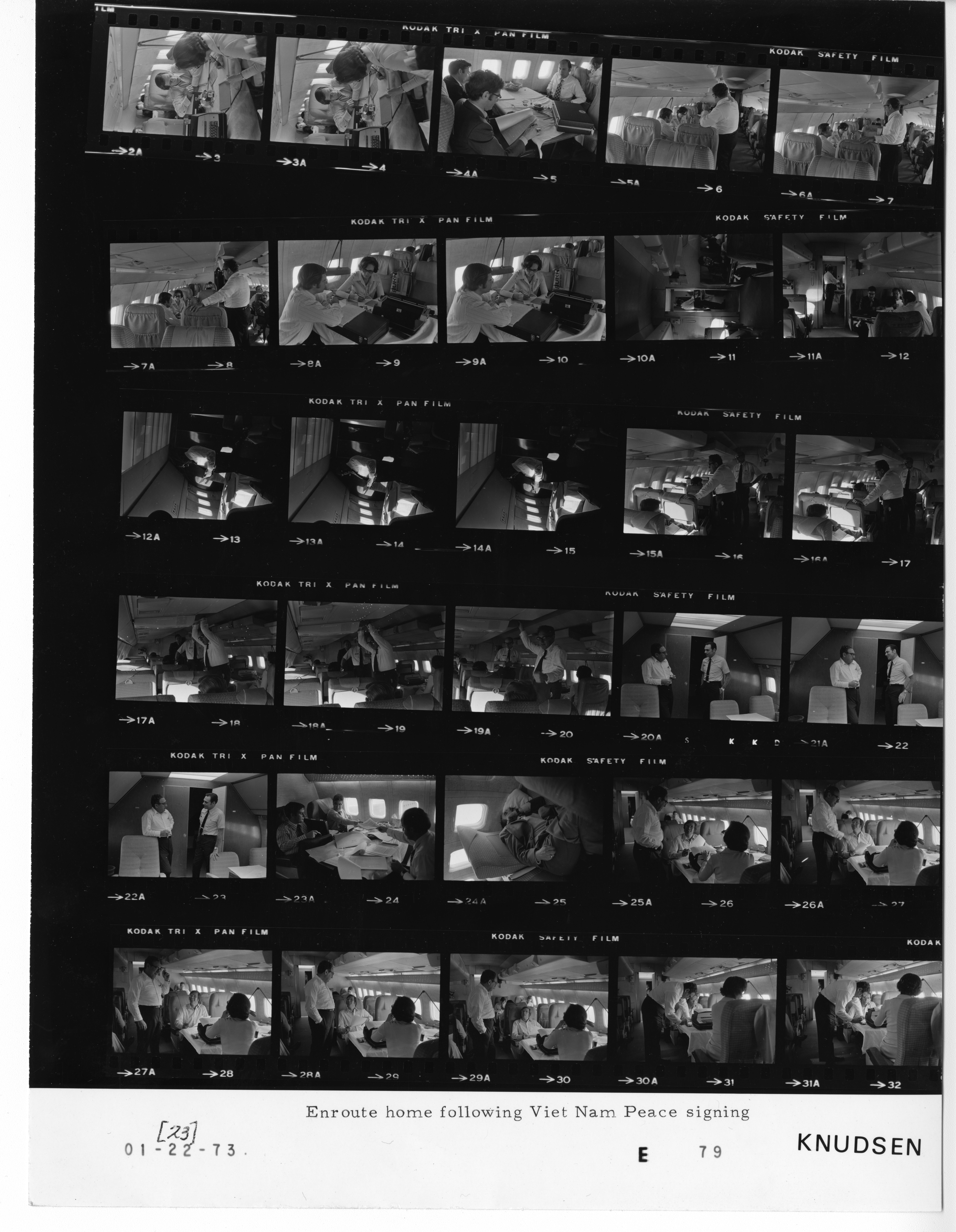
- Frame(s): WHPO-E0079-, Henry Kissinger and staff aboard the plane returning to the United States after the Vietnam Peace Accord talks. 1/23/1973, air airplane. Henry Kissinger, staff.
Roll WHPO-E0080 Photographer: Knudsen, Robert L. | Color or B&W: B&W
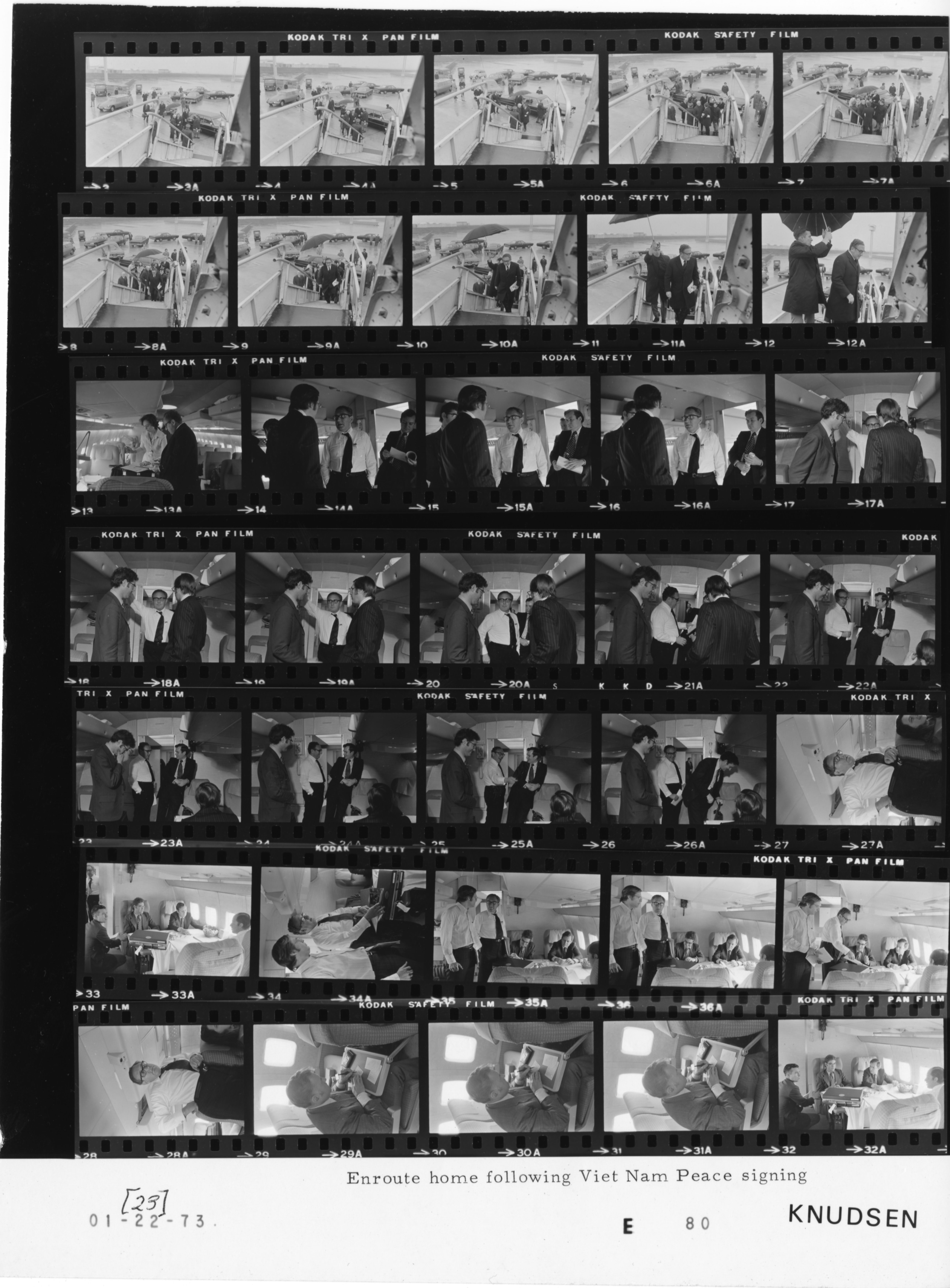
- Frame(s): WHPO-E0080-03A-32A, Henry Kissinger and his Paris Peace Talks staff members boarding his plane (and staff aboard the plane) in Paris, for the return flight home to Washington, D. C., after the Vietnam Peace Accord talks. 1/23/1973, Paris, France; air tarmac, plane. Henry Kissinger, staff.
Roll WHPO-E0081 Photographer: Kightlinger, Jack | Color or B&W: B&W
- Frame(s): WHPO-E0081-, President Nixon, Cabinet Members, Henry Kissinger, and others discussing the signing of the Vietnam Peace Agreement made at the Paris Peace Talks. 1/23/1973, Washington, D.C. White House, Cabinet Room. President Nixon, Rogers Morton, William Rogers, Laird, Kissinger, Richardson, Haldeman, Ziegler, Stein, Anne Armstrong, Cabinet members, aides.
Roll WHPO-E0082 Photographer: Kightlinger, Jack | Color or B&W: B&W
- Frame(s): WHPO-E0082-03-04, H.R. Haldeman and Henry Kissinger standing in the doorway. 1/23/1973, Washington, D.C. White House, Cabinet Room. President Nixon, Henry Kissinger, Haldeman, Cabinet members, aides, Scott, O'Neill, Albert, Mike Mansfield, Ford, Agnew, James Eastland, Ziegler, press corps members.
- Frame(s): WHPO-E0082-05-12, A Cabinet meeting to discuss the Vietnam Peace Agreement. 1/23/1973, Washington, D.C. White House, Cabinet Room. President Nixon, Henry Kissinger, Haldeman, Cabinet members, aides, Scott, O'Neill, Albert, Mike Mansfield, Ford, Agnew, James Eastland, Ziegler, press corps members.
- Frame(s): WHPO-E0082-13-26, President Nixon meeting with Congressional leaders. 1/23/1973, Washington, D.C. Executive Office Building, Presidential Office. President Nixon, Henry Kissinger, Haldeman, Cabinet members, aides, Scott, O'Neill, Albert, Mike Mansfield, Ford, Agnew, James Eastland, Ziegler, press corps members.
- Frame(s): WHPO-E0082-27-30, President Nixon announcing the Vietnam Peace Agreement on television . 1/23/1973, Washington, D.C. White House, Oval Office. President Nixon, Henry Kissinger, Haldeman, Cabinet members, aides, Scott, O'Neill, Albert, Mike Mansfield, Ford, Agnew, James Eastland, Ziegler, press corps members.
Roll WHPO-E0083 Photographer: Kightlinger, Jack | Color or B&W: B&W
- Frame(s): WHPO-E0083-, President Nixon seated at his oval office desk, announcing the Vietnam Peace Agreement.. 1/23/1973, Washington, D.C. White House, Oval Office. President Nixon.
- Frame(s): WHPO-E0083-07, President Nixon seated at his oval office desk, announcing the Vietnam Peace Agreement. 1/23/1973, Washington, D.C. White House, Oval Office. President Nixon.
- Frame(s): WHPO-E0083-15, President Nixon seated at his oval office desk, announcing the Vietnam Peace Agreement. 1/23/1973, Washington, D.C. White House, Oval Office. President Nixon.
Roll WHPO-E0084 Photographer: Kightlinger, Jack | Color or B&W: Color
- Frame(s): WHPO-E0084-, Crew preparing the Oval Office for Nixon's televised speech regarding the Vietnam Peace Agreement. 1/23/1973, Washington, D.C. White House, Oval Office. TV crews.
Roll WHPO-E0085 Photographer: Atkins, Oliver | Color or B&W: Color
- Frame(s): WHPO-E0085-, President Nixon announcing the Vietnam agreement from his desk. 1/23/1973, Washington, D.C. White House, Oval Office. President Nixon, press corps members.
- Frame(s): WHPO-E0085-09, President Nixon sitting at his desk announcing the Vietnam agreement in a live televised broadcast. 1/23/1973, Washington, D.C. White House, Oval Office.
- Frame(s): WHPO-E0085-18, President Nixon sitting at his desk announcing the Vietnam agreement in a live televised broadcast. 1/23/1973, Washington, D.C. White House, Oval Office.
- Frame(s): WHPO-E0085-19, President Nixon sitting at his desk announcing the Vietnam agreement in a live televised broadcast. 1/23/1973, Washington, D.C. White House, Oval Office.
Roll WHPO-E0086 Photographer: Atkins, Oliver | Color or B&W: Color
- Frame(s): WHPO-E0086-, President Nixon announcing the Vietnam agreement from his desk. 1/23/1973, Washington, D.C. White House, Oval Office. President Nixon, press corps members.
Roll WHPO-E0087 Photographer: Atkins, Oliver | Color or B&W: Color
- Frame(s): WHPO-E0087-, President Nixon meeting with Cabinet and Congressional leaders about the signing of the Vietnam Peace Agreement. 1/23/1973, Washington, D.C. White House, Cabinet Room; Presidential Office, Executive Office Building. President Nixon, Cabinet members, William Rogers, Melvin Laird, Elliot Richardson, Richard Kleindienst, Rogers C.B. Morton, Earl Butz, Frederick Dent, Peter Brennan, Caspar Weinberger, James Lynn, Claude Brinegar, Roy Ash, John Scali, Anne Armstrong, George Schultz, H.R. Haldeman, Kenry Kissinger, Peter Flanigan, William Timmons, Ron Ziegler, Ray Price, Herbert Stein, William Safire, Leonard Garment, George Bush (Chairman of the Republican National Committee).
- Frame(s): WHPO-E0087-17, President Nixon and Vice President Agnew seated informally in the EOB officer during a meeting with Cabinet and Congressional leaders about the signing of the Vietnam Peace Agreement. 1/23/1973, Washington, D.C. Presidential Office, Executive Office Building (E0B). President Nixon, Spiro Agnew, Tip O'Neill, Senate Majority Leader Mike Mansfield (D-Montana), Senator James O. Eastland (D-Mississippi), Speaker of the House Carl B. Albert (D-Oklahoma), House Majority Leader Thomas P. O'Neill (Dmassachusetts), House Minority Leader Gerald R. Ford (R-Hichigan), Senate Minority Leader Hugh Scott (R-Pennsylvania).
Roll WHPO-E0088 Photographer: Atkins, Oliver | Color or B&W: Color
- Frame(s): WHPO-E0088-05A-15A, Henry Kissinger and others leaving a Cabinet meeting. 1/23/1973, Washington, D.C. White House, Cabinet Room. President Nixon, Cabinet members, aides, Kissinger, Cabinet members, William Rogers, Melvin Laird, Elliot Richardson, Richard Kleindienst, Rogers C.B. Morton, Earl Butz, Frederick Dent, Peter Brennan, Caspar Weinberger, James Lynn, Claude Brinegar, Roy Ash, John Scali, Anne Armstrong, George Schultz, H.R. Haldeman, Kenry Kissinger, Peter Flanigan, William Timmons, Ron Ziegler, Ray Price, Herbert Stein, William Safire, Leonard Garment, George Bush (Chairman of the Republican National Committee).
- Frame(s): WHPO-E0088-16A-23A, President Nixon and Vice President Agnew seated informally in the EOB officer during a meeting with Cabinet and Congressional leaders about the signing of the Vietnam Peace Agreement. 1/23/1973, Washington, D.C. Executive Office Building, (EOB) Presidential Office. President Nixon, Spiro Agnew, Tip O'Neill, Henry Kissinger, William E. Timmons, Assistant. Senate Majority Leader Mike Mansfield (D-Montana), Senator James O. Eastland (D-Mississippi), Speaker of the House Carl B. Albert (D-Oklahoma), House Majority Leader Thomas P. O'Neill (Dmassachusetts), House Minority Leader Gerald R. Ford (R-Hichigan), Senate Minority Leader Hugh Scott (R-Pennsylvania).
Roll WHPO-E0089 Photographer: Parish, William | Color or B&W: B&W
- Frame(s): WHPO-E0089-06-07, Jack Kightlinger seated at a desk. 1/23/1973, Washington, D.C. unknown room, Oval Office. Jack Kightlinger.
- Frame(s): WHPO-E0089-08, WHPO Director and Presidential Photographer Oliver OLLIE Atkins standing in the Oval Office. 1/23/1973, Washington, D.C. unknown room, Oval Office. Oliver Atkins.
- Frame(s): WHPO-E0089-09-23, President Nixon at his desk just before announcing the Vietnam Peace Agreement on television. 1/23/1973, Washington, D.C. White House, Oval Office. President Nixon.
Roll WHPO-E0090 Photographer: Parish, William | Color or B&W: B&W
- Frame(s): WHPO-E0090-02A-03A, Jack Kightlinger seated at a desk. 1/23/1973, Washington, D.C. unknown room, Oval Office. Jack Kightlinger, unidentified man.
- Frame(s): WHPO-E0090-04A-17A, President Nixon just before the televised speech regarding the Vietnam Peace Agreement. 1/23/1973, Washington, D.C. White House, Oval Office. President Nixon.
- Frame(s): WHPO-E0090-14A, Head and shoulders portrait of President Nixon just before the televised speech regarding the Vietnam Peace Agreement. 1/23/1973, Washington, D.C. White House, Oval Office. President Nixon.
- Frame(s): WHPO-E0090-18A, The Oval Office. 1/23/1973, Washington, D.C. unknown room, Oval Office. Jack Kightlinger, unidentified man.
The White House Communications Agency Sound Recordings Collection contains public statements that took place between 1969 and 1974. Visit the finding aid to learn more.
L - White House Press Office Briefings
- WHCA-SR-L-113
Press briefing by Gerald Warren. (1/23/1973, White House Press Lobby)
Keywords: Press conferences, news conferences, interviews, media
Original Format: 1/4-inch reel-to-reel audiotape. Original source type: Original. - WHCA-SR-L-114
Press briefing by Ronald Ziegler. (1/23/1973, White House Press Lobby)
Runtime: 2:40
Keywords: Press conferences, news conferences, interviews, media, press secretary
Original Format: 1/4-inch reel-to-reel audiotape. Original source type: Original. - WHCA-SR-L-115
Press briefing by Ronald Ziegler. (1/23/1973, White House Press Lobby)
Runtime: 3:45
Keywords: Press conferences, news conferences, interviews, media, press secretary
Original Format: 1/4-inch reel-to-reel audiotape. Original source type: Original. - WHCA-SR-L-116
Press briefing by Ronald Ziegler. (1/23/1973, White House Press Lobby)
Runtime: 23:00
Keywords: Press conferences, news conferences, interviews, media, press secretary
Original Format: 1/4-inch reel-to-reel audiotape. Original source type: Original.
P - Formal Presidential Remarks
- WHCA-SR-P-730116
Remarks by President Nixon announcing the end of the Vietnam War. (1/23/1973)
Runtime: 9:29
Original Format: 1/4-inch reel-to-reel audiotape. Original source type: Original.
The White House Communications Agency Videotape Collection contains “off-the-air” recordings of televised programs produced between 1968 and 1974. Visit the finding aid to learn more.
- WHCA-6023
"Today" Show I (mostly LBJ material). retrospective on the career of the late former President Lyndon Baines Johnson
CBS
Runtime: 01:05:27 - WHCA-6024
"Today" Show II. retrospective on the career of the late former President Lyndon Baines Johnson "LBJ"
ABC
Runtime: 01:04:14 - WHCA-6025
ABC Special on LBJ; PBS Special on LBJ.
ABC
Runtime: 01:00:58 - WHCA-6026
President Nixon Announces Vietnam Peace Agreement. Begins with NBA basketball game prior to announcement
ALL NETWORKS
Runtime: 01:05:32 - WHCA-6027
President Richard Nixon Address to the Nation Announcing the Conclusion of an Agreement on Ending the War and Restoring Peace in Vietnam. President spoke at 10:01 p.m. from the Oval Office of the White House.
President announced he had “concluded an agreement to end the war and bring peace with honor in Vietnam and South East Asia.”
With NBC commentary.
ALL NETWORKS
Runtime: 01:00:00 - WHCA-6028
President Nixon Announces Vietnam Peace Agreement.
ALL NETWORKS
Runtime: 0:30 - WHCA-6062
Weekly News Summary, Tape V.
ALL NETWORKS
Runtime: 0:30
1. Synopsis of top stories: Vietnam ceasefire near; Former President Johnson's (LBJ) funeral; Watergate break-in trial. Time Code Start: 00:00. Keywords: Vietnam War, ceasefires, truces, peace, Presidents, families, death memorials, burials, internments, religious services, funerals, trials, break-in, burglary, theft, plumbers, scandals, Watergate. Network: ABC.
2. Vietnam War ceasefire announcement expected in televised President Nixon address tonight. Time Code Start: 01:15. Keywords: Vietnam War, ceasefires, Presidents, speeches, telecasts, television, TV. Network: ABC.
3. Kissinger return from Paris. Time Code Start: 01:45. Keywords: Paris Peace Talks, Vietnam War, treaty, treaties, negotiations, government, officials, travel, trips. Network: ABC.
4. Film report from Paris on final peace talks session. Time Code Start: 03:06. Keywords: Paris Peace Talks, Vietnam War, treaty, treaties, negotiations. Network: ABC.
5. Vietnam mostly quiet, some U.S. air strikes, little ground action. Time Code Start: 04:46. Keywords: Vietnam War, aircraft, bombings. Network: ABC.
6. Report from South Vietnam's President Thieu's statement on ceasefire. Time Code Start: 04:54. Keywords: South Vietnam, Presidents, speeches, statements, Vietnam War, ceasefires. Network: ABC.
7. Commercials. Time Code Start: 05:21. Keywords: advertisements, ads, TV spots, television. Network: ABC.
8. Film report on former President Johnson's (LBJ) Presidency from members of his administration: Hubert Humphrey, Bill Moyers, Former Secretary of Defense Clark Clifford, Abe Fortas, Liz Carpenter. Time Code Start: 06:22. Keywords: Presidents, death, staff, officials, Vice Presidents, statements, interviews. Network: ABC.
9. Commercials. Time Code Start: 08:54. Keywords: advertisements, ads, TV spots, television. Network: ABC.
10. Film comments on former President Johnson's (LBJ) Presidency from members of his administration: Hubert Humphrey, Bill Moyers, Clark Former Secretary of Defense Clark Clifford, Abe Fortas, Liz Carpenter. Time Code Start: 09:58. Keywords: Presidents, death, staff, officials, Vice Presidents, statements, interviews. Network: ABC.
11. Eulogies from Jackson's Senate colleagues: Senator Barry Goldwater, Edmund Muskie. Time Code Start: 13:23. Keywords: Senators, death, memorials, speeches. Network: ABC.
12. Film report on former President Johnson's (LBJ) ranch. Time Code Start: 15:11. Keywords: Presidents, land, housing, homes, ranches. Network: ABC.
13. Commercials. Time Code Start: 17:24. Keywords: advertisements, ads, TV spots, television. Network: ABC.
14. Report on volcanic eruptions at Vestman Island, Iceland. Time Code Start: 19:26. Keywords: dormant volcanoes, natural disasters, explosions. Network: ABC.
15. Howard K. Smith: Boxing champion George Foreman defeats Joe Frazier, wins world heavyweight title. Time Code Start: 19:45. Keywords: sports, boxing, contests, boxers, celebrities, titles, awards. Network: ABC.
16. Federal Trade Commission (FTC) asks for ban on advertising of "little cigars". Time Code Start: 20:05. Keywords: Consumer Affairs, consumer protection agency, advertisements, ads, TV spots, television, commercials, billboards. Network: ABC.
17. House of Representatives subcommittee report blames racial violence on the USS Kitty hawk and USS Constellation on failure of military discipline. Time Code Start: 20:26. Keywords: Armed Forces, Navy, Marines, ships, America's Flagship, aircraft carriers, CV-64, Kitty Hawk–class supercarrier, racial, racism, African Americans, abortive mutiny, sit-ins, protestss, demonstrations, discharges, confrontations. Network: ABC.
18. Senator Barry Goldwater, responding to Senator George McGovern's recent comments, says "the American people have no sympathy for a sorehead". Time Code Start: 20:47. Keywords: Presidential elections, campaigns, campaigning, candidates. Network: ABC.
19. President Nixon aides testify about re-election committee role in Watergate bugging. Time Code Start: 21:12. Keywords: bugging, bugs, wiretapping, wire taps, surveillance, spying, recordings, Watergate, Senate committee hearings, investigations, testimony, testify, cover-ups, break-in, burglary, theft, plumbers, scandals. Network: ABC.
20. Government reports cost of living rise for December. Time Code Start: 23:31. Keywords: economy, economics, budgets, finances, recession, inflation, money, wages, costs, unemployment, prices, increases. Network: ABC.
21. Commercials. Time Code Start: 24:16. Keywords: advertisements, ads, TV spots, television. Network: ABC.
22. Harry Reasoner's commentary on former President Johnson (LBJ). Time Code Start: 25:26. Keywords: Presidents, death, media, reports, documentary, news, celebrities. Network: ABC.
23. Commercials. Time Code Start: 26:23. Keywords: advertisements, ads, TV spots, television. Network: ABC. - WHCA-6063
Weekly News Summary, Tape VI.
ALL NETWORKS
Runtime: 1:00
1. President Nixon to announce ceasefire in televised speech tonight. Time Code Start: 00:00. Keywords: Vietnam War, ceasefires, Presidents, speeches, telecasts, television, TV. Network: NBC.
2. Film report on final Paris peace talks conference. Kissinger and Vietnamese negotiator Le Duc Tho leave together, shake hands. Time Code Start: 02:11. Keywords: Paris Peace Talks, Vietnam War, treaty, treaties, negotiations, government, officials, travel, trips, departures. Network: NBC.
3. Film report on Kissinger's arrival at Andrews Air Force Base. Time Code Start: 04:42. Keywords: cabinet, advisors, travel, trips, Armed Forces, military, air bases, airfields, airports. Network: NBC.
4. South Vietnam prepares for ceasefire. South Vietnam's President Thieu states that a ceasefire cannot assure peace in South Vietnam. Time Code Start: 05:22. Keywords: South Vietnam, Presidents, speeches, statements, Vietnam War, ceasefires. Network: NBC.
5. Commercials. Time Code Start: 06:01. Keywords: advertisements, ads, TV spots, television. Network: NBC.
6. Report on former President Johnson (LBJ) funeral plans, with film report from Austin, Texas; Former President Johnson (LBJ) lies in state. Time Code Start: 07:03. Keywords: Presidents, death memorials, burials, internments, religious services, funerals. Network: NBC.
7. Report from Blanco County, Texas on former President Johnson's (LBJ) Ranch. Time Code Start: 10:55. Keywords: Presidents, land, housing, homes, ranches. Network: NBC.
8. Commercials. Time Code Start: 12:59. Keywords: advertisements, ads, TV spots, television. Network: NBC.
9. President Nixon decalres a National Day of Mourning for former President Johnson (LBJ). Time Code Start: 13:27. Keywords: Presidents, death, memorials. Network: NBC.
10. Film interview with former Vice President Hubert Humphrey on former President Johnson (LBJ). Time Code Start: 13:51. Keywords: Presidents, death, staff, officials, Vice Presidents, statements, interviews. Network: NBC.
11. Film interview with NAACP President Roy Wilkins about former President Johnson (LBJ). Time Code Start: 15:26. Keywords: organizations, National Association for the Advancement of Colored People (NAACP), opinions, Presidents. Network: NBC.
12. David Brinkley commentary on former President Johnson (LBJ) and Vietnam. Time Code Start: 16:38. Keywords: Presidents, death, media, reports, documentary, news, celebrities, Vietnam War. Network: NBC.
13. Plans for former President Johnson (LBJ)'s body; former President Johnson's (LBJ) funeral in Washington, D.C.. Time Code Start: 18:35. Keywords: Presidents, death memorials, burials, internments, religious services, funerals. Network: NBC.
14. Commercials. Time Code Start: 18:56. Keywords: advertisements, ads, TV spots, television. Network: NBC.
15. Government issues year-end report on Cost of Living. Time Code Start: 19:54. Keywords: economy, economics, budgets, finances, recession, inflation, money, wages, costs, unemployment, prices, reports. Network: NBC.
16. Watergate break-in trial testimony on use of re-election campaign funds to pay Watergate. Time Code Start: 20:18. Keywords: Watergate, Senate committee hearings, investigations, testimony, testify, cover-ups, break-in, burglary, theft, plumbers, scandals. Network: NBC.
17. House Subcommittee reports on race riot on board USS Kitty hawk and USS Constellation, claims they were the result of lax discipline. Time Code Start: 22:17. Keywords: Armed Forces, Navy, Marines, ships, America's Flagship, aircraft carriers, CV-64, Kitty Hawk–class supercarrier, racial, racism, African Americans, abortive mutiny, sit-ins, protestss, demonstrations, discharges, confrontations. Network: NBC.
18. Film report on volcanic eruptions at Vestman Island, Iceland. Time Code Start: 22:55. Keywords: dormant volcanoes, natural disasters, explosions. Network: NBC.
19. Alexandros Onassis, only son of Greek shipping magnate Aristotle Onassis, dies from plane crash injuries. Time Code Start: 23:58. Keywords: Shipping, executives, families, death, plane, accidents. Network: NBC.
20. Economic report: U.S. dollar slides down in European currency markets, stock market down. Time Code Start: 24:37. Keywords: stock markets, investments, securities, Wall Street, Dow Jones, New York Stock Exchange, NASDAQ, finances, recession, inflation, money. Network: NBC.
21. Commercials. Time Code Start: 25:27. Keywords: advertisements, ads, TV spots, television. Network: NBC.
22. Announcement of Vietnam ceasefire expected in Presidents Nixon's speech this evening. Time Code Start: 26:30. Keywords: Vietnam War, ceasefires, Presidents, speeches, statements, announcements. Network: NBC.
23. ceasefire imminent, President Nixon to speak on television. Time Code Start: 30:24. Keywords: Vietnam War, ceasefires, Presidents, speeches, telecasts, television, TV. Network: CBS.
24. Report on final Paris peace talks conference, with Kissinger. Time Code Start: 32:10. Keywords: Paris Peace Talks, Vietnam War, treaty, treaties, negotiations, media, speeches, statements, interviews. Network: CBS.
25. POWs expected to be released soon after ceasefire takes effect. Time Code Start: 34:08. Keywords: Vietnam War, Vietnam Prisoner of War, ceasefires. Network: CBS.
26. Commercials. Time Code Start: 34:44. Keywords: advertisements, ads, TV spots, television. Network: CBS.
27. Report on former President Johnson's (LBJ) funeral arrangements, with film report from Austin, Texas. Time Code Start: 35:51. Keywords: Presidents, death, death memorials, burials, internments, religious services, funerals. Network: CBS.
28. Report on world reaction to news of former President Johnson (LBJ)'s death. Time Code Start: 37:57. Keywords: Presidents, death, heads of state, reations, statements. Network: CBS.
29. Commercials. Time Code Start: 38:51. Keywords: advertisements, ads, TV spots, television. Network: CBS.
30. Report on the energy crisis, shortages of natural gas and "light fuel distillates", alternate energy sources undeveloped. Time Code Start: 39:55. Keywords: energy crisis, oil crisis, petroleum, oil supply, gasoline, fuel, shortages, rationing, allocations. Network: CBS.
31. Commercials. Time Code Start: 48:45. Keywords: advertisements, ads, TV spots, television. Network: CBS.
32. Report on House Subcommittee report on racial violence on the USS Kitty hawk and U.S.S. Constellation. Time Code Start: 49:47. Keywords: Armed Forces, Navy, Marines, ships, America's Flagship, aircraft carriers, CV-64, Kitty Hawk–class supercarrier, racial, racism, African Americans, abortive mutiny, sit-ins, protestss, demonstrations, discharges, confrontations. Network: CBS.
33. President Nixon's re-election senior campaign aides named in Jeb Magruder testimony about set-up of G. Gordon Liddy's intelligence network. Time Code Start: 50:08. Keywords: bugging, bugs, wiretapping, wire taps, surveillance, spying, recordings, Watergate, Senate committee hearings, investigations, testimony, testify, cover-ups, break-in, burglary, theft, plumbers, scandals, Presidential elections, campaigns. Network: CBS.
34. Economic report. Time Code Start: 52:22. Keywords: economy, economics, budgets, finances, recession, inflation, money, wages, costs, unemployment, prices, reports. Network: CBS.
35. Senator Barry Goldwater response to George McGovern's comments on President Nixon: "don't be a sorehead". Time Code Start: 53:42. Keywords: Presidential elections, campaigns, campaigning, candidates. Network: CBS.
36. Report from the Texas hill country on former President Johnson (LBJ), with film interviews from former President Johnson's (LBJ) neighbors. Time Code Start: 55:16. Keywords: Presidents, land, housing, homes, ranches, friends. Network: CBS.
Context (External Sources)
The Vanderbilt Television News Archive is the world's most extensive and complete archive of television news. They have been recording, preserving and providing access to television news broadcasts of the national networks since August 5, 1968.
Wikipedia is a free encyclopedia that anyone can edit.