

Introduction
This almanac page for Tuesday, January 2, 1973, pulls together various records created by the federal government and links to additional resources which can provide context about the events of the day.
Previous Date: Monday, January 1, 1973
Next Date: Wednesday, January 3, 1973
Schedule and Public Documents
The Daily Diary files represent a consolidated record of the President's activities. Visit the finding aid to learn more.
The President's day began at The White House - Washington, D. C.
The Weekly Compilation of Presidential Documents made available transcripts of the President's news conferences; messages to Congress; public speeches, remarks, and statements; and other Presidential materials released by the White House.
Digitized versions can be found at HathiTrust.
Each Public Papers of the Presidents volume contains the papers and speeches of the President of the United States that were issued by the White House Office of the Press Secretary during the time period specified by the volume. The material is presented in chronological order, and the dates shown in the headings are the dates of the documents or events. In instances when the release date differs from the date of the document itself, that fact is shown in the text note.
To ensure accuracy, remarks have been checked against audio recordings (when available) and signed documents have been checked against the original, unless otherwise noted. Editors have provided text notes and cross references for purposes of identification or clarity.
The Federal Register is the official daily publication for rules, proposed rules, and notices of federal agencies and organizations, as well as executive orders and other Presidential documents.
No Federal Register published on this date
Archival Holdings
Any selection of archival documents will necessarily be partial. You should use the documents and folders identified below as a starting place, but consult the linked collection finding aids and folder title lists and the collections themselves for context. Many documents to be found this way do not lend themselves to association with specific dates, but are essential to a complete understanding of the material.
Selective document listing
President's Office Files
The President's Office Files consists of materials drawn together by the Special Files Unit from several administrative subdivisions within the White House Office. It is the handwriting and sensitive papers sent to the Staff Secretary that now comprise much of the President's Office Files. Visit the finding aid to learn more.
- News Summaries, Unmarked News Summaries, Box 53, News Summaries - January 2 to 11, 1973 [1 of 7] [Note: Due to the way News Summary products were compiled, you should also consult nearby days for potentially relevant materials.]
- Weekend News Review (Including Sat, Sun, Mon nets and wires; Sun, Mon. papers; Time, Newsweek; and recent columns), January 2, 1973
- Review of TV News Shows, Sat. Dec. 23 thru Fri. Dec. 29, 1972, January 2, 1973
- December Magazine Review with Focus on Those Issued Last Week, Jan. 2, 1973
The H. R. Haldeman Diaries consists of seven handwritten diaries, 36 dictated diaries recorded as sound recordings, and two handwritten audio cassette tape subject logs. The diaries and logs reflect H. R. Haldeman’s candid personal record and reflections on events, issues, and people encountered during his service in the Nixon White House. As administrative assistant to the President and Chief of Staff, Haldeman attended and participated in public events and private meetings covering the entire scope of issues in which the Nixon White House engaged in during the years 1969-1973. Visit the finding aid to learn more.
- Transcript of diary entry (PDF)
Wednesday, December 27th through Tuesday, January 2nd. Again, no contact. The President was in Washington, having come back up on the evening of the 26th from Key Biscayne and spending some time in DC and in--, at Camp David. I left for Palm Springs on the 26th and was there through this entire period; had no contact with the President during that entire time. About the only thing that came up that involved me directly was…
-------------------------------------------------------------------------------------------------------------------
DECLASSIFIED - E.O. 13526, Sect. 3.4: by MS, NARA, June 12, 2013
Audio Cassette 29, Side A, Withdrawn Item Number 6
Duration: 25 seconds
….Steve Bull’s concern with the President's decision to zip off to Nicaragua all of a sudden, to visit the refugee centers and so on. We mobilized Kissinger, Haig, etcetera, and talked him out of it.
------------------------------------------------------------------------------------------------------------------
Other than that the period was relatively uneventful. - Original audio recording (MP3)
The National Archives Catalog is the online portal to the records held at the National Archives, and information about those records. It is the main way of describing our holdings and also provides access to electronic records and digitized versions of our holdings.
The Catalog searches across multiple National Archives resources at once, including archival descriptions, digitized and electronic records, authority records, and web pages from Archives.gov and the Presidential Libraries. The Catalog also allows users to contribute to digitized historical records through tagging and transcription.
Nixon Library Holdings
All National Archives Units
National Security Documents
The President's Daily Brief is the primary vehicle for summarizing the day-to-day sensitive intelligence and analysis, as well as late-breaking reports, for the White House on current and future national security issues. Read "The President's Daily Brief: Delivering Intelligence to Nixon and Ford" to learn more.
The Foreign Relations of the United States series presents the official documentary historical record of major U.S. foreign policy decisions and significant diplomatic activity. Visit the State Department website for more information.
Vol. IX, Vietnam, October 1972-January 1973
America Leaves the War, December 30, 1972-January 27, 1973
242. Message From the Chief of the U.S. Delegation to the Paris Peace Talks (Porter) to the President’s Assistant for National Security Affairs (Kissinger), Paris, January 2, 1973, 1956Z
Source: National Archives, Nixon Presidential Materials, NSC Files, Box 865, For the President’s Files (Winston Lord)—China Trip/Vietnam, Camp David Memcons, December 1972 [1 of 3]. Secret; Critic; Sensitive; Exclusively Eyes Only. Sent via Guay and Kennedy.
Vol. XV, Soviet Union, June 1972-August 1974
Summit Preparations; Jackson-Vanik Amendment; Non-Use of Nuclear Weapons, December 1972-April 1973
72. Memorandum From Helmut Sonnenfeldt of the National Security Council Staff to the President’s Assistant for National Security Affairs (Kissinger, Washington, January 2, 1973
Source: National Archives, Nixon Presidential Materials, NSC Files, Kissinger Office Files, Box 67, Country Files—Europe—USSR, Map Room, Aug. 1972–May 31, 1973, [1 of 3]. Secret; Eyes Only. Sent for action. At the top of the memorandum, Kissinger wrote and underscored: “(1) Hillenbrand—Bonn—Falin” and “(2) Helsinki—U.S. Force MBFR relationship.” Above the first paragraph of the memorandum, he wrote, “Preliminary substance.”
Vol. XXV, Arab-Israeli Crisis and War, 1973
Arab-Israeli Crisis and War, 1973
1. Memorandum From Richard T. Kennedy of the National Security Council Staff to the President’s Assistant for National Security Affairs (Kissinger), Washington, January 2, 1973
Source: Library of Congress, Manuscript Division, Kissinger Papers, Box CL 168, Geopolitical File, 15 May 1972–7 May 73. Secret; Sensitive. Sent for information.
Vol. E-6, Documents on Africa, 1973-1976
Africa Region
1. Memorandum From Fernando Rondon of the National Security Council Staff to the President’s Assistant for National Security Affairs (Kissinger), Washington, January 2, 1973
Rondon presented a plan of action for Africa during the second Nixon Administration. His recommendations were not acted upon.
Source: National Archives, Nixon Presidential Materials, NSC Files, Box 747, Country Files-Africa, Africa General, vol. II. Secret. Sent for action. Kennedy concurred. No action indicated. Kissinger wrote in the margin next to recommendation 1, “Like who?” and next to recommendation 2, “What makes you think that?” Tab A, “Guidelines for a NSSM Study on Africa South of the Sahara,” is attached but not published.
Horn of Africa
77. Telegram 45 From the Embassy in Ethiopia to the Department of State, Addis Ababa, January 2, 1973, 1533Z
Ambassador Ross Adair provided his views on the impact of the possible closing of the U.S. military facility at Kagnew Station in Asmara, Ethiopia.
Source: National Archives, RG 59, Central Files 1970–73, DEF 19–1 US-ETH. Secret; Immediate; Stadis; Exdis; Noforn. Repeated to Asmara.
Uganda
240. Telegram 1 From the Embassy in Uganda to the Department of State, Kampala, January 2, 1973, 0700Z
Ambassador Thomas P. Melady described the Amin regime as racist, erratic, brutal, inept, bellicose, irrational, ridiculous, militaristic, and, above all, xenophobic. He recommended that the United States continue to reduce its presence in Uganda.
Source: National Archives, RG 59, Central Files 1970–73, POL Uganda. Secret; Exdis. Repeated to Addis Ababa, Bujumbura, Dar Es Salaam, Khartoum, Kigali, Kinshasa, London, Lourenco Marques, Lusaka, Mogadiscio, Nairobi, Paris, Rome, and USCINCEUR.
Vol. E-8, Documents on South Asia, 1973-1976
Indian Ocean Region
53. Telegram 72 From the Department of State to the Embassy in Sri Lanka, Washington, January 2, 1973, 1716Z
The Department discussed recent disruptions in Indo-Nepalese relations, placed them within the context of U.S.-Nepalese and U.S.-Indian relations, and emphasized that the United States had little to gain from attempting to affect the economic and political relationship between Nepal and India.
Source: National Archives, RG 84, Katmandu Embassy Files: Lot 77 F 31, Political Affairs and Relations, Nepal. Confidential. Drafted by Quainton (DCM); cleared by ECON, POL, SA, and AID/DIR; and approved by Cargo. It was repeated to Colombo, Dhaka, Islamabad, Kabul, London, Moscow, New Delhi, Rangoon, Calcutta, Bombay, Hong Kong, Madras, Beijing, and CINCPAC.
India-Pakistan 1
103. Telegram 32 From the Embassy in Pakistan to the Department of State, Islamabad, January 2, 1973, 1048Z
The Embassy assessed the Bhutto Government’s first year in power, with a specific focus on Pakistan’s foreign policy.
Source: National Archives, RG 59, Central Files 1970–73, Political and Defense, POL 1 PAK. Confidential. It was repeated to Dhaka, Hong Kong, Kabul, Karachi, Lahore, London, Moscow, New Delhi, and Tehran. Sober offered a separate assessment of the Pakistan domestic political situation in Telegram 355 from Islamabad, January 11. (Ibid.)
Nepal, Sikkim, and Bhutan
245. Telegram 72 From the Department of State to the Embassy in Sri Lanka, Washington, January 2, 1973, 1716Z
Assistant Secretary Sisco met with Ambassador Neville Kanakaratne on December 21, 1972. The Ambassador asked the United States for help in negotiations with the World Bank and with the problem of a shortfall in PL–480 credits because inflation had eroded Sri Lanka’s ability to purchase the expected 115,000 tons. Sisco agreed to do whatever he could to solve both problems.
Source: National Archives, RG 84, Colombo Embassy Files: Lot 77 F 54, Aid 1973. Confidential. It was repeated to Colombo, Dhaka, Islamabad, Kabul, London, Moscow, New Delhi, Rangoon, Calcutta, Bombay, Hong Kong, Madras, USLO Beijing, and CINCPAC.
Vol. E-12, Documents on East and Southeast Asia, 1973-1976
Pacific Islands
303. Memorandum From the President’s Assistant for National Security Affairs (Kissinger) to President Nixon, Washington, January 2, 1973., Washington, January 2, 1973
Kissinger reported on Laird’s views of the Micronesian status negotiations and noted that the negotiations have been postponed.
Source: National Archives, Nixon Presidential Materials, NSC Files, Box 568, Country Files, Far East, Trust Territories, Vol. III [1 of 2]. Secret. Sent for action. Holdridge initialed the memorandum on behalf of Kissinger. On the second page, Nixon highlighted the paragraph about OEO and the Peace Corps and wrote to Kissinger: “K—this had to be written by a Peace Corps advocate.” At the bottom of the page, the President initialed his approval of the recommendation and wrote, “K with strong reservation. Laird is totally right on the Peace Corps + Legal Services.” He also noted for Erlichman: “E—get both groups out of there discreetly because of need to cut both programs.” Tab A, Kissinger’s memorandum, January 25, to the Secretary of Defense, is attached but not published, as is Tab B, Laird’s memorandum, December 4, to Nixon, and Tab C, Ambassador Williams’s letter, October 27, to Nixon.
The Kissinger telephone conversation transcripts consist of approximately 20,000 pages of transcripts of Kissinger’s telephone conversations during his tenure as Assistant to the President for National Security Affairs (1969-1974) and Secretary of State (1973-1974) during the administration of President Richard Nixon. Visit the finding aid for more information.
Digitized versions can be found in the National Archives Catalog.
Audiovisual Holdings
Visit the White House Tapes finding aid to learn about the taping system's operation and archival processing.
Old Executive Office Building
- 393-1; Unknown between 2:45 p.m. & 3:33 p.m.; Nixon, Richard M. (President); Colson, Charles W.; Bull, Stephen B.; White House operator
- 393-2; Unknown between 3:13 p.m. & 3:33 p.m.; Colson, Charles W.; Warren, Gerald L.
- 393-3; Unknown between 3:13 p.m. & 3:33 p.m.; Nixon, Richard M. (President); Colson, Charles W.
Oval Office
- 829-17; Unknown between 8:45 a.m. & 8:53 a.m.; Nixon, Richard M. (President); McKay, John
- 829-18; Unknown between 8:45 a.m. & 8:53 a.m.; Nixon, Richard M. (President); Hays, Wayne Woodrow ("Woody")
- 829-19; Unknown between 8:45 a.m. & 8:53 a.m.; Nixon, Richard M. (President); Bull, Stephen B.
- 829-20; Unknown between 8:45 a.m. & 8:53 a.m.; Nixon, Richard M. (President); Sanchez, Manolo
- 829-21; Unknown between 8:45 a.m. & 8:53 a.m.; Nixon, Richard M. (President); [Unknown person(s)]
- 829-22; Unknown between 8:45 a.m. & 8:53 a.m.; Nixon, Richard M. (President); Bull, Stephen B.; White House operator
- 829-23; Unknown between 8:45 a.m. & 8:56 a.m.; Nixon, Richard M. (President); Sanchez, Manolo; Warren, Gerald L.
- 829-24; 8:56 a.m. - 9:03 a.m.; Nixon, Richard M. (President); Burger, Warren E.
- 829-25; Unknown between 9:03 a.m. & 9:28 a.m.; Nixon, Richard M. (President)
- 829-26; Unknown between 9:03 a.m. & 9:28 a.m.; Nixon, Richard M. (President); Bull, Stephen B.
- 829-27; Unknown between 9:03 a.m. & 9:28 a.m.; Nixon, Richard M. (President)
- 829-28; Unknown between 9:03 a.m. & 9:28 a.m.; Nixon, Richard M. (President)
- 829-29; Unknown between 9:03 a.m. & 9:28 a.m.; Nixon, Richard M. (President); Bull, Stephen B.
- 829-30; Unknown between 9:03 a.m. & 9:28 a.m.; Nixon, Richard M. (President); Bull, Stephen B.
- 829-31; 11:28 a.m. - 11:46 a.m.; Nixon, Richard M. (President); Bull, Stephen B.; Woods, Rose Mary; Acker, Marjorie P.
- 829-32; Unknown between 11:46 a.m. & 11:50 a.m.; Nixon, Richard M. (President); Bull, Stephen B.
- 829-33; Unknown between 11:50 a.m. & 12:00 p.m.; Nixon, Richard M. (President); Bull, Stephen B.
- 829-34; Unknown between 12:00 p.m. & 12:13 p.m.; Nixon, Richard M. (President); Sanchez, Manolo
- 829-35; 12:13 p.m. - 12:56 p.m.; Nixon, Richard M. (President); Timmons, William E.; Bull, Stephen B.
- 829-36; Unknown between 12:56 p.m. & 1:00 p.m.; Nixon, Richard M. (President); Bull, Stephen B.
- 829-37; 1:00 p.m. - 1:14 p.m.; Nixon, Richard M. (President); Timmons, William E.
- 829-39; Unknown between 9:03 a.m. & 9:28 a.m.; [Unknown person(s)]
- 829-40; Unknown between 9:03 a.m. & 9:28 a.m.; [Unknown person(s)]
- 829-41; Unknown between 1:14 p.m. & 3:33 p.m.; [Unknown person(s)]
- 830-1; Unknown between 3:33 p.m. & 3:35 p.m.; Nixon, Richard M. (President); Bull, Stephen B.
- 830-2; Unknown between 3:35 p.m. & 4:19 p.m.; Nixon, Richard M. (President); Mansfield, Michael J. ("Mike"); Atkins, Oliver F. ("Ollie"); Bull, Stephen B.
- 830-3; Unknown between 4:19 p.m. & 4:22 p.m.; Nixon, Richard M. (President); Bull, Stephen B.
- 830-4; Unknown between 4:22 p.m. & 4:37 p.m.; Nixon, Richard M. (President); Timmons, William E.
- 830-5; Unknown between 4:37 p.m. & 4:41 p.m.; Nixon, Richard M. (President); Bull, Stephen B.
- 830-6; Unknown between 4:41 p.m. & 6:10 p.m.; Nixon, Richard M. (President); Colson, Charles W.; Sanchez, Manolo; White House operator; Johnson, Lyndon B.
White House Telephone
- 35-50; Unknown between 8:45 a.m. & 8:53 a.m.; Nixon, Richard M. (President); White House operator; Bull, Stephen B.
- 35-51; 8:56 a.m. - 9:03 a.m.; Nixon, Richard M. (President); Burger, Warren E.
- 35-52; Unknown between 9:03 a.m. & 10:15 a.m.; Nixon, Richard M. (President); White House operator
- 35-53; 10:15 a.m. - 10:16 a.m.; Nixon, Richard M. (President); Bull, Stephen B.
- 35-54; Unknown between 10:16 a.m. & 10:20 a.m.; Nixon, Richard M. (President); White House operator
- 35-55; 10:20 a.m. - 10:21 a.m.; Nixon, Richard M. (President); Bull, Stephen B.
- 35-56; Unknown between 10:21 a.m. & 11:20 a.m.; Colson, Charles W.; White House operator; [Unknown person(s)]; Woods, Rose Mary; Warren, Gerald L.; Nixon, Richard M. (President)
- 35-57; 2:43 p.m. - 2:43 p.m.; Nixon, Richard M. (President); White House operator
- 35-58; 2:49 p.m. - 2:51 p.m.; Nixon, Richard M. (President); Timmons, William E.
- 35-59; Unknown between 2:51 p.m. & 3:03 p.m.; Nixon, Richard M. (President); White House operator
- 35-60; 3:03 p.m. - 3:05 p.m.; Nixon, Richard M. (President); Bull, Stephen B.
- 35-61; Unknown between 3:05 p.m. & 3:10 p.m.; Nixon, Richard M. (President); White House operator
- 35-62; 3:10 p.m. - 3:11 p.m.; Nixon, Richard M. (President); Bull, Stephen B.
- 35-63; Unknown between 3:11 p.m. & 3:12 p.m.; Nixon, Richard M. (President); White House operator
- 35-64; 3:12 p.m. - 3:13 p.m.; Nixon, Richard M. (President); Bull, Stephen B.
- 35-65; Unknown between 3:13 p.m. & 3:30 p.m.; Colson, Charles W.; White House operator; Nixon, Richard M. (President); Warren, Gerald L.
- 35-66; Unknown between 4:41 p.m. & 4:46 p.m.; Nixon, Richard M. (President); White House operator
- 35-67; 4:46 p.m. - 4:51 p.m.; Nixon, Richard M. (President); Johnson, Lyndon B.
- 35-68; Unknown between 4:51 p.m. & 9:44 p.m.; Nixon, Richard M. (President); White House operator
- 35-69; 9:44 p.m. - 10:00 p.m.; Nixon, Richard M. (President); Colson, Charles W.
- 35-70; 10:01 p.m. - 10:01 p.m.; Nixon, Richard M. (President); White House operator
The White House Photo Office collection consists of photographic coverage of President Richard Nixon meeting with prominent social, political, and cultural personalities; speaking engagements and news conferences of the President and various high-ranking members of the White House staff and Cabinet; Presidential domestic and foreign travel, including Presidential vacations; social events and entertainment involving the First Family, including entertainers present; official portraits of the President, First Family, and high-ranking members of the Nixon administration; the 1969 and 1973 Inaugurals; the President’s 1972 Presidential election campaign appearances (including speeches) and other official activities of the White House staff and the President’s Cabinet from January 20, 1969 until August 9, 1974 at the White House and the Old Executive Office Building; other locations in Washington, DC, such as The Mall; and the Presidential retreats in Camp David, Maryland, Key Biscayne, Florida, and San Clemente, California. Visit the finding aid to learn more.
Roll WHPO-D1156 Photographer: Atkins, Oliver | Color or B&W: B&W
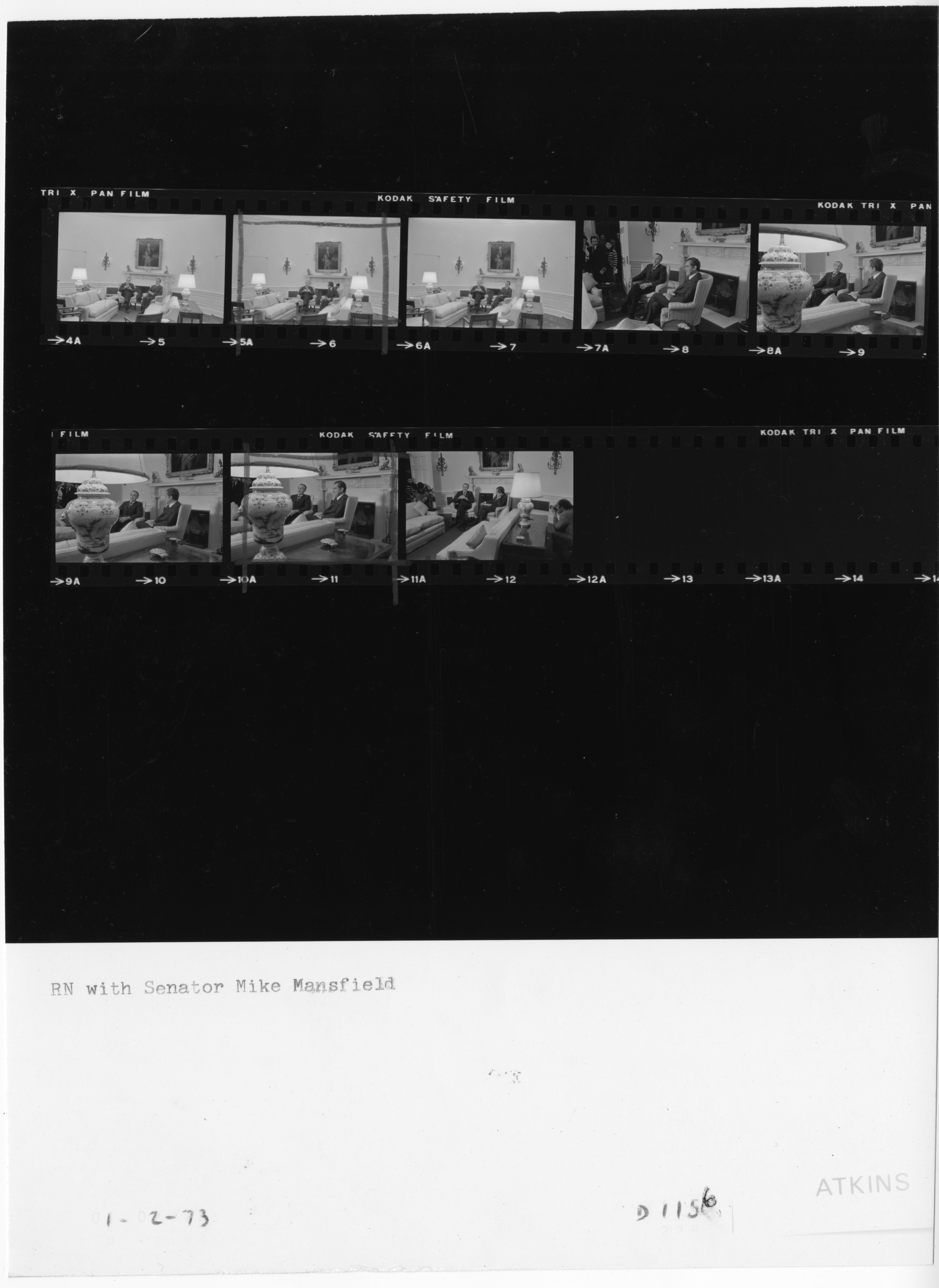
- Frame(s): WHPO-D1156-05-12, President Nixon seated in the Oval Office during a meeting with Senate Majority Leader Senator Mike Mansfield. 1/2/1973, Washington, D.C. White House, Oval Office. President Nixon, Mike Mansfield, unidentified reporters and press corps members.
The White House Communications Agency Sound Recordings Collection contains public statements that took place between 1969 and 1974. Visit the finding aid to learn more.
L - White House Press Office Briefings
- WHCA-SR-L-096
Press briefing by Gerald Warren. (1/2/1973, White House Press Lobby)
Keywords: Press conferences, news conferences, interviews, media
Original Format: 1/4-inch reel-to-reel audiotape. Original source type: Original.
P - Formal Presidential Remarks
- WHCA-SR-P-730101
Remarks by President Nixon re death of Roberto Clemente. (1/2/1973)
Runtime: 0:54
Original Format: 1/4-inch reel-to-reel audiotape. Original source type: Original.
The White House Communications Agency Videotape Collection contains “off-the-air” recordings of televised programs produced between 1968 and 1974. Visit the finding aid to learn more.
- WHCA-5983
Weekly News Summary, Tape II.
ALL NETWORKS
14. Clark/Smith: Democrats trying to turn Capitol Hill against President Nixon with Thomas O'Neill and Senator Fulbright. Time Code Start: 40:16. Keywords: House of Representatives, Congress, lobbying, lobbyists, political parties, Democrats, Democratic Party. Network: ABC.
15. Reasoner/Cioffi: Paris peace talks. Time Code Start: 42:45. Keywords: Paris Peace Talks, Vietnam War, treaty, treaties, negotiations. Network: ABC.
16. Gill: Kissinger returns to Washington; bombing strategy. Time Code Start: 44:19. Keywords: cabinet, advisors, travel, trips. Network: ABC.
17. Smith/Peterson/Farmer: Commentary on bombing of Bach Mai and hospital there with Freidheim and Allen; Polish ship destroyed in Haiphong Harbor, Vietnam. Time Code Start: 45:43. Keywords: Vietnam War, military, bombings, hospitals, Poland, Navy, ships, destruction. Network: ABC.
18. Reasoner: Commentary on times could be worse. Time Code Start: 49:16. Keywords: lifestyles, reports. Network: ABC.
19. Chancellor/Dobyns: Paris Peace Talks resume. Time Code Start: 51:23. Keywords: Paris Peace Talks, Vietnam War, treaty, treaties, negotiations. Network: NBC.
20. Chancellor: Freidheim talks about hospital bombing; Taylor films of Hanoi, Vietnam; Ramsay Clark raises money for North Vietnam. Time Code Start: 53:45. Keywords: Vietnam War, military, bombings, hospitals, ships, destruction. Network: NBC.
21. Chancellor/Duke: Congress gets ready to convene; Democratic Caucus votes to stop war with Fulbright. Time Code Start: 57:44. Keywords: political parties, Democrats, Democratic Party, Vietnam War, protests, voting. Network: NBC. - WHCA-5984
Weekly News Summary, Tape III.
ALL NETWORKS
1. Rather/Morton/Pierpoint: Albert promised peace soon; President Nixon and Mansfield. Time Code Start: 00:00. Keywords: Presidents, Paris Peace Talks, Vietnam War, treaty, treaties, negotiations. Network: CBS.
2. Rather/Kalisher/Kalb: Paris peace talks resume; North Vietnam evacuates large cities. Time Code Start: 03:18. Keywords: Paris Peace Talks, Vietnam War, treaty, treaties, negotiations. Network: CBS.
3. Rather/Herman: Freidheim on the Hanoi bombing; Clark, Allen on the Bock Ny proposal. Time Code Start: 05:40. Keywords: Vietnam War, bombings. Network: CBS.
4. Rather/Sevareid: Commentary on Congress. Time Code Start: 09:32. Keywords: House of Representatives. Network: CBS.
Context (External Sources)
The Vanderbilt Television News Archive is the world's most extensive and complete archive of television news. They have been recording, preserving and providing access to television news broadcasts of the national networks since August 5, 1968.
Wikipedia is a free encyclopedia that anyone can edit.