
Introduction
This almanac page for Wednesday, January 3, 1973, pulls together various records created by the federal government and links to additional resources which can provide context about the events of the day.
Previous Date: Tuesday, January 2, 1973
Next Date: Thursday, January 4, 1973
Schedule and Public Documents
The Daily Diary files represent a consolidated record of the President's activities. Visit the finding aid to learn more.
The President's day began at The White House - Washington, D. C.
The Weekly Compilation of Presidential Documents made available transcripts of the President's news conferences; messages to Congress; public speeches, remarks, and statements; and other Presidential materials released by the White House.
Digitized versions can be found at HathiTrust.
Each Public Papers of the Presidents volume contains the papers and speeches of the President of the United States that were issued by the White House Office of the Press Secretary during the time period specified by the volume. The material is presented in chronological order, and the dates shown in the headings are the dates of the documents or events. In instances when the release date differs from the date of the document itself, that fact is shown in the text note.
To ensure accuracy, remarks have been checked against audio recordings (when available) and signed documents have been checked against the original, unless otherwise noted. Editors have provided text notes and cross references for purposes of identification or clarity.
The Federal Register is the official daily publication for rules, proposed rules, and notices of federal agencies and organizations, as well as executive orders and other Presidential documents.
The Congressional Record is the official daily record of the debates and proceedings of the U.S. Congress.
Archival Holdings
Any selection of archival documents will necessarily be partial. You should use the documents and folders identified below as a starting place, but consult the linked collection finding aids and folder title lists and the collections themselves for context. Many documents to be found this way do not lend themselves to association with specific dates, but are essential to a complete understanding of the material.
Selective document listing
President's Office Files
The President's Office Files consists of materials drawn together by the Special Files Unit from several administrative subdivisions within the White House Office. It is the handwriting and sensitive papers sent to the Staff Secretary that now comprise much of the President's Office Files. Visit the finding aid to learn more.
- News Summaries, Unmarked News Summaries, Box 53, News Summaries - January 2 to 11, 1973 [2 of 7] [Note: Due to the way News Summary products were compiled, you should also consult nearby days for potentially relevant materials.]
- News Summary, January 3, 1973, (Tuesday nets, wires, columns)
The H. R. Haldeman Diaries consists of seven handwritten diaries, 36 dictated diaries recorded as sound recordings, and two handwritten audio cassette tape subject logs. The diaries and logs reflect H. R. Haldeman’s candid personal record and reflections on events, issues, and people encountered during his service in the Nixon White House. As administrative assistant to the President and Chief of Staff, Haldeman attended and participated in public events and private meetings covering the entire scope of issues in which the Nixon White House engaged in during the years 1969-1973. Visit the finding aid to learn more.
- Transcript of diary entry (PDF)
Wednesday, January 3.
Back at work. The President had me in at 11:00 for about three hours on just a general recap of where things were. He went through a lot of odds and ends -- the question of whether the Heath visit is a dinner, and if so, he wants to go on the new rule of very limited staff and Cabinet. Wants to have Ed David in after the Inaugural. Wants to hold all that kind of thing that he can until after the Inaugural. He was asking about Hodgson’s status, which I didn't know, and Klein’s, which I also didn't know. Plans for Cabinet meeting on the 22nd, wondered about Safire's status, which I didn't know. Wants to keep the OEP post position open for someone that he might want to use, just as a good hard intellectual and as a foil for Kissinger on the NSC. Wants to be sure Ehrlichman handles the reorganization at the leadership meeting on Friday morning, and that he does not go into a lot of detail about the Counselors and their big staff and so on, but rather to make the point that we’ve cut the White House staff and we're putting the responsibility out to on the Departments. The President will provide offices in EOB for the Counselors, but not with staffs, all staffing will come from their departments. Wants Conger to check on other possible Presidential desks for the Oval Office and says he's gotten some expert to agree to do some redecorating in the Oval Office, apparently somebody that Mrs. Nixon has been using at the Residence, so that may work out. He's at least getting rid of the Boehme birds on the shelves.
He's concerned about David's Congressional seat and wants to be sure we're getting that set up. Had a lot of ideas on the news summary, to leave off the magazines and local Washington papers, emphasize the positive, rather than dwelling so much on negative things. He said he'd have a reception for the National Committee after the Inaugural, wants to hold up on the diplomatic reception until Vietnam is settled. Was pleased with the Senate resolution today on Vietnam, wants the House to go for the same resolution. Met with Henry last night, again today, and will meet with him again on Saturday extensively on Vietnam before he leaves Sunday for the new talks. Wants Ehrlichman, Kissinger and me to establish three major goals in big terms--not a laundry list-- but the real problem is what there is to do in the domestic area. There really isn't anything. One goal would be destroy the establishment, the intellectual and media and so on. Was very pleased with Schlesinger's idea of knocking off MIT funds from DOD before Elliot Richardson gets in. Agreed to see Elliot tomorrow at 11:30 after the NSC meeting.
Kept coming back to the concern about Rose and her attitude. Apparently she’s been very negative and unpleasant. That, as usual, worries him.
Also a lot of concerns about Henry, saying that he's been through a awful lot in trying to keep his dauber up, and so on, while I had been gone, that he had been using Colson very heavily for this, which the record indicates is correct. He spent hours talking with Colson during the period I was gone. Colson also said this was the case. He thinks Henry is at least partially responsible for the media efforts to separate the President and Kissinger's positions, and is concerned that he not get away with that. Basically, however, he seems to be in very good spirits, no major problems.
End of January 3.
As a general comment, it's clear to me that he still hasn't really focused on getting down to work on the second term. He's using the Inaugural as an excuse for not scheduling things, but he's not working on the Inaugural. I think until he gets Vietnam settled, everything else is going to pretty much stay in the background, and there won't be much concentration on anything. - Original audio recording (MP3)
The National Archives Catalog is the online portal to the records held at the National Archives, and information about those records. It is the main way of describing our holdings and also provides access to electronic records and digitized versions of our holdings.
The Catalog searches across multiple National Archives resources at once, including archival descriptions, digitized and electronic records, authority records, and web pages from Archives.gov and the Presidential Libraries. The Catalog also allows users to contribute to digitized historical records through tagging and transcription.
Nixon Library Holdings
All National Archives Units
National Security Documents
The President's Daily Brief is the primary vehicle for summarizing the day-to-day sensitive intelligence and analysis, as well as late-breaking reports, for the White House on current and future national security issues. Read "The President's Daily Brief: Delivering Intelligence to Nixon and Ford" to learn more.
The Foreign Relations of the United States series presents the official documentary historical record of major U.S. foreign policy decisions and significant diplomatic activity. Visit the State Department website for more information.
Vol. IX, Vietnam, October 1972-January 1973
America Leaves the War, December 30, 1972-January 27, 1973
243. Memorandum of Conversation, Washington, January 3, 1973, 11:30 a.m.-12:20 p.m.
Source: National Archives, Nixon Presidential Materials, NSC Files, Box 859, For the President’s Files (Winston Lord)—China Trip/Vietnam, Sensitive Camp David, Vol. XXIII. Top Secret; Sensitive; Exclusively Eyes Only. The meeting was held in Kissinger’s office in the White House.
244. Message From the Chief of the U.S. Delegation to the Paris Peace Talks (Porter) to the President’s Assistant for National Security Affairs (Kissinger), Paris, January 3, 1973, 1855Z
Source: National Archives, Nixon Presidential Materials, NSC Files, Box 865, For the President’s Files (Winston Lord)—China Trip/Vietnam, Camp David Memcons, December 1972 [1 of 3]. Top Secret; Operational Immediate; Sensitive; Exclusively Eyes Only. Sent via Guay and Kennedy.
Vol. XVIII, China, 1973-1976
Kissinger's Visits to Beijing and the Establishment of the Liaison Offices, January 1973-May 1973
1. Memorandum of Conversation, New York City, January 3, 1973, 10:15-11:00 p.m.
Source: National Archives, Nixon Presidential Materials, NSC Files, Kissinger Office Files, Box 94, Country Files, Far East, China Exchanges, January 1–April 14, 1973. Top Secret; Sensitive; Exclusively Eyes Only.
Vol. XXXVI, Energy Crisis, 1969-1974
March 16, 1972-March 6, 1973
150. Memorandum From Philip A. Odeen of the National Security Council Staff to the President’s Assistant for International Affairs (Kissinger), Washington, January 3, 1973
Source: National Archives, Nixon Presidential Materials, NSC Files, Box 250, Agency Files, National Energy Office, Vol. I, March 1972–February 1973. Secret; Outside System. Urgent; Sent for information.
The Kissinger telephone conversation transcripts consist of approximately 20,000 pages of transcripts of Kissinger’s telephone conversations during his tenure as Assistant to the President for National Security Affairs (1969-1974) and Secretary of State (1973-1974) during the administration of President Richard Nixon. Visit the finding aid for more information.
Digitized versions can be found in the National Archives Catalog.
Audiovisual Holdings
Visit the White House Tapes finding aid to learn about the taping system's operation and archival processing.
Oval Office
- 831-1; 9:40 a.m. - 9:46 a.m.; Nixon, Richard M. (President); Bull, Stephen B.
- 831-2; Unknown between 9:46 a.m. & 9:49 a.m.; Nixon, Richard M. (President); Bull, Stephen B.
- 831-3; 9:49 a.m. - 10:50 a.m.; Nixon, Richard M. (President); Ziegler, Ronald L.; Kissinger, Henry A.
- 831-4; Unknown between 10:50 a.m. & 11:00 a.m.; Nixon, Richard M. (President); Woods, Rose Mary
- 831-5; Unknown between 11:00 a.m. & 1:00 p.m.; Nixon, Richard M. (President); Haldeman, H. R. ("Bob")
- 831-6; Unknown between 11:30 a.m. & 1:00 p.m.; Nixon, Richard M. (President); Haldeman, H. R. ("Bob"); Bull, Stephen B.; Ehrlichman, John D.
- 831-7; 1:05 p.m. - 2:00 p.m.; Nixon, Richard M. (President); Haldeman, H. R. ("Bob"); Bull, Stephen B.; Ziegler, Ronald L.
- 831-8; 2:00 p.m. - 2:48 p.m.; Nixon, Richard M. (President); Sanchez, Manolo
- 831-9; 2:00 p.m. - 2:48 p.m.; Nixon, Richard M. (President); White House operator
- 831-10; 2:00 p.m. - 2:48 p.m.; Nixon, Richard M. (President); Bull, Stephen B.
- 831-11; 2:48 p.m. - 2:52 p.m.; Nixon, Richard M. (President); Moore, Richard A.
- 831-12; Unknown between 2:52 p.m. & 2:59 p.m.; Nixon, Richard M. (President); Sanchez, Manolo
- 831-13; Unknown between 2:52 p.m. & 2:59 p.m.; Nixon, Richard M. (President); Bull, Stephen B.; Timmons, William E.
- 831-14; Unknown between 2:52 p.m. & 2:59 p.m.; Nixon, Richard M. (President); White House operator
- 831-15; Unknown between 2:52 p.m. & 2:59 p.m.; Nixon, Richard M. (President); Bull, Stephen B.
- 831-16; Unknown between 2:59 p.m. & 3:03 p.m.; Nixon, Richard M. (President); O'Neill, Thomas P. ("Tip"), Jr.; Ford, Gerald R.
- 831-17; Unknown between 3:03 p.m. & 3:05 p.m.; Nixon, Richard M. (President); Bull, Stephen B.
- 831-18; 3:05 p.m. - 3:14 p.m.; Nixon, Richard M. (President); Johnston, J. Bennett, III; Johnston, J. Bennett, III (Mrs.); Johnston, J. Bennett, Jr.; Johnston, J. Bennett, Jr. (Mrs.); Johnston, Mary; Johnston, Hunter; Johnston, Sally; Allums, Betsy; Allums, Bill; Timmons, William E.; Atkins, Oliver F. ("Ollie"); Bull, Stephen B.
- 831-19; 3:14 p.m. - 3:15 p.m.; Nixon, Richard M. (President); Bull, Stephen B.
- 831-20; Unknown between 3:16 p.m. & 3:31 p.m.; Nixon, Richard M. (President); Abshire, David M.; Timmons, William E.; Atkins, Oliver F. ("Ollie")
- 832-1; Unknown between 3:32 p.m. & 3:39 p.m.; Nixon, Richard M. (President); Stapp, Curtis C.; Stapp, Curtis C. (Mrs.); Stapp, Donna; Rodgers, Donald F.; Atkins, Oliver F. ("Ollie")
- 832-2; Unknown between 3:39 p.m. & 3:43 p.m.; Nixon, Richard M. (President); Bull, Stephen B.
- 832-3; Unknown between 3:39 p.m. & 3:43 p.m.; Nixon, Richard M. (President); Bull, Stephen B.
- 832-4; Unknown between 3:43 p.m. & 4:02 p.m.; Nixon, Richard M. (President); Galbreath, Daniel M.; Giusti, Dave; Blass, Stephen; Moore, Richard A.; Atkins, Oliver F. ("Ollie"); Bull, Stephen B.
- 832-5; Unknown between 4:02 p.m. & 4:19 p.m.; Nixon, Richard M. (President); Bull, Stephen B.
- 832-6; Unknown between 4:02 p.m. & 4:19 p.m.; Nixon, Richard M. (President); Bull, Stephen B.
- 832-7; Unknown between 4:02 p.m. & 4:19 p.m.; Nixon, Richard M. (President); Bull, Stephen B.
- 832-8; Unknown between 4:02 p.m. & 4:19 p.m.; Nixon, Richard M. (President); Bull, Stephen B.
- 832-9; Unknown between 4:02 p.m. & 4:19 p.m.; Nixon, Richard M. (President); Sanchez, Manolo
- 832-10; Unknown between 4:19 p.m. & 5:05 p.m.; Nixon, Richard M. (President); Kissinger, Henry A.
- 832-11; Unknown between 5:06 p.m. & 5:09 p.m.; Nixon, Richard M. (President); Sanchez, Manolo
- 832-12; Unknown between 5:09 p.m. & 6:17 p.m.; Nixon, Richard M. (President); Haldeman, H. R. ("Bob"); [Unknown person(s)]; Ziegler, Ronald L.; Bull, Stephen B.
White House Telephone
- 35-71; 1:01 p.m. - 1:03 p.m.; Mansfield, Michael J. ("Mike"); Scott, Hugh; Nixon, Richard M. (President)
- 35-72; Unknown between 2:00 p.m. & 2:48 p.m.; Nixon, Richard M. (President); White House operator
- 35-73; 2:48 p.m. - 2:52 p.m.; Nixon, Richard M. (President); Moore, Richard A.
- 35-74; Unknown between 2:52 p.m. & 2:59 p.m.; Nixon, Richard M. (President); White House operator
- 35-75; 2:59 p.m. - 3:03 p.m.; Nixon, Richard M. (President); Ford, Gerald R.; O'Neill, Thomas P. ("Tip"), Jr.
- 35-76; Unknown between 7:54 p.m. & 8:17 p.m.; Nixon, Richard M. (President); White House operator
- 35-77; 8:17 p.m. - 8:17 p.m.; White House operator; Nixon, Richard M. (President)
- 35-78; 8:39 p.m. - 8:59 p.m.; Nixon, Richard M. (President); Colson, Charles W.
The White House Photo Office collection consists of photographic coverage of President Richard Nixon meeting with prominent social, political, and cultural personalities; speaking engagements and news conferences of the President and various high-ranking members of the White House staff and Cabinet; Presidential domestic and foreign travel, including Presidential vacations; social events and entertainment involving the First Family, including entertainers present; official portraits of the President, First Family, and high-ranking members of the Nixon administration; the 1969 and 1973 Inaugurals; the President’s 1972 Presidential election campaign appearances (including speeches) and other official activities of the White House staff and the President’s Cabinet from January 20, 1969 until August 9, 1974 at the White House and the Old Executive Office Building; other locations in Washington, DC, such as The Mall; and the Presidential retreats in Camp David, Maryland, Key Biscayne, Florida, and San Clemente, California. Visit the finding aid to learn more.
Roll WHPO-D1158 Photographer: Atkins, Oliver | Color or B&W: Color
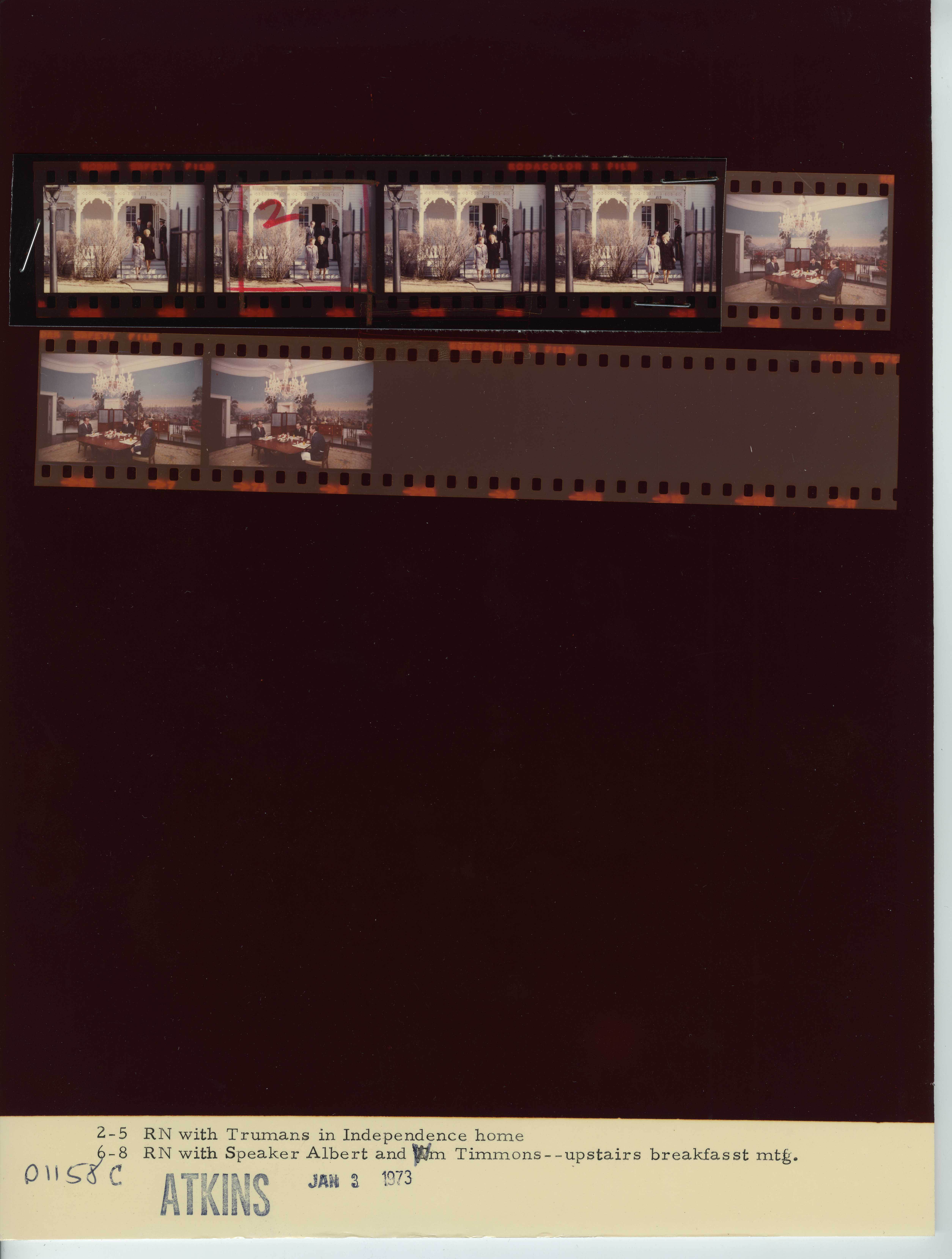
- Frame(s): WHPO-D1158-06A-07A, President Nixon at a breakfast meeting with Speaker of the House Congressman Carl Albert and Bill Timmons, National Convention Manager and Assistant for Legislative Affairs. 1/3/1973, Washington, D.C. Private Dining Room, White House. President Nixon, Carl Albert, Bill Timmons.
Roll WHPO-D1159 Photographer: Atkins, Oliver | Color or B&W: B&W
- Frame(s): WHPO-D1159-02-38, Formal closeup portraits of John Scali. 1/3/1973, Washington, D.C. unknown. John Scali.
- Frame(s): WHPO-D1159-25, Formal profile portrait of John Scali. 1/3/1973, Washington, D.C. unknown. John Scali.
Roll WHPO-D1160 Photographer: Atkins, Oliver | Color or B&W: B&W

- Frame(s): WHPO-D1160-02-26, President Nixon talking to Pittsburgh Pirates President Daniel Galbreath, with pitchers Dave Giusti and Steve Blass, about a Roberto Clemente Memorial Fund for Nicaraguan earthquake victims. 1/3/1973, Washington, D.C. White House, Oval Office. President Nixon, Daniel Galbreath, Dave Giusti, Steve Blass, press corps members.
Roll WHPO-D1161 Photographer: Schumacher, Karl | Color or B&W: B&W
- Frame(s): WHPO-D1161-04-24, Judy Agnew talking with women at a Capitol Hill Club Reception. 1/3/1973, Washington, D.C. unknown. Judy Agnew, unidentified women.
Roll WHPO-D1162 Photographer: Atkins, Oliver | Color or B&W: B&W
- Frame(s): WHPO-D1162-01A-04A, President Nixon standing with Senator J. Bennett Johnston, Jr., and members of his family. 1/3/1973, Washington, D.C. White House, Oval Office. President Nixon, Mr. & Mrs. J. Bennett Johnston, Jr., Johnston children.
Roll WHPO-D1163 Photographer: Atkins, Oliver | Color or B&W: B&W
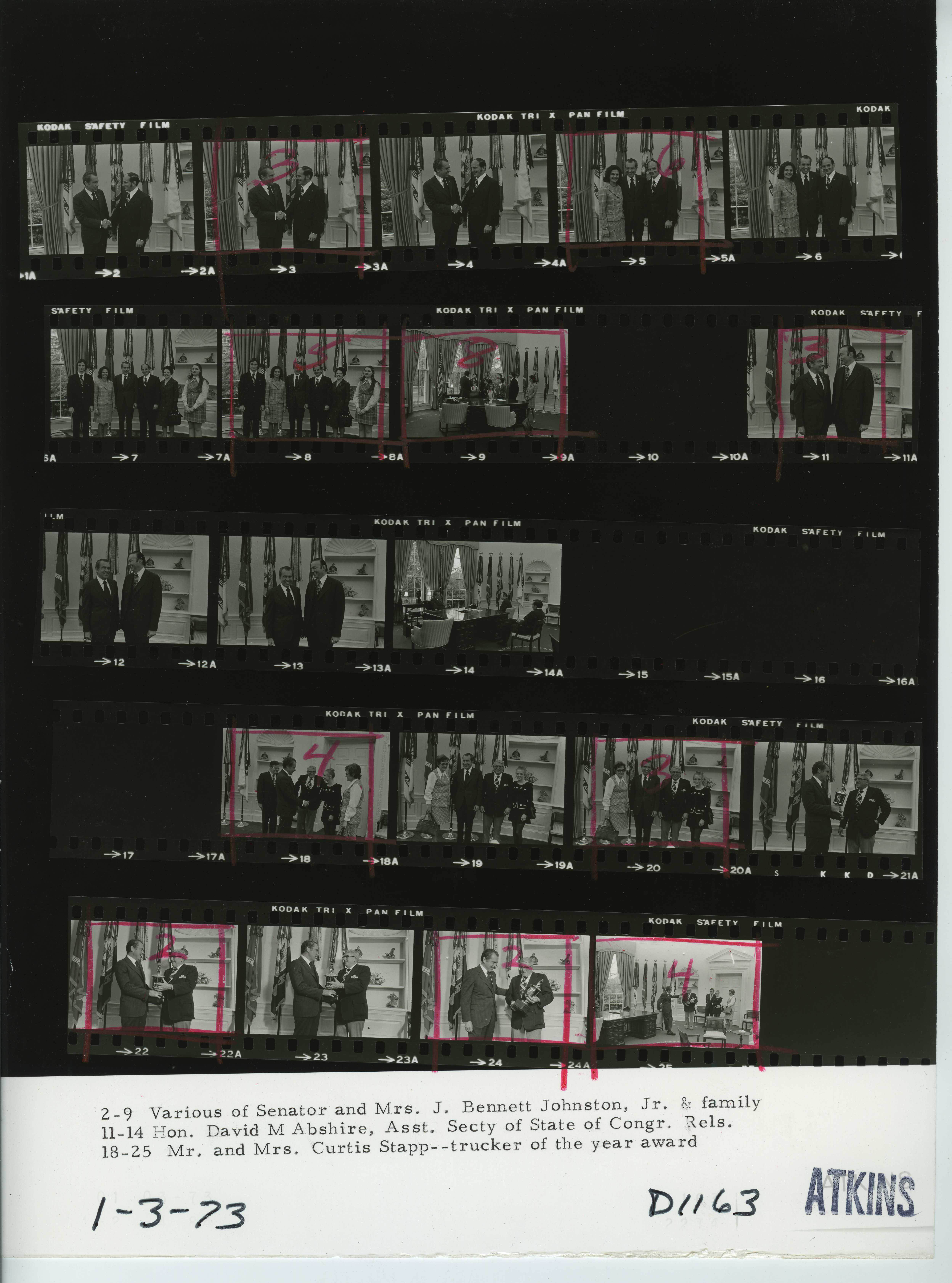
- Frame(s): WHPO-D1163-02-04, President Nixon with Senator J. Bennett Johnston. 1/3/1973, Washington, D.C. White House, Oval Office. President Nixon, Sen. & Mrs. J. Bennett Johnston, Jr., Johnston children, Mrs. J. Bennett Johnston, David Abshire, Mr. & Mrs. Curtis Stapp, Donna Stapp, Bill Timmons, Donald Rodgers.
- Frame(s): WHPO-D1163-05-06, President Nixon with Senator J. Bennett Johnston and Mrs. Johnston. 1/3/1973, Washington, D.C. White House, Oval Office. President Nixon, Sen. & Mrs. J. Bennett Johnston, Jr., Johnston children, Mrs. J. Bennett Johnston, David Abshire, Mr. & Mrs. Curtis Stapp, Donna Stapp, Bill Timmons, Donald Rodgers.
- Frame(s): WHPO-D1163-07-09, President Nixon with Senator J. Bennett Johnston and members of his family. 1/3/1973, Washington, D.C. White House, Oval Office. President Nixon, Sen. & Mrs. J. Bennett Johnston, Jr., Johnston children, Mrs. J. Bennett Johnston, David Abshire, Mr. & Mrs. Curtis Stapp, Donna Stapp, Bill Timmons, Donald Rodgers.
- Frame(s): WHPO-D1163-11-14, President Nixon with David Abshire, Assistant Secretary of State for Congressional Relations (from 1970–1973). 1/3/1973, Washington, D.C. White House, Oval Office. President Nixon, David Abshire.
- Frame(s): WHPO-D1163-18-20, 25, President Nixon standing with truck "Driver of the Year" Curtis Stapp and family members. 1/3/1973, Washington, D.C. White House, Oval Office. President Nixon, Sen. & Mrs. J. Bennett Johnston, Jr., Johnston children, Mrs. J. Bennett Johnston, David Abshire, Mr. & Mrs. Curtis Stapp, Donna Stapp, Bill Timmons, Donald Rodgers.
- Frame(s): WHPO-D1163-21-24, President Nixon with truck "Driver of the Year" Curtis Stapp. 1/3/1973, Washington, D.C. White House, Oval Office. President Nixon, Mr. & Mrs. Curtis Stapp, Donna Stapp, Bill Timmons, Donald Rodgers.
Roll WHPO-D1164 Photographer: Schumacher, Karl | Color or B&W: B&W
- Frame(s): WHPO-D1164-, Vice President Agnew taking photos with male members of Congress and their family members, from the 93rd United State Congress. 1/3/1973, Washington, D.C. unknown. Spiro Agnew, Unidentified Congressmen and their family members.
- Frame(s): WHPO-D1164-02-17, Vice President Agnew swearing in male members of Congress from the 93rd United State congress. 1/3/1973, Washington, D.C. unknown. Spiro Agnew, Unidentified Congressmen and their family members.
Roll WHPO-D1165 Photographer: Schumacher, Karl | Color or B&W: B&W
- Frame(s): WHPO-D1165-, Vice President Agnew taking photos with male members of Congress and their family members, from the 93rd United State Congress. 1/3/1973, Washington, D.C. unknown. Spiro Agnew, Unidentified Congressmen and their family members.
- Frame(s): WHPO-D1165-03A-19A, Vice President Agnew swearing in only male members of Congress from the 93rd United State congress. 1/3/1973, Washington, D.C. unknown. Spiro Agnew, Unidentified Congressmen and their family members.
The White House Communications Agency Sound Recordings Collection contains public statements that took place between 1969 and 1974. Visit the finding aid to learn more.
H - White House Staff Member Recordings
- WHCA-SR-H-693
Press briefing by Gerald Warren, Steve Blass, Dave Giusti, and Dan Galbraith. (1/3/1973, Press Lobby, White House)
Runtime: 11:39
Keywords: Press conferences, news conferences, interviews, media
Production credits: Audio feed supplied by WHCA; Recorded by JMM (initials of WHCA engineer)
Original Format: 1/4-inch reel-to-reel audiotape. Original source type: Original.
L - White House Press Office Briefings
- WHCA-SR-L-097
Press briefing by Ronald Ziegler. (1/3/1973, White House Press Lobby)
Runtime: 54:36:00
Keywords: Press conferences, news conferences, interviews, media, press secretary
Original Format: 1/4-inch reel-to-reel audiotape. Original source type: Original. - WHCA-SR-L-098
Press briefing by Ronald Ziegler. (1/3/1973, White House Press Lobby)
Keywords: Press conferences, news conferences, interviews, media, press secretary
Original Format: 1/4-inch reel-to-reel audiotape. Original source type: Original.
The White House Communications Agency Videotape Collection contains “off-the-air” recordings of televised programs produced between 1968 and 1974. Visit the finding aid to learn more.
- WHCA-5984
Weekly News Summary, Tape III.
ALL NETWORKS
5. Smith/Clark/Geer: 93rd Congress on Vietnam. Time Code Start: 12:25. Keywords: Vietnam War, House of Representatives, debates. Network: ABC.
6. Reasoner/Gill: Present administration's stand on bombing. Time Code Start: 16:42. Keywords: Vietnam War, bombings. Network: ABC.
7. Smith/Kaplow/Sherwood: 93rd Congress to convene. Time Code Start: 18:33. Keywords: House of Representatives. Network: ABC.
8. Reasoner/Collins: Vietnam and An Loc. Time Code Start: 23:29. Keywords: Vietnam War. Network: ABC.
9. Smith: Commentary on Congress. Time Code Start: 25:46. Keywords: House of Representatives. Network: ABC.
10. Chancellor/Duke: Congress is threatening to cut off funds for the Vietnam war with Mansfield, Jackson, Percy, Brooke. Time Code Start: 27:34. Keywords: Vietnam War, Congress, funding. Network: NBC.
11. Chancellor/Valeriani: Ron Ziegler warns Congress of the danger of talk about cutting funds for the Vietnam war. Time Code Start: 31:37. Keywords: Vietnam War, media, press conferences, news conferences, interviews. Network: NBC.
12. Brinkley: Commentary on executive branch assuming Congressional duties. Time Code Start: 34:00. Keywords: House of Representatives, Presidents. Network: NBC.
13. Chancellor/Briggs: Southern University reopens. Time Code Start: 37:00. Keywords: colleges, universities, opening. Network: NBC.
14. Chancellor/McCormick: Second Session of the 93rd Congress. Time Code Start: 39:05. Keywords: House of Representatives. Network: NBC.
15. Rather/Mudd: Ronald Zeigler announces that Congress should not threaten the plans of President Nixon and Kissinger with Mansfield and Albert. Time Code Start: 41:05. Keywords: Presidents, House of Representatives. Network: CBS.
16. Rather/Davis: Progress on peace talks; film of South Vietnam's President Thieu. Time Code Start: 44:40. Keywords: South Vietnam, Presidents, speeches, statements, Vietnam War. Network: CBS.
17. Rather/Dick: President Nixon administration accused of threatening a free press with Donald Champion and Robert Sheleenburg. Time Code Start: 47:15. Keywords: accusations, media, newspapers, magazines, publications, constitutional rights. Network: CBS.
18. Rather/Bradley: Deserters in Vietnam mess with drugs and now they are hung-up. Time Code Start: 49:17. Keywords: Vietnam Missing in Action, Vietnam War, Armed Forces, military, troops, desertions, drugs, heroin, marijuana, alcohol, alcoholism, addicts, addiction, prevention, programs. Network: CBS.
Context (External Sources)
The Vanderbilt Television News Archive is the world's most extensive and complete archive of television news. They have been recording, preserving and providing access to television news broadcasts of the national networks since August 5, 1968.
Wikipedia is a free encyclopedia that anyone can edit.