
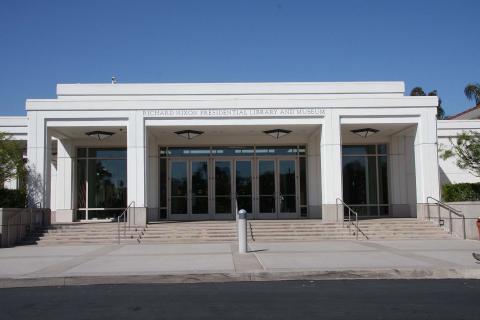
Introduction
This almanac page for Wednesday, January 19, 1972, pulls together various records created by the federal government and links to additional resources which can provide context about the events of the day.
Previous Date: Tuesday, January 18, 1972
Next Date: Thursday, January 20, 1972
Schedule and Public Documents
The Daily Diary files represent a consolidated record of the President's activities. Visit the finding aid to learn more.
The President's day began at The White House - Washington, D. C.
The Weekly Compilation of Presidential Documents made available transcripts of the President's news conferences; messages to Congress; public speeches, remarks, and statements; and other Presidential materials released by the White House.
Digitized versions can be found at HathiTrust.
Each Public Papers of the Presidents volume contains the papers and speeches of the President of the United States that were issued by the White House Office of the Press Secretary during the time period specified by the volume. The material is presented in chronological order, and the dates shown in the headings are the dates of the documents or events. In instances when the release date differs from the date of the document itself, that fact is shown in the text note.
To ensure accuracy, remarks have been checked against audio recordings (when available) and signed documents have been checked against the original, unless otherwise noted. Editors have provided text notes and cross references for purposes of identification or clarity.
The Federal Register is the official daily publication for rules, proposed rules, and notices of federal agencies and organizations, as well as executive orders and other Presidential documents.
The Congressional Record is the official daily record of the debates and proceedings of the U.S. Congress.
Archival Holdings
Any selection of archival documents will necessarily be partial. You should use the documents and folders identified below as a starting place, but consult the linked collection finding aids and folder title lists and the collections themselves for context. Many documents to be found this way do not lend themselves to association with specific dates, but are essential to a complete understanding of the material.
Selective document listing
President's Office Files
The President's Office Files consists of materials drawn together by the Special Files Unit from several administrative subdivisions within the White House Office. It is the handwriting and sensitive papers sent to the Staff Secretary that now comprise much of the President's Office Files. Visit the finding aid to learn more.
- News Summaries, Annotated News Summaries, Box 33, [Jan. 19-24, 1972] [1 of 2] [Note: Due to the way News Summary products were compiled, you should also consult nearby days for potentially relevant materials.]
- January 19, 1972
- News Summary, January 19, 1972, (Tues. wires, nets, mags, columns)
- President's Daily Schedule, Box 102, [President's Daily Schedule, Jan.-Mar. 1972] [1 of 3]
- The President's Schedule, Wednesday - January 19, 1972
The H. R. Haldeman Diaries consists of seven handwritten diaries, 36 dictated diaries recorded as sound recordings, and two handwritten audio cassette tape subject logs. The diaries and logs reflect H. R. Haldeman’s candid personal record and reflections on events, issues, and people encountered during his service in the Nixon White House. As administrative assistant to the President and Chief of Staff, Haldeman attended and participated in public events and private meetings covering the entire scope of issues in which the Nixon White House engaged in during the years 1969-1973. Visit the finding aid to learn more.
- Transcript of diary entry (PDF)
Wednesday, Wednesday, January 19th. During the staff meeting this morning, Shultz and Ehrlichman and I got into a discussion of the whole Connally situation. With George basically raising the issue, made the point that we have a real problem, if we de facto drop the Council for International Economic Policy. Because business sees it as a Presidential interest in trade problems, also we have Volcker making policy and this provides a counterbalance to him. That would be very bad to drop. They feel the problem is not in the announcing of policy, or, in other words the spokesman, but in the process of arriving at the policy. That the President should make the policy on the recommendation of the Council, but he should not go to Connally until after the Council has acted. There’s no point in having the Council if it's subject to one Cabinet member's veto. The whole purpose of the Council is to bring in all Departments. Now the question is whether we can get away with having a make-believe Council, or should we make a clean breast of it, that the President has changed the system, and will defer to Connally in these areas. Ehrlichman feels the Council can't succeed if the President doesn't want its advice. How do you enforce Connally's authority in trade policy if you don't have the Council? Rogers and others won't take it, and the lower-level people in the departments, particularly State, will start putting out attacks on Connally. Looking at it realistically, we're moving to a position of Connally functioning as Deputy President for International Economic Affairs. He already is Deputy President for Domestic Economic Affairs. Still he is also the Secretary of the Treasury, with vast responsibilities which he is not carrying out, and he's the Chairman of the Cost of Living Council. It's hard for anyone else to do anything. For example, Shultz says he can't because it's not his business anymore, and Connally has no staff and no time to do it. So in effect Shultz now reports to Connally not the President. Shultz says he realized yesterday in the meeting with the President how disconnected he has become from the President, that is, the Commerce-State decision yesterday was an example of how he can work if he is connected. Question is, are Shultz's orders now to report to Connally? The problem is Connally doesn't have the depth, breadth, or ultimate responsibility. Also, he has a strong interest in having no strength in the White House, therefore, he won't deal with anything that builds the White House. He goes off on his own, such as the gold in Rome, the gold statement in Rome. They feel the President needs some people in the White House who are his own people, who know what's going on. For example, now Shultz knows nothing about what's now going on in international trade. Connally has the ball. He doesn't consult, he operates, and proximity is the key to who you talk to, so Connally talks to Volcker.
Shultz then had to leave that meeting. Ehrlichman and I went on some more on the point that there's a problem with what line the President wants taken with the Vice President: How much he should be included in or out? What kind of external impression do we want to put out? That is, should we put Connally out in front on the school tax? John says Connally's moves threaten the President's orderly process, because antibodies will build up as they are now with Shultz, and a lot of other noses are bent, like Romney's and Peterson's. So the President has to decide: Does he want Shultz, and Ehrlichman, and all to look after the President's interests regarding Connally, and take positions where they think they should? Or does he want to short circuit the whole thing say Connally is the Deputy President with his own authority? This can't work with the rest of the Cabinet. That is, you couldn't hold Richardson in check, except by acceptance of a system that covers all of them. The President's staff can't build interdepartmental stuff, if the Cabinet officer goes direct and gets counter orders, which is why Ehrlichman has to sit in with Cabinet officers. Also, one departmental guy, even Connally, can't wheel the other departments. Ehrlichman also predicts there'll be IRS troubles, and that Connally's not in the position to cope with them. That we have a bad situation there with the bureaucracy. He says Shultz's problem is that George is getting eclipsed or at least feels that he is.
We reconvened a little later in the morning to resume the discussion, after Shultz was again available. Made the point that the question really is how the President sees the White House staff at this point. He has to come to grips with the way he's setting up Connally. The doctrine of revealed preference is the way Shultz goes, and he says it now is the revealed preference that the President is going to do his talking and all with Connally, instead of with Shultz and Ehrlichman. Also, Shultz says he's receiving a lot of Presidential instruction via Colson and he wants to be sure that this is the right channel and that it provides adequate input. He says Nixon is a much deeper, more subtle man than Connally, has values Connally doesn't. Connally has much less judgment. Maybe not on the same wavelength on some substantive areas, even though they are on the political base. Therefore he thinks Connally has brought the idea, for example, he thinks Connally has bought the idea, of permanent controls. We are all Nixon men, not Connally men. If this shifts to Connally, our views may change. He thinks we've gone past the point of one spokesman to one policy maker and that's a very different thing. Connally is not a staff man who checks with everyone, also he's not deep, he doesn't welcome with other viewpoints, and he's deluged with extra responsibilities, so he doesn't have the time or staff to handle. If he wanted to recruit, he could get good people, but he hasn't. Maybe this all isn't clear to Connally. He has a thing about the White House staff. He thinks Kissinger's operation, for example, is not desirable. He needs to face the question of how to handle this Deputy President role. Will he use the CEA and Shultz and so on, or will he try to do it all himself and in Treasury?
Ehrlichman says you can't just shift implicitly to the Deputy President idea, it has to be done overtly and clearly. If that is the concept, you need to understand it, and adapt to it, and Connally must also. If this is not the intent, then we're on the path of least resistance, just laying things off on people, and that's bad. If you set up a Connally White House staff, that is Flanigan, then you set up competition between the President and Deputy President's staffs. I had the thought as we were talking about this, that the President really is putting himself hostage to Connally, unnecessarily, as he's also done with Rogers, also unnecessarily.
I had an opportunity a little later in the morning to get into all of this with the President, which I did, reviewing basically all the points that Ehrlichman and Shultz had covered with me. The President was very thoughtful about it and seemed to appreciate this, suggested that I should join Flanigan in the Connally meeting today. That he can't let Connally get crosswise with Peter. He says Connally's got to do all these things, but he must not be out in front on them. And what he really wants is Connally as an advisor, especially on the political input. For example, Shultz is dead wrong on free trade politically, some of that kind of thing.
He then said, after thinking a bit, that he'd like to talk to me in a different dimension and he said he that hadn't intended to tell me this, and he wasn't, had not told anyone else, and was not going to tell anyone else, but that he had a very difficult time with Connally in California. That the night they had dinner at the President's house, Connally told him he had spent his time in Texas going off on a horse, and thinking through his future and he concluded that he had completed what he’d came here for, done the job that was needed, and he would be, therefore, leaving at the end of January. This he had talked over very thoroughly with Nellie and there was a firm decision. The President really had to go to work on him, apparently, to make the point that this was not in the best interests at this time, and worked back on it not only that night, but again, that's why he had him over before the Sato dinner the next night, and went back into it again. The President's feeling is that we can't afford to let him go now, and that we've got to pay the price that's necessary to keep him, so he really is, in a sense, in hostage to him as I had suspected earlier today. In that context, he wants me to go to the Connally meeting with Flanigan today, or wanted me to. He wanted me to make the point to Connally that we don't want to force Flanigan on him, if he's more comfortable with Dick Allen or some other low-level person, we can easily move it that way. I'm to tell him the President has told me to implement Connally's views. The White House staff is to carry that out. The question then is whether the Flanigan idea is one that he likes. If not, if he prefers Allen, that's fine. We do have to keep the organization of the Council, but we can do it any way he wants. Now, how do we do this trade thing and all? Connally has the international monetary problem, Cost of Living Council, international credit, the whole situation re trade. Also, the President wants him in close touch on national security matters. So how can we be helpful and staff wise, and how do we clear things, without bothering him, so on? And back to Flanigan, he doesn't want to impose him on Connally, the question is would Allen be better? He's bright, loyal, conservative. The President's purpose if it is Flanigan, is to let him be and the Council be the buffer. If Connally and the President will make the decisions on monetary and trade, on the other hand, how do we do it? How do we carry out the decisions? Connally and the President will discuss them, but it's not to Connally's interests to be out front on decision making, so we need a White House staff man who will broker them and take orders from the President and Connally. Question is who does the staff work leading to the decision? Who brokers with the other Departments, Peterson, Rogers, and so on? We need to take the heat off Connally on this and put it on the White House. We need the best staff work to prepare the decision, get the input from the departments, and so on. That was the President's guidance.
He called me over a couple hours later at the EOB, said he had some more thoughts on it, and said the problem is that Flanigan won't see it in the subtle way that's necessary. The President thinks Flanigan's best, but that won't be evident to Connally. So I'm to pull in the President's views during the conversation, ask Connally for a moment alone with him afterwards, if he's got any doubts on Flanigan, then let it drop. Then I should get into the question of the whole relationship with the White House staff, and make the point that all contact will be in support of him, not derogation. He also told me to give Connally a copy of the speech draft, and to give, have him give the President a call back about his views on the tone of it, and so on.
I then went on over with Peter to Connally's office and we had a good one hour meeting where Pete and Connally seemed to be basically on the same wave-length. I briefed Peter beforehand and on the way over about how to go at it, and he seemed to buy the concept, which was different than his original approach. Also, he was aware because Connally had said, made some crack to him about he might not be around much longer, of the need to put this together in such a way as to keep Connally on salvo, and that helped. Although I didn't, of course, tell him anything about what the President had told me.
I stayed afterwards and Connally agreed that he definitely wanted Flanigan in the post; he needs a strong man, someone who can wheel this. He doesn't intend to be involved in 90 percent of the decisions, but he wants to be sure and keep a line on it, so that it doesn't get away from him.
President called me over as soon as I got back, and asked for a report which I gave him and he seemed to be pretty pleased that had worked out. He then settled back and read me his Vietnam speech, which is going to be very good next Tuesday night. Then he reviewed the State of the Union, talked about the fact that he had a good conclusion on it now, and he read the conclusion which is good too.
At that point, Connally called about his suggestions on the State of the Union, and then the President called Rose to give her the corrections.
We got into another flap this morning, Kissinger called me in...
-------------------------------------------------------------------------------------------------------------------
DECLASSIFIED - E.O. 13526, Sect. 3.4: by MS, NARA, June 12, 2013
Audio Cassette 18, Side A, Withdrawn Item Number 14 [AC-18(A) Sel 13]
Duration: 1 minute 30 seconds
...to say that Rogers or, the State people have met with Rabin again yesterday, and that Rabin was not going to be able to hold out any longer on moving to negotiations, because of the pressure that they are putting on him that he won't get any planes unless he starts negotiating. So he's going to give in on either Friday or Monday. Henry's concerned about this not because the negotiations per se make any difference, but because of the problem that creates with the Soviets and the fact that it screws up our being able to settle this at the Moscow summit. He's also concerned that while Rabin reports back to him on everything State says to him, once they get Rabin locked up, they'll start dealing with the Egyptians and the Egyptians, of course, will not report back to us, so we won't know what's going on. On the other hand, the Egyptians will report to the Russians, so they will know what's going on. Also, Dobyrnin gets back tonight and he's concerned about that.
As a result of that, I pushed the, I told the President about this, and he shared the concerns. I also filled the President in on the whole Jordan problem from last night. Then I pushed again on my draft of the memorandum of instructions to Rogers and Kissinger, and the President agreed to that, and had me go ahead and get it done up and signed, which I did. And we'll, I guess, hand-deliver it to Rogers tomorrow.
-------------------------------------------------------------------------------------------------------------------
End of January 19th. - Original audio recording (MP3)
The National Archives Catalog is the online portal to the records held at the National Archives, and information about those records. It is the main way of describing our holdings and also provides access to electronic records and digitized versions of our holdings.
The Catalog searches across multiple National Archives resources at once, including archival descriptions, digitized and electronic records, authority records, and web pages from Archives.gov and the Presidential Libraries. The Catalog also allows users to contribute to digitized historical records through tagging and transcription.
Nixon Library Holdings
All National Archives Units
National Security Documents
The President's Daily Brief is the primary vehicle for summarizing the day-to-day sensitive intelligence and analysis, as well as late-breaking reports, for the White House on current and future national security issues. Read "The President's Daily Brief: Delivering Intelligence to Nixon and Ford" to learn more.
The Foreign Relations of the United States series presents the official documentary historical record of major U.S. foreign policy decisions and significant diplomatic activity. Visit the State Department website for more information.
Vol. II, Organization and Management of U.S. Foreign Policy, 1969-1972
The NSC System
170. Memorandum From President Nixon to Secretary of State Rogers and the President’s Assistant for National Security Affairs (Kissinger), Washington, January 19, 1972
Source: National Archives, RG 59, Office Files of William P. Rogers: Lot 73 D 443, Box 25, WPR—President Nixon. Secret; Eyes Only; Personal.
Vol. XXI, Chile, 1969-1973
Cool and Correct: The U.S. Response to the Allende Administration, November 5, 1970-December 31, 1972
288. Memorandum from Ashley Hewitt and Robert Hormats of the National Security Council Staff to the President’s Deputy Assistant for National Security Affairs (Haig), Washington, January 19, 1972
Source: National Archives, Nixon Presidential Materials, NSC Files, Box 776, Country Files, Latin America, Chile, Vol. VII. Top Secret; Sensitive; Exclusively Eyes Only; Completely Outside the System. Sent for information. The memorandum is addressed to Haig, but Haig wrote HAK over his own name, and Kissinger initialed the memorandum. Tab A, entitled “Incoming Correspondence Returned,” is attached but not printed.
Vol. E-1, Documents on Global Issues, 1969-1972
International Cooperation in Space, 1969-1972
275. Memorandum From Secretary of State Rogers to President Nixon, Washington, January 19, 1972
Rogers provided the President with an update on the status of negotiations with the Europeans on both the post-Apollo program and the proposed European communication satellite system.
Source: National Archives, RG 59, Central Files 1970-73, SP 10 EUR. No classification marking. Drafted by Robert T. Webber (SCI/SAM), and Frank J. Haendler (EUR/RPE); concurred in by Abraham Katz (EUR/RPE) and Frutkin. Also printed as Document I-26 in Logsdon (ed.), Exploring the Universe, Vol. II, External Relations. Johnson’s September 1, 1971, letter to Lefevre is Document 269. Attached but not published were Lefevre’s December 23, 1971, letter to Johnson and the January 11, 1972, NASA Report on Technical Discussions with the European Space Conference.
Vol. E-7, Documents on South Asia, 1969-1972
U.S. Relations with India and Pakistan, 1972
209. Telegram 774 From the Embassy in India to the Department of State, New Delhi, January 19, 1972, 1110Z
Ambassador Keating asked for authorization to reciprocate the interest in improved relations expressed by Indian Foreign Secretary Kaul on January 15. Keating recognized that a policy review was in process in Washington but felt that neither country should delay the process of improving bilateral relations.
Source: National Archives, RG 59, Central Files 1970–73, POL INDIA–US. Confidential; Priority; Limdis. Repeated to Bombay, Calcutta, Dacca, Islamabad, Madras, and priority to Saigon for Nelson Gross. Telegram 300 and 642 are Documents 201 and 205.
Vol. E-7, Documents on South Asia, 1969-1972
U.S. Relations with India and Pakistan, 1972
210. Minutes of Senior Review Group Meeting, Washington, January 19, 1972, 3:04-4:25 p.m.
The Senior Review Group reviewed South Asia policy and decided to recommend that recognition of Bangladesh be postponed, the restoration of improved relations with India take place slowly, and restrictions on trade with Pakistan be removed.
Source: National Archives, Nixon Presidential Materials, NSC Files, NSC Institutional Files (H-Files), Box H–113, SRG Minutes, Originals, 1972–1973. Secret; Nodis. The January 19 attachment is Top Secret; Sensitive. No drafting information appears on the minutes. The meeting was held in the White House Situation Room. For the Departments of State and Defense documents cited by Kissinger see Documents 206 and 207.
Vol. E-10, Documents on American Republics, 1969-1972
Mexico
472. Memorandum of Conversation, Washington, January 19, 1972., Washington, January 19, 1972
Assistant Secretary Meyer and Mexican Foreign Secretary Rabasa discussed trade relations, border economics, the bracero program, Mexico’s $343 million trade deficit with the United States, and the 10 percent surcharge on imports.
Source: National Archives, RG 59, Central Files 1970–73, POL MEX–US. Confidential. Drafted by Robert A. Stevenson (ARA/MEX). The meeting between Meyer and Rabasa took place following an earlier meeting on January 19, between Rogers and Rabasa, which covered general United States-Mexican relations, a Mexican offer to provide “good offices” in negotiations over the Panama Canal, and the agenda and activities of the Organization of American States. (Ibid.) Assistant Secretary Meyer and Mexican Foreign Secretary Rabasa discussed trade relations, border economics, the bracero program, Mexico’s $343 million trade deficit with the United States, and the 10 percent surcharge on imports.
Source: National Archives, RG 59, Central Files 1970–73, POL MEX–US. Confidential. Drafted by Robert A. Stevenson (ARA/MEX). The meeting between Meyer and Rabasa took place following an earlier meeting on January 19, between Rogers and Rabasa, which covered general United States-Mexican relations, a Mexican offer to provide “good offices” in negotiations over the Panama Canal, and the agenda and activities of the Organization of American States. (Ibid.)
Vol. E-10, Documents on American Republics, 1969-1972
Panama
558. Memorandum From Ashley C. Hewitt of the National Security Council Staff to the President’s Assistant for National Security Affairs (Kissinger), Washington, January 19, 1972., Washington, January 19, 1972
National Security Council staff member Hewitt summarized two CIA reports regarding the Panama Canal treaty negotiations. In the first report, Torrijos criticized the U.S. stance in the Canal negotiations, and the second indicated that the Panamanian Government would slow the pace of negotiations until after the August National Assembly elections.
Source: National Archives, Nixon Presidential Materials, NSC Files, Box 792, Country Files, Latin America, Panama, Atlantic-Pacific International Ocean Canal Study Commission, Vol. 2, 1972. Secret; Sensitive. Sent for information. Attached but not published are Tabs A and B. Tab A is a January 14 CIA memorandum, “Plan of Panamanian Government to Issue Official Statement on Status of Canal Treaty Negotiations;” Tab B is a January 17 CIA memorandum, “Criticism by General Omar Torrijos of the Position Taken by the United States in the Treaty Negotiations.”
The Kissinger telephone conversation transcripts consist of approximately 20,000 pages of transcripts of Kissinger’s telephone conversations during his tenure as Assistant to the President for National Security Affairs (1969-1974) and Secretary of State (1973-1974) during the administration of President Richard Nixon. Visit the finding aid for more information.
Digitized versions can be found in the National Archives Catalog.
Audiovisual Holdings
Visit the White House Tapes finding aid to learn about the taping system's operation and archival processing.
Oval Office
- 651-1; Unknown between 9:32 a.m. & 10:05 a.m.; Nixon, Richard M. (President); [Unknown person(s)]
- 651-2; Unknown between 9:32 a.m. & 10:05 a.m.; Nixon, Richard M. (President); Bull, Stephen B.
- 651-3; 10:05 a.m. - 10:06 a.m.; Nixon, Richard M. (President); Butterfield, Alexander P.
- 651-4; Unknown between 10:06 a.m. & 10:13 a.m.; Nixon, Richard M. (President); White House operator
- 651-5; Unknown between 10:06 a.m. & 10:13 a.m.; Nixon, Richard M. (President); Bull, Stephen B.
- 651-6; Unknown between 10:06 a.m. & 10:13 a.m.; Nixon, Richard M. (President); Bull, Stephen B.
- 651-7; 10:13 a.m. - 10:21 a.m.; Nixon, Richard M. (President); Rockefeller, Nelson A.
- 651-8; Unknown between 10:21 a.m. & 10:30 a.m.; Nixon, Richard M. (President); Bull, Stephen B.
- 651-9; Unknown between 10:21 a.m. & 10:30 a.m.; Nixon, Richard M. (President); [Unknown person(s)]
- 651-10; 10:30 a.m. - 11:18 a.m.; Nixon, Richard M. (President); Price, Raymond K., Jr.; Woods, Rose Mary; [Unknown person(s)]; Ziegler, Ronald L.
- 651-11; 11:18 a.m. - 11:18 a.m.; Nixon, Richard M. (President); Sanchez, Manolo
- 651-12; 11:19 a.m. - 1:15 p.m.; Bull, Stephen B.; Butterfield, Alexander P.; Haldeman, H. R. ("Bob"); Nixon, Richard M. (President); Sanchez, Manolo; Harlow, Bryce N.
- 651-13; Unknown between 1:15 p.m. & 11:59 p.m.; United States Secret Service agents; [Unknown person(s)]
White House Telephone
- 19-5; Unknown between 10:06 a.m. & 10:13 a.m.; Nixon, Richard M. (President); White House operator
- 19-6; 10:13 a.m. - 10:21 a.m.; Nixon, Richard M. (President); Rockefeller, Nelson A.
- 19-7; Unknown between 1:40 p.m. & 1:43 p.m.; Nixon, Richard M. (President); White House operator
- 19-8; 1:43 p.m. - 1:44 p.m.; Nixon, Richard M. (President); Tkach, Walter R.
- 19-9; Unknown between 2:15 p.m. & 2:29 p.m.; Nixon, Richard M. (President); White House operator
- 19-10; 2:29 p.m. - 2:34 p.m.; Nixon, Richard M. (President); Connally, John B.
- 19-11; Unknown between 2:34 p.m. & 3:43 p.m.; Nixon, Richard M. (President); White House operator
- 19-12; 3:43 p.m. - 3:44 p.m.; Nixon, Richard M. (President); Safire, William L.
- 19-13; 3:58 p.m. - 3:59 p.m.; Nixon, Richard M. (President); Haldeman, H. R. ("Bob")
- 19-14; 4:30 p.m. - 4:31 p.m.; Nixon, Richard M. (President); Eisenhower, Julie Nixon
- 19-15; 4:39 p.m. - 4:42 p.m.; Nixon, Richard M. (President); Connally, John B.
- 19-16; Unknown between 4:42 p.m. & 4:46 p.m.; Nixon, Richard M. (President); White House operator
- 19-17; 4:46 p.m. - 4:49 p.m.; Nixon, Richard M. (President); Price, Raymond K., Jr.
- 19-18; Unknown between 5:06 p.m. & 5:17 p.m.; Nixon, Richard M. (President); White House operator
- 19-19; 5:17 p.m. - 5:18 p.m.; Nixon, Richard M. (President); Tkach, Walter R.
- 19-20; Unknown between 6:30 p.m. & 7:02 p.m.; Nixon, Richard M. (President); White House operator
- 19-21; 7:02 p.m. - 7:03 p.m.; Nixon, Richard M. (President); Sanchez, Fina
- 19-22; Unknown between 7:03 p.m. & 7:14 p.m.; Nixon, Richard M. (President); White House operator
- 19-23; 7:14 p.m. - 7:14 p.m.; Nixon, Richard M. (President); White House operator
- 19-24; Unknown between 7:14 p.m. & 7:22 p.m.; Nixon, Richard M. (President); White House operator
- 19-25; 7:22 p.m. - 7:23 p.m.; Nixon, Richard M. (President); Haldeman, H. R. ("Bob")
The White House Photo Office collection consists of photographic coverage of President Richard Nixon meeting with prominent social, political, and cultural personalities; speaking engagements and news conferences of the President and various high-ranking members of the White House staff and Cabinet; Presidential domestic and foreign travel, including Presidential vacations; social events and entertainment involving the First Family, including entertainers present; official portraits of the President, First Family, and high-ranking members of the Nixon administration; the 1969 and 1973 Inaugurals; the President’s 1972 Presidential election campaign appearances (including speeches) and other official activities of the White House staff and the President’s Cabinet from January 20, 1969 until August 9, 1974 at the White House and the Old Executive Office Building; other locations in Washington, DC, such as The Mall; and the Presidential retreats in Camp David, Maryland, Key Biscayne, Florida, and San Clemente, California. Visit the finding aid to learn more.
Roll WHPO-8290 Photographer: Atkins, Oliver | Color or B&W: B&W
- Frame(s): WHPO-8290-, Mr. and Mrs. J. Willard Marriott, Inaugural Committee Chairman and Mr. and Mrs. Kosiglu. 1/19/1972, unknown unknown.
Roll WHPO-8292 Photographer: Schumaker, Byron | Color or B&W: B&W
- Frame(s): WHPO-8292-, Mrs. Lillian Green. 1/19/1972, Washington, D.C. Mrs. Lillian Green.
Roll WHPO-8293 Photographer: Knudsen, Robert L. | Color or B&W: Color
- Frame(s): WHPO-8293-, Needlepoint of Presidential Seal. 1/19/1972, Washington, D.C. President's Executive Office Building Conference room.
Roll WHPO-8295 Photographer: Schumacher, Karl | Color or B&W: Color
- Frame(s): WHPO-8295-, Vice President Agnew at Birmingham, Alabama. 1/19/1972, Birmingham, Alabama Spiro Agnew.
Roll WHPO-8296 Photographer: Schumacher, Karl | Color or B&W: B&W
- Frame(s): WHPO-8296-, Vice President Agnew at the Touchdown Club in Birmingham, Alabama. 1/19/1972, Birmingham, Alabama Touchdown Club. Spiro Agnew.
Roll WHPO-8297 Photographer: Schumacher, Karl | Color or B&W: B&W
- Frame(s): WHPO-8297-, Vice President Agnew at the Touchdown Club in Birmingham, Alabama. 1/19/1972, Birmingham, Alabama Touchdown Club. Spiro Agnew.
Roll WHPO-8298 Photographer: Schumacher, Karl | Color or B&W: B&W
- Frame(s): WHPO-8298-, Vice President Agnew at the Touchdown Club in Birmingham, Alabama. 1/19/1972, Birmingham, Alabama Touchdown Club. Spiro Agnew.
- Frame(s): WHPO-8298-, Vice President Agnew being greeted at airport. 1/19/1972, Birmingham, Alabama Airport at Birmingham, Ala. Spiro Agnew, Judy Agnew.
Roll WHPO-8299 Photographer: Schumacher, Karl | Color or B&W: B&W
- Frame(s): WHPO-8299-, Vice President Agnew at the Governor's Award Banquet. 1/19/1972, Birmingham, Alabama Touchdown Club. Spiro Agnew.
The White House Communications Agency Sound Recordings Collection contains public statements that took place between 1969 and 1974. Visit the finding aid to learn more.
H - White House Staff Member Recordings
- WHCA-SR-H-491
Press briefing by Peter Peterson and Ronald Ziegler. (1/19/1972, Press Center, White House)
Runtime: 46:00:00
Keywords: Press conferences, news conferences, interviews, media, press secretary
Production credits: Audio feed supplied by WHCA; Recorded by LRR (initials of WHCA engineer)
Original Format: 1/4-inch reel-to-reel audiotape. Original source type: Original.
I - Various Administration Events
- WHCA-SR-I-097
Retirement for Jiggs Fauver. (1/19/1972, Family Theater, White House)
Runtime: 1:15:00
Production credits: Audio feed supplied by WHCA; Recorded by LDH (initials of WHCA engineer)
Original Format: 1/4-inch reel-to-reel audiotape. Original source type: Original.
The White House Communications Agency Videotape Collection contains “off-the-air” recordings of televised programs produced between 1968 and 1974. Visit the finding aid to learn more.
- WHCA-4978
Julie Nixon Eisenhower in Atlanta, Georgia.
ALL NETWORKS
Runtime: 00:33:00 - WHCA-4979
"This Week".
Undetermined
Runtime: 00:29:56 - WHCA-4980
"Martin Agronsky: Evening Edition".
NBC
Runtime: 00:29:31 - WHCA-4981
"The Dick Cavett Show". HOW - a discussion of the report of the Presidential Commission on Marijuana
Post-Newsweek Stations, Inc.
Runtime: 01:32:32 - WHCA-4986
Weekly News Summary II.
Undetermined
Runtime: 1:30
21. Smith/Donaldson: Small retail stores exempt from price controls; also many rental controls released (Rumsfeld). Time Code Start: 54:54. Keywords: wage and price controls, freezes, prices, costs, increases, decreases, economy, economics, budgets, finances, recession, inflation, money, rents, housing. Network: ABC.
22. Reasoner/Giggans: MIG 21 downed in Vietnam; more on possible TET offensive. Time Code Start: 57:25. Keywords: Vietnam War, aircraft, crashes, bombings, holidays. Network: ABC.
23. Smith/Jarriel: Possible collusion of the Russians with North Vietnam to foul efforts of President Nixon's trip to China. Time Code Start: 60:00. Keywords: Presidents, travel, trips, Nixon trips, international, People's Republic of China, Soviet Union, Russia, USSR. Network: ABC.
24. Smith: Russian fishing boats finally agree to follow Coast Guard vessels to a U.S. port. Time Code Start: 61:30. Keywords: Soviet Union, Russia, USSR, ships, boats, fishing, illegal, Alaska. Network: ABC.
25. Smith: President Nixon announces get tough policy with countries that confiscate U.S. government property. Time Code Start: 62:08. Keywords: Presidents,. Network: ABC.
26. Reasoner: Congress passes bill concerning campaign spending. Time Code Start: 62:27. Keywords: Presidential elections, campaigns, campaigning, reforms, legislation, bills, laws, funding, finances, donations, contributions, costs. Network: ABC.
27. Smith: Commentary campaign spending. Time Code Start: 62:57. Keywords: Presidential elections, campaigns, campaigning, candidates, costs, finances, funding. Network: ABC.
28. Chancellor/Levine: Cost of living council decisions with Rumsfeld. Time Code Start: 64:45. Keywords: economy, economics, budgets, finances, recession, inflation, money, wages, costs, unemployment, prices, reports, cabinet, advisors. Network: NBC.
29. Chancellor/Stern: Budget report. Time Code Start: 67:17. Keywords: reports, economy, economics, budgets, finances, recession, inflation, money, wages, costs, unemployment, prices, payments. Network: NBC.
30. Chancellor: Congress sends campaign spending bill to White House. Time Code Start: 70:56. Keywords: Presidential elections, campaigns, campaigning, reforms, legislation, bills, laws, funding, finances, donations, contributions, costs. Network: NBC.
31. Chancellor: Chinese gunners fired on American planes over Laos. Time Code Start: 71:40. Keywords: Vietnam War, People's Republic of China, military, attacks. Network: NBC.
32. Chancellor/Brinkley: Amnesty for the Draft evaders. Time Code Start: 72:45. Keywords: military, conscription, evasion, selective service, lottery, laws, Vietnam War, conscientious objectors, political offenses, pardons, draft evasion. Network: NBC.
33. Chancellor: Senator Muskie gets another endorsement. Time Code Start: 76:35. Keywords: Senators, Presidential elections, campaigns, campaigning, candidates. Network: NBC.
34. Cronkite/Schieffer: Air war in Southeast Asia steps up. Time Code Start: 76:55. Keywords: Vietnam War, bombings, aircraft, military, weapons, Asian, Indochina, Cambodia, Laos, Myanmar (Burma), Thailand, and Vietnam, Philippines, Malaysia, East Timor, Indonesia, Brunei, Singapore. Network: CBS.
35. Cronkite/Dunning: More on the Vietnam war; Long Chegn. Time Code Start: 80:39. Keywords: Vietnam War. Network: CBS.
36. Cronkite: Cost of living council gives new exemptions. Time Code Start: 84:17. Keywords: economy, economics, budgets, finances, recession, inflation, money, wages, costs, unemployment, prices, reports. Network: CBS.
37. Cronkite: Richmond, Virginina judge refuses stay of order for school desegregation. Time Code Start: 85:34. Keywords: law officials, judges, justices, desegregation, racism, racial profiling, racial discrimination, civil rights, African Americans, schools, students. Network: CBS.
38. Cronkite: House approves campaign spending bill. Time Code Start: 86:03. Keywords: Presidential elections, campaigns, campaigning, reforms, legislation, bills, laws, funding, finances, donations, contributions, costs. Network: CBS.
39. Cronkite/Sevareid: Senator Muskie receives another endorsement. Time Code Start: 86:47. Keywords: Senators, Presidential elections, campaigns, campaigning, candidates. Network: CBS.
40. Cronkite: President Nixon announces get tough policy on countries that seize American property. Time Code Start: 89:31. Keywords: Presidents, warnings, real estate, takeovers. Network: CBS.
Context (External Sources)
The Vanderbilt Television News Archive is the world's most extensive and complete archive of television news. They have been recording, preserving and providing access to television news broadcasts of the national networks since August 5, 1968.
Wikipedia is a free encyclopedia that anyone can edit.