
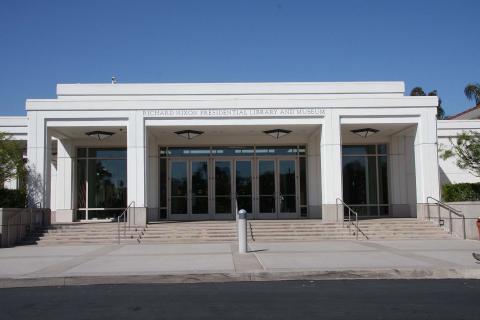
Introduction
This almanac page for Tuesday, September 19, 1972, pulls together various records created by the federal government and links to additional resources which can provide context about the events of the day.
Previous Date: Monday, September 18, 1972
Next Date: Wednesday, September 20, 1972
Schedule and Public Documents
The Daily Diary files represent a consolidated record of the President's activities. Visit the finding aid to learn more.
The President's day began at The White House - Washington, D. C.
The Weekly Compilation of Presidential Documents made available transcripts of the President's news conferences; messages to Congress; public speeches, remarks, and statements; and other Presidential materials released by the White House.
Digitized versions can be found at HathiTrust.
Each Public Papers of the Presidents volume contains the papers and speeches of the President of the United States that were issued by the White House Office of the Press Secretary during the time period specified by the volume. The material is presented in chronological order, and the dates shown in the headings are the dates of the documents or events. In instances when the release date differs from the date of the document itself, that fact is shown in the text note.
To ensure accuracy, remarks have been checked against audio recordings (when available) and signed documents have been checked against the original, unless otherwise noted. Editors have provided text notes and cross references for purposes of identification or clarity.
- Message to the Congress Transmitting Annual Report on the Foreign Assistance Program.
- Message to the Senate Transmitting the United States-Polish Consular Convention.
- Message to the Senate Transmitting the United States-Romanian Consular Convention.
- Message to the Senate Transmitting the United States-Hungarian Consular Convention.
- Proclamation 4157—National Coaches Day
The Federal Register is the official daily publication for rules, proposed rules, and notices of federal agencies and organizations, as well as executive orders and other Presidential documents.
The Congressional Record is the official daily record of the debates and proceedings of the U.S. Congress.
Archival Holdings
Any selection of archival documents will necessarily be partial. You should use the documents and folders identified below as a starting place, but consult the linked collection finding aids and folder title lists and the collections themselves for context. Many documents to be found this way do not lend themselves to association with specific dates, but are essential to a complete understanding of the material.
Selective document listing
President's Office Files
The President's Office Files consists of materials drawn together by the Special Files Unit from several administrative subdivisions within the White House Office. It is the handwriting and sensitive papers sent to the Staff Secretary that now comprise much of the President's Office Files. Visit the finding aid to learn more.
- News Summaries, Annotated News Summaries, Box 38, Sept. 19-30, 1972 [1 of 6] [Note: Due to the way News Summary products were compiled, you should also consult nearby days for potentially relevant materials.]
- Political Media Analysis, September 19, 1972
- News Summary, September 19, 1972, (Mon. nets, wires, mags)
- President's Daily Schedule, Box 102, [President's Daily Schedule, Aug.-Sept. 1972] [2 of 2]
- The President's Schedule, Tuesday - September 19, 1972
The H. R. Haldeman Diaries consists of seven handwritten diaries, 36 dictated diaries recorded as sound recordings, and two handwritten audio cassette tape subject logs. The diaries and logs reflect H. R. Haldeman’s candid personal record and reflections on events, issues, and people encountered during his service in the Nixon White House. As administrative assistant to the President and Chief of Staff, Haldeman attended and participated in public events and private meetings covering the entire scope of issues in which the Nixon White House engaged in during the years 1969-1973. Visit the finding aid to learn more.
- Transcript of diary entry (PDF)
Tuesday, September 19.
Mitchell called from New York because he couldn't come to the political strategy meeting today and had several ideas. In view of the polls at the present time, he thinks we ought to look at an alternate media plan, maybe build up the closer states, California, New York, Michigan, and so on, transferring from those states that are way ahead, like Texas. He thinks we should stay with the Democrats' negative commercial longer and hold up on the positive commercials for a while. If the leads hold, we should work out a plan for combined ads with Senatorial candidates. Flexibility is the key point. He thinks Buchanan's analysis piece is good, he especially likes the idea of Connally using Meany, Jackson, Humphrey quotes and thinks it would be good for Reagan to do an economic speech, especially at something like the Press Club. Feels we've got to get Dole, Finch and all to quit talking about the New Republican Majority. Feels there is some tendency of our troops to let up, so we shouldn't let the word out that we're cutting back on anything.
We had a problem today on the press situation with Pat Nixon. She talked to the President and apparently was disturbed because of a Q&A that got very rough in her first day out. The President has thus issued orders that we knock off all of that, that she shouldn't be put through that, nor should any of the rest of the family.
He's concerned about the grain deal and was asking about the staff analysis on that. Wants to be sure we keep the heat on on amnesty, and that we move out an amnesty commercial with the Democrats.
He got into some speech analysis points, based on his address to the Drug Conference this morning, made the point that the phrases that were picked up on television were all the ones that the President put in. Each is one that people can see, a visual type thing. He wants the speech writers to look at how the President cut out the connecting words and used short sentences, keeping the heat on them. He continues to bemoan the fact that he doesn't really have a good speechwriter.
We had our political strategy meeting with Connally, MacGregor, Colson and George Christian this afternoon. Agreed that we shouldn't let the line build up that we're going to sweep in all the Congressional candidates. Connally made the point that we shouldn't let Pat Nixon get out in front of the President. She can’t appear to be out ahead of him, so we should slow her down, not too long a tour, etcetera. Point was made on the necessity of getting the candidates to hang on the President, not the President going in for them. He decided to run the Russian five-minute-spot next week and then hold it up till after October 5, when we've finished the various Soviet announcements, but run the China five-minute the following week. Also going to run the Democrats national defense sixty-second spot next week, and go with Connally's foreign policy speech on Wednesday the 4th, keep everybody else clear on that day. Connally's point is that our strategy now must not be to do anything to become the issue. McGovern's the issue; we should keep it that way, and don't inject any issue. Also, keep Agnew at a low-key and don't let him become an issue.
Got into some follow-up on this on the helicopter to Camp David. Connally wanted to do a Q&A at his Democrat deal at the ranch. President doesn't feel he should, and I've had to turn that off. We got into an additional concern about depoliticizing the family schedule, keep them out of partisan activities, keep them in just basic events, get them out of any press Q&A type things. Keep Agnew out of the line of fire. McGovern is now the issue, keep it that way. Don't let the President, or Vice President or family become the issue, be sure Connally understands this. Stop releasing the surrogate schedules, which look like we've got too many other people out. Then he wants to consider dropping the regional press conference idea and figure out something to substitute for them, we shouldn't let the press dictate what we do. We could have one in-office press conference to get rid of the pressure. Probably it would be worthwhile to get it out of the way. Then find other events in Atlanta and Boston. Honor somebody, visit something, do a regional reception of our people, drop a major statement, nonpolitical or nonpartisan, or do a radio speech on, basic subject of the next four years. He had me into Aspen when we arrived to chat about this a little further before he went to dinner with his family.
End of September 19. - Original audio recording (MP3)
The National Archives Catalog is the online portal to the records held at the National Archives, and information about those records. It is the main way of describing our holdings and also provides access to electronic records and digitized versions of our holdings.
The Catalog searches across multiple National Archives resources at once, including archival descriptions, digitized and electronic records, authority records, and web pages from Archives.gov and the Presidential Libraries. The Catalog also allows users to contribute to digitized historical records through tagging and transcription.
Nixon Library Holdings
All National Archives Units
National Security Documents
The President's Daily Brief is the primary vehicle for summarizing the day-to-day sensitive intelligence and analysis, as well as late-breaking reports, for the White House on current and future national security issues. Read "The President's Daily Brief: Delivering Intelligence to Nixon and Ford" to learn more.
The Foreign Relations of the United States series presents the official documentary historical record of major U.S. foreign policy decisions and significant diplomatic activity. Visit the State Department website for more information.
Vol. V, United Nations, 1969-1972
Committee of 24
79. Telegram From the Mission to the United Nations to the Department of State, New York, September 19, 1972, 2233Z
Source: National Archives, RG 59, Central Files 1970–73, POL 19 UN. Confidential.
Vol. VIII, Vietnam, January-October 1972
The Parties Move Toward Agreement, July 19-October 7, 1972
263. Memorandum From the President’s Assistant for National Security Affairs (Kissinger) to President Nixon, Washington, September 19, 1972
Source: National Archives, Nixon Presidential Materials, NSC Files, Box 855, For the President’s Files (Winston Lord)—China Trip/Vietnam, Sensitive Camp David, Vol. XVII. Top Secret; Eyes Only. A stamped notation on the memorandum indicates the President saw it. Kissinger had earlier sent to Haig an untitled, shorter report of his meeting with Le Duc Tho in Hakto 33, September 15, 2005Z, which Haig provided to the President. A stamped notation on the covering memorandum indicates the President saw it. (Ibid.)
Vol. XV, Soviet Union, June 1972-August 1974
Economic Normalization and Soviet Jewish Emigration, September-December 1972
48. Memorandum From the President’s Special Counsel (Garment) to President Nixon, Washington, September 19, 1972
Source: National Archives, Nixon Presidential Materials, NSC Files, Box 721, Country Files—Europe—USSR, Vol. XXVI. No classification marking. Sent via Haldeman. A stamped notation at the top of the memorandum indicates the President saw it. In a September 20 covering memorandum to Haldeman, Garment wrote: “I discussed this subject with Henry Kissinger, gave him a draft, and am sending him a copy of the attached memorandum to the President. He said I could cite his general concurrence.”
Vol. XVII, China, 1969-1972
China, March-December 1972
253. Memorandum of Conversation, New York, September 19, 1972, 6:17-7:45 p.m.
Source: National Archives, Nixon Presidential Materials, NSC Files, Box 850, President’s File—China Trip, China Exchanges. Top Secret; Sensitive; Exclusively Eyes Only. Attached but not printed were Kissinger’s talking points.
Vol. XX, Southeast Asia, 1969-1972
Thailand
176. Memorandum From Richard T. Kennedy of the National Security Council Staff to the President’s Assistant for National Security Affairs (Kissinger), Washington, September 19, 1972
Source: National Archives, Nixon Presidential Materials, NSC Files, Box 565, Country Files, Far East, Thailand, Vol. IX. Secret; Sensitive. Sent for action.
Vol. XXI, Chile, 1969-1973
Cool and Correct: The U.S. Response to the Allende Administration, November 5, 1970-December 31, 1972
309. Memorandum From William J. Jorden of the National Security Council Staff to the President’s Assistant for National Security Affairs (Kissinger), Washington, September 19, 1972
Source: National Archives, Nixon Presidential Materials, NSC Files, Box 776, Country Files, Latin America, Chile, Vol. VII. Secret; Sensitive. Sent for information. The memorandum was sent through Haig. At the top, Kissinger wrote, “Al—Discuss soonest. Davis is an idiot. HK.” On a covering memorandum, Haig wrote, “HAK—I’ve asked Walters to prepare plan—you and Kennedy may wish to talk to him before I return.” (Ibid.)
Vol. XXIII, Arab-Israeli Dispute, 1969-1972
Proximity Talks and the Backchannel: Separate Department of State and White House Negotiating Tricks
309. Memorandum of Conversation, Washington, September 19, 1972, 3 p.m.
Source: National Archives, Nixon Presidential Materials, NSC Files, Kissinger Office Files, Box 131, Middle East. Top Secret; Sensitive; Exclusively Eyes Only. All brackets are in the original except those indicating text that remains classified. The conversation took place in Kissinger’s office.
Vol. XXXIV, National Security Policy, 1969-1972
Taking Stock
224. National Intelligence Estimate, Washington, September 19, 1972
Source: Central Intelligence Agency, NIC Files, Job 79–R01012A. Top Secret; [codewords not declassified]. The CIA and the intelligence organizations of the Departments of State and Defense and the NSA participated in the preparation of this estimate. The Director of Central Intelligence submitted this estimate with the concurrence of all members of the USIB with the exception of the representatives of the FBI and the Department of the Treasury, who abstained on the grounds that the subject matter was outside their jurisdiction. According to a Post Mortem, approved by the USIB on December 13, NIE 11–12–72 resulted from an urgent request from the Director of the DIA for such an estimate. (Ibid.) The table of contents and four annexes are not printed. The full text of this NIE is in the CIA FOIA Electronic Reading Room (www.foia.cia.gov).
Vol. E-4, Documents on Iran and Iraq, 1969-1972
Iran 1972
221. Memorandum From the Vice Admiral of the Navy (Peet) to Secretary of Defense Laird, Washington, September 19, 1972
Peet updated Laird on the status of the items promised to the Shah, including F–14/15s, laser-guided bombs, and uniformed technicians.
Source: Washington National Records Center, OASD Files, (C) (A), FRC 330–77–0094, Iran 1972. Secret. The enclosures are not published.
The Kissinger telephone conversation transcripts consist of approximately 20,000 pages of transcripts of Kissinger’s telephone conversations during his tenure as Assistant to the President for National Security Affairs (1969-1974) and Secretary of State (1973-1974) during the administration of President Richard Nixon. Visit the finding aid for more information.
Digitized versions can be found in the National Archives Catalog.
Audiovisual Holdings
Visit the White House Tapes finding aid to learn about the taping system's operation and archival processing.
Camp David Hard Wire
- 212-1; 6:23 p.m. - 6:55 p.m.; Nixon, Richard M. (President); Haldeman, H. R. ("Bob")
- 212-2; Unknown between 6:55 p.m. & 7:46 p.m.; Nixon, Richard M. (President); Sanchez, Manolo
- 212-3; 7:45 p.m. - 7:45 p.m.; Nixon, Richard M. (President); Camp David Operator
- 212-4; 7:46 p.m. - 8:10 p.m.; Nixon, Richard M. (President); Colson, Charles W.
- 212-5; Unknown between 8:10 p.m., 9/19 & 7:10 p.m., 7/30; Hirsch, William; Camp David Operator
- 212-6; Unknown between 8:10 p.m., 9/19 & 7:10 p.m., 7/30; Eisenhower, Julie Nixon; [Unknown person(s)]
- 212-7; Unknown between 8:10 p.m., 9/19 & 7:10 p.m., 7/30; Eisenhower, Julie Nixon; [Unknown person(s)]
- 212-8; Unknown between 8:10 p.m., 9/19 & 7:10 p.m., 7/30; Eisenhower, Julie Nixon; [Unknown person(s)]; Sanchez, Manolo
- 212-9; Unknown between 8:10 p.m., 9/19 & 7:10 p.m., 7/30; Cox, Edward R. F.; Camp David Operator; Hall, Allen C.
Camp David Study Table
- 144-1; Unknown between 7:45 p.m. & 7:46 p.m.; Nixon, Richard M. (President); [Unknown person(s)]; Camp David Operator
- 144-2; 7:46 p.m. - 8:10 p.m.; Nixon, Richard M. (President); Colson, Charles W.
- 144-3; Unknown between 8:10 p.m., 9/19 & 7:10 p.m., 5/18; Hirsch, William; Camp David Operator
- 144-4; Unknown between 8:10 p.m., 9/19 & 7:10 p.m., 5/18; Cox, Edward R. F.; Hall, Allen C.
Old Executive Office Building
- 357-1; Unknown between 12:51 p.m. & 1:45 p.m.; Nixon, Richard M. (President); Sanchez, Manolo
- 357-2; Unknown between 12:51 p.m. & 1:45 p.m.; Nixon, Richard M. (President); Sanchez, Manolo
- 357-3; Unknown between 12:51 p.m. & 1:45 p.m.; Nixon, Richard M. (President); Sanchez, Manolo; [Unknown person(s)]
- 357-4; Unknown between 12:51 p.m. & 1:45 p.m.; Nixon, Richard M. (President); Haldeman, H. R. ("Bob")
- 357-5; 1:45 p.m. - 3:10 p.m.; Nixon, Richard M. (President); Colson, Charles W.; Ehrlichman, John D.; [Unknown person(s)]; Kissinger, Henry A.
- 357-6; 3:10 p.m. - 3:10 p.m.; Nixon, Richard M. (President); Monzon, Zosimo T.; White House operator
Oval Office
- 783-1; 10:07 a.m. - 10:34 a.m.; Nixon, Richard M. (President); Olszowski, Stefan; Trampczynski, Witold; Rogers, William P.; Sokalski, Henry K.; Kissinger, Henry A.; White House photographer; Bull, Stephen B.
- 783-2; Unknown between 10:34 a.m. & 10:39 a.m.; Nixon, Richard M. (President); Bull, Stephen B.
- 783-4; 10:39 a.m. - 11:16 a.m.; Nixon, Richard M. (President); Bush, George H. W.; Rogers, William P.; Kissinger, Henry A.; White House photographer; White House operator
- 783-5; 11:18 a.m. - 11:18 a.m.; Nixon, Richard M. (President); Bull, Stephen B.
- 783-6; 11:18 a.m. - 11:18 a.m.; Nixon, Richard M. (President); Sanchez, Manolo
- 783-7; 11:19 a.m. - 11:25 a.m.; Nixon, Richard M. (President); Bull, Stephen B.; Scully, Marion; Ziegler, Ronald L.; Kissinger, Henry A.; White House photographer
- 783-8; 11:25 a.m. - 11:25 a.m.; Nixon, Richard M. (President); Bull, Stephen B.
- 783-9; 11:25 a.m. - 11:26 a.m.; Nixon, Richard M. (President); Bush, Prescott S.
- 783-10; 11:40 a.m. - 11:45 a.m.; Nixon, Richard M. (President); Butterfield, Alexander P.
- 783-11; 11:45 a.m. - 12:12 p.m.; Nixon, Richard M. (President); Haldeman, H. R. ("Bob"); Bull, Stephen B.
- 783-12; 12:12 p.m. - 12:12 p.m.; Nixon, Richard M. (President); Bull, Stephen B.
- 783-13; 12:13 p.m. - 12:15 p.m.; Nixon, Richard M. (President); Fisher, O. Clark; Nidecker, John E.; White House photographer
- 783-14; 12:15 p.m. - 12:16 p.m.; Nixon, Richard M. (President); Bull, Stephen B.
- 783-15; Unknown between 12:16 p.m. & 12:25 p.m.; Nixon, Richard M. (President); Reserve Officers Association; Upp, Robert D. (Brig. Gen.); Crawford, B. Hayden (Rear Adm.); Boyles, Eugene H. (Col.); Craig, James C. (Col.); Rhatican, William F.; Stephens, Melvin; Bull, Stephen B.; White House photographer
- 783-16; Unknown between 12:22 p.m. & 12:25 p.m.; Nixon, Richard M. (President); Kissinger, Henry A.
- 783-17; Unknown between 12:22 p.m. & 12:25 p.m.; Nixon, Richard M. (President); Sanchez, Manolo
- 783-18; Unknown between 12:22 p.m. & 12:46 p.m.; Nixon, Richard M. (President); Bull, Stephen B.; Kissinger, Henry A.
- 783-19; 12:47 p.m. - 12:47 p.m.; Nixon, Richard M. (President); White House operator
- 783-20; Unknown between 12:47 p.m. & 1:53 p.m.; Nixon, Richard M. (President); White House operator
- 783-21; Unknown between 3:10 p.m. & 3:12 p.m.; Nixon, Richard M. (President); White House operator
- 783-22; Unknown between 3:10 p.m. & 3:12 p.m.; Nixon, Richard M. (President); Bull, Stephen B.
- 783-23; 3:12 p.m. - 3:13 p.m.; Nixon, Richard M. (President); Eisenhower, Julie Nixon
- 783-24; Unknown between 3:13 p.m. & 3:23 p.m.; Nixon, Richard M. (President); Bull, Stephen B.; Butterfield, Alexander P.
- 783-25; 3:27 p.m. - 3:42 p.m.; Nixon, Richard M. (President); Woods, Rose Mary; Bull, Stephen B.; Haldeman, H. R. ("Bob")
- 783-26; 3:42 p.m. - 5:41 p.m.; Nixon, Richard M. (President); Haldeman, H. R. ("Bob"); Timmons, William E.; Kissinger, Henry A.; Connally, John B.; MacGregor, Clark; Christian, George E.; Bull, Stephen B.; Butterfield, Alexander P.
- 783-27; Unknown between 5:41 p.m. & 11:59 p.m.; Nixon, Richard M. (President); [Unknown person(s)]
White House Telephone
- 30-1; 11:17 a.m. - 11:17 a.m.; Nixon, Richard M. (President); White House operator
- 30-2; 11:25 a.m. - 11:26 a.m.; Nixon, Richard M. (President); Bush, Prescott S.
- 30-3; 12:47 p.m. - 12:47 p.m.; Nixon, Richard M. (President); White House operator
- 30-4; Unknown between 12:47 p.m. & 1:53 p.m.; Nixon, Richard M. (President); White House operator
- 30-5; 1:53 p.m. - 1:54 p.m.; Nixon, Richard M. (President); Ehrlichman, John D.
- 30-6; 2:01 p.m. - 2:02 p.m.; Nixon, Richard M. (President); Ehrlichman, John D.
- 30-7; Unknown between 3:10 p.m. & 3:12 p.m.; Nixon, Richard M. (President); White House operator
- 30-8; 3:12 p.m. - 3:13 p.m.; Nixon, Richard M. (President); Eisenhower, Julie Nixon
The White House Photo Office collection consists of photographic coverage of President Richard Nixon meeting with prominent social, political, and cultural personalities; speaking engagements and news conferences of the President and various high-ranking members of the White House staff and Cabinet; Presidential domestic and foreign travel, including Presidential vacations; social events and entertainment involving the First Family, including entertainers present; official portraits of the President, First Family, and high-ranking members of the Nixon administration; the 1969 and 1973 Inaugurals; the President’s 1972 Presidential election campaign appearances (including speeches) and other official activities of the White House staff and the President’s Cabinet from January 20, 1969 until August 9, 1974 at the White House and the Old Executive Office Building; other locations in Washington, DC, such as The Mall; and the Presidential retreats in Camp David, Maryland, Key Biscayne, Florida, and San Clemente, California. Visit the finding aid to learn more.
Roll WHPO-D0339 Photographer: Kightlinger, Jack | Color or B&W: Color

- Frame(s): WHPO-D0339-, Pat Nixon at a Women's Federation reception. 9/19/1972, Washington, D.C. unknown. Pat Nixon, unidentified women.
Roll WHPO-D0419 Photographer: Atkins, Oliver | Color or B&W: B&W
- Frame(s): WHPO-D0419-, President Nixon seated at the dining table during a breakfast meeting with a small group of Republican leaders and staff. 9/19/1972, Washington, D.C. White House, Family Dining Room. President Nixon, Gerald Ford, Leslie Arends, Henry Kissinger, Ronald Ziegler, John Ehrlichman, Hugh Scott, Bruce Harlow, Kenneth R. Cole, Caspar W. Weinberger, William Timmons.
- Frame(s): WHPO-D0419-04A, President Nixon seated at the dining table during a breakfast meeting with a small group of Republican leaders and staff. 9/19/1972, Washington, D.C. White House, Family Dining Room. President Nixon, Gerald Ford, Leslie Arends, Henry Kissinger, Ronald Ziegler, John Ehrlichman, Hugh Scott, Bruce Harlow, Kenneth R. Cole, Caspar W. Weinberger, William Timmons.
Roll WHPO-D0420 Photographer: Atkins, Oliver | Color or B&W: B&W
- Frame(s): WHPO-D0420-, President Nixon seated informally in the Oval Office during a meeting with Polish Ambassador Witold Trampczynski, Stefan Olszowski, Henry Sokalski and Secretary of State William Rogers. 9/19/1972, Washington, D.C. White House, Oval Office. President Nixon, Witold Trampczynski, Stefan Olszowski, William Rogers, Henry Sokalski, reporters, members of the press.
- Frame(s): WHPO-D0420-10A, President Nixon and Secretary of State William Rogers seated informally in the Oval Office during a meeting with Polish Ambassador Witold Trampczynski, Stefan Olszowski (Polish People's Republic Minister of Foreign Affairs), and Polish Interpreter Henry Sokalski. 9/19/1972, Washington, D.C. White House, Oval Office. President Nixon, Witold Trampczynski, Stefan Olszowski, William Rogers, Henry Sokalski, reporters, members of the press.
Roll WHPO-D0421 Photographer: Atkins, Oliver | Color or B&W: B&W

- Frame(s): WHPO-D0421-, President Nixon seated in the Oval Office with the United Nations Ambassador George W. Bush, and unidentified others. 9/19/1972, Washington, D.C. White House, Oval Office. President Nixon, George W. Bush, Henry Kissinger, William Rogers.
Roll WHPO-D0422 Photographer: Atkins, Oliver | Color or B&W: B&W
- Frame(s): WHPO-D0422-, President Nixon standing in the Rose Garden patio with Marian Scully, Manolo Sanchez, and Nixon's Irish setter dog King Timahoe. 9/19/1972, Washington, D.C. Rose Garden patio, White House. President Nixon, Manolo Sanchez, Marian Scully, King Timahoe.
Roll WHPO-D0423 Photographer: Schumacher, Karl | Color or B&W: B&W
- Frame(s): WHPO-D0423-, Vice President Agnew and Judy Agnew walking to the Air Force Two plane and boarding it. Agnew talking to Press reporters. 9/19/1972, Washington, D.C. tarmac, National Airport. Spiro Agnew, Judy Agnew, aides, press corps members.
- Frame(s): WHPO-D0423-04, Vice President Agnew lifts wife Judy Agnew up off the pavement to pull on a large flag banner covering the plane to the amusement of staff or reporters nearby. 9/19/1972, Washington, D.C. tarmac, National Airport. Spiro Agnew, Judy Agnew, aides, press corps members.
Roll WHPO-D0424 Photographer: Atkins, Oliver | Color or B&W: B&W
- Frame(s): WHPO-D0424-, President Nixon shaking hands and talking with Congressman O. Clark Fisher. 9/19/1972, Washington, D.C. White House, Oval Office. President Nixon, O. Clark Fisher.
Roll WHPO-D0425 Photographer: Knudsen, Robert L. | Color or B&W: B&W
- Frame(s): WHPO-D0425-02-05, President Nixon with officers of the Reserve Officers Association. 9/19/1972, Washington, D.C. White House, Oval Office. President Nixon, Robert Upp, B. Hayden Crawford, John Carlton, Eugene Boyles, James Craig.
- Frame(s): WHPO-D0425-06-08, President Nixon shaking hands with ROA President Brigidier General Upp. 9/19/1972, Washington, D.C. White House, Oval Office. President Nixon, Robert Upp, B. Hayden Crawford, John Carlton, Eugene Boyles, James Craig.
Roll WHPO-D0426 Photographer: unknown | Color or B&W: B&W
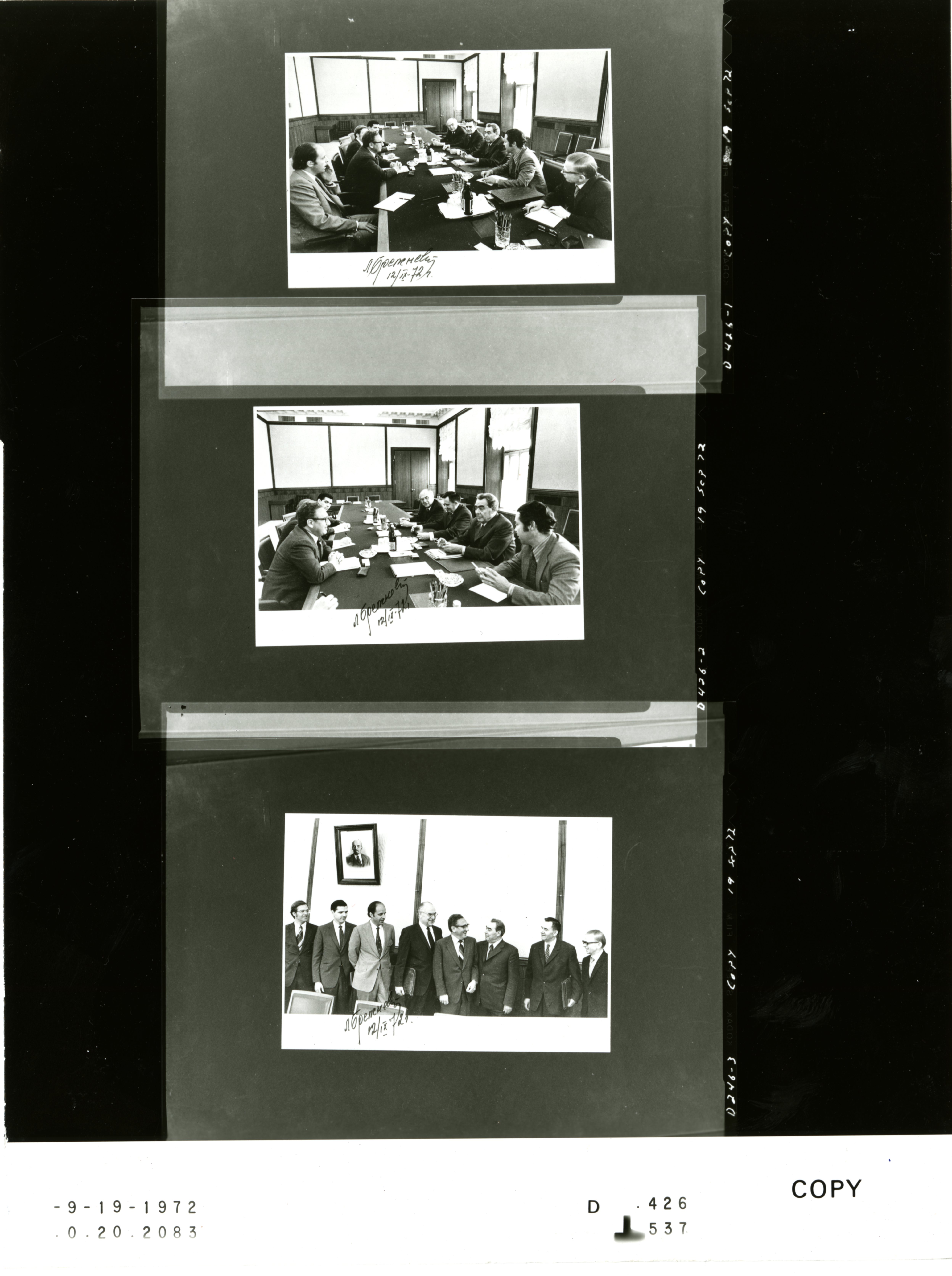
- Frame(s): WHPO-D0426-01-03, Copies of snapshots signed and dated 9/12/1972, of Henry Kissinger with Leonid Brezhnev, Andrei Gromyko, and other Russian Soviet and American officials seated at a conference table and standing together under a portrait of Lenin. 9/19/1972, unknown unknown. Henry Kissinger, Leonid Brezhnev, Andrei Gromyko, American officials.
Roll WHPO-D0438 Photographer: Kightlinger, Jack | Color or B&W: Color
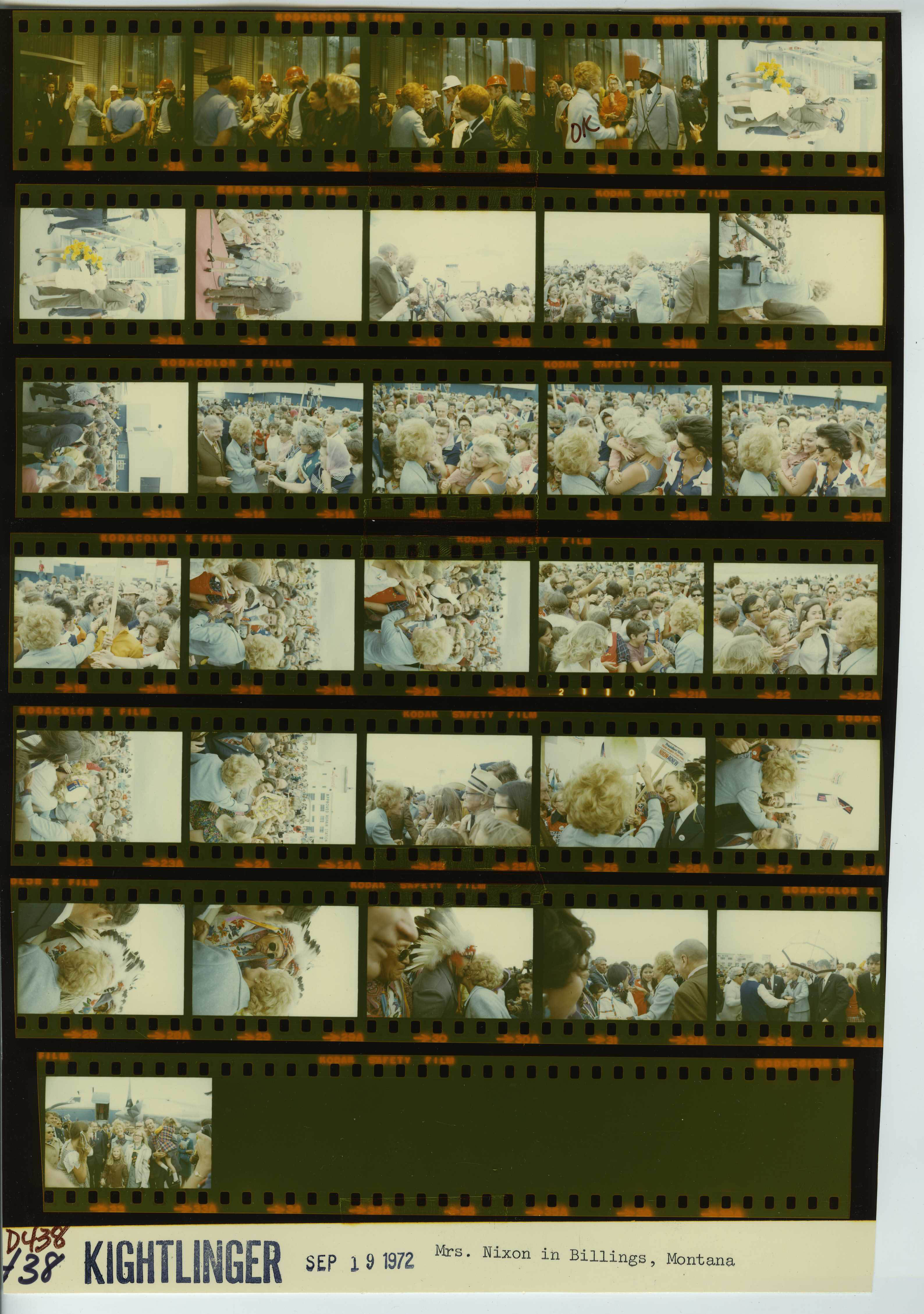
- Frame(s): WHPO-D0438-03-06, Pat Nixon greeting construction workers and others as she leaves a Chicago hotel. 9/19/1972, Chicago, Illinois hotel, entrance. Pat Nixon, unidentified persons.
- Frame(s): WHPO-D0438-07-33, Pat Nixon greeting people in the crowd at the Billings, Montana airport. 9/19/1972, Billings, Montana airport. Pat Nixon, unidentified persons.
Roll WHPO-D0439 Photographer: Kightlinger, Jack | Color or B&W: Color
- Frame(s): WHPO-D0439-03A-11A, Pat Nixon leaving Billings, Montana. 9/19/1972, Billings, Montana airport, tarmac. Pat Nixon, unidentified persons.
- Frame(s): WHPO-D0439-12A-22A, Pat Nixon arriving in Yellowstone National Park. 9/19/1972, Yellowstone, Wyoming Pat Nixon, unidentified persons.
- Frame(s): WHPO-D0439-23A-28A, Pat Nixon at a podium. 9/19/1972, Billings, Montana, Yellowstone, Wyoming unidentified site. Pat Nixon, unidentified persons.
Roll WHPO-D0440 Photographer: Kightlinger, Jack | Color or B&W: Color
- Frame(s): WHPO-D0440-02A-12A, Pat Nixon at a podium with Yellowstone National Park rangers, officials and unidentified others. 9/19/1972, Yellowstone, Wyoming outdoor site. Pat Nixon, unidentified persons.
- Frame(s): WHPO-D0440-13A-14A, Pat Nixon with a woman at a Yellowstone National Park hotel registration desk. 9/19/1972, Yellowstone, Wyoming hotel. Pat Nixon, unidentified persons.
Roll WHPO-D0441 Photographer: Kightlinger, Jack | Color or B&W: Color
- Frame(s): WHPO-D0441-, Pat Nixon at Yellowstone National Park outdoors with mounted ranger officers. Pat Nixon eating from a buffet line staffed by men in cowboy outfits. 9/19/1972, Yellowstone, Wyoming outdoor site. Pat Nixon, Rogers Morton, unidentified persons.
- Frame(s): WHPO-D0441-, Pat Nixon in Yellowstone National Park at a buffet line staffed by men in Western Cowboy outfits. 9/19/1972, Yellowstone, Wyoming outdoor site. Pat Nixon, Rogers Morton, unidentified persons.
- Frame(s): WHPO-D0441-24, Pat Nixon, in Yellowstone National Park with a troop of Girl Scouts, and the Girl Scouts' adult leader holding a framed landscape photograph portrait of Yellowstone National Park and mountains which the Girl Scouts troop had presented to the First Lady. 9/19/1972, Yellowstone, Wyoming outdoor site. Pat Nixon, unidentified Girl Scouts and Scout leader, unidentified persons.
Roll WHPO-D0442 Photographer: Kightlinger, Jack | Color or B&W: Color

- Frame(s): WHPO-D0442-03A-28A, Pat Nixon at a welcoming arrival ceremony in Billings, Montana. 9/19/1972, Billings, Montana Pat Nixon, Rogers Morton, National Park Service official, crowd, band, unidentified persons.
- Frame(s): WHPO-D0442-29A-32A, Pat Nixon and Secretary Rogers Morton, outdoors at Yellowstone National Park Service with park officials. 9/19/1972, Yellowstone, Wyoming Pat Nixon, Rogers Morton, National Park Service official, crowd, band, unidentified persons.
Roll WHPO-D0443 Photographer: Schumacher, Karl | Color or B&W: B&W
- Frame(s): WHPO-D0443-, Vice President Agnew in Minneapolis, MN greeting members of a crowd. 9/19/1972, Minneapolis, Minnesota street. Spiro Agnew, Judy Agnew, unidentified persons, crowd.
- Frame(s): WHPO-D0443-05A-09A, Judy Agnew shaking hands with passengers on an airplane. 9/19/1972, air; Minneapolis, Minnesota plane, airport. Spiro Agnew, Judy Agnew, unidentified persons, crowd.
- Frame(s): WHPO-D0443-10A-31A, Vice President Agnew and Judy Agnew are welcomed at their Minneapolis, MN arrival. 9/19/1972, Minneapolis, Minnesota street. Spiro Agnew, Judy Agnew, unidentified persons, crowd.
Roll WHPO-D0444 Photographer: Schumacher, Karl | Color or B&W: B&W
- Frame(s): WHPO-D0444-, Vice President Agnew and Judy Agnew at various sites in Minneapolis, MN. 9/19/1972, Minneapolis, Minnesota unidentified rooms; Radisson Hotel entrance. Spiro Agnew, Judy Agnew, unidentified persons.
- Frame(s): WHPO-D0444-, Vice President Agnew and Judy Agnew at Hunter Farm in Minneapolis, MN. 9/19/1972, Minneapolis, Minnesota Hunter Farm. Spiro Agnew, Judy Agnew, unidentified persons.
Roll WHPO-D0445 Photographer: Schumacher, Karl | Color or B&W: B&W
- Frame(s): WHPO-D0445-, Vice President Agnew holding a press conference in Minneapolis, MN. 9/19/1972, Minneapolis, Minnesota unknown. Spiro Agnew, press corps members.
Roll WHPO-D0446 Photographer: Schumacher, Karl | Color or B&W: B&W
- Frame(s): WHPO-D0446-, Vice President Agnew arriving in St. Louis and greeting members in the crowd. 9/19/1972, St. Louis, Missouri airport, Clayton Inn. Spiro Agnew, crowd.
Roll WHPO-D0447 Photographer: Schumacher, Karl | Color or B&W: B&W
- Frame(s): WHPO-D0447-03-06, The Agnews leaving the Washington area and arriving in Minneapolis, Minnesota. 9/19/1972, unknown airports. Spiro Agnew, Judy Agnew, unidentified persons.
- Frame(s): WHPO-D0447-07-27, Vice President Agnew delivering a speech. 9/19/1972, Minneapolis, Minnesota unidentified site. Spiro Agnew, Judy Agnew, unidentified persons.
The White House Communications Agency Sound Recordings Collection contains public statements that took place between 1969 and 1974. Visit the finding aid to learn more.
L - White House Press Office Briefings
- WHCA-SR-L-024
Press briefing by Ronald Ziegler, Senate Minority Leader Hugh Scott (R-PA) and House Minority Leader Gerald Ford (R-MI). (9/19/1972, White House Press Lobby)
Runtime: 17:20
Keywords: Press conferences, news conferences, interviews, media, press secretary
Original Format: 1/4-inch reel-to-reel audiotape. Original source type: Original. - WHCA-SR-L-025
Press briefing by Ronald Ziegler. (9/19/1972, White House Press Lobby)
Runtime: 15:00
Keywords: Press conferences, news conferences, interviews, media, press secretary
Original Format: 1/4-inch reel-to-reel audiotape. Original source type: Original.
The White House Communications Agency Videotape Collection contains “off-the-air” recordings of televised programs produced between 1968 and 1974. Visit the finding aid to learn more.
- WHCA-5779
"Martin Agronsky: Evening Edition". John Ehrlichman.
WETA
Runtime: 00:29:58 - WHCA-5783
Weekly News Summary, Tape II.
ALL NETWORKS
Runtime: 01:28:24
4. Reasoner/Reynolds: Hearings on polls, McGovern for school tax credits, (McGovern) in Chicago, Illinois. Time Code Start: 08:31. Keywords: taxes, schools, public opinions, polls, approval ratings, Gallup poll, Harris poll, Presidential elections, campaigns, primaries, candidates, voting. Network: ABC.
5. Smith/Jackson: (Pam Powell) youth vote. Time Code Start: 12:03. Keywords: Vote, voters, voting, Presidential elections, campaigns, campaigning, candidates, young people, issues, voting age, registrations. Network: ABC.
6. Smith/Shoumacher: More on wheat deal, future market. Time Code Start: 15:08. Keywords: U.S., American, Soviet Union, USSR, Russia, agriculture, food, crops, products, sales, agreements, business, imports, exports, trade. Network: ABC.
7. Smith: Vietnam, end of war move by Congress. Time Code Start: 19:35. Keywords: Vietnam War, ending. Network: ABC.
8. Reasoner: Commentary on amorality. Time Code Start: 20:19. Keywords: media, reports, morales, immoral, philosophies, psychology. Network: ABC.
9. Chancellor/Erikson: Three released POWs go sightseeing in Hanoi, Vietnam; interview with POWs. Time Code Start: 22:15. Keywords: Vietnam War, Vietnam Prisoner of War, releases. Network: NBC.
10. Chancellor/Goralski: Foreign relations bill passes Senate; General Lavelle hearings. Time Code Start: 24:32. Keywords: Vietnam War, Air Force, military officials, bombings, Sentate, hearings, investigations, retirement, hearings, investigations. Network: NBC.
11. Chancellor/Streithorst: Vietnam, Quang Tri city. Time Code Start: 26:55. Keywords: Vietnam War. Network: NBC.
12. Chancellor/Valeriani/Perkins: George McGovern in Chicago, Illinois and Milwaukee, Wisconsin; Vice President Agnew in Minneapolis, Minnesota. Time Code Start: 29:36. Keywords: Presidential elections, campaigns, campaigning, primaries, candidates, speeches. Network: NBC.
13. Chancellor: Watergate. Time Code Start: 33:53. Keywords: Watergate, Senate committee hearings, investigations, testimony, testify, cover-ups, break-in, burglary, theft, plumbers, scandals. Network: NBC.
14. Brinkley: Commentary on Crime Victims' Compensation Bill 750, to compensate crime victims for losses; Brinkley calls for solution to criminals not being caught, and the severe physical or financial hardships of their victims. Time Code Start: 34:25. Keywords: bills, laws, anti-crime, offences, offenses, infractions, criminals, criminality, law breaking, financial aid, legal aid, prosecutions, government funding. Network: NBC.
15. Cronkite/Morton: McGovern in Chicago, Illinois. Time Code Start: 36:08. Keywords: Presidential elections, campaigns, campaigning, primaries, candidates, speeches. Network: CBS.
16. Cronkite/Rather: President Nixon and the ethnic vote; Vice President Agnew. Time Code Start: 39:28. Keywords: Vote, voters, voting, Vice Presidents, travel, trips, Nixon trips, domestic, Presidential elections, campaigns, campaigning, candidates, voting. Network: CBS.
17. Cronkite/Schorr: Watergate seven plead not guilty. Time Code Start: 42:28. Keywords: Watergate, Senate committee hearings, investigations, testimony, testify, cover-ups, break-in, burglary, theft, plumbers, scandals. Network: CBS.
18. Sevareid: Commentary on Crime Victims' Compensation Bill 750, to compensate crime victims for losses, bill makes federal offense of attacks on police, firemen. Time Code Start: 44:15. Keywords: bills, laws, anti-crime, offences, offenses, infractions, criminals, criminality, law breaking, financial aid, legal aid, prosecutions, government funding. Network: CBS.
Context (External Sources)
The Vanderbilt Television News Archive is the world's most extensive and complete archive of television news. They have been recording, preserving and providing access to television news broadcasts of the national networks since August 5, 1968.
Wikipedia is a free encyclopedia that anyone can edit.