

Introduction
This almanac page for Wednesday, September 20, 1972, pulls together various records created by the federal government and links to additional resources which can provide context about the events of the day.
Previous Date: Tuesday, September 19, 1972
Next Date: Thursday, September 21, 1972
Schedule and Public Documents
The Daily Diary files represent a consolidated record of the President's activities. Visit the finding aid to learn more.
The President's day began at Camp David, Maryland
The Weekly Compilation of Presidential Documents made available transcripts of the President's news conferences; messages to Congress; public speeches, remarks, and statements; and other Presidential materials released by the White House.
Digitized versions can be found at HathiTrust.
Each Public Papers of the Presidents volume contains the papers and speeches of the President of the United States that were issued by the White House Office of the Press Secretary during the time period specified by the volume. The material is presented in chronological order, and the dates shown in the headings are the dates of the documents or events. In instances when the release date differs from the date of the document itself, that fact is shown in the text note.
To ensure accuracy, remarks have been checked against audio recordings (when available) and signed documents have been checked against the original, unless otherwise noted. Editors have provided text notes and cross references for purposes of identification or clarity.
The Federal Register is the official daily publication for rules, proposed rules, and notices of federal agencies and organizations, as well as executive orders and other Presidential documents.
The Congressional Record is the official daily record of the debates and proceedings of the U.S. Congress.
Archival Holdings
Any selection of archival documents will necessarily be partial. You should use the documents and folders identified below as a starting place, but consult the linked collection finding aids and folder title lists and the collections themselves for context. Many documents to be found this way do not lend themselves to association with specific dates, but are essential to a complete understanding of the material.
Selective document listing
President's Office Files
The President's Office Files consists of materials drawn together by the Special Files Unit from several administrative subdivisions within the White House Office. It is the handwriting and sensitive papers sent to the Staff Secretary that now comprise much of the President's Office Files. Visit the finding aid to learn more.
- News Summaries, Unmarked News Summaries, Box 51, News Summaries - September 1972 [5 of 6] [Note: Due to the way News Summary products were compiled, you should also consult nearby days for potentially relevant materials.]
- News Summary, September 20, 1972, (Tues. nets, wires, columns)
The H. R. Haldeman Diaries consists of seven handwritten diaries, 36 dictated diaries recorded as sound recordings, and two handwritten audio cassette tape subject logs. The diaries and logs reflect H. R. Haldeman’s candid personal record and reflections on events, issues, and people encountered during his service in the Nixon White House. As administrative assistant to the President and Chief of Staff, Haldeman attended and participated in public events and private meetings covering the entire scope of issues in which the Nixon White House engaged in during the years 1969-1973. Visit the finding aid to learn more.
- Transcript of diary entry (PDF)
Wednesday, September 20th. The President had me over for almost four hours this morning; went through the whole IMF speech idea. He wants to use the point that as weak nations become stronger, economic competition becomes much greater, and the possibility of economic conflicts increase. Work in some of this, to try and get a little more dramatic point to it, saying, that as our policies succeed in making Japan, Germany, Europe, and so on, strong economically, our competition increases, because we're not held together by the fears that united us before. Got into some other speech ideas for the campaign on the radio speeches and the regional deals. Atlanta he wants to do basically on national defense and world peace, picking up Connally's speech. What we need for peace, the progress we've made, how we did it, so on. Then for the New England speech, he wants to tie to the Bicentennial in, work in the kind of people that build America: hard work, pride, hope, wave the flag, not permissiveness, time for revitalization of our institutions, and that kind of thing. And he needs good talking points for the me--, citizens, and a speech to read for the cancer deal.
He also got into some schedule strategy, he wants to get into mid-America in the third week—the small towns, the mountain states, the Ohio motorcade, and that kind of thing. He decided not to do the Mormon Tabernacle, have the Vice President do that instead; also wants him to do Montana. He thinks he'll do an in-office press conference, either just before Atlanta or just before Boston. He wants to be sure that the VP doesn't take McGovern on, that it's better for Connally to do this. The VP should compare Nixon and McGovern, on the record, and the progress on revenue sharing, that sort of thing. Use the New American Majority, not Republican majority; work for the election of Congress and Senators who will support the President, not who are Republicans. He wants the surrogates and the VP to be a contrast to McGovern: be pro-President and pro-American; things are good, the economy's looking up, so we should quit running down the country; be proud of our President and our young people; show your pride by voting on election day to get the biggest vote in history. He wants all surrogates to carry this line, and also to compare now and in '68, enumerate how things have changed.
He raised the question of Burundi, where he is just learned that 200,000 people have been killed by the government in order to maintain control; they're killing off all the intellectuals, apparently in the country, or intelligent people. He makes the point that we should…
[End of tape reel AC-24(B)]
[Begin tape reel AC-25(A)]
This is continuing Wednesday, September 20th. The, I was making the point that the President was concerned that the slaughters in Burundi, and feeling that we should have a contingency plan to deal with this kind of thing, or if they should capture UN guy or something of this sort.
He covered some other strategy items that we should use: the don't let them take it away line; building peace, economy; end of permissiveness; or the peace and prosperity idea. There's a change of view here; the mood of the nation has changed; we don't need to be against status quo as we had thought a couple of months ago we needed to be. The people are now shifting to where they have a more optimistic outlook, and we can work with that. He wants to be sure we make a big thing out of the fact there were no casualties in Vietnam last week, and that we answered the McGovern defense thing, which is out tomorrow. He's concerned about Gelb, Halperin, and some of our other people who are now on the McGovern defense list, and wants to be sure Henry knows how we were snookered on that; thinks we ought to get Huston back for planning in the next Administration to smoke out this kind of people. Got back on the point that the Congressional candidates should be supporting the President rather than he supporting them; that it's okay to go ahead on the endorsement letters, but beyond that, they should grab onto the President's coattails, we shouldn't be pushing them down people's throats. He feels that as of now we should leave the campaign basically where it is: first, keep Agnew positive; second, go ahead on the Congressional letters; third, focus on Connally to the maximum possible extent; fourth, on the family, cut back and low key them, no more press conferences for them at all.
On the house cleaning post-election, he wants to get after ACDA, who are always cutting up the President according to Scoop Jackson, and slice it to the bone. He also wants to dump the Science Advisor, the Space Council, and all those miscellaneous staffs under the Vice President.
Later today, he had Ehrlichman and Weinberger up to Camp David for a general meeting: first, extensive discussion of veto strategy and the plans for the balance of this Congressional session; then, a discussion of policy, post-election. He feels that we've got to recognize what our mandate is; that it's not toward a more liberal domestic policy; that we've had enough social programs -forced integration, education, housing, and so on; this is contrary to what the establishment thinks; they and the Congress think that the country want this stuff. He referred then to the Disraeli point of Gladstone being an exhausted volcano, with all his reforms, and the point that the people do not want to be improved. The huge social programs have been tried, they don't work; people don't want more on welfare, they don't want to help the working poor; and our move has to be harder on this, not softer. People will say that the mandate means to go forward with all our revolutionary programs, but the President feels, totally different from Reagan, that the huge colossus of the federal government is a mess. The people running it are incompetent and it won't change, and the American people don't want to support it. We can't just allow the country to grow like top seed; we have to do something, but we have to move toward slimming down rather than fattening up the federal government. He wants a review of the list of things to drop, but he wants to add to it. In the White House, he wants to drop the Science Advisor, Committee for International Economic Policy, the Advisory Boards, whatever can be done within the law to cut our own shop down. Most of the programs he wants to drop are in HEW, the higher education subsidy, and that kind of thing. Make it clear to the NEA that they supported McGovern and they're not welcome anymore at the White House. In the health field, we should do much less, and we should hit some of the sacred cows, like the cotton program at Agriculture. On welfare, we have to support HR 1 until the election; afterward, we should not send it back to Congress.
His theory on the election is that he's got a better, we've got a better chance to win the House than we do the Senate. He thinks if we get over 55 percent we can carry the House, because they're more affected by the swing than the Senate is. The problem is that in the new Congress, we'll have some issues like trade, health, tax, and energy, which Ehrlichman points out that can virtually, but that we can virtually avoid programmatic initiatives. We need to get OMB going on listing the bad programs. He points out that we shouldn't assume that a great Administration is one that does new things—maybe it's one that gets rid of old things. We should not make it Reagan-like, not obtuse and anti-people, we should make it for people, get government off their backs.
Say as little as possible during the campaign so we have the fewest promises to have to keep, and so that we have an ability to interpret our mandate our way. The process must have a setting and with the big, and that that, a setting that'll bring Congress along with us by exerting public opinion and leadership. The question of the value of reorganization, Weinberger and Ehrlichman point out, it provides the opportunity to break up some of the baronies, but we need to study what's do-able. Same with special revenue sharing: rework them and then send them back in on the basis that we can get something through.
If we win, we don't intend to coast in the second term. In the first year, we've got to really do something regarding a new government. Something that the President really believes in, tear the State Department to pieces, and Defense; don't just preside over the huge morass. Also, the Treasury bureaucracy is bad and so is Justice. We need a study on the Vice President's office in a ruthless way; eliminate all the surplus staff and committees. Then he raised the question of who's doing the CIA study. He feels Helms has got to go and...
-------------------------------------------------------------------------------------------------------------------
DECLASSIFIED - E.O. 13526, Sect. 3.4: by MS, NARA, June 12, 2013
Audio Cassette 25, Side A, Withdrawn Item Number 2 [AC-25(A) Sel 2]
Duration: 11 seconds
…we should get rid of the clowns by cutting personnel forty percent. The information they develop is worthless…
-------------------------------------------------------------------------------------------------------------------
...some discussion on the problem of intelligence, reorganization; and the real problem is, of course, Defense and Congress.
He wants to tell all hands that everybody should resign November 8, but no one should plan on a vacation; that the period of November 7 to December 7 should be the most intensive month ever. We should have a total cutoff of the press during that period and have some intensive Camp David sessions and really get the thing hammered together. Also, Kissinger should know there are to be no foreign leaders after the election until after the Inaugural, and we should tell them that now.
End of September 20th. - Original audio recording (MP3)
The National Archives Catalog is the online portal to the records held at the National Archives, and information about those records. It is the main way of describing our holdings and also provides access to electronic records and digitized versions of our holdings.
The Catalog searches across multiple National Archives resources at once, including archival descriptions, digitized and electronic records, authority records, and web pages from Archives.gov and the Presidential Libraries. The Catalog also allows users to contribute to digitized historical records through tagging and transcription.
Nixon Library Holdings
All National Archives Units
National Security Documents
The President's Daily Brief is the primary vehicle for summarizing the day-to-day sensitive intelligence and analysis, as well as late-breaking reports, for the White House on current and future national security issues. Read "The President's Daily Brief: Delivering Intelligence to Nixon and Ford" to learn more.
The Foreign Relations of the United States series presents the official documentary historical record of major U.S. foreign policy decisions and significant diplomatic activity. Visit the State Department website for more information.
Vol. II, Organization and Management of U.S. Foreign Policy, 1969-1972
Managing the Department of State
346. Memorandum From the Deputy Under Secretary of State for Management (Macomber) to the Acting Assistant Secretary of State for Public Affairs (Richardson), Washington, September 20, 1972
Source: National Archives, RG 59, Office of the Deputy Under Secretary for Management, Management Reform Task Force Papers: Lot 74 D 394, MR: TF IX, Openness. No classification marking. Drafted by Steven, and sent through S/S. A copy was sent to EUR. Printed from a copy that indicates Macomber signed the original.
Vol. XV, Soviet Union, June 1972-August 1974
Economic Normalization and Soviet Jewish Emigration, September-December 1972
49. National Security Decision Memorandum 190, Council for International Economic Policy Decision Memorandum 12, Washington, September 20, 1972
Source: National Archives, Nixon Presidential Materials, NSC Files, Box 495, President’s Trip Files, Dobrynin/Kissinger, Vol. 13. Secret; Sensitive; Nodis. Copies were sent to the Secretaries of Commerce and Treasury.
50. National Security Decision Memorandum 191, Council for International Economic Policy Decision Memorandum 13, Washington, September 20, 1972
Source: National Archives, Nixon Presidential Materials, NSC Files, Box 495, President’s Trip Files, Dobrynin/Kissinger, Vol. 13. Secret; Nodis. Copies were sent to the Secretaries of State and Treasury.
Vol. XXI, Chile, 1969-1973
Cool and Correct: The U.S. Response to the Allende Administration, November 5, 1970-December 31, 1972
310. Memorandum From the Executive Secretary of the 40 Committee (Ratliff) to the President’s Assistant for National Security Affairs (Kissinger), Washington, September 20, 1972
Source: Department of State, Bureau of Intelligence and Research, INR/IL Historical Files, Chile, July–December 1972. Secret; Eyes Only; Outside System. Sent for action. Concurred in by Jorden and Kennedy. The memorandum was initialed by Haig.
Vol. XXXIX, European Security
Prelude to Negotiations, June 1972-November 1972
114. Minutes of a Joint Verification Panel and Senior Review Group Meeting, Washington, September 20, 1972, 4:10-5:13 p.m.
Source: National Archives, Nixon Presidential Materials, NSC Institutional Files (H-Files), Box H–113, SRG Meeting Minutes, Originals, 1972–73. Secret; Nodis. The meeting took place in the White House Situation Room.
Vol. E-2, Documents on Arms Control and Nonproliferation, 1969-1972
Conferences on Nuclear and World Disarmament and Soviet UN Initiative on Non-Use of Force
341. Telegram 171873 From the Department of State to the Mission to the United Nations, Washington, September 20, 1972, 2129Z
The telegram transmitted a Soviet verbal statement urging U.S. support for the Soviet proposal for a UN resolution rejecting of the use of force in international relations and forever prohibiting the use of nuclear weapons.
Source: National Archives, RG 59, Central Files 1970–1973, DEF 18–6. Limited Official Use. Also sent to Moscow. Drafted by McIntyre (IO/UNP); cleared by Kadilis (EUR/SOV); and approved by Armitage (UNP).342. Telegram 172239 From the Department of State to the Mission to the United Nations, Washington, September 20, 1972, 2317Z
The telegram reported on Soviet Minister Counselor Vorontsov’s discussion with Assistant Secretary of State for International Organization Affairs De Palma of the Soviet proposal for a UN resolution on the non-use of force and prohibition of nuclear weapons.
Source: National Archives, RG 59, Central Files 1970–1973, DEF 18–6. Limited Official Use. Also sent to Moscow. Drafted by McIntyre (IO/UNP); cleared by Armitage (UNP), Kadilis (EUR/SOV), and in substance by Martin (PM/DCA); and approved by De Palma (IO).
Vol. E-4, Documents on Iran and Iraq, 1969-1972
Iraq 1972
324. Memorandum From David A. Korn, NEA/IRN, to the Assistant Secretary of State for Near Eastern and South Asian Affairs (Sisco), Washington, September 20, 1972
Analyzing the recent Soviet-Iraqi communiqué, Korn judged that the ties between Moscow and Baghdad were continuing but had not been extended.
Source: National Archives, RG 59, NEA/ARN, Office of Lebanon, Jordan, Syria, and Iraq Affairs, Lot 75D442, Box 14, POL REL, IRAQ/USSR, 1972. Confidential.
Vol. E-5, Part 1, Documents on Sub-Saharan Africa, 1969-1972
Burundi
222. Memorandum From the Presidentʼs Assistant for National Security Affairs (Kissinger) to President Nixon, Washington, September 20, 1972
Kissinger reported on the warfare in Burundi between the Hutus and the Tutsis and the reactions of the international community. In a lengthy handwritten note in response to Kissingerʼs memorandum, Nixon deplored the U.S. reaction as cynical and callous and instructed Kissinger to tell the Africa Bureau in the Department of State to recommend at a minimum how to express U.S. moral outrage. He also ordered the immediate recall of Ambassador Yost for consultations.
Source: National Archives, Nixon Presidential Materials, NSC Files, Box 735, Country Files, Africa, Burundi, Vol. I. Administratively Confidential. Sent for information. Drafted by F.E. Rondon and based on a report that he and Richard Kennedy forwarded to Kissinger on September 20. (Ibid.) The memorandum is stamped: “The President Has Seen.” The President hand wrote a lengthy note on page two of the memorandum, which was transcribed in the White House on September 21. The transcription is included as part of the document.
Vol. E-5, Part 1, Documents on Sub-Saharan Africa, 1969-1972
Uganda
254. Memorandum From the Deputy Assistant to the President for National Security Affairs (Haig) to President Nixon, Washington, September 20, 1972
Haig reported that an Interdepartmental Task Force had been updating contingency plans for Uganda; a daily update would be included in the Presidentʼs morning brief.
Source: Library of Congress, Manuscript Division, Kissinger Papers, Box CL 295, Memoranda to the President, September 1972. Secret. The memorandum is stamped, “The President Has Seen,” and Nixon wrote “good” on it, and also “K—we must have contingencies for every possible nutty thing which might happen between now election.”
The Kissinger telephone conversation transcripts consist of approximately 20,000 pages of transcripts of Kissinger’s telephone conversations during his tenure as Assistant to the President for National Security Affairs (1969-1974) and Secretary of State (1973-1974) during the administration of President Richard Nixon. Visit the finding aid for more information.
Digitized versions can be found in the National Archives Catalog.
Audiovisual Holdings
Visit the White House Tapes finding aid to learn about the taping system's operation and archival processing.
White House Telephone
The White House Photo Office collection consists of photographic coverage of President Richard Nixon meeting with prominent social, political, and cultural personalities; speaking engagements and news conferences of the President and various high-ranking members of the White House staff and Cabinet; Presidential domestic and foreign travel, including Presidential vacations; social events and entertainment involving the First Family, including entertainers present; official portraits of the President, First Family, and high-ranking members of the Nixon administration; the 1969 and 1973 Inaugurals; the President’s 1972 Presidential election campaign appearances (including speeches) and other official activities of the White House staff and the President’s Cabinet from January 20, 1969 until August 9, 1974 at the White House and the Old Executive Office Building; other locations in Washington, DC, such as The Mall; and the Presidential retreats in Camp David, Maryland, Key Biscayne, Florida, and San Clemente, California. Visit the finding aid to learn more.
Roll WHPO-D0427 Photographer: Grove, Andrew | Color or B&W: B&W
- Frame(s): WHPO-D0427-, Bob Brown standing with a group of men. 9/20/1972, Washington, D.C. unknown. Robert Brown, unidentified men.
- Frame(s): WHPO-D0427-, Bob Brown seated with a group of men. 9/20/1972, Washington, D.C. unknown. Robert Brown, unidentified men.
Roll WHPO-D0448 Photographer: Schumacher, Karl | Color or B&W: B&W
- Frame(s): WHPO-D0448-, Vice President Agnew delivering a speech at a convention. 9/20/1972, Columbus, Ohio unknown. Agnew, delegates.
Roll WHPO-D0449 Photographer: Schumacher, Karl | Color or B&W: B&W
- Frame(s): WHPO-D0449-, Vice President Agnew standing with an unidentified man and delivering a speech at a convention. 9/20/1972, Columbus, Ohio unknown. Agnew, unidentified man, delegates.
Roll WHPO-D0450 Photographer: Schumacher, Karl | Color or B&W: B&W
- Frame(s): WHPO-D0450-07-14, Vice President Agnew speaking to and greeting students at a school. 9/20/1972, St. Louis, Missouri unidentified site. Spiro Agnew, Judy Agnew, unidentified men, women, and students.
- Frame(s): WHPO-D0450-15-19, Vice President Agnew at a luncheon and speaking from a podium. 9/20/1972, St. Louis, Missouri unidentified site. Spiro Agnew, Judy Agnew, unidentified men, women, and students.
- Frame(s): WHPO-D0450-20-28, Vice President Agnew conducting a press conference. 9/20/1972, St. Louis, Missouri unidentified site. Spiro Agnew, Judy Agnew, unidentified men, women, and students.
- Frame(s): WHPO-D0450-29, Vice President Agnew waving before entering a plane. 9/20/1972, St. Louis, Missouri unidentified site. Spiro Agnew, Judy Agnew, unidentified men, women, and students.
Roll WHPO-D0451 Photographer: Schumacher, Karl | Color or B&W: B&W
- Frame(s): WHPO-D0451-, Vice President Agnew conducting a press conference and greeting people. 9/20/1972, Columbus, Ohio unidentified sites. Agnew, press corps members, unidentified persons.
Roll WHPO-D0452 Photographer: Schumacher, Karl | Color or B&W: B&W
- Frame(s): WHPO-D0452-, Vice President Agnew speaking at a luncheon, conducting a press conference (18A), and greeting policemen (19A). 9/20/1972, St. Louis, Missouri various sites. Agnew, Judy Agnew, unidentified persons, policemen.
Roll WHPO-D0453 Photographer: Schumacher, Karl | Color or B&W: B&W
- Frame(s): WHPO-D0453-03-08, Vice President Agnew and Judy Agnew arriving at the airport. 9/20/1972, Columbus, Ohio airport. Spiro Agnew, Judy Agnew, unidentified persons, crowd, delegates.
- Frame(s): WHPO-D0453-09-27, Vice President Agnew and Judy Agnew greeting the crowds along a street and in a building. 9/20/1972, Columbus, Ohio street, building. Spiro Agnew, Judy Agnew, unidentified persons, crowd, delegates.
- Frame(s): WHPO-D0453-28-37, Vice President Agnew addressing a convention. 9/20/1972, Columbus, Ohio building. Spiro Agnew, Judy Agnew, unidentified persons, crowd, delegates.
Roll WHPO-D0454 Photographer: Schumacher, Karl | Color or B&W: Color
- Frame(s): WHPO-D0454-, Vice President Agnew greeting people in the crowd, standing with an unidentified man, and addressing a convention. 9/20/1972, Columbus, Ohio street, building. Agnew, unidentified man, crowd, delegates.
Roll WHPO-D0458 Photographer: Kightlinger, Jack | Color or B&W: Color
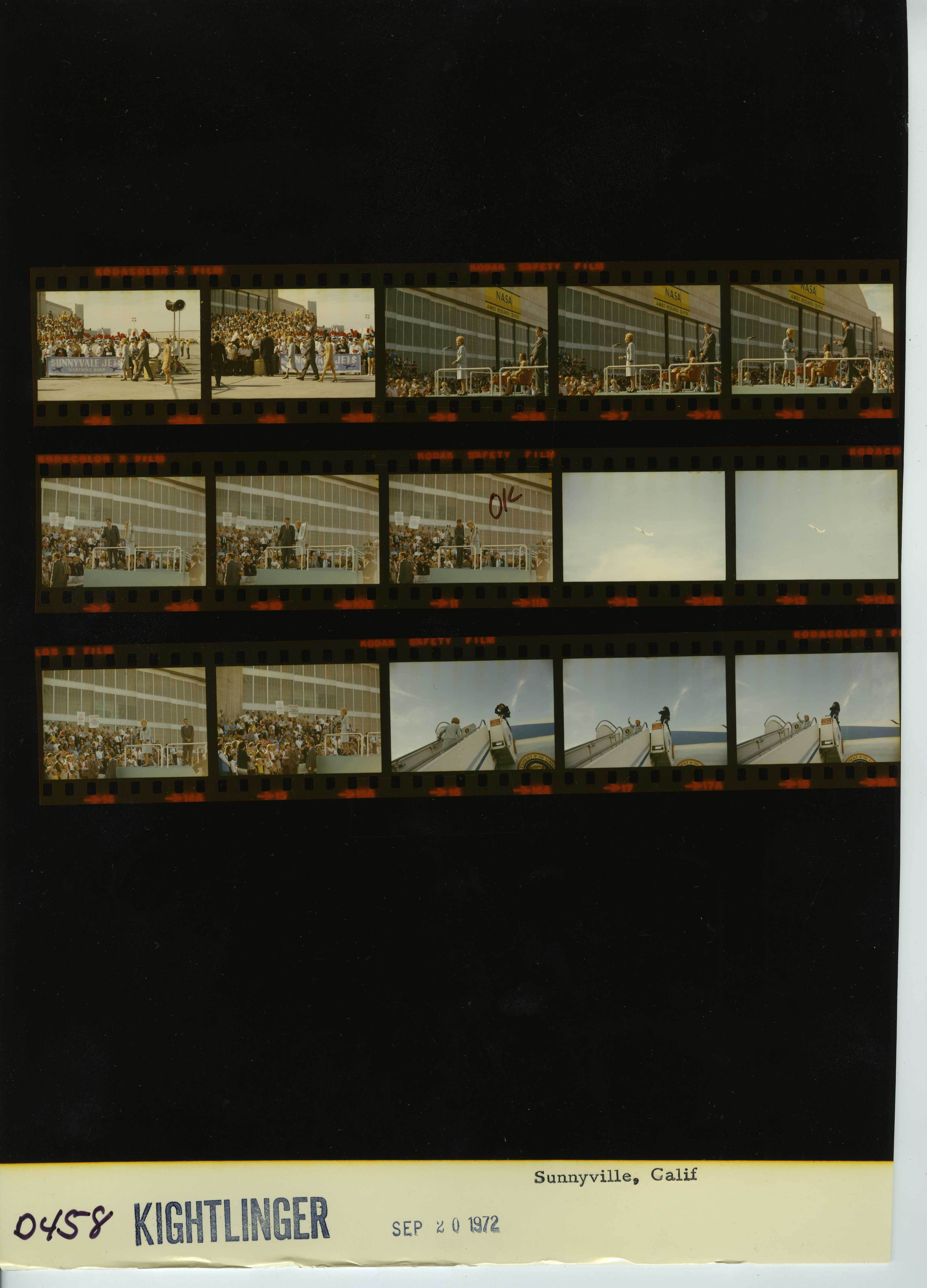
- Frame(s): WHPO-D0458-04-15, Pat Nixon arriving at NASA's Ames Research Center and speaking to a crowd. 9/20/1972, Sunnyvale, California grounds, Ames Research Center. Pat Nixon, band, crowd.
- Frame(s): WHPO-D0458-16-18, Pat Nixon walking up a stairway to a plane and waving goodbye. 9/20/1972, Sunnyvale, California airport. Pat Nixon, band, crowd.
Roll WHPO-D0459 Photographer: Kightlinger, Jack | Color or B&W: Color
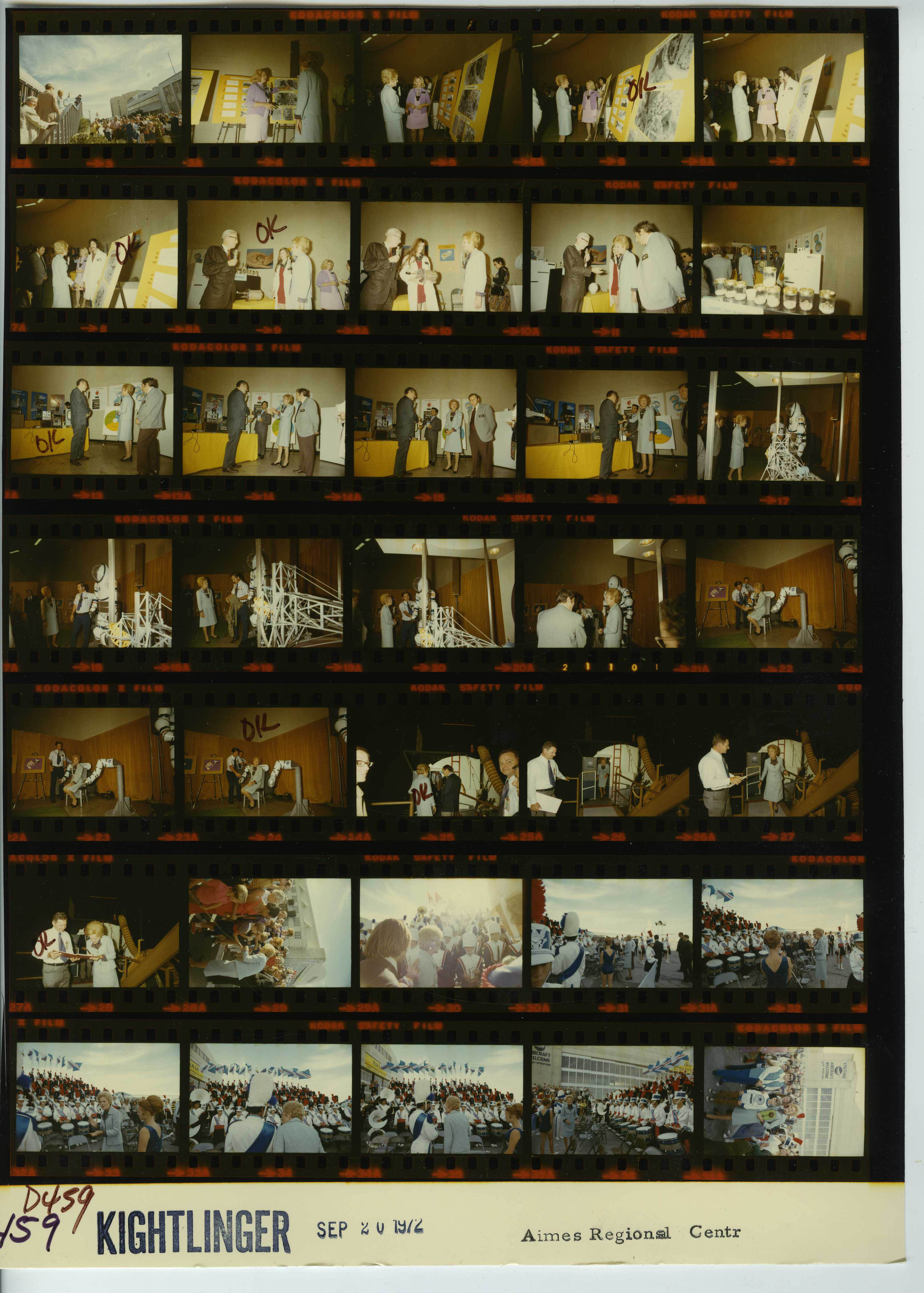
- Frame(s): WHPO-D0459-, Pat Nixon at various sites outside of and inside the Ames Research Center NASA. 9/20/1972, Sunnyvale, California outside of, inside Ames Research Center. Pat Nixon, officials, band, crowd.
- Frame(s): WHPO-D0459-23, Pat Nixon seated with her arm in a robotic extendable arm unit, while an unidentified technician stands nearby, inside the Ames Research Center NASA. 9/20/1972, Sunnyvale, California Ames Research Center. Pat Nixon, unidentified official.
Roll WHPO-D0460 Photographer: Kightlinger, Jack | Color or B&W: Color
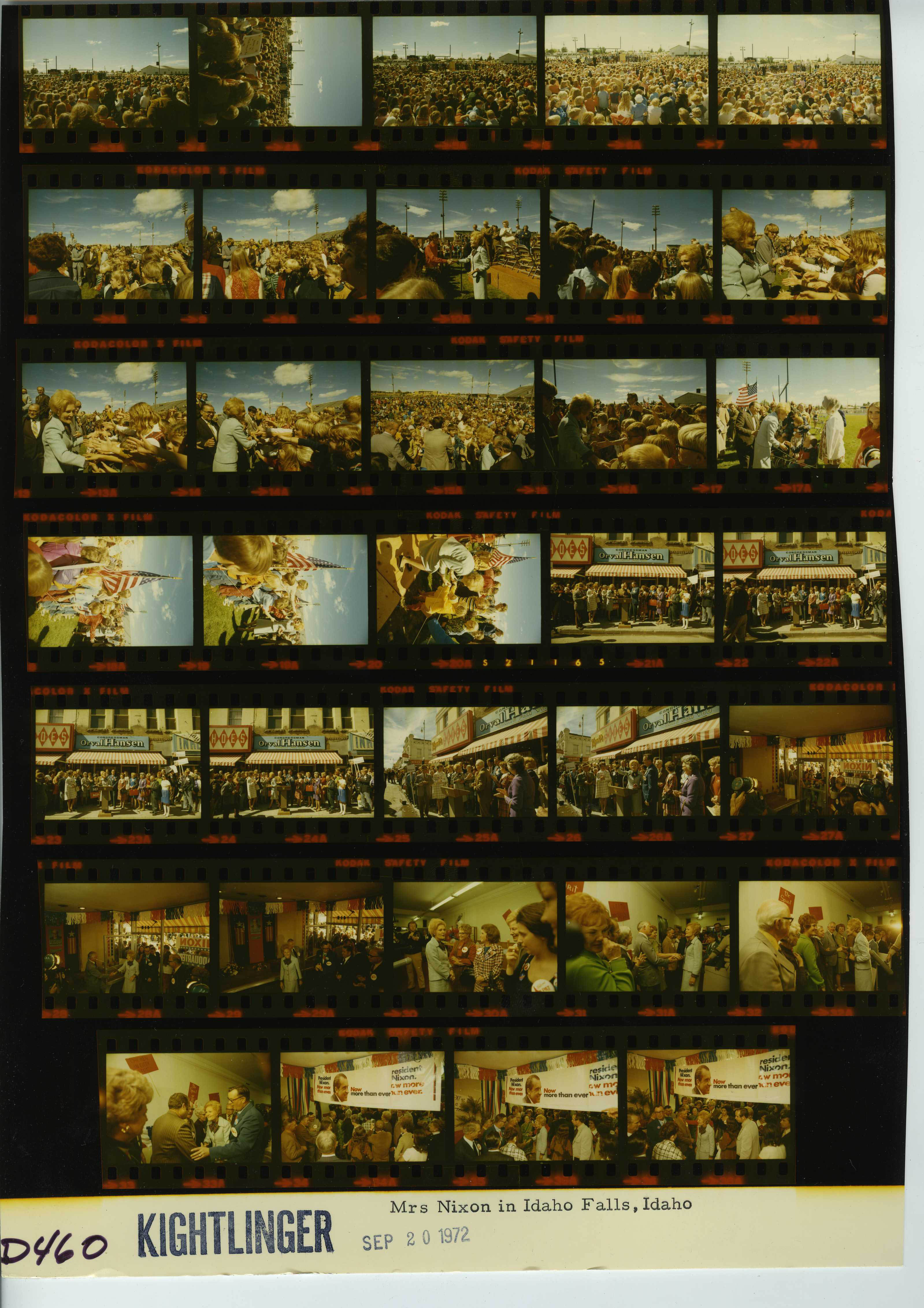
- Frame(s): WHPO-D0460-, Pat Nixon arriving in Idaho Falls, Idaho. Pat Nixon outside of and inside campaign headquarters. 9/20/1972, Idaho Falls, Idaho airport, campaign headquarters. Pat Nixon, crowd, campaign workers.
- Frame(s): WHPO-D0460-22A, Pat Nixon speaking to supporters standing outside Congressman Orval Hansen's office and Nixon's Idaho Falls campaign headquarters. 9/20/1972, Idaho Falls, Idaho airport, campaign headquarters. Pat Nixon, crowd, campaign workers.
Roll WHPO-D0461 Photographer: Kightlinger, Jack | Color or B&W: Color
- Frame(s): WHPO-D0461-, Pat Nixon shaking hands with individuals prior to leaving. 9/20/1972, Yellowstone, Wyoming; Idaho Falls, Idaho unidentified site, airport; airport. Pat Nixon, National Park Service personnel, individuals, crowd.
- Frame(s): WHPO-D0461-24, Crowd of supporters and well wishers awaiting Pat Nixon's arrival in Idaho Falls, Idaho. 9/20/1972, Yellowstone, Wyoming; Idaho Falls, Idaho unidentified site, airport; airport. Pat Nixon, National Park Service personnel, individuals, crowd.
Roll WHPO-D0462 Photographer: Kightlinger, Jack | Color or B&W: Color
- Frame(s): WHPO-D0462-, Pat Nixon leaving Yellowstone Park (5-16) and arriving in Idaho Falls (21-33). 9/20/1972, Yellowstone, Wyoming; Idaho Falls, Idaho airports. Pat Nixon, National Park Service officials, local officials, crowd.
Roll WHPO-D0463 Photographer: Kightlinger, Jack | Color or B&W: Color
- Frame(s): WHPO-D0463-, Pat Nixon at various sites. 9/20/1972, Idaho Falls, Idaho various unidentified sites. Pat Nixon, officials, unidentified persons, crowd.
The White House Communications Agency Sound Recordings Collection contains public statements that took place between 1969 and 1974. Visit the finding aid to learn more.
L - White House Press Office Briefings
- WHCA-SR-L-026
Press briefing by Ronald Ziegler. (9/20/1972, White House Press Lobby)
Keywords: Press conferences, news conferences, interviews, media, press secretary
Original Format: 1/4-inch reel-to-reel audiotape. Original source type: Original.
The White House Communications Agency Videotape Collection contains “off-the-air” recordings of televised programs produced between 1968 and 1974. Visit the finding aid to learn more.
- WHCA-5780
"A Public Affair: Election '72". U.S. Senator Thomas Eagleton (D-MO).
PBS
Runtime: 0:30 - WHCA-5781
Fonda-Hayden Interview, From Detroit. actress and anti-Vietnam war activist Jane Fonda; jazz singer composer Mel Tormé, Dr. Wardell Pomeroy.
Daphne Productions and Roland & Jaffee Productions
Runtime: 00:58:44 - WHCA-5783
Weekly News Summary, Tape II.
ALL NETWORKS
Runtime: 01:28:24
19. Reasoner/Collins/Mariano: Vietnam, Quang Tri. Time Code Start: 46:50. Keywords: Vietnam War. Network: ABC.
20. Smith/Bell: POWs released and make statements. Time Code Start: 51:04. Keywords: Vietnam War, Vietnam Prisoner of War, releases. Network: ABC.
21. Reasoner/Gill: Democratic law suit over Watergate; Vice President Agnew. Time Code Start: 53:24. Keywords: Vice Presidents, Watergate, Senate committee hearings, investigations, testimony, testify, cover-ups, break-in, burglary, theft, plumbers, scandals. Network: ABC.
22. Smith/Murphy: McGovern runs into pro-President Nixon crowd in Ohio. Time Code Start: 55:36. Keywords: Presidential elections, campaigns, campaigning, candidates. Network: ABC.
23. Reasoner: AFL-CIO President George Meany axes Colorado AFL-CIO. Time Code Start: 59:07. Keywords: leaders, labor, unions, American Federation of Labor, Congress of Industrial Organizations, ending, dismissals. Network: ABC.
24. Chancellor: POWs released (film). Time Code Start: 59:37. Keywords: Vietnam War, Vietnam Prisoner of War, releases. Network: NBC.
25. Chancellor: FBI investigate wheat deal. Time Code Start: 61:31. Keywords: U.S., American, Soviet Union, USSR, Russia, agriculture, food, crops, products, sales, agreements, business, imports, exports, trade, Federal Bureau of Investigations, government, organizations, crime. Network: NBC.
26. Chancellor/Perkins/Nessen: Vice President Agnew in St. Louis, Missouri; Sargent Shriver in Minnesota, Minnesota. Time Code Start: 62:27. Keywords: Vice Presidents, Presidential elections, campaigns, campaigning, candidates. Network: NBC.
27. Brinkley: Commentary on news media. Time Code Start: 66:05. Keywords: radio, television, TV, the press, network broadcasting corporations. Network: NBC.
28. Chancellor/Briggs: AFL-CIO President George Meany suspends Colorado labor leader. Time Code Start: 67:32. Keywords: leaders, labor, unions, American Federation of Labor, Congress of Industrial Organizations. Network: NBC.
29. Chancellor/Duke: Tax increases (Representative Mills and Senator Saxbe). Time Code Start: 69:29. Keywords: taxes, taxation, revenue, increases. Network: NBC.
30. Cronkite/Hart: POWs released (film). Time Code Start: 71:56. Keywords: Vietnam War, Vietnam Prisoner of War, releases. Network: CBS.
31. Cronkite/Morton: McGovern and Vietnam veterans. Time Code Start: 79:30. Keywords: Vietnam War, veterans. Network: CBS.
32. Sevareid: Election polls. Time Code Start: 81:56. Keywords: public opinions, polls, approval ratings, Gallup poll, Harris poll, Presidential elections, campaigns, primaries, candidates, voting. Network: CBS.
33. Hart: Report from Hanoi, Vietnam. Time Code Start: 84:47. Keywords: Vietnam War. Network: CBS.
Context (External Sources)
The Vanderbilt Television News Archive is the world's most extensive and complete archive of television news. They have been recording, preserving and providing access to television news broadcasts of the national networks since August 5, 1968.
Wikipedia is a free encyclopedia that anyone can edit.