
Introduction
This almanac page for Tuesday, October 3, 1972, pulls together various records created by the federal government and links to additional resources which can provide context about the events of the day.
Previous Date: Monday, October 2, 1972
Next Date: Wednesday, October 4, 1972
Schedule and Public Documents
The Daily Diary files represent a consolidated record of the President's activities. Visit the finding aid to learn more.
The President's day began at Camp David, Maryland
The Weekly Compilation of Presidential Documents made available transcripts of the President's news conferences; messages to Congress; public speeches, remarks, and statements; and other Presidential materials released by the White House.
Digitized versions can be found at HathiTrust.
Each Public Papers of the Presidents volume contains the papers and speeches of the President of the United States that were issued by the White House Office of the Press Secretary during the time period specified by the volume. The material is presented in chronological order, and the dates shown in the headings are the dates of the documents or events. In instances when the release date differs from the date of the document itself, that fact is shown in the text note.
To ensure accuracy, remarks have been checked against audio recordings (when available) and signed documents have been checked against the original, unless otherwise noted. Editors have provided text notes and cross references for purposes of identification or clarity.
- Remarks at a Ceremony Marking Entry Into Force of the Treaty on the Limitation of Anti-Ballistic Missile Systems and the Interim Agreement on the Limitation of Strategic Offensive Arms
- Letter to Chairman Nikolai V. Podgorny of the Soviet Union Accepting for the United States the Interim Agreement on the Limitation of Strategic Offensive Arms
- Proclamation 4161—Columbus Day, 1972
The Federal Register is the official daily publication for rules, proposed rules, and notices of federal agencies and organizations, as well as executive orders and other Presidential documents.
The Congressional Record is the official daily record of the debates and proceedings of the U.S. Congress.
Archival Holdings
Any selection of archival documents will necessarily be partial. You should use the documents and folders identified below as a starting place, but consult the linked collection finding aids and folder title lists and the collections themselves for context. Many documents to be found this way do not lend themselves to association with specific dates, but are essential to a complete understanding of the material.
Selective document listing
President's Office Files
The President's Office Files consists of materials drawn together by the Special Files Unit from several administrative subdivisions within the White House Office. It is the handwriting and sensitive papers sent to the Staff Secretary that now comprise much of the President's Office Files. Visit the finding aid to learn more.
- News Summaries, Annotated News Summaries, Box 39, October 1-13, 1972 [1 of 5] [Note: Due to the way News Summary products were compiled, you should also consult nearby days for potentially relevant materials.]
- Political Media Analysis, October 3, 1972
- News Summary, October 3, 1972, (Mon. nets, wires, mags)
- President's Daily Schedule, Box 102, [President's Daily Schedule, Oct.-Dec. 1972] [1 of 2]
- The President's Schedule, Tuesday - October 3, 1972
President's Personal File
The President's Personal File is essentially a President's secretary's file, kept by Rose Mary Woods, personal secretary to the President, for two purposes: (1) preserving for posterity a collection of documents particularly close to the President, whether because he dictated or annotated them, or because of the importance of the correspondent or the event concerned and (2) giving appropriate attention–letters of gratitude, invitations to White House social events, and the like–to members and important friends and supporters of the Nixon administration. This generalization does not describe all the varied materials of a file group which is essentially a miscellany, but it does identify the reason for the existence of the file group's core. Visit the finding aid to learn more.
- President's Speech File
Among Pat Buchanan’s duties was the compilation and coordination of background briefing materials for Presidential and a few Vice Presidential press conferences. The briefings—for both the larger, announced press conferences and the smaller, informal ones held in the Oval Office—related to a widespread number of topics and were in the form of probable questions which the White House staff members anticipated news reporters would address to the President. Along with the questions, were answers recommended by Buchanan, other members of the White House staff, and the heads of major departments of the government.
The briefing books are primarily in the form of potential questions and suggested answers (often with heavy annotation by President Nixon), along with associated memos. A listing of briefing books is below, with indication of whether President Nixon annotated the book or not. Each book has an index to the potential questions with direct links to the National Archives Catalog. You should consult the full digital folder for suggested responses, President Nixon's annotations, and other documents and topics not covered by the index.
Foreign and Domestic Briefing Book, October 3, 1972 (Pat Buchanan) (Annotated)
Citation: Foreign and Domestic Briefing Book, October 3, 1972 (Pat Buchanan); box 166; White House Special Files: Staff Member and Office Files: President's Personal File; Richard Nixon Presidential Library and Museum, Yorba Linda, CA
Consult the full digital folder for other briefing materials not in the form of prepared questions and answers.
- WATERGATE BREAK-IN
- At your last press conference you said you were confident there was no White House involvement in the Watergate break-in -- in light of the indictments of two members of your Committee to Re-Elect, can you say the same of your campaign?
- Isn't it inconceivable that some $85,000 in campaign funds could have been shifted to Mr. Barker's account, without someone in authority knowing of it at the Committee?
- Won't you reveal the details of your own White House investigation of this matter and the results?
- CORRUPT ADMINISTRATION
- SCANDALS
- "HIDING IN THE WHITE HOUSE"
- 28 POINTS/FIVE WEEKS
- HOW CLOSE WILL IT BE
- DEBATES
- PRESIDENTIAL GOALS
- GRAIN DEAL
- Can you respond to charges that the Soviets got the "better" of the grain deal with the United States -- that we should have bargained harder with them for the wheat?
- If there was no "scandal" involved in the wheat deal, why is the FBI looking into the matter -- and when can we wexpect their report?
- Can you tell us your view about a Government employee like Mr. Palmby negotiating a deal that will reap enormous profits for a firm he is about to join?
- How do you feel about legislation to reimburse farmers for profits lost -- when they were not informed of the size of the Soviet wheat demand and sold early?
- Isn't it true that some of the big grain exporters had inside information which added immensely to their profits, information not available to the farmers?
- Are you confident that the wheat farmers of the Southwest did not get the short end of the stick, when they were not given information apparently given to the Big Six about the magnitude of the Soviet grain disaster?
- TAXES
- In light of most every expert's prediction there will be a tax increase next year, how can you possibly hope to avoid one?
- Is VAT dead?
- In light of Mr. Mills seemingly increasing coolness, what are the chances of your spending ceiling?
- If Congress refuses to pass your ceiling, can you still guarantee there will be no tax increase next year?
- If you plans call for cuts in the domestic budget, can you tell us where you intend to cut first?
- In light of the present fiscal crunch, how will it be possible for you to meet your commitment to reduce property taxes, without a corresponding increase in taxes somewhere else?
- H. R. 1
- WATER POLLUTION BILL
- "SCANDALS"
- WATERGATE BREAK-IN
- At your last press conference you said you were confident there was no White House involvement in the Watergate break-in -- in light of the indictments of two members of your Committee to Re-Elect, can you say the same of your campaign?
- Isn't it inconceivable that some $85,000 in campaign funds could have been shifted to Mr. Barker's account, without someone in authority knowing of it at the Committee?
- Won't you reveal the details of your own White House investigation of this matter and the results?
- WATERGATE
- Can you answer the unanswered question as to who financed the Watergatre break-in? Surely the White House investigation uncovered this fact?
- Chairman Patman has stated that his Committee was unsuccessful in its efforts to investigate the Watergate incident because of White House pressure. Did any White House members recommend to members of the Committee that they vote against such an investigation?
- VIETNAM-PEACE TALKS
- At one point recently, you said that the chances for peace had never been better, can you now tell us what are the chances for a cease-fire before the election or in the near future?
- Is it true that President Thieu is the main roadblock to settlement?
- Is there a chance of a cease-fire before the election?
- What are the present conditions for a halt to the bombing?
- VIETNAM -- EFFECTIVENESS OF MINING
- SALT
- FORCE REDUCTIONS/EUROPEAN SECURITY
- SOVIET JEWS AND TRADE
- SOVIET JEWRY
- SOVIET TRADE
- MIDDLE EAST - PEACE PROSPECTS AND TERRORISM
- MIDDLE EAST - ROGERS' PLAN
- CUBA
- JAPAN-PRC RELATIONS
- VIETNAM - POW RELEASE
- TRIPARTITE GOVERNMENT IN SAIGON
- THIEU A ROADBLOCK?
- UGANDA: ADMISSION OF ASIANS
- WATERGATE BREAK-IN
- At your last press conference you said you were confident there was no White House involvement in the Watergate break-in -- in light of the indictments of two members of your Committee to Re-Elect, can you say the same of your campaign?
- Isn't it inconceivable that some $85,000 in campaign funds could have been shifted to Mr. Barker's account, without someone in authority knowing of it at the Committee?
- Won't you reveal the details of your own White House investigation of this matter and the results?
- "SCANDALS"
- "CORRUPT ADMINISTRATION"
- DEBATES
- "HIDING IN THE WHITE HOUSE"
- HOW CLOSE WILL IT BE
- 28 POINTS/FIVE WEEKS
- PRESIDENTIAL GOALS
- GRAIN DEAL
- Can you respond to charges that the Soviets got the "better" of the grain deal with the United States -- that we should have bargained harder with them for the wheat?
- If there was no "scandal" involved in the wheat deal, why is the FBI looking into the matter -- and when can we wexpect their report?
- Can you tell us your view about a Government employee like Mr. Palmby negotiating a deal that will reap enormous profits for a firm he is about to join?
- How do you feel about legislation to reimburse farmers for profits lost -- when they were not informed of the size of the Soviet wheat demand and sold early?
- Isn't it true that some of the big grain exporters had inside information which added immensely to their profits, information not available to the farmers?
- Are you confident that the wheat farmers of the Southwest did not get the short end of the stick, when they were not given information apparently given to the Big Six about the magnitude of the Soviet grain disaster?
- TAXES
- In light of most every expert's prediction there will be a tax increase next year, how can you possibly hope to avoid one?
- Is VAT dead?
- In light of Mr. Mills seemingly increasing coolness, what are the chances of your spending ceiling?
- If Congress refuses to pass your ceiling, can you still guarantee there will be no tax increase next year?
- If you plans call for cuts in the domestic budget, can you tell us where you intend to cut first?
- In light of the present fiscal crunch, how will it be possible for you to meet your commitment to reduce property taxes, without a corresponding increase in taxes somewhere else?
- H. R. 1
The H. R. Haldeman Diaries consists of seven handwritten diaries, 36 dictated diaries recorded as sound recordings, and two handwritten audio cassette tape subject logs. The diaries and logs reflect H. R. Haldeman’s candid personal record and reflections on events, issues, and people encountered during his service in the Nixon White House. As administrative assistant to the President and Chief of Staff, Haldeman attended and participated in public events and private meetings covering the entire scope of issues in which the Nixon White House engaged in during the years 1969-1973. Visit the finding aid to learn more.
- Transcript of diary entry (PDF)
Tuesday, October 3.
The President came down from Camp David this morning with Gromyko for the SALT signing ceremony. Went very well, was very impressive to everybody there. The President had me in afterwards. He's just covering general political things, mainly his concern with the Southern California Political Group. He feels that the fundraising group he met out there was fine, but the more he thinks about the political group, the more he thinks they're tilted to the Party and the right and the hack-types, and that we're going to have to direct California more actively, especially on the PR side, to the Democrats for Nixon business.
Ziegler said that Sidey came in and talked to him after the SALT ceremony. He won't vote for McGovern, that he feels he's flipped his cork on the basis of his UPI editors thing yesterday where he hit the President as the most corrupt Administration in history. Phil Potter also came in, said that McGovern is incredible, that he disagrees violently with his remarks. Did comment that the press is rumbling about not having any access to the President and gave Ziegler a tip that McGovern on his Food for Peace thing had heavy shipments of grain abroad in '60 and '62, and that we ought to look into this. He'd like to write it up if we can dig up anything.
The President went back to Camp David this afternoon to work on the press conference. Had me over this evening for some general chitchat before dinner, nothing of any importance, and then I guess he worked into the evening or had a movie with Tricia.
End of October 3. - Original audio recording (MP3)
The National Archives Catalog is the online portal to the records held at the National Archives, and information about those records. It is the main way of describing our holdings and also provides access to electronic records and digitized versions of our holdings.
The Catalog searches across multiple National Archives resources at once, including archival descriptions, digitized and electronic records, authority records, and web pages from Archives.gov and the Presidential Libraries. The Catalog also allows users to contribute to digitized historical records through tagging and transcription.
Nixon Library Holdings
All National Archives Units
National Security Documents
The President's Daily Brief is the primary vehicle for summarizing the day-to-day sensitive intelligence and analysis, as well as late-breaking reports, for the White House on current and future national security issues. Read "The President's Daily Brief: Delivering Intelligence to Nixon and Ford" to learn more.
The Foreign Relations of the United States series presents the official documentary historical record of major U.S. foreign policy decisions and significant diplomatic activity. Visit the State Department website for more information.
Vol. III, Foreign Economic Policy; International Monetary Policy, 1969-1972
International Monetary Policy, 1969-1972
243. Information Memorandum From Robert Hormats of the National Security Council Staff to the President’s Assistant for National Security Affairs (Kissinger), Washington, October 3, 1972
Source: National Archives, Nixon Presidential Materials, NSC Files, Agency Files, Box 306, IBRD/IMF. Limited Official Use.
Vol. V, United Nations, 1969-1972
High-Level Meetings; Miscellaneous Issues
46. Telegram From the Department of State to the Mission to the United Nations, Washington, October 3, 1972, 0038Z
Source: National Archives, Nixon Presidential Materials, NSC Files, Box 303, Agency Files, USUN, Vol. X. Confidential; Exdis.
Special Meetings of the Security Council
131. Telegram From the Department of State to the Mission to the United Nations, Washington, October 3, 1972, 2141Z
Source: National Archives, RG 59, Central Files 1970–73, UN 3 SC. Confidential; Priority. Drafted by Armitage and Herz, cleared by Bell, and approved by Herz. Repeated to London, Paris, Rome, Brussels, Vienna, Canberra, Moscow, New Delhi, Khartoum, Mogadiscio, Conakry, Panama City, Buenos Aires, Lima, Nairobi, Tokyo, and Djakarta.
Vol. XV, Soviet Union, June 1972-August 1974
Economic Normalization and Soviet Jewish Emigration, September-December 1972
57. National Security Study Memorandum 162, Washington, October 3, 1972
Source: National Archives, Nixon Presidential Materials, NSC Files, NSC Institutional Files (H-Files), Box H–207, NSSM 151–NSSM 200. Secret. A copy was sent to the Chairman of the JCS. Sonnenfeldt forwarded the NSSM to Kissinger under a covering memorandum, September 30, which reads: “As you requested, we have asked for a quick interagency paper on this issue.” (Ibid., Box H–194, NSSM 162)
Vol. XVII, China, 1969-1972
China, March-December 1972
254. Memorandum of Conversation, New York, October 3, 1972, 8:30-9:20 p.m.
Source: National Archives, Nixon Presidential Materials, NSC Files, Box 850, President’s File—China Trip, China Exchanges. Top Secret; Sensitive; Exclusively Eyes Only. Attached but not printed were Kissinger’s talking points.
Vol. XXIII, Arab-Israeli Dispute, 1969-1972
Proximity Talks and the Backchannel: Separate Department of State and White House Negotiating Tricks
312. Memorandum From the Executive Secretary of the Department of State (Eliot) to the President’s Assistant for National Security Affairs (Kissinger), Washington, October 3, 1972
Source: National Archives, Nixon Presidential Materials, NSC Files, Box 658, Country Files, Middle East, Middle East Nodis/Cedar/Plus, Vol. V. Secret; Nodis; Cedar.
Vol. E-2, Documents on Arms Control and Nonproliferation, 1969-1972
Conferences on Nuclear and World Disarmament and Soviet UN Initiative on Non-Use of Force
345. National Security Study Memorandum 162, Washington, October 3, 1972
The NSSM directed that a study be prepared on U.S. options for addressing the Soviet proposed UN resolution on the non-use of force and the prohibition of the use of nuclear weapons.
Source: National Archives, Nixon Presidential Materials, NSC Files, Box 365, Subject Files, NSSMs (104-206). Secret. A copy was sent to Moorer.
Vol. E-5, Part 1, Documents on Sub-Saharan Africa, 1969-1972
Burundi
227. Memorandum From the Presidentʼs Assistant for National Security Affairs (Kissinger) to President Nixon, Washington, October 3, 1972
Kissinger responded to Nixonʼs question regarding what the United States had done in reaction to the situation in Burundi. After outlining several measures, he recommended that the Department of State and Ambassador Yost be informed that while the present Burundi Government remained in power official relations were expected to be minimal.
Source: National Archives, Nixon Presidential Materials, NSC Files, Box 735, Country Files, Africa, Burundi, Vol. I. Confidential. Sent for action. The President initialed “Agree” and wrote below: “K also see the Burundi Ambassador.” Tab 1 is Document 225. Tab 2 is Document 226.
The Kissinger telephone conversation transcripts consist of approximately 20,000 pages of transcripts of Kissinger’s telephone conversations during his tenure as Assistant to the President for National Security Affairs (1969-1974) and Secretary of State (1973-1974) during the administration of President Richard Nixon. Visit the finding aid for more information.
Digitized versions can be found in the National Archives Catalog.
Audiovisual Holdings
Visit the White House Tapes finding aid to learn about the taping system's operation and archival processing.
Camp David Hard Wire
- 215-1; Unknown between 6:00 p.m. & 7:19 p.m.; Nixon, Richard M. (President); Haldeman, H. R. ("Bob"); Sanchez, Manolo
- 215-2; Unknown between 6:00 p.m. & 7:19 p.m.; Nixon, Richard M. (President); Camp David Operator
- 215-3; 7:19 p.m. - 7:23 p.m.; Nixon, Richard M. (President); Eisenhower, Julie Nixon
Camp David Study Table
- 145-27; Unknown between 9:19 a.m. & 11:59 a.m.; [Unknown person(s)]; Camp David Operator
- 146-1; Unknown between 6:00 p.m. & 7:19 p.m.; Nixon, Richard M. (President); Camp David Operator
- 146-2; 7:19 p.m. - 7:23 p.m.; Nixon, Richard M. (President); Eisenhower, Julie Nixon
Old Executive Office Building
- 355-1; Unknown between 12:50 p.m. & 12:59 p.m.; Nixon, Richard M. (President); Bull, Stephen B.
- 355-2; Unknown between 12:50 p.m. & 12:59 p.m.; Nixon, Richard M. (President); Sanchez, Manolo
- 355-3; Unknown between 12:50 p.m. & 12:59 p.m.; Nixon, Richard M. (President); White House operator
- 355-4; 12:59 p.m. - 1:00 p.m.; Nixon, Richard M. (President); Nixon, Thelma C. ("Pat") (Ryan)
- 355-5; Unknown between 1:00 p.m. & 1:56 p.m.; Nixon, Richard M. (President); Sanchez, Manolo
- 355-6; Unknown between 1:00 p.m. & 1:56 p.m.; Nixon, Richard M. (President); Sanchez, Manolo
- 355-7; Unknown between 1:00 p.m. & 1:56 p.m.; Nixon, Richard M. (President); White House operator
- 355-8; 1:56 p.m. - 2:07 p.m.; Nixon, Richard M. (President); Connally, John B.
- 355-9; Unknown between 2:07 p.m. & 2:08 p.m.; Nixon, Richard M. (President); White House operator
- 355-10; 2:08 p.m. - 2:09 p.m.; Nixon, Richard M. (President); Cox, Tricia Nixon
- 355-11; Unknown between 2:09 p.m. & 2:10 p.m.; Nixon, Richard M. (President); [Unknown person(s)]
- 355-12; Unknown between 2:09 p.m. & 2:10 p.m.; Nixon, Richard M. (President); White House operator
- 355-13; 2:10 p.m. - 2:11 p.m.; Nixon, Richard M. (President); Bull, Stephen B.
- 355-14; 2:15 p.m. - 3:15 p.m.; Nixon, Richard M. (President); Colson, Charles W.; Kissinger, Henry A.; Ehrlichman, John D.
Oval Office
- 791-1; Unknown between 10:58 a.m. & 10:59 a.m.; Nixon, Richard M. (President); Bull, Stephen B.
- 791-2; 10:59 a.m. - 11:31 a.m.; Nixon, Richard M. (President); Ehrlichman, John D.
- 791-3; 11:56 a.m. - 12:06 p.m.; Nixon, Richard M. (President); Haldeman, H. R. ("Bob"); Sanchez, Manolo; White House operator; [Unknown person(s)]; Malek, Frederic V.; Bull, Stephen B.
- 791-4; 12:07 p.m. - 12:16 p.m.; Nixon, Richard M. (President); Matthews, Joseph L.; Hauck, William F.; Rhatican, William F.; Stephens, Melville L.; White House photographer; Bull, Stephen B.
- 791-5; 12:17 p.m. - 12:24 p.m.; Nixon, Richard M. (President); Professional Air Traffic Controllers Organization; Leyden, John F.; Poli, Robert E.; Sturgil, Robert C.; Cashen, Henry C., II; White House photographer
- 791-6; Unknown between 12:24 p.m. & 12:27 p.m.; Nixon, Richard M. (President); Kissinger, Henry A.
- 791-7; 12:27 p.m. - 12:47 p.m.; Nixon, Richard M. (President); Kissinger, Henry A.; Sanchez, Manolo
- 791-8; Unknown between 12:50 p.m. & 3:25 p.m.; United States Secret Service agents; [Unknown person(s)]
- 791-9; 3:25 p.m. - 3:25 p.m.; Nixon, Richard M. (President); Bull, Stephen B.
- 791-10; 3:25 p.m. - 3:32 p.m.; Nixon, Richard M. (President); Woods, Rose Mary; Bull, Stephen B.
- 791-11; 3:32 p.m. - 4:16 p.m.; Nixon, Richard M. (President); Richardson, Elliot L.; Hoopes, David C.; Ehrlichman, John D.; Cole, Kenneth R., Jr.; Bull, Stephen B.; [Unknown person(s)]; Griffin, Robert P.; Timmons, William E.; Goode, Mark I.; Johnson, Robert; Gordon, John Marshall
- 791-12; Unknown between 4:16 p.m. & 4:24 p.m.; Nixon, Richard M. (President); Bull, Stephen B.
- 791-13; 4:24 p.m. - 4:25 p.m.; Nixon, Richard M. (President); Griffin, Robert P.; Timmons, William E.
- 791-14; 4:26 p.m. - 4:28 p.m.; Nixon, Richard M. (President); Ziegler, Ronald L.; Haldeman, H. R. ("Bob")
- 791-15; Unknown between 4:30 p.m., 10/3 & 11:05 a.m., 9/14; United States Secret Service agents; [Unknown person(s)]
White House Telephone
- 30-42; Unknown between 11:56 a.m. & 12:06 p.m.; Haldeman, H. R. ("Bob"); White House operator
- 30-43; Unknown between 11:56 a.m. & 12:06 p.m.; Haldeman, H. R. ("Bob"); Malek, Frederic V.
- 30-44; Unknown between 12:50 p.m. & 12:59 p.m.; Nixon, Richard M. (President); White House operator
- 30-45; 12:59 p.m. - 1:00 p.m.; Nixon, Richard M. (President); Nixon, Thelma C. ("Pat") (Ryan)
- 30-46; Unknown between 1:00 p.m. & 1:56 p.m.; Nixon, Richard M. (President); White House operator
- 30-47; 1:56 p.m. - 2:07 p.m.; Nixon, Richard M. (President); Connally, John B.
- 30-48; Unknown between 2:07 p.m. & 2:08 p.m.; Nixon, Richard M. (President); White House operator
- 30-49; 2:08 p.m. - 2:09 p.m.; Nixon, Richard M. (President); Cox, Tricia Nixon
- 30-50; Unknown between 2:09 p.m. & 2:10 p.m.; Nixon, Richard M. (President); White House operator
- 30-51; 2:10 p.m. - 2:11 p.m.; Nixon, Richard M. (President); Bull, Stephen B.
The White House Photo Office collection consists of photographic coverage of President Richard Nixon meeting with prominent social, political, and cultural personalities; speaking engagements and news conferences of the President and various high-ranking members of the White House staff and Cabinet; Presidential domestic and foreign travel, including Presidential vacations; social events and entertainment involving the First Family, including entertainers present; official portraits of the President, First Family, and high-ranking members of the Nixon administration; the 1969 and 1973 Inaugurals; the President’s 1972 Presidential election campaign appearances (including speeches) and other official activities of the White House staff and the President’s Cabinet from January 20, 1969 until August 9, 1974 at the White House and the Old Executive Office Building; other locations in Washington, DC, such as The Mall; and the Presidential retreats in Camp David, Maryland, Key Biscayne, Florida, and San Clemente, California. Visit the finding aid to learn more.
Roll WHPO-D0596 Photographer: Royer | Color or B&W: B&W
- Frame(s): WHPO-D0596-03A-36A, President Nixon, top Russian officials, and others at the signing of the SALT Agreement. A closeup agreement itself. 10/3/1972, Washington, D.C. White House, East Room. Nixon, President Nixon, Gromyko, Dobrynin, William Rogers, Agnew, Pat Nixon, officials.
- Frame(s): WHPO-D0596-30A, President Nixon speaking with Andrei Gromyko at the signing of the SALT Agreement. A closeup agreement itself. 10/3/1972, Washington, D.C. White House, East Room. President Nixon, William Rogers, Andrei Gromyko, Anatoly Dobrynin.
Roll WHPO-D0597 Photographer: Royer | Color or B&W: B&W
- Frame(s): WHPO-D0597-, President Nixon, top Russian officials, and others at the signing of the SALT Agreement. Photos of the SALT agreement document. 10/3/1972, Washington, D.C. White House, East Room. President Nixon, Gromyko, Dobrynin, William Rogers, Gerard Smith, officials, guests.
- Frame(s): WHPO-D0597-21A, President Nixon signing the SALT Agreement. 10/3/1972, Washington, D.C. White House, East Room. President Nixon, Andrei Gromyko, Anatoly Dobrynin, William Rogers, Gerard Smith, officials, guests.
Roll WHPO-D0598 Photographer: Royer | Color or B&W: Color
- Frame(s): WHPO-D0598-, President Nixon, top Russian officials, and others at the signing of the SALT Agreement. 10/3/1972, Washington, D.C. White House, East Room. President Nixon, Andrei Gromyko, Anatoly Dobrynin, William Rogers, Gerard Smith, officials, guests.
- Frame(s): WHPO-D0598-18, President Nixon, top Russian officials, and others at the signing of the SALT Agreement. 10/3/1972, Washington, D.C. White House, East Room. President Nixon, Andrei Gromyko, Anatoly Dobrynin, William Rogers, Gerard Smith, officials, guests.
Roll WHPO-D0599 Photographer: Atkins, Oliver | Color or B&W: Color
- Frame(s): WHPO-D0599-, President Nixon, top Russian officials, and others at the signing of the SALT Agreement. 10/3/1972, Washington, D.C. White House, East Room. President Nixon, Gromyko, Dobrynin, William Rogers, Gerard Smith, officials, guests.
Roll WHPO-D0600 Photographer: Atkins, Oliver | Color or B&W: B&W
- Frame(s): WHPO-D0600-, President Nixon shaking hands with Professional Air Traffic Controllers Org. President John Leyden and standing with him and other PATCO officers. 10/3/1972, Washington, D.C. White House, Oval Office. President Nixon, John Leyden, Robert Poli, Robert Sturgil.
Roll WHPO-D0601 Photographer: Atkins, Oliver | Color or B&W: B&W
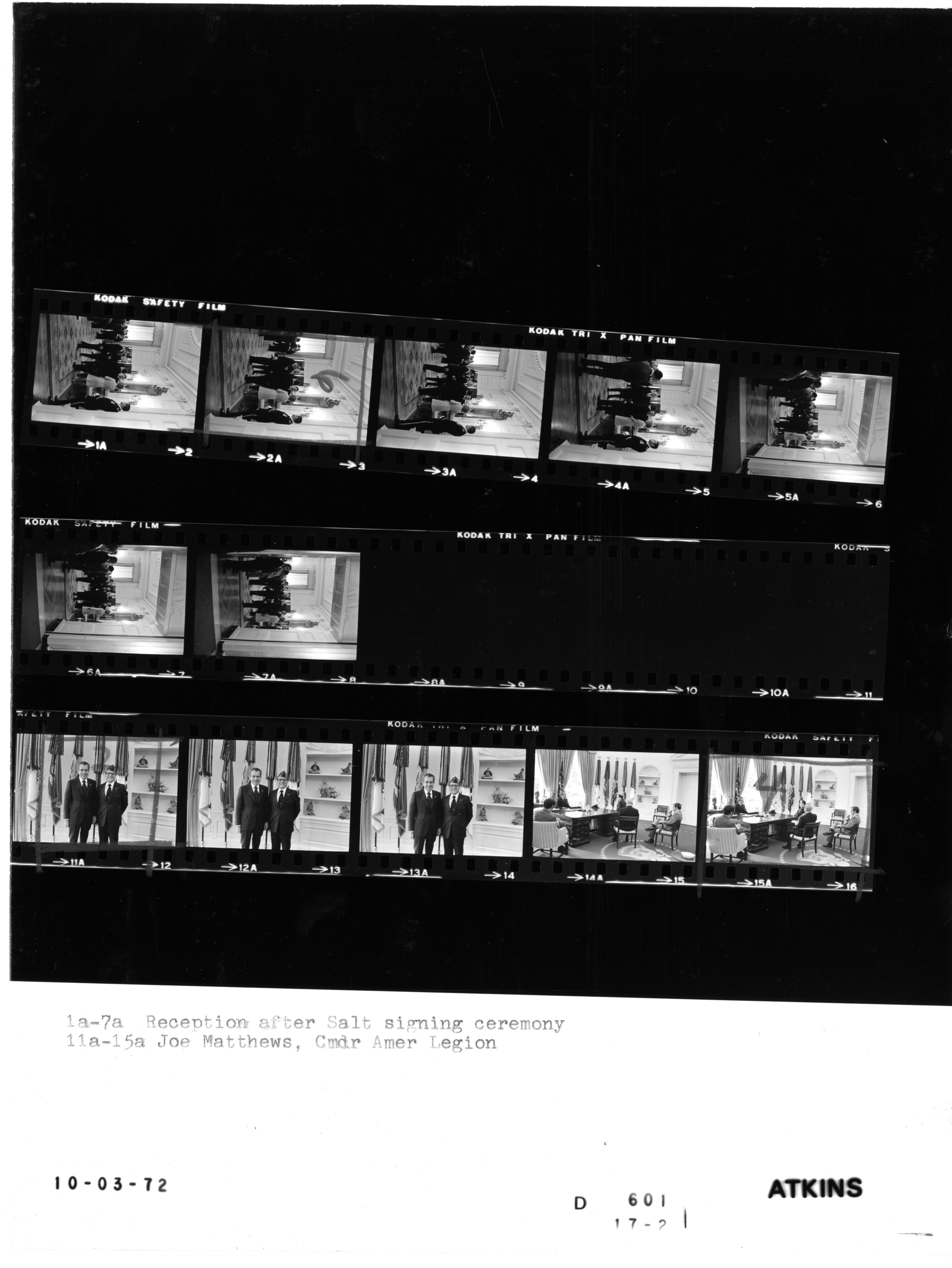
- Frame(s): WHPO-D0601-01A-07A, President Nixon and others after the signing of the SALT Agreement. 10/3/1972, Washington, D.C. White House, East Room. President Nixon, , Pat Nixon, Gromyko, William Rogers, Marion Smoak, officials, guests.
- Frame(s): WHPO-D0601-11A-15A, President Nixon standing with National American Legion Commander Joseph Matthews and seated at his desk with him and others. 10/3/1972, Washington, D.C. White House, Oval Office. President Nixon, Joseph Matthews, William Hauck, William Rhatican, Melville Stephens.
Roll WHPO-D0602 Photographer: Royer | Color or B&W: B&W
- Frame(s): WHPO-D0602-, Mike Farrell accepting the Colorado Convention Board Award. 10/3/1972, Washington, D.C. grounds, White House. Farrell, unidentified man and woman.
The White House Communications Agency Sound Recordings Collection contains public statements that took place between 1969 and 1974. Visit the finding aid to learn more.
L - White House Press Office Briefings
- WHCA-SR-L-032
Press briefing by Ronald Ziegler. (10/3/1972, White House Press Lobby)
Runtime: 0:16:46
Keywords: Press conferences, news conferences, interviews, media, press secretary, briefings, public statements to the press, Soviet Union, USSR, Russia, cabinet, advisors, SALT, S.A.L.T, Strategic Arms Limitation Talks, Cold War, detente, signing, treaty, treaties
Production credits: Audio feed supplied by WHCA; Recorded by CRB (initials of WHCA engineer)
Original Format: 1/4-inch reel-to-reel audiotape. Original source type: Original. Technical notes: 50 minutes and 32 seconds of silence at end of recording removed from access copies.
P - Formal Presidential Remarks
- WHCA-SR-P-721001
Remarks by President Nixon on signing SALT Ratification Agreement. (10/3/1972, East Room, the White House)
Runtime: 0:24:34
Keywords: SALT, S.A.L.T., Strategic Arms Limitation Talks, Russia, Soviet Union, USSR, Cold War, détente, summits, meetings
Production credits: Mult feed supplied by ABC; Recorded by JA (initials of WHCA engineer)
Original Format: 1/4-inch reel-to-reel audiotape. Original source type: Original.
The White House Communications Agency Videotape Collection contains “off-the-air” recordings of televised programs produced between 1968 and 1974. Visit the finding aid to learn more.
Context (External Sources)
The Vanderbilt Television News Archive is the world's most extensive and complete archive of television news. They have been recording, preserving and providing access to television news broadcasts of the national networks since August 5, 1968.
Wikipedia is a free encyclopedia that anyone can edit.