
Introduction
This almanac page for Wednesday, November 22, 1972, pulls together various records created by the federal government and links to additional resources which can provide context about the events of the day.
Previous Date: Tuesday, November 21, 1972
Next Date: Thursday, November 23, 1972
Schedule and Public Documents
The Daily Diary files represent a consolidated record of the President's activities. Visit the finding aid to learn more.
The President's day began at Camp David, Maryland
The Weekly Compilation of Presidential Documents made available transcripts of the President's news conferences; messages to Congress; public speeches, remarks, and statements; and other Presidential materials released by the White House.
Digitized versions can be found at HathiTrust.
The Federal Register is the official daily publication for rules, proposed rules, and notices of federal agencies and organizations, as well as executive orders and other Presidential documents.
Archival Holdings
Any selection of archival documents will necessarily be partial. You should use the documents and folders identified below as a starting place, but consult the linked collection finding aids and folder title lists and the collections themselves for context. Many documents to be found this way do not lend themselves to association with specific dates, but are essential to a complete understanding of the material.
Selective document listing
President's Office Files
The President's Office Files consists of materials drawn together by the Special Files Unit from several administrative subdivisions within the White House Office. It is the handwriting and sensitive papers sent to the Staff Secretary that now comprise much of the President's Office Files. Visit the finding aid to learn more.
- News Summaries, Unmarked News Summaries, Box 52, News Summaries - November 1972 [6 of 11] [Note: Due to the way News Summary products were compiled, you should also consult nearby days for potentially relevant materials.]
- News Summaries, November 22, 1972, (Tues. nets, wires)
The H. R. Haldeman Diaries consists of seven handwritten diaries, 36 dictated diaries recorded as sound recordings, and two handwritten audio cassette tape subject logs. The diaries and logs reflect H. R. Haldeman’s candid personal record and reflections on events, issues, and people encountered during his service in the Nixon White House. As administrative assistant to the President and Chief of Staff, Haldeman attended and participated in public events and private meetings covering the entire scope of issues in which the Nixon White House engaged in during the years 1969-1973. Visit the finding aid to learn more.
- Transcript of diary entry (PDF)
Wednesday, November 22nd. The President had Ehrlichman and me over at 8:30 this morning for a two hour meeting before he started his regular schedule. We went through a huge load of miscellaneous personnel things.
-------------------------------------------------------------------------------------------------------------------
DECLASSIFIED - E.O. 13526, Sect. 3.4: by MS, NARA, June 12, 2013
Audio Cassette 27, Side B, Withdrawn Item Number 2 [AC-27(B) Sel 2]
Duration: 20 seconds
He wants to kick Ida Rimstadt out of the Geneva post and use that for a plum. It later developed that Hodgson wanted it although Henry's going to give it to him, although he was originally thinking of giving that to Rumsfeld as a one-year deal to get rid of him.
-------------------------------------------------------------------------------------------------------------------
Still concerned about Rumsfeld. Redefines the Peterson job as a super-ambassador in Europe. He had me call Helms, while we were meeting, to tell him we want to make the change in March when he reaches 60, but make the announcement earlier, and that we'll keep Iran open for him. He wanted me to call Rogers, but I couldn't get him to offer Erwin, Paris, and get Alex Johnson to retire, tell him that Casey and Rush are coming in. He wanted to consider John Kyle for Congressional Liaison at Interior. He raised the question of some of the Catholics, I mean the Italians, and said he won't consider any Italian unless he's a Catholic. He wants a list of all those, see if we can't do that. He juggled a lot of names around: like Dent, who we now are not going to get to take Commerce, maybe for Transportation; Malek for Transportation; move Silberman out as a judge from the Labor Department, good man in there; he wants some blacks, at least two black ambassadors, and at least one good one in the White House. On ambassadorial appointments, he wants to be sure they're all made for two years, because Goldwater, for example, when he leaves the Senate in '74, wants to have Ambassador to Mexico for two years. Goldwater and everyone else is pushing hard that Dole must leave, that he's out of his mind to consider staying.
He's concerned about a letter he got from Gabe Haugy, saying that the jubilation on his election is muted because of Watergate. He wanted me to check Flanigan, Mitchell, Don Kendall, and a few others on that. Says if the OEP is not subject to confirmation, we should give it to Pat Gray, but he cannot send Gray up for confirmation hearings. He says that Webster of IRS must be accountable to Ehrlichman, not through Shultz; same with the FBI. He made the point that we need some good Mexicans; wants to consider moving Ramirez up into something. He says we should have a monthly meeting of the Cabinet to cover general problems. He's starting to get soft on the need to meet with Cabinet people, I think as he's being pushed by some of these appointees.
The Kissinger question came up in several contexts. First, he wants me to talk to Henry about being very careful in all of his appointments in his place; that he should examine his staff: the President had a check made regarding all the people in government who supported McGovern; and of all the agencies, you had the most in your office—thirteen former staff or paid consultants who supported McGovern. Then having loosened the ground, he wants me to lob Scali for UN at him. He wants to make the point to Henry that the rules are no end runs on personnel to Ehrlichman, Shultz, and so forth. They must come to me, and then, if we can't settle it, the two of us go to the President together. He wanted me to call Haig in Paris and get Henry to quit posing for pictures smiling with Le Duc Tho; and dictated a wire to Kissinger, a cable he wanted me to send, saying the President is very disappointed in the lack of progress in the negotiations to date. Under the circumstances, unless the other side shows the same willingness to be reasonable that we are showing, I am directing you to discontinue the talks and we shall then have to resume military activities until the other side is ready to negotiate. They must be disabused of the idea they seem to have that we have no other choice but to settle on their terms. You should inform them directly, without equivocation, that we do have another choice. And if they were surprised that I would take the strong action I did prior to Moscow Summit, and prior to the election, they will find that now with the election behind us, I will take whatever action I consider necessary to protect US interests.
Henry called me on the phone from Paris to report they had another four hour session, still in a very tough phase, may break through tomorrow...
-------------------------------------------------------------------------------------------------------------------
DECLASSIFIED - E.O. 13526, Sect. 3.4: by MS, NARA, June 12, 2013
Audio Cassette 27, Side B, Withdrawn Item Number 3 [AC-27(B) Sel 3]
Duration: 17 seconds
…that he will be bringing the South Vietnam emissary back with him. That a meeting in New York with the President would be fine over the weekend, but that he'll need two separate hours of his time. That he'll probably leave Saturday and be in New York Saturday night…
-------------------------------------------------------------------------------------------------------------------
…and that Ziegler should say nothing as of now.
The President's meetings that I sat in today included Bill Clements, the new Deputy Secretary of Defense. That went very well. Clements comes on like gangbusters; a very strong guy who is going to push hard for building the Defense Department, but cutting costs wherever possible, exactly what the President wants him to do. The President told him to, that he must do the cutting, but he must play a hawk versus Elliot; that he should have a close role with Kissinger; that he should spend some time with Packard after his announcement. Also with Ken Rush, but Packard most important; that we have to get the Defense Department away from the defense establishment; he must understand that their there, they must understand that they are there to serve the President, not the Department. He discussed the problem with Tower, and the concern of the key people in Congress, Thurmond and Stennis, Ebert and Arends, that they've got to be sold on Clements and Richardson as a package before the announcement. He covered the relations with the military. The President has to have a direct relationship with the Joint Chiefs, and that they have to change their way of thinking. He told him to see Connally and get his advice on and reading, on how to get along with Kissinger and with Elliot. He told him to broker his Texas position; keep his line into Texas as our Texas man; to work with Kissinger, but stand up to him. Clements raised the point that John Foster is a disaster in R and D, and that R and D is itself a disaster, and that Foster should be removed. The President agreed and told him to go ahead and do it. He told him to tilt the other way from Elliot regarding systems analysis and so forth. The President was very pleased with the meeting afterward and said that's the kind of guy we should be appointing, not people like John Whitaker who are nice but soft.
On Dave Kennedy, I laid the groundwork first, that he wasn't going to stay on. The President opened describing the new Peterson assignment, and that he'd be reporting to through White House, not the Secretary of State as sort of a super-ambassador to Europe, as Kennedy, in a sense, has been. Kennedy understood, agreed it was the right thing to do, obviously doesn't like being dumped, but realizes he can't do anything about it.
-------------------------------------------------------------------------------------------------------------------
EXEMPTED IN FULL, E.O. 13526, Sect. 3.3B(6), June 12, 2013
Audio Cassette 27, Side B, Withdrawn Item Number 4 [AC-27(B) Sel 4]
Duration: 20 seconds
JAPAN
-------------------------------------------------------------------------------------------------------------------
Kennedy recommended considering Graham Martin for the undersecretary political post instead of Porter. The President seemed to be interested in that as a possibility. Kennedy raised his special assignment projects on textile negotiations; the President told him to talk to Shultz about that. That he probably should follow up on it, and that he should also talk to Shultz after the first of the week on Jurick and the ongoing status of negotiations, and so forth. He told him to talk to Bill Casey about what's wrong at State, both process and names in the lower echelons. Kennedy's going back Friday morning to Brussels, and as soon as Peterson's set, Kennedy should talk with him, but he won't be back till the 9th. He reported that Rogers had shifted a NATO DCM out and had him working directly for Rogers. He put a new DCM in, in order to avoid Sonnenfeld being put in the Europe post.
-------------------------------------------------------------------------------------------------------------------
DECLASSIFIED - E.O. 13526, Sect. 3.4: by MS, NARA, June 12, 2013
Audio Cassette 27, Side B, Withdrawn Item Number 5 [AC-27(B) Sel 5]
Duration: 14 seconds
And Kennedy reported that Luns says this president should come to Europe as soon as possible, meet at NATO; and the President said he would do so after the inaugural; and that Kennedy could tell them so when he gets over there.
-------------------------------------------------------------------------------------------------------------------
Timmons came into his meeting with the President prepared to resign. The President came on full steam, telling him all the things he wanted him to do in cutting back his Department, and that sort of thing, and caught Bill completely off balance; said in all Departments, we'll appoint the Congressional liaison; you should give us the recommendations for those spots, and then you should act as liaison with them, plus two men in the Senate and two men in the House in your office, the two best you can get; then, go with less people, and make the Departments work. That all of the PIOs are going to have to meet with Ziegler from now on, and that Timmons is to do the same with all the Congressional men; they work for the President, not for the Departments. Timmons mentioned the need to elevate the Congressional men to assistant secretaries, and raised the personal problem that it might be better for him to leave; to get someone with better communication with the President; a fresh face and with some built-in status and prestige. The President told him to stay on through the session and then look; to stay in for two years, and you'll be better off then, the Watergate will have healed. We need you and we'll have a close-knit, well-oiled team. On the Watergate, the main thing is to clear the slate; the stories are worse than the facts.
Ford has requested an appointment with the President on the Congressional campaign committee; the President said he'd see him. They agreed to have leadership meetings monthly, and on the alternate weeks have big four meetings, if needed. And the President said Timmons should find a way to bring in the young guys for some special meetings. It was agreed that the Cabinet room should be used for a lot of these meetings, even without the President.
After all the meetings, the President had a chat with Ehrlichman and me; got into some detail on the whole Watergate thing. Had John spell out the situation for him, and it's obvious that he's still concerned about that, and is pushing John to get a plan wrapped up as quickly as possible and to him.
End of November 22nd. - Original audio recording (MP3)
The National Archives Catalog is the online portal to the records held at the National Archives, and information about those records. It is the main way of describing our holdings and also provides access to electronic records and digitized versions of our holdings.
The Catalog searches across multiple National Archives resources at once, including archival descriptions, digitized and electronic records, authority records, and web pages from Archives.gov and the Presidential Libraries. The Catalog also allows users to contribute to digitized historical records through tagging and transcription.
Nixon Library Holdings
All National Archives Units
National Security Documents
The President's Daily Brief is the primary vehicle for summarizing the day-to-day sensitive intelligence and analysis, as well as late-breaking reports, for the White House on current and future national security issues. Read "The President's Daily Brief: Delivering Intelligence to Nixon and Ford" to learn more.
The Foreign Relations of the United States series presents the official documentary historical record of major U.S. foreign policy decisions and significant diplomatic activity. Visit the State Department website for more information.
Vol. IX, Vietnam, October 1972-January 1973
Paris Negotiations Collapse, October 24-December 13, 1972
116. Message From the President’s Assistant for National Security Affairs (Kissinger) to President Nixon, Paris, November 22, 1972, 0120Z
Source: National Archives, Nixon Presidential Materials, NSC Files, Box 857, For the President’s Files (Winston Lord)—China Trip/Vietnam, Sensitive Camp David, Vol. XXI (2). Top Secret; Sensitive; Exclusively Eyes Only. Sent via Haig and Kennedy.
117. Message From the President’s Assistant for National Security Affairs (Kissinger) to President Nixon, Paris, November 22, 1972
Source: National Archives, Nixon Presidential Materials, NSC Files, Box 857, For the President’s Files (Winston Lord)—China Trip/Vietnam, Sensitive Camp David, Vol. XXI (2). Top Secret; Sensitive; Exclusively Eyes Only. Sent via Haig and Kennedy.
118. Message From Richard T. Kennedy of the National Security Council Staff to the President’s Deputy Assistant for National Security Affairs (Haig) in Paris, Washington, November 22, 1972, 1745Z
Source: National Archives, Nixon Presidential Materials, NSC Files, Box 857, For the President’s Files (Winston Lord)—China Trip/Vietnam, Sensitive Camp David, Vol. XXI (2). Top Secret; Sensitive; Eyes Only. Sent via Guay.
119. Message From the President’s Assistant for National Security Affairs (Kissinger) to the Ambassador to Vietnam (Bunker), Paris, November 22, 1972, 2100Z
Source: National Archives, Nixon Presidential Materials, NSC Files, Kissinger Office Files, Box 26, HAK Trip Files, HAK Paris Trip Hakto, November 18–25, 1972. Top Secret; Sensitive; Eyes Only. Sent via Haig and Kennedy.
Vol. XIX, Part 1, Korea, 1969-1972
Republic of Korea Troops in Vietnam and Force Modernization, April 1971-December 1972
167. Telegram From the Embassy in Korea to the Department of State, Seoul, November 22, 1972, 1058Z
Source: National Archives, RG 59, Central Files 1970–73, POL 15–5 KOR S. Confidential; Immediate. Repeated to Tokyo and CINCPAC.
Vol. XLII, Vietnam: The Kissinger-Le Duc Tho Negotiations
Breakdown of Negotiations, November 1972-December 1972
28. Memorandum of Conversation, Paris, November 22, 1972, 2:28-5:58 p.m.
Source: National Archives, Nixon Presidential Materials, NSC Files, Box 858, For the President’s Files (Winston Lord)—China Trip/Vietnam Negotiations, Sensitive, Camp David, Vol. XXI, Minutes of Meetings. Top Secret; Sensitive; Exclusively Eyes Only. The meeting took place at 108 Avenue du Général Leclerc in Gif-sur-Yvette. All brackets are in the original. The tabs are attached but not printed.
Kissinger assessed this day’s meeting for the President as follows:
“I touched upon each of the positions outlined by Le Duc Tho at yesterday’s session. We dropped several of our less important changes, calling concessions what actually amounted to returning to previously agreed upon language in the October draft. I stayed firm on the political section, the troops in the South issue, withdrawal of U.S. civilian personnel, South Vietnamese civilian prisoners, and Laos and Cambodia. I deferred our definitive position on the status of the DMZ, on which they had moved part way yesterday.”
Le Duc Tho continued to focus on Kissinger’s attempts to change the text of the agreement negotiated in October. Kissinger told Nixon that he answered Tho “firmly,” telling him: “we were not asking Hanoi to abandon principles but rather to elaborate more fully on principles they had already agreed to. I noted that you [Nixon] were making an exceptional effort in search of peace at a time when you had a strong mandate from the American people which removed any restrictions on your course of action.” (Foreign Relations, 1969–1976, vol. IX, Vietnam, October 1972–January 1973, Document 117)
Vol. E-4, Documents on Iran and Iraq, 1969-1972
Iran 1972
236. Telegram 7008 From the Ambassador in Iran (Farland) to the Under Secretary of State (Johnson), Tehran, November 22, 1972
In strong terms, the Ambassador emphasized that the United States must abide by the condition to replace the Shah’s aircraft rapidly.
Source: National Archives, RG 59, Central Files 1970–73, DEF 19–8 US-IRAN. Top Secret; Nodis.
Vol. E-7, Documents on South Asia, 1969-1972
Bangladesh, December 1971-December 1972
431. Memorandum From Harold Saunders of the National Security Council Staff to the President’s Assistant for National Security Affairs (Kissinger), Washington, November 22, 1972
Saunders posed the options open to the United States in the pending debate in the UN General Assembly on the question of membership for Bangladesh. Kissinger decided to continue to support the position taken on the question by Pakistan and China.
Source: National Archives, Nixon Presidential Materials, NSC Files, Box 591, Country Files, Middle East, Bangladesh. Confidential. Sent for action. In a November 23 note attached to the memorandum, Richard Kennedy informed Saunders that Kissinger had decided that the United States should hold to its former position on the issue.
The Kissinger telephone conversation transcripts consist of approximately 20,000 pages of transcripts of Kissinger’s telephone conversations during his tenure as Assistant to the President for National Security Affairs (1969-1974) and Secretary of State (1973-1974) during the administration of President Richard Nixon. Visit the finding aid for more information.
Digitized versions can be found in the National Archives Catalog.
Audiovisual Holdings
Visit the White House Tapes finding aid to learn about the taping system's operation and archival processing.
Camp David Hard Wire
- 230-11; Unknown between 8:20 a.m. & 10:52 a.m.; Nixon, Richard M. (President); Camp David Operator
- 230-12; 10:52 a.m. - 10:56 a.m.; Nixon, Richard M. (President); Woods, Rose Mary
- 230-13; Unknown between 10:56 a.m. & 7:04 p.m.; Nixon, Richard M. (President); Camp David Operator
- 230-14; 7:04 p.m. - 7:07 p.m.; Nixon, Richard M. (President); Johnson, Lyndon B.
- 230-15; Unknown between 7:07 p.m., 11/22 & 3:36 p.m., 10/10; Nixon, Richard M. (President); Sanchez, Fina
- 230-16; Unknown between 7:07 p.m., 11/22 & 3:36 p.m., 10/10; Nixon, Richard M. (President); Eisenhower, Julie Nixon
- 230-17; Unknown between 7:07 p.m., 11/22 & 3:36 p.m., 10/10; Nixon, Richard M. (President); Eisenhower, Julie Nixon
- 230-18; Unknown between 7:07 p.m., 11/22 & 3:36 p.m., 10/10; Nixon, Richard M. (President); Nixon, Thelma C. ("Pat") (Ryan); Eisenhower, Julie Nixon
- 230-19; Unknown between 7:07 p.m., 11/22 & 3:36 p.m., 10/10; Nixon, Richard M. (President); Eisenhower, Julie Nixon
- 230-20; Unknown between 7:07 p.m., 11/22 & 3:36 p.m., 10/10; Eisenhower, Julie Nixon; Cox, Tricia Nixon
- 230-21; Unknown between 7:07 p.m., 11/22 & 3:36 p.m., 10/10; Nixon, Thelma C. ("Pat") (Ryan); Eisenhower, Julie Nixon
- 230-22; Unknown between 7:07 p.m., 11/22 & 3:36 p.m., 10/10; Nixon, Thelma C. ("Pat") (Ryan); Eisenhower, Julie Nixon
- 230-23; Unknown between 7:07 p.m., 11/22 & 3:36 p.m., 10/10; Nixon, Thelma C. ("Pat") (Ryan); Eisenhower, Julie Nixon
- 230-24; Unknown between 7:07 p.m., 11/22 & 3:36 p.m., 10/10; Nixon, Thelma C. ("Pat") (Ryan); Eisenhower, Julie Nixon
- 230-25; Unknown between 7:07 p.m., 11/22 & 3:36 p.m., 10/11; Eisenhower, Julie Nixon; [Unknown person(s)]
- 230-26; Unknown between 7:07 p.m., 11/22 & 3:36 p.m., 10/11; Nixon, Richard M. (President); Eisenhower, Julie Nixon
- 230-27; Unknown between 7:07 p.m., 11/22 & 3:36 p.m., 10/11; Eisenhower, Julie Nixon; [Unknown person(s)]
- 230-28; Unknown between 7:07 p.m., 11/22 & 3:36 p.m., 10/11; Nixon, Thelma C. ("Pat") (Ryan); Eisenhower, Julie Nixon; Cox, Tricia Nixon
- 230-29; Unknown between 7:07 p.m., 11/22 & 3:36 p.m., 10/11; Nixon, Thelma C. ("Pat") (Ryan); Eisenhower, Julie Nixon; Cox, Tricia Nixon
- 230-30; Unknown between 7:07 p.m., 11/22 & 3:36 p.m., 10/11; Nixon, Richard M. (President); Eisenhower, Julie Nixon
Camp David Study Table
- 155-28; Unknown between 8:20 a.m. & 10:52 a.m.; Nixon, Richard M. (President); Camp David Operator
- 155-29; 10:52 a.m. - 10:56 a.m.; Nixon, Richard M. (President); Woods, Rose Mary
- 155-30; Unknown between 10:56 a.m. & 7:04 p.m.; Nixon, Richard M. (President); Camp David Operator
- 155-31; 7:04 p.m. - 7:07 p.m.; Nixon, Richard M. (President); Camp David Operator; Johnson, Lyndon B.
- 155-32; Unknown between 10:56 a.m. & 7:04 p.m.; [Unknown person(s)]; Camp David Operator
The White House Photo Office collection consists of photographic coverage of President Richard Nixon meeting with prominent social, political, and cultural personalities; speaking engagements and news conferences of the President and various high-ranking members of the White House staff and Cabinet; Presidential domestic and foreign travel, including Presidential vacations; social events and entertainment involving the First Family, including entertainers present; official portraits of the President, First Family, and high-ranking members of the Nixon administration; the 1969 and 1973 Inaugurals; the President’s 1972 Presidential election campaign appearances (including speeches) and other official activities of the White House staff and the President’s Cabinet from January 20, 1969 until August 9, 1974 at the White House and the Old Executive Office Building; other locations in Washington, DC, such as The Mall; and the Presidential retreats in Camp David, Maryland, Key Biscayne, Florida, and San Clemente, California. Visit the finding aid to learn more.
Roll WHPO-D1013 Photographer: Atkins, Oliver | Color or B&W: B&W
- Frame(s): WHPO-D1013-, President Nixon seated in a living room area at Camp David with H.R. Haldeman and John Ehrlichman during a meeting discussing reorgnization. 11/22/1972, Camp David, Maryland Living Room, Aspen Lodge. President Nixon, H.R. Haldeman, John Ehrlichman.
Roll WHPO-D1014 Photographer: Atkins, Oliver | Color or B&W: B&W
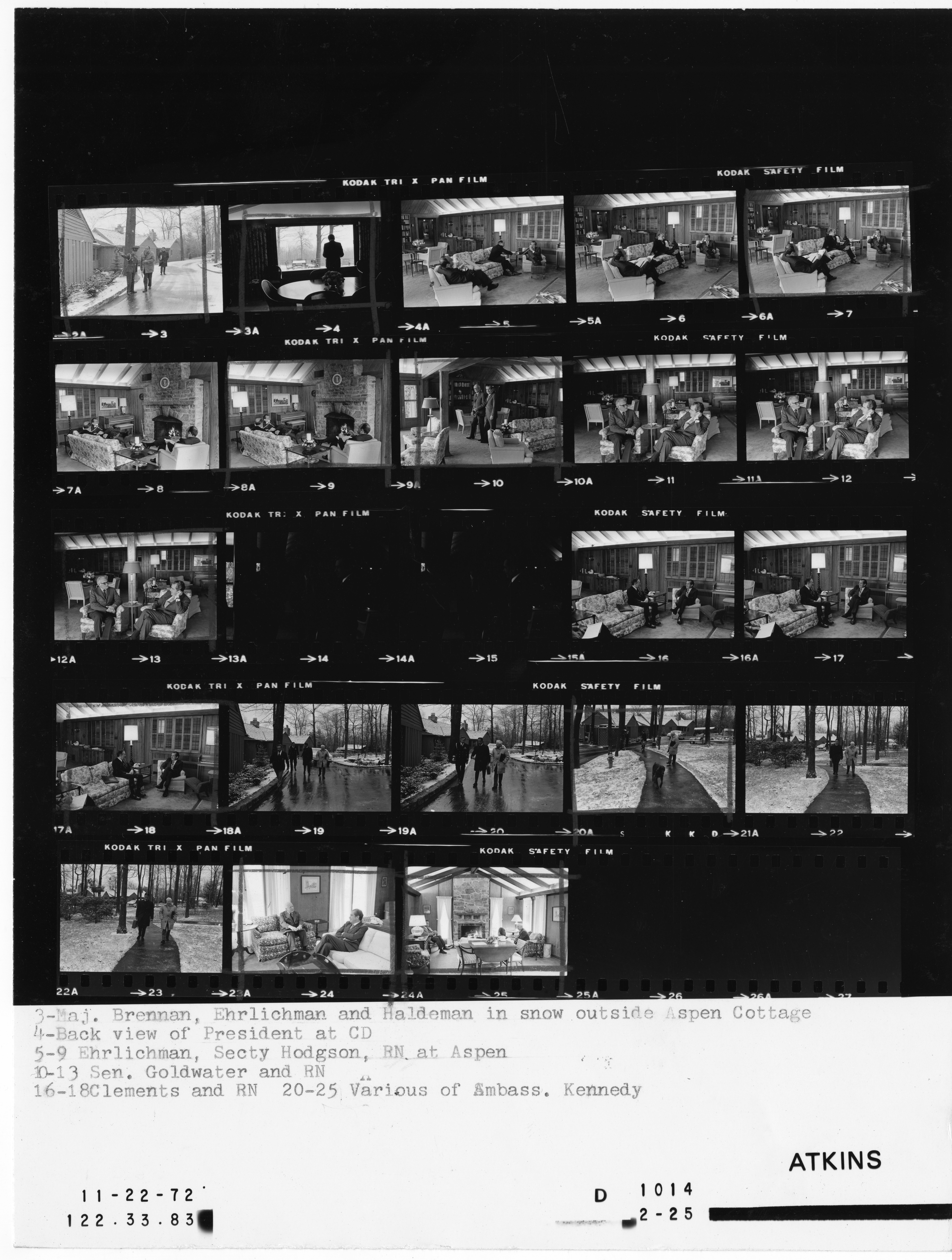
- Frame(s): WHPO-D1014-03, H.R. Haldeman and John Ehrlichman, walking along snow-cleared paths on the ground of Camp David. 11/22/1972, Camp David, Maryland Aspen Lodge, living room, sun porch. President Nixon, H.R. Haldeman, John Ehrlichman, David Kennedy, Hodgson, Barry Goldwater, William Clements, Jr., military aides.
- Frame(s): WHPO-D1014-04, President Nixon, seen from behind, standing alone looking out an Aspen Lodge window at the snow covered grounds and patio seating area at Camp David. 11/22/1972, Camp David, Maryland Aspen Lodge, living room, sun porch. President Nixon.
- Frame(s): WHPO-D1014-05-09, President Nixon standing, and seated informally with James Hodgson, and H.R. Ehrlichman. 11/22/1972, Camp David, Maryland Aspen Lodge, living room, sun porch. President Nixon, H.R. Haldeman, John Ehrlichman, David Kennedy, Hodgson, Barry Goldwater, William Clements, Jr., military aides.
- Frame(s): WHPO-D1014-10-13, President Nixon standing, and seated informally with Barry Goldwater. 11/22/1972, Camp David, Maryland Aspen Lodge, living room, sun porch. President Nixon, H.R. Haldeman, John Ehrlichman, David Kennedy, Hodgson, Barry Goldwater, William Clements, Jr., military aides.
- Frame(s): WHPO-D1014-16-18, President Nixon standing, and seated informally with William Clements, Jr. 11/22/1972, Camp David, Maryland Aspen Lodge, living room, sun porch. President Nixon, H.R. Haldeman, John Ehrlichman, David Kennedy, Hodgson, Barry Goldwater, William Clements, Jr., military aides.
- Frame(s): WHPO-D1014-19-23, H.R. Haldeman and Ambassador David Kennedy walking along snow-cleared paths. 11/22/1972, Camp David, Maryland Aspen Lodge, living room, sun porch. President Nixon, H.R. Haldeman, John Ehrlichman, David Kennedy, Hodgson, Barry Goldwater, William Clements, Jr., military aides, King Timahoe.
- Frame(s): WHPO-D1014-24-25, President Nixon standing, and seated informally with Ambassador David Kennedy. 11/22/1972, Camp David, Maryland Aspen Lodge, living room, sun porch. President Nixon, H.R. Haldeman, John Ehrlichman, David Kennedy, Hodgson, Barry Goldwater, William Clements, Jr., military aides.
Roll WHPO-D1015 Photographer: Atkins, Oliver | Color or B&W: Color
- Frame(s): WHPO-D1015-, Snow covered grounds and cabin building exterior of Aspen Lodge at Camp David. 11/22/1972, Camp David, Maryland Aspen Lodge.
- Frame(s): WHPO-D1015-03, Snow covered grounds and cabin building exterior of Aspen Lodge at Camp David. 11/22/1972, Camp David, Maryland Aspen Lodge.
- Frame(s): WHPO-D1015-10, Small 4-5 ft Spruce pine tree standing outside on the snow-covered grounds nearby a cabin building of Aspen Lodge at Camp David. 11/22/1972, Camp David, Maryland Aspen Lodge.
Roll WHPO-D1016 Photographer: Schumacher, Karl | Color or B&W: B&W
- Frame(s): WHPO-D1016-04A-09A, Vice President Agnew seated with Ambassador Robin and an unidentified man. 11/22/1972, Washington, D.C. unidentified room. Spiro Agnew, Ambassador Robin.
- Frame(s): WHPO-D1016-10A, Unidentified men in a kitchenette. 11/22/1972, Washington, D.C. unidentified room. unidentified men.
- Frame(s): WHPO-D1016-11A, An Unoccupied office. 11/22/1972, Washington, D.C. unidentified room.
The White House Communications Agency Sound Recordings Collection contains public statements that took place between 1969 and 1974. Visit the finding aid to learn more.
H - White House Staff Member Recordings
- WHCA-SR-H-669
Private taping by Frank Carlucci regarding Hurricane Agnes. (11/22/1972, Room 252, Executive Office Building)
Runtime: [Nonelisted]
Production credits: Audio feed supplied by WHCA; Recorded by CRB (initials of WHCA engineer)
Original Format: 1/4-inch reel-to-reel audiotape. Original source type: Original.
L - White House Press Office Briefings
- WHCA-SR-L-066
Press briefing by Ronald Ziegler. (11/22/1972, Camp David)
Runtime: 35:27:00
Keywords: Press conferences, news conferences, interviews, media, press secretary
Original Format: 1/4-inch reel-to-reel audiotape. Original source type: Original.
The White House Communications Agency Videotape Collection contains “off-the-air” recordings of televised programs produced between 1968 and 1974. Visit the finding aid to learn more.
- WHCA-5932
Weekly News Summary, Tape II.
ALL NETWORKS
Runtime: 01:04:45
1. Reasoner/Rolfson: Kissinger in Paris. Time Code Start: 00:00. Keywords: Paris Peace Talks, Vietnam War, treaty, treaties, negotiations, government, officials, travel, trips. Network: ABC.
2. Reasoner: Busing in Michigan. Time Code Start: 02:18. Keywords: bills, laws, legislation, desegregation, racism, racial discrimination, African Americans, schools, students, transportation, reports. Network: ABC.
3. Reasoner/Shoumacher: Economic report. Time Code Start: 05:57. Keywords: economy, economics, budgets, finances, recession, inflation, money, wages, costs, unemployment, prices, reports. Network: ABC.
4. Reasoner/Jarriel: Camp David. Time Code Start: 08:09. Keywords: government, buildings. Network: ABC.
5. Reasoner: Chicago Seven trials (Chicago 7). Time Code Start: 09:54. Keywords: Yuppies, Abbie Hoffman, Jerry Rubin, Tom Hayden, Chicago Seven (Chicago 7), militants, demonstrations, demonstraters, protests, protesters, Republican National Convention, convention, crime, crimes, offences, infractions, criminals, criminality, law break. Network: ABC.
6. Dobyns: Would you believe Kissinger is still in Paris?. Time Code Start: 11:54. Keywords: Paris Peace Talks, Vietnam War, treaty, treaties, negotiations, government, officials, travel, trips. Network: NBC.
7. Chancellor/Quint: SALT II talks are looking up [Strategic Arms Limitation Talks]; President Nixon lifted government bans on ships and planes going to Cuba. Time Code Start: 14:18. Keywords: SALT, S.A.L.T., Strategic Arms Limitation Talks, Russia, Soviet Union, USSR, Cold War, détente. Network: NBC.
8. Chancellor/Oliver: Hearings in San Diego, California on the race relation problem in the Navy. Time Code Start: 16:55. Keywords: Armed Forces, Navy, Marines, ships, racial, racism, desegregation, racism, racial profiling, racial discrimination, civil rights, African Americans. Network: NBC.
9. Mudd/Schieffer: U.S. lost its first B-52 in Vietnam. Time Code Start: 19:05. Keywords: Vietnam War, aircraft, losses. Network: CBS.
10. Mudd/Kalb: Paris peace talks; Kissinger and South Vietnam are not getting along. Time Code Start: 20:25. Keywords: Paris Peace Talks, Vietnam War, treaty, treaties, negotiations, government, officials, travel, trips. Network: CBS.
11. Mudd/Schorr: President Nixon economic council makes predictions as to a good, solid, and growing economy with Herb Stein. Time Code Start: 21:58. Keywords: economy, economics, budgets, finances, recession, inflation, money, wages, costs, unemployment, prices, reports. Network: CBS.
12. Mudd/Dean: Democratic party looking for scapegoat with Robert Strauss, Larry O'Brien, Frank Mankiewicz, George Mitchell and Governor George Wallace. Time Code Start: 24:02. Keywords: Presidential elections, campaigns, campaigning, candidates, managers, bugging, bugs, wiretapping, wire taps, surveillance, spying, recordings, Senate committee hearings, investigations, testimony, testify, cover-ups, break-in, scandals, Watergate. Network: CBS.
13. Sevareid: Commentary on a diploma, is it worth what it's supposed to be worth?. Time Code Start: 29:57. Keywords: education, colleges, universities, graduation, credentials,. Network: CBS.
Context (External Sources)
The Vanderbilt Television News Archive is the world's most extensive and complete archive of television news. They have been recording, preserving and providing access to television news broadcasts of the national networks since August 5, 1968.
Wikipedia is a free encyclopedia that anyone can edit.