
Introduction
This almanac page for Friday, November 17, 1972, pulls together various records created by the federal government and links to additional resources which can provide context about the events of the day.
Previous Date: Thursday, November 16, 1972
Next Date: Saturday, November 18, 1972
Schedule and Public Documents
The Daily Diary files represent a consolidated record of the President's activities. Visit the finding aid to learn more.
The President's day began at Camp David, Maryland
The Weekly Compilation of Presidential Documents made available transcripts of the President's news conferences; messages to Congress; public speeches, remarks, and statements; and other Presidential materials released by the White House.
Digitized versions can be found at HathiTrust.
Each Public Papers of the Presidents volume contains the papers and speeches of the President of the United States that were issued by the White House Office of the Press Secretary during the time period specified by the volume. The material is presented in chronological order, and the dates shown in the headings are the dates of the documents or events. In instances when the release date differs from the date of the document itself, that fact is shown in the text note.
To ensure accuracy, remarks have been checked against audio recordings (when available) and signed documents have been checked against the original, unless otherwise noted. Editors have provided text notes and cross references for purposes of identification or clarity.
The Federal Register is the official daily publication for rules, proposed rules, and notices of federal agencies and organizations, as well as executive orders and other Presidential documents.
Archival Holdings
Any selection of archival documents will necessarily be partial. You should use the documents and folders identified below as a starting place, but consult the linked collection finding aids and folder title lists and the collections themselves for context. Many documents to be found this way do not lend themselves to association with specific dates, but are essential to a complete understanding of the material.
Selective document listing
President's Office Files
The President's Office Files consists of materials drawn together by the Special Files Unit from several administrative subdivisions within the White House Office. It is the handwriting and sensitive papers sent to the Staff Secretary that now comprise much of the President's Office Files. Visit the finding aid to learn more.
- News Summaries, Unmarked News Summaries, Box 52, News Summaries - November 1972 [3 of 11] [Note: Due to the way News Summary products were compiled, you should also consult nearby days for potentially relevant materials.]
- News Summary, November 17, 1972 (Thurs. nets, wires)
The H. R. Haldeman Diaries consists of seven handwritten diaries, 36 dictated diaries recorded as sound recordings, and two handwritten audio cassette tape subject logs. The diaries and logs reflect H. R. Haldeman’s candid personal record and reflections on events, issues, and people encountered during his service in the Nixon White House. As administrative assistant to the President and Chief of Staff, Haldeman attended and participated in public events and private meetings covering the entire scope of issues in which the Nixon White House engaged in during the years 1969-1973. Visit the finding aid to learn more.
- Transcript of diary entry (PDF)
Friday, November 17.
Started out this morning with some phone calls. Dole had called yesterday, he wanted to clear the need to make appointments at the National Committee for the Executive Committee of the Reform Commission. He is trying to find good people for it. Wants to meet with me on the subject. He assumes that he is going to stay on as Chairman since Evans and Armstrong are both leaving, so I told him I'd meet with him next week. I'm going to have to work out a shift on the Chairmanship. But we will talk to John Mitchell about trying to get him to do it. Talked with Connally to give him the report that Rogers would not be leaving, made the point that with the problem of Vietnam testimony that we would not be moving immediately, but will start making the changes underneath. For his information, we have a clear understanding, although we can't say so now, because it would make him a lame duck. At the middle of the year this might open up. The advantage is that this keeps it loose for now, and, in light of your conversation with the President, he wanted you to know this because it may also resolve the Kissinger situation by then. Connally got the point that I was saying State might be available to him by midyear, which was what the President wanted him to know. Connally then also raised the point that he had forgotten to mention, in his conversation with the President yesterday, that he feels very strongly that we are dealing with a new phenomenon in the country --that we’ll have lots of problems on the Hill. He's picked up some from Bob Wilson and so on, that the President wouldn't give a damn for them, so now they don't give a damn for him, and they don't want any more bills dropped from the White House. In other words, Congress will be, at best, a very difficult situation. Connally feels strongly that in the country the people have decided that they want a balance of power. They don't like the Supreme Court and he thinks we should ask for an amendment to the Constitution to force reconfirmation of our Federal judgeships every eight years. And he went into his pitch on that, but then he says the people saw what happened with the LBJ landslide, all the new legislation, a lot of it bad. He thinks the people deliberately set up a split, that we may have to approach Congressional politics differently. We shouldn't campaign to ask people to support the President but rather to support an idea. The people want the split. The President is not to blame for the failure to pick up Congress. And he cites the two Senators in Texas, divided between the Party. The people want to keep the power divided. He says we shouldn't worry at all about the President not helping enough. The worst thing he could have done is to push for a Republican Congress.
Talked to Connally again later in the day about Colson, because the President wanted his view on whether Colson should leave now or later. He had talked to Colson today and got the distinct impression that he was leaving, that he was concerned there was no politician being left in the White House and that we have to have someone. We are going to have more and more power and fewer people in the reorganization so they must be available to the leaders of Congress. So someone has to take on Chuck's chore. He also thinks that Ehrlichman and I have to be more accessible, at least while we are building someone else up. On the other hand, Colson is not indispensable and it is better to make all the changes at the same time-- Cabinet and White House. It is a bad signal just to do the Cabinet and not the White House. He agrees Chuck should move now. Congress is going to be mean and testy, they're going to cause all possible trouble. We should keep them off base, shift people, move them in and out so they can't pick on the old people. There's a lot of merit to getting Chuck out because of the investigations coming up and all. He doesn't think it will look bad at all, he thinks if he is still around he will be a bigger issue, while if he is out, it doesn't matter. He should definitely move out now, not later. The best he can do is get out quick, get his law firm established as fast as possible, you can't keep breaking china forever.
The President got into a bunch of miscellaneous stuff this morning. Wants to meet with Flanigan, Klein, Finch, Helms, Bill Casey, and so on. Shifted this afternoon's appointments around a little. Wanted to get Shultz' view on Rumsfeld's staying on the Cost of Living Council and on whether we could consider Flanigan for the International Economic Area. Gave me a pitch on telling Klein that he's going to have to go because we are not going to be doing the sales pitch out of the White House anymore. Wants to tell Flanigan that there is no opportunity for him on anything requiring confirmation and there is a problem for him staying in the White House under the new structure.
Wants to move as quickly as we can on announcing the Ash, Weinberger, Richardson, Laird shift. Wants to get Volpe before Romney, so he can tell Romney, Volpe is going. Wants Shultz to deal Hodgson out before he comes in to see the President. Wants to be sure we have an understanding with all the appointees that we lay it on the line that the President is going to name the second spots and all the other key slots-- Jerry Brown, Kendall and the names of our businessmen. Makes the point that loyalty is the most important thing and as we dismantle various offices we should use the loyal people throughout the agencies. Follow Harlow's role of controlling all the key posts, with loyalty much more important than competence. He likes the idea of bringing Frank Dale in. Wants to know why Mitchell is opposed to Ehrlichman, wants me to tell John that the President is going to keep Ehrlichman. Came up with the idea of a special assignment for Peterson as East/West Trade with the Soviet Union and the European Community and so on, in addition to his basic Ambassador job. Everybody thought that wouldn't work and the President later agreed that we could give him the European Community plus NATO instead. Wanted Shultz to handle him first, however. President made the point that we've got to change the attitude of the Cabinet officers, make the point that now the President's the buyer, not the seller. We need them to be cheerleaders for the President. Let the staff and the Cabinet handle the problems and they cheer the President up rather than vice versa. He keeps coming up with the point that we should think in terms of Kissinger leaving, he gets fed up with Henry, as he thinks about him and doesn't think we should plan to keep him on for very long after we get Vietnam settled.
I talked to Kissinger after he met with the President today. He's concerned about Carlucci, wants me to talk to Haig and Walters about him. He questions Richardson at Defense and the question of how the Congressional right wing would take it. He's afraid of his basic McNamara leanings and of his tie to Larry Lind and Jonathan Moore. Questions whether he differs from McNamara in his convictions and says we cannot have Defense lead in the effort to disarm. The problem is he's not on our basic wavelength and we really have to give the Chiefs clear access if we put him in there. He said the President wanted to check out Secor Browne for ACTA.
He called me this evening to say-- regarding our conversation this morning with Rogers --I told him that Bill was going to stay on for a short time. Said he didn't react really the way he feels that he believes this is a disaster for the President and the country and unworkable for the Administration and for our foreign policy. Our problem is not the foreign service, it's the Secretary and he operates independently of the White House, won't carry out orders and won't do the work, for preparation of his own materials. So the Department is torn between their loyalty to the Secretary versus the White House. He always debriefs them when any meeting is held at the White House. For the President, in the crucial first six months of a new term, the changes that occur will be geared to the Secretary and he’ll have be treated as if he's there permanently, so everything will be affected by his attitude towards the White House. Thus the best we can get is neutrality. If anything slips they’ll organize against us and they’ll be egged on by the Secretary. The first six months is the time to set the new patterns. We need a new doctrine, not just new people. That is, for example, they put Gartov on the SALT delegation against our orders as ACTA representative and he briefed today, totally contrary to our position, and we can't do anything about it. We should get him fired but now we just have to maneuver around him. Rogers will now run wild and try to win one, and that's probably true, because Rogers did talk about wanting to get into the Middle East thing before he leaves, at least get negotiations started. Every negotiation will get set the wrong way and he'll defeat the reorganization.
Henry thinks it's a disaster for the second term, and he's affronted that it was done without discussion with him. He has no doubt-- he wants me to have no doubt regarding his feelings. He's certainly discussed it with Al, and he says it won't work either. As a long term proposition, he'll have to think it over very carefully. In other words, he's threatening. He says he knows Rogers will start a big Middle East thing again. He's right. He says we should start the new Administration with a clear slate-- you're losing the chance to make the current policy established, responsive to the President. If we had a Secretary we could work with, we could tell him what we want and it would get done. The establishment is now shook up and we could really do something. If it drags on six or eight months wondering who's in the wings and so forth, it'll create an inherently mushy situation. The Department is ready to follow now. We'll destroy that because they'll have to stay loyal to the Secretary, thinking he's permanent. The correct thing to do is dump him and change now. Obviously, keeping him may drive Kissinger out. He dropped a number of veiled threats to that effect. He says if one has to carry a major burden, one shouldn't have it dumped on one's shoulders. I should have no illusions regarding his feelings-- he's very serious about it. He says he has to know exactly what the President expects him to do. He's not just somebody you can move around. This is a courtesy that has not been extended to him. He has hesitations regarding staying. I tried to calm him down, make all the obvious points about what we're doing, it'll all work out, etcetera, but I don't think I satisfied him very much.
The President kept calling me during the afternoon and the meetings later in the day and into the evening on the line I should use in talking with Rogers. He says I should have a clear understanding that number one, he's to leave on June 1, but will say nothing prior to that. Number two, there will be a reorganization in the Department as in all others. Number three, the President will make the decisions regarding all appointments. Number four, the line of working control must be through the system. I was originally going to do it on the phone. He told me not to, to see him in person tomorrow. Make the point that it’s unfortunate that he had the impression that he's being fired, the President had the impression he was leaving. We cannot wait on the reorganization of the Department, we're going to run the appointments as Kennedy did, that is, the President makes the decisions. Regarding the foreign service, we'll have to see what promotions we want to put through. The most important thing is loyalty. We can't have another Yost situation. He wants to stick that into him. Everybody has to work within the system. It's partly Kissinger's fault we know, but we all have to use the system and that must be clearly understood, and there must be an equal understanding regarding the date or no one else will know that. He then said when I meet with Rogers I should make the point that we have no problems with anyone else in the Cabinet except you. The President wants to work it out in the right way, and he thinks I should push him to come on and say what he thinks is wrong. First, I should lay out everything: the President will handle Volpe, make the point that Rogers objected two years ago to sending Volpe to Italy; hit the Yost point, that we don't want any more of them; the President doesn't want to hurt him, but with reorganization now -- without delay -- the plans must go ahead. The President has been through four years of hell between you and Kissinger. From now on it must work through the system. The only merit that any of this delay has, is that it saves Rogers. I should get across the point that Kleindienst supported the President when things were tough, the point that the Vietnam testimony is mostly out of defense. He wants me to play a hard line with Bill if he decides to leave-- fine, after his very unadmirable conduct yesterday. I'll be very tough with him, and cold. The President is going to select the top people in all the Departments, and has some ideas for State. Regarding the reorganization, the President has views on that. Regarding his successor, he hasn't decided (but it will be Rush, of course). The important thing is to get to Rogers-- that I must be candid. The whole Cabinet is now worked out, everyone is relaxed about it, you're the only problem. He can't get away with the idea that he's defending his colleagues in the Cabinet. I should make the point that this is where the spotlight will be, can we justify it. I'm not to tell him anything about the others. We'll only accept cold turkey terms. The President's talked to Laird, he wants to leave, Shultz is staying and Kleindienst is. Richardson's worked out, so is Peterson; Romney and Volpe will leave, and Hodgson will; you're the only one with any problem. So cut out the crap about the President being cold and hard to the whole Cabinet.
A couple of times with the line regarding Colson. I had a long meeting with Colson this afternoon at the President's request and tried to make the pitch that Chuck should go in to the President and say he's reconsidered and thinks he should leave now. Colson didn't buy that at all so we argued it all through. He makes the strong pitch that he ought to stay for the six months, and I must say he makes a convincing argument from the viewpoint that we need somebody in that Colson role, and that he's clearly the best person for it. I went back and made the pitch to the President and Ehrlichman on that basis and they didn't buy it. They both feel he should leave, as did Connally as I covered earlier. I called Connally at the President's request on that. So the President said I should talk to Colson tomorrow, I should be very tough and very considerate. Say that the President doesn't want the situation to arise that he has to turn his back on somebody -- and there's a one in five chance that it might happen -- but he does want Chuck to set up a new establishment both within and outside and he's the one to do it. He should get in Fitzsimmons, and so forth, for lunch and dinners with the President before January 20-- get them all in that are important, groups and individuals. He says I should play a hard line with him, that he just can't take the risk of coming down to the hard place with them, but that he should find the man to replace himself, so on. I should make the point that it's my judgment that there's a one in five chance and that we shouldn't make the President be in a position of having to turn his back on you. We want him to recommend the best man to do it, we want him to set up some dinners for the top people, and so on.
The President met with Laird, received his resignation and general review of some of his recommendations. He thinks Rush should succeed him. Regarding the timing of the announcement, he doesn't care, although he wants to leave by January 20 even if his successor's not confirmed. He pitched Hewlett for Deputy Secretary and Rush for Secretary. The President asked Laird to give me his recommendations for the best man in the department to keep and Laird pulled out his big black book with the whole list in it. He said Rush might be a problem with State because he's apt to be overly agreeable on things. He hit Rogers' line on Vietnam testimony by saying most of that will be Defense, not State. The President then made a long pitch to Laird that he should take a Chairmanship of the National Committee and be the President's personal political man because he's the best politician -- political operator -- in the Republican Party. Laird immediately rejected that possibility saying he couldn't possibly do that to his wife, that he's committed to taking three months off and after that he's not going to get into any more political stuff. He told Laird to stay loose regarding any commitments on '76 and to come and talk to the President before he made any move on that and overall it was a very satisfactory meeting with Laird leaving on a good note, as contrasted to the Rogers meeting yesterday.
End of November 17. - Original audio recording (MP3)
The National Archives Catalog is the online portal to the records held at the National Archives, and information about those records. It is the main way of describing our holdings and also provides access to electronic records and digitized versions of our holdings.
The Catalog searches across multiple National Archives resources at once, including archival descriptions, digitized and electronic records, authority records, and web pages from Archives.gov and the Presidential Libraries. The Catalog also allows users to contribute to digitized historical records through tagging and transcription.
Nixon Library Holdings
All National Archives Units
National Security Documents
The President's Daily Brief is the primary vehicle for summarizing the day-to-day sensitive intelligence and analysis, as well as late-breaking reports, for the White House on current and future national security issues. Read "The President's Daily Brief: Delivering Intelligence to Nixon and Ford" to learn more.
The Foreign Relations of the United States series presents the official documentary historical record of major U.S. foreign policy decisions and significant diplomatic activity. Visit the State Department website for more information.
Vol. IX, Vietnam, October 1972-January 1973
Paris Negotiations Collapse, October 24-December 13, 1972
110. Backchannel Message From the President’s Assistant for National Security Affairs (Kissinger) to the Ambassador to Vietnam (Bunker), Washington, November 17, 1972, 0005Z
Source: National Archives, Nixon Presidential Materials, NSC Files, Box 413, Backchannel Messages, To Amb. Bunker, Saigon, Sept. thru Dec. 1972 [Part 2]. Top Secret; Sensitive; Exclusively Eyes Only.
111. Memorandum From Secretary of Defense Laird to President Nixon, Washington, November 17, 1972
Source: National Archives, Nixon Presidential Materials, NSC Files, Box 106, Vietnam Subject Files, Vietnam: Cherokee Enhance Plus, October–December 1972. Top Secret. The five enclosures (Enhance Plus Aircraft; Army [weapons and equipment sent]; CONUS Shipping; PACOM Shipping; and Enhance Plus Ships Load List) are attached but not printed.
Vol. E-10, Documents on American Republics, 1969-1972
Peru
639. Minutes of Senior Review Group Meeting, Washington, November 17, 1972, 3:04–4:13 p.m., Washington, November 17, 1972, 3:04-4:13 p.m.
The Senior Review Group discussed outstanding problems with Peru and policy options outlined in a study memorandum prepared by the National Security Council Interdepartmental Group for Latin American Affairs (NSC–IG/ARA).
Source: National Archives, Nixon Presidential Materials, NSC Files, NSC Institutional Files (H-Files), Box H–113, SRG Meeting Minutes, Originals, 1972–1973. Confidential. The meeting took place in the White House Situation Room. A portion of the study produced in response to NSSM 158 is published as Document 638. Minutes of a future SRG meeting on Peru have not been found. The CIEP/Treasury initiative was not found.
The Kissinger telephone conversation transcripts consist of approximately 20,000 pages of transcripts of Kissinger’s telephone conversations during his tenure as Assistant to the President for National Security Affairs (1969-1974) and Secretary of State (1973-1974) during the administration of President Richard Nixon. Visit the finding aid for more information.
Digitized versions can be found in the National Archives Catalog.
Audiovisual Holdings
Visit the White House Tapes finding aid to learn about the taping system's operation and archival processing.
Camp David Hard Wire
- 226-4; Unknown between 8:36 a.m. & 12:40 p.m.; Nixon, Richard M. (President); Sanchez, Manolo
- 226-5; Unknown between 8:36 a.m. & 12:40 p.m.; Nixon, Richard M. (President); Camp David Operator
- 226-6; 12:40 p.m. - 12:43 p.m.; Nixon, Richard M. (President); Haldeman, H. R. ("Bob")
- 226-7; 12:44 p.m. - 12:45 p.m.; Nixon, Richard M. (President); Haldeman, H. R. ("Bob")
- 226-8; Unknown between 12:45 p.m. & 12:49 p.m.; Nixon, Richard M. (President); Camp David Operator
- 226-9; 12:49 p.m. - 12:50 p.m.; Nixon, Richard M. (President); Haldeman, H. R. ("Bob")
- 226-10; Unknown between 12:50 p.m. & 1:04 p.m.; Nixon, Richard M. (President); Camp David Operator
- 226-11; Unknown between 12:50 p.m. & 1:04 p.m.; Nixon, Richard M. (President); Camp David Operator
- 226-12; 1:04 p.m. - 1:05 p.m.; Nixon, Richard M. (President); Haldeman, H. R. ("Bob")
- 226-13; 1:07 p.m. - 1:15 p.m.; Nixon, Richard M. (President); Harlow, Bryce N.
- 226-14; Unknown between 1:15 p.m. & 6:20 p.m.; Nixon, Richard M. (President); Camp David Operator
- 226-15; 6:20 p.m. - 6:24 p.m.; Nixon, Richard M. (President); Haldeman, H. R. ("Bob")
- 226-16; Unknown between 6:24 p.m. & 8:33 p.m.; Nixon, Richard M. (President); Camp David Operator
- 226-17; 8:33 p.m. - 8:35 p.m.; Nixon, Richard M. (President); Haldeman, H. R. ("Bob")
- 226-18; Unknown between 8:35 p.m. & 8:40 p.m.; Nixon, Richard M. (President); Camp David Operator
- 226-19; 8:40 p.m. - 8:41 p.m.; Nixon, Richard M. (President); McKee, Patricia B.
- 226-20; 8:47 p.m. - 8:47 p.m.; Nixon, Richard M. (President); Camp David Operator
- 226-21; Unknown between 8:47 p.m. & 8:53 p.m.; Nixon, Richard M. (President); Camp David Operator
- 226-22; 8:53 p.m. - 8:56 p.m.; Nixon, Richard M. (President); Keyes, Paul W.
- 226-23; Unknown between 8:56 p.m. & 11:59 p.m.; Camp David Operator; Nixon, Richard M. (President)
- 226-35; Unknown between 1:15 p.m. & 6:20 p.m.; [Unknown person(s)]
- 226-36; Unknown between 1:15 p.m. & 6:20 p.m.; Nixon, Richard M. (President); Sanchez, Manolo
Camp David Study Table
- 153-38; Unknown between 8:36 a.m. & 12:40 p.m.; Nixon, Richard M. (President); Camp David Operator
- 153-39; 12:40 p.m. - 12:43 p.m.; Nixon, Richard M. (President); Haldeman, H. R. ("Bob")
- 153-40; 12:44 p.m. - 12:45 p.m.; Nixon, Richard M. (President); Haldeman, H. R. ("Bob")
- 153-41; Unknown between 12:45 p.m. & 12:49 p.m.; Nixon, Richard M. (President); Camp David Operator
- 153-42; 12:49 p.m. - 12:50 p.m.; Nixon, Richard M. (President); Haldeman, H. R. ("Bob")
- 153-43; Unknown between 12:50 p.m. & 1:04 p.m.; Nixon, Richard M. (President); Camp David Operator
- 153-44; Unknown between 12:50 p.m. & 1:04 p.m.; Nixon, Richard M. (President); Camp David Operator
- 153-45; 1:04 p.m. - 1:05 p.m.; Nixon, Richard M. (President); Haldeman, H. R. ("Bob")
- 153-46; 1:07 p.m. - 1:15 p.m.; Nixon, Richard M. (President); Harlow, Bryce N.
- 153-47; Unknown between 1:15 p.m. & 6:20 p.m.; Nixon, Richard M. (President); Camp David Operator
- 153-48; 6:20 p.m. - 6:24 p.m.; Nixon, Richard M. (President); Haldeman, H. R. ("Bob")
- 153-49; Unknown between 6:24 p.m. & 8:33 p.m.; Nixon, Richard M. (President); Camp David Operator
- 153-50; 8:33 p.m. - 8:35 p.m.; Nixon, Richard M. (President); Haldeman, H. R. ("Bob")
- 153-51; Unknown between 8:35 p.m. & 8:40 p.m.; Nixon, Richard M. (President); Camp David Operator
- 153-52; 8:40 p.m. - 8:41 p.m.; Nixon, Richard M. (President); McKee, Patricia B.
- 153-53; 8:47 p.m. - 8:47 p.m.; Nixon, Richard M. (President); Camp David Operator
- 153-54; Unknown between 8:47 p.m. & 8:53 p.m.; Nixon, Richard M. (President); Camp David Operator
- 153-55; 8:53 p.m. - 8:56 p.m.; Nixon, Richard M. (President); Keyes, Paul W.
- 153-56; Unknown between 8:56 p.m. & 11:59 p.m.; Camp David Operator; Nixon, Richard M. (President)
The White House Photo Office collection consists of photographic coverage of President Richard Nixon meeting with prominent social, political, and cultural personalities; speaking engagements and news conferences of the President and various high-ranking members of the White House staff and Cabinet; Presidential domestic and foreign travel, including Presidential vacations; social events and entertainment involving the First Family, including entertainers present; official portraits of the President, First Family, and high-ranking members of the Nixon administration; the 1969 and 1973 Inaugurals; the President’s 1972 Presidential election campaign appearances (including speeches) and other official activities of the White House staff and the President’s Cabinet from January 20, 1969 until August 9, 1974 at the White House and the Old Executive Office Building; other locations in Washington, DC, such as The Mall; and the Presidential retreats in Camp David, Maryland, Key Biscayne, Florida, and San Clemente, California. Visit the finding aid to learn more.
Roll WHPO-D0993 Photographer: Knudsen, Robert L. | Color or B&W: B&W
- Frame(s): WHPO-D0993-, The Tonawanda, N.Y., Little League baseball team. 11/17/1972, Washington, D.C. Jacqueline Kennedy Garden, White House. Little League baseball team members.
Roll WHPO-D0994 Photographer: Knudsen, Robert L. | Color or B&W: B&W
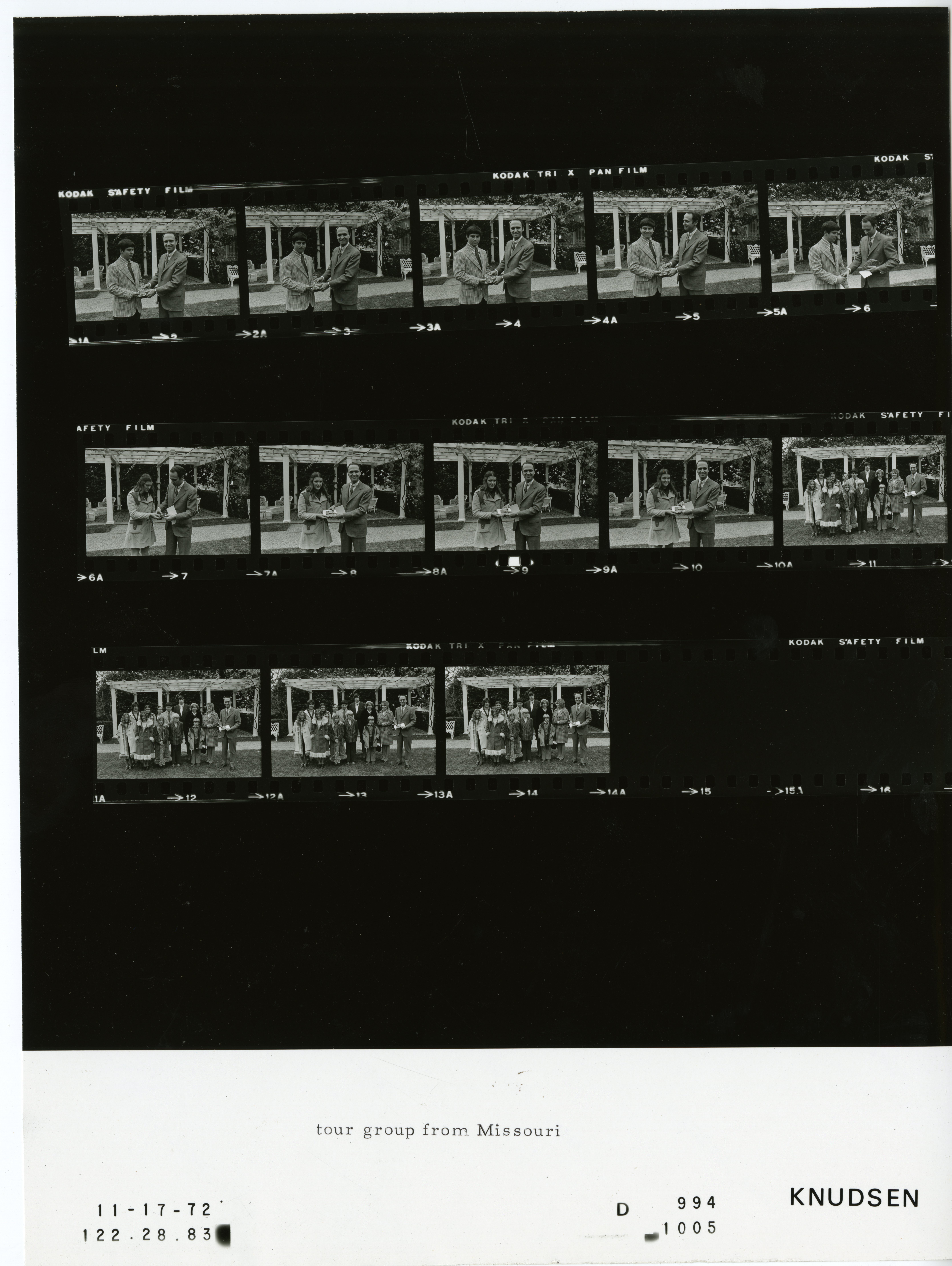
- Frame(s): WHPO-D0994-, Farrell with individuals and a group from Missouri. 11/17/1972, Washington, D.C. Jacqueline Kennedy Garden, White House. Farrell, Missouri group.
Roll WHPO-D0995 Photographer: Atkins, Oliver | Color or B&W: B&W
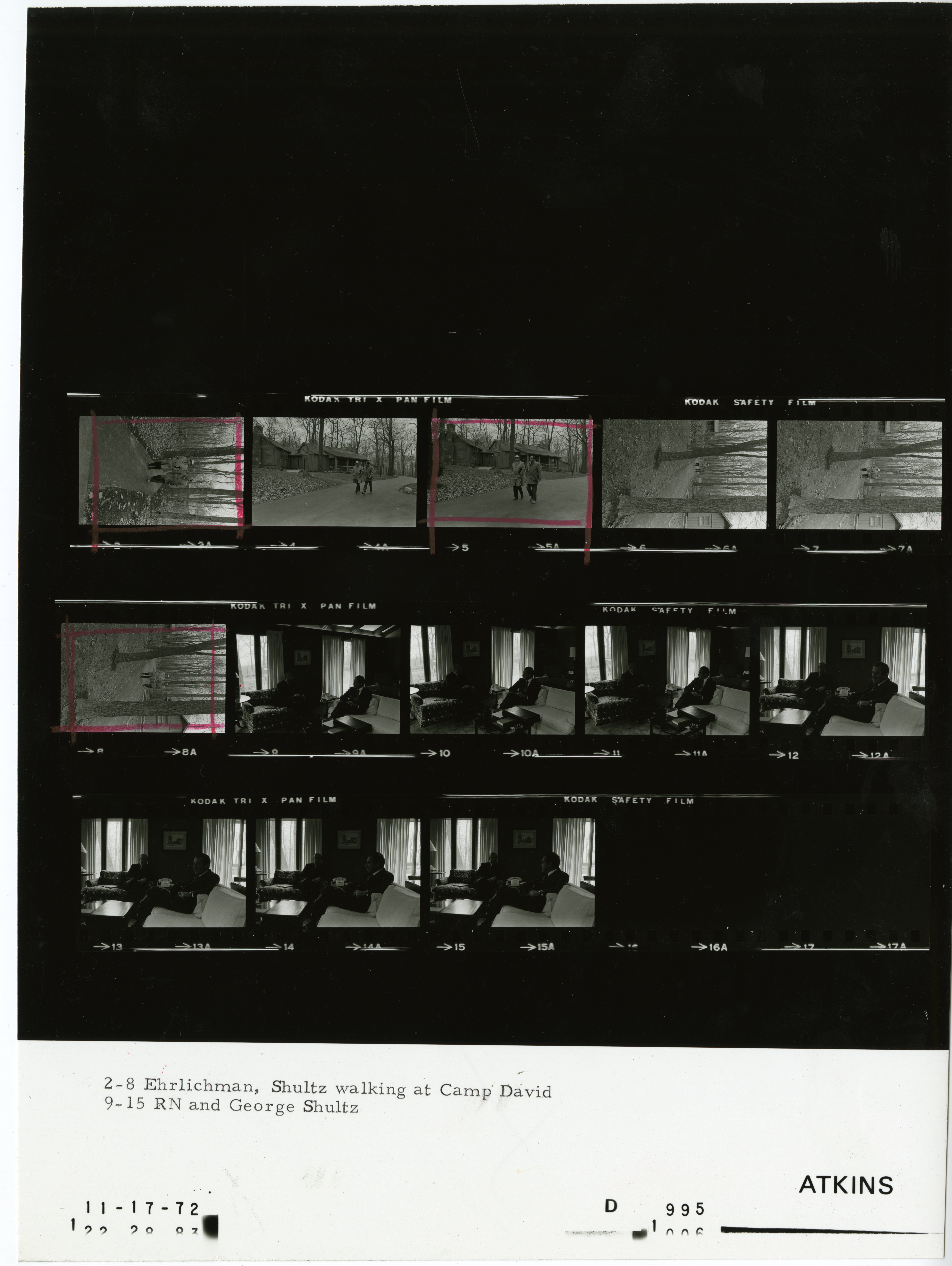
- Frame(s): WHPO-D0995-03-08, Ehrlichman and Shultz walking on the grounds. 11/17/1972, Camp David, Maryland Aspen Lodge, grounds. President Nixon, Ehrlichman, Shultz.
- Frame(s): WHPO-D0995-09-15, Dark shots of President Nixon and Shultz seated together. 11/17/1972, Camp David, Maryland Aspen Lodge, grounds. President Nixon, Ehrlichman, George Shultz.
Roll WHPO-D0996 Photographer: Atkins, Oliver | Color or B&W: B&W
- Frame(s): WHPO-D0996-, Shots of the inside of the press trailer. 11/17/1972, Camp David, Maryland press trailer.
Roll WHPO-D0997 Photographer: Schumacher, Karl | Color or B&W: B&W
- Frame(s): WHPO-D0997-, Head and shoulders candids of Richard Moore. 11/17/1972, Washington, D.C. driveway, North Portico entrance, White House. Richard Moore.
Roll WHPO-D0998 Photographer: Atkins, Oliver | Color or B&W: B&W
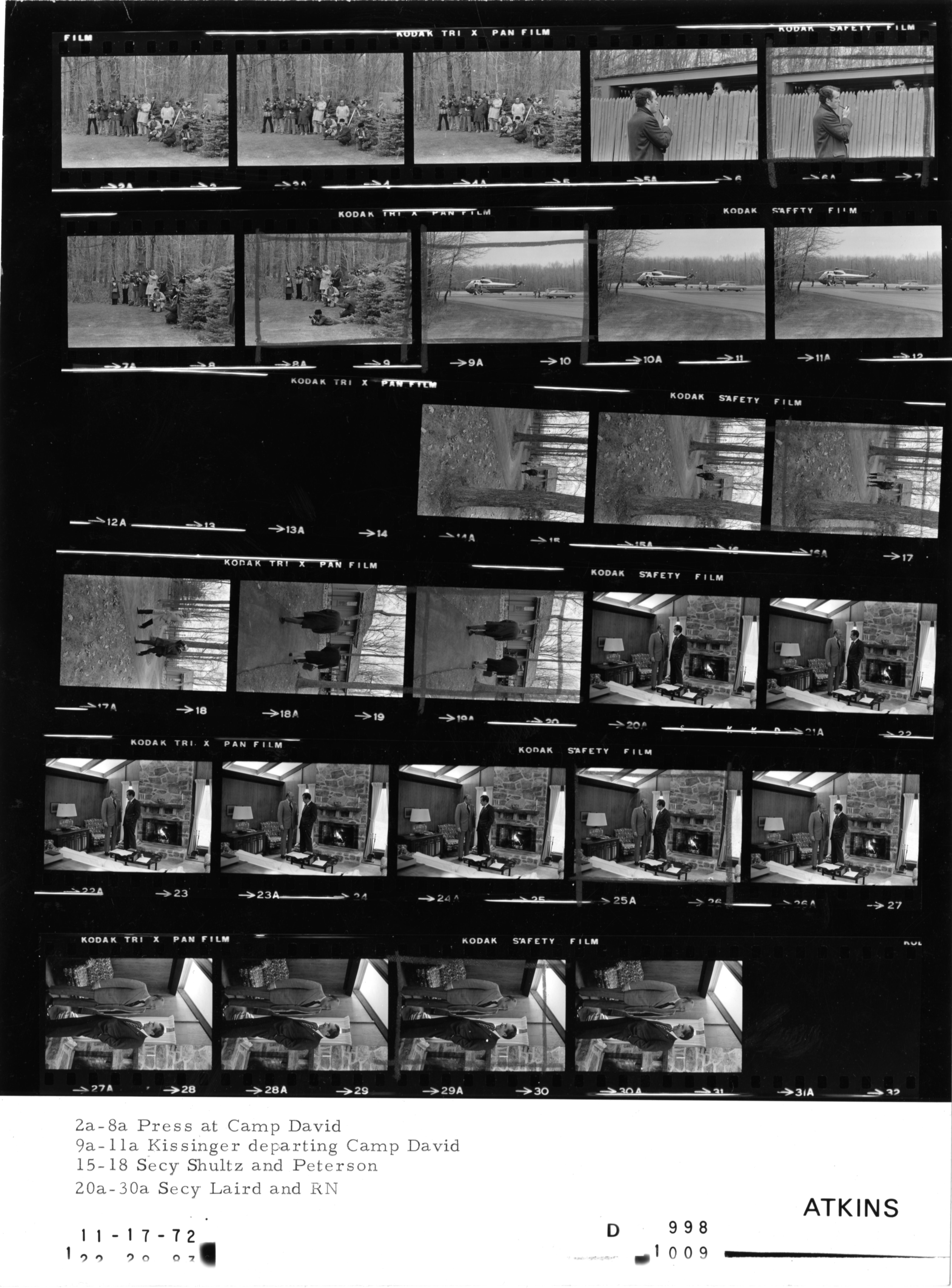
- Frame(s): WHPO-D0998-02A-08A, Group shots of the press corps. 11/17/1972, Camp David, Maryland Aspen Lodge, grounds. press corps photographers and reporters.
- Frame(s): WHPO-D0998-09A-12A, Henry Kissinger departing by helicopter from Camp David. 11/17/1972, Camp David, Maryland Aspen Lodge, grounds. Henry Kissinger.
- Frame(s): WHPO-D0998-11A-19A, George Shultz and Peter Peterson walking on the Camp David grounds. 11/17/1972, Camp David, Maryland Aspen Lodge, grounds. George Shultz, Peter Peterson.
- Frame(s): WHPO-D0998-20A-30A, President Nixon standing in the Aspen Lodge living room area with Melvin Laird. 11/17/1972, Camp David, Maryland Aspen Lodge, living room. President Nixon, Melvin Laird.
- Frame(s): WHPO-D0998-30A, President Nixon standing in the Aspen Lodge living room area with Melvin Laird. 11/17/1972, Camp David, Maryland Aspen Lodge, living room. President Nixon, Melvin Laird.
Roll WHPO-D1000 Photographer: Atkins, Oliver | Color or B&W: Color
- Frame(s): WHPO-D1000-03A-09A, Dinner and birthday party at Camp David's Aspen Lodge, for Charles Bebe Rebozo. 11/17/1972, Camp David, Maryland Aspen Lodge rooms, kitchen. President Nixon, Pat Nixon, Charles Bebe Rebozo, Robert BOB Henry Abplanalp, kitchen staff, staff.
- Frame(s): WHPO-D1000-10A-11A, Unidentified staff having dinner together at Camp David's Aspen Lodge. 11/17/1972, Camp David, Maryland Aspen Lodge rooms, kitchen. President Nixon, Pat Nixon, Charles Bebe Rebozo, Robert BOB Henry Abplanalp, kitchen staff, staff.
The White House Communications Agency Sound Recordings Collection contains public statements that took place between 1969 and 1974. Visit the finding aid to learn more.
L - White House Press Office Briefings
- WHCA-SR-L-062
Press briefing by Ronald Ziegler. (11/17/1972, White House Press Lobby)
Runtime: 61:47:00
Keywords: Press conferences, news conferences, interviews, media, press secretary
Original Format: 1/4-inch reel-to-reel audiotape. Original source type: Original. - WHCA-SR-L-063
Press briefing by Ronald Ziegler and Henry A. Kissinger. (11/17/1972, White House Press Lobby)
Runtime: 3:07
Keywords: Press conferences, news conferences, interviews, media, press secretary
Original Format: 1/4-inch reel-to-reel audiotape. Original source type: Original.
The White House Communications Agency Videotape Collection contains “off-the-air” recordings of televised programs produced between 1968 and 1974. Visit the finding aid to learn more.
- WHCA-5931
Weekly News Summary, Tape I.
ALL NETWORKS
Runtime: 1:30
1. Smith/Gill/Rolfson: Peace talks. Time Code Start: 00:00. Keywords: Paris Peace Talks, Vietnam War, treaty, treaties, negotiations. Network: ABC.
2. Smith/Reynolds: McGovern speaks. Time Code Start: 03:23. Keywords: Presidential elections, campaigns, campaigning, candidates. Network: ABC.
3. Smith: Commentary on West German elections. Time Code Start: 07:02. Keywords: West Germany, West German federal elections, candidates, Chancellors, leaders. Network: ABC.
4. Chancellor/Valeriani/Dobyns: Peace talks. Time Code Start: 08:41. Keywords: Paris Peace Talks, Vietnam War, treaty, treaties, negotiations. Network: NBC.
5. Chancellor/McCormick: Senator Dominick, Republicans didn't receive White House support in elections. Time Code Start: 12:00. Keywords: political parties, Republicans, GOP, elections, campaigns, campaigning. Network: NBC.
6. Mudd/Pierpoint/Kalisher/Kalb: Peace talks (Ziegler). Time Code Start: 13:35. Keywords: Paris Peace Talks, Vietnam War, treaty, treaties, negotiations. Network: CBS.
7. Sevareid: Commentary on CBS strike. Time Code Start: 18:38. Keywords: media, journalists, press services, news reporters, strikes. Network: CBS.
Context (External Sources)
The Vanderbilt Television News Archive is the world's most extensive and complete archive of television news. They have been recording, preserving and providing access to television news broadcasts of the national networks since August 5, 1968.
Wikipedia is a free encyclopedia that anyone can edit.