
Introduction
This almanac page for Thursday, November 16, 1972, pulls together various records created by the federal government and links to additional resources which can provide context about the events of the day.
Previous Date: Wednesday, November 15, 1972
Next Date: Friday, November 17, 1972
Schedule and Public Documents
The Daily Diary files represent a consolidated record of the President's activities. Visit the finding aid to learn more.
The President's day began at Camp David, Maryland
The Weekly Compilation of Presidential Documents made available transcripts of the President's news conferences; messages to Congress; public speeches, remarks, and statements; and other Presidential materials released by the White House.
Digitized versions can be found at HathiTrust.
The Federal Register is the official daily publication for rules, proposed rules, and notices of federal agencies and organizations, as well as executive orders and other Presidential documents.
Archival Holdings
Any selection of archival documents will necessarily be partial. You should use the documents and folders identified below as a starting place, but consult the linked collection finding aids and folder title lists and the collections themselves for context. Many documents to be found this way do not lend themselves to association with specific dates, but are essential to a complete understanding of the material.
Selective document listing
President's Office Files
The President's Office Files consists of materials drawn together by the Special Files Unit from several administrative subdivisions within the White House Office. It is the handwriting and sensitive papers sent to the Staff Secretary that now comprise much of the President's Office Files. Visit the finding aid to learn more.
- News Summaries, Unmarked News Summaries, Box 52, News Summaries - November 1972 [2 of 11] [Note: Due to the way News Summary products were compiled, you should also consult nearby days for potentially relevant materials.]
- News Summary, November 16, 1972, (Wed. nets, wires)
The H. R. Haldeman Diaries consists of seven handwritten diaries, 36 dictated diaries recorded as sound recordings, and two handwritten audio cassette tape subject logs. The diaries and logs reflect H. R. Haldeman’s candid personal record and reflections on events, issues, and people encountered during his service in the Nixon White House. As administrative assistant to the President and Chief of Staff, Haldeman attended and participated in public events and private meetings covering the entire scope of issues in which the Nixon White House engaged in during the years 1969-1973. Visit the finding aid to learn more.
- Transcript of diary entry (PDF)
Thursday, November 16.
The President met with Connally this morning. I flew up with John on the helicopter and did not sit in the meeting, which lasted about two hours. The President had me in afterwards, and gave me quite a detailed report. He says that Connally has concluded that there's no hope for him in the Democratic Party. He feels that if he could get the Democratic nomination, he could run and beat Agnew, as a Democrat, but that he also could run as a Republican and beat Kennedy, and he thinks that it's inevitable that Kennedy would get the nomination. He has in effect, therefore, decided to change parties and become a Republican. The question is a matter of timing, and what he does beyond that. The President discussed the possibilities of an Administration role with him, and the two of them apparently agreed that it would not be wise for Connally to come in now. He doesn't want Secretary of Defense in any event. And feels that he couldn't take State as long as Kissinger is there, and he doesn't want to do that anyway, because he has a lot of opportunity to make money this year and wants to spend his time doing that. Figures he can make $10 to $15 million on some land deals and that sort of thing, and that after that, he can come back into the public sector. The President encouraged him to change parties quickly, which would send up a lot of signals and establish him clearly as a candidate for '76 and get some of the people rolling that might be able to be helpful to him. A highly satisfactory meeting from both viewpoints, at least the President thought so. They talked about the Cabinet changes, reorganization and so on, and apparently it went pretty well, and that Connally thinks we're doing the right thing.
Had a meeting with Rogers this afternoon and got into the preparation of that with me. Wanted me to sit him down first, show him the reorganization plan, greatly underplay the National Security thing, and make the point that we're going forward with reorganization. That this requires massive changes in the Cabinet, and we need your leadership to help move the others. I did this, when Rogers arrived, and it didn't work out very well, in that Rogers obviously was shocked to be told that he was to leave, and he didn't say much more than that to me, except that he felt it was a bad way to handle it. When he got to the President, he made a brief pitch about his concern on the appearance of his being fired, that it creates bad and unnecessary public opinion, made the point that loyalty goes both ways, and people expect the President to be loyal to the people who work so hard for him. He referred to the press reports about needing some reorganization of foreign policy without him there and so on. Said that the President should have consulted him first, and then decided. That led into quite a long discussion of the problems of other Cabinet officers. And as we went down the list, it became clear that there wouldn't be the same kind of problems with most of them. Peterson we’re going to offer the European Community, Volpe Italy, Morton Canada or NATO or even stay in Interior if he wants to. Romney, Laird and Hodgson just move out. Kleindienst, Butz and Shultz will stay. Richardson shifts to Defense, Hodgson maybe we have some possibilities for him. We then discussed the organization of State if Rogers were to stay, and he basically made a pitch to be left on until June 1, so that he can clean up things that he was doing and not look like Kissinger had forced him out. He made the point that there's a lot of Vietnam work to be done, and follow-up after the agreement. And the President was quite impressed by that point, because he agreed that that was a problem. Rogers pitched strongly that it's bad to look as if we've hatched a plot and here it is. And then he proceeded to knife some of the other Departments, said that Justice isn't what it should be, that we should make a change there. That he argued though that we should work out an orderly process of changes over a period of time, and handle each one individually, instead of an overall plan all at once. He agreed that we can get the second levels in place in the State Department. Try for a younger guy on the economic side, like Jim Lind, put Porter in the Alex Johnson job, Sutherland in a good embassy, or in Marshall Green's place as Assistant Secretary. Bring Kubisch into Peterson's place, perhaps Rush as Deputy and Casey as Economic-- although we didn't discuss Casey actually with Bill.
Told me I've got to tell Kissinger --this was after the meeting-- that we're not going to face the Rogers thing yet. That Bill suggested Porter as Under Secretary. Also, then to talk to Connally -- and tell him there's the problem with Vietnam, testimony and so forth, so Rogers is going to stay on a while. We'll start making the changes underneath, but for Connally's own information we have a clear understanding with Bill as to a departure. But we can't lame duck him --
Continued on the next tape.
[End of tape reel AC-26(B)]
[Begin tape reel AC-27(A)]
Continuing November 16. I was covering the point of what the President wanted me to cover with Connally on the Rogers meeting, telling him that for his own information we have a clear understanding that Rogers will be leaving, but we can’t lame duck him now by talking about it, that in the middle of this year this might open up, so this keeps it loose for now. In light of his conversation with the President, he might want to know that, because we may resolve the Kissinger situation by then also. President got into the Rogers thing. This whole thing was a rather disgraceful performance by Rogers who was obviously concerned with his own self-serving problems and pushed pretty hard on that area using the other Cabinet officers problems as way to make his own pitch. Bill recognized this. Bill obviously is totally concerned with the public impression of his own position on this and really nothing else.
The President got into the thank you letter business again today. Apparently dictated off a bunch of them last night and went through the need to get all the details worked out and all kinds of people he wants letters sent to, and so on. He also got into the Colson question again, giving me some more advice on how to talk to Chuck. Said I should make the point that the President's a loyalist and I'm sure this hasn't crossed his mind, but that it just doesn't add up for you to stay in, your position erodes the longer you stay. Now is the time to leave, when others are. The others don't have a new role, you do. You can do all the stuff from the outside, and we won't replace you inside. There never will be a better time than now. There’ll only be a worse time to leave. The press will be more cautious in riding you when you're out and this gives you the opportunity to file a libel suit if you want to. You would never forgive yourself if later on you became an issue. So you should get it all set up now and leave on January 20.
The President got into some points on Cabinet things, again in a meeting with Ehrlichman and me. Feels we do have to dump Flanigan. That on Klein, I've got to tell him we are going to have a total reorganization, the situation's changed, it's not a healthy relation between Communications and the Press Office, so Communications will be under the Press Secretary. We should offer him Director of Communications of the RNC or Mexico. He wants to consider Leonard Wrench for the USIA; Connally apparently recommended him. He wants more Southerners in. He wants to offer Rog Morton Canada, NATO or Australia. Wants to see if Bob Hill wants to come back in, says Lodge has to go now. Wants to meet with Nelson Rockefeller next week.
He says that Paul Nietze has come to him before he leaves for the SALT meetings, says that he’s been interviewing someone at Brookings who’s told him he was writing a book on SALT. Nietze saw part of the manuscript and it has a lot of quotes from the Nissims and actual negotiation transcripts and apparently Kissinger has some hand in this because he has a veto on the book. Nietze feels that publication of this book in April when it’s planned would be disastrous especially regarding the Russians. That it would be extremely serious and damaging.
On Kleindienst, he says the bastards in the White House set up the Evan and Novak stories saying he thought Kleindienst should be removed. That actually he wants him kept; that Eastland and Hruska say we can't pull out the rug, for the next three to five months, with all the things that are going to be coming up, it would be asinine to send a new AG up for confirmation. We should wait four or five or six months and then when the situation is cleaned up put a new man in. He said Laird called, pushing Rush. That Dole called and is worried about appointing an Executive Committee and a Reform Commission for the National Committee. And Mitchell got into some discussion of candidates for the National Chairmanship.
A session tonight with Ash and Malek going over names, didn't make very much progress. Tried to cover the remaining Cabinet posts, and some Under Secretaries, Agency heads, etcetera. It's a long hard process trying to plow through all the names, although Malek has got some very good lists.
End of November 16. - Original audio recording (MP3)
The National Archives Catalog is the online portal to the records held at the National Archives, and information about those records. It is the main way of describing our holdings and also provides access to electronic records and digitized versions of our holdings.
The Catalog searches across multiple National Archives resources at once, including archival descriptions, digitized and electronic records, authority records, and web pages from Archives.gov and the Presidential Libraries. The Catalog also allows users to contribute to digitized historical records through tagging and transcription.
Nixon Library Holdings
All National Archives Units
National Security Documents
The President's Daily Brief is the primary vehicle for summarizing the day-to-day sensitive intelligence and analysis, as well as late-breaking reports, for the White House on current and future national security issues. Read "The President's Daily Brief: Delivering Intelligence to Nixon and Ford" to learn more.
The Foreign Relations of the United States series presents the official documentary historical record of major U.S. foreign policy decisions and significant diplomatic activity. Visit the State Department website for more information.
Vol. V, United Nations, 1969-1972
UN Finances and Reduction of the U.S. Assessment
197. Telegram From the Mission to the United Nations to the Department of State, New York, November 16, 1972, 0100Z
Source: National Archives, RG 59, Central Files 1970–73, UN 10–4. Confidential; Priority; Limdis.
198. Telegram From the Mission to the United Nations to the Department of State, New York, November 16, 1972, 1405Z
Source: National Archives, RG 59, Central Files 1970–73, UN 10–4. Confidential; Priority; Limdis.
Vol. XVII, China, 1969-1972
China, March-December 1972
266. Special National Intelligence Estimate, Washington, November 16, 1972
Source: National Archives, Nixon Presidential Materials, NSC Files, Subject Files, Box 361, National Intelligence Estimates, part 4. Secret; Sensitive. Representatives of the CIA, the Departments of Defense, State, and Treasury, AEC, and NSA participated in the preparation of this estimate. The representative of the FBI abstained, as the subject was outside his jurisdiction.
267. Joint State–Defense Department Memorandum for President Nixon, Washington, November 16, 1972
[Source: Washington National Records Center, RG 330, OSD Files: FRC 330 77 0095, China (Nats), 471.61, 1972. Top Secret. 8 pages of source text not declassified.]
Vol. E-1, Documents on Global Issues, 1969-1972
U.S.-Cuba Hijacking Agreement, 1969-February 1973
135. Memorandum of Conversation between Secretary Rogers and Swiss Ambassador Schnyder, Washington, November 16, 1972
Rogers asked Schnyder to forward a message on completing a U.S.-Cuban hijacking agreement to Swiss Ambassador Masnata in Havana. Rogers emphasized that general U.S. policy toward Cuba would remain unchanged.
Source: National Archives, RG 59, Central Files 1970-73, AV 12. Confidential; Exdis. Drafted by Hurwitch and approved in S on November 17. Rogers informed the President of his conversation with Schnyder that evening. (Ibid., President’s Evening Reading: Lot 74 D 164)
The Kissinger telephone conversation transcripts consist of approximately 20,000 pages of transcripts of Kissinger’s telephone conversations during his tenure as Assistant to the President for National Security Affairs (1969-1974) and Secretary of State (1973-1974) during the administration of President Richard Nixon. Visit the finding aid for more information.
Digitized versions can be found in the National Archives Catalog.
Audiovisual Holdings
Visit the White House Tapes finding aid to learn about the taping system's operation and archival processing.
Camp David Hard Wire
- 225-24; Unknown between 8:30 a.m. & 8:43 a.m.; Nixon, Richard M. (President); Sanchez, Manolo
- 225-25; Unknown between 8:30 a.m. & 8:43 a.m.; Nixon, Richard M. (President); Camp David Operator
- 225-26; Unknown between 8:30 a.m. & 8:43 a.m.; Nixon, Richard M. (President)
- 225-27; 8:43 a.m. - 8:51 a.m.; Nixon, Richard M. (President); Nixon, Thelma C. ("Pat") (Ryan)
- 225-28; Unknown between 8:51 a.m. & 1:35 p.m.; Nixon, Richard M. (President); Magner, John G.
- 225-29; Unknown between 8:51 a.m. & 1:35 p.m.; Nixon, Richard M. (President)
- 225-30; Unknown between 8:51 a.m. & 1:35 p.m.; Nixon, Richard M. (President); Sanchez, Manolo
- 225-31; Unknown between 8:51 a.m. & 1:35 p.m.; Nixon, Richard M. (President); Sanchez, Manolo
- 225-32; Unknown between 8:51 a.m. & 1:35 p.m.; Nixon, Richard M. (President); Camp David Operator
- 225-33; 1:35 p.m. - 1:35 p.m.; Nixon, Richard M. (President); Camp David Operator
- 225-34; 1:36 p.m. - 1:36 p.m.; Nixon, Richard M. (President); Camp David Operator
- 225-35; 1:51 p.m. - 1:57 p.m.; Nixon, Richard M. (President); Eisenhower, Julie Nixon
- 225-36; 2:08 p.m. - 2:09 p.m.; Nixon, Richard M. (President); Haldeman, H. R. ("Bob")
- 225-37; Unknown between 2:09 p.m. & 2:18 p.m.; Nixon, Richard M. (President); Magner, John G.
- 225-38; 2:18 p.m. - 2:23 p.m.; Nixon, Richard M. (President); Chandler, Norman
- 225-39; Unknown between 2:23 p.m. & 3:45 p.m.; Nixon, Richard M. (President); Haldeman, H. R. ("Bob"); Ehrlichman, John D.
- 225-40; Unknown between 3:45 p.m. & 5:42 p.m.; Nixon, Richard M. (President); Sanchez, Manolo
- 225-41; Unknown between 1:36 p.m. & 1:51 p.m.; Nixon, Richard M. (President); [Unknown person(s)]
- 226-1; 5:42 p.m. - 6:05 p.m.; Nixon, Richard M. (President); Haldeman, H. R. ("Bob")
- 226-2; Unknown between 6:05 p.m., 11/16 & 12:40 p.m., 9/24; Nixon, Richard M. (President)
- 226-3; Unknown between 6:05 p.m., 11/16 & 12:40 p.m., 9/24; Nixon, Richard M. (President)
Camp David Study Table
- 153-29; Unknown between 8:30 a.m. & 8:43 a.m.; Nixon, Richard M. (President); Camp David Operator
- 153-30; 8:43 a.m. - 8:51 a.m.; Nixon, Richard M. (President); Nixon, Thelma C. ("Pat") (Ryan)
- 153-31; Unknown between 12:30 p.m. & 1:35 p.m.; Nixon, Richard M. (President); Camp David Operator
- 153-32; 1:35 p.m. - 1:35 p.m.; Nixon, Richard M. (President); Camp David Operator
- 153-33; 1:36 p.m. - 1:36 p.m.; Nixon, Richard M. (President); Camp David Operator
- 153-34; 1:51 p.m. - 1:57 p.m.; Nixon, Richard M. (President); Eisenhower, Julie Nixon
- 153-35; Unknown between 1:57 p.m. & 2:08 p.m.; Nixon, Richard M. (President); Camp David Operator
- 153-36; 2:08 p.m. - 2:09 p.m.; Nixon, Richard M. (President); Haldeman, H. R. ("Bob")
- 153-37; 2:18 p.m. - 2:23 p.m.; Nixon, Richard M. (President); Chandler, Norman
The White House Photo Office collection consists of photographic coverage of President Richard Nixon meeting with prominent social, political, and cultural personalities; speaking engagements and news conferences of the President and various high-ranking members of the White House staff and Cabinet; Presidential domestic and foreign travel, including Presidential vacations; social events and entertainment involving the First Family, including entertainers present; official portraits of the President, First Family, and high-ranking members of the Nixon administration; the 1969 and 1973 Inaugurals; the President’s 1972 Presidential election campaign appearances (including speeches) and other official activities of the White House staff and the President’s Cabinet from January 20, 1969 until August 9, 1974 at the White House and the Old Executive Office Building; other locations in Washington, DC, such as The Mall; and the Presidential retreats in Camp David, Maryland, Key Biscayne, Florida, and San Clemente, California. Visit the finding aid to learn more.
Roll WHPO-D0992 Photographer: Atkins, Oliver | Color or B&W: B&W
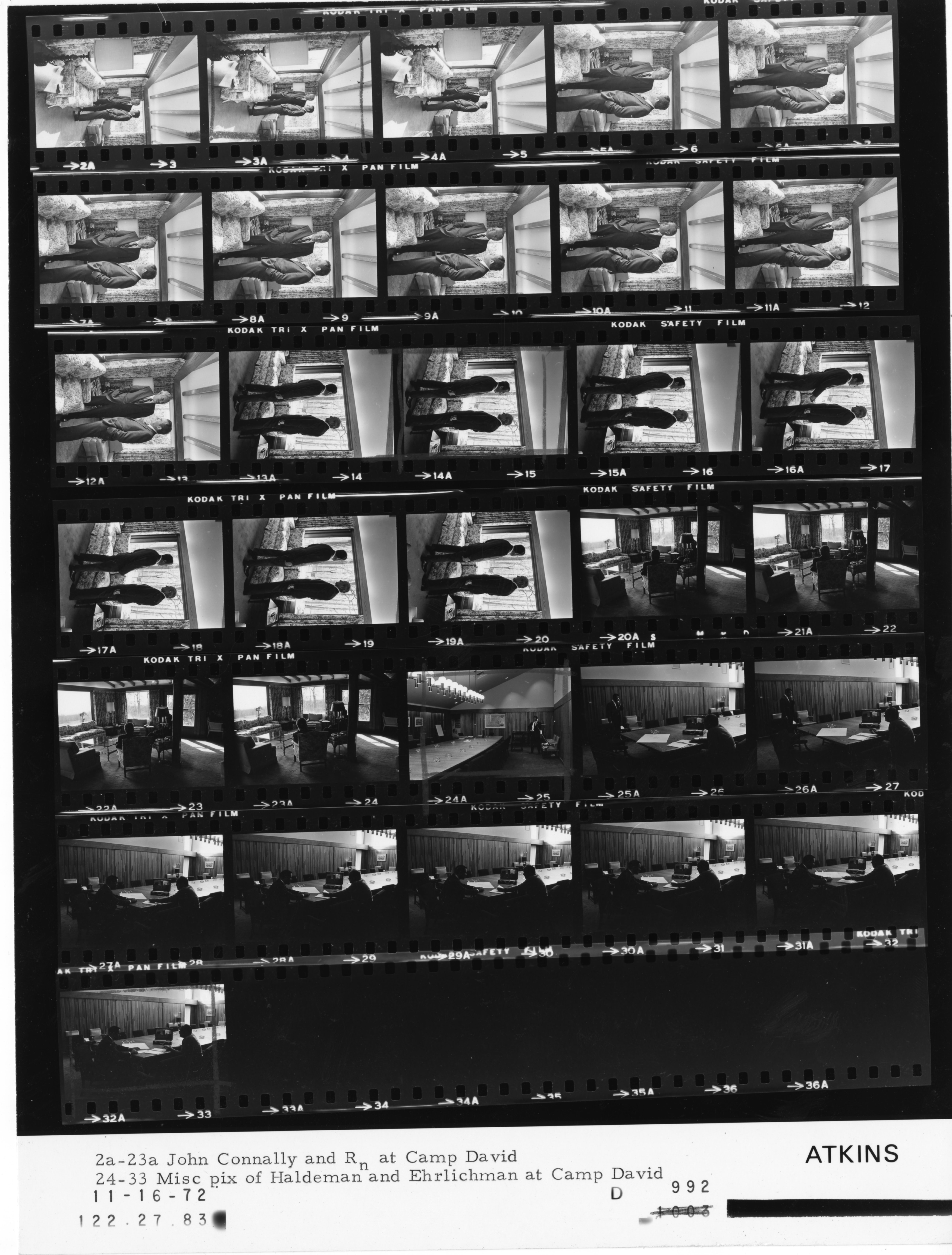
- Frame(s): WHPO-D0992-02A-23A, President Nixon standing and seated with Connally. 11/16/1972, Camp David, Maryland Aspen Lodge; unidentified room. President Nixon, John Connally, Haldeman, Ehrlichman.
- Frame(s): WHPO-D0992-03A, President Nixon standing and talking with John Connally. 11/16/1972, Camp David, Maryland Aspen Lodge; sun room. President Nixon, John Connally.
- Frame(s): WHPO-D0992-16A, President Nixon standing and talking with John Connally in front of a large window. 11/16/1972, Camp David, Maryland Aspen Lodge; sun room. President Nixon, John Connally.
- Frame(s): WHPO-D0992-24A-32A, Haldeman and Ehrlichman at a conference table. 11/16/1972, Camp David, Maryland Aspen Lodge; unidentified room. Haldeman, Ehrlichman.
The White House Communications Agency Sound Recordings Collection contains public statements that took place between 1969 and 1974. Visit the finding aid to learn more.
L - White House Press Office Briefings
- WHCA-SR-L-060
Press briefing by Ronald Ziegler. (11/16/1972, White House Press Lobby)
Runtime: 25:05:00
Keywords: Press conferences, news conferences, interviews, media, press secretary
Original Format: 1/4-inch reel-to-reel audiotape. Original source type: Original. - WHCA-SR-L-061
Press briefing by Ronald Ziegler. (11/16/1972, White House Press Lobby)
Runtime: 8:00
Keywords: Press conferences, news conferences, interviews, media, press secretary
Original Format: 1/4-inch reel-to-reel audiotape. Original source type: Original.
The White House Communications Agency Videotape Collection contains “off-the-air” recordings of televised programs produced between 1968 and 1974. Visit the finding aid to learn more.
- WHCA-5928
Weekly News Summary, Tape II.
ALL NETWORKS
Runtime: 01:39:00
13. Smith/Jarriel/Reasoner/Giggans: Peace talks; Vietnam. Time Code Start: 29:52. Keywords: Paris Peace Talks, Vietnam War, treaty, treaties, negotiations. Network: ABC.
14. Reasoner: Restoration of relations with Cuba through negotiating anti-hijacking agreement. Time Code Start: 34:45. Keywords: Cuban, diplomacy, negotiations, agreements, crime prevention, hijackings, skyjackings, kidnappings, terrorism, aircraft. Network: ABC.
15. Chancellor: Hesberg asked to resign by White House. Time Code Start: 36:35. Keywords: Presidents, cabinet, officials, resignations. Network: NBC.
16. Chancellor/Dobyns/Lord: Peace talks; Vietnam. Time Code Start: 37:12. Keywords: Paris Peace Talks, Vietnam War, treaty, treaties, negotiations. Network: NBC.
17. Chancellor/Rosenfeld: Hijacking; Cuba relations. Time Code Start: 43:25. Keywords: hijackings, skyjackings, kidnappings, terrorism, aircraft, airlines. Network: NBC.
18. Chancellor: Commentary on Cuba relations. Time Code Start: 45:32. Keywords: Cuban, diplomacy, politics. Network: NBC.
19. Mudd/Kalb: Cuba relations on hijacking. Time Code Start: 46:38. Keywords: hijackings, skyjackings, kidnappings, terrorism, aircraft, airlines. Network: CBS.
20. Mudd/Wagner: Peace talks; Vietnam. Time Code Start: 48:40. Keywords: Paris Peace Talks, Vietnam War, treaty, treaties, negotiations. Network: CBS.
21. Mudd/Schorr: head of Democratic National Committee Jean Westwood fights for her job. Time Code Start: 55:06. Keywords: leaders, women, political parties, Demomcrats. Network: CBS.
Context (External Sources)
The Vanderbilt Television News Archive is the world's most extensive and complete archive of television news. They have been recording, preserving and providing access to television news broadcasts of the national networks since August 5, 1968.
Wikipedia is a free encyclopedia that anyone can edit.