
Introduction
This almanac page for Wednesday, March 7, 1973, pulls together various records created by the federal government and links to additional resources which can provide context about the events of the day.
Previous Date: Tuesday, March 6, 1973
Next Date: Thursday, March 8, 1973
Schedule and Public Documents
The Daily Diary files represent a consolidated record of the President's activities. Visit the finding aid to learn more.
The President's day began at The White House - Washington, D. C.
The Weekly Compilation of Presidential Documents made available transcripts of the President's news conferences; messages to Congress; public speeches, remarks, and statements; and other Presidential materials released by the White House.
Digitized versions can be found at HathiTrust.
Each Public Papers of the Presidents volume contains the papers and speeches of the President of the United States that were issued by the White House Office of the Press Secretary during the time period specified by the volume. The material is presented in chronological order, and the dates shown in the headings are the dates of the documents or events. In instances when the release date differs from the date of the document itself, that fact is shown in the text note.
To ensure accuracy, remarks have been checked against audio recordings (when available) and signed documents have been checked against the original, unless otherwise noted. Editors have provided text notes and cross references for purposes of identification or clarity.
The Federal Register is the official daily publication for rules, proposed rules, and notices of federal agencies and organizations, as well as executive orders and other Presidential documents.
The Congressional Record is the official daily record of the debates and proceedings of the U.S. Congress.
Archival Holdings
Any selection of archival documents will necessarily be partial. You should use the documents and folders identified below as a starting place, but consult the linked collection finding aids and folder title lists and the collections themselves for context. Many documents to be found this way do not lend themselves to association with specific dates, but are essential to a complete understanding of the material.
Selective document listing
President's Office Files
The President's Office Files consists of materials drawn together by the Special Files Unit from several administrative subdivisions within the White House Office. It is the handwriting and sensitive papers sent to the Staff Secretary that now comprise much of the President's Office Files. Visit the finding aid to learn more.
- News Summaries, Annotated News Summaries, Box 44, March 1-7, 1973 [5 of 5] [Note: Due to the way News Summary products were compiled, you should also consult nearby days for potentially relevant materials.]
- News Summary, March 7, 1973, (Tuesday nets, wires)
- Digest of Recent News Comment, March 7, 1973
President's Personal File
The President's Personal File is essentially a President's secretary's file, kept by Rose Mary Woods, personal secretary to the President, for two purposes: (1) preserving for posterity a collection of documents particularly close to the President, whether because he dictated or annotated them, or because of the importance of the correspondent or the event concerned and (2) giving appropriate attention–letters of gratitude, invitations to White House social events, and the like–to members and important friends and supporters of the Nixon administration. This generalization does not describe all the varied materials of a file group which is essentially a miscellany, but it does identify the reason for the existence of the file group's core. Visit the finding aid to learn more.
- President's Speech File
The H. R. Haldeman Diaries consists of seven handwritten diaries, 36 dictated diaries recorded as sound recordings, and two handwritten audio cassette tape subject logs. The diaries and logs reflect H. R. Haldeman’s candid personal record and reflections on events, issues, and people encountered during his service in the Nixon White House. As administrative assistant to the President and Chief of Staff, Haldeman attended and participated in public events and private meetings covering the entire scope of issues in which the Nixon White House engaged in during the years 1969-1973. Visit the finding aid to learn more.
- Transcript of diary entry (PDF)
Wednesday, March 7.
The President had me in early this morning for quite a long while. Reviewed the stag dinner deal last night is concerned about some way of identifying people when they're introduced. Stans apparently did a good job which pointed out the need to do this at other parties, which we don't get done. I suggested the idea of giving people identification cards to hand to the introducing aides, which he thinks is a great idea, so we're going to try that. He was disturbed that we have the Navy singers for tonight, they had the Army last night, and he thinks that they are much better. It turned out later that Steve had changed this, and we do have the Army tonight, too. The President talked with Rollins and told him to work Harry Dent on developing candidates. Was concerned about whether General Wheeler got a thank you on Vietnam. Talked to Packard on California, and Packard thinks Finch should go for the Senate and raised this with him. Doesn’t want Baroody to push Connally, or have Packard do so, and have him head up this committee job, and that led to the question about Laird. He came up with the idea of making Laird counselor to the President. He feels that we need people who can work the Hill, and we need advice inside on how to do it and thought Laird was around town, we ought to get him to do it. Later today, when we were talking he said that he had thought about that some more and thinks the idea of Laird as counselor is a bad idea. But we could make him consultant to the President to advise on strategy, sit in on all meetings and so on, while he's around Washington. Then spend time on the Hill, direct the battle, and so on. He told me to check Harlow first, and then see if we could work it out with Laird.
He decided not to send the Denton letter until we get all the POW's out. Feels we've got to push for a role call amnesty vote. Should start building the social issue. Wants me to call Roger Stevens, making the point that the President noted what he's doing at the Kennedy Center, and here's one vote for Roger Stevens in terms of having clean plays and so on. Referred to one of the lines he developed for his State Department appearance yesterday, about he who compromises with terrorists today will be terrorized by the terrorists tomorrow, which he thought was a good line and had bite, and wants Rogers to look for that kind of thing. On IRS, he wants the Senate-- or some Senator or Congressman to ask for a full field IRS check on all members of the House and Senate, plus White House staff and Cabinet on a yearly basis.
He got into-- he said this morning he wanted to have a schedule review this afternoon on plans for going out to the country and meeting with the Congress and so on. Sort out everything, find different ways to get across our message, and determine what our purpose is in going to the country, what does it do? Change the polls? Get mail to the Congress? Or what? And told me to be ready for a meeting on that this afternoon. He wants Ehrlichman to put special attention on developing a good agenda for the Leaders meeting, thinks that's a better use of his time, for the big bullet, than the things he's doing.
Called Timmons in today and raised the question of whether he ought to see the freshmen group in Congress that were fighting for him today. Agreed to do so. He's going to see them at 5:00 tomorrow and shifted McClellan to a breakfast tomorrow morning. Said again that the road show idea doesn't appeal to him, and wants some new recommendations.
This afternoon he had me go over the schedule meeting, but got into some other things first. Wanted me to give Manalo and Fina a modest raise in pay and also said that Rose had mentioned to Bebe that she hadn't had a pay raise in all the time that she had been here. He thought that giving her a pay raise would help the morale thing there. I recommended against it but said that I would be glad to do it. He wanted me to call Risner and Denton, the two POW leaders, and get a reading from them on when the President should have a POW event, and also tell them that the President would like to chat with them off the record some time when they can be in Washington. He commented that the VFW award kids who came in just looked terrible. He thought that they were probably bare-footed, were wearing jeans and awful-looking clothes, and he doesn't think we should allow that. On the stag dinners, he thinks they’re good do for pro groups and that we should do more of them, because they're much easier for him then a mixed dinner.
Getting into the schedule he wants to have a formal arrival ceremony for Thieu at El Toro, and then have him stay at San Clemente, no ceremonies at the compound. He said to schedule this Friday until 4:30. And then he'll go to Camp David and he can see someone up there on Saturday morning. And he has to come back down Sunday morning for the church service. Wanted Rogers added to the Cabinet agenda to cover aid to Vietnam. Then we talked some about the Kennedy's 13 Great Mistakes book, wants me to find Malcolm Smith, find out what he really did and what happened on the book. We covered a number of the other schedule items and philosophy, then he had to leave to get ready for the dinner.
The dinner tonight, which I attended, went very well. The President gave a good wrap-up talk on the overall world situation and ended by reading the Denton letter, which, of course, overwhelmed everybody. He had done the same thing last night. The evening was extremely effective and very impressive to those who were there.
End of March 7. - Original audio recording (MP3)
The National Archives Catalog is the online portal to the records held at the National Archives, and information about those records. It is the main way of describing our holdings and also provides access to electronic records and digitized versions of our holdings.
The Catalog searches across multiple National Archives resources at once, including archival descriptions, digitized and electronic records, authority records, and web pages from Archives.gov and the Presidential Libraries. The Catalog also allows users to contribute to digitized historical records through tagging and transcription.
Nixon Library Holdings
All National Archives Units
National Security Documents
The President's Daily Brief is the primary vehicle for summarizing the day-to-day sensitive intelligence and analysis, as well as late-breaking reports, for the White House on current and future national security issues. Read "The President's Daily Brief: Delivering Intelligence to Nixon and Ford" to learn more.
The Foreign Relations of the United States series presents the official documentary historical record of major U.S. foreign policy decisions and significant diplomatic activity. Visit the State Department website for more information.
Vol. X, Vietnam, January 1973-July 1975
Neither War nor Peace, January 27-June 15, 1973
26. Memorandum From John Holdridge and Richard Kennedy of the National Security Council Staff to the President’s Assistant for National Security Affairs (Kissinger), Washington, March 7, 1973
Source: National Security Council, Nixon Administration Intelligence Files, Subject Files, Box I–010, Vietnam, January–October 1973. Secret; Sensitive; Exclusively Eyes Only; Outside the System. Sent for action.
27. Transcript of Telephone Conversation Between President Nixon and the President’s Assistant for National Security Affairs (Kissinger), Washington, March 7, 1973, 12:37 p.m.
Source: National Archives, Nixon Presidential Materials, Henry A. Kissinger Telephone Conversation Transcripts, Box 19, Chronological File. No classification marking.
Vol. XXI, Chile, 1969-1973
"That Chilean Guy May Have Some Problems": The Downfall of Salvador Allende, January-September 1973
321. Memorandum From the Executive Secretary of the Department of State (Eliot) to the President’s Assistant for National Security Affairs (Kissinger), Washington, March 7, 1973
Source: National Archives, Nixon Presidential Materials, NSC Files, Box 777, Country Files, Latin America, Chile, Vol. VIII. Confidential.
Vol. XXXI, Foreign Economic Policy, 1973-1976
The End of Fixed Exchange Rates, January-March 1973
26. Conversation Among President Nixon, the President’s Assistant for National Security Affairs (Kissinger), and Secretary of the Treasury Shultz, Washington, March 7, 1973
Source: National Archives, Nixon Presidential Materials, White House Tapes, Oval Office, Conversation 871–5. No classification marking. According to the President’s Daily Diary, Nixon met with Kissinger and Shultz from 10:54 to 11:41 a.m. (Ibid., White House Central Files) The editor transcribed the portion of the conversation printed here specifically for this volume.
27. Transcript of a Telephone Conversation Between West German Minister of Finance Schmidt and the President’s Assistant for National Security Affairs (Kissinger), March 7, 1973, 1:41 p.m.
Source: National Archives, Nixon Presidential Materials, Kissinger Telephone Conversations, Box 19. No classification marking. Kissinger was in Washington; Schmidt was in Germany.
28. Memorandum From the Under Secretary of State for Economic Affairs (Casey) to Secretary of the Treasury Shultz, Washington, March 7, 1973
Source: National Archives, RG 56, Records of Secretary of the Treasury George P. Shultz, 1971–1974, Entry 166, Box 5, GPS State Department 1972/1974. No classification marking.
29. Memorandum From the Chairman of the Council of Economic Advisers (Stein) to Secretary of the Treasury Shultz, Washington, March 7, 1973
Source: National Archives, RG 56, Records of Secretary of the Treasury George P. Shultz, 1971–1974, Entry 166, Box 3, Council of Economic Advisers 1973. No classification marking.
Vol. E-8, Documents on South Asia, 1973-1976
India-Pakistan 1
111. Memorandum From the President’s Assistant for National Security Affairs (Kissinger) to President Nixon, Washington, March 7, 1973
President Nixon approved a reversion to the 1967–1971 policy for South Asia that would authorize sales of non-lethal military aid to Pakistan and would provide the Pakistanis with armored personnel carriers sold under the 1970 “one-time exception.” Nixon also conditionally authorized the release of suspended pre-1971 loans to India.
Source: Library of Congress, Manuscript Division, Kissinger Papers, Box CL 202, Geopolitical File, Pakistan, Chronological File, 13 September 1971–7 March 1973. Secret. Sent for action. Nixon approved the recommendations. A copy without Nixon’s signature’s approvals is in the National Archives, Nixon Presidential Materials, NSC Files, Box 628, Pakistan, Vol. X, Sept. 72–Oct. 73, Country Files, Middle East.112. Memorandum From the President’s Assistant for National Security Affairs (Kissinger) to President Nixon, Washington, March 7, 1973
President’s Assistant for National Security Affairs Kissinger advised President Nixon of Prime Minister Bhutto’s recently stated claims of Soviet-Indian alignment against Pakistan and presented a letter of reply for Nixon’s signature.
Source: Library of Congress, Manuscript Division, Kissinger Papers, Box CL 202, Geopolitical File, Pakistan, Chronological File, 13 September 1971–7 March 1973. Secret. Sent for action. Attached but not printed is a signed copy of Nixon’s March 8 letter to Bhutto. (Ibid.)
Vol. E-11, Part 1, Documents on Mexico; Central America; and the Caribbean, 1973-1976
American Republics Regional
1. National Security Study Memorandum 173, Washington, March 7, 1973
Summary: Kissinger instructed the CIA, the Treasury, and the Departments of State and Defense to carry out a review of U.S. policies and programs in Latin America.
Source: National Archives, Nixon Presidential Materials, NSC Institutional Files, Box H–197, Study Memorandums, NSSM 173. Secret; Limdis. Copies were also sent to the Chairman of the JCS, and the Assistant to the President for International Economic Affairs. The study prepared in response to this memorandum is published as Document 5. The August 30, 1969, Rockefeller Report on Quality of Life in the Americas is printed in the Department of State Bulletin, December 8, 1969, pp. 495–540. Nixon’s October 31, 1969, address outlining a policy of “mature partnership” with Latin America, is ibid., November 17, 1969, pp. 409–414. NSSM 15, February 3, 1969, is published in Foreign Relations, 1969–1976, vol. E–10, Documents on American Republics, 1969–1972, Document 1. NSSM 108, December 10, 1970, is in the National Archives, Nixon Presidential Materials, NSC Institutional Files, Box H–178, Study Memorandums, NSSM 108.Summary: Kissinger instructed the CIA, the Treasury, and the Departments of State and Defense to carry out a review of U.S. policies and programs in Latin America.
Source: National Archives, Nixon Presidential Materials, NSC Institutional Files, Box H–197, Study Memorandums, NSSM 173. Secret; Limdis. Copies were also sent to the Chairman of the JCS, and the Assistant to the President for International Economic Affairs. The study prepared in response to this memorandum is published as Document 5. The August 30, 1969, Rockefeller Report on Quality of Life in the Americas is printed in the Department of State Bulletin, December 8, 1969, pp. 495–540. Nixon’s October 31, 1969, address outlining a policy of “mature partnership” with Latin America, is ibid., November 17, 1969, pp. 409–414. NSSM 15, February 3, 1969, is published in Foreign Relations, 1969–1976, vol. E–10, Documents on American Republics, 1969–1972, Document 1. NSSM 108, December 10, 1970, is in the National Archives, Nixon Presidential Materials, NSC Institutional Files, Box H–178, Study Memorandums, NSSM 108.
Vol. E-12, Documents on East and Southeast Asia, 1973-1976
Japan
169. National Security Study Memorandum 172, Washington, March 7, 1973., Washington, March 7, 1973
Kissinger instructed the Departments of State, Defense, Treasury, Commerce, and the CIA to review U.S. policy toward Japan.
Source: National Archives, Nixon Presidential Materials, NSC Institutional Files (H-Files), Box H–197, NSSM Files, NSSM 172 (2 of 3). Secret. Copies were sent to the Chairman of the Joint Chiefs of Staff and the Assistant to the President for International Economic Affairs. NSSM 122, on policy toward Japan, is scheduled to be published in Foreign Relations, 1969–1976, Volume XIX, Part II, Japan, 1969–1972.
Thailand and Burma
364. Memorandum From Richard T. Kennedy of the National Security Council Staff to the President’s Assistant for National Security Affairs (Kissinger), Washington, March 7, 1973., Washington, March 7, 1973
Kennedy recommended that Kissinger tell Clements to prepare additional military assistance for Thailand.
Source: National Archives, Nixon Presidential Materials, NSC Files, Box 565, Country Files, Far East, Thailand, Volume 10, 1973–. Secret. Sent for urgent action. Kissinger initialed the “approve” option, and a notation from Scowcroft indicates that Kissinger followed up by calling Clements. A notation on the first page indicates that Tab B, attached, the proposed telegram to Unger, was given to the situation room for dispatch on March 9. Tab A, a telephone conversation between Kissinger and Clements from March 5, is attached but not published. Tab C, telegram 3675 from Bangkok, March 7, is attached but not published. On March 16, Kissinger asked Richardson to make twelve 105 mm howitzers available for Thailand in addition to the eight C–123 aircraft. (Memorandum from Kissinger to Secretary of Defense; ibid.)
Vol. E-15, Part 1, Documents on Eastern Europe, 1973-1976
East Europe Regional
3. Minutes of Senior Review Group Meeting, Washington, March 7, 1973, 3:13-3:44 p.m., Washington, March 7, 1973, 3:13-3:44 p.m.
The Senior Review Group considered economic policy for Eastern Europe and concluded that the Department of State should prepare a detailed plan for economic engagement with each country.
Source: National Archives, Nixon Presidential Materials, NSC Files, NSC Institutional Files (H-Files), Box H-113, SRG Meeting Minutes. Confidential. The meeting took place in the White House Situation Room. NSSM 163, October 27, 1972, is printed as Document 25 in Foreign Relations, 1969-1976, volume XX, Eastern Europe and Eastern Mediterranean, 1969-1972. The Department of State’s response to the Senior Review Group’s request is Document 4.
The Kissinger telephone conversation transcripts consist of approximately 20,000 pages of transcripts of Kissinger’s telephone conversations during his tenure as Assistant to the President for National Security Affairs (1969-1974) and Secretary of State (1973-1974) during the administration of President Richard Nixon. Visit the finding aid for more information.
Digitized versions can be found in the National Archives Catalog.
Audiovisual Holdings
Visit the White House Tapes finding aid to learn about the taping system's operation and archival processing.
Old Executive Office Building
- 417-17; Unknown between 12:24 p.m. & 2:31 p.m.; Nixon, Richard M. (President); Kissinger, Henry A.
- 417-18; Unknown between 12:24 p.m. & 2:31 p.m.; Nixon, Richard M. (President); Sanchez, Manolo
- 417-19; Unknown between 12:24 p.m. & 2:31 p.m.; Nixon, Richard M. (President); Sanchez, Manolo
- 417-20; Unknown between 12:24 p.m. & 2:31 p.m.; Nixon, Richard M. (President); Sanchez, Manolo
- 417-21; Unknown between 12:24 p.m. & 2:31 p.m.; Nixon, Richard M. (President)
- 417-22; Unknown between 12:24 p.m. & 3:00 p.m.; Nixon, Richard M. (President); [Unknown person(s)]
- 417-23; Unknown between 12:24 p.m. & 3:00 p.m.; Nixon, Richard M. (President); [Unknown person(s)]
- 417-24; 3:00 p.m. - 4:08 p.m.; Nixon, Richard M. (President); Rockefeller, Nelson A.; Bush, George H. W.
- 418-1; Unknown between 4:08 p.m. & 4:15 p.m.; Nixon, Richard M. (President); Sanchez, Manolo
- 418-2; Unknown between 4:15 p.m. & 5:50 p.m.; Nixon, Richard M. (President); Haldeman, H. R. ("Bob"); [Unknown person(s)]; White House operator; Sanchez, Manolo
Oval Office
- 871-1; Unknown between 8:12 a.m. & 8:15 a.m.; Nixon, Richard M. (President); [Unknown person(s)]
- 871-2; Unknown between 8:15 a.m. & 8:25 a.m.; Nixon, Richard M. (President); Bull, Stephen B.
- 871-3; Unknown between 8:20 a.m. & 8:53 a.m.; Nixon, Richard M. (President); Bull, Stephen B.
- 871-4; 8:53 a.m. - 10:52 a.m.; Nixon, Richard M. (President); Dean, John W., III; Haldeman, H. R. ("Bob"); [Unknown person(s)]; Timmons, William E.; Bull, Stephen B.; Kissinger, Henry A.; Ziegler, Ronald L.; Sanchez, Manolo
- 871-5; 10:54 p.m. - 11:41 p.m.; Nixon, Richard M. (President); Pappas, Thomas A.; [Unknown person(s)]; Shultz, George P.; Kissinger, Henry A.
- 871-6; Unknown between 11:41 a.m. & 11:52 a.m.; Sanchez, Manolo; [Unknown person(s)]
- 871-7; 11:52 a.m. - 12:09 p.m.; Nixon, Richard M. (President); Kissinger, Henry A.; Pauls, Rolf
- 871-8; Unknown between 12:09 p.m. & 12:10 p.m.; Nixon, Richard M. (President); [Unknown person(s)]
- 871-9; 12:10 p.m. - 12:20 p.m.; Nixon, Richard M. (President); Armstrong, Anne L.; Franklin, Barbara H.; Hitt, Patricia R.; Spain, Jayne B.; Lee, Julia; Bernstein, Bernice L.; Chang, Marguerite S.; Hart, Janet; Jacox, Marilyn E.; Karle, Isabella L.; Townsend, Marjorie R.; Lee, Jill
- 871-10; Unknown between 8:20 a.m. & 8:53 a.m.; Nixon, Richard M. (President); [Unknown person(s)]
- 871-11; Unknown between 12:20 p.m. & 12:24 p.m.; Nixon, Richard M. (President); Bull, Stephen B.
- 871-12; Unknown between 12:20 p.m., 3/7 & 9:51 a.m., 2/21; [Unknown person(s)]
White House Telephone
The White House Photo Office collection consists of photographic coverage of President Richard Nixon meeting with prominent social, political, and cultural personalities; speaking engagements and news conferences of the President and various high-ranking members of the White House staff and Cabinet; Presidential domestic and foreign travel, including Presidential vacations; social events and entertainment involving the First Family, including entertainers present; official portraits of the President, First Family, and high-ranking members of the Nixon administration; the 1969 and 1973 Inaugurals; the President’s 1972 Presidential election campaign appearances (including speeches) and other official activities of the White House staff and the President’s Cabinet from January 20, 1969 until August 9, 1974 at the White House and the Old Executive Office Building; other locations in Washington, DC, such as The Mall; and the Presidential retreats in Camp David, Maryland, Key Biscayne, Florida, and San Clemente, California. Visit the finding aid to learn more.
Roll WHPO-E0392 Photographer: Atkins, Oliver | Color or B&W: B&W
- Frame(s): WHPO-E0392-, President Nixon meeting German Ambassador Rolf Pauls. 3/7/1973, Washington, D.C. White House, Oval Office. President Nixon, German Ambassador Rolf Pauls.
Roll WHPO-E0393 Photographer: Knudsen, Robert L. | Color or B&W: B&W
- Frame(s): WHPO-E0393-, President Nixon meeting Veterans of Foreign Wars (VFW) scholarship winners. 3/7/1973, Washington, D.C. White House, Cabinet Room. President Nixon, unidentified Veterans of Foreign Wars scholarship winners.
Roll WHPO-E0394 Photographer: Atkins, Oliver | Color or B&W: Color
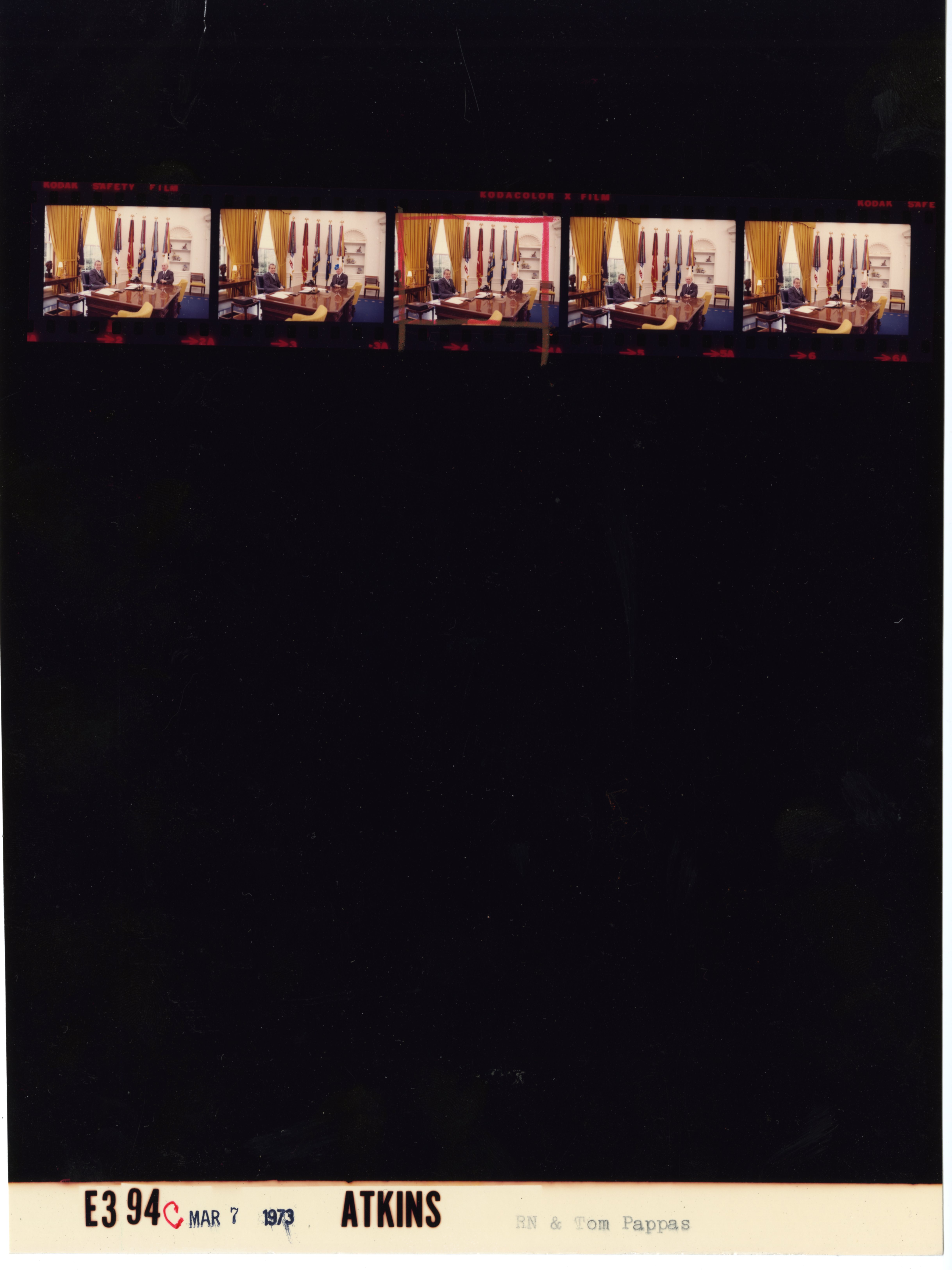
- Frame(s): WHPO-E0394-, President Nixon meeting Tom Pappas. 3/7/1973, Washington, D.C. White House, Oval Office. President Nixon, Thomas Pappas.
Roll WHPO-E0395 Photographer: Atkins, Oliver | Color or B&W: Color
- Frame(s): WHPO-E0395-, President Nixon meeting Federal Women's Awards winners. 3/7/1973, Washington, D.C. White House, Oval Office. President Nixon, unidentified award winners.
Roll WHPO-E0396 Photographer: Atkins, Oliver | Color or B&W: Color
- Frame(s): WHPO-E0396-, President Nixon meeting Federal Women's Awards winners. 3/7/1973, Washington, D.C. White House, Oval Office. President Nixon, unidentified award winners.
Roll WHPO-E0397 Photographer: Knudsen, Robert L. | Color or B&W: B&W
- Frame(s): WHPO-E0397-, President Nixon meeting Federal Women's Awards winners. 3/7/1973, Washington, D.C. White House, Oval Office. President Nixon, unidentified award winners.
Roll WHPO-E0398 Photographer: Atkins, Oliver | Color or B&W: B&W
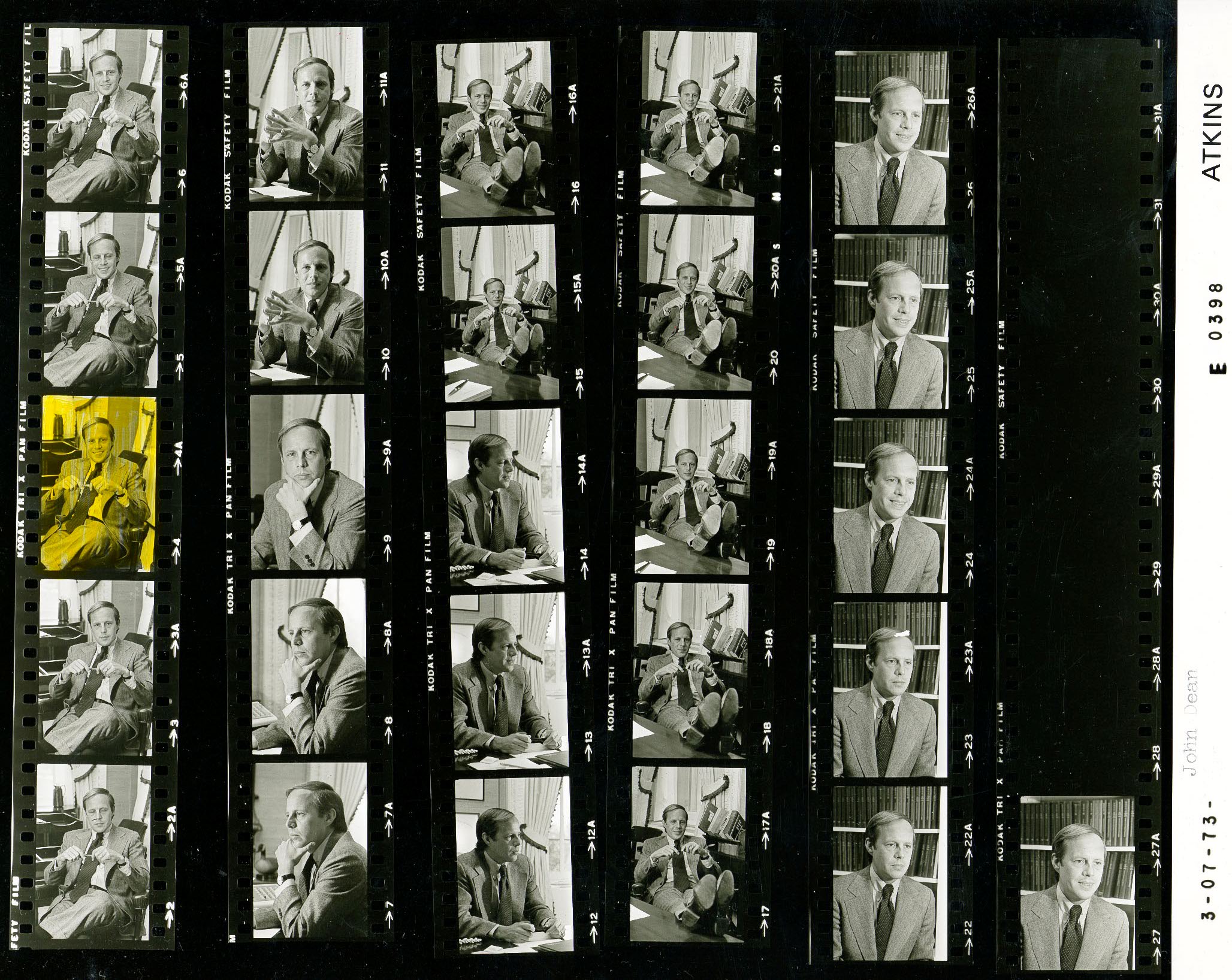
- Frame(s): WHPO-E0398-, Portrait of John Dean in his office. 3/7/1973, Washington, D.C. unknown. John Dean.
- Frame(s): WHPO-E0398-03A, Portrait of John Dean in his office holding a pen. 3/7/1973, Washington, D.C. unknown. John Dean.
- Frame(s): WHPO-E0398-20A, Portrait of John Dean in his office, feet on the desk while holding a pen. 3/7/1973, Washington, D.C. unknown. John Dean.
Roll WHPO-E0399 Photographer: Kightlinger, Jack | Color or B&W: Color
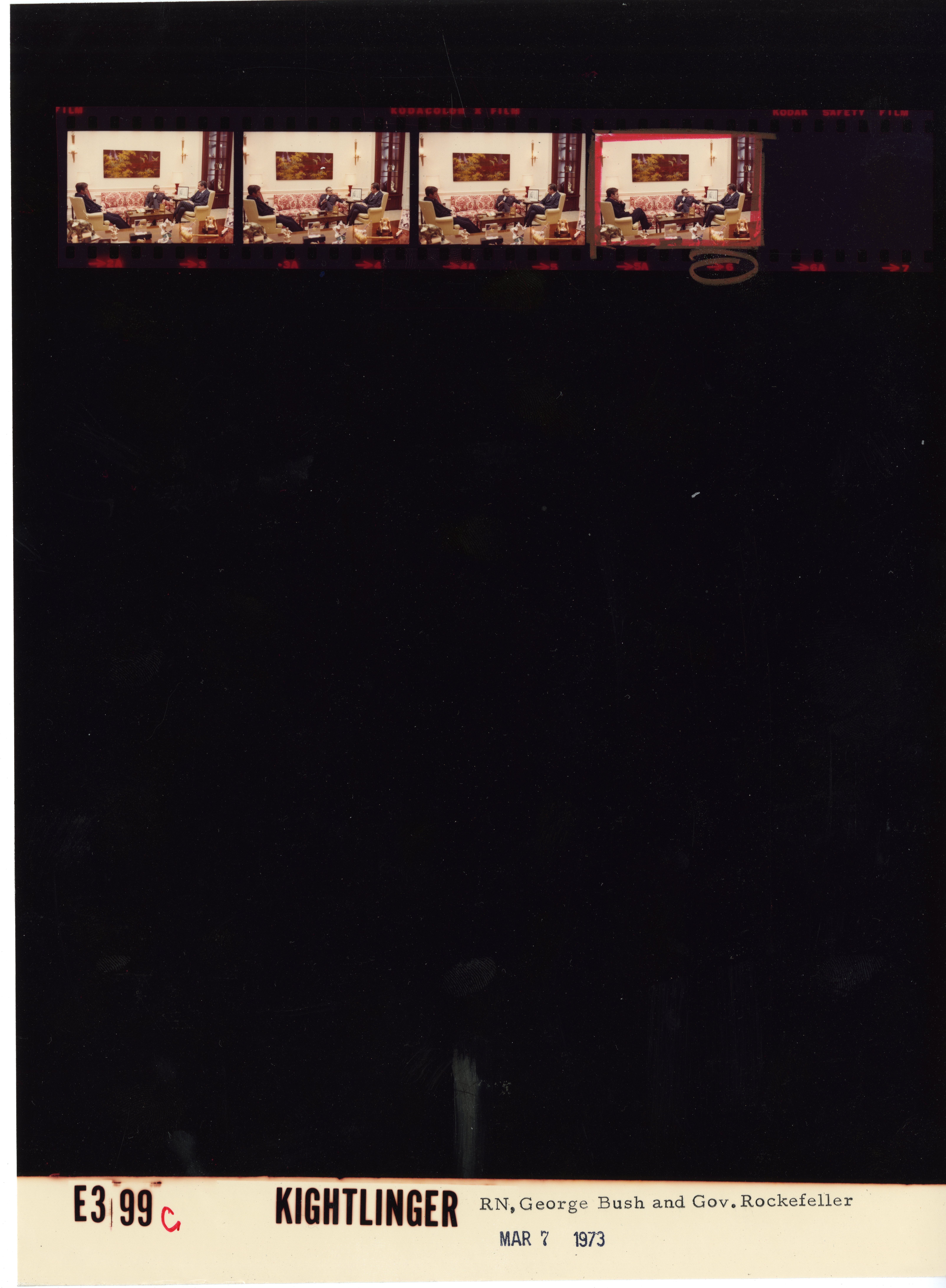
- Frame(s): WHPO-E0399-, President Nixon in the Oval office during a meeting with Republican National Committee Chairman George H. W. Bush and New York Governor Nelson Rockefeller. 3/7/1973, Washington, D.C. White House, Oval Office. George H. W. Bush, Nelson Rockefeller.
- Frame(s): WHPO-E0399-03A, President Nixon sitting informally during a meeting with Republican National Committee Chairman George H. W. Bush and New York Governor Nelson Rockefeller in the Oval Office. 3/7/1973, Washington, D.C. White House, Oval Office. President Nixon, George H.W. Bush, Nelson Rockefeller.
The White House Communications Agency Sound Recordings Collection contains public statements that took place between 1969 and 1974. Visit the finding aid to learn more.
P - Formal Presidential Remarks
- WHCA-SR-P-730312
Remarks by President Nixon to recipients of the Federal Woman's Award. (3/7/1973)
Runtime: 2:00
Original Format: 1/4-inch reel-to-reel audiotape. Original source type: Original. - WHCA-SR-P-730313
Remarks by President Nixon at stag dinner with Bob Hope. (3/7/1973)
Runtime: 37:10:00
Original Format: 1/4-inch reel-to-reel audiotape. Original source type: Original.
S - White House Press Office Briefings (continuation of the L-series)
- WHCA-SR-S-012
Press briefing by Ronald Ziegler. (3/7/1973, White House Press Lobby)
Runtime: 53:10:00
Keywords: Press conferences, news conferences, interviews, media, press secretary
Production credits: Audio feed supplied by WHCA; Recorded by RMM (initials of WHCA engineer)
Original Format: 1/4-inch reel-to-reel audiotape. Original source type: Original. - WHCA-SR-S-013
Briefing by Gerald Warren and John D. Ehrlichman. (3/7/1973, EOB Conference Room)
Runtime: 76:00:00
Keywords: Briefings, public briefings, statements to the press (see also Press conferences, news conferences, interviews, media)
Production credits: Audio feed supplied by GSA; Recorded by E. Doss (initials of WHCA engineer)
Original Format: 1/4-inch reel-to-reel audiotape. Original source type: Original.
The White House Communications Agency Videotape Collection contains “off-the-air” recordings of televised programs produced between 1968 and 1974. Visit the finding aid to learn more.
- WHCA-6163
"Panorama".
CBS
Runtime: 01:32:29 - WHCA-6164
Bob Hope Special at the Mardi Gras.
NBC
Runtime: 00:59:56 - WHCA-6166
Weekly News Summary, Tape II.
ALL NETWORKS
Runtime: 01:33:48
16. Smith/Peterson/Reasoner/Wordham: POWs at Andrews Air Force Base and Clark Air Force Base. Time Code Start: 44:59. Keywords: Vietnam War, Vietnam Prisoner of War, releases, arrivals, Armed Forces, military, air bases, airfields, airports, hospitals. Network: ABC.
17. Smith/Kaplow: Diplomats Cleo Noel and Curtis Moore funeral services; murdered by Arab guerrillas in Sudan last week. Time Code Start: 54:08. Keywords: death memorials, burials, internments, religious services, funerals. Network: ABC.
18. Smith/Clark: L. Patrick Gray hearing. Time Code Start: 56:07. Keywords: Federal Bureau of Investigations, leaders, nominees, Senate committee hearings, testimony, testify. Network: ABC.
19. Smith: Commentary on Mayor Lindsay's New York City finances; City employee incomes have doubled in last decade, Welfare rolls have tripled, budget problems. Time Code Start: 58:03. Keywords: cities, lifestyles, salary, salaries, employment. Network: ABC.
20. Chancellor/Kiker/Neal: Recently released POWs arrive at Andrews Air Force Base and Travis Air Force Base. Time Code Start: 59:50. Keywords: Vietnam War, Vietnam Prisoner of War, releases, arrivals, Armed Forces, military, air bases, airfields, airports, hospitals. Network: NBC.
21. Chancellor/Brinkley: Commentary on the excessiveness of the welcome home treatment for the POWs. Time Code Start: 63:10. Keywords: Vietnam War, Vietnam Prisoner of War. Network: NBC.
22. Chancellor/Stern: More on L. Patrick Gray nomination hearings. Time Code Start: 65:54. Keywords: Federal Bureau of Investigations, leaders, nominees, Senate committee hearings, testimony, testify. Network: NBC.
23. Chancellor/Mackin: Funeral for two murdered diplomats Ambassador Cleo Noel and DCM Curtis Moore at Arlington National Cemetery; murdered at the embassy in Sudan. Time Code Start: 67:38. Keywords: Ambassadors, embassies, officials, North Africa, Middle East, militants, bombings, violence, sabotage, shootings, kidnappings, terrorism, death, assassinations, death memorials, burials, internments, religious services, funerals. Network: NBC.
24. Cronkite/Schieffer/Drinkwater: The returning POWs at Andrews and Travis Air Force Bases. Time Code Start: 69:20. Keywords: Vietnam War, Vietnam Prisoner of War, releases, arrivals, Armed Forces, military, air bases, airfields, airports, hospitals. Network: CBS.
25. Cronkite: L. Patrick Gray nomination hearings. Time Code Start: 75:00. Keywords: Federal Bureau of Investigations, leaders, nominees, Senate committee hearings, testimony, testify. Network: CBS.
26. Sevareid: Commentary titled Sauce for the Goose, author Jessica Mitford comments on drug tests, taxi drivers should walk in rush hour, dog owners should clean streets. Time Code Start: 79:58. Keywords: humor, British, activists, authors, criticism, drug testing, pharmaceuticals, executives, rush hour, traffic, animals, cleanup. Network: CBS.
Context (External Sources)
The Vanderbilt Television News Archive is the world's most extensive and complete archive of television news. They have been recording, preserving and providing access to television news broadcasts of the national networks since August 5, 1968.
Wikipedia is a free encyclopedia that anyone can edit.