

Introduction
This almanac page for Tuesday, March 6, 1973, pulls together various records created by the federal government and links to additional resources which can provide context about the events of the day.
Previous Date: Monday, March 5, 1973
Next Date: Wednesday, March 7, 1973
Schedule and Public Documents
The Daily Diary files represent a consolidated record of the President's activities. Visit the finding aid to learn more.
The President's day began at The White House - Washington, D. C.
The Weekly Compilation of Presidential Documents made available transcripts of the President's news conferences; messages to Congress; public speeches, remarks, and statements; and other Presidential materials released by the White House.
Digitized versions can be found at HathiTrust.
Each Public Papers of the Presidents volume contains the papers and speeches of the President of the United States that were issued by the White House Office of the Press Secretary during the time period specified by the volume. The material is presented in chronological order, and the dates shown in the headings are the dates of the documents or events. In instances when the release date differs from the date of the document itself, that fact is shown in the text note.
To ensure accuracy, remarks have been checked against audio recordings (when available) and signed documents have been checked against the original, unless otherwise noted. Editors have provided text notes and cross references for purposes of identification or clarity.
The Federal Register is the official daily publication for rules, proposed rules, and notices of federal agencies and organizations, as well as executive orders and other Presidential documents.
The Congressional Record is the official daily record of the debates and proceedings of the U.S. Congress.
Archival Holdings
Any selection of archival documents will necessarily be partial. You should use the documents and folders identified below as a starting place, but consult the linked collection finding aids and folder title lists and the collections themselves for context. Many documents to be found this way do not lend themselves to association with specific dates, but are essential to a complete understanding of the material.
Selective document listing
President's Office Files
The President's Office Files consists of materials drawn together by the Special Files Unit from several administrative subdivisions within the White House Office. It is the handwriting and sensitive papers sent to the Staff Secretary that now comprise much of the President's Office Files. Visit the finding aid to learn more.
- News Summaries, Annotated News Summaries, Box 44, March 1-7, 1973 [4 of 5] [Note: Due to the way News Summary products were compiled, you should also consult nearby days for potentially relevant materials.]
- News Summary, March 6, 1973, (Monday nets, wires)
- News Summaries, Annotated News Summaries, Box 44, March 1-7, 1973 [5 of 5]
- Magazine Report and Digest of Recent News Comment, March 6, 1973
President's Personal File
The President's Personal File is essentially a President's secretary's file, kept by Rose Mary Woods, personal secretary to the President, for two purposes: (1) preserving for posterity a collection of documents particularly close to the President, whether because he dictated or annotated them, or because of the importance of the correspondent or the event concerned and (2) giving appropriate attention–letters of gratitude, invitations to White House social events, and the like–to members and important friends and supporters of the Nixon administration. This generalization does not describe all the varied materials of a file group which is essentially a miscellany, but it does identify the reason for the existence of the file group's core. Visit the finding aid to learn more.
- President's Speech File
The H. R. Haldeman Diaries consists of seven handwritten diaries, 36 dictated diaries recorded as sound recordings, and two handwritten audio cassette tape subject logs. The diaries and logs reflect H. R. Haldeman’s candid personal record and reflections on events, issues, and people encountered during his service in the Nixon White House. As administrative assistant to the President and Chief of Staff, Haldeman attended and participated in public events and private meetings covering the entire scope of issues in which the Nixon White House engaged in during the years 1969-1973. Visit the finding aid to learn more.
- Transcript of diary entry (PDF)
Tuesday, March 6.
The President had a very heavy day, scheduled right from 8:30 through to 6:00 and then first of the two "fat cat" dinners tonight. He did have me in at 6:00 for a short time, and reacted to the day, making the point that it basically was useless, because all of the events were spinning wheels. He went over the schedule item-by-item and made the point that none of the things really needed to be done nor did any of them really advance the ball for us in any way. He got into a little discussion of schedule strategy. Ehrlichman had raised the idea of doing a series of regional briefings and he's not inclined to do that, he feels we’ve already done it. We shouldn't do the same thing over, we need a new idea to get attention. But that Agnew should get out and do the regional briefings. He feels the Baroody operation has failed on their promotion of the budget battle, and that we need to replace him. And had some ideas on plans for the dinner tonight.
Ehrlichman reported earlier-- he and Timmons on the President's leadership meeting this morning, which apparently was quite historic. This was just with Scott and Ford, and we knew that Scott intended to come in and complain about things on the Hill and suggest the President have a series of meetings up there with the Republican Senators. Scott started off doing exactly that, and said the mood was very bad and whined on and on for two or three minutes. The President just let him go, and then he stepped and said Hugh, people really don’t-- said that-- he used a lot of apparently pretty strong profanity, and said that the Press-- I mean the Senate are nothing but a bunch of A’s and that we never get anything from them. There's nothing that does any good, no matter what we do for them, and all I can say is eff the Senate. That we bring them down and give them their cookies, and treat them nice socially, in order to cover the things that we need to do, but we can't count on them for any vote, and never have been able to. He then swung over and turned to Gerry, and said now tell me about what we can count on in the House. At another point, he turned to Korologos, you forget wasting time on the Senate, you get over to the House and get to work, where we can get something done. And then at a later point, Scott interrupted and said, well Mr. President, I need some advice on handling votes, what do you want me to do as the leader, when the great bulk of the Republicans decide to vote against the Administration on a particular issue? Should I vote with the majority of our people, or should I stay with the Administration and stick out like a sore thumb by voting the other way? The President said that it doesn't make any difference, you can vote anyway you want, nobody gives an ass what the Senate does or how the Senate votes. Everybody present felt that this is going to have quite a substantial effect, and probably a very salutary one on Scott, as it sort of shapes him up.
End of March 6. - Original audio recording (MP3)
The National Archives Catalog is the online portal to the records held at the National Archives, and information about those records. It is the main way of describing our holdings and also provides access to electronic records and digitized versions of our holdings.
The Catalog searches across multiple National Archives resources at once, including archival descriptions, digitized and electronic records, authority records, and web pages from Archives.gov and the Presidential Libraries. The Catalog also allows users to contribute to digitized historical records through tagging and transcription.
Nixon Library Holdings
All National Archives Units
National Security Documents
The President's Daily Brief is the primary vehicle for summarizing the day-to-day sensitive intelligence and analysis, as well as late-breaking reports, for the White House on current and future national security issues. Read "The President's Daily Brief: Delivering Intelligence to Nixon and Ford" to learn more.
The Foreign Relations of the United States series presents the official documentary historical record of major U.S. foreign policy decisions and significant diplomatic activity. Visit the State Department website for more information.
Vol. XV, Soviet Union, June 1972-August 1974
Summit Preparations; Jackson-Vanik Amendment; Non-Use of Nuclear Weapons, December 1972-April 1973
79. Memorandum of Conversation, Washington, March 6, 1973, 6:12-7:15 p.m.
Source: National Archives, Nixon Presidential Materials, NSC Files, Box 495, Dobrynin/Kissinger, Vol. 15. Top Secret; Sensitive; Exclusively Eyes Only. The meeting took place in the Military Aide’s office in the White House. The memorandum is attached at Tab A to a memorandum from Kissinger to Nixon, undated, summarizing his conversations with Dobrynin on March 6 and 8.
Vol. XXXVI, Energy Crisis, 1969-1974
March 16, 1972-March 6, 1973
169. Memorandum From James H. Critchfield, Special Assistant to the Deputy Director of Operations, Central Intelligence Agency, to the Deputy Director of Operations (Colby), Washington, March 6, 1973
Source: Central Intelligence Agency, Executive Registry Files, Job 80–M01048A, Box 4. Secret. On an attached routing slip, the Director of the Near Eastern Division wrote Colby that “We think Critchfield has usefully categorized ways of thinking about forms of joint action in support of consuming countries’ interests in Middle East oil. We have no difficulty with his analysis as far as it goes but think that divergent interests among the consumers would be a formidable obstacle. His comment on King Husayn’s proposal in para. 14 closely parallels the piece I sent you yesterday.”
Vol. XXXVIII, Part 1, Foundations of Foreign Policy, 1973-1976
Foundations of Foreign Policy, 1973-1976
4. Memorandum for the President’s Files by the President’s Press Secretary (Ziegler), Washington, March 6, 1973
Source: National Archives, Nixon Presidential Materials, Staff Member and Office Files, White House Special Files, President’s Office Files, President’s Meeting File, 1969–1974, Box 91, Memoranda for the President—Beginning February 4 [1973]. No classification marking. Nixon attended a luncheon at the Department of State where he met with Rogers, Kissinger, Kenneth Rush, William Porter, William Casey, Curtis Tarr, William Macomber, Richard Pedersen, Joseph Donelan, David Newsom, Willis Armstrong, Marshall Green, Walter Stoessel, Marshall Wright, Samuel DePalma, William Hall, Joseph Sisco, John Richardson, U. Alexis Johnson, Armin Meyer, Robert McCloskey, Theodore Eliot, and Ziegler. (President’s Daily Diary; ibid., White House Central Files) Nixon also delivered remarks to Department of State personnel at an afternoon memorial ceremony honoring Ambassador to the Sudan Cleo Noel, Jr., and Deputy Chief of Mission George Curtis Moore. Members of the Black September terrorist group had kidnapped and slain Noel, Moore, and Belgian Chargé d’Affaires Guy Eid on March 2. For text of these remarks, see Public Papers: Nixon, 1973, pp. 169–171.
Vol. E-3, Documents on Global Issues, 1973-1976
Terrorism
207. Memorandum for the President’s Files by his Assistant to the President and Press Secretary (Ziegler), Washington, March 6, 1973
Nixon discussed the Sudan incident and other issues related to terrorism policy with Department of State officials.
Source: National Archives, Nixon Presidential Materials, White House Special Files, President’s Office Files, Memoranda for the President, Box 91, Beginning March 4 (1973). No classification marking.
Vol. E-6, Documents on Africa, 1973-1976
Sudan
218. Memorandum of Conversation, Washington, March 6, 1973, 10:30 a.m.
Sudanese Minister of National Reform, Abdel Rahman Abdulla, conveyed President Nimeiri’s condolences for the deaths of two American officials. Abdulla requested security assistance to defend against BSO retaliation. President Nixon said that Sudan was only accidentally involved in the assassinations and promised cooperation.
Source: National Archives, RG 59, Central Files 1970–1973, POL 13–10. Secret; Exdis
Uganda
242. Memorandum From the President’s Assistant for National Security Affairs (Kissinger) to President Nixon, Washington, March 6, 1973
Kissinger informed Nixon that the Department of State wished to phase out all USAID programs in Uganda because of deteriorating internal security. He recommended approval of Ambassador Melady’s return to Kampala to oversee the phase out. Nixon disapproved the recommendation.
Source: National Archives, Nixon Presidential Materials, NSC Files, Box 746, Uganda, Vol. 1. Secret. Sent for action. A notation on the memorandum reads: “The President has seen.” Nixon circled the number 450 in the last sentence of the memorandum and added a handwritten notation that reads: “absolutely not—cut to 100 maximum for all govt. agencies.” He also highlighted the recommendation with a handwritten notation that reads: “No; Let the chargé do it—no appeal.” Tab A, the text of a telegram to the President from General Amin on the signing of the Vietnam Peace Agreement, was not attached.
Vol. E-9, Documents on North Africa, 1973-1976
Morocco, 1973-1976
61. Memorandum From Director of Central Intelligence Schlesinger to the President’s Assistant for National Security Affairs (Kissinger), Washington, March 6, 1973
[Source: Central Intelligence Agency, Office of the Director of Central Intelligence, Job 80M01048A, OPI 10, Box 5. Secret. 2 pages not declassified.]
Vol. E-11, Part 2, Documents on South America, 1973-1976
Brazil
83. Backchannel Message From President Nixon to Brazilian President Médici, Washington, March 6, 1973
Summary: Nixon informed Médici he strongly opposed an effort by Venezuela and Ecuador to lift OAS sanctions on Cuba.
Source: National Archives, Nixon Presidential Materials, NSC Files, Box 772, Country Files, Latin America, Brazil, Vol. IV, 1973–1974. Top Secret; Exclusively Eyes Only. On April 18, Scowcroft informed Kissinger that Nixon had “reacted strongly to an item [text not declassified] regarding Venezuela’s and Ecuador’s efforts to remove OAS sanctions from Cuba. Scowcroft attached a copy of the item with Nixon’s handwritten note, “K[issinger]—inform State now—we are to vigorously oppose this move—get our position in the private channel to Médici.” (Ibid.)
Vol. E-15, Part 2, Documents on Western Europe, 1973-1976, Second, Revised Edition
United Kingdom, 1973-1976
219. Memorandum From the President’s Assistant for National Security Affairs (Kissinger) to President Nixon, Washington, March 6, 1973
Summary: Kissinger requested Nixon’s guidance on U.S. support for a British submarine missile.
Source: National Archives, Nixon Presidential Materials, NSC Files, Kissinger Office Files, Box 63, Country Files, Europe, General, Exchanges with the UK—Nuclear. Top Secret; Sensitive. A stamped notation on the memorandum indicates the President saw it. Nixon initialed his approval of Kissinger’s recommendation.
The Kissinger telephone conversation transcripts consist of approximately 20,000 pages of transcripts of Kissinger’s telephone conversations during his tenure as Assistant to the President for National Security Affairs (1969-1974) and Secretary of State (1973-1974) during the administration of President Richard Nixon. Visit the finding aid for more information.
Digitized versions can be found in the National Archives Catalog.
Audiovisual Holdings
Visit the White House Tapes finding aid to learn about the taping system's operation and archival processing.
Cabinet Room
- 116-1; Unknown between 12:00 a.m. & 9:57 a.m.; [Unknown person(s)]
- 116-2; Unknown between 12:00 a.m. & 9:57 a.m.; [Unknown person(s)]
- 116-3; Unknown between 8:35 a.m. & 10:00 a.m.; White House tour group
- 116-4; Unknown between 10:00 a.m. & 10:58 a.m.; Abdallah, Abdel Rahman; Hamza, Abdel Aziz al-Nasri (Ambassador); Newsome, David D.; Hart, Thomas; [Unknown person(s)]
- 116-6; Unknown between 10:58 a.m. & 3:04 p.m.; White House tour group
- 116-7; Unknown between 10:58 a.m. & 3:04 p.m.; White House tour group
- 116-8; Unknown between 10:58 a.m. & 11:59 p.m.; Nixon, Richard M. (President); Gribbs, Roman S.; Welch, Louie; Garn, E. J. ("Jake"); Greco, Dick, Jr.; Lugar, Richard G.; Maltester, Jack D.; Parks, Lyman S.; Moody, Tom; Allen, Thomas P.; Cmich, Stanley A.; Taft, James L., Jr.; Testerman, Kyle; Driggs, John W.; Wilson, Pete; May, Stephen; Lynn, James T.; Cole, Kenneth R., Jr.; Falk, James H.; Mead, Dana G.; O'Neill, Paul H.
- 116-9; Unknown between 12:00 a.m. & 9:57 a.m.; [Unknown person(s)]
- 116-10; Unknown between 8:35 a.m. & 10:00 a.m.; [Unknown person(s)]
- 117-1; Unknown between 10:58 a.m. & 11:59 p.m.; Nixon, Richard M. (President); Gribbs, Roman S.; Welch, Louie; Garn, E. J. ("Jake"); Greco, Dick, Jr.; Lugar, Richard G.; Maltester, Jack D.; Parks, Lyman S.; Moody, Tom; Allen, Thomas P.; Cmich, Stanley A.; Taft, James L., Jr.; Testerman, Kyle; Driggs, John W.; Wilson, Pete; May, Stephen; Lynn, James T.; Cole, Kenneth R., Jr.; Falk, James H.; Mead, Dana G.; O'Neill, Paul H.
Oval Office
- 869-1; Unknown between 8:06 a.m. & 8:20 a.m.; Nixon, Richard M. (President); Bull, Stephen B.
- 869-2; Unknown between 8:06 a.m. & 8:20 a.m.; Nixon, Richard M. (President); [Unknown person(s)]
- 869-3; Unknown between 8:06 a.m. & 8:20 a.m.; Nixon, Richard M. (President); Bull, Stephen B.
- 869-4; Unknown between 8:20 a.m. & 8:24 a.m.; Nixon, Richard M. (President); Haldeman, H. R. ("Bob"); [Unknown person(s)]
- 869-5; 8:25 a.m. - 8:30 a.m.; Nixon, Richard M. (President); Timmons, William E.; Ehrlichman, John D.
- 869-6; Unknown between 8:30 a.m. & 8:35 a.m.; Nixon, Richard M. (President); Bull, Stephen B.
- 869-7; 8:35 a.m. - 9:57 a.m.; Nixon, Richard M. (President); Scott, Hugh; Ford, Gerald R.; Ash, Roy L.; Cole, Kenneth R., Jr.; Korologos, Thomas C.; Cook, Richard K.; Timmons, William E.; Ehrlichman, John D.; Ziegler, Ronald L.
- 869-8; 9:57 a.m. - 10:00 a.m.; Nixon, Richard M. (President); Bull, Stephen B.
- 869-9; 10:00 a.m. - 10:00 a.m.; Nixon, Richard M. (President); [Unknown person(s)]
- 869-10; 10:00 a.m. - 11:20 a.m.; Nixon, Richard M. (President); Scowcroft, Brent G. (Gen.); Singleton, James A. (Capt.); Singleton, James A. (Mrs.); Jeffery, Robert D.; Jeffery, Robert D. (Mrs.); [Unknown person(s)]; Kissinger, Henry A.; Bull, Stephen B.; Newsom, David N.; Abdallah, Abdel Rahman; Hamza, Abdel Aziz al-Nasri (Ambassador)
- 869-11; Unknown between 11:20 a.m. & 11:49 a.m.; Nixon, Richard M. (President); Bull, Stephen B.
- 869-12; Unknown between 11:20 a.m. & 11:49 a.m.; Nixon, Richard M. (President); Bull, Stephen B.
- 869-13; 11:49 a.m. - 12:00 p.m.; Nixon, Richard M. (President); Dean, John W., III
- 869-14; Unknown between 12:00 p.m. & 12:19 p.m.; Nixon, Richard M. (President); Bull, Stephen B.
- 869-15; Unknown between 12:00 p.m. & 12:19 p.m.; Nixon, Richard M. (President); [Unknown person(s)]
- 869-16; Unknown between 12:00 p.m. & 12:19 p.m.; Nixon, Richard M. (President); Bull, Stephen B.
- 869-17; 12:19 p.m. - 12:46 p.m.; Nixon, Richard M. (President); Ziegler, Ronald L.; Ehrlichman, John D.; Wilson, Jerry V.; Shepard, Geoffrey C.; [Unknown person(s)]
- 869-18; Unknown between 12:46 p.m. & 12:48 p.m.; Nixon, Richard M. (President); [Unknown person(s)]
- 869-19; 12:48 p.m. - 12:56 p.m.; Nixon, Richard M. (President); Ehrlichman, John D.
- 869-20; 2:40 p.m. - 3:02 p.m.; Nixon, Richard M. (President); Kissinger, Henry A.; Bull, Stephen B.
- 869-21; 3:02 p.m. - 3:04 p.m.; Nixon, Richard M. (President); [Unknown person(s)]
- 869-22; Unknown between 3:04 p.m. & 3:39 p.m.; [Unknown person(s)]
- 869-23; Unknown between 12:46 p.m. & 12:48 p.m.; Nixon, Richard M. (President); [Unknown person(s)]
- 869-24; Unknown between 12:40 p.m. & 2:40 p.m.; [Unknown person(s)]
- 869-25; Unknown between 3:04 p.m. & 3:39 p.m.; [Unknown person(s)]
- 870-1; Unknown between 3:39 p.m. & 3:42 p.m.; Nixon, Richard M. (President); Bull, Stephen B.
- 870-2; 3:42 p.m. - 4:20 p.m.; Nixon, Richard M. (President); Corcoran, Thomas G.; [Unknown person(s)]; Bull, Stephen B.
- 870-3; Unknown between 4:20 p.m. & 4:22 p.m.; Nixon, Richard M. (President); Bull, Stephen B.
- 870-4; Unknown between 4:20 p.m. & 4:46 p.m.; Nixon, Richard M. (President); Bull, Stephen B.; Pamplin, Robert B.; [Unknown person(s)]
- 870-5; Unknown between 4:46 p.m. & 6:00 p.m.; Nixon, Richard M. (President); Bull, Stephen B.; Ziegler, Ronald L.; Butz, Earl L.; Lynn, James T.; Weinberger, Caspar W. ("Cap"); Ehrlichman, John D.; Ash, Roy L.
- 870-6; Unknown between 6:00 p.m. & 6:05 p.m.; Nixon, Richard M. (President); Sanchez, Manolo
- 870-7; Unknown between 6:05 p.m. & 7:01 p.m.; Nixon, Richard M. (President); Haldeman, H. R. ("Bob")
- 870-8; Unknown between 6:05 p.m. & 7:01 p.m.; Nixon, Richard M. (President); Bull, Stephen B.
- 870-9; Unknown between 6:05 p.m. & 7:01 p.m.; Nixon, Richard M. (President); Bull, Stephen B.; [Unknown person(s)]
- 870-10; Unknown between 6:05 p.m. & 7:01 p.m.; Nixon, Richard M. (President); [Unknown person(s)]
- 870-11; Unknown between 7:01 p.m., 3/6 & 8:12 a.m., 2/21; [Unknown person(s)]
The White House Photo Office collection consists of photographic coverage of President Richard Nixon meeting with prominent social, political, and cultural personalities; speaking engagements and news conferences of the President and various high-ranking members of the White House staff and Cabinet; Presidential domestic and foreign travel, including Presidential vacations; social events and entertainment involving the First Family, including entertainers present; official portraits of the President, First Family, and high-ranking members of the Nixon administration; the 1969 and 1973 Inaugurals; the President’s 1972 Presidential election campaign appearances (including speeches) and other official activities of the White House staff and the President’s Cabinet from January 20, 1969 until August 9, 1974 at the White House and the Old Executive Office Building; other locations in Washington, DC, such as The Mall; and the Presidential retreats in Camp David, Maryland, Key Biscayne, Florida, and San Clemente, California. Visit the finding aid to learn more.
Roll WHPO-E0379 Photographer: Atkins, Oliver | Color or B&W: B&W
- Frame(s): WHPO-E0379-, President Nixon meeting Vietnam POWs (Vietnam Prisoner of War) Captain Jerry Singleton and Captain Robert Jeffrey. 3/6/1973, Washington, D.C. White House, Oval Office. President Nixon, Captain Jerry Singleton, Mrs. Jerry Singleton, Captain Robert Jeffrey, Mrs. Robert Jeffrey, Brent Scowcroft.
Roll WHPO-E0380 Photographer: Atkins, Oliver | Color or B&W: B&W
- Frame(s): WHPO-E0380-01A-06A, President Nixon meeting with unidentified man. 3/6/1973, Washington, D.C. White House, Oval Office. President Nixon, unidentified male, Kissinger.
- Frame(s): WHPO-E0380-11A-17A, President Nixon meeting with Washington D.C. Police Chief Jerry Wilson. 3/6/1973, Washington, D.C. White House, Oval Office. President Nixon, Jerry Wilson.
- Frame(s): WHPO-E0380-12A, President Nixon seated informally during an Oval Office meeting with Washington D.C. Police Chief Jerry Wilson. 3/6/1973, Washington, D.C. White House, Oval Office. President Nixon, Jerry Wilson.
Roll WHPO-E0381 Photographer: Schumacher, Karl | Color or B&W: Color
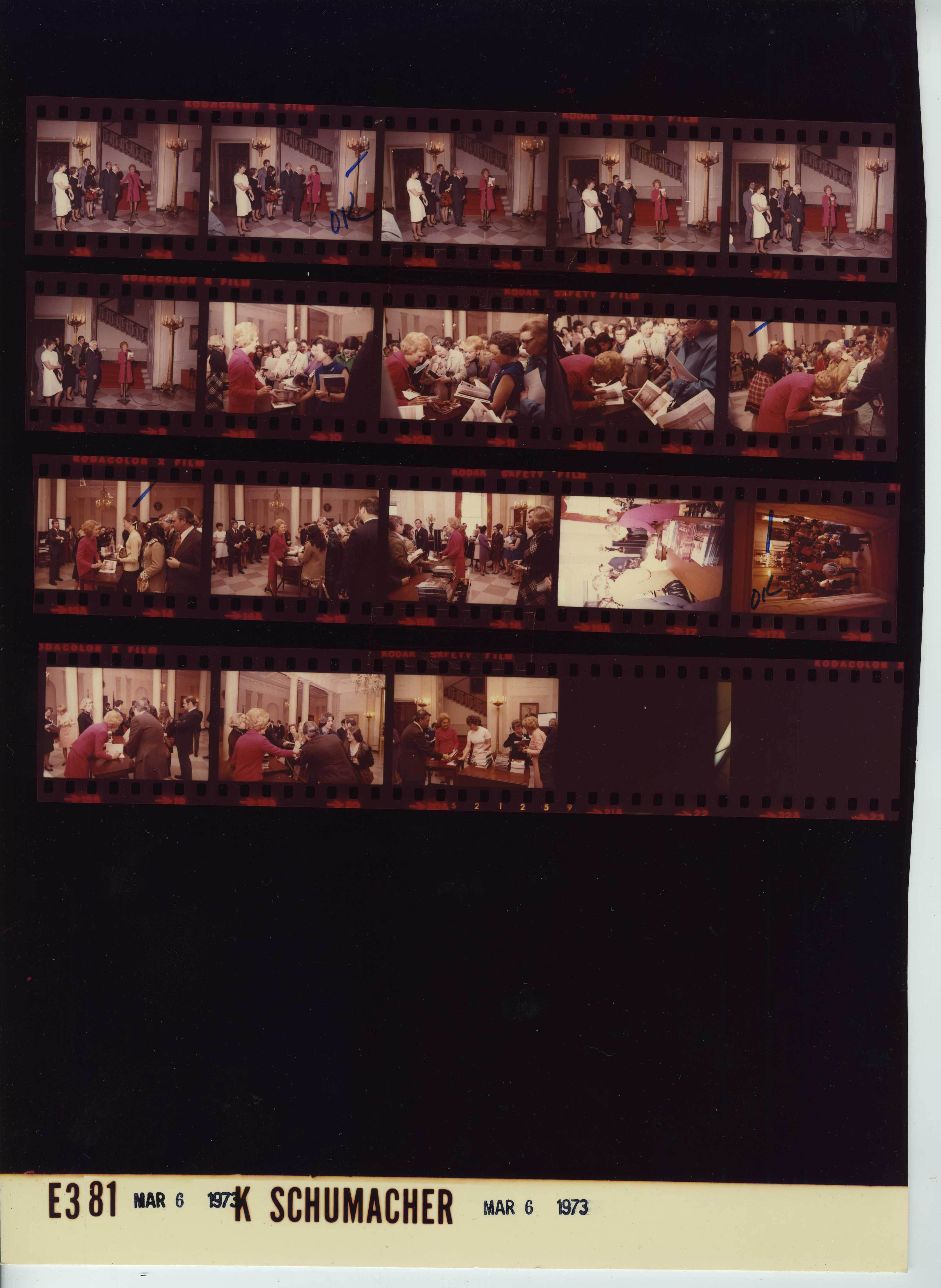
- Frame(s): WHPO-E0381-, Pat Nixon greeting guests and signing copies of the new White House Guide Book with her autograph. 3/6/1973, Washington, D.C. White House, East Room. Pat Nixon White House visitors.
Roll WHPO-E0382 Photographer: Kightlinger, Jack | Color or B&W: B&W
- Frame(s): WHPO-E0382-, Brent Scowcroft accepting a VFW inaugural plaque from unidentified Veterans of Foreign Wars organization representatives. 3/6/1973, Washington, D.C. White House, Rose Garden. Brent Scowcroft, unidentified Veterans.
Roll WHPO-E0383 Photographer: Atkins, Oliver | Color or B&W: B&W
- Frame(s): WHPO-E0383-, President Nixon at a State Department ceremony held in-honor of two slain diplomats. 3/6/1973, Washington, D.C. Main State Building. President Nixon, unidentified attendees.
Roll WHPO-E0384 Photographer: Atkins, Oliver | Color or B&W: B&W
- Frame(s): WHPO-E0384-, President Nixon at State Department ceremony held in-honor of two slain diplomats. 3/6/1973, Washington, D.C. Main State Building [now Harry S. Truman Building]. President Nixon, unidentified attendees.
Roll WHPO-E0385 Photographer: Schumacher, Karl | Color or B&W: B&W

- Frame(s): WHPO-E0385-, Portrait study of Henry Kissinger. 3/6/1973, Washington, D.C. unknown. Henry Kissinger.
- Frame(s): WHPO-E0385-07A, Portrait study of Henry Kissinger smiling. 3/6/1973, Washington, D.C. unknown. Henry Kissinger.
Roll WHPO-E0386 Photographer: Schumacher, Karl | Color or B&W: B&W
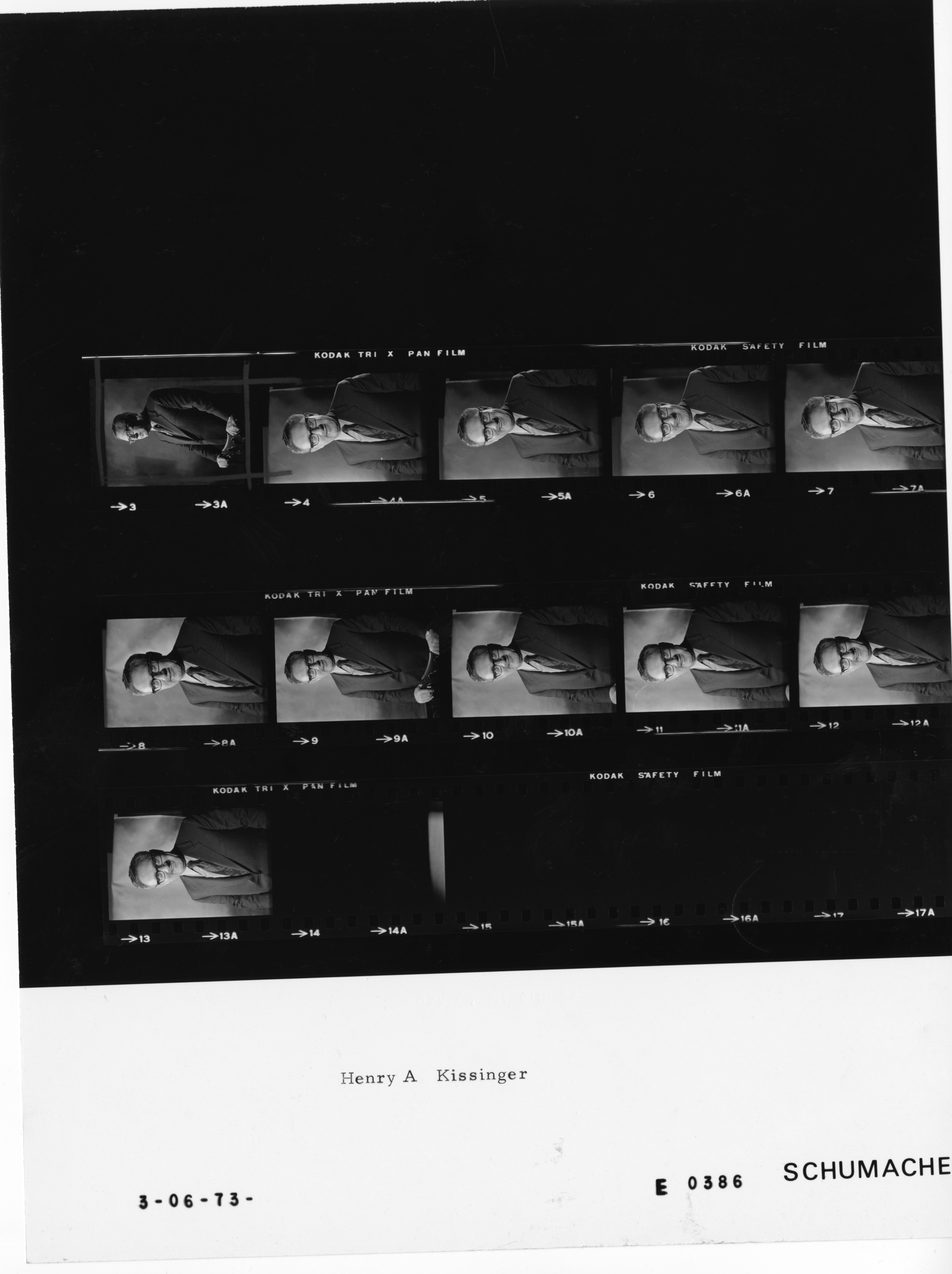
- Frame(s): WHPO-E0386-, Portrait study of Henry Kissinger. 3/6/1973, Washington, D.C. unknown. Henry Kissinger.
Roll WHPO-E0387 Photographer: Knudsen, Robert L. | Color or B&W: B&W
- Frame(s): WHPO-E0387-02-06, President Nixon at Meeting of Mayors. 3/6/1973, Washington, D.C. White House, Cabinet Room. President Nixon, unidentified mayors.
- Frame(s): WHPO-E0387-09-12, President Nixon meeting with Thomas G. Corcoran. 3/6/1973, Washington, D.C. White House, Oval Office. President Nixon, Thomas G. Corcoran.
- Frame(s): WHPO-E0387-15-19, President Nixon meeting with Robert B. Pamplin. 3/6/1973, Washington, D.C. White House, Oval Office. President Nixon, Robert B. Pamplin.
Roll WHPO-E0388 Photographer: Kightlinger, Jack | Color or B&W: B&W
- Frame(s): WHPO-E0388-, VFW presentation to Mike Farrell from unidentified Veterans of Foreign Wars organization representatives. 3/6/1973, Washington, D.C. White House, Rose Garden. Michael Farrell, unidentified Veterans.
Roll WHPO-E0389 Photographer: Atkins, Oliver | Color or B&W: Color
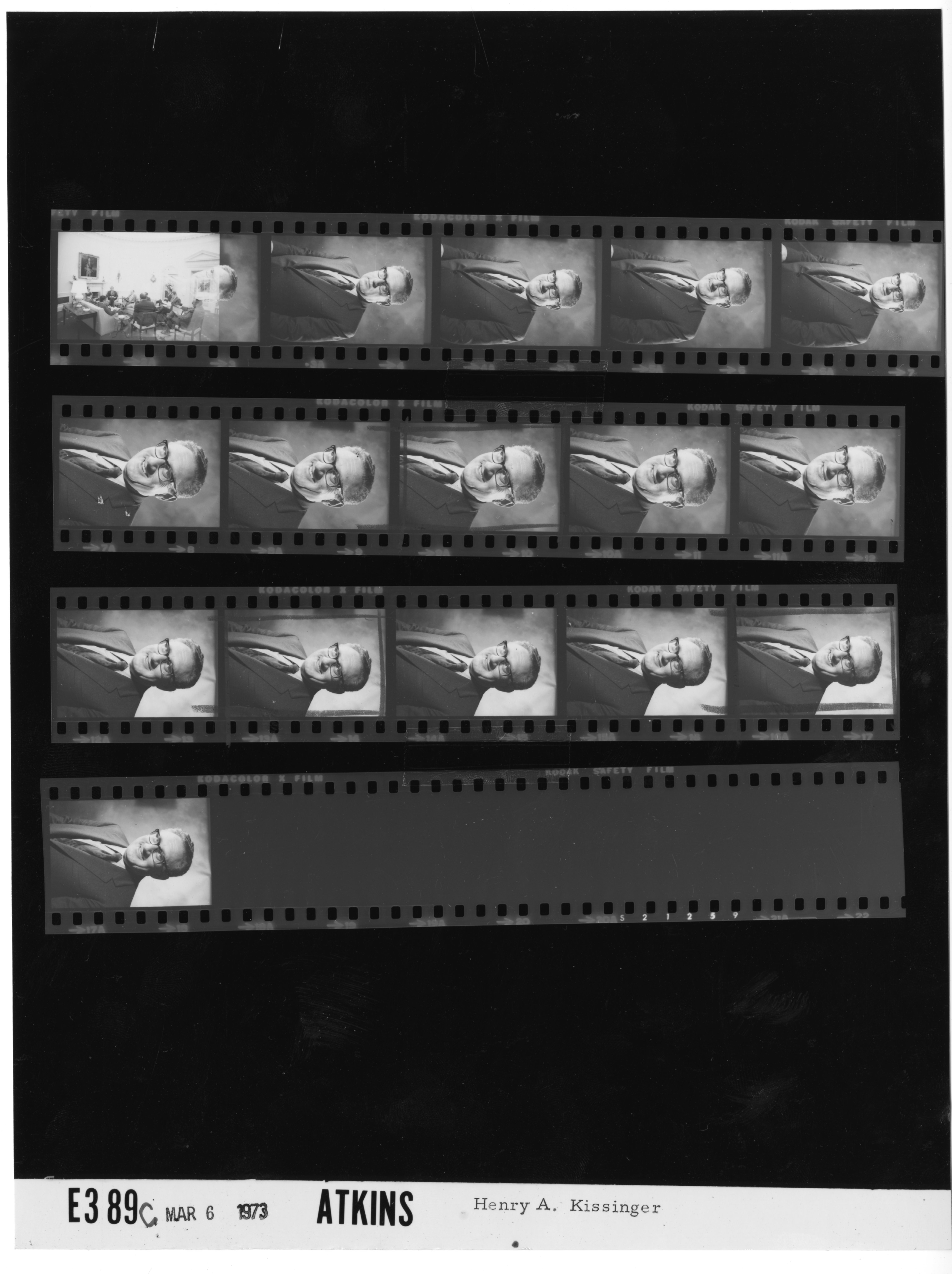
- Frame(s): WHPO-E0389-, Portrait study of Henry Kissinger. 3/6/1973, Washington, D.C. unknown. Henry Kissinger.
Roll WHPO-E0390 Photographer: Atkins, Oliver | Color or B&W: Color
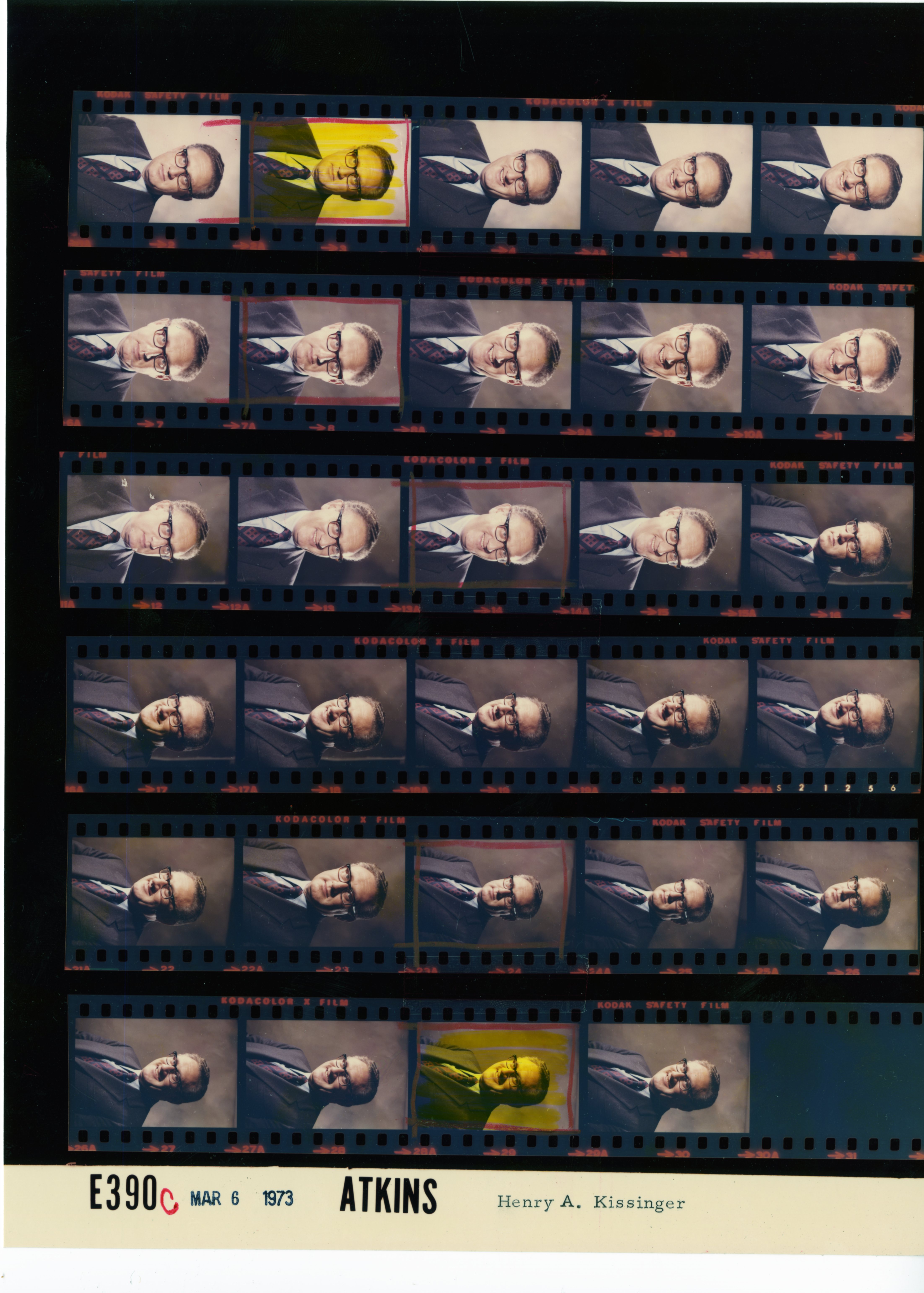
- Frame(s): WHPO-E0390-, Portrait study of Henry Kissinger. 3/6/1973, Washington, D.C. unknown. Henry Kissinger.
- Frame(s): WHPO-E0390-03, Head and shoulders formal portrait of Henry Kissinger. 3/6/1973, Washington, D.C. unknown. Henry Kissinger.
- Frame(s): WHPO-E0390-29, Formal portrait study of Henry Kissinger smiling. 3/6/1973, Washington, D.C. unknown. Henry Kissinger.
Roll WHPO-E0391 Photographer: Atkins, Oliver | Color or B&W: B&W
- Frame(s): WHPO-E0391-, President Nixon meeting VFW scholarship winners. 3/6/1973, Washington, D.C. White House, Cabinet Room. President Nixon, unidentified Veterans of Foreign Wars scholarship winners.
Roll WHPO-E2330 Photographer: Knudsen, Robert L. | Color or B&W: Color
- Frame(s): WHPO-E2330-, Pat Nixon poses with eight grade students from Whittier, California. 3/6/1973, Washington DC White House, exterior.
The White House Communications Agency Sound Recordings Collection contains public statements that took place between 1969 and 1974. Visit the finding aid to learn more.
B - Vice-Presidential (Agnew and Ford)
- WHCA-SR-B-247
Remarks at the VFW Convention-Sheraton Park Hotel, Wash., DC. (3/6/1973)
Runtime: 22:10
Original Format: 1/4-inch reel-to-reel audiotape. Original source type: Original.
C - First Lady
- WHCA-SR-C-142
Remarks by Pat Nixon at presentation of 11th edition of the White House guidebook in the North Hall of The White House. (3/6/1973, North Hall, The White House)
Runtime: 2:26
Production credits: Audio feed supplied by WHCA; Recorded by RMM (initials of WHCA engineer)
Original Format: 1/4-inch reel-to-reel audiotape. Original source type: Original.
P - Formal Presidential Remarks
- WHCA-SR-P-730309
Photo opportunity with Chief Jerry Wilson. (3/6/1973)
Runtime: 3:54
Original Format: 1/4-inch reel-to-reel audiotape. Original source type: Original. - WHCA-SR-P-730310
Remarks by President Nixon while viewing Am. Foreign Service Assn. plaque at State Dept. with Thomas Boyatt. (3/6/1973)
Runtime: 7:29
Original Format: 1/4-inch reel-to-reel audiotape. Original source type: Original. - WHCA-SR-P-730311
Remarks by President Nixon at stag dinner. (3/6/1973)
Runtime: 33:05:00
Original Format: 1/4-inch reel-to-reel audiotape. Original source type: Original.
S - White House Press Office Briefings (continuation of the L-series)
- WHCA-SR-S-007
Congressional leadership briefing by Senate Minority Leader Hugh Scott (R-PA) and House Minority Leader Gerald Ford (R-MI). (3/6/1973, White House Press Lobby)
Runtime: 27:40:00
Keywords: Briefings, private briefings
Production credits: Audio feed supplied by WHCA; Recorded by WWT (initials of WHCA engineer)
Original Format: 1/4-inch reel-to-reel audiotape. Original source type: Original. - WHCA-SR-S-008
Press briefing by Gerald Warren. (3/6/1973, White House Press Lobby)
Runtime: 33:30:00
Keywords: Press conferences, news conferences, interviews, media
Production credits: Audio feed supplied by WHCA; Recorded by WWT (initials of WHCA engineer)
Original Format: 1/4-inch reel-to-reel audiotape. Original source type: Original. - WHCA-SR-S-009
Press briefing by Washington, DC police chief Jerry Wilson. (3/6/1973, White House Press Lobby)
Runtime: 13:20
Keywords: Press conferences, news conferences, interviews, media
Production credits: Audio feed supplied by [not listed]; Recorded by RMM (initials of WHCA engineer)
Original Format: 1/4-inch reel-to-reel audiotape. Original source type: Original. - WHCA-SR-S-010
Briefing by Gerald Warren, John D. Ehrlichman and Secretary of State William P. Rogers. (3/6/1973, EOB Conference Room (450))
Keywords: Briefings, public briefings, statements to the press (see also Press conferences, news conferences, interviews, media)
Production credits: Audio feed supplied by [not listed, probably GSA]; Recorded by E. Doss (initials of WHCA engineer)
Original Format: 1/4-inch reel-to-reel audiotape. Original source type: Original. - WHCA-SR-S-011
Press briefing on revenue-sharing by Mayors Pritchard, Gunther, and Gribbs. (3/6/1973, White House Press Lobby)
Runtime: 10:00
Keywords: Press conferences, news conferences, interviews, media
Production credits: Audio feed supplied by WHCA; Recorded by RWF (initials of WHCA engineer)
Original Format: 1/4-inch reel-to-reel audiotape. Original source type: Original.
The White House Communications Agency Videotape Collection contains “off-the-air” recordings of televised programs produced between 1968 and 1974. Visit the finding aid to learn more.
- WHCA-6166
Weekly News Summary, Tape II.
ALL NETWORKS
Runtime: 01:33:48
2. Reasoner/Jarriel: President Nixon and the Sudan; Sudanese President Nimeiry calls killing American diplomats Cleo Noel and Curtis Moore and Belgian diplomat in Khartoum by Black September terrorists intolerable crime;. Time Code Start: 01:43. Keywords: Ambassadors, embassies, North Africa, Middle East, militants, bombings, violence, sabotage, shootings, kidnappings, terrorism, death, assassinations. Network: ABC.
3. Reasoner/Collins/Shoumacher: POWs at Clark Air Force Base; Captain Naysmith cuts down a sign on his return in home town; Hanoi aid. Time Code Start: 04:14. Keywords: Vietnam War, Vietnam Prisoner of War, releases, arrivals, Armed Forces, military, air bases, airfields, airports, hospitals. Network: ABC.
4. Smith/Clark: FBI L. Patrick Gray; White House aides and Watergate. Time Code Start: 09:35. Keywords: Watergate, Senate committee hearings, investigations, testimony, testify, cover-ups, break-in, burglary, theft, plumbers, scandals. Network: ABC.
5. Chancellor/Valeriani: More on the deaths of American Ambassador Ambassador Cleo J. Noel, Jr, and assistant in Sudan; President Nixon attends State Department meeting on halting terrorism. Time Code Start: 12:10. Keywords: Ambassadors, embassies, North Africa, Middle East, militants, bombings, terrorism, violence, sabotage, shootings, kidnappings, death, assassinations. Network: NBC.
6. Chancellor/Jones: Latest group of released POWs visit an American school room in the Philippines. Time Code Start: 14:27. Keywords: Vietnam War, Vietnam Prisoner of War, releases, schools, students. Network: NBC.
7. Chancellor: Secretary of State Rogers before Senate hearings comments on the number of truce violations in Vietnam. Time Code Start: 18:42. Keywords: cabinet, advisors, Vietnam War, ceasefires, violations, investigations, Watergate, Senate committee hearings, investigations, testimony, testify, cover-ups, break-in, burglary, theft, plumbers, scandals. Network: NBC.
8. Chancellor/Brinkley: Commentary on the separation of powers in the Federal Government; commentary on the budget. Time Code Start: 19:42. Keywords: legislative, judiciary, executive, checks and balances, branches of government. Network: NBC.
9. Chancellor/Stern: More on the confirmation hearing for L. Patrick Gray with Senator Gurney. Time Code Start: 22:10. Keywords: Federal Bureau of Investigations, leaders, nominees, Senate committee hearings, testimony, testify. Network: NBC.
10. Chancellor/Oliver: Returning POW John Naysmith comes home from Hanoi to chop down a sign. Time Code Start: 24:19. Keywords: Vietnam War, Vietnam Prisoner of War, releases. Network: NBC.
11. Cronkite/Schorr: The battle of the budget with Representatives Albert and Gerald Ford; Senators Scott and Mahone with Dr. Burns and Federal Reserve Board. Time Code Start: 26:24. Keywords: economy, economics, budgets, finances, recession, inflation, money, wages. Network: CBS.
12. Cronkite/Chase/Dean: Possible result of a new Federal self help guide for impoverished people are not going to be good. Time Code Start: 28:47. Keywords: anti-poverty, destitution, lifestyles, guides, books, pamphlets, publications. Network: CBS.
13. Sevareid: Commentary on the new federal guidelines for the poor and the federal budget controversy. Time Code Start: 35:24. Keywords: economy, economics, budgets, finances, recession, inflation, money, wages, costs, unemployment, prices. Network: CBS.
14. Cronkite/Pierpoint: More on the two murdered Ambassadors in the Sudan; President Nixon attends State Department meeting on ways to halt terrorism. Time Code Start: 39:08. Keywords: Ambassadors, embassies, North Africa, Middle East, militants, bombings, terrorism, violence, sabotage, shootings, kidnappings, death, assassinations. Network: CBS.
15. Cronkite/Dunning: Vietnamese war brides. Time Code Start: 41:52. Keywords: Vietnam War, marriages, weddings. Network: CBS.
Context (External Sources)
The Vanderbilt Television News Archive is the world's most extensive and complete archive of television news. They have been recording, preserving and providing access to television news broadcasts of the national networks since August 5, 1968.
Wikipedia is a free encyclopedia that anyone can edit.