
Introduction
This almanac page for Friday, January 28, 1972, pulls together various records created by the federal government and links to additional resources which can provide context about the events of the day.
Previous Date: Thursday, January 27, 1972
Next Date: Saturday, January 29, 1972
Schedule and Public Documents
The Daily Diary files represent a consolidated record of the President's activities. Visit the finding aid to learn more.
The President's day began at Camp David, Maryland
The Weekly Compilation of Presidential Documents made available transcripts of the President's news conferences; messages to Congress; public speeches, remarks, and statements; and other Presidential materials released by the White House.
Digitized versions can be found at HathiTrust.
Each Public Papers of the Presidents volume contains the papers and speeches of the President of the United States that were issued by the White House Office of the Press Secretary during the time period specified by the volume. The material is presented in chronological order, and the dates shown in the headings are the dates of the documents or events. In instances when the release date differs from the date of the document itself, that fact is shown in the text note.
To ensure accuracy, remarks have been checked against audio recordings (when available) and signed documents have been checked against the original, unless otherwise noted. Editors have provided text notes and cross references for purposes of identification or clarity.
The Federal Register is the official daily publication for rules, proposed rules, and notices of federal agencies and organizations, as well as executive orders and other Presidential documents.
The Congressional Record is the official daily record of the debates and proceedings of the U.S. Congress.
Archival Holdings
Any selection of archival documents will necessarily be partial. You should use the documents and folders identified below as a starting place, but consult the linked collection finding aids and folder title lists and the collections themselves for context. Many documents to be found this way do not lend themselves to association with specific dates, but are essential to a complete understanding of the material.
Selective document listing
President's Office Files
The President's Office Files consists of materials drawn together by the Special Files Unit from several administrative subdivisions within the White House Office. It is the handwriting and sensitive papers sent to the Staff Secretary that now comprise much of the President's Office Files. Visit the finding aid to learn more.
- News Summaries, Annotated News Summaries, Box 33, [Jan. 25-31, 1972] [2 of 2] [Note: Due to the way News Summary products were compiled, you should also consult nearby days for potentially relevant materials.]
- News Summary, January 28, 1972
- President's Daily Schedule, Box 102, [President's Daily Schedule, Jan.-Mar. 1972] [3 of 3]
- The President's Schedule, Friday - January 28, 1972
President's Personal File
The President's Personal File is essentially a President's secretary's file, kept by Rose Mary Woods, personal secretary to the President, for two purposes: (1) preserving for posterity a collection of documents particularly close to the President, whether because he dictated or annotated them, or because of the importance of the correspondent or the event concerned and (2) giving appropriate attention–letters of gratitude, invitations to White House social events, and the like–to members and important friends and supporters of the Nixon administration. This generalization does not describe all the varied materials of a file group which is essentially a miscellany, but it does identify the reason for the existence of the file group's core. Visit the finding aid to learn more.
- President's Speech File
The H. R. Haldeman Diaries consists of seven handwritten diaries, 36 dictated diaries recorded as sound recordings, and two handwritten audio cassette tape subject logs. The diaries and logs reflect H. R. Haldeman’s candid personal record and reflections on events, issues, and people encountered during his service in the Nixon White House. As administrative assistant to the President and Chief of Staff, Haldeman attended and participated in public events and private meetings covering the entire scope of issues in which the Nixon White House engaged in during the years 1969-1973. Visit the finding aid to learn more.
- Transcript of diary entry (PDF)
Friday, January 28th. The President stayed at Camp David last night, came down this morning in time for schedule today.
He decided to do the Marina Whitman announcement for the CEA tomorrow, rather than today as the staff was recommending. So we get better news coverage since he has a drug story that would top it today.
He did a bunch of memos last night at Camp David, a long one to Ehrlichman outlining his decision on how to handle the integration-segregation issue. He's decided to take the hard line against integration, and wanted me to get the line out on Vietnam, that the others, the critics are now consciously aiding and abetting the enemy. As contrasted to prior to the announcement when they were just echoing the enemy line unconsciously.
The President and I met this afternoon with the Attorney General, on the general, on the overall political plan, particularly the specifics of his departure. It was agreed the announcement would be made the 16th, effective March 1st, and that the President at the same time would announce that he was sending the Kleindienst and Pat Gray nominations up for AG and Deputy, respectively.
He's also agreed that the VP should not go to New Hampshire, but it was okay for him to go the other primary states, but he should only do nonpolitical public events for the immediate future.
The other question discussed was whether Mitchell could go into the law firm, which he wants to do. Everybody else has felt that he should not, but he talked the President into his viewpoint on the basis that we're going to get criticized anyway, and it won't be any worse if he's in the firm than if he's not. I don't think that's right, but that was the decision.
I did a nearly two hour interview today with Barbara Walters for the Today show. The whole thing filmed in my office for use next week. I'll probably really bust things open, because I used the conscious aid and abet the enemy line in answer to one of her questions, and I'm sure it will create quite a stir when it comes out.
The President called tonight after he'd gone back to the Residence...
-------------------------------------------------------------------------------------------------------------------
DECLASSIFIED - E.O. 13526, Sect. 3.4: by MS, NARA, June 12, 2013
Audio Cassette 18, Side B, Withdrawn Item Number 5 [AC-18(B) Sel 5]
Duration: 13 seconds
...to say that Kissinger had had a very good talk with Dobrynin today and things seemed to be
really on the track there.
-------------------------------------------------------------------------------------------------------------------
Also, that I was not to tell Tkach, but he thought he was getting the flu, and was glad he was doing it over the weekend, so he wouldn't miss any time in the office.
End of January 28th. - Original audio recording (MP3)
The National Archives Catalog is the online portal to the records held at the National Archives, and information about those records. It is the main way of describing our holdings and also provides access to electronic records and digitized versions of our holdings.
The Catalog searches across multiple National Archives resources at once, including archival descriptions, digitized and electronic records, authority records, and web pages from Archives.gov and the Presidential Libraries. The Catalog also allows users to contribute to digitized historical records through tagging and transcription.
Nixon Library Holdings
All National Archives Units
National Security Documents
The President's Daily Brief is the primary vehicle for summarizing the day-to-day sensitive intelligence and analysis, as well as late-breaking reports, for the White House on current and future national security issues. Read "The President's Daily Brief: Delivering Intelligence to Nixon and Ford" to learn more.
The Foreign Relations of the United States series presents the official documentary historical record of major U.S. foreign policy decisions and significant diplomatic activity. Visit the State Department website for more information.
Vol. IV, Foreign Assistance, International Development, Trade Policies, 1969-1972
East-West Trade, 1969-1972
355. Memorandum From the President’s Assistant for International Economic Affairs (Peterson) to the President’s Assistant for National Security Affairs (Kissinger), Washington, January 28, 1972
Source: National Archives, Nixon Presidential Materials, NSC Files, Subject Files, Box 402, Trade, Volume V 1/72-4/7/73. Secret. Attached to a February 2 memorandum from Holdridge to Kissinger; see footnote 1, Document 356.
Vol. VIII, Vietnam, January-October 1972
Before the Easter Offensive, January 20-March 29, 1972
9. Memorandum of Conversation, Washington, January 28, 1972
Source: National Archives, Nixon Presidential Materials, NSC Files, Box 493, President’s Trip Files, Dobrynin/Kissinger, 1972, Vol. 9 [Part 2]. Top Secret; Sensitive; Exclusively Eyes Only. The meeting was held in the White House Map Room. This memorandum of conversation was sent under a February 8 covering memorandum from Kissinger to the President summarizing the meeting. A notation on the February 8 memorandum indicates the President saw it. Printed in full in Foreign Relations, 1969–1976, volume XIV, Soviet Union, October 1971–May 1972, Document 41.
Vol. XIV, Soviet Union, October 1971-May 1972
Preparing for Moscow and Nixon's Trip to China, January 1-March 29, 1972
41. Memorandum of Conversation, Washington, January 28, 1972, 1 p.m.
Source: National Archives, Nixon Presidential Materials, NSC Files, Box 493, President’s Trip Files, Dobrynin/Kissinger, 1972, Vol. 9 [Pt 2]. Top Secret; Sensitive; Exclusively Eyes Only. The meeting was held in the Map Room at the White House. Kissinger summarized the meeting in a February 8 memorandum to the President, to which he attached this memorandum of conversation. A notation on the summary memorandum indicates the President saw it. (Ibid., Kissinger Office Files, Box 67, Country Files, Europe, U.S.S.R., Sonnenfeldt Papers [2 of 2]) The lunch ran from 1:10 to 3:30 p.m. (Library of Congress, Kissinger Papers, Box 438, Miscellany, 1968–1976, Record of Schedule)
Vol. XXXII, SALT I, 1969-1972
Narrowing the Issues, October 19, 1971-April 18, 1972
230. Backchannel Message From the President’s Assistant for National Security Affairs (Kissinger) to the Chief of the Delegation to the Strategic Arms Limitation Talks (Smith), Washington, January 28, 1972
Source: National Archives, Nixon Presidential Materials, NSC Files, Box 427, Backchannel Files, Backchannel Messages, 1972 SALT. Secret; Sensitive; Exclusive; Eyes Only.
Vol. XL, Germany and Berlin, 1969-1972
Germany and Berlin, 1969-1972
338. Memorandum for the President’s File by the President’s Assistant for National Security Affairs (Kissinger), Washington, January 28, 1972
Source: National Archives, Nixon Presidential Materials, White House Special Files, President’s Office Files, Box 87, Memoranda for the President, Beginning January 23, 1972. Top Secret; Sensitive; Exclusively Eyes Only. No drafting information appears on the memorandum. A tape recording of the conversation is ibid., White House Tapes, Recording of Conversation Between Nixon and Barzel, January 28, 1972, 11:32 a.m.–12:16 p.m., Oval Office, Conversation 659–3. For Barzel’s memoir account of the meeting, see Im Streit und umstritten, pp. 170–172.
Vol. XLI, Western Europe; NATO, 1969-1972
Spain
306. Letter From the Former Ambassador in Spain (Hill) to President Nixon, Washington, January 28, 1972
Source: National Archives, Nixon Presidential Materials, NSC Files, Box 706, Country Files—Europe, Spain, Vol. IV. Secret.
Vol. E-1, Documents on Global Issues, 1969-1972
U.S. Policy Towards International Production and Trafficking in Illegal Drugs
215. Memorandum From John H. Holdridge of the National Security Council Staff to the President’s Assistant for National Security Affairs (Kissinger), Washington, January 28, 1972
Holdridge reported on the almost “shockingly cooperative” attitude of General Ne Win towards anti-narcotics cooperation with the United States.
Source: National Archives, Nixon Presidential Materials, NSC Files, Box 358, Subject Files, Subject Files, Narcotics V. Secret. Sent for information. Haig was the original recipient, although he redirected this memorandum to Kissinger. Tab A was attached but not published.
Vol. E-4, Documents on Iran and Iraq, 1969-1972
Iran 1972
164. Research Study RNAS–2 Prepared in the Bureau of Intelligence and Research, Washington, January 28, 1972
In a study called “Iran: Arms and the Shah,” the Bureau assessed the Shah’s request for a firm agreement for high-technology American weapons to Iran through 1980.
Source: National Archives, Nixon Presidential Materials, NSC Files, Box 1282, Saunders Files, Middle East Negotiations, Iran Military 1/1/72–12/31/72. Secret; No Foreign Dissem; Controlled Dissem. Drafted by Peter S. Maher (INR/Near East and South Asia); and approved by Curtis F. Jones (INR/Near East and South Asia). An attached note wondered whether the summary would be useful in connection with the Presidential trip to Iran. Kissinger responded, “Yes—that is why I have included for file!”
Vol. E-4, Documents on Iran and Iraq, 1969-1972
Iraq 1972
296. Telegram 16061 From the Department of State to the Embassy in Belgium, Washington, January 28, 1972, 1659Z
The Department informed the Embassy that the United States planned to establish an Interests Section in Baghdad, as permitted by terms of diplomatic notes exchanged between the U.S. and Iraqi Governments, dated August 30 and September 14, 1967, after the break in relations.
Source: National Archives, RG 59, Central Files 1970–73, POL 17 US-IRAQ. Confidential. Drafted by Scotes; cleared by Seelye, Papendorp, Leamon R. Hunt (NEA/EX), Atherton, Victor H. Dikeos (A), William N. Dale (SCA), and Lawrence Koegel (SCA).
Vol. E-7, Documents on South Asia, 1969-1972
U.S. Relations with India and Pakistan, 1972
217. Memorandum From the Executive Secretary of the Department of State (Eliot) to the President’s Assistant for National Security Affairs (Kissinger), Washington, January 28, 1972
In a memorandum prepared for Kissinger and the Senior Review Group, the Department outlined alternate strategies for U.S. policy in South Asia. One strategy called for no major modifications of policy while the situation on the subcontinent was still in flux. The other envisioned taking advantage of the fluid situation to move toward more normal relations with India and to recognize and establish relations with Bangladesh.
Source: National Archives, Nixon Presidential Materials, NSC Files, NSC Institutional Files (H-Files), Box H–061, SRG Meeting, South Asia, 2/1/72. Secret; Exdis. Curran signed the memorandum for Eliot.
Vol. E-7, Documents on South Asia, 1969-1972
U.S. Relations with India and Pakistan, 1972
218. Letter From the Pakistani Ambassador (Raza) to the Assistant Secretary of State for Near Eastern and South Asian Affairs (Sisco), Washington, January 28, 1972
Raza informed Sisco that Pakistan intended to call upon the UN Security Council to post UN observers along the border between India and Pakistan to report on Indian violations of the cease-fire. Pakistan requested U.S. support for this initiative.
Source: National Archives, RG 59, Central Files 1970–73, POL 27–14 INDIA–PAK/UN. No classification marking.
Vol. E-7, Documents on South Asia, 1969-1972
U.S. Relations with India and Pakistan, 1972
219. Analytical Summary Prepared by Harold Saunders and Richard Kennedy of the National Security Council Staff for the President’s Assistant for National Security Affairs (Kissinger), Washington, January 28, 1972
In a summary prepared for Kissinger, Saunders and Kennedy analyzed issues concerning South Asia that the Senior Review Group was scheduled to discuss on February 1. Drawing on papers prepared by the Departments of State and Defense, AID, and the NSC staff, they summarized issues relating to strategy, humanitarian assistance, economic assistance, military supply, and cease-fire and withdrawal.
Source: National Archives, Nixon Presidential Materials, NSC Files, NSC Institutional Files (H-Files), Box H–061, SRG Meeting, 2/1/72. Secret. A January 28 memorandum from Saunders and Kennedy to Kissinger indicates that they drafted the summary. (Ibid.) Of the papers cited in the summary, the January 28 Department of State paper dealing with alternate strategies is Document 217 and the January 25 paper on economic assistance for India and Pakistan is Document 215. Two of the papers dealing with military supply, dated January 22 and January 26, are Documents 213 and 216. The third, “Commerce Licenses for India and Pakistan,” is in the National Archives, Nixon Presidential Materials, NSC Files, NSC Institutional Files (H-Files), Box H–061, SRG Meeting, South Asia, 2/1/72. On January 28 the NSC staff prepared an assessment of a Department of State paper dealing with the issues of ceasefire and withdrawal that was sent to the NSC on December 22. The paper and assessment can be found ibid. A January 26 paper dealing with humanitarian assistance is in the Bangladesh compilation in this volume as Document 389.
The discussion in the summary of the possibility of the U.S adopting a more independent position vis-à-vis the three major powers of the area, in the paragraph which outlines Strategy II, prompted Kissinger to ask a question in the margin: “When?”
The Kissinger telephone conversation transcripts consist of approximately 20,000 pages of transcripts of Kissinger’s telephone conversations during his tenure as Assistant to the President for National Security Affairs (1969-1974) and Secretary of State (1973-1974) during the administration of President Richard Nixon. Visit the finding aid for more information.
Digitized versions can be found in the National Archives Catalog.
Audiovisual Holdings
Visit the White House Tapes finding aid to learn about the taping system's operation and archival processing.
Cabinet Room
- 88-3; 2:59 p.m. - 3:50 p.m.; Nixon, Richard M. (President); Construction Industry Collective Bargaining Commission; Hodgson, James D.; Van Dusen, Richard C.; Counts, J. Curtis; Dunlop, John T.; Bonadio, Frank A.; Hutcheson, Maurice A.; Ward, Martin J.; Wharton, Hunter P.; Halvorson, Carl M.; Higgins, Robert L.; Stastny, John A.; Silberman, Laurence H.; Usery, Willie J., Jr.; Moskow, Michael H.; Fosco, Peter; Lyons, John H. ("Jack"); Pillard, Charles H.; Power, Joseph T.; Owens, Thomas H.; Dunn, William E.; Ferguson, James H.; Rich, Joseph; Miller, George A.; Stevens, Fred R.; Witcraft, Dale R.; Lafayette, David P.; Uehlein, E. Carl, Jr.; Mills, D. Quinn; Carlough, Edward F.; Healy, John W., II; Georgine, Robert A.; Sidell, William; Rumsfeld, Donald H.
- 88-4; Unknown between 3:50 p.m., 1/28 & 1:30 p.m., 4/10; [Unknown person(s)]
Oval Office
- 659-1; 10:25 a.m. - 11:12 a.m.; Nixon, Richard M. (President); Haldeman, H. R. ("Bob"); [Unknown person(s)]; Ziegler, Ronald L.; Bull, Stephen B.
- 659-2; 11:17 a.m. - 11:27 a.m.; Nixon, Richard M. (President); Kissinger, Henry A.
- 659-3; 11:32 a.m. - 12:16 p.m.; Nixon, Richard M. (President); Kissinger, Henry A.; Bull, Stephen B.; Barzel, Rainer; Weber, Heinz; White House photographer
- 659-4; 12:17 p.m. - 12:20 p.m.; Nixon, Richard M. (President); Kissinger, Henry A.; Bull, Stephen B.
- 659-5; 12:21 p.m. - 12:34 p.m.; Nixon, Richard M. (President); a.m.brose, Myles J.; Mitchell, John N.; Volcker, Paul A.; Ehrlichman, John D.; Krogh, Egil ("Bud"), Jr.; Jaffe, Jerome H. (Dr.); Shepard, Geoffrey C.; Alger, Mark W.; Caulfield, John J.; Ziegler, Ronald L.; White House photographer; Bull, Stephen B.; a.m.brose, Elaine (Miller); a.m.brose, Myles J., Jr.; a.m.brose, Kevin; a.m.brose, Elise; a.m.brose, Nora; a.m.brose, Kathleen; a.m.brose, Christopher
- 659-6; 12:34 p.m. - 1:21 p.m.; Nixon, Richard M. (President); Ehrlichman, John D.; Bull, Stephen B.; Fisher, Max M.; Rabin, Yitzhak; Kaplan, Jeremiah; Stein, Herbert; Goldberg, Lawrence Y.; White House photographer
- 659-7; Unknown between 1:21 p.m. & 1:35 p.m.; Nixon, Richard M. (President); Bull, Stephen B.
- 659-8; 1:35 p.m. - 1:35 p.m.; Nixon, Richard M. (President); White House operator
- 659-9; Unknown between 1:35 p.m. & 2:24 p.m.; Nixon, Richard M. (President); Sanchez, Manolo
- 659-10; 2:24 p.m. - 2:51 p.m.; Nixon, Richard M. (President); Woods, Rose Mary; Bull, Stephen B.
- 659-11; Unknown between 2:51 p.m. & 2:59 p.m.; Nixon, Richard M. (President); Woods, Rose Mary
- 659-12; Unknown between 2:51 p.m. & 2:59 p.m.; Nixon, Richard M. (President); Bull, Stephen B.
- 659-13; 3:50 p.m. - 3:52 p.m.; Nixon, Richard M. (President); Ziegler, Ronald L.
- 659-14; Unknown between 3:52 p.m. & 4:06 p.m.; Nixon, Richard M. (President); Bull, Stephen B.
- 659-15; Unknown between 3:52 p.m. & 4:06 p.m.; Nixon, Richard M. (President); [Unknown person(s)]
- 659-16; 4:06 p.m. - 4:46 p.m.; Nixon, Richard M. (President); Mitchell, John N.; Haldeman, H. R. ("Bob")
- 659-17; Unknown between 4:46 p.m. & 4:48 p.m.; Nixon, Richard M. (President); Bull, Stephen B.
- 659-18; Unknown between 4:46 p.m. & 4:48 p.m.; Nixon, Richard M. (President); Sanchez, Manolo
- 659-19; Unknown between 4:46 p.m. & 4:48 p.m.; Nixon, Richard M. (President); Bull, Stephen B.
- 659-20; 4:48 p.m. - 5:03 p.m.; Nixon, Richard M. (President); Kissinger, Henry A.; Atkins, Oliver F. ("Ollie")
- 659-21; Unknown between 2:51 p.m. & 2:59 p.m.; Nixon, Richard M. (President); Bull, Stephen B.; [Unknown person(s)]
- 659-22; Unknown between 2:59 p.m. & 3:50 p.m.; United States Secret Service agents; [Unknown person(s)]
- 659-23; Unknown between 5:03 p.m. & 11:59 p.m.; United States Secret Service agents; [Unknown person(s)]
White House Telephone
- 19-146; Unknown between 1:24 p.m. & 1:35 p.m.; Nixon, Richard M. (President); White House operator
- 19-147; 1:35 p.m. - 1:35 p.m.; Nixon, Richard M. (President); White House operator
- 19-148; Unknown between 5:05 p.m. & 5:23 p.m.; Nixon, Richard M. (President); White House operator
- 19-149; 5:23 p.m. - 5:25 p.m.; Nixon, Richard M. (President); Woods, Rose Mary
- 19-150; Unknown between 5:25 p.m. & 5:26 p.m.; Nixon, Richard M. (President); White House operator
- 19-151; 5:26 p.m. - 5:30 p.m.; Nixon, Richard M. (President); Haldeman, H. R. ("Bob")
- 19-152; Unknown between 5:30 p.m. & 5:33 p.m.; Nixon, Richard M. (President); White House operator
- 19-153; 5:33 p.m. - 5:44 p.m.; Nixon, Richard M. (President); Haldeman, H. R. ("Bob")
- 19-154; 5:49 p.m. - 5:49 p.m.; Nixon, Richard M. (President); White House operator
- 19-155; 5:49 p.m. - 6:08 p.m.; Nixon, Richard M. (President); Colson, Charles W.
- 19-156; 6:13 p.m. - 6:13 p.m.; Nixon, Richard M. (President); White House operator
- 19-157; Unknown between 6:13 p.m. & 11:35 p.m.; Sanchez, Manolo; White House operator; Hair, Ray
The White House Photo Office collection consists of photographic coverage of President Richard Nixon meeting with prominent social, political, and cultural personalities; speaking engagements and news conferences of the President and various high-ranking members of the White House staff and Cabinet; Presidential domestic and foreign travel, including Presidential vacations; social events and entertainment involving the First Family, including entertainers present; official portraits of the President, First Family, and high-ranking members of the Nixon administration; the 1969 and 1973 Inaugurals; the President’s 1972 Presidential election campaign appearances (including speeches) and other official activities of the White House staff and the President’s Cabinet from January 20, 1969 until August 9, 1974 at the White House and the Old Executive Office Building; other locations in Washington, DC, such as The Mall; and the Presidential retreats in Camp David, Maryland, Key Biscayne, Florida, and San Clemente, California. Visit the finding aid to learn more.
Roll WHPO-8343 Photographer: Knudsen, Robert L. | Color or B&W: B&W
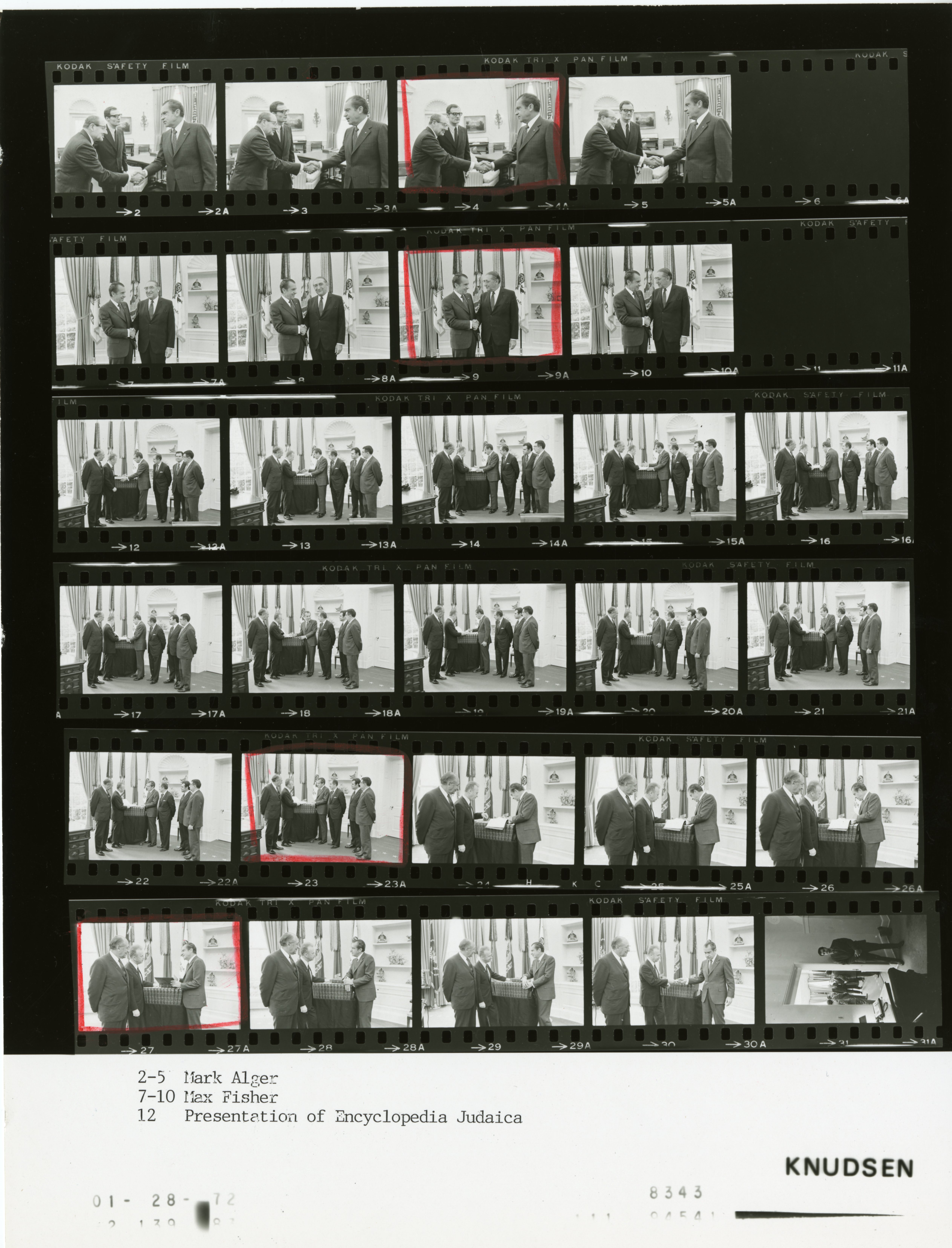
- Frame(s): WHPO-8343-02-05, President Nixon shaking hands with OMB official Mark Alger. 1/28/1972, Washington, D.C. White House, Oval Office. President Nixon, Mark Alger, unidentified man, Max Fisher, Yitzhak Rabin, Jeremiah Kaplan, Stein, Lawrence Goldberg.
- Frame(s): WHPO-8343-06-30, President Nixon shaking hands with Max Fisher. President Nixon receiving the 16 volume Encyclopedia Judaica from Israeli Ambassador Yitzhak Rabin and others. 1/28/1972, Washington, D.C. White House, Oval Office. President Nixon, Mark Alger, unidentified man, Max Fisher, Yitzhak Rabin, Jeremiah Kaplan, Stein, Lawrence Goldberg.
Roll WHPO-8344 Photographer: Knudsen, Robert L. | Color or B&W: B&W
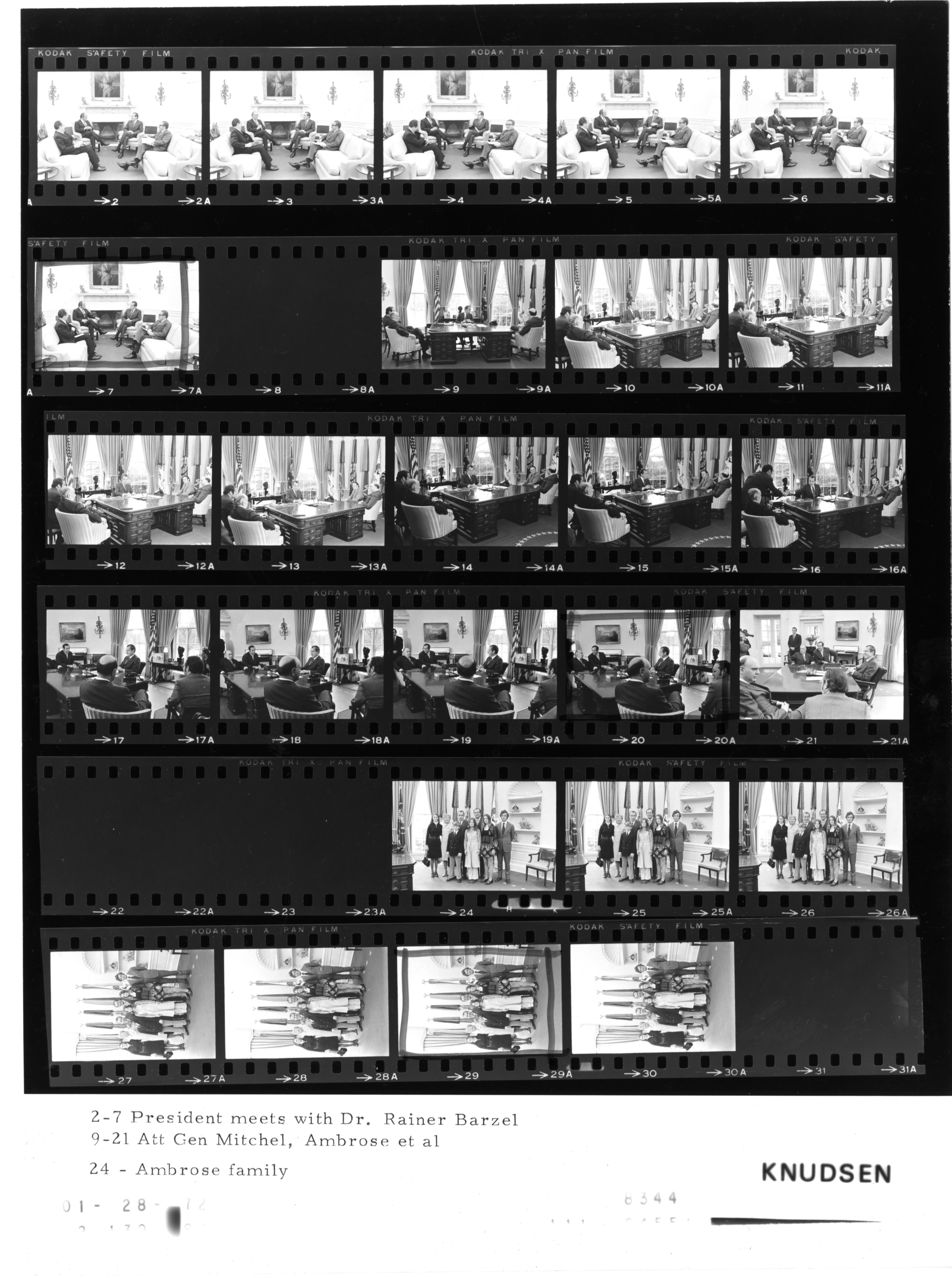
- Frame(s): WHPO-8344-02-07, President Nixon seated informally with Rainer Barzel, Henry Kissinger and Heinz Weber. 1/28/1972, Washington, D.C. White House, Oval Office. President Nixon, Rainer Barzel, Kissinger, Heinz Weber, Mitchell, Miles Ambrose, Volcker, Jerome Jaffe, Ambrose family members.
- Frame(s): WHPO-8344-09-21, President Nixon seated with officials and signing the Executive Order establishing the Drug Enforcement Program. 1/28/1972, Washington, D.C. White House, Oval Office. President Nixon, Rainer Barzel, Kissinger, Heinz Weber, Mitchell, Miles Ambrose, Volcker, Jerome Jaffe, Ambrose family members.
- Frame(s): WHPO-8344-24-30, President Nixon standing with the Ambrose family. 1/28/1972, Washington, D.C. White House, Oval Office. President Nixon, Rainer Barzel, Kissinger, Heinz Weber, Mitchell, Miles Ambrose, Volcker, Jerome Jaffe, Ambrose family members.
Roll WHPO-8345 Photographer: Schumaker, Byron | Color or B&W: B&W
- Frame(s): WHPO-8345-, Economic briefing. 1/28/1972, Washington, D.C. Press Room, White House. unidentified men.
Roll WHPO-8346 Photographer: Knudsen, Robert L. | Color or B&W: B&W
- Frame(s): WHPO-8346-, President Nixon at a meeting of the Construction Industry Collective Bargaining Commission. 1/28/1972, Washington, D.C. White House, Cabinet Room. President Nixon, Commission members.
Roll WHPO-8349 Photographer: Atkins, Oliver | Color or B&W: Color
- Frame(s): WHPO-8349-, President Nixon presenting the Medals of Freedom to Mr. & Mrs. Dewitt Clinton whjile Pat Nixon stands nearby. The Ray Conniff Singers performing in the East Room. 1/28/1972, Washington, D.C. White House, East Room. President Nixon, Pat Nixon, Mr. & Mrs. Dewitt Clinton, Ray Conniff singers.
Roll WHPO-8350 Photographer: Atkins, Oliver | Color or B&W: Color
- Frame(s): WHPO-8350-, President Nixon presenting the Medals of Freedom to Mr. & Mrs. Dewitt Clinton as Pat Nixon looks on. The Ray Conniff Singers performing. 1/28/1972, Washington, D.C. White House, East Room. President Nixon, Pat Nixon, Mr. & Mrs. Dewitt Clinton, Ray Conniff singers.
The White House Communications Agency Sound Recordings Collection contains public statements that took place between 1969 and 1974. Visit the finding aid to learn more.
G - Cabinet Officer Briefings
- WHCA-SR-G-149
Press briefing by Secretary of Labor James D. Hodgson and Undersecretary W. J. Usery, with Ronald Ziegler and Gerald Warren. (1/28/1972, Press Center)
Production credits: Audio feed supplied by WHCA; Recorded by SRJ (initials of WHCA engineer)
Original Format: 1/4-inch reel-to-reel audiotape. Original source type: Original.
H - White House Staff Member Recordings
- WHCA-SR-H-502
Press briefing with Herb Kaplow on Nixon's interview with Jerome Jaffe. (1/28/1972, Press Center, White House)
Runtime: 30:00:00
Keywords: Press conferences, news conferences, interviews, media, interviews, media
Production credits: Audio feed supplied by WHCA; Recorded by DAS (initials of WHCA engineer)
Original Format: 1/4-inch reel-to-reel audiotape. Original source type: Original.
H - White House Staff Member Recordings
- WHCA-SR-H-503
Interview with H.R. Haldeman by Barbara Walters of NBC [Possible Copyright]. (1/28/1972, West Wing, White House)
Runtime: 1:20:00
Keywords: interviews, media, television
Production credits: Audio feed supplied by NBC; Recorded by RWF (initials of WHCA engineer)
Original Format: 1/4-inch reel-to-reel audiotape. Original source type: Original.
P - Formal Presidential Remarks
- WHCA-SR-P-720114
Toast honoring Dewitt Wallace, with Wallace, Billy Graham, Secretary Rogers, Bob Hope. (1/28/1972)
Runtime: 9:34
Original Format: 1/4-inch reel-to-reel audiotape. Original source type: Original.
P - Formal Presidential Remarks
- WHCA-SR-P-720115
Remarks by President Nixon introducing entertainment honoring Dewitt Wallace with Wallace. (1/28/1972)
Runtime: 9:28
Keywords: Musician, musicians, music, celebrities, performance, American popular music
Original Format: 1/4-inch reel-to-reel audiotape. Original source type: Original.
The White House Communications Agency Videotape Collection contains “off-the-air” recordings of televised programs produced between 1968 and 1974. Visit the finding aid to learn more.
- WHCA-5010
"Garner Ted Armstrong".
Eastern Educational Network
Runtime: 00:59:06 - WHCA-5011
"Chronolog", Part I. Anthony Burgess, Raymond P. Shafer, Dr. Tom Underleider [or Ungerleider] (members of the Presidents' Commission on Marijuana and Drug Abuse).
Daphne Productions and Roland & Jaffee Productions
Runtime: 01:04:59 - WHCA-5012
Chronolog, Pt. II. Richard Nixon, news commentators.
NBC, ABC, CBS
Runtime: 01:00:02 - WHCA-5013
"Martin Agronsky: Evening Edition".
Undetermined
Runtime: 00:29:57 - WHCA-5029
Weekly News Summary, Tape I.
ALL NETWORKS
Runtime: 01:35:56
1. Howard Hughes fake autobiography hoax with book synopsis / film of author Clifford Irving's press conference with his attorney Maurice Nessen/ on camera comments by Ted Weber Jr. (spokesman for McGraw-Hill). Time Code Start: 00:00. Keywords: authors, books, publications, hoaxes, fakes, Howard Hughes, aviators, autobiographies, autobiography, media, press conferences, news conferences, interviews. Network: ABC.
2. Report on President Nixon's request for legislation to end the dock strike/ film of picketers at the U.S.-Mexico border. Time Code Start: 04:51. Keywords: harbors, Stevedores, dock workers, longshoremen, strikes, recession, inflation, wages, unemployment, trade, negotiations, trade, negotiations. Network: ABC.
3. Report on Senator McGovern's disclosure of campaign contributors and personal assets. Time Code Start: 06:59. Keywords: Presidential elections, campaigns, campaigning, candidates. Network: ABC.
4. Report on Leonard Woodcock (United Automobile Workers (UAW)) endorsement of Senator Muskie/ film of Muskie campaigning in Florida. Time Code Start: 07:26. Keywords: elections, campaigns, campaigning, candidates, leaders, labor, unions, United Auto Workers. Network: ABC.
5. Film report on Senator Hubert H. Humphrey's campaign in Wisconsin/ on camera comments by Humphrey. Time Code Start: 10:20. Keywords: Presidential elections, campaigns, campaigning, primaries, candidates, voting, speeches. Network: ABC.
6. Report on President Nixon's executive order to wipe out drug trafficking/ film of President Nixon in the White House/ on camera comments by John Mitchell and Myles Ambrose (new Head of the Drug Enforcement Office). Time Code Start: 13:06. Keywords: Presidents, laws, orders, pharmaceuticals, medicines, drugs, drug abuse, narcotics, heroin, marijuana, alcohol, alcoholism, addicts, addiction, prevention, programs, sales. Network: ABC.
7. Film report of the trial of the Harrisburg 7 (Berrigan and jury selection for the trial. Time Code Start: 15:22. Keywords: Protests, militants, bombings, violence, sabotage, shootings, kidnappings, courts, trials, investigations, prosecutions. Network: ABC.
8. Howard K. Smith: commentary on President Nixon's plan to end the Vietnam War. Time Code Start: 17:39. Keywords: Vietnam War, endings. Network: ABC.
9. Report on President Nixon's request for legislation to end the dock strike/ film of picketers at the U.S.-Mexico border/ on camera comments by James Hodgson. Time Code Start: 19:19. Keywords: harbors, Stevedores, dock workers, longshoremen, strikes, recession, inflation, wages, unemployment, trade, negotiations, trade, negotiations. Network: NBC.
10. David Brinkley commentary on the Congress' refusal to move against the dock workers. Time Code Start: 23:18. Keywords: harbors, Stevedores, dock workers, longshoremen, strikes, recession, inflation, wages, unemployment, trade, negotiations, trade, negotiations, House of Representatives. Network: NBC.
11. Report on Leonard Woodcock (United Automobile Workers (UAW)) endorsement of Senator Muskie. Time Code Start: 25:27. Keywords: leaders, labor, unions, United Auto Workers. Network: NBC.
12. Report on government removing six U.S. cities from the over 6% unemployment rate list. Time Code Start: 27:02. Keywords: jobs, unemployment, statistics. Network: NBC.
13. Report on Federal Food and Drug Administration (FDA) order on limits on saccharin. Time Code Start: 27:22. Keywords: food, sugar substitutes, artificial sweetners. Network: NBC.
14. Chancellor: Report on the lowering of the Prime Rate and the increase on the stock exchange. Time Code Start: 27:46. Keywords: credit rates, APR, borrowing, lending, mortgages, banks, stock markets, investments, securities, Wall Street, Dow Jones, New York Stock Exchange, NASDAQ, finances, recession, inflation, money, credit, loans, decreases. Network: NBC.
15. Nevada Supreme Court order to force Howard Hughes to testify/ film report on Hughes telephone news conference in Las Vegas/ interview with Maheu on Hughes autobiography book. Time Code Start: 28:09. Keywords: authors, books, publications, hoaxes, fakes, Howard Hughes, autobiographies, autobiography, media, press conferences, news conferences, interviews, lawsuits, courts, trials, testify, testimony, investigations, aviators, celebrities, executives. Network: NBC.
16. Report on President Nixon's executive order to wipe out drug trafficking. Time Code Start: 31:41. Keywords: Presidents, laws, orders, pharmaceuticals, medicines, drugs, drug abuse, narcotics, heroin, marijuana, alcohol, alcoholism, addicts, addiction, prevention, programs, sales. Network: CBS.
17. Report on North Vietnam's consideration of Allied Peace Proposal. Time Code Start: 32:32. Keywords: Paris Peace Talks, Vietnam War, treaty, treaties, negotiations. Network: CBS.
18. Film report on fighting in Vietnam and potential Communist offense. Time Code Start: 32:56. Keywords: Vietnam War, reports. Network: CBS.
19. Film report on increased leisure time and prositution in South Vietnam for U.S. GI's. Time Code Start: 35:07. Keywords: Vietnam War, troops, prostitutes, pornography, prostitution, sex, sexuality. Network: CBS.
20. Film report on Governor George Wallace's entry as a Democratic candidate/ news conference in Florida. Time Code Start: 38:33. Keywords: Governors, Presidential elections, campaigns, primaries, candidates. Network: CBS.
21. Report on Leonard Woodcock (United Automobile Workers (UAW)) endorsement of Senator Muskie/ report on Senator McGovern's disclosure of campaign contributors and personal assets. Time Code Start: 39:59. Keywords: leaders, labor, unions, United Auto Workers. Network: CBS.
22. Report of Federal Communication Commisssion (FCC) dropping Bell Telephone investigation. Time Code Start: 40:31. Keywords: media, radio, broadcastings, telecommunication, organizations, agencies, investigations, ending. Network: CBS.
23. Report on President Nixon's request for legislation to end the dock strike/ film of picketers at the U.S.-Mexico border. Time Code Start: 40:48. Keywords: harbors, Stevedores, dock workers, longshoremen, strikes, recession, inflation, wages, unemployment, trade, negotiations, trade, negotiations. Network: CBS.
24. Report on Presidential candidates response to President Nixon's peace proposal and their intentions re: Vietnam War. Time Code Start: 41:25. Keywords: Paris Peace Talks, Vietnam War, treaty, treaties, negotiations. Network: CBS.
25. Sevareid: Commentary on proposals for changing old political campaign system. Time Code Start: 45:16. Keywords: bills, laws, reforms, Presidential elections, campaigns, campaigning, candidates, costs, finances, funding. Network: CBS.
Context (External Sources)
The Vanderbilt Television News Archive is the world's most extensive and complete archive of television news. They have been recording, preserving and providing access to television news broadcasts of the national networks since August 5, 1968.
Wikipedia is a free encyclopedia that anyone can edit.