
Introduction
This almanac page for Thursday, January 11, 1973, pulls together various records created by the federal government and links to additional resources which can provide context about the events of the day.
Previous Date: Wednesday, January 10, 1973
Next Date: Friday, January 12, 1973
Schedule and Public Documents
The Daily Diary files represent a consolidated record of the President's activities. Visit the finding aid to learn more.
The President's day began at The White House - Washington, D. C.
The Weekly Compilation of Presidential Documents made available transcripts of the President's news conferences; messages to Congress; public speeches, remarks, and statements; and other Presidential materials released by the White House.
Digitized versions can be found at HathiTrust.
Each Public Papers of the Presidents volume contains the papers and speeches of the President of the United States that were issued by the White House Office of the Press Secretary during the time period specified by the volume. The material is presented in chronological order, and the dates shown in the headings are the dates of the documents or events. In instances when the release date differs from the date of the document itself, that fact is shown in the text note.
To ensure accuracy, remarks have been checked against audio recordings (when available) and signed documents have been checked against the original, unless otherwise noted. Editors have provided text notes and cross references for purposes of identification or clarity.
The Federal Register is the official daily publication for rules, proposed rules, and notices of federal agencies and organizations, as well as executive orders and other Presidential documents.
The Congressional Record is the official daily record of the debates and proceedings of the U.S. Congress.
Archival Holdings
Any selection of archival documents will necessarily be partial. You should use the documents and folders identified below as a starting place, but consult the linked collection finding aids and folder title lists and the collections themselves for context. Many documents to be found this way do not lend themselves to association with specific dates, but are essential to a complete understanding of the material.
Selective document listing
President's Office Files
The President's Office Files consists of materials drawn together by the Special Files Unit from several administrative subdivisions within the White House Office. It is the handwriting and sensitive papers sent to the Staff Secretary that now comprise much of the President's Office Files. Visit the finding aid to learn more.
- News Summaries, Unmarked News Summaries, Box 53, News Summaries - January 2 to 11, 1973 [2 of 7] [Note: Due to the way News Summary products were compiled, you should also consult nearby days for potentially relevant materials.]
- News Summary, January 11, 1973 (Wednesday nets, wires)
The H. R. Haldeman Diaries consists of seven handwritten diaries, 36 dictated diaries recorded as sound recordings, and two handwritten audio cassette tape subject logs. The diaries and logs reflect H. R. Haldeman’s candid personal record and reflections on events, issues, and people encountered during his service in the Nixon White House. As administrative assistant to the President and Chief of Staff, Haldeman attended and participated in public events and private meetings covering the entire scope of issues in which the Nixon White House engaged in during the years 1969-1973. Visit the finding aid to learn more.
- Transcript of diary entry (PDF)
Thursday, January 11.
The President got into the Frank Stanton appointment problem this morning, in that we're in a bind on the American Red Cross pushing us as chairman there, plus Hobe Lewis pushing to keep him on the USIA board. He thinks that our original plan to keep him off of both things is probably wrong. We're taking him on too frontally; that we ought to let him do something, so we don't appear too vindictive, and on a vendetta. So we should let him have the Red Cross, which is a non-governmental thing and dump him off of the USIA, which clearly is our appointment. He thinks Colson ought to call Stanton and clear that up and let him have the Red Cross thing.
Also got into the Klein question. Said we ought to tell him to go ahead and go, as we had originally planned but that he has the President's total support. The President is concerned about the California operation. He wants it really nailed down. He thinks Copley sounds like the best thing; the President will do anything to help him, but doesn't want to hurt anything, so maybe he should stay out of it. In the meantime, Herb should go on doing all the public appearances and so on, but not get bogged down in details here.
On the Watergate question, he wanted me to talk to Mitchell and find out -- have him find out from DeLoach if the guy who did the bugging on us in '68 is still at the FBI. And then Gray should nail him with a lie detector and get it settled, which would give us the evidence we need. He also thinks I ought to move with George Christian -- get LBJ to use his influence to turn off the Hill investigation with Califano, Hubert and so on. Later in the day, he decided that wasn't such a good idea and told me not to do it, which I fortunately hadn't done.
Henry phoned this morning from Paris and said that there would be a cable coming in a couple of hours. That he got 80 percent of what the President asked for in his cable, or at least it would be do-able. And it would be consistent with what Henry had said, along the lines we want, and that we had gotten 100 percent on substance. He seemed pretty pleased. They had a six hour meeting today, and the cable came in later. It turned out he basically had gotten everything we want. And that he'll do the signing in Paris rather than Hanoi, which is the key thing, and set the date for the 23rd with an announcement, after Haig gets back from South Vietnam, if we get Thieu to go along. We would say that we have a basic solution, that Henry will be going to Paris on the 23rd to finalize the details. The President got into some concern about how we deal with Congress and with Henry during the intervening week -- next week -- and that lead into the question of going to Florida, which he wants to do. And we basically decided to go on down to Florida this went back and forth during the day, but ended up with the decision to go to Florida and have Henry come there, meet with Haig on Sunday and have Haig leave for Saigon from Florida.
Later in the afternoon with Ziegler in there, the President said he had written out the announcement for Ron to use, the line. And also Kissinger's line to use to the leaders, and the line that Rogers, Laird and all the rest should use. Ken got back into the problem of keeping the lid on next week, and the question of how we handle the time as in-between developments, which will be tough, it's going to be a hard week. He's very anxious, though, to get to Florida and thinks by getting Henry down there, it may work out pretty well, and I think he's right.
The Vice President requested a meeting with the President today and came in with an incredible proposal. He thought there’s -- something ought to be done to divert public attention from Vietnam and the attacks we're getting into on it. He suggested that he take a trip to Egypt to visit Sadat, and see if he could try and untangle something on the Middle East. The President was obviously so astonished he didn't know quite how to answer the thing at first. But then made the point that the likelihood of anything good coming out of such a trip was almost zero, and that it would be very unwise for the Vice President to take the risk of being rebuffed at that high a level, so on -- which was a nice way of getting him out of it. It was obvious that the Vice President kept pushing it, and saying, well, you know I could do it because of Sadat's threats, and all that sort of thing. And we finally got through to him that the President had no intention of letting him go, so he backed off of that. Then admitted that really what he was after was a way to rebuild his own image. And that he's being attacked because the one substantive thing that he had, the intergovernmental relations, had been taken away from him, so he had nothing really of importance to do.
He then got into a little general discussion on politics. He's determined to try and have Mathias defeated in the primary next year, thinks Rog Morton will go for the seat. Also, he and the President agreed that Saxbe should be defeated if possible. The meeting wasn’t really very productive because of the total ludicrousness of the VEEP's reason for coming in.
Later in the day, the President got into the problem of second term goals. Says we don't have goals set on a specific basis, that we really need three, and we need to know what are they? He had obviously been working on the idea, and had a list of things like: environment, crime and drugs, health, labor, land use and so on and domestic area. And said of course, we also have to have the political goals, like the new majority, the new establishment, candidate development, and then sort of Presidential goals -- like respect for the office, respect for the flag, a return to idealism and that sort of thing. He thinks everyone now is so bound up in details that they're leaving the substance of the mechanics, and we're not getting this worked out, and that we've got to get to the three or four points that we want to leave. The things that we want to bring home to the American people -- what are we going to be remembered for?
The domestic list that Ehrlichman prepared has to be cut, and we need some form to it and to establish priorities, rather than try to do everything. Wanted me to explain to Ehrlichman, Colson and so on, that now through the Inauguration, he'll be out of circulation, completely isolated. And agreed that in the meantime I could get a group doing memos on the goal project.
He went back and forth on when and how to go to Florida, and finally ended up that he'll go down tomorrow afternoon and take Price with him, say he's working on the Inaugural, State of the Union and other messages. And that he'll be there two to three days, and that if Henry returns before he comes back, he'll come directly to Florida. He originally was going to have Haig go down with him, but dropped that and will have him come later.
End of January 11. - Original audio recording (MP3)
The National Archives Catalog is the online portal to the records held at the National Archives, and information about those records. It is the main way of describing our holdings and also provides access to electronic records and digitized versions of our holdings.
The Catalog searches across multiple National Archives resources at once, including archival descriptions, digitized and electronic records, authority records, and web pages from Archives.gov and the Presidential Libraries. The Catalog also allows users to contribute to digitized historical records through tagging and transcription.
Nixon Library Holdings
All National Archives Units
National Security Documents
The President's Daily Brief is the primary vehicle for summarizing the day-to-day sensitive intelligence and analysis, as well as late-breaking reports, for the White House on current and future national security issues. Read "The President's Daily Brief: Delivering Intelligence to Nixon and Ford" to learn more.
The Foreign Relations of the United States series presents the official documentary historical record of major U.S. foreign policy decisions and significant diplomatic activity. Visit the State Department website for more information.
Vol. IX, Vietnam, October 1972-January 1973
America Leaves the War, December 30, 1972-January 27, 1973
261. Message From the Vice Chief of Staff of the Army (Haig) to the President’s Assistant for National Security Affairs (Kissinger) in Paris, Washington, January 11, 1973, 0317Z
Source: National Archives, Nixon Presidential Materials, NSC Files, Kissinger Office Files, Box 28, HAK Trip Files, HAK Paris Trip Tohak 67–146, January 7–14, 1973. Top Secret; Sensitive; Exclusively Eyes Only. Sent via Guay. Written on January 10.
262. Message From the President’s Assistant for National Security Affairs (Kissinger) to President Nixon, Paris, January 11, 1973, 0828Z
Source: National Archives, Nixon Presidential Materials, NSC Files, Kissinger Office Files, Box 28, HAK Trip Files, HAK Paris Trip Hakto 1–48, January 7–14, 1973. Top Secret; Sensitive; Exclusively Eyes Only. Sent via Guay and Kennedy.
263. Message From the President’s Assistant for National Security Affairs (Kissinger) to President Nixon, Paris, January 11, 1973, 1735Z
Source: National Archives, Nixon Presidential Materials, NSC Files, Kissinger Office Files, Box 28, HAK Trip Files, HAK Paris Trip Hakto 1–48, January 7–14, 1973. Top Secret; Flash; Sensitive; Exclusively Eyes Only. Sent via Guay and Kennedy.
264. Message From Richard T. Kennedy of the National Security Council Staff to the President’s Assistant for National Security Affairs (Kissinger) in Paris, Washington, January 11, 1973, 1752Z
Source: National Archives, Nixon Presidential Materials, NSC Files, Kissinger Office Files, Box 28, HAK Trip Files, HAK Paris Trip Tohak 67–146, January 7–14, 1973. Top Secret; Flash; Sensitive; Exclusively Eyes Only. Sent via Guay.
265. Message From the President’s Assistant for National Security Affairs (Kissinger) to Richard T. Kennedy of the National Security Council Staff and the President’s Military Assistant (Scowcroft), Paris, January 11, 1973, 1810Z
Source: National Archives, Nixon Presidential Materials, NSC Files, Kissinger Office Files, Box 28, HAK Trip Files, HAK Paris Trip Hakto 1–48, January 7–14, 1973. Top Secret; Flash; Sensitive; Exclusively Eyes Only.
266. Message From the President’s Assistant for National Security Affairs (Kissinger) to President Nixon, Paris, January 11, 1973, 2240Z
Source: National Archives, Nixon Presidential Materials, NSC Files, Kissinger Office Files, Box 28, HAK Trip Files, HAK Paris Trip Hakto 1–48, January 7–14, 1973. Top Secret; Flash; Sensitive; Exclusively Eyes Only. Sent via Kennedy.
Vol. XV, Soviet Union, June 1972-August 1974
Summit Preparations; Jackson-Vanik Amendment; Non-Use of Nuclear Weapons, December 1972-April 1973
73. Memorandum From the Director of Central Intelligence (Helms) to the President’s Assistant for National Security Affairs (Kissinger), Washington, January 11, 1973
[Source: Central Intelligence Agency, Job 80–M01048A, Box 8, Tensions in the USSR. Sensitive; Secret; Eyes Only. 2 pages not declassified.]
Vol. XXI, Chile, 1969-1973
"That Chilean Guy May Have Some Problems": The Downfall of Salvador Allende, January-September 1973
317. Memorandum, Washington, January 11, 1973
Source: National Security Council, Nixon Intelligence Files, Subject File, Chile 1973. Secret; Sensitive; Eyes Only. This summarizes a more detailed January 11 memorandum from the Chief of Station to Davis. See Document 129 in Foreign Relations, 1969–1976, vol. E–16, Documents on Chile, 1969–1973. A January 11 covering memorandum from Shackley to Meyer, requested Meyer’s and Davis’s concurrence with passing [text not declassified] for a get-out-the-vote campaign. A January 11 memorandum from Shackley to Jorden requested Jorden’s support to spend the money. Jorden concurred in an attached January 19 memorandum to Shackley. (Both in the National Security Council, Nixon Intelligence Files, Subject File, Chile 1973)
Vol. XXV, Arab-Israeli Crisis and War, 1973
Arab-Israeli Crisis and War, 1973
2. Memorandum From Harold H. Saunders of the National Security Council Staff to the President’s Assistant for National Security Affairs (Kissinger), Washington, January 11, 1973
Source: National Archives, Nixon Presidential Materials, NSC Files, Box 757, Presidential Correspondence, 1969–1974, Jordan–King Hussein. Secret; Nodis. Sent for action.
Vol. XLII, Vietnam: The Kissinger-Le Duc Tho Negotiations
Settlement Accomplished: The Accords Initialed and Signed, January 1973
45. Memorandum of Conversation, Paris, January 11, 1973, 10 a.m.-4 p.m.
Source: National Archives, Nixon Presidential Materials, NSC Files, Box 866, For the President’s Files (Winston Lord)—China Trip/Vietnam Negotiations, Camp David Memcons, January 8–13, 1973 [January 23, 1973]. Top Secret; Sensitive; Exclusively Eyes Only. The meeting took place at La Fontaine au Blanc, St. Nom la Bretèche. All brackets are in the original. The tabs are attached but not printed; on Tab D, see Appendix 3.
In Kissinger’s report to Nixon on the day’s meeting, he noted: “We finished the complete text of the agreement, including the provisions for signature.” With the final text in hand, Kissinger focused on obtaining the agreement of South Vietnamese President Thieu: “Our major problem now, of course, is Saigon. I believe the only way to bring Thieu around will be to tell him flatly that you will proceed, with or without him. If he balks and we then initial, there will still be 3 to 4 days between initialing and signing for the pressures to build up. I have already told Le Duc Tho that we would have to discuss the situation in this eventuality. In any event, if we once again delay the initialing or reopen the negotiations, we would not only jeopardize but certainly lose everything that has been achieved.” (Foreign Relations, 1969–1976, vol. IX, Vietnam, October 1972–January 1973, Document 263)
Nixon replied quickly, in full agreement with Kissinger: “I also totally agree that we must go ahead with the agreement with Hanoi regardless of whether Thieu goes along or not. If we cannot deliver Thieu, we then obviously will have the problem of Hanoi’s reaction. In that event, there would be no Presidential announcement made on Thursday, January 18. Instead, we would have Haig delay his return so that there would be no pressure for an announcement until after January 20. Then, on January 22, I would make an announcement that we had reached an agreement in principle with the North Vietnamese and call on Thieu to adhere to it. I have already told Haig that he is to tell Thieu that we are not going to negotiate with him but rather that we will proceed and we are presenting this, in effect, on a take-it-or-leave-it basis.” (Ibid., Document 264)
Vol. E-16, Documents on Chile, 1969-1973
"That Chilean Guy May Have Some Problems": The Downfall of Salvador Allende, January-September 1973
129. Memorandum From the Central Intelligence Agency to the Ambassador to Chile (Davis), Washington, January 11, 1973
Summary: This memorandum responded to questions raised by Ambassador Davis concerning the proposal to fund private-sector opposition groups in Chile.
Source: National Security Council, Nixon Intelligence Files, Subject Files, Chile 1973–. Secret; Sensitive; Eyes Only. Initialed by Shackley. Attachment A is not attached.
The Kissinger telephone conversation transcripts consist of approximately 20,000 pages of transcripts of Kissinger’s telephone conversations during his tenure as Assistant to the President for National Security Affairs (1969-1974) and Secretary of State (1973-1974) during the administration of President Richard Nixon. Visit the finding aid for more information.
Digitized versions can be found in the National Archives Catalog.
Audiovisual Holdings
Visit the White House Tapes finding aid to learn about the taping system's operation and archival processing.
Old Executive Office Building
- 401-17; Unknown between 1:05 p.m. & 2:11 p.m.; Nixon, Richard M. (President); [Unknown person(s)]
- 401-18; Unknown between 1:05 p.m. & 2:11 p.m.; Nixon, Richard M. (President); Sanchez, Manolo
- 401-19; Unknown between 1:05 p.m. & 2:11 p.m.; Nixon, Richard M. (President); Sanchez, Manolo
- 401-20; Unknown between 1:05 p.m. & 2:11 p.m.; Nixon, Richard M. (President); Sanchez, Manolo
- 401-21; Unknown between 1:05 p.m. & 2:11 p.m.; Nixon, Richard M. (President); White House operator
- 401-22; 2:11 p.m. - 2:12 p.m.; Nixon, Richard M. (President); Cox, Tricia Nixon
- 401-23; Unknown between 2:12 p.m. & 2:17 p.m.; Nixon, Richard M. (President); Sanchez, Manolo
- 401-24; Unknown between 2:12 p.m. & 2:17 p.m.; Nixon, Richard M. (President); White House operator
- 401-25; 2:17 p.m. - 2:18 p.m.; Nixon, Richard M. (President); Kennedy, Richard T. (Col.)
- 401-26; 2:30 p.m. - 3:15 p.m.; Nixon, Richard M. (President); Kennedy, Richard T. (Col.); [Unknown person(s)]
- 401-27; Unknown between 3:15 p.m. & 3:19 p.m.; Nixon, Richard M. (President); Haldeman, H. R. ("Bob")
- 401-28; Unknown between 3:15 p.m. & 3:19 p.m.; Nixon, Richard M. (President); White House operator
- 401-29; 3:19 p.m. - 3:20 p.m.; Nixon, Richard M. (President); Ziegler, Ronald L.
- 401-30; Unknown between 3:20 p.m. & 3:24 p.m.; Nixon, Richard M. (President); Sanchez, Manolo
- 401-31; 3:24 p.m. - 4:35 p.m.; Nixon, Richard M. (President); Ziegler, Ronald L.; Haldeman, H. R. ("Bob"); [Unknown person(s)]
- 401-32; Unknown between 1:05 p.m. & 2:11 p.m.; Nixon, Richard M. (President); [Unknown person(s)]
- 401-33; Unknown between 1:05 p.m. & 2:11 p.m.; Nixon, Richard M. (President); [Unknown person(s)]
- 402-1; Unknown between 4:35 p.m. & 5:30 p.m.; Nixon, Richard M. (President); Haldeman, H. R. ("Bob"); Kendall, William T.; White House operator; Sanchez, Manolo; Brinegar, Claude S.; Dent, Harry S.; Shultz, George P.; Ziegler, Ronald L.
Oval Office
- 838-1; Unknown between 8:29 a.m. & 8:36 a.m.; Nixon, Richard M. (President); Bull, Stephen B.
- 838-2; Unknown between 8:36 a.m. & 9:04 a.m.; Nixon, Richard M. (President); Acker, Marjorie P.
- 838-3; Unknown between 8:36 a.m. & 9:04 a.m.; Nixon, Richard M. (President); Sanchez, Manolo
- 838-4; Unknown between 8:36 a.m. & 9:04 a.m.; Nixon, Richard M. (President); Haldeman, H. R. ("Bob")
- 838-5; Unknown between 8:36 a.m. & 9:04 a.m.; Nixon, Richard M. (President); Haldeman, H. R. ("Bob")
- 838-6; Unknown between 8:36 a.m. & 9:04 a.m.; Nixon, Richard M. (President); Haldeman, H. R. ("Bob")
- 838-7; Unknown between 8:36 a.m. & 9:04 a.m.; Nixon, Richard M. (President); [Unknown person(s)]
- 838-8; Unknown between 8:36 a.m. & 9:04 a.m.; Nixon, Richard M. (President); Bull, Stephen B.
- 838-9; Unknown between 8:36 a.m. & 9:04 a.m.; Nixon, Richard M. (President); Bull, Stephen B.
- 838-10; Unknown between 8:36 a.m. & 9:04 a.m.; Nixon, Richard M. (President); White House operator
- 838-11; 9:04 a.m. - 9:42 a.m.; Nixon, Richard M. (President); Kennedy, Richard T. (Col.); Brennan, Peter J.
- 838-12; 9:42 a.m. - 9:43 a.m.; Nixon, Richard M. (President); Lynn, James T.
- 838-13; Unknown between 9:43 a.m. & 9:46 a.m.; Nixon, Richard M. (President); Bull, Stephen B.
- 838-14; Unknown between 9:43 a.m. & 9:46 a.m.; Nixon, Richard M. (President); Sanchez, Manolo
- 838-15; 9:46 a.m. - 10:03 a.m.; Nixon, Richard M. (President); Timmons, William E.
- 838-16; Unknown between 10:03 a.m. & 10:05 a.m.; Nixon, Richard M. (President); Bull, Stephen B.
- 838-17; 10:05 a.m. - 10:16 a.m.; Nixon, Richard M. (President); Ziegler, Ronald L.
- 838-18; 10:20 a.m. - 11:03 a.m.; Nixon, Richard M. (President); Haldeman, H. R. ("Bob"); White House operator; [Unknown person(s)]; Agnew, Spiro T. (Vice President)
- 838-19; 11:03 a.m. - 1:00 p.m.; Nixon, Richard M. (President); Train, Russell E.; Busterude, John; Willard, Beatrice ("Bettie"); Fairbanks, Richard M., III; Ehrlichman, John D.; Atkins, Oliver F. ("Ollie"); Agnew, Spiro T. (Vice President); Haldeman, H. R. ("Bob"); Timmons, William E.; Bull, Stephen B.; Sanchez, Manolo
- 838-20; Unknown between 1:00 p.m. & 1:04 p.m.; Nixon, Richard M. (President); Sanchez, Manolo
- 838-21; Unknown between 1:00 p.m. & 1:04 p.m.; Nixon, Richard M. (President); Butterfield, Alexander P.
- 838-22; Unknown between 1:04 p.m. & 11:59 p.m.; [Unknown person(s)]; Butterfield, Alexander P.
White House Telephone
- 35-127; Unknown between 8:36 a.m. & 9:04 a.m.; Nixon, Richard M. (President); White House operator
- 35-128; 9:08 a.m. - 9:09 a.m.; Nixon, Richard M. (President); Brennan, Peter J.
- 35-129; Unknown between 9:09 a.m. & 9:42 a.m.; Nixon, Richard M. (President); White House operator; Kennedy, Richard T. (Col.)
- 35-130; 9:42 p.m. - 9:43 p.m.; Nixon, Richard M. (President); Lynn, James T.
- 35-131; Unknown between 10:20 a.m. & 11:03 a.m.; Haldeman, H. R. ("Bob"); White House operator; [Unknown person(s)]
- 35-132; Unknown between 12:14 p.m. & 1:00 p.m.; Haldeman, H. R. ("Bob"); White House operator; Timmons, William E.
- 35-133; Unknown between 1:05 p.m. & 2:11 p.m.; Nixon, Richard M. (President); White House operator
- 35-134; 2:11 p.m. - 2:12 p.m.; Nixon, Richard M. (President); Cox, Tricia Nixon; Cox, Edward R. F.
- 35-135; Unknown between 2:12 p.m. & 2:17 p.m.; Nixon, Richard M. (President); White House operator
- 35-136; 2:17 p.m. - 2:18 p.m.; Nixon, Richard M. (President); Kennedy, Richard T. (Col.)
- 35-137; Unknown between 3:15 p.m. & 3:19 p.m.; Nixon, Richard M. (President); White House operator
- 35-138; 3:19 p.m. - 3:20 p.m.; Nixon, Richard M. (President); Ziegler, Ronald L.
- 35-139; 3:55 p.m. - 3:56 p.m.; Haldeman, H. R. ("Bob"); Nixon, Richard M. (President)
- 35-140; Unknown between 3:57 p.m. & 4:15 p.m.; Nixon, Richard M. (President); White House operator
- 35-141; 4:15 p.m. - 4:17 p.m.; Nixon, Richard M. (President); Kennedy, Richard T. (Col.)
- 35-142; Unknown between 4:35 p.m. & 5:02 p.m.; Nixon, Richard M. (President); White House operator
- 35-143; 5:02 p.m. - 5:03 p.m.; Nixon, Richard M. (President); Bond, Christopher S.
- 35-144; Unknown between 5:03 p.m. & 5:10 p.m.; Nixon, Richard M. (President); White House operator
- 35-145; 5:10 p.m. - 5:11 p.m.; Nixon, Richard M. (President); Dent, Frederick B.
- 35-146; Unknown between 5:11 p.m. & 5:12 p.m.; Nixon, Richard M. (President); White House operator
- 35-147; 5:12 p.m. - 5:13 p.m.; Nixon, Richard M. (President); Shultz, George P.
- 35-148; Unknown between 5:30 p.m. & 6:07 p.m.; Nixon, Richard M. (President); White House operator
- 35-149; 6:07 p.m. - 6:10 p.m.; Nixon, Richard M. (President); Haldeman, H. R. ("Bob")
The White House Photo Office collection consists of photographic coverage of President Richard Nixon meeting with prominent social, political, and cultural personalities; speaking engagements and news conferences of the President and various high-ranking members of the White House staff and Cabinet; Presidential domestic and foreign travel, including Presidential vacations; social events and entertainment involving the First Family, including entertainers present; official portraits of the President, First Family, and high-ranking members of the Nixon administration; the 1969 and 1973 Inaugurals; the President’s 1972 Presidential election campaign appearances (including speeches) and other official activities of the White House staff and the President’s Cabinet from January 20, 1969 until August 9, 1974 at the White House and the Old Executive Office Building; other locations in Washington, DC, such as The Mall; and the Presidential retreats in Camp David, Maryland, Key Biscayne, Florida, and San Clemente, California. Visit the finding aid to learn more.
Roll WHPO-D1197 Photographer: Schumacher, Karl | Color or B&W: B&W
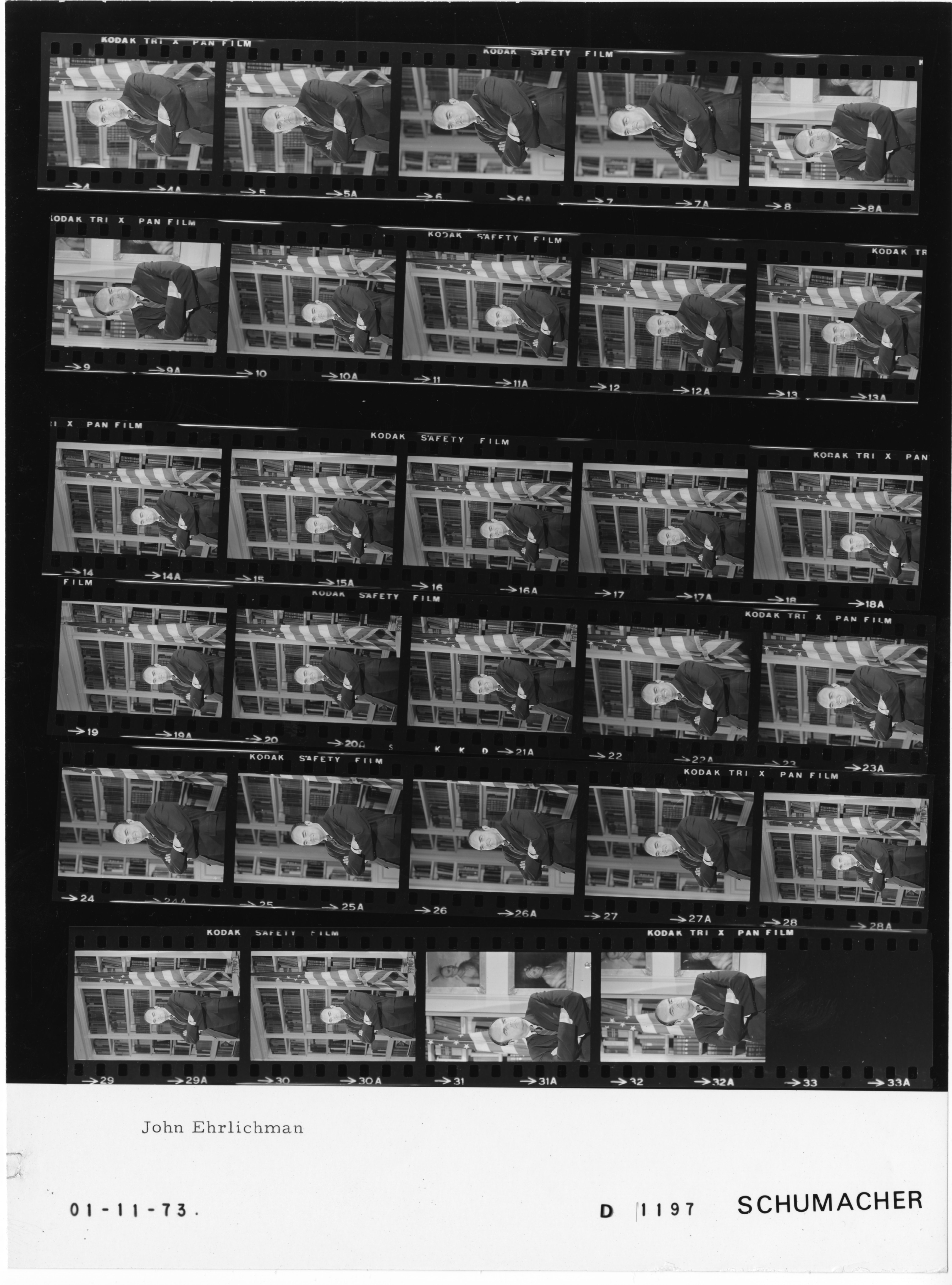
- Frame(s): WHPO-D1197-04A-32A, Portrait of John Ehrlichman standing with his arms crossed. 1/11/1973, Washington, D.C. White House, Library. John Ehrlichman.
Roll WHPO-D1198 Photographer: Schumacher, Karl | Color or B&W: B&W

- Frame(s): WHPO-D1198-03-28, Seated portrait study of John Ehrlichman. 1/11/1973, Washington, D.C. White House, Library. John Ehrlichman.
Roll WHPO-D1199 Photographer: Royer | Color or B&W: B&W
- Frame(s): WHPO-D1199-05-34, Roy Ash seated while being interviewed by Mr. Inglehart. 1/11/1973, Washington, D.C. unknown office. Roy Ash, Mr. Inglehart.
Roll WHPO-D1200 Photographer: Schumacher, Karl | Color or B&W: B&W
- Frame(s): WHPO-D1200-01-04, 05, 07, Candid portraits of President Nixon, while seated. 1/11/1973, Washington, D.C. unknown. President Nixon.
- Frame(s): WHPO-D1200-03, Portrait of President Nixon seated while resting his head. 1/11/1973, Washington, D.C. unknown. President Nixon.
Roll WHPO-D1201 Photographer: Atkins, Oliver | Color or B&W: B&W
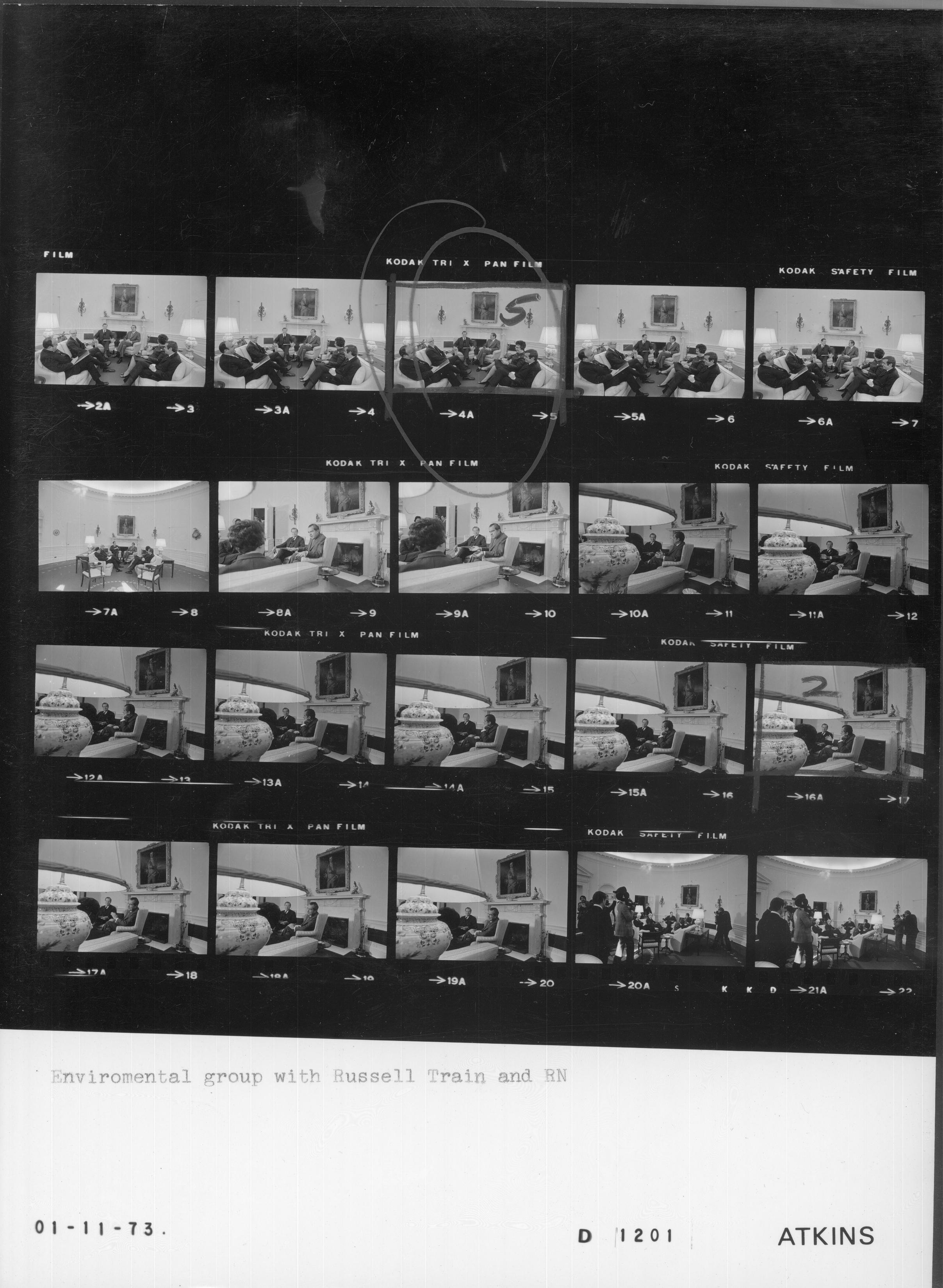
- Frame(s): WHPO-D1201-02A-19A, President Nixon seated with members of the Council on Environmental Quality. 1/11/1973, Washington, D.C. White House, Oval Office. President Nixon, John Ehrlichman, John Busterud, Russell Train, Betty Willard, Richard Fairbanks, press corps members.
- Frame(s): WHPO-D1201-20A-21A, Reporters and Press photographers surround President Nixon seated with members of the Council on Environmental Quality. 1/11/1973, Washington, D.C. White House, Oval Office. President Nixon, John Ehrlichman, John Busterud, Russell Train, Betty Willard, Richard Fairbanks, press corps members.
Roll WHPO-D1202 Photographer: Atkins, Oliver | Color or B&W: B&W
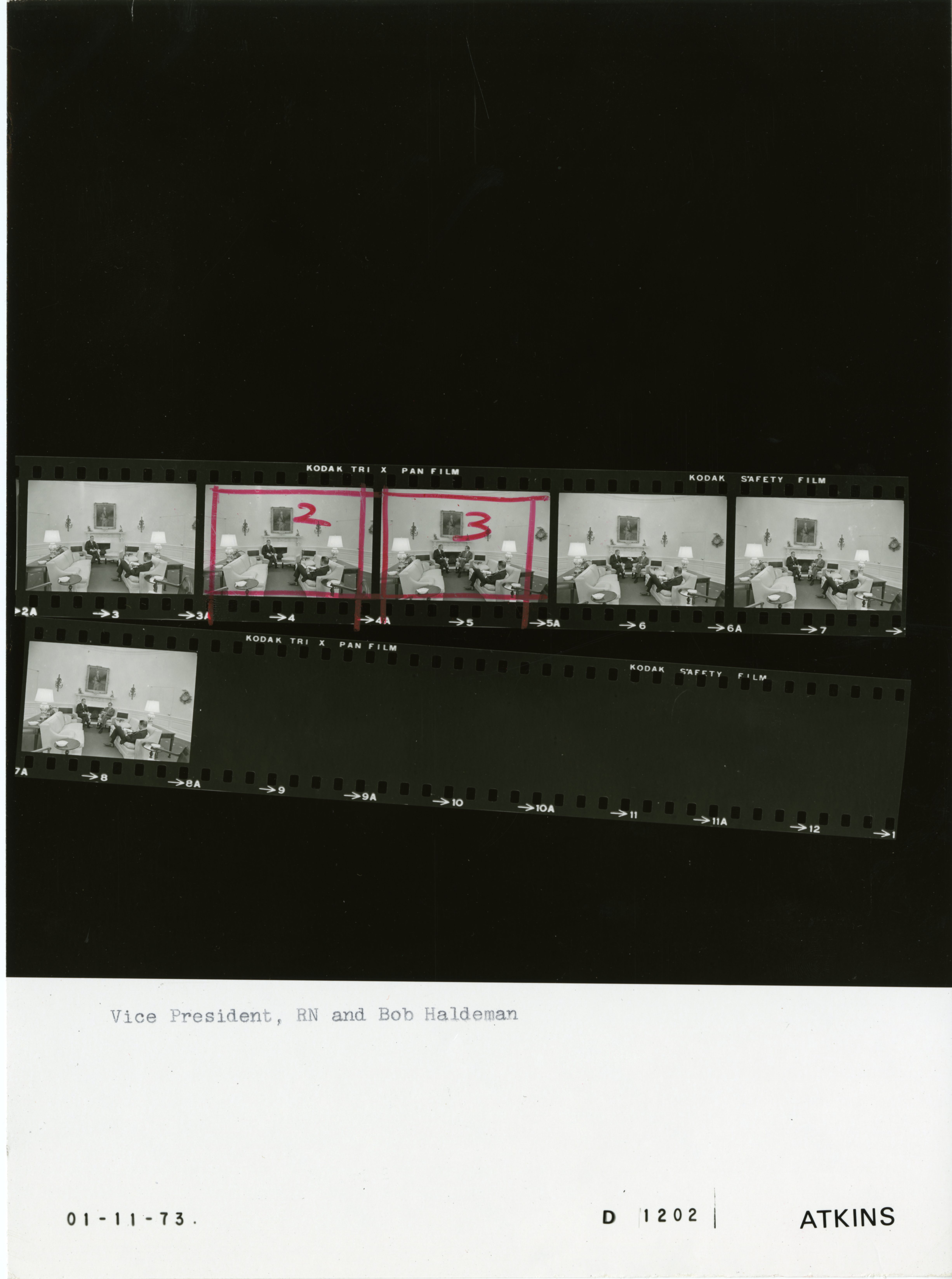
- Frame(s): WHPO-D1202-03-04, Vice President Agnew seated in the Oval Office while speaking with H.R. Haldeman seated on the couch. 1/11/1973, Washington, D.C. White House, Oval Office. Spiro Agnew, H.R. Haldeman.
- Frame(s): WHPO-D1202-05-08, President Nixon seated in an Oval Office meeting with Vice President Agnew and H.R. Haldeman. 1/11/1973, Washington, D.C. White House, Oval Office. President Nixon, Spiro Agnew, H.R. Haldeman.
Roll WHPO-D1203 Photographer: Royer | Color or B&W: B&W
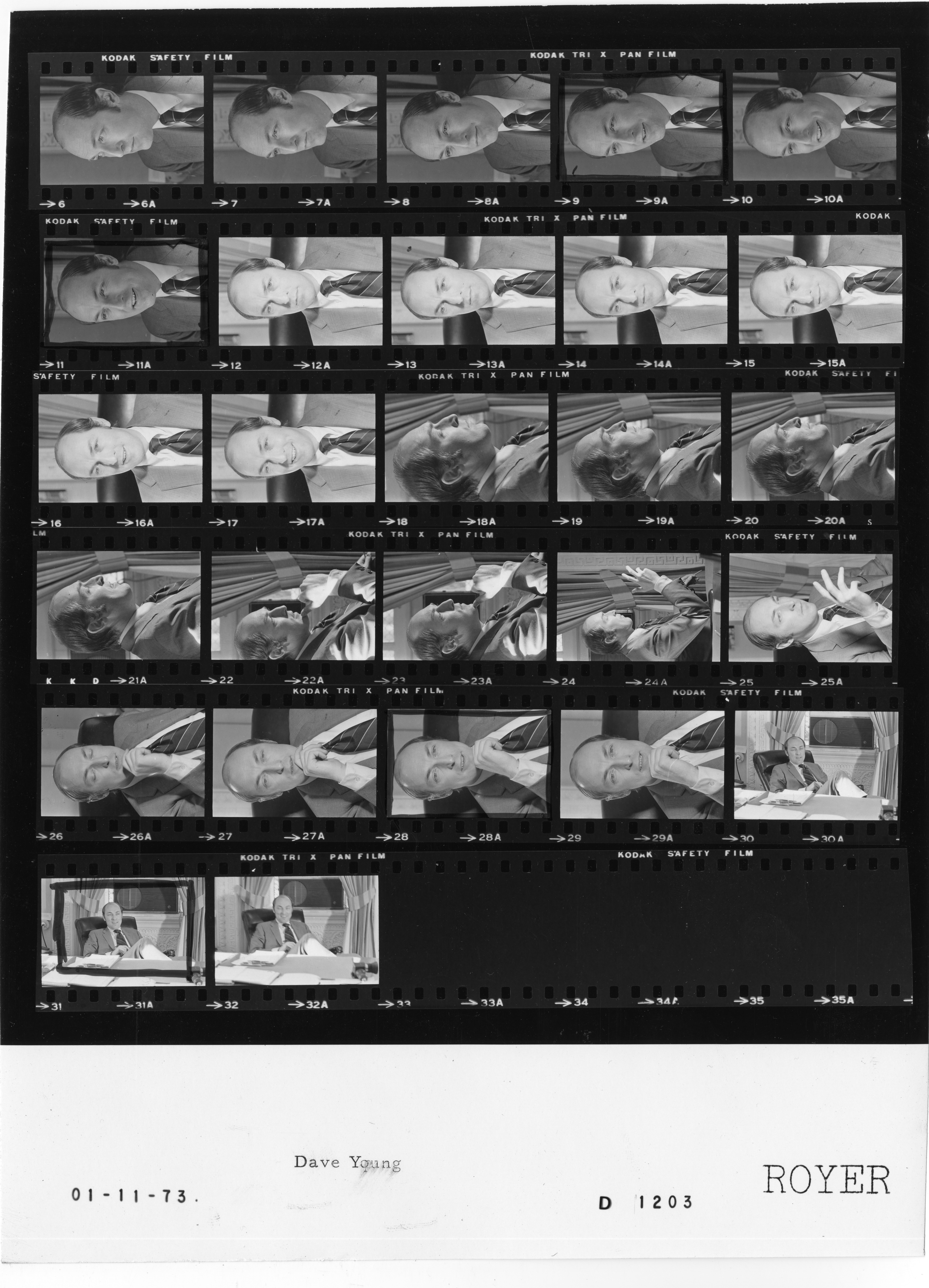
- Frame(s): WHPO-D1203-06A-32A, Close-up portrait of Dave Young. 1/11/1973, Washington, D.C. unknown. David Young.
- Frame(s): WHPO-D1203-09A, Close-up portrait of Dave Young. 1/11/1973, Washington, D.C. unknown. David Young.
Roll WHPO-D1204 Photographer: Atkins, Oliver | Color or B&W: Color
- Frame(s): WHPO-D1204-02A-14A, 33A-34A, Formal standing portrait of John Ehrlichman near an American flag. 1/11/1973, Washington, D.C. White House, Library. John Ehrlichman.
- Frame(s): WHPO-D1204-10A, Formal standing portrait of John Ehrlichman near an American flag. 1/11/1973, Washington, D.C. White House, Library. John Ehrlichman.
- Frame(s): WHPO-D1204-15A-24A, Formal standing portrait of John Ehrlichman. 1/11/1973, Washington, D.C. White House, Library. John Ehrlichman.
- Frame(s): WHPO-D1204-25A-32A, Formal standing portrait of John Ehrlichman near an American flag and paintings of Early American Indian chiefs. 1/11/1973, Washington, D.C. White House, Library. John Ehrlichman.
Roll WHPO-D1205 Photographer: Atkins, Oliver | Color or B&W: Color
- Frame(s): WHPO-D1205-03A-32A, Formal seated portrait of John Ehrlichman. 1/11/1973, Washington, D.C. White House, Library. John Ehrlichman.
- Frame(s): WHPO-D1205-06A, Formal seated portrait of John Ehrlichman smiling near the American flag. 1/11/1973, Washington, D.C. White House, Library. John Ehrlichman.
The White House Communications Agency Sound Recordings Collection contains public statements that took place between 1969 and 1974. Visit the finding aid to learn more.
G - Cabinet Officer Briefings
- WHCA-SR-G-198
Press briefing by Director George Shultz of the Office of Management and Budget, with Ronald Ziegler. (1/11/1973, [none listed])
Runtime: 35:00:00
Production credits: Audio feed supplied by WHCA; Recorded by MAN (initials of WHCA engineer)
Original Format: 1/4-inch reel-to-reel audiotape. Original source type: Original.
The White House Communications Agency Videotape Collection contains “off-the-air” recordings of televised programs produced between 1968 and 1974. Visit the finding aid to learn more.
- WHCA-5991
"Chung Kuo", China Special, pt 1. People's Republic of China
Post-Newsweek Stations, Inc.
Runtime: 1:00 - WHCA-5992
Chung Kuo, China Special, pt 2. People's Republic of China George Romney.
NBC
Runtime: 1:00 - WHCA-5995
Weekly News Summary, Tape III.
ALL NETWORKS
Runtime: 00:45:14
1. Smith/Jarriel: Phase III with Shultz. Time Code Start: 00:00. Keywords: cabinet, advisors, wage and price controls, freezes, prices, costs, increases, decreases, economy, economics, budgets, finances, recession, inflation, money. Network: ABC.
2. Smith/Schorr/Donaldson: Justice department accuses Committee to Re-elect the President (CRP) of illegal campaign acts, Watergate trial with E. Howard Hunt. Time Code Start: 03:08. Keywords: Presidential elections, campaigns, campaigning, candidates, organizations, accusations, Watergate, Senate committee hearings, investigations, testimony, testify, cover-ups, break-in, burglary, theft, plumbers, scandals. Network: ABC.
3. Reasoner: Paris peace talks, Vietnam. Time Code Start: 06:03. Keywords: Paris Peace Talks, Vietnam War, treaty, treaties, negotiations. Network: ABC.
4. Reasoner/Shoumacher: US Air Force pilot Captain Heck refuses to fly B-52's. Time Code Start: 06:50. Keywords: Vietnam War, bombings, aircraft, conscientious objectors, protests,. Network: ABC.
5. Smith/Clark: President Nixon appointees must testify to Hill or Congress will not confirm them. Time Code Start: 09:10. Keywords: Presidents, House of Representatives, appointments, nominees, testify, testimony, investigations. Network: ABC.
6. Chancellor/Levine: The economy, Phase III (Shultz). Time Code Start: 11:10. Keywords: cabinet, advisors, wage and price controls, freezes, prices, costs, increases, decreases, economy, economics, budgets, finances, recession, inflation, money. Network: NBC.
7. Valeriani: More on Phase III. Time Code Start: 14:12. Keywords: wage and price controls, freezes, prices, costs, increases, decreases, economy, economics, budgets, finances, recession, inflation, money. Network: NBC.
8. Chancellor/Stern: E. Howard Hunt pleads guilty to all charges. Time Code Start: 15:57. Keywords: national security, intelligence gathering, covert activities, spying, espionage, Watergate, Senate committee hearings, investigations, testimony, testify, cover-ups, break-in, burglary, theft, plumbers, scandals. Network: NBC.
9. Chancellor: Republicans charged with campaign violations. Time Code Start: 18:55. Keywords: political parties, Republicans, GOP, lawsuits, Presidential elections, campaigns, campaigning, funding, finances, investigations. Network: NBC.
10. Chancellor/Dobyns: Paris peace talks. Time Code Start: 19:45. Keywords: Paris Peace Talks, Vietnam War, treaty, treaties, negotiations. Network: NBC.
11. Chancellor: Captain Heck refused to bomb anymore; Vietnam. Time Code Start: 22:20. Keywords: Vietnam War, bombs, bombings. Network: NBC.
12. Chancellor/Duke: President Nixon appointment controversy with Jackson, John Ehrlichman, Office of Management and Budget (OMB) Director Caspar Weinberger. Time Code Start: 24:48. Keywords: Presidents, cabinet, advisors, nominations, appointments, confirmations. Network: NBC.
13. Rather/Pierpoint: Phase III (Shultz). Time Code Start: 29:25. Keywords: cabinet, advisors, wage and price controls, freezes, prices, costs, increases, decreases, economy, economics, budgets, finances, recession, inflation, money. Network: CBS.
14. Rather/Schorr: E. Howard Hunt pleads guilty to all charges. Time Code Start: 32:35. Keywords: national security, intelligence gathering, covert activities, spying, espionage, Watergate, Senate committee hearings, investigations, testimony, testify, cover-ups, break-in, burglary, theft, plumbers, scandals. Network: CBS.
15. Morton: George McGovern in Massachusetts to thank voters. Time Code Start: 36:10. Keywords: Vote, voters, voting, Presidential elections, campaigns, campaigning, candidates, voting. Network: CBS.
16. Rather/Kalisher: Paris peace talks. Time Code Start: 37:44. Keywords: Paris Peace Talks, Vietnam War, treaty, treaties, negotiations. Network: CBS.
17. Rather/Roth: Clay Whitehead attempts to explain his message about censorship. Time Code Start: 40:18. Keywords: media, censors. Network: CBS.
18. Sevareid: Commentary on Phase III. Time Code Start: 42:20. Keywords: wage and price controls, freezes, prices, costs, increases, decreases, economy, economics, budgets, finances, recession, inflation, money. Network: CBS.
Context (External Sources)
The Vanderbilt Television News Archive is the world's most extensive and complete archive of television news. They have been recording, preserving and providing access to television news broadcasts of the national networks since August 5, 1968.
Wikipedia is a free encyclopedia that anyone can edit.