
Introduction
This almanac page for Wednesday, January 10, 1973, pulls together various records created by the federal government and links to additional resources which can provide context about the events of the day.
Previous Date: Tuesday, January 9, 1973
Next Date: Thursday, January 11, 1973
Schedule and Public Documents
The Daily Diary files represent a consolidated record of the President's activities. Visit the finding aid to learn more.
The President's day began at The White House - Washington, D. C.
The Weekly Compilation of Presidential Documents made available transcripts of the President's news conferences; messages to Congress; public speeches, remarks, and statements; and other Presidential materials released by the White House.
Digitized versions can be found at HathiTrust.
The Federal Register is the official daily publication for rules, proposed rules, and notices of federal agencies and organizations, as well as executive orders and other Presidential documents.
Archival Holdings
Any selection of archival documents will necessarily be partial. You should use the documents and folders identified below as a starting place, but consult the linked collection finding aids and folder title lists and the collections themselves for context. Many documents to be found this way do not lend themselves to association with specific dates, but are essential to a complete understanding of the material.
Selective document listing
President's Office Files
The President's Office Files consists of materials drawn together by the Special Files Unit from several administrative subdivisions within the White House Office. It is the handwriting and sensitive papers sent to the Staff Secretary that now comprise much of the President's Office Files. Visit the finding aid to learn more.
- News Summaries, Unmarked News Summaries, Box 53, News Summaries - January 2 to 11, 1973 [7 of 7] [Note: Due to the way News Summary products were compiled, you should also consult nearby days for potentially relevant materials.]
- News Summary, January 10, 1973, (Tuesday nets, wires)
The H. R. Haldeman Diaries consists of seven handwritten diaries, 36 dictated diaries recorded as sound recordings, and two handwritten audio cassette tape subject logs. The diaries and logs reflect H. R. Haldeman’s candid personal record and reflections on events, issues, and people encountered during his service in the Nixon White House. As administrative assistant to the President and Chief of Staff, Haldeman attended and participated in public events and private meetings covering the entire scope of issues in which the Nixon White House engaged in during the years 1969-1973. Visit the finding aid to learn more.
- Transcript of diary entry (PDF)
Wednesday, January 10.
In the staff meeting this morning we got into the Webster problem, and I said we weren't going to be appointing him, but told Ehrlichman that we were going to have to put him at the FTC. John pretty much blew his gasket, feels that he's got to see the President on that, and also on Pottenger, which we've got to get a decision on today. That carried on into the day, and the President didn't want to talk to John about it, even though John had requested the meeting. Wanted me to handle it. After going back and forth with John some, we decided on the Pottenger matter that we could get the executive order on quotas for colleges changed, and that the President would never have signed such a thing anyway. Turns out it was a Lyndon Johnson executive order. Now we'll get a signal out, which should handle Buchanan's objection to Pottenger, who was only enforcing the order according to Ehrlichman's pitch. John seems to feel that he can wheel it that way and agreed to try and do it.
On the Webster thing, I covered John's point with the President. The President said, we'll give Webster the OEP. I checked with that Colson. He says that won't go, so we came down on the basis, that the President said to tell Ehrlichman that he has an uneasy feeling on him, and that he's a little too smooth, reminds him of Kirkpatrick, the FTC guy, and he personally feels that it's better to have him in a less sensitive position. We need a solid man that we can control politically in that post. But that if John insists, the President will take him on faith, on John's recommendation only; if he tries to screw any friends of ours or anything like that, John is going to have wheel it though.
The President had Rose and me in for several hours this morning just on general chitchat. Said that Hobe Lewis had raised the question of keeping Stanton on the USIA Board, and we talked him out of that. Talked about Cliff Folger as a possibility for Red Cross Chairman. Discussed Stans' S-list and all the problems there. The question of Van Claiborne's program for the Inaugural concert. Some ideas for Chief of Protocol -- the President doesn't want to go with Borman, or somebody who is a star in his own right, but rather an advance man type. I suggested Dick Walling, and Rose suggested Mike Duvall.
We got Henry's cable regarding scheduling, and the President said I should send Henry a cable saying to leave open the possibility of a Haig trip to the friendly Asian capitals, as well as to Saigon rather than Henry going to Hanoi. But then the President realized that I was right in saying that we'd have a real problem in getting Henry stirred up on something like that, and shouldn't get into it. A little later, we got -- I had a phone call from Henry, and he said that he was sending a new scheduling approach that he thought the President would like because it solves some of the problems. And then when his cable came in, it turned out it was, because he's worked out a deal now where he would return to Paris to sign the agreement rather than going to Hanoi. And then would go to Hanoi in early February to work out peace settlement arrangements rather than to sign the agreement, which would solve the problem of Saigon's objection to signing the agreement in Hanoi -- and also the President's objection -- plus closing down the time frame and all that.
The President had Haig come over to go over the cable and the situation, and then he had quite a discussion on it. The real point is that the President feels he has to announce the settlement to the Americans before Kissinger initials it. Otherwise there is no point in his announcing it, because it's just covering something that is already done. He told Haig to get a message back to Henry, saying that the new scenario is infinitely preferable to the old routine of his going to Hanoi and that we should go ahead trying to work that out with the North Vietnamese -- that we would like the cease-fire as soon as possible, not to drag it on. But he feels that we will face an insurmountable problem on informing Congressional leaders and so on, in the period between the time Kissinger returns and the time that Haig returns from Saigon, therefore, Haig's trip should be compressed if possible. In other words, the less time Haig is in Saigon, the better. He should leave the technical work for others. Part of the problem, the President feels, is that Henry wants to be at the Inaugural and I think that's right. He's working the timing to suit his own convenience.
The ideal here would be to get Kissinger to Paris quicker, like during the Inaugural. So then he said on the cable to say if we're fortunate enough to get Thieu aboard, that we don't believe the news will hold, and the announcement for the 19th which is in Henry’s scenario, would have to be Presidential, rather than just White House saying that Henry is going to Paris for the signing. And then we would have to say at that time that we have an agreement. We should leave open the possibility of an announcement on Haig's return from Saigon, if we get a break with Thieu's acceptance; if Thieu doesn't agree, then the President is going to have to get the leaders in and tell them and go for a massive bluff to try and force Thieu -- saying on TV that Thieu won't accept, that he calls on him to do so. Both he and Haig feel we have to do that, rather than option two, which would be just to try and go it alone, because that just won't work. We should after some discussion came to the point that Friday's too late for either a Presidential or a White House announcement, because we're into the Inaugural cycle then. And Henry should make the point to the North Vietnamese that anything we do has got to be done by Thursday night at the latest, so Haig should leave a day earlier and get back in time for that. The President wants a 1,000 word maximum statement drafted for TV Thursday night, including something thanking the American people for their support. Now it depends on the intentions on both sides to keep the agreement, that we'll do our part. We call on all others to abide by it and so forth.
He feels the real problem on all this is Congressional, because they're going to demand the details. On the other hand, if Thieu doesn't go along, the clear thing is that Haig should stay in Asia, go to the other countries and filibuster and not come back until Saturday or Sunday. Then the President would bring the leaders in Monday and tell them that our problem is that we can't get Thieu's agreement and then he’d go on TV Monday night and try to play the bluff. He's obviously very much concerned about getting this on the right track for announcements, and timing, and so forth, and is afraid that Henry's ego and other kinds of problems are interfering in the sound decision in this regard, and I think he is probably right.
End of January 10. - Original audio recording (MP3)
The National Archives Catalog is the online portal to the records held at the National Archives, and information about those records. It is the main way of describing our holdings and also provides access to electronic records and digitized versions of our holdings.
The Catalog searches across multiple National Archives resources at once, including archival descriptions, digitized and electronic records, authority records, and web pages from Archives.gov and the Presidential Libraries. The Catalog also allows users to contribute to digitized historical records through tagging and transcription.
Nixon Library Holdings
All National Archives Units
National Security Documents
The President's Daily Brief is the primary vehicle for summarizing the day-to-day sensitive intelligence and analysis, as well as late-breaking reports, for the White House on current and future national security issues. Read "The President's Daily Brief: Delivering Intelligence to Nixon and Ford" to learn more.
The Foreign Relations of the United States series presents the official documentary historical record of major U.S. foreign policy decisions and significant diplomatic activity. Visit the State Department website for more information.
Vol. IX, Vietnam, October 1972-January 1973
America Leaves the War, December 30, 1972-January 27, 1973
257. Message From the Ambassador to Vietnam (Bunker) to the President’s Assistant for National Security Affairs (Kissinger) in Paris, Saigon, January 10, 1973, 0927Z
Source: National Archives, Nixon Presidential Materials, NSC Files, Kissinger Office Files, Box 28, HAK Trip Files, HAK Paris Trip Tohak 1–66, January 7–14, 1973. Top Secret; Sensitive; Exclusively Eyes Only. Sent via the White House Situation Room, Guay, and Lord.
258. Message From the President’s Assistant for National Security Affairs (Kissinger) to President Nixon, Paris, January 10, 1973, 2010Z
Source: National Archives, Nixon Presidential Materials, NSC Files, Kissinger Office Files, Box 28, HAK Trip Files, HAK Paris Trip Hakto 1–48, January 7–14, 1973. Top Secret; Flash; Sensitive; Exclusively Eyes Only. Sent via Kennedy.
259. Diary Entry by the Assistant to the President (Haldeman), Washington, January 10, 1973
Source: Haldeman Diaries: Multimedia Edition.
260. Message From the President’s Assistant for National Security Affairs (Kissinger) to Richard T. Kennedy of the National Security Council Staff, Paris, January 10, 1973, 2115Z
Source: National Archives, Nixon Presidential Materials, NSC Files, Kissinger Office Files, Box 28, HAK Trip Files, HAK Paris Trip Hakto 1–48, January 7–14, 1973. Top Secret; Flash; Sensitive; Exclusively Eyes Only.
Vol. XLII, Vietnam: The Kissinger-Le Duc Tho Negotiations
Settlement Accomplished: The Accords Initialed and Signed, January 1973
44. Memorandum of Conversation, Paris, January 10, 1973, 3-6:48 p.m.
Source: National Archives, Nixon Presidential Materials, NSC Files, Box 866, For the President’s Files (Winston Lord)—China Trip/Vietnam Negotiations, Camp David Memcons, January 8–13, 1973 [January 23, 1973]. Top Secret; Sensitive; Exclusively Eyes Only. The meeting took place at 108 Avenue du Général Leclerc in Gif-sur-Yvette. All brackets are in the original. The tabs are attached but not printed.
In his message to President Nixon summarizing the day’s meeting, Kissinger wrote: “Today’s four-hour session continued the momentum of yesterday. I think we can now say with some assurance that the agreement, understandings and protocols should all be completed by Saturday [January 13] or Sunday [January 14], except perhaps for some technical conforming of the protocol texts.” However, he cautioned: “It is always possible, of course, that Hanoi will reverse course, but the atmosphere and approach is totally different from December. Whatever the press and other observers may say about our military actions, they certainly seem to have contributed to this result.”
Expressing his ongoing concern about the possibility of Saigon or Hanoi or both somehow short-circuiting the agreement, Kissinger added: “The need for the strictest security on the status of the talks, not to mention possible scenarios, remains as imperative as ever. Finally, of course, the problem in Saigon remains formidable. This fact plus the constant caveat about Hanoi’s course of action mean that even private celebrations will be premature for many days to come.” (Foreign Relations, 1969–1976, vol. IX, Vietnam, October 1972–January 1973, Document 258)
The Kissinger telephone conversation transcripts consist of approximately 20,000 pages of transcripts of Kissinger’s telephone conversations during his tenure as Assistant to the President for National Security Affairs (1969-1974) and Secretary of State (1973-1974) during the administration of President Richard Nixon. Visit the finding aid for more information.
Digitized versions can be found in the National Archives Catalog.
Audiovisual Holdings
Visit the White House Tapes finding aid to learn about the taping system's operation and archival processing.
Old Executive Office Building
- 395-2; Unknown between 2:26 p.m. & 3:34 p.m.; Nixon, Richard M. (President); Sanchez, Manolo
- 395-3; Unknown between 2:26 p.m. & 3:34 p.m.; Nixon, Richard M. (President); Sanchez, Manolo; [Unknown person(s)]
- 395-4; Unknown between 2:26 p.m. & 3:34 p.m.; Nixon, Richard M. (President); Woods, Rose Mary
- 395-5; Unknown between 2:26 p.m. & 3:34 p.m.; Nixon, Richard M. (President); White House operator
- 395-6; 3:34 p.m. - 3:35 p.m.; Nixon, Richard M. (President); Kennedy, Richard T. (Col.)
- 395-7; Unknown between 3:35 p.m. & 3:41 p.m.; Nixon, Richard M. (President); White House operator; Laird, Melvin R.
- 395-8; 3:41 p.m. - 3:46 p.m.; Nixon, Richard M. (President); Haldeman, H. R. ("Bob")
- 395-9; Unknown between 3:46 p.m. & 3:49 p.m.; Nixon, Richard M. (President); Bull, Stephen B.
- 395-10; Unknown between 3:46 p.m. & 3:49 p.m.; Nixon, Richard M. (President); [Unknown person(s)]; Haldeman, H. R. ("Bob")
- 395-11; 3:49 p.m. - 3:50 p.m.; Nixon, Richard M. (President); Rowan, Dan; Martin, Dick
- 395-12; Unknown between 3:50 p.m. & 4:11 p.m.; Nixon, Richard M. (President)
- 395-13; Unknown between 4:11 p.m. & 4:30 p.m.; Nixon, Richard M. (President); Haldeman, H. R. ("Bob")
- 395-14; Unknown between 4:14 p.m. & 4:30 p.m.; Nixon, Richard M. (President); Sanchez, Manolo
- 395-15; 4:30 p.m. - 5:55 p.m.; Nixon, Richard M. (President); Haig, Alexander M., Jr.; [Unknown person(s)]; Haldeman, H. R. ("Bob")
Oval Office
- 837-2; Unknown between 9:05 a.m. & 9:14 a.m.; Nixon, Richard M. (President)
- 837-3; Unknown between 9:05 a.m. & 2:24 p.m.; Nixon, Richard M. (President); Bull, Stephen B.; Woods, Rose Mary; Sanchez, Manolo; Haldeman, H. R. ("Bob")
- 837-4; Unknown between 1:20 p.m. & 2:24 p.m.; Nixon, Richard M. (President); Haldeman, H. R. ("Bob")
- 837-5; Unknown between 2:24 p.m. & 5:59 p.m.; [Unknown person(s)]
- 837-6; Unknown between 9:05 a.m. & 9:56 a.m.; Nixon, Richard M. (President); [Unknown person(s)]
White House Telephone
- 35-121; Unknown between 2:26 p.m. & 3:34 p.m.; Nixon, Richard M. (President); White House operator
- 35-122; 3:34 p.m. - 3:35 p.m.; Nixon, Richard M. (President); Kennedy, Richard T. (Col.)
- 35-123; 3:41 p.m. - 3:46 p.m.; Haldeman, H. R. ("Bob"); Nixon, Richard M. (President)
- 35-124; 3:49 p.m. - 3:50 p.m.; Nixon, Richard M. (President); Rowan, Dan; Martin, Dick
- 35-125; Unknown between 3:50 p.m. & 7:28 p.m.; Nixon, Richard M. (President); White House operator
- 35-126; 7:28 p.m. - 7:30 p.m.; Nixon, Richard M. (President); Berlin, Muriel ("Honey")(Johnson)
The White House Photo Office collection consists of photographic coverage of President Richard Nixon meeting with prominent social, political, and cultural personalities; speaking engagements and news conferences of the President and various high-ranking members of the White House staff and Cabinet; Presidential domestic and foreign travel, including Presidential vacations; social events and entertainment involving the First Family, including entertainers present; official portraits of the President, First Family, and high-ranking members of the Nixon administration; the 1969 and 1973 Inaugurals; the President’s 1972 Presidential election campaign appearances (including speeches) and other official activities of the White House staff and the President’s Cabinet from January 20, 1969 until August 9, 1974 at the White House and the Old Executive Office Building; other locations in Washington, DC, such as The Mall; and the Presidential retreats in Camp David, Maryland, Key Biscayne, Florida, and San Clemente, California. Visit the finding aid to learn more.
Roll WHPO-D1195 Photographer: Royer | Color or B&W: B&W
- Frame(s): WHPO-D1195-05-08, Deputy Special Assistant John E. Nidecker receiving a quill pen from an unidentified man. 1/10/1973, Washington, D.C. unknown. John Nidecker, unidentified man.
Roll WHPO-D1196 Photographer: Royer | Color or B&W: B&W
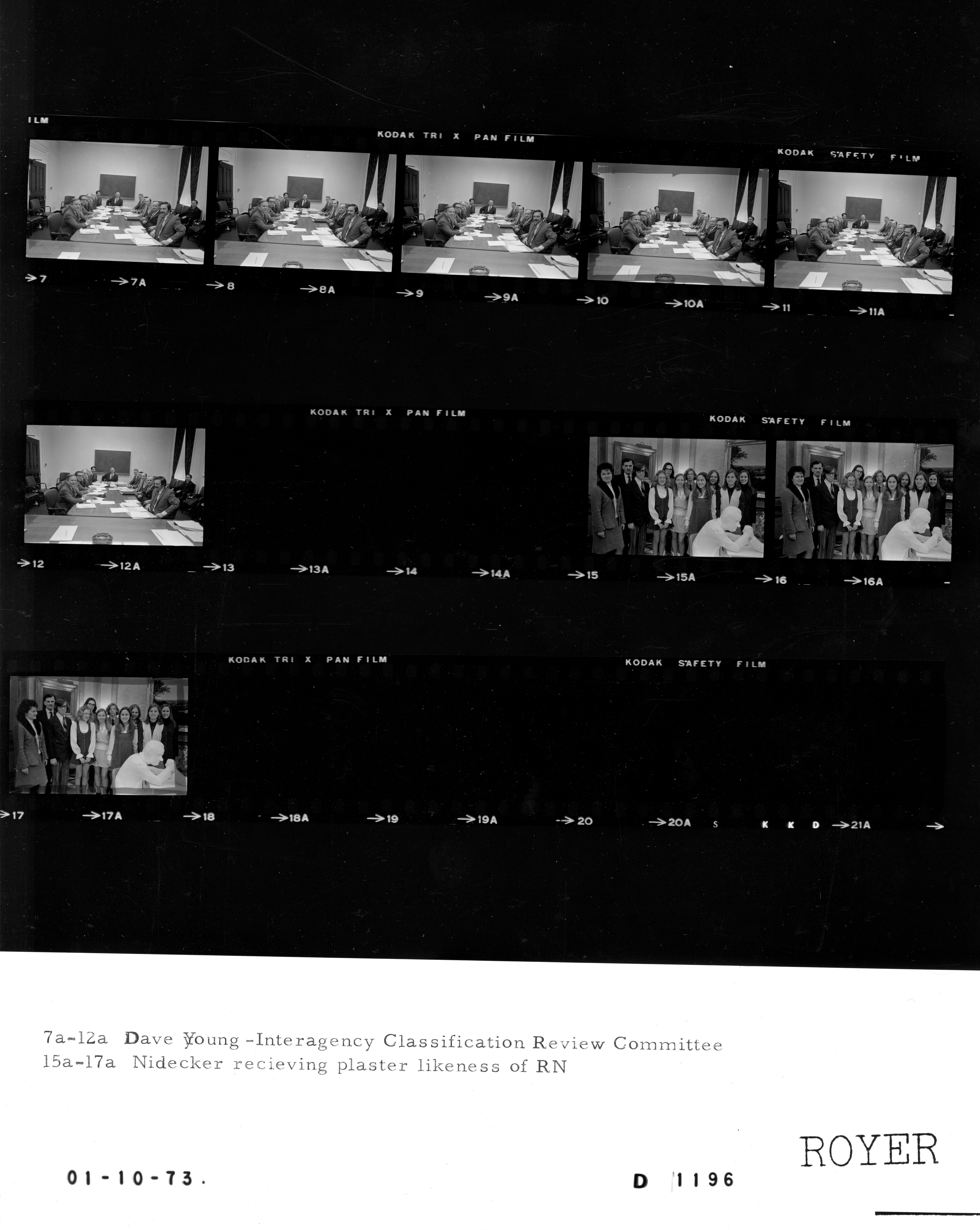
- Frame(s): WHPO-D1196-07A-12A, Dave Young meeting with the Interagency Classification Review Committee seated around a conference table. 1/10/1973, Washington, D.C. conference room. Dave Young, unidentified men.
- Frame(s): WHPO-D1196-15A-17A, Deputy Special Assistant John E. Nidecker stands with a group of Pennsylvania students and their teachers near the life-sized plaster statue gift they made, of President Nixon arm-wrestling George McGovern. 1/10/1973, Washington, D.C. interior room at the White House. John E. Nidecker, unidentified men, woman and high school students.
The White House Communications Agency Sound Recordings Collection contains public statements that took place between 1969 and 1974. Visit the finding aid to learn more.
H - White House Staff Member Recordings
- WHCA-SR-H-679
Briefing by Dolf Droge of 20 University of Nebraska students. (1/10/1973, [None listed])
Runtime: 1:20:00
Keywords: Briefings, private briefings
Production credits: Audio feed supplied by WHCA; Recorded by JMC (initials of WHCA engineer)
Original Format: 1/4-inch reel-to-reel audiotape. Original source type: Original.
L - White House Press Office Briefings
- WHCA-SR-L-103
Press briefing by Ronald Ziegler. (1/10/1973, White House Press Lobby)
Runtime: 25:00:00
Keywords: Press conferences, news conferences, interviews, media, press secretary
Original Format: 1/4-inch reel-to-reel audiotape. Original source type: Original.
The White House Communications Agency Videotape Collection contains “off-the-air” recordings of televised programs produced between 1968 and 1974. Visit the finding aid to learn more.
- WHCA-5994
Weekly News Summary, Tape II.
ALL NETWORKS
14. Smith/Donaldson: Watergate hearings. Time Code Start: 23:00. Keywords: Watergate, Senate committee hearings, investigations, testimony, testify, cover-ups, break-in, burglary, theft, plumbers, scandals. Network: ABC.
15. Reasoner/Bell: Paris peace talks, B-52 pilot refused to fly raid, more bomber pilots comment. Time Code Start: 25:51. Keywords: Paris Peace Talks, Vietnam War, treaty, treaties, negotiations. Network: ABC.
16. Smith/Clark: Elliot Richardson tells about the bombing. Time Code Start: 30:03. Keywords: Vietnam War, bombings. Network: ABC.
17. Reasoner/Peterson: Major U.S. Army reorganization. Time Code Start: 32:30. Keywords: Armed Forces, military, leaders, change of command. Network: ABC.
18. Smith: Commentary on second guessing the secret peace talks. Time Code Start: 33:45. Keywords: Paris Peace Talks, Vietnam War, treaty, treaties, negotiations. Network: ABC.
19. Chancellor/Stern: The Watergate case, E. Howard Hunt pleads guilty. Time Code Start: 35:25. Keywords: Watergate, Senate committee hearings, investigations, testimony, testify, cover-ups, break-in, burglary, theft, plumbers, scandals. Network: NBC.
20. Chancellor/Dobyns: Paris peace talks continue. Time Code Start: 38:25. Keywords: Paris Peace Talks, Vietnam War, treaty, treaties, negotiations. Network: NBC.
21. Chancellor: Richardson at Congressional meeting to confirm him as Secretary of Defense. Time Code Start: 40:29. Keywords: House of Representatives, meetings, confirmations, appointments, cabinet, advisors. Network: NBC.
22. Chancellor/Levine: Gordon Rule at state hearing. Time Code Start: 41:53. Keywords: Armed Forces, Navy, military officials, leaders, hearings, investigations, testimony, testify, hirings, Roy Ash, criticisms. Network: NBC.
23. Chancellor/Brinkley: Commentary on Congress. Time Code Start: 45:12. Keywords: House of Representatives. Network: NBC.
24. Chancellor/Nessen: Secretary Morton comments on energy crisis before senate hearing. Time Code Start: 47:15. Keywords: petroleum, oil, gasoline, fuel, shortages, rationing, natural resources. Network: NBC.
25. Chancellor: Commentary on President Nixon appointments. Time Code Start: 49:20. Keywords: Presidents, cabinet, advisors, nominations, appointments, confirmations. Network: NBC.
26. Rather/Schorr: E. Howard Hunt pleads guilty in Watergate case. Time Code Start: 49:42. Keywords: Watergate, Senate committee hearings, investigations, testimony, testify, cover-ups, break-in, burglary, theft, plumbers, scandals. Network: CBS.
27. Rather/Pierpoint: Paris peace talks; President Nixon never consulted military advisors before bombing. Time Code Start: 52:16. Keywords: Paris Peace Talks, Vietnam War, treaty, treaties, negotiations. Network: CBS.
28. Rather/Erickson: Richardson comments on bombing; Vietnam; film by Swedish TV on U.S. bombing. Time Code Start: 54:00. Keywords: Vietnam War, bombs, bombings. Network: CBS.
29. Rather: Japanese film of POWs. Time Code Start: 57:13. Keywords: Vietnam War, Vietnam Prisoner of War. Network: CBS.
30. Rather/McLaughlin: Gordon Rule case. Time Code Start: 60:11. Keywords: Armed Forces, Navy, military officials, leaders, hearings, investigations, testimony, testify, hirings, Roy Ash, criticisms. Network: CBS.
31. Rather/Sevareid: President Nixon, Congress relationship. Time Code Start: 62:35. Keywords: Presidents, House of Representatives. Network: CBS.
Context (External Sources)
The Vanderbilt Television News Archive is the world's most extensive and complete archive of television news. They have been recording, preserving and providing access to television news broadcasts of the national networks since August 5, 1968.
Wikipedia is a free encyclopedia that anyone can edit.