

Introduction
This almanac page for Wednesday, December 6, 1972, pulls together various records created by the federal government and links to additional resources which can provide context about the events of the day.
Previous Date: Tuesday, December 5, 1972
Next Date: Thursday, December 7, 1972
Schedule and Public Documents
The Daily Diary files represent a consolidated record of the President's activities. Visit the finding aid to learn more.
The President's day began at Camp David, Maryland
The Weekly Compilation of Presidential Documents made available transcripts of the President's news conferences; messages to Congress; public speeches, remarks, and statements; and other Presidential materials released by the White House.
Digitized versions can be found at HathiTrust.
The Federal Register is the official daily publication for rules, proposed rules, and notices of federal agencies and organizations, as well as executive orders and other Presidential documents.
Archival Holdings
Any selection of archival documents will necessarily be partial. You should use the documents and folders identified below as a starting place, but consult the linked collection finding aids and folder title lists and the collections themselves for context. Many documents to be found this way do not lend themselves to association with specific dates, but are essential to a complete understanding of the material.
Selective document listing
President's Office Files
The President's Office Files consists of materials drawn together by the Special Files Unit from several administrative subdivisions within the White House Office. It is the handwriting and sensitive papers sent to the Staff Secretary that now comprise much of the President's Office Files. Visit the finding aid to learn more.
- News Summaries, Unmarked News Summaries, Box 52, News Summaries - December 1972 [2 of 6] [Note: Due to the way News Summary products were compiled, you should also consult nearby days for potentially relevant materials.]
- News Summary, December 6, 1972, (Tues. nets, wires, columns)
The H. R. Haldeman Diaries consists of seven handwritten diaries, 36 dictated diaries recorded as sound recordings, and two handwritten audio cassette tape subject logs. The diaries and logs reflect H. R. Haldeman’s candid personal record and reflections on events, issues, and people encountered during his service in the Nixon White House. As administrative assistant to the President and Chief of Staff, Haldeman attended and participated in public events and private meetings covering the entire scope of issues in which the Nixon White House engaged in during the years 1969-1973. Visit the finding aid to learn more.
- Transcript of diary entry (PDF)
Wednesday, December 6th at Camp David. The whole day today was virtually taken up with the Kissinger-Vietnam negotiation problems. Although the President did have some personnel meetings and Ehrlichman and I met during the afternoon on Under Secretaries and Agency heads for a while.
The President called me over first thing this morning when I arrived to get into the question of Kissinger. He made the point that we can't rally the establishment behind this—that's the liberal media, and so forth—and we don't need to rally the people. The key now is how to psyche Kissinger up for the briefing. He wants me to get this across, that this is the view of Connally, Colson, Ziegler and me: there's nothing to rally the people to. So he thinks I should get a cable to Kissinger regarding the rallying, making the point that at the present time we don't need public support. We just need to act and let the actions speak louder than words. Escalating the Presidential rallying also would rally the opposition, which is now quiet. We have to expect criticism among the media and the left, but the question is, can, whether they can enlist public support for further opposition. The fact that there are no draftees to Vietnam, low casualties, etcetera, means the American people are not going to be shocked; they're just disappointed, not enraged, by the settlement not coming off. Our main goal must be as low key, to play this as low-key as possible, and to ignore Hanoi's intransigence, not Saigon's. We have to realize that Hanoi will play it the other way, but they won't be believed. This has been polled extensively and we feel that this is the right track on public opinion. The main sticking point is the POW problem, and we just have to weather that. Regarding the negotiations breaking down; but as for our major objective, the POW's, we are confident we can achieve it. Then he wanted me to talk to Ziegler and get his arguments on why it would be a mistake to go on television, and also list Connally's points. He makes the point that we are in the same problems with Henry as we were in India-Pakistan, where we failed and Kissinger's reaction was to get into a big funk about it.
-------------------------------------------------------------------------------------------------------------------
DECLASSIFIED - E.O. 13526, Sect. 3.4: by MS, NARA, June 12, 2013
Audio Cassette 28, Side A, Withdrawn Item Number 12 [AC-28(A) Sel 10]
Duration: 18 seconds
After I left the President's meeting Kennedy called and said he'd had a call very late last evening from the Soviets, and that they were working hard on trying to help on this….
-------------------------------------------------------------------------------------------------------------------
...that the group in Paris met at 10:30, took a break for lunch at 1:30, and they were still in the meeting. The guess is that they'll meet tomorrow, if there is any movement today, which is at least a 50-50 chance. He raised the point that he just met with the VP, who wants to be sure that the President realizes a possible complication if the VP's message is to go to, or mission is to go to Saigon, that there'd be a concern if Truman dies, which is a little idiotic, but sort of typical of the Agnew approach.
Kennedy called at noon to say they had finished the afternoon meeting, and it had run, that the total they had run was five and a half hours. They are going to meet again tomorrow at 3:00, and a reports coming, but he had no clues as to what it might be.
Then the President had me over at 1:00. Went over a few odds and ends on personnel and general items; then said the real problem is that Kissinger is trying to cover his own mistakes. He can't bear to come back and face the press because he knows they'll attack him this time; the only other time that he was like this was India-Pakistan. It's clear that he wants the President out as the blocking back to clear the way. Ziegler makes the point that if the talks break down, it will be a defeat and we have to ride through that. We’ve got to stand with the statement that we will only sign when it's right; we're stronger with that base than we are explaining. There will be a big media deal regarding the failure, but it won't penetrate to the public unless the President goes on television and makes something out of it. Kissinger must do a strong, brief statement—positive—play from the position of strength, not failure.
Later in the afternoon we got the cable from Kissinger giving the report on the meetings that basically says that they are almost totally sure of failure. I've got the cable in the file. And the President went through a long discussion—really agony—on the decision that Kissinger poses for him, which is whether to make one last offer in the hope that they'll take it, or to go the other way and pull out: Kissinger lays out the options on it. The President said I should get Ehrlichman's view on whether we should wait six months for the POW's, which would, which is what would happen if we pull out, and start bombing. And Henry thinks in, within six months, or in six months, we'd be able to make a deal with them to get our POW's...
-------------------------------------------------------------------------------------------------------------------
DECLASSIFIED - E.O. 13526, Sect. 3.4: by MS, NARA, June 12, 2013
Audio Cassette 28, Side A, Withdrawn Item Number 13 [AC-28(A) Sel 11-1]
Duration: 7 seconds
…but that would be the end of South Vietnam.
-------------------------------------------------------------------------------------------------------------------
Or, to take the other option, which is to put one more peace proposal in and to try to keep it going, and not put it on a take-it-or-leave-it basis. The President said—this was at about 6:00—he said to meet again at 8:30 with Ehrlichman. I went over the whole thing with John. He made the point, first, that any agreement's better than no agreement, and we're in a stronger position to try to deal with the North than try to deal with the South, and vice versa. Also he feels that if there's no agreement, it would be a monumental blow to America in Vietnam policy, but the President should not go on television; he should not personify that failure; he should jettison Kissinger instead, and let Kissinger do the briefing.
The President had Ehrlichman and me over at 8:15, and we met in the Aspen living room by the fire with the lights low on a cold night, and the President was slumped down in his chair and sort of went through the whole thing with John. John feels we have to try the finesse before going with our big gun, the President—the finesse being to try to maintain the appearance—at least, that the negotiations are continuing. He's concerned regarding the height of expectation in the country. The President said his view is that we have to get Kissinger out of the meetings for a while, to take a look and consult, and that's the key need at this point. But both of Kissinger's options really lead to the same conclusion, which is that we start bombing now. One way, we get the POW's now, and the other way we get them in July, but Congress may pull the string on us.
-------------------------------------------------------------------------------------------------------------------
DECLASSIFIED - E.O. 13526, Sect. 3.4: by MS, NARA, June 12, 2013
Audio Cassette 28, Side A, Withdrawn Item Number 13 [AC-28(A) Sel 11-2]
Duration: 1 minute 53 seconds
This poisons our relations with China and the Soviet, which is the big game right at the time we're building for the Soviet summit. That we don't have any great goals as we did on May 8th; that the October 8th solution would have worked, if Thieu had taken it, but Thieu couldn't take it because of Kennedy, Kissinger’s schedule, which would have shown that we did it without them, and then forces it down their throats. So it comes down to the fact that we're facing a situation basically the same as at the start of the first term. Either we're got to flush it, take the heat, and get on to other things, or we're got to continue, which is what we did then, and it worked very well. And the situation is infinitely better now than it was at that time. North Viet--, South Vietnamese can survive if we support them. But, if we now that the flamboyant cutoff that Kissinger wants to take and resume bombing until we get the POW’s back, then it would be okay. But, the major goal that we've always had of South Vietnam surviving would be the real question. Or we can face the fact that we can't make a deal between the Vietnams, so we have to make a deal with North Vietnam for the POW’s. Give all we have to get that, give all we have to give to get it, stop the bombing and the mining, stop, but continue our support of Vietnam. The problem is, Kissinger believes, South Vietnam would fall, but it might not, and that's the point, at least there's a chance of it not falling.
The President says we may be at that critical point, but we have to make the decision. We've gone a long way, we've done our best, so now we get our POW’s out; help South Vietnam. If they fall, so be it. It's better to have it over now and get it behind us. At least that would be one argument.
-------------------------------------------------------------------------------------------------------------------
The price that North Vietnam will exact is the question; they may require that we stop all military assistance to South Vietnam, and we can't, because that would be a sellout. But Kissinger's course would keep the agony going until July, and cut then. The problem is he's tired and emotional, and he's afraid to have his negotiations fail. So the message to Kissinger now must be to ask the question; and not to say that this is the final offer, especially not that he knows that they'll turn it down and go home. The main thing is to get Kissinger back here and decide here, not through the channels across the Atlantic. We can't go back to the October 8th position, which Ehrlichman suggested, because it won't work if South Vietnam doesn't accept it; in fact, there isn't anything if South Vietnam doesn't accept it. Haig is partly colored by the military desire to continue the war. We'll have a lot more heat if the President goes on TV than we would have otherwise. He feels Kissinger's approach now is not very rational. We have to consider his paranoia: what he said before, the emotional effect of the Italian article, and all those things.
At that point, he had Colonel Kennedy come in. The President read Kennedy's draft of instructions to Kissinger and then read aloud his own draft, which is much longer and more on the basis of continuing the talks. He said we have to recognize that the North Vietnamese are evaluating Kissinger, personally, too. They think he has more authority than he does, and they think he has no choice but to make a deal because of what he said. You have to look at the historical perspective; if the talks break, we resume the bombing, and our only goal is the POW's, and we estimate that by July that North Vietnam will cave and give us the POW's. If you assume that's right, then look at what happens in the meantime. One, we have a fight with the Congress regarding supporting South Vietnam, and they will claim South Vietnam's intransigence.
-------------------------------------------------------------------------------------------------------------------
DECLASSIFIED - E.O. 13526, Sect. 3.4: by MS, NARA, June 12, 2013
Audio Cassette 28, Side A, Withdrawn Item Number 13 [AC-28(A) Sel 11-3]
Duration: 8 seconds
Two, it exacerbates our problems with China and the Soviets.
-------------------------------------------------------------------------------------------------------------------
Three, the Congress is likely to drag their feet on aid to South Vietnam, both economic and military, and to limit our funding for bombing and so on.
-------------------------------------------------------------------------------------------------------------------
DECLASSIFIED - E.O. 13526, Sect. 3.4: by MS, NARA, June 12, 2013
Audio Cassette 28, Side A, Withdrawn Item Number 13 [AC-28(A) Sel 11-4]
Duration: 17 seconds
So Saigon collapses anyway. So one way we get the POW’s now, the other way we maybe get the POW’s in July and Saigon probably collapses either way. If they're going to collapse now, they'll collapse in eight months anyway.
-------------------------------------------------------------------------------------------------------------------
Ehrlichman suggested the ploy of the lawyers, saying the next guy to negotiate will be tougher than I am. The answer to that is, we played it last summer and lost that position with Henry's statement that peace is at hand. So we can't do anything with that. The President told Kennedy to send both messages: Kennedy's as the official instructions, the President's to give the flavor and background—the President's ideas on how to approach the meeting. Kennedy's concern, he expressed his concern regarding the total break with Thieu and thus his collapse, which would mean a waste of ten years, and he is worried about the effect that would have on the American psyche. The President answers that you come to a point where you have to weigh the cost. If we've made the total effort, we can do no more. Ehrlichman makes the point that we have to cut the budget $10 billion tomorrow, all across the social spectrum, and at the same time we're going to ask for more money for South Vietnam, which would be rough to do. Kennedy's concerned regarding how we may be perceived over the long haul—over time. What will the effect be regarding our relations in the world? There's a real question as to how this war is ended, and that's important in world relations. The President then said to fold these two messages into one cable.
-------------------------------------------------------------------------------------------------------------------
DECLASSIFIED - E.O. 13526, Sect. 3.4: by MS, NARA, June 12, 2013
Audio Cassette 28, Side A, Withdrawn Item Number 13 [AC-28(A) Sel 11-5]
Duration: 18 seconds
Kennedy brought up the Dobrynin message. The Russians are working on this. Dobrynin emphasized three times that Kissinger and the President should know that they are in touch with North Vietnam, and that he wants them to know this, and it will take time to make the contacts.
-------------------------------------------------------------------------------------------------------------------
The President said Kissinger must not bring this to such a sharp head that he has to say the negotiations have collapsed. Don’t say take it or leave it and get backed into a corner, just leave the implication, that we'll have a long period of more or less silent. Oh, there was a long period then in the meeting: a more or less silent review of the messages with slight changes in phrases and that sort of thing. Then the President said that Kissinger is in his India-Pakistan mood, that the feeling that all is lost, but nothing is ever totally lost. We need to get Henry here and talk to him, have him talk to the President at length, to review the options carefully. The President just feels the bomb-them-to-submission idea won't work. The goal of just saving the POW's is not enough, and we can't guarantee Congress support for eight months. Kennedy then left to send the messages to Henry, going by chopper back down to the office. The President sort of evaluated the whole thing and said the real problem is we have a weak reed as a negotiator at this point.
-------------------------------------------------------------------------------------------------------------------
DECLASSIFIED - E.O. 13526, Sect. 3.4: by MS, NARA, June 12, 2013
Audio Cassette 28, Side A, Withdrawn Item Number 13 [AC-28(A) Sel 11-6]
Duration: 19 seconds
He thought it would be useful to have Rush up tomorrow and have him bring up on the QT the contingency plans for the strikes on North Vietnam if the negotiations break down. Then he had me call Kennedy and tell him the President wants to see the plans, to get them up tomorrow, that he should bring them up, and we'll have Rush come too.
-------------------------------------------------------------------------------------------------------------------
The other things that arose during the session were Harry Truman's imminent death, and the President's ideas on a message regarding that. And then the fact that the moon shot's been delayed, due to a mechanical problems, and that Dole should go out and talk to the press tomorrow.
End of December 6th. - Original audio recording (MP3)
The National Archives Catalog is the online portal to the records held at the National Archives, and information about those records. It is the main way of describing our holdings and also provides access to electronic records and digitized versions of our holdings.
The Catalog searches across multiple National Archives resources at once, including archival descriptions, digitized and electronic records, authority records, and web pages from Archives.gov and the Presidential Libraries. The Catalog also allows users to contribute to digitized historical records through tagging and transcription.
Nixon Library Holdings
All National Archives Units
National Security Documents
The President's Daily Brief is the primary vehicle for summarizing the day-to-day sensitive intelligence and analysis, as well as late-breaking reports, for the White House on current and future national security issues. Read "The President's Daily Brief: Delivering Intelligence to Nixon and Ford" to learn more.
The Foreign Relations of the United States series presents the official documentary historical record of major U.S. foreign policy decisions and significant diplomatic activity. Visit the State Department website for more information.
Vol. V, United Nations, 1969-1972
UN Finances and Reduction of the U.S. Assessment
208. Telegram From the Mission to the United Nations to the Department of State, New York, December 6, 1972, 2118Z
Source: National Archives, Nixon Presidential Materials, NSC Files, Box 303, Agency Files, USUN, Vol. X. Confidential; Priority; Exdis.
Vol. IX, Vietnam, October 1972-January 1973
Paris Negotiations Collapse, October 24-December 13, 1972
143. Message From the President’s Deputy Assistant for National Security Affairs (Haig) to Richard T. Kennedy of the National Security Council Staff, Paris, December 6, 1972, 0115Z
Source: National Archives, Nixon Presidential Materials, NSC Files, Box 858, For the President’s Files (Winston Lord)—China Trip/Vietnam, Sensitive Camp David, Vol. XXII (1). Top Secret; Sensitive; Eyes Only. Sent via Guay. Written on December 5.
144. Message From the President’s Assistant for National Security Affairs (Kissinger) to President Nixon, Paris, December 6, 1972, 1850Z
Source: National Archives, Nixon Presidential Materials, NSC Files, Box 858, For the President’s Files (Winston Lord)—China Trip/Vietnam, Sensitive Camp David, Vol. XXII (1). Top Secret; Flash; Sensitive; Exclusively Eyes Only. Sent via Guay and Kennedy.
Vol. XXIV, Middle East Region and Arabian Peninsula, 1969-1972; Jordan, September 1970
Middle East Region
35. Memorandum From the Executive Secretary of the Department of State (Eliot) to the President’s Assistant for National Security Affairs (Kissinger), Washington, December 6, 1972
Source: National Archives, Nixon Presidential Materials, NSC Files, NSC Institutional Files (H-Files), Box H–212, National Security Decision Memoranda, NSDM 32. No classification marking. Attachments not printed. In an October 6 telephone conversation, Kissinger told Morton that a $10 million project was “symbolically of great interest” to the Israelis and that he should meet with Rabin. (Ibid., Kissinger Telephone Conversations, Box 16, Chronological Files) On October 18, Morton notified Kissinger that he had met with Rabin regarding Israeli plans for desalination and their request for a U.S. commitment of $10 million in support of this program. He included a timeline of significant decisions regarding desalination in Israel. (Ibid.)
Vol. XXXVI, Energy Crisis, 1969-1974
March 16, 1972-March 6, 1973
145. Intelligence Note Prepared in the Bureau of Intelligence and Research, Washington, December 6, 1972
Source: National Archives, RG 59, Central Files 1970–73, PET 6 IRAN. Confidential. Drafted by Robert L. Dowell, Jr. (INR); approved by Ghiardi; and released by Weiss. Published in full in Foreign Relations, 1969–1976, volume E–4, Documents on Iran and Iraq, 1969–1972, Document 239.
Vol. XLII, Vietnam: The Kissinger-Le Duc Tho Negotiations
Breakdown of Negotiations, November 1972-December 1972
34. Memorandum of Conversation, Paris, December 6, 1972, 10:40 a.m.-3:50 p.m.
Source: National Archives, Nixon Presidential Materials, NSC Files, Box 865, For the President’s Files (Winston Lord)—China Trip/Vietnam Negotiations, Camp David Memcons, December 1972 [3 of 3]. Top Secret; Sensitive; Exclusively Eyes Only. The meeting took place at 31 Boulevard de la Saussaye, Neuilly-sur-Seine. All brackets are in the original. The tabs are attached but not printed.
On the day before this meeting, President Nixon sent Kissinger a message with instructions. He was not to go back to the October agreement, but was to follow a course that Kissinger and Nixon both felt would probably lead to a breakdown of the talks. That is, Kissinger was to insist that the agreement now be based on the changes negotiated in the November round. It should also include 1) a better translation of the term “administrative structure” so that the organization established by the agreement to implement the negotiated settlement could not be seen as a governmental structure and 2) a formulation that made clear that North Vietnamese troops in the South had no right to be there indefinitely.
Furthermore, Nixon’s message continued:
“You should make the record as clear as possible in the talks that the responsibility for the breakdown rests with the North Vietnamese. You should make a clear record of the fact that they have reneged; first as to the meaning of the agreement on the political side by reasons of the translation problem and second because they have insisted on maintaining the right of North Vietnamese forces to remain permanently in South Vietnam.”
In anticipation of the possible failure of the talks, Nixon also focused on the military option:
“Keeping the negotiations going with postponements, etc. is in our interest. In the meantime, however, you can assume that I will order a very substantial increase in military action against the North, including the use of B–52s over the Hanoi-Haiphong complex. I would be willing to order that tomorrow prior to the next meeting. I would like your recommendation on this. In any event we should have the whole salvo ready to go when the talks break down, if they do.” (Foreign Relations, 1969–1976, vol. IX, Vietnam, October 1972–January 1973, Document 141)
In contrast, the Politburo directed Le Duc Tho to return to the October agreement as the basis for a settlement, telling him: “The points that were agreed to on 23 November are not good for our side.” (Message from Politburo to Le Duc Tho and Xuan Thuy, 5–6 December 1972, in Doan Duc, et al., compilers, Major Events: The Diplomatic Struggle and International Activities during the Resistance War Against the Americans to Save the Nation, 1954–1975, volume 4, p. 355)
In summary, the negotiations seemed to have reached absolute gridlock. While Nixon instructed Kissinger not to return to the October draft agreement, the Politburo instructed Le Duc Tho to insist on a return to it.
Kissinger replied to Nixon’s guidance several hours later:
“Assuming the negotiations do break off, here are my further thoughts on our course of action. We will have to take the initiative both on the military front, by drastically stepping up the bombing, and on the public relations front, by seizing the initiative with respect to explaining the negotiations. I should of course give a detailed briefing on the negotiating record which I will make as impeccable as possible from our standpoint before any breakdown. We have a strong case.” (Message Hakto 13 quoted in Foreign Relations, 1969–1976, vol. IX, Vietnam, October 1972–January 1973, Document 142)
After the meeting, Kissinger filed the following report to the President:
“We held a brutal five-hour session this afternoon at our location. Both sides reviewed the present negotiating situation and essentially stuck to their positions. I again emphasized your willingness to make a settlement but only if we got the changes needed to undertake the necessary massive effort with Saigon. Their position remained essentially as it was on Monday, i.e., offering us the choice of returning to the October agreement or exacting concessions from us in exchange for any changes they would accept. All their proposed changes are unacceptable. At the end we decided to make one final effort tomorrow in which I told them we would present our absolute minimum conditions on a take-it-or-leave-it basis. Tho held to his position that there would be no changes in the provisions of the agreement, but that we could discuss ʻdetails’.” (Ibid., Document 144)
Vol. E-4, Documents on Iran and Iraq, 1969-1972
Iran 1972
239. Intelligence Note RECN–36 Prepared in the Bureau of Intelligence and Research, Washington, December 6, 1972
The report on “Iranian Oil Negotiations” observed that the recent Saudi Arabian agreement on oil participation had inspired Iran to demand a revision of its Spring 1972 deal.
Source: National Archives, RG 59, Central Files 1970–73, PET 6 IRAN. Confidential. Drafted by Robert L. Dowell, Jr. (NEA); and approved by John F. Ghiardi (INR/Economic). Released by Leonard Weiss (INR).
Vol. E-10, Documents on American Republics, 1969-1972
Bolivia
115. Telegram 6896 from the Embassy in Bolivia to the Department of State, December 6, 1972, 2205Z., December 6, 1972, 2205Z
Ambassador Siracusa informed officials in Washington that President Bánzer desired to meet President Nixon in Washington. Siracusa discussed how Bánzer’s government was much more pro-United States than the Torres government, and that Bánzer would gain considerable domestic public support from a visit with the President.
Source: National Archives, RG 59, Central Files 1970–73, POL 15–1 BOL. Secret; Nodis. Although Bánzer was scheduled to visit Washington on October 16, 1973, he postponed the visit. On October 2, Bánzer informed the U.S. Ambassador that he could not leave the country during the announcement of controversial economic reforms because there might be significant unrest. The visit was never rescheduled. For documentation on Bánzer’s planned visit to the United States, see ibid., Box 911, VIP Visits, Bolivia President Bánzer Visit 10/31/73.
The Kissinger telephone conversation transcripts consist of approximately 20,000 pages of transcripts of Kissinger’s telephone conversations during his tenure as Assistant to the President for National Security Affairs (1969-1974) and Secretary of State (1973-1974) during the administration of President Richard Nixon. Visit the finding aid for more information.
Digitized versions can be found in the National Archives Catalog.
Audiovisual Holdings
Visit the White House Tapes finding aid to learn about the taping system's operation and archival processing.
Camp David Hard Wire
- 233-8; Unknown between 12:56 p.m. & 1:07 p.m.; Nixon, Richard M. (President); Bull, Stephen B.
- 233-9; Unknown between 12:56 p.m. & 1:07 p.m.; Nixon, Richard M. (President); Sanchez, Manolo
- 233-10; 1:07 p.m. - 3:18 p.m.; Nixon, Richard M. (President); Haldeman, H. R. ("Bob"); Ziegler, Ronald L.
- 233-11; Unknown between 3:18 p.m. & 3:25 p.m.; Nixon, Richard M. (President); Camp David Operator
- 233-12; Unknown between 3:18 p.m. & 3:25 p.m.; Camp David Operator; Nixon, Richard M. (President)
- 233-13; 3:25 p.m. - 3:31 p.m.; Nixon, Richard M. (President); Cox, Tricia Nixon
- 233-14; Unknown between 3:31 p.m. & 4:40 p.m.; Nixon, Richard M. (President); Camp David Operator
- 233-15; Unknown between 3:31 p.m. & 4:40 p.m.; Nixon, Richard M. (President); Haldeman, H. R. ("Bob")
- 233-16; Unknown between 3:31 p.m. & 4:40 p.m.; Nixon, Richard M. (President); Camp David Operator
- 233-17; Unknown between 3:31 p.m. & 4:40 p.m.; Camp David Operator; Nixon, Richard M. (President)
- 233-18; Unknown between 3:31 p.m. & 4:40 p.m.; Nixon, Richard M. (President); Camp David Operator
- 233-19; Unknown between 3:31 p.m. & 4:40 p.m.; Nixon, Richard M. (President); Ford, Gerald R.
- 233-20; Unknown between 3:31 p.m. & 4:40 p.m.; Nixon, Richard M. (President); Camp David Operator
- 233-21; 4:40 p.m. - 5:21 p.m.; Nixon, Richard M. (President); Kennedy, Richard T. (Col.)
- 233-22; Unknown between 5:31 p.m. & 5:54 p.m.; Nixon, Richard M. (President); Sanchez, Manolo
- 234-1; Unknown between 5:31 p.m. & 5:54 p.m.; Nixon, Richard M. (President); Camp David Operator
- 234-2; Unknown between 5:31 p.m. & 5:54 p.m.; Nixon, Richard M. (President); Haldeman, H. R. ("Bob")
- 234-3; Unknown between 5:31 p.m. & 5:54 p.m.; Nixon, Richard M. (President); Camp David Operator
- 234-4; 5:54 p.m. - 5:59 p.m.; Nixon, Richard M. (President); Kennedy, Richard T. (Col.)
- 234-5; Unknown between 5:59 p.m. & 8:16 p.m.; Nixon, Richard M. (President); Haldeman, H. R. ("Bob")
- 234-6; Unknown between 6:30 p.m. & 8:16 p.m.; Nixon, Richard M. (President)
- 234-7; Unknown between 6:30 p.m. & 8:17 p.m.; Nixon, Richard M. (President); Sanchez, Manolo
- 234-8; 8:16 p.m. - 8:17 p.m.; Nixon, Richard M. (President); Haldeman, H. R. ("Bob")
- 234-9; Unknown between 8:17 p.m. & 8:24 p.m.; Nixon, Richard M. (President); Haldeman, H. R. ("Bob")
Camp David Study Table
- 157-5; Unknown between 3:18 p.m. & 3:25 p.m.; Nixon, Richard M. (President); Camp David Operator
- 157-6; Unknown between 3:18 p.m. & 3:25 p.m.; Camp David Operator; Nixon, Richard M. (President)
- 157-7; 3:25 p.m. - 3:31 p.m.; Nixon, Richard M. (President); Cox, Tricia Nixon; Nixon, Thelma C. ("Pat") (Ryan)
- 157-8; Unknown between 3:31 p.m. & 4:40 p.m.; Nixon, Richard M. (President); Camp David Operator
- 157-9; Unknown between 3:31 p.m. & 4:40 p.m.; Nixon, Richard M. (President); Haldeman, H. R. ("Bob")
- 157-10; Unknown between 3:31 p.m. & 4:40 p.m.; Nixon, Richard M. (President); Camp David Operator
- 157-12; Unknown between 3:31 p.m. & 4:40 p.m.; Camp David Operator; Nixon, Richard M. (President)
- 157-13; Unknown between 3:31 p.m. & 4:40 p.m.; Nixon, Richard M. (President); Camp David Operator
- 157-14; Unknown between 3:31 p.m. & 4:40 p.m.; Nixon, Richard M. (President); Ford, Gerald R.
- 157-15; Unknown between 3:31 p.m. & 4:40 p.m.; Nixon, Richard M. (President); Camp David Operator
- 157-16; 4:40 p.m. - 5:31 p.m.; Nixon, Richard M. (President); Kennedy, Richard T. (Col.)
- 157-17; Unknown between 5:31 p.m. & 5:54 p.m.; Nixon, Richard M. (President); Camp David Operator
- 157-18; Unknown between 5:31 p.m. & 5:54 p.m.; Nixon, Richard M. (President); Camp David Operator
- 157-19; 5:54 p.m. - 5:59 p.m.; Nixon, Richard M. (President); Kennedy, Richard T. (Col.)
- 157-20; Unknown between 5:59 p.m. & 8:16 p.m.; Nixon, Richard M. (President); Camp David Operator
- 157-21; 8:16 p.m. - 8:17 p.m.; Nixon, Richard M. (President); Haldeman, H. R. ("Bob")
The White House Photo Office collection consists of photographic coverage of President Richard Nixon meeting with prominent social, political, and cultural personalities; speaking engagements and news conferences of the President and various high-ranking members of the White House staff and Cabinet; Presidential domestic and foreign travel, including Presidential vacations; social events and entertainment involving the First Family, including entertainers present; official portraits of the President, First Family, and high-ranking members of the Nixon administration; the 1969 and 1973 Inaugurals; the President’s 1972 Presidential election campaign appearances (including speeches) and other official activities of the White House staff and the President’s Cabinet from January 20, 1969 until August 9, 1974 at the White House and the Old Executive Office Building; other locations in Washington, DC, such as The Mall; and the Presidential retreats in Camp David, Maryland, Key Biscayne, Florida, and San Clemente, California. Visit the finding aid to learn more.
Roll WHPO-D1062 Photographer: Knudsen, Robert L. | Color or B&W: B&W
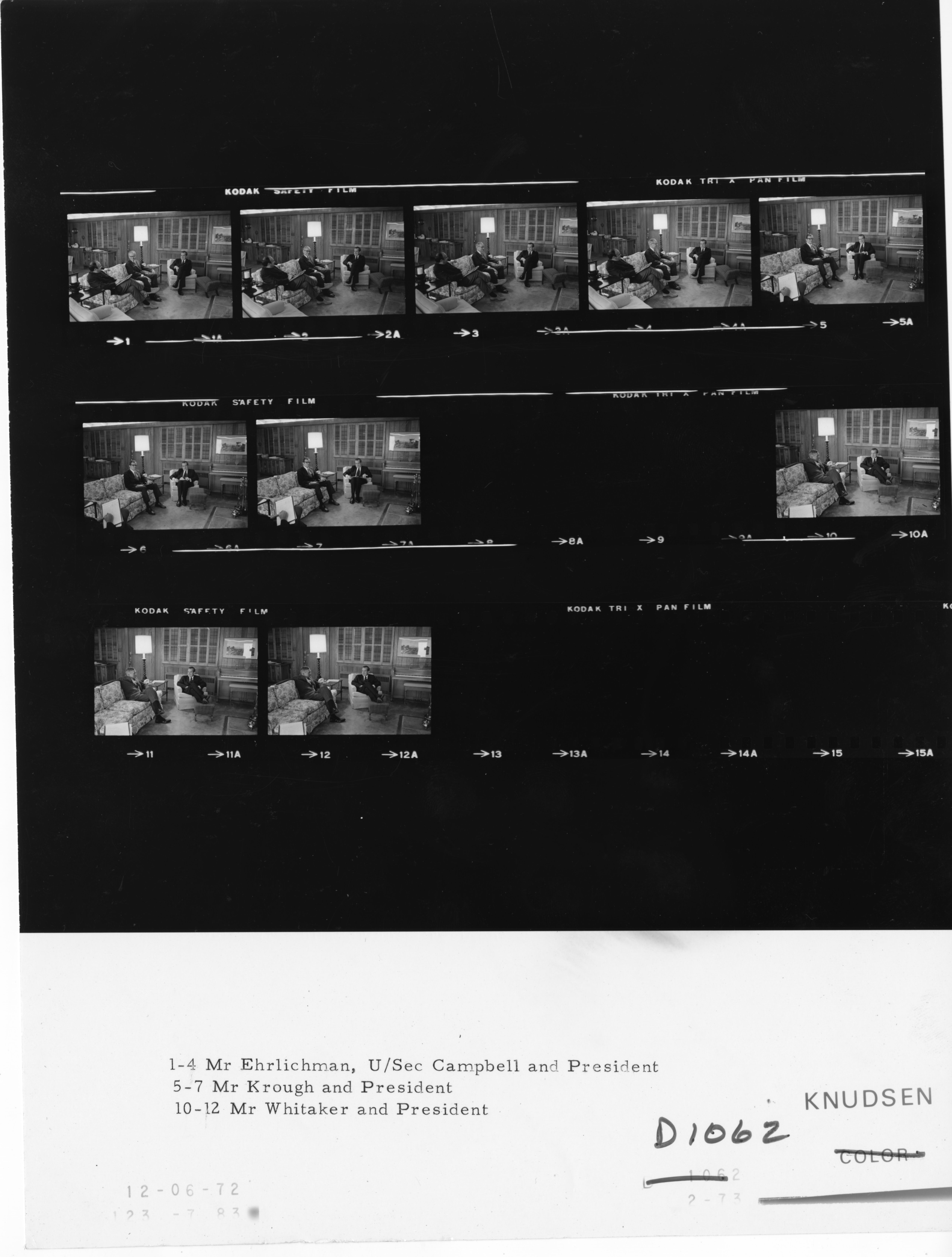
- Frame(s): WHPO-D1062-01-04, President Nixon seated informally with J. Phil Campbell, and H.R. Ehrlichman. 12/6/1972, Camp David, Maryland Aspen Lodge, den. President Nixon, Ehrlichman, , J. Phil Campbell.
- Frame(s): WHPO-D1062-05-07, President Nixon seated informally with Egil Krogh and John Ehrlichman. 12/6/1972, Camp David, Maryland Aspen Lodge, den. President Nixon, John Ehrlichman, Egil BUD Krogh.
- Frame(s): WHPO-D1062-10-12, President Nixon seated informally with John Whitaker. 12/6/1972, Camp David, Maryland Aspen Lodge, den. President Nixon, John Whitaker.
The White House Communications Agency Sound Recordings Collection contains public statements that took place between 1969 and 1974. Visit the finding aid to learn more.
H - White House Staff Member Recordings
- WHCA-SR-H-671
Briefing by UNIC member of White House Counsel staff to NYSU political science students (incomplete). (12/6/1972, Family Theater, White House)
Runtime: [Nonelisted]
Keywords: Briefings, private briefings
Production credits: Audio feed supplied by WHCA; Recorded by GET (initials of WHCA engineer)
Original Format: 1/4-inch reel-to-reel audiotape. Original source type: Original. - WHCA-SR-H-672
Press briefing by Robert Finch. (12/6/1972, Press Lobby, White House)
Runtime: 16:00
Keywords: Press conferences, news conferences, interviews, media
Production credits: Audio feed supplied by WHCA; Recorded by GET (initials of WHCA engineer)
Original Format: 1/4-inch reel-to-reel audiotape. Original source type: Original.
L - White House Press Office Briefings
- WHCA-SR-L-080
Press briefing by Ronald Ziegler. (12/6/1972, Camp David)
Runtime: 22:00
Keywords: Press conferences, news conferences, interviews, media, press secretary
Original Format: 1/4-inch reel-to-reel audiotape. Original source type: Original.
The White House Communications Agency Videotape Collection contains “off-the-air” recordings of televised programs produced between 1968 and 1974. Visit the finding aid to learn more.
- WHCA-5941
Weekly News Summary, Tape II.
ALL NETWORKS
Runtime: 01:01:06
13. Reasoner/Rolfson/Ciotti: Paris peace talks. Time Code Start: 29:48. Keywords: Paris Peace Talks, Vietnam War, treaty, treaties, negotiations. Network: ABC.
14. Smith/Burke: Vietnam, Saigon rocket attack. Time Code Start: 33:52. Keywords: Vietnam War, bombings. Network: ABC.
15. Smith: New cabinet announcement. Time Code Start: 35:47. Keywords: Presidents, cabinet, advisors, appointments. Network: ABC.
16. Reasoner/Kershaw: Russian ship, American grain. Time Code Start: 36:23. Keywords: American, Soviet Union, USSR, Russia, agriculture, crops, products, sales, business, imports, exports, trade, ships, transportation. Network: ABC.
17. Watson: Ireland's Constitutional Referendum. Time Code Start: 38:10. Keywords: United Kingdom, government, constitutions, voting, referendum. Network: ABC.
18. Smith: Commentary on former President Truman. Time Code Start: 41:18. Keywords: Presidents, documntary, reports. Network: ABC.
19. Chancellor/Dobyns: Paris peace talks, Kissinger. Time Code Start: 43:57. Keywords: Paris Peace Talks, Vietnam War, treaty, treaties, negotiations, government, officials, travel, trips. Network: NBC.
20. Chancellor/Streithorst/Hunt: Communists attack Tan Son Nhut Air Force base in Vietnam. Time Code Start: 45:00. Keywords: Vietnam War, Armed Forces, military, air bases, airfields, airports. Network: NBC.
21. Chancellor: Dent is new cabinet member. Time Code Start: 47:58. Keywords: Presidents, cabinet, advisors, appointments. Network: NBC.
22. Mudd/Kalisher: Paris peace talks, Kissinger. Time Code Start: 48:37. Keywords: Paris Peace Talks, Vietnam War, treaty, treaties, negotiations, government, officials, travel, trips. Network: CBS.
23. Collingwood: Commentary on Paris peace talks. Time Code Start: 50:45. Keywords: Paris Peace Talks, Vietnam War, treaty, treaties, negotiations. Network: CBS.
24. Wagner: Attack of Tan Son Nhut Air Force Base in South Vietnam. Time Code Start: 51:20. Keywords: Vietnam War, Armed Forces, military, air bases, airfields, airports. Network: CBS.
25. Mudd/Pierpoint/Schorr: Dent is new cabinet member, Peterson leaving, commentary on Commerce Department. Time Code Start: 54:05. Keywords: Presidents, cabinet, advisors, appointments. Network: CBS.
26. Sevareid: Commentary on re-organization of the Democratic Party. Time Code Start: 57:08. Keywords: political parties, Democrats, Democratic Party. Network: CBS.
Context (External Sources)
The Vanderbilt Television News Archive is the world's most extensive and complete archive of television news. They have been recording, preserving and providing access to television news broadcasts of the national networks since August 5, 1968.
Wikipedia is a free encyclopedia that anyone can edit.