

Introduction
This almanac page for Tuesday, December 5, 1972, pulls together various records created by the federal government and links to additional resources which can provide context about the events of the day.
Previous Date: Monday, December 4, 1972
Next Date: Wednesday, December 6, 1972
Schedule and Public Documents
The Daily Diary files represent a consolidated record of the President's activities. Visit the finding aid to learn more.
The President's day began at The White House - Washington, D. C.
The Weekly Compilation of Presidential Documents made available transcripts of the President's news conferences; messages to Congress; public speeches, remarks, and statements; and other Presidential materials released by the White House.
Digitized versions can be found at HathiTrust.
Each Public Papers of the Presidents volume contains the papers and speeches of the President of the United States that were issued by the White House Office of the Press Secretary during the time period specified by the volume. The material is presented in chronological order, and the dates shown in the headings are the dates of the documents or events. In instances when the release date differs from the date of the document itself, that fact is shown in the text note.
To ensure accuracy, remarks have been checked against audio recordings (when available) and signed documents have been checked against the original, unless otherwise noted. Editors have provided text notes and cross references for purposes of identification or clarity.
The Federal Register is the official daily publication for rules, proposed rules, and notices of federal agencies and organizations, as well as executive orders and other Presidential documents.
Archival Holdings
Any selection of archival documents will necessarily be partial. You should use the documents and folders identified below as a starting place, but consult the linked collection finding aids and folder title lists and the collections themselves for context. Many documents to be found this way do not lend themselves to association with specific dates, but are essential to a complete understanding of the material.
Selective document listing
President's Office Files
The President's Office Files consists of materials drawn together by the Special Files Unit from several administrative subdivisions within the White House Office. It is the handwriting and sensitive papers sent to the Staff Secretary that now comprise much of the President's Office Files. Visit the finding aid to learn more.
- News Summaries, Unmarked News Summaries, Box 52, News Summaries - December 1972 [1 of 6] [Note: Due to the way News Summary products were compiled, you should also consult nearby days for potentially relevant materials.]
- News Summary, December 5, 1972, (Monday nets, wires, mags)
- President's Daily Schedule, Box 102, [President's Daily Schedule, Oct.-Dec. 1972] [2 of 2]
- The President's Schedule, Tuesday - December 5, 1972
The H. R. Haldeman Diaries consists of seven handwritten diaries, 36 dictated diaries recorded as sound recordings, and two handwritten audio cassette tape subject logs. The diaries and logs reflect H. R. Haldeman’s candid personal record and reflections on events, issues, and people encountered during his service in the Nixon White House. As administrative assistant to the President and Chief of Staff, Haldeman attended and participated in public events and private meetings covering the entire scope of issues in which the Nixon White House engaged in during the years 1969-1973. Visit the finding aid to learn more.
- Transcript of diary entry (PDF)
Tuesday, December 5.
In Washington. The President had me over first thing this morning. In fact, he called me at home. I wasn't planning to go in until late, but I hurried up to go in. We had a problem because some of the Cabinet announcements had leaked, and he wanted them canceled, although he simmered down on that. The problem was the Post got the story, which was especially galling.
Then got into the Vietnam problem and wanted to discuss it in some detail. The question of whether he should go on TV or not. He got Kissinger's cable, which pushed hard on his going on again. Also, he got word that today's meeting had been canceled. They were going to meet tomorrow.
This led to a discussion later in the day with Colson on the same subject. He had Colson read the cable and discussed it. Chuck felt as I do and as the President does, that he should not go on. You can't rally the people again, and so on. Then he told me to go over this with Connally before his meeting with John, which I did. He also had Ziegler go over it, on the basis of whether there is anything that the President can say now that's new. The question is who to blame for the breakdown? Kissinger wants the President to blame North Vietnam and then pick the thing up. The President's concern is that this just ties him in with a failure and doesn't really accomplish anything. Connally felt the same way, after we had talked about it a little bit. He feels that this is going to be a serious blow to the American people, that we can't rely on the translation excuse, and that TV's not the answer. If there's any alternative, we should low key it as much as possible as being an interruption, not a breakdown or a breakoff. Kissinger has to take the heat, not the President, but he should not do it in despair or frustration. He should make the point that they have backed off. So then the President told me to send a message to Kissinger to tell North Vietnam tomorrow, first, that it's his belief now, that in view of the North Vietnam reneged on the October 26 agreement, and their intransigence, that the President will be able to get funds from Congress to continue military action and military and economic support for South Vietnam.
Also, that we should avoid a dramatic breakoff by us, should treat it as a case where we reached an impasse at this time, and each side has gone back for consultation; we'll resume when it appears productive to resume. Indicate it's the unanimous opinion here that it would be a mistake to break it off and the President to go on TV with chapter and verse as to why the negotiations failed. Instead, you should go as hard as you can. If you can't do it, you go home and consult further to see what the next course is, without saying anything we’d order a short military step-p. Kissinger should do a very short, matter-of-fact briefing, not with a huge buildup. Say North Vietnam backed off their commitment, we'll bargain in good faith whenever they're ready. Don't use the translation excuse. They insisted on North Vietnam forces in South Vietnam and a formula that they interpret as a coalition government, which we cannot accept. The President should not get into any details, nor should Kissinger --we're in the Christmas season now, people feel good, and so on, they don't want to hear all this. We should keep the hopes alive. We need to get Kissinger into a different frame of mind. We can't rally people to back negotiations that failed. Kissinger's TV idea would be a mistake. A briefing by you, at a low key, is the way to handle. As a bargaining point, make the point that the President now believes that he can get the funds from Congress. I should cover all these points in the message; that we must not assume that the gun is there to be fired. Henry's got to be turned off on dealing with this, so that he won't take the position when he gets in the meeting with the North Vietnamese and lock the President into it. The President called me later and said I should add to the cable a thing that says "Incidentally, the President and all of us here, feel that any discussion of your resignation is totally out of order", and then he agreed that that shouldn’t be raised. Kissinger is overdramatizing that whole thing.
The President got into the Christmas plans problem early today. Lucy and Bull are apparently going at it on the social plan, and we don't have anything worked out, so he was calling for action on that. Ended up calling Lucy and Steve into the office, going through what he wants with them.
Had a long session with Connally on the whole question of the new party and Connally's going for the Presidency, and it's clear that Connally is ready to run, but not totally convinced that we can do it by building a new party. That the third party route just isn't workable, and there's no point in trying it. He does feel that we could do something in the way of building or reestablishing the Republican Party in a different way, with a new name, such as the Republican Independent Party. It would clearly put a new cast on it, but not lose the base that we have now, which Connally feels is indispensable. He debated the question of whether he would change parties and came to no conclusion on that. It will depend on how the whole question comes out at the Democratic National Committee meeting, first of all, and then in general decision. Connally's feeling, however, is that he shouldn't change things when they are going well, and that we're in a pretty good position now, we ought to leave it that way. He ought not to change parties until there's a clear indication that that's the thing to do, which he doesn't feel there is at this point. I made the point that he maybe can't afford that luxury, in that it would be bad for him to change parties; in a way that looks like an opportunistic move to go for the nomination, where it would be good for him to change as a reaction to the sellout of the Party to the Libs. He agreed with that. The meeting went on for a couple of hours with general discussion of this and the whole Vietnam question. It was left that Connally would explore, and nothing really was settled.
End of December 5. - Original audio recording (MP3)
The National Archives Catalog is the online portal to the records held at the National Archives, and information about those records. It is the main way of describing our holdings and also provides access to electronic records and digitized versions of our holdings.
The Catalog searches across multiple National Archives resources at once, including archival descriptions, digitized and electronic records, authority records, and web pages from Archives.gov and the Presidential Libraries. The Catalog also allows users to contribute to digitized historical records through tagging and transcription.
Nixon Library Holdings
All National Archives Units
National Security Documents
The President's Daily Brief is the primary vehicle for summarizing the day-to-day sensitive intelligence and analysis, as well as late-breaking reports, for the White House on current and future national security issues. Read "The President's Daily Brief: Delivering Intelligence to Nixon and Ford" to learn more.
The Foreign Relations of the United States series presents the official documentary historical record of major U.S. foreign policy decisions and significant diplomatic activity. Visit the State Department website for more information.
Vol. V, United Nations, 1969-1972
UN Finances and Reduction of the U.S. Assessment
207. Telegram From the Mission to the United Nations to the Department of State, New York, December 5, 1972, 2358Z
Source: National Archives, RG 59, Central Files 1970–73, UN 10–4. Confidential; Limdis; Priority.
Vol. IX, Vietnam, October 1972-January 1973
Paris Negotiations Collapse, October 24-December 13, 1972
141. Message From President Nixon to the President’s Assistant for National Security Affairs (Kissinger) in Paris, Washington, December 5, 1972
Source: National Archives, Nixon Presidential Materials, NSC Files, Box 858, For the President’s Files (Winston Lord)—China Trip/Vietnam, Sensitive Camp David, Vol. XXII (1). Top Secret; Flash; Sensitive; Exclusively Eyes Only. Sent via Kennedy and Haig.
Vol. XXIV, Middle East Region and Arabian Peninsula, 1969-1972; Jordan, September 1970
Saudi Arabia
167. Letter From the Deputy Secretary of Defense (Rush) to Secretary of State Rogers, Washington, December 5, 1972
Source: National Archives, RG 59, Central Files 1970–73, DEF 6–4 SAUD. Secret.
Vol. E-10, Documents on American Republics, 1969-1972
Colombia
167. Letter From President Pastrana of Colombia to President Nixon, Bogotá, December 5, 1972., Bogotá, December 5, 1972
President Pastrana discussed a number of the problems Colombia would face in attempting to prevent the spread of foot-and-mouth disease. In particular, he noted that displacing a large number of cattle, located in remote areas, would be costly.
Source: National Archives, Nixon Presidential Materials, White House Central Files, Foreign Affairs, Box 32, EX FO 3–1/1–2, 1973–1974. The letter bears Pastrana’s typed signature. Nixon’s letter to Pastrana is printed as Document 166.
The Kissinger telephone conversation transcripts consist of approximately 20,000 pages of transcripts of Kissinger’s telephone conversations during his tenure as Assistant to the President for National Security Affairs (1969-1974) and Secretary of State (1973-1974) during the administration of President Richard Nixon. Visit the finding aid for more information.
Digitized versions can be found in the National Archives Catalog.
Audiovisual Holdings
Visit the White House Tapes finding aid to learn about the taping system's operation and archival processing.
Camp David Hard Wire
- 233-1; 9:31 p.m. - 9:39 p.m.; Nixon, Richard M. (President); Cernan, Eugene A.; Evans, Ronald E.; Schmitt, Harrison H. ("Jack")
- 233-2; Unknown between 9:39 p.m. & 10:05 p.m.; Nixon, Richard M. (President)
- 233-3; Unknown between 9:39 p.m. & 10:05 p.m.; Nixon, Richard M. (President)
- 233-4; Unknown between 9:39 p.m. & 10:05 p.m.; Nixon, Richard M. (President); Camp David Operator
- 233-5; Unknown between 9:39 p.m. & 10:05 p.m.; Nixon, Richard M. (President)
- 233-6; 10:05 p.m. - 10:34 p.m.; Nixon, Richard M. (President); Colson, Charles W.
- 233-7; Unknown between 10:34 p.m., 12/5 & 11:05 a.m., 10/30; Nixon, Richard M. (President)
- 233-23; Unknown between 9:00 p.m. & 9:31 p.m.; Nixon, Richard M. (President); Camp David Operator
Camp David Study Table
- 157-1; Unknown between 9:00 p.m. & 9:31 p.m.; Nixon, Richard M. (President); Camp David Operator
- 157-2; 9:31 p.m. - 9:39 p.m.; Nixon, Richard M. (President); Cernan, Eugene A.; Evans, Ronald E.; Schmitt, Harrison H. ("Jack")
- 157-3; Unknown between 9:39 p.m. & 10:05 p.m.; Nixon, Richard M. (President); Camp David Operator
- 157-4; 10:05 p.m. - 10:34 p.m.; Nixon, Richard M. (President); Colson, Charles W.
Old Executive Office Building
- 386-1; Unknown between 2:00 p.m. & 6:20 p.m.; Nixon, Richard M. (President); Colson, Charles W.; Haldeman, H. R. ("Bob"); White House operator; Bull, Stephen B.; Ziegler, Ronald L.; Sanchez, Manolo; Connally, John B.; [Unknown person(s)]
- 386-2; Unknown between 6:20 p.m. & 6:29 p.m.; Nixon, Richard M. (President); Monzon, Zosimo T.
- 386-3; 6:29 p.m. - 6:30 p.m.; Nixon, Richard M. (President); Butterfield, Alexander P.
- 386-4; Unknown between 6:30 p.m. & 7:35 p.m.; Nixon, Richard M. (President); Haldeman, H. R. ("Bob"); Butterfield, Alexander P.; White House operator; Cox, Tricia Nixon; Monzon, Zosimo T.
- 386-5; Unknown between 6:44 p.m. & 7:35 p.m.; Nixon, Richard M. (President); Haldeman, H. R. ("Bob")
- 386-6; Unknown between 6:44 p.m. & 7:35 p.m.; Nixon, Richard M. (President); Sanchez, Manolo; Bull, Stephen B.
- 386-7; Unknown between 6:44 p.m. & 7:35 p.m.; Nixon, Richard M. (President); Sanchez, Manolo
- 386-8; Unknown between 6:44 p.m. & 7:35 p.m.; Nixon, Richard M. (President); Bull, Stephen B.
- 386-9; Unknown between 6:44 p.m. & 7:35 p.m.; [Unknown person(s)]
- 387-1; 7:57 a.m. - 7:57 a.m.; Nixon, Richard M. (President); White House operator
- 387-2; Unknown between 7:57 a.m. & 8:10 a.m.; Nixon, Richard M. (President); Brennan, Peter J.
- 387-4; 8:10 a.m. - 9:50 a.m.; Nixon, Richard M. (President); Kennedy, Richard T. (Col.); White House operator; Colson, Charles W.; [Unknown person(s)]; Sanchez, Manolo; Haldeman, H. R. ("Bob"); Cox, Tricia Nixon
- 387-5; 10:13 a.m. - 10:13 a.m.; Nixon, Richard M. (President); White House operator
- 387-6; Unknown between 10:13 a.m. & 10:15 a.m.; Nixon, Richard M. (President); Bull, Stephen B.
- 387-7; 10:15 a.m. - 11:38 a.m.; Nixon, Richard M. (President); Shultz, George P.; Ehrlichman, John D.; White House photographer; Bull, Stephen B.
- 387-8; 1:09 p.m. - 1:09 p.m.; Nixon, Richard M. (President); White House operator
- 387-9; 1:09 p.m. - 1:10 p.m.; Nixon, Richard M. (President); Bull, Stephen B.
- 387-10; Unknown between 1:10 p.m. & 2:00 p.m.; Nixon, Richard M. (President); Sanchez, Manolo
- 387-11; Unknown between 1:10 p.m. & 2:00 p.m.; Nixon, Richard M. (President); Sanchez, Manolo
- 387-12; Unknown between 1:10 p.m. & 2:00 p.m.; Nixon, Richard M. (President); Sanchez, Manolo
- 387-13; Unknown between 2:00 p.m. & 3:00 p.m.; Nixon, Richard M. (President); Colson, Charles W.; Haldeman, H. R. ("Bob"); [Unknown person(s)]
Oval Office
- 818-1; Unknown between 11:42 a.m. & 11:43 a.m.; Nixon, Richard M. (President); Bull, Stephen B.
- 818-2; 11:43 a.m. - 12:05 p.m.; Nixon, Richard M. (President); Haldeman, H. R. ("Bob"); Winchester, Lucy A.; Bull, Stephen B.
- 818-3; 12:05 p.m. - 12:25 p.m.; Nixon, Richard M. (President); Rivero, Horacio, Jr. (Adm.); Kennedy, Richard T. (Col.); White House photographer; Bull, Stephen B.
- 818-4; 12:26 p.m. - 12:30 p.m.; Nixon, Richard M. (President); Dormann, Henry O.; Klein, Herbert G.; White House photographer; Bull, Stephen B.
- 818-5; Unknown between 12:30 p.m. & 12:31 p.m.; Nixon, Richard M. (President); Bull, Stephen B.
- 818-6; 12:31 p.m. - 12:37 p.m.; Nixon, Richard M. (President); Taylor, M. Harvey; Zimmerman, Leroy S.; Butterfield, Alexander P.
- 818-7; Unknown between 12:37 p.m. & 12:42 p.m.; Nixon, Richard M. (President); Bull, Stephen B.
- 818-8; Unknown between 12:37 p.m. & 12:42 p.m.; Nixon, Richard M. (President); Bull, Stephen B.
- 818-9; Unknown between 12:37 p.m. & 12:42 p.m.; Sanchez, Manolo; [Unknown person(s)]
White House Telephone
- 34-16; 7:57 a.m. - 7:57 a.m.; Nixon, Richard M. (President); White House operator
- 34-17; Unknown between 8:10 a.m. & 8:26 a.m.; Nixon, Richard M. (President); White House operator
- 34-18; 8:26 a.m. - 8:27 a.m.; Nixon, Richard M. (President); Colson, Charles W.
- 34-19; 8:56 a.m. - 8:59 a.m.; Nixon, Richard M. (President); Kennedy, Richard T. (Col.)
- 34-20; 9:44 a.m. - 9:45 a.m.; Cox, Tricia Nixon; Nixon, Richard M. (President)
- 34-21; 10:13 a.m. - 10:13 a.m.; Nixon, Richard M. (President); White House operator
- 34-22; 1:09 p.m. - 1:10 p.m.; Nixon, Richard M. (President); Bull, Stephen B.
- 34-23; Unknown between 2:00 p.m. & 2:56 p.m.; Nixon, Richard M. (President); White House operator
- 34-24; 2:56 p.m. - 2:57 p.m.; Nixon, Richard M. (President); Bull, Stephen B.
- 34-25; 2:58 p.m. - 2:58 p.m.; Nixon, Richard M. (President); White House operator
- 34-26; 6:43 p.m. - 6:44 p.m.; Nixon, Richard M. (President); Cox, Tricia Nixon
- 34-147; 1:09 p.m. - 1:09 p.m.; Nixon, Richard M. (President); White House operator
- 34-148; Unknown between 6:30 p.m. & 6:43 p.m.; Nixon, Richard M. (President); White House operator
The White House Photo Office collection consists of photographic coverage of President Richard Nixon meeting with prominent social, political, and cultural personalities; speaking engagements and news conferences of the President and various high-ranking members of the White House staff and Cabinet; Presidential domestic and foreign travel, including Presidential vacations; social events and entertainment involving the First Family, including entertainers present; official portraits of the President, First Family, and high-ranking members of the Nixon administration; the 1969 and 1973 Inaugurals; the President’s 1972 Presidential election campaign appearances (including speeches) and other official activities of the White House staff and the President’s Cabinet from January 20, 1969 until August 9, 1974 at the White House and the Old Executive Office Building; other locations in Washington, DC, such as The Mall; and the Presidential retreats in Camp David, Maryland, Key Biscayne, Florida, and San Clemente, California. Visit the finding aid to learn more.
Roll WHPO-D1056 Photographer: Atkins, Oliver | Color or B&W: B&W
- Frame(s): WHPO-D1056-02-11, President Nixon standing with Henry Dormann. 12/5/1972, Washington, D.C. White House, Oval Office. President Nixon, Henry Dormann, Herb Klein, M. Harvey Taylor, Leroy Zimmerman.
- Frame(s): WHPO-D1056-15-20, President Nixon standing with M. Harvey Taylor and Leroy Zimmerman. 12/5/1972, Washington, D.C. White House, Oval Office. President Nixon, Henry Dormann, Herb Klein, M. Harvey Taylor, Leroy Zimmerman.
Roll WHPO-D1057 Photographer: Knudsen, Robert L. | Color or B&W: B&W
- Frame(s): WHPO-D1057-, President Nixon seated informally with Horacio Rivero, U.S. Ambassador to Spain. 12/5/1972, Washington, D.C. White House, Oval Office. President Nixon, Horacio Rivero.
Roll WHPO-D1058 Photographer: Royer | Color or B&W: B&W
- Frame(s): WHPO-D1058-, Pat Nixon receiving a bicentennial plate from Mrs. Haugan, President of the General Federation of Women's Clubs, and standing with Board members and others. 12/5/1972, Washington, D.C. White House, Map Room. Pat Nixon, Mrs. Kermit Haugan, Mildred Ahlgren, Grace Christian, Ruth O'Brien, Frances Shuman, Mary Taylor, Mr. & Mrs. Townsend Bright, Mr. & Mrs. Wilmer Fenton.
Roll WHPO-D1059 Photographer: Kightlinger, Jack | Color or B&W: Color
- Frame(s): WHPO-D1059-03-19, Pat Nixon seated with two children from the Hospital for Sick Children and standing with an adult. 12/5/1972, Washington, D.C. White House, Library. Pat Nixon, Kirstin Hayward, Thomas Harvey, Jr., unidentified adult, Mrs. Kermit Haugan.
- Frame(s): WHPO-D1059-20-23, Pat Nixon receiving a bicentennial plate from Mrs. Haugan, President of the General Federation of Women's Clubs. 12/5/1972, Washington, D.C. White House, Map Room. Pat Nixon, Kirstin Hayward, Thomas Harvey, Jr., unidentified adult, Mrs. Kermit Haugan.
Roll WHPO-D1060 Photographer: Kightlinger, Jack | Color or B&W: Color
- Frame(s): WHPO-D1060-03-06, Pat Nixon standing with two children from the Hospital for Sick Children and adults associated with the hospital. 12/5/1972, Washington, D.C. White House, Library, Blue Room, Map Room. Pat Nixon, Kirstin Hayward, Thomas Harvey, Jr., Marjorie Parker, Vi Curtis Hinton, William Powers, Lorene Nagel, Gladys Hough, Army Commanders' wives, social aide, Women's Clubs board members.
- Frame(s): WHPO-D1060-07-12, Pat Nixon greeting Army Commanders' Wives. 12/5/1972, Washington, D.C. White House, Library, Blue Room, Map Room. Pat Nixon, Kirstin Hayward, Thomas Harvey, Jr., Marjorie Parker, Vi Curtis Hinton, William Powers, Lorene Nagel, Gladys Hough, Army Commanders' wives, social aide, Women's Clubs board members.
- Frame(s): WHPO-D1060-13-14, Pat Nixon in group photos of the Board of the General Federation of Women's Clubs. 12/5/1972, Washington, D.C. White House, Library, Blue Room, Map Room. Pat Nixon, Kirstin Hayward, Thomas Harvey, Jr., Marjorie Parker, Vi Curtis Hinton, William Powers, Lorene Nagel, Gladys Hough, Army Commanders' wives, social aide, Women's Clubs board members.
Roll WHPO-D1061 Photographer: Kightlinger, Jack | Color or B&W: B&W
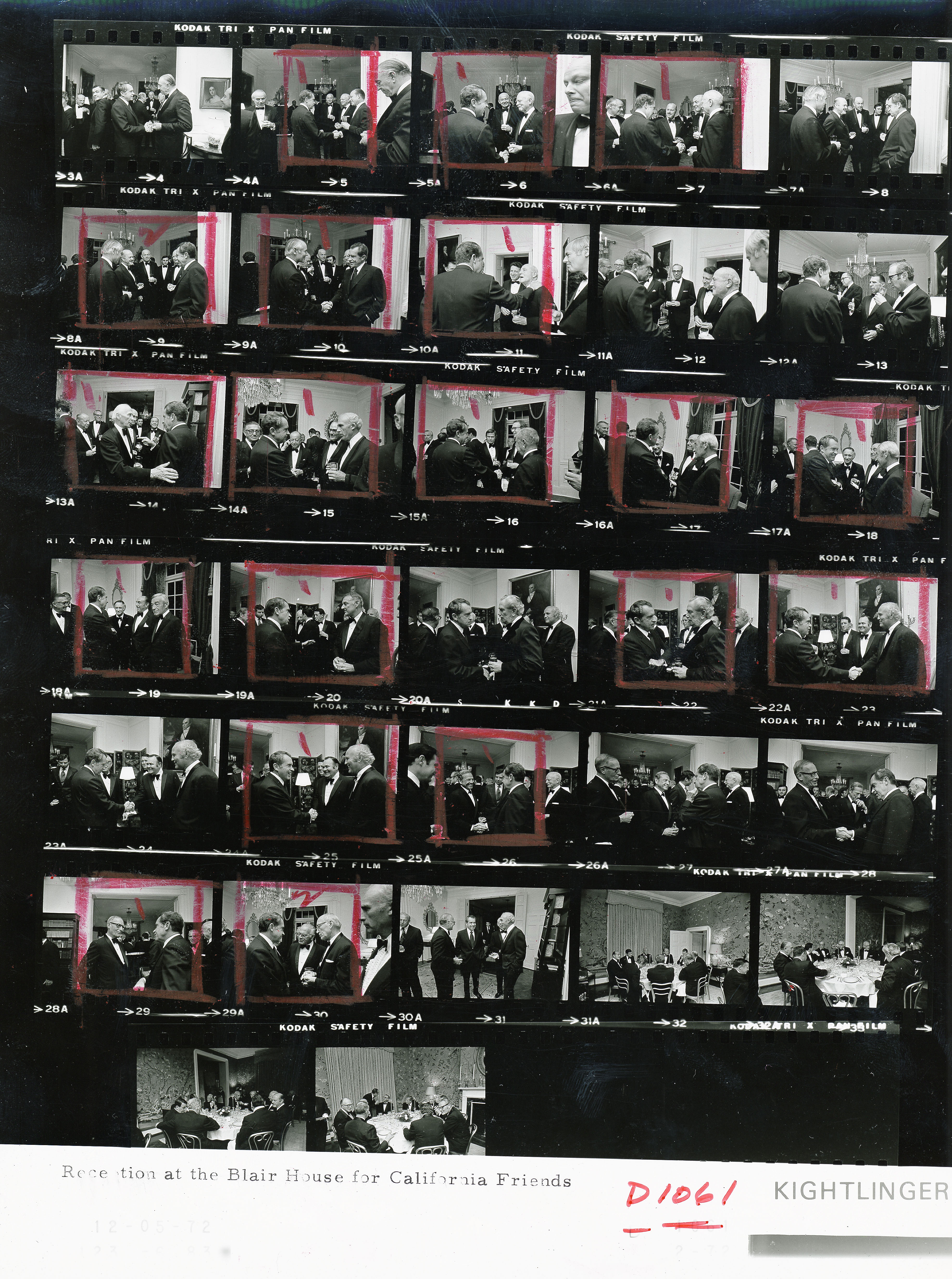
- Frame(s): WHPO-D1061-, Guests at their dinner tables during a reception given by President Nixon's California friends, honoring top Administration appointees from California. 12/5/1972, Washington, D.C. Blair drawing room, Blair Lee drawing room, Blair House. President Nixon, California friends and Administration officials,Jack Wrather, Holmes Tuttle, David Packard, Jack Hume, Roy Ash, Justin Dart, William French Smith, Thomas Pike, Caspar Weinberger, Walter a. Haas, Sr. Earl Adams, Ray Watt, Arnold O. Beckman, Leonard Firestone, Taft Schrober, Ben Deane, Samuel Shumway, Theodore Cummings, Jack Drown, Marco Hellman, Alfred Hart, Gordon Luce, Jack Warner, Darius Keaton, Samuel Shulman, Otto N. Miller.
- Frame(s): WHPO-D1061-03A-30, President Nixon shaking hands with guests at a reception, given by his California friends, honoring top Administration appointees from California. Shots of guests at dinner tables. 12/5/1972, Washington, D.C. Blair drawing room, Blair Lee drawing room, Blair House. President Nixon, California friends and Administration officials,Jack Wrather, Holmes Tuttle, David Packard, Jack Hume, Roy Ash, Justin Dart, William French Smith, Thomas Pike, Caspar Weinberger, Walter a. Haas, Sr. Earl Adams, Ray Watt, Arnold O. Beckman, Leonard Firestone, Taft Schrober, Ben Deane, Samuel Shumway, Theodore Cummings, Jack Drown, Marco Hellman, Alfred Hart, Gordon Luce, Jack Warner, Darius Keaton, Samuel Shulman, Otto N. Miller.
The White House Communications Agency Sound Recordings Collection contains public statements that took place between 1969 and 1974. Visit the finding aid to learn more.
L - White House Press Office Briefings
- WHCA-SR-L-078
Press briefing by Ronald Ziegler. (12/5/1972, White House Press Lobby)
Runtime: 23:00
Keywords: Press conferences, news conferences, interviews, media, press secretary
Original Format: 1/4-inch reel-to-reel audiotape. Original source type: Original. - WHCA-SR-L-079
Press briefing by Ronald Ziegler. (12/5/1972, White House Press Lobby)
Runtime: 20:00
Keywords: Press conferences, news conferences, interviews, media, press secretary
Original Format: 1/4-inch reel-to-reel audiotape. Original source type: Original.
The White House Communications Agency Videotape Collection contains “off-the-air” recordings of televised programs produced between 1968 and 1974. Visit the finding aid to learn more.
- WHCA-5941
Weekly News Summary, Tape II.
ALL NETWORKS
Runtime: 01:01:06
1. Smith/Matney: More cabinet appointments, James Lynn. Time Code Start: 00:00. Keywords: Presidents, cabinet, advisors, nominations, appointments, confirmations. Network: ABC.
2. Zimmerman: Federal housing in Detroit, Michigan. Time Code Start: 02:35. Keywords: homes, residences, federally funded. Network: ABC.
3. Smith/Jones: Russian [related terms: Soviet Union, USSR] grain shortage. Time Code Start: 05:04. Keywords: American, Soviet Union, USSR, Russia, agriculture, crops, products, sales, business, imports, exports, trade, shortages. Network: ABC.
4. Reasoner: Commentary on Scrooge, the New York Unions and the Blue Law. Time Code Start: 07:29. Keywords: Charles Dickens, books, characters, labor, unions, religion, religious, laws, Sabbath day, Sundays, shopping bans, sales, products. Network: ABC.
5. Chancellor/Mackin/Simpson: New measures for preventing hijacking with sixty days. Time Code Start: 09:17. Keywords: hijackings, skyjackings, kidnappings, terrorism, aircraft, airlines. Network: NBC.
6. Chancellor/Rosenfeld: Secretary of State Rogers and hijacking treaty with Cuba. Time Code Start: 13:10. Keywords: hijackings, skyjackings, kidnappings, terrorism, aircraft, airlines, cabinet, advisors, Cuban, treaties. Network: NBC.
7. Chancellor: Cabinet appointment, Russian ship loads American wheat. Time Code Start: 14:49. Keywords: U.S., American, Soviet Union, USSR, Russia, agriculture, food, crops, products, sales, agreements, business, imports, exports, trade, offiicals, appointments, confirmations. Network: NBC.
8. Brinkley: Commentary on What is on your mind? From South Carolina. Time Code Start: 16:52. Keywords: Southern states, politics. Network: NBC.
9. Mudd/Davis: South Vietnam opposes secret treaty. Time Code Start: 19:57. Keywords: Vietnam War, treaties, treaty. Network: CBS.
10. Mudd/Serafin: New hijacking protection and rules. Time Code Start: 22:42. Keywords: hijackings, skyjackings, kidnappings, terrorism, aircraft, airlines, security, rulings. Network: CBS.
11. Kalb: Anti-hijacking agreement with Cuba, Secretary of State Rogers. Time Code Start: 25:35. Keywords: hijackings, skyjackings, kidnappings, terrorism, aircraft, airlines, Cuban, cabinet, advisors. Network: CBS.
12. Mudd/Schorr: New cabinet members, comment on Housing and Urban Development (HUD) with James Lynn, new Secretary of Health, Education and Welfare (HEW). Time Code Start: 27:15. Keywords: cabinet, advisors, government agencies. Network: CBS.
Context (External Sources)
The Vanderbilt Television News Archive is the world's most extensive and complete archive of television news. They have been recording, preserving and providing access to television news broadcasts of the national networks since August 5, 1968.
Wikipedia is a free encyclopedia that anyone can edit.