
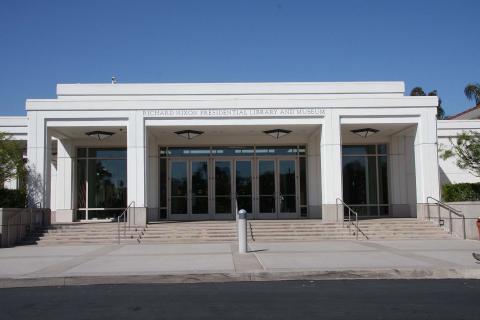
Introduction
This almanac page for Thursday, December 7, 1972, pulls together various records created by the federal government and links to additional resources which can provide context about the events of the day.
Previous Date: Wednesday, December 6, 1972
Next Date: Friday, December 8, 1972
Schedule and Public Documents
The Daily Diary files represent a consolidated record of the President's activities. Visit the finding aid to learn more.
The President's day began at Camp David, Maryland
The Weekly Compilation of Presidential Documents made available transcripts of the President's news conferences; messages to Congress; public speeches, remarks, and statements; and other Presidential materials released by the White House.
Digitized versions can be found at HathiTrust.
Each Public Papers of the Presidents volume contains the papers and speeches of the President of the United States that were issued by the White House Office of the Press Secretary during the time period specified by the volume. The material is presented in chronological order, and the dates shown in the headings are the dates of the documents or events. In instances when the release date differs from the date of the document itself, that fact is shown in the text note.
To ensure accuracy, remarks have been checked against audio recordings (when available) and signed documents have been checked against the original, unless otherwise noted. Editors have provided text notes and cross references for purposes of identification or clarity.
The Federal Register is the official daily publication for rules, proposed rules, and notices of federal agencies and organizations, as well as executive orders and other Presidential documents.
Archival Holdings
Any selection of archival documents will necessarily be partial. You should use the documents and folders identified below as a starting place, but consult the linked collection finding aids and folder title lists and the collections themselves for context. Many documents to be found this way do not lend themselves to association with specific dates, but are essential to a complete understanding of the material.
Selective document listing
President's Office Files
The President's Office Files consists of materials drawn together by the Special Files Unit from several administrative subdivisions within the White House Office. It is the handwriting and sensitive papers sent to the Staff Secretary that now comprise much of the President's Office Files. Visit the finding aid to learn more.
- News Summaries, Unmarked News Summaries, Box 52, News Summaries - December 1972 [2 of 6] [Note: Due to the way News Summary products were compiled, you should also consult nearby days for potentially relevant materials.]
- News Summary, December 7, 1972, (Wed nets, wires)
The H. R. Haldeman Diaries consists of seven handwritten diaries, 36 dictated diaries recorded as sound recordings, and two handwritten audio cassette tape subject logs. The diaries and logs reflect H. R. Haldeman’s candid personal record and reflections on events, issues, and people encountered during his service in the Nixon White House. As administrative assistant to the President and Chief of Staff, Haldeman attended and participated in public events and private meetings covering the entire scope of issues in which the Nixon White House engaged in during the years 1969-1973. Visit the finding aid to learn more.
- Transcript of diary entry (PDF)
Thursday, December 7th, at Camp David. We started off the day with the Dole problem, since I called him this morning to confirm his appointment with the President today, and make sure he was ready to make his announcement. And he took a very bitter approach; indicated to me that there had been a lot of press stuff out indicating he was being forced out and that sort of thing. That he didn't think that was right that he wasn't going to go along with it, and he didn't know whether he was ready to move ahead on his resignation or not. That he was going to be talking to his State Chairman from Kansas later today, and then would call me back. He got into quite a bit of tirade on the whole situation, blaming it on White House leaks and that sort of thing. Although it's clear from checking some of the stuff he was referring to, that they must be Dole-originated leaks, which he's trying to do in self-defense, not realizing he's hurting himself more than he's helping. I talked to Mitchell about it, and he didn't have much to offer in the way of help.
The President had apparently had talked to Ford sometime this morning about the Dole thing, too, and had me call Ford back and see if we could get his help, and Gerry was concerned about the situation, but didn't feel that there was much he could do about it. Then tonight, Colson called Larry to report that Dole had called him saying he had decided he was the only friend he had at the White House, and the launched into a ten minute tirade against me, followed by a statement that he was being forced out and screwed in the press, and that sort of thing, and that he wasn't going to stand for it. That he had the votes on the Committee, and that he wasn't going to get out, he was going to fight it. So, we now launched Bryce Harlow and John Mitchell to see if they can get him to listen to reason.
We got into a few other personnel things today. The President talked to Colson about his pleasure with Webster; who is going to the IRS; he thinks that he's going to be very good. Also he met with Charlie Walker today and told Chuck that Walker's setting up a new PR firm, wants Colson to talk with him, that the two of them ought to work together. He talked a little about Packard in the Business Council. The President said he's not going to go out doing the meetings with the Departments, and that sort of thing, like he did four years ago. That he's tried love with the bureaucracy and that didn't work now he's going to try a little fear and respect. He also says he's not going to do any more birthday phone calls unless there's some special reason for it. He said to go ahead and give [unintelligible] the Cuban, for a non-Castro South American Ambassador post. He wanted to know if we are using any astronauts in our personnel search.
And then we got into the Kennedy situation at the first meeting this morning. He got into the point that the rallying theme won't work when the people's spirits are up. We have to wait and try to rally the people later, if the public spirit drops, but as of now, it hasn't dropped and there's no way to rally it, because there's no need to rally it.
Then later this morning, he made the point that he doesn't think that Kissinger's thinking clearly regarding the reality here and in Congress, and he wanted to be sure that Colonel Kennedy had a full set of notes on the meeting that the President had with Kennedy and Rush and Moorer this afternoon. He said that both Moorer and Rush have the same opinion that the President does, that we've got to go ahead with negotiations, so we can't fold up and resume the bombing. He said to tell Kennedy, Kissinger to stay tomorrow night at Paris, after their meeting tomorrow, and then come in Saturday morning. He said that I need to grapple with him as soon as he arrives, depending on the situation. That I have, to get the TV point out of the way, that it's not our option, and on his resignation, that's okay for the President, but it's bad for Henry. The President concludes that Kissinger's in a worried state at this point, for three reasons: one, the Italian interview; two, because the negotiations have failed; and three, his concern about Rogers, and it's hard to tell in what order. He said to hit Kissinger very hard on the television thing. That Ziegler, Colson and Connally all agreed that it would be disastrous. That on May 8th and Cambodia, people were low and needed to be rallied now they're high and you can't rally them.
Then I was over at 5:00 and he had Ehrlichman join us discussing some personnel items. And then Manalo brought in Kissinger's cable, which the President read and then reviewed the highlights with us. He had apparently had made a little progress, but not very much, although he now realizes we should move for agreement. He still put the two choices to the President, though, after laying out all the pitfalls involved in each, especially the negotiating route. He wanted Kennedy to make a copy of this and give it to Rush on an eyes only basis, and then have Rush call the President as soon as he's read it and give him his opinion.
-------------------------------------------------------------------------------------------------------------------
DECLASSIFIED - E.O. 13526, Sect. 3.4: by MS, NARA, June 12, 2013
Audio Cassette 28, Side A, Withdrawn Item Number 15 [AC-28(A) Sel 13-1]
Duration: 1 minute 13 seconds
The President then told us that the result of the Moorer and Rush meeting was agreement that Congress would pull the plug on Thieu if it was clear that he had blocked the agreement. Both of them agreed it that we should take the October 8th agreement if we could get it, even if Thieu won't go along. Moorer thinks Thieu will in the crunch. That he'll have to.
The President says Kissinger without knowing it has a self-destructive instinct. He doesn't want to risk an agreement that fails. He thinks it's better to bust it off let the President put the blame on North Vietnam and continue that bombing until we get the prisoners back. But the result of that will be South Vietnam is lost between now and July. Moorer agrees that that would happen. The President says Thieu is the one that screwed up as a result of Kissinger pressing him too hard. So Kissinger realizes his place in history is on the line and he's concerned regarding the reports the President has pulled him back. The clinker in Kissinger's break-off proposal, and the idea of resuming the bombing, is that we're not sure that they'll give us the POW’s in July, even though we think they will. And we don't know that South Vietnam will survive even so. The real question is, doesn't Thieu have to come around?
-------------------------------------------------------------------------------------------------------------------
The President will have, had said that he'd have an answer to Kissinger's cable in a couple of hours. He wanted Rush's and Kennedy's reactions. Kennedy's view was that the cable left us in precisely the same question as yesterday; that he's not sure what Kissinger meant by referring to a “recess” in the cable. He says Kissinger is correct regarding the attitudes of the two Vietnams. And Kennedy said he was going to put the question to AI as to what their opinion really was. Kennedy thinks that he, Kissinger was recommending the negotiating option yesterday, and that also today he recommends going for an agreement, but is warning of the consequences. The President feels Kissinger's choice is the bombing option, but it won't work unless the President goes on TV, and, as he sees it, that's not in the cards, he moves to the other option. If the President won't step up and do it, in other words, then I have to take the other route. Kissinger always prefers the big action play, against all odds, and winning it. The President says I do, too, if you win it. Kissinger wants to push the President into taking a course of action that Kissinger warned against. The President is getting into quite a lot of psychological reaction to Kissinger, and Ehrlichman did likewise. Ehrlichman feels that deep down Kissinger would like to get out of it now and lay it on the President. That Kissinger wants, subconsciously, to flee rather than fight, but he'd deny that and would say he's recommending fight, but actually he's fleeing from the complex, and therefore, the right thing. The President is convinced that if Kissinger came back without an agreement, he would resign. When he returns, I've got to get him firmly on board, to see it through all the way. No hang-dog position. We can't let him drop the word that he wanted to hang tough and the President forced him to make the best deal that he could. Ehrlichman's case is that Kissinger has a vested interest in an agreement and to show that he's improved on October, and that he can't separate from the President to the right. The President says unless it breaks down.
-------------------------------------------------------------------------------------------------------------------
DECLASSIFIED - E.O. 13526, Sect. 3.4: by MS, NARA, June 12, 2013
Audio Cassette 28, Side A, Withdrawn Item Number 15 [AC-28(A) Sel 13-2]
Duration: 20 seconds
The President feels we just can't spend anymore; anymore money, lives, time, effort, agony on the war. That we can get out now because of what he's done on May 8th, and that was Rush's view, he said. His conclusion is we have to make an agreement…
-------------------------------------------------------------------------------------------------------------------
...so he says give Henry a terse reply. There has been movement in today's meeting, and we should go. Then Henry should plan to return to Camp David so he can have a full day with the President and with Haig. The President said that he, that I should indicate to Henry that he's doing a superhuman job. We know how tough it is; that he had a long meeting on the military option today with Admiral Moorer, and he's now drafting a reply with instructions. He, these were his instructions when the call, the phone call came in from Henry, and I took it while the President went out for a swim.
Henry was calling from Paris, said that he hadn't heard from me for a few days and so he was just calling to check in with me. Then immediately he said, basically, I wanted you to know that I'm in favor of going ahead, but I did want to warn about the implications that are involved. Then I said, well you're clearly making some progress in the negotiations and it looks better, doesn't it? And he said, yes, we're slowly getting there, and if we all know what we're getting into, it's the right thing to do, but it's not the millennium. It will be a better agreement than October would have been. We still have the option, though, of going the other way, and he wants us to know that, and we can do it by putting the heat and the blame on the others, as he spelled out in his message. Basically, he thinks the course the President suggests is the one he favors. If we don't quite make it, he'll recess in order to consult. I asked him how he saw the timing working out, and he said it's a question of whose nerves hold out the longer. We'll have a pretty clear view by tomorrow. He'll probably come back Saturday morning. If things break rapidly, he'll send Haig back and he'll stay there to work out the details. At the latter part of the conversation, the President came bouncing in from the pool, waving, saying, do you need me, and I said, no, as I continued the conversation, so he went on into his room to get dressed.
I talked again to Kennedy, and he said he'd talked to Haig and that AI thinks that we're really talking about the second option, but we'll recess after tomorrow's meeting in any event. Kennedy feels we shouldn't force a recess after tomorrow, but we should try and lock the whole thing up if we can. Then the President talked with Rush and then had me get on and get Rush's view and make notes on it. Rush says that basically his position is that Hanoi has not given up its ultimate objective and Saigon has not given up its ultimate objective. Hanoi wants to unify all Vietnam under their control. Thieu wants all of the North Vietnamese out of South Vietnam. Our objectives, on the other hand, are outlined in the May 8 speech, and the President got the support of the nation at that time, because he made a decision to take strong action and because he outlined a reasonable and solid program of victory. Now we're in negotiations that give the President his objective, and our objectives are reasonable. We should not allow our enemies to push us around and we should not allow our allies to veto. We can't tolerate South Vietnam's objection. We've achieved our objective. Henry, going out saying peace is at hand has set us in that position. The record will show that we have achieved the May 8 objectives plus more than that. We can't say that we must have what Thieu wants, because then we won't get the support of the Congress or the country, so then both we and Vietnam will be defeated. If Hanoi breaks the agreements after we make one, then we'd have a good chance of getting support to go in and react to the breaking of the agreement. On the other hand, if we go the other way, world opinion would say that we put Thieu ahead of our POW's. In other words, we can't make the argument that we're bombing in order to save our POW's, it'll be clear that we're bombing in order to save Thieu.
The President dictated a cable which I wrote out in longhand, then rewrote in longhand and sent over for typing, brought it back, read it to the President, he approved it, and I had it sent down as the cable to Kissinger, telling him to take the second option, but to view it as a fixed decision with no further debate. Kennedy agrees with this route and those are the instructions to Henry tonight.
The President felt very relieved and figures he's made the decision now and can live with it, and he then obviously felt quite relaxed, had John and me stay for dinner. And after we left, he had the four secretaries come over to watch a movie with him.
End of December 7th.
Oh, later this evening, he decided to go ahead on the Justice Department changes. He'd been stalling on the decision as to whether to go with Dean Sneed as the Deputy Attorney General, but he decided tonight to do so. Kleindienst is really fighting it, and Mitchell is strongly opposed to it, so Ehrlichman is in the middle of the flap on the thing, but...
[End of tape reel AC-28(A)]
[End of December 07, 1972] - Original audio recording (MP3)
The National Archives Catalog is the online portal to the records held at the National Archives, and information about those records. It is the main way of describing our holdings and also provides access to electronic records and digitized versions of our holdings.
The Catalog searches across multiple National Archives resources at once, including archival descriptions, digitized and electronic records, authority records, and web pages from Archives.gov and the Presidential Libraries. The Catalog also allows users to contribute to digitized historical records through tagging and transcription.
Nixon Library Holdings
All National Archives Units
National Security Documents
The President's Daily Brief is the primary vehicle for summarizing the day-to-day sensitive intelligence and analysis, as well as late-breaking reports, for the White House on current and future national security issues. Read "The President's Daily Brief: Delivering Intelligence to Nixon and Ford" to learn more.
The Foreign Relations of the United States series presents the official documentary historical record of major U.S. foreign policy decisions and significant diplomatic activity. Visit the State Department website for more information.
Vol. V, United Nations, 1969-1972
Special Meetings of the Security Council
145. Telegram From the Embassy in Panama to the Department of State, Panama City, December 7, 1972, 2208Z
Source: National Archives, RG 59, Central Files 1970–73, UN 3 SC. Confidential; Priority. Repeated to USUN.
UN Finances and Reduction of the U.S. Assessment
209. Telegram From the Mission to the United Nations to the Department of State, New York, December 7, 1972, 0219Z
Source: National Archives, RG 59, Central Files 1970–73, UN 10–4. Confidential; Priority; Limdis.
Vol. IX, Vietnam, October 1972-January 1973
Paris Negotiations Collapse, October 24-December 13, 1972
145. Message From President Nixon to the President’s Assistant for National Security Affairs (Kissinger) in Paris, Washington, December 7, 1972, 0511Z
Source: National Archives, Nixon Presidential Materials, NSC Files, Box 858, For the President’s Files (Winston Lord)—China Trip/Vietnam, Sensitive Camp David, Vol. XXII (1). Top Secret; Flash; Sensitive; Exclusively Eyes Only. Sent via Kennedy, Guay, and Haig.
146. Message From the President’s Deputy Assistant for National Security Affairs (Haig) to Richard T. Kennedy of the National Security Council Staff, Paris, December 7, 1972, 1337Z
Source: National Archives, Nixon Presidential Materials, NSC Files, Box 858, For the President’s Files (Winston Lord)—China Trip/Vietnam, Sensitive Camp David, Vol. XXII (1). Top Secret; Sensitive; Exclusively Eyes Only. Sent via Guay.
147. Message From the President’s Assistant for National Security Affairs (Kissinger) to President Nixon, Paris, December 7, 1972, 2133Z
Source: National Archives, Nixon Presidential Materials, NSC Files, Box 858, For the President’s Files (Winston Lord)—China Trip/Vietnam, Sensitive Camp David, Vol. XXII (2). Top Secret; Flash; Sensitive; Exclusively Eyes Only. Sent via Haig, Guay, and Kennedy.
Vol. XVII, China, 1969-1972
China, March-December 1972
269. Memorandum of Conversation, Paris, December 7, 1972, 11:25 p.m.-12:15 a.m.
Source: National Archives, Nixon Presidential Materials, NSC Files, Box 850, President’s File—China Trip, China Exchanges. Top Secret; Sensitive; Exclusively Eyes Only. The meeting was held at the PRC Embassy.
Vol. XXIX, Eastern Europe, 1969-1972
Bulgaria
76. Telegram From the Embassy in Bulgaria to the Department of State, Sofia, December 7, 1972, 0815Z
Source: National Archives, RG 59, Central Files 1970–73, POL BUL–US. Confidential; Limdis.
Vol. XLII, Vietnam: The Kissinger-Le Duc Tho Negotiations
Breakdown of Negotiations, November 1972-December 1972
35. Memorandum of Conversation, Paris, December 7, 1972, 3-7 p.m.
Source: National Archives, Nixon Presidential Materials, NSC Files, Box 865, For the President’s Files (Winston Lord)—China Trip/Vietnam Negotiations, Camp David Memcons, December 1972 [3 of 3]. Top Secret; Sensitive; Exclusively Eyes Only. The meeting took place at 108 Avenue du Général Leclerc in Gif-sur-Yvette. All brackets are in the original. The tabs are attached but not printed.
In his report to the President after the meeting, Kissinger first went into the details of the various proposals and counterproposals, amendments, and revisions presented during the session. Then he developed a broader view of what was happening and what it meant, observing that “it is now obvious as the result of our additional exploration of Hanoi’s intentions that they have not in any way abandoned their objectives or ambitions with respect to South Vietnam. What they have done is decide to modify their strategy by moving from conventional and main force warfare to a political and insurgency strategy within the framework of the draft agreement. Thus, we can anticipate no lasting peace in the wake of a consummated agreement, but merely a shift in Hanoi’s modus operandi. We will probably have little chance of maintaining the agreement without evident hair-trigger U.S. readiness, which may in fact be challenged at any time, to enforce its provisions.
“Thus we are now down to my original question: is it better to continue to fight on by scuttling the agreement now; or be forced to react later, vindicated by the violation of a solemnly entered agreement? Were we to opt for the former, I can with ample justification recess the talks tomorrow on grounds that would leave us in a good public position, emphasizing Hanoi’s absolute unwillingness to give us any assurance on the issue of their troops in the South or to even accept modifications to the text of the agreement which would establish the principle of nonintervention in the future. If on the other hand we opt for an agreement, we would then have to be prepared to react promptly and decisively at the first instance of North Vietnamese violation. I raise these issues not because the agreement itself is bad but because the balance of existing forces cannot get us a better agreement; no war in history has been settled on better terms than the reality of forces on the battlefield could justify. Nor can our worries be fixed by specific provisions at this point. The GVN approach and our vigilance are the key factors.” (Foreign Relations, 1969–1976, vol. IX, Vietnam, October 1972–January 1973, Document 147)
Kissinger did not express a preference in his report, but in a telephone conversation with Haldeman that day he made it clear that he favored the second option, and Haldeman so informed the President. (Ibid., Document 150, footnote 3)
Nixon’s immediate reply gave Kissinger instructions for the December 8 meeting. “I have decided,” the President’s message reads, “that we should go forward with the second option with the only condition being that the agreement we get must be some improvement over the October agreement as you have indicated it is.” He added: “I am completely aware of all the problems we will have in getting agreement from Thieu and in policing the agreement if it is reached, however I believe the risks of the other option of breaking off the talks and escalating the bombing are far greater.” (Ibid., Document 150)
Vol. E-5, Part 2, Documents on North Africa, 1969-1972
Libya
95. Telegram 1849 From the Embassy in Libya to the Department of State, Tripoli, December 7, 1972, 1456Z
The telegram warned that the United States could expect overt discrimination from Libya due to its policy of support for Israel.
Source: National Archives, RG 59, Central Files 1970–73, POL LIBYA–US. Secret;Exdis. Also sent to Lagos. In telegram 199168, November 2, the Department instructed the Embassy not to broach the topic of the F–5s, but observed that Tripoli had neither been asked for, nor made, payments for the F–5s. (Ibid., DEF 12–5 LIBYA)
Vol. E-10, Documents on American Republics, 1969-1972
Cuba
265. Telegram 221538 From the Department of State to the Mission to the United Nations, December 7, 1972, 1814Z., December 7, 1972, 1814Z
The Department of State responded to press speculation that United States-Cuban hijacking negotiations might indicate a change in U.S. policy toward Cuba.
Source: National Archives, RG 59, Central Files 1970–73, POL CUBA–US. Unclassified. It was drafted by Philip K. Johnson (ARA/CCA); cleared in ARA/CCA and IO/UNP; and approved by Hurwitch.
The Kissinger telephone conversation transcripts consist of approximately 20,000 pages of transcripts of Kissinger’s telephone conversations during his tenure as Assistant to the President for National Security Affairs (1969-1974) and Secretary of State (1973-1974) during the administration of President Richard Nixon. Visit the finding aid for more information.
Digitized versions can be found in the National Archives Catalog.
Audiovisual Holdings
Visit the White House Tapes finding aid to learn about the taping system's operation and archival processing.
Camp David Hard Wire
- 234-10; 1:05 p.m. - 1:20 p.m.; Ehrlichman, John D.; Webster, George D.
- 234-11; Unknown between 1:20 p.m. & 9:04 p.m.; Nixon, Richard M. (President); Sanchez, Manolo
- 234-12; 9:04 p.m. - 9:04 p.m.; Nixon, Richard M. (President); Camp David Operator
- 234-13; Unknown between 9:04 p.m. & 9:12 p.m.; Nixon, Richard M. (President); Sanchez, Manolo
- 234-14; Unknown between 9:04 p.m. & 9:12 p.m.; Nixon, Richard M. (President); Sanchez, Manolo
- 234-15; Unknown between 9:04 p.m. & 9:12 p.m.; Nixon, Richard M. (President)
Camp David Study Table
The White House Photo Office collection consists of photographic coverage of President Richard Nixon meeting with prominent social, political, and cultural personalities; speaking engagements and news conferences of the President and various high-ranking members of the White House staff and Cabinet; Presidential domestic and foreign travel, including Presidential vacations; social events and entertainment involving the First Family, including entertainers present; official portraits of the President, First Family, and high-ranking members of the Nixon administration; the 1969 and 1973 Inaugurals; the President’s 1972 Presidential election campaign appearances (including speeches) and other official activities of the White House staff and the President’s Cabinet from January 20, 1969 until August 9, 1974 at the White House and the Old Executive Office Building; other locations in Washington, DC, such as The Mall; and the Presidential retreats in Camp David, Maryland, Key Biscayne, Florida, and San Clemente, California. Visit the finding aid to learn more.
Roll WHPO-D1063 Photographer: Schumacher, Karl | Color or B&W: B&W
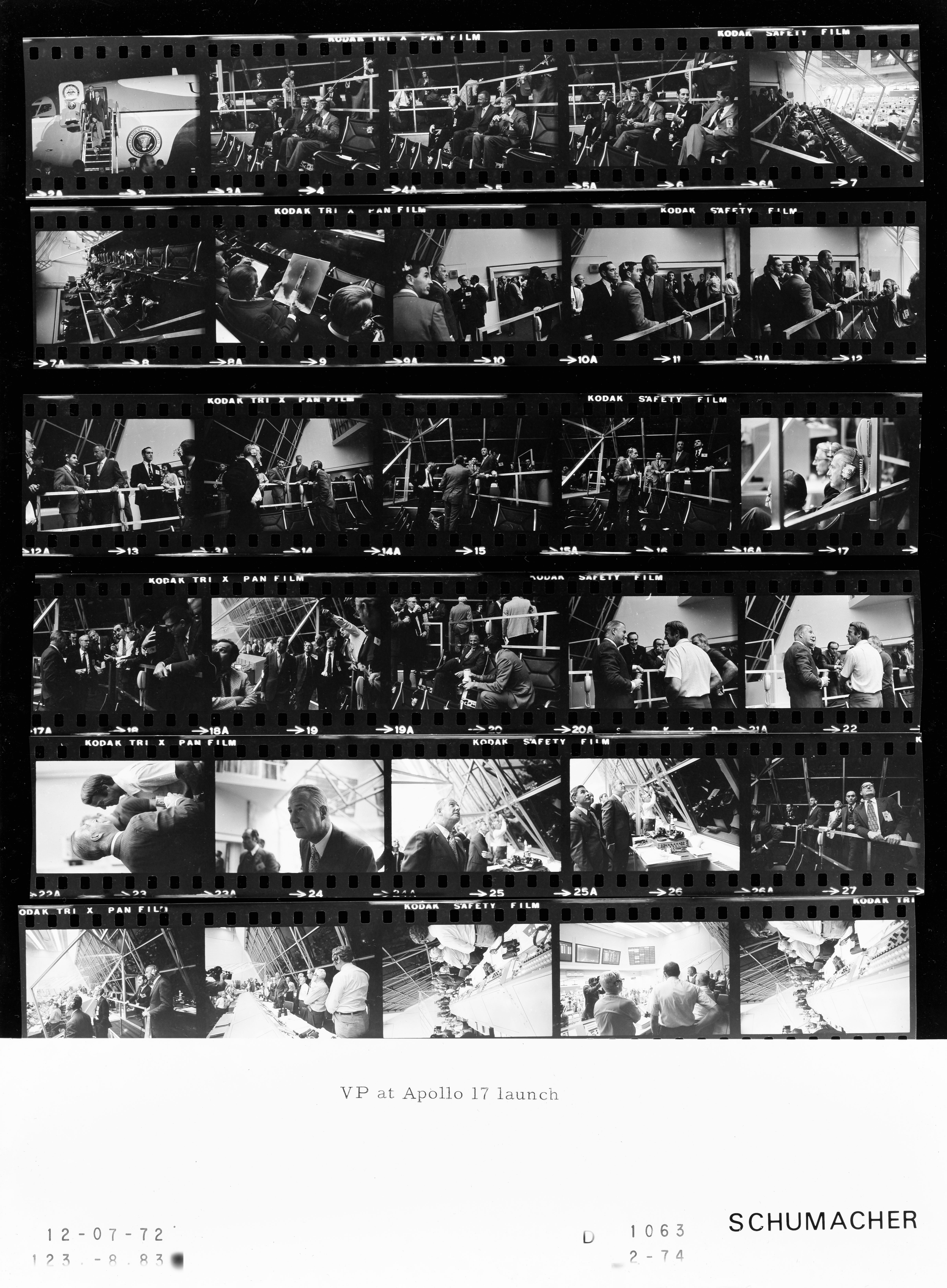
- Frame(s): WHPO-D1063-03, Vice President Agnew and Judy Agnew leaving their plane. 12/7/1972, Cape Kennedy, Florida tarmac. Spiro Agnew, Judy Agnew, unidentified men.
- Frame(s): WHPO-D1063-04-32, Vice President Agnew and others at the command center for the Apollo 17 launch. 12/7/1972, Cape Kennedy, Florida command center. Spiro Agnew, Judy Agnew, unidentified men.
Roll WHPO-D1064 Photographer: Schumacher, Karl | Color or B&W: B&W
- Frame(s): WHPO-D1064-, Vice President Agnew meeting with Governor George Wallace on an airplane. 12/7/1972, Cape Kennedy, Florida plane. Spiro Agnew, George Wallace.
Roll WHPO-D1065 Photographer: Schumacher, Karl | Color or B&W: Color
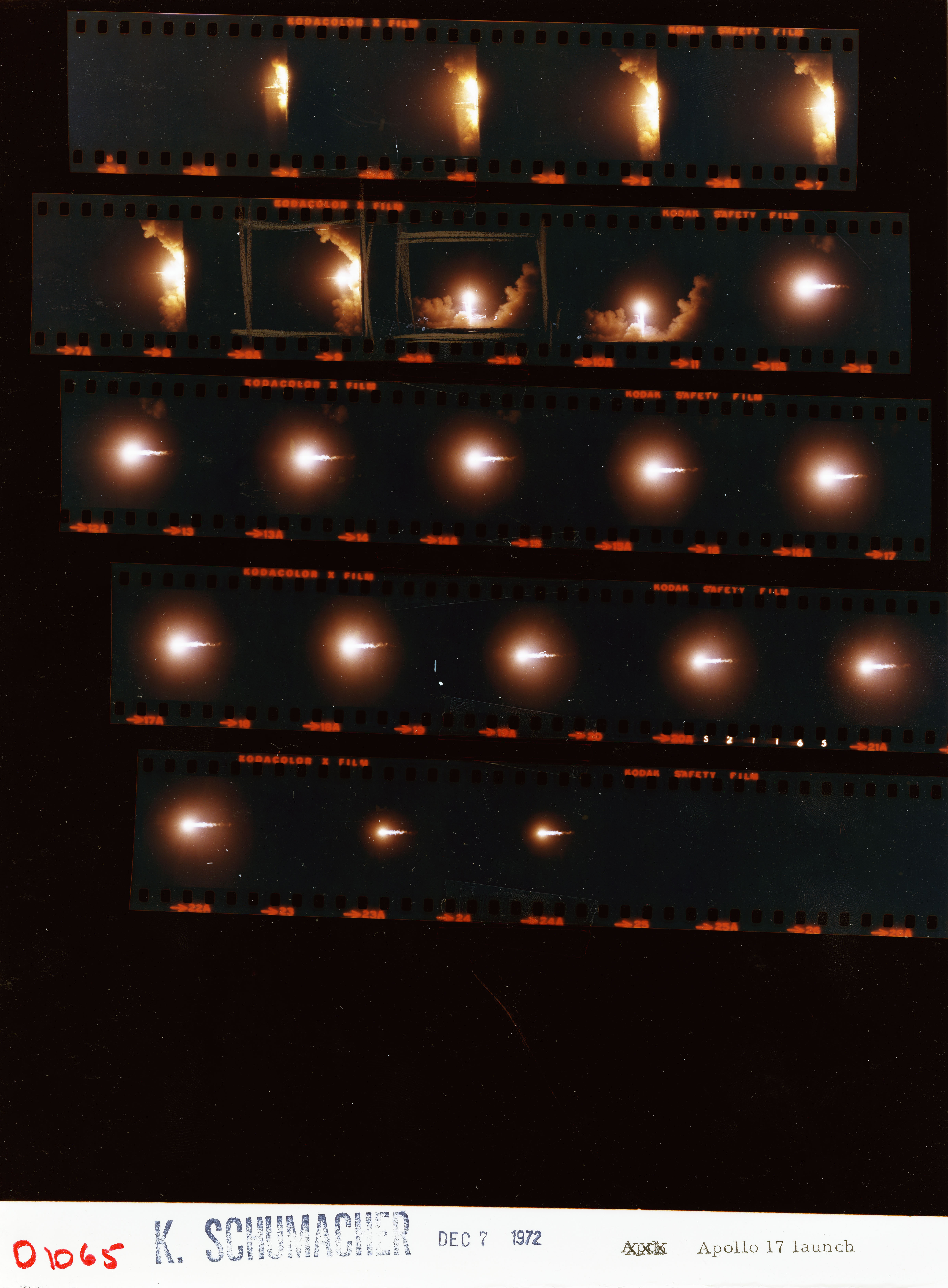
- Frame(s): WHPO-D1065-, Apollo 17 spacecraft lift off, and seen soaring into space. 12/7/1972, Cape Kennedy, Florida air.
Roll WHPO-D1066 Photographer: Royer | Color or B&W: B&W
- Frame(s): WHPO-D1066-, Tricia Nixon Cox accepting a Christmas tree from unidentified men and Santa Claus. 12/7/1972, Washington, D.C. North Portico driveway, White House. Tricia Nixon Cox, Santa Claus, unidentified men.
Roll WHPO-D1067 Photographer: Kightlinger, Jack | Color or B&W: B&W
- Frame(s): WHPO-D1067-, Tricia Nixon Cox standing with Santa Claus and a Christmas tree. 12/7/1972, Washington, D.C. North Portico driveway, White House. Tricia Nixon Cox, Santa Claus.
Roll WHPO-D1068 Photographer: Kightlinger, Jack | Color or B&W: Color
- Frame(s): WHPO-D1068-, Santa Claus delivering a Christmas tree, which Tricia Nixon Cox and unidentified men accept. 12/7/1972, Washington, D.C. North Portico driveway, White House. Tricia Nixon Cox, Santa Claus, unidentified men.
Roll WHPO-D1069 Photographer: Atkins, Oliver | Color or B&W: Color
- Frame(s): WHPO-D1069-01-05, President Nixon seated alone in the Aspen Lodge living room at Camp David. 12/7/1972, Camp David, Maryland Sun Porch, Aspen Lodge. President Nixon, John Ehrlichman, Caspar Weinberger, Carlucci, Herbert Stein, Ken Cole, Shultz, aides.
- Frame(s): WHPO-D1069-02, President Nixon seated alone in the Aspen Lodge living room at Camp David. 12/7/1972, Camp David, Maryland Sun Porch, Aspen Lodge. President Nixon.
- Frame(s): WHPO-D1069-04, President Nixon seated alone in the Aspen Lodge living room at Camp David. View seen through a small square window outside looking in. 12/7/1972, Camp David, Maryland Sun Porch, Aspen Lodge. President Nixon.
- Frame(s): WHPO-D1069-06, President Nixon holding a budget meeting at Camp David. 12/7/1972, Camp David, Maryland Sun Porch, Aspen Lodge. President Nixon, John D. Ehrlichman, Assistant. Caspar W. Weinberger, Director of the OMB. Frank C. Carlucci, Deputy Director of the OMB. Herbert Stein, Chairman of the Council of Economic Advisers; Possibly Kenneth R. Cole, Jr., Deputy Assistant, George P. Shultz, Secretary of the Treasury, Charls E. Walker, Under Secretary of the Treasury, George D. Webster, Partner with Marmet and Webster (2 of 4).
- Frame(s): WHPO-D1069-06-10, President Nixon holding a budget meeting at Camp David. 12/7/1972, Camp David, Maryland Sun Porch, Aspen Lodge. President Nixon, John D. Ehrlichman, Assistant. Caspar W. Weinberger, Director of the OMB. Frank C. Carlucci, Deputy Director of the OMB. Herbert Stein, Chairman of the Council of Economic Advisers. Kenneth R. Cole, Jr., Deputy Assistant. George P. Shultz, Secretary of the Treasury. Charls E. Walker, Under Secretary of the Treasury. George D. Webster, Partner with Marmet and Webster.
Roll WHPO-D1070 Photographer: Atkins, Oliver | Color or B&W: B&W
- Frame(s): WHPO-D1070-, George Shultz, George Webster, and Maj. Jack Brennan standing outside Aspen Lodge at Camp David. 12/7/1972, Camp David, Maryland entranceway, Aspen Lodge. George Shultz, George Webster, Maj. John V. Brennan (AKA) Jack Brennan.
Roll WHPO-D1071 Photographer: Atkins, Oliver | Color or B&W: B&W
- Frame(s): WHPO-D1071-03-04, Unidentified persons in the Camp David kitchen. 12/7/1972, Camp David, Maryland Aspen Lodge Kitchen. President Nixon, John D. Ehrlichman, Assistant. Caspar W. Weinberger, Director of the OMB. Frank C. Carlucci, Deputy Director of the OMB. Herbert Stein, Chairman of the Council of Economic Advisers. Kenneth R. Cole, Jr., Deputy Assistant. George P. Shultz, Secretary of the Treasury. Charls E. Walker, Under Secretary of the Treasury. George D. Webster, Partner with Marmet and Webster.
- Frame(s): WHPO-D1071-05-10, President Nixon conducting a budget meeting at Camp David. 12/7/1972, Camp David, Maryland Aspen Lodge Sun Porch. President Nixon, John D. Ehrlichman, Assistant. Caspar W. Weinberger, Director of the OMB. Frank C. Carlucci, Deputy Director of the OMB. Herbert Stein, Chairman of the Council of Economic Advisers. Kenneth R. Cole, Jr., Deputy Assistant. George P. Shultz, Secretary of the Treasury. Charls E. Walker, Under Secretary of the Treasury. George D. Webster, Partner with Marmet and Webster.
- Frame(s): WHPO-D1071-05-10, President Nixon conducting a budget meeting at Camp David. 12/7/1972, Camp David, Maryland Aspen Lodge Kitchen. President Nixon, John D. Ehrlichman, Assistant. Caspar W. Weinberger, Director of the OMB. Frank C. Carlucci, Deputy Director of the OMB. Herbert Stein, Chairman of the Council of Economic Advisers. Kenneth R. Cole, Jr., Deputy Assistant. George P. Shultz, Secretary of the Treasury. Charls E. Walker, Under Secretary of the Treasury. George D. Webster, Partner with Marmet and Webster.
- Frame(s): WHPO-D1071-11-18, Ken Cole, Caspar Weinberger, Frank Carlucci, and Herb Stein standing outside at Camp David. 12/7/1972, Camp David, Maryland Aspen Lodge, Sun Porch, entranceway. Herb Stein, Frank C. Carlucci, Weinberger.
- Frame(s): WHPO-D1071-11-18, Ken Cole, Caspar Weinberger, Frank Carlucci, and Herb Stein standing outside the Aspen Lodge at Camp David. 12/7/1972, Camp David, Maryland Aspen Lodge Kitchen. President Nixon, George Shultz, Herb Stein, Frank C. Carlucci, Ken Cole, Ehrlichman, Weinberger, Charles Walker, unidentified persons.
- Frame(s): WHPO-D1071-20, George Shultz and John John Ehrlichman standing together at Camp David. 12/7/1972, Camp David, Maryland Aspen Lodge Kitchen. President Nixon, George Shultz, Herb Stein, Frank C. Carlucci, Ken Cole, John Ehrlichman, Weinberger, Charles Walker, unidentified persons.
- Frame(s): WHPO-D1071-20, George Shultz and John Ehrlichman standing together at Camp David. 12/7/1972, Camp David, Maryland Aspen Lodge, Sun Porch, entranceway. George Shultz, John Ehrlichman.
- Frame(s): WHPO-D1071-21, President Nixon seated informally at Camp David in the Aspen Lodge with George Shultz and Charles Walker at Camp David. 12/7/1972, Camp David, Maryland Aspen Lodge, Sun Porch, entranceway. President Nixon, George Shultz, Charles Walker.
The White House Communications Agency Sound Recordings Collection contains public statements that took place between 1969 and 1974. Visit the finding aid to learn more.
D - First Family
- WHCA-SR-D-040
Tricia Nixon Cox remarks upon receiving the White House Christmas tree on the Northern Portico. (12/7/1972, Northern Portico, The White House)
Runtime: 12:00
Production credits: Audio feed supplied by WHCA; Recorded by CRB (initials of WHCA engineer)
Original Format: 1/4-inch reel-to-reel audiotape. Original source type: Original.
L - White House Press Office Briefings
- WHCA-SR-L-081
Press briefing by Ronald Ziegler. (12/7/1972, Camp David)
Runtime: 21:30
Keywords: Press conferences, news conferences, interviews, media, press secretary
Original Format: 1/4-inch reel-to-reel audiotape. Original source type: Original.
The White House Communications Agency Videotape Collection contains “off-the-air” recordings of televised programs produced between 1968 and 1974. Visit the finding aid to learn more.
- WHCA-5942
Weekly News Summary, Tape III.
ALL NETWORKS
Runtime: 00:29:33
1. Reasoner/Cioffi/Rolfson/Koppel: Paris peace talks; Vietnam. Time Code Start: 00:00. Keywords: Paris Peace Talks, Vietnam War, treaty, treaties, negotiations. Network: ABC.
2. Smith: Claude Brenigar Secretary of Transportation nominee and Secretary of Transportation Volpe appointments. Time Code Start: 05:04. Keywords: Presidents, cabinet, advisors, nominations, appointments, confirmations, Ambassadors. Network: ABC.
3. Reasoner: Commentary on Apollo 17 launch. Time Code Start: 05:24. Keywords: NASA, National Aeronautics and Space Administration, space, space program, astronauts, moon, flights. Network: ABC.
4. Chancellor/Dobyns/Kaplan: Paris peace talks (Isham). Time Code Start: 07:21. Keywords: Paris Peace Talks, Vietnam War, treaty, treaties, negotiations. Network: NBC.
5. Chancellor/Levine: Wholesale prices up. Time Code Start: 10:46. Keywords: wage and price controls, freezes, prices, costs, increases, decreases, economy, economics, budgets, finances, recession, inflation, money. Network: NBC.
6. Chancellor: New cabinet appointments. Time Code Start: 12:31. Keywords: Presidents, cabinet, advisors, nominations, appointments, confirmations. Network: NBC.
7. Brinkley's Journal: Report from Georgia. Time Code Start: 13:06. Keywords: Supreme Court, overturns, death penalty. Network: NBC.
8. Cronkite/Fenton/Kalisher: Paris peace talks. Time Code Start: 16:21. Keywords: Paris Peace Talks, Vietnam War, treaty, treaties, negotiations. Network: CBS.
9. Cronkite/Pierpoint/Schorr: Wholesale prices up; more cabinet announcements (Ziegler, [unreadable]). Time Code Start: 18:57. Keywords: Presidents, cabinet, advisors, appointments. Network: CBS.
10. Sevareid: Commentary on East-West relations thaw and warming of Communist-US relations helped by nuclear arms agreement; VIDEO, AUDIO LOSS DURING COMMENT. Time Code Start: 23:17. Keywords: SALT, S.A.L.T., Strategic Arms Limitation Talks, Russia, Soviet Union, USSR, Cold War, détente,. Network: CBS.
Context (External Sources)
The Vanderbilt Television News Archive is the world's most extensive and complete archive of television news. They have been recording, preserving and providing access to television news broadcasts of the national networks since August 5, 1968.
Wikipedia is a free encyclopedia that anyone can edit.