

Introduction
This almanac page for Monday, December 4, 1972, pulls together various records created by the federal government and links to additional resources which can provide context about the events of the day.
Previous Date: Sunday, December 3, 1972
Next Date: Tuesday, December 5, 1972
Schedule and Public Documents
The Daily Diary files represent a consolidated record of the President's activities. Visit the finding aid to learn more.
The President's day began at Key Biscayne, Florida
The Weekly Compilation of Presidential Documents made available transcripts of the President's news conferences; messages to Congress; public speeches, remarks, and statements; and other Presidential materials released by the White House.
Digitized versions can be found at HathiTrust.
The Federal Register is the official daily publication for rules, proposed rules, and notices of federal agencies and organizations, as well as executive orders and other Presidential documents.
No Federal Register published on this date
Archival Holdings
Any selection of archival documents will necessarily be partial. You should use the documents and folders identified below as a starting place, but consult the linked collection finding aids and folder title lists and the collections themselves for context. Many documents to be found this way do not lend themselves to association with specific dates, but are essential to a complete understanding of the material.
Selective document listing
President's Office Files
The President's Office Files consists of materials drawn together by the Special Files Unit from several administrative subdivisions within the White House Office. It is the handwriting and sensitive papers sent to the Staff Secretary that now comprise much of the President's Office Files. Visit the finding aid to learn more.
- Annotated and Unmarked News Summaries [Note: Although there was no News Summary on this date, due to the way News Summary products were compiled, you should also consult nearby days for potentially relevant materials.]
The H. R. Haldeman Diaries consists of seven handwritten diaries, 36 dictated diaries recorded as sound recordings, and two handwritten audio cassette tape subject logs. The diaries and logs reflect H. R. Haldeman’s candid personal record and reflections on events, issues, and people encountered during his service in the Nixon White House. As administrative assistant to the President and Chief of Staff, Haldeman attended and participated in public events and private meetings covering the entire scope of issues in which the Nixon White House engaged in during the years 1969-1973. Visit the finding aid to learn more.
- Transcript of diary entry (PDF)
Monday, December 4.
Started at Key Biscayne. The President had me over at 10:00 this morning. Got into a lot of odds and ends on personnel and miscellaneous things. Wants to be sure that on the campaign follow-up, Bush gets the record re: the President's help for Congressional candidates and all the selling points, the pictures, letters, calls, films and so on. Also he wants to use Brock, Ford and Scott to push this, and MacGregor and John Mitchell. Concerned about the agréments onVolpe, Helms and Moynihan-- wants to get those announcements moving. Wants Bush to put a Catholic woman in as the number two at the Committee. Wants to know from MacGregor and Malek who our 20 best state chairmen were and really crank them up so they know we care. He's worried that they'll get let down as Colson did, that after they did all the work, nothing happens. He wants to be sure we have a super advance man in charge of crowd building at the Inaugural, get our crowd in. He says we do need to show public support. Not crowd numbers, but emotion, feel, and attitude; people jumping with tears in their eyes, and all, which is what Ziegler doesn't react to. He isn't sent by the schoolteachers.
He got into the story from Billy Kilmer that Nixon was hurting the Redskins and had me call George Allen to find out what Kilmer is up to. Allen said he figured Kilmer had been drinking and had given the interview, and he shouldn't have done it, and he was very distressed with how negative the whole Washington press is, and all. I think the point was made to him.
He wants to get out the fact that our Republican candidates were too old for the races, and that that's the reason so many of them lost so badly. Got into the question of planning for Christmas and follow-up things at parties and that sort of thing for the Cabinet and wants some plans on that.
Kissinger called with his report from Paris. Said he was sending a message, but they had had a two and a half hour private session. He just presented his position and will get an answer this afternoon on it. They agreed to meet tomorrow at a place we furnish. He says it's exactly on track the way he and the President discussed. A lot of speculation that Rogers plans to visit there this week, and that that must be turned off. He says the mood is quite consistent with the game plan, so on.
Then, after we got back to Washington and home tonight, the President called me to say that he had just talked to Colonel Kennedy, who had a report from Henry that things had been very tough in the afternoon session and that we're going to have to break off the talks. The President will have to go on TV and rally the American people. The President told Kennedy to tell Kissinger to stay on the hard line, that this was not a viable option and that the President has a very uneasy feeling about going on TV at this point. He doesn't think Kissinger is in touch with reality; says it's better to state it in a practical manner and just do it without going on TV to rally the people. We don't have to decide until tomorrow, so we can wait and see what happens, but we should say we haven't completed negotiations and go ahead with more bombing. Going on TV unnecessarily escalates the public reaction. It's too bad we don't have a direct line to Haig to get a feeling from him, but Henry's got to realize we can't repeat history; we can't go on and do it again. They're going to meet tomorrow at 3:00, and we'll get a report then. The President says he's always felt that all of Kissinger's stuff on the mood, and so forth, actually had nothing to do with the results, and that we just have to play this string out, see where it runs.
Had a talk with Bush on the Dole thing. He thinks the situation there is OK, and on Scali, he thinks he'd be good for the UN. He has the flair for it. He likes the idea of an Italian as a first step. We should get Rogers' acquiescence or support and Bush feels he can set him up at the UN even though there would be some objections. He'd be glad to help sell it to Rogers.
The President got into the new majority question; the need for a continued all-out attack on the old establishment, the media, the university, the social set and the lobbyists, and to build up a new establishment -- that we're weak on this except for Colson and Dent. As far as working with ethnics, Labor, Democrats, South, little businessmen, he wants to be sure we go through all the lists from the campaign, develop our group that we can follow-up on. Keep up contact with these people; he doesn't think we are doing this adequately-- the Nixon friends and supporters in the media business in each area. For example, Malek's names aren't adequate; he didn't get the California Carter group. And in all the other states people are just taking to get in with those new people-- not the old ones. We should follow-up on the established ones; briefing groups-- and not just with the President, but so they feel that they’re in. Some in the Congress, groups of Mayors, Labor, and so on.
Got into the post Inaugural schedule. Wants to make one European trip, but not as hurriedly as our one in '69. Spend two or three days in each of the four major cities, plus NATO. Then also he wants to do a thank you trip around the United States -- North, South, East and West-- and a full diplomatic reception for the Diplomatic Corps. Then he had Ziegler in to discuss the press handling thing. He wants Ron's plan as to how he's going to handle them; deal with building our people; cutting the opponents, and so forth; how to handle Sidey and Life, and the usual rundown on that.
End of December 4. - Original audio recording (MP3)
The National Archives Catalog is the online portal to the records held at the National Archives, and information about those records. It is the main way of describing our holdings and also provides access to electronic records and digitized versions of our holdings.
The Catalog searches across multiple National Archives resources at once, including archival descriptions, digitized and electronic records, authority records, and web pages from Archives.gov and the Presidential Libraries. The Catalog also allows users to contribute to digitized historical records through tagging and transcription.
Nixon Library Holdings
All National Archives Units
National Security Documents
The President's Daily Brief is the primary vehicle for summarizing the day-to-day sensitive intelligence and analysis, as well as late-breaking reports, for the White House on current and future national security issues. Read "The President's Daily Brief: Delivering Intelligence to Nixon and Ford" to learn more.
The Foreign Relations of the United States series presents the official documentary historical record of major U.S. foreign policy decisions and significant diplomatic activity. Visit the State Department website for more information.
Vol. IX, Vietnam, October 1972-January 1973
Paris Negotiations Collapse, October 24-December 13, 1972
139. Message From the President’s Assistant for National Security Affairs (Kissinger) to President Nixon, Paris, December 4, 1972
Source: National Archives, Nixon Presidential Materials, NSC Files, Box 858, For the President’s Files (Winston Lord)—China Trip/Vietnam, Sensitive Camp David, Vol. XXII (1). Top Secret; Flash; Sensitive; Exclusively Eyes Only. Sent via Guay and Kennedy.
140. Telephone Conversation Between President Nixon and Richard T. Kennedy of the National Security Council Staff, Washington, December 4, 1972
Source: National Archives, Nixon Presidential Materials, White House Tapes, Conversation 34–11. No classification marking. According to the President’s Daily Diary, Nixon spoke with Kennedy from 7:51 to 8:02 p.m. (Ibid., White House Central Files) The editors transcribed the portions of the conversation printed here specifically for this volume.
Vol. XXI, Chile, 1969-1973
Cool and Correct: The U.S. Response to the Allende Administration, November 5, 1970-December 31, 1972
315. Telegram From the Department of State to the Deputy Secretary of State (Irwin) in Paris, Washington, December 4, 1972, 2250Z
Source: National Archives, RG 59, Central Files 1970–73, POL 15–1 CHILE. Confidential; Immediate. Drafted by Fisher. Repeated immediate to Santiago.
Vol. XXIII, Arab-Israeli Dispute, 1969-1972
Proximity Talks and the Backchannel: Separate Department of State and White House Negotiating Tricks
321. Telegram From the Department of State to the Interests Section in Egypt, Washington, December 4, 1972, 2349Z
Source: National Archives, Nixon Presidential Materials, NSC Files, Box 658, Country Files, Middle East, Middle East Nodis/Cedar/Plus, Vol. V. Secret; Nodis; Cedar Plus. Drafted by Sterner, cleared by Atherton, and approved by Sisco. Repeated to Tel Aviv.
Vol. XLII, Vietnam: The Kissinger-Le Duc Tho Negotiations
Breakdown of Negotiations, November 1972-December 1972
32. Memorandum of Conversation, Paris, December 4, 1972, 10:30 a.m.-1 p.m.
Source: National Archives, Nixon Presidential Materials, NSC Files, Box 865, For the President’s Files (Winston Lord)—China Trip/Vietnam Negotiations, Camp David Memcons, December 1972 [3 of 3]. Top Secret; Sensitive; Exclusively Eyes Only. The meeting took place at 11 Rue Darthé, Choisy-le-Roi. All brackets are in the original.
Shortly before this new round of meetings in Paris, Kissinger, according to Haldeman, “seemed to be in better spirits today and ready to go on a positive basis on his new negotiating round. He is concerned because he will have to convince the North Vietnamese that if we don’t get an agreement we’re going to stay in [South Vietnam], and he has to convince the South Vietnamese that if we don’t get an agreement we’re going to get out, so it’s a little touchy to play both sides against the center, but I think that he and Haig both feel that they are going to get the deal and wrap it up on this trip.” (Haldeman Diaries: Multimedia Edition, December 2, 1972)33. Memorandum of Conversation, Paris, December 4, 1972, 3:50-6:35 p.m.
Source: National Archives, Nixon Presidential Materials, NSC Files, Box 865, For the President’s Files (Winston Lord)—China Trip/Vietnam Negotiations, Camp David Memcons, December 1972 [3 of 3]. Top Secret; Sensitive; Exclusively Eyes Only. The meeting took place at 2 Rue de Marroniers, Ste. Gemme (par Feucherolles), Yvelines. All brackets are in the original.
Going into the December round of meetings, the Politburo expressed some unhappiness with Le Duc Tho’s performance in the November meetings. Although expressed impersonally, it nonetheless represented sharp criticism. A December 1 assessment of the round sent to Tho and Thuy noted: “After the U.S. double-crossed us and refused to sign the Agreement to which both sides had already agreed, we fought them and severely criticized them. However, during the first few days [of the November meetings] we did not steadfastly follow our principle of firmly maintaining the content of the Agreement, and instead we hastily presented a number of soft, flexible ideas.” (Message from the Politburo to Le Duc Tho and Xuan Thuy, 1 December 1972, Doan Duc, et al., Major Events: The Diplomatic Struggle and International Activities during the Resistance War Against the Americans to Save the Nation, 1954–1975, volume 4, p. 352) Tho and Thuy accepted this criticism and even put it a little more starkly in a November 28 report to the Politburo: “we have made a number of concessions too early.” (Luu and Nguyen, Le Duc Tho-Kissinger Negotiations in Paris, p. 356)
When Kissinger reported to the President from Paris about the December 4 afternoon session, he stated that “we are at a point where a break-off of the talks looks almost certain.” In the meeting, according to Kissinger, Le Duc Tho “rejected every change we asked for, asked for a change on civilian prisoners [in South Vietnam], demanded the withdrawal of American civilians from South Vietnam thus making the maintenance of the Vietnam Air Force impossible, and withdrew some concessions from last week.” If the United States went along with Tho’s demands, he concluded, “we would wind up with an agreement significantly worse than what we started with.” Consequently, as Kissinger informed the President, he had told Tho “flatly that his approach did not provide the basis for a settlement.” Nevertheless, Tho “stuck firmly by his intransigent position. The only alternative he offered to his presentation this afternoon was to go back to the October agreement literally with no changes by either side.”
Kissinger was pessimistic:
“It is not impossible that Tho is playing chicken and is waiting for us to cave tomorrow. But I do not think so. There is almost no doubt that Hanoi is prepared now to break off the negotiations and go another military round. Their own needs for a settlement are now outweighed by the attractive vision they see of our having to choose between a complete split with Saigon or an unmanageable domestic situation. We have two basic choices, assuming as we must that their position is final: (1) go back to the October agreement or (2) run a risk of a break-off of the talks.
“I believe the first option is impossible:
“—After all our dealings with Saigon and his insistence on some changes these past weeks, this would be tantamount to overthrowing Thieu. He could not survive such a demonstration of his and our impotence.
“—We would have no way of explaining our actions since late October.
“—It would be an enormous propaganda victory for Hanoi.
“—Most importantly, it would deprive us of any ability to police the agreement, because if the Communists know we are willing to swallow this backdown, they will also know that we will not have the capacity to react to violations.
“Thus while the October agreement was a good one, intervening events make it impossible to accept it now.
“4. Therefore I believe we must be prepared to break off negotiations.”
Kissinger also put the afternoon meeting into a larger context for Nixon, observing: “The central issue is that Hanoi has apparently decided to mount a frontal challenge to us such as we faced last May. If so, they are gambling on our unwillingness to do what is necessary; they are playing for a clearcut victory through our split with Saigon or our domestic collapse rather than run the risk of a negotiated settlement. This is the basic question; the rest is tactics.” (Foreign Relations, 1969–1976, vol. IX, Vietnam, October 1972–January 1973, Document 139)
Vol. E-4, Documents on Iran and Iraq, 1969-1972
Iran 1972
238. Telegram 219119 From the Department of State to the Embassy in Iran, Washington, December 4, 1972, 1842Z
The Department sent Farland an expanded copy of the proposed compensation package for the Shah.
Source: National Archives, RG 59, Central Files 1970–73, DEF 19–8 US-IRAN. Top Secret; Immediate; Eyes Only.
Vol. E-5, Part 1, Documents on Sub-Saharan Africa, 1969-1972
Uganda
263. Memorandum From the Presidentʼs Assistant for National Security Affairs (Kissinger) to President Nixon, Washington, December 4, 1972
Kissinger briefed the President on the current situation in Uganda and recommended that he approve the Department of Stateʼs recommendation not to make long-term decisions concerning Uganda and also Departmentʼs contingency agreement to represent British interests in Uganda. The President approved both recommendations.
Source: National Archives, Nixon Presidential Materials, NSC Files, Box 746, Country Files, Africa, Uganda, Vol. I. Confidential. Sent for action. Drafted by Rondon. The memorandum is stamped, “The President Has Seen.”
The Kissinger telephone conversation transcripts consist of approximately 20,000 pages of transcripts of Kissinger’s telephone conversations during his tenure as Assistant to the President for National Security Affairs (1969-1974) and Secretary of State (1973-1974) during the administration of President Richard Nixon. Visit the finding aid for more information.
Digitized versions can be found in the National Archives Catalog.
Audiovisual Holdings
Visit the White House Tapes finding aid to learn about the taping system's operation and archival processing.
White House Telephone
- 34-11; 7:51 p.m. - 8:02 p.m.; Nixon, Richard M. (President); Kennedy, Richard T. (Col.)
- 34-12; Unknown between 8:02 p.m. & 8:03 p.m.; Nixon, Richard M. (President); White House operator
- 34-13; 8:03 p.m. - 8:16 p.m.; Nixon, Richard M. (President); Haldeman, H. R. ("Bob")
- 34-14; Unknown between 8:16 p.m. & 8:23 p.m.; Nixon, Richard M. (President); White House operator
- 34-15; 8:23 p.m. - 8:32 p.m.; Nixon, Richard M. (President); Kennedy, Richard T. (Col.)
The White House Photo Office collection consists of photographic coverage of President Richard Nixon meeting with prominent social, political, and cultural personalities; speaking engagements and news conferences of the President and various high-ranking members of the White House staff and Cabinet; Presidential domestic and foreign travel, including Presidential vacations; social events and entertainment involving the First Family, including entertainers present; official portraits of the President, First Family, and high-ranking members of the Nixon administration; the 1969 and 1973 Inaugurals; the President’s 1972 Presidential election campaign appearances (including speeches) and other official activities of the White House staff and the President’s Cabinet from January 20, 1969 until August 9, 1974 at the White House and the Old Executive Office Building; other locations in Washington, DC, such as The Mall; and the Presidential retreats in Camp David, Maryland, Key Biscayne, Florida, and San Clemente, California. Visit the finding aid to learn more.
Roll WHPO-D1050 Photographer: Atkins, Oliver | Color or B&W: B&W
- Frame(s): WHPO-D1050-01A-04A, President Nixon standing on the pier with Charles Bebe Rebozo, Ron Ziegler, and H.R. Haldeman. 12/4/1972, Key Biscayne, Florida pier, Coco Lobo III, Biscayne Bay. President Nixon, Charles Bebe Rebozo, Haldeman, Ziegler, aides.
- Frame(s): WHPO-D1050-5A-8A, President Nixon and Rebozo walking to, boarding, and sailing on the Coco Lobo III. 12/4/1972, Key Biscayne, Florida pier, Coco Lobo III, Biscayne Bay. President Nixon, Rebozo, Haldeman, Ziegler, aides.
Roll WHPO-D1051 Photographer: Atkins, Oliver | Color or B&W: Color
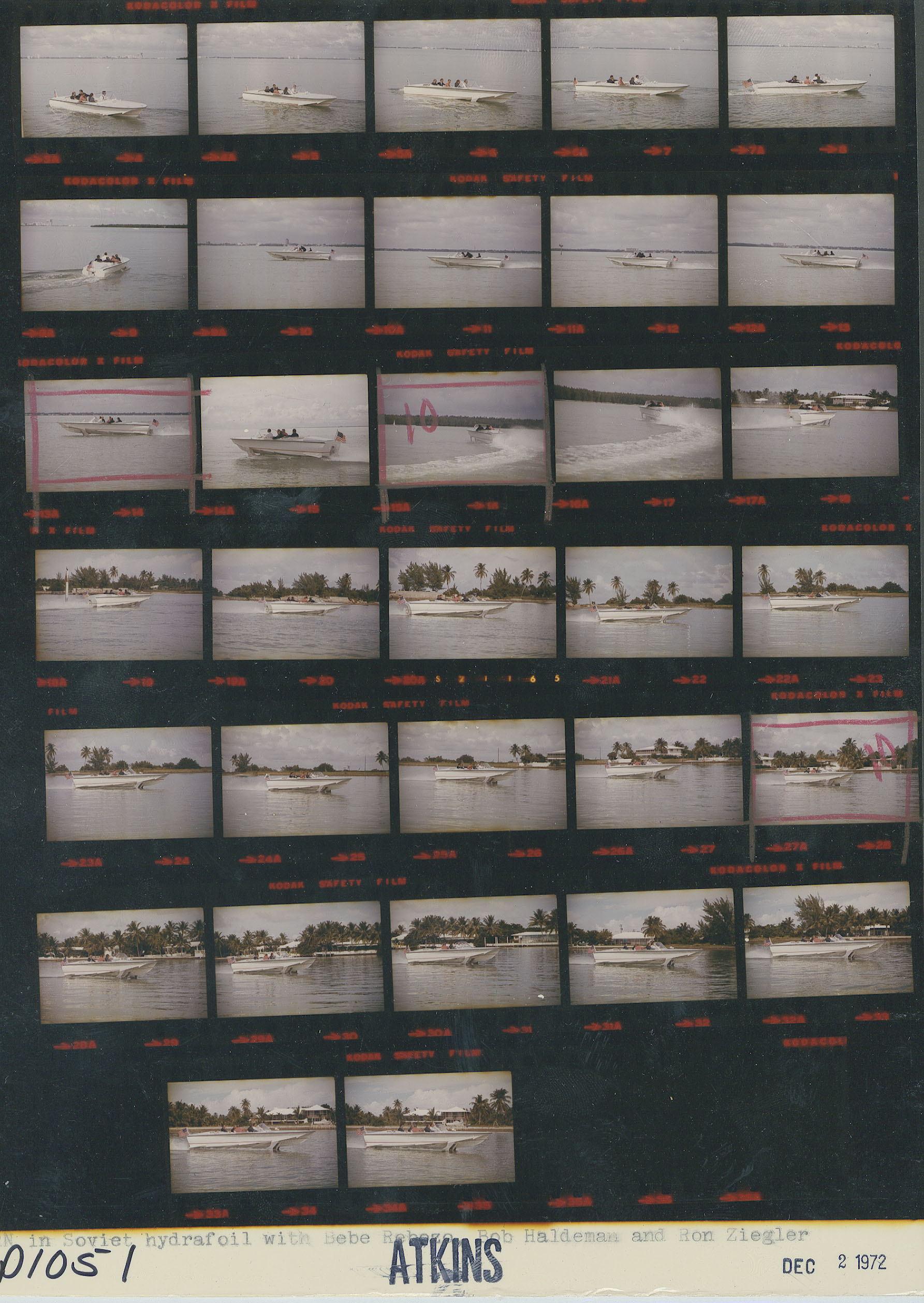
- Frame(s): WHPO-D1051-, President Nixon and others on a hydrofoil. 12/4/1972, Key Biscayne, Florida hydrofoil, Biscayne Bay. President Nixon, Haldeman, Bebe Rebozo, Ziegler, boat captain.
Roll WHPO-D1052 Photographer: Atkins, Oliver | Color or B&W: Color
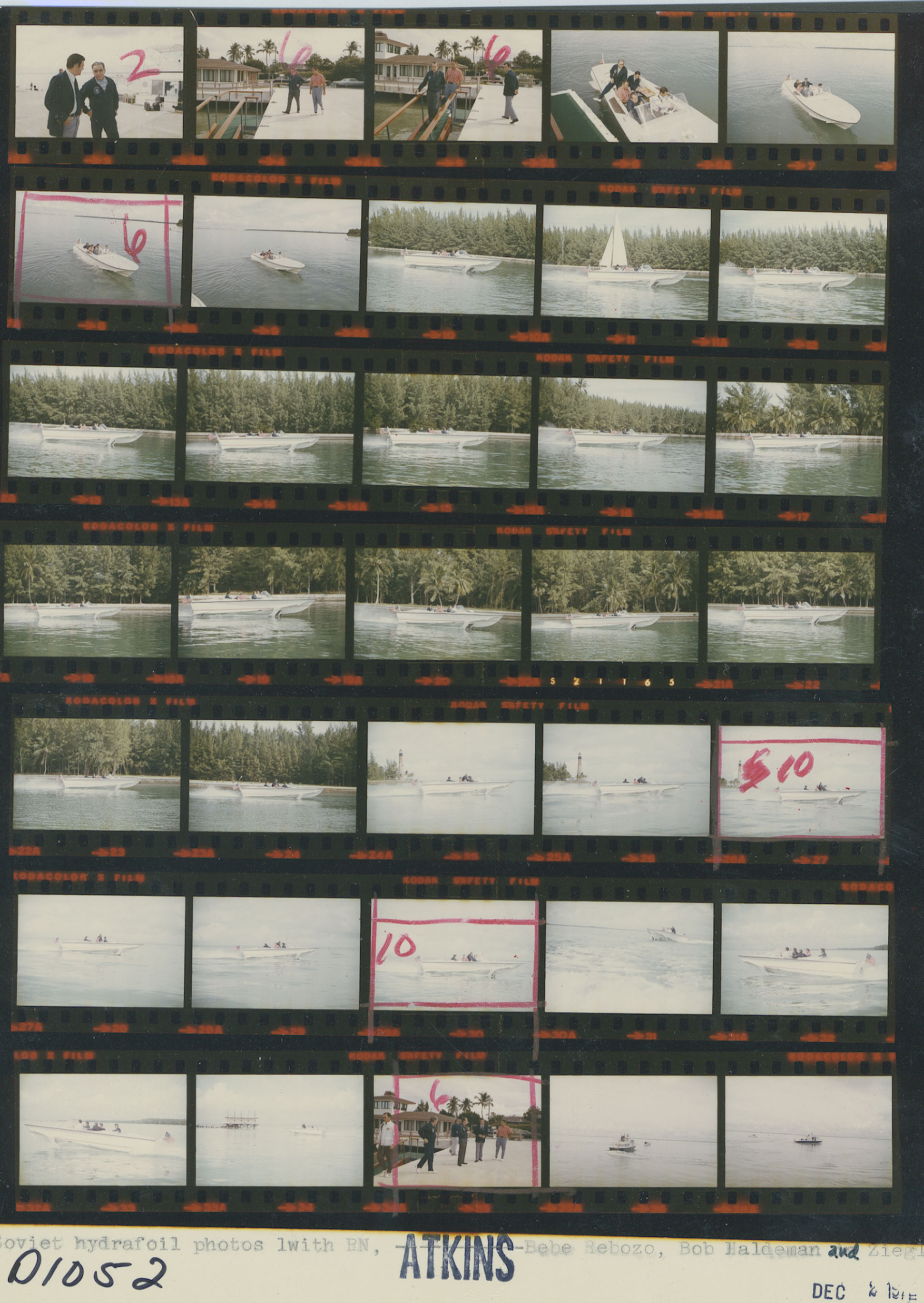
- Frame(s): WHPO-D1052-03-05, President Nixon, Charles Bebe Rebozo, H.R. Haldeman, and Ron Ziegler on the pier. 12/4/1972, Key Biscayne, Florida Biscayne Bay, pier. President Nixon, Charles Bebe Rebozo, H.R. Haldeman, Ronald Ziegler, boat captain.
- Frame(s): WHPO-D1052-06-34, President Nixon, Bebe Charles Bebe Rebozo, H.R. Haldeman, and Ron Ziegler riding on the hydrofoil boat. 12/4/1972, Key Biscayne, Florida Biscayne Bay, hydrofoil. President Nixon, Charles Bebe Rebozo, H.R. Haldeman, Ronald Ziegler, boat captain.
- Frame(s): WHPO-D1052-27, President Nixon, Bebe Charles Bebe Rebozo, H.R. Haldeman, and Ron Ziegler riding on the hydrofoil boat. 12/4/1972, Key Biscayne, Florida Biscayne Bay, hydrofoil.
- Frame(s): WHPO-D1052-35, President Nixon, Bebe Charles Bebe Rebozo, H.R. Haldeman, and Ziegler back on the pier. 12/4/1972, Key Biscayne, Florida Biscayne Bay, pier. President Nixon, Charles Bebe Rebozo, H.R. Haldeman, Ronald Ziegler, boat captain.
- Frame(s): WHPO-D1052-36-37, The Coco Lobo III yacht in the Key Biscayne Bay. 12/4/1972, Key Biscayne, Florida Biscayne Bay, Coco Lobo III. President Nixon, Charles Bebe Rebozo, H.R. Haldeman, Ronald Ziegler, boat captain.
Roll WHPO-D1053 Photographer: Royer | Color or B&W: B&W
- Frame(s): WHPO-D1053-, Members of a visiting Goodwill Charity Industries group. 12/4/1972, Washington, D.C. North Portico Driveway, White House. unidentified Goodwill Industries group.
Roll WHPO-D1055 Photographer: unknown | Color or B&W: Color
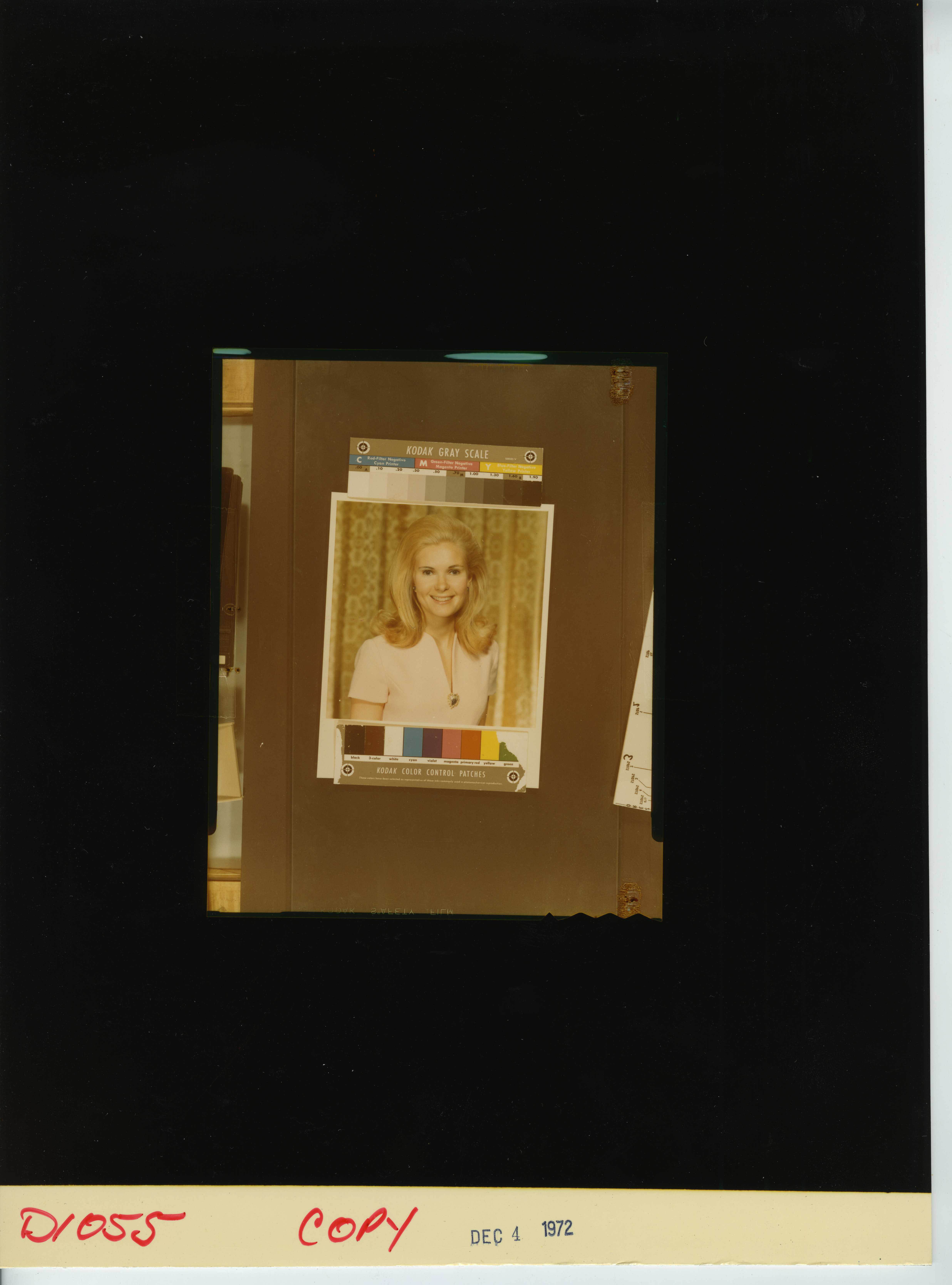
- Frame(s): WHPO-D1055-, Copy of a closeup formal portrait of Tricia Nixon Cox. 12/4/1972, Washington, D.C. unknown. Tricia Nixon Cox.
The White House Communications Agency Sound Recordings Collection contains public statements that took place between 1969 and 1974. Visit the finding aid to learn more.
L - White House Press Office Briefings
- WHCA-SR-L-077
Press briefing by Ronald Ziegler. (12/4/1972, 4 Ambassadors Presss Center, Miami, Florida)
Keywords: Press conferences, news conferences, interviews, media, press secretary
Original Format: 1/4-inch reel-to-reel audiotape. Original source type: Original.
The White House Communications Agency Videotape Collection contains “off-the-air” recordings of televised programs produced between 1968 and 1974. Visit the finding aid to learn more.
- WHCA-5940
Weekly News Summary, Tape I.
ALL NETWORKS
Runtime: 01:32:11
22. Reasoner/Rolfson: Paris peace talks. Time Code Start: 61:40. Keywords: Paris Peace Talks, Vietnam War, treaty, treaties, negotiations. Network: ABC.
23. Gill: President Nixon controlling peace talks. Time Code Start: 64:00. Keywords: Paris Peace Talks, Vietnam War, treaty, treaties, negotiations. Network: ABC.
24. Smith/Schoumacher: Rumsfeld is NATO (N.A.T.O) Ambassador; Bureau of Indian Affairs (BIA) heads fired with Morton and Loesch. Time Code Start: 65:16. Keywords: cabinet, advisors, diplomats, Ambassadors, N.A.T.O., North Atlantic Treaty Organization, Europe, international, world, military, defense, organizations, American Indians, Native Americans, tribes. Network: ABC.
25. Smith: Commentary on global peace. Time Code Start: 67:42. Keywords: wars, truces, treaty, treaties, ceasefires. Network: ABC.
26. Chancellor/Dobyns/Kaplan: Paris peace talks are in their final stage with Kissinger, South Vietnam's Ambassador says they will not sign initial peace agreement but may sign later. Time Code Start: 69:27. Keywords: Presidents, speeches, statements, Paris Peace Talks, Vietnam War, treaty, treaties, negotiations, government, officials, travel, trips. Network: NBC.
27. Chancellor: Secretary of Defense Laird said Department of Defense is going to spend more money than ever. Time Code Start: 74:56. Keywords: cabinet, advisors, military, Cambodia, Vietnam War, speeches, statements. Network: NBC.
28. Chancellor/Duke: Senator Mathais says Congress is losing its power to executive branch. Time Code Start: 76:36. Keywords: House of Representatives, legislation,. Network: NBC.
29. Chancellor/Lewis: Vice President Agnew and Bob Dole at a Governors Conference. Time Code Start: 79:00. Keywords: Governors, conventions, conferences, Vice Presidents, leaders. Network: NBC.
30. Chancellor/Nessen: Bureau of Indian Affairs (BIA) hearings on destruction. Time Code Start: 81:44. Keywords: American Indians, Native Americans, tribes, American Indian Movement, occupations, government agencies, vandalism. Network: NBC.
31. Mudd/Kalisher: Paris peace talks with Kissinger. Time Code Start: 83:57. Keywords: Paris Peace Talks, Vietnam War, treaty, treaties, negotiations, government, officials, travel, trips. Network: CBS.
32. Schorr: The Watergate trial is beginning. Time Code Start: 86:19. Keywords: Watergate, Senate committee hearings, investigations, testimony, testify, cover-ups, break-in, burglary, theft, plumbers, scandals. Network: CBS.
33. Schieffer: The Calley Trial debated (Lt. Calley and My Lai Massacre trial). Time Code Start: 87:46. Keywords: Vietnam War, Lt. Calley, My Lai Massacre, military trials, massacres, war crimes, atrocities, mass murders, civilians deaths, shootings. Network: CBS.
34. Sevareid: The Christmas spirit and shoplifting. Time Code Start: 89:40. Keywords: holidays, retail, gifts, theft, Christmas. Network: CBS.
Context (External Sources)
The Vanderbilt Television News Archive is the world's most extensive and complete archive of television news. They have been recording, preserving and providing access to television news broadcasts of the national networks since August 5, 1968.
Wikipedia is a free encyclopedia that anyone can edit.