
Introduction
This almanac page for Tuesday, August 1, 1972, pulls together various records created by the federal government and links to additional resources which can provide context about the events of the day.
Previous Date: Monday, July 31, 1972
Next Date: Wednesday, August 2, 1972
Schedule and Public Documents
The Daily Diary files represent a consolidated record of the President's activities. Visit the finding aid to learn more.
The President's day began at The White House - Washington, D. C.
The Weekly Compilation of Presidential Documents made available transcripts of the President's news conferences; messages to Congress; public speeches, remarks, and statements; and other Presidential materials released by the White House.
Digitized versions can be found at HathiTrust.
Each Public Papers of the Presidents volume contains the papers and speeches of the President of the United States that were issued by the White House Office of the Press Secretary during the time period specified by the volume. The material is presented in chronological order, and the dates shown in the headings are the dates of the documents or events. In instances when the release date differs from the date of the document itself, that fact is shown in the text note.
To ensure accuracy, remarks have been checked against audio recordings (when available) and signed documents have been checked against the original, unless otherwise noted. Editors have provided text notes and cross references for purposes of identification or clarity.
The Federal Register is the official daily publication for rules, proposed rules, and notices of federal agencies and organizations, as well as executive orders and other Presidential documents.
The Congressional Record is the official daily record of the debates and proceedings of the U.S. Congress.
Archival Holdings
Any selection of archival documents will necessarily be partial. You should use the documents and folders identified below as a starting place, but consult the linked collection finding aids and folder title lists and the collections themselves for context. Many documents to be found this way do not lend themselves to association with specific dates, but are essential to a complete understanding of the material.
Selective document listing
President's Office Files
The President's Office Files consists of materials drawn together by the Special Files Unit from several administrative subdivisions within the White House Office. It is the handwriting and sensitive papers sent to the Staff Secretary that now comprise much of the President's Office Files. Visit the finding aid to learn more.
- News Summaries, Annotated News Summaries, Box 37, August 1-4, 1972 [1 of 4] [Note: Due to the way News Summary products were compiled, you should also consult nearby days for potentially relevant materials.]
- News Summary, August 1, 1972, (Monday Nets, Wires, Mags)
President's Personal File
The President's Personal File is essentially a President's secretary's file, kept by Rose Mary Woods, personal secretary to the President, for two purposes: (1) preserving for posterity a collection of documents particularly close to the President, whether because he dictated or annotated them, or because of the importance of the correspondent or the event concerned and (2) giving appropriate attention–letters of gratitude, invitations to White House social events, and the like–to members and important friends and supporters of the Nixon administration. This generalization does not describe all the varied materials of a file group which is essentially a miscellany, but it does identify the reason for the existence of the file group's core. Visit the finding aid to learn more.
- President's Speech File
The H. R. Haldeman Diaries consists of seven handwritten diaries, 36 dictated diaries recorded as sound recordings, and two handwritten audio cassette tape subject logs. The diaries and logs reflect H. R. Haldeman’s candid personal record and reflections on events, issues, and people encountered during his service in the Nixon White House. As administrative assistant to the President and Chief of Staff, Haldeman attended and participated in public events and private meetings covering the entire scope of issues in which the Nixon White House engaged in during the years 1969-1973. Visit the finding aid to learn more.
- Transcript of diary entry (PDF)
Tuesday, August 1st. The President had me in early this morning. Wanted me to follow-up on George Bush at the UN...
-------------------------------------------------------------------------------------------------------------------
DECLASSIFIED - E.O. 13526, Sect. 3.4: by MS, NARA, June 12, 2013
Audio Cassette 23, Side B, Withdrawn Item Number 5 [AC-23(B) Sel 1]
Duration: 5 seconds
…making the point to him that he could only be an asset if he stands up to Waldheim and the UN crowd. He should not get gun shy or apologetic; should stay solid on the US position; make an asset about kiss--, kicking the UN. He should not let State pressure him. The President thinks he's doing a great job. He shouldn’t give an inch to the Waldheim crowd. Stay as George Bush, defender of America. We need to keep Waldheim in line through this September-October period. During the campaign, George should get out and make a lot of talks as many as he can around the country.
-------------------------------------------------------------------------------------------------------------------
The big question today was whether McGovern is going to get free time on television tonight; went back and forth on it, and the net result was that he didn't get the time. He made his Eagleton announcement last night, and then was going to try to get the time tonight anyway. The networks wised up to it and canceled the time. Most of them furious because he's trying to con them; also, apparently, his staff was very rough, at least on NBC, and he hasn't helped his network relations a bit by this maneuver.
Connally called to say that Marvin Watson had told him that Ed McCormick in Boston had told him that Kevin White had called him to say that McGovern had called him last night and said that it would be Larry O'Brien for vice president that this is something that Kennedy's pushing for, and that's why they're putting it together that way.
We had a political meeting today. Spent a long time discussing the rules revision problem; didn't resolve anything, but there is a problem there that we're going to have to get our team working on. Also, I spent most of the afternoon reviewing the Wolper documentary films, and was not very impressed with what I saw considering the amount of money, time, and effort that's been invested in them. I am going review the whole thing again tomorrow, because I'm afraid we sort of missed the boat there, although we'll see what develops. The President is going to be furious when he sees them, because he's given so much time and he knows how much film they've been shooting, and what comes out looks like a, only rather adequate newsreel hodgepodge.
End of August 1st. - Original audio recording (MP3)
The National Archives Catalog is the online portal to the records held at the National Archives, and information about those records. It is the main way of describing our holdings and also provides access to electronic records and digitized versions of our holdings.
The Catalog searches across multiple National Archives resources at once, including archival descriptions, digitized and electronic records, authority records, and web pages from Archives.gov and the Presidential Libraries. The Catalog also allows users to contribute to digitized historical records through tagging and transcription.
Nixon Library Holdings
All National Archives Units
National Security Documents
The President's Daily Brief is the primary vehicle for summarizing the day-to-day sensitive intelligence and analysis, as well as late-breaking reports, for the White House on current and future national security issues. Read "The President's Daily Brief: Delivering Intelligence to Nixon and Ford" to learn more.
The Foreign Relations of the United States series presents the official documentary historical record of major U.S. foreign policy decisions and significant diplomatic activity. Visit the State Department website for more information.
Vol. III, Foreign Economic Policy; International Monetary Policy, 1969-1972
International Monetary Policy, 1969-1972
240. Telegram From the Embassy in Germany to the Department of State, Bonn, August 1, 1972, 0935Z
Source: National Archives, Nixon Presidential Materials, NSC Files, Subject Files, Box 356, Monetary. Secret; Exdis. Attached to an August 2 memorandum from Hormats to Kissinger apprising Kissinger of the increase in the free market price of gold to $70 per ounce and reminding him of the need to contact Schmidt, pursuant to his July 25 conversation with Arthur Burns, regarding U.S. willingness to defend the dollar lest the Europeans come “to believe that we are returning to Connally’s policy of letting them bear the sole burden of defending the Smithsonian rates.” See Documents 235 and 236. Kissinger wrote on Hormats’ memorandum: “Hormats—Let’s do it. Draft something.” No record of a written reply has been found. On August 9 Hormats sent Kissinger a briefing memorandum for his August 10 breakfast with Shultz, which inter alia, suggested he sound out the Secretary on his agreement with Burns to commit a “sizable amount” to support the dollar. (National Archives, Nixon Presidential Materials, NSC Files, Agency Files, Box 299, Treasury Volume III) No record of the August 10 meeting was found, but on September 1 Hormats sent Kissinger talking points for his meeting with Ambassador Pauls, indicating that Kissinger had discussed the international monetary system with Burns and Shultz and the United States would cooperate in the effort to defend the dollar rate, including, when appropriate, selling currencies drawn under swap agreements. The talking points continued: “However, the major responsibility for defending present rates should continue to lie with nations whose currencies might be under upward pressure in the market.” (Ibid., Country Files—Europe, Box 687, Germany Volume XII 5/72-12/72)
Vol. XLII, Vietnam: The Kissinger-Le Duc Tho Negotiations
Serious Negotiations and the October Settlement, July 1972-October 1972
16. Memorandum of Conversation, Paris, August 1, 1972, 9:57 a.m.-6:04 p.m.
Source: National Archives, Nixon Presidential Materials, NSC Files, Box 864, For the President’s Files (Winston Lord)—China/Vietnam Negotiations, Sensitive, Camp David Memcons, May–October 1972 [4 of 5]. Top Secret; Sensitive; Exclusively Eyes Only. The meeting took place at the North Vietnamese Residence at 11 Rue Darthé, Choisy-le-Roi. All brackets are in the original. The tabs are attached but not printed.
On August 3, Kissinger analyzed the August 1 meeting for Nixon, noting that it “was the longest private meeting ever, and the most interesting session we have ever had.” However, he observed: “The significance of our meeting remains to be clarified, and we cannot be sure of its meaning at this stage.”
Regarding what the North Vietnamese had offered, his analysis continued:
“—Their proposal injects a number of new elements hitherto lacking in their position, as I have enumerated above. They no longer seek Thieu’s resignation as a precondition for PRG/GVN talks, although his resignation would be part of a final settlement. They have sought to identify areas of similarity in our respective positions and proposed a multiplicity of negotiating forums for resolving differences between us and between the Vietnamese parties themselves.
“—On the other hand, they seem to be insisting on our acceptance of the principle of a three segment Government of National Concord as the key to progress on other issues.
“Two possible interpretations of Hanoi’s tactics suggest themselves at this stage:
“—The first is that all the new elements in their proposal are essentially ornamental and that no real progress is possible until we accept their National Concord principle which would in effect predetermine the political outcome in Saigon. If this interpretation is correct, they are essentially holding to a hard line but establishing a record which would appear more flexible in the event of a breakdown in the talks.
“—The second is that the variety of new elements advanced are designed to veil real movement toward a dual track approach where we settle the military issues with them and the Vietnamese sort out their political differences themselves. The explicit suggestion of negotiating forums between the Vietnamese themselves could be interpreted to support this thesis. If this hypothesis proves correct, what Hanoi would expect from us is a rejection of the National Concord concept but nonetheless a vague political counterproposal which would not prejudge the political outcome. Under this approach we would provide them a face-saving formulation whereby they could claim military and political issues were being resolved concurrently, although in fact the military issues would be solved first and the political negotiations would be more prolonged and more of a Vietnamese responsibility.”
Kissinger’s last point to the President was: “Our two main objectives are:
“—(1) to see whether a reasonable settlement is possible by probing their positions on key issues such as Government of National Concord, the timing of a ceasefire, and de facto separation of political and military issues; and
“—(2) in any event, to keep the private negotiating process going into the fall, to give them a chance to settle as the certainty of your re-election looms ever larger, and to further bolster our negotiating record.” ( Foreign Relations, 1969–1976, vol. VIII, Vietnam, January–October 1972, Document 225)
Le Duc Tho’s August 1 report on the meeting to Hanoi noted: “This time Kissinger presented a twelve-point proposal and agreed to discuss both military and political issues with us. With regard to the political issue, this proposal is softer than was their earlier eight-point proposal. Their desire to reach a settlement is clearer. However, although the Americans have pulled back and made concessions on a number of points, they still are holding on to their high card.” (Message from Le Duc Tho and Xuan Thuy to Nguyen Duy Trinh, 1 August 1972, in Doan Duc, et al., compilers, Major Events: The Diplomatic Struggle and International Activities during the Resistance War Against the Americans to Save the Nation, 1954–1975, volume 4, p. 330)
Ten days later, the Politburo sent Le Duc Tho and his subordinate Xuan Thuy the following analysis and instructions:
“The Politburo has the following thoughts about the contents of the 1 August 1972 private meeting:
“—The American Scheme:
“The U.S. wants to achieve a ceasefire, the withdrawal of most of the U.S.’s troops, and the return of most of the American POWs before the U.S. elections, but they still want to be able to keep the puppets in power and they do not yet want a resolution of the political problem in South Vietnam. The U.S. has proposed a ceasefire in place but demands the withdrawal of North Vietnamese troops from South Vietnam, and it views the Provisional Revolutionary Government as merely a local government that falls under the framework of the Saigon regime.
“Therefore, on the political problem in South Vietnam the U.S. position is still directly opposed to our position.
“—Our Policy:
“Intensify our struggle on all three fronts—military, political, and diplomatic—to try to reach a settlement by the end of 1972.
“We will demonstrate a good faith effort to reach a settlement with Nixon, but at the same time we will oppose his scheme to make it past the elections.” (Ibid., pp. 331–332)
Vol. E-7, Documents on South Asia, 1969-1972
U.S. Relations with India and Pakistan, 1972
296. Memorandum for the Record, Washington, August 1, 1972
Acting Secretary of State Irwin, Assistant Secretary Sisco, and other interested Department of State officials discussed how best to dissuade India from developing nuclear weapons.
Source: Department of State, NEA/INC Files: Lot 77 D 387, Working File’Indian Nuclear Intentions. Secret; Sensitive. Drafted in NEA/INC on August 2 by Dennis Kux. The 42-page draft response to NSSM 156, prepared in NEA/INC on August 4, is ibid. For NSSM 156, see Document 275.
The Kissinger telephone conversation transcripts consist of approximately 20,000 pages of transcripts of Kissinger’s telephone conversations during his tenure as Assistant to the President for National Security Affairs (1969-1974) and Secretary of State (1973-1974) during the administration of President Richard Nixon. Visit the finding aid for more information.
Digitized versions can be found in the National Archives Catalog.
Audiovisual Holdings
Visit the White House Tapes finding aid to learn about the taping system's operation and archival processing.
Old Executive Office Building
- 351-10; 2:22 p.m. - 2:40 p.m.; Nixon, Richard M. (President); Colson, Charles W.
- 351-11; Unknown between 2:40 p.m. & 2:50 p.m.; Nixon, Richard M. (President); [Unknown person(s)]
- 351-12; Unknown between 2:40 p.m. & 2:50 p.m.; Nixon, Richard M. (President); Woods, Rose Mary
- 351-13; 2:50 p.m. - 3:04 p.m.; Nixon, Richard M. (President); Woods, Rose Mary; Bull, Stephen B.
- 351-14; 3:04 p.m. - 3:04 p.m.; Nixon, Richard M. (President); Sanchez, Manolo
- 351-15; 3:05 p.m. - 3:05 p.m.; Nixon, Richard M. (President); White House operator
- 351-16; 3:05 p.m. - 3:35 p.m.; Nixon, Richard M. (President); Timmons, William E.; [Unknown person(s)]; Haig, Alexander M., Jr.; Ehrlichman, John D.
Oval Office
- 758-1; Unknown between 7:41 a.m. & 8:20 a.m.; Nixon, Richard M. (President); [Unknown person(s)]
- 758-2; 8:20 a.m. - 8:22 a.m.; Nixon, Richard M. (President); Butterfield, Alexander P.
- 758-3; Unknown between 8:22 a.m. & 8:31 a.m.; Nixon, Richard M. (President); White House operator
- 758-4; 8:31 a.m. - 8:37 a.m.; Nixon, Richard M. (President); Mitchell, John N.
- 758-5; Unknown between 8:37 a.m. & 8:39 a.m.; Nixon, Richard M. (President); Butterfield, Alexander P.; Bull, Stephen B.
- 758-6; 8:39 a.m. - 10:09 a.m.; Nixon, Richard M. (President); Haldeman, H. R. ("Bob"); Bull, Stephen B.; Colson, Charles W.
- 758-7; 10:09 a.m. - 10:31 a.m.; Nixon, Richard M. (President); Richardson, Elliot L.; Egeberg, Roger O.; Cole, Kenneth R., Jr.; Cavanaugh, James H.; White House photographer; Bull, Stephen B.
- 758-8; Unknown between 10:31 a.m. & 10:33 a.m.; Nixon, Richard M. (President); [Unknown person(s)]
- 758-9; Unknown between 10:31 a.m. & 10:33 a.m.; Nixon, Richard M. (President); Sanchez, Manolo
- 758-10; Unknown between 10:31 a.m. & 10:33 a.m.; Nixon, Richard M. (President); Bull, Stephen B.
- 758-11; 10:33 a.m. - 11:50 a.m.; Nixon, Richard M. (President); Haldeman, H. R. ("Bob"); Ziegler, Ronald L.; White House operator; Colson, Charles W.; Bull, Stephen B.
- 758-12; 11:51 a.m. - 12:14 p.m.; Nixon, Richard M. (President); Bull, Stephen B.; Winer, Samuel D.; LeTendre, Andre; Rhatican, William F.; White House photographer
- 758-13; Unknown between 12:14 p.m. & 12:15 p.m.; Nixon, Richard M. (President); Bull, Stephen B.
- 758-14; 12:16 p.m. - 12:24 p.m.; Nixon, Richard M. (President); Carpenter, Richard; Carpenter, Karen; Bash, Sherwin; Block, Paul; Cole, Kenneth R., Jr.; Cavanaugh, James H.; White House photographer
- 758-15; Unknown between 12:24 p.m. & 12:25 p.m.; Nixon, Richard M. (President); Bull, Stephen B.; White House photographer
- 758-16; Unknown between 4:53 p.m. & 4:57 p.m.; Nixon, Richard M. (President); Brown, Robert J.; Scott, Stanley S.; White House photographer
- 758-17; 4:57 p.m. - 5:17 p.m.; Nixon, Richard M. (President); Cook, Richard K.; Friedersdorf, Max L.; Nidecker, John E.; Bishop, John J., Jr.; Dowd, William F.; Robison, Howard W.; Erlenborn, John N.; Zwach, John M.; Cederberg, Elford A.; Gubser, Charles S.; Crane, Philip M.; Mosher, Charles A.; Andrews, Mark; Duncan, John; Burke, J. Herbert; Findley, Paul; Kyl, John; O'Konski, Alvin E.; Myers, John T.; Lujan, Manuel, Jr.; Clawson, Delwin M.; Archer, William, Jr.; Snyder, M. Gene; Case, Clifford P.; Hatfield, Mark O.; Biester, Edward G., Jr.; Brown, Garry E.; Conte, Silvio O.; Davis, Glenn R.; Derwinski, Edward J.; Dickinson, William L.; Hosmer, Craig; Martin, David T.; Minshall, William E.; Nelsen, Ancher; Rhodes, John J.; Ruppe, Philip E.; Sandman, Charles W., Jr.; Saylor, John P.; Scherle, William J.; White House photographer
- 758-18; Unknown between 5:17 p.m. & 5:20 p.m.; Nixon, Richard M. (President); Bull, Stephen B.
- 758-19; Unknown between 5:17 p.m. & 5:20 p.m.; Nixon, Richard M. (President); Bull, Stephen B.; Butterfield, Alexander P.
- 758-20; 5:20 p.m. - 5:21 p.m.; Nixon, Richard M. (President); Kiernan, Edward J.
- 758-21; Unknown between 5:21 p.m. & 5:22 p.m.; Nixon, Richard M. (President); Bull, Stephen B.
- 758-22; 5:22 p.m. - 5:23 p.m.; Nixon, Richard M. (President); Butterfield, Alexander P.
- 758-23; 5:23 p.m. - 5:26 p.m.; Nixon, Richard M. (President); McCarroll, John
- 758-24; Unknown between 12:25 p.m. & 4:53 p.m.; United States Secret Service agents; Bull, Stephen B.
White House Telephone
- 28-26; Unknown between 8:22 a.m. & 8:31 a.m.; Nixon, Richard M. (President); White House operator
- 28-27; 8:31 a.m. - 8:37 a.m.; Nixon, Richard M. (President); Mitchell, John N.
- 28-28; Unknown between 10:34 a.m. & 11:03 a.m.; Haldeman, H. R. ("Bob"); White House operator
- 28-29; Unknown between 11:03 a.m. & 2:22 p.m.; Nixon, Richard M. (President); White House operator
- 28-30; 2:22 p.m. - 2:40 p.m.; Nixon, Richard M. (President); Colson, Charles W.
- 28-31; Unknown between 2:40 p.m. & 3:05 p.m.; Nixon, Richard M. (President); White House operator
- 28-32; 3:05 p.m. - 3:10 p.m.; Nixon, Richard M. (President); Timmons, William E.
- 28-33; 3:26 p.m. - 3:29 p.m.; Nixon, Richard M. (President); Ehrlichman, John D.
- 28-34; 4:33 p.m. - 4:33 p.m.; Nixon, Richard M. (President); White House operator
- 28-35; Unknown between 4:33 p.m. & 5:20 p.m.; Nixon, Richard M. (President); White House operator
- 28-36; Unknown between 4:33 p.m. & 5:20 p.m.; Nixon, Richard M. (President); White House operator
- 28-37; 5:20 p.m. - 5:21 p.m.; Nixon, Richard M. (President); Kiernan, Edward J.
- 28-38; 5:23 p.m. - 5:26 p.m.; Nixon, Richard M. (President); McCarroll, John; Keys, Jim; Roger, Elmer
- 28-39; Unknown between 5:26 p.m., 8/1 & 9:33 a.m., 6/20;
- 28-58; Unknown between 11:03 a.m. & 2:22 p.m.; Nixon, Richard M. (President); White House operator
The White House Photo Office collection consists of photographic coverage of President Richard Nixon meeting with prominent social, political, and cultural personalities; speaking engagements and news conferences of the President and various high-ranking members of the White House staff and Cabinet; Presidential domestic and foreign travel, including Presidential vacations; social events and entertainment involving the First Family, including entertainers present; official portraits of the President, First Family, and high-ranking members of the Nixon administration; the 1969 and 1973 Inaugurals; the President’s 1972 Presidential election campaign appearances (including speeches) and other official activities of the White House staff and the President’s Cabinet from January 20, 1969 until August 9, 1974 at the White House and the Old Executive Office Building; other locations in Washington, DC, such as The Mall; and the Presidential retreats in Camp David, Maryland, Key Biscayne, Florida, and San Clemente, California. Visit the finding aid to learn more.
Roll WHPO-9694 Photographer: Grove, Andrew | Color or B&W: B&W
- Frame(s): WHPO-9694-, All American Youth Bowling Champions standing as a group (1-4) and bowling individually (5-18). 8/1/1972, Washington, D.C. Diplomatic Entrance steps, Bowling Alley, White House. young bowlers, adults.
Roll WHPO-9699 Photographer: Grove, Andrew | Color or B&W: B&W
- Frame(s): WHPO-9699-, Deputy Special Assistant John E. Nidecker receiving a gift presentation. 8/1/1972, Washington, D.C. unknown. Nidecker, unidentified young girls and woman.
Roll WHPO-9700 Photographer: Schumaker, Byron | Color or B&W: B&W
- Frame(s): WHPO-9700-02-09, Herb Klein with a group of young people from Oklahoma. 8/1/1972, Washington, D.C. unknown. Herb Klein, Oklahoma citizens, unidentified woman.
- Frame(s): WHPO-9700-10, Unidentified woman at a desk. 8/1/1972, Washington, D.C. unknown. Klein, Oklahoma citizens, unidentified woman.
Roll WHPO-9701 Photographer: Schumaker, Byron | Color or B&W: B&W
- Frame(s): WHPO-9701-, Vice President Agnew seated and standing at his desk with Dr. Spencer. 8/1/1972, Washington, D.C. Vice Presidential Office, Executive Office Building. Agnew, Dr. Spencer.
Roll WHPO-9703 Photographer: Knudsen, Robert L. | Color or B&W: B&W
- Frame(s): WHPO-9703-, President Nixon standing in the Oval Office during a meeting with Karen Carpenter and Richard Carpetner of the band The Carpenters and members of their staff. 8/1/1972, Washington, D.C. White House, Oval Office. President Nixon, Karen Carpenter, Richard Carpenter, Sherwin Bash, Paul Block, unidentified men.
- Frame(s): WHPO-9703-17A, President Nixon standing in the Oval Office during a meeting with Karen Carpenter and Richard Carpetner of the band The Carpenters. 8/1/1972, Washington, D.C. White House, Oval Office. President Nixon, Karen Carpenter, Richard Carpenter.
Roll WHPO-9704 Photographer: Atkins, Oliver | Color or B&W: Color
- Frame(s): WHPO-9704-, President Nixon seated at his desk at the time of taping an audio message for the Retired Officers Association. 8/1/1972, Washington, D.C. White House, Oval Office. President Nixon.
- Frame(s): WHPO-9704-05, President Nixon seated at his desk at the time of taping an audio message for the Retired Officers Association. 8/1/1972, Washington, D.C. White House, Oval Office. President Nixon.
- Frame(s): WHPO-9704-08, President Nixon seated at his desk at the time of taping an audio message for the Retired Officers Association. 8/1/1972, Washington, D.C. White House, Oval Office. President Nixon.
Roll WHPO-9705 Photographer: unknown | Color or B&W: B&W
- Frame(s): WHPO-9705-, Head and shoulders portraits of Father John McLaughlin. 8/1/1972, Washington, D.C. unknown. McLaughlin.
Roll WHPO-9706 Photographer: Atkins, Oliver | Color or B&W: Color
- Frame(s): WHPO-9706-, Ed Cox in various poses in front of bookcases. 8/1/1972, Washington, D.C. White House, Library. Ed Cox.
- Frame(s): WHPO-9706-02, Portrait of Edward Cox. 8/1/1972, Washington, D.C. White House, Library. Edward Cox.
- Frame(s): WHPO-9706-04, Portrait of Edward Cox. 8/1/1972, Washington, D.C. White House, Library. Edward Cox.
Roll WHPO-9707 Photographer: Knudsen, Robert L. | Color or B&W: Color
- Frame(s): WHPO-9707-, President Nixon standing and talking with staff members. 8/1/1972, Washington, D.C. White House, Oval Office. Robert J. Brown, Stanley Scott, Nixon.
Roll WHPO-9708 Photographer: Atkins, Oliver | Color or B&W: B&W
- Frame(s): WHPO-9708-, President Nixon standing and talking with staff members. 8/1/1972, Washington, D.C. White House, Oval Office. Robert J. Brown, Stanley Scott, Nixon.
Roll WHPO-9709 Photographer: Schumaker, Byron | Color or B&W: B&W
- Frame(s): WHPO-9709-, The Carpenters standing with press office secretaries. 8/1/1972, Washington, D.C. room, White House. Karen Carpenter, Richard Carpenter, press office secretaries.
Roll WHPO-9710 Photographer: Kightlinger, Jack | Color or B&W: B&W
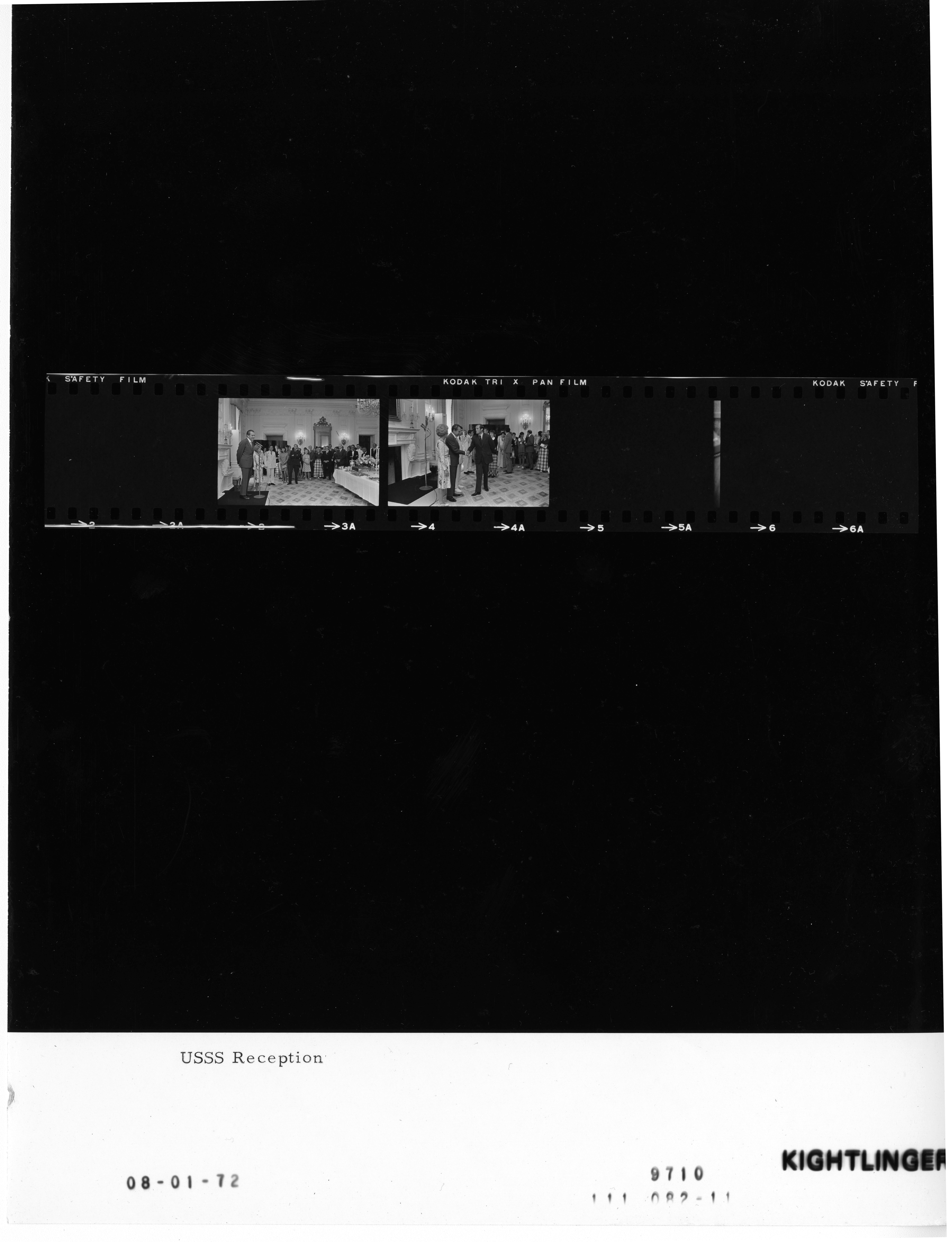
- Frame(s): WHPO-9710-, President Nixon addressing and greeting US Secret Service Presidential Protective Division personnel. 8/1/1972, Washington, D.C. White House, State Dining Room. President Nixon, Pat Nixon, Secret Service personnel.
Roll WHPO-9711 Photographer: Kightlinger, Jack | Color or B&W: Color
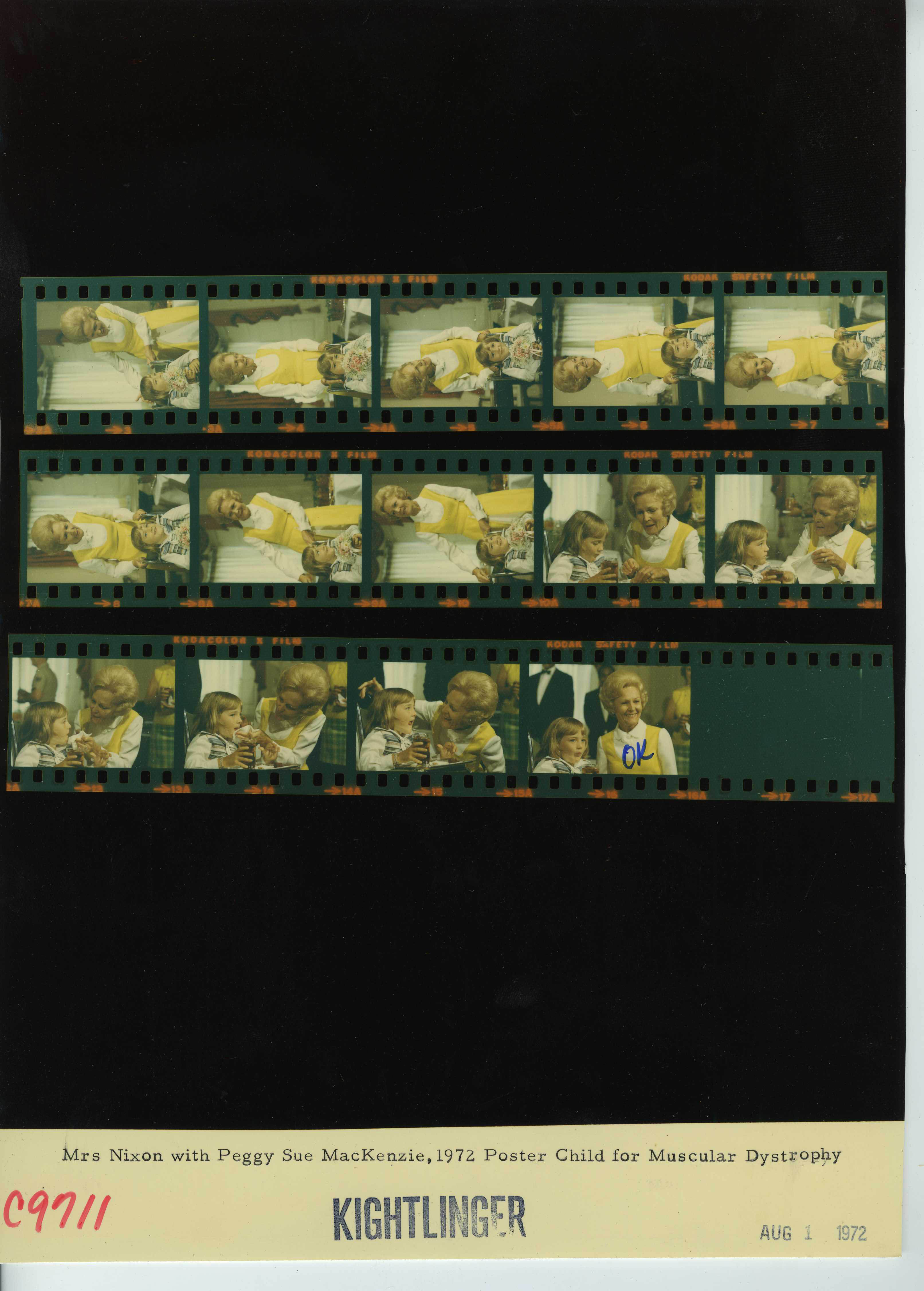
- Frame(s): WHPO-9711-, Pat Nixon with Peggy Sue MacKenzie, 1972 Muscular Dystrophy Poster Child. 8/1/1972, Washington, D.C. White House, Map Room. Pat Nixon, Peggy Sue MacKenzie.
- Frame(s): WHPO-9711-06, Pat Nixon with Peggy Sue MacKenzie, 1972 Muscular Dystrophy Poster Child. 8/1/1972, Washington, D.C. White House, Map Room. Pat Nixon, Peggy Sue MacKenzie.
- Frame(s): WHPO-9711-15, Pat Nixon with Peggy Sue MacKenzie, 1972 Muscular Dystrophy Poster Child. 8/1/1972, Washington, D.C. White House, Map Room. Pat Nixon, Peggy Sue MacKenzie.
Roll WHPO-9712 Photographer: Kightlinger, Jack | Color or B&W: Color
- Frame(s): WHPO-9712-, Pat Nixon standing and seated with Peggy Sue MacKenzie, 1972 Muscular Dystrophy Poster Child, and unidentified persons, possibly family members. 8/1/1972, Washington, D.C. White House, Map Room. Pat Nixon, Peggy Sue MacKenzie, unidentified persons.
The White House Communications Agency Sound Recordings Collection contains public statements that took place between 1969 and 1974. Visit the finding aid to learn more.
G - Cabinet Officer Briefings
- WHCA-SR-G-183
Briefing by Secretary of HEW Elliot Richardson and Dr. Roger Egeberg. (8/1/1972, White House Press Lobby)
Runtime: 25:00:00
Production credits: Audio feed supplied by WHCA; Recorded by GET (initials of WHCA engineer)
Original Format: 1/4-inch reel-to-reel audiotape. Original source type: Original.
P - Formal Presidential Remarks
- WHCA-SR-P-720801
Private taping for the Retired Officers Assn. (8/1/1972)
Runtime: 0:58
Original Format: 1/4-inch reel-to-reel audiotape. Original source type: Original. - WHCA-SR-P-720802
Remarks by President Nixon at reception for Secret Service. (8/1/1972)
Runtime: 2:32
Original Format: 1/4-inch reel-to-reel audiotape. Original source type: Original.
The White House Communications Agency Videotape Collection contains “off-the-air” recordings of televised programs produced between 1968 and 1974. Visit the finding aid to learn more.
- WHCA-5623
"Today" show excerpt.
Post-Newsweek Stations, Inc.
Runtime: 00:22:35 - WHCA-5628
Weekly News Summary, Tape II.
ALL NETWORKS
Runtime: 01:37:58
15. Smith/Zimmerman: Democratic committee to select replacement for Senator Eagleton; Senator Eagleton comments on leaving ticket. Time Code Start: 33:12. Keywords: Presidents, Presidential elections, campaigns, candidates. Network: ABC.
16. Snell: Report from Missouri on Senator Eagleton departure from Democratic ticket. Time Code Start: 36:34. Keywords: Presidents, Presidential elections, campaigns, candidates. Network: ABC.
17. Kaplow: Labor meets to decide on McGovern endorsement. Time Code Start: 38:17. Keywords: Presidential elections, campaigns, campaigning, candidates. Network: ABC.
18. Reasoner: Commentary on confusion in current events, Republicans bugging Democrats headquarters, McGovern, Eagleton, Public Health Service uses humans as guinea pigs to study syphilis, Bobby Fischer and chess, baseball news more satisfying. Time Code Start: 40:26. Keywords: venereal diseases, sexual transmitted diseases, STD, sex, sexuality, tests, testing, bugging, bugs, wiretapping, wire taps, surveillance, spying, recordings, Presidential elections, campaigns, campaigning, candidates, investigations, cover-ups, scandals, . Network: ABC.
19. Chancellor/Briggs: Senator Eagleton's decision to step down; McGovern; Jack Anderson apology. Time Code Start: 42:17. Keywords: Presidents, Presidential elections, campaigns, candidates, International Telephone & Telegraph, communications, world corporations, conglomerates, campaign funding, investigations, hearings. Network: NBC.
20. Chancellor/Kiker: Reaction to Senator Eagleton stepping down. Time Code Start: 45:35. Keywords: Presidents, Presidential elections, campaigns, candidates. Network: NBC.
21. Brinkley: Politics and politicians. Time Code Start: 48:37. Keywords: political activities. Network: NBC.
22. Mudd/Serafin: Senator Eagleton's day, talks about career; Jack Anderson's apology to Senator Eagleton. Time Code Start: 50:35. Keywords: Presidents, Presidential elections, campaigns, candidates, International Telephone & Telegraph, communications, world corporations, conglomerates, campaign funding, investigations, hearings. Network: CBS.
23. Mudd/Morton: Morton comments on McGovern dropping Senator Eagleton. Time Code Start: 55:46. Keywords: Presidents, Presidential elections, campaigns, candidates. Network: CBS.
24. Mudd/Plant: Missouri Democrats comment on McGovern dropping Senator Eagleton. Time Code Start: 56:50. Keywords: Presidents, Presidential elections, campaigns, candidates. Network: CBS.
25. Mudd/Davis: Ben Hoa, North Vietnam bombing, Quang Tri. Time Code Start: 59:21. Keywords: Vietnam War, bombings. Network: CBS.
26. Sevareid: Commentary on Senator Eagleton's bid for Vice President (VP). Time Code Start: 63:15. Keywords: Vice Presidents, Presidential elections, campaigns, campaigning, candidates. Network: CBS.
Context (External Sources)
The Vanderbilt Television News Archive is the world's most extensive and complete archive of television news. They have been recording, preserving and providing access to television news broadcasts of the national networks since August 5, 1968.
Wikipedia is a free encyclopedia that anyone can edit.