
Introduction
This almanac page for Monday, July 31, 1972, pulls together various records created by the federal government and links to additional resources which can provide context about the events of the day.
Previous Date: Sunday, July 30, 1972
Next Date: Tuesday, August 1, 1972
Schedule and Public Documents
The Daily Diary files represent a consolidated record of the President's activities. Visit the finding aid to learn more.
The President's day began at The White House - Washington, D. C.
The Weekly Compilation of Presidential Documents made available transcripts of the President's news conferences; messages to Congress; public speeches, remarks, and statements; and other Presidential materials released by the White House.
Digitized versions can be found at HathiTrust.
The Federal Register is the official daily publication for rules, proposed rules, and notices of federal agencies and organizations, as well as executive orders and other Presidential documents.
No Federal Register published on this date
The Congressional Record is the official daily record of the debates and proceedings of the U.S. Congress.
Archival Holdings
Any selection of archival documents will necessarily be partial. You should use the documents and folders identified below as a starting place, but consult the linked collection finding aids and folder title lists and the collections themselves for context. Many documents to be found this way do not lend themselves to association with specific dates, but are essential to a complete understanding of the material.
Selective document listing
President's Office Files
The President's Office Files consists of materials drawn together by the Special Files Unit from several administrative subdivisions within the White House Office. It is the handwriting and sensitive papers sent to the Staff Secretary that now comprise much of the President's Office Files. Visit the finding aid to learn more.
- News Summaries, Annotated News Summaries, Box 36, July 25-31, 1972 [5 of 5] [Note: Due to the way News Summary products were compiled, you should also consult nearby days for potentially relevant materials.]
- Weekend News Review, July 31, 1972
- President's Daily Schedule, Box 102, [President's Daily Schedule, Apr.-July 1972] [3 of 3]
- The President's Schedule, Monday - July 31, 1972
The H. R. Haldeman Diaries consists of seven handwritten diaries, 36 dictated diaries recorded as sound recordings, and two handwritten audio cassette tape subject logs. The diaries and logs reflect H. R. Haldeman’s candid personal record and reflections on events, issues, and people encountered during his service in the Nixon White House. As administrative assistant to the President and Chief of Staff, Haldeman attended and participated in public events and private meetings covering the entire scope of issues in which the Nixon White House engaged in during the years 1969-1973. Visit the finding aid to learn more.
- Transcript of diary entry (PDF)
Monday, July 31.
We left first thing this morning for Louisiana for Ellender's funeral. The trip went very well. The President got a great reception. Lots of crowds on the streets. Governor met him and said he was for him. Senator Eastland told him that he'd carry every county in Mississippi. The Sheriff said that he'd clean up in Louisiana, as did the police chief, etcetera. He had plenty of time on the plane to chat with the Louisiana Congressional delegation and pick up some political points there. He had quite a discussion with me on general political and Convention plans. He's concerned about California, where he thinks we have our major problems. First, the economy; second, Reagan; third, the fact that it's youth-oriented; but all wrapped up mainly into the fact that of the failure on our part to launch a Democrat Independent campaign there. That ours is a Goldwater-type organization instead of what it should be. He emphasizes that California is the most important state for Connally to work in.
Got into some problems of who goes to the Convention, especially regarding the Pat Nixon staff. Also, the family's obviously pressuring him to get out and shake hands with the delegates and all. He wants to look for something, after the acceptance speech, along that line. He wants some work done on Ed Cox's schedule to use him with the suburbanite elites, upper-class colleges. Use his arrogance, not put him into middle America. He wonders if he ought to go to Wilkes-Barre to look at the flood damage and express some more concern. He was following up with me on whether the men got over to photograph the Ft. Wayne stuff. This comes out of a report that Clawson gives me from an FBI contact of his, indicating that McGovern has an illegitimate daughter who he fathered while he was in high school or college, with the records all very specific in Ft Wayne. We're trying to get pictures of it to have on file, although we have no intention of using it.
He felt he should not go on this press conference if Eagleton is taken off of the ticket; is anxious to get MacGregor's staff meetings and so on started and get people fired up.
Bobby Griffin raised the point with him that, in our canvassing, we need to locate Wallace people and pick them up, as well as Nixon people. Also that we ought to hit the auto manufacturers, to get them to hire people now. They're making enormous profits out of enormous sales, but instead of hiring new people they're running a lot of overtime, which doesn't help us on unemployment.
When we got back, we had an economic political meeting with Shultz, Stein, Weinberger, Ehrlichman, and Colson to discuss the basic economic issues on the basis that the experts know we're in good shape but the people don't. The problems are on inflation, particularly food prices, tax reform, unemployment, and the general area of expansion of the economy. On food prices, the consumers blame the processors and the middle men, so a month before the election we should look for some way to impose a freeze on that segment of the food business. We can't do it earlier because it won't work and we don't want people to find that out. We need to make an all-out assault on the spending ceiling on the basis that it assures against a tax increase. The President feels two fronts need a political play: prices, of food only, to show concern; and taxes, to indicate that we have a tax program. He urged that Weinberger or someone take all of McGovern's votes while he was in the Senate, add up what they would have added to the budget. Say this would have meant so much in increased taxes. That he's the biggest spender in Congress, that he voted against price controls.
Instead of just defending us, we have to kick the hell out of McGovern. We have to find something we can do on the control side of the processor. The problem of bragging on what we have done shows that we're for the status quo, and this may not be salable. We need to force the debate to be on McGovern's economic program, not on our record. This shows the need though, to talk about our issue, foreign policy, instead of getting people talking about the economy. The best we can do is to avoid the negative as much as possible.
The President met after that with Connally alone for quite a while, then called me in. Connally made the point that it's vital, until McGovern and Eagleton make their final decision and McGovern gets a new candidate if he throws Eagleton off, that we make no news whatever. For instance, there should be no announcement of Connally's committee, no news from MacGregor, etcetera. Wallace's announcement on Saturday, for instance, made no ripples, because McGovern and Eagleton were dominating the news.
Then, this evening, McGovern and Eagleton had their meeting. Came out of it and, at about 9:45, had a press conference that was carried on CBS radio. McGovern announced that, while he was fully satisfied that Eagleton's health was great and he consistently supported Eagleton, that they had made a joint decision. That health was not a factor, but the public debate of it was diverting attention again from the national issues and that the paramount need for the Democrats is unity and a full discussion of the issues. That the debate regarding Eagleton will divide, so the best course is for Eagleton to step aside. With nothing but best wishes, he's agreed to campaign, and I welcome his help, etcetera. Eagleton said that he was jointly in agreement that he should withdraw, that it wasn't an easy decision, that thousands of people had phoned, written, and so forth, but that he will not divide the Democratic Party, which already has too many divisions. His personal feelings are secondary to the need to unify the Democratic Party and elect McGovern president. "My conscience is clear, my spirit is high, this is definitely not my last press conference. Tom Eagleton will be around for a long, long time, and I will be working for McGovern in the meantime." Then he said no one could have been finer, more considerate, more generous in his concern than George McGovern, and so on. McGovern then said that he will consider the Vice President choice very carefully, has no one in mind at this point. He won't discuss the VP tomorrow night. He's requested free time on all three networks at 9:00 tomorrow night. He says he'll discuss the campaign to date at that time, which should be an impossibility. At that point, I called the President to report to him, and missed a good chunk of the press conference. The rest of it just babbled on on how heartrending a decision it was, and explaining away various factors. Nothing of any importance.
End of July 31. - Original audio recording (MP3)
The National Archives Catalog is the online portal to the records held at the National Archives, and information about those records. It is the main way of describing our holdings and also provides access to electronic records and digitized versions of our holdings.
The Catalog searches across multiple National Archives resources at once, including archival descriptions, digitized and electronic records, authority records, and web pages from Archives.gov and the Presidential Libraries. The Catalog also allows users to contribute to digitized historical records through tagging and transcription.
Nixon Library Holdings
All National Archives Units
National Security Documents
The President's Daily Brief is the primary vehicle for summarizing the day-to-day sensitive intelligence and analysis, as well as late-breaking reports, for the White House on current and future national security issues. Read "The President's Daily Brief: Delivering Intelligence to Nixon and Ford" to learn more.
The Foreign Relations of the United States series presents the official documentary historical record of major U.S. foreign policy decisions and significant diplomatic activity. Visit the State Department website for more information.
Vol. III, Foreign Economic Policy; International Monetary Policy, 1969-1972
International Monetary Policy, 1969-1972
238. Telegram From the Embassy in France to the Department of State, Paris, July 31, 1972, 1716Z
Source: National Archives, RG 59, Central Files 1970-73, FN 10. Confidential; Immediate; Limdis; Greenback.
239. Paper Prepared in the Department of the Treasury, Washington, July 31, 1972
Source: Washington National Records Center, Department of the Treasury, Deputy to the Assistant Secretary for International Affairs: FRC 56 83 26, Contingency Planning, 1965-1973. Confidential. The paper bears no drafting information.
Vol. XXIII, Arab-Israeli Dispute, 1969-1972
Proximity Talks and the Backchannel: Separate Department of State and White House Negotiating Tricks
302. Telegram From the Department of State to the Interests Section in Egypt, Washington, July 31, 1972, 1801Z
Source: National Archives, Nixon Presidential Materials, NSC Files, Box 658, Country Files, Middle East, Middle East Nodis/Cedar/Plus, Vol. V. Secret; Priority; Nodis; Cedar Double Plus. Drafted by Anderson; cleared by Kissinger, Sisco, and Atherton; and approved by Rogers.
Vol. XLI, Western Europe; NATO, 1969-1972
United Kingdom
354. Memorandum From the President’s Deputy Assistant for National Security Affairs (Haig) to Bruce Kehrli of the White House Staff, Washington, July 31, 1972
Source: National Archives, Nixon Presidential Materials, NSC Files, Box 694, Country Files—Europe, Ireland. Secret.
Vol. E-5, Part 2, Documents on North Africa, 1969-1972
Algeria
33. Memorandum of Conversation, Washington, July 31, 1972
In an official démarche, Assistant Secretary of State for African Affairs Newsom discussed with Minister Abdelkader Bousselham the hijacking of a Delta Airlines aircraft by members of the Black Panthers, who had been paid a million-dollar ransom.
Source: National Archives, RG 59, Central Files 1970–73, AV 12 US. Confidential. Following his 1968 flight from the United States to avoid imprisonment for an assault conviction, Eldridge Cleaver, Minister of Information for the Black Panthers, founded a headquarters in Algeria. On June 3, two Black Panthers had demanded and received $500,000 in ransom after hijacking a Western Airlines flight, a sum which the government of Algeria returned to the airline. The Government then released the hijackers to the Black Panthers in Algiers.
The Kissinger telephone conversation transcripts consist of approximately 20,000 pages of transcripts of Kissinger’s telephone conversations during his tenure as Assistant to the President for National Security Affairs (1969-1974) and Secretary of State (1973-1974) during the administration of President Richard Nixon. Visit the finding aid for more information.
Digitized versions can be found in the National Archives Catalog.
Audiovisual Holdings
Visit the White House Tapes finding aid to learn about the taping system's operation and archival processing.
Oval Office
- 757-1; Unknown between 4:05 p.m. & 4:07 p.m.; Nixon, Richard M. (President); White House operator
- 757-2; Unknown between 4:05 p.m. & 4:07 p.m.; Nixon, Richard M. (President); Bull, Stephen B.
- 757-3; 4:07 p.m. - 4:08 p.m.; Nixon, Richard M. (President); Colson, Charles W.
- 757-4; 4:08 p.m. - 4:10 p.m.; Nixon, Richard M. (President); Bull, Stephen B.
- 757-5; 4:10 p.m. - 5:38 p.m.; Nixon, Richard M. (President); Colson, Charles W.; Haldeman, H. R. ("Bob"); [Unknown person(s)]; Weinberger, Caspar W. ("Cap"); Shultz, George P.; Stein, Herbert; Ehrlichman, John D.
- 757-6; 5:38 p.m. - 6:40 p.m.; Nixon, Richard M. (President); Connally, John B.; Sanchez, Manolo; White House operator; Waggonner, Joe D., Jr.; Haldeman, H. R. ("Bob")
- 757-7; 8:44 p.m. - 8:46 p.m.; Nixon, Richard M. (President); Ehrlichman, John D.
- 757-8; 9:05 p.m. - 9:06 p.m.; Nixon, Richard M. (President); Buchanan, Patrick J.
- 757-9; Unknown between 9:06 p.m. & 9:51 p.m.; Nixon, Richard M. (President); Sanchez, Manolo
- 757-10; Unknown between 9:06 p.m. & 9:51 p.m.; Nixon, Richard M. (President)
- 757-11; Unknown between 9:06 p.m. & 9:51 p.m.; Nixon, Richard M. (President)
- 757-12; Unknown between 9:06 p.m. & 9:51 p.m.; Nixon, Richard M. (President)
- 757-13; 9:51 p.m. - 9:57 p.m.; Nixon, Richard M. (President); Haldeman, H. R. ("Bob")
- 757-14; Unknown between 9:57 p.m. & 10:16 p.m.; Nixon, Richard M. (President)
- 757-15; Unknown between 9:57 p.m. & 10:16 p.m.; Nixon, Richard M. (President); [Unknown person(s)]
- 757-16; Unknown between 9:57 p.m. & 10:16 p.m.; Nixon, Richard M. (President)
- 757-17; Unknown between 9:57 p.m. & 10:16 p.m.; Nixon, Richard M. (President)
- 757-18; Unknown between 9:57 p.m. & 10:16 p.m.; Nixon, Richard M. (President)
- 757-19; 10:16 p.m. - 10:25 p.m.; Nixon, Richard M. (President); Haldeman, H. R. ("Bob")
- 757-20; 10:26 p.m. - 10:31 p.m.; Nixon, Richard M. (President); Buchanan, Patrick J.
- 757-21; Unknown between 10:31 p.m. & 10:58 p.m.; Nixon, Richard M. (President); White House operator
- 757-22; Unknown between 10:31 p.m. & 10:58 p.m.; Nixon, Richard M. (President); White House operator
- 757-23; 10:58 p.m. - 11:11 p.m.; Nixon, Richard M. (President); Colson, Charles W.
- 757-24; Unknown between 11:11 p.m. & 11:18 p.m.; Nixon, Richard M. (President)
- 757-25; Unknown between 11:18 p.m. & 11:59 p.m.; United States Secret Service agents
White House Telephone
- 28-13; 4:06 p.m. - 4:06 p.m.; Nixon, Richard M. (President); White House operator
- 28-14; 4:07 p.m. - 4:08 p.m.; Nixon, Richard M. (President); Colson, Charles W.
- 28-15; Unknown between 5:32 p.m. & 5:44 p.m.; Nixon, Richard M. (President); White House operator; Connally, John B.
- 28-16; 5:44 p.m. - 5:54 p.m.; Nixon, Richard M. (President); Waggonner, Joe D., Jr.; Connally, John B.
- 28-17; Unknown between 5:54 p.m. & 8:44 p.m.;
- 28-18; 8:44 p.m. - 8:46 p.m.; Nixon, Richard M. (President); Ehrlichman, John D.
- 28-19; 9:05 p.m. - 9:06 p.m.; Nixon, Richard M. (President); Buchanan, Patrick J.
- 28-20; 9:51 p.m. - 9:57 p.m.; Nixon, Richard M. (President); Haldeman, H. R. ("Bob")
- 28-21; 10:16 p.m. - 10:25 p.m.; Nixon, Richard M. (President); Haldeman, H. R. ("Bob")
- 28-22; 10:26 p.m. - 10:31 p.m.; Nixon, Richard M. (President); Buchanan, Patrick J.
- 28-23; Unknown between 10:31 p.m. & 10:58 p.m.; Nixon, Richard M. (President); White House operator
- 28-24; Unknown between 10:31 p.m. & 10:58 p.m.; Nixon, Richard M. (President); White House operator
- 28-25; 10:58 p.m. - 11:11 p.m.; Nixon, Richard M. (President); Colson, Charles W.
The White House Photo Office collection consists of photographic coverage of President Richard Nixon meeting with prominent social, political, and cultural personalities; speaking engagements and news conferences of the President and various high-ranking members of the White House staff and Cabinet; Presidential domestic and foreign travel, including Presidential vacations; social events and entertainment involving the First Family, including entertainers present; official portraits of the President, First Family, and high-ranking members of the Nixon administration; the 1969 and 1973 Inaugurals; the President’s 1972 Presidential election campaign appearances (including speeches) and other official activities of the White House staff and the President’s Cabinet from January 20, 1969 until August 9, 1974 at the White House and the Old Executive Office Building; other locations in Washington, DC, such as The Mall; and the Presidential retreats in Camp David, Maryland, Key Biscayne, Florida, and San Clemente, California. Visit the finding aid to learn more.
Roll WHPO-9686 Photographer: Knudsen, Robert L. | Color or B&W: B&W
- Frame(s): WHPO-9686-, The swearing-in ceremony of Louis Nunez as an Asst. Director of the Civil Rights Commission. 7/31/1972, Washington, D.C. White House, Roosevelt Room. Louis Nunez, Mrs. Nunez, unidentified officials.
Roll WHPO-9688 Photographer: Atkins, Oliver | Color or B&W: B&W
- Frame(s): WHPO-9688-, President Nixon and members of Congress en route aboard Air Force One, (AF1) to attend the funeral of Senator Allen Ellender. 7/31/1972, air lounge area, Air Force One (AF1), "Spirit of '76". President Nixon, James Eastland, Robert Griffin, Hugh Scott, John McClellan, Milton Young, Otto Passman, Joe Waggonner, Hale Boggs, George Shultz.
- Frame(s): WHPO-9688-03A, President Nixon and members of Congress en route aboard Air Force One, (AF1) to attend the funeral of Senator Allen Ellender. 7/31/1972, air lounge area, Air Force One (AF1), "Spirit of '76". President Nixon, James Eastland, Robert Griffin, Hugh Scott, John McClellan, Milton Young.
- Frame(s): WHPO-9688-10A, President Nixon and members of Congress en route aboard Air Force One, (AF1) to attend the funeral of Senator Allen Ellender. 7/31/1972, air lounge area, Air Force One (AF1), "Spirit of '76". President Nixon, James Eastland, Robert Griffin, Milton Young, Otto Passman, Joe Waggonner, Hale Boggs.
- Frame(s): WHPO-9688-19A, President Nixon and members of Congress en route aboard Air Force One, (AF1) to attend the funeral of Senator Allen Ellender. 7/31/1972, air lounge area, Air Force One (AF1), "Spirit of '76". President Nixon, James Eastland, Robert Griffin, Hugh Scott, John McClellan, Milton Young, Otto Passman, Joe Waggonner, Hale Boggs, George Shultz.
Roll WHPO-9689 Photographer: Atkins, Oliver | Color or B&W: B&W
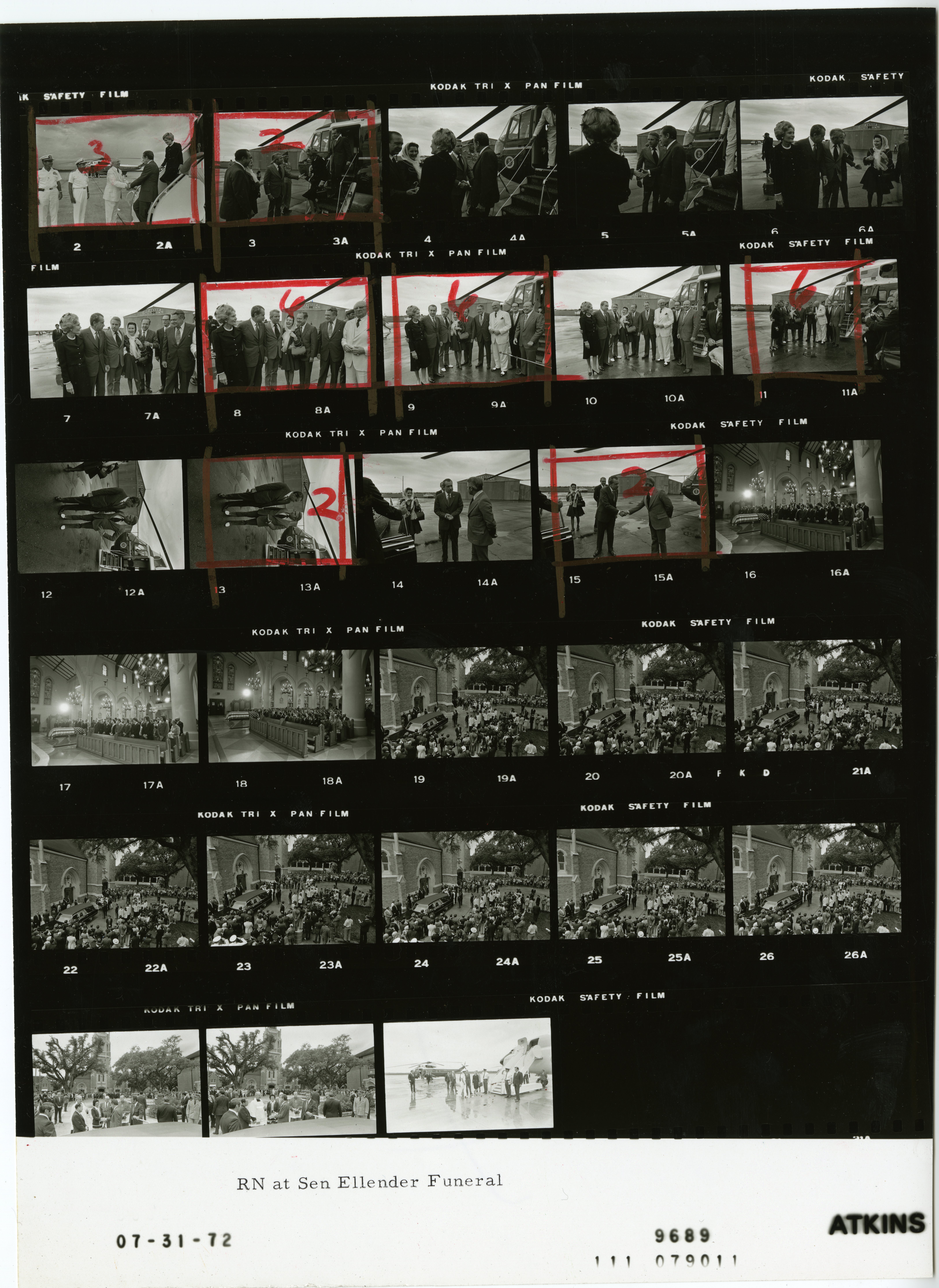
- Frame(s): WHPO-9689-02, 29, President Nixon and Pat Nixon are greeted upon arrival and departure at Naval Air Station Joint Reserve Base New Orleans. (NASJRB). 7/31/1972, NAS New Orleans, Houma, Louisiana tarmac; helipad, Naval Air Station Joint Reserve Base New Orleans. President Nixon, Pat Nixon, Navy officers, Congressmen, Gov. & Mrs. Edwin Edwards, clergy, family members, funeral attendees.
- Frame(s): WHPO-9689-03-15, President Nixon, Pat Nixon, and others are greeted upon arrival at the Naval Air Station Joint Reserve Base New Orleans helipad. 7/31/1972, NAS New Orleans, Houma, Louisiana tarmac; helipad, Naval Air Station Joint Reserve Base New Orleans. President Nixon, Pat Nixon, Navy officers, Congressmen, Gov. & Mrs. Edwin Edwards, clergy ,family members, funeral attendees.
- Frame(s): WHPO-9689-13, President Nixon talking with Governor Edwin Edwards upon arrival at the Naval Air Station Joint Reserve Base New Orleans helipad. 7/31/1972, Houma, Louisiana tarmac, helipad. President Nixon, Edwin Edwards.
- Frame(s): WHPO-9689-16-28, The funeral proceedings of Senator Ellender at St. Francis de Sales Cathedral in Houma, LA. 7/31/1972, Houma, Louisiana St. Francis de Sales Cathedral. President Nixon, Pat Nixon, Navy officers, Congressmen, Governor Edwards & Mrs. Edwin Edwards, clergy ,family members, funeral attendees.
- Frame(s): WHPO-9689-18, President Nixon and Pat Nixon attending the funeral memorial service of Senator Ellender at St. Francis de Sales Cathedral in Houma, LA. The American Flag draped casket of Senator Ellender is seen on the left. 7/31/1972, Houma, Louisiana St. Francis de Sales Cathedral. President Nixon, Pat Nixon, Navy officers, Congressmen, Governor Edwards, Mrs. Edwin Edwards, clergy ,family members, funeral attendees.
- Frame(s): WHPO-9689-19, President Nixon and Pat Nixon walking beside the Navy pallbearers carrying the American Flag draped casket of Senator Ellender from church to the waiting hearse at St. Francis de Sales Cathedral in Houma, LA. A crowd and members of the press are gathered outside surrounding the area. 7/31/1972, Houma, Louisiana St. Francis de Sales Cathedral. President Nixon, Pat Nixon, Navy officers, Congressmen, Governor Edwards, Mrs. Edwin Edwards, clergy ,family members, funeral attendees.
Roll WHPO-9690 Photographer: Atkins, Oliver | Color or B&W: B&W
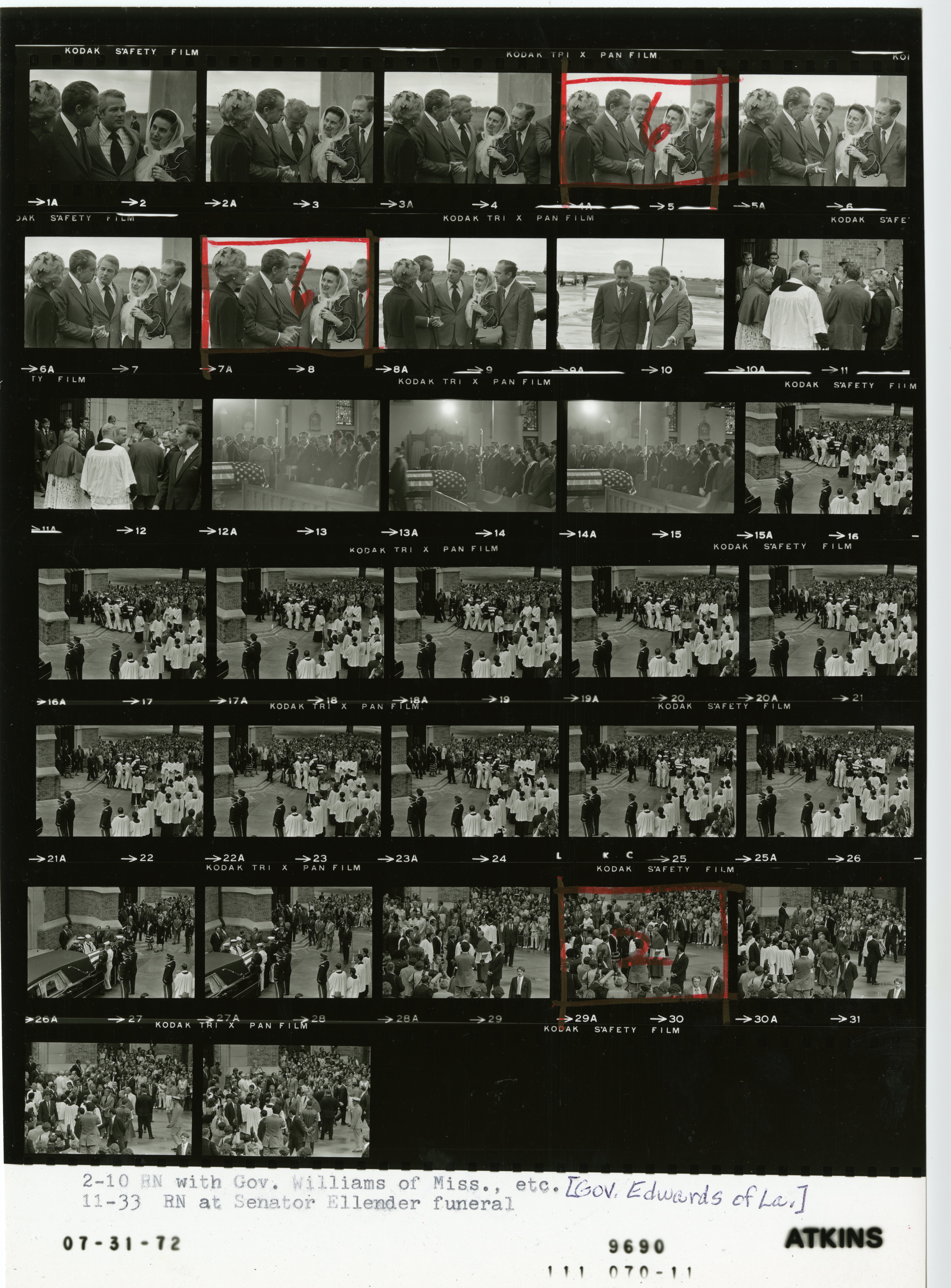
- Frame(s): WHPO-9690-02-10, President Nixon and Pat Nixon being greeted upon arrival. 7/31/1972, Houma, Louisiana helipad, St. Francis de Sales Cathedral. President Nixon, Pat Nixon, Congressmen, Gov. Edwin Edwards, Mrs. Edwin Edwards, clergy, family members, funeral attendees.
- Frame(s): WHPO-9690-04, President Nixon and Pat Nixon speaking with Governor Edwin Edwards and his wife upon arrival at the funeral memorial services of Senator Ellender at St. Francis de Sales Cathedral in Houma, LA. 7/31/1972, Houma, Louisiana helipad, St. Francis de Sales Cathedral. President Nixon, Pat Nixon, Congressmen, Gov. Edwin Edwards, Mrs. Edwin Edwards.
- Frame(s): WHPO-9690-13-33, The funeral memorial service proceedings of Senator Ellender at St. Francis de Sales Cathedral in Houma, LA. 7/31/1972, Houma, Louisiana St. Francis de Sales Cathedral. President Nixon, Pat Nixon, Congressmen, Gov. Edwin Edwards, Mrs. Edwin Edwards, clergy, family members, funeral attendees.
- Frame(s): WHPO-9690-27, President Nixon stands beside the casket of Senator Ellender while navy Pallbearers place it into the hearse outside the church after funeral proceedings of Senator Ellender at St. Francis de Sales Cathedral in Houma, LA. Pat Nixon accompanies a members of the Ellender family nearby. 7/31/1972, Houma, Louisiana St. Francis de Sales Cathedral. President Nixon, Pat Nixon, Congressmen, Gov. Edwin Edwards, Mrs. Edwin Edwards, clergy, family members, funeral attendees.
Roll WHPO-9691 Photographer: Atkins, Oliver | Color or B&W: B&W
- Frame(s): WHPO-9691-, President Nixon standing while ladies sit, and standing with Rep. Otto Passman. 7/31/1972, air lounge area, "Spirit of '76". President Nixon, Pat Nixon, Mrs. John McClellan, Mrs. Hale Boggs, Mrs. Milton Young, Otto Passman.
Roll WHPO-9692 Photographer: Knudsen, Robert L. | Color or B&W: B&W
- Frame(s): WHPO-9692-, President Nixon seated informally in the Oval Office during a meeting with the Troika and White House staff members: Charles Colson, H.R. Haldeman, Director of the OMB Caspar Weinberger, George Shultz, Chairman of the Council of Economic Advisers (CEA) Herb Stein and John Ehrlichman. 7/31/1972, Washington, D.C. White House, Oval Office. President Nixon, Charles W. Colson, H.R. Haldeman, Caspar Weinberger, George Shultz, Herb Stein, John Ehrlichman.
- Frame(s): WHPO-9692-03A, President Nixon seated informally in the Oval Office during a meeting with the Troika and White House staff members: Charles Colson, H.R. Haldeman, Director of the OMB Caspar Weinberger, George Shultz, Chairman of the Council of Economic Advisers (CEA) Herb Stein and John Ehrlichman. 7/31/1972, Washington, D.C. White House, Oval Office. President Nixon, Charles W. Colson, H.R. Haldeman, Caspar Weinberger, George Shultz, Herb Stein, John Ehrlichman.
Roll WHPO-9693 Photographer: Schumacher, Karl | Color or B&W: B&W
- Frame(s): WHPO-9693-, White House interns seated and standing around a conference table. 7/31/1972, Washington, D.C. unknown. White House interns.
Roll WHPO-9695 Photographer: Kightlinger, Jack | Color or B&W: Color
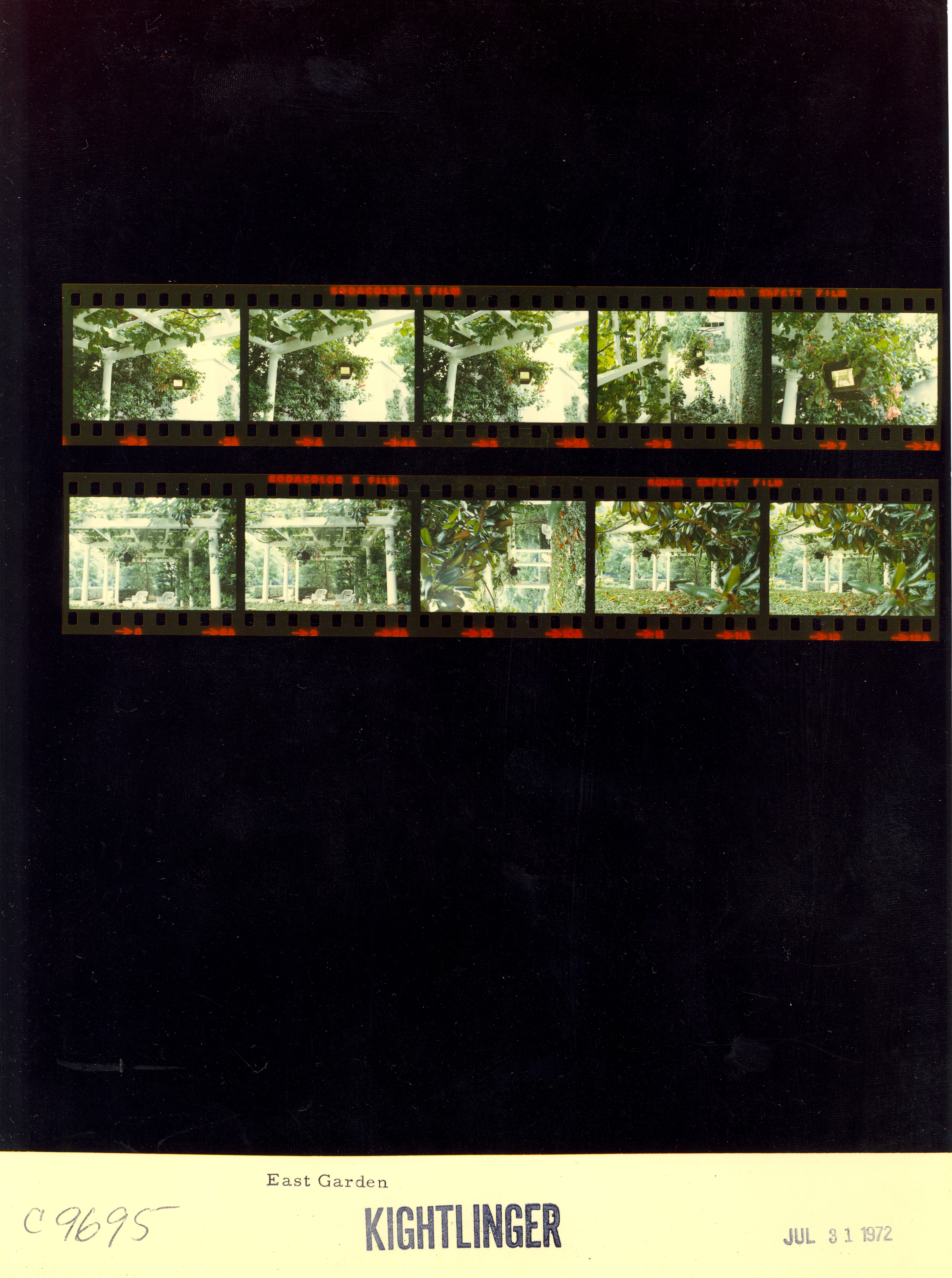
- Frame(s): WHPO-9695-03-07, The unoccupied East Garden Pergola outdoor seating area hanging light box. 7/31/1972, Washington, D.C. East Garden, White House.
- Frame(s): WHPO-9695-08-12, The unoccupied East Garden Pergola outdoor seating area furnished with White Whicker chairs. 7/31/1972, Washington, D.C. East Garden, White House.
The White House Communications Agency Sound Recordings Collection contains public statements that took place between 1969 and 1974. Visit the finding aid to learn more.
H - White House Staff Member Recordings
- WHCA-SR-H-631
Interview of Barbara Franklin by Barbara Walters. (7/31/1972, Mono Room, Room 79, EOB)
Runtime: 0:08:53
Keywords: interviews, media,
Production credits: Audio feed supplied by WHCA; Recorded by BAC (initials of WHCA engineer)
Original Format: 1/4-inch reel-to-reel audiotape. Original source type: Original. - WHCA-SR-H-632
Rita Hauser (Lawyer), Pat Hitt (Assistant Secretary of the Department of Health, Education, and Welfare), and Sally Ann Payton speaking to Summer Interns regarding the Role of Women in the Administration and Society. (7/31/1972, Room 444, Executive Office Building)
Runtime: 1:33:00
Keywords: Feminism, Feminist movement, women's rights, Womens Liberation, equality, equal rights, gender, civil rights, activists, women
Production credits: Audio feed supplied by WHCA; Recorded by JMM (initials of WHCA engineer)
Original Format: 1/4-inch reel-to-reel audiotape. Original source type: Original.
The White House Communications Agency Videotape Collection contains “off-the-air” recordings of televised programs produced between 1968 and 1974. Visit the finding aid to learn more.
- WHCA-5628
Weekly News Summary, Tape II.
ALL NETWORKS
Runtime: 01:37:58
1. Smith: Senator Eagleton's day. Time Code Start: 00:00. Keywords: Presidents, Presidential elections, campaigns, candidates. Network: ABC.
2. Smith/Tucker/Donaldson: Possible VP candidates. Time Code Start: 01:50. Keywords: Vice Presidents, Presidential elections, campaigns, campaigning, candidates. Network: ABC.
3. Smith/Jarriel: Senator Ellender's funeral. Time Code Start: 04:48. Keywords: Senators, death memorials, burials, internments, religious services, funerals. Network: ABC.
4. Reasoner: Senator Eagleton poll. Time Code Start: 07:00. Keywords: Presidents, Presidential elections, campaigns, candidates, public opinions, polls, gallup. Network: ABC.
5. Burke: Pennsylvania floods. Time Code Start: 07:30. Keywords: floods, weather, disasters, damages, rescues, aid. Network: ABC.
6. Smith: Commentary on Democrats. Time Code Start: 11:07. Keywords: political parties, Democrats, Democratic Party. Network: ABC.
7. Chancellor: Senators Eagleton and McGovern to decide on ticket. Time Code Start: 12:56. Keywords: Presidents, Presidential elections, campaigns, candidates. Network: NBC.
8. Briggs: Senator Eagleton's Headquarters (HQ), support mail. Time Code Start: 13:42. Keywords: Presidents, Presidential elections, campaigns, candidates. Network: NBC.
9. Chancellor/Nessen: Senator Ellender funeral, McGovern (film of President Nixon). Time Code Start: 15:12. Keywords: Presidents, Senators, death memorials, burials, internments, religious services, funerals. Network: NBC.
10. Chancellor/Dancy/Briggs: Discussion of Senator Eagleton's chances on ticket. Time Code Start: 17:41. Keywords: Presidents, Presidential elections, campaigns, candidates. Network: NBC.
11. Mudd/Norton: McGovern to announce results of meeting with Senator Eagleton. Time Code Start: 22:43. Keywords: Presidents, Presidential elections, campaigns, candidates. Network: CBS.
12. Serafin: Senator Eagleton, support for staying on ticket. Time Code Start: 26:25. Keywords: Presidents, Presidential elections, campaigns, candidates. Network: CBS.
13. Mudd/Pierpoint: Senator Ellender funeral. Time Code Start: 28:55. Keywords: Senators, death memorials, burials, internments, religious services, funerals. Network: CBS.
14. Sevareid: Senator Eagleton. Time Code Start: 30:41. Keywords: Presidents, Presidential elections, campaigns, candidates. Network: CBS.
Context (External Sources)
The Vanderbilt Television News Archive is the world's most extensive and complete archive of television news. They have been recording, preserving and providing access to television news broadcasts of the national networks since August 5, 1968.
Wikipedia is a free encyclopedia that anyone can edit.