
Introduction
This almanac page for Wednesday, August 2, 1972, pulls together various records created by the federal government and links to additional resources which can provide context about the events of the day.
Previous Date: Tuesday, August 1, 1972
Next Date: Thursday, August 3, 1972
Schedule and Public Documents
The Daily Diary files represent a consolidated record of the President's activities. Visit the finding aid to learn more.
The President's day began at The White House - Washington, D. C.
The Weekly Compilation of Presidential Documents made available transcripts of the President's news conferences; messages to Congress; public speeches, remarks, and statements; and other Presidential materials released by the White House.
Digitized versions can be found at HathiTrust.
Each Public Papers of the Presidents volume contains the papers and speeches of the President of the United States that were issued by the White House Office of the Press Secretary during the time period specified by the volume. The material is presented in chronological order, and the dates shown in the headings are the dates of the documents or events. In instances when the release date differs from the date of the document itself, that fact is shown in the text note.
To ensure accuracy, remarks have been checked against audio recordings (when available) and signed documents have been checked against the original, unless otherwise noted. Editors have provided text notes and cross references for purposes of identification or clarity.
The Federal Register is the official daily publication for rules, proposed rules, and notices of federal agencies and organizations, as well as executive orders and other Presidential documents.
The Congressional Record is the official daily record of the debates and proceedings of the U.S. Congress.
Archival Holdings
Any selection of archival documents will necessarily be partial. You should use the documents and folders identified below as a starting place, but consult the linked collection finding aids and folder title lists and the collections themselves for context. Many documents to be found this way do not lend themselves to association with specific dates, but are essential to a complete understanding of the material.
Selective document listing
President's Office Files
The President's Office Files consists of materials drawn together by the Special Files Unit from several administrative subdivisions within the White House Office. It is the handwriting and sensitive papers sent to the Staff Secretary that now comprise much of the President's Office Files. Visit the finding aid to learn more.
- News Summaries, Annotated News Summaries, Box 37, August 1-4, 1972 [2 of 4] [Note: Due to the way News Summary products were compiled, you should also consult nearby days for potentially relevant materials.]
- News Summary, August 2, 1972, (Tues. nets, wires, mags, columns)
- President's Daily Schedule, Box 102, [President's Daily Schedule, Aug.-Sept. 1972] [1 of 2]
- The President's Schedule, Wednesday - August 2, 1972
The H. R. Haldeman Diaries consists of seven handwritten diaries, 36 dictated diaries recorded as sound recordings, and two handwritten audio cassette tape subject logs. The diaries and logs reflect H. R. Haldeman’s candid personal record and reflections on events, issues, and people encountered during his service in the Nixon White House. As administrative assistant to the President and Chief of Staff, Haldeman attended and participated in public events and private meetings covering the entire scope of issues in which the Nixon White House engaged in during the years 1969-1973. Visit the finding aid to learn more.
- Transcript of diary entry (PDF)
Wednesday, August 2.
The President had no schedule today. Spent time on odds and ends. He talked to me first thing this morning about the Pat Nixon film. Wants to-- wanted to set up a plan for her to review it, which we did. The President warned Rose and Tricia to sit in with her and rave about it, so that we'd get approval. They ran it at 5:00 today, and it came off extremely well, so we're in good shape on that. He got into some Convention ideas, particularly his thought of doing some kind of personal hand shaker after the acceptance speech, and agreed with my recommendation that he simply stay on the platform and let people file by and greet him there. So that's what we're going to work out. There are some problems with Pat Nixon on Convention scheduling and the question of her arriving separately and all, but those appear to be soluble.
We had a flap today on the Wallace thing because apparently Schneider and France misunderstood Connally last night, think that we're not going to provide them with financial support. And we were at a point where they were threatening, at least, to go to Wallace and reactivate him as a third party candidate. Connally and Colson went back and forth on this, and apparently it's now been resolved, with our committing to financial support of their staff needs for the balance of the year, and other minor items.
The President met with Connally for an hour and a half this afternoon, reviewed progress on lining up Democrats. Discussed general strategy as to what the President ought to do in way of a press conference, agreeing he should not have any while the Democrats are in their continuing state of disarray, and reviewed plans for the Connally Democrat barbecue in September. John seems to be in good shape––a little tired––is on his way back to Texas tonight, but still fired up on organizing the Democrats, so things appear to be going well.
End of August 2. - Original audio recording (MP3)
The National Archives Catalog is the online portal to the records held at the National Archives, and information about those records. It is the main way of describing our holdings and also provides access to electronic records and digitized versions of our holdings.
The Catalog searches across multiple National Archives resources at once, including archival descriptions, digitized and electronic records, authority records, and web pages from Archives.gov and the Presidential Libraries. The Catalog also allows users to contribute to digitized historical records through tagging and transcription.
Nixon Library Holdings
All National Archives Units
National Security Documents
The President's Daily Brief is the primary vehicle for summarizing the day-to-day sensitive intelligence and analysis, as well as late-breaking reports, for the White House on current and future national security issues. Read "The President's Daily Brief: Delivering Intelligence to Nixon and Ford" to learn more.
The Foreign Relations of the United States series presents the official documentary historical record of major U.S. foreign policy decisions and significant diplomatic activity. Visit the State Department website for more information.
Vol. VIII, Vietnam, January-October 1972
The Parties Move Toward Agreement, July 19-October 7, 1972
224. Conversation Between President Nixon and the President’s Assistant for National Security Affairs (Kissinger), Washington, August 2, 1972
Source: National Archives, Nixon Presidential Materials, White House Tapes, Oval Office, Conversation 759–5. No classification marking. The editors transcribed the portions of the tape recording printed here specifically for this volume. The transcript is part of a larger conversation, 10:34–11:47 a.m.
Vol. XXIII, Arab-Israeli Dispute, 1969-1972
Proximity Talks and the Backchannel: Separate Department of State and White House Negotiating Tricks
303. Conversation Between President Nixon and the President’s Assistant for National Security Affairs (Kissinger), Washington, August 2, 1972
Source: National Archives, Nixon Presidential Materials, White House Tapes, Oval Office, Conversation No. 759–5. No classification marking. According to the President’s Daily Diary, Nixon and Kissinger met from 10:34 to 11:47 a.m. (Ibid., White House Central Files) The editors transcribed the portion of the tape recording printed here specifically for this volume. Brackets indicate unclear portions of the original recording or those omitted by the editors except “[in]” and “[laughs]”, added for clarity.
Vol. XXXIV, National Security Policy, 1969-1972
Taking Stock
221. Memorandum From the President’s Assistant for National Security Affairs (Kissinger) to President Nixon, Washington, August 2, 1972
Source: National Archives, Nixon Presidential Materials, NSC Files, Box 237, Agency Files, DPRC & Defense Budget, Jan–Jul, 1972. Secret. Sent for action. The memorandum bears a stamped note indicating that the President saw it. Although no drafting information appears on the memorandum, Odeen sent a draft to Kissinger on July 20 under a covering memorandum. (Ibid.)
Vol. XXXVI, Energy Crisis, 1969-1974
March 16, 1972-March 6, 1973
135. Transcript of a Telephone Conversation Between the President’s Assistant for National Security Affairs (Kissinger) and John B. Connally, Washington, August 2, 1972, 12:32 p.m.
Source: National Archives, Nixon Presidential Materials, NSC Files, Kissinger Telephone Conversation Transcripts, Box 15, Chronological Files. No classification marking.
Vol. E-4, Documents on Iran and Iraq, 1969-1972
Iran 1972
216. Memorandum From Harold Saunders of the National Security Council Staff to the President’s Assistant for National Security Affairs (Kissinger), Washington, August 2, 1972
Saunders put to Kissinger the questions which arose from the President’s promise of U.S. military personnel to Iran.
Source: National Archives, Nixon Presidential Materials, NSC Files, Box 602, Country Files, Middle East, Iran, Vol. IV 9/1/71–4/73. Secret. Tab A is the White House backchannel message as sent for transmission. Tabs B and C are not published. At the top of this memorandum, Kissinger wrote, “Al—OK—but what do you think? HK.” Haig responded “I agree.” Kissinger initialed his approval. In Telegram 4467 from Tehran, July 24, the Embassy requested clarification as to the nature and extent of the U.S. military support to be provided to Iran. While recommending a forthcoming response, the Embassy also urged that Washington emphasize the non-operative role contemplated for U.S. personnel assisting the Iranian forces. (Ibid., RG 59, Central Files 1970–73, DEF 19–9 US-IRAN.) In Telegram 4639 from Tehran, August 1, Farland conveyed ALAM’s assurance that Iran did not foresee an operational role for U.S. military technicians. (Ibid., Nixon Presidential Materials, NSC Files, Box 1282, Saunders Files, Middle East Negotiations, Iran Military 1/1/72–12/31/72.)
Vol. E-7, Documents on South Asia, 1969-1972
U.S. Relations with India and Pakistan, 1972
297. Memorandum of Conversation, Washington, August 2, 1972
Acting Secretary of State Irwin and Indian Ambassador Jha discussed the possibility of developing a dialogue to improve relations between the United States and India. Jha sought to explain the negative comments made by Indian Prime Minister Gandhi during Ambassador Keating’s farewell call and argued that if a constructive dialogue were not initiated soon, increasing anti-American sentiment in India might make it difficult to do so.
Source: National Archives, RG 59, Central Files 1970–73, POL INDIA-US. Secret; Nodis. Drafted on August 7 by Kux and cleared in draft by Irwin.
The Kissinger telephone conversation transcripts consist of approximately 20,000 pages of transcripts of Kissinger’s telephone conversations during his tenure as Assistant to the President for National Security Affairs (1969-1974) and Secretary of State (1973-1974) during the administration of President Richard Nixon. Visit the finding aid for more information.
Digitized versions can be found in the National Archives Catalog.
Audiovisual Holdings
Visit the White House Tapes finding aid to learn about the taping system's operation and archival processing.
Old Executive Office Building
- 352-17; Unknown between 1:19 p.m. & 2:33 p.m.; Nixon, Richard M. (President); Sanchez, Manolo
- 352-18; Unknown between 1:19 p.m. & 2:33 p.m.; Nixon, Richard M. (President); [Unknown person(s)]
- 352-19; Unknown between 1:19 p.m. & 2:33 p.m.; Nixon, Richard M. (President); Sanchez, Manolo
- 352-20; Unknown between 1:19 p.m. & 2:33 p.m.; Nixon, Richard M. (President); Sanchez, Manolo
- 352-21; Unknown between 1:19 p.m. & 2:33 p.m.; Nixon, Richard M. (President); White House operator
- 352-22; 2:33 p.m. - 2:36 p.m.; Nixon, Richard M. (President); Ziegler, Ronald L.
- 352-23; Unknown between 2:36 p.m. & 2:53 p.m.; Nixon, Richard M. (President); Woods, Rose Mary
- 352-24; Unknown between 2:36 p.m. & 2:53 p.m.; Nixon, Richard M. (President); [Unknown person(s)]
- 352-25; Unknown between 2:36 p.m. & 2:53 p.m.; Nixon, Richard M. (President); Bull, Stephen B.
- 352-26; 2:53 p.m. - 5:36 p.m.; Nixon, Richard M. (President); Haldeman, H. R. ("Bob"); Connally, John B.; Acker, Marjorie P.; Bull, Stephen B.; Woods, Rose Mary
- 352-27; Unknown between 5:36 p.m. & 11:59 p.m.; [Unknown person(s)]
Oval Office
- 759-1; Unknown between 7:52 a.m. & 8:32 a.m.; Nixon, Richard M. (President); [Unknown person(s)]
- 759-2; 8:32 a.m. - 10:25 a.m.; Nixon, Richard M. (President); Haldeman, H. R. ("Bob"); Bull, Stephen B.; Butterfield, Alexander P.; White House operator; Mitchell, John N.
- 759-3; Unknown between 10:25 a.m. & 10:34 a.m.; Nixon, Richard M. (President); [Unknown person(s)]
- 759-4; Unknown between 10:25 a.m. & 10:34 a.m.; Nixon, Richard M. (President); Bull, Stephen B.
- 759-5; 10:34 a.m. - 11:47 a.m.; Nixon, Richard M. (President); Kissinger, Henry A.
- 759-6; Unknown between 11:47 a.m. & 12:33 p.m.; Nixon, Richard M. (President); Bull, Stephen B.
- 759-7; Unknown between 11:47 a.m. & 12:33 p.m.; Nixon, Richard M. (President); Sanchez, Manolo
- 759-8; Unknown between 11:47 a.m. & 12:33 p.m.; Nixon, Richard M. (President); Woods, Rose Mary
- 759-9; Unknown between 11:47 a.m. & 12:33 p.m.; Nixon, Richard M. (President); Bull, Stephen B.
- 759-10; 12:33 p.m. - 12:38 p.m.; Nixon, Richard M. (President); Woods, Rose Mary; McFarland, Harvey J.
- 759-11; 12:38 p.m. - 1:17 p.m.; Nixon, Richard M. (President); Haldeman, H. R. ("Bob"); [Unknown person(s)]; White House operator; Kissinger, Henry A.; Aiken, George D.; Woods, Rose Mary
White House Telephone
- 28-40; Unknown between 9:33 a.m. & 10:25 a.m.; Haldeman, H. R. ("Bob"); White House operator; Nixon, Richard M. (President)
- 28-41; Unknown between 9:33 a.m. & 10:34 a.m.; Haldeman, H. R. ("Bob"); Mitchell, John N.
- 28-42; Unknown between 12:54 p.m. & 12:59 p.m.; Nixon, Richard M. (President); White House operator
- 28-43; 12:59 p.m. - 1:08 p.m.; Nixon, Richard M. (President); Aiken, George D.; Kissinger, Henry A.
- 28-44; Unknown between 1:08 p.m. & 2:33 p.m.; Nixon, Richard M. (President); White House operator
- 28-45; 2:33 p.m. - 2:36 p.m.; Nixon, Richard M. (President); Ziegler, Ronald L.
- 28-46; Unknown between 2:36 p.m., 8/2 & 8:10 p.m., 6/20;
The White House Photo Office collection consists of photographic coverage of President Richard Nixon meeting with prominent social, political, and cultural personalities; speaking engagements and news conferences of the President and various high-ranking members of the White House staff and Cabinet; Presidential domestic and foreign travel, including Presidential vacations; social events and entertainment involving the First Family, including entertainers present; official portraits of the President, First Family, and high-ranking members of the Nixon administration; the 1969 and 1973 Inaugurals; the President’s 1972 Presidential election campaign appearances (including speeches) and other official activities of the White House staff and the President’s Cabinet from January 20, 1969 until August 9, 1974 at the White House and the Old Executive Office Building; other locations in Washington, DC, such as The Mall; and the Presidential retreats in Camp David, Maryland, Key Biscayne, Florida, and San Clemente, California. Visit the finding aid to learn more.
Roll WHPO-9713 Photographer: unknown | Color or B&W: Color
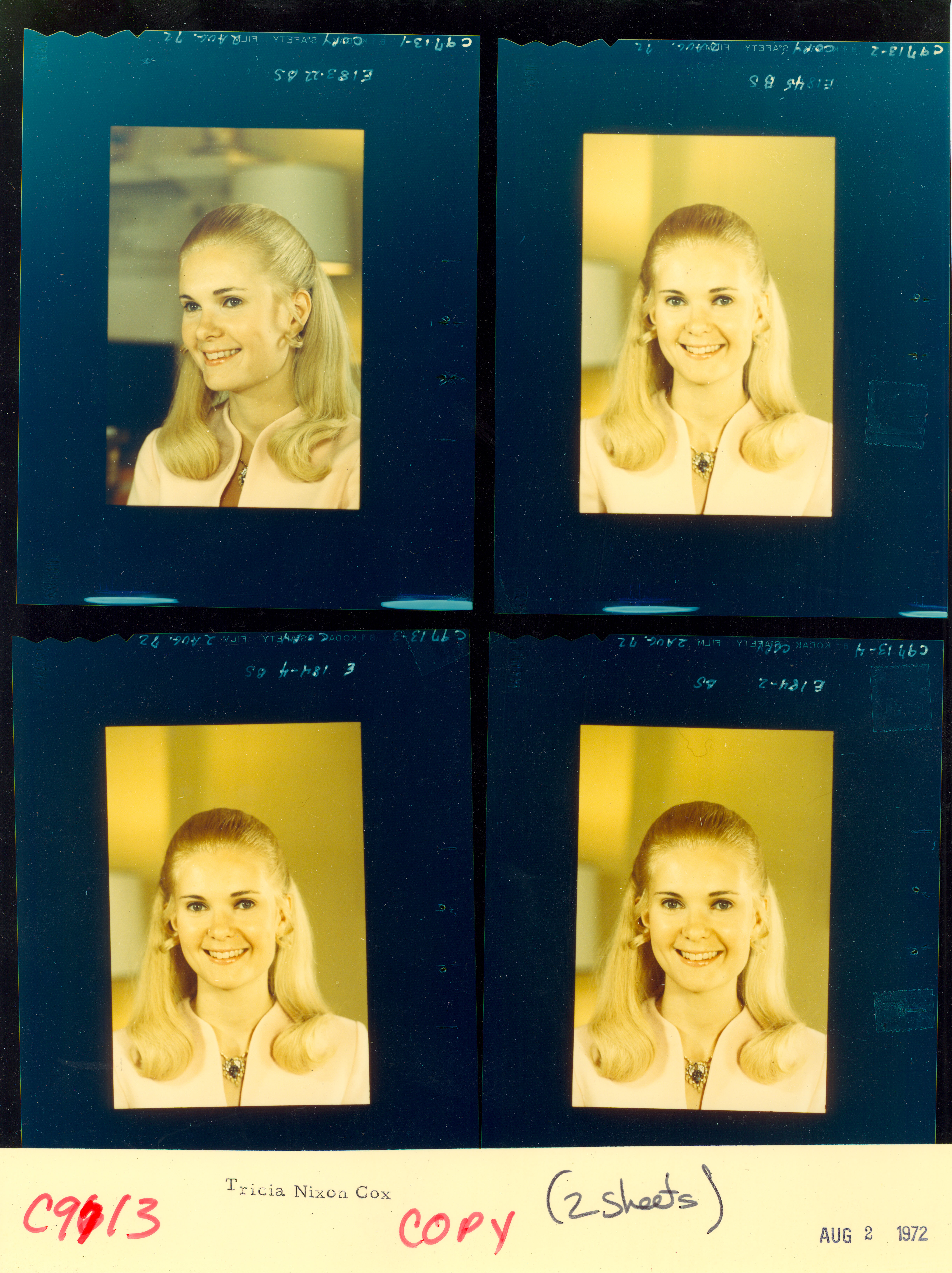
- Frame(s): WHPO-9713-, Closeup formal portraits of Tricia Nixon Cox. E184, and BS written directly on the 4x5 copy negs. - possibly taken by WHPO photographer Byron Schumacher. E0184 is not photo portraits of Tricia. 8/2/1972, Washington, D.C. unknown. Tricia Nixon Cox.
- Frame(s): WHPO-9713-, Closeup formal portraits of Tricia Nixon Cox. E184, and BS written directly on the 4x5 copy negs. - possibly taken by WHPO photographer Byron Schumacher. E0184 is not photo portraits of Tricia. 8/2/1972, Washington, D.C. unknown. Tricia Nixon Cox.
Roll WHPO-9714 Photographer: Knudsen, Robert L. | Color or B&W: B&W
- Frame(s): WHPO-9714-, Mike Flock standing with White House as background. 8/2/1972, Washington, D.C. White House, South Lawn. Mike Flock.
Roll WHPO-9715 Photographer: Grove, Andrew | Color or B&W: B&W
- Frame(s): WHPO-9715-, Members of the League of Latin American Citizens standing on the Diplomatic Entrance steps with Finch and others in the East Garden. 8/2/1972, Washington, D.C. Diplomatic Entrance steps, East Garden, White House. Finch, Conde, league members.
Roll WHPO-9716 Photographer: Knudsen, Robert L. | Color or B&W: B&W
- Frame(s): WHPO-9716-, President Nixon shaking hands and standing with Harvey McFarland, Mayor of Picton, Ontario, Canada. 8/2/1972, Washington, D.C. White House, Oval Office. President Nixon, Harvey McFarland.
Roll WHPO-9717 Photographer: Kightlinger, Jack | Color or B&W: Color
- Frame(s): WHPO-9717-, Pat Nixon hosts an Irish Teachers Tea event for Irish International Teacher Program participants. 8/2/1972, Washington, D.C. Blue Room, Grand Hallway, White House. Pat Nixon, Irish teachers, Irish Teachers Tea.
Roll WHPO-9718 Photographer: Kightlinger, Jack | Color or B&W: Color
- Frame(s): WHPO-9718-, President Nixon standing with two Irish International Teacher Program participants. 8/2/1972, Washington, D.C. Blue Room, White House. Pat Nixon, unidentified men.
Roll WHPO-9719 Photographer: Grove, Andrew | Color or B&W: B&W
- Frame(s): WHPO-9719-, Robert Finch receiving a gift presentation from a Boy Scout and an unidentified adult. 8/2/1972, Washington, D.C. unknown. Robert Finch, Boy Scout, unidentified man.
The White House Communications Agency Sound Recordings Collection contains public statements that took place between 1969 and 1974. Visit the finding aid to learn more.
H - White House Staff Member Recordings
- WHCA-SR-H-633
Press briefing by Frank Carlucci, George Lincoln, and Dr. Arthur Fleming regarding Agnes flood legislation. (8/2/1972, Press Center, White House)
Runtime: 20:00
Keywords: Press conferences, news conferences, interviews, media
Production credits: Audio feed supplied by WHCA; Recorded by GET (initials of WHCA engineer)
Original Format: 1/4-inch reel-to-reel audiotape. Original source type: Original.
The White House Communications Agency Videotape Collection contains “off-the-air” recordings of televised programs produced between 1968 and 1974. Visit the finding aid to learn more.
- WHCA-5624
"A Public Affair: Election '72". Newsm: Secretary of Agriculture Earl Butz.
CBS, WTOP-TV
Runtime: 0:30 - WHCA-5628
Weekly News Summary, Tape II.
ALL NETWORKS
Runtime: 01:37:58
27. Smith/Geer: Vice President poll, McGovern comments on choices. Time Code Start: 66:03. Keywords: public opinions, polls, approval ratings, Gallup poll, Harris poll, Vice Presidents, Presidential elections, campaigns, primaries, candidates, voting. Network: ABC.
28. Reasoner/Shoumacher: Aerospace workers hesitant in backing McGovern. Time Code Start: 68:25. Keywords: NASA, National Aeronautics and Space Administration, space program, astronauts. Network: ABC.
29. Smith/Jarriel: GAO investigation started on Democratic HQ's bugging [Watergate]. Time Code Start: 70:58. Keywords: Watergate, Senate committee hearings, investigations, testimony, testify, cover-ups, break-in, burglary, theft, plumbers, scandals. Network: ABC.
30. Reasoner/Collins: Vietnam war, Quang Tri; Funeral service. Time Code Start: 73:23. Keywords: death memorials, burials, internments, religious services, funerals. Network: ABC.
31. Smith: Commentary on happiness. Time Code Start: 75:28. Keywords: psychology, public opinions. Network: ABC.
32. Chancellor/Jones: Senate withdrawl proposals; film from Vietnam interviewing troops about going home. Time Code Start: 77:10. Keywords: Vietnam War, withdrawals, Senate, debates, military, troops, media, interviews. Network: NBC.
33. Chancellor/Dancy: McGovern's day. Time Code Start: 79:48. Keywords: Presidential elections, campaigns, campaigning, candidates. Network: NBC.
34. Chancellor: Committee to elect Vice President next Tuesday, head of Democratic National Committee Jean Westwood. Time Code Start: 81:51. Keywords: Vice Presidents, nominations, Presidential elections, campaigns, campaigning, candidates, leaders, women, advisors, political parties, Demomcrats. Network: NBC.
35. Chancellor: Dole on upcoming Republican convention. Time Code Start: 83:58. Keywords: political parties, Republicans, GOP, political parties, Republicans, GOP, conventions, Presidential elections, campaigns, candidates, leaders. Network: NBC.
36. Mudd/Morton: Democratic National Committee summoned to Washington to pick Vice President, McGovern, Jean Westwood, Mankiewitz, Mrs. Eagleton. Time Code Start: 85:38. Keywords: Vice Presidents, nominations, Presidential elections, campaigns, campaigning, candidates, leaders, women, advisors, political parties, Demomcrats. Network: CBS.
37. Mudd/Walker/Schieffer: Federal review of campaign funds to elect President Nixon, O'Brien, Ann Dorr. Time Code Start: 89:58. Keywords: Presidents, Presidential elections, campaigns, campaigning, candidates, funding, investigations. Network: CBS.
38. Mudd/Herman: Senate withdrawl proposals from Vietnam. Time Code Start: 93:37. Keywords: Vietnam War. Network: CBS.
39. Sevareid: Position of VP. Time Code Start: 95:05. Keywords: Vice Presidents, Presidential elections, campaigns, campaigning, candidates. Network: CBS.
Context (External Sources)
The Vanderbilt Television News Archive is the world's most extensive and complete archive of television news. They have been recording, preserving and providing access to television news broadcasts of the national networks since August 5, 1968.
Wikipedia is a free encyclopedia that anyone can edit.