
Introduction
This almanac page for Wednesday, September 8, 1971, pulls together various records created by the federal government and links to additional resources which can provide context about the events of the day.
Previous Date: Tuesday, September 7, 1971
Next Date: Thursday, September 9, 1971
Schedule and Public Documents
The Daily Diary files represent a consolidated record of the President's activities. Visit the finding aid to learn more.
The President's day began at The White House - Washington, D. C.
The Weekly Compilation of Presidential Documents made available transcripts of the President's news conferences; messages to Congress; public speeches, remarks, and statements; and other Presidential materials released by the White House.
Digitized versions can be found at HathiTrust.
The Federal Register is the official daily publication for rules, proposed rules, and notices of federal agencies and organizations, as well as executive orders and other Presidential documents.
The Congressional Record is the official daily record of the debates and proceedings of the U.S. Congress.
Archival Holdings
Any selection of archival documents will necessarily be partial. You should use the documents and folders identified below as a starting place, but consult the linked collection finding aids and folder title lists and the collections themselves for context. Many documents to be found this way do not lend themselves to association with specific dates, but are essential to a complete understanding of the material.
Selective document listing
President's Office Files
The President's Office Files consists of materials drawn together by the Special Files Unit from several administrative subdivisions within the White House Office. It is the handwriting and sensitive papers sent to the Staff Secretary that now comprise much of the President's Office Files. Visit the finding aid to learn more.
- News Summaries, Unmarked News Summaries, Box 46, News Summaries - September 1971 [2 of 9] [Note: Due to the way News Summary products were compiled, you should also consult nearby days for potentially relevant materials.]
- Digest of Recent News Comment, September 8, 1971
- News Summary, Wednesday, September 8, 1971, (Tuesday newscasts, wires and magazines)
- President's Daily Schedule, Box 102, [President's Daily Schedule, Sept.-Dec. 1971] [1 of 3]
- The President's Schedule, Wednesday - September 8, 1971
The H. R. Haldeman Diaries consists of seven handwritten diaries, 36 dictated diaries recorded as sound recordings, and two handwritten audio cassette tape subject logs. The diaries and logs reflect H. R. Haldeman’s candid personal record and reflections on events, issues, and people encountered during his service in the Nixon White House. As administrative assistant to the President and Chief of Staff, Haldeman attended and participated in public events and private meetings covering the entire scope of issues in which the Nixon White House engaged in during the years 1969-1973. Visit the finding aid to learn more.
- Transcript of diary entry (PDF)
Wednesday, September 8.
President had the day clear to work on the Congressional speech for tomorrow, had me over at 10:00 this morning during a break on speech drafts to go over schedule plans in detail, particularly the Northwest trip—the question of when to go to Montana, Portland, Seattle, and so on. But he wants to try to work all of them in on the way to Alaska, and he's agreed not to try to get into California at that time, but thinks we need to really work on doing some good planning for California, and to get in there. Also, he's anxious to get started on the state committee dinners with the political types.
That got him into a general PR analysis. He wants to be sure I force all our staff to read the new media book when it comes out. Then he got to going back over what we've done this year—China, the economy, the wedding, etcetera--and we should be doing much better than we are in the polls as a result of that. He feels the problem is that-- is that we try to use the economy and the war as an explanation, and that's not the answer. The real problem is media erosion day-byday. On the plus side is our warm reception in the country, but now we need to get our own orators out. He raises the question, now what do we do about it? How do we get this turned around?
We got into a discussion of Shultz's plan to set up a series of meetings for consultation following the Congressional address--one with labor, one with business, one with agriculture, and one with Congress--allowing an hour and a half for each of the meetings. The President agreed to do them, on the basis that they'd just be listening sessions for him, and he'll include the fact that he's doing them in the Congressional speech as part of his pitch.
He raised the question with me of his concern on Henry's delusions of grandeur as a peacemaker, in that he keeps hitting the President on the idea of his going to Hanoi secretly to try and settle Vietnam. President doesn't want him to do it, first of all, because he doesn't think it'll work; and secondly, because he doesn't think it can be kept a secret. He's concerned that it would be a disaster to do it and fail. The risk is too great, and also there's no use meeting with Pham Van Dong anyway, the President doesn't feel. He wants me to have Haig tout Henry off of this. He feels Henry doesn't realize that the Communist method of working is to keep talking and to screw you behind your back while they're doing it. To them, talking is a tactic to win, not to work out an agreement; whereas, Henry keeps trying to work out an agreement with them.
He also said he-- the troop announcement in November, he's not going to do on TV. He'll wait until December 21 and do the final announcement at that time, and do it on television. And he's moved the office press conference from October 7 to the 12th, so he can tie that in with the Russian announcement.
He wants to be sure that Colson and his crew blast Muskie on his busing statement. We should hit him not for avoiding taking a position. He doesn't want to leave them on the "I don't know where he stands" hook. He wants to hit him for holding the wrong position, which is, that he is for busing. Figures Dent should get the busing-- the anti-busing people to take him on on this.
End of September 8. - Original audio recording (MP3)
The National Archives Catalog is the online portal to the records held at the National Archives, and information about those records. It is the main way of describing our holdings and also provides access to electronic records and digitized versions of our holdings.
The Catalog searches across multiple National Archives resources at once, including archival descriptions, digitized and electronic records, authority records, and web pages from Archives.gov and the Presidential Libraries. The Catalog also allows users to contribute to digitized historical records through tagging and transcription.
Nixon Library Holdings
All National Archives Units
National Security Documents
The President's Daily Brief is the primary vehicle for summarizing the day-to-day sensitive intelligence and analysis, as well as late-breaking reports, for the White House on current and future national security issues. Read "The President's Daily Brief: Delivering Intelligence to Nixon and Ford" to learn more.
The Foreign Relations of the United States series presents the official documentary historical record of major U.S. foreign policy decisions and significant diplomatic activity. Visit the State Department website for more information.
Vol. V, United Nations, 1969-1972
Appointment of UN Development Program Administrator
259. Telegram From the Mission to the United Nations to the Department of State, New York, September 8, 1971, 1246Z
Source: National Archives, Nixon Presidential Materials, NSC Files, Box 301, Agency Files, USUN, Vol. VII. Confidential; Exdis.
Chinese Representation in the United Nations
404. Telegram From the Department of State to the Embassy in the Republic of China, Washington, September 8, 1971, 0048Z
Source: National Archives, RG 59, Central Files 1970–73, UN 6 CHICOM. Secret; Immediate; Exdis. Drafted by Herz and Feldman; cleared by Pedersen, Assistant Secretaries Green and De Palma, Kissinger, and Curran; and approved by Secretary Rogers. Repeated to USUN, Tokyo, Canberra, Wellington, and Brussels.
405. Telegram From the Embassy in the Republic of China to the Department of State, Taipei, September 8, 1971, 1031Z
Source: National Archives, RG 59, Central Files 1970–73, UN 6 CHICOM. Secret; Immediate; Exdis. Repeated to Brussels, Canberra, Tokyo, USUN, and Wellington.
Vol. XI, South Asia Crisis, 1971
South Asia Crisis, 1971
144. Minutes of Washington Special Actions Group Meeting, Washington, September 8, 1971, 3:07-4:25 p.m.
Source: National Archives, Nixon Presidential Materials, NSC Files, NSC Institutional Files (H-Files), Box H–115, WSAG Minutes, Originals, 1971. Secret. No drafting information appears on the source text. The meeting was held in the White House Situation Room. Another record of the meeting was prepared on September 13 by James Noyes (OASD/ISA). (Washington National Records Center, OSD Files, FRC 330 76 0197, Box 74, Pakistan 381 (Jan–Nov) 1971)
Vol. XXI, Chile, 1969-1973
Cool and Correct: The U.S. Response to the Allende Administration, November 5, 1970-December 31, 1972
255. Memorandum From Arnold Nachmanoff of the National Security Council Staff to the President’s Assistant for National Security Affairs (Kissinger), Washington, September 8, 1971
Source: National Archives, Nixon Presidential Materials, NSC Files, Box 775, Country Files, Latin America, Chile, Vol. V. Secret; Sensitive; Eyes Only; Outside System. Sent for action.
256. Memorandum From Arnold Nachmanoff of the National Security Council Staff to the President’s Assistant for National Security Affairs (Kissinger), Washington, September 8, 1971
Source: National Archives, Nixon Presidential Materials, NSC Files, NSC Institutional Files (H-Files), Box H–112, SRG Meetings, Chile, 9/9/71. Secret; Nodis. Sent for information.
Vol. XXIX, Eastern Mediterranean, 1969-1972
Greece
323. Memorandum From Harold Saunders of the National Security Council Staff to the Presidentʼs Assistant for National Security Affairs (Kissinger), Washington, September 8, 1971
Source: National Archives, Nixon Presidential Materials, NSC Files, Box 594, Country Files—Middle East, Greece, Vol. II 1 Nov 1970–31 Dec 1971. Secret; Sensitive. Sent for action. A notation by Haig on the memorandum reads: “Hal–OBE. HAK has held.”
Cyprus
380. Minutes of the Senior Review Group Meeting, Washington, September 8, 1971
Source: National Archives, Nixon Presidential Materials, NSC Files, NSC Institutional Files (H-Files), Box H-112, SRG Minutes, Originals, 1971. Secret. No drafting information appears on the minutes. The meeting took place in the White House Situation Room from 4:27–4:37 p.m. Jeanne Davis sent the minutes under a covering memorandum to Kissinger on September 10 and also sent copies to Kennedy and Saunders. Kissinger initialed the transmittal memorandum.
Vol. XL, Germany and Berlin, 1969-1972
Germany and Berlin, 1969-1972
329. Message From the Ambassador to Germany (Rush) to the President’s Assistant for National Security Affairs (Kissinger), Bonn, September 8, 1971
Source: National Archives, Nixon Presidential Materials, NSC Files, Kissinger Office Files, Box 59, Country Files, Europe, Ambassador Rush, Berlin, Vol. 2. Top Secret; Sensitive; Exclusively Eyes Only. The message was sent through the special Navy channel in Frankfurt. No time of transmission is on the message; a handwritten note indicates that it was received in Washington at 1830Z.
Vol. E-16, Documents on Chile, 1969-1973
Cool and Correct: The U.S. Response to the Allende Administration, November 5, 1970-December 31, 1972
82. Memorandum for the 40 Committee, Washington, September 8, 1971
Summary: This memorandum outlined the pressing situation facing the “bulwark against the regime of President Salvador Allende,” the newspaper El Mercurio, and requested funds to support the paper.
Source: Department of State, Bureau of Intelligence and Research, INR/IL Historical Files, Box 1, Chile, 40 Committee Action After September 1970. Secret; Sensitive; Eyes Only. A handwritten notation on the first page reads, “On 9 Sept 1971 the 40 Committee referred the proposal to HA. [HA approved 700,000 on 15 Sept. 71.] See 9 Sept. minute.” The memorandum for the record of the September 9 40 Committee meeting is printed in Foreign Relations, 1969–1976, vol. XXI, Chile, 1969–1973, Document 258.
The Kissinger telephone conversation transcripts consist of approximately 20,000 pages of transcripts of Kissinger’s telephone conversations during his tenure as Assistant to the President for National Security Affairs (1969-1974) and Secretary of State (1973-1974) during the administration of President Richard Nixon. Visit the finding aid for more information.
Digitized versions can be found in the National Archives Catalog.
Audiovisual Holdings
The White House Tapes are sound recordings of President Richard Nixon's telephone conversations and of meetings held in the Oval Office and the Cabinet Room in the White House, the President's office in the Old Executive Office Building (OEOB), the Lincoln Sitting Room in the residence section of the White House, and several locations at the Presidential retreat at Camp David, Maryland. These recordings document many of the major events and decisions of the Nixon Administration from February 16, 1971 to July 18, 1973. Visit the White House Tapes finding aid to learn about the taping system's operation and archival processing.
Old Executive Office Building
- 274-26; Unknown between 9:40 a.m. & 10:06 a.m.; Nixon, Richard M. (President); Haldeman, H. R. ("Bob")
- 274-27; Unknown between 9:40 a.m. & 10:06 a.m.; Nixon, Richard M. (President); Sanchez, Manolo
- 274-28; 10:06 a.m. - 11:40 a.m.; Nixon, Richard M. (President); Haldeman, H. R. ("Bob"); [Unknown person(s)]
- 274-29; Unknown between 11:40 a.m. & 1:27 p.m.; Nixon, Richard M. (President); Sanchez, Manolo
- 274-30; Unknown between 11:40 a.m. & 1:27 p.m.; Nixon, Richard M. (President); [Unknown person(s)]
- 274-31; Unknown between 11:40 a.m. & 1:27 p.m.; Nixon, Richard M. (President); White House operator
- 274-32; 1:27 p.m. - 1:28 p.m.; Nixon, Richard M. (President); Price, Raymond K., Jr.
- 274-33; Unknown between 1:28 p.m. & 1:34 p.m.; Nixon, Richard M. (President); White House operator
- 274-34; Unknown between 1:34 p.m. & 3:03 p.m.; Nixon, Richard M. (President); Price, Raymond K., Jr.; Sanchez, Manolo; Ehrlichman, John D.; [Unknown person(s)]; Bull, Stephen B.; Butterfield, Alexander P.
- 274-35; Unknown between 2:24 p.m. & 3:03 p.m.; Nixon, Richard M. (President); Sanchez, Manolo
- 274-36; Unknown between 2:24 p.m. & 3:03 p.m.; Nixon, Richard M. (President); Ziegler, Ronald L.
- 274-37; Unknown between 2:24 p.m. & 3:03 p.m.; Nixon, Richard M. (President); White House operator
- 274-38; 3:03 p.m. - 3:04 p.m.; Nixon, Richard M. (President); Price, Raymond K., Jr.
- 274-39; Unknown between 3:04 p.m. & 3:06 p.m.; Nixon, Richard M. (President); White House operator
- 274-40; 3:06 p.m. - 3:08 p.m.; Nixon, Richard M. (President); Price, Raymond K., Jr.
- 274-41; Unknown between 3:08 p.m. & 3:26 p.m.; Nixon, Richard M. (President); [Unknown person(s)]
- 274-42; Unknown between 3:08 p.m. & 3:26 p.m.; Nixon, Richard M. (President); Ehrlichman, John D.
- 274-43; Unknown between 3:08 p.m. & 3:26 p.m.; Nixon, Richard M. (President); Woods, Rose Mary
- 274-44; 3:26 p.m. - 5:10 p.m.; Nixon, Richard M. (President); Ehrlichman, John D.; [Unknown person(s)]
- 274-45; Unknown between 5:10 p.m. & 5:35 p.m.; Nixon, Richard M. (President); Sanchez, Manolo
- 274-46; 5:35 p.m. - 6:05 p.m.; Nixon, Richard M. (President); Price, Raymond K., Jr.; Butterfield, Alexander P.; Yates, Nellie L.; [Unknown person(s)]
- 274-47; 6:05 p.m. - 6:06 p.m.; Nixon, Richard M. (President); Sanchez, Manolo
White House Telephone
- 8-46; Unknown between 9:40 a.m. & 1:27 p.m.; Price, Raymond K., Jr.; White House operator
- 8-47; Unknown between 9:40 a.m. & 1:27 p.m.; Nixon, Richard M. (President); White House operator
- 8-48; 1:27 p.m. - 1:28 p.m.; Nixon, Richard M. (President); Price, Raymond K., Jr.
- 8-49; 1:46 p.m. - 1:47 p.m.; Nixon, Richard M. (President); Ehrlichman, John D.
- 8-50; Unknown between 1:47 p.m. & 3:03 p.m.; Nixon, Richard M. (President); White House operator
- 8-51; 3:03 p.m. - 3:04 p.m.; Nixon, Richard M. (President); Price, Raymond K., Jr.
- 8-52; 3:05 p.m. - 3:05 p.m.; Nixon, Richard M. (President); White House operator
- 8-53; 3:06 p.m. - 3:08 p.m.; Nixon, Richard M. (President); Price, Raymond K., Jr.
- 8-54; Unknown between 3:08 p.m. & 7:40 p.m.; Price, Raymond K., Jr.; White House operator
- 8-55; Unknown between 3:08 p.m. & 7:40 p.m.; Price, Raymond K., Jr.; White House operator; Butterfield, Alexander P.
- 8-56; Unknown between 3:08 p.m. & 7:40 p.m.; Nixon, Richard M. (President); White House operator
- 8-57; 7:40 p.m. - 7:41 p.m.; Nixon, Richard M. (President); Yates, Nellie L.
- 8-58; 8:33 p.m. - 8:34 p.m.; Nixon, Richard M. (President); Butterfield, Alexander P.
- 8-59; 11:01 p.m. - 11:02 p.m.; Nixon, Richard M. (President); Butterfield, Alexander P.
The White House Photo Office collection consists of photographic coverage of President Richard Nixon meeting with prominent social, political, and cultural personalities; speaking engagements and news conferences of the President and various high-ranking members of the White House staff and Cabinet; Presidential domestic and foreign travel, including Presidential vacations; social events and entertainment involving the First Family, including entertainers present; official portraits of the President, First Family, and high-ranking members of the Nixon administration; the 1969 and 1973 Inaugurals; the President’s 1972 Presidential election campaign appearances (including speeches) and other official activities of the White House staff and the President’s Cabinet from January 20, 1969 until August 9, 1974 at the White House and the Old Executive Office Building; other locations in Washington, DC, such as The Mall; and the Presidential retreats in Camp David, Maryland, Key Biscayne, Florida, and San Clemente, California. Visit the finding aid to learn more.
Roll WHPO-7203 Photographer: Schumaker, Byron | Color or B&W: B&W
- Frame(s): WHPO-7203-02A-11A, Herb Klein sitting with a summer intern. 9/8/1971, Washington, D.C. unknown. Herb Klein, unidentified young man.
Roll WHPO-7205 Photographer: Kightlinger, Jack | Color or B&W: B&W
- Frame(s): WHPO-7205-02A-28A, Portrait of George Bell. 9/8/1971, Washington, D.C. unknown. George Bell.
Roll WHPO-7206 Photographer: Knudsen, Robert L. | Color or B&W: B&W
- Frame(s): WHPO-7206-03A-09A, Governor Evans, his wife, and their two sons poisng in front of the White House. 9/8/1971, Washington, D.C. White House, South Lawn. Governor Evans, Mrs. Evans, Evans sons.
Roll WHPO-7207 Photographer: Knudsen, Robert L. | Color or B&W: Color
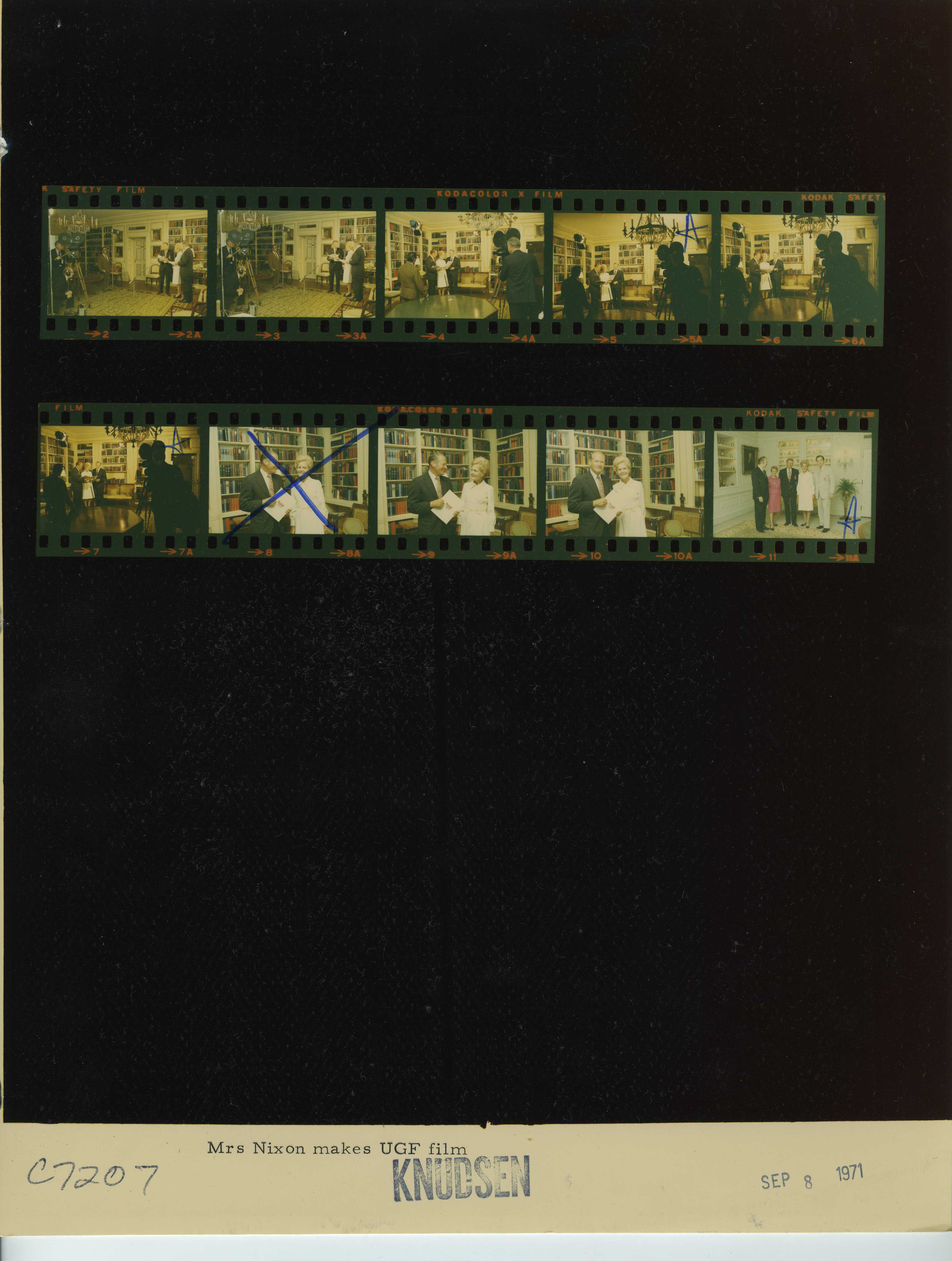
- Frame(s): WHPO-7207-02-07, Pat Nixon preparing to make a United Givers Fund film. 9/8/1971, Washington, D.C. White House, Library. Pat Nixon, unidentified men and women, film crew.
- Frame(s): WHPO-7207-08-11, Pat Nixon standing with unidentified persons. 9/8/1971, Washington, D.C. White House, Library. Pat Nixon, unidentified men and women, film crew.
The White House Communications Agency Videotape Collection contains “off-the-air” recordings of televised programs produced between 1968 and 1974. Visit the finding aid to learn more.
- WHCA-4630
Opening of the John F. Kennedy Center for the Performing Arts.
NBC
Runtime: 00:30:22 - WHCA-4631
"If You Turn On". commentary on drug use and abuse Richard Nixon, Knights of Columbus officials.
Undetermined
Runtime: 00:58:52 - WHCA-4632
"The David Frost Show" with guest host Pearl Bailey. Harriet Van Horn (American newspaper columnist and film/television critic).
Group W Productions
Runtime: 01:31:59 - WHCA-4633
"NBC Quarterly Report".
Metromedia
Runtime: 00:59:27 - WHCA-4634
CBS, NBC Coverage: Opening of the John F. Kennedy Center for the Performing Arts.
WGN
Runtime: 01:02:34 - WHCA-4635
"The Dick Cavett Show" :Carl Reiner, Ralph Nader, G. Steinem, S. Vaughan. News: economist Pierre A. Rinfret.
WTOP-TV, WETA Public Affairs
Runtime: 01:32:34
Context (External Sources)
The Vanderbilt Television News Archive is the world's most extensive and complete archive of television news. They have been recording, preserving and providing access to television news broadcasts of the national networks since August 5, 1968.
Wikipedia is a free encyclopedia that anyone can edit.